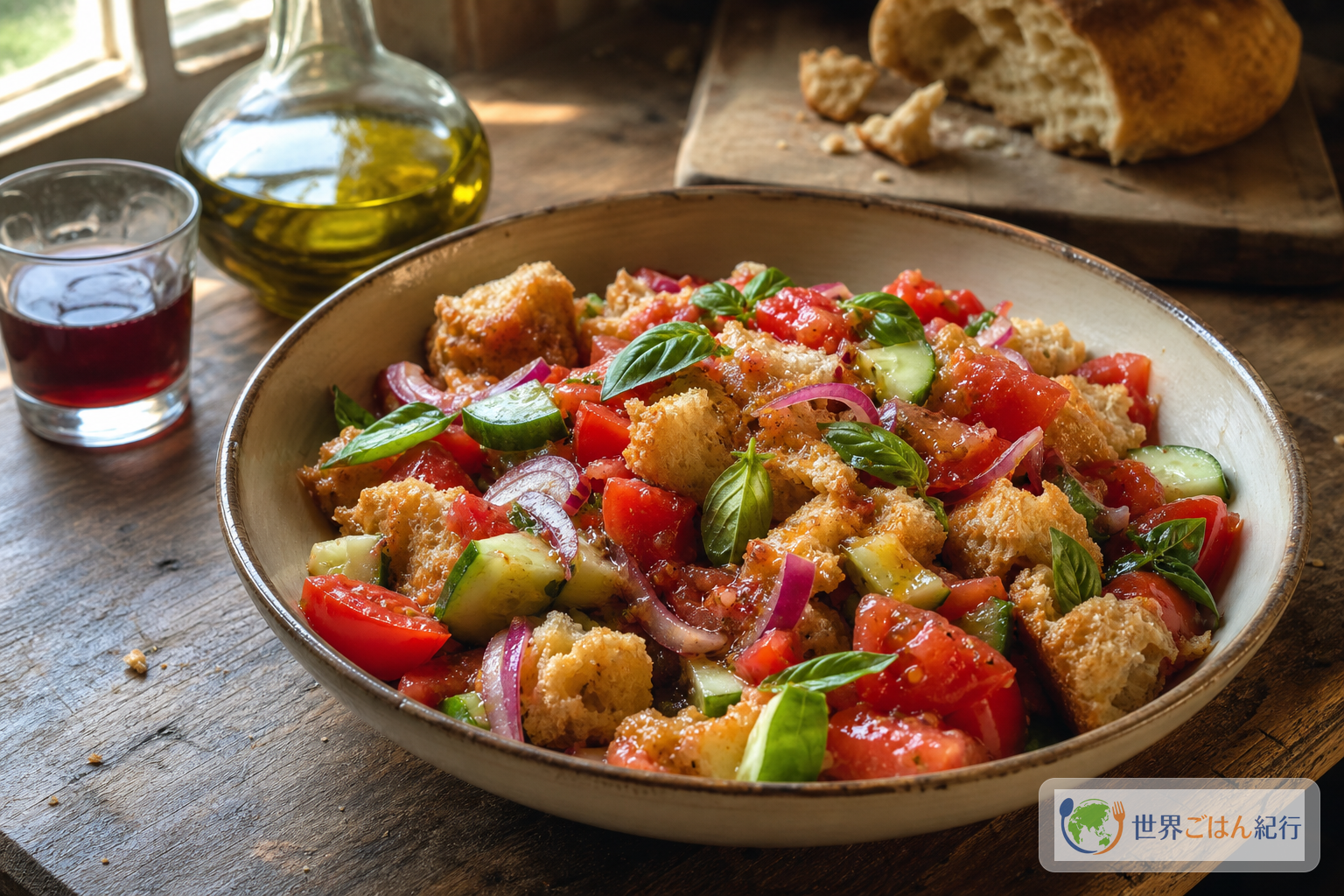
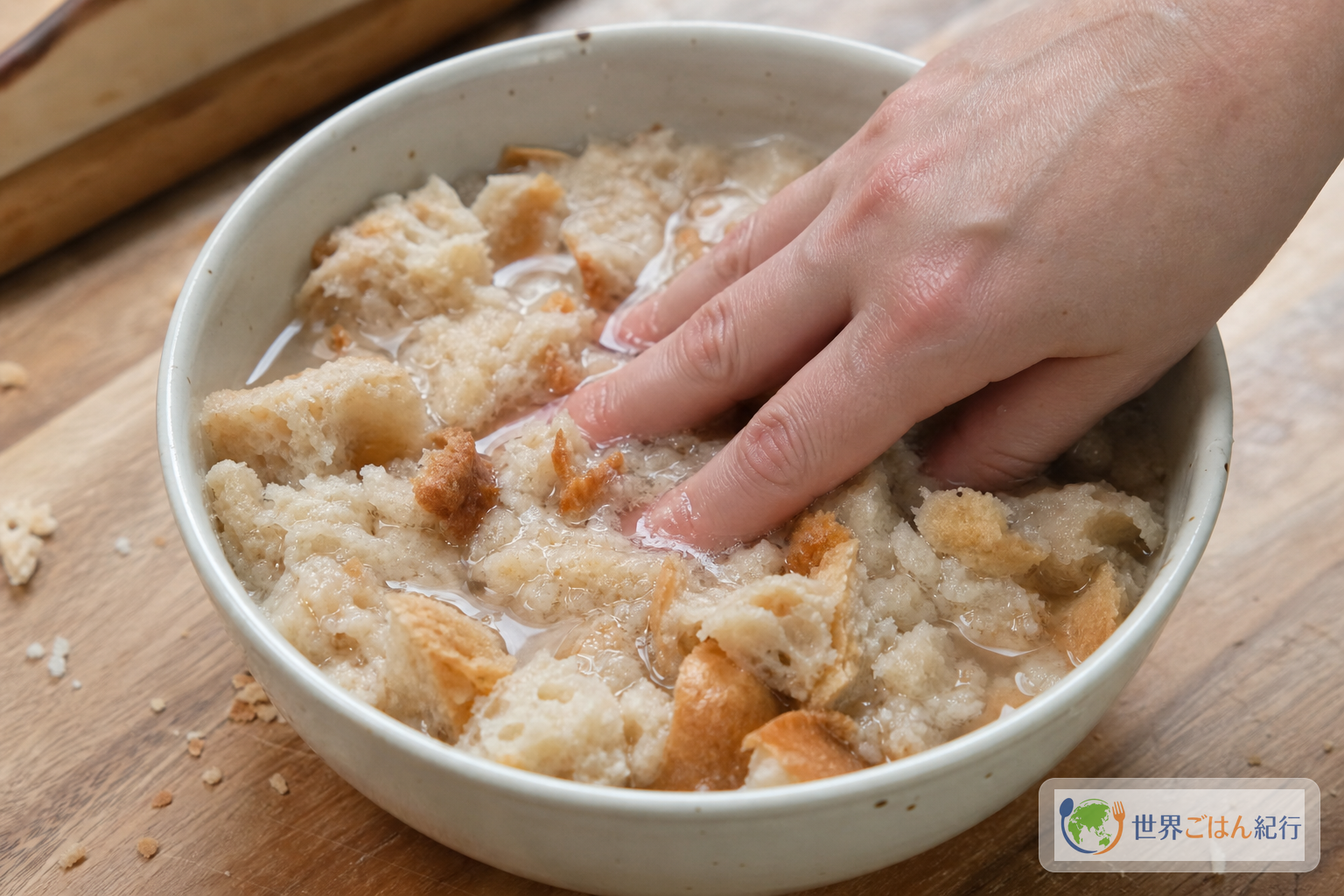
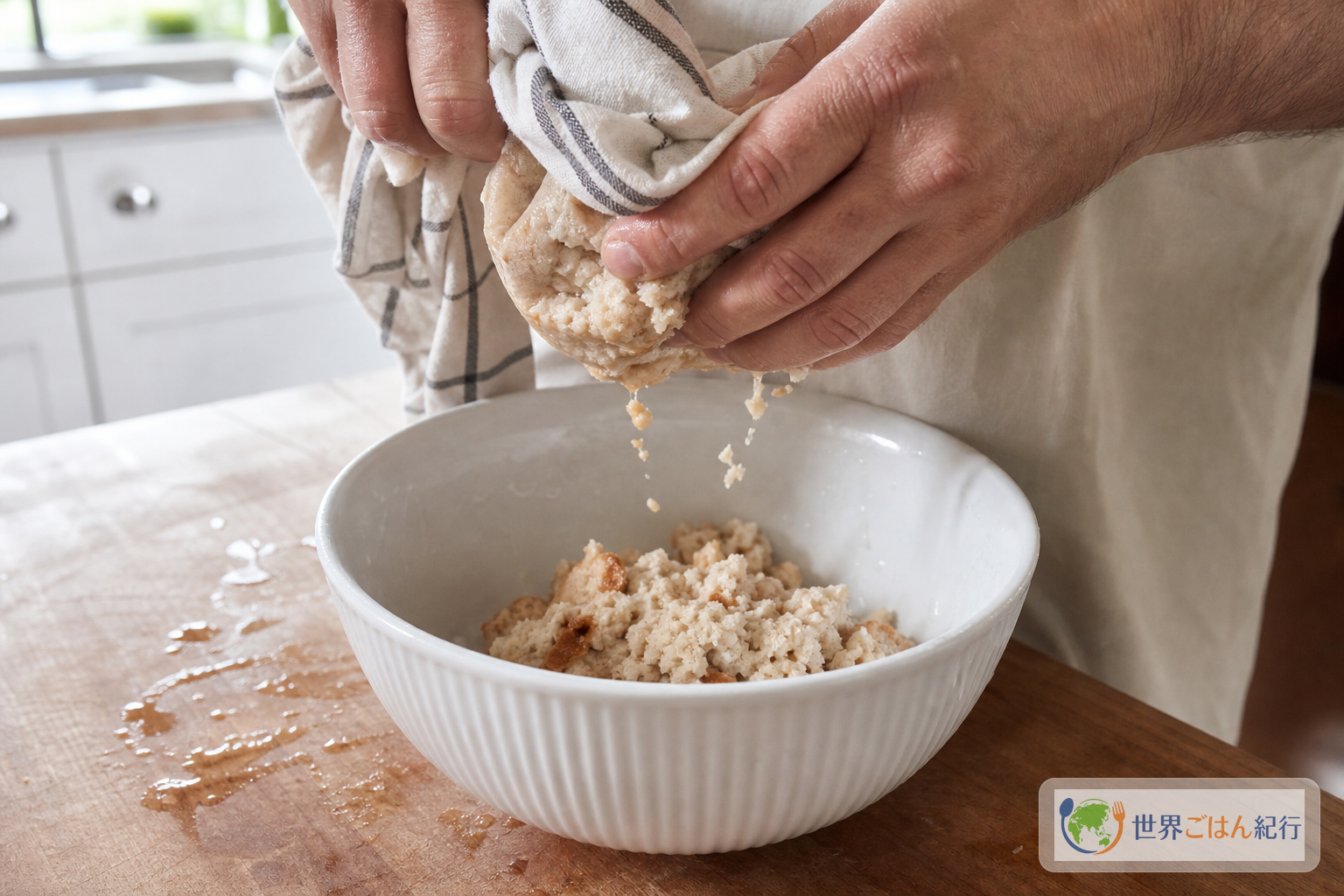
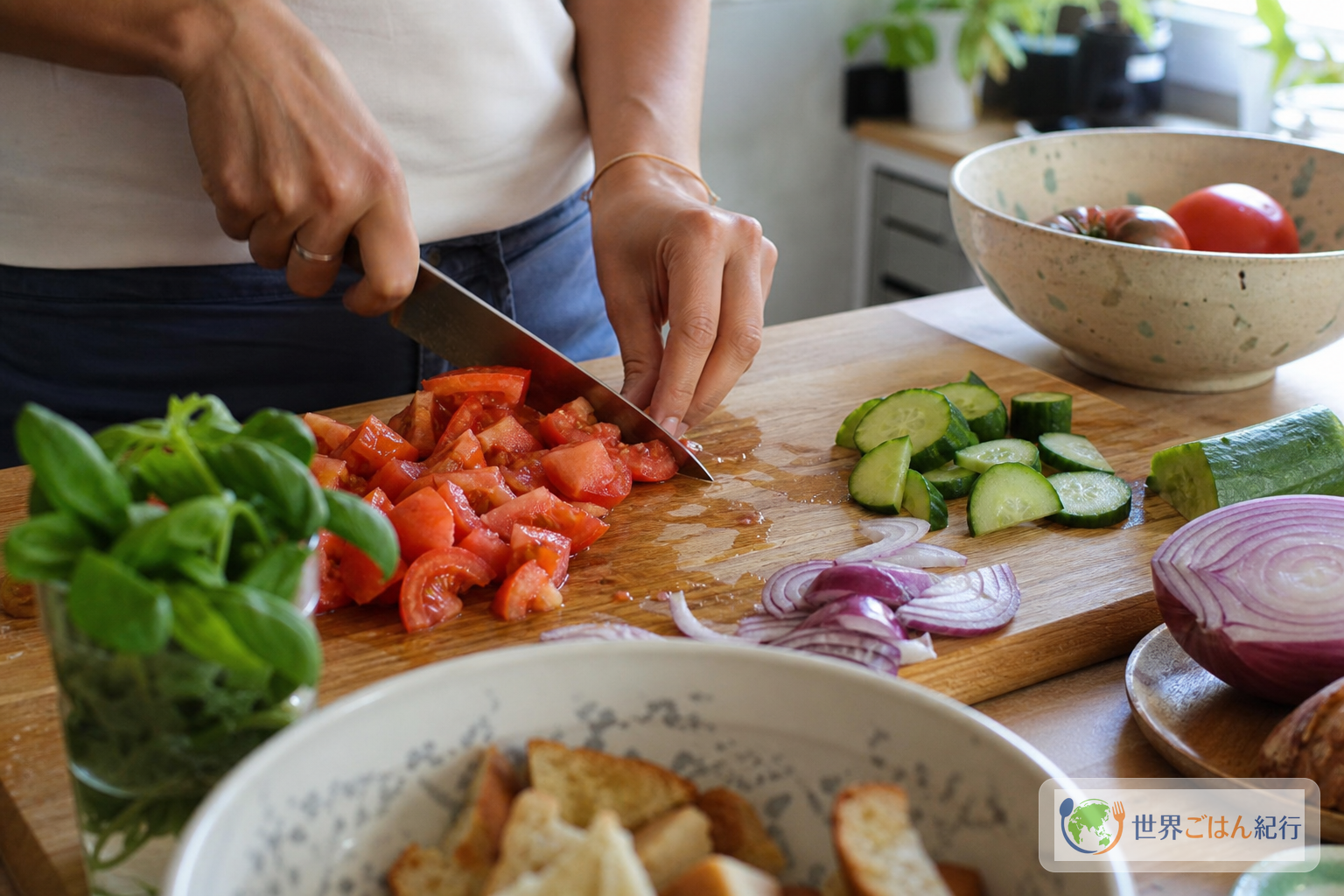
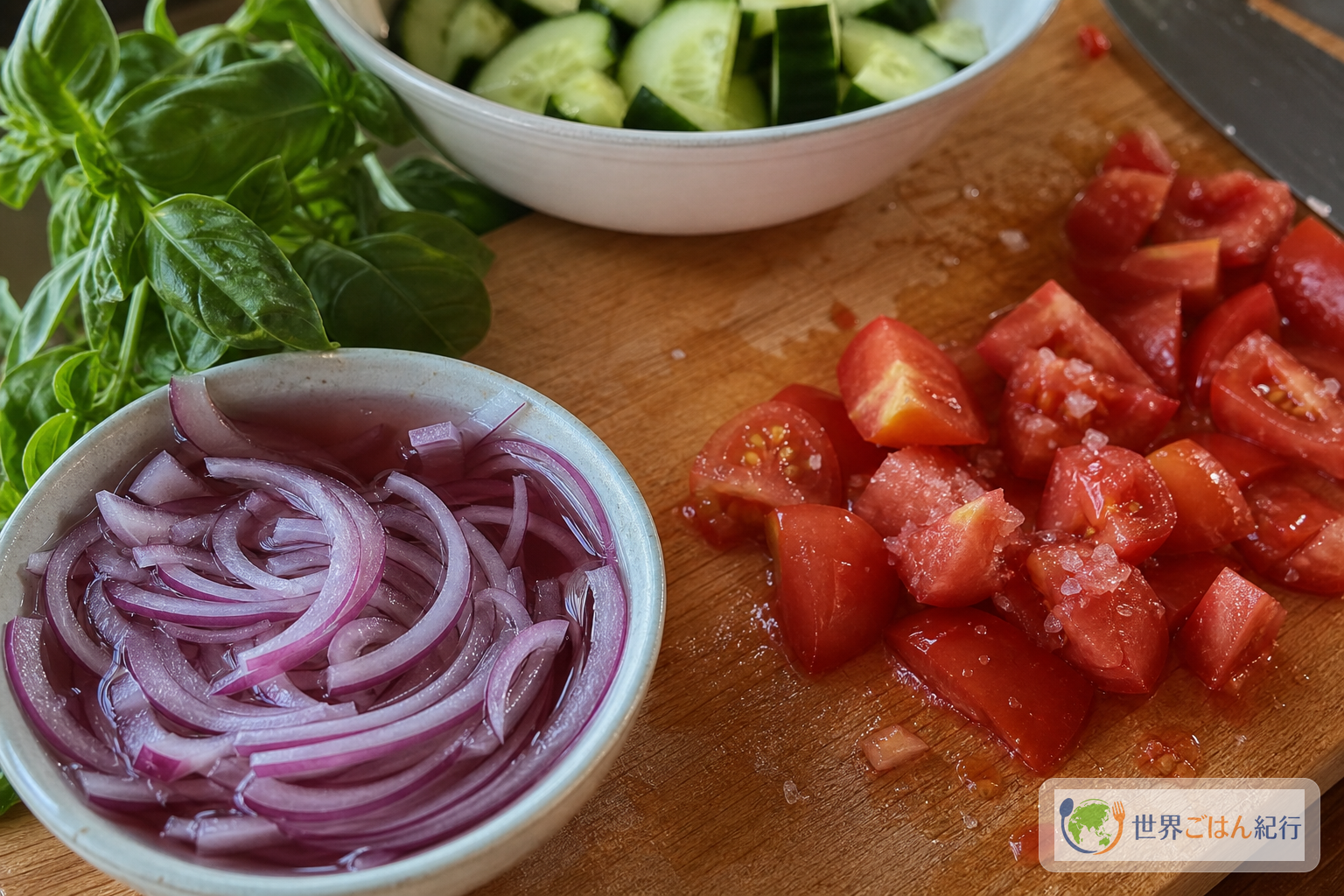
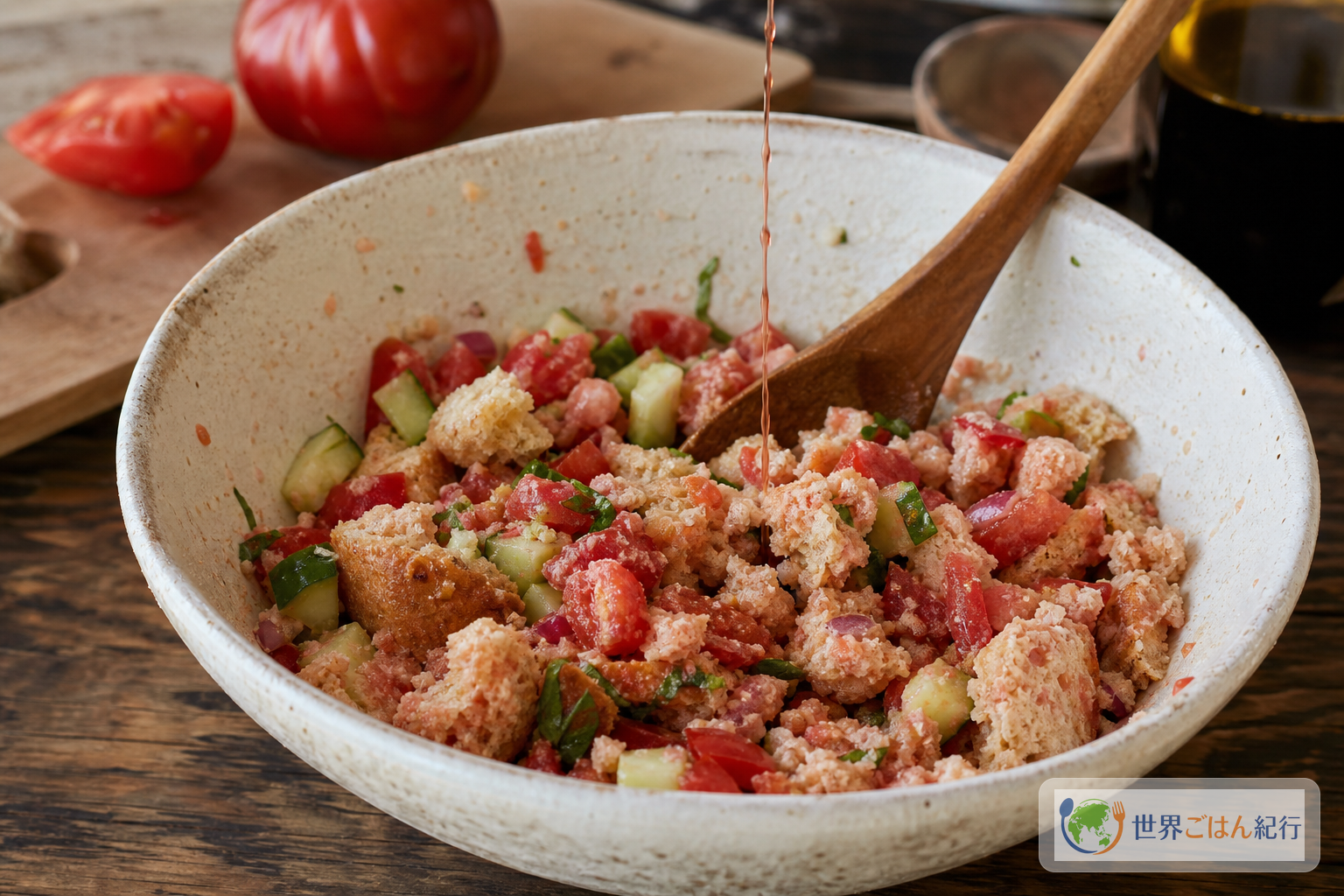
Wrap stale bread soaked in cold water in both hands and squeeze, and cloudy white water runs between your fingers. On the cutting board, freshly cut ripe tomatoes spread their red juice, and beside them basil waits to be torn by hand. In a Tuscan summer kitchen, this is a typical scene. Panzanella is a dish of stale bread and summer vegetables tossed with vinegar and olive oil, and the stale bread is the star.
A summer field meal that stayed in the family bowl
Panzanella is a summer dish from the Tuscan countryside, made from seasonal vegetables and bread left over and not eaten. According to a regional introduction on Cortonaweb, because it can be made without cooking, it could be eaten in the fields by people who spent the whole day away from home at farm work. That origin as a summer dish that needs no fire is a story about field work long ago. It does not mean it is fine to leave it at room temperature in a kitchen today. The basics are stale bread, ripe tomatoes, and basil. Some households add cucumber, onion, or tuna, so what is in the bowl differs a little from home to home.
Tuscany has a bread called Pane Toscano DOP whose dough contains no salt. Unsalted Tuscan bread sits at the base of the local table, and dishes that use up stale bread are plentiful. Besides panzanella, ribollita, pappa al pomodoro, and fettunta are named. Visit Tuscany says panzanella was already known in the 16th century. It cannot be said, though, that it had the same tomato-based recipe as today even then. Ordinary baguettes and similar breads contain salt, so you need to go easy on extra salt. This point comes up again in the ingredients below.
The Italian dictionary Treccani says the etymology of panzanella is uncertain. It describes the dish as pieces or slices of bread moistened with water and eaten with oil, vinegar, salt, and herbs, and it also mentions a version using toasted bread. There is nothing to support stating flatly that the word combines pane and zanella.
In neighboring Umbria, even the herbs differ
Recipes introduced for Tuscany list stale bread, tomatoes, red onion, cucumber, basil, red wine vinegar, and olive oil. The official tourism material of neighboring Umbria presents it as a summer dish that rehydrates unsalted stale bread in water. Today tomatoes and cucumbers go in, but the simple old combination was said to be onion and mentuccia. Mentuccia is left as the name of the herb in the source. It cannot be said to be the same as peppermint. Summer vegetables that differ from home to home, and herbs, give each place its own expression.
Even within Tuscany, a regional recipe from Cortona includes two stalks of celery. That is not a required ingredient for all of Tuscany, however. Tuna, hard-boiled egg, and olives are likewise only options you may add. There is no need to pack everything into the basic mix. If you are making it for the first time, begin by tasting just fresh tomato, bread, and basil. You will then see well how important it is to keep the herbs and the texture of the bread.
Setting the old Umbrian combination of onion and mentuccia next to the Tuscan version with basil shows that regional differences in herbs are the breadth of home cooking. Versions using something other than basil cannot be dismissed across the board as fake.
Ingredients (serves 4)
This is a home-adjusted mix built around 220 g of bread and 450 g of ripe tomatoes for 4 servings. Bread low in sugar and fat, such as baguette, country loaf, or rustic loaf, suits it. For softer bread, shorten the soaking time. No heat is used in the cooking. In order, prep takes 45 minutes and chilling 30 minutes, 75 minutes in total. Working in parallel can make it shorter. Be sure to keep the juice of the ripe tomatoes that comes out when you cut them. That juice later carries flavor into the bread.
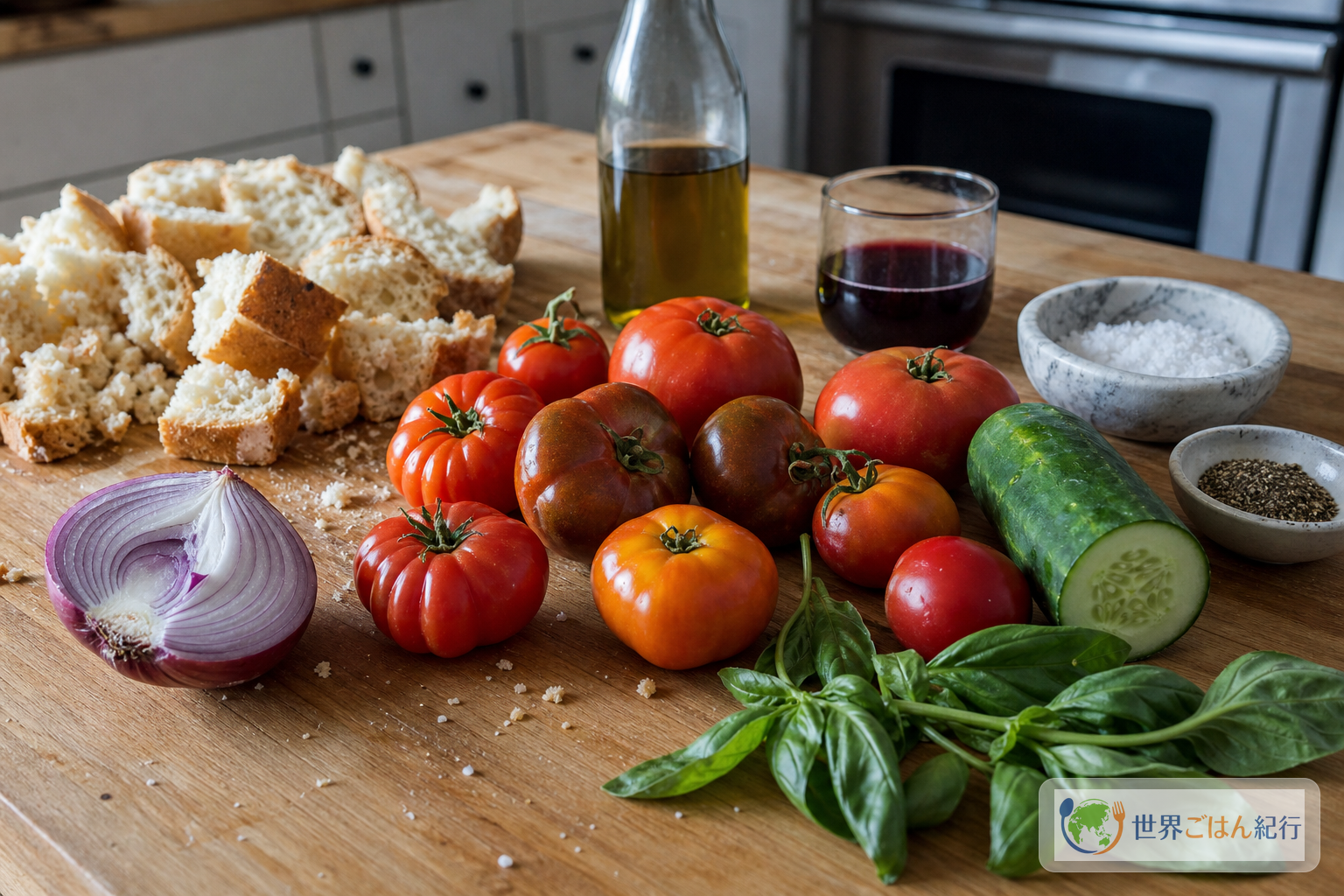
Bread is often salted, and capers are salty too. Apart from the 3 g sprinkled on the tomatoes, add salt in small amounts, and you do not need to use up the full 7 g. Add salt as you taste.
Wash the vegetables and basil under running water before cutting and dry them with a clean cloth or paper towel. Do not use spoiled vegetables. Keep this separate from tools used for raw meat or fish, and keep both hands and tools clean. Bread contains wheat. If you use sandwich loaf or similar, also check the labeling for milk, egg, and other allergens.
Choosing bread and vinegar
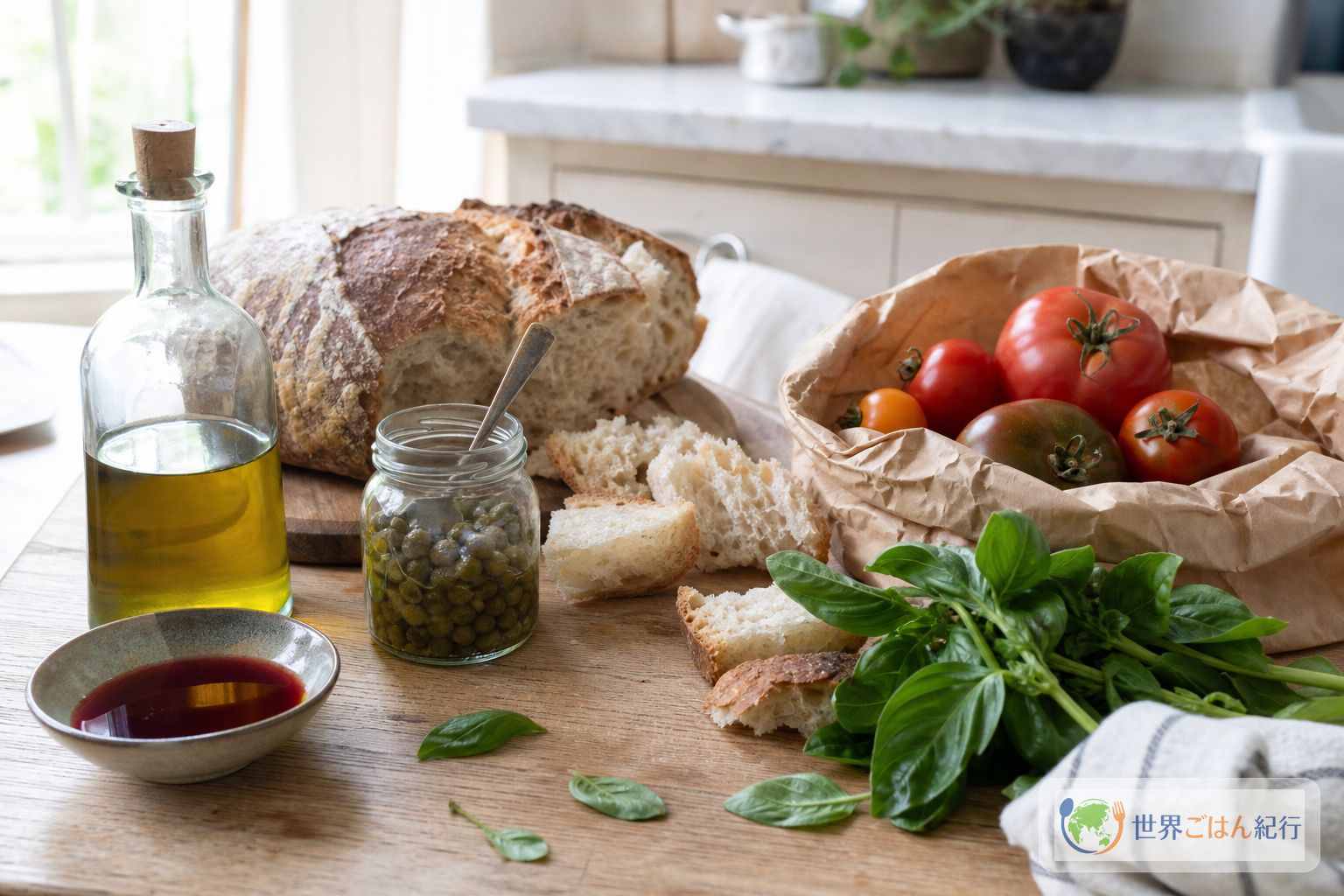
More than the brand of bread, what matters is how it breaks down after it absorbs water. For baguette and country loaf, look at the firmness and the state of the crust. Even the same bread takes a different time to rehydrate depending on how dry it is, so take it out by how soft the center is rather than by time. If you only have freshly baked bread, you can cut it and dry it. 8 minutes at 150°C is a guide for drying at home, and is not meant to add color. Let it cool before use. For 180 g of sandwich loaf, check after a short time. Breads high in fat or sugar finish differently. Keep large chunks and the crust, and handle it without kneading.
The vinegar for the basic recipe is red wine vinegar. White wine vinegar or sherry vinegar can stand in. If you make it with rice vinegar you have at home, start with less than 20 ml for tossing and add 5 ml at a time, tasting. The fruit-derived aroma will not be the same. The point is not to add vinegar all at once. Use the olive oil uncooked, keeping the aroma of extra virgin as it is. Price alone does not tell you how oily or how good it is.
Capers are not an essential ingredient in the basic recipe; add 15 g when you want a small amount of acidity and salt. When buying, check whether they are packed in vinegar or salt, and check the ingredients and the storage instructions after opening. Desalt them as the product label directs. Since you use only a small amount at a time, choose a jar size you can finish after opening. Prices and stock of specific products are not discussed here. Add capers to taste.
What to check when rehydrating the bread
Bread softened in water is squeezed once. After that, the tomato juice, vinegar, and oil are combined with it. Three things to check are whether it is soft to the core, whether it is squeezed to the point that no drops fall, and whether too much liquid has collected at the bottom of the bowl. Squeezing the rehydrated bread takes out the taste of water, and the tomato juice goes into the space left. When you then let it take up the juice a little at a time, the flavor reaches the inside of the bread.
The 8–10 minutes for country bread is a guide. If you press with a finger and the center is already soft, take it out even before the time is up. For sandwich loaf, check that it is not falling apart while you wait the 3–4 minutes. For softer bread, finish sooner. If it still drips after squeezing, squeeze lightly once more. Do not re-knead bread that has turned sticky.
Taste after chilling for 30 minutes. Do not use up all the vinegar early; leave the 5 ml for adjusting. Add the basil just before eating. Fold the vegetables and bread from underneath, and do not crush them.
If it is watery, check the liquid before adding oil
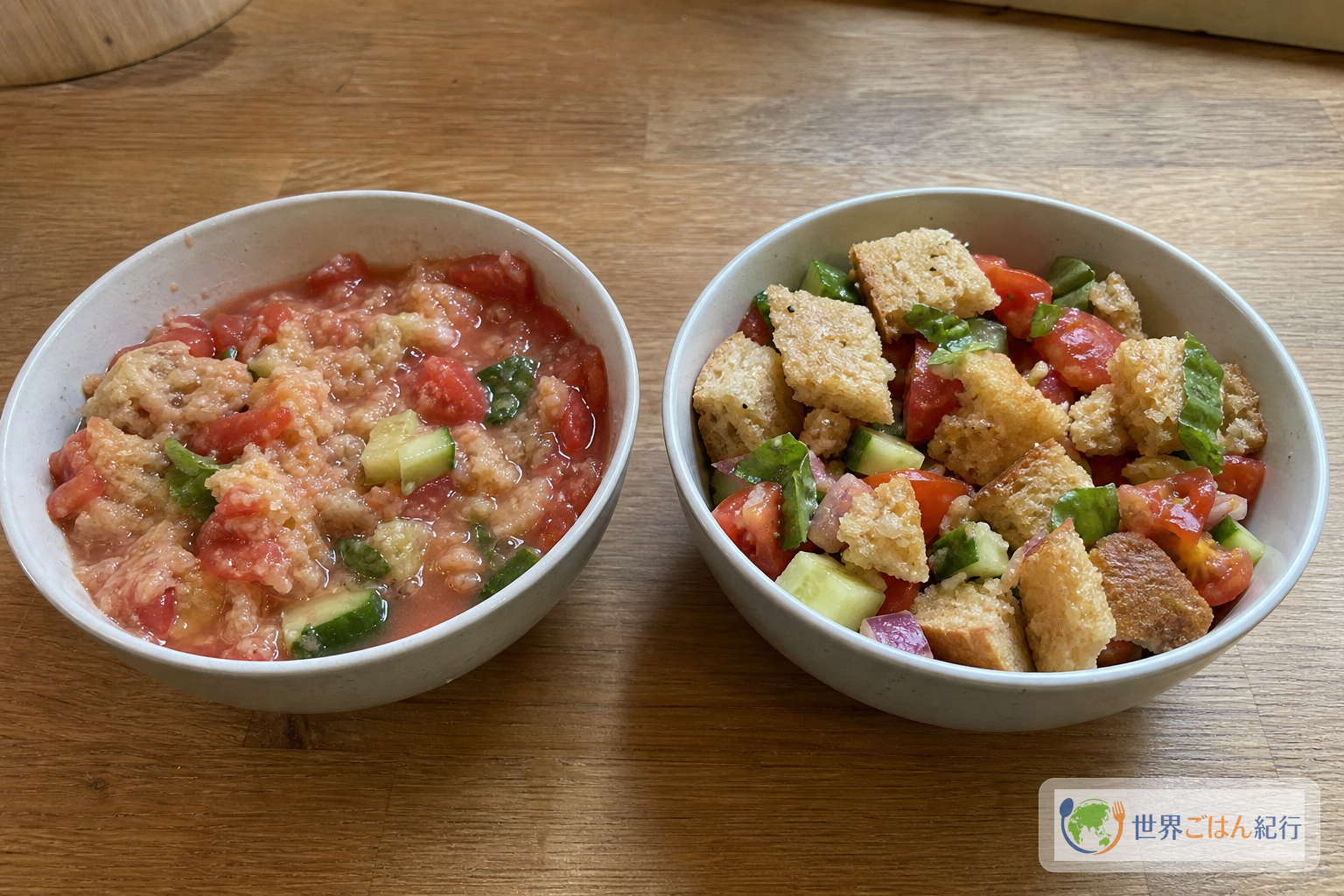
Even if it looks watery, there is a difference between leftover juice at the bottom of the bowl and the bread itself having collapsed into a paste. Start by separating the juice at the bottom from the state of the bread. Extra juice can be dealt with by draining in a colander. Bread that has once collapsed does not return to its original crumbs. Adding bread or vegetables is a home adjustment, so do not raise a fixed amount from the start; add a little at a time while watching.
| Condition | Likely cause | How to fix |
|---|---|---|
| Juice collects at the bottom | Not squeezed enough, or all the tomato juice went in at once | Set in a colander briefly to drain extra juice. If adding bread, add a little at a time and check softness |
| Bread is sticky | Soaked too long, mixed too much, or soft bread | Do not work it further. Shorten the soak next time. Collapsed crumbs do not return |
| Hard core | Not soaked enough, hard crust | Add tomato juice 1 tbsp at a time, wait a few minutes, and check the center |
| Too acidic | Too much vinegar | Add a little tomato and bread to increase the total. Do not try to cancel acidity with oil alone |
| Flavor is blurred | Not enough salt or acidity | Try a single bite and adjust from a pinch of salt or 1 tsp vinegar |
| Onion is sharp | Cut thick, not soaked enough | Taste one slice before tossing. If sharp, extend the water soak and drain |
When correcting the taste, do not add several seasonings to the whole bowl at once. Test on a single bite first, then add salt or vinegar. Check the finished flavor while it is cold. If you included capers, count their saltiness too.
At the table, as a vegetable side or a light lunch
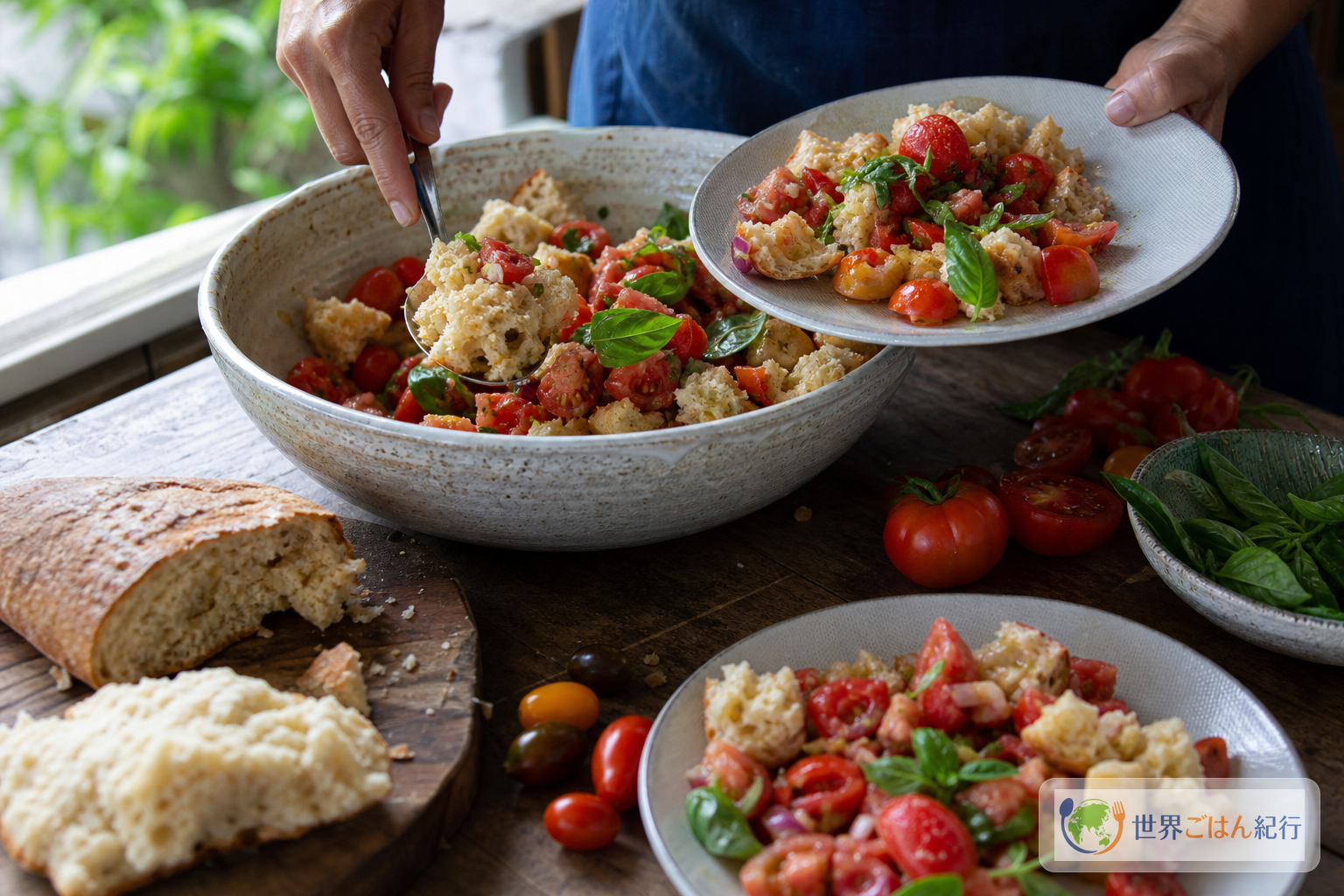
For an appetizer or side dish, serve it in a small bowl; for a light lunch, on a large plate. Because this is a dish that includes bread, it satisfies very differently from the same amount of a salad without bread. Try putting it beside grilled chicken, white fish, or an omelet. This is not a fixed menu from the region, only an idea for the table. Adding hard-boiled egg, tuna, or beans is an adaptation. Keep the basic texture of bread and raw vegetables.
For a summer salad with no step of rehydrating bread, there is Greek salad. It is a different dish, with raw tomato and cucumber paired with feta and olives. For a season when you want a warm vegetable dish, there is Piedmont's bagna cauda. That is a separate story from the origins of panzanella, but the pleasure of eating vegetables according to the season is shared by both.
- How to make Greek salad (in Japanese): the same summer vegetables, eaten with the saltiness of feta and olives.
- How to make bagna cauda (in Japanese): for days when you want autumn and winter vegetables with a warm garlic-and-anchovy sauce.
For leftover hard bread there is also Spanish migas, a dish that moistens hard bread and sautés it with garlic and oil until the crumbs separate. Panzanella lets the bread take up vegetable juices with no heat, while migas adjusts moisture in the pan. This is not a suggestion to make large amounts of both on the same day; keep it in mind as another destination for leftover bread.
- How to make migas (in Japanese): the Spanish dish that turns leftover bread into fragrant crumbs by sautéing.
Making ahead: refrigerate and add the basil last
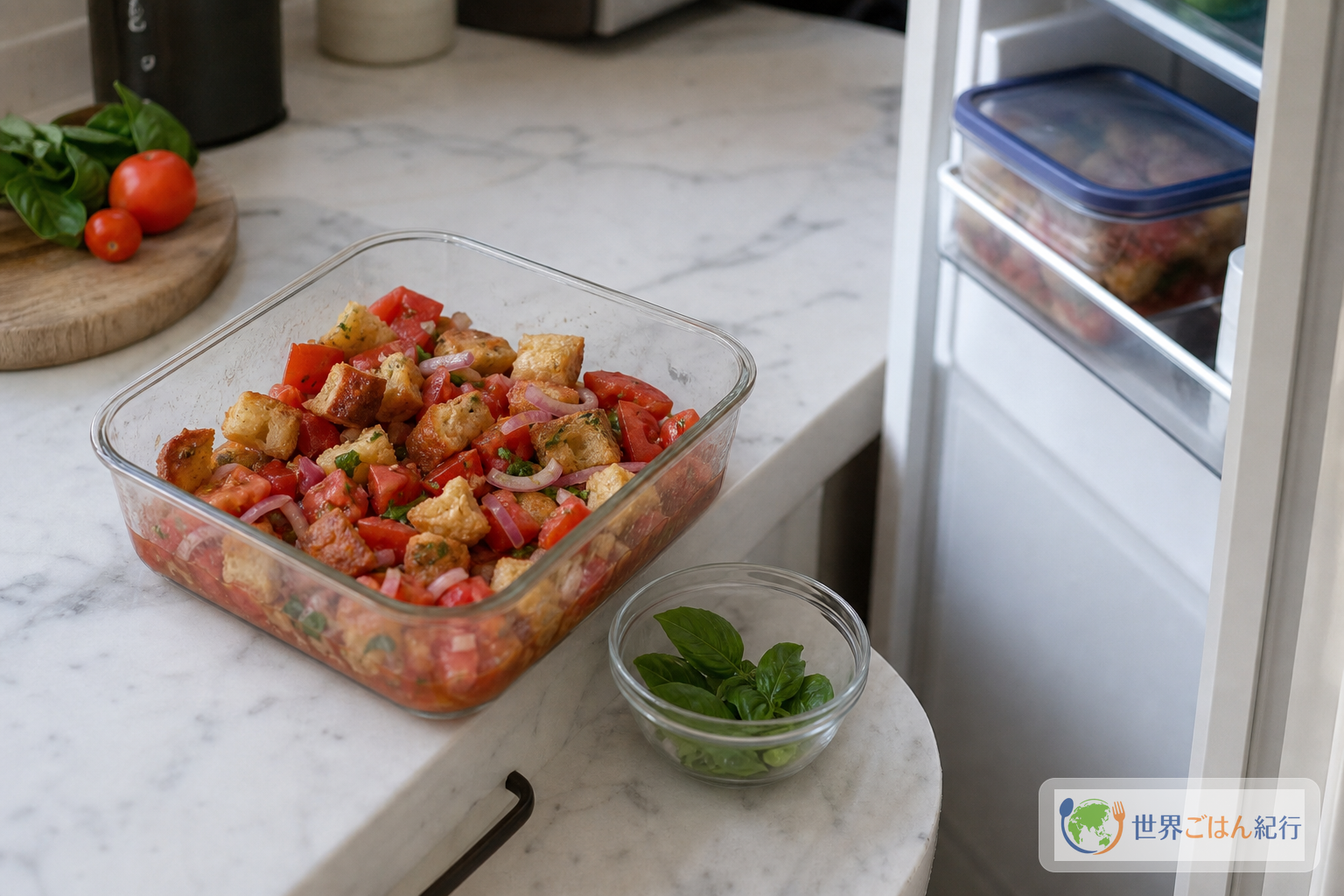
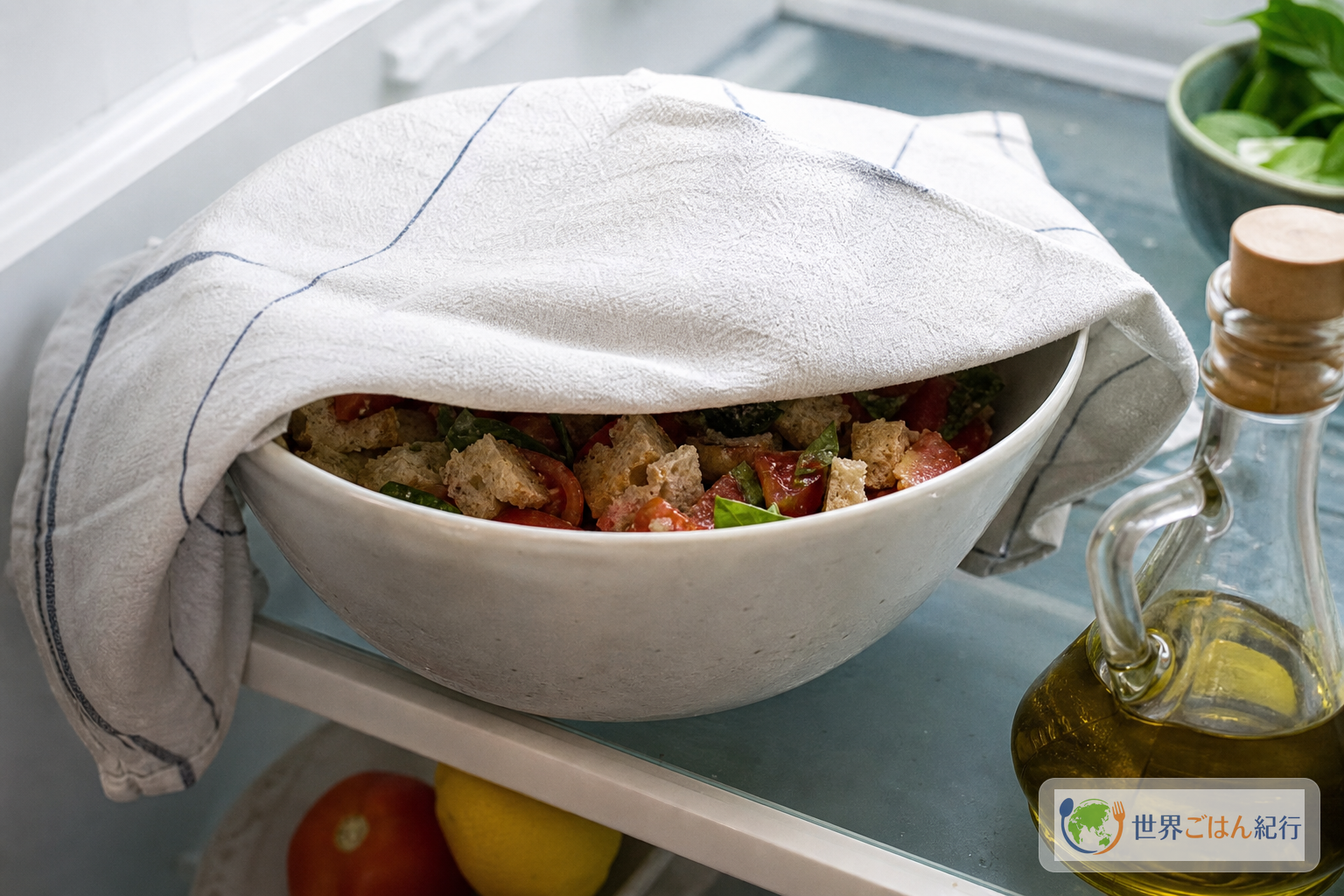
After tossing, chill 30 minutes before eating. Tear the basil just before eating. Putting texture first, the home approach is to finish it the same day. This is not a guarantee of safety through the next day. Put leftovers in a clean container and refrigerate right away. Adding more vegetables does not extend how long it keeps. Freezing is unsuited to the texture, because on thawing the liquid separates out of the bread and raw vegetables.
This is an uncooked dish that includes cut vegetables. The FDA advises refrigerating perishable fresh produce and herbs at 40°F (about 4°C) or below. Separate the old story of eating it in the fields from handling in a kitchen today. Refrigerate once finished, and take out only what you will eat. Even with vinegar it needs refrigeration, and it does not become a dish that can sit at room temperature. If you carry it, use ice packs and a cooler bag. Do not try to revive something left at room temperature for a long time with seasoning or extra vegetables.
If you take it to a potluck, carrying the bread, the cut vegetables with tomato juice, the seasonings, and the basil separately makes it easier to adjust texture where you eat. Even when the ingredients are separated, it still needs refrigeration. Toss it before eating and keep it cold. Drain the cucumber and onion, which release water easily. This way of dividing is not meant as a way to extend the time you can carry it.
Frequently asked questions
Can I toast the bread before using it?
The dictionary description also includes versions with toasted bread. The name of the dish alone cannot fix it to a single texture. The method here uses bread that has been rehydrated and squeezed so it is moist. Toasting gives a different texture and adds a toasty flavor. If you make the toasted type, the soaking has to be adjusted too. Do not swap the whole amount for croutons and keep the same soaking time.
Can I make it with sandwich loaf or rice vinegar?
With sandwich loaf, 180 g and 400 ml cold water for the bread is a home guide. It breaks down easily, so check the center within 3 to 4 minutes. With rice vinegar, start with a small amount for tossing and taste, adding 5 ml at a time. It cannot be said to turn out the same as one made with unsalted country bread and red wine vinegar. When you substitute, start by holding back on water and vinegar.
Can canned tomatoes or shiso (perilla) stand in?
The basic version uses fresh ripe tomatoes. Cherry tomatoes can substitute at about 450 g. Canned tomatoes differ in texture from fresh flesh, so they are not recommended as a substitute in the basic mix. If you use shiso, enjoy it as a herb variation of your own. It is not the same aroma as basil, nor a substitute for mentuccia. The dish still works without capers. Adjust salt and vinegar as you taste.
Sources
- Visit Tuscany, "La ricetta della panzanella": basic ingredients, 10-minute soak, 30-minute chill. Accessed and checked 5 October 2026.
- Cortonaweb, "Panzanella": a countryside summer dish, regional recipe with celery. Accessed and checked 5 October 2026.
- Visit Tuscany, "Pane Toscano DOP": unsalted bread and the food culture of using stale bread. Accessed and checked 5 October 2026.
- Umbria Tourism, "Sapori d'estate": Umbrian summer dishes, onion and mentuccia. Accessed and checked 5 October 2026.
- Treccani, "Panzanèlla": definition of the dish name, uncertain etymology. Accessed and checked 5 October 2026.
- FDA, "Selecting and Serving Produce Safely": washing fresh produce, preventing cross-contamination, refrigeration. Accessed and checked 5 October 2026.