The story of tortilla: a Spanish egg dish that is good even cold
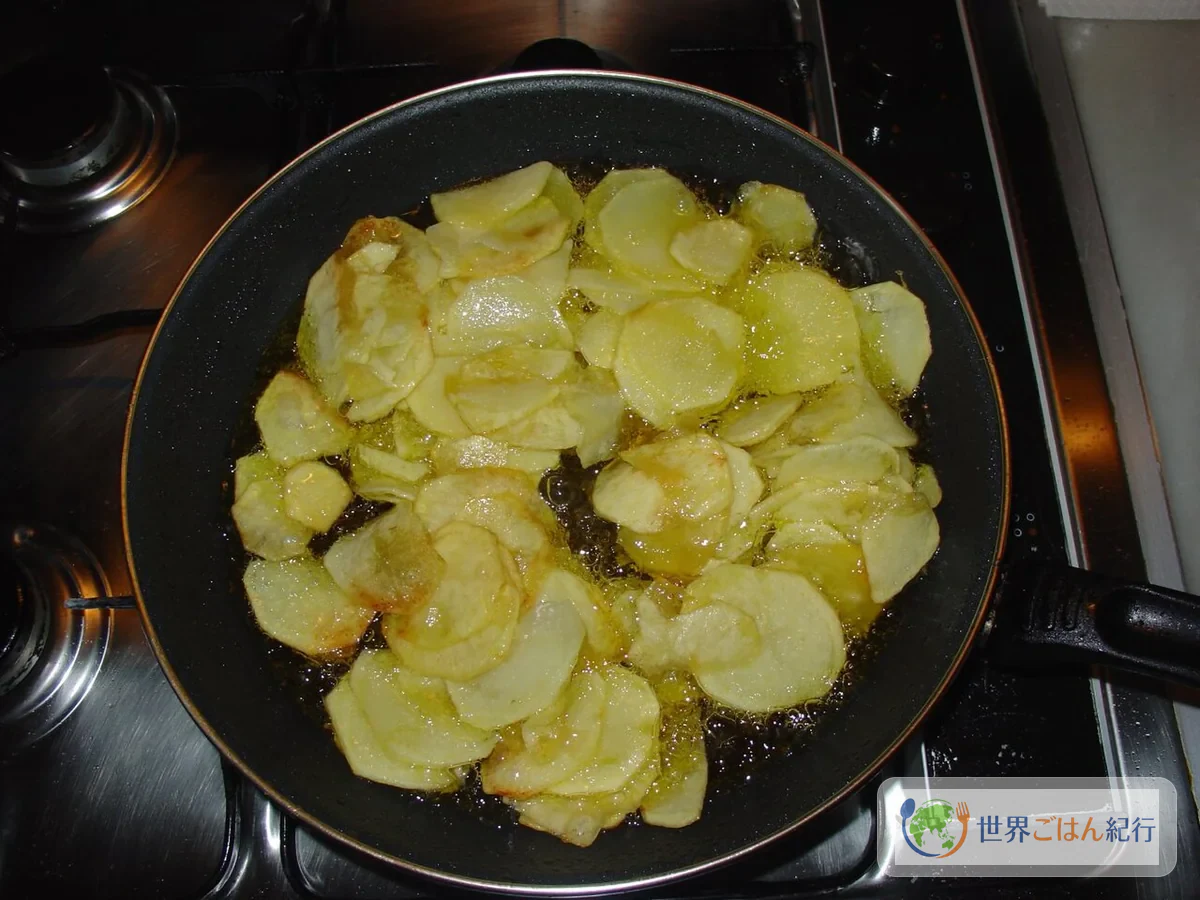
When you start slicing potatoes thin, at first it looks like "just home cooking." But pour olive oil into the pan and slowly sink the potatoes and onion into it, and the air of the kitchen changes a little. It's not as intense as frying. It's not as dry as sautéing. In the oil the potatoes quietly soften, and the sweet smell of onion rises. Hurry here, and you won't get close to that thick slice you're served in a Spanish bar.
Tortilla española, or tortilla de patatas, is a Spanish classic built on eggs, potatoes, olive oil and salt. In Japan it is often called a "Spanish omelet," but rather than a fluffy omelet it is closer to a thick egg cake in which potatoes are held together by egg. The official Spain.info recipe also uses, for four, 4 medium potatoes, 4–5 eggs, 1 onion and olive oil, and has you cook gently over low heat before flipping.
What's interesting about tortilla is that there are so few ingredients and so many arguments. Onion or no onion. A runny center or set through. Hot, or cooled and tucked into bread. In Spain these are matters of quite serious taste, not just of region and household. It's a little like how Japanese rolled omelets (tamagoyaki) split into a "sweet camp" and a "dashi camp."
This article makes it with onion, cooked through to the center, on the safe side, so it is less likely to fail in a home kitchen. In Spanish bars there are types with a very loose center, like the Betanzos style, but at home it is more reassuring to put the handling of eggs first. To eat egg dishes safely the FDA advises cooking until the whites and yolks are firm, and cooking egg dishes to 160°F (about 71°C). Even if you aim for a creamy texture, serve a well-cooked one to children, pregnant people, older people and anyone with health concerns.
If paella Valenciana (in Japanese) is the weekend star, tortilla is the Spanish dish closer to a weekday kitchen. Bake it the day before and in the morning you just cut it. On a hot day, add gazpacho (in Japanese) and you have a Spanish-style lunch with little time at the stove. In contrast with a heavy stew like cocido madrileño (in Japanese), the strength of this dish is that it doesn't lose flavor when cold.
We keep the Spanish basics while leaning toward ingredients that are easy to find in an ordinary supermarket. Potatoes that hold their shape, medium-to-large eggs, and olive oil that needn't be extra virgin. The biggest hurdle is the flip, so we describe the plate method, the lid method, and a method of cooking thick in a small pan.
Ingredients (serves 4): from an ordinary supermarket
Tortilla is a potato dish before it is an egg dish. With too much egg alone it is soft like chawanmushi, and with too much potato alone it turns floury. The guide is 500–600 g potatoes to 5 eggs. Adding 1/2 to 1 onion increases the sweetness and makes it easier to eat cold.

This recipe uses eggs. A near-runny tortilla is popular in Spanish bars, but at home cook the eggs through to the center, with the guide that no raw egg runs out when you cut it. Cool leftovers, store them in a clean container in the refrigerator and eat them within about 3 days.
Choosing potatoes
You can make it with floury potatoes, but they break down easily, and the cut face turns grainy when you flip. A variety that keeps its shape, like a waxy potato, gives clean layers of potato when you cut it. Some places in Spain are particular even about the variety, but in a home kitchen "a potato that doesn't break down in cooking" is enough.
The oil is a lot. But don't throw it away
The first time, 250 ml of olive oil may make you flinch. But this is not oil that you eat all of. It is oil for slowly simmering the potatoes, which you drain off thoroughly at the end. The oil that has taken up their aroma can be used the next day for fried eggs, pasta and stir-fries. In Spanish homes too, the oil after making tortilla is not thrown out but reused.
With a small pan 20 cm across you can reduce the oil to 180–200 ml. But since the whole of the potatoes will be less likely to touch the oil, turn them over often as it goes. There is also a method of lightly heating the potatoes first in a microwave and finishing in oil, though the aroma becomes a bit milder.
Olive oil decides the aroma of the potatoes. It needn't be expensive, but using one without an oxidized smell makes a difference when it cools.
A small pan that is not too deep gives thickness. Around 20 cm in diameter holds together well for four and makes it easier to put a plate over it to flip.
If you want to check the core temperature, a thin cooking thermometer gives reassurance. It isn't a dish aimed at runny centers, but if you take an egg dish in a lunch box or to a potluck, it is steadier not to judge by feel alone.
Method: simmer the potatoes, then bind them with egg
Tortilla is not a dish where you "sauté potatoes and pour on egg." You slowly soften the potatoes in oil, mix them with egg and let them rest a little, and finally cook them to set as one thick mass. It is less a dish for browning than one in which cooked potatoes are joined by egg.
On days you're not confident about flipping, cook it thick in a small 18 cm pan and finish by covering and cooking over low heat until the center is done. The beauty of the browning drops a little, but the shape is stable. With an oven-safe pan you can also cook one side and finish it in a 180°C oven for 8–10 minutes.
Tips: the onion dispute and the reality of flipping
The topic that comes up most about tortilla is whether to add onion. The official Spain.info recipe has onion, but in Spain quite a few people prefer none. The Guardian's explanation of Spanish omelet also treats this dispute as a matter of strong taste. For a first time in a home kitchen, I recommend it with onion. It brings sweetness, softens the floury quality of the potatoes, and makes it easier to eat cold.
They don't need to be crisp like potato chips. Cook until the potatoes break softly in the oil, and they hold together when mixed with the egg. Chase color and only the outside hardens and the layers fall apart when you cut.
If you whip hard to make it fluffy, the bubbles escape after cooking and it tends to deflate. Roughly mixing white and yolk is enough. The thickness of the tortilla comes not from bubbles but from the amount of potato.
In the Spain.info method the potatoes and onion are added to the egg before cooking. Letting it sit a little rather than cooking at once lets the potatoes take in the egg and makes a hollow of only egg in the center less likely. Because you add hot potatoes, the egg also warms to a gentle creaminess, which is another benefit.
In a 26 cm pan, four servings come out like a thin rolled omelet. For thickness, about 20 cm is easy to handle. The smaller the pan, the less scary the flip is. The plate can be small too.
Cut it fresh from the pan and the hot egg and potato move and the cut face easily collapses. Resting 5–10 minutes lets the center settle on the residual heat, and the layers remain when the knife goes in. If you serve it at room temperature as in a bar, it is delicious even after about 20 minutes.
A near-runny tortilla is attractive, but it isn't easy to get the same doneness every time in a home kitchen. The center state changes especially with the egg size, the thickness of the pan and the temperature of the potatoes. For lunch boxes eaten cold, for the next day, or for children, lean toward the set-through type.
For storage containers, a shallow one is more convenient than a deep one. Kept thick, it holds heat and takes a long time to cool. If you store it cut, the cut faces dry easily, so press plastic wrap against them before putting on the lid.
Serving and menus: breakfast or tapas
Fresh from the pan isn't the only right way to eat tortilla. Its great charm is that it's good even cooled. In Spain, a small cut piece is picked at in bars as a nibble, or tucked into bread as a bocadillo de tortilla. The Spain.info tapas introduction too treats tortilla as one of the staples ordered with a drink.
A summer lunch with gazpacho
On a hot day, serve gazpacho (in Japanese) in small glasses and put the tortilla beside it at room temperature. The tartness and chill of the gazpacho cut the heaviness of egg and potato. Bake the tortilla the day before and on the day only blend the gazpacho, and the lunchtime kitchen is much easier.
As a starter on paella day
On a day when paella Valenciana (in Japanese) is the star, cut the tortilla into small cubes and serve it first as a nibble. Pair it with cold white wine or sparkling water during the wait for the rice, and the table doesn't slump into dead waiting time. But both paella and tortilla have carbohydrates, so small portions are enough.
Pass it to the day after cocido
The day after making a stew like cocido madrileño (in Japanese), the kitchen is a little tired. On such a day, make a simple plate from the leftover vegetables and tortilla, and you connect the heaviness and the lightness of Spanish food. You can reheat tortilla in a microwave, but eaten back at room temperature, the egg aroma is milder.
Tucked in bread for a lunch box
Slice a baguette or roll lengthwise, put in the tortilla, and you have a classic Spanish sandwich. Rub the bread with tomato, add a little olive oil and salt, and it becomes pan con tomate style. For a lunch box, cook the tortilla through, cool it, and then put it in.
Lightened with a salad
Add a slice to a salad of arugula, lettuce, tomato, olives and tuna, and you get the acidity and moisture that egg and potato alone lack. Olive oil, vinegar and salt are enough for the dressing. Since the tortilla itself is salty, keep the salad light.
Variations
The basics are eggs, potatoes, oil and salt. Whether to add onion is already one fork. Once you're used to it, you can add seasonal vegetables and leftovers. But add too many and it moves toward a loaded frittata rather than tortilla. For the beginning, adding just one thing is about right.

No onion, closer to the classic
Leave out the onion and raise the potatoes to 600 g. Keep the salt at 1 1/4 tsp, and use 5–6 eggs. With less sweetness, the aroma of the potatoes and the quality of the oil come forward. This is the form if you lean toward the Spanish "no-onion camp." It is a little plain when cold, so it suits eating warm more than tucking in bread.
With pepper
Cut 1 pepper into thin strips and cook it in the oil with the onion. The aroma is strong, so too much turns it into a pepper omelet. In a small amount, the sweetness of the potatoes and the green aroma are balanced, and it suits a summer lunch.
With tuna
Add 1/2 can of drained tuna at the stage of mixing egg and potatoes. The savor of fish goes in and it suits lunch boxes. Tuna is salty, so reduce the salt in the egg a little. It stays clearly flavored cold, though it strays a bit from the Spanish basics.
With cheese
Mix 40 g shredded melting cheese into the egg mixture. It is easy for children to eat, but gets a little heavy when cold. It is a home variation rather than the tortilla of a Spanish bar. With cheese, the aroma of the olive oil weakens, so add an outline with finishing parsley or black pepper.
Time-saving version with the microwave
Put the cut potatoes and onion in a heatproof bowl, toss with 2 tbsp olive oil and salt, cover loosely with plastic wrap and heat at 600 W for 6–7 minutes. Then lightly coat them with oil in the pan, mix with egg and cook. The oil aroma weakens, but it is realistic for a weeknight dinner.
Small pintxo version
Divide the egg mixture in half and cook 2 rounds in a 16 cm pan. Cool them, cut into small cubes and spear with toothpicks for tapas-style pintxos. If bringing them to a potluck, cook them through and carry them kept cold after refrigerating.
Storage and reheating: cook it well if it goes in a lunch box
Tortilla suits make-ahead cooking. But since it is an egg dish, don't be careless with how you store it. The FDA advises not leaving cooked egg dishes at room temperature for more than 2 hours, and refrigerating within 1 hour in hot conditions. In a Japanese summer kitchen, those "hot conditions" are quite realistic.
When it's done, cool it for about 10–20 minutes on a plate, then store it cut or whole in a container. Cover while hot and water drops fall, making the surface sticky. Treat it as good for 3 days refrigerated, and take out only what you will eat. It can be frozen, but the texture of the potatoes becomes a bit dry. We recommend refrigerating only.
To reheat, warm briefly in a microwave or in a pan over low heat. In a microwave the egg hardens if the center gets too hot, so check every 30 seconds at 600 W. In a pan, cover and heat over low heat 2 minutes per side. The surface regains a little toastiness.
To bring it to a potluck, bake it the night before and refrigerate, and carry it in a cooler bag on the day. Cut after bringing it back to room temperature on site, and the egg aroma comes up better than straight from the refrigerator. But it is not suited to dishes set out outdoors for long. It is safer to put out a little at a time and keep the rest refrigerated or cold.
For a lunch box, don't make it runny. Bake it firm through the center, cool it completely and then pack it. Don't put it in the same container as watery tomatoes or gazpacho; if you add salad, use a separate container. Baking the night before, refrigerating, and cutting and packing in the morning is easier both for safety and for work than baking in the morning.
The creamy tortilla popular in Spanish bars is meant to be eaten on the spot. For lunch boxes, picnics and potlucks, make the type cooked through to the center. Leaving egg dishes at room temperature for long raises not only a flavor problem but a food-safety risk.
Background of the dish: the 1798 theory and Spanish home cooking
Tortilla de patatas seems like a symbol of Spanish cooking, but it is a dish from after potatoes came to be widely eaten in Europe. In "the origin of traditional dishes," Spain.info touches on research stating that tortilla de patatas was mentioned in 1798 in Villanueva de la Serena in the province of Badajoz, and introduces it as a dish made by Joseph de Tena and the Marquis of Robledo as a cheap, easy way to stave off hunger.
The combination of egg and potato is not a luxury. It is rather the wisdom of getting satisfaction from few ingredients. That is exactly why it spread to home kitchens, bar counters, picnics, sandwiches and late-night snacks. The Spruce Eats too introduces Spanish tortilla as a dish eaten warm or cold, and used as tapas, a main dish, a portable snack, and a filling for bocadillos.
In recipes for Japanese readers it is often introduced as an "omelet," and attention tends to go to the fluffiness of the egg. But reading English and Spanish recipes, at the center are the cooking of the potatoes and the use of oil. In the Spain.info method too, the potatoes and onion are slowly cooked in medium-temperature olive oil, the oil is drained in about 10 minutes, and after combining with the egg it is cooked over low heat. Hurry here and you get just a thick egg cake, burnt outside and raw-ish inside.
The onion dispute too is proof that this dish is rooted in daily life. For haute cuisine, the chef decides the right answer. But tortilla is home cooking, so a mother's taste, the taste of the neighborhood bar, the taste eaten on an outing is each person's right answer. We made this one with onion not because it is the only right answer in Spain. It is because in a home kitchen it is good cold, hard to fail, and easy to shop for.
And one more thing matters in a modern home: food safety. In articles by Spanish specialists and on food safety too, the risks around runny tortilla come up from time to time. If making it for home use, rather than chasing a liquid center that looks good on social media, we want to take as our standard a state that cuts properly and can be eaten with confidence the next day. Precisely because it is a humble dish of egg and potato, let's take care with the cooking alone.
FAQ
Q1. Which is authentic, tortilla with onion or without?
Both exist. The official Spain.info recipe has onion, but plenty of people in Spain prefer none. In a Japanese home kitchen, onion brings sweetness and makes it easier to eat cold, so we recommend onion for a first try. Once you're used to it, make one without onion too and decide by preference.
Q2. Can I heat the potatoes in the microwave?
For saving time, yes. But the aroma and texture of slow cooking in oil are somewhat weaker. A practical split is the microwave-assisted method on weekdays and slow oil on weekends. Even with the microwave, coat them lightly in oil at the end before mixing with the egg, and the taste gets closer.
Q3. It falls apart when I flip it. What should I do?
Often it's one of: the pan is too large, the egg and potatoes weren't rested after mixing, or the first side was cooked too lightly. Use a pan about 20 cm across, mix the egg and potatoes and let them sit 10 minutes, and flip once the bottom has firmly set. If using a plate scares you, covering and cooking through to the center is fine.
Q4. Is it all right to leave it runny?
For adults eating on the spot it is a matter of preference, but for a home article we recommend cooking through to the center. To eat egg dishes safely the FDA advises cooking until the eggs are firm, and cooking egg dishes to 160°F (about 71°C). Avoid a runny center for children, pregnant people, older people and anyone with health concerns.
Q5. Can I put it in the next day's lunch box?
Yes. But cook it through to the center, and refrigerate it early after baking. In the morning cut it with a clean knife and pack it completely cold. Don't put it in the same container as watery vegetables, and adding an ice pack gives reassurance.
Q6. What do I do with the leftover olive oil?
It has taken on the aroma of the potatoes and onion, so it suits the next day's fried eggs, stir-fried vegetables, pasta and ajillo-style sautés. Remove small burnt bits with a strainer or tea strainer, put it in a clean container in the refrigerator, and use it up within a few days. Don't keep oil mixed with egg; use it on the spot.
Summary: "small and thick" is the shortcut to tortilla
Tortilla is a Spanish-kitchen dish made with 5 eggs, 550 g potatoes, 100 g onion and 250 ml olive oil. What matters is softening the potatoes without scorching them, resting them mixed with the egg, and cooking thick in a pan that is not too large. The flip is nerve-wracking, but with a plate over the sink it goes more calmly than you'd expect.
For the first time, make the type with onion, cooked through to the center. Once you're used to the taste, you can widen to no onion, pepper, tuna, and a small-cut tapas version. It is good even cold, so it works for a summer lunch with gazpacho (in Japanese), a starter on paella Valenciana (in Japanese) day, and a lunch box tucked in bread.
Once you flip it well in the kitchen, from then on it gets a little more fun. Cover with the plate, hold your breath, turn it over. Only at the moment it slides back round do you feel quite like you're in a Spanish bar.
Sources
- Spain.info "Recipe: Potato omelette. Spanish cuisine" (https://www.spain.info/en/recipe/potato-omelette/) (accessed May 2026)
- Spain.info "Discover the origins of the most traditional Spanish dishes" (https://www.spain.info/en/top/discover-the-origin-of-some-traditional-spanish-dishes/) (accessed May 2026)
- Spain.info "20 recommended and highly popular Spanish tapas" (https://www.spain.info/en/top/recommended-popular-spanish-tapas/) (accessed May 2026)
- The Spruce Eats "Spanish Tortillas (Tortillas espanola)" (https://www.thespruceeats.com/tortillas-omelets-in-spain-3083069) (accessed May 2026)
- The Guardian "How to make a Spanish omelette - recipe" (https://www.theguardian.com/food/2020/jul/22/how-to-make-spanish-omelette-tortilla-recipe-felicity-cloake) (accessed May 2026)
- FDA "What You Need to Know About Egg Safety" (https://www.fda.gov/food/buy-store-serve-safe-food/what-you-need-know-about-egg-safety) (accessed May 2026)