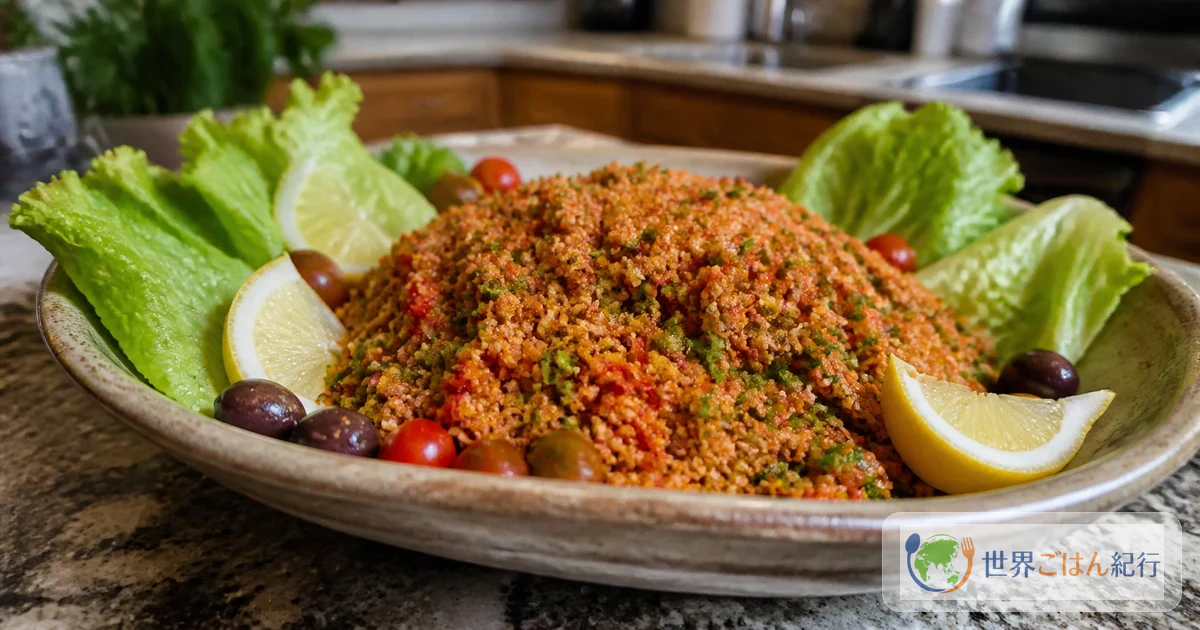
A "holy porridge" that ties feast days to memory
In Armenia, there is a custom of sharing porridge cooked in a huge pot on feast days such as Easter and at church gatherings. People take turns gripping a long wooden paddle and stir for hours until the porridge turns a pale cream color. That porridge is harissa (Հարիսա / հարիսա).
Harissa stands apart within Middle Eastern cooking (in Japanese). It is a porridge of hulled wheat grains and chicken (or lamb) simmered slowly overnight, then beaten until the wheat dissolves completely into a paste. The finished harissa is flooded with melted butter, and a golden film spreads over the cream-colored porridge. One spoonful brings together the gentle sweetness of wheat, the savoriness of chicken and the richness of butter, with a depth you would never guess from its plain looks.
Harissa is both Armenia's "national dish" and a "holy food." Besides being known as an Easter dish, it is remembered as the food that sustained people during the resistance at Musa Dagh in 1915, and communities with roots in Musa Dagh still cook and share harissa every September at their commemorations.
In Armenian folk tradition, the name is said to come from Saint Gregory telling people "hari sa" ("stir it"). Meanwhile, the Arabic "harees" is explained as coming from a verb meaning "to crush." It has nothing to do with the Tunisian chili paste also called harissa. In the Arabic-speaking world, a related dish exists as harees (hareesa), eaten as a Ramadan dish in the UAE, Bahrain and Saudi Arabia.
Ingredients (serves 6)
Method
The night before
Put 300 g wheat berries (or pearl or rolled barley) in a bowl, cover with plenty of water and let them soak in the refrigerator overnight (8–12 hours). The next morning, check that the grains have plumped up, then drain them in a colander. This soak leads directly to harissa's smooth finish; skip it and the grains stay hard.
Simmering
The story behind the dish: the heroes of Musa Dagh and harissa


The history of harissa can't be separated from the history of the Armenian people themselves.
According to an Armenian tradition handed down since the Middle Ages, harissa began when Gregory the Illuminator (Saint Gregory), who spread Christianity in Armenia in the 4th century, was feeding the poor and, running short of lamb, added wheat to the pot. Simmering wheat and meat in a big pot and sharing it with everyone who gathered fit the Christian spirit of sharing, and harissa became a "holy meal" made for religious gatherings.
Harissa took on special meaning in modern Armenia because of the resistance at Musa Dagh in 1915. During the Armenian genocide in the last years of the Ottoman Empire, about 4,000 Armenians from villages around Musa Dagh (Mount Moses), in what is now Hatay Province in southern Turkey, took refuge on the mountain and held out for about 53 days, from July to September 1915. Harissa is remembered as the food that kept them alive.
Rescued by French navy warships, the survivors of Musa Dagh lost their homeland, but the tradition of making harissa never died. Many of them settled in 1939 in Anjar, a town in Lebanon's Beqaa Valley, where neighborhoods still bear the names of the six villages of Musa Dagh. Every year around September, harissa is cooked in big pots and shared to commemorate the resistance.
Making harissa is a ritual in itself. Traditional harissa is simmered all night without letting the fire go out, with several men taking turns stirring with a wooden paddle. This stirring duty is considered an honor, both hard physical work and a kind of spiritual discipline. Just as Ghanaians find community in the pounding of fufu, the stirring of harissa is a symbol of Armenian community.
Armenian harissa and Arabic harees belong to a closely related family of dishes. Harees is eaten as a Ramadan dish in the UAE, Bahrain, Saudi Arabia and Kuwait, and its basic structure, wheat and meat simmered into a paste, is strikingly similar. The difference is the seasoning: Arabian harees adds cinnamon or cardamom, while Armenian harissa is seasoned austerely with nothing but salt and pepper.
Cooking tips: four techniques for perfect harissa
1. Keep the heat at a bare simmer: the battle against scorching
Harissa's biggest enemy is scorching. Once the wheat absorbs liquid and turns sticky, it clings easily to the bottom of the pot. There are three defenses: use a heavy-bottomed pot (a thin one concentrates heat in one spot and burns), keep the heat at the lowest simmer, and always stir from the bottom at least once every 30 minutes.
2. Stir in one direction
Traditionally, harissa is always stirred in the same direction. There is no clear scientific basis for it, but stirring one way is said to break down the wheat starch evenly for a smoother texture. India's khichdi (in Japanese) also breaks grains down into a paste, but there the spices are the star, while harissa relies on nothing but the flavor of its ingredients.
3. Pour the butter while it foams
The Armenian way is to pour the finishing butter not as clarified butter but foaming (just short of beurre noisette). Put the butter in a small pan over medium heat: first it bubbles, then the bubbles turn fine and a faint hazelnut aroma appears. Turn off the heat at this point and pour it over the harissa; the toasty note of browned butter turns the plain porridge rich in an instant.
4. Next-day leftover harissa is the best
Harissa sets firm and chewy as it cools. The next day, add a little water and work it over low heat, and it turns back into a smooth porridge. You can also cut it into thick slices and fry them in butter, crisp outside and chewy inside.
Traditionally harissa takes more than 4 hours, but a pressure cooker cuts it to 1 1/2 hours. Here's how:
- Put the soaked wheat berries and chicken in the pressure cooker and add 2 L water
- Cook at high pressure for 40 minutes
- Let the pressure release naturally, open the lid, then lift out the chicken and shred it
- Return the shredded chicken and cook uncovered over the lowest heat for 30 minutes, stirring, until it becomes a paste
- Season with salt and pepper and pour on melted butter
The result is nearly identical to the traditional method. For a weeknight, this is the way to go.
Variations: make harissa your own
Lamb version
In some parts of Armenia, harissa made with lamb instead of chicken is also traditional. Use 500 g bone-in lamb shoulder in place of the chicken and extend the simmering time by 30 minutes. The lamb version is richer, with a faint gaminess. As with chorba frik, pairing lamb with grain is shared kitchen wisdom across the Middle East and North Africa.
Spiced version
Traditional Armenian harissa is seasoned austerely with just salt and pepper, but following Arabian harees, add 1/4 tsp cinnamon and 2 cardamom pods during simmering for a sweet, aromatic accent. It is a variation that brings in the Middle East's culture of fragrance, akin to the spicing of biryani (in Japanese).
Barley and chicken-wing version
Use waxy barley instead of wheat berries and swap the chicken for wings, and everything can come from an ordinary supermarket. The beta-glucan in the barley thickens the porridge and the gelatin from the wings melts in, giving a very smooth harissa. Finishing with toasted sesame oil instead of butter makes a Japanese-inspired harissa with a new flavor.
Another Armenian chicken dish, amich (in Japanese), a bird stuffed with rice, dried fruit and nuts and roasted, puts festive splendor front and center, the opposite of harissa. Comparing a quiet bowl of beaten wheat with an oven-roasted stuffed chicken shows the range of Armenian cooking.
Sweet dessert version
You can also turn the wheat porridge into a sweet dessert porridge. Add 3 tbsp sugar and 2 tbsp honey, sprinkle with ground cinnamon to finish and top with dried fruit (raisins, chopped apricots). Just as Romania's placinta (in Japanese) varies with cheese or apple, harissa works as a dessert when made sweet.

Ingredient guide: gathering what you need for harissa
Harissa's great appeal is that its ingredients are extremely simple: basically just wheat, chicken and butter. If you can't find wheat berries, supermarket barley makes a fine substitute.
Where to find the main ingredients
| Ingredient | Where to buy | Notes |
|---|---|---|
| Wheat berries | Natural food stores, Middle Eastern grocers, online | The original ingredient |
| Pearl or rolled barley | Supermarket grain aisle | Substitute. Breaks down quickly |
| Waxy barley | Supermarket grain aisle, Asian grocers | Substitute. Gives a stickier texture |
| Bone-in chicken thighs | Supermarket | The bones give broth |
| Unsalted butter | Supermarket | For finishing |
Wheat berries are unrefined whole wheat kernels. Because the bran, endosperm and germ all remain, they are rich in fiber and minerals and have a distinctive, chewy pop. The hulled wheat grains used for Armenian harissa are close to this, and products sold as wheat berries work well.
Frequently asked questions

Q1. Is it the same as Tunisian harissa?
They are completely different. Tunisian harissa is a chili-based hot paste, while Armenian harissa is a porridge of wheat and meat. The name of the Tunisian paste is said to come from the Arabic for "to crush," while in Armenia the name is explained by the Saint Gregory legend above. The two foods are unrelated. When searching for the Armenian dish, use "Armenian harissa" to find accurate information.
Q2. Rolled barley or wheat berries: which should I use?
The original ingredient is wheat berries (wheat); rolled barley is barley. Either works, so use whichever is easier to find. Wheat berries are larger and take longer to soak and cook, but they tend to keep a little chewy pop for a more rustic finish. Rolled barley is already processed, so it breaks down faster for a smoother, creamier result. If it's your first time, rolled barley is more forgiving.
Q3. Can I use olive oil instead of butter?
You can, but the taste of harissa changes fundamentally. Olive oil can't reproduce the rich depth of butterfat, and you end up with a different dish. Note that ghee (clarified butter) is also made from milk and can contain residual milk protein, so it is not a substitute for people with a milk allergy. With a milk allergy, skip the butter and finish with olive oil or another plant oil.
Q4. Can I freeze it?
Yes. Freeze it in portions and it keeps for 1 month. After thawing, the liquid may separate, so reheat it over low heat while working it with a wooden spoon to bring back the original texture. Adding a little butter when reheating brings it closer to its pre-frozen flavor.
Q5. What goes well with harissa?
In Armenia, the classic partner is lavash, a thin unleavened flatbread. Naan or pita bread make good stand-ins. Vegetable pickles called turshi are another great supporting player, cutting through harissa's richness; any sharp, crunchy pickle has a similar effect. Pairing it with tangy side dishes, as with dolma (in Japanese), is the Armenian way.
Q6. Can I make it with meat other than chicken?
Traditionally, harissa is also made with lamb or turkey. It is sometimes made with beef too; beef shank gives a distinctive gelatinous body and a delicious result.
Related recipes: dishes of the Caucasus and the Middle East

From the same Caucasus region: Khachapuri (in Japanese) is Georgia's cheese bread, a classic of the Caucasus's simple wheat cooking. Satsivi (in Japanese) is Georgia's chicken in walnut sauce, showing how widespread the pairing of chicken and grain is across the Caucasus. Khinkali (in Japanese), Georgia's soup-filled dumplings, show the depth of the Caucasus's wheat culture.
Middle Eastern grain dishes: Mujaddara (in Japanese), Lebanon's lentils and rice, shares harissa's basic grain-plus-protein structure. Khichdi (in Japanese), India's rice and lentil porridge, comes from a different culture, yet its method of simmering grain into a paste is remarkably similar.
The world's porridge traditions: Harissa is one part of a porridge culture found all over the world. Ugali is East Africa's cornmeal porridge, and fufu is Ghana's pounded yam, both reflecting the universal human wisdom of eating grains and starches as a paste.
In closing: what it means to keep stirring

Harissa, made from nothing but wheat, chicken and butter, is perhaps one of the simplest dishes in the world. Yet behind it lie the legend of Saint Gregory, the Easter table and the memory of the tragedy and survival of 1915.
Stirring all night is the very opposite of efficiency. In an age when microwaves and pressure cookers can shorten everything, you deliberately take a long time to beat the wheat smooth. You stand at the stove, watch the heat, and turn the wooden spoon again and again to keep it from scorching. Armenians find something like prayer in that time.
With 300 g wheat berries (or rolled barley) and bone-in chicken thighs, your kitchen becomes a mountain village in the Caucasus. No difficult technique is required. All you need is to wait and to keep stirring. Finish with a pool of butter and breathe in the steam and the scent of butter as it rises; it's a moment that feels like standing in an Armenian churchyard in autumn. Give it a try.
Sources
Books and papers:
- Batmanglij, N. (2011). Food of Life: Ancient Persian and Modern Iranian Cooking and Ceremonies. Mage Publishers. https://www.mage.com/food-of-life
- Uvezian, S. (2001). The Cuisine of Armenia. Hippocrene Books. https://www.hippocrene.com/product/the-cuisine-of-armenia/
- Werfel, F. (1933). The Forty Days of Musa Dagh. Viking Press. https://www.penguinrandomhouse.com/books/69038/the-forty-days-of-musa-dagh-by-franz-werfel/
Reports and articles:
- Wikipedia, "Harees" (section on Armenian cuisine) https://en.wikipedia.org/wiki/Harees (accessed 22 October 2026). The Saint Gregory legend, the Easter dish, Musa Dagh
- Wikipedia, "Musa Dagh" https://en.wikipedia.org/wiki/Musa_Dagh (accessed 22 October 2026). Duration of the 1915 resistance and number of people
- Wikipedia, "Anjar, Lebanon" https://en.wikipedia.org/wiki/Anjar,_Lebanon (accessed 22 October 2026). Resettlement of the Musa Dagh community
- UNESCO, "Lavash, the preparation, meaning and appearance of traditional bread as an expression of culture in Armenia" (2014) https://ich.unesco.org/en/RL/lavash-the-preparation-meaning-and-appearance-of-traditional-bread-as-an-expression-of-culture-in-armenia-00985
Harissa contains wheat (wheat berries) and dairy (butter). If you substitute barley (pearl, rolled or waxy barley), it still contains gluten. People with celiac disease or gluten intolerance can replace the wheat with buckwheat groats or quinoa, though harissa's distinctive sticky texture won't be reproduced. Ghee (clarified butter) is also a dairy product, so people with a milk allergy should use plant oil instead of butter.
| Item | Value |
|---|---|
| Energy | About 420 kcal |
| Protein | About 25 g |
| Fat | About 20 g |
| Carbohydrates | About 35 g |
| Dietary fiber | About 5.5 g |
| Salt equivalent | About 2.0 g |
Estimated from the amounts in the ingredient table (6 servings, chicken calculated as the edible portion without skin and bone). Whole wheat grains contain more fiber than refined wheat flour.