


East Africa's staple, made from nothing but maize flour and water
Just two ingredients: maize flour and water. That's all it takes to make the staple at the heart of everyday meals in many East African homes.
Ugali is a traditional East African staple made by working maize (corn) flour into water until it becomes a stiff, smooth mass. It's eaten across much of sub-Saharan Africa, including Tanzania, Kenya, Uganda, the Democratic Republic of the Congo, Malawi and Zambia. It looks like a white dome of firm porridge, with a texture somewhere between Japanese mochi and Italian polenta. You pull off a piece by hand and use it to scoop up soups and stews.
In Tanzania and Kenya, ugali turns up again and again at lunch and dinner; it is about as everyday as a staple gets. You'll find it not only at home but in neighborhood eateries, where it comes as a set plate with greens, beans or a meat stew.
It may be one of the simplest staples in the world, but making it takes a surprising amount of skill. Get the ratio of flour to water, the heat or the timing of the kneading wrong, and you end up with a lumpy, crumbly mass. This article walks through how ugali is really made in East African homes, and how to reproduce it in a home kitchen.
A Swahili word for a staple made by cooking maize flour (or a similar flour) into a stiff mass; a thin, loose porridge is called uji. Kenya also says ugali; in Uganda it's posho, in Malawi and Zambia nsima, in Congo fufu, and in South Africa pap. The ingredients and basic method are almost the same everywhere, but the grind of the maize flour and the final firmness vary by region. If West African jollof rice, with its rice cooked in tomato, is a staple that takes effort, ugali is a staple that stands on its ingredients alone.

Ingredients (serves 4)

Method
Making the ugali: simple, so technique shows
People tend to think ugali is just "stir flour into water," but in East African homes, how well you can make ugali is a measure of your cooking skill. Getting it smooth and lump-free, at just the right firmness, takes experience.
The trick is to add the flour in two stages. First, stir in a small amount of flour to make a loose porridge; once that's smooth, add the rest and work it into a stiff mass.
Ugali that's too soft drifts toward uji, the loose porridge; too firm, and it's dry and hard to eat. The right firmness is "a finger leaves a dent, but it doesn't crumble." Aim for something a little softer than mochi, about as springy as an earlobe. If it's short on water, add 1 tbsp at a time; if it's short on flour, add 1 tbsp at a time.
Serving: shaping a dome
East Africa has its own way of serving ugali.
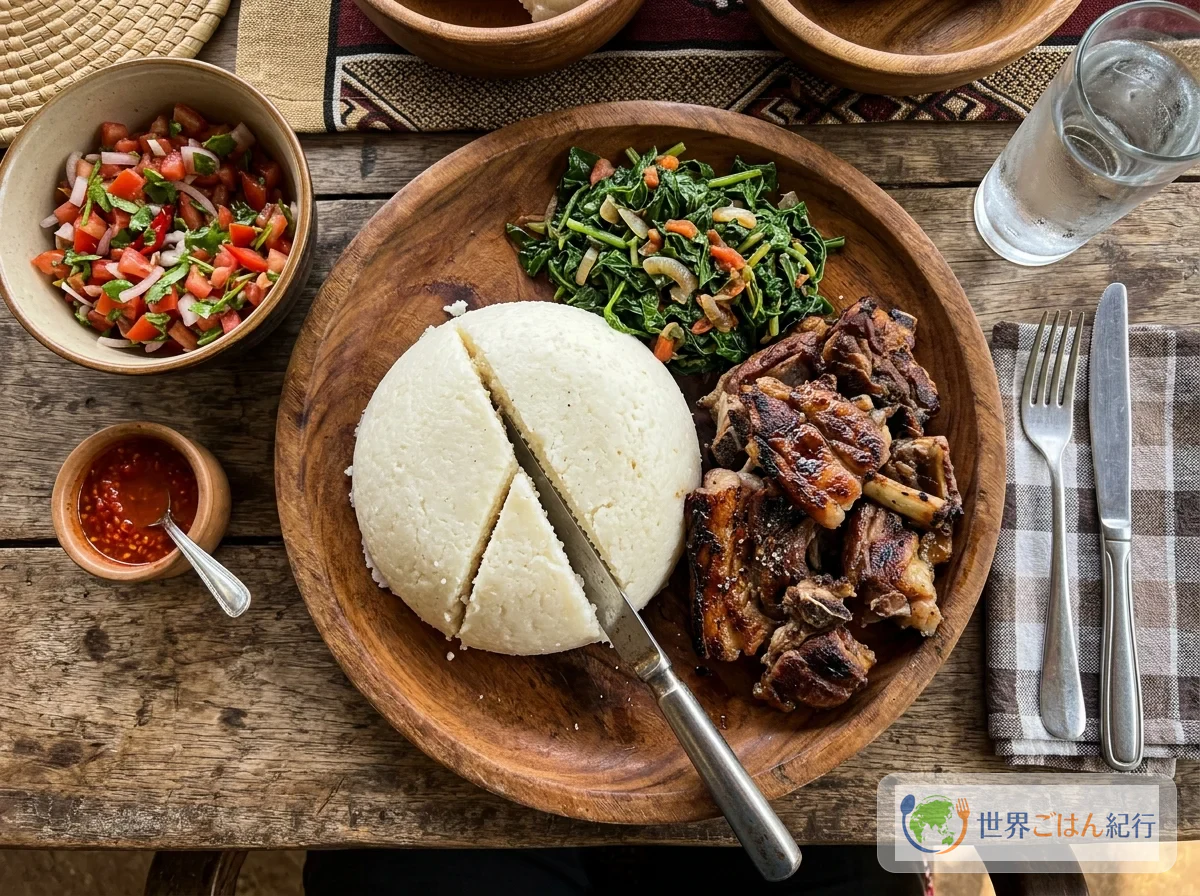
Gather the ugali in the pot with the wooden spoon and push it to the center. Smooth the surface with a spoon dipped in water and shape it into a dome. Place a plate over the pot and flip it, and a neat dome of ugali lands on the plate.
This white dome sits at the center of the East African table, with sides such as sukuma wiki and nyama choma arranged around it. Unlike Senegalese cooking, where a dish such as thieboudienne (in Japanese) brings everything together on one platter, ugali reflects an East African style that keeps the staple and the sides separate.
Making sukuma wiki (sautéed greens)
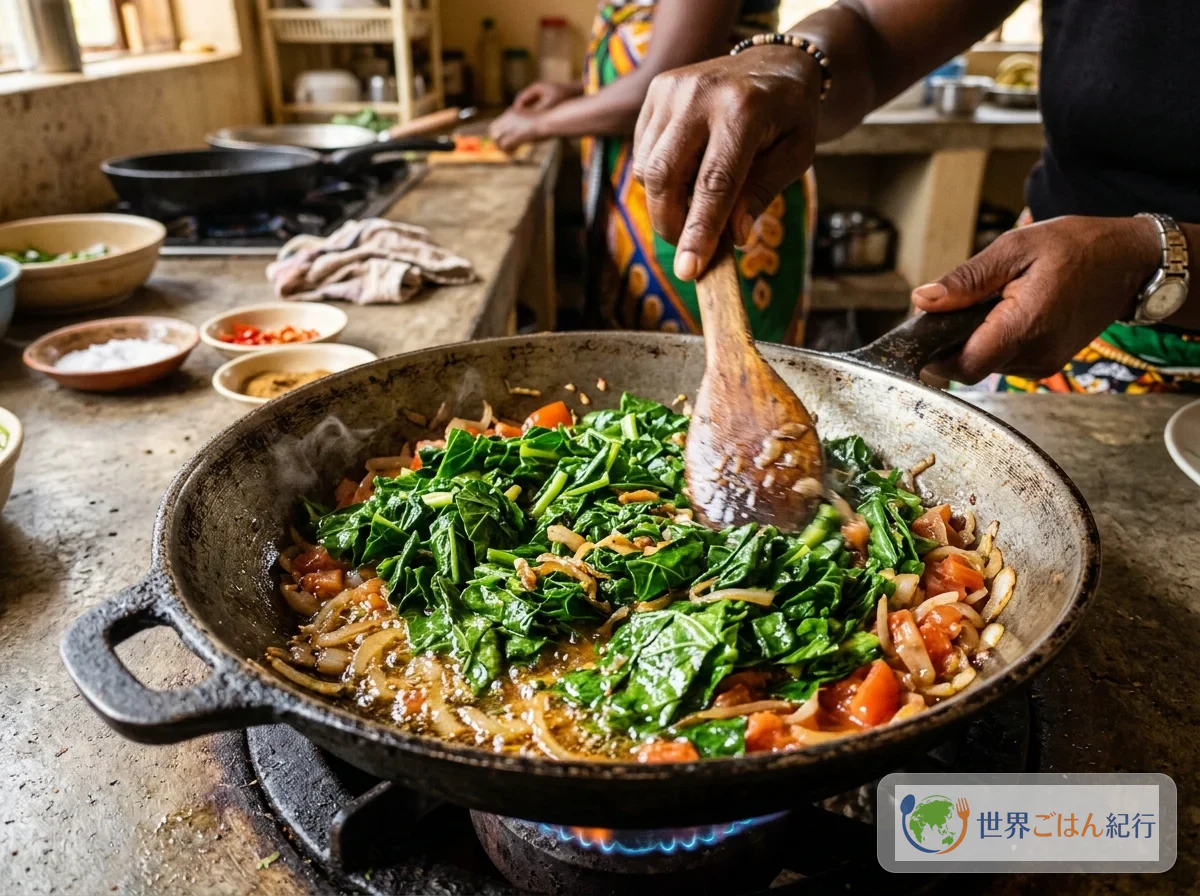
Sukuma wiki means "push the week" in Swahili. Cheap, nutritious and good enough to eat every day, it lives up to its name as the side dish that sees ordinary East African households through the week.
Sukuma wiki is simply kale (or collard greens) cooked with onion and tomato. If kale is hard to find, komatsuna or bok choy make perfectly good substitutes.
Heat the oil in a skillet and cook the onion until translucent. Add the garlic and cook until fragrant, then add the tomatoes and cook for about 3 minutes to drive off their liquid. Add the kale, cut into thin ribbons, season with salt and black pepper, cover and steam for 5 minutes. Ideally the kale should be wilted but still have some bite. Drizzle with lemon juice to finish.
East African sukuma wiki uses collard greens (a relative of kale), but the following greens make good stand-ins. The flavor shifts a little, but they all go beautifully with ugali.
| Green | Character | How close |
|---|---|---|
| Komatsuna | Mild, not very bitter. Widely available at Asian grocers | ★★★★☆ |
| Bok choy | Similar crisp texture | ★★★★☆ |
| Spinach | Cooks quickly, so shorten the cooking time | ★★★☆☆ |
| Kale | Closest to the East African flavor | ★★★★★ |
| Shungiku (chrysanthemum greens) | Its distinctive bitterness is close to African kale | ★★★☆☆ |
Making nyama choma (grilled meat)
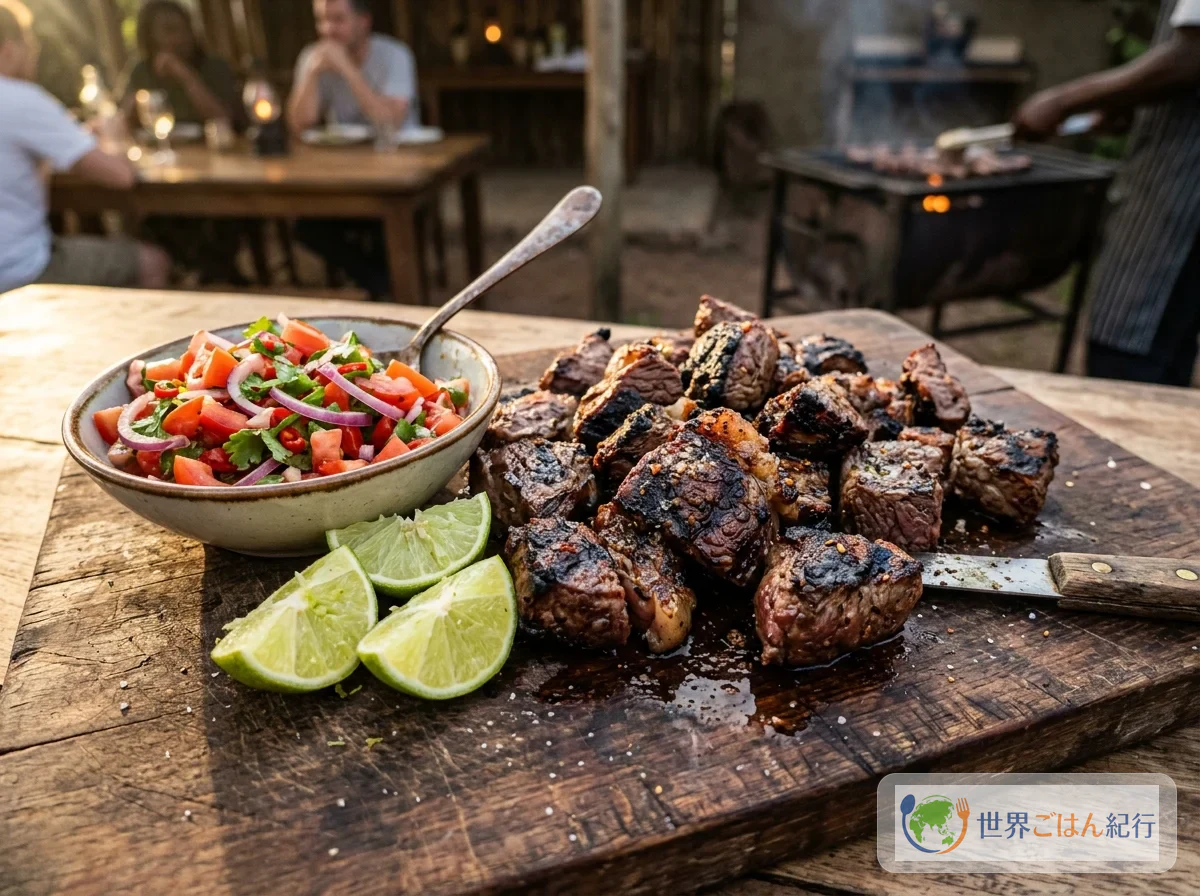
Nyama choma means "grilled meat" in Swahili. In Kenya and Tanzania, gathering around nyama choma on weekends and holidays is one of life's great pleasures. The traditional way in Kenya and Tanzania is goat grilled over charcoal, but beef round or rump makes an excellent version at home.
Cut the beef into bite-size pieces and marinate for 30 minutes with the salt, black pepper, garlic, lemon juice and paprika. Heat the oil in a skillet and sear the meat well over high heat. Turn the heat down to medium and cook for 8–10 minutes, until the meat is cooked through.
What defines nyama choma is simple salt seasoning and the savor of the fire. No elaborate marinades or sauces. Good meat, grilled simply: that is the philosophy of nyama choma. Where a Middle Eastern kebab leans on spices, nyama choma lets the meat speak for itself.
On days when you want skewers in a punchy marinade as the main event, Tanzania's mshikaki (in Japanese) is a great match too. Its tang and spice come through more strongly than nyama choma's, so make the ugali a little softer, firm enough to scoop up the meat juices, and the whole meal comes together differently.
How to eat ugali: scoop it with your right hand
In East Africa, ugali is traditionally eaten with the right hand.
- Pull off a bite-size piece of ugali with your right hand
- Roll it into a ball with your fingertips
- Press a hollow into it with your thumb to make a little spoon
- Use the hollow to scoop up sukuma wiki or stew
- Pop it straight into your mouth
This hand-scooping way of eating only works because ugali is just firm and cohesive enough. A knife and fork are perfectly fine at your table, but we recommend trying it by hand at least once. The feel of the ugali under your fingertips and the fun of scooping up stew are something a spoon can't give you.

History: how maize changed African food
The history of ugali is closely tied to the arrival of maize in Africa.
Maize is originally a crop of Mexico and the wider Americas. In the 16th century, when the Portuguese reached the east coast of Africa, they brought maize as a trade good. Before that, sorghum and millet were the main grains in East Africa, and flours from these grains were also cooked into stiff porridges.
Maize turned out to suit East Africa's climate and soils remarkably well. Compared with sorghum and millet, it yields more and grows faster. Its cultivation gradually spread inland, and especially from the 20th century on, maize became the main grain in many areas.
In the late 19th century, during the colonial era of German East Africa (now Tanzania) and British East Africa (now Kenya), maize was produced in large quantities to feed plantation workers. Cheap, easy to store and simple to cook, maize flour was widely handed out as workers' rations. This is how maize ugali took hold as an everyday staple.
Today, maize remains a pillar of food security in Tanzania and Kenya. That one study of Malawi is titled "Maize is life" gives a sense of how deeply the grain is woven into daily life in eastern and southern Africa.

Dishes of maize flour cooked in water exist all over the world: Italian polenta, Romanian mămăligă, and grits in the American South. All of them grew out of maize's spread from the Americas, and each evolved into its own food culture. What sets ugali apart from Italian polenta is its plainness, with no butter or cheese, and the culture of eating it by hand.
Five techniques for perfect ugali
1. Choose fine, white maize flour
East African ugali uses white maize flour. Yellow cornmeal (the polenta kind) works too, but there are differences.
| Type | Color | Grind | Result |
|---|---|---|---|
| White maize flour (East African) | White to cream | Fine | Smooth and springy |
| Yellow cornmeal (for polenta) | Yellow | Medium to coarse | Gritty, a little firm |
| Corn grits (Southern US) | Yellow | Coarse | Very grainy |
If you can't find finely ground white maize flour, whiz yellow cornmeal in a food processor for about 30 seconds to make it finer; the texture comes closer to East African ugali.
2. Prevent lumps by adding the flour in two stages
The most common beginner's failure is lumps (pockets of dry flour). Add the flour all at once and the water and flour can't mix evenly, leaving a gluey outside with dry flour trapped in the middle. Just as biryani (in Japanese) is built by layering rice in stages, ugali depends on adding things gradually.
The fix is adding in two stages. First add 1/3 of the flour to make a loose porridge, get it completely smooth, then add the rest. If the first stage is smooth, the later flour won't form lumps.
3. Use a thick, sturdy wooden spoon (mwiko)
East African kitchens have a dedicated wooden paddle called a mwiko. It's thicker and longer than an ordinary wooden spoon, made for working stiff ugali.
In a home kitchen, a wooden pestle or a thick wooden spoon will do. A thin silicone spatula won't let you put enough force into it to work the ugali properly. Since you'll be leaning on it hard, choose something with a handle that won't snap.
4. Keep the heat at low to medium and don't scorch it
Ugali scorches easily on the bottom of the pot. It's the opposite of high-heat cooking like nasi goreng (in Japanese): once all the flour is in, there's little free water, so high heat burns it in no time. After adding the flour, keep the heat low to medium and stir up from the bottom frequently.
If it starts to smell burnt, that pot of ugali is unfortunately a do-over. The burnt flavor spreads through the whole batch and can't be removed.
5. Don't skip the steaming
When it's done, turn off the heat, cover and let it steam for 2 minutes. This step lets excess moisture evaporate and sets the surface evenly. Skip it and the ugali will be sticky on the outside.
Variations: how the stiff porridge changes by country and region
East African ugali is the same dish everywhere, yet subtly different from country to country. Just as doro wat (in Japanese) varies in flavor from region to region within Ethiopia, ugali has many faces.
Tanzanian ugali
Firmness varies from household to household and region to region. In this article we use roughly 1 part flour to 2 parts water and aim for a finished ugali soft enough that "a finger leaves a dent." Classic sides are sukuma wiki (sautéed greens), dagaa (a stew of small dried fish) and maharage (stewed beans).
On the Tanzanian coast, a variation with coconut milk added is also said to be made. It gains a gentle sweetness and coconut aroma, so it can be enjoyed alongside fish dishes too.
Kenyan ugali
The basic method in Kenya is the same. Some households cook it quite firm and cut it into portions to plate; the shape varies from home to home.
Kenya's classic combination is ugali + sukuma wiki + nyama choma (grilled goat). At nyama choma joints, ordering ugali with your grilled meat is the standard way to eat.
Ugandan posho
In Uganda the same dish is called posho. The name differs, but it is still a staple of maize flour cooked stiff. The classic accompaniment is groundnut sauce (peanut sauce), whose rich peanut flavor sets off the plainness of posho. In contrast to a filled pastry like the empanada (in Japanese), posho is an all-purpose staple that goes with anything.
Malawian and Zambian nsima
In Malawi and Zambia it's called nsima, and its standing as the national dish is even higher. In Malawi people say that without nsima, it doesn't feel like you've eaten, which shows how closely maize is bound up with daily life.
Congolese fufu
In the Democratic Republic of the Congo, fufu is often made with cassava flour instead of maize flour. Cassava fufu is chewier and stretchier than maize ugali, a texture all its own and quite different again from the sourness and spongy texture of injera (in Japanese).
Ugali and nutrition: is it really "poor people's food"?
Ugali is often criticized as "all calories and no nutrition." Here are approximate values for the maize flour itself (once cooked with water, the values per gram drop to roughly a third).
| Nutrient (approx. per 100 g dry white maize flour) | Amount |
|---|---|
| Calories | about 360 kcal |
| Protein | 8 g |
| Fat | 2 g |
| Carbohydrates | 78 g |
| Dietary fiber | 3 g |
| Vitamin B1 | 0.2 mg |
| Iron | 2 mg |
It's true that ugali on its own is short on protein and vitamins. But in East Africa, ugali is almost never eaten on its own.
Sukuma wiki (sautéed kale) supplies vitamins A, C and K, iron and calcium; nyama choma and dagaa (small fish) supply protein, zinc and vitamin B12; and maharage (stewed beans) supplies plant protein and fiber. In other words, looked at as "ugali plus sides," it makes a balanced meal.
On the same principle by which dal bhat covers its nutrition with the "complete protein" of lentils and rice, ugali achieves nutritional completeness through the sides it's paired with.
Historically, regions that relied on maize as a staple suffered from pellagra, a niacin (vitamin B3) deficiency. The niacin in maize is in a bound form that the body absorbs poorly. In Mexico, treating maize with alkali (nixtamalization) solved the problem, but that method never spread to East Africa. Today there are also efforts to fortify maize flour with added nutrients, though what is added differs by country and product.
Frequently asked questions
These are questions we often hear from people who have made ugali. For where to find ingredients, see the "Ingredients" section above. As with other unfamiliar dishes like tagine (in Japanese) or hummus (in Japanese), the first time may feel awkward, but by the second you'll be working quickly.
Q1. Can you eat ugali cold?
Yes. Cold ugali firms up, but sliced thin and lightly pan-fried, it turns crisp outside and becomes something else delicious. Crumbling cold ugali into soup and reheating it is also a common way to use leftovers in Tanzania. If you're eating it the next day, wrap it in plastic wrap and keep it in the refrigerator.
Q2. Is it gluten-free?
Yes, ugali made from maize flour alone contains no wheat gluten. Maize is a different grain from wheat. That said, some commercial maize flours are blended with wheat flour, so check the ingredient label.
Q3. Can it be used as baby food?
Uji is not simply thinned-out ugali: it is a separate, loose porridge made from maize flour or similar flours, and in East Africa it is said to be eaten at breakfast and given to infants and young children. If you want to try it for a baby, start with maize flour stirred into plenty of water and cooked over low heat into a loose porridge, then gradually make it thicker. Check for corn allergy beforehand.
Q4. Can I use cornstarch instead?
No. Cornstarch is only the extracted starch of the corn kernel; it lacks the fiber and protein ugali needs. Made with cornstarch, you'd get nothing but a clear, thickened liquid. Always use maize flour (corn flour / maize meal).
Q5. Can I make it in a rice cooker?
We don't recommend it. The most important part of making ugali is working it hard, and a rice cooker can't do that. Without enough working, you get a lumpy mass. A pot and a wooden spoon are the best way.
If you enjoyed East African ugali, try other dishes from across the continent: Ethiopian injera (in Japanese), a fermented crepe-like staple; Senegalese thieboudienne (in Japanese), rice cooked with fish and tomato; and Nigerian jollof rice, a spicy tomato rice. For Ethiopian food in general, see our introduction to Ethiopian cuisine (in Japanese).
Sources
Academic papers and books
- Oniang'o, R. K., Mutuku, J. M., & Malaba, S. J. (2003). "Contemporary African food habits and their nutritional and health implications." Asia Pacific Journal of Clinical Nutrition, 12(3), 231-236.
- Nuss, E. T., & Tanumihardjo, S. A. (2011). "Quality Protein Maize for Africa: Closing the Protein Inadequacy Gap in Vulnerable Populations." Advances in Nutrition, 2(3), 217-224.
African agriculture and food research
- Smale, M. (1995). "Maize is life: Malawi's delayed Green Revolution." World Development, 23(5), 819-831.
Statistics and reports
- FAO. FAOSTAT (statistical database of crop production and food supply; checked 22 October 2026)



