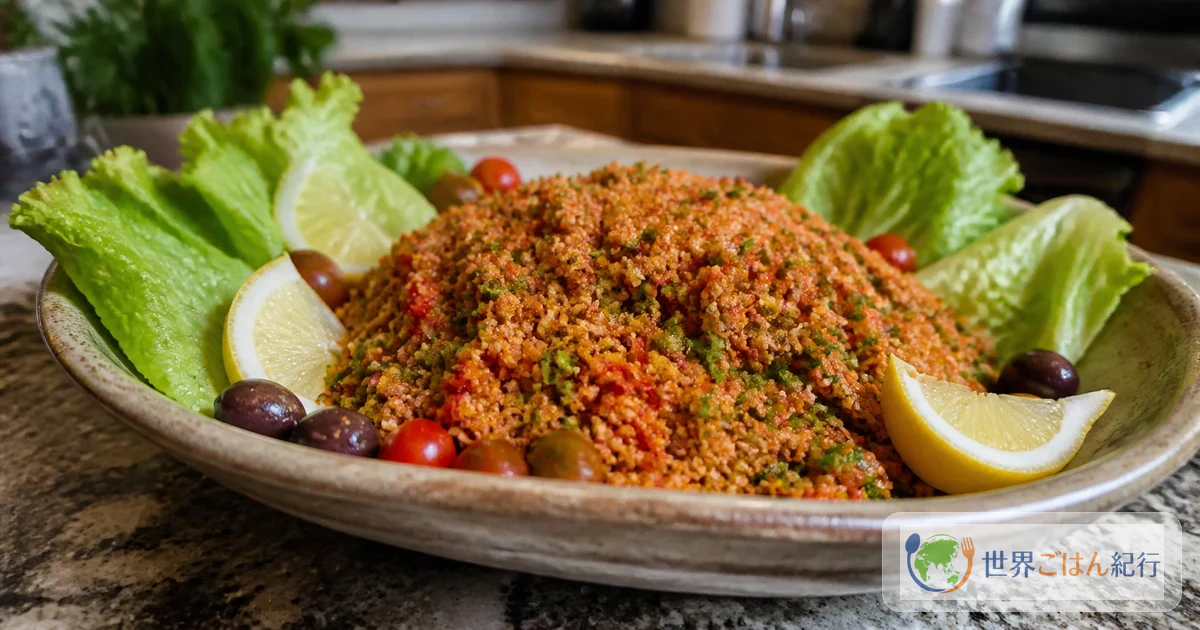
The moment it comes out of the oven, a scored meat pie fills the kitchen with its aroma
Picture an evening in the kitchen, looking into the baking dish. From the diamond lines scored in the surface, oil bubbles up in small beads, and the toasty smell of bulgur is laid over with cinnamon and the sweetness of sautéed onion. This scene is imagined, to help you grasp the outline of the dish. Baked kibbeh brings up a "toasted grain" aroma that meat alone cannot.
This is kibbeh bil sanieh. The Arabic "kibbeh bil sanieh" is explained in English food writing as "kibbeh in a tray" or "tray-baked kibbeh." The name points straight to the method. Unlike fried kibbeh, which is shaped one piece at a time, you layer a thin shell, a sautéed filling, and another thin shell in a single pan and cut it into pieces. Simply Lebanese's recipe also explains the meaning of the name and the way it is eaten from the pan.
In a home kitchen, the first stumbling block is not the number of ingredients. It is choosing fine bulgur, not leaving too much water in it after soaking, and not making the top and bottom layers too thick. If you get these three right, you can get to the point of seeing layers when you cut, even without a food processor.
The baseline is lean ground beef. We then go through, in order, the difference if you mix in lamb, the compromise if you replace pine nuts with walnuts, and how to build the flavor if you don't have Lebanese seven-spice. Finally, we cover how much yogurt, tabbouleh, and hummus to prepare, in a form that lets you decide whether to buy the ingredients now or hold off.
This dish uses bulgur, which contains wheat; beef or lamb; and pine nuts, a tree nut. If you serve yogurt or tahini alongside, watch for dairy and sesame as well. Commercial spices may be made on lines that also handle wheat, milk, and nuts, so people with allergies should check the labels.
The origins of kibbeh bil sanieh and the regional table
Kibbeh is a dish in which a shell made by combining fine bulgur and meat is paired with sautéed meat, onion, and nuts. It is not a single recipe belonging only to Lebanon; there are many forms, fried, baked, or cooked in yogurt, and the spices change by region and by household. As The Matbakh's explanation describes it, bil sanieh is the form finished in a baking pan.
It is hard to say "in Lebanese homes it is always done like this." For example, Simply Lebanese's write-up touches on differences between the Kamouneh style of southern Lebanon and the seasoning seen in the north and Beirut. In A Pinch of Adventure's home-cooking record, it is described as a dish that appears at holiday tables and family gatherings. Both are representative examples, not the only correct answer. We choose the parts where differences show up when you recreate it at home.
What to keep for authenticity, and what you don't need to buy
| Axis of judgment | Core to keep | What you can adjust |
|---|---|---|
| Grain | Fine bulgur. A smoothness that joins with the meat | Adjust the water to the soaking time on the package |
| Meat | Beef, or beef and lamb. Not too fatty for the shell | If you don't have lamb, make it with beef alone |
| Aroma | Seven-spice, allspice, cumin, a little cinnamon | Without seven-spice, build it from allspice and black pepper |
| Texture | A layer of sautéed filling and pine nuts | Pine nuts can be replaced with walnuts, but the aroma changes |
| How to eat | Yogurt, herbs, acidity, and bread alongside | Tabbouleh and hummus can be store-bought, or a simple salad |
Using fine bulgur is not a matter of mood. With coarse grains or couscous, the meat and grain don't hold together well, and the surface cracks easily when spread thin. In Zaatar and Zaytoun's method too, using fine bulgur and shaping thin layers are the keys to the texture.
How it differs from fried kibbeh
| Type | Shape | Difficulty at home | Notes when making it at home |
|---|---|---|---|
| Kibbeh bil sanieh | Pressed into a pan and baked | Medium | Don't make the layers too thick; don't dry out the surface |
| Fried kibbeh | Barrel shapes stuffed with filling | High | Cracking, oil temperature, and wrapping are difficult |
| Kibbeh nayyeh | Raw meat and bulgur | High | Not covered here; we use the cooked, baked form |
| Kibbeh labaniyeh | Simmered in yogurt | Medium | Watch for the yogurt splitting |
For a first kibbeh at home, bil sanieh is the easiest form to judge. It needs no frying oil and no wrapping one piece at a time. But if you think of it as "just baking," it will tend toward either a cracked shell or a heavy center. The shortcut is to check, in order, the moisture of the shell, the thickness of the layers, and the oven temperature.
Ingredients (serves 4)
It helps to think of the ingredients in two groups: the outer kibbeh shell, and the filling that goes between. The outside is where fine bulgur and meat are joined into one. The inside is sautéed meat, onion, and pine nuts, which creates aroma and texture.

You can adjust the meat to beef, lamb, or a mix of the two. Pine nuts are expensive and can be replaced with walnuts. Only the bulgur, though, if at all possible, look for the fine grind. Swapping in couscous or breadcrumbs gives a texture closer to a different meat dish than the thin layers of kibbeh.
What is worth buying
Once you have bulgur and spices, you can use them across Lebanese cooking. Leftover bulgur goes to tabbouleh, tahini goes to hummus, and cumin goes to falafel (in Japanese) and kebab. Decide whether you are buying only for one tray of kibbeh, or whether you can see the next dishes too.
Fine bulgur is an ingredient you buy for the texture
The conditions for buying are that you want to keep the cross-section of the kibbeh thin and even, and that you plan to use the rest in tabbouleh as well. Don't decide by the word "bulgur" on the label alone; check that it says "fine" and that the package size is 500 g. Coarse bulgur, or prepared, seasoned products, won't make this shell.
How to make it: thin layers, hot oil, rest before cutting
Kibbeh bil sanieh is not a dish where you mix everything together and bake it. You keep the outer shell and the filling separate, and layer them at the end. Because they are kept apart, the cross-section shows thin layers and you get the contrast between a toasty outside and a moist filling when you eat it.
Where things tend to go wrong, and how to fix them

If you will use cumin in the next dish too
If you don't have cumin, you would be buying it just to use 1/2 tsp in the base of the kibbeh. The condition for buying is that you plan to use it in falafel (in Japanese) or bean dishes too. If you already have ground cumin, skip buying and use what you have. When you buy, check that the package says ground cumin and its size.
It cracks during shaping
The cause is under-soaked bulgur, meat that is too lean, or too little moisture in the dough. If the surface cracks while you work it, add ice water 1 tsp at a time. Adding it all at once makes it loose, so adjust with the feel of working it with wet hands. Keep the meat for the dough cold, and spread it in the pan before the temperature rises and the fat softens.
It turns watery
This happens when the onion and bulgur hold too much water. Squeeze the grated onion lightly. Don't leave the bulgur soaking; drain it after 10 to 15 minutes. When cooking the filling too, don't layer it while pan juices remain.
The surface is hard
The baking time may be too long or the oil too little. Drizzling olive oil after scoring is not only for aroma but also to prevent drying. If your oven has strong top heat, check once after 20 minutes and cover with foil if needed.
The center is soft and collapses when cut
The filling may still hold moisture, or it may have been cut right after baking. If you cannot check the core temperature, bake 5 more minutes at a time without cutting, and cover with foil if the surface looks about to darken. The 10-minute rest after baking is part of the dish.
The filling falls apart
The filling may be too thick, or it was layered before it cooled. Keep the filling to about 5–7 mm, and when it is cooked, spread it on a tray to cool a little. Too many pine nuts make the layers separate, so start with about 35 g.
Sides that bring you closer to the local way of eating

Kibbeh is a meat dish, but it is easier to eat if you don't finish it with meat alone. In records of Lebanese cooking, baked kibbeh is repeatedly paired with yogurt, cucumber, herb salad, and bread. Simply Lebanese's serving suggestion also explains that the tray version can be a main dish or cut into small plates. If you set it on a dinner table, have cold yogurt and salad ready before you start baking, so you can create contrast in temperature and acidity on the plate.
On days it goes on your menu, rather than set the kibbeh in the center as a big main dish, take one cut piece at a time. With warm kibbeh, cold yogurt, an acidic salad, and thin bread on the same table, the heaviness of the meat does not persist, and each person can combine them in whatever amounts they like. If you want to bring in rice, extra lemony cucumber salad suits better than plain rice, and keeps the lightness of a mezze table.
Cucumber yogurt
Mix 150 g plain yogurt with 1/2 cucumber in 5 mm dice, a pinch of salt, a little grated garlic, and a little mint. Its role is to meet the oil and spice of the kibbeh with cold acidity.
If you use tahini, only 2 tsp in the sauce
If you have tahini, mix 100 g plain yogurt with 2 tsp tahini, 1 tsp lemon juice, and a little salt. If it is thick, add water 1 tsp at a time. It adds the richness of white sesame, and can be used not only for kibbeh but also for hummus and roasted vegetables. If you don't buy tahini, the cucumber yogurt alone fills the role.
Tabbouleh or a simple herb salad
For a more authentic match, tabbouleh goes well. On a day with little time, a simple salad of only parsley, tomato, lemon, and olive oil is enough. Baked kibbeh is a brown dish, so green and red beside it make the table look lighter.
Hummus and pita
With hummus beside it, the smoothness of chickpeas pulls the meal together. Lined up with kibbeh, hummus, tabbouleh, and pita, it becomes a small mezze table even at home. On a day you want to add something fried, keep falafel (in Japanese) to a small amount so the whole meal doesn't get too heavy.
Storage and reheating
| State | Storage | Keeps | Reheating |
|---|---|---|---|
| After baking | Cool a little, refrigerate in a shallow container | 2 days | 8 minutes in a 180°C oven or toaster oven |
| Before baking | Pack into the pan, wrap, refrigerate | Same day | Straight from cold at 200°C for 35 to 40 minutes |
| Cut pieces | Wrap one piece at a time and freeze | 2 weeks | Thaw in the refrigerator, then 180°C for 10 minutes |
When refrigerating, don't put it hot into a deep container. It takes a long time for the center to cool, which is not safe for a meat dish. After taking it out of the pan, move the pieces one at a time to a shallow container and put the lid on once the steam has settled.
Reheating in the microwave alone softens the surface of the bulgur again. On a rushed day, warm it in the microwave at 600 W for about 40 seconds and then bake in a toaster oven for 3 minutes to bring back the toastiness. Time varies with the thickness of each piece, so make sure it is hot all the way through. Do not warm the yogurt sauce; add it just before eating.
Frequently asked questions
Q. I can't find bulgur. Can I use couscous?
Couscous is closer to a granular pasta and does not bind with meat the way fine bulgur does. We have not built this recipe around couscous; if you must substitute, finely crush pearl barley and soak it in hot water. But the texture is a different thing. Looking for fine bulgur at a Middle Eastern grocery or online gets you closer to the cross-section of kibbeh.
Q. Can I make it with mixed ground meat?
You can. But the aroma of pork fat comes through and weakens the Lebanese character. For the first time, centering on lean ground beef is easier to handle, adding 1 tsp of beef fat only if it is too lean. If you can get ground lamb, using lamb for half of the filling brings out the aroma.
Q. What can I use in place of pine nuts if they're expensive?
You can use 30 g of coarsely chopped walnuts. The aroma changes, but the textural accent remains. Almonds stand out as too hard, so if you use them, chop them fine. If you leave out the nuts, cook the onion a little longer to make up the sweetness.
Q. Is a food processor essential?
Not at all. You can make it by working it by hand for about 8 minutes. If you use a food processor, the key is not to turn the meat and bulgur to a complete paste. Pulse briefly and stop before the grains disappear.
Q. Can I make it without an oven?
You can cook it covered in a heavy frying pan over low heat, but the dry, toasty surface is harder to get. In a frying pan, cook the bottom over low heat for 18 minutes, turn it over using a plate, and cook 12 minutes more. It breaks apart easily, so for the first time an oven or a toaster-oven-safe baking dish is recommended.
Summary: with kibbeh you build layers of meat and grain, more than a meat dish
Kibbeh bil sanieh uses plenty of ground meat, but the star is not the meat alone. Fine bulgur joins with the meat to form a thin outer layer. Inside is the aroma of pine nuts and onion, and alongside are yogurt and herbs. That combination is what makes it not just a meat pie but Lebanese baked kibbeh.
For the first time, fine bulgur, lean ground beef, onion, pine nuts, allspice, and yogurt are enough. Buy fine bulgur if you will keep using it in tabbouleh, and if cumin or tahini would be for one dish only, make do with substitutes you already have. Once you can draw that line, shopping stops being a source of hesitation. As you get used to it, mix in a little lamb, look for Lebanese seven-spice, or put tabbouleh and hummus beside it to widen the table.
Sources
- Simply Lebanese, "Kibbeh Bil Sanieh" (accessed 14 July 2026)
- The Matbakh, "Baked Kibbeh Bil Sanieh" (accessed 14 July 2026)
- Zaatar and Zaytoun, "Kibbe bil Sanieh" (accessed 14 July 2026)
- A Pinch of Adventure, "Baked Lebanese Kibbeh Recipe" (accessed 14 July 2026)
- Japan Ministry of Health, Labour and Welfare, "Q&A on heating conditions for meat" (in Japanese; accessed 14 July 2026)