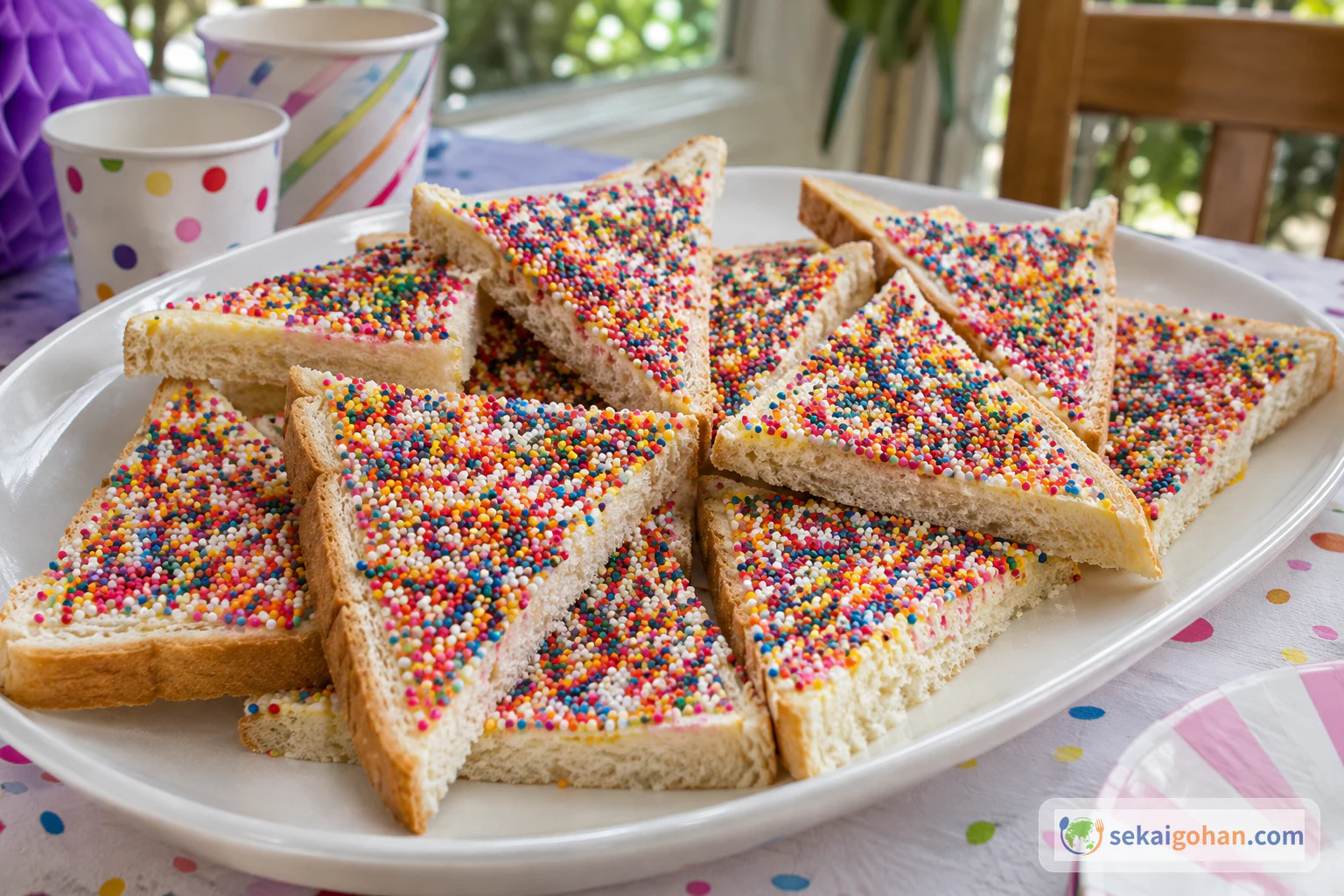
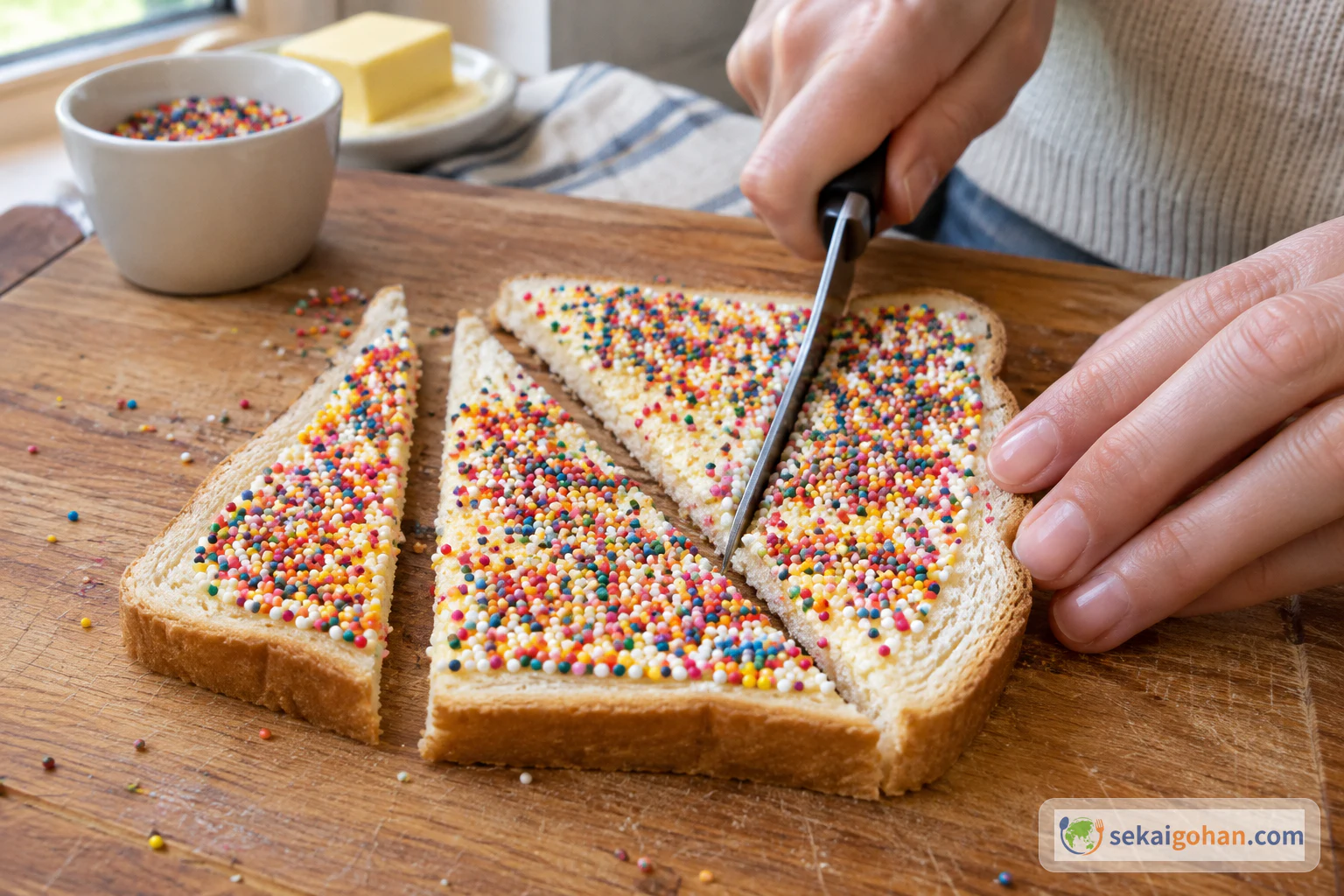
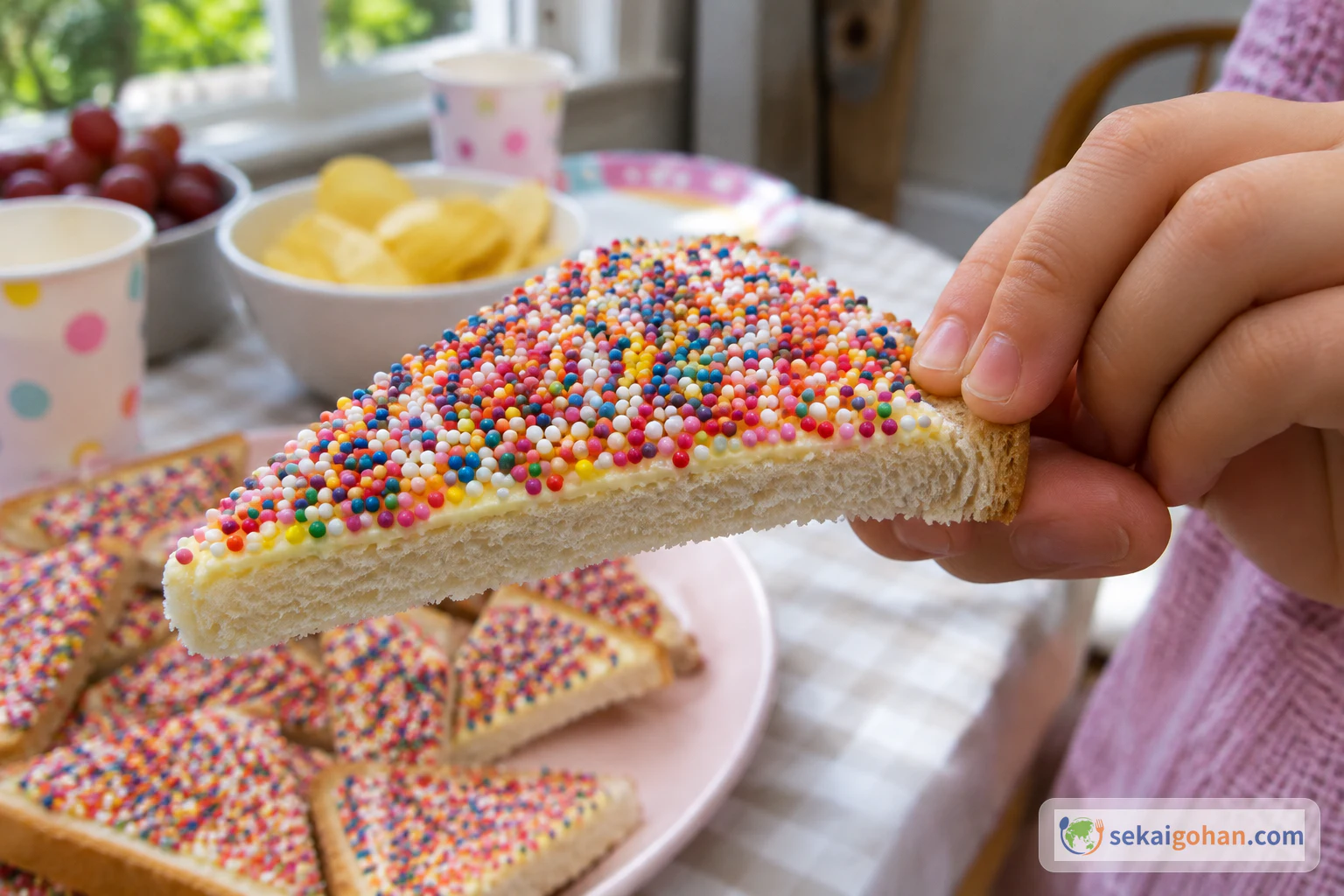
Small hands pick up the triangles by the crust. Every colour shows in the tiny round sprinkles on top, pressed close together, and some of that colour still ends up on the fingers. Fairy bread is soft white sandwich bread spread with butter, pressed into hundreds and thousands and cut into triangles. Children in Australia and New Zealand get it at their birthday parties. It tastes soft and only mildly sweet, with the gentle salt of the butter under the beads, and people often say it tastes like funfetti cake.
A Party Plate from Australia and New Zealand
At the children's table
Fairy bread takes three ingredients and no heat. There is nothing to bake and nothing to toast. The bread is served cold, which simply means as it is, straight from the cutting board to the plate. It shows up at children's parties on both sides of the Tasman, next to the cakes and the cups of cordial, and the name "fairy bread" is used almost nowhere else. If you are cooking your way through the food of Australia, this is the plate every Australian recognises from childhood.
The rules are short and people hold to them. The bread is cheap, soft, white supermarket sliced bread. The sprinkles are the round, multicoloured kind. The cut is a triangle, and the crusts stay on so there is something to hold. Fairy bread has also become a small national joke. In April 2021 a satirical fake petition to rename it was reported by mainstream outlets as if it were real. In November 2021 it got its own Google Doodle.
Where the name comes from
Nobody knows for sure where the name began. It is often linked to "Fairy Bread", a poem by Robert Louis Stevenson in A Child's Garden of Verses (1885). For a long time, though, the words meant other foods. In 1913 a recipe competition in a Perth newspaper gave the name to an eggy tea cake raised with baking powder instead of yeast. Through the 1920s, "fairy bread" usually meant very thin, crisp toast served with soup, close to Melba toast.
The sprinkles came first. A collection of writing published in Melbourne in 1886 already shows hundreds and thousands scattered over bread and butter. In 1921 a Perth confectioner's advertisement presented nonpareils as a treat to amuse children. The name and the sprinkles first appear together in April 1929, in a Hobart newspaper's report of a children's party at a sanatorium. That report lists fairy bread and butter with 100's and 1,000's, along with cakes, tarts and home-made cakes. By 1935 a Sydney newspaper was recommending it as a Christmas treat for children, and the meaning has stayed the same since.
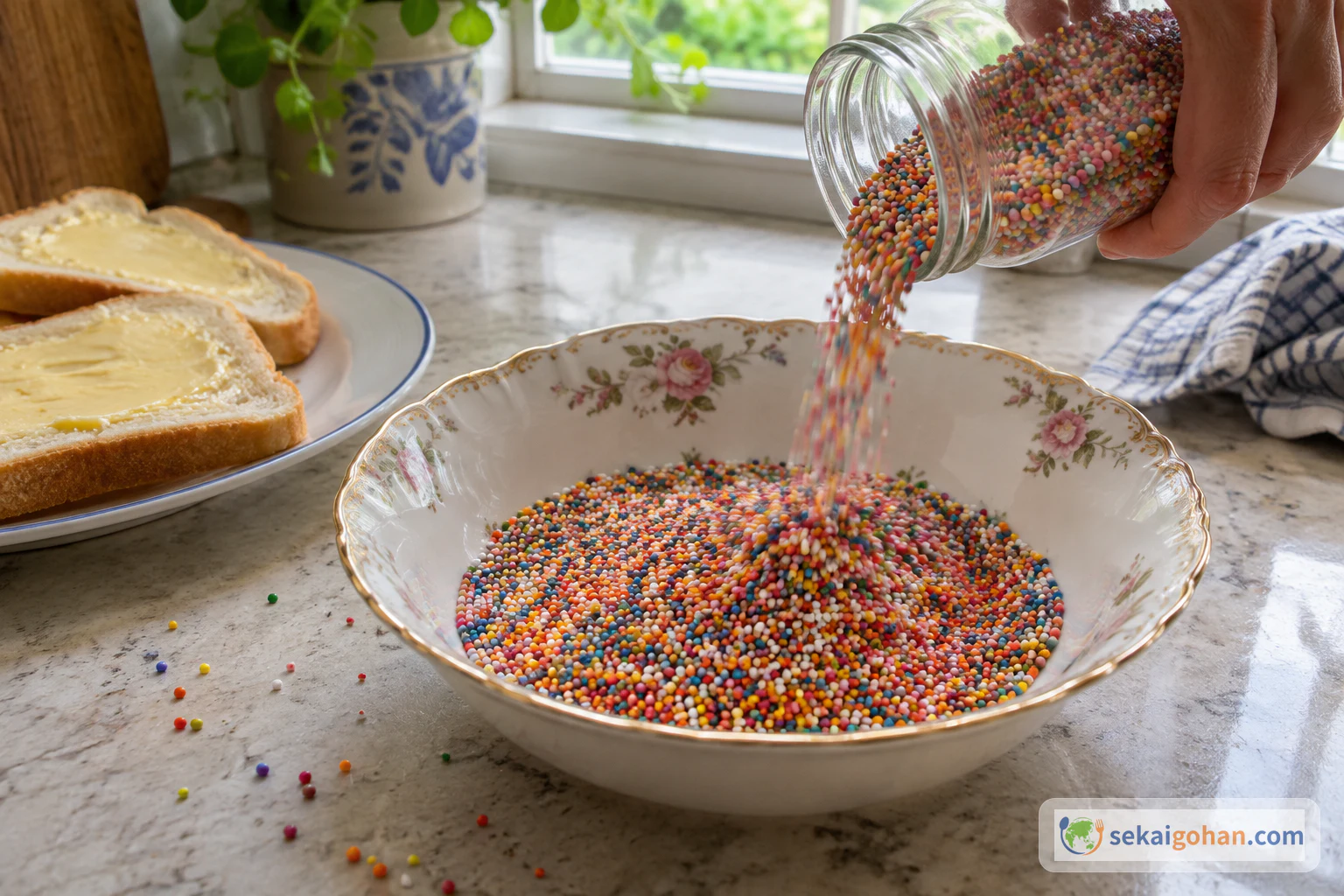
In Australia and New Zealand, the tiny round multicoloured sprinkles are called hundreds and thousands, often written 100s & 1000s. Elsewhere they are sold as rainbow nonpareils. The round shape is part of what makes the dish fairy bread.
Its neighbours in the Netherlands
The Dutch also put sprinkles on buttered bread, but they make it a different food. Hagelslag is made of oblong chocolate sprinkles a few millimetres long, and the Dutch eat it every day, mostly at breakfast. One estimate puts their consumption at around 14 million kg a year. The same family includes muisjes, sugar-coated aniseeds, and vlokken, flakes of chocolate. Fairy bread is the party version of the same idea: round beads in every colour, cut into triangles, and eaten at a birthday.
Ingredients (serves 4)
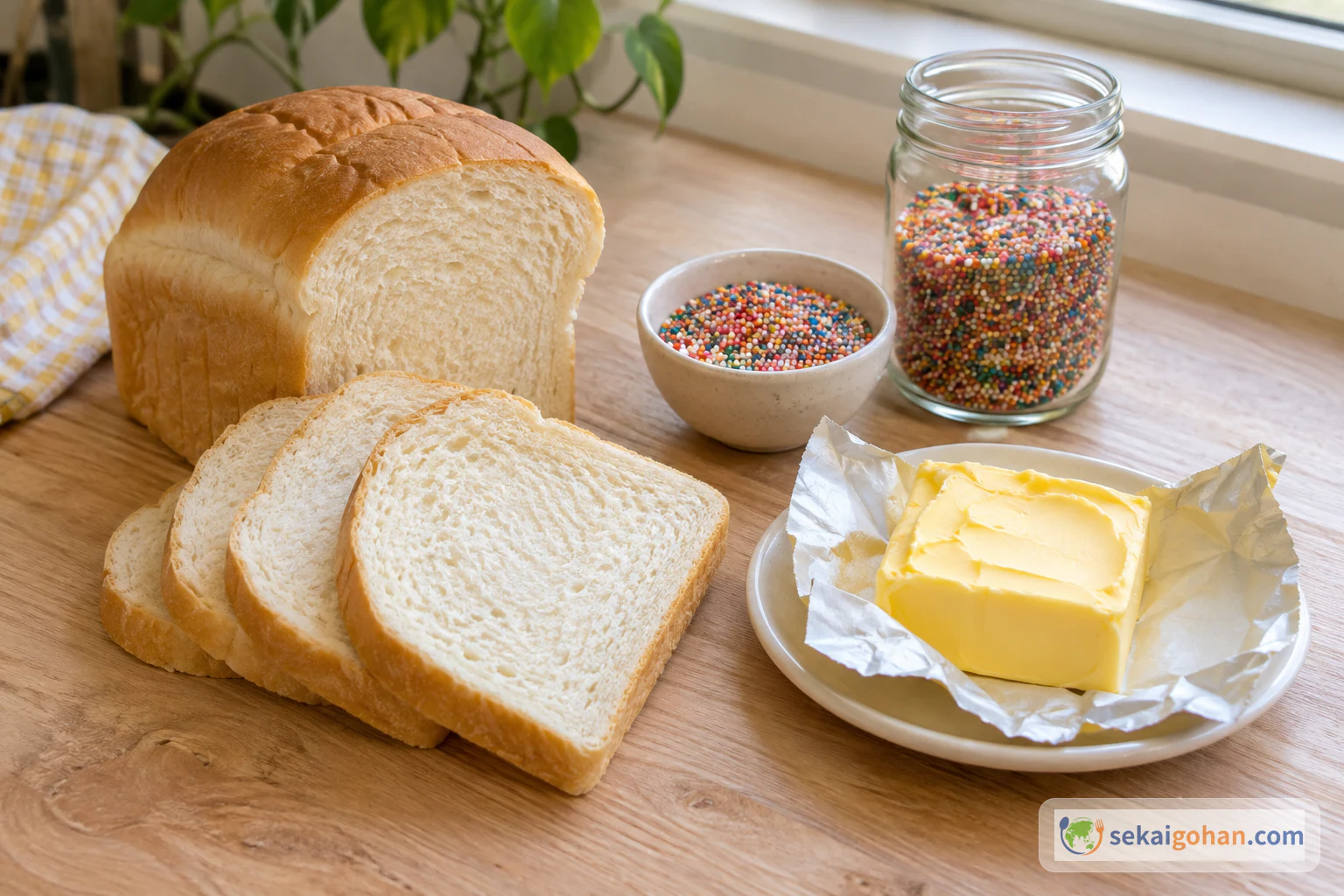
No other salt is added. Salted butter is the only thing that balances the sweetness of the sprinkles, so buy salted rather than unsalted.
Bread contains wheat and butter contains milk. Check the bread label for milk as well. Also read the sprinkle label for anything your guests need to avoid.
Equipment
- A small table knife for spreading
- A wide bowl with a rim, wider than a slice of bread
- A plate for the buttered and coated slices
- A cutting board
- A small sharp knife or a bread knife
When children help, give them the dipping and pressing to do and keep the sharp knife with an adult.
Choosing the Bread, Butter and Sprinkles
Buy the cheapest soft white sandwich loaf in the supermarket. In Australia that is the bread fairy bread is made with, and a fancy loaf gets complaints. A sourdough, a seeded loaf or a firm crust fights with the soft, sweet top. Square-sided sliced bread of an ordinary thickness is what you want.
Salted butter is the classic choice. Margarine is the usual swap for anyone who avoids dairy, and it does the same job of holding the sprinkles. Spread as little as you need for the sprinkles to stick. A thick layer turns greasy in the mouth.
Hundreds and thousands are the one thing you may have to look for. Baking supply shops and online shops sell them as rainbow nonpareils, so search for "nonpareils" or "hundreds and thousands". Long sprinkles, chocolate strands or flat confetti shapes make a fine snack, but it looks and eats differently, and the long chocolate strands move it toward Dutch hagelslag. For fairy bread, keep the round beads and keep the crusts on.
Method
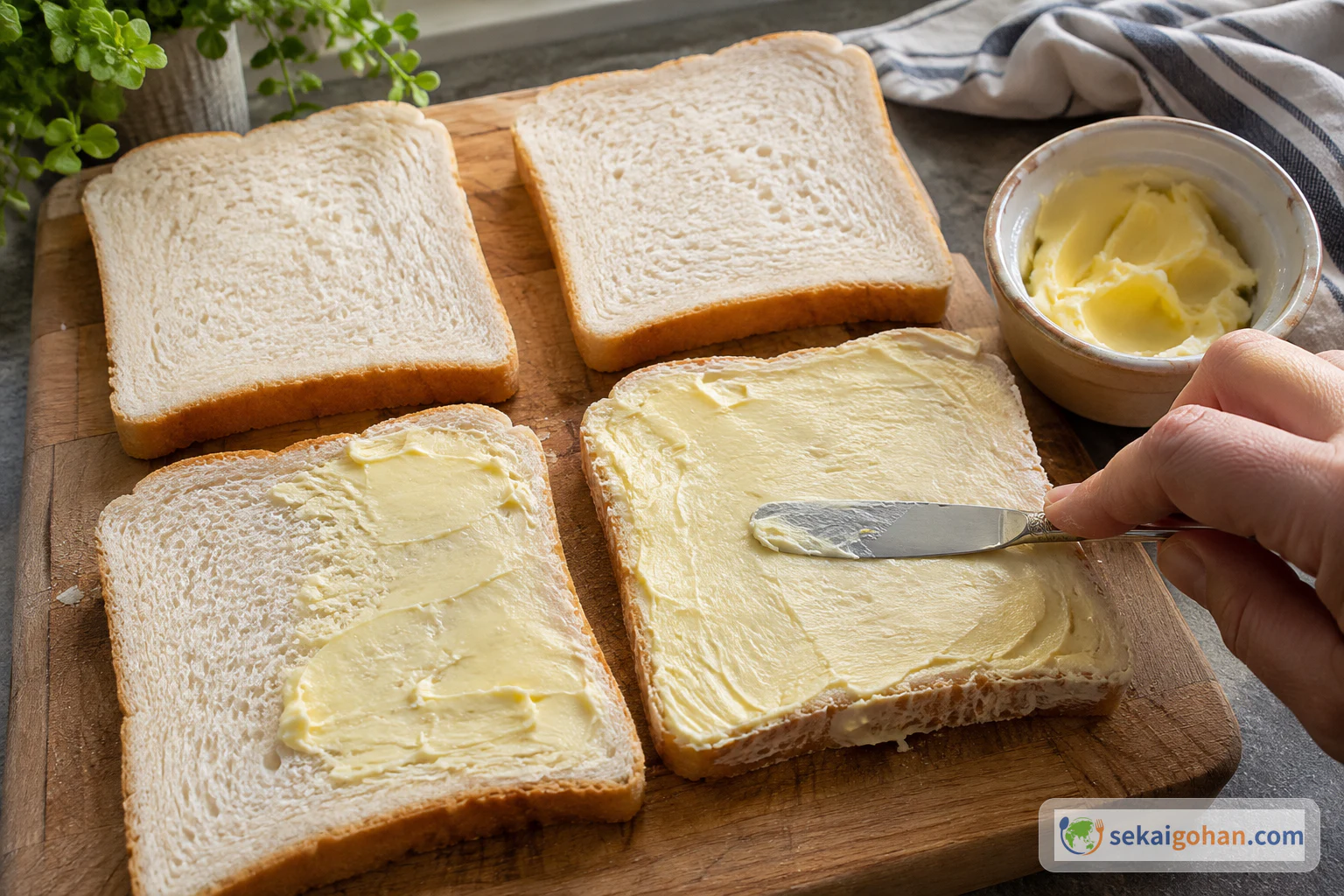
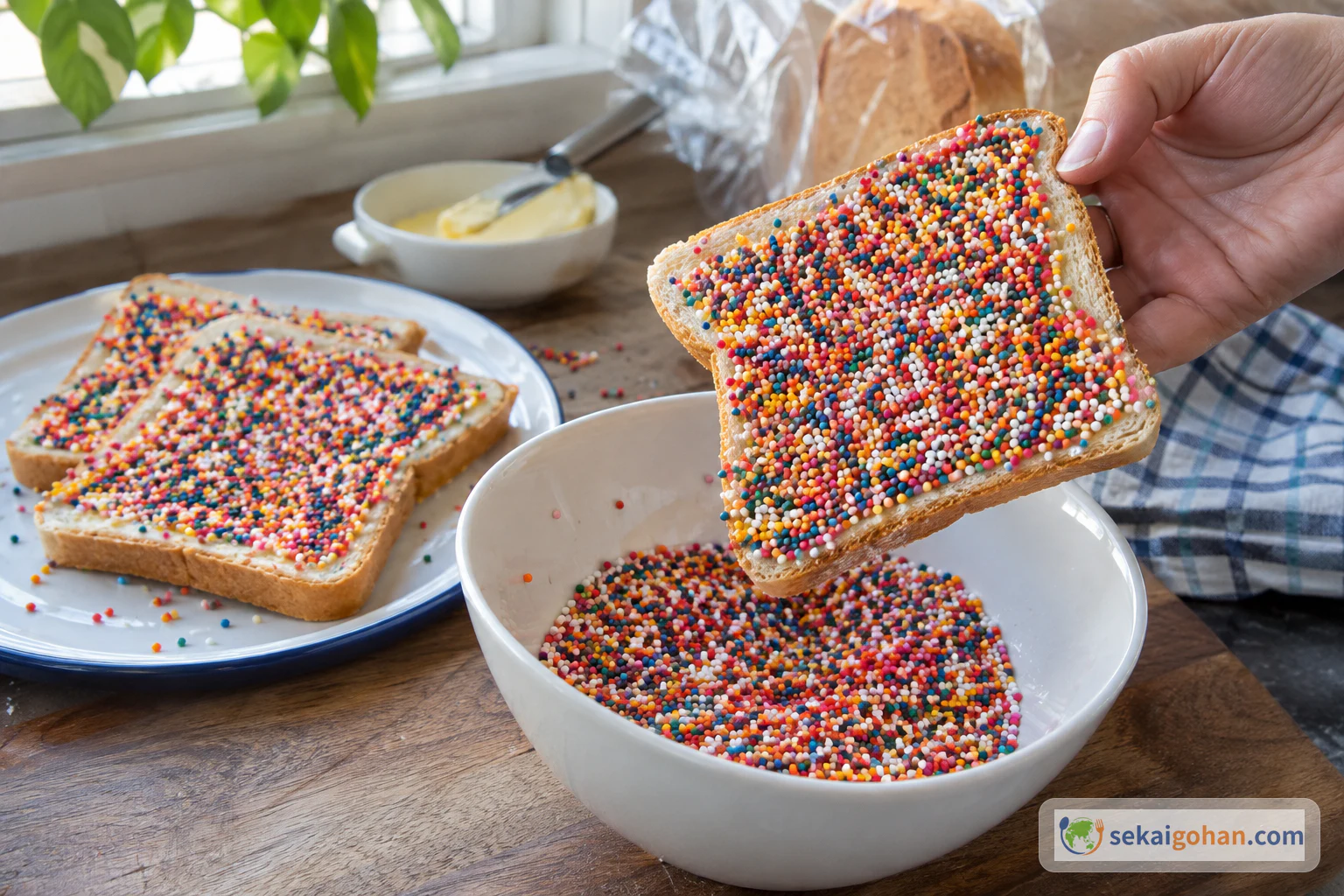
The only waiting is for the butter to soften. Once it is soft, the work takes about five minutes. Butter every slice before you start dipping so you can coat them one after another, then cut and serve right away.
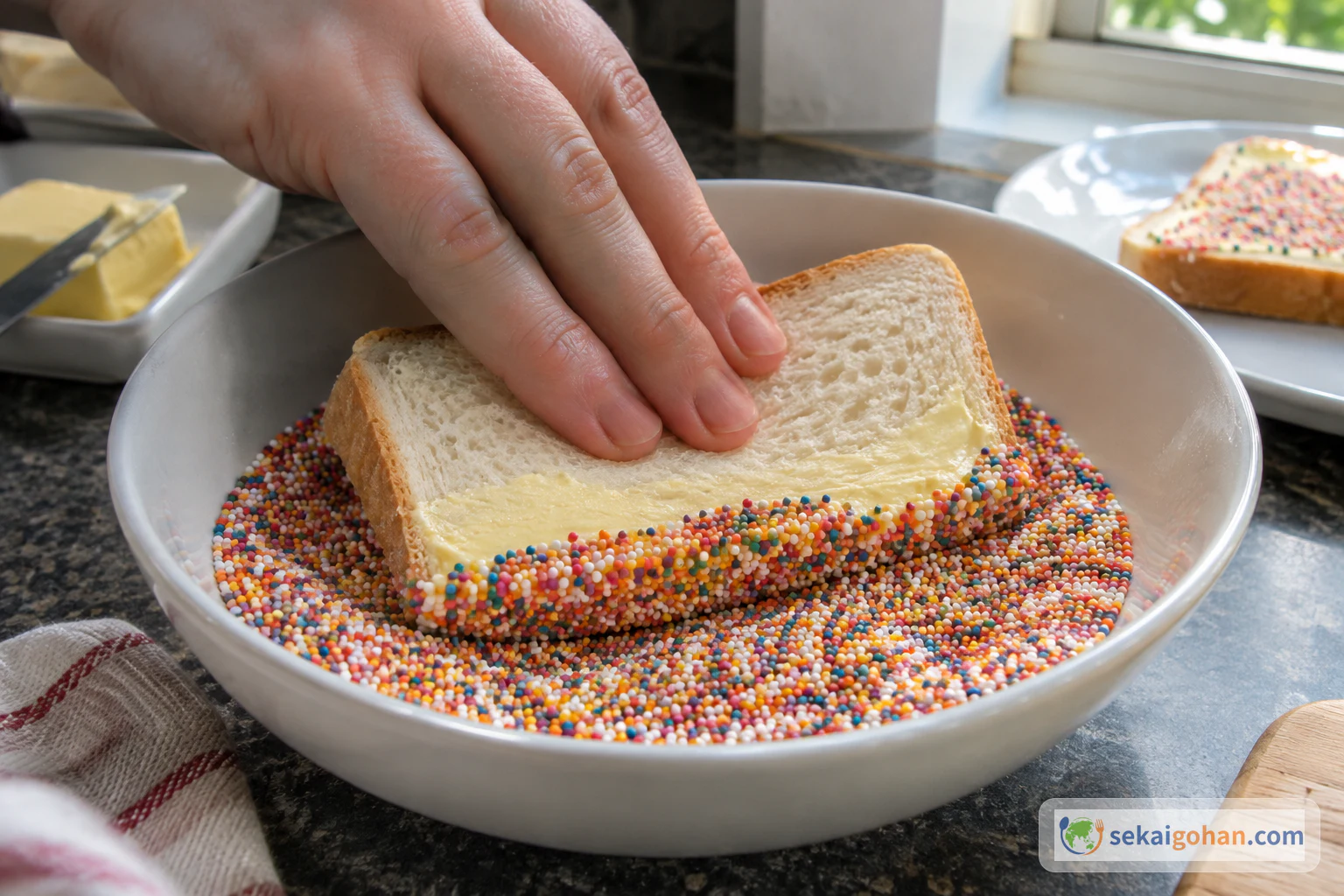
If you scatter sprinkles over the bread from above, you get bare patches and beads all over the floor. Press the buttered face into a bowl of sprinkles instead. The whole surface gets covered in one go and the loose beads stay in the bowl.
When It Goes Wrong
| What you see | Why | What to do |
|---|---|---|
| Only spots of colour, with bread showing between them | The sprinkles were scattered on top and not pressed in | Press the slice butter side down into the bowl and push gently over the whole face |
| Sprinkles all over the bench and floor | Scattering from above | Use the wide rimmed bowl so the loose beads stay inside it |
| The bread tears while you spread | The butter is still cold | Wait until a finger sinks into it easily, then spread with light strokes |
| Bare white edges or corners | The butter stopped short of the crust | Butter right out to the crust, then press the edge back into the bowl |
| Colour on everyone's fingers | People are holding the coated face | Cut with the crusts on and hold each triangle by its crust |
Serving and Variations
At the party table
Fairy bread goes on the table as soon as it is cut, at room temperature, usually on a plain plate next to the cake and the other party food. Pile the triangles loosely so the coloured tops and white crusts both show. Children reach for them first because they are small, bright and easy to hold.
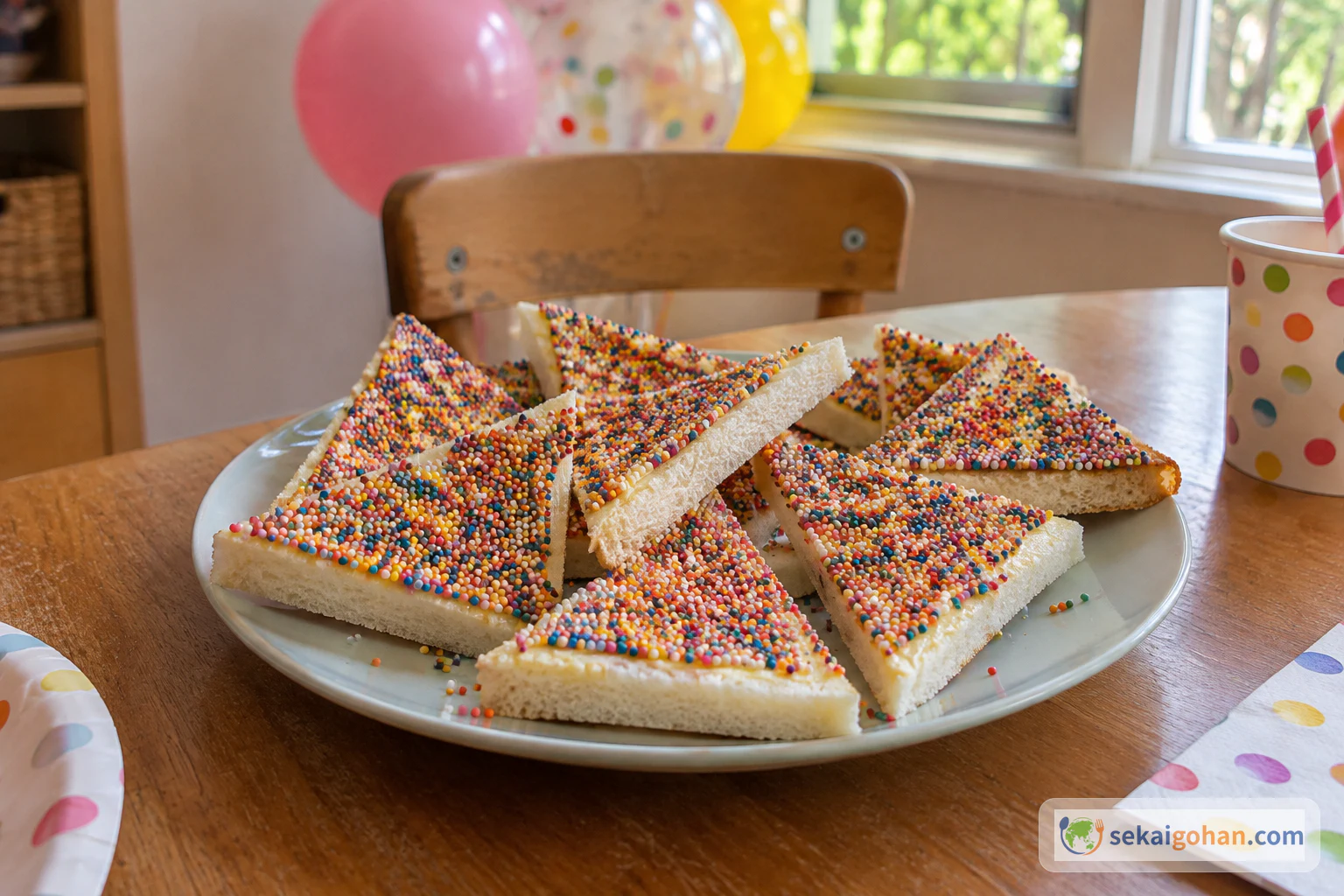
Holding a triangle by the crust at its tip keeps your fingers away from the sprinkles. You bite into the beads first, then the soft white bread underneath.
Variations
- Dairy-free. Use margarine instead of butter and choose a bread with no milk on the label. The sprinkles stick just as well.
- One colour of sprinkles. Use round nonpareils in a single colour to match a party theme. The method stays the same, but you lose the rainbow look that makes fairy bread recognisable.
Frequently Asked Questions
Can I make fairy bread ahead of the party?
Make it just before serving. It is a cold dish, made on the bench and eaten straight away, so slices that sit too long lose the fresh, soft feel. Butter the slices and fill the bowl a little early if you like, then dip and cut when guests arrive.
Should the bread be toasted?
No. Classic fairy bread uses plain, untoasted soft white bread and is served cold. Toast turns it into a crisp, warm snack with a different texture, and the butter melts instead of holding the sprinkles in a neat layer.
How much should I make for a party?
This batch gives one slice per person for four people, cut into two or four triangles each. For a bigger group, increase the bread, butter and sprinkles by the same amount. A single tray at an Australian children's party can hold around two loaves' worth.
Was fairy bread really banned in Australian schools?
No. In 2024 a rumour went around that schools in South Australia had banned fairy bread. The state education department said the report was false and that its food guidelines are voluntary.