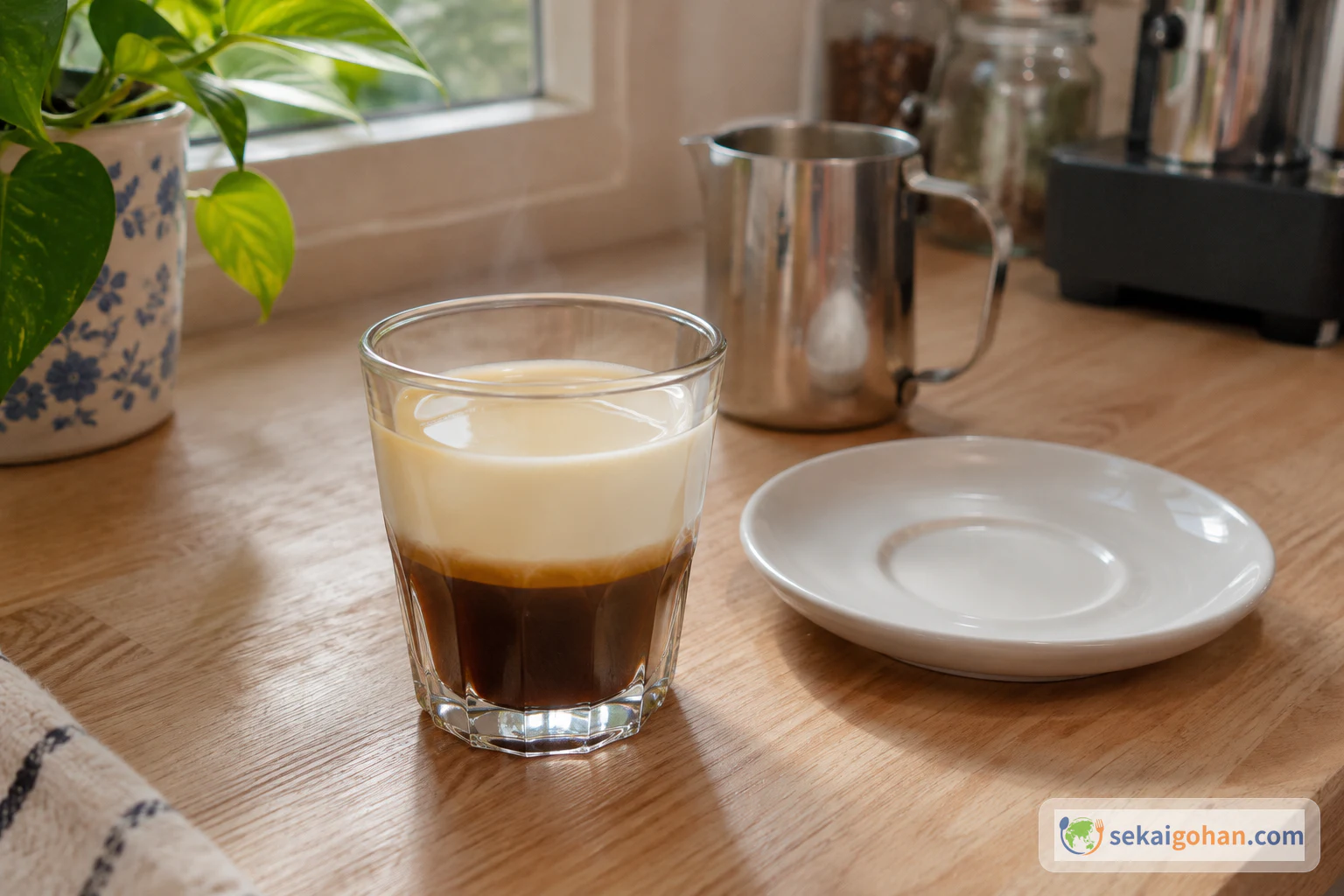


The jug drops low over the cup and the milk speeds up. It hits the back of the cup, folds over itself, and a pale leaf opens on a brown surface that stays almost level with the rim. That flat, smooth top is the whole idea. A flat white is espresso with steamed milk. It carries more coffee than a latte and much less foam than a cappuccino, so the espresso comes through the milk instead of hiding under a soft cap.
In Australian cafés it is a standard order. At home it takes two ingredients and a few minutes. What matters is how much air you let into the milk.
A Café Drink with a Disputed Birthplace
Flat, and white
The name describes the cup. The foam is not piled high, so the surface sits flat, and the milk turns the coffee white. One way to think of it is as the espresso version of the black coffee with milk that people make at home. It is a plain, strong, milky cup rather than a foamy treat. Next to a latte the coffee is more concentrated. Next to a cappuccino the top is thin and glossy, with none of the airy dome you dig into with a spoon.
Who poured it first
Australians and New Zealanders have argued over the flat white for decades. On the Australian side, an espresso bar on Sussex Street in Sydney opened in 1985 and claims to have been the first to put the name on its menu, and its owner keeps a menu photograph dated to that year. A 1983 review of a Sydney café already printed the words "flat white coffee." On the New Zealand side there are two stories: one from Auckland in 1984, and one from Wellington in 1989. In the Wellington story a cappuccino would not foam because the milk was low in fat, and the barista served it anyway, flat and white.
The name is older than either country's claim. "Flat white" turns up in 1960s Britain: a character orders one in a 1963 British film, and the phrase appears in print there in 1971. Another account goes back to 1950s Britain. Thrifty customers noticed that a cappuccino cup held about ¼ cup (60 ml) less than a teacup, so café owners, many of them Italian, used the bigger cup, added more water and topped it with a little foam. Where the drink began is not settled, and it probably never will be.
The argument went international in January 2015, when a large American coffee chain put the flat white on its US menus and credited it to Australia. New Zealand objected loudly. Since then the name has become café vocabulary around the world.
There is a well-known story from Canberra. In January 1985 the cafeteria at Parliament House reportedly put up a sign saying "flat white only" because the season's milk would not foam. The story has not been confirmed from a primary source.
Cups on either side of the Tasman
The cup changes from one side of the Tasman Sea to the other. Australian cafés tend to use a ceramic cup about the size of a latte glass, around a generous ¾ cup (200 ml). In New Zealand a tulip-shaped cup of about ¾ cup (175 ml) is more common. Many cafés also swap the espresso for a double ristretto, a shorter shot that makes the drink noticeably sweeter.
Ingredients (serves 1)
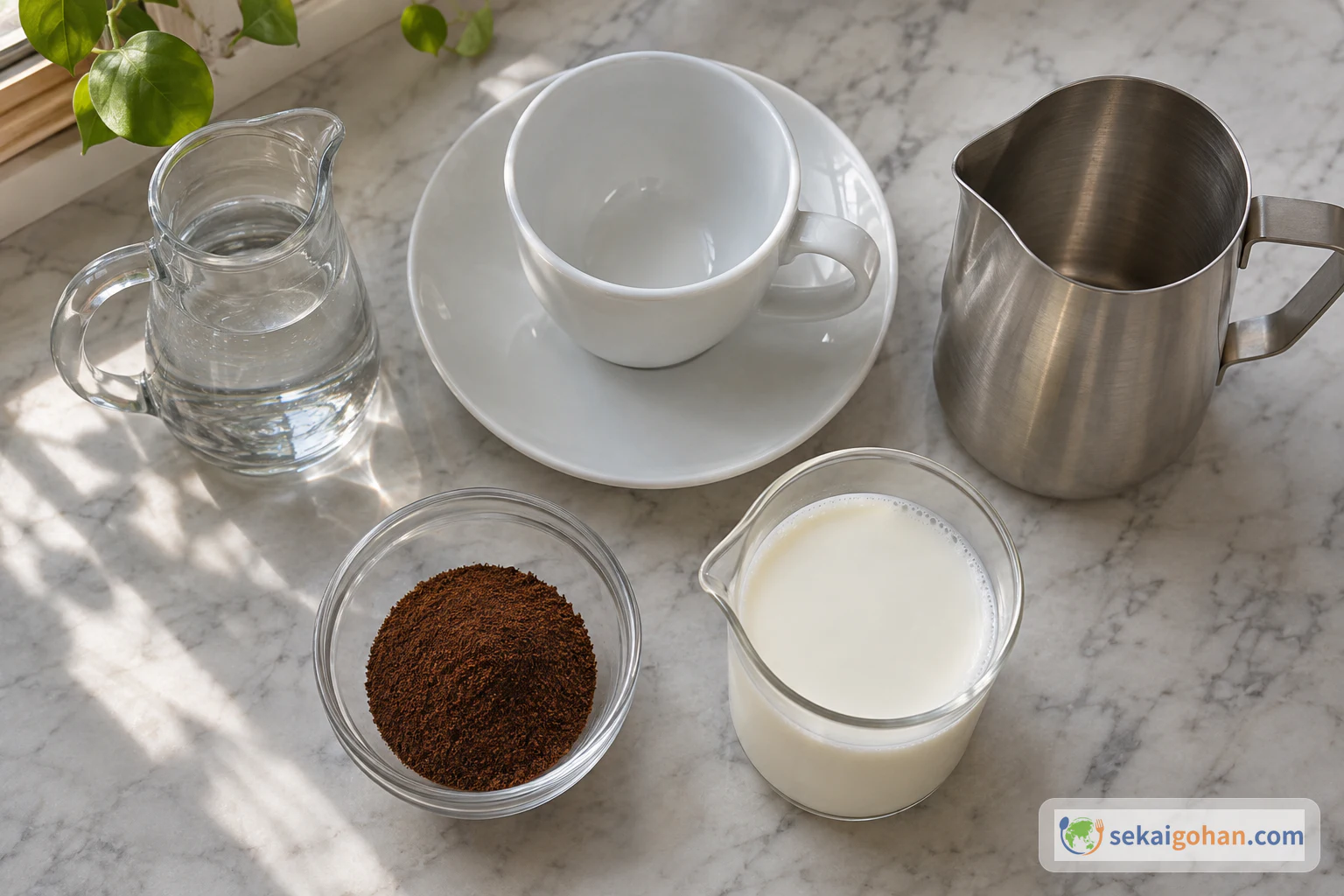
This drink contains milk. Plant milks are covered below, but they foam differently and change the cup. If you buy pods, check their labels for any added ingredients.
Equipment
- Espresso machine with a steam wand, or a pod machine with a steamer attachment, with the water reservoir filled
- Stainless milk pitcher (jug)
- A cup that holds ⅔ to a generous ¾ cup (150–200 ml), ceramic for the Australian style
- Coffee grinder that can grind fine enough for espresso, if you grind your own
- Milk thermometer (optional)
Choosing Coffee, Milk and Cup
Coffee beans make the biggest difference to the taste. Buy beans roasted within the last two weeks, in a medium to dark roast, and grind them just before you pull the shot. A double shot uses 0.6–0.7 oz (18–20 g), so the 0.6 oz (18 g) dose sits at the lower end. A pod works fine and saves the grinding and dosing. The cup is the Australian part of the drink, so a plain ceramic cup in the ⅔–¾ cup (150–200 ml) range is worth using.
| Milk | What it does to the cup |
|---|---|
| Whole milk | The best microfoam: glossy, fine and easy to pour into a pattern |
| Oat milk | The next best choice. It foams well and works for a dairy-free cup |
| Skim milk | Usable, but it gives a thinner body than whole milk |
| Soy milk | Usable, but its flavor can cover the espresso |
| Almond or coconut milk | Hard to steam into a smooth texture, so it is a poor fit for the flat foam |
Stale beans give a thin shot with pale crema, and no amount of milk technique fixes that. Fresh, recently roasted coffee is the one purchase that changes the result.
Method
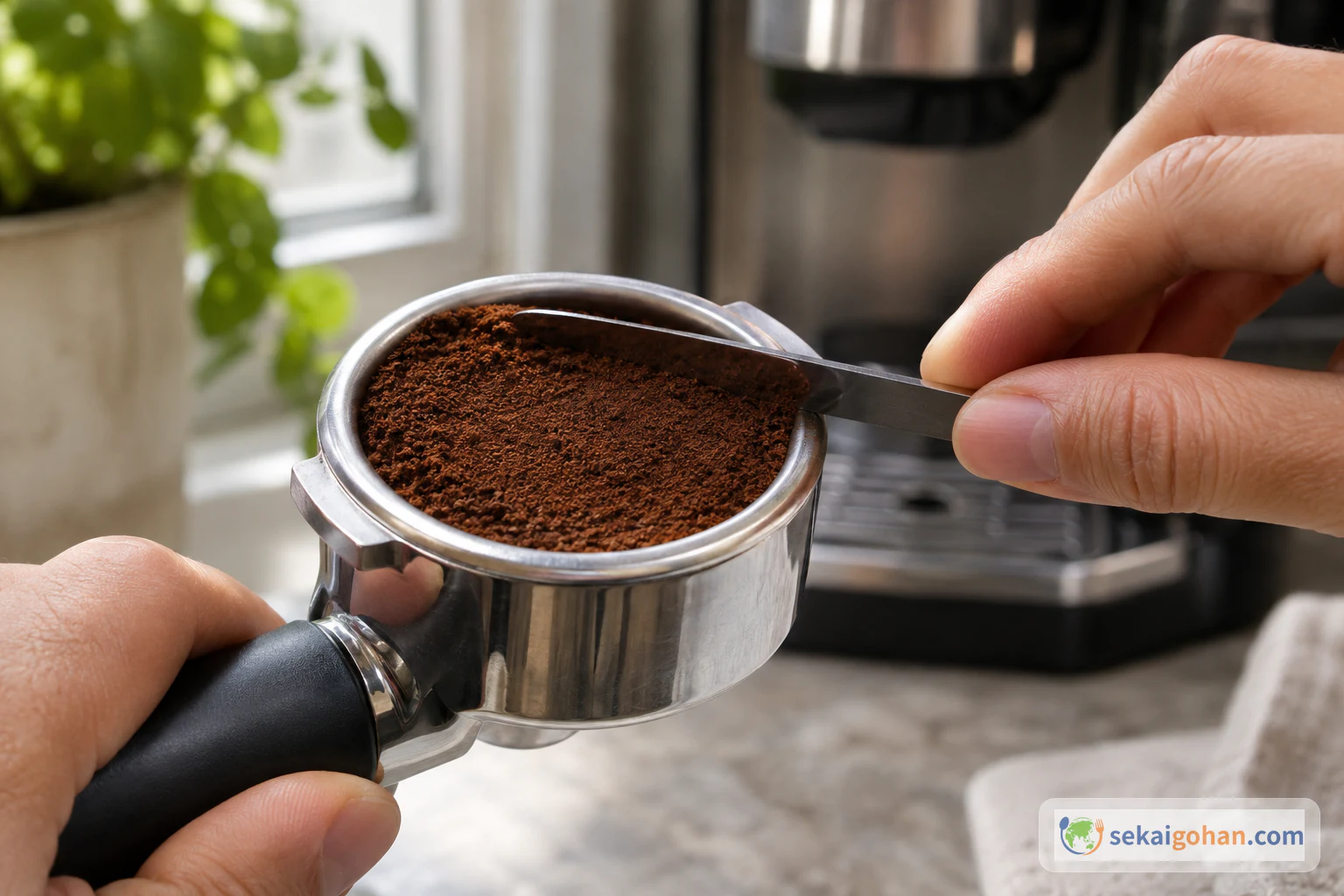
Work in one quick run. Make the espresso straight into the cup, then steam the milk while the shot is fresh, then pour. The whole cup takes two or three minutes, steaming included, so set out the cup and the pitcher of cold milk before you start. Steaming is where the drink is won or lost. A short burst of air gives a flat white, and too much air gives a cappuccino.
The steam wand, the steam and the heated pitcher can all burn. Keep your fingers away from the wand tip, and hold the pitcher by its handle once the milk is hot.
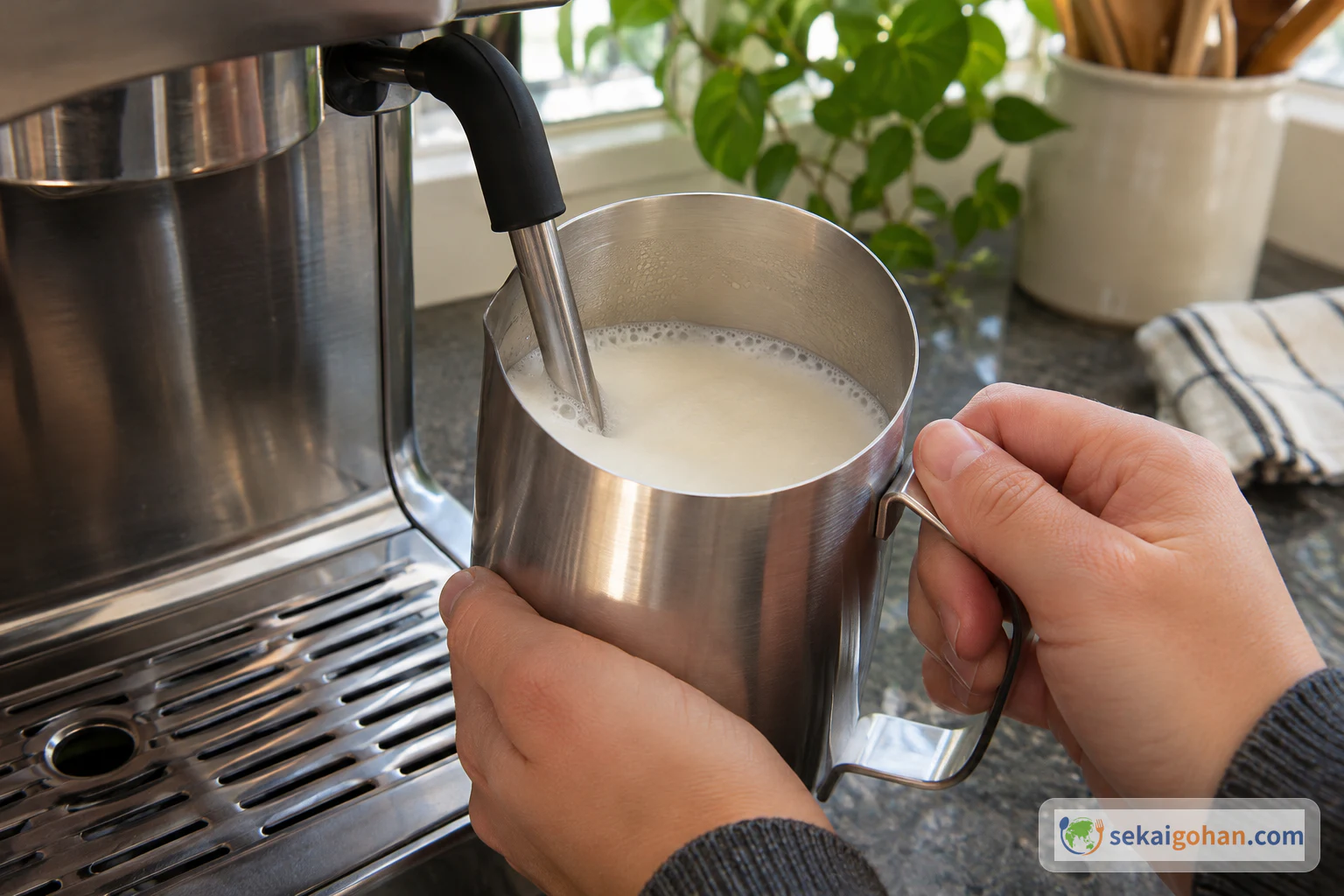
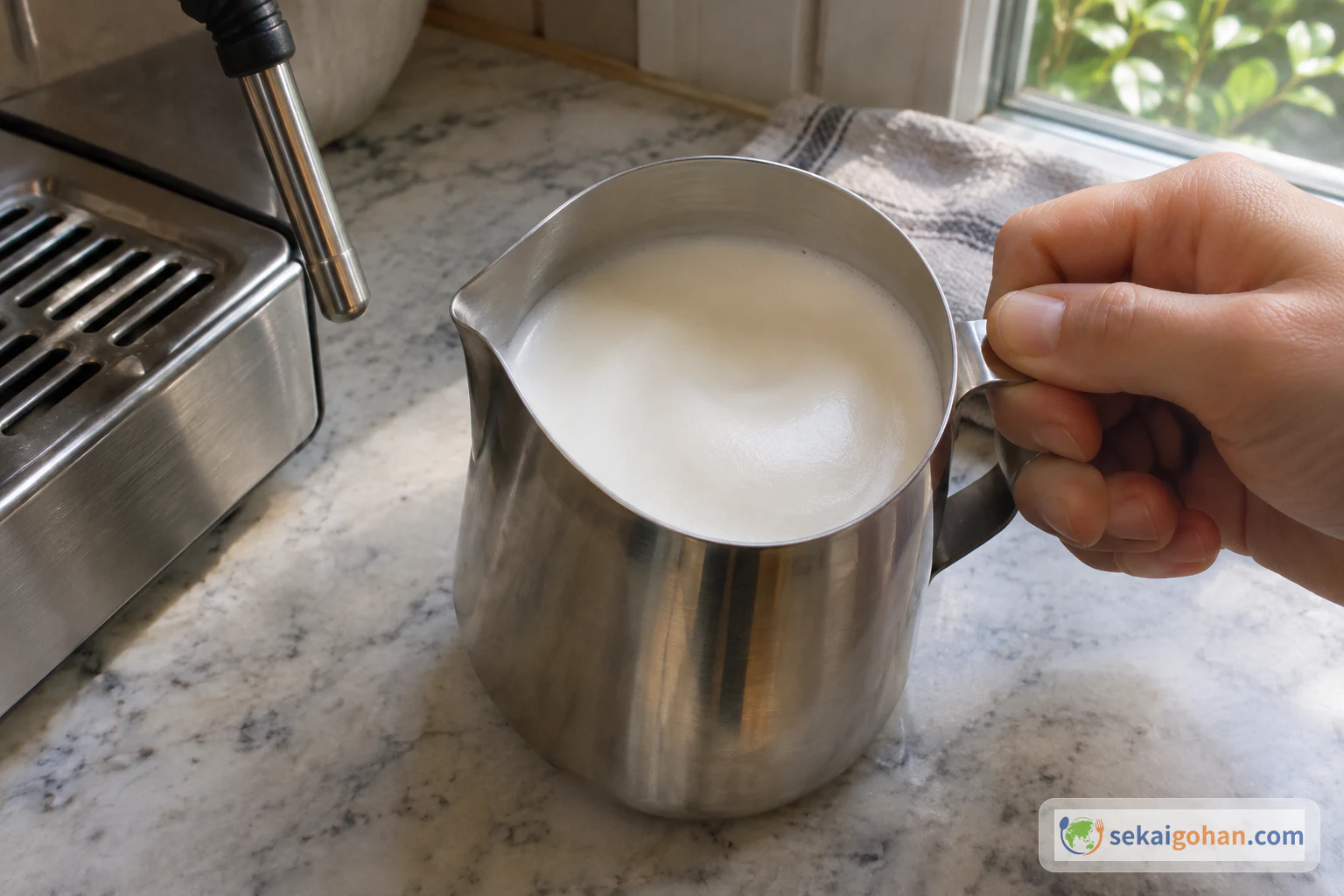
To control the air, hold the wand tip just under the milk surface for only 3 to 5 seconds. Then lower it slightly and angle the pitcher at about 20 degrees so the milk spins in a whirlpool. The whirlpool breaks large bubbles into fine foam instead of adding more. If you use a thermometer, stop heating at 140–150°F (60–65°C).
Machines differ. Some pull closer to ¼ cup (60 ml) in 25 to 30 seconds for a double shot. Measure what your machine gives once, then pick a cup in the ⅔–¾ cup (150–200 ml) range that leaves room for the milk to fold in and form the pattern.
When It Goes Wrong
| What you see | Why | What to do |
|---|---|---|
| Large bubbles all over the milk | The wand stayed near the surface for too long and pulled in too much air | Tap the pitcher on the counter to pop them. Next time, let air in for only 3 to 5 seconds |
| A tall foam cap, like a cappuccino | Too much air went in before the whirlpool | Lower the wand sooner and let the spinning milk heat without taking in more air |
| No pattern, only a pale or white blur | The jug stayed high for the whole pour | Start 1¼–1½ inches (3–4 cm) above the cup, bring the spout right down to the surface and tilt only at the end |
| The cup fills before the pattern forms, or tastes too milky | The shot was smaller than the cup expects, or the cup is too big | Check how much your machine pulls and choose a smaller cup in the ⅔–¾ cup (150–200 ml) range |
| Plant milk turns thin or splits into bubbles | Almond and coconut milks are hard to steam smooth | Switch to oat milk, which foams most like whole milk |
Serving and Variations

A flat white goes on the table as soon as the pattern has formed, in its ceramic cup on a saucer with a spoon. In Australia it belongs to the café counter. It is plain enough to drink alongside almost anything, and it needs no sugar, cocoa or syrup on top.
Double ristretto base
Pull a double ristretto instead of the espresso. The shorter shot makes a noticeably sweeter cup with less bitterness, and many cafés serve it this way.
The ¼-inch (5 mm) school
Some coffee schools teach a thinner top, with the milk settling under about ¼ inch (5 mm) of microfoam. Steam with even less air than in step 2. The result is a flatter, silkier cup.
Oat milk
Oat milk is the best dairy-free swap. It steams to a smooth foam and pours a pattern, and its own mild sweetness goes along with the espresso.
Toward a latte or a cappuccino
Use the same coffee and milk, but change the foam and the cup. More milk in a bigger cup moves the drink toward a latte. A deep layer of foam moves it toward a cappuccino. Keeping the foam thin and the cup small is what makes it a flat white.
Frequently Asked Questions
Can I make it with an espresso pod?
Yes. One pod replaces the 0.6 oz (18 g) of ground coffee, and everything else stays the same. Pull about 2 tbsp plus 1 tsp (35 ml) from the pod straight into the cup, then steam and pour as usual. The steamer attachment on your machine handles the milk.
Is a flat white just a small latte?
They are close relatives, close enough that a Sydney newspaper joked in 1984 that "cafe latte translates as flat white." The difference is less milk for the same espresso, and a thin foam layer, so the coffee taste stays in front.
Do I need a milk thermometer?
No. The foam depth is the cue to follow. A thermometer is useful while you learn, because it shows you when the milk reaches 140–150°F (60–65°C), the point where you stop heating.