Open the leaf, and coconut and root vegetables become one

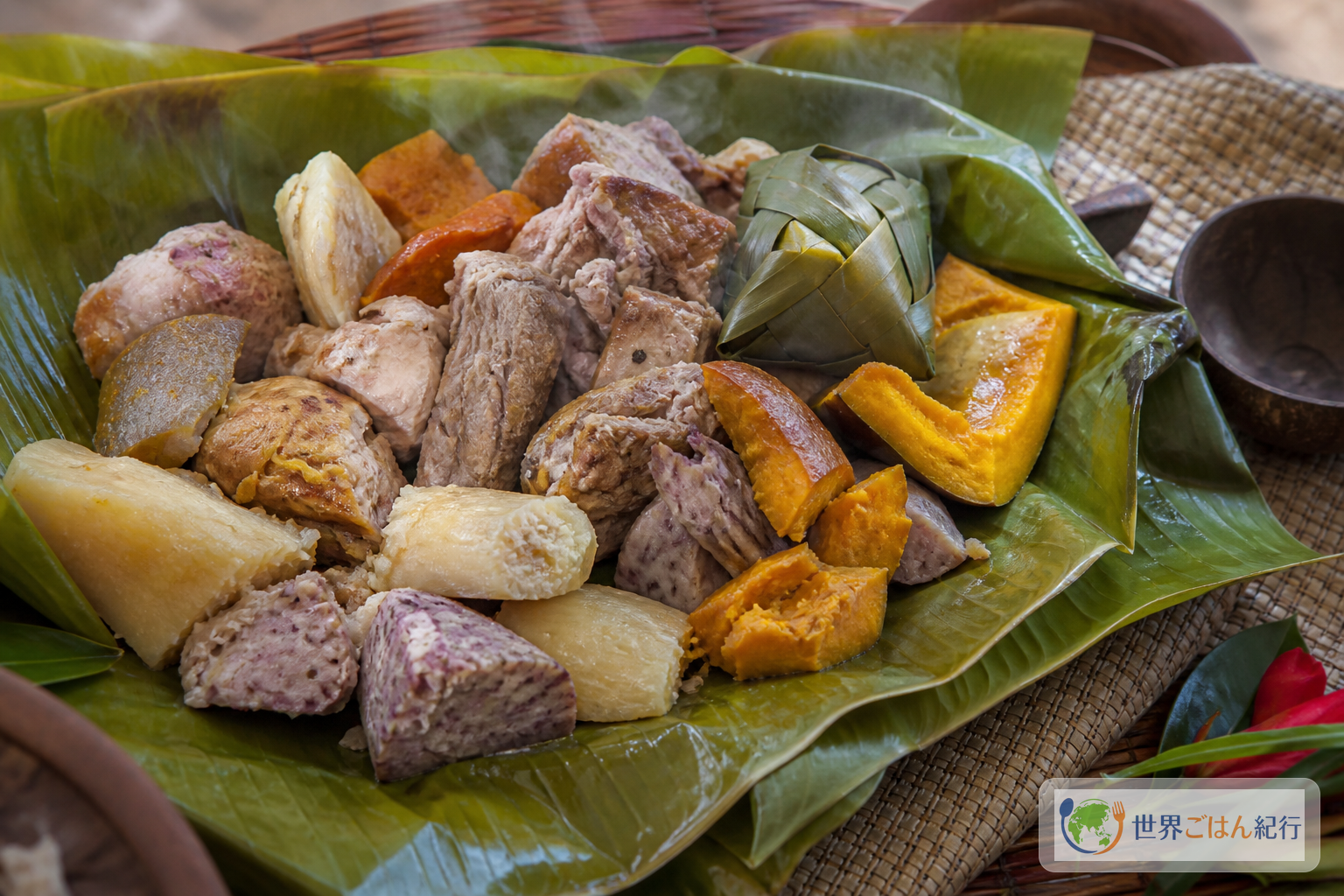
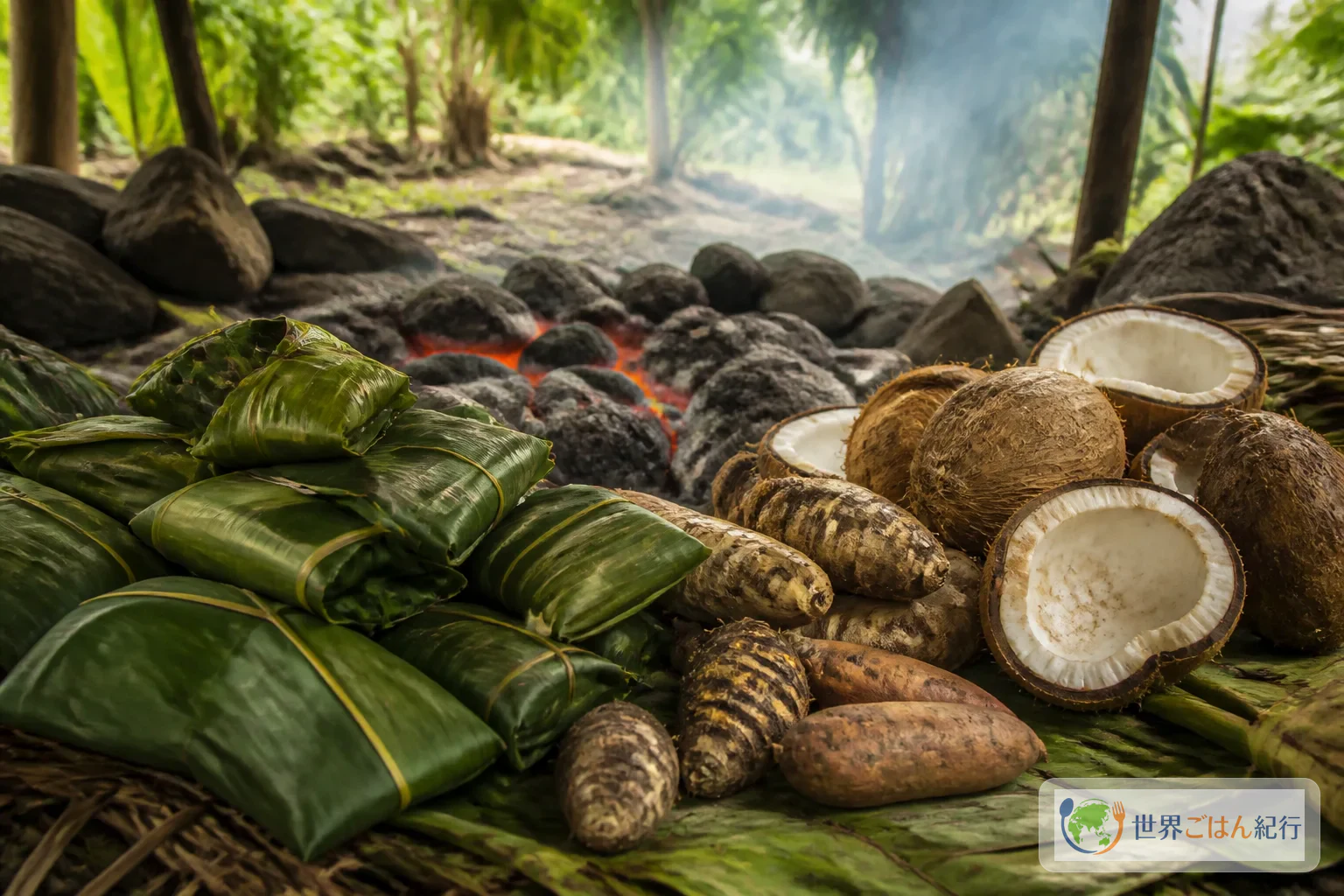
When you open the baked leaf parcel, the aroma of coconut comes first, and a gloss from the leaf's steam stays on the surface. The inside is not firm like a baked cake; it is a steam-baked dough in which grated root vegetables have come together softly and taken in the juices of the chicken.
Laplap is a dish that the Vanuatu tourism office introduces as the "national dish." Root vegetables such as taro, yam and cassava are grated, combined with coconut cream, wrapped in leaves and cooked slowly under hot stones. The hot stones add a slight smoky aroma, and it is tied to celebrations and to kastom (inherited custom) events, and is also sold at lunchtime markets. A fuller description of the dish is available in the Vanuatu tourism office's local food guide.
It is not only a specialty for tourists. In the markets of Port Vila, Luganville and Lenakel, and at roadside stalls outside town, local dishes are laid out alongside vegetables and root crops from the garden. In the scene of buying laplap at the market and eating it, you can see how Vanuatu's food is put together: garden crops on the island, fish coming from the sea, and the work of squeezing coconut all land on the same table.
In a home kitchen you can't reproduce an earth oven with stones laid underground as is. Still, you can keep finely grating the root vegetables, letting the coconut's fat soak into the dough, and sealing in steam with leaves and aluminum foil. Keeping the frame of the dish, grate the root, and bring it together with leaves and heat, we layer chicken and aromatics on as a home-style filling.
English sources vary between "Lap Lap," "Laplap" and "lap-lap." This article uses "laplap" throughout.
Ingredients (serves 4): separating the local core from the substitutes

The recipe from the Pacific Community (SPC) is built on one taro, 400 ml coconut cream, leaves, and vegetables of your choice with meat, chicken or fish, baked at 180 °C for about 2 hours. The amounts below are a home mix fitted to that idea for a four-serving baking dish. The coconut milk is divided by use ahead of time: 300 ml for the root dough, 30 ml for the leaves, and 70 ml over the filling.
The "true taro" that appears in the sources and the Japanese sato-imo are not necessarily exactly the same. If you can get taro at an import grocery you come closer to the original, but even peeled sato-imo suits the purpose of making a sticky, dense dough. Sato-imo is stickier than taro and holds together better when cut.
For the leaves, local sources vary between explanations using banana leaves and ones that prefer the softer heliconia leaf. If you can get frozen banana leaves, you keep the aroma. If it is difficult, wrap in oven-safe parchment and close the outside with foil, but the green aroma you get with leaves is weaker.
Never taste taro raw. Pacific taro sources also advise not eating raw corms or leaves, and peeling carefully and cooking by baking or boiling. Decide the seasoning of the grated dough by the amount of salt and the richness of the coconut milk.
For coconut milk, choose unsweetened cooking-grade, not a drink or a sweetened product. Check the can's content (400 ml here), its ingredients and how to store it after opening.
Method: layer the aroma of leaves and the stickiness of the root
Use a round 20 cm baking dish, or a baking dish 20 cm square and at least 5 cm deep. Have disposable gloves and a damp towel ready before peeling so that you don't touch your face or mouth with hands that handled raw taro. Keep the cutting board and knife for chicken separate from those for roots, and wash with detergent afterward.
Don't eat taro raw; peel it carefully and cook through to the center. When you substitute sato-imo, don't lick the raw grated dough to check the seasoning either. The University of Hawai‘i's Pacific Food Guide also sets out cautions on handling and cooking taro.
Because this is a wrapped dish with chicken, don't judge safety by baking time alone. By the standard of the US Food Safety and Inspection Service, the safe internal temperature for chicken and casseroles with meat is 74 °C. In this recipe too, check against the FoodSafety.gov temperature chart.
Tips: decided by the moisture of the dough and how the leaves are closed

Laplap is not a dish where you add seasonings to make the flavor stronger. The moisture of the root, the richness of the coconut milk and the steam left inside the leaf combine to make a softness that can be sliced. Judging the moisture decides whether the laplap can be cut.
If the holes are coarse, fibers of the root remain; if too fine, moisture tends to gather in one place. Use a fine grater with 2–3 mm holes and leave no hard lumps. If you chop in a food processor, a guide is not to let the pieces get bigger than a grain of rice.
If the taro is watery and the dough keeps running from the bottom of the bowl, don't add more coconut milk. Leave it 10 minutes to let the root absorb it, and if it is still loose, add only 50 g more grated taro. Putting in wheat flour or potato starch moves it away from the texture of a root steamed in leaves.
A torn leaf used alone lets coconut milk run out of it, and only the bottom of the dish turns watery. Lay a small piece of leaf over the hole and set the outer leaves in a cross. If you have no leaves, double the parchment before wrapping in foil, but parchment alone doesn't close.
If you scatter the chicken through the whole dough, the thin parts overcook and only the thick meat in the center lags behind. Put the chicken and onion in a single layer in the center and don't make a lump over 3 cm. If the internal temperature doesn't reach 74 °C, close the parcel and extend heating by 15 minutes at a time.
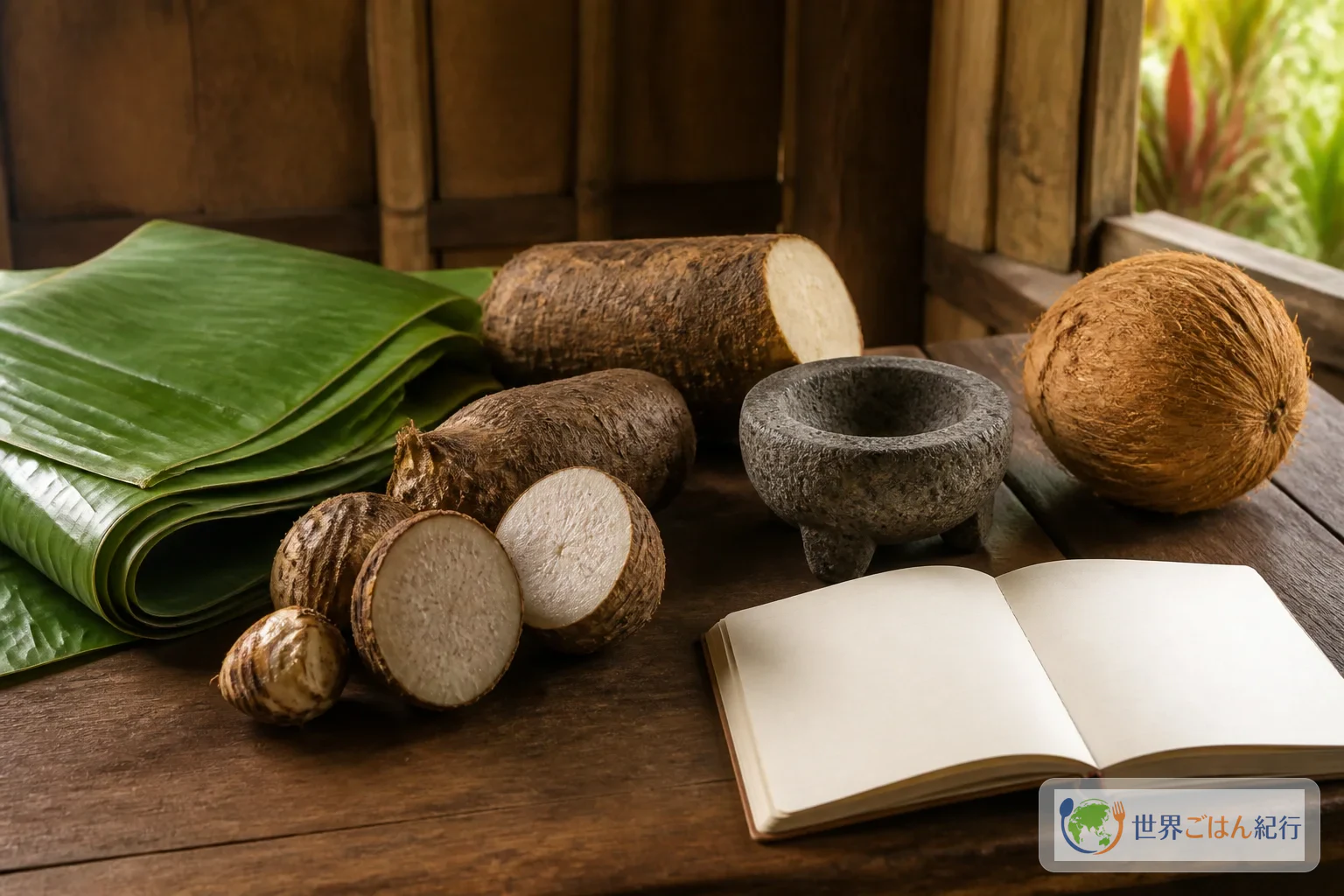
If you finely chop the garlic and ginger with a knife, you can make this without a mortar. But if you want to make a paste of the aromatics going into 400 g chicken, so as to concentrate the flavor in part of the root, a deep mortar with a pestle is easier to handle. If you also use it for other spices and aromatics there is a reason to buy one, but if you crush garlic only a few times a year, use a grater and skip buying one.
Variations: rearranging island roots and fillings

Laplap is not a dish fixed as "taro and chicken." The sources describe versions with cassava, yam and cooking banana, alone or combined, and the filling changes to vegetables, chicken, fish and so on. But when the filling changes, the heating time and moisture change, so don't reuse the 120 minutes of the chicken version as it is.
| How to change | How to build it | State to check |
|---|---|---|
| Use yam | Replace 600 g taro with 600 g yam | The stickiness is weaker, so don't make the dough thick |
| Use cassava | Grate 600 g thickly peeled cassava finely | Always cook to the center and leave no hard grains |
| Use cooking banana | Mash green plantain and the like as part of the root | Sweetness and moisture change, so don't add all the coconut milk at once |
| Switch to white fish | Replace 400 g chicken with 400 g boneless white fish | Aim for 45–60 minutes at 180 °C, and check the center is 63 °C or the flesh is opaque and flakes |
| Leave out meat and greens | Wrap only root, dough, coconut milk and salt | Bake it thinner as a root dish without filling, close to the Santo examples |
For Malekula's laplap soso'ur there are descriptions of using plenty of coconut milk before and after baking and putting meat or island greens in the center. To try that atmosphere at home, make a shallow hollow in the center of the baked parcel and pour 40 ml warmed coconut milk into it just before eating. This is not an amount that reproduces the local dish exactly, but a home variation inspired by the way of gathering sauce in the center and sharing around it.
The fish version finishes faster than the chicken version. Keep the root thickness to about 2 cm and heat until the white fish no longer stays translucent. If the dough sets first and only the fish lags, cut the fish from 4 cm to 3 cm cubes, and add 10 minutes without opening the parcel.
Set beside Fiji's lovo (in Japanese), which wraps fish in banana leaves, and Samoa's palusami, you also see differences among Pacific dishes that use leaves as a container for aroma and steam. In laplap the root dough is the center; in palusami the contents of the leaf and the richness of the coconut are the center.
In order of closeness to the original ingredients: taro, yam, cassava, cooking banana. Swapping in sato-imo or sweet potato makes it easier at home, but the sweetness and stickiness are not the same. To avoid keeping only the name and making a different dish, keep the structure of grating the root and wrapping it with coconut milk and leaves.
Vanuatu's markets and tables: the same laplap changes by island and by home

A paper studying Vanuatu's food culture lists aelan kaekae (island food): yam and taro, breadfruit, coconut, banana, fruits and seafood. Alongside dishes made over a wood fire or in an earth oven, rice, noodles and canned meat and fish also enter today's island table. The mixing of local and outside ingredients is not the story of a dish losing its purity; it is the result of the table absorbing exchange and changes of life since the colonial period. You can read more in the Australian National University chapter on food and contact history.
Regional differences appear not only in the kind of filling. A study of the west coast of Santo reports that types of laplap are distinguished by additional ingredients such as vegetables, meat and nuts, and by how they are placed and wrapped, while in that region examples made without added meat or vegetables are also reported. Under the same name "laplap," there can be households that make a thick dough of root alone the star, and households that put meat and greens in the center. A cooking vessel study on J-STAGE explains such differences within island cooking techniques and social choices.
Malekula's soso'ur is recorded as a dish baked and shared at family reunions and celebrations. The scene of people gathering around the dish, taking a little of the dough and eating it with the coconut milk, meat and greens in the center, is a little different from a meal where conversation starts after serving everyone's individual plates. Inside the way of eating is time for passing cooking knowledge from elders to young people. The material from the UNESCO ICHCAP (Asia-Pacific intangible heritage centre) introduces not only the cooking technique but the act of sharing in the community itself.
This recipe, using an oven in place of an earth oven, does not reproduce that communal cooking. Including the heat of stones, wood smoke and the work of grating and squeezing coconut, the local dish differs in both time and tools. The decisions of what to keep are three: make the root into a dough, put coconut milk between the dough and the leaf, and wrap in leaf so that steam doesn't escape. We add chicken to that and rearrange it into a home procedure where you can measure the internal temperature.
Storage and FAQ: eating leftover parcels safely

Can laplap be made ahead?
Yes. Open the leaves, let the heat go, move it to a shallow airtight container and refrigerate. Don't leave it long at room temperature; following the US Food Safety and Inspection Service guidance, keep the refrigerator at 4 °C or below and plan to eat it within 3–4 days as a cooked meat dish. Take out only what you will eat and reheat to 74 °C at the center. The FoodSafety.gov storage chart gives 3–4 days for refrigerated cooked meat and poultry.
What if I can't get banana leaves?
Double the oven-safe parchment to wrap, and wrap aluminum foil around the outside, and it will cook. The green aroma of the leaf and the moist texture where the leaf touched are weaker. Even with parchment, put the root dough and filling in the center, seam side down, and seal with foil.
Will sato-imo taste the same as taro?
Not the same. Sato-imo is easy to buy and, being stickier, holds the dough together, but it tends to give a smaller, denser texture than taro. If you can find taro, use it; with sato-imo, don't put in all the coconut milk at the start, and bring it to a state where a spoonful falls slowly. Neither is eaten raw; cook to the center.
What if the dough is still watery after baking?
If, when you open the parcel, liquid runs from the center and the dough is white and grainy, it is under-cooked. Close the foil and leaves again and add 15 minutes at a time at 180 °C. Even if the chicken has already reached 74 °C, keep heating until the dough sets, and next time spread the dough about 2 cm thinner. Conversely, if only the edges are hard and the center is loose, you may have put the filling too thick in the center.
Can I replace the chicken with fish?
You can, but don't heat it for the same 120 minutes. Cut 400 g white fish into even 3 cm cubes, thin the root and start checking from 45–60 minutes. Heat until the center reaches 63 °C, or the flesh turns opaque and flakes with a fork. It varies with the kind and thickness of the fish, so put the state of the center ahead of time.
Can I use milk instead of coconut milk?
You can wrap it as a structure, but without the fat and aroma of coconut it moves away from the taste of laplap. If you need to avoid dairy, choose unsweetened coconut milk. People with a coconut allergy shouldn't force a substitute; treat it as a different root dish.
Sources
For the cultural background, recipe, regional differences and safety information in the text, the following materials were consulted. Each URL was opened on 29 August 2026 (JST) and confirmed to match the passages used in the text.
- Vanuatu Tourism Office, "Vanuatu Local Food Guide - Traditional Cuisine & Must-Try Dishes": on the ingredients of laplap, cooking with hot stones and leaves, kastom events, and serving at markets. Accessed and checked 29 August 2026 (JST)
- Vanuatu Tourism Office, "Vanuatu Markets - Local Culture & Fresh Produce": on the markets and roadside sales of Port Vila, Luganville and Lenakel, and local food and produce. Accessed and checked 29 August 2026 (JST)
- Pacific Community, "Taro in Pacific cooking": on the basic ingredients of laplap, the mix of grated root and coconut cream, the steps of softening leaves and baking at 180 °C for about 2 hours, and substitutes for root and leaves. Accessed and checked 29 August 2026 (JST)
- ICHCAP, "Laplap Soso'ur: Traditionally Grated and Baked Yam": on Malekula's laplap soso'ur, how coconut milk is used, combinations of fillings, and the culture of sharing food in the community. Accessed and checked 29 August 2026 (JST)
- James Flexner, Edson Willie, Mark Horrocks, "Archaeologies of Island Melanesia", ANU E Press: on aelan kaekae, a table centered on root crops, coconut and seafood, earth ovens, and exchange with introduced foods. Accessed and checked 29 August 2026 (JST)
- Y. Nojima, "Pottery as Cooking Vessels in Vanuatu", J-STAGE: on Vanuatu's cooking methods including the west coast of Santo, laplap with added fillings and examples of root only, and differences in cooking techniques by island. Accessed and checked 29 August 2026 (JST)
- University of Hawai‘i at Mānoa, "Pacific Food Guide - Taro": on not eating taro raw, peeling and cooking it, and its cultural position in the Pacific region. Accessed and checked 29 August 2026 (JST)
- FoodSafety.gov, "Cook to a Safe Minimum Internal Temperature": on checking 74 °C for chicken and dishes with meat, 63 °C for fish, and 74 °C for leftovers. Accessed and checked 29 August 2026 (JST)
- FoodSafety.gov, "Cold Food Storage Chart": on 3–4 days of refrigerated storage for cooked meat and poultry. Accessed and checked 29 August 2026 (JST)