
Brazilian Tapioca (Beiju): Chewy Pan-Cooked Rounds Made from Cassava Starch

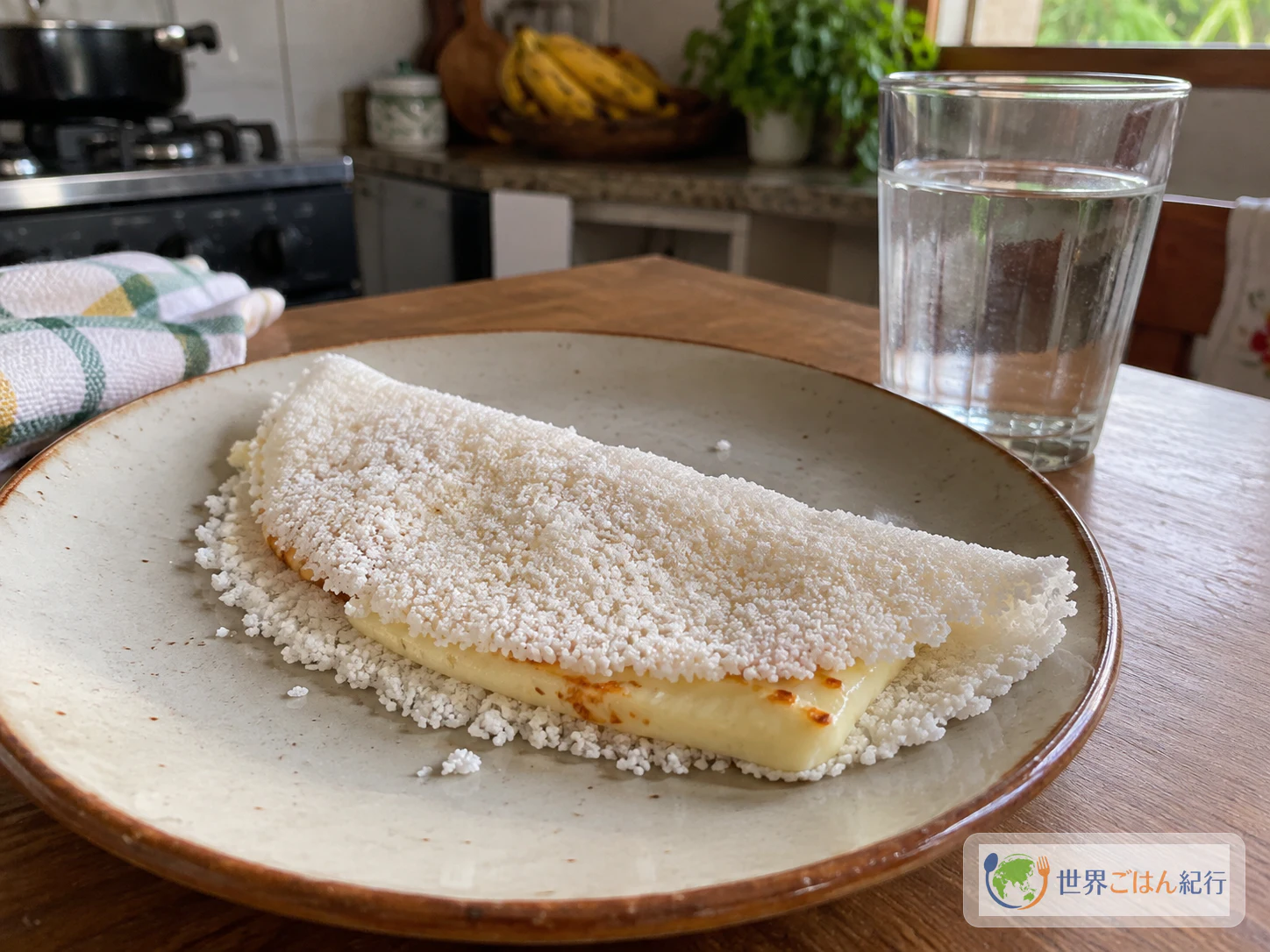
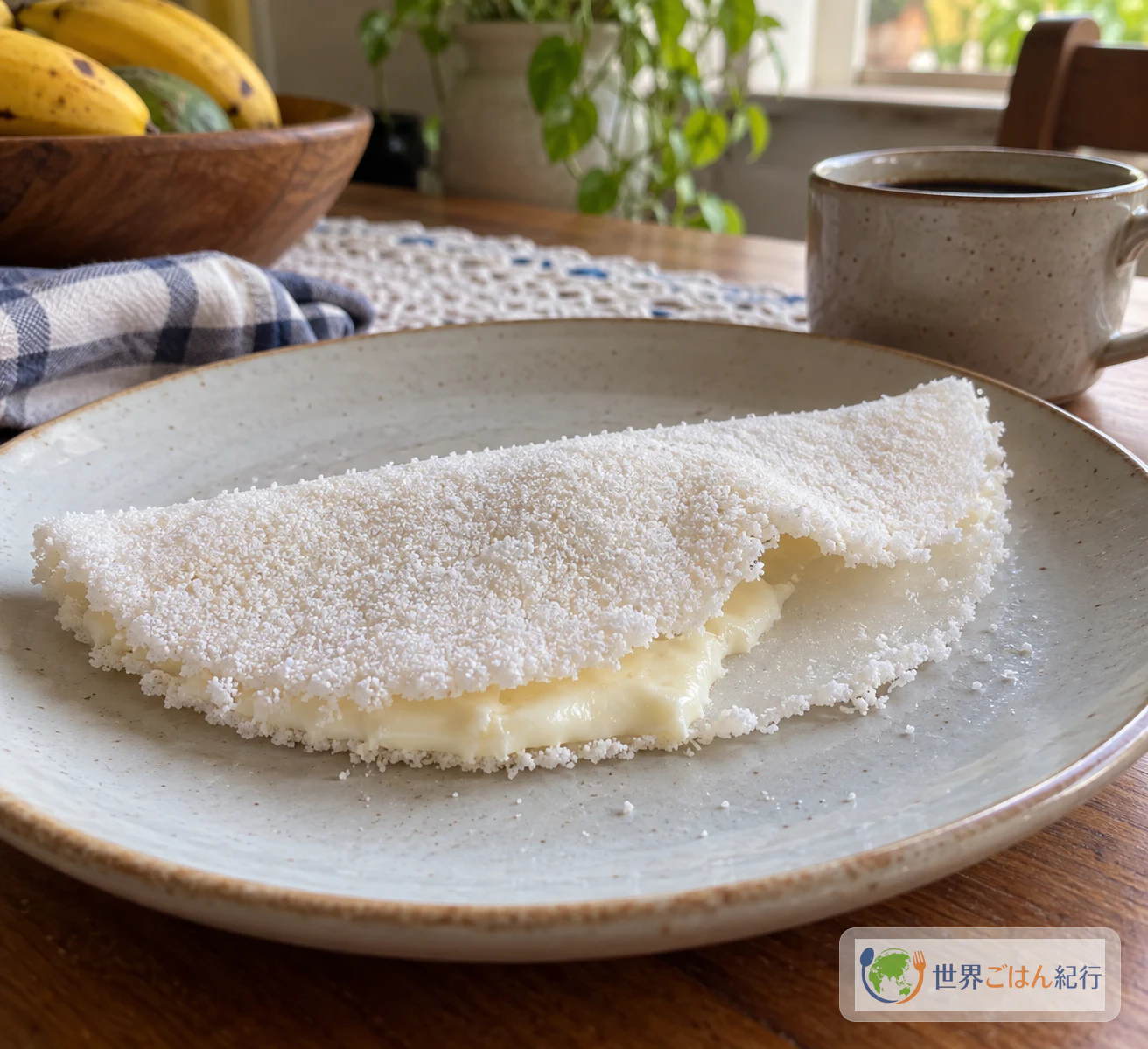
Brazilian tapioca: a white, slightly translucent cassava-starch round folded into a half-moon around white cheese, served as a light snack
Serves
8 tapiocas
Level
Beginner
Cuisine
Brazilian

How to make Brazilian tapioca (beiju) from cassava starch, water and salt. Covers how to moisten the starch into damp grains, why you sift it, how to tell when the round has set in a dry pan, folding it around cheese, and how to choose the right starch so you don't confuse it with tapioca pearls or cassava meal.

Cooking flow

Cooking steps

STEP 11 / 8

Mix the starch and salt

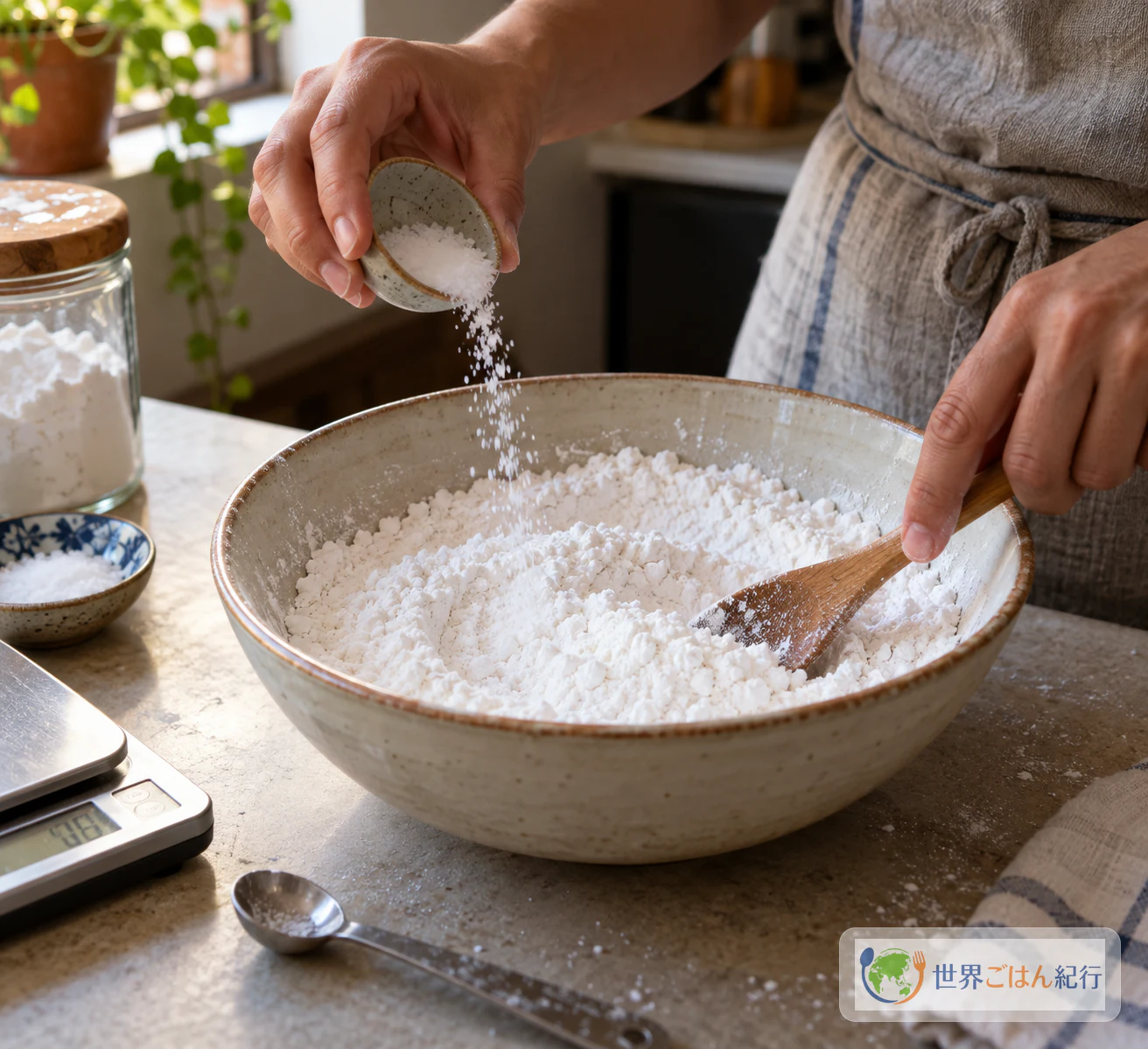
Adding salt to cassava starch in a bowl and mixing, to prepare tapioca dough
Mix the salt into the dry starch before any water goes in

Put 1 lb (500 g) cassava starch and 10 g salt in a bowl and mix with your hand until the salt is evenly spread through the dry powder. At this stage everything is still completely dry.

STEP 22 / 8

Add the water a little at a time

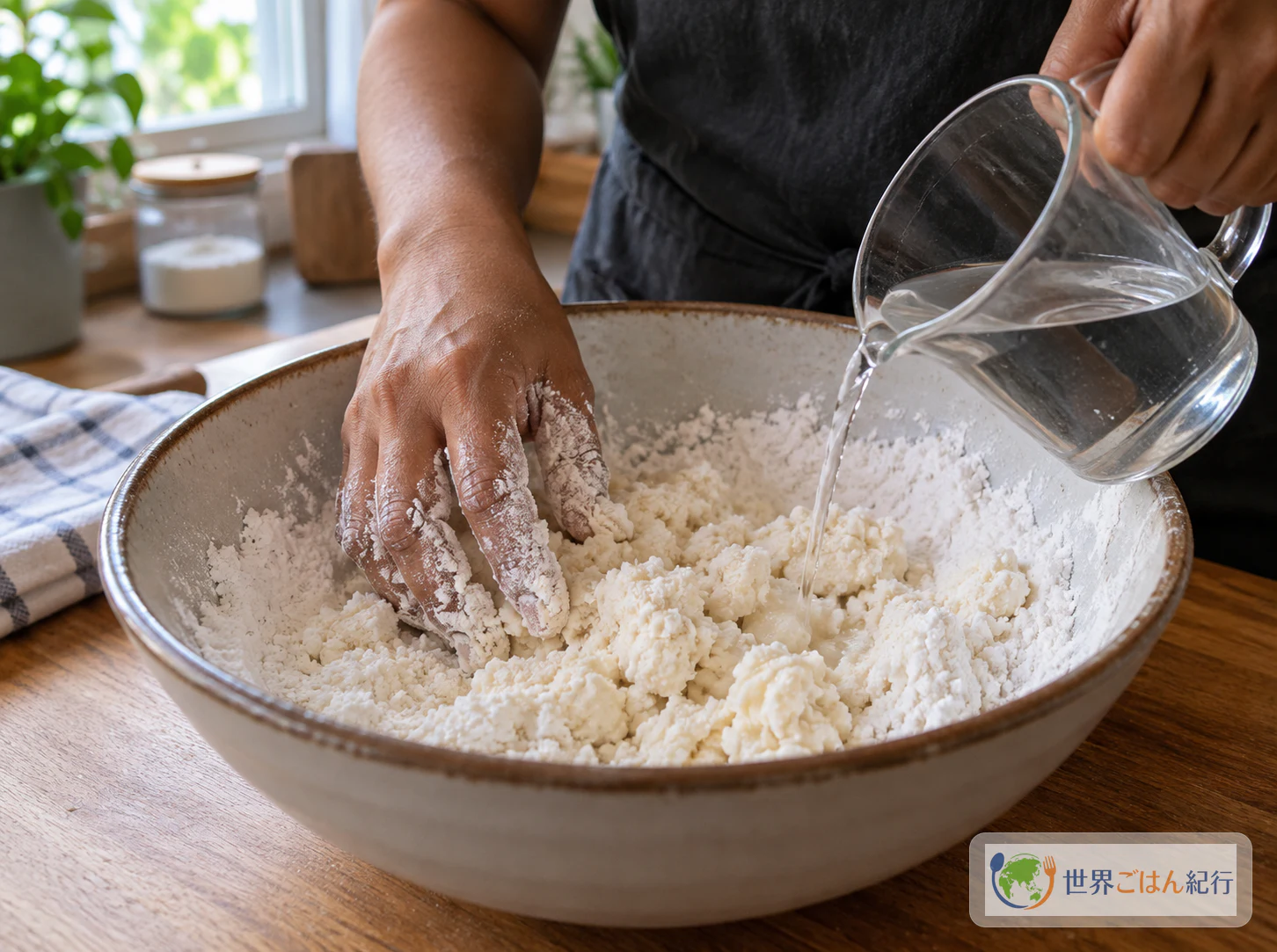
Pouring water into cassava starch a little at a time and moistening it by hand
Add water in small amounts; the starch should form damp clumps, not a batter

Add the 1¼ cups (300 ml) water in several additions, working it into the starch with your fingertips after each one. Don't pour it all in at once; let each addition spread through the powder before adding the next. You are aiming for damp, irregular clumps, never a smooth, pourable batter.

The recipe calls for all 1¼ cups (300 ml). Starches differ from product to product, so if you hold back some water, note how much you used.

STEP 33 / 8

Break up the clumps and let it rest

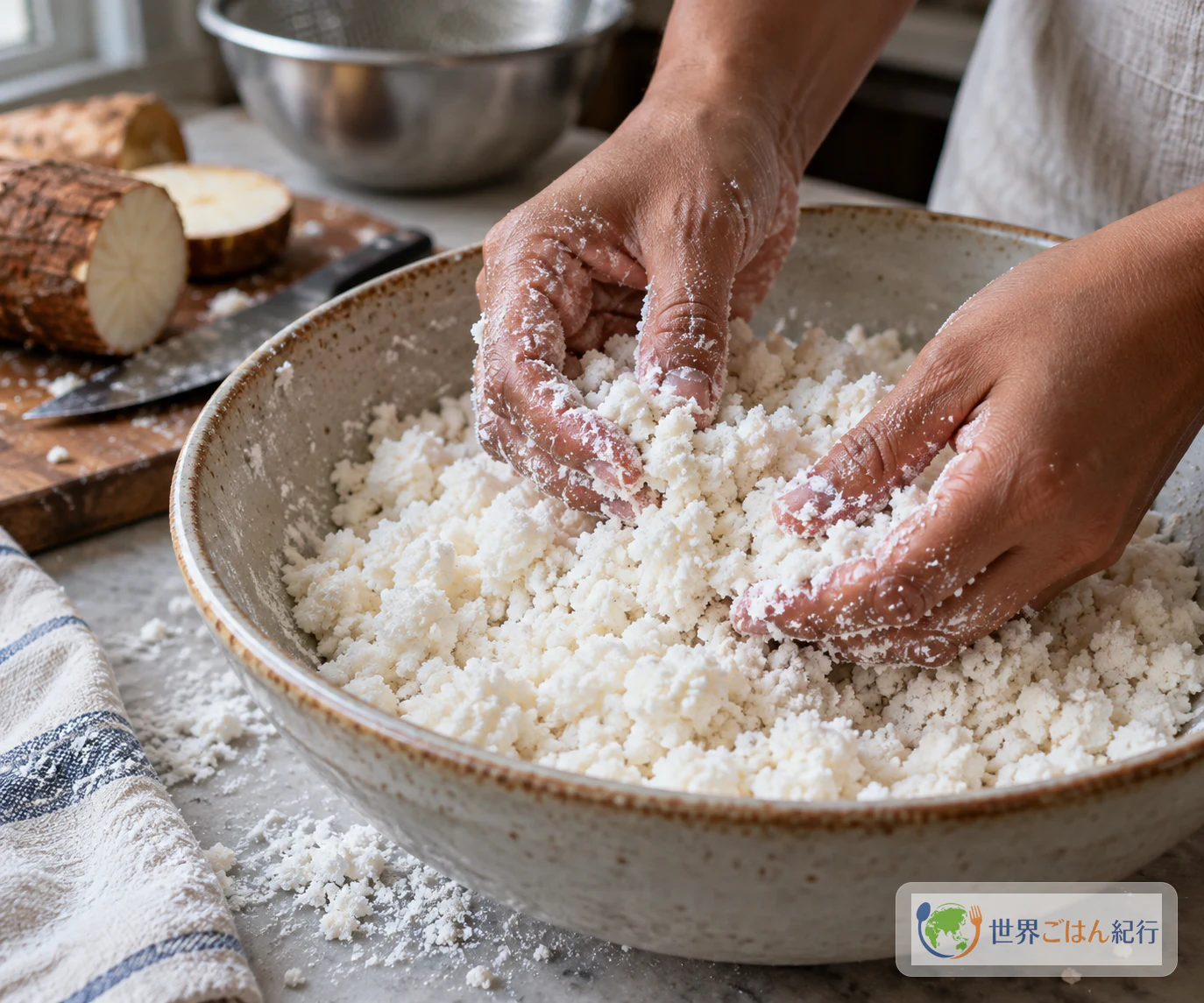
Breaking up clumps of damp starch with the fingertips into fine crumbs
Rub the damp starch into small crumbs; this recipe uses packaged starch, not fresh cassava root

Rub the larger clumps between your fingertips until the whole bowl looks like fine, damp crumbs. Then leave it to rest for a few minutes.

STEP 44 / 8

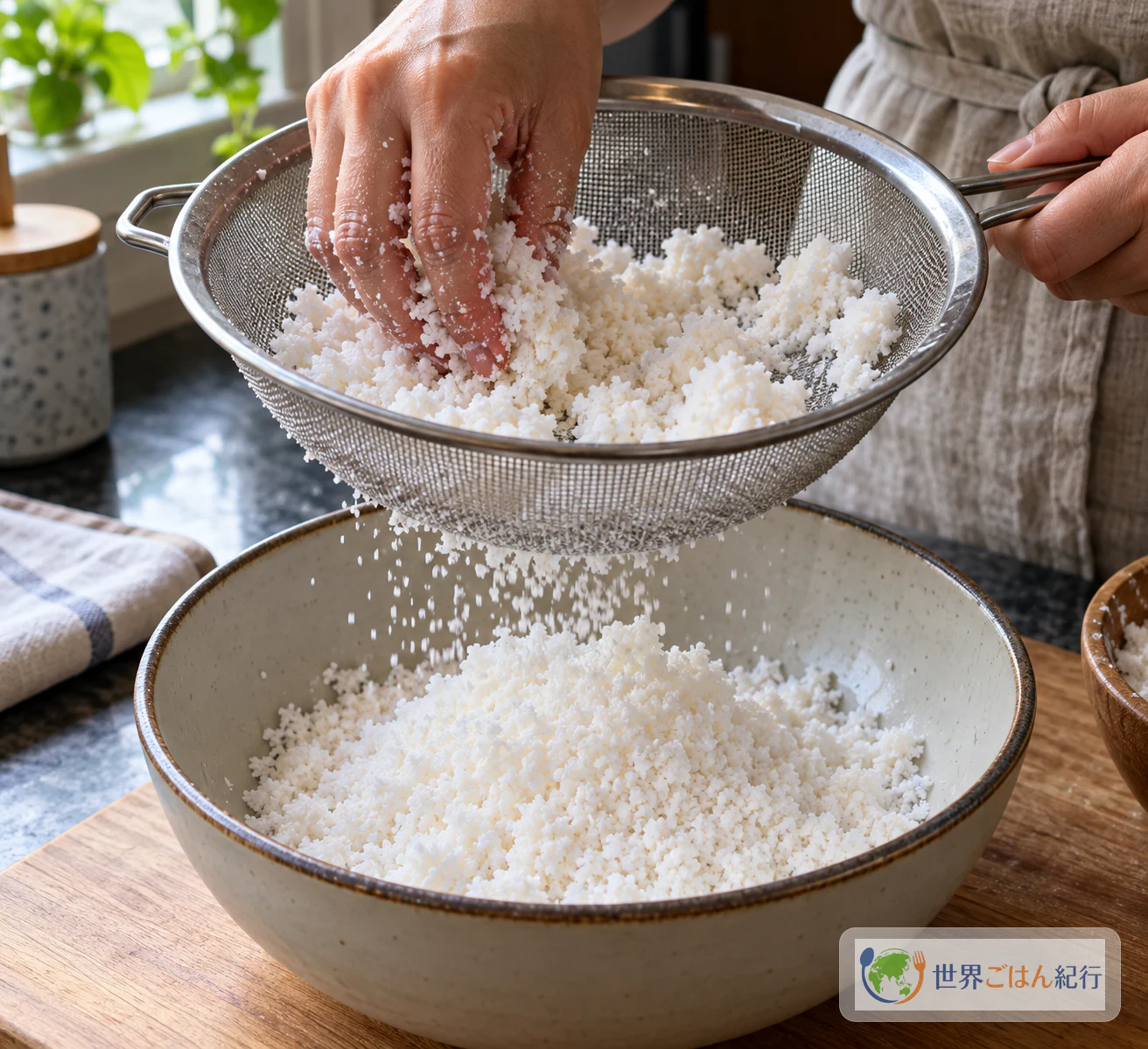
Sift the damp starch

Fine, damp tapioca dough falling through a sieve into a bowl
Sifting makes the grains even, so they join into a sheet without thick spots

Press the damp starch through a fine-mesh sieve into a bowl. If firm clumps stay on top, rub them through with your fingers. What falls through should be small, even, slightly moist grains. Keep them in that grainy state; don't press them back together.

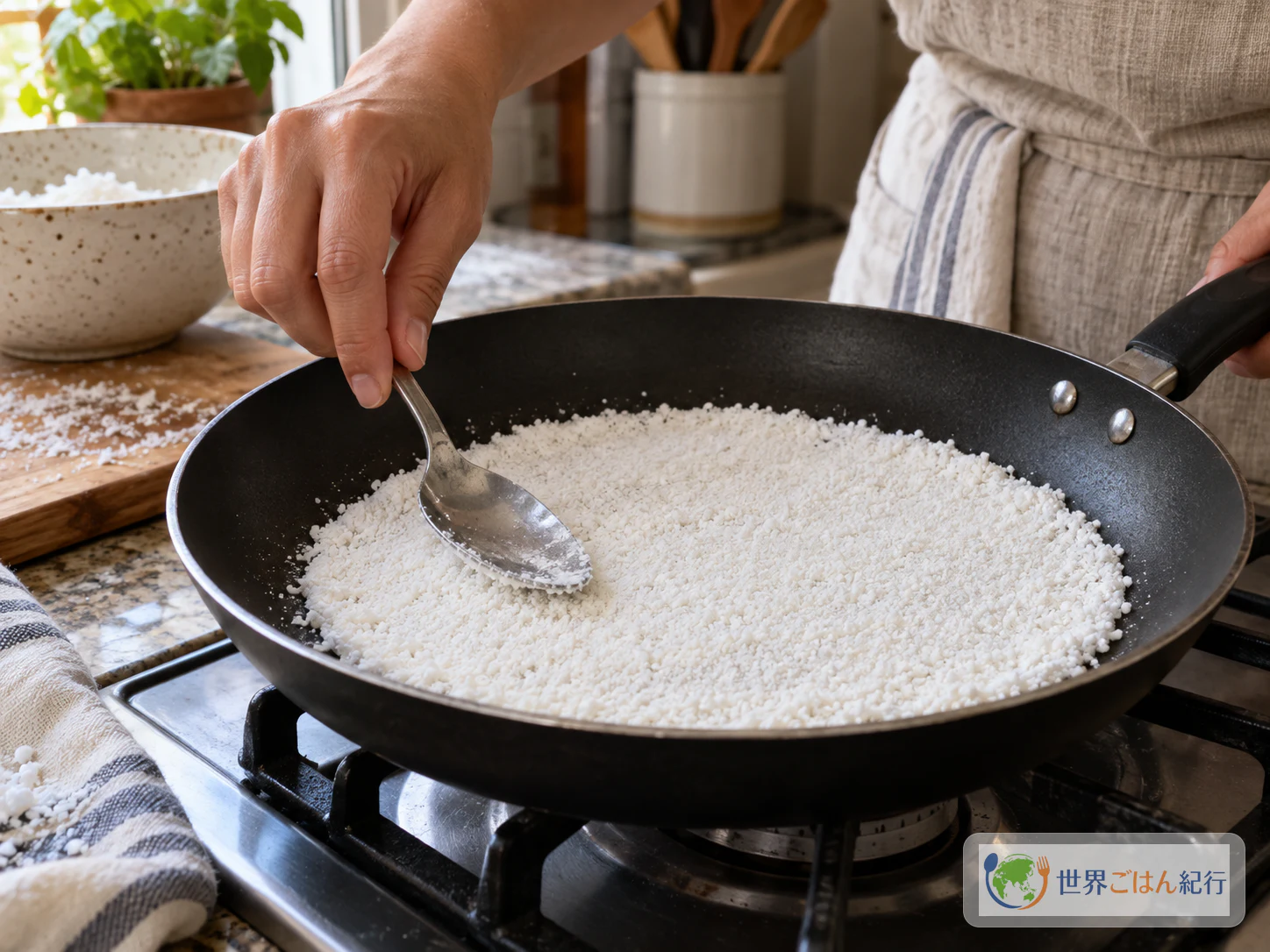
STEP 55 / 8

Spread the grains in a dry pan

Spreading damp, grainy starch into an even round in an unoiled frying pan
Spread the grains evenly in a dry pan, filling gaps without packing them down

Heat a dry frying pan, with no oil. Scatter the sifted grains over it with a spoon and spread them into a thin, even round. Don't press down hard; just fill any gaps and level any thick mounds. At first you will still see individual pale grains.

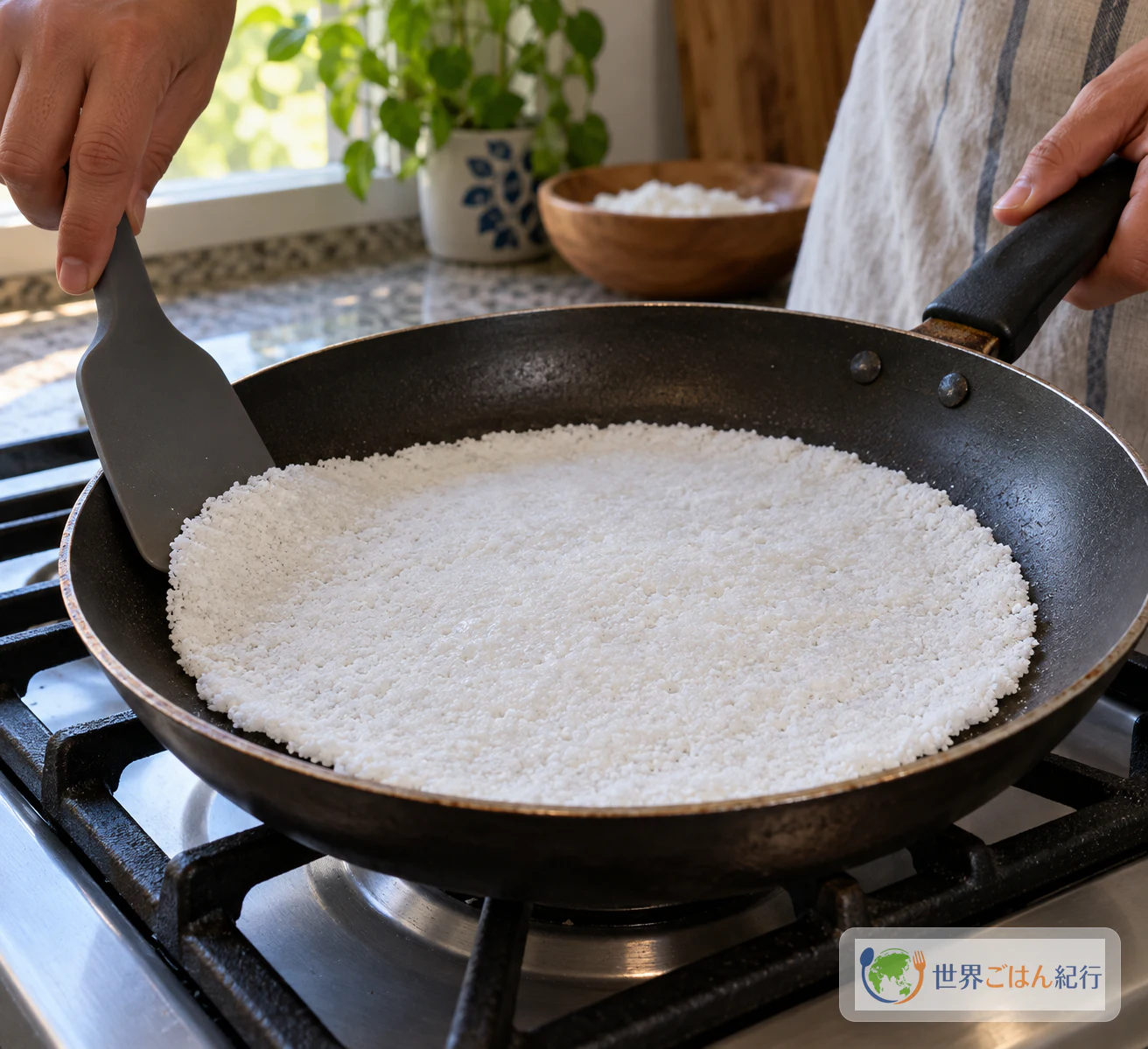
STEP 66 / 8

Cook until the grains join and the edge lifts

Tapioca whose grains have joined in the heat, with the edge of the white sheet beginning to lift
The grains have become one white sheet and the edge is starting to lift: no browning needed

Leave the round alone while the heat joins the grains into a continuous, pale white sheet. It is ready when the grains have fused and the edge has lifted slightly from the pan. Use a thin spatula to check the edge. You are not trying to brown it.

You can also turn the round over at this point, then add the filling and fold. This recipe folds once the edge lifts. To flip, wait until the edge has lifted and use a thin spatula, since a round turned too early tears easily.

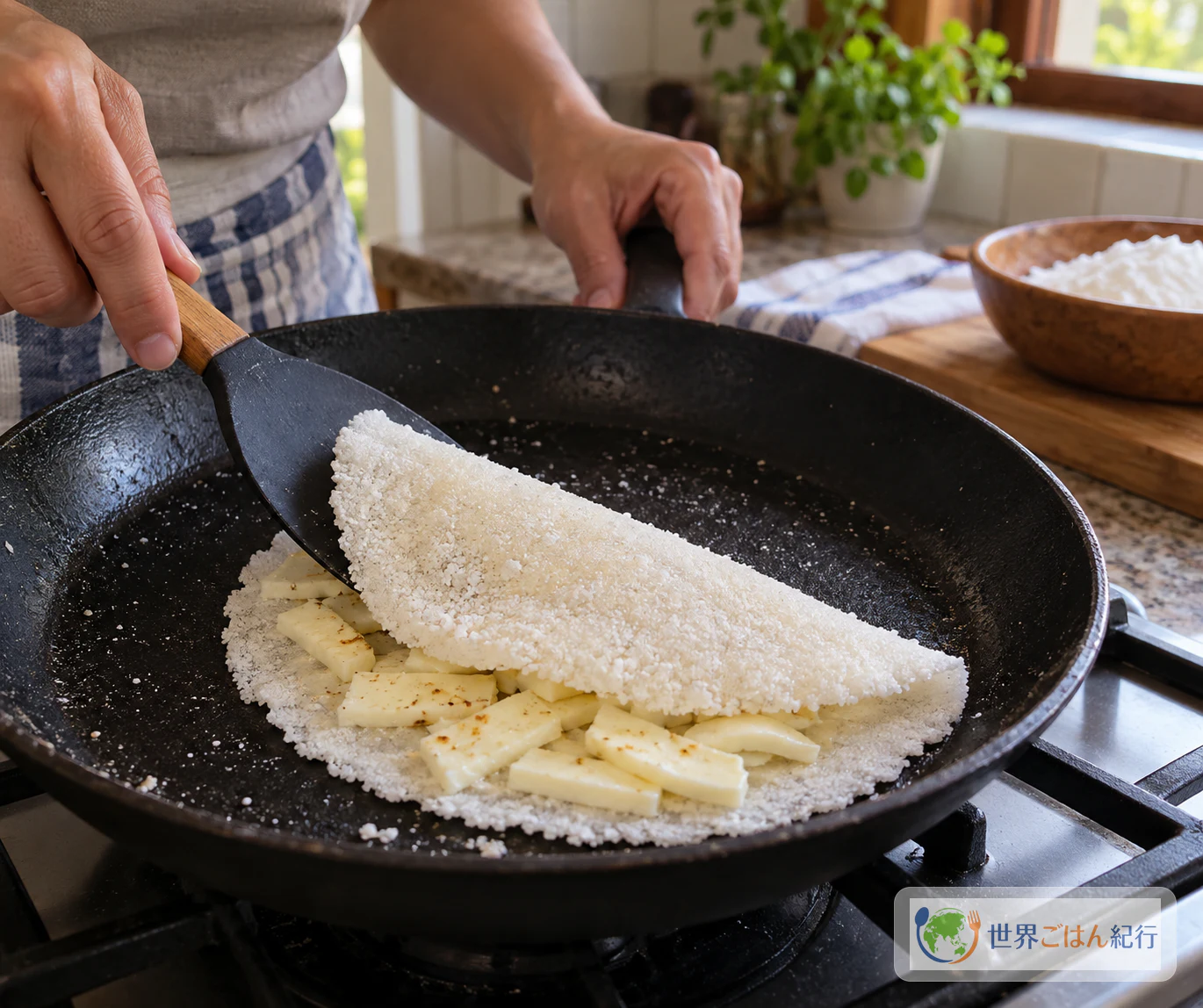
STEP 77 / 8

Add the filling and fold

White cheese placed on one half of the cooked tapioca, folded into a half-moon
Put a modest amount of cheese on one side and fold the round over it

If you are using a filling, place a modest amount on one half of the round and fold it over into a half-moon. Let it sit in the pan for a few seconds so the filling warms. If you are making it plain, simply fold it.

STEP 88 / 8

Serve right away

Freshly made tapioca torn open to show its chewy interior where the grains have joined
Eat it warm, when the joined starch is soft and chewy; the background coffee and banana are not ingredients in this recipe

Slide the tapioca onto a plate straight away and eat it while it is warm. Repeat with the remaining grains to make 8 in all, adjusting the heat after the first if needed.

0 / 0
Ingredients

Ingredients

1 / 2

Tapioca dough

Ingredient Amount Role and how to choose
Cassava starch (polvilho doce, sweet cassava starch) 1 lb (500 g) The whole body of the dough. Not tapioca pearls, cassava meal or sour polvilho azedo
Salt 10 g Seasons the dough. Ordinary fine table salt can be weighed as is
Water 1¼ cups (300 ml) Moistens the dry starch into grains. Add it a little at a time
2 / 2

Optional filling

Ingredient Amount Notes
Queijo coalho or another filling Optional; no set amount Use a modest amount
0 / 0

Sift damp cassava starch over a hot, dry pan, and the heat joins the loose grains into one pale, chewy round. That's Brazilian tapioca: a thin, folded snack made from the starch of mandioca (cassava), eaten for breakfast or in the afternoon, plain or wrapped around cheese, coconut or jam. The process is a little surprising the first time. When you pour water into the starch a little at a time, it never becomes a smooth batter. Under your fingertips it turns into damp, crumbly grains, and those grains are what you sift into the pan. You aren't trying to brown the round. You're waiting for the grains to fuse into one sheet, and you fold it as soon as the edge begins to lift.

What Brazilian Tapioca Is

If "tapioca" makes you think of chewy pearls in a sweet drink or a pudding, this is a different dish. The starch at the center of it comes from mandioca. In Brazil it goes by names such as goma or polvilho, and it comes in two main kinds: polvilho doce (sweet) and polvilho azedo (sour), which are produced in different ways. This recipe uses polvilho doce.

The names beiju and tapioca don't always mean the same round. The version here is the modern, flat type, cooked at home from packaged starch. Tapioca is widely eaten in Brazil's Northeast and is linked to the North and Northeast, but it has also become a snack eaten across the country. Fillings run from sweet to savory, and thickness and texture vary from place to place.

Beiju on the Rio Negro

On the Rio Negro in the Amazon, the Museu da Amazônia's exhibition "Aturás Mandiocas Beijus" presents a traditional agricultural system built around mandioca. It shows how beiju, including beiju cica, is tied to making flours and to knowing the local varieties, which people tell apart by land, taste and aroma. Indigenous curators and consultants took part in the exhibition. What it records is specific to the Rio Negro, not a single origin story for tapioca across Brazil.

Ingredients: Three Items, and the Right Starch
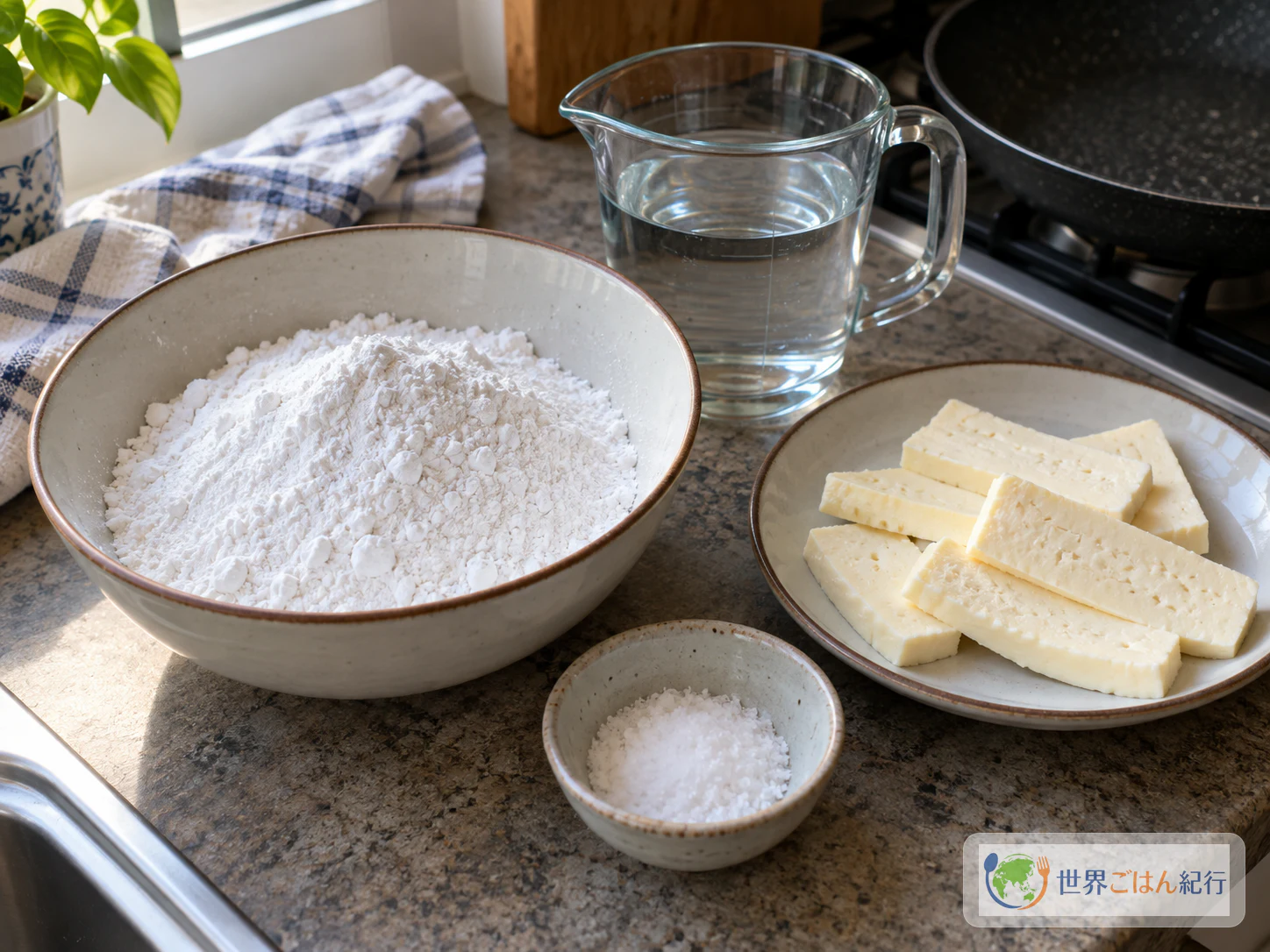
Ingredients for tapioca dough: cassava starch, salt and water, with white cheese set aside separately
The dough itself is only starch, salt and water; the cheese stays on its own plate as an optional filling

These amounts make 8 tapiocas. Choose the size of each round yourself.

Equipment

  • Mixing bowl
  • Kitchen scale
  • Measuring jug
  • Fine-mesh sieve
  • Spoon or small slotted spoon, for scattering the grains
  • Dry frying pan, or a tapioqueira if you have one
  • Thin spatula

A special tapioqueira is not required. The steps work in an ordinary flat frying pan, and no oil is used.

Choosing the Starch and the Cheese

Look for packaging labeled "tapioca flour," "tapioca starch" or "cassava starch." That's the fine white starch you need. The amounts are set for cassava starch, so use only that. Several products sit close to it on the shelf and are easy to confuse:

Product Use it here? Why
Tapioca pearls No Already shaped into balls; they won't form damp grains
Farinha de mandioca (cassava meal / whole cassava flour) No A coarse flour made from the root, the kind used for farofa, not the starch
Polvilho azedo (sour cassava starch) No Made by a different process from polvilho doce
Potato starch and other starches No The amounts are set for cassava starch

For the filling, queijo coalho is a salty Brazilian fresh cheese. If you can't find it, a salty grilling cheese works instead, though its aroma, moisture, saltiness and the way it softens will all be a little different. Leave extra salt out of the filling, because the salt goes in the dough.

Allergies and food safety

The dough itself is only cassava starch, salt and water. The optional cheese contains milk. Check the labels on both the starch and any filling for allergens and shared production lines. If you need the dish to be gluten-free, confirm it on each product's label rather than assuming. This recipe uses packaged, food-grade starch and does not involve processing raw cassava root at home. Don't taste the raw starch; eat the tapioca once it has been heated and set.

Method: From Dry Powder to Damp Grains to a Folded Round

The one thing to watch

Every step before the pan is about making damp, even grains, not a batter. In the pan, judge by whether the grains have joined into one white sheet and the edge has lifted slightly, not by color.

Start at around medium heat and adjust with your first round before making the rest.

Fixing Common Tapioca Problems

Problem Likely cause What to do
Large wet lumps won't pass through the sieve The water went in too fast, or it wasn't mixed evenly Rub the lumps apart with your fingertips and add any remaining water in small amounts; next time, divide the water into more additions
The grains don't join into a sheet in the pan The starch is too dry, the grains are uneven, or the pan isn't hot enough Before adding other ingredients, test a small amount and check how damp the grains are and how hot the pan is
The round cracks when turned Too thin, or turned before the edge had set Wait until the edge begins to lift, or skip turning and fold it instead
The texture feels off Too thin or too thick Very thin rounds break easily; very thick ones cook and eat differently. Aim for an even, thin layer

If you think the starch is the problem, check the label before you try a different flour. Tapioca comes in many thicknesses in Brazil. What matters is an even layer that binds all the way through.

Serving Tapioca: Fillings and Variations

Tapioca is made to be eaten warm, straight from the pan. Common fillings include cheese, jam, peanut butter and chicken, and coconut and other sweet combinations are popular too. The dough stays the same whatever you choose. Keep the starch, salt and water as they are and change only what goes inside.

Variation How to make it Notes
Plain Fold with no filling The best way to taste the chewy starch itself on a first try
Queijo coalho Fold around thin slices If unavailable, a salty grilling cheese, with a different flavor and melt
Coconut and condensed milk Unsweetened coconut with a little condensed milk, served as a sweet snack No set amounts
Jam Spread thinly inside One of the basic fillings
Chicken Warm cooked chicken and fold it inside Seasoning is up to you

Start with one filling so you get to know the texture of the starch, then branch out. Cassava shows up in very different forms in Brazilian cooking. Farofa uses coarse cassava meal, a different product from the fine starch here, and pão de queijo is another dish built on cassava starch. Cooking them side by side shows how many textures one root can give you.

Frequently Asked Questions

Is tapioca flour the same as tapioca pearls?

No. Pearls are starch that has already been shaped into balls. This recipe needs the fine, loose starch sold as tapioca flour, tapioca starch or cassava starch, so it can be moistened into grains and sifted.

Do I need oil in the pan?

No. The tapioca cooks in a hot, dry pan without oil.

Can I make it without cheese?

Yes, the filling is optional. Plain tapioca, folded as soon as the edge lifts, is a good first try.
Sources

  • The Culinary Institute of America, "Basic Tapioca Dough," Worlds of Flavor 2020 General Session V Recipes, recipe credited to Rodrigo Oliveira. The basis for the amounts (cassava starch 500 g, salt 10 g, water 300 ml), the yield of 8 tapiocas, adding water gradually, breaking up the clumps, resting a few minutes, sifting, spreading evenly, folding or adding filling once the edge lifts slightly, and the list of filling options. It does not specify salt type, pan size, temperature, dough per round, cooking time or filling amounts. https://static1.squarespace.com/static/5f062cd4be01b227f768ea0d/t/5fa199d856298058348e5fb0/1604426201109/General%2BSession%2BV%2BRecipes.pdf
  • Coordenadoria de Assistência Técnica Integral (CATI), Governo do Estado de São Paulo, "Mandioca: instruções práticas." Supports the description of polvilho doce and azedo as mandioca starches made by different processes, tapioca being widely eaten in the Northeast and made from store-bought polvilho, and the method of sifting and cooking in a hot pan without oil, including turning the round. It gives no amounts, temperatures or times. https://www.cati.sp.gov.br/portal/themes/unify/arquivos/produtos-e-servicos/acervo-tecnico/IP_271_Mandioca.pdf
  • Museu da Amazônia (MUSA), with IPHAN and ACIMRN, "Aturás Mandiocas Beijus." Supports the Rio Negro's mandioca-centered traditional agricultural system, the links between beiju and knowledge of local varieties, and the participation of Indigenous curators and consultants. It concerns the Rio Negro and is not used for the recipe or for tapioca's history across Brazil. https://museudaamazonia.org.br/exposicoes/aturas-mandiocas-beijus/
  • Instituto Brasil a Gosto, "Tapioca." Supports tapioca as breakfast and snack food, the range of fillings, thickness and texture, and coconut and condensed milk as a filling example. Its separate recipe's amounts and cooking times are not used here. https://brasilagosto.org/tapioca/
  • Transparent Language Portuguese Blog, "[Brazilian food] – Tapioca." Used as supplementary support for tapioca's association with the North and Northeast and its spread as a snack nationwide, for judging doneness by the lifting edge, and for cheese as a filling. Its amounts and its explanation of the word's origin are not used. https://blogs.transparent.com/portuguese/brazilian-food-tapioca/