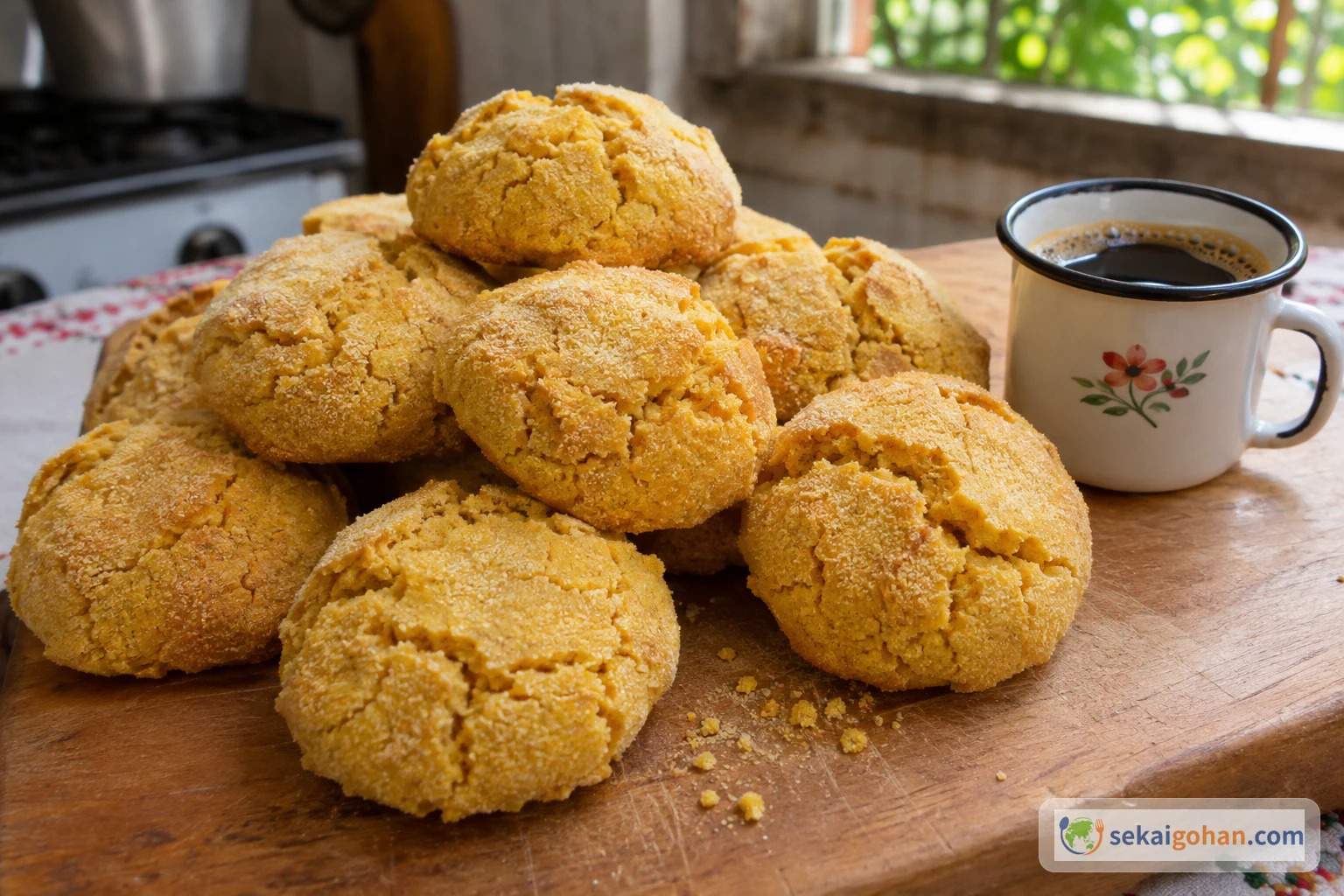
Tip white starch into a bowl, rub in cold butter, stir in the cheese and drizzle in milk a little at a time, and the loose powder turns into something like damp sand. Press it flat in a hot skillet. A few minutes later the edge has set, the smell of toasted cheese rises from the bottom, and when you flip it a golden face appears. This is Paraguayan mbeju (also written mbeyu), a flatbread made from cassava starch, fat, cheese and a little liquid. It's salty from the cheese, and it crumbles lightly before turning a little chewy as you bite.
What mbeju is

In Paraguay, mbeju is eaten at breakfast and at merienda (the afternoon snack), alongside mate or cocido. In a home kitchen, think of it as a cheesy griddle cake made from tapioca starch. It's not as bouncy as a potato-starch mochi cake and not as thin as a cheese cracker. Really, it's less a flour dish than a way of setting starch and dairy with heat.
The cassava starch at its base comes from Guaraní food culture. After colonial times, cooks added beef tallow, butter, milk and cheese, and the result is today's mbeju, a traditional starch flatbread shared by Paraguay and northern Argentina. Local recipes revolve around almidón de mandioca, queso Paraguay, manteca and leche. What makes it taste local is the kind of starch and the saltiness of the cheese.
Corn and cassava turn up again and again in Paraguayan cooking: chipa, mbeju, sopa paraguaya, bori bori. In all of them, the grains and roots of South American fields take the place that rice or wheat would have elsewhere.
Chipa almidón uses the same cassava starch but is shaped into rings and baked as a cheese bread. Chipa guasu combines whole corn kernels with eggs and milk and is baked in the oven. Sopa paraguaya is a savory cornmeal bread. Mbeju is cooked in a skillet from cassava starch, so both the ingredients and the heat are different.
| Dish | Main ingredients | Method | Role at the table |
|---|---|---|---|
| Mbeju | Cassava starch, cheese, fat, milk | Cooked in a skillet | Breakfast, snack, partner for mate |
| Chipa | Cassava starch, eggs, cheese | Shaped and baked in the oven | Bread, snack, food for the road |
| Chipa guasu | Whole corn kernels, eggs, cheese | Baked in a dish | Side to meat, main starch |
| Sopa paraguaya | Cornmeal, onion, cheese | Baked in the oven | Beside asado, lunch box, breakfast |
Mbeju is never worked into a true dough, and that's the biggest difference from other flour dishes. What you're tasting is the grain of the starch itself.
Ingredients: a home version with tapioca starch and white cheese

The basic ratio uses plenty of fat and cheese against the tapioca starch and adds milk a little at a time. Shredded pizza cheese alone gives too little saltiness and dairy aroma, so combine mozzarella with feta, grated hard cheese or cottage cheese.
Basic mbeju (6.5 inches (16 cm) across, 4 pieces)
Ingredients (serves 4)
This recipe uses dairy. Tapioca starch and cassava starch are not wheat, but the production lines of imported products and the labels on cheeses differ from brand to brand. If you have restrictions on milk, wheat, eggs or other allergens, always check the allergen labeling on each package.
Substitution guide
| Local ingredient | Candidates elsewhere | Verdict |
|---|---|---|
| Almidón de mandioca | Tapioca starch, cassava starch | The most important one. Do not replace it with wheat flour |
| Queso Paraguay | Mozzarella + a little feta | Cover stretch and saltiness separately |
| Manteca or grasa | Butter, lard | Butter smells good and suits home cooks. Lard is closer to the local richness |
| Leche | Milk, water, whey | Milk is easiest to handle. Too much makes it sticky |
Mbeju has few ingredients, so if you are buying extra, put the starch and cheese first. Once you own the starch, you can use it for chipa or for Brazilian pão de queijo as well. Choosing one stretchy cheese and one salty cheese makes failure less likely.
Three decisions at the shop
The hardest choices at the shop are the tapioca starch, the cheese and the skillet. Real queso Paraguay is hard to find outside Paraguay. Skip imported cheeses with similar names. Combine a stretchy cheese with a strongly salty one for steadier results.
| Decision | Choose | Avoid | Why |
|---|---|---|---|
| Starch | Tapioca starch, cassava starch | Wheat flour, rice flour alone | Cassava starch creates the lightly crumbling texture of mbeju |
| Cheese | Mozzarella 5.5 oz (160 g) + feta 1.5 oz (40 g) | Wet fresh cheese alone | Separating stretch from saltiness keeps the flavor from going dull |
| Skillet | Heavy iron, cast-metal or thick-bottomed pan | Thin, light aluminum pan | Holds a steady bottom temperature at medium-low heat and cooks the center through |
| Liquid | ¼ cup (80 ml) milk in two additions | All of it at once | Starch absorption and cheese moisture differ from product to product |
Tapioca starch is often on the shelves of Asian grocery stores, baking suppliers and import shops. The label reads either "tapioca starch" or "cassava starch". If it is a fine white powder that looks like potato starch, it will work. Granulated products sold as tapioca pearls are rehydrated differently and do not suit this recipe.
Pizza cheese alone will hold a shape. But pizza cheeses vary widely in fat and salt, and when baked the fat tends to come out first and flatten the flavor. Use mozzarella for the stretch and add feta or grated hard cheese for the salt. That combination is the most reliable one for cooks outside Paraguay.
Buy mozzarella, butter and milk at the supermarket, and track down only the tapioca starch at an import shop or online. If you cannot find feta, add 3 tbsp of grated hard cheese for saltiness.
Choosing ingredients for mbeju
This version uses tapioca starch, mozzarella, and feta or grated hard cheese, all easy to buy outside Paraguay, in a ratio that holds together in a home skillet. The one thing to hold firm on is the cassava starch. Wheat flour pushes it toward a pancake and loses the light crumble and gentle chew, so for your first batch, get tapioca starch or cassava starch.
Cheese gives mbeju its flavor. Real queso Paraguay is hard to find abroad, so the practical route is mozzarella for stretch and feta or grated hard cheese for salt. Pizza cheese on its own stretches but brings little salt, and the whole thing tastes vague. A pinch of salt worked into cottage cheese or finely shredded string cheese also does the job. Cream cheese alone is too sour and too wet, and you won't get that light crumble with it.
Method: bake sandy dough into a thin disk
The mixture does not hold together when you mix it. If that worries you and you add too much milk, the finished mbeju turns heavy. The target is damp sand: it clumps for a moment when squeezed and crumbles back when you press it with a finger.
The moisture check before cooking
Treat the first piece as a test for adjusting the other three. Even with the same 9 oz (250 g), starch behaves differently depending on humidity, cheese moisture and how fine the starch is. Stick to the weights, then adjust by feel and by how the dough behaves in the pan.
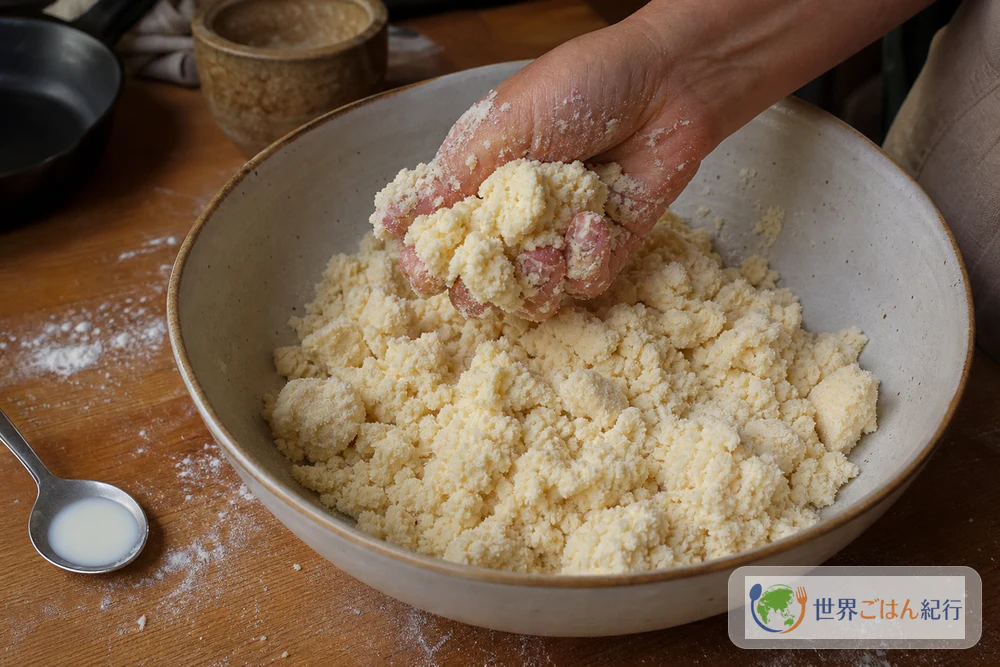
The signal is that it "loosens again after you squeeze it." If it clumps briefly in a light fist and crumbles under your thumb, it is ready to cook. If white powder falls between your fingers the moment you squeeze, it is too dry. If it sticks to your palm like a dumpling, it is too wet.
Watch how it falls from a spoon as well. Dry dough drops as loose powder, while well-moistened dough falls in small clumps. On days when you use fresh mozzarella or cottage cheese, the cheese releases moisture, so stop the milk at ¼ cup (60 ml). On days when you use mostly grated hard cheese, the mixture dries out more easily, so add milk 1 tsp at a time at the end.
| What you see | Cook as is? | Adjustment |
|---|---|---|
| Clumps when squeezed, breaks apart under a finger | Cook as is | Add no milk |
| Powder keeps falling even when squeezed | Fix before cooking | Add 2 tsp milk and mix for 1 minute |
| Dry white powder is left at the bottom of the bowl | Fix before cooking | Add milk 1 tsp at a time, up to 1.5 tbsp (20 ml) |
| Sticks to your hand and forms a dumpling | Do not cook as is | Add 1 tbsp tapioca starch and rest for 2 minutes |
| Plenty of oil seeps out once it starts cooking | Fix from the second piece | Cut the butter by 5 g and lower the heat |
A first piece that cracks on the flip is not a failure but a signal to adjust. If it cracked and tasted floury, add 2 tsp milk. If it browned but the center is still white, lower the heat and widen the diameter by 0.5 inches (1 cm). If cheese sticks to the spatula, wait 1 more minute before flipping. Mbeju gives no bubble signal as a pancake does, so look at whether the bottom moves as a single disk.
On humid rainy-season days, or when you use cheese straight from the refrigerator, the mixture turns heavy after just 2 minutes of resting. In that case, do not add milk. Cook one piece first. In a dry winter kitchen, the mixture loosens too much. If the first piece cracks when you flip it, add only 2 tsp of milk from the second piece on.
The starch is too dry, or the bottom has not set yet. For the next piece, add 2 tsp milk and, after the dough is in the skillet, use the spatula to push the outside inward. Flip only after the bottom is toasty and colored.
Common mbeju problems and fixes

Mbeju failures usually come down to moisture and heat. Add too much water or milk and it turns pasty in the pan with a raw center, drifting toward a white griddle cake. Add too little and it cracks before you can flip it and tastes floury. It can also look round and done in the pan yet break into powder when cut, because the heat never reached the center.
| Problem | Cause | Fix |
|---|---|---|
| Cracks and tastes powdery | Too little milk, too little pressing, flipped too early | Add 2 tsp milk, push the outside inward and cook |
| Raw center | Too thick, heat too high | Make it 6.5 inches (16 cm) across and 0.375 inch (8 mm) thick and cook longer on medium-low |
| Only the surface burns | Sweetened cheese, high heat, too much fat | Lower the heat and rub the butter evenly into the starch |
| Flavor is dull | Not enough salt in the cheese | Add a little feta, grated hard cheese or salt |
| Sticks to the spatula | Cheese is melting out | Cook 1 more minute to set the bottom and flip with a large spatula |
The most common mistake at home is getting nervous about the powdery look and pouring in more milk. Stop when the mix "does not hold together but takes shape when squeezed." In the pan, the cheese and fat melt, and the starch soaks up the moisture and binds.
Serving, storing and variations
Mbeju with mate, cocido and other drinks

Mbeju is best eaten straight from the pan. If the cheese is salty enough, a thin brush of butter is all it needs for breakfast. A drink brings it to life: hot mate loosens the cheese fat, and cold tereré makes it a morning-to-midday snack. Cocido, the brewed mate drunk around Paraguay, takes milk, which ties it to the dairy aroma of mbeju.
If you don't have mate or cocido, go for something bitter or toasty over sweet juice. Roasted green tea, unsweetened black or iced tea, dark-roast coffee or milk tea will all stand up to the starch and the rich cheese. For breakfast, add a small dish of tomato. For a midday snack, add onion or cucumber with lemon squeezed over, so the plate isn't all starch.
To eat it the Paraguayan way, don't stack the mbeju on a platter. Cut and serve each piece as it comes off the heat. The starch in the center tightens as it cools, so put the first two out and bring the rest to the table as they cook, rather than waiting to eat them all together.
Mbeju beside meat and at dinner
Mbeju goes well with grilled meats such as churrasco or chivito. It's lighter than rice or bread, and the salty cheese soaks up the meat juices. To widen the South American table, set it next to the tangy vinagrete, the black bean feijoada and the corn-based chipa guasu, and you start to see what a starch dish does on the plate.
At dinner, mbeju shouldn't be the whole meal. A small tomato salad, grilled beef, stewed black beans and tangy onion keep the starch and cheese from getting too heavy. If you're serving sopa paraguaya the same day, both lean on dairy and starch, so make half the mbeju and set it beside meat or beans.
Variations
| Direction | Add | Note |
|---|---|---|
| Breakfast style | 1 fried egg, black pepper | Mbeju itself is rich, so keep the egg soft |
| Beside meat | Thin grilled meat, tomato, lime | Serve beside it rather than stuffing, so it breaks less |
| Stronger cheese | 1.5 oz (40 g) more mozzarella | It browns faster, so lean toward low heat |
| With herbs | 2 tbsp scallion, 1 tbsp parsley | Do not overdo herbs that release water |
| Sweet-and-salty snack | 1 tsp honey | Departs from tradition, but suits the saltiness of the cheese |
Mbeju doesn't take well to stuffing. The more filling you add, the harder it is to flip. Cook it plain and serve vegetables or meat on the side. If you want a filling, cut the finished mbeju in half and pile it on top instead of sandwiching it.
Storing and reheating mbeju

Mbeju is best fresh, because the starch tightens and the cheese loses its stretch as it cools. To store it, let it cool completely, wrap each piece in plastic wrap and refrigerate until the next day. Wrapped while hot, the steam dampens the surface, and the toasty crust is hard to get back.
To reheat, give it 20–30 seconds at 600 W in the microwave at most, then finish in a dry skillet with no oil over low to medium-low heat, 1 1/2 minutes per side. It burns easily. It's ready when the surface dries and the cheese smell comes back.
You can freeze it, but the texture suffers. Wrap each cooked piece on its own and use within 2 weeks. Thaw at room temperature and reheat in a skillet; that leaves it less powdery than thawing in the microwave.
Don't make the dough ahead. Because it has milk and cheese, the moisture separates over time and the center cooks up heavy. To prepare the night before, just weigh the starch and salt and grate the cheese. Rub in the butter, add the milk and cook in the morning.
Frequently asked questions

Q1. Can I make it with potato starch?
It will hold a shape, but the texture is quite different. Potato starch is very sticky and tends to turn hard as the flatbread cools. Use tapioca starch or cassava starch for your first batch, and if you do want to mix in potato starch, keep it to one third of the total.
Q2. Can I replace the milk with water?
Yes, but without the milk's fat and sweetness the flavor is a little flatter. If you use water, add 10 g more butter and use a slightly saltier cheese to make up for it. Soy milk works too, though the aroma moves away from the Paraguayan style.
Q3. Can I serve it as a gluten-free dish?
The recipe itself uses no wheat flour. However, tapioca starch, cheese, butter and grated hard cheese are made on different production lines depending on the product. If you need to avoid gluten strictly, check each label and make sure no wheat flour is left on your cooking tools.