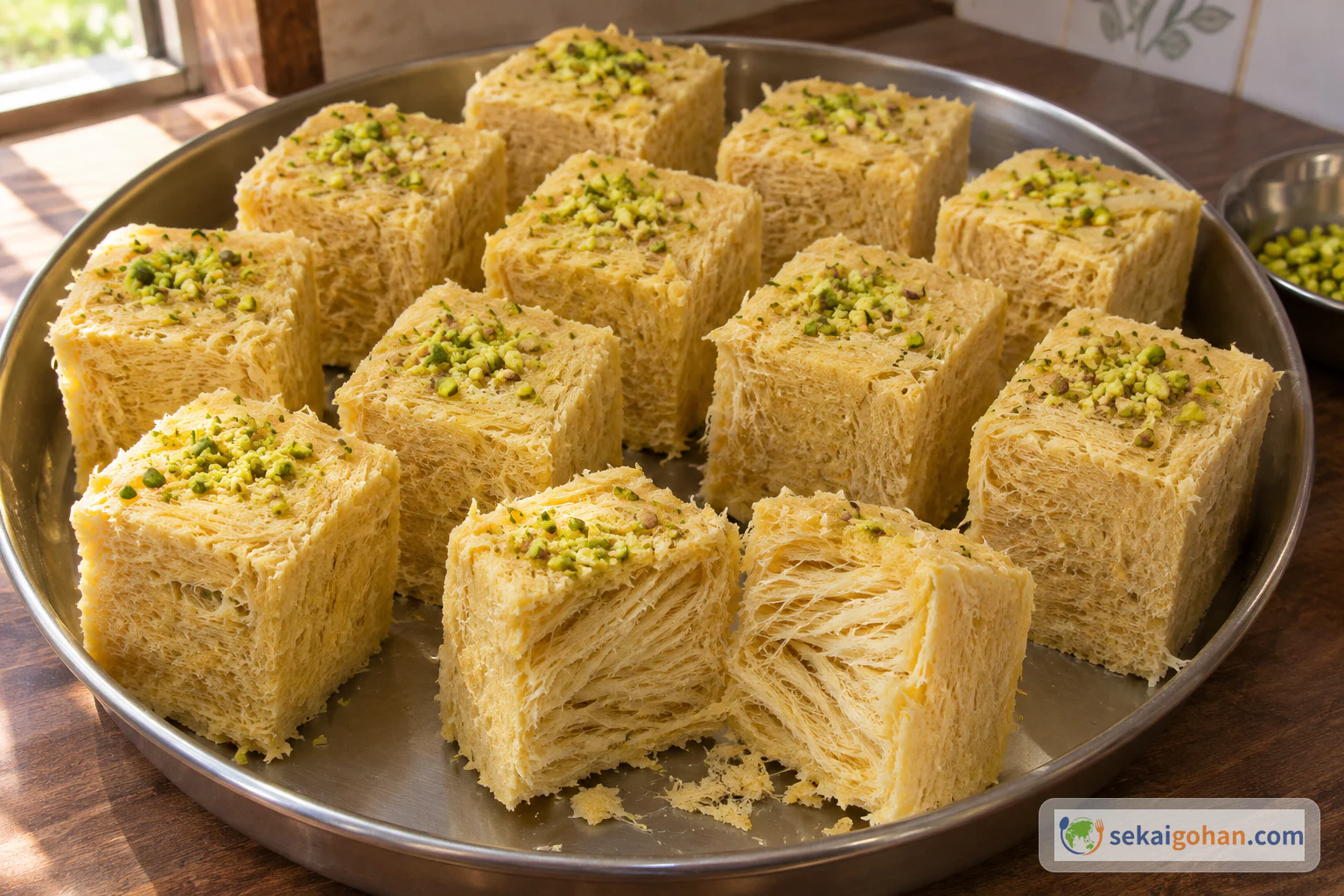
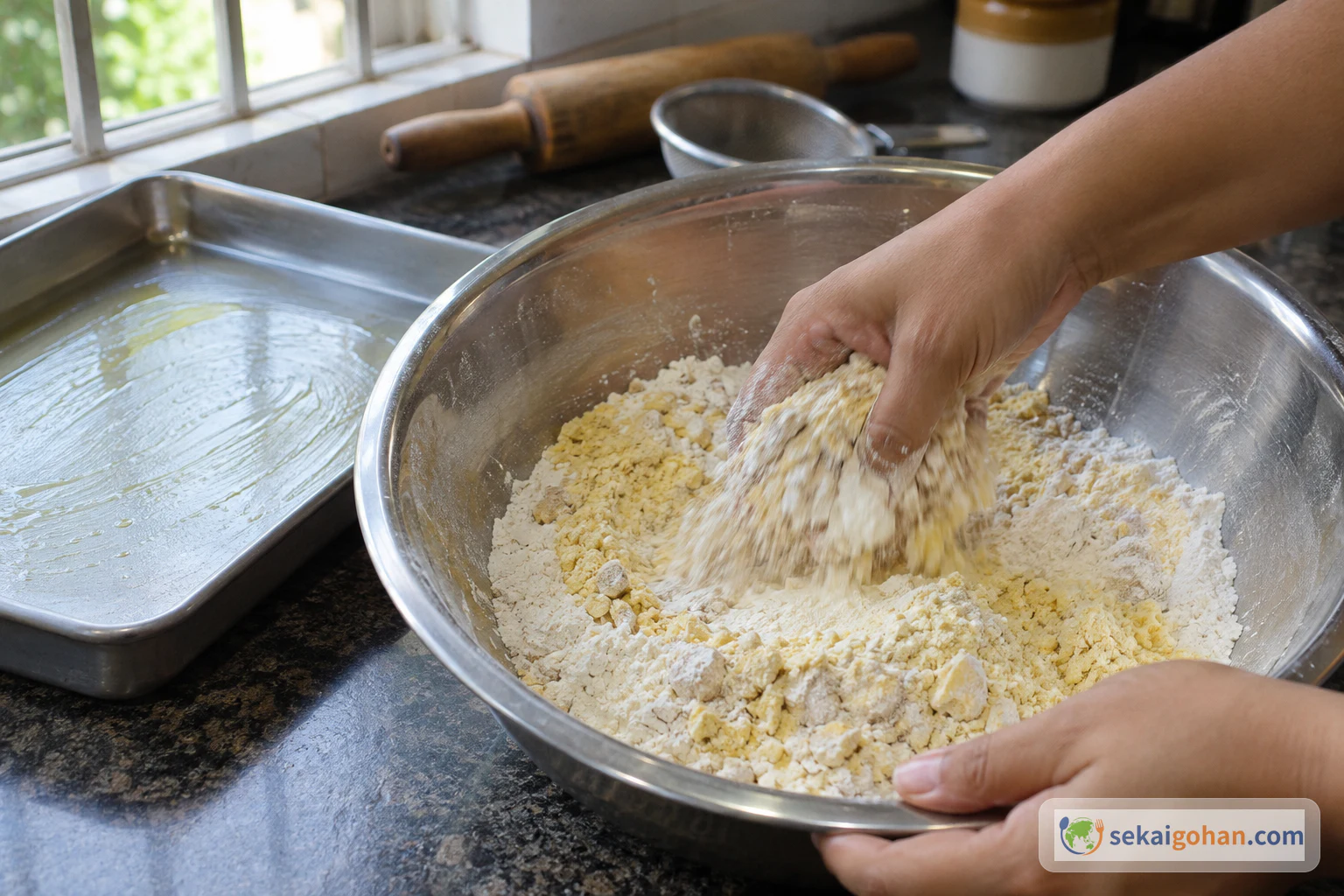
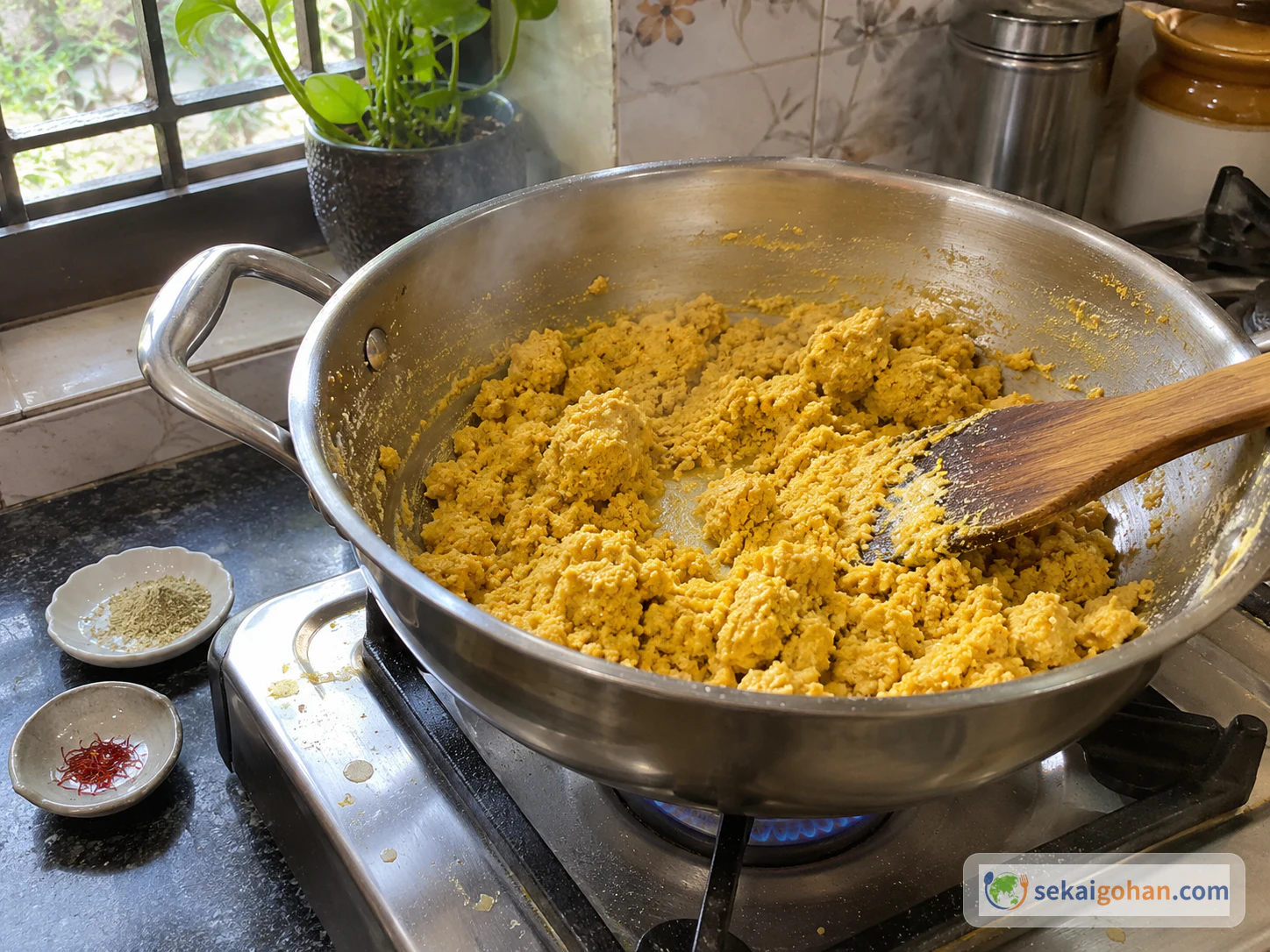
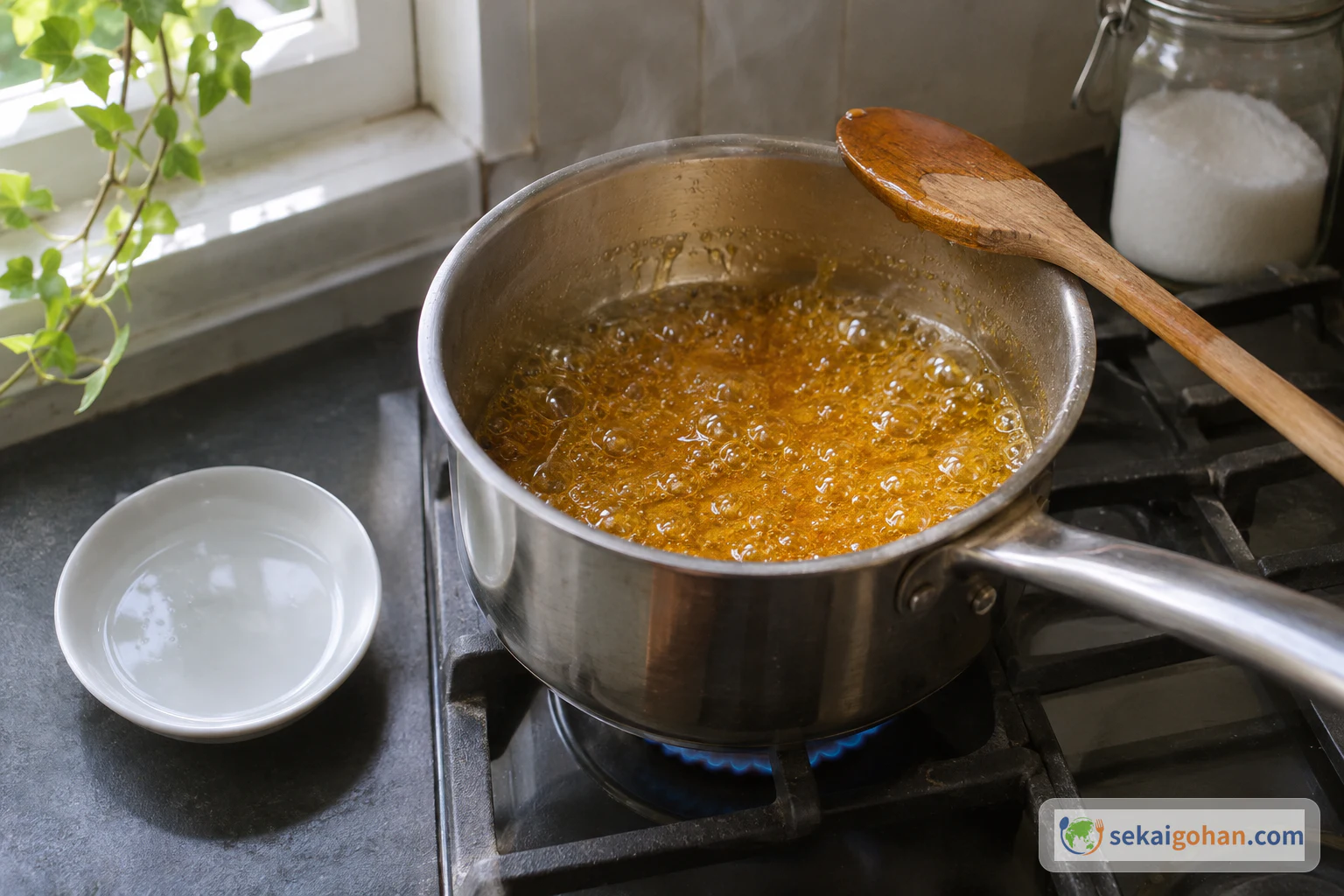
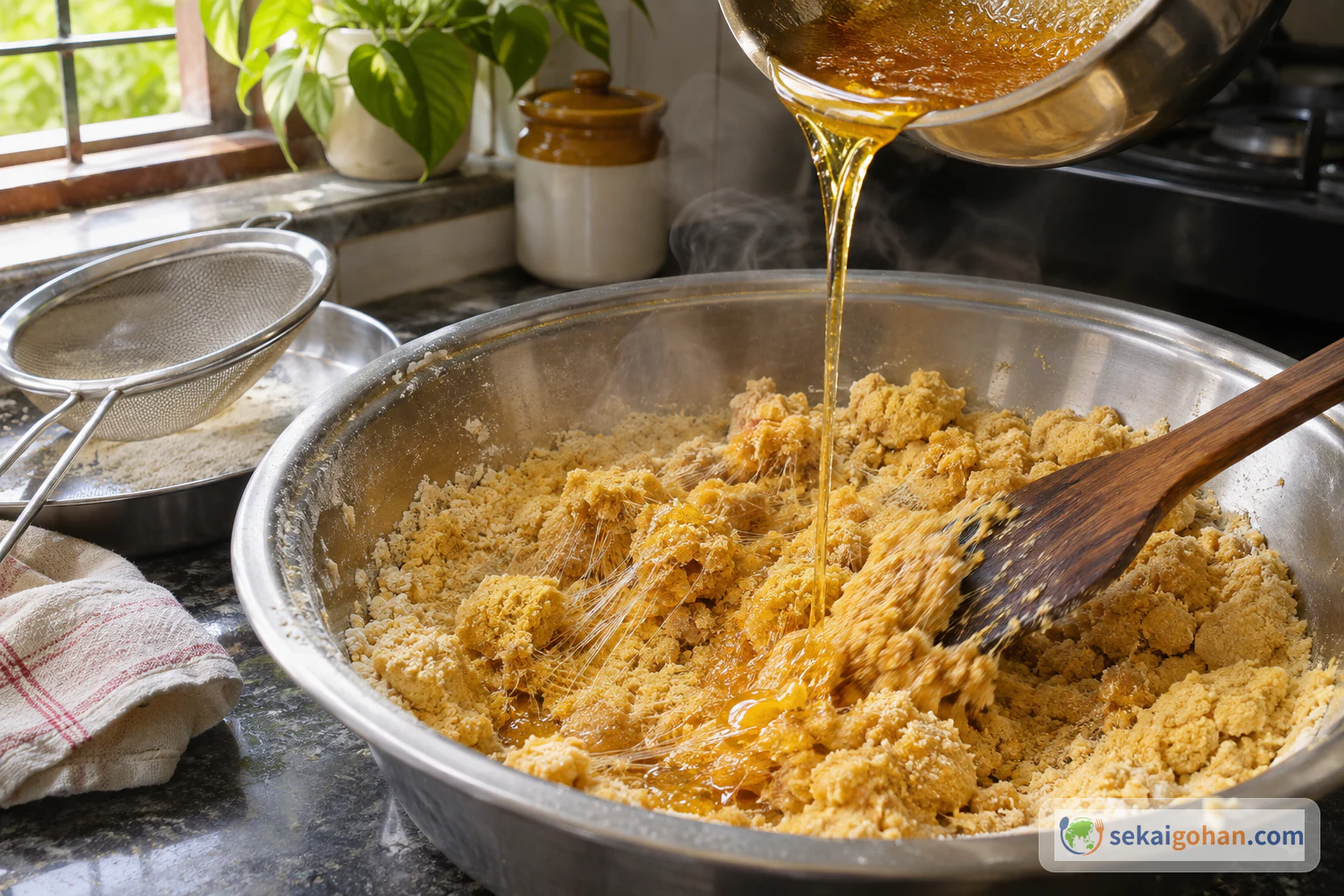
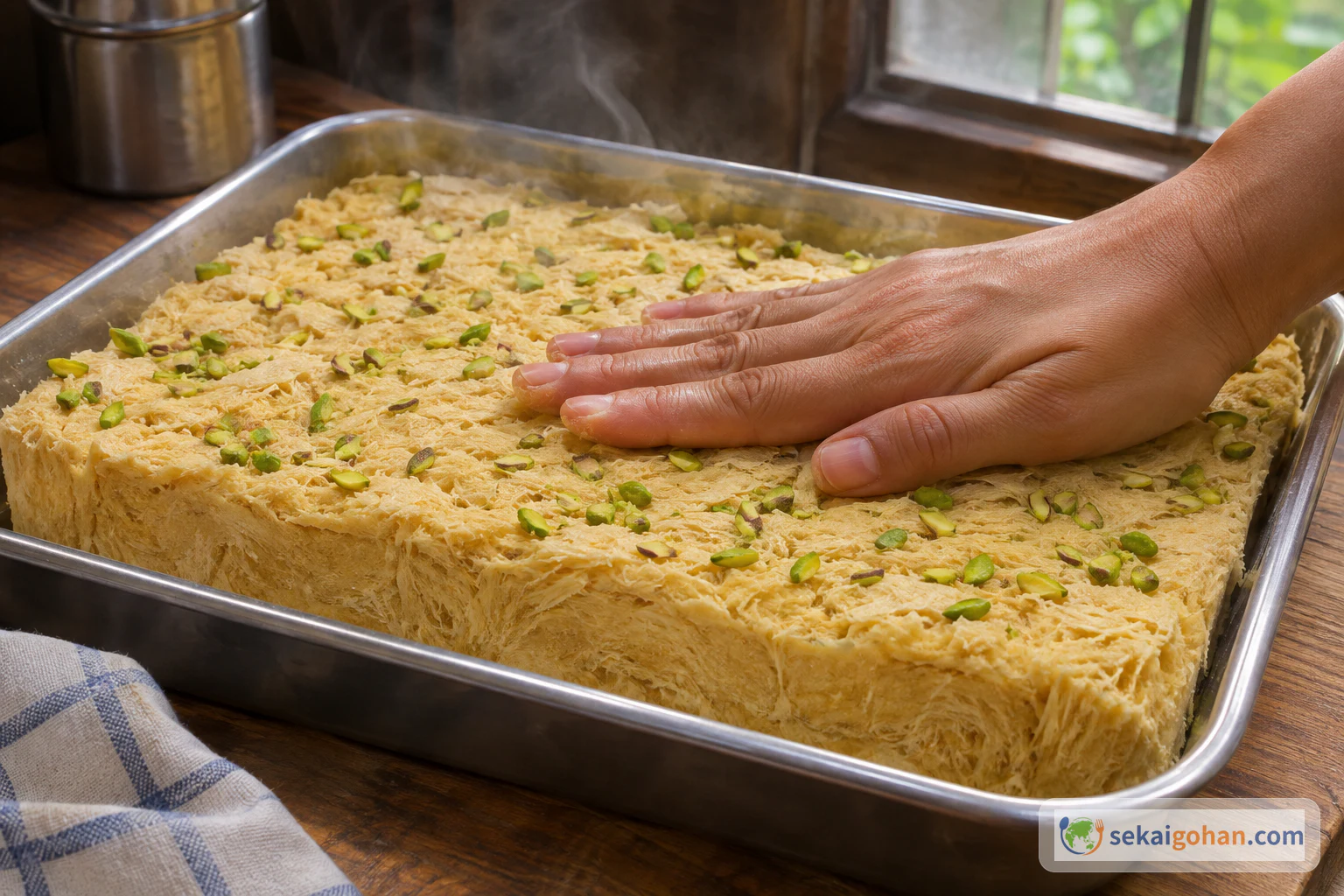
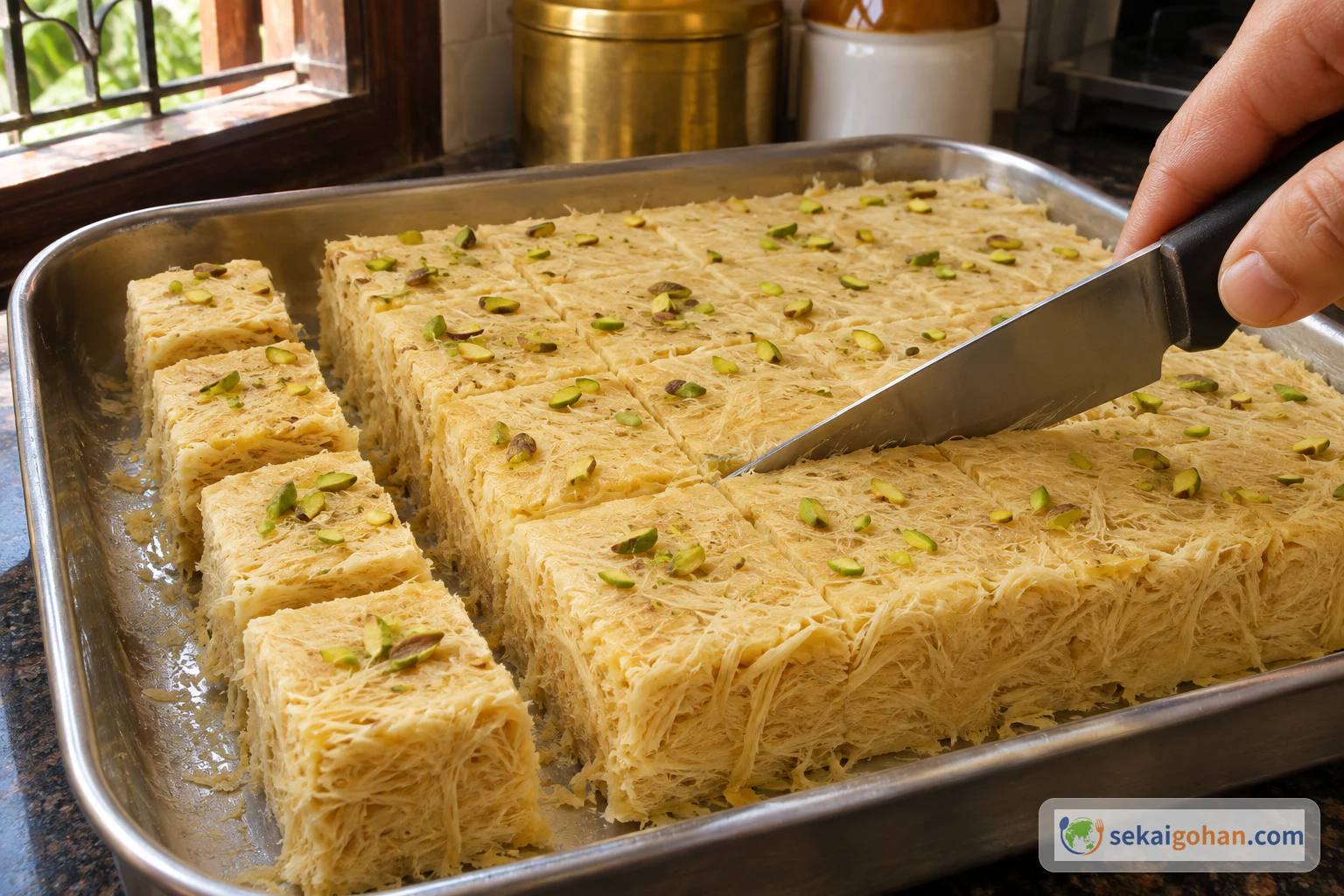
The thick, deep-yellow syrup goes into the bowl of warm roasted flour a little at a time. As the spatula keeps turning, fine strands of sugar start pulling through the crumbs, and that is the moment the sweet comes together. Sohan papdi, also written soan papdi and known as patisa, is a mithai made from chickpea flour and plain flour roasted in ghee, scented with cardamom and set into cubes that are crisp and flaky. A bite holds together for a second, then falls apart on the tongue into dry, sweet threads that taste of toasted besan and ghee. In India it turns up every Diwali in boxes that pass from house to house, and it is also made across Pakistan and Bangladesh.
A Sweet Made of Threads, Passed From Hand to Hand
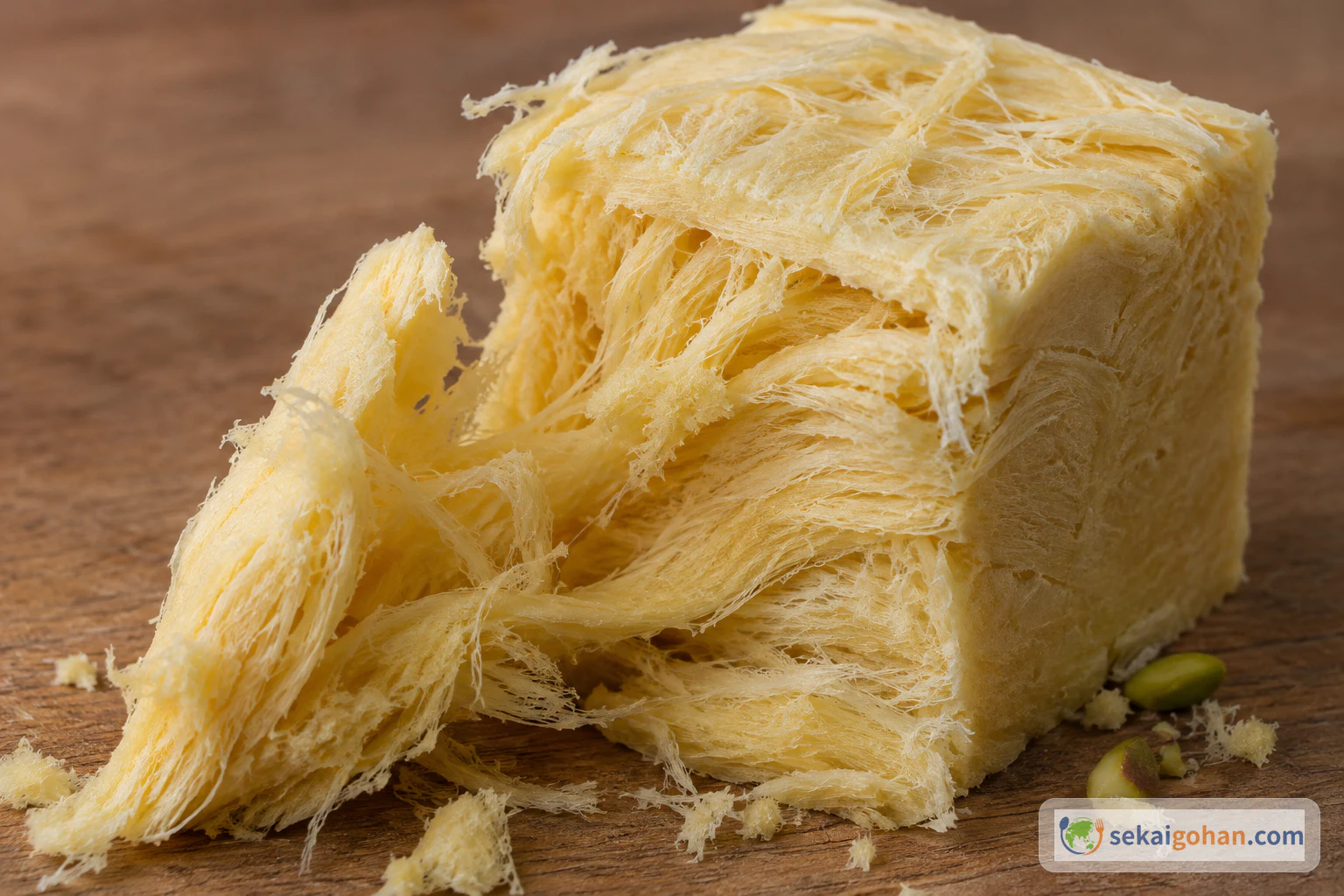
The structure is the whole point. In the traditional method, syrup is cooked to a hard ball, cooled on a greased slab, folded twenty to thirty times, then looped into a ring and pulled through a plate of flour in a figure eight. Every loop doubles the strands, so ten loops give 1,024 threads and twelve give 4,096. The home method below uses the same ingredients but gets there by a shorter route. Hot syrup is stirred into roasted flour until threads form by themselves, so nobody has to pull scalding sugar by hand.
Names, origins and its cousins
Spellings change from region to region. The cubes are made across North India, Punjab, Bengal, Gujarat, Rajasthan and Uttar Pradesh. Where it was first made is not settled: western Maharashtra, Uttar Pradesh and Gujarat all have their claims. The food anthropologist Kurush F. Dalal, who sees the sweet as Persian in origin, says the word "soan" comes from the Persian sohan pashmaki, which links it to a wider family of pulled-sugar sweets. That family includes Chinese dragon's beard candy, Korean kkul-tarae and Persian pashmaki, the ancestor of Turkish pişmaniye.
Son papdi, sohan papdi, san papri, shonpapdi, shompapri and patisa all mean the same sweet. Sohan halwa is a different confection altogether, despite the shared word.
From paper cones to the Diwali box
Sohan papdi used to be sold by weight in rolled paper cones. Street carts kept it in big glass jars. Factory production turned it into the firm, boxed cube most people know now, and it is one of the few mithai sold sealed in packets. That is why it travels so well as a gift. People buy it all year, but demand peaks at festival time, and at Diwali the boxes go round so often that the sweet has earned a joke name: "the sweet that nobody eats but everybody receives." A factory video once showed workers mixing it in large vats and pulling it by hand, and viewers argued over whether the flour on screen was maida. The comments kept coming back to one point: real soan papdi is made with besan. A batch made at home has that flavour. The roasted chickpea flour tastes nutty and rich, the cardamom stands out, and you can taste the ghee. The shape varies too: cubes are the usual form, but there are loose flakes, rounds, and a "soan roll" packed into a glass to set as a cylinder. Cardamom is the usual scent, though some versions use rose and others saffron.
Ingredients (makes 12 to 15 pieces)
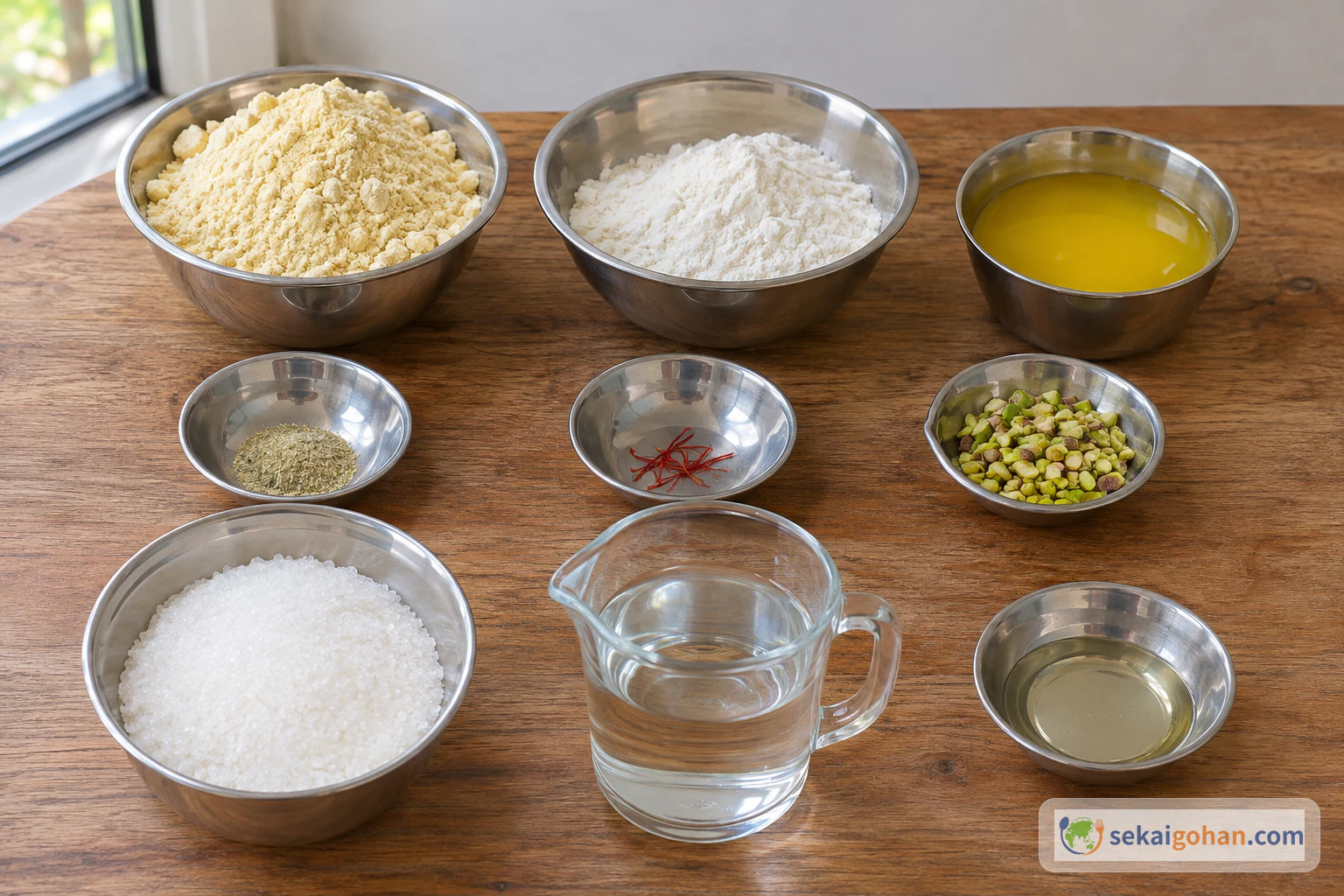
No milk goes into this sweet. The ghee is only for roasting and is kept separate from the oil for the tray.
This sweet contains dairy (ghee), wheat (plain flour), chickpea (a legume) and tree nuts (pistachios, or almonds if you swap them). Everything is cooked, so nothing in it is raw.
Equipment
- Heavy frying pan for roasting the flour
- Medium saucepan for the syrup
- Heat-resistant wooden spatula
- Fine sieve
- Large bowl
- Shallow metal tray, small enough that the mixture stands 1½ inches (3.8 cm) deep
- Sharp knife
- Kitchen scale
- Small saucer of cold water for testing the syrup
What to Buy and What Can Change
Besan is the one thing to track down. Look for it at Indian grocers or online, sold as gram flour or besan. No other flour gives the same toasted aroma or holds the threads the same way, so don't swap it. Ghee comes from the same shops. If you can't find it, melt unsalted butter and skim off the milk solids to make clarified butter. It works, though the flavour comes out a little less nutty.
The rest is easy to find. Use ordinary plain (all-purpose) flour and white granulated sugar. Ground cardamom is on most spice racks, and you can also crush seeds from the pods yourself. Saffron is expensive; leave it out and the pieces come out paler but still good. Turmeric gives the colour but none of the saffron aroma. Use unsalted roasted pistachios, or chopped almonds in their place. Grease the tray with any neutral vegetable oil.
If you crush seeds from the pods instead of using powder, the cardamom comes through more strongly against the sweet threads. Grind them finely so no gritty bits end up in the layers.
Method: Roast, Boil, Stir, Cut Warm
This is quick, hot work with no resting time until the end. Grease the tray and weigh everything before you light the stove. Roasting the flour takes about 20 minutes of steady stirring. While the roasted flour sits warm, the syrup cooks for about 25 minutes. After that, combining, spreading and cutting go in one go while the mixture is still warm. Once it cools it will no longer spread or cut cleanly.
When It Goes Wrong
| What you see | Why | What to do |
|---|---|---|
| Tastes of raw flour | The flour was not roasted long enough | Keep roasting until it is deeper yellow and smells nutty |
| Burnt smell, bitter taste | Heat too high or not stirred enough | Start again; next time turn the heat just below medium and stir constantly |
| No threads, a sticky lump | Syrup too thin, or the flour had gone cold | Cook the syrup until thick and deep yellow; combine while the flour is warm |
| Sets hard while you are still stirring | Syrup cooked too far, or poured in all at once | Pour in a thin stream and stir the whole time |
| Pieces shatter when cut | The slab cooled before cutting | Cut while still warm |
| Pieces stick to the tray | The tray was not greased | Oil the tray thinly before you start |
| Soft and sticky the next day | It has absorbed moisture from the air | Store airtight; wrap pieces one by one |
Serving, Variations and Storage
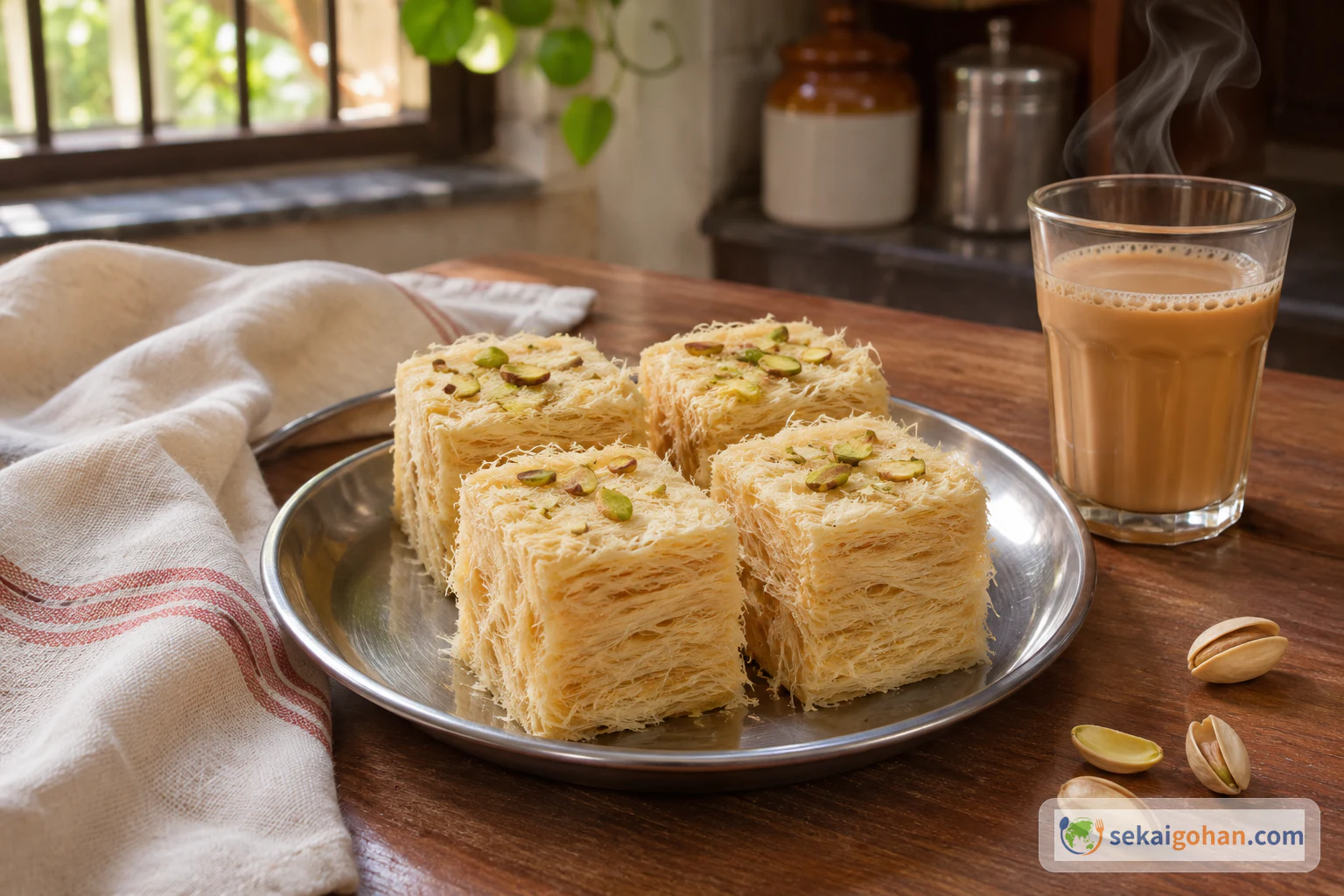
Serve the pieces at room temperature, with chai or black tea to cut the sweetness. A homemade box makes a good festival gift, and at Diwali it stands out from the factory cubes going round. Sohan papdi is high in sugar and fat, so one or two pieces with tea is plenty.
Variations
- Cardamom alone. Leave out the saffron and the cardamom stands on its own; the pieces come out paler.
- Almond topping. Chopped almonds instead of pistachios give a milder, toastier top.
- Rose. A very small splash of rose water in the syrup gives the rose-scented version. It is strong, so add very little.
- A thinner slab. Spread it 1 inch (2.5 cm) thick and cut 1-inch (2.5 cm) squares to get smaller, shallower pieces.
- The hand-pulled version. This one uses a different mix, mostly plain flour with a little besan, plus lemon juice in the syrup. The syrup is cooked to a hard ball, folded and pulled into doubling threads. Wear heat-resistant gloves, and treat it as a separate, advanced recipe.
Storage
Keep the pieces in an airtight container for up to one week. Wrapped one by one in food film or butter paper, they keep longer at room temperature. Left uncovered, they soak up moisture from the air and go soft and sticky.
Frequently asked questions
Is sohan halwa the same thing?
No. Sohan halwa is a separate sweet with its own method and texture, and it only shares part of the name. If a recipe gives you a dense, chewy slab instead of dry threads, it is the halwa.
Are patisa and soan papdi different sweets?
They are the same sweet under different names. Patisa is used especially in North India and Punjab, alongside sohan papdi, son papdi and the other spellings. Whichever name is on the box, you get the same flaky cube.
Does sohan papdi contain milk?
No milk is added here, and the syrup is just sugar and water. Ghee is still a dairy product, so the sweet is not dairy-free. Some home recipes stir a little milk into the syrup, so check the labels on bought boxes.
Why do bought boxes taste different from homemade?
Factory pieces are made in large batches and sold as firm, sealed cubes, and viewers of one factory video argued over whether besan was used at all. A home batch like this one roasts the besan slowly in ghee, which gives it a nutty, rich flavour.