


Long noodles, piled on the birthday platter uncut
Late afternoon in the kitchen, garlic and onion slide into hot oil. In go the chicken, shrimp, carrot and cabbage, one after another, and when the yellow noodles hit the steam the pan suddenly gets loud. The noodles drink up soy sauce and oyster sauce and darken little by little, and at the very end you squeeze over some citrus. It looks a lot like Japanese yakisoba, but one bite tells you it is something else entirely: the smell of a celebration.
Pancit canton (also spelled pansit canton) is a stir-fried wheat noodle dish made all over the Philippines. Pancit comes in many styles, from rice-noodle bihon to glass-noodle versions and palabok topped with a shrimp sauce, but canton uses thick, chewy wheat noodles. English-language Filipino food sites often describe them as close to lo mein or egg noodles, and at home people add pork, chicken, shrimp, fish balls, sausage and vegetables depending on what they have that day.

What makes pancit special in the Philippines is that it is more than a noodle dish. It shows up at birthdays, graduations, baptisms and family gatherings as a dish for long life: eating long, uncut noodles carries a wish for a long life. In a Food & Wine essay about growing up in a Filipino family, the writer recalls that the center of every birthday was not cake but pancit.
In a home kitchen, the tricky part is not the seasoning but the noodles. Dried pancit canton noodles soak up sauce beautifully, but the steamed yakisoba-style noodles sold refrigerated in many supermarkets are already cooked, so too much liquid turns them soft fast. This recipe is built around imported dried noodles, and also covers how to adjust the liquid for steamed noodles, what to use instead of calamansi, and how to revive leftovers.
If you are cooking a Filipino spread, follow up with sour sinigang (in Japanese), adobo braised in soy sauce and vinegar (in Japanese), and the sweet layered rice cake sapin-sapin (in Japanese), and the table opens up quickly.
Both pancit and pansit are common in the Philippines. This article uses "pancit," the spelling most people search for. "Canton" points to the influence of Cantonese noodle dishes, but today's pancit canton has grown into a Filipino home-cooking dish in its own right.
Background: how Chinese noodles became a Filipino celebration dish

Behind pancit is a long history of Chinese immigrants and the Filipino table mixing together. EatingWell, citing the food writing of Doreen Fernandez, explains that the word pancit comes from the Hokkien "pian-e-sit," meaning "something quickly cooked." It didn't originally refer only to noodles, but stir-fried noodle dishes that could be eaten right away suited workers, travelers and home cooks alike, and they took root as Filipino food.
The name "canton" might make you think of Chinese food, but today's pancit canton is not simply a copy of chow mein. The sweet-salty balance of soy sauce and oyster sauce, the tartness of squeezed calamansi, the abundance of meat, shrimp and vegetables piled on one plate, and the birthday wish for long life all come together into a distinctly Filipino celebration noodle.
Pancit varies a great deal by region and household: rice-noodle bihon, glass-noodle sotanghon, palabok covered in an orange shrimp sauce, pancit habhab from Lucban, and the generously topped noodles of Malabon. Of all these, canton is one of the easiest to start with. The noodles are wheat, so they are forgiving, and the other ingredients are easy to find at an ordinary supermarket.
| Style | Noodles | Main flavors | How easy at home |
|---|---|---|---|
| Pancit canton | Wheat noodles, egg noodles | Soy sauce, oyster sauce, chicken broth | Easy. Steamed yakisoba noodles work as a substitute |
| Pancit bihon | Rice noodles | Soy sauce, broth, sweetness from vegetables | Easy, but the noodles break easily |
| Pancit palabok | Rice noodles | Shrimp stock, achuete (annatto), chicharon | Ingredients are a bit harder to find |
| Pancit sotanghon | Glass noodles | Chicken broth, soy sauce, mushrooms | Lighter. Easy to keep a little saucy |
What makes it so interesting as home cooking is how wide the range of "correct" toppings is. Kawaling Pinoy lists chicken, pork, shrimp, fish balls, sausage and liver for the meat, and snap peas, napa cabbage, cabbage, carrots, celery and kinchay (Chinese celery) for the vegetables. The recipe from Musang, the Filipino restaurant in Seattle, featured on Epicurious, also stresses the flexibility of using whatever vegetables are in the fridge.
So at home, rather than hunting down every imported ingredient, it works better to decide what the core is. The core is four things: wheat noodles, cooking them so they absorb soy sauce and oyster sauce, citrus at the end, and the celebratory spirit that holds the plate together even when it is loaded with toppings.
Ingredients (serves 4): the dried-noodle basics and substitutes

This makes 4 servings. For a birthday or guests, pile it on a big platter next to the main dishes. On a weeknight, it is enough to serve as both the starch and the main course. If your skillet is small, finish the noodles in two batches.
This dish contains wheat (noodles), shrimp, soy (soy sauce) and seafood (oyster sauce, fish sauce). Dried noodles and oyster sauce vary by brand in their egg, dairy and seafood labeling, so check the package when you shop.
If you use steamed yakisoba noodles
The easiest substitute to find is steamed yakisoba-style noodles, usually sold refrigerated. If you use them, have 3 packs (about 450 g) ready and cut the chicken broth from 450 ml to 180 ml. Steamed noodles already contain moisture, so the same amount of broth as for dried noodles will make them far too soft. Skip any seasoning packet, and warm the noodles briefly in the microwave before adding them so they separate easily.
The first thing to look for is "pancit canton noodles" or wheat noodles made for Filipino cooking. Next comes oyster sauce, and last of all calamansi. Lemon or sudachi can stand in for the citrus, but the texture of the dried noodles shapes the whole dish. Try Asian or Filipino grocery stores, or search online for "pancit canton noodles."
Ingredients and tools for this dish
Dried noodles get you closer to the Filipino texture, where the noodles finish cooking as they soak up the broth. If you try it first with steamed noodles and like it, dried noodles are worth seeking out next time.
Even without calamansi, a squeeze of sudachi or lemon at the end lightens the heaviness of the soy sauce and oyster sauce. If you plan to keep cooking Filipino food, a bottle of fish sauce will also come in handy for variations on sinigang (in Japanese) and adobo (in Japanese).
Since this is a big-platter dish, a wide skillet or wok that is easy to toss in keeps the noodles from breaking. If all you have is a small skillet, it is safer to finish the toppings and the noodles separately.
Method: let the noodles drink the broth, then return the toppings
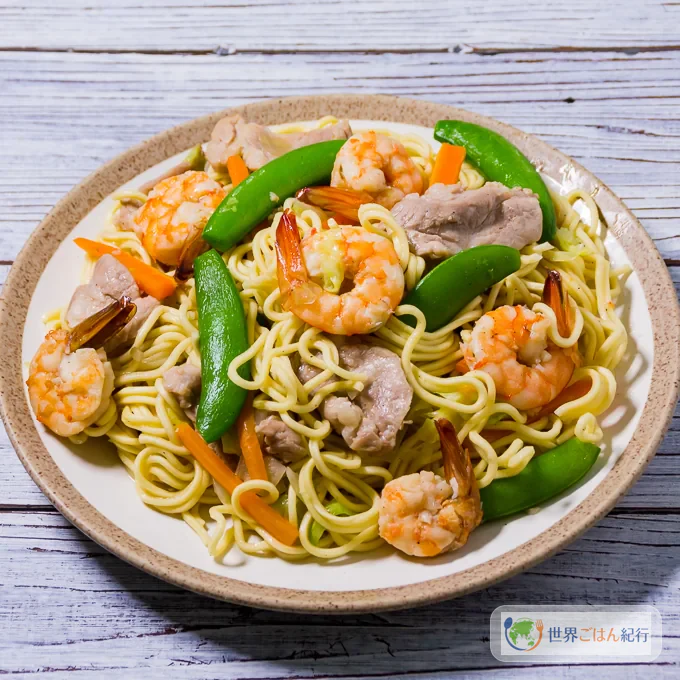
Pancit canton is not a dish where you stir-fry everything at once. You cook some of the toppings first and set them aside, build a base with aromatics and meat, then add the noodles and let them absorb the broth. Returning the vegetables and shrimp at the end means the noodles soak up flavor while the vegetables don't go limp.
Kawaling Pinoy also notes that pancit canton noodles break less when you turn them gently with tongs, chopsticks or two large spoons. Pressing down with a spatula tends to cut them short, so on days you want long noodles on the platter, toss with care.
Getting closer to the original in a home kitchen

Pancit canton is easier to make when you decide what to keep, rather than insisting that every ingredient be authentic. Separate what you can find at any supermarket from what is worth buying imported.
| Ingredient in question | Closer to the original | Practical option | Verdict |
|---|---|---|---|
| Noodles | Dried pancit canton noodles | Thick dried Chinese noodles, steamed yakisoba noodles | Steamed noodles are fine the first time. Reduce the liquid |
| Citrus | Calamansi | Sudachi, lemon, lime | Always add acidity at the end |
| Fish sauce | Patis | Nam pla, or leave it out | A little is plenty. Too much makes it salty |
| Herbs | Kinchay | Celery leaves, green onion | Keep a little fresh, green aroma |
| Processed meats | Chinese sausage, fish balls | Kamaboko or fried fish cakes, a few hot dogs | Adds a festive feel, but don't overdo it |
| Vegetables | Snap peas, napa cabbage, cabbage | Cabbage, carrot, komatsuna or other leafy greens | Go easy on watery vegetables |
It is less about what you must not substitute and more about knowing what a swap will change. Steamed noodles are convenient, but they leave less room to absorb broth, so use less liquid with a stronger seasoning. Leaving out the patis makes the aroma gentler, but soy sauce and oyster sauce alone still make a perfectly good home-style dish. On the other hand, if you drop the citrus entirely the flavor turns heavy, so always squeeze something over at the end, even if it's just lemon or sudachi.
In Filipino homes, puto or pandesal sometimes sit beside the pancit. Outside the Philippines, rather than adding bread, it can feel more natural to keep a little sauce from adobo (in Japanese) and eat it with the noodles. A small bowl of sour sinigang (in Japanese) also pairs well with soy-seasoned noodles.
What goes wrong: sticky noodles, bland flavor, leftover toppings

Most pancit canton failures come down to liquid and order. Add too much water trying to soften the noodles and they get sticky; leave all the toppings in the whole time and the vegetables sink while the shrimp turn tough.
| Problem | Cause | Fix |
|---|---|---|
| Sticky noodles | Too much broth; dried-noodle amounts of liquid used for steamed noodles | With steamed noodles, start with 180 ml broth |
| Hard noodles | Heat turned off before the dried noodles absorbed all the broth | Add boiling water 2 tbsp at a time and keep cooking |
| Bland | Too little seasoning for the amount of noodles | Finish with 1 tsp soy sauce and a little fish sauce |
| Too salty | Too much fish sauce and oyster sauce | Squeeze in more calamansi (or lemon), or stretch it with unsalted scrambled egg or blanched vegetables |
| Tough shrimp | Left in from start to finish | Sear first, set aside, return at the end |
| Leftover toppings | Too many vegetables added before the noodles went in | Stir-fry the vegetables briefly and cut them to the same length as the noodles |
Watch the capacity of your skillet in particular. Pancit canton is a platter dish, so it's tempting to keep adding toppings. But 250 g of noodles plus meat, shrimp and vegetables all at once is a crowded fit even in a 26 cm (10-inch) skillet. When the pan is crowded, things steam instead of stir-fry, the noodles go soft and the vegetables turn watery.
The fix is simple: take toppings out. Stir-fry the shrimp, snap peas and, if needed, half the cabbage first and set them aside, then return them after the noodles have absorbed the broth. It's the same thinking as in Chinese stir-fries: don't handle things that take longer to cook, things whose color you want to keep and things that toughen easily all at the same time.
This dish contains meat, shrimp and fish sauce, so don't leave it out at room temperature for long. Once you've served the platter, move any leftovers to an airtight container as soon as they've cooled slightly and refrigerate. If you pack it in a lunch box, reheat it until it's hot all the way through, and use an ice pack in hot weather.
Storing and reheating: revive it the next day with oil and citrus, not water

Pancit canton is best fresh, but it is still good the next day. Kawaling Pinoy recommends storing leftovers in an airtight container in the fridge and finishing them within about 3 days, and notes that it doesn't freeze well. Because the noodles keep absorbing moisture, freezing tends to ruin the texture once thawed.
To refrigerate, don't leave it out until it's completely cold; once it has cooled slightly, spread it in shallow containers. Since it contains shrimp and meat, it's easier to manage if you divide it into a portion for the next day's lunch and a portion for dinner on day two.
You can reheat it in the microwave alone, but the noodles tend to clump. A skillet works better. Warm 1 tsp oil over medium-low heat and add the pancit. If you add water, keep it to about 2 tsp; more water turns the noodles back into steamed noodles. Finish with a small squeeze of lemon or sudachi so the oil and soy sauce don't feel heavy again.
For next-day twists, try topping it with a fried egg, adding shredded adobo meat, or upping the green onion and lemon. Rather than steering it toward Japanese yakisoba with ketchup or Worcestershire-style sauce, pulling it back to the Filipino side with citrus and aromatics keeps it tasting like pancit.
It's tempting to cut the noodles short to make them easier to eat, but the long noodles are what make pancit a celebration dish. For a lunch box, don't force it; divide it into small bundles that are easy to pick up with a fork or chopsticks, so the noodles don't tangle too much.
Variations

Pancit canton holds up well even when you change the toppings. But there is an order to changing things. First keep the noodles and the soy-oyster sauce backbone, then change the toppings. If you move the heat, sweetness and sauce a lot from the start, it becomes hard to tell what you're making.
Chicken-only home version
Leave out the pork and shrimp and increase the chicken thigh to 300 g. Add 1/2 tsp more fish sauce to make up for the savoriness the shrimp would have given. Good for days when kids are eating, when someone has an allergy, or when you want to use up the meat in the fridge.
Seafood-heavy celebration version
Increase the peeled shrimp to 200 g and add a little squid, scallops and kamaboko (fish cake). Seafood toughens if overcooked, so always sear it first, set it aside and return it at the end. It looks great on a big platter, which makes it ideal for birthdays and guests.
Vegetable-heavy weeknight version
Swap the cabbage for komatsuna, bok choy and bean sprouts. Bean sprouts release water, so add them at the very end, once the noodles are almost done, and toss for just 30 seconds. For protein, fried tofu works well, and if you go easy on the fish sauce the result is quite light.
About instant pancit canton
In the Philippines, instant pancit canton from brands like Lucky Me! is an everyday food too. It is a different category of convenience food and plays a different role from the platter pancit in this article. Adding an egg or calamansi to it for a quick snack on a busy day is fun, but if you are making it as a celebration dish, finishing a big platter with dried noodles and real toppings is far more satisfying.
Menu ideas: serving it as a Filipino celebration platter

When pancit canton is the center of dinner, it's easier to eat if you don't add too many main dishes. The noodles already have chicken, pork, shrimp and vegetables, so another heavy meat dish on the side doubles up on both flavor and oil. Start by thinking in three roles: something sour, something fried and something sweet to finish, and your shopping gets much simpler.
For sourness, the best soup partner is sinigang (in Japanese), bright with tamarind. On days you want a small side of soy-and-vinegar braise, serve adobo (in Japanese) in a small dish and treat the pancit as the starch. For a light egg dish, tortang talong (in Japanese), grilled eggplant wrapped in egg, is handy. To finish on a sweet note, sapin-sapin (in Japanese), made with glutinous rice and coconut, fits well. These are all Filipino home dishes, but because their roles split cleanly into sour, braised, vegetable omelet and sticky sweet, the table doesn't feel cluttered.
To compare Southeast Asian stir-fried noodles, read about sweet-soy mie goreng (in Japanese), tangy, nutty pad thai (in Japanese) and Vietnamese rice-noodle pho ga (in Japanese) to see how differently each handles moisture in the noodles. For a light side, green papaya som tam (in Japanese) or Lao herb-and-meat salad laab (in Japanese) makes a good contrast. Both use sourness and herbs to cut through the oil in the pancit.
To build a big shared table, expand to the rice dish nasi goreng (in Japanese), coconut rice nasi lemak (in Japanese) and rich laksa (in Japanese), and you can compare Southeast Asian ways of eating noodles and rice. Among them, pancit sits in the middle, at home on a celebration day or a weekday lunch. Add more toppings when you want it showy. On weekdays, keep to the noodles and vegetables. That range is what makes it so Filipino.
If you want to shop just once, it's fine to buy extra oyster sauce, fish sauce, lemons and green onions. Fish sauce also goes into soto ayam (in Japanese) and the pickled vegetables for banh mi (in Japanese). Beyond pancit, a little oyster sauce works in home versions of gapao rice (in Japanese) and lomo saltado (in Japanese). Once you can see how to use up a whole bottle, buying imported seasonings feels much less daunting.
Some days call for something lighter. Banh xeo (in Japanese) is wrapped in greens. Khao piak sen (in Japanese) is soothing and brothy. Amok (in Japanese) is mellowed by coconut. Mumu (in Japanese) offers a steam-roasted contrast. Roti canai (in Japanese) is fun to eat with your hands. Bak kut teh (in Japanese) is an herbal soup. Mohinga (in Japanese) is a contrasting breakfast noodle. Tom yum goong (in Japanese) lets you compare levels of sourness.
On weekdays, make the noodles the star. A little meat is enough. Two colors of vegetables are plenty. Make the soup a sour one. Keep sweet sides small. When guests come, use a big platter. Put the citrus on a separate plate. Cut back the fish sauce for kids. Add more black pepper for adults. Return the shrimp at the end. Don't cut the noodles. Cut the toppings thin. Don't add more oil. Add water little by little. Move leftovers to shallow containers. Stir-fry them again the next day. Squeeze lemon over at the end. That alone brings the flavor back. You don't have to make everything. Gather around the long noodles, and it will still feel like pancit.
For a first try, three dishes are plenty: pancit canton + sinigang + sapin-sapin. If you add a braise, keep the adobo portion small and make the pancit toppings mostly chicken and vegetables. Rather than adding more flavor directions, a home table comes together better when sour, noodles and a sweet finish are clearly separated.
Frequently asked questions

Q1. What's the difference between pancit canton and yakisoba?
Japanese yakisoba is usually steamed Chinese-style noodles stir-fried with a Worcestershire-style sauce. Pancit canton is a Filipino dish in which wheat noodles absorb soy sauce, oyster sauce and chicken broth, then meat, shrimp and vegetables are returned to the pan and everything is piled onto a big platter. The tartness of calamansi or lemon squeezed over at the end is another big difference.
Q2. What can I use if I can't find calamansi?
Sudachi, lemon or lime all work. The closest match is a mix of a little sudachi and a little lemon. Bottled lemon juice will add a minimum of acidity, but fresh citrus has a better aroma.
Q3. Which is better, dried noodles or steamed yakisoba noodles?
For a version closer to the original, use dried pancit canton noodles; for convenience, use steamed noodles. Dried noodles finish cooking as they soak up the broth, so the flavor gets into the noodles more easily. With steamed noodles, reduce the broth to around 180 ml and finish them quickly as stir-fried noodles.
Q4. Can I make it ahead?
Plan to finish it within about 3 days in the fridge. Freezing isn't recommended because the noodle texture suffers. To reheat, stir-frying in a skillet with a little oil and finishing with a squeeze of citrus brings the texture back better than the microwave alone.
Q5. Can I make it without shrimp?
Yes. Use more chicken and add a little fish sauce to make up the savoriness. If you have a shrimp allergy, avoid shrimp and oyster sauce containing seafood, and check product labels.
In short: with pancit, protect the long noodles, not the pile of toppings

Pancit canton is not a dish that gets better the more lavish the ingredients. Don't cut the long noodles, let them absorb the broth, return the toppings while they're still colorful, and finish with citrus. Get that flow down, and even steamed yakisoba noodles will bring you surprisingly close to a Filipino table.
For a first try, dried or steamed noodles, chicken, shrimp, cabbage, carrot, soy sauce, oyster sauce and lemon are enough. Next time, you can add patis, calamansi, fish balls, kinchay and snap peas. What makes pancit Filipino isn't perfect imported ingredients so much as the mood of gathering around a big platter and asking, "Want a little more?"
For a Filipino menu, lighten the palate with sour sinigang (in Japanese), add a meat dish with adobo (in Japanese), and set out a little sapin-sapin (in Japanese) after the meal for a celebration-day flow. To compare Southeast Asian stir-fried noodles, try cooking sweet-soy mie goreng (in Japanese) and tangy pad thai (in Japanese) side by side.
Sources
The cooking steps, noodle handling and timing for the toppings were checked mainly against the first three sources.
The storage time follows Kawaling Pinoy's guideline of about 3 days in the fridge. The birthday and long-life story draws on an essay by a Filipino family published in Food & Wine.



