Start with the Sound of Rice Drying on the Wok
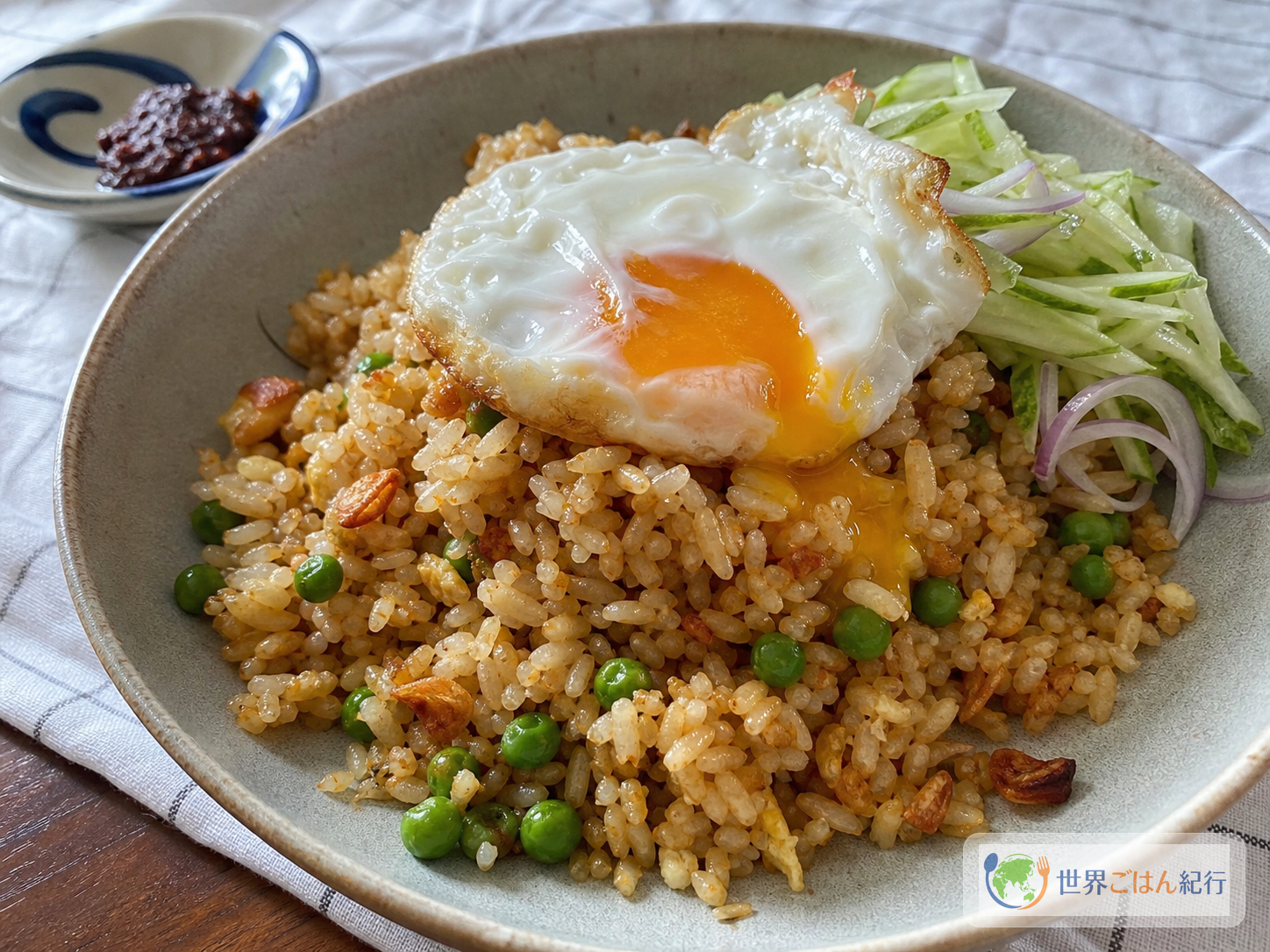
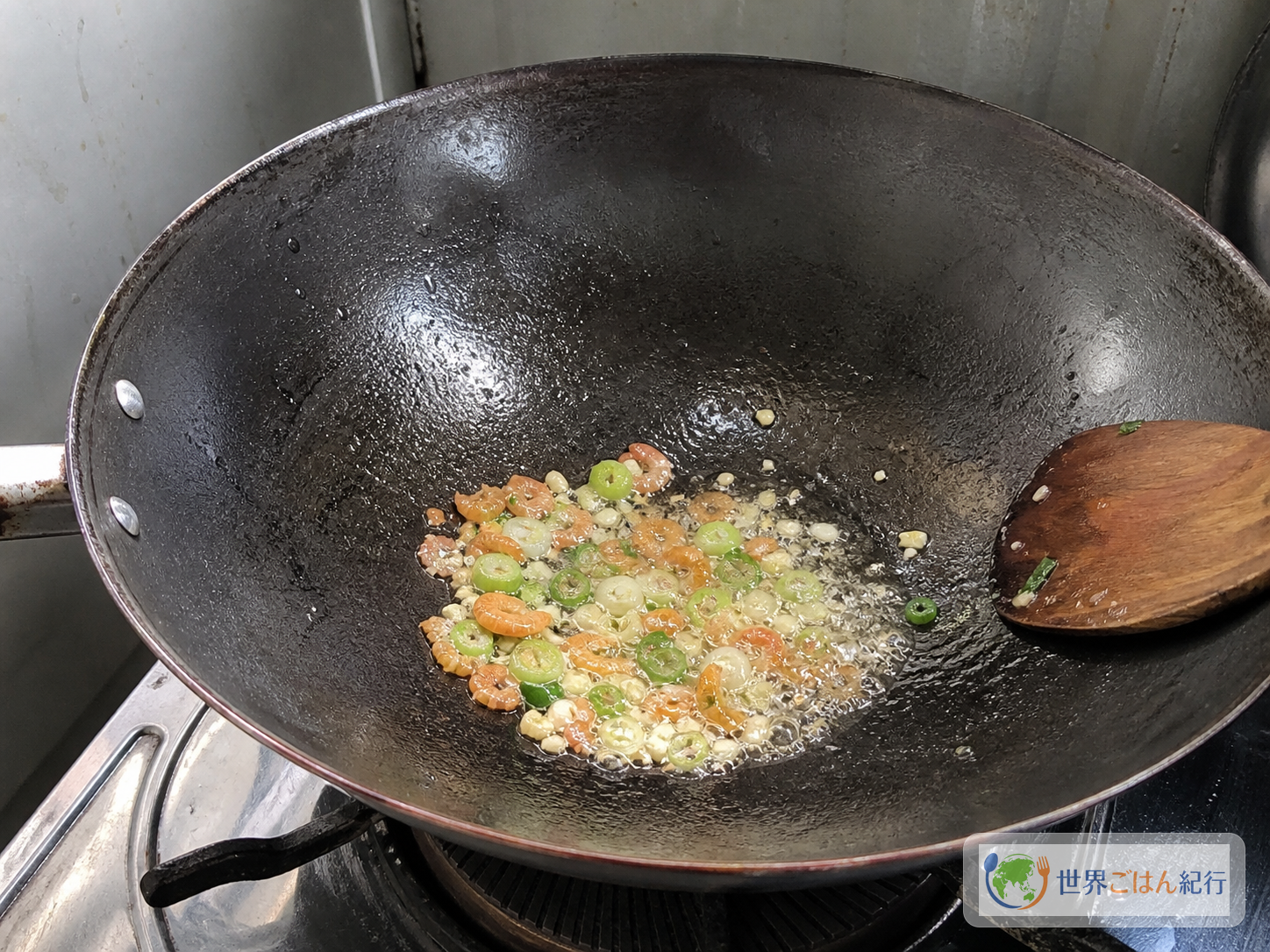
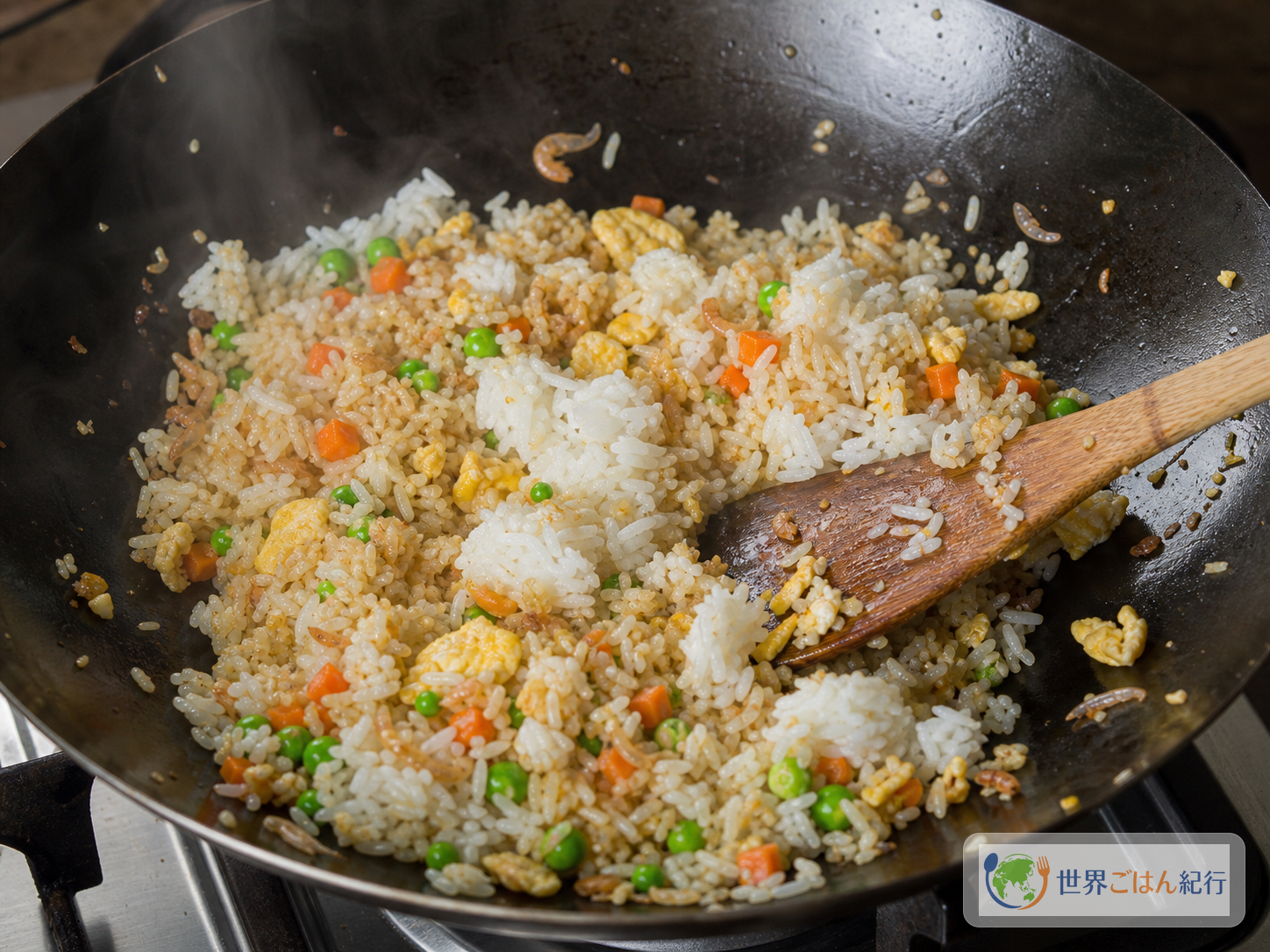
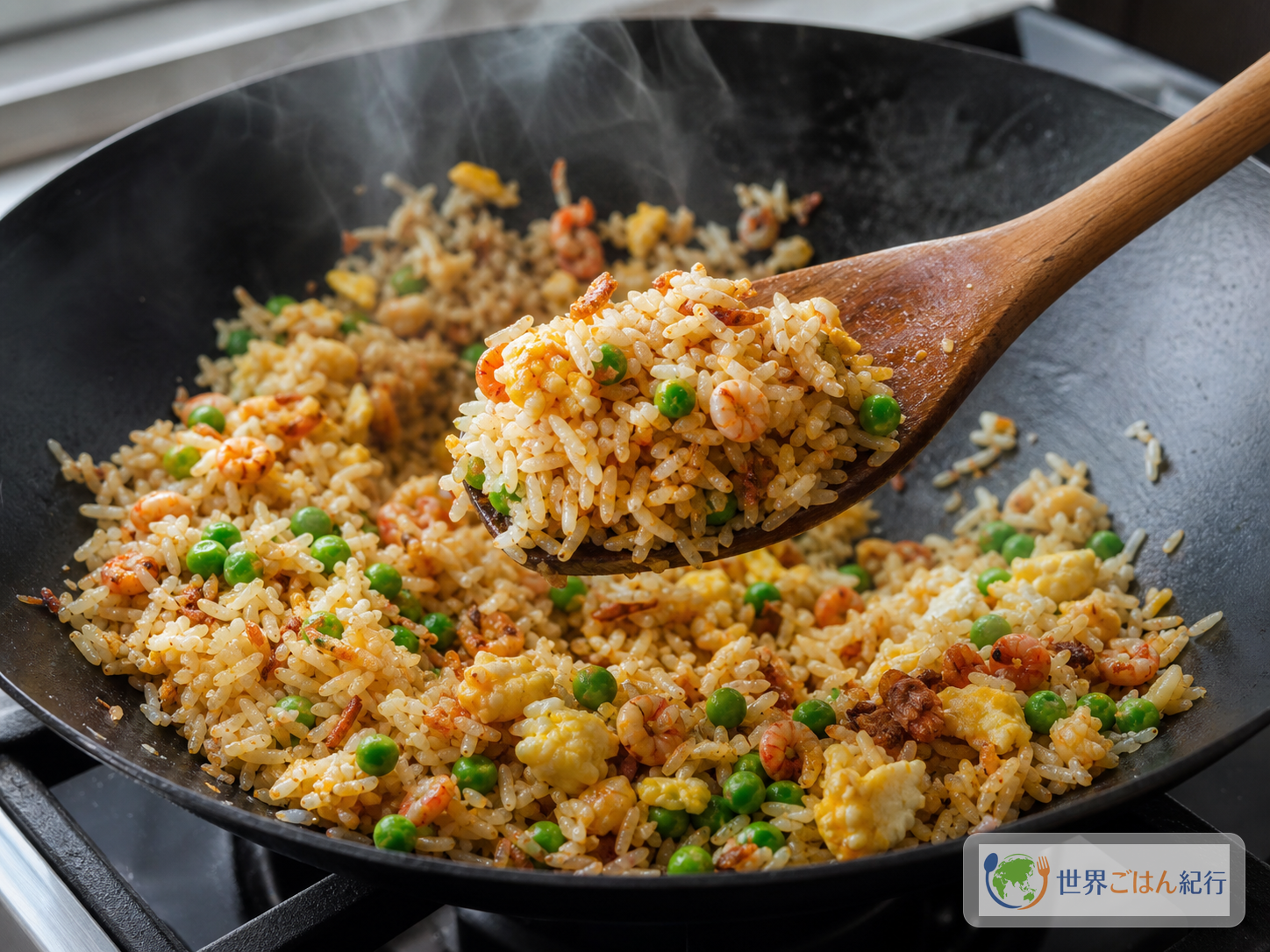
Break up the rice from the fridge, crack the eggs, chop the scallion, and then put the wok on the heat. When the oil runs thin and the scent of garlic and scallion rises, add the rice, and white clumps loosen little by little. Do not press it down with a spatula; turn it from the bottom. The moment the grains dry against the wok and begin to make a light sizzling sound, the outline of fried rice shows even in a home kitchen.
Fried rice is a familiar dish. There are well-known types such as the Yangzhou style, and plates that are simply leftover rice fried with egg, scallion, dried shrimp, ham and greens. This article puts first getting the grains light on a home stove, rather than reproducing a restaurant's blazing heat.
Like chow mein and lo mein, fried rice is a dish with little time once it is on the heat. Do not chop while frying; set the rice, eggs, aromatics and sauce mix all within reach before you begin.
In Chinese it is written 炒饭 in simplified characters, 炒飯 in traditional, and chǎofàn in pinyin. In this text the dish is simply called "fried rice."
History and the Local Table
Fried rice is less a dish with one right answer than a reuse wisdom grown in regions where rice is the staple. Cold rice is revived with oil and egg, with a little meat, shrimp and scallion added for aroma. In Chinese homes and eateries it may be the closing rice dish set beside a grand meal, or a quick plate made for morning or noon. The well-known Yangzhou style is introduced as a showy type with egg, shrimp, char siu, peas and scallion all finely prepared, but not every fried rice is Yangzhou style.
Regional differences are large too. Cantonese households sometimes add sweet aroma with char siu or dried shrimp, and Fujian-style has a type served with a thick sauce. In Hong Kong and in Chinese households in Southeast Asia, using long-grain rice for a light finish is not unusual. In northern Chinese homes, some days it is just egg, scallion and greens on hand. In other words, what makes fried rice is not the lavishness of ingredients but drying cold rice quickly and giving each grain a thin coat of egg and oil aroma.
What is hard in many home kitchens is not the heat but the rice's moisture. Short-grain rice is sticky, and if you put in freshly cooked rice as is, the grains stick even on high heat. Refrigerate the previous day's rice, loosen it before frying, and divide it into batches of two portions or fewer. Keep just these three and even a home burner becomes much lighter. Dark soy sauce is an aid for color, and too much makes it heavy, so start from 1/2 tsp. The aromatic stars are scallion, egg, and soy sauce brought to fragrance at the wok's side.
| What to decide | A local-leaning idea | How to land it in a home kitchen |
|---|---|---|
| Rice | Lightly fry cold rice or long-grain rice | Cook short-grain rice on the firm side, spread it out to cool |
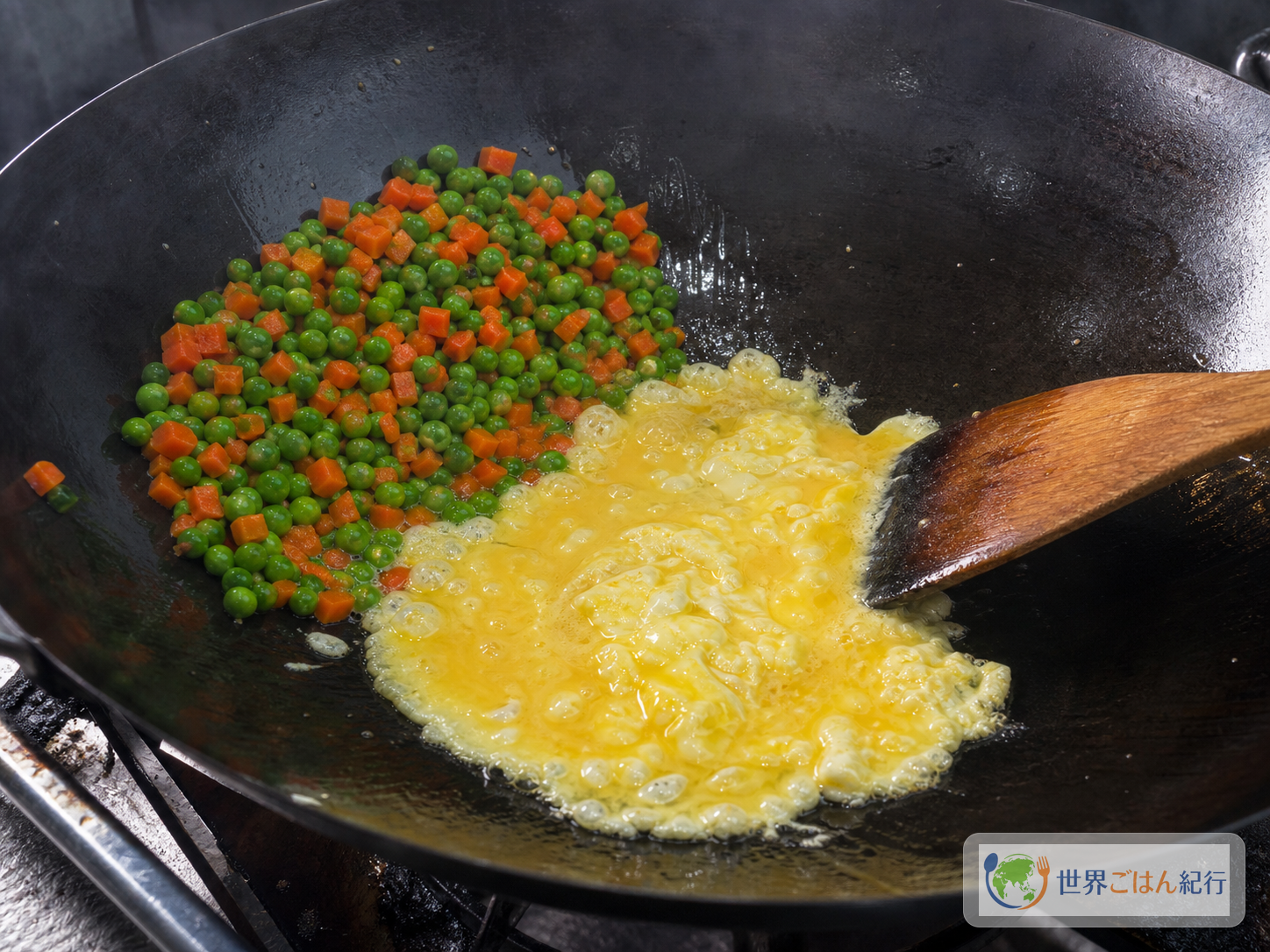
| Egg | Leave it between the grains rather than coating the rice | Make big soft-set clumps first, then add the rice |
| Add-ins | Vary by household and shop | Make it with scallion, egg, carrot, peas and a little dried shrimp |
| Color | Tint lightly with dark soy sauce or soy sauce | Only 1/2 tsp dark soy sauce. Regular soy sauce can substitute |
| Heat | Strong and short, driving off moisture | Cook no more than two portions, use the wok's side widely |
Ingredients (serves 2)
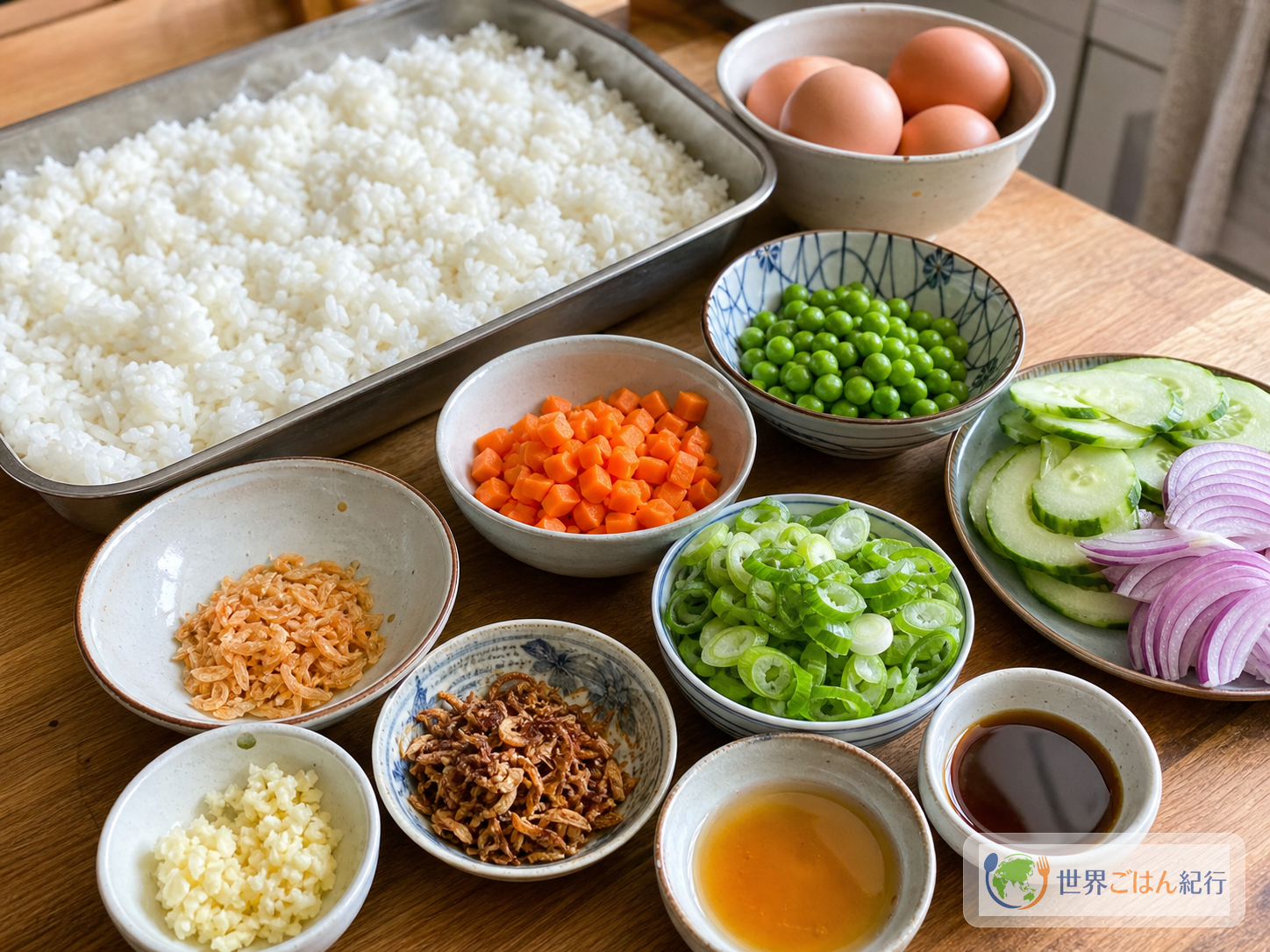
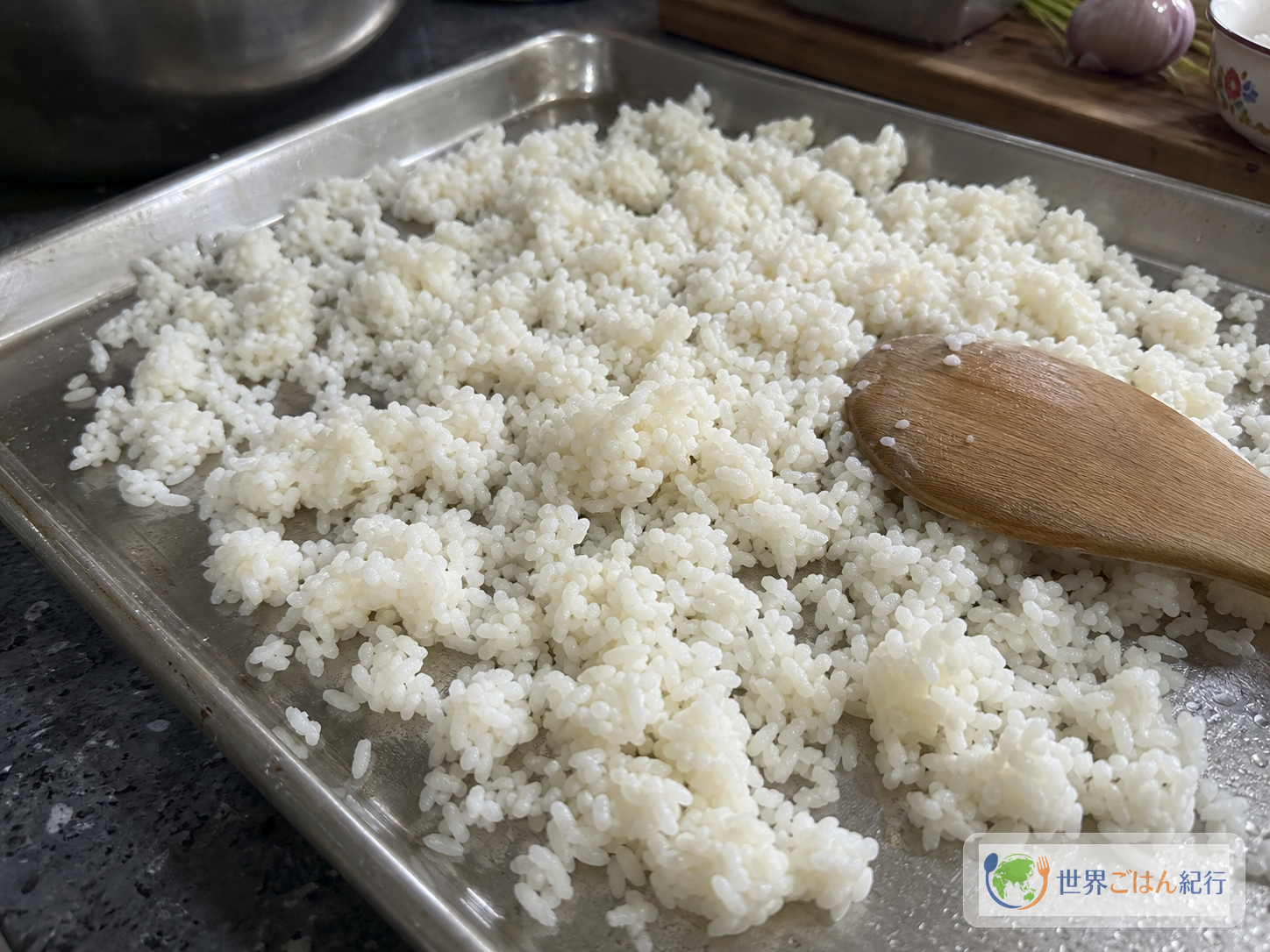
Use cold rice, not freshly cooked. If you cook it the same day, use 1–2 tbsp less water than usual, spread the cooked rice on a tray to let the steam escape, and chill it in the refrigerator for 20 minutes.
This recipe may contain egg, shrimp, soy and wheat. Check the ingredient labels of the soy sauce, dark soy sauce and dried shrimp. Do not leave cold rice at room temperature for long; refrigerate it once it has cooled slightly, and when frying heat it until hot all through.
What to Decide When Shopping
Things you buy locally are rice, eggs, scallion, carrot and cucumber. What is worth looking at on the shopping list is the dark soy sauce for color, a wok in which rice spreads easily, and long-grain rice that cooks up firmer. Rather than hunting for eggs and vegetables online, gathering the seasoning and the tool makes more difference in the result.
Dark soy sauce is a thick soy sauce close to Chinese tamari, and in small amounts deepens the color of rice. Substituting more regular soy sauce makes it salty, so if you have none, it is safer to leave it out. It can also go to the sauce for Hainanese chicken rice and the marinade for beggar's chicken.
You can also make it in a skillet, but a wok that lets you use its sides widely makes it easier to drive off the rice's moisture in a short time. A wok also goes to shuizhu niurou and char kway teow, not only rice dishes.
Long-grain rice is not required. On a day with only short-grain rice, how carefully you chill it matters more. Still, if you want to compare the lightness of fried rice, cooking jasmine rice on the firm side loosens the grains more readily.
Method
Fried rice is not a dish where you think after the heat is on. Set out the sauce mix, loosened rice, cut vegetables and eggs first. On a home burner, making two portions at a time gives lighter rice than frying four at once.
Serving and Building a Meal
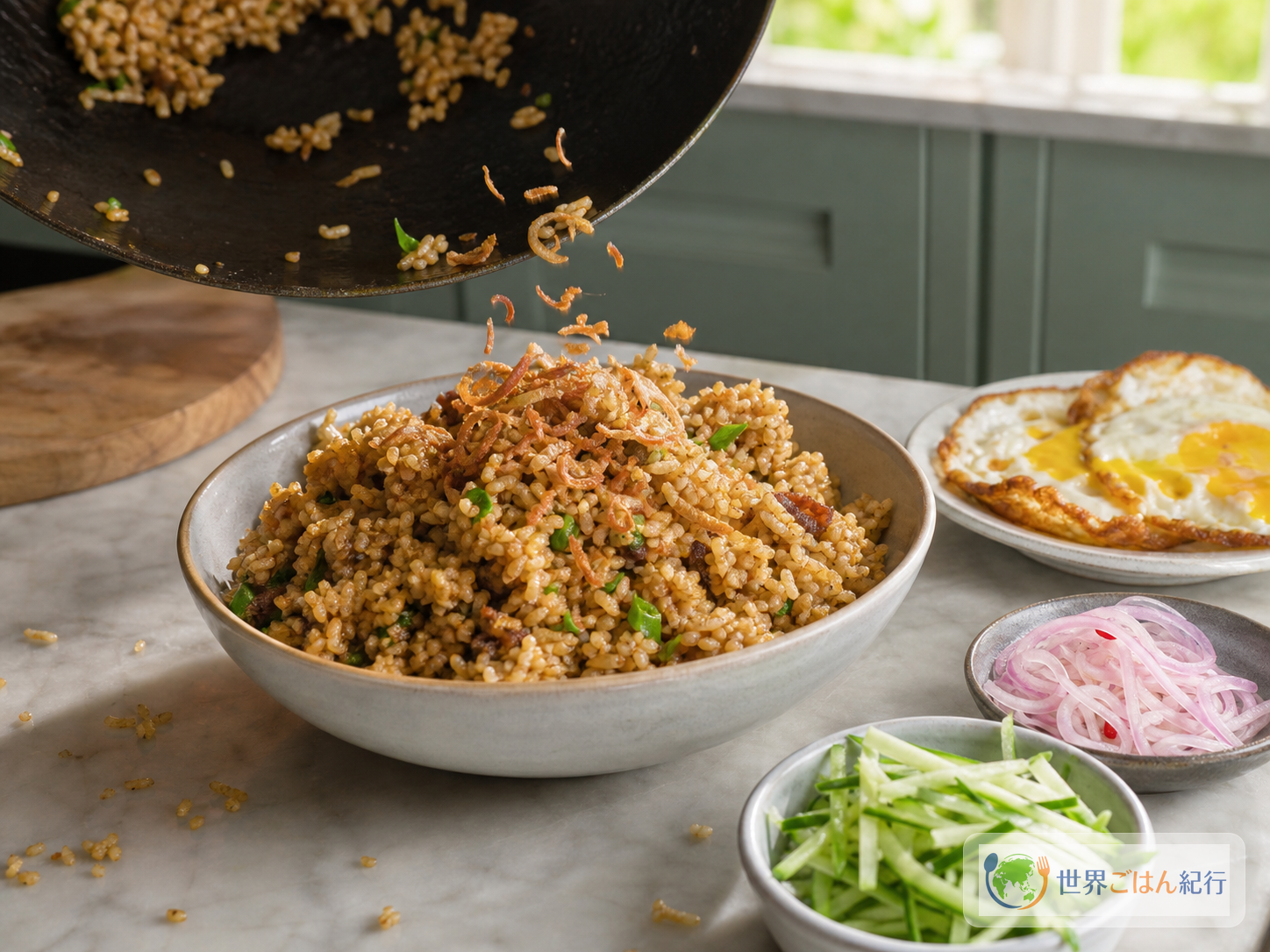
Fried rice is complete as one plate, but because the aroma of oil and egg lingers, adding the acidity of cucumber and onion makes it easier to eat. It is not that restaurants locally always serve it this way; it is an adjustment to keep the plate from feeling heavy at home. 2 tsp rice vinegar, a pinch of salt and a pinch of sugar left 10 minutes is enough.
Fried rice in Chinese homes may be the main dish on some days, and on others a way to clear out the previous night's leftovers. Leftover stir-fried greens, the ends of char siu, boiled beans, cold white rice: it is a dish that returns such odds and ends to one plate in a morning or noon kitchen. Making it at home too, it is safer to think of it not as lavish but as "putting in only a few low-moisture ingredients." On days when you want lots of watery vegetables like tomato or napa cabbage, serve them in a small dish or soup instead of mixing into the fried rice, and the rice stays light.
To build a Chinese-style table, reading it alongside the spicy main mapo tofu, the soupy shuizhu niurou and the vegetable-rich luohan zhai shows the differences in heat treatment: stir-frying, simmering, braising. To compare with Southeast Asian fried rice, htamin gyaw, which builds aroma with fish sauce, and nasi goreng, which uses sweet kecap manis, are close next reads.
Where It Goes Wrong and How to Recover
Fried rice failures are easiest to correct if you sort them into four: moisture, salt, heat and quantity. It is not that you fail for lack of a restaurant's firepower; at home it is often that too much goes in at once.
| Condition | Cause | How to recover |
|---|---|---|
| Rice is sticky | Used freshly cooked rice, or too much rice | Spread on a tray to cool 5 minutes and stir-fry only half again over medium heat for 1 minute |
| Too salty | Soy sauce poured directly on the rice | Dilute with 80 g more cold rice and 1 beaten egg |
| Too dark | Too much dark soy sauce | Next time only up to 1/2 tsp. Do not increase regular soy sauce |
| Egg disappears | Mixed too long after adding the rice | Set the egg in large clumps first, and turn less after the rice goes in |
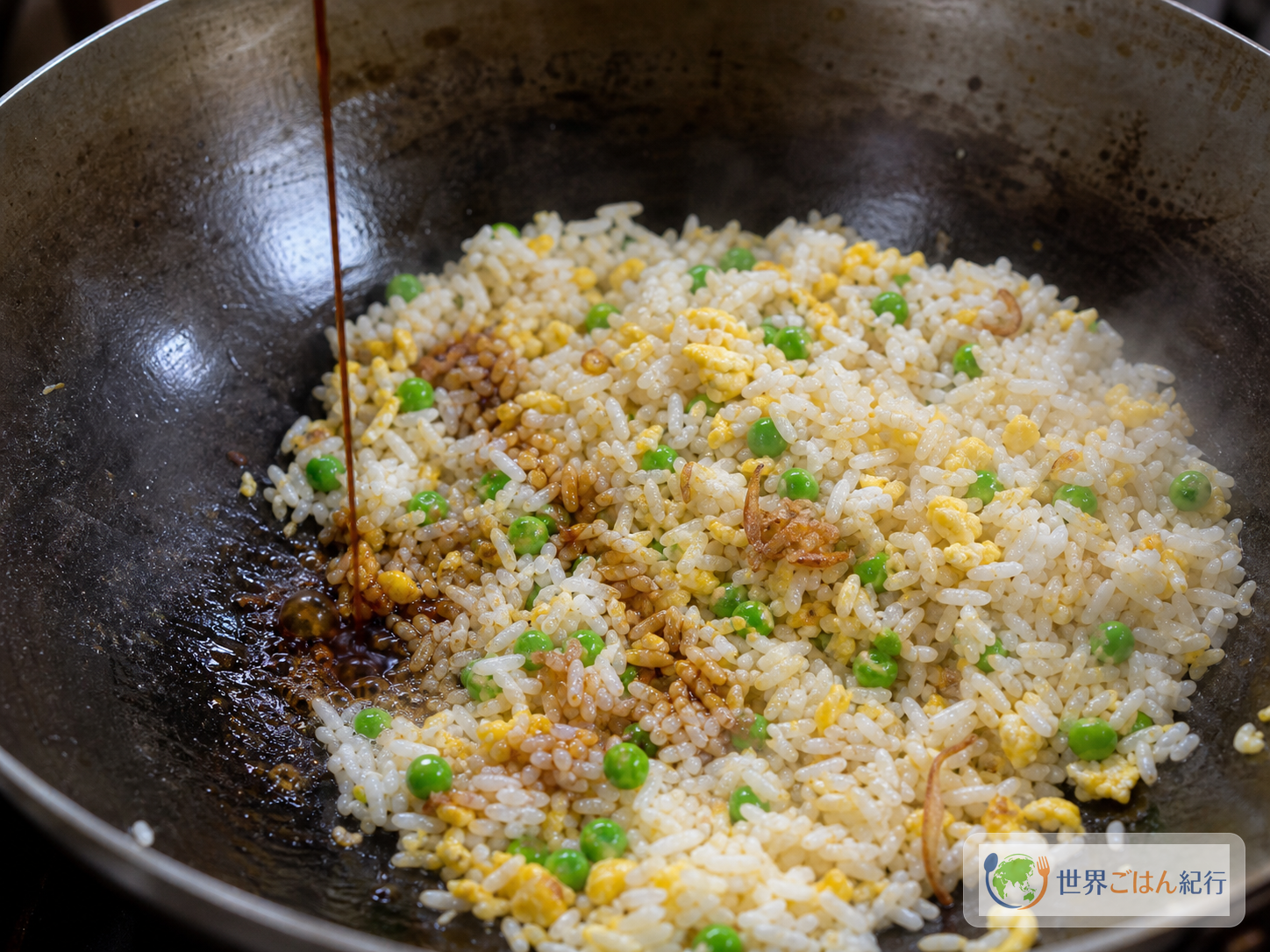
| Weak aroma | Did not scorch the soy sauce at the wok's side | Pour the sauce around the wok's side and toss for just 30 seconds over medium-high |
| Sticks to the pan | Pan was cold or oil too little | Warm the pan over medium first, swirl a thin film of oil, then add the aromatics |
Frozen peas can go in still frozen. But if there is a lot of frost, rinse them lightly and pat dry. If frost goes into the pan, steam comes up before the rice dries and it becomes steamed rather than stir-fried.
Storage and Reheating
Fried rice is best fresh, but spread what is left in a shallow container to cool and refrigerate it. Rice dishes spoil easily when left long at room temperature, so do not leave them out on the table; once cooled slightly, move them to the refrigerator early.
| Storage | Duration | Reheating |
|---|---|---|
| Refrigerator | 2 days | In a skillet over medium for 3 minutes. Add 1 tsp oil and toss |
| Freezer | 2 weeks | Freeze in portions. 3 minutes at 600 W, stir, then 1 more minute |
| Lunch box | Same day | Reheat thoroughly and pack after cooling. Do not include a soft-set egg |
| Side dish | 1 day refrigerated | In a separate container from the fried rice. Drain before serving |
To reheat in the microwave only, sprinkle 1 tsp water per portion, cover loosely with plastic wrap and heat at 600 W for 1 1/2 minutes. Stir once and heat another 30 seconds. To bring back the lightness of the grains, finish by frying in a skillet over medium heat for just 1 minute for aroma.
FAQ
Can I make it with freshly cooked rice?
You can, but putting freshly cooked rice straight into the pan makes it sticky. Reduce the cooking water by 1–2 tbsp, spread the cooked rice on a tray to cool slightly, and chill it 20 minutes in the refrigerator. Even in a hurry, just letting the steam escape before frying changes a lot.
Can I make it without dark soy sauce?
Dark soy sauce is a seasoning for color. The stars of aroma and saltiness are the scallion oil, the egg and the soy sauce brought to fragrance at the wok's side. On days you have none, leave it out. Greatly increasing regular soy sauce makes it salty before it turns dark.
When do I add char siu?
Instead of dried shrimp you can use 40 g of char siu in 5 mm cubes. After the aromatic oil in step 2, just before adding the carrot and peas, warm it over medium heat for 1 minute. Char siu is already cooked, so rather than frying it long, lightly bringing out its fat and sweet aroma is enough.
Is it better made with jasmine rice?
For lighter grains, jasmine rice suits it. But not all Chinese fried rice is made with long-grain rice. It can be made with short-grain rice if cooked firm and chilled. For the first time, learn moisture control with the rice you have at home, then compare with long-grain rice, which is realistic.
Can I make four portions at once?
On a home burner, divide into two portions at a time. Putting in four at once leaves too little contact between rice and the wok's surface, and it steams before frying. Even with a large wok, splitting into two batches at first is more likely to succeed.
Sources
- Made With Lau, "Yangzhou Fried Rice"
- Serious Eats, "Wok Skills 101: Stir-Frying Basics"
- The Woks of Life, "Egg Fried Rice"
- Wikipedia contributors, "Chinese fried rice"