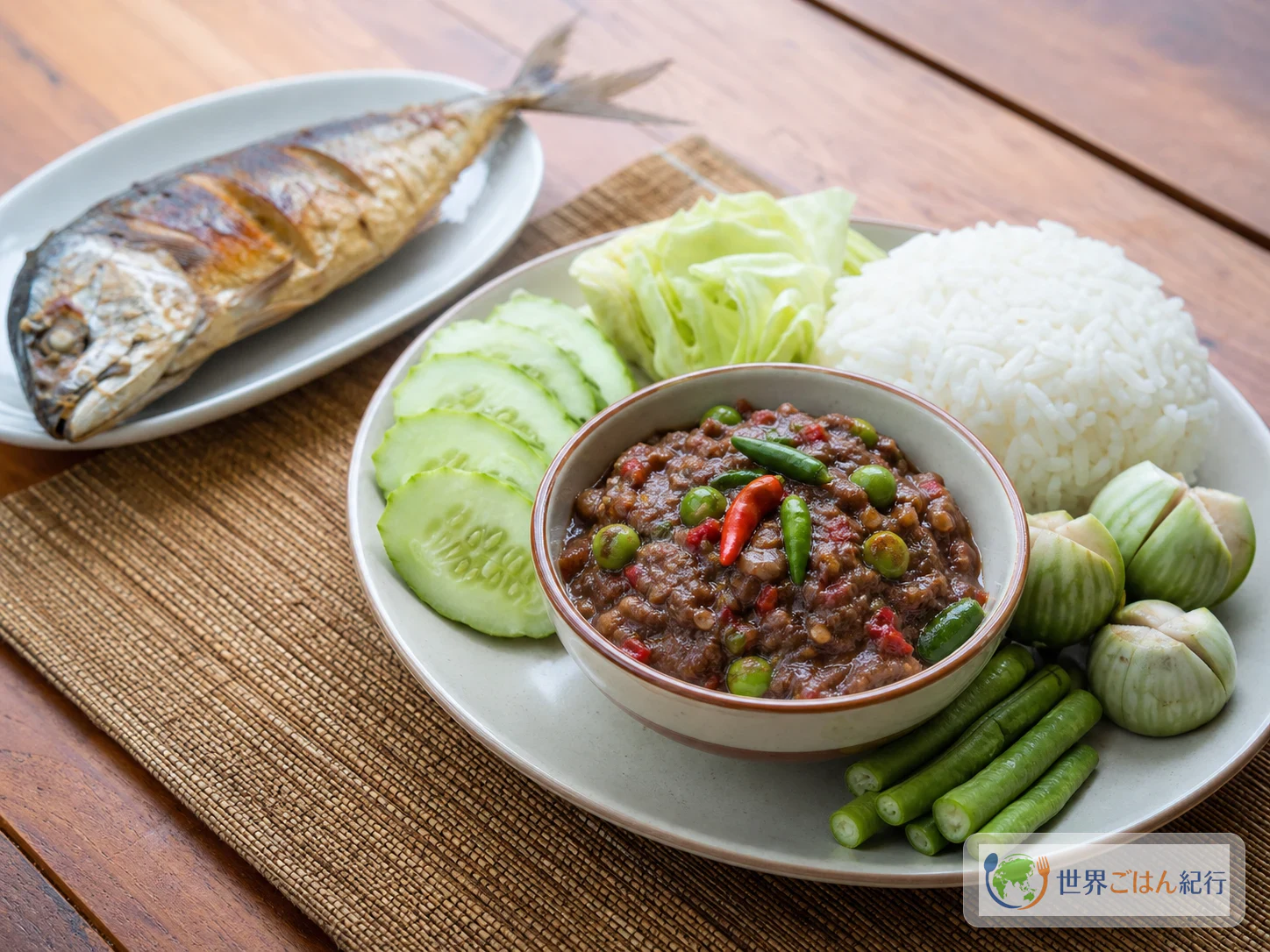
The aroma comes first: Thai nam prik kapi
Open the lid and the fermented smell of shrimp comes first.
It is not a condiment to put straight in the mouth.
Layered with garlic, red chilies, lime, and a little sugar, it becomes "a table flavor" that vegetables and rice can receive.
In Thai, nam prik means a chili-based dip, and kapi means fermented shrimp paste.
The Thai government's regional food guide presents nam prik kapi as a dish of the central region.
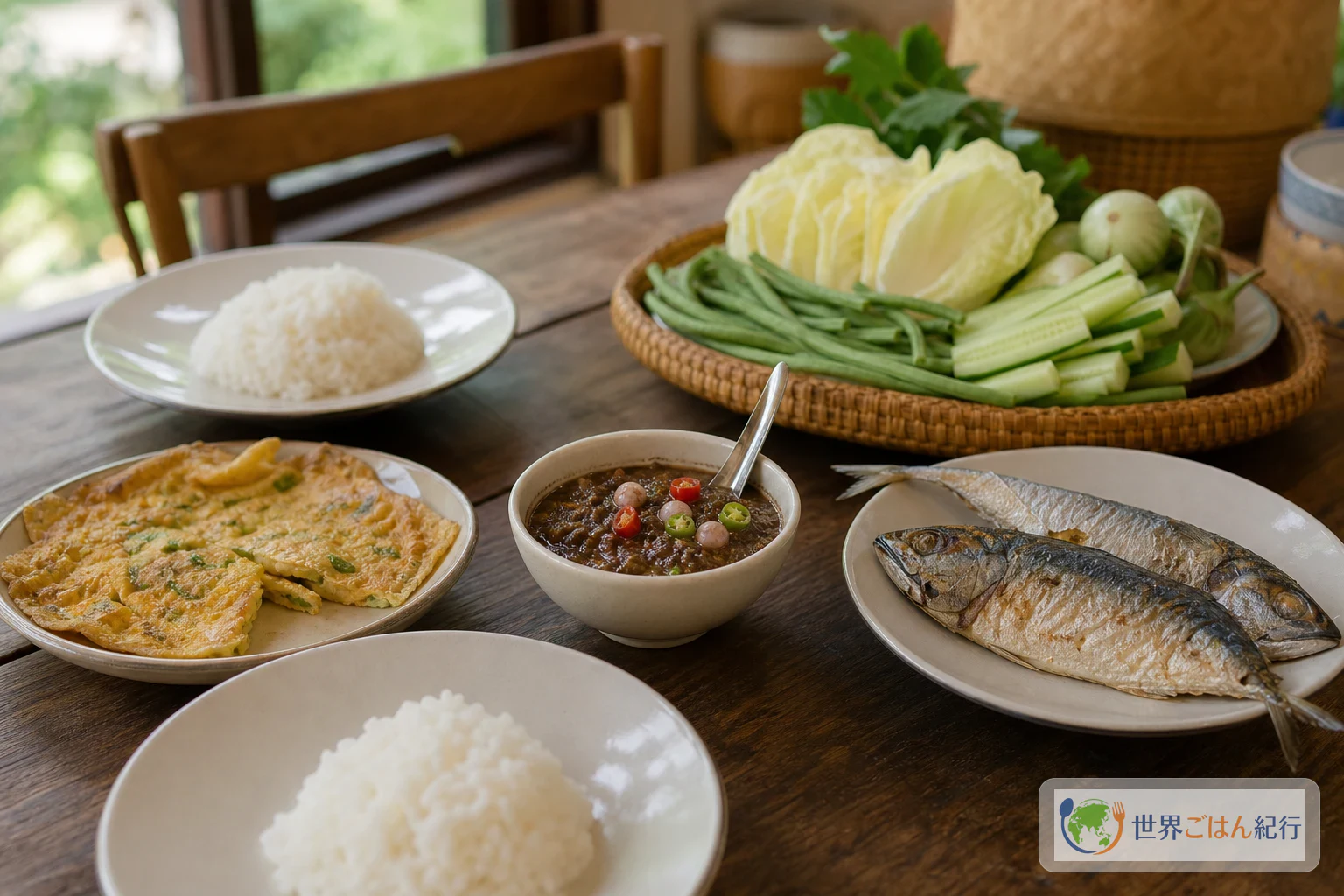
The table described in the Thai embassy's food culture introduction is also not one where each plate is complete for one person.
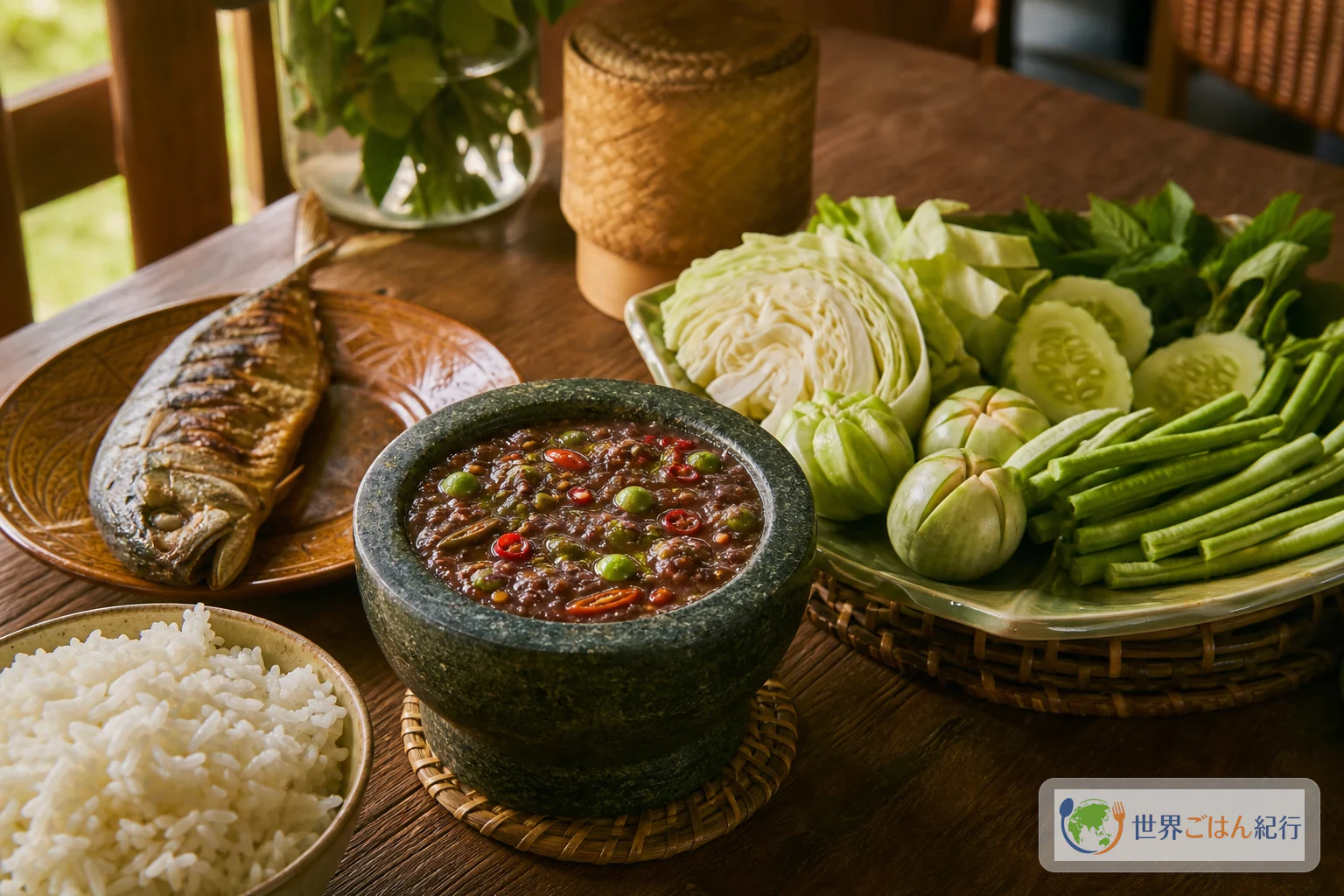
Rice is served on individual plates, and in the center are the dip, vegetables, and egg or fish dishes, combined a little at a time.
So a dip made strong on its own floats apart at the table.
The landing point for reproducing it in a home kitchen is a strength where the saltiness loosens when you bite a vegetable and the aroma rounds out when mixed with rice.
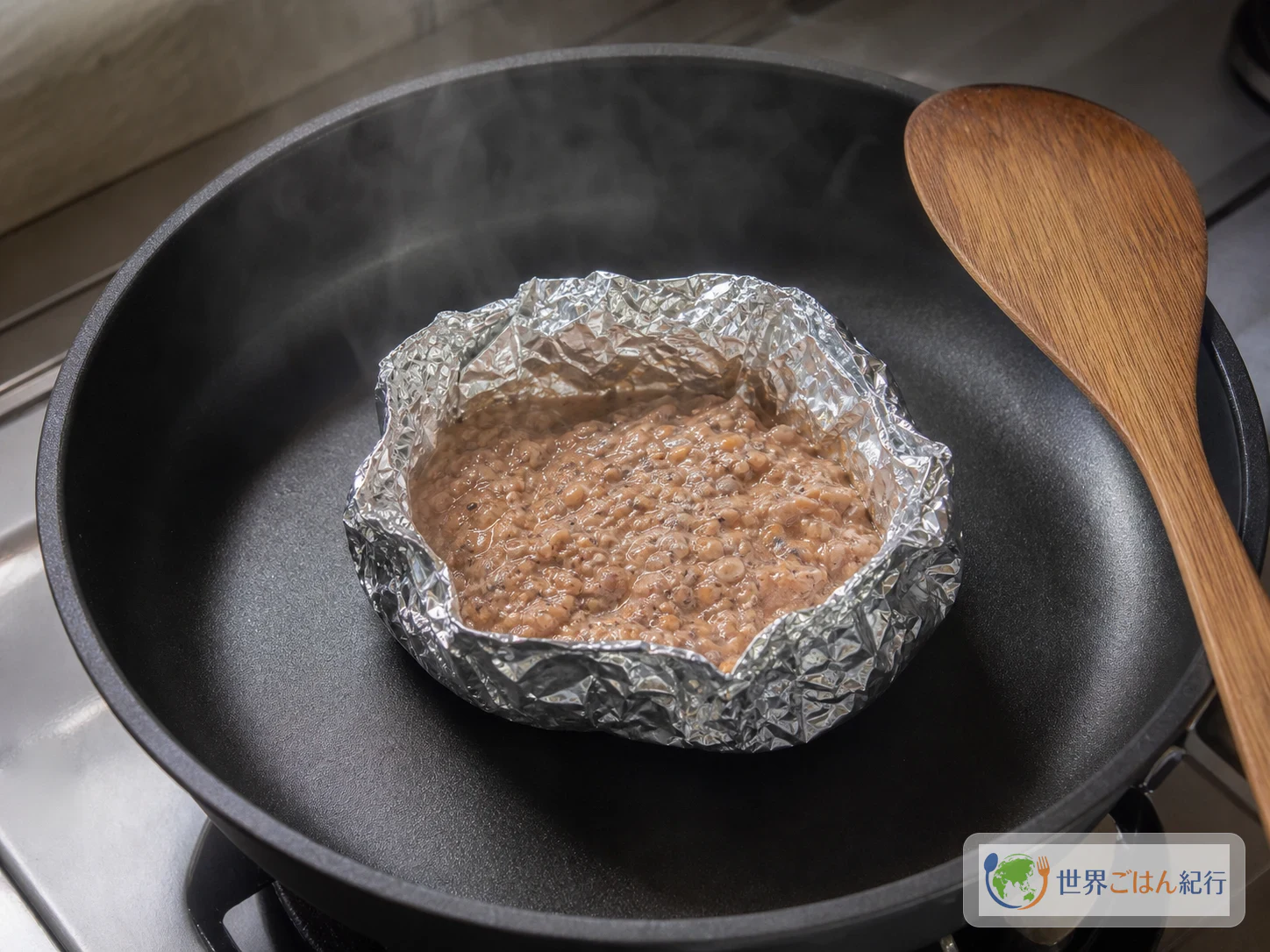
Warm the kapi over low heat to settle its aroma, and do not make a full paste in the mortar.
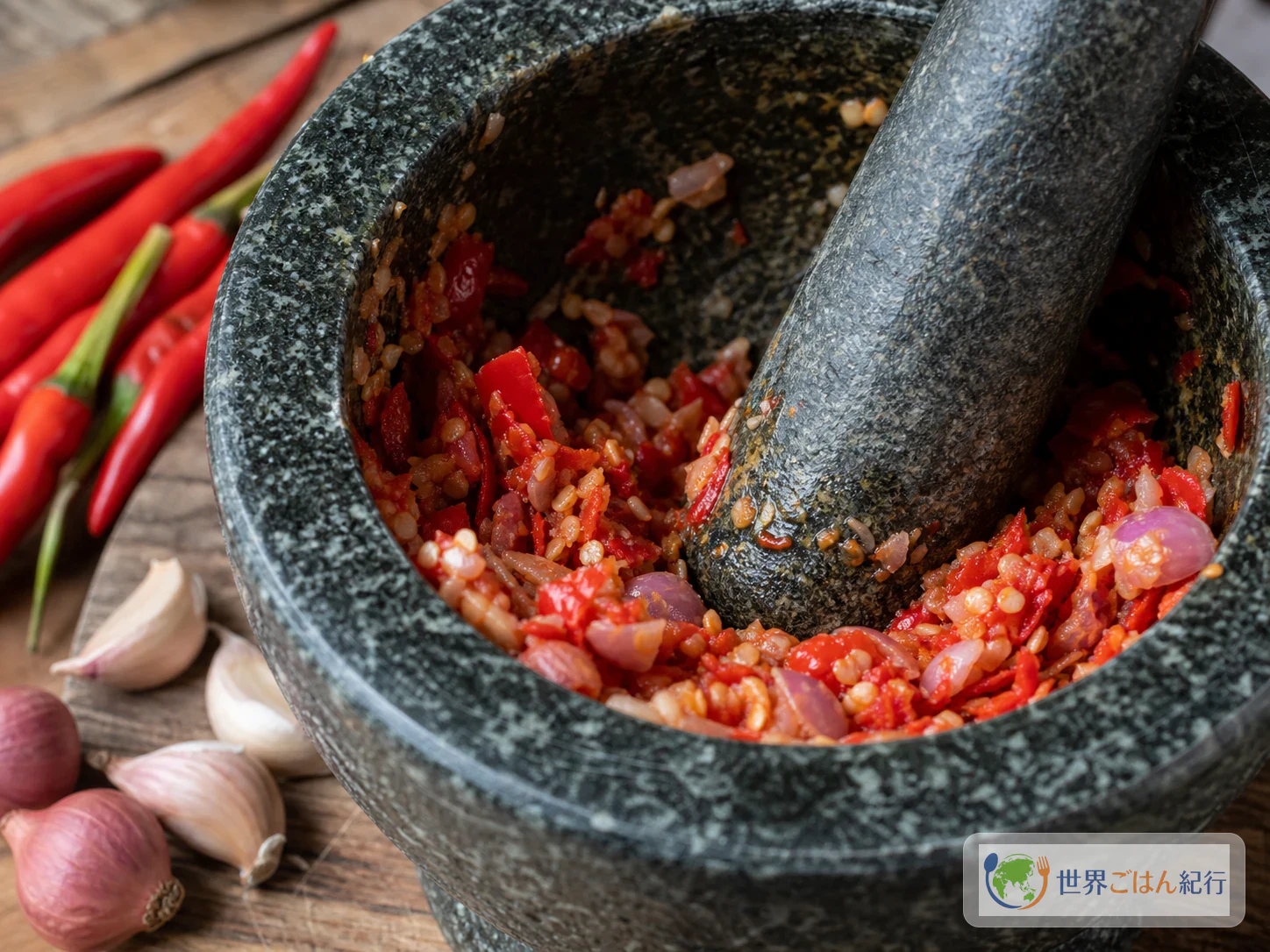
Stop where grains of red chili, fibers of garlic, and the sourness of lime remain.
Unlike khao kluk kapi, which turns the same kapi into fried rice, this is a small star for eating vegetables and rice in alternation.
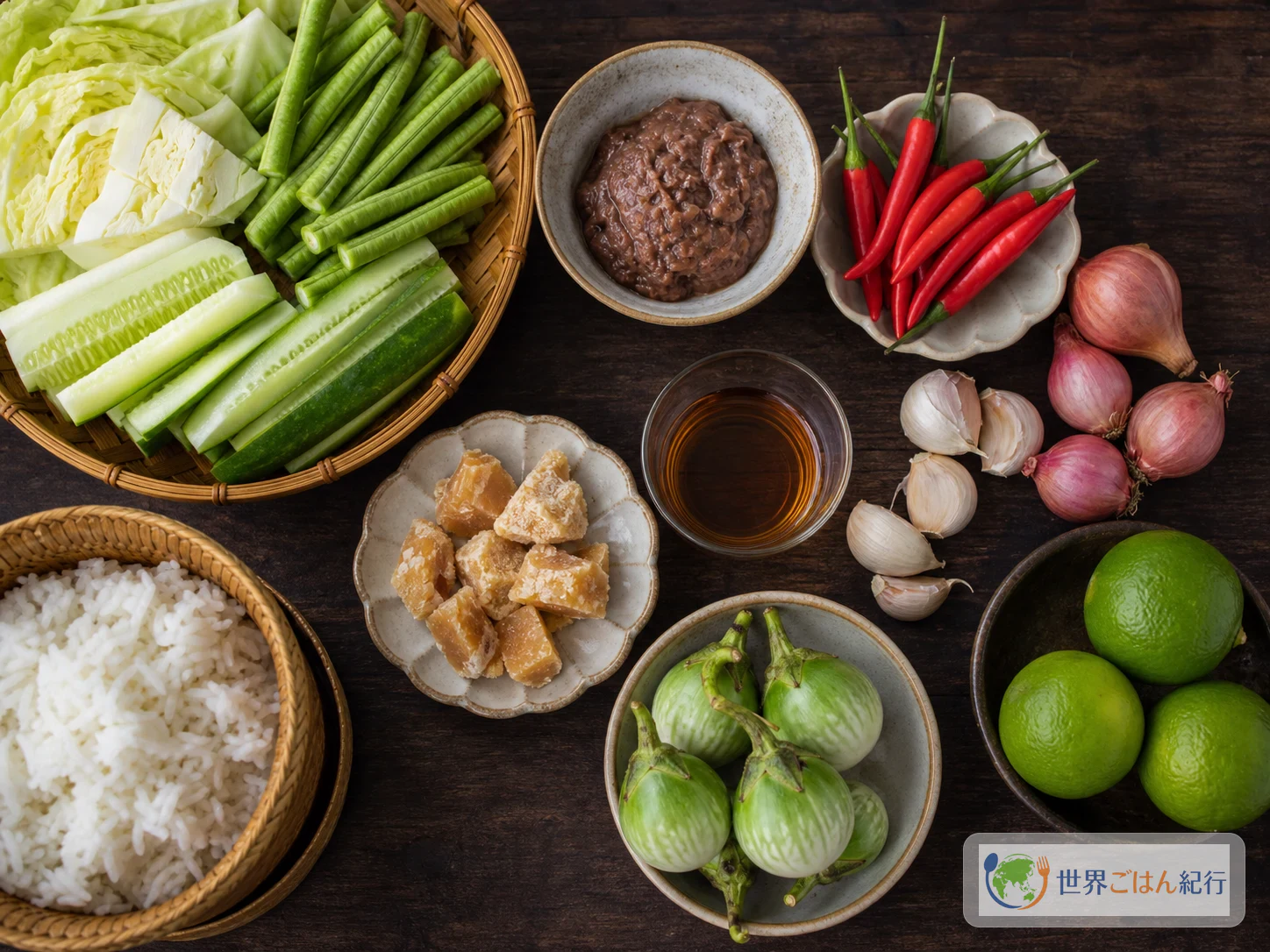
The star is the saltiness and savoriness of the kapi, the outline is chili, the aroma bridge is garlic and red onion, and lime lightens the aftertaste. Rather than adding more kapi for strength, first adjust to a strength you can eat with sourness and vegetables.
Ingredients: make kapi the star, decide the salt later
Makes dip for 4 and the vegetable and rice combination.
Kapi differs greatly in saltiness and fermented aroma from product to product, so no extra salt is added from the start.
Kapi is easier to find if you search by "shrimp paste," "kapi," or "กะปิ."
Before the size, check that the ingredients include shrimp, whether it is an ambient or refrigerated product, and the storage instructions after opening.
A 500 g large container is for people who will also use it in khao kluk kapi and stir-fries.
If you only want to try this dish, looking for a small container leaves less to be stuck with in the refrigerator.
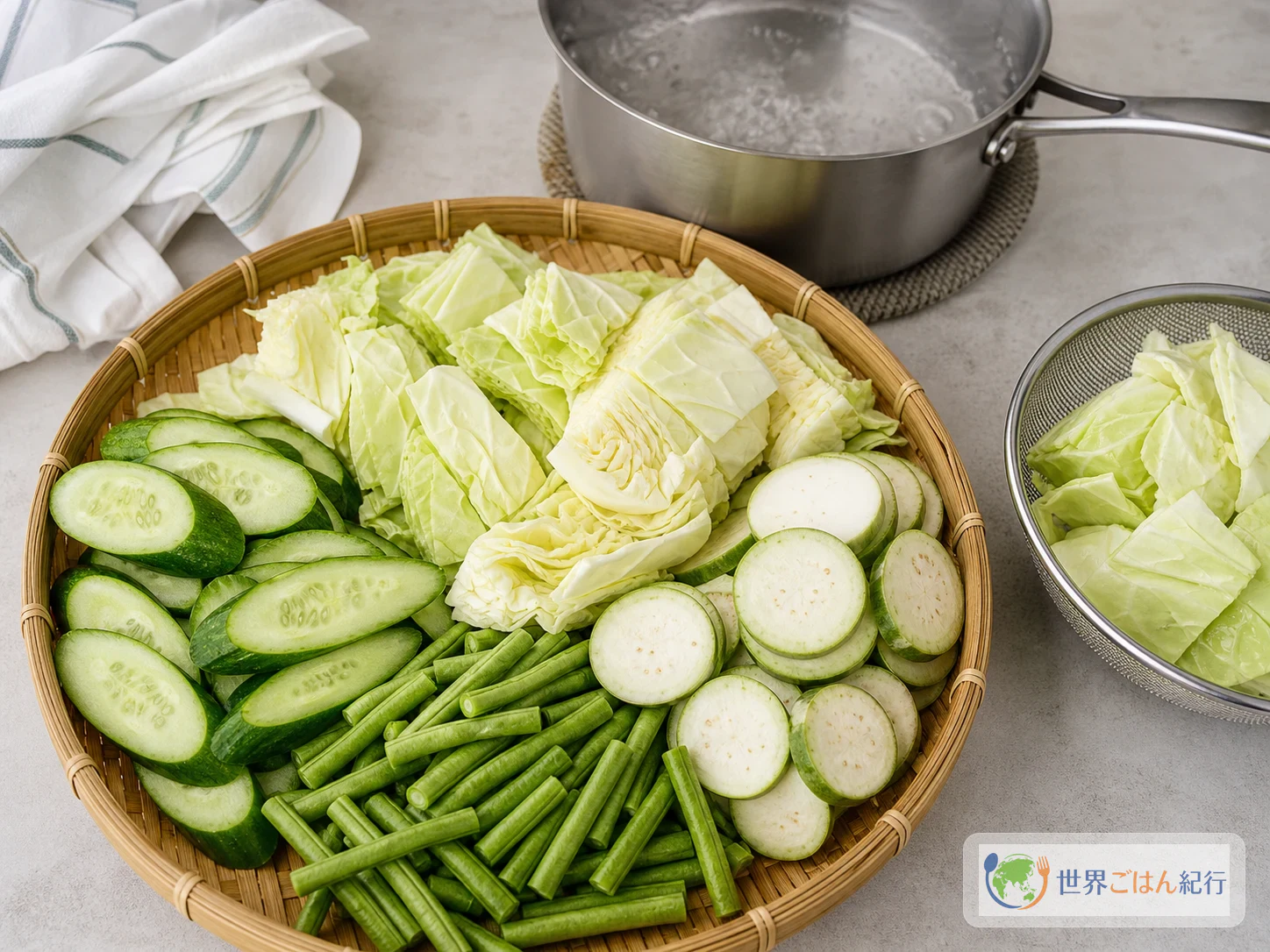
Makua puang adds small green grains and a light bitterness when pounded. With regular eggplant, cut into 5 mm cubes and do not mix it in raw; boil thin slices for 1 minute and cool. If you replace it with cucumber only, the texture is lighter, but the role of receiving the dip's saltiness is kept.
Kapi contains shrimp. Anyone with a shrimp allergy should not use it. Check the ingredient labels of fish sauce and processed seasonings too, and do not share serving spoons or vegetables. The substitute version is treated as a separate dip in "Variations."
Method: wake up the aroma, then bring it back to the table with sourness
Prep and building the kapi aroma (15 minutes)
Pound and set the flavor (15 minutes)
Cooking tips: make kapi approachable without losing its aroma
Warming 1 minute per side over low heat rounds off the sharp aroma of a freshly opened jar a little. Toasting until smoke appears produces bitterness that more lime cannot bring back.
A blender tends to make a uniform paste and erases the difference between chili and onion when served with vegetables. Without a stone mortar, use a heavy mortar and keep it coarse, mainly pressing.
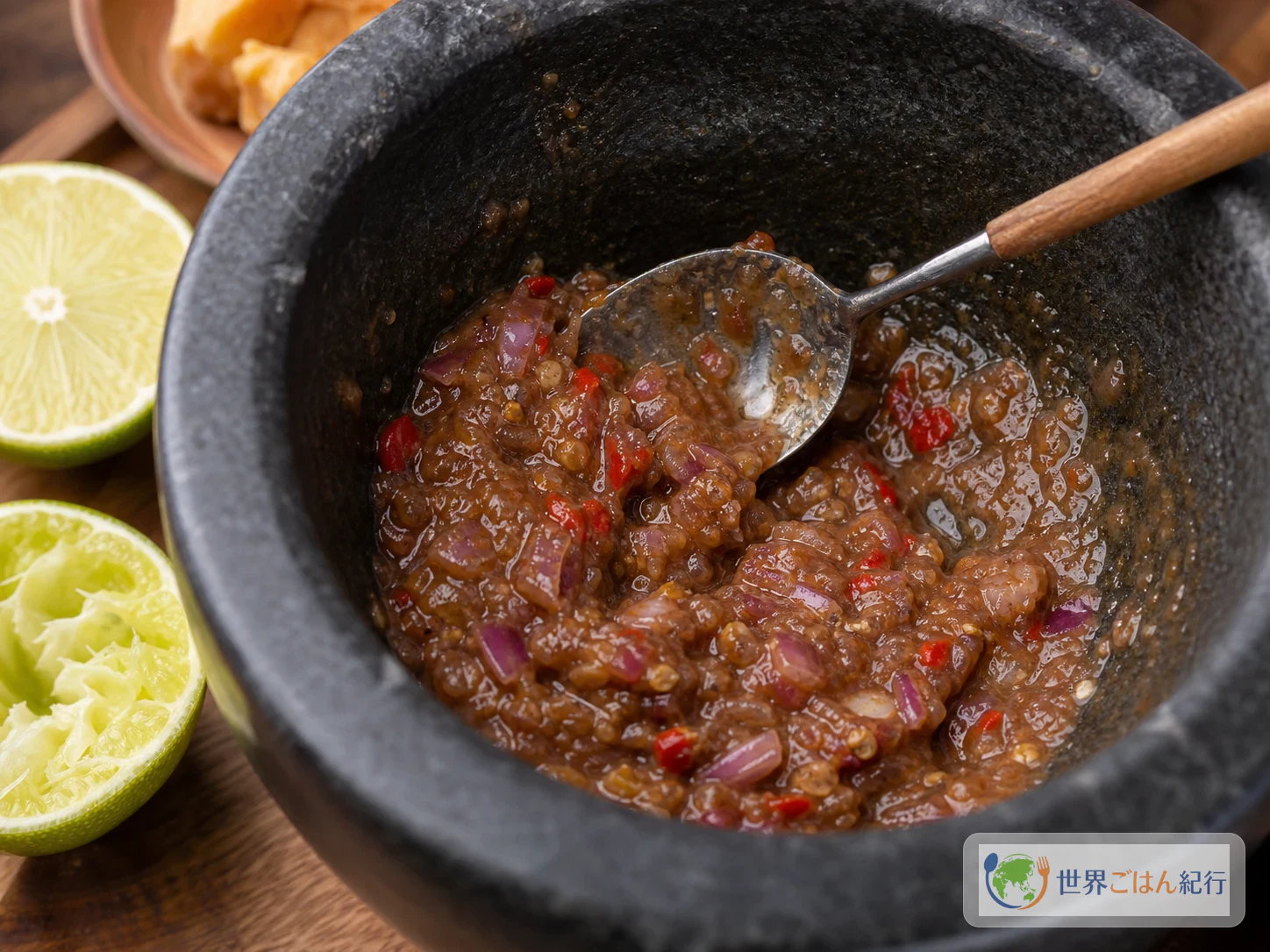
At the point where lime goes in, the outline of kapi's saltiness and aroma becomes visible. If the sourness is lacking, add juice 5 ml at a time; if too sour, add sugar 1 g at a time. Add more kapi last.
The thickness changes with the water in the vegetables and the amount of lime. Add 5 ml water at a time only when stiff. When it becomes loose, do not heat it to drive off water; receive it with more unsalted vegetables and rice.
A stone mortar has clear conditions for buying.
If you make dishes that crush chilies and garlic coarsely several times a month and enjoy a texture with grains remaining, a stone one with stable weight is easy to use.
If you want to try it just once, or live in an apartment and worry about the noise of pounding, start with a mortar you already have.
When choosing, check whether a pestle is included, not just the mortar.
The condition for buying fish sauce is that you will also use it in Thai or Vietnamese cooking and can use up 700 ml within half a year.
If you will use it up only in this dish, skip buying it and substitute the 0.5 g of salt in the ingredient table.
When choosing fish sauce, check the volume, ingredients, and storage instructions after opening.
Variations: change the heat and ingredients to widen the table to your range
Make it milder
Reduce the chilies to 2–3 and crush them after removing the stems and seeds.
Even with less heat, the axis of kapi and lime remains.
To separate completely for children, set aside the aromatics and kapi before the chilies go in and finish in a separate mortar.
Replace Thai small eggplants with ordinary vegetables
The light bitterness of makua puang can be approached with thin slices of eggplant.
If you do not want bitterness, choose texture in the order cucumber, boiled broccoli, cabbage.
Watery tomatoes dilute the dip, so avoid them for the first plate.
Move it toward a home dinner
Replace the jasmine rice with white rice and set grilled fish, rolled omelet, and boiled vegetables beside it, and the arrangement centers on rice.
This is not so much a full reproduction of Thai nam prik as a variation that moves the way of eating, taking a little at a time from a central dip, into a home menu.
If vegetables are the star, adding a textured side like som tam lines up the direction of the sourness.
If you avoid shrimp
Replacing the kapi and fish sauce with miso or kombu stock gives a chili dip with no shrimp.
But it is a different dish from nam prik kapi, which has the aroma and savoriness of fermented shrimp.
Check labels, and do not share the same mortar or serving spoon.
Background: the dip is not one dish but a way of building a table
Seen as a sauce on its own, nam prik kapi shows only the strength of its aroma.
Returned to the Thai table, its role changes.
The name of the dish also shows how the flavor is built. Nam prik is the name for a chili-based dip, and kapi means fermented shrimp paste. In the name itself remain the base of heat and the star of aroma.
This is because a strongly flavored dip, plain rice, raw vegetables, boiled vegetables, and egg or fish dishes all sit on the same table, and the combination can change with each bite.
The Thai embassy's food culture introduction also explains Thai cooking as an arrangement in which shared dishes are matched to individual rice and spicy dishes are accompanied by mild-tasting ones.
Dishes of the central region, the Suan Dusit University Thai food resource says, have been refined in presentation and combination while taking influence from several cultures.
The same resource lists jasmine rice, nam prik kapi, and vegetables at the central table, and explains that kapi, too, differs in color and flavor by region of origin.
Regional differences are not small either. In Hungry in Thailand's overview, the ingredients and heat of nam prik move from household to household, and by region there are types that use fermented ingredients or meat. This page narrows to the kapi type that the Thai government lists as a central-region dish.
The story that paste from the sea side and paste from the gulf side look different tells us that even the same "kapi" may not have the same aroma every time you buy it.
There is no need to force that difference away in a home kitchen.
Match the toasting time, combine the lime first, and make the first bite a vegetable.
Rather than fixing the dish, keeping it in a state where the flavor can move at the table is the interesting part of this dip.
Even among tasks that are all "pounding," the aroma is built differently from som tam, where green papaya is coarsely broken.
Placed beside gapao, with its stir-fried ground meat as the main dish, nam prik kapi shows itself as a dish that adds ways to eat vegetables and rice rather than adding meat.
Frequently asked questions
Q. What should I do if the kapi smell is too strong?
Wrap it in aluminum foil and warm it over low heat for 1 minute per side.
Do not toast it until smoke appears; add lime juice 5 ml at a time and receive it with rice and cucumber.
Removing the aroma completely also removes the axis of the dish, so there is no need to make it odorless.
Q. Can I make it without a stone mortar?
You can make it in a heavy mortar.
Press the pestle down to split the chilies and garlic, add the red onion, and leave coarse grains.
If using a blender, do not run it continuously: pulse a few times for 1 second each and stop before adding liquid.
Q. Can I store the nam prik kapi I made?
Move it to a clean lidded container and use it up within 2–3 days refrigerated as a guide.
Do not return leftovers to the container after dipping vegetables or rice.
Store the vegetables separately and put out only what you will eat in a small dish.
Q. Can I substitute miso for the shrimp paste?
You can make a different dip with miso, lime, and chili, but it cannot reproduce the aroma of kapi's fermented shrimp.
If you need to avoid shrimp, do not give it the same dish name; treat it as a miso chili dip.
Q. How hot should I make it?
At first make it with 2–3 red chilies and put sliced chilies on a separate plate so each person can add more.
6–8 is the amount for when you want heat to be the star.
The perception of heat also changes with kapi's saltiness, lime's sourness, and the water in the vegetables, so do not set the taste by chilies alone.
Sources
- Thailand.go.th, "Regional Delicacies: A Journey Through Thai Cuisine" (accessed and checked 30 July 2026)
- Royal Thai Embassy Copenhagen, "Thai Food and Fruits" (accessed and checked 30 July 2026)
- Suan Dusit University, "Thai Food Sets from the Central Region" (accessed and checked 30 July 2026)
- Eating Thai Food, "Thai Nam Prik Kapi Recipe" (accessed and checked 30 July 2026)
- Hungry in Thailand, "Nam Prik Kapi" (accessed and checked 30 July 2026)
- Ministry of Health, Labour and Welfare (Japan), "Labeling of foods containing allergens" (in Japanese; accessed and checked 30 July 2026)