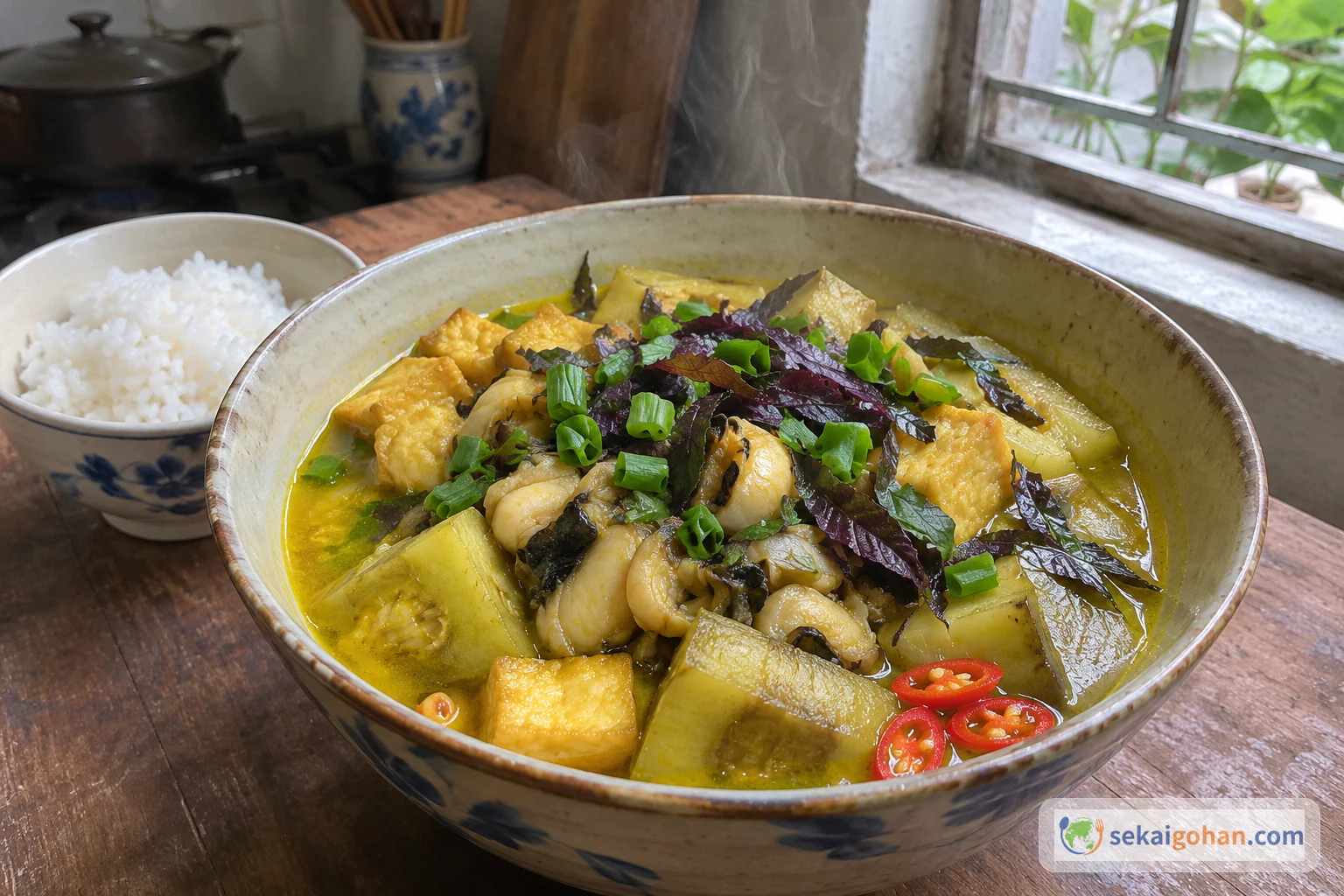
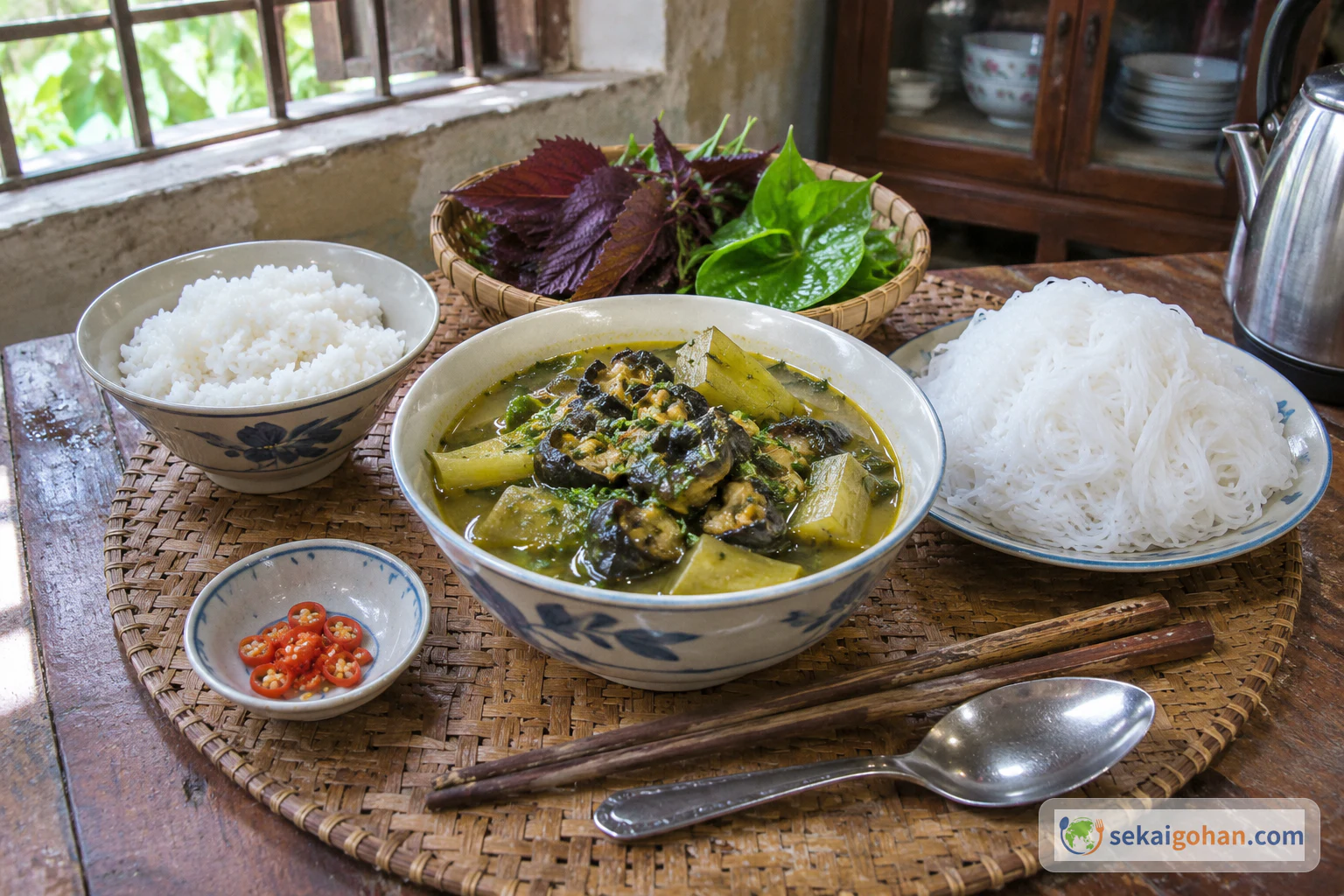
Ốc Nấu Chuối Đậu: Northern Vietnamese Snail Stew with Green Banana and Tofu

A northern Vietnamese stew in turmeric-yellow broth with shelled snail meat, green banana and fried tofu, topped with purple perilla and scallion
Serves
4–5 servings
Level
Intermediate
Cuisine
Vietnamese

Ốc nấu chuối đậu is northern Vietnam's snail, green banana and tofu stew. Learn the two-stage snail cooking, banana prep and swaps for mẻ and mắm tôm.

Cooking flow

Cooking steps

STEP 11 / 12

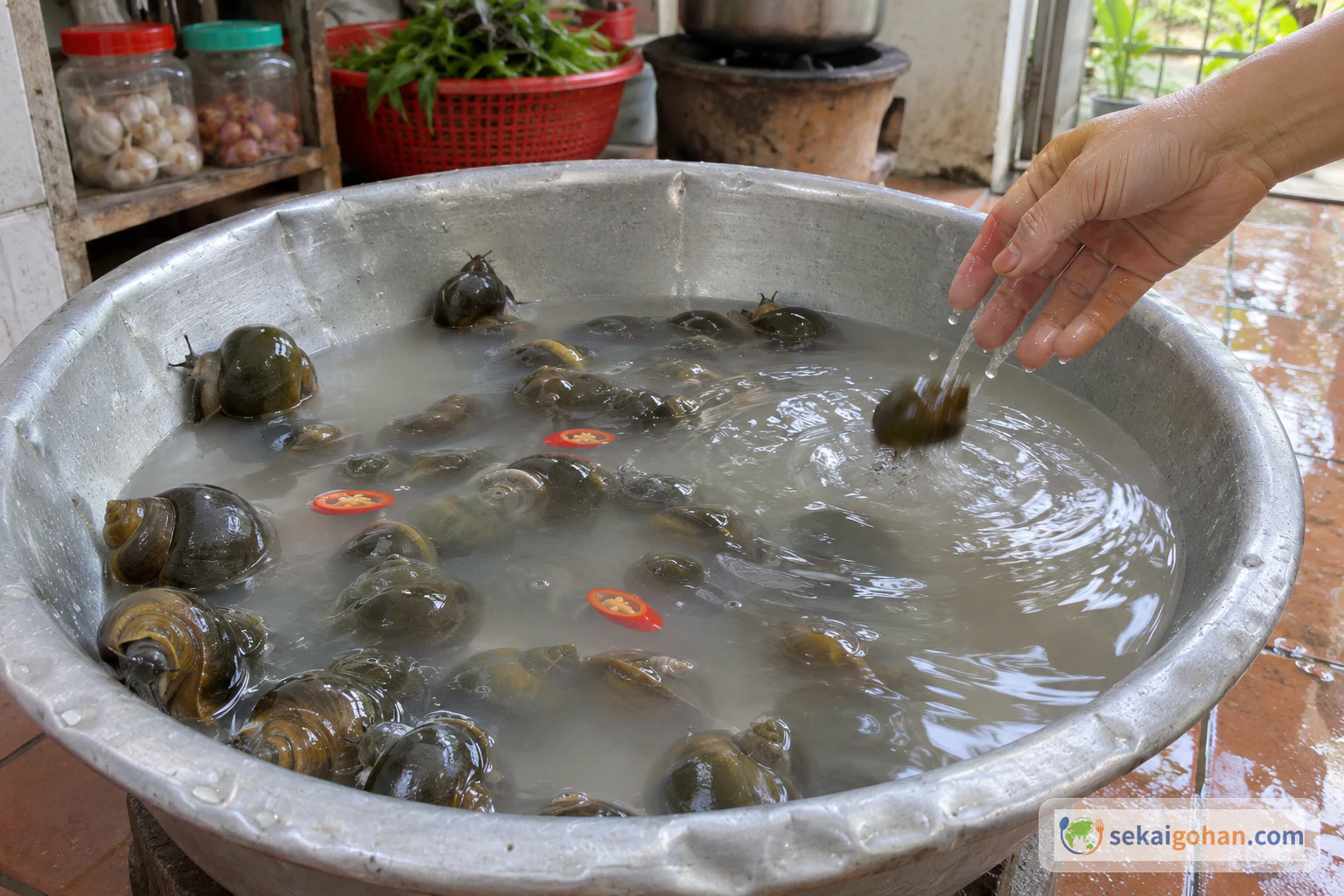
Purge the snails

Large snails in their shells soaking in rice-washing water with sliced red chilli in a metal basin
Keep the snails fully under the water so every one of them purges

Put the snails in a metal basin and pour in rice-washing water to cover them. Slice a chilli or two into the water and leave the snails to soak for 2–3 hours. Northern cooks swear by metal, which they count on to make the snails spit out their mud faster, and change the water partway through. When the time is up, the water should be cloudy with what they have released, and live snails still pull back into their shells at a touch.

STEP 22 / 12

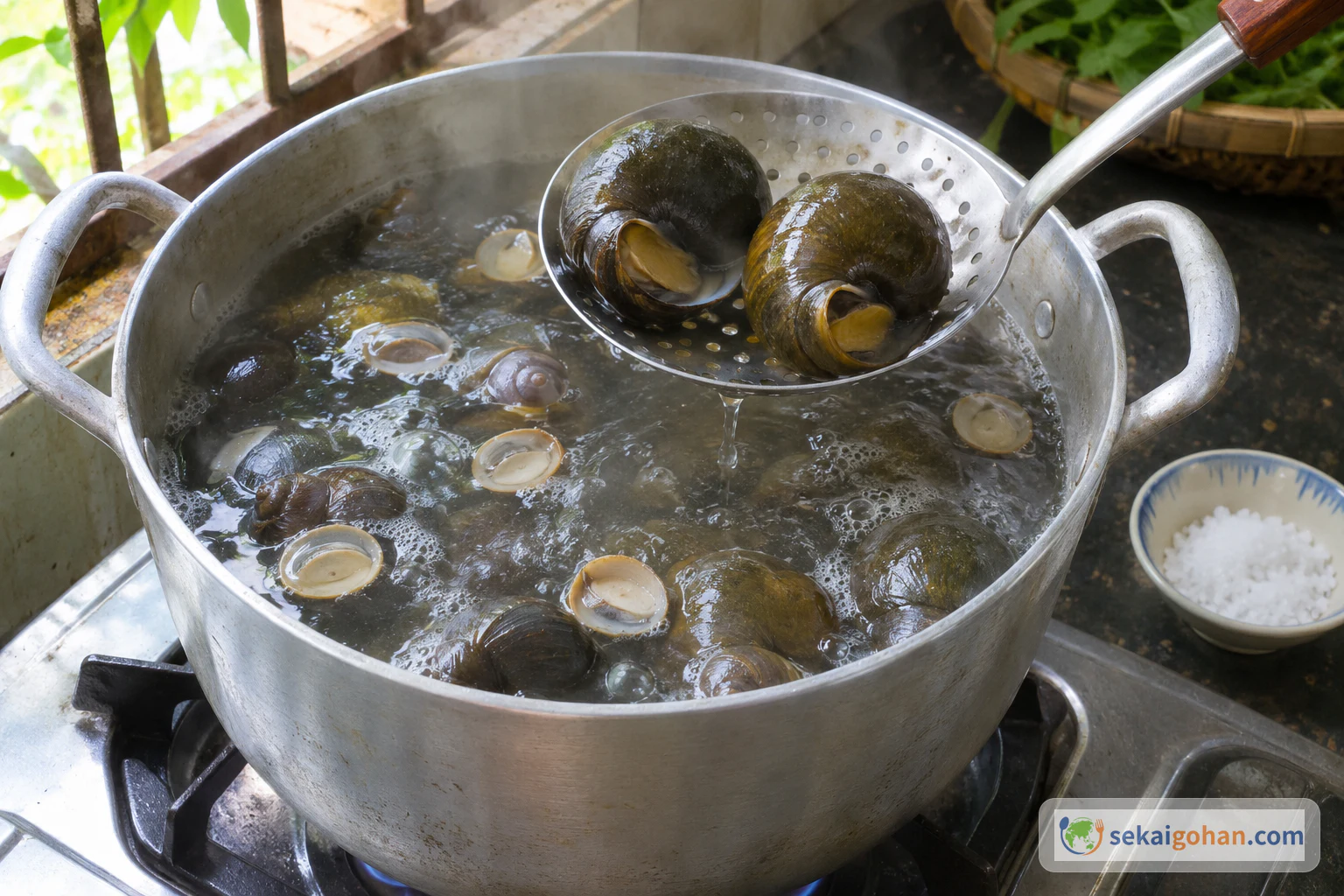
Boil until the caps loosen

Snails boiling in salted water as their caps float free and a skimmer lifts them out
Free-floating caps are the signal to lift the snails out before the meat tightens

Rinse the snails well under running water. Bring a pot of water with a little salt to a boil and tip the snails in. Once the water returns to a boil, count one minute, then lift the snails out with a skimmer straight away and keep the cooking water. This short boil only loosens the meat; the real cooking happens later in the sauce. You are there when the small round caps come away from the shells and float on the surface.

STEP 33 / 12

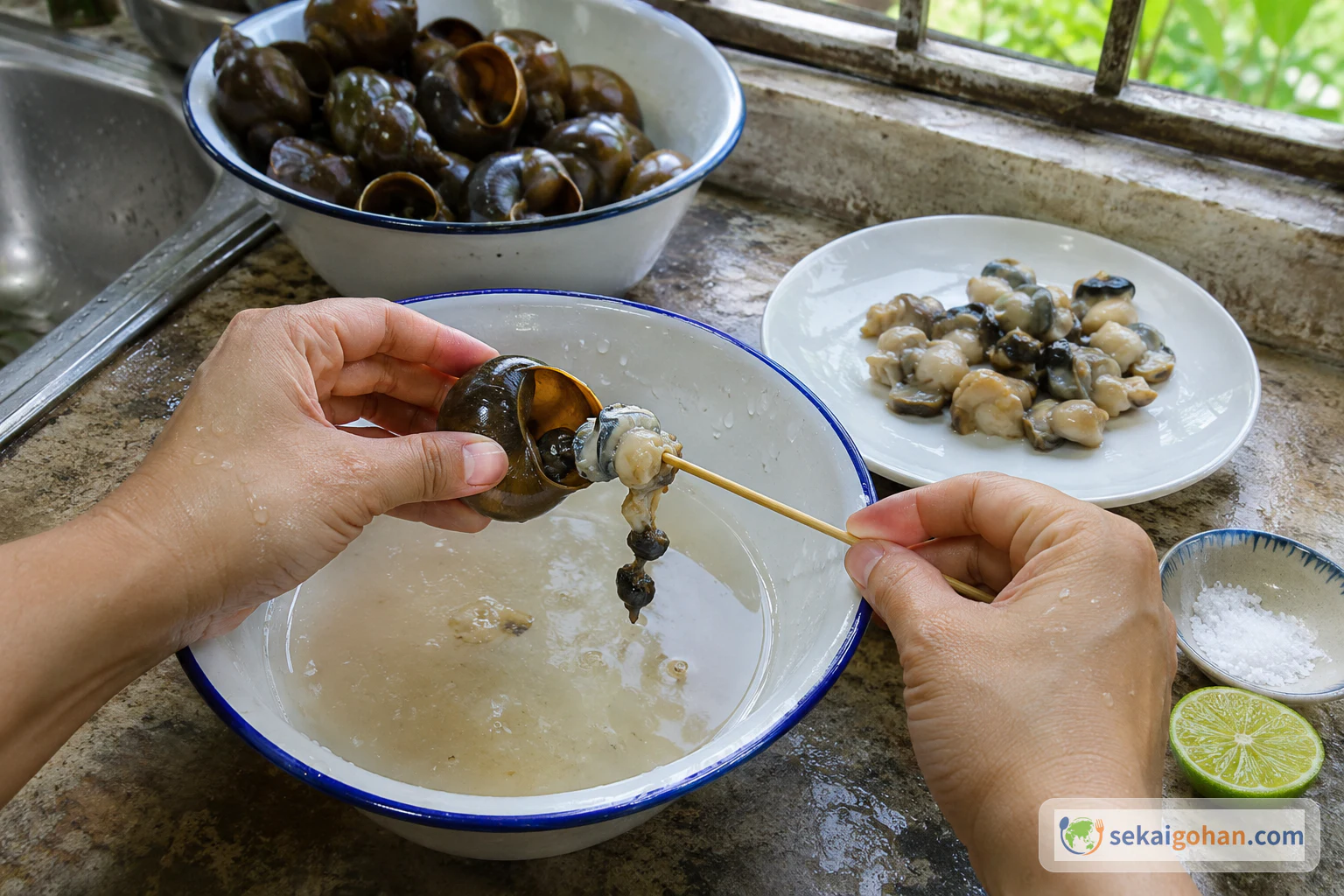
Cool and pull out the meat

Hands drawing snail meat out of the shell with a bamboo skewer and separating the dark end
A slow, twisting pull brings the meat out in one piece

Drop the snails into cold water until they are cool enough to hold. Cut off the tip of each shell, then hook the meat out of the opening with a bamboo skewer. Pull away the dark intestinal end and throw it out along with the shells. Each piece should come out whole, pale and firm, with no dark tip left on it.

STEP 44 / 12

Clean and season the meat

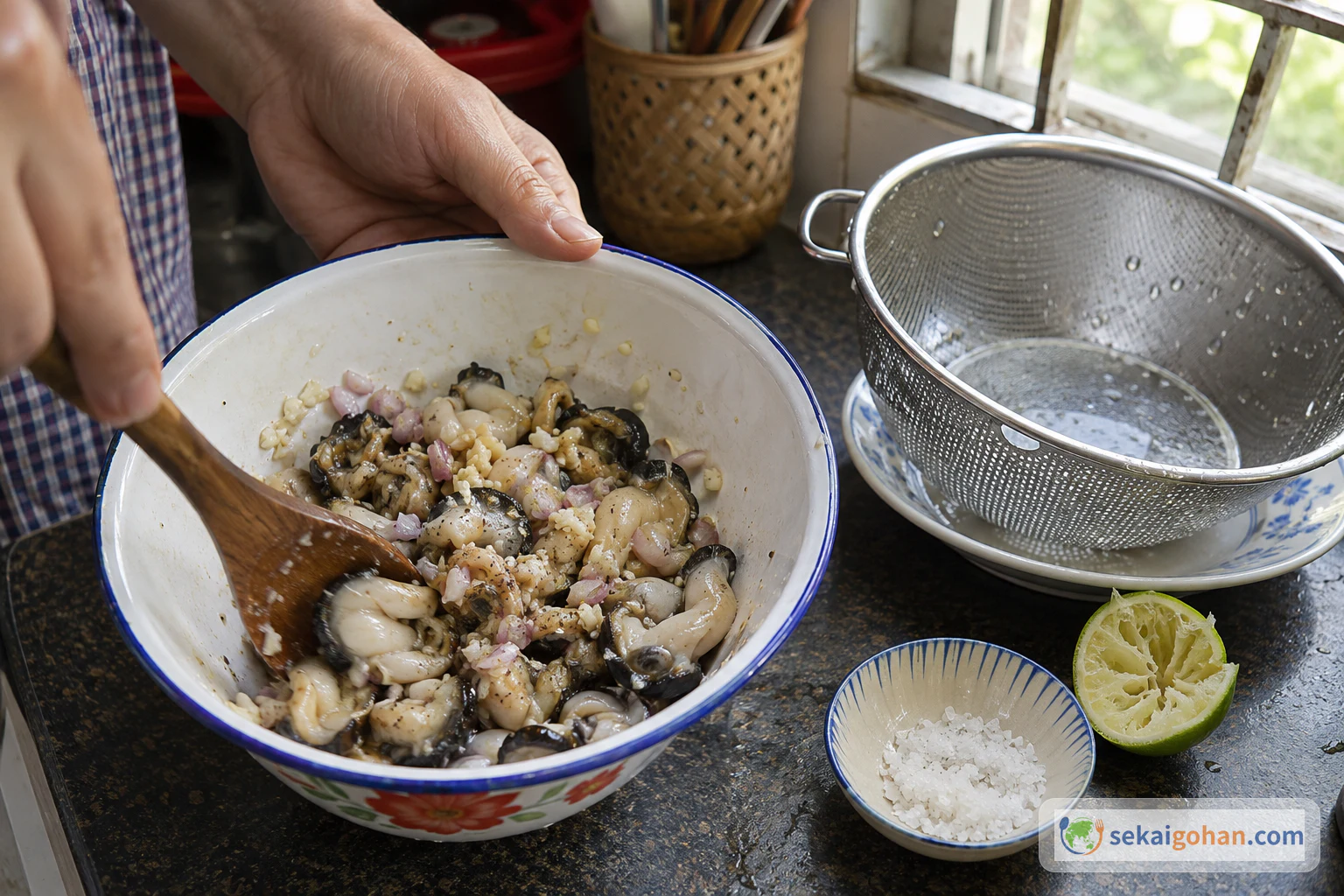
Cleaned snail meat in a bowl being folded with minced shallot, garlic, fish sauce and pepper
Fold, do not knead; the aromatics should cling without bruising the meat

Rub the meat with a little salt and vinegar or lemon until the slime comes away, then rinse it in clean water. Toss it with a little minced shallot and garlic, a small splash of the fish sauce, a pinch of the hạt nêm and a pinch of pepper. Keep the seasoning light, since salt and fish sauce can tighten the meat and make it salty, and some northern cooks skip this seasoning entirely. Strain the snail cooking liquid through a fine strainer and set it aside. The meat is ready when it feels clean rather than slick and every piece is lightly coated.

STEP 55 / 12

Cut and soak the bananas

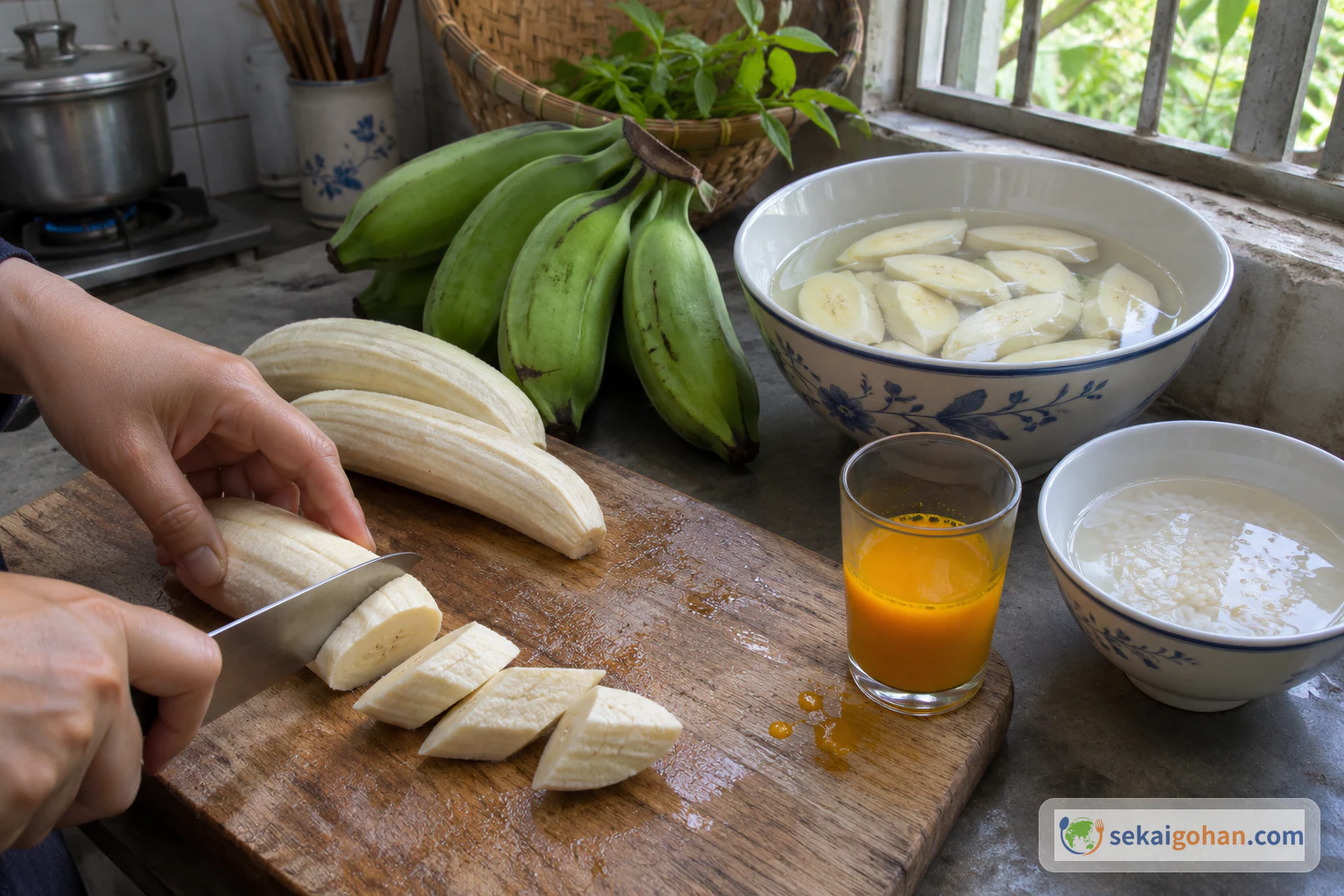
Green bananas peeled and cut into chunks in salted water, with turmeric juice and fermented rice beside them
Get each piece into the soaking water as soon as it is cut, before the surface darkens

Peel the green bananas, or leave the peel on if you prefer. Cut them into bite-size pieces and drop each one straight into rice-washing water with a little salt, slaked-lime water, or lightly salted water with lemon. Grate the turmeric and press out its juice. Drain the bananas and toss them with half the turmeric juice and half the mẻ. The cut faces should be evenly yellow, with no grey or dark patches.

STEP 66 / 12

Brown the pork belly

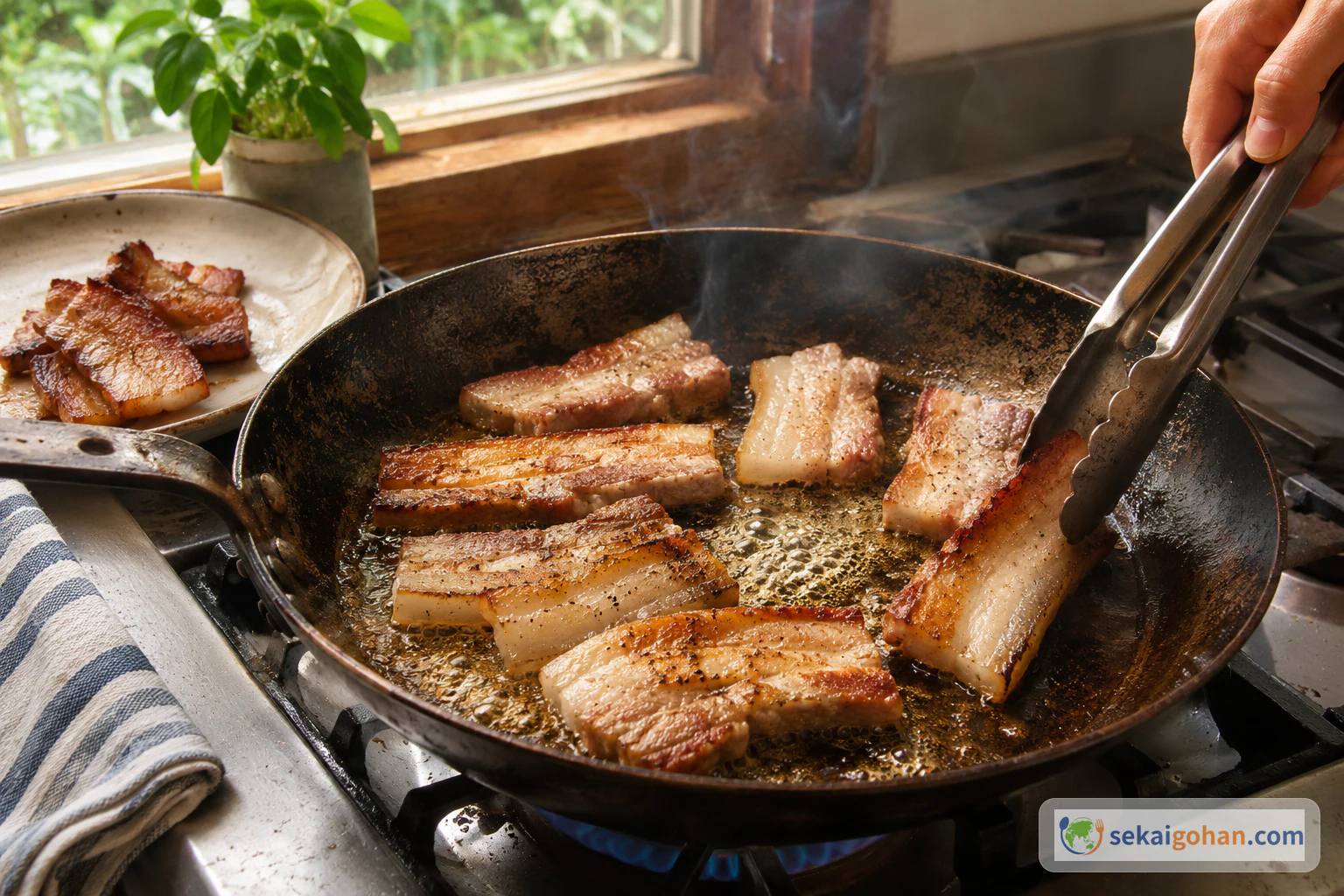
Thick strips of pork belly searing in a pan with browned edges and bubbling fat
Leave the strips alone until the underside releases from the pan on its own

Cut the pork belly into thick strips. Lay them in a frying pan in a single layer and sear, turning, until the edges brown and the fat runs out into the pan. The rendered fat is what gives the sauce its richness later. Move the pork to the heavy pot once the edges are golden-brown and crisp and the pan glistens with fat.

STEP 77 / 12

Fry the tofu

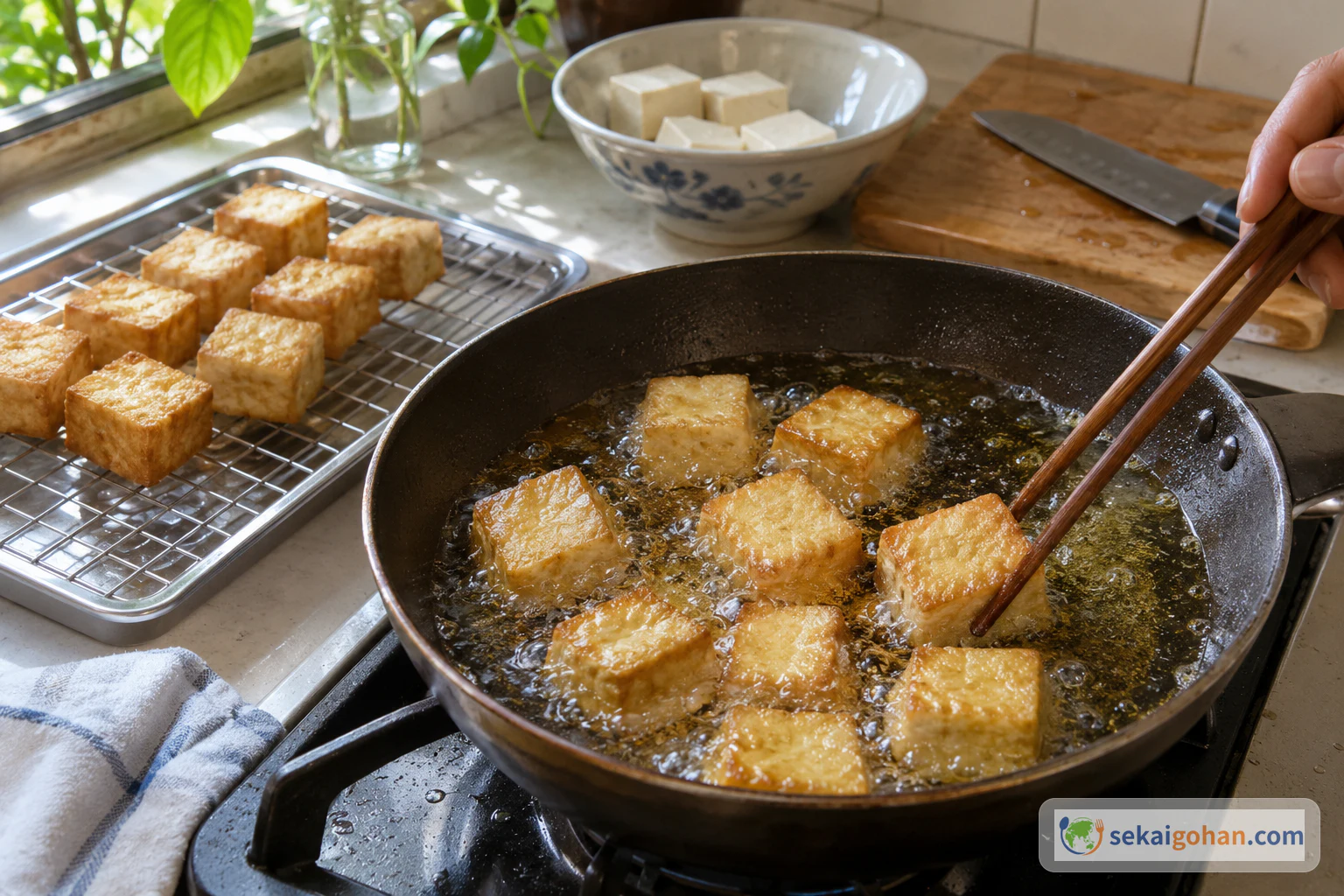
Cubes of tofu frying golden in oil while already fried pieces drain on a metal rack
A rack keeps the crust dry so the tofu holds its shape in the stew

Cut the tofu into bite-size pieces. Heat oil in a small shallow pan and lower the tofu in gently, turning it until every side is golden. Lift the pieces onto a wire rack to drain. They are done when the surface is golden, the pieces feel light, and they keep their shape when you pick them up.

Hot oil

Lower the tofu into the oil away from you and keep children clear of the stove. Wet tofu spits, so let excess water drip off first.

STEP 88 / 12

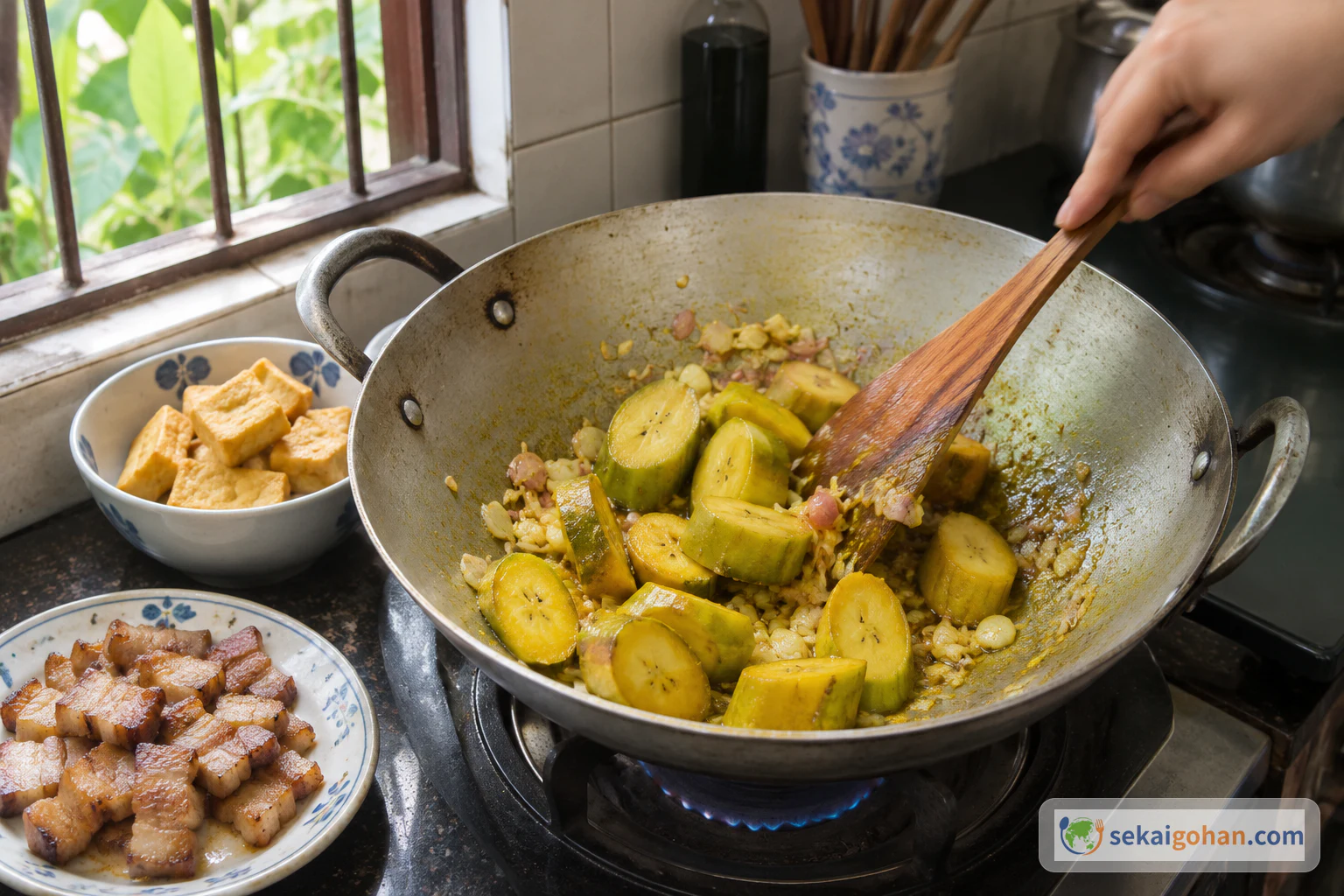
Stir-fry the bananas

Turmeric-yellow green banana being folded into fried shallot and garlic with a wooden spatula
Stir gently; the bananas should firm up on the outside, not brown

Heat a little oil in the frying pan and cook the rest of the shallot and garlic until fragrant. Add the turmeric-coated bananas and stir-fry until their surfaces tighten. This firming keeps them from collapsing in the simmer. Tip them into the pot with the pork when the pieces hold their shape under the spatula and carry a faint yellow sheen.

STEP 99 / 12

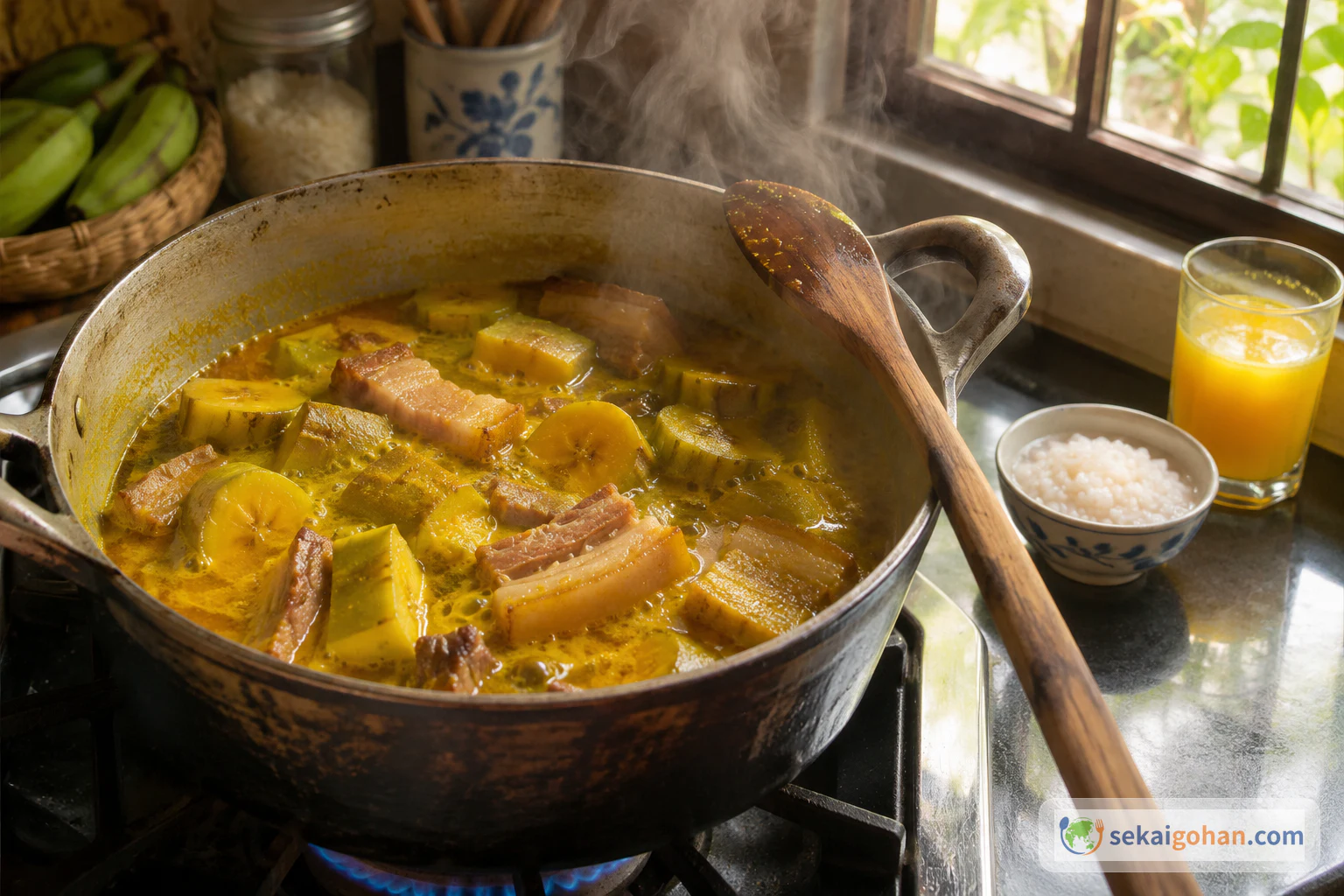
Simmer until the sauce turns glossy

Pork belly and green banana simmering in a thickened golden sauce with slow bubbles
Slow bubbles breaking at the edge mean the heat is right; a rolling boil breaks the bananas

Pour in the strained snail liquid, then add water until the pork and bananas are just covered. Add the remaining fish sauce and hạt nêm, the mắm tôm, the salt, and the rest of the mẻ and turmeric juice. Simmer over low heat, scraping the bottom now and then so nothing catches. Keep going until the pork and bananas are tender and the sauce has thickened to a glossy gold.

STEP 1010 / 12

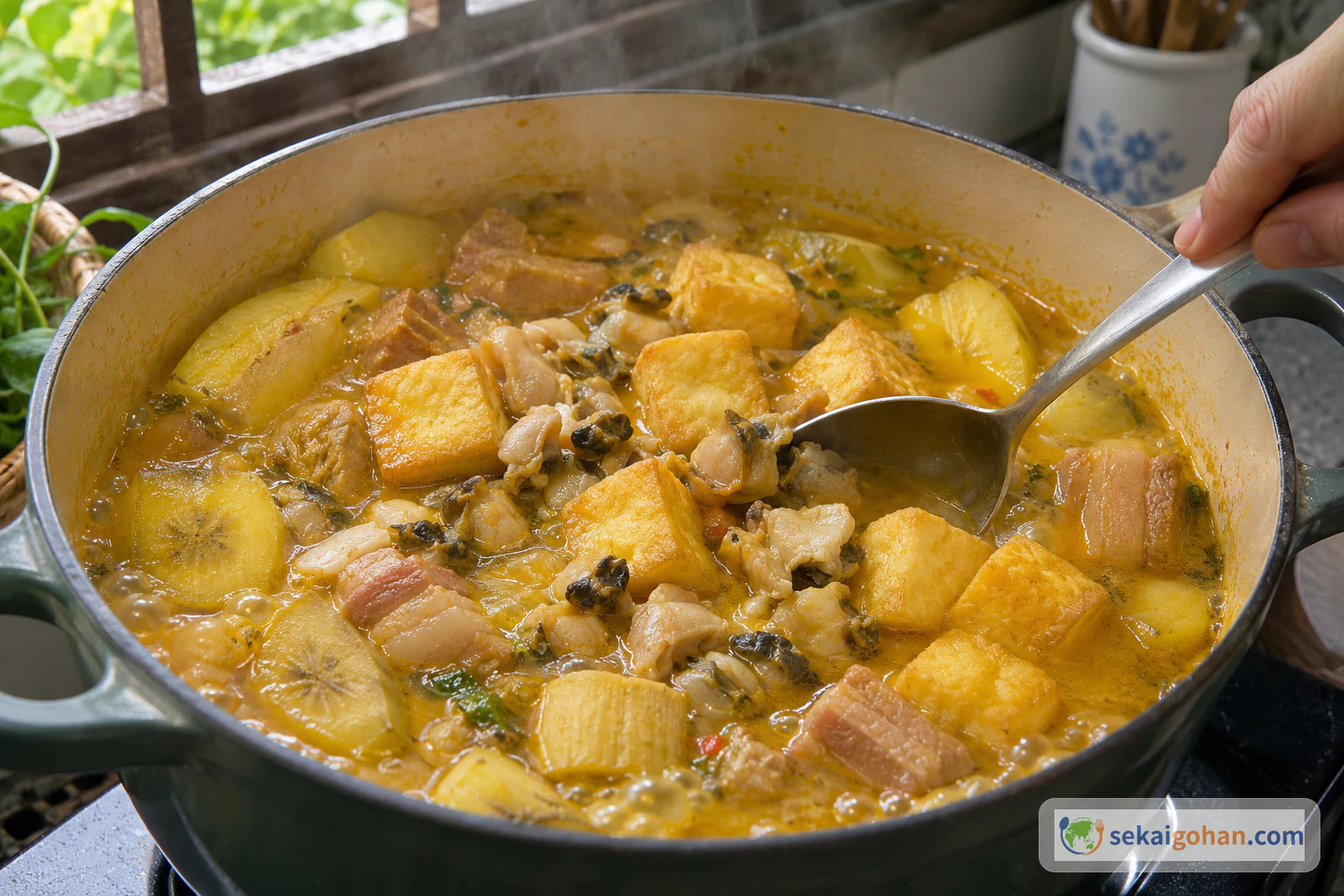
Add the snails and tofu last

Snail meat and fried tofu being pushed into the simmering golden sauce
Press the pieces under rather than stirring, so the banana around them stays whole

Only once the sauce has thickened, add the snail meat and fried tofu. Push them gently under the sauce and simmer for 4–5 minutes. Going in earlier toughens the snail meat and wears down the tofu. They are ready when the sauce bubbles around them and the snail meat is hot right through to the centre.

Order is everything

Pork and banana need a long simmer, snail and tofu a short one. Holding the snails back until the sauce is glossy is what keeps them springy instead of rubbery.

STEP 1111 / 12

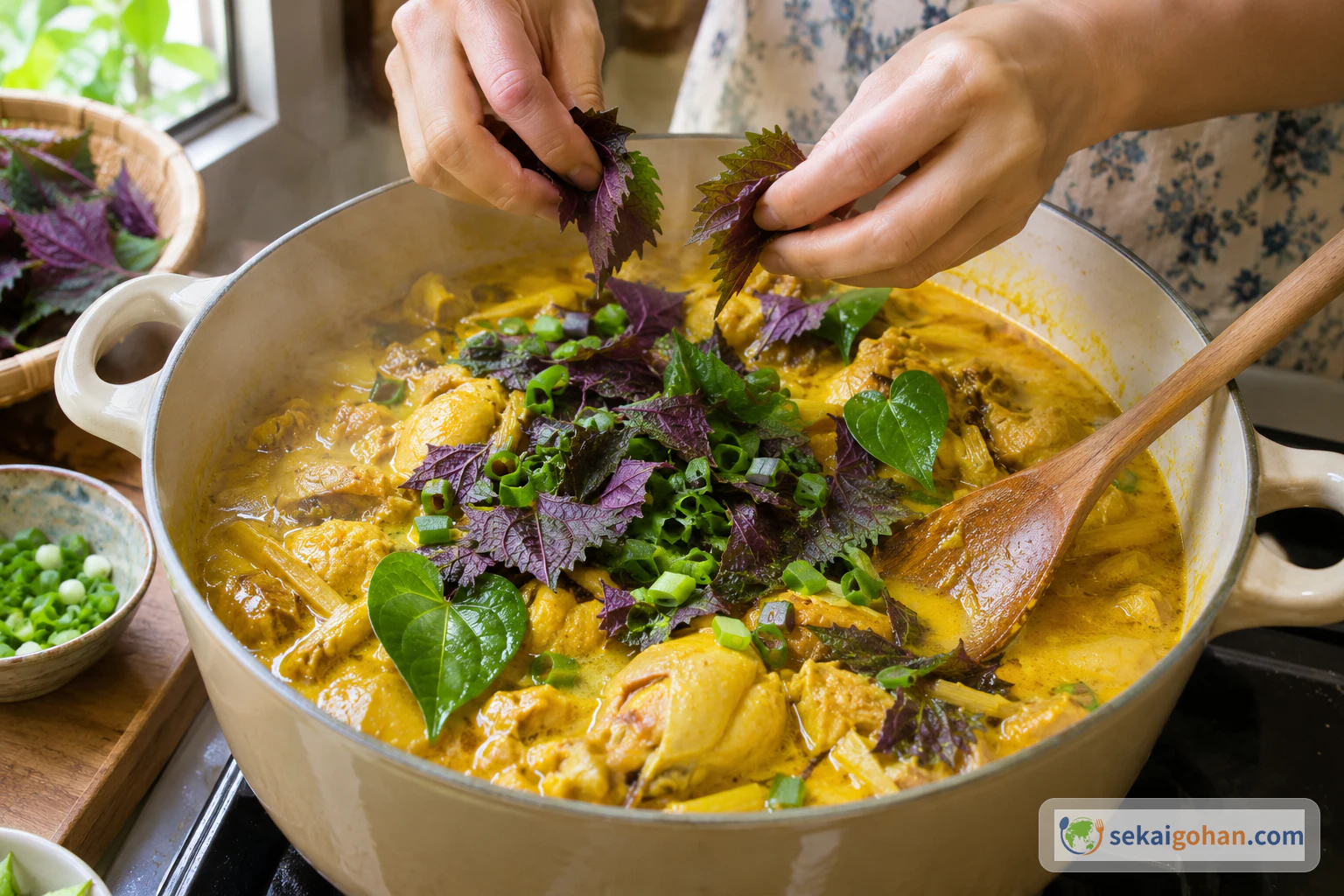
Finish with the herbs

Hands tearing purple perilla over the glossy golden stew, with scallion and betel leaves on top
Tear the perilla by hand at the last moment so its scent rises with the steam

Taste the sauce and adjust it with fish sauce or salt. Add the scallions, tear in the perilla and wild betel leaves, and stir once. Turn off the heat at once and let the warmth of the pot draw out their aroma. Stop when the leaves have just wilted and still look bright.

Herbs off the heat

The herbs give the stew half its smell. Added early, they boil away into a dull green; added as the flame goes out, they stay sharp and fragrant.

STEP 1212 / 12

Serve hot

The stew on a northern Vietnamese table with white rice, bún noodles, fresh herbs and sliced chilli
Fresh herbs on the side let each person add more perilla to their own bowl

Ladle the stew into a deep bowl and scatter over sliced chilli if you like heat. Set it in the middle of the table with hot rice or bún, and add extra perilla for anyone eating it over noodles. Serve it while it is still steaming and the herbs are still green.

0 / 0
Ingredients

Ingredients

1 / 1

Ingredients

Ingredient Amount Role
Large freshwater snails, live in the shell (ốc nhồi or ốc mít) 2¼ lb (1 kg) The chewy heart of the stew
Pork belly (thịt ba chỉ) 9 oz (250 g) Rendered fat that gives the sauce richness
Green bananas (chuối xanh) 4–5 Starchy body that softens and thickens the sauce
Firm tofu (đậu phụ) 3–4 blocks Fried first so it holds in the pot
Fresh turmeric (nghệ tươi) 1 root Golden colour and earthy aroma
Fermented rice (mẻ) ½ small rice bowl (½ chén) The sour backbone; half for the bananas, half for the pot
Shallots (hành khô) 2 Aromatic base; a little minced for the snail meat
Garlic (tỏi) 2–3 cloves Aroma; a little minced for the snail meat
Fish sauce (nước mắm) 1½ tbsp Salt and savour; a little for the snail meat, the rest in the pot
Fermented shrimp paste (mắm tôm) ½ tbsp Deep fermented savour, the northern signature
Salt 1 tsp, plus a little for boiling and cleaning Seasoning
Vietnamese seasoning granules (hạt nêm) 1 tsp Savour; a little for the snail meat, the rest in the pot
Black pepper a pinch Seasoning for the snail meat
Vinegar or lemon a little Rubbing the snail meat clean
Rice-washing water (nước vo gạo) as needed Purging the snails and soaking the bananas
Fresh red chillies (ớt) as needed Sliced into the soak and sliced to serve
Scallions (hành lá) as needed Finishing herb
Purple perilla (tía tô) as needed Finishing herb
Wild betel leaves (lá lốt) as needed Finishing herb
Cooking oil as needed Frying the tofu and the aromatics
Hot cooked rice or bún (rice vermicelli) to serve The base for each bowl
0 / 0

By the time the snails and fried tofu go into the pot, the sauce has already turned thick and golden with turmeric, and the sour smell of fermented rice rises with the steam. A few minutes later a handful of purple perilla, wild betel leaves and scallion goes on top, the heat goes off, and the pot heads for a table set with hot rice. Ốc nấu chuối đậu is a home stew from northern Vietnam: large freshwater snails, green bananas and tofu simmered with pork belly. It tastes sour and earthy at once, with a deep fermented-shrimp savour underneath, chewy snail against banana as soft and starchy as potato, and herbs that hit the nose before the spoon reaches your mouth.

A Northern Pot for Cold Days

The name reads like a shopping list. Ốc is snail, nấu is to cook, chuối is banana and đậu is tofu, and you will also see the same dish written as ốc om chuối đậu. In English it goes by snail stew with green bananas and tofu, which is accurate and says nothing about the sourness that defines it.

This is plain everyday food of the north, made for an ordinary dinner and for the days when the family gathers. It is local enough that some Vietnamese from other regions have never eaten it. The snails come from ponds, lakes and rice fields, and the dish belongs to cold weather, when a hot pot of it in the middle of the table warms the whole family. Many cooks hold up the Hanoi way of making it as the northern standard. For the wider picture of the country's cooking, start from our Vietnam page.

Hot food, cold food

In Vietnam, ingredients are thought of as warming or cooling the body, and snails count as a very "cold" food. That is why warming turmeric goes into the pot and why the stew is always eaten hot.

How the pot changes from kitchen to kitchen

The sour note usually comes from mẻ, fermented cooked rice, though some northern cooks use dấm bỗng, a fermented rice vinegar, instead. Mắm tôm, the pungent fermented shrimp paste, is a fixture of the northern pot. Tomato is where cooks part ways most: many northern kitchens leave it out, while other versions add one tomato or several. This version leaves it out.

Thickness varies too. Some cooks boil a couple of extra bananas separately, mash them and stir them in with crushed peanuts for a heavier, richer sauce. The same family of ingredients also turns into quite different dishes: ốc xào chuối đậu is a dry stir-fry with almost no liquid, ốc nhồi thịt packs snail meat and pork back into the shells to steam, and bún ốc is a snail noodle soup. Here the snails are shelled and simmered, and nothing goes back into a shell.


Ingredients (serves 4–5)
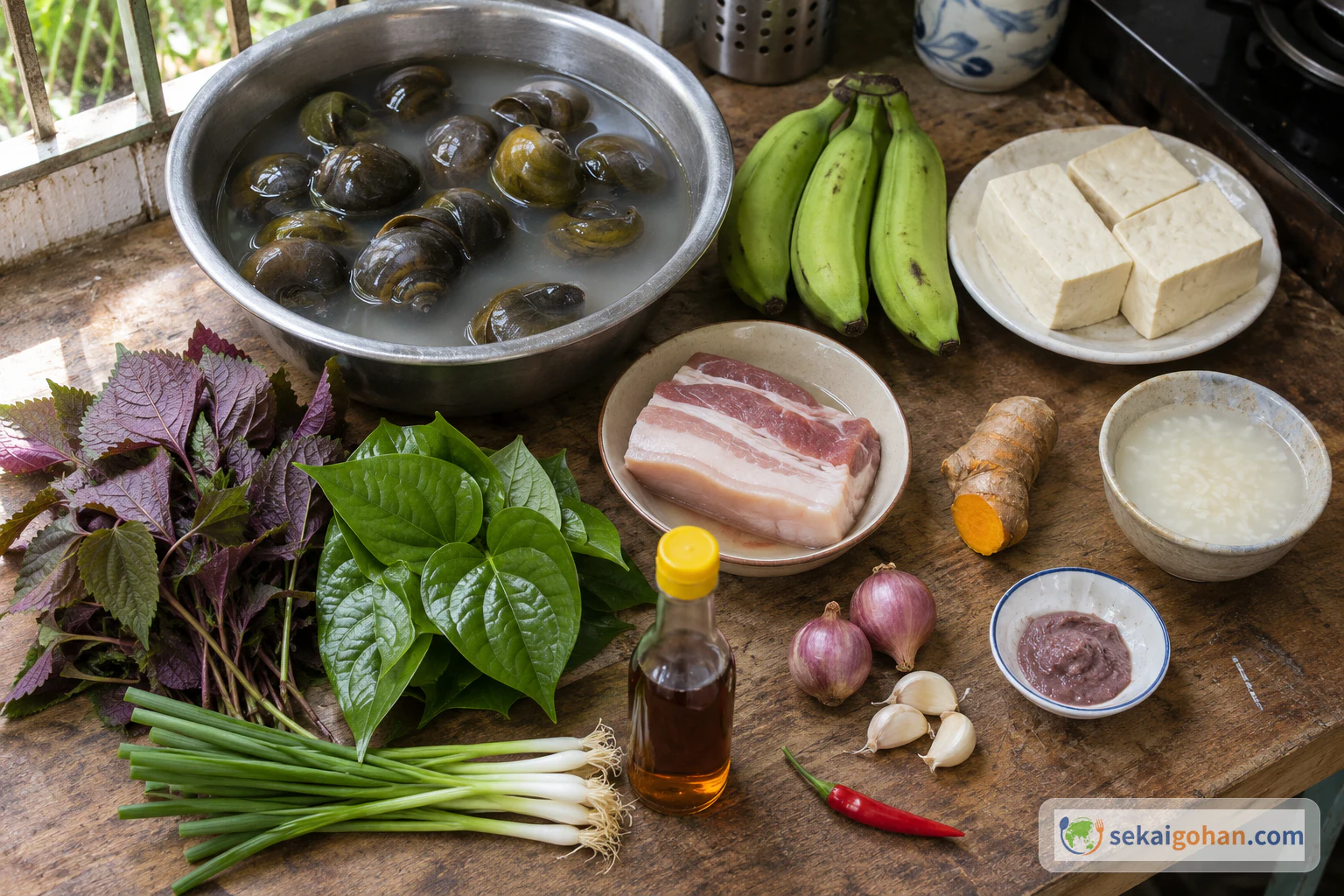
Snails in rice-washing water, green bananas, firm tofu, pork belly, fresh turmeric, fermented rice, shallots, garlic, herbs and fish sauce laid out on a counter
The bananas should be hard and fully green, and the mẻ loose and soupy
Split the mẻ in two

The ½ bowl of mẻ is the whole amount. Half coats the raw bananas, the other half goes into the simmer. Adding more on top of that is what turns the stew harsh and sour.

Allergen information

This stew contains molluscs (snails), fish (fish sauce), crustaceans (shrimp paste), soy (tofu) and pork.

Equipment

  • A metal basin for purging the snails
  • A pot of boiling water and a slotted skimmer
  • Bamboo skewers for pulling out the snail meat
  • A fine strainer for the snail cooking liquid
  • A frying pan for browning the pork and stir-frying the bananas
  • A small shallow pan for frying the tofu, and a plain wire rack to drain it
  • A heavy pot for the simmer, and a wooden spatula

Shopping and Swaps

The snails decide everything, so buy them alive. Choose snails that pull shut when touched, with dark, glossy shells and no banding, and leave behind any that float. The snail for this dish has a thin, glossy shell, no small spiral hole beside the opening and no coloured stomach mass. Vietnamese cooks tell it apart from the golden apple snail, with its thick banded shell and orange or red stomach mass, which they warn carries many parasites. Do not gather wild apple snails to cook.

Outside Vietnam, large freshwater snails are hard to find. Big sea snails such as whelks or turban shells, or frozen escargot, make a workable stew, but the texture and flavour come out as a different dish. Small clams change it too much to be worth using.

Green bananas are a cooking ingredient, eaten only after they are cooked through, when they turn mild, tender and starchy like potato. The green bananas on supermarket shelves are usually unripe dessert bananas that turn sweet and soft in the pot. Green cooking bananas or plantains from a Southeast Asian, African or Caribbean grocer come closer.

Ingredient If you cannot find it What changes
Mẻ Plain unsweetened yogurt, the same amount, not diluted Milder sourness, less fermented aroma
Mắm tôm Leave it out and add a little more fish sauce Less depth; the northern funk fades
Fresh turmeric Ground turmeric, a little at a time until the colour looks right Flatter, dustier aroma
Hạt nêm Chicken bouillon granules Close in savour
Lá lốt Green shiso leaves Points the herb aroma the same way, but it is a different leaf
Tía tô Green shiso Weaker aroma and no purple colour

Buy fish sauce, mắm tôm, mẻ and bún ready-made from a shop that sells them as food rather than fermenting mẻ or mắm tôm yourself.


Method

The snails set the pace. Start the soak 2–3 hours before you cook, then boil and shell them and keep their cooking liquid. Once the bananas are coated, brown the pork and fry the tofu. The cooking takes 40 minutes in all, not counting the soak, and the only stretch where the pot looks after itself is the simmer before the snails go back in.

Snails are always eaten fully cooked

Snails and slugs can carry rat lungworm, a parasite that infects people through raw or undercooked meat or through hands that touched them. It brings headache, nausea, vomiting, fever and a stiff neck one to three weeks later, can reach the brain, and in rare cases kills; there is no vaccine and no preventive drug. Never taste the snail meat raw or half-cooked. Wear gloves while handling live snails, wash your hands well afterwards, and make sure the meat is cooked through to the centre before serving.

When It Goes Wrong

What you see Why What to do
The snail meat is rubbery Boiled past the point where the caps loosened, or added to the stew too early Lift the snails out as soon as the caps float, and give them only the final 4–5 minutes in the sauce
The meat is gritty or slimy Short soak, intestine left on, or no rubbing Soak the full 2–3 hours, remove every dark end, rub with salt and vinegar or lemon
The bananas turn grey or black Cut surfaces left in the air Drop each piece into the soaking water as you cut
The bananas fall apart Skipped the stir-fry, or the heat is too high Stir-fry until firm before simmering, and keep the pot at a gentle bubble
The tofu crumbles Fried too lightly, or simmered too long Fry until golden and light, and add it only at the end
The sauce is thin Too much liquid, or taken off the heat too soon Add water only to just cover, and keep simmering until glossy before the snails go in

Serving, Variations and Storage

At the table

Hot rice is the everyday partner; bún turns the stew into something closer to a noodle bowl, with more sauce and more perilla. Either way it goes into the middle of the table for everyone to share, on an ordinary weeknight or when relatives come over, and it is at its best on a cold evening.

Variations

  • Mashed-banana thickening. Boil two extra green bananas until soft, mash them and stir them in near the end with crushed peanuts. The sauce turns thick and nutty, closer to a stew you can stand a spoon in.
  • Dấm bỗng instead of mẻ. The fermented rice vinegar gives a sharper, cleaner sourness with a lighter aroma.
  • Yogurt instead of mẻ. Plain yogurt softens the sourness and drops most of the fermented smell, an easier start for anyone new to mẻ.
  • Over bún. Leave more liquid in the pot, pour it over room-temperature noodles and pile on perilla.

Leftovers

Let the stew cool, then refrigerate it promptly in a clean, covered container with all its sauce, and finish it the next day. Reheat it in a pot over medium heat until it boils, so the snails are heated through a second time.

Frequently asked questions

Do I have to use a metal basin?

Northern cooks reach for metal because they count on it to make the snails release mud faster. Any basin that holds enough rice-washing water to cover the snails still does the job, as long as you give them the full soak and change the water partway through.

Can I eat the dark end of the snail?

Take it off. It is the intestine, and this dish never uses it. Pull it away while the meat is cooling, before you rub and rinse the meat.

Is mắm tôm eaten raw here?

No. The shrimp paste goes into the simmering sauce and cooks with everything else. If you cannot eat shrimp paste, leave it out and add a little more fish sauce.

Can I make the stew ahead?

Cook it through the simmer in step 9, then cool and refrigerate the pork and banana in their sauce. When you are ready to eat, bring it back to a boil, add the snails and fried tofu for their final minutes, and finish with fresh herbs.
Sources