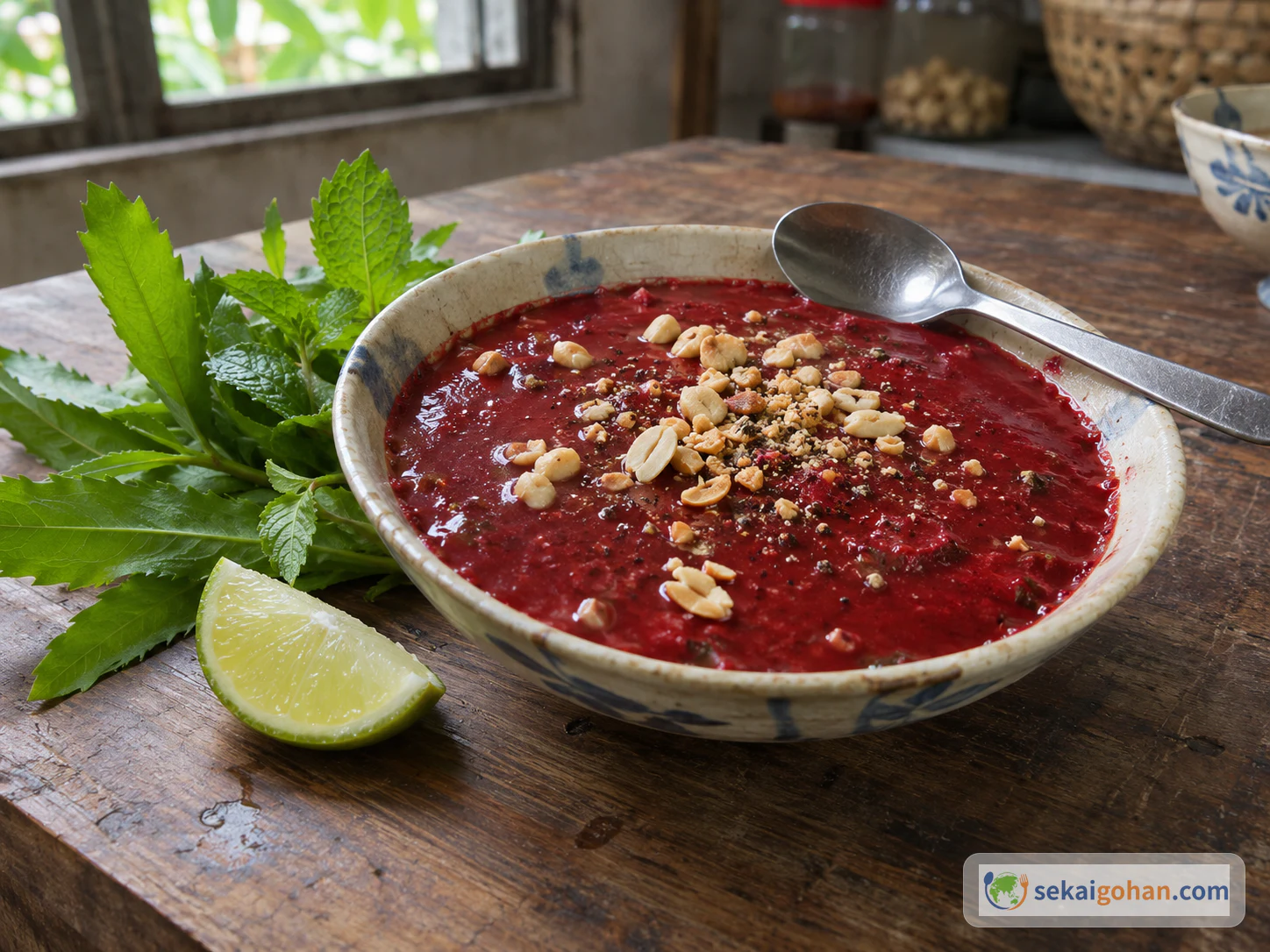
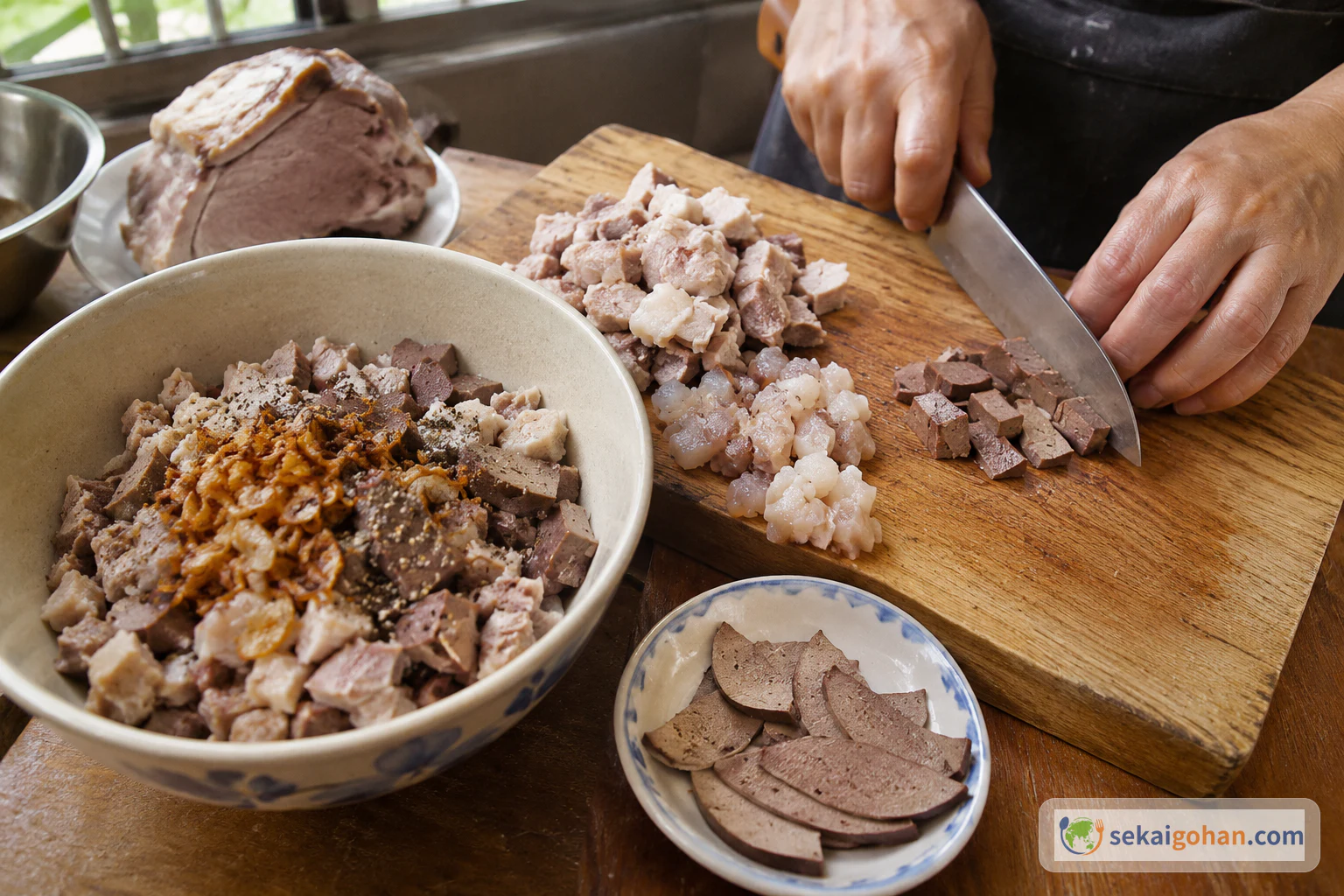
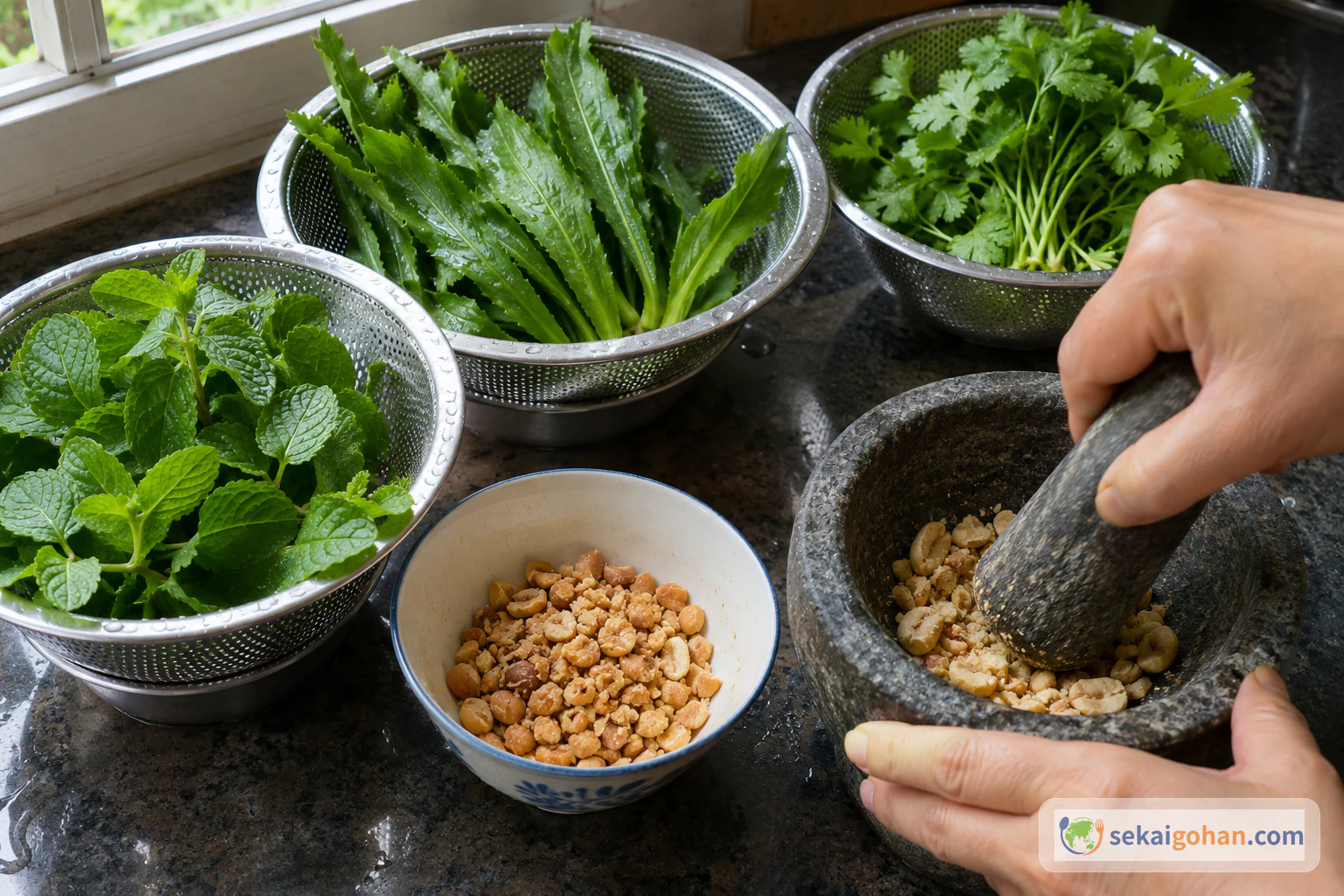
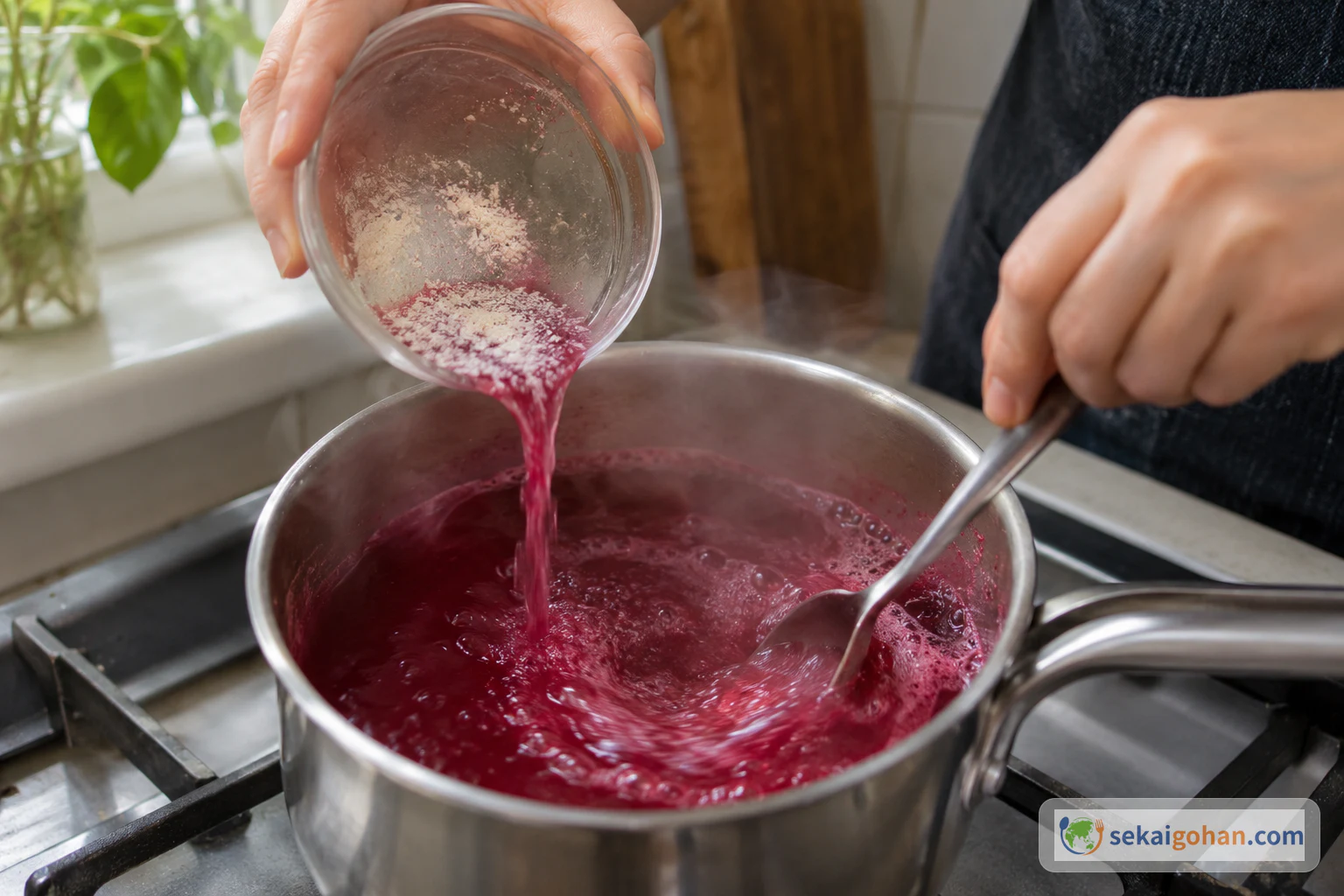
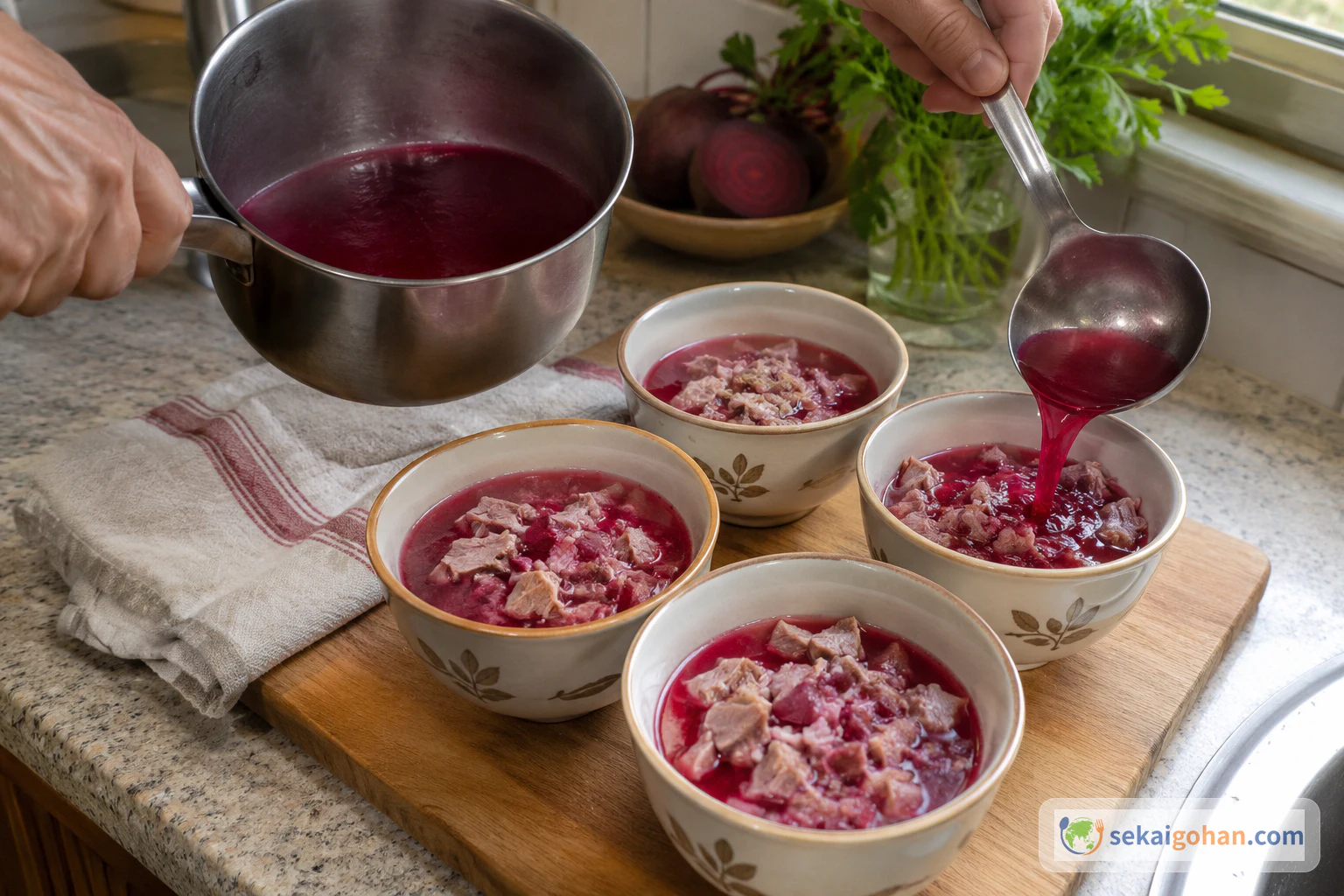
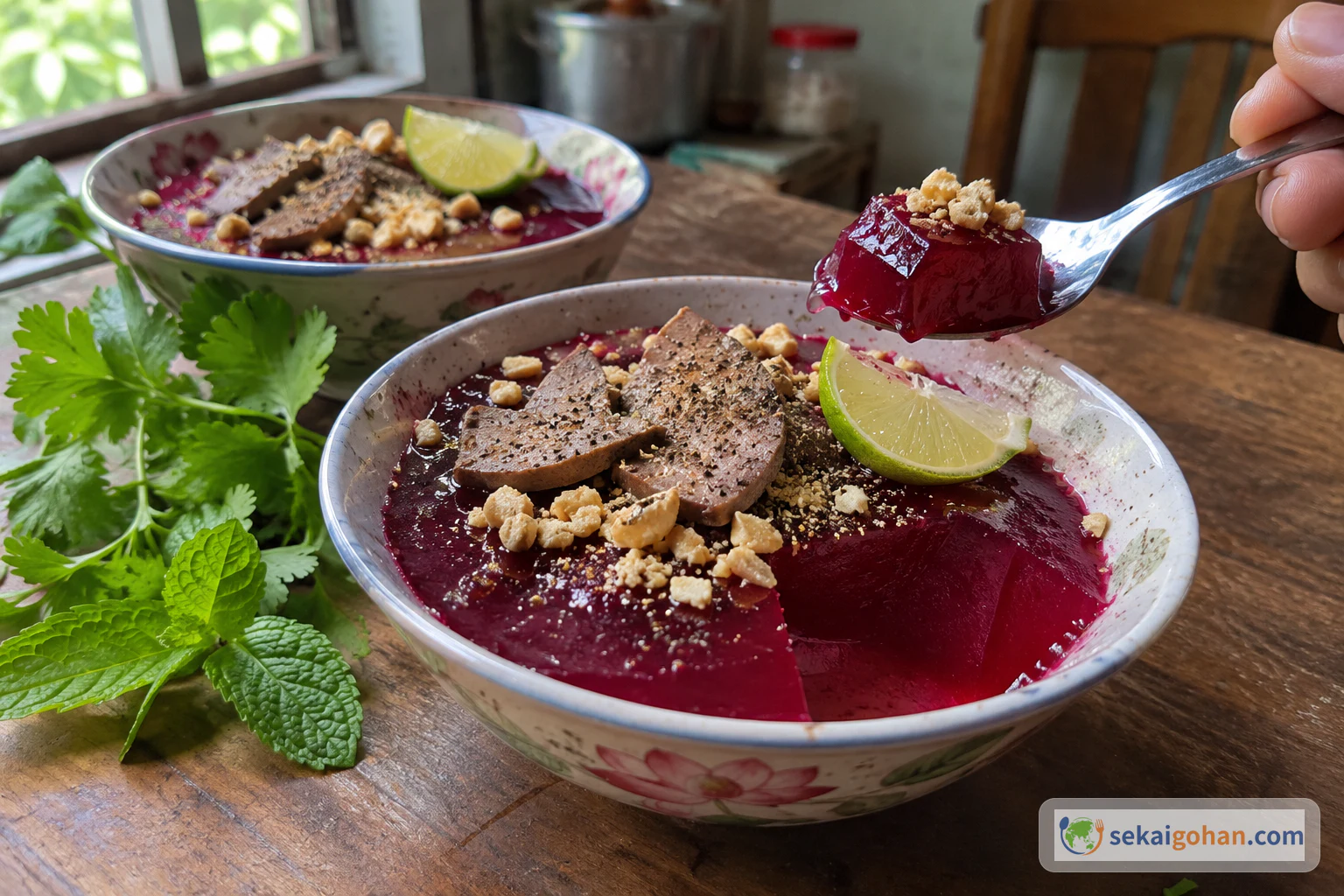
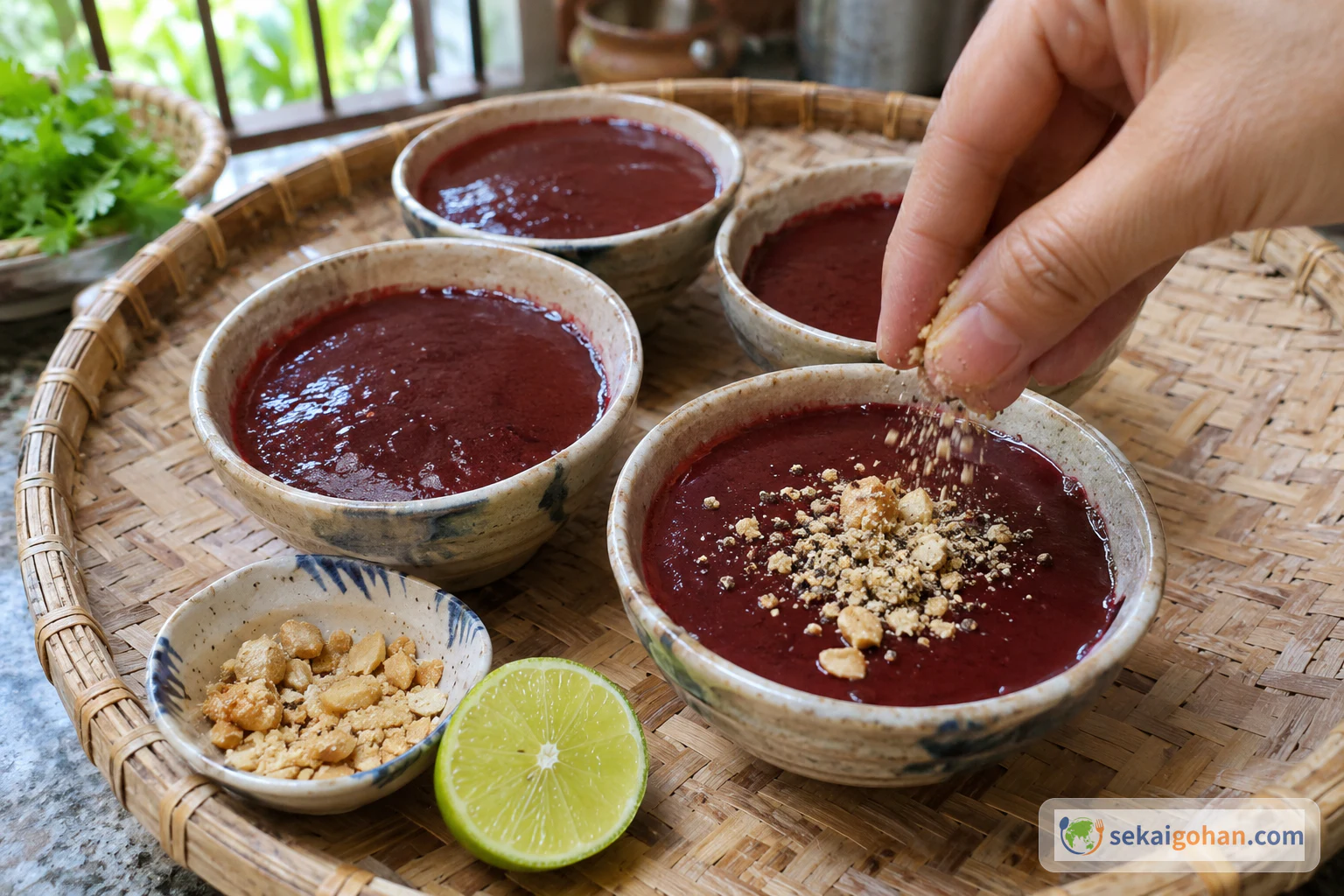
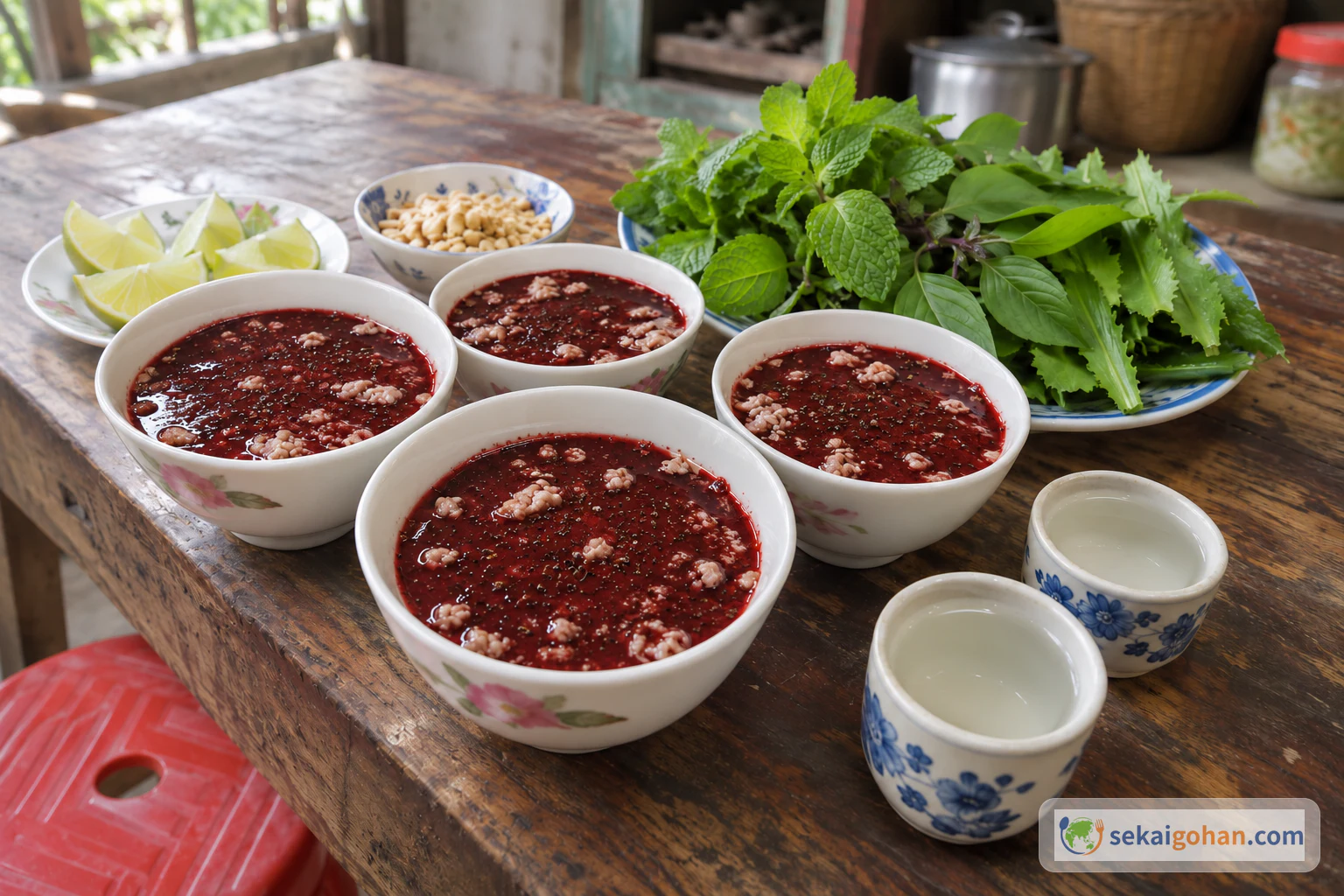
The tray comes out with one small bowl for each person at the table, and every bowl holds the same thing: a level disc of dark red, smooth and glossy, scattered with crushed roasted peanuts and a crack of black pepper. Beside it sit a plate of mint and long, saw-edged culantro, lime wedges, and small cups of clear rice liquor. Under the red surface is a layer of chopped cooked pork and rib cartilage, so each spoonful is cold and buttery on the tongue, with little taste of blood, and then crunchy where the cartilage catches. Lime, herbs and chilli bring the sourness and heat. This is tiết canh, fresh raw blood set in the bowl over cooked meat, a dish of family celebrations in northern Vietnam. Because the raw version carries a serious infection risk, the bowl you make at home tonight is the blood-free beet version, red and spoonable, with the same peanuts, herbs and lime.
A Bowl for Weddings, Tết and the Morning of the Slaughter
What is in the bowl
Tiết canh is built from very few parts. Fresh blood is mixed with a little salt water or diluted fish sauce to slow its clotting, then thinned with water and poured over a filling of chopped cooked meat. The bowl is left untouched until it sets, then finished with pepper and roasted peanuts, with lime and herbs alongside. Pig's blood is the most common. Duck comes second, and in the north, where a duck killed at home is an ordinary event, practical duck versions are widely shared.
When and with whom it is eaten
The dish belongs to the days when a pig is killed. Families slaughter before Tết, after a wedding, or several households split one pig between them, and tiết canh is served that same morning. The men sit with a bowl each and drink rice liquor; it also turns up as a weekend breakfast and at gatherings of male friends. Serving it carries a message: it shows that the pig just slaughtered was healthy.
Across rural and urban areas near Hanoi, a 2012–2013 survey found that 35% of rural people and 8.6% of urban people had eaten pig-blood tiết canh in the past year. It was most common among men in their forties and among farmers, manual workers, and people working in sales and services. Children rarely eat it. Many people believe it prevents anaemia and cools the body; those are beliefs held about the dish, not effects it has been shown to have.
Pork, duck, and blood that is cooked
Vietnamese cooks set blood in two very different ways. In bún bò Huế and bún riêu, pig's blood is first set into firm blocks called huyết and then simmered, so it reaches the bowl cooked. Tiết canh is never heated: the blood sets raw in the bowl and is eaten cold. The ingredients overlap; the method and the risk do not. European blood dishes such as black pudding or Swedish blodplättar are cooked too, which puts them on the huyết side of that line.
The Vietnamese spelling is tiết canh; without the diacritics it becomes tiet canh. Where the name comes from is not settled, so treat any neat translation of it with care.
Why Tiết Canh Is Advised Against
The risk in the bowl is Streptococcus suis, a bacterium common in pigs. About 90% of human infections are reported from Asia. Between 3% and 7% of infections are fatal, and in severe sepsis the death rate can reach about 60%, as it did in the 2005 outbreak in Sichuan, China.
In 2017 Vietnam recorded 171 cases and 14 deaths, and seven in ten of the people infected had eaten raw pork or raw pork products such as tiết canh. Cases rise around Tết, the season of home slaughter. The illness starts with high fever, nausea and vomiting, easy to mistake for an upset stomach, and can move on to septic shock, coma, multiple organ failure and meningitis. Antibiotics cure it, but treatment is long: meningitis means at least three weeks in hospital, and late treatment can be fatal. There is no vaccine. Official advice in Vietnam is not to eat blood pudding or raw pork, and to cook pork thoroughly.
Many people trust tiết canh from a pig raised at home, a pig that looks healthy, or a free-ranging hill pig. Healthy-looking pigs and pork often carry the bacterium all the same, so none of those animals make the raw dish safe. In May 2009 an official letter recommended banning its sale; people saw the ban as impossible to carry out, and tiết canh has never been formally banned.
Do not eat tiết canh made with raw blood, and do not make it at home. There is no exception for small portions, homemade bowls, or animals that look healthy. Cook pork and offal through to the center.
How It Has Always Been Made, Kept as a Record
This section describes how tiết canh is made in northern Vietnam so the dish is understood. It is not a method to follow. The bowl to cook at home is the beet version below.
The bowl and the salted liquid
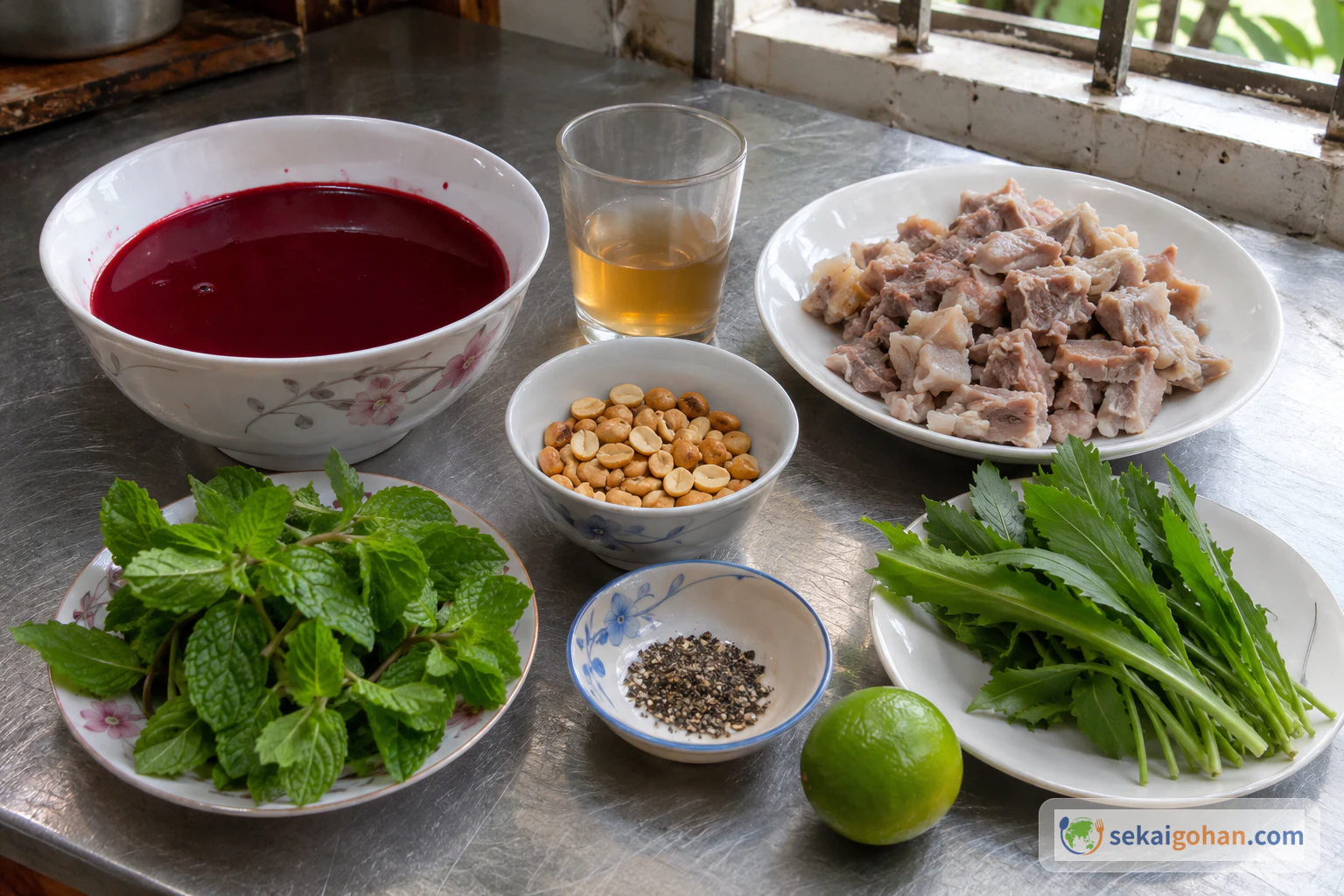
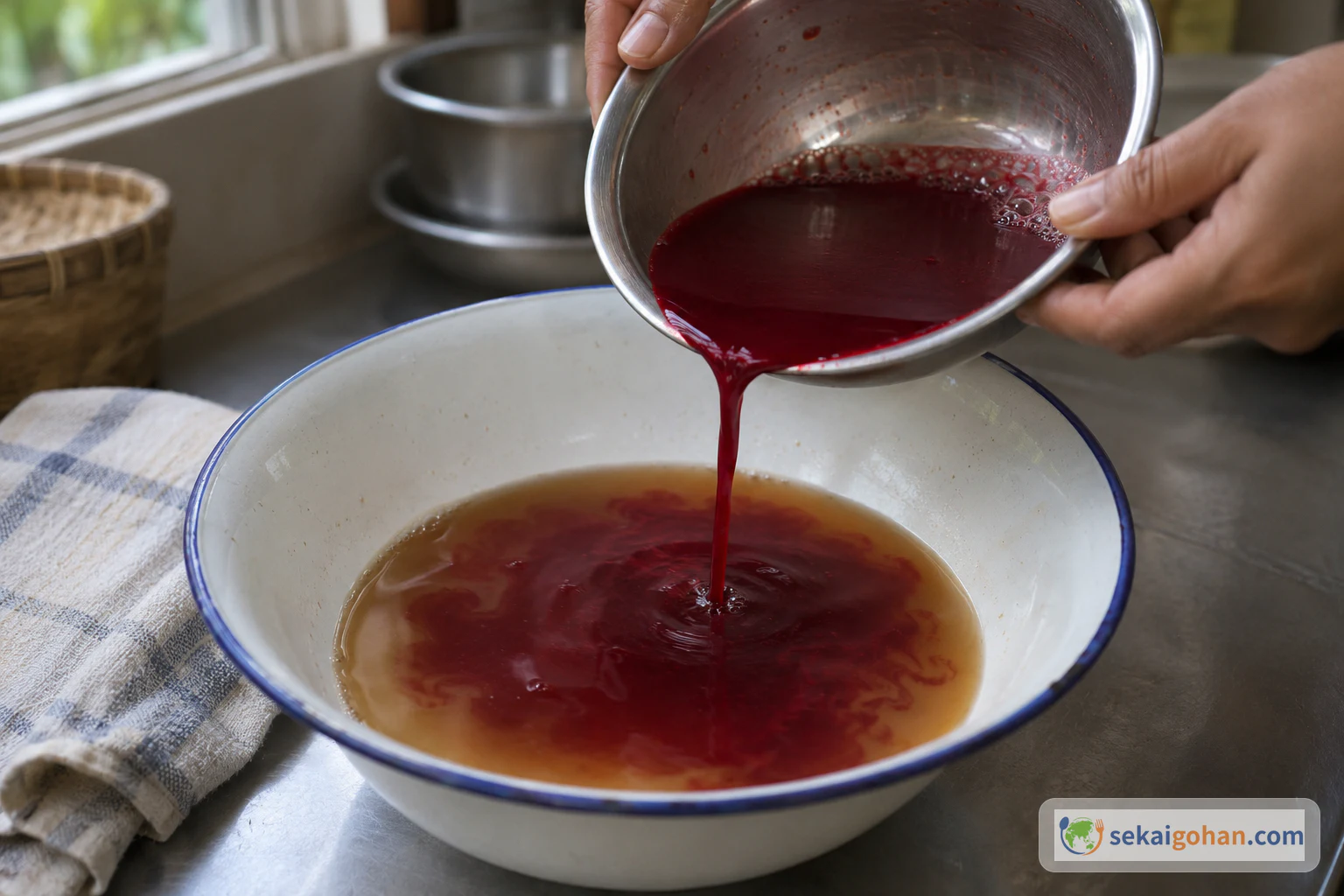
The blood goes into a large bowl that already holds a little salt water, either salt and water or fish sauce diluted with water. The amount matters: too much salt and the blood never sets, even after it meets the filling. For duck, the liquid is one part fish sauce to two parts water that has been boiled and cooled, scaled to the bird: 1 tbsp fish sauce and 2 tbsp water for a 2¼–3¼ lb (1–1.5 kg) duck, 2 tbsp and 4 tbsp for 3¼–4½ lb (1.5–2 kg), 3 tbsp and 6 tbsp for 4½–6½ lb (2–3 kg). Some cooks rub the inside of the bowl with half a lime instead.
The filling
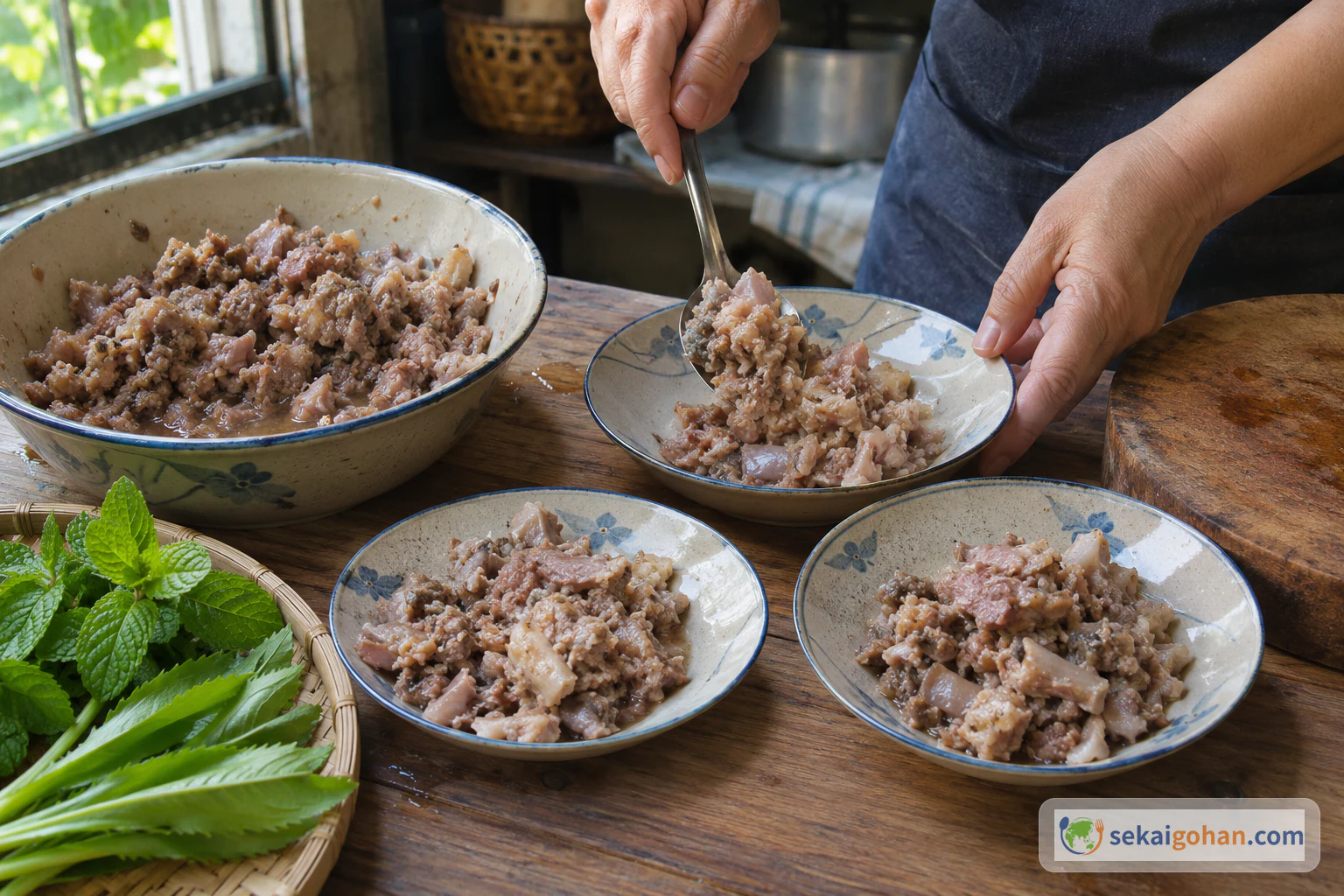
For pork, the filling (bổi) is spare-rib meat, rib cartilage, neck meat, lung, tongue, throat and intestine, boiled or grilled, chopped, and sometimes stir-fried to sharpen the crunch, with grilled onion and ginger in some kitchens. For duck, the neck and bones are pounded and finely chopped with the offal and gizzard, then mixed with herbs such as mint, culantro (mùi tàu) and rice paddy herb (ngổ). Either way, the filling is divided among the bowls before any blood is poured.
Pouring and setting
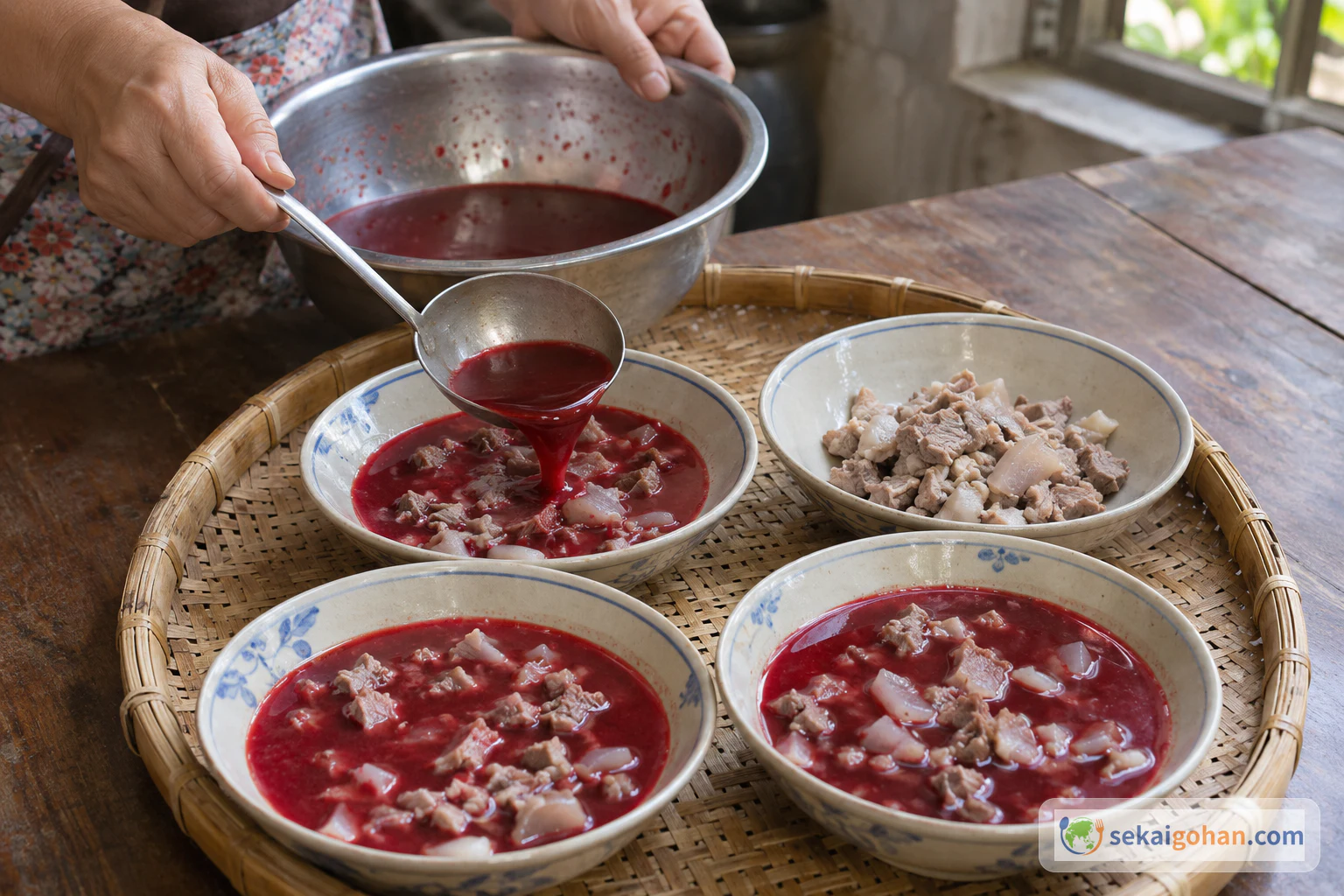
The blood is thinned at one spoon of blood to two spoons of water. A one-to-one ratio also circulates; one to two is the common one. The mixture is poured over the filling, and the bowls are not touched again: moving them breaks the bond as it forms, and the blood will not set. A 4½ lb (2 kg) duck makes four bowls.
Finishing at the table
Once set, each bowl gets black pepper and roasted peanuts, with lime, mint, basil and culantro beside it and rice liquor in small cups. Duck bowls also get slices of liver. The rule above stands at the end of all this: do not eat it.
Ingredients (serves 4)
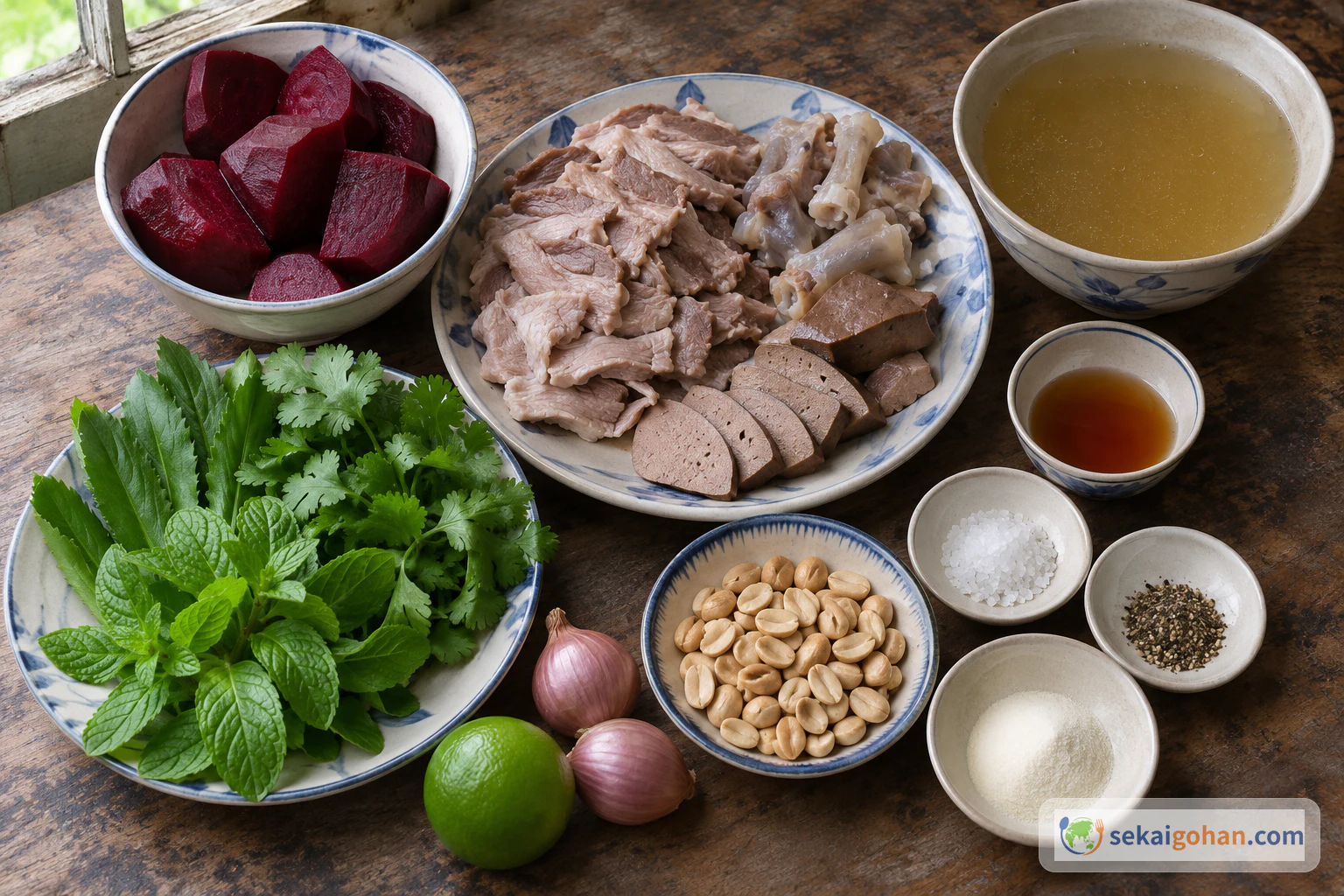
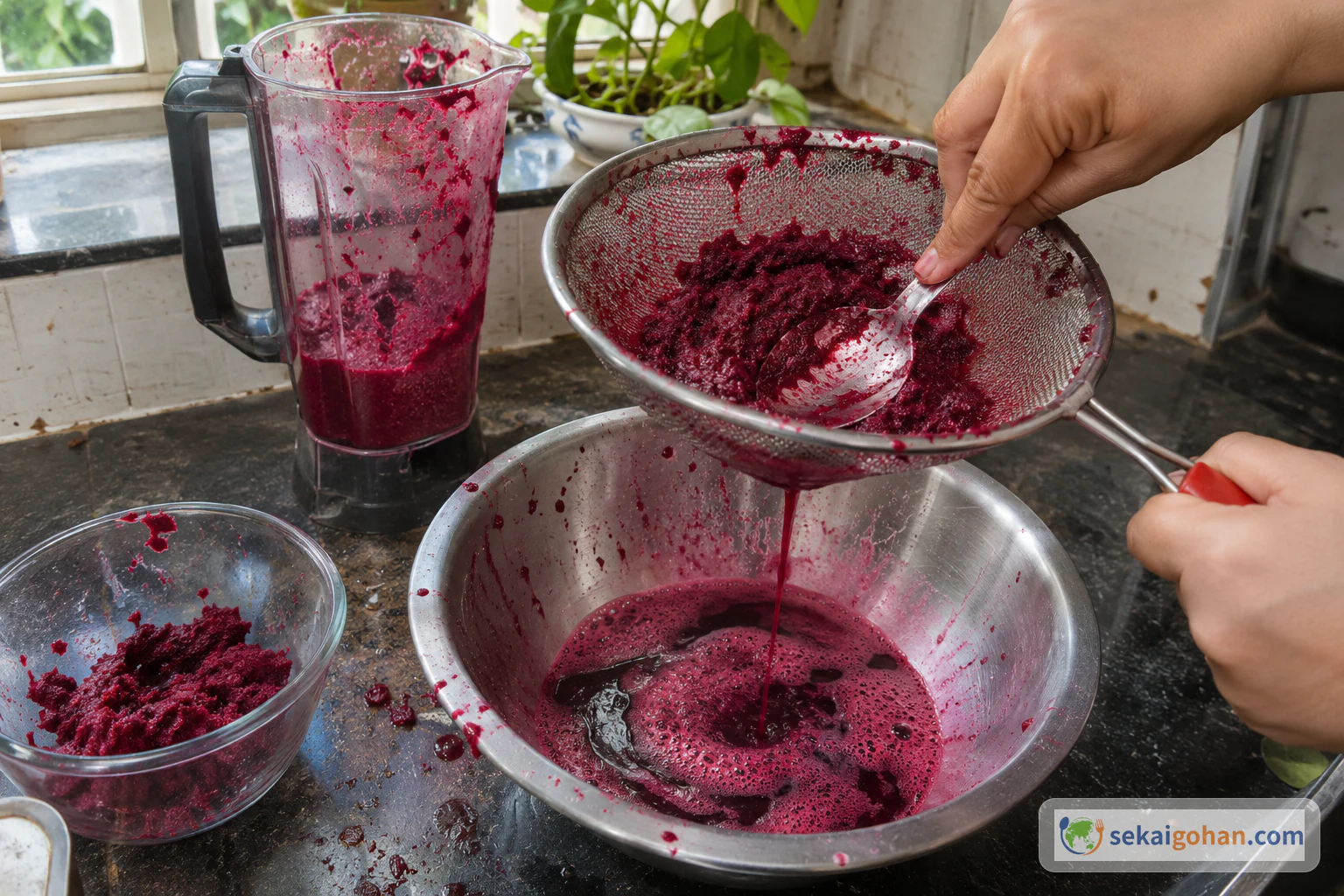
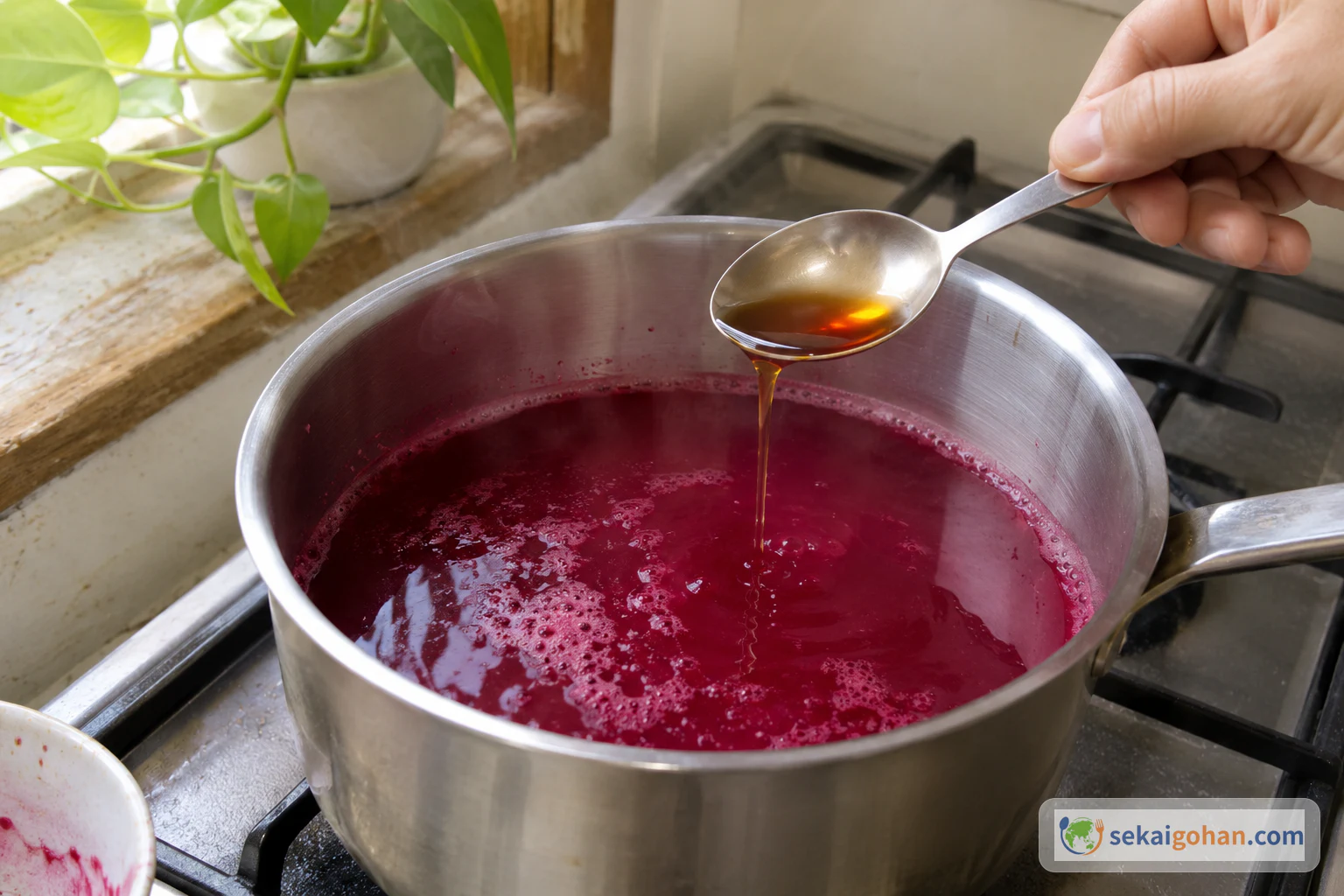
The beet version keeps the shape of the dish: a cooked filling under a cold red set, with the same garnishes. The red comes from beets and the set from a gelling powder, so the flavor of blood is gone; what you get is the color and the spoon-through texture.
Contains peanuts, and fish (fish sauce). The filling is offal: liver and cartilage. Check the labels on the peanuts and the gelling powder.
Equipment
- Pot for blanching
- Knife and cutting board
- Mortar and pestle
- Blender
- Fine-mesh sieve and a bowl beneath it
- Saucepan and ladle
- Four small bowls of the same size
- Measuring spoons and a liquid measuring cup
- Plastic wrap
Choosing and Substituting
The gelling powder decides the texture more than anything else. Bột rau câu is a Vietnamese blend whose mix of agar, carrageenan and sugar changes from brand to brand; it is not the same as plain agar powder, agar sticks, or a jelly powder. If you find bột rau câu at a Vietnamese grocer, use 1 oz (30 g). With plain agar powder, use the package's standard amount for 2½ cups (600 ml): at 1 oz, pure agar sets too hard to spoon.
Fish sauce carries the flavor that makes this Vietnamese. Thai fish sauce works in its place. Salt or soy sauce gives saltiness but loses the fermented depth, and the bowl tastes flat. Buy the freshest beets you can find; their earthiness varies, and a strongly earthy one tastes better boiled before blending.
The herbs belong on the side, picked up with each spoonful. The Vietnamese herbs húng chó and mùi tàu are easiest to find at Southeast Asian shops; mint, culantro and cilantro from a supermarket land close, though they are not the same leaves. Buy liver and cartilage fresh, and treat them as ingredients that are always cooked through. Peanuts, lime, herbs and fish sauce are what to keep; the cut of meat in the filling is the part you can change.
Method
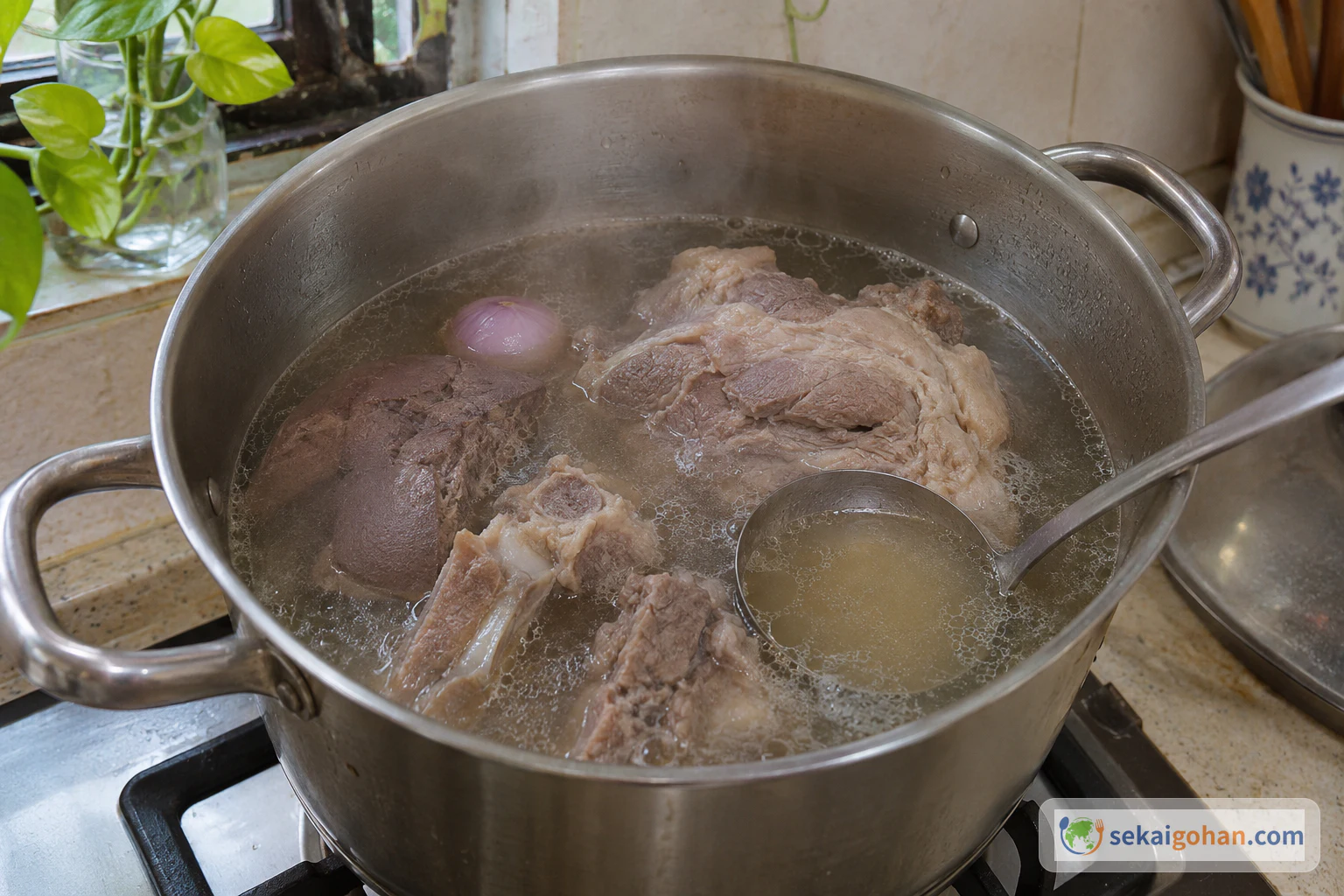
Everything starts with the blanching pot, since the broth you save there becomes part of the red liquid. Dice the filling and prepare the garnish while the broth cools a little, then blend the beets, make the red liquid and pour. The hands-off time is the chill, about 2 hours, so the bowls can be made earlier in the day.
When It Goes Wrong
| What you see | Why | What to do |
|---|---|---|
| The liquid will not set | Too little powder, powder not fully dissolved, or a strongly acidic beet | Pour the liquid back into the pot, add a very small amount of powder, boil for 2 minutes and pour it back over the filling |
| The set wobbles but holds | Not cold enough yet | Leave it in the refrigerator longer |
| Too hard to cut with a spoon | Too much powder, most often 1 oz (30 g) of pure agar | Next time, start from the package's standard amount |
| Soft and breaking apart | Wet filling, or the bowls were moved after pouring | Drain the filling well before it goes in, and leave the bowls still |
| Earthy taste | Some beets are earthier than others | Squeeze in more lime; next time boil the beets before blending |
| Dry, tough filling | The meat boiled too long | Shorten the boil and cook the cartilage separately for longer |
Serving, Variations and Storage
At the table
Serve one bowl per person, cold from the refrigerator, with the herb plate and lime in the middle. Each person squeezes lime over their bowl, tucks a herb leaf onto the spoon and digs through to the filling. In the north the bowls go out with rice liquor in small cups, on the morning of a family slaughter or at a gathering of friends; the beet version fits the same place at the start of a meal.
Variations
- Chilli: sliced fresh chilli on top brings the heat that northern eaters add with lime, and sharpens the cold set.
- Six small cups: pour the same amount into six cups of a scant ½ cup (100 ml) each. Smaller bowls set more readily and pass around easily as a starter.
- Yuzu for lime: the sourness turns gentler and more fragrant, and the bowl drifts toward a Japanese table.
- Mint, shiso and myoga: a different herb set; the aroma moves away from Vietnam but keeps the fresh, green contrast.
Storage
Cover the bowls with plastic wrap, keep them in the refrigerator, and eat them within 2 days. The jelly holds its shape at room temperature but weeps water as it sits, so sooner is better. Do not reheat it: heat melts the gel. Keep the cooked filling refrigerated and do not leave it out at room temperature.
Frequently Asked Questions
What if the pig or duck is my own and looks healthy?
That makes no difference. Healthy-looking pigs often carry Streptococcus suis, and the advice is not to eat raw blood pudding at all. Small portions and homemade bowls are not exceptions.
Can children or older people eat it?
No one should eat the raw-blood version; the advice not to eat it has no group exceptions. The beet version is made with cooked filling and a gel, so the questions for it are allergies: peanuts and fish sauce.
Can I make it without peanuts?
Yes. Toasted sesame seeds or cashews give a similar crunch on top. Check allergies for whatever you use, since sesame and cashews are allergens too.
Can I use other meats in the filling?
Yes. Chicken, duck, pork and beef all work, using throat meat, cartilage, gizzard, sliced meat or liver. Chicken gizzard, liver and cartilage make a lighter, cleaner-tasting filling.