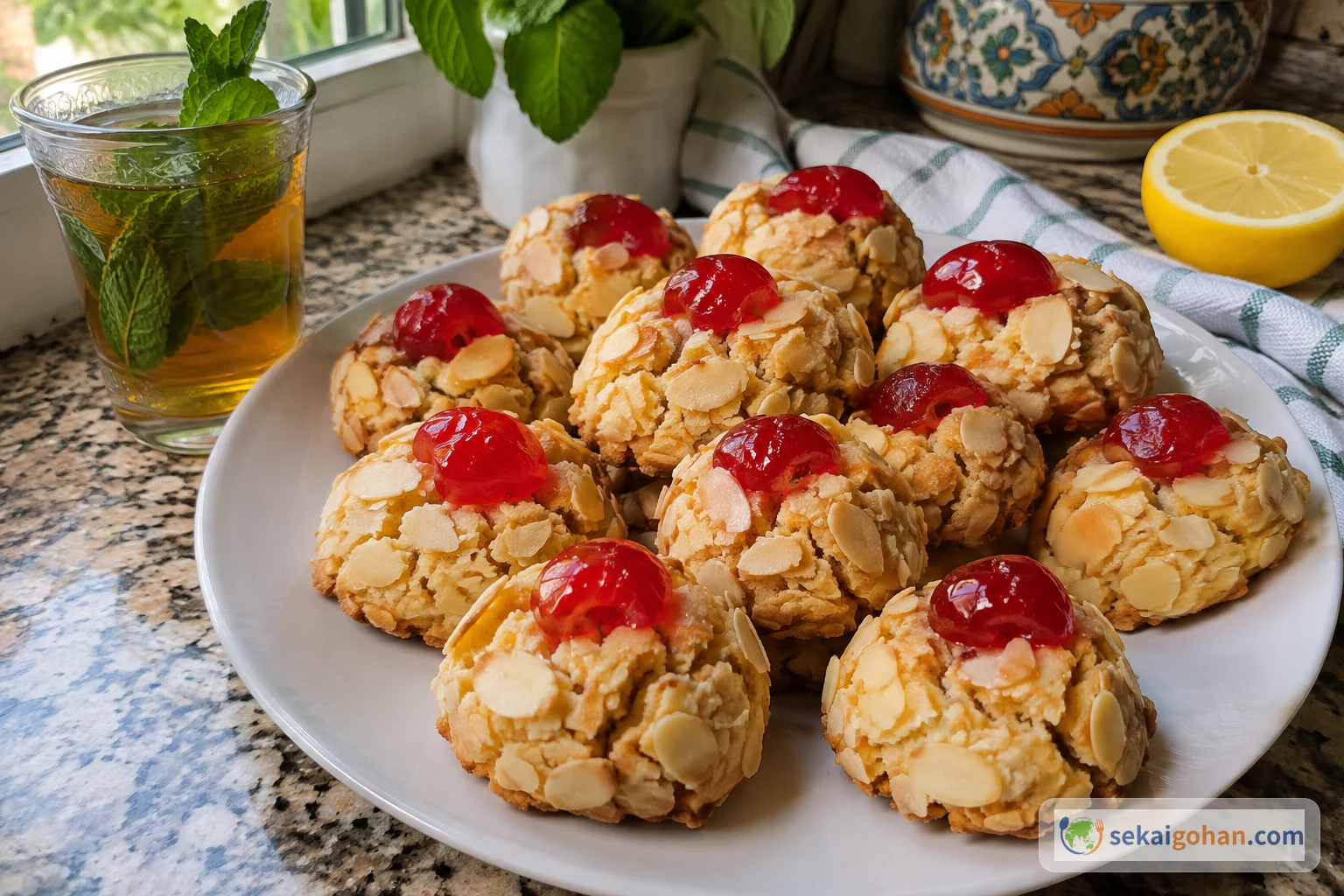
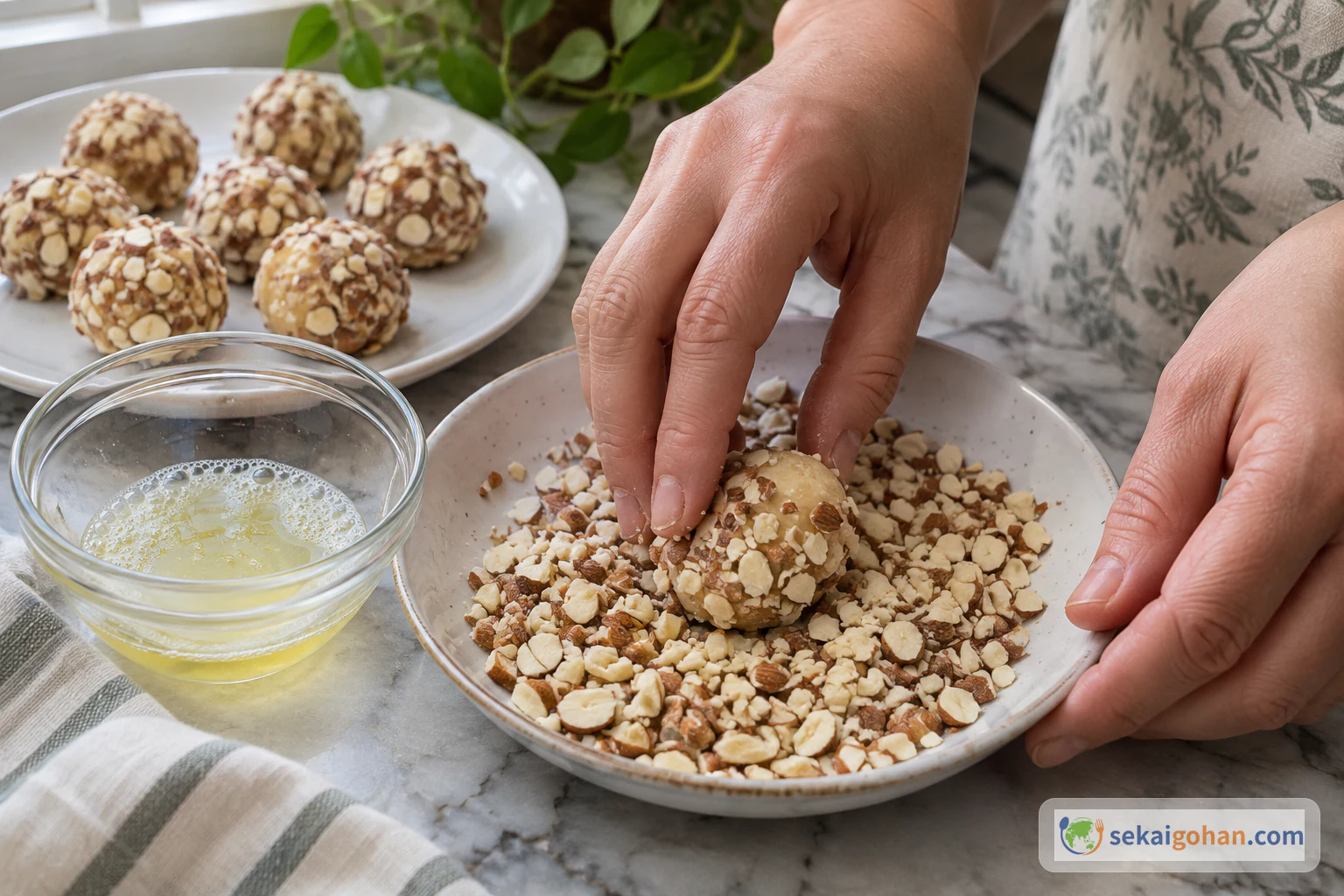
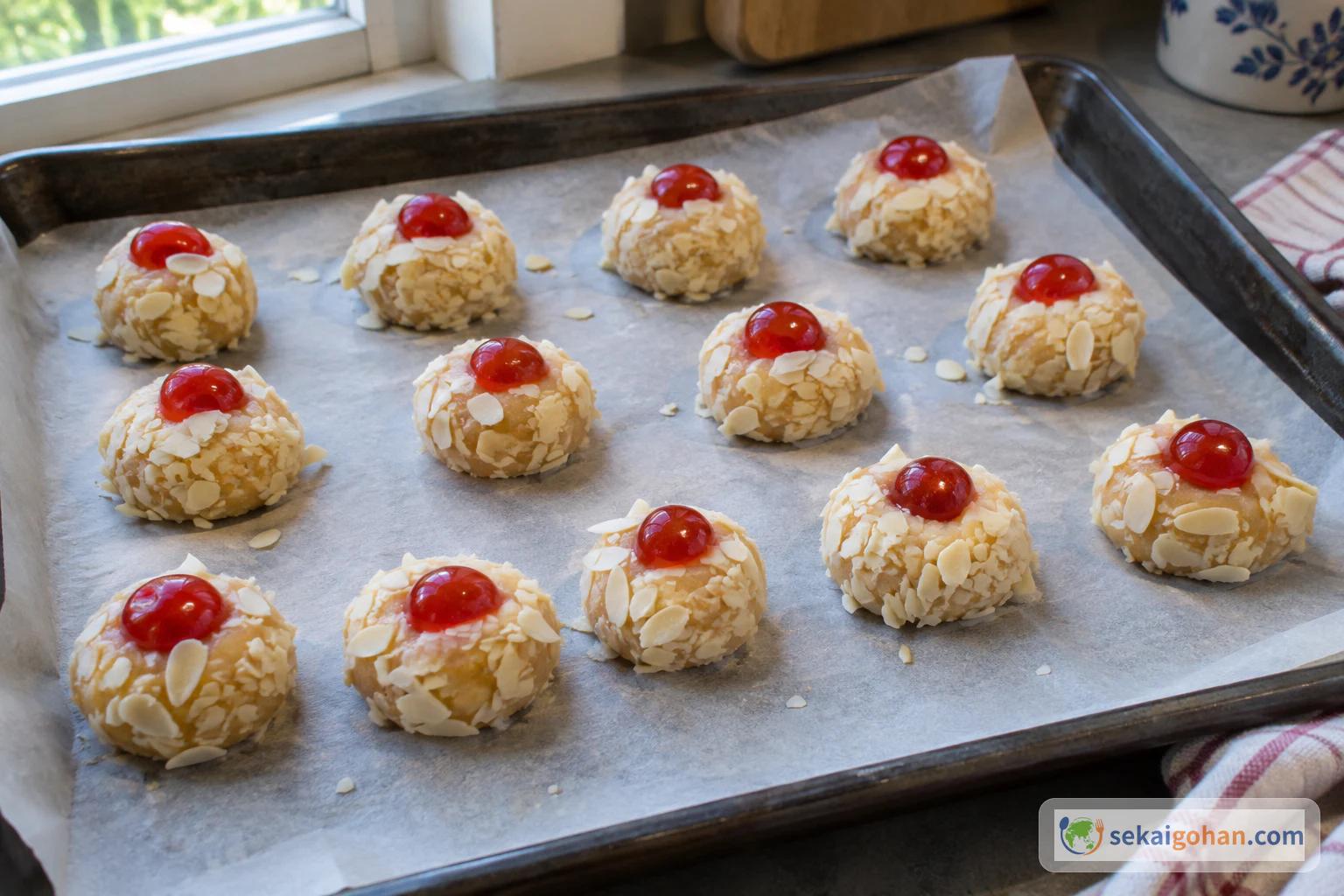
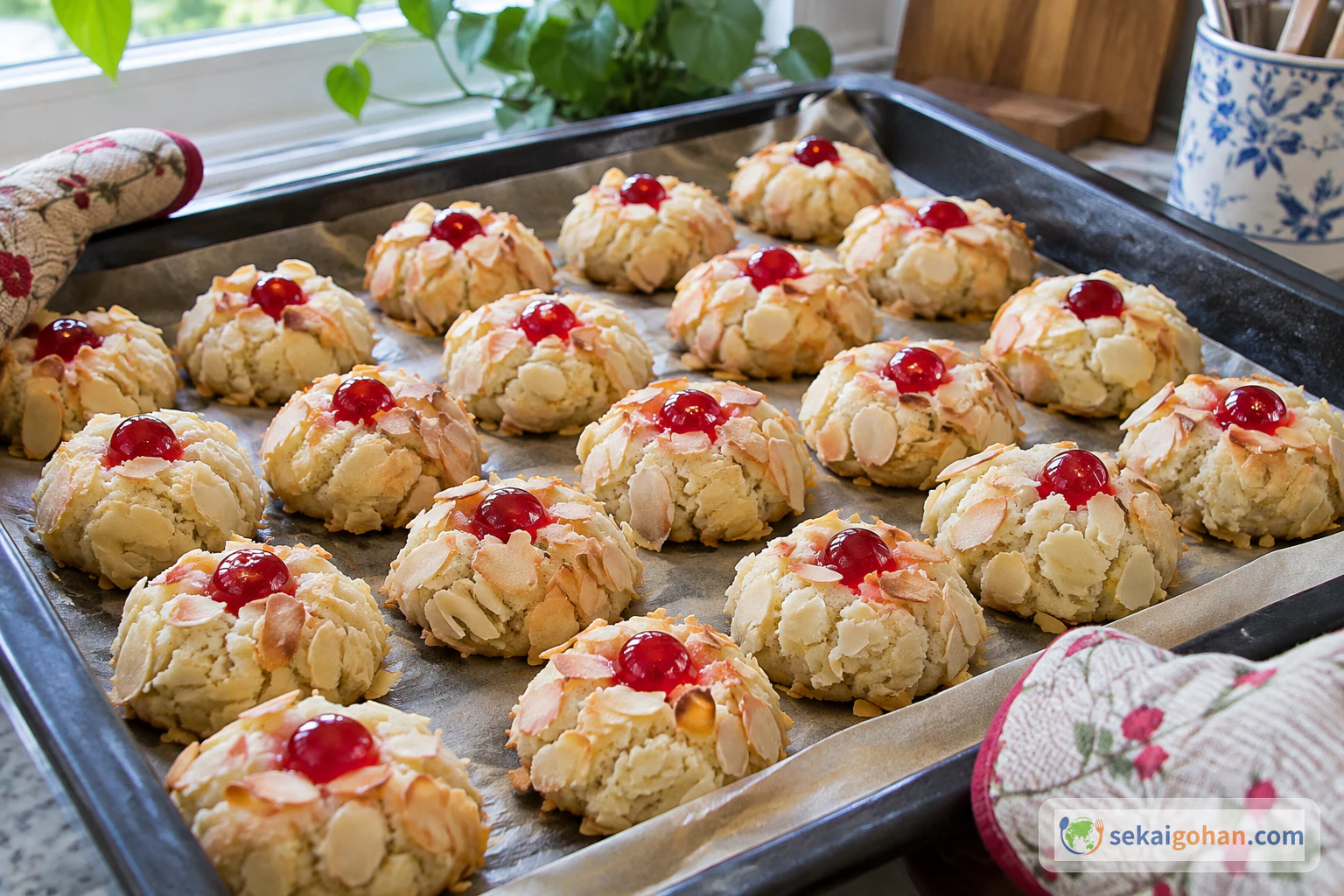
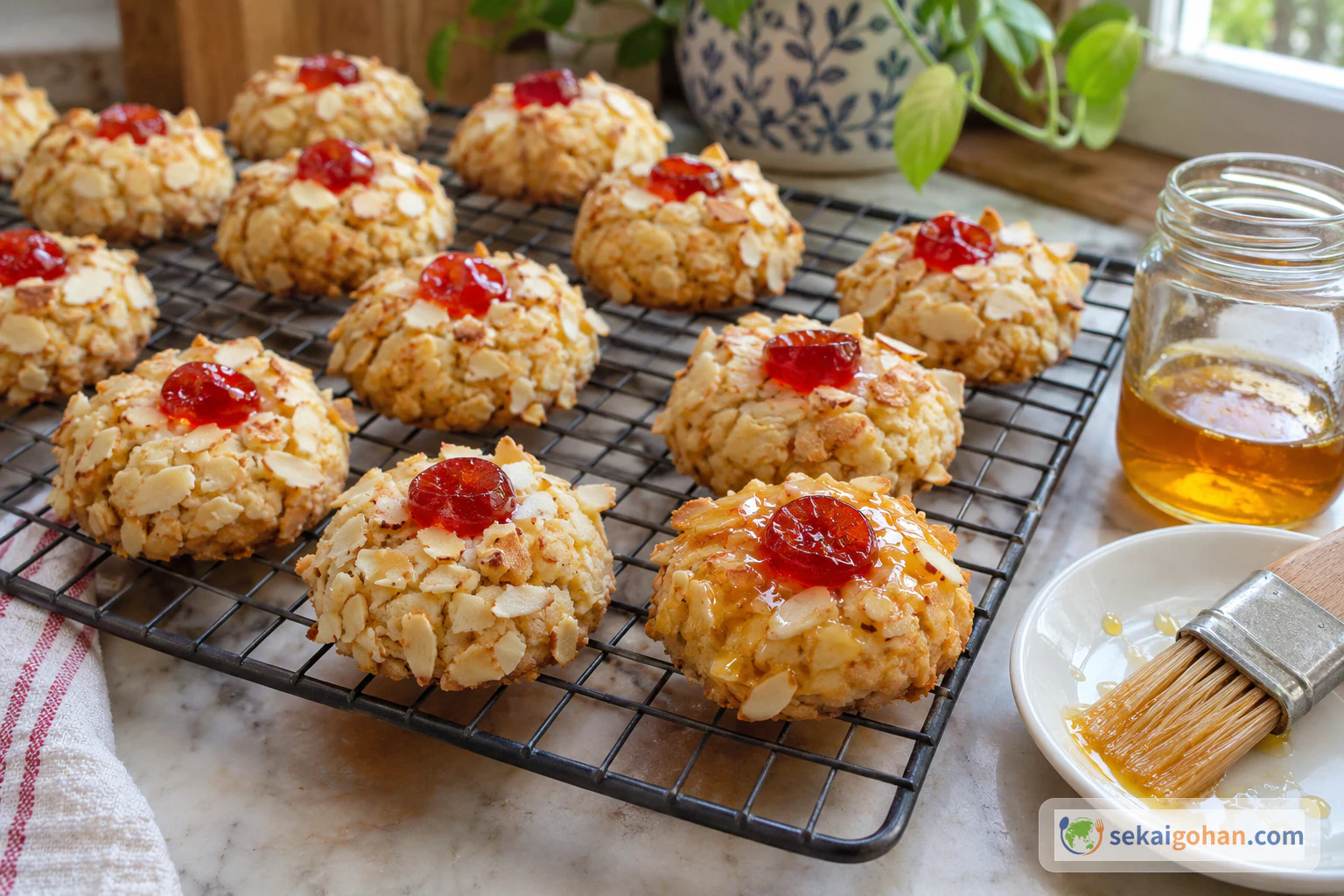
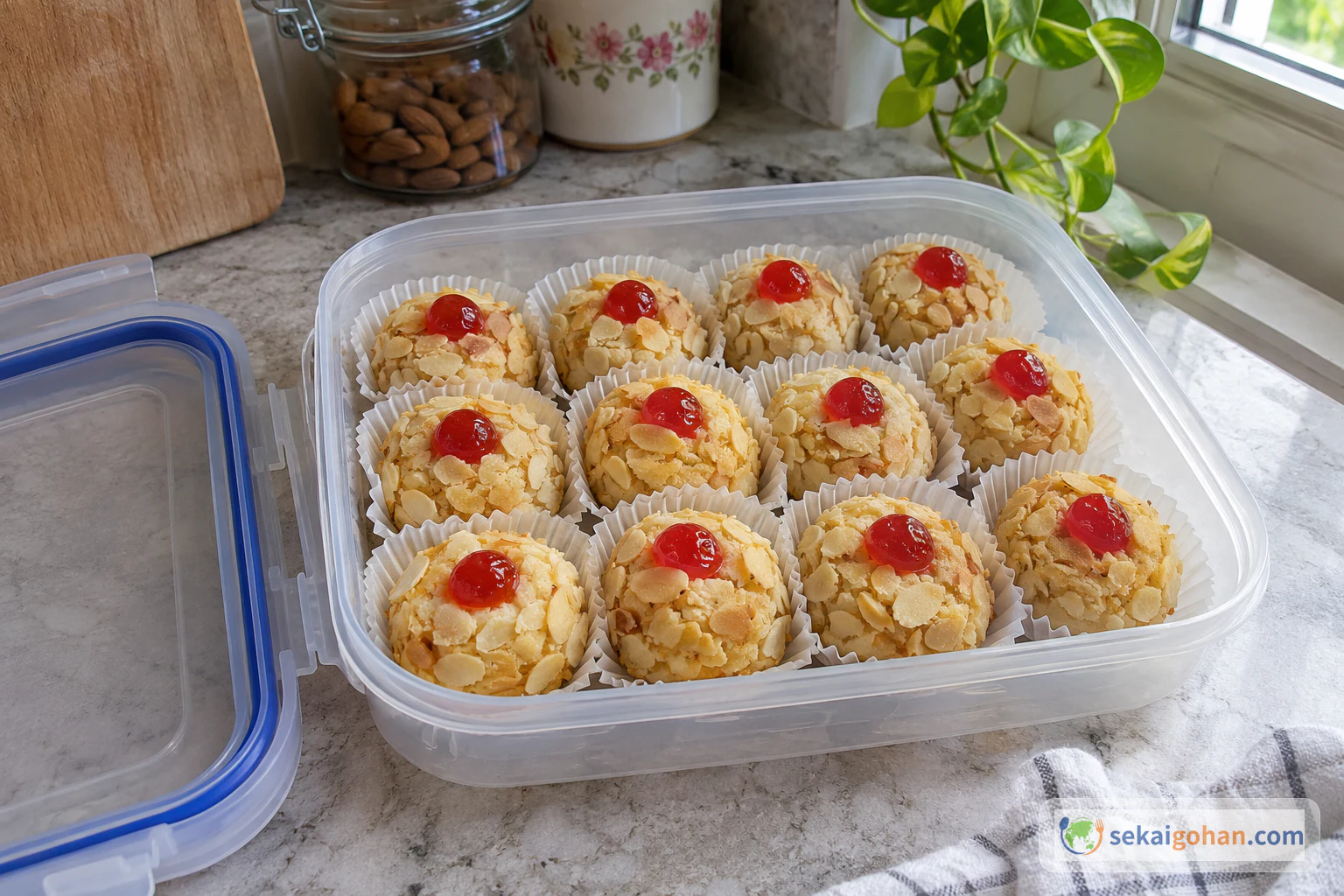
Each pale ball of dough goes into the egg white wet. It comes out of the almond dish bristling, with every bit of dough hidden under shards of raw almond. Once they bake, the tips of those almonds turn pale gold, the half cherry on top goes glossy, and the kitchen smells of lemon zest and orange blossom. These are mchewek, small Algerian almond cookies made without wheat flour. They are crisp on the outside and moist, a little chewy, inside: dense with almond, sweet, and bright with citrus.
Mchewek: A Bristly Almond Ball for Eid and Weddings
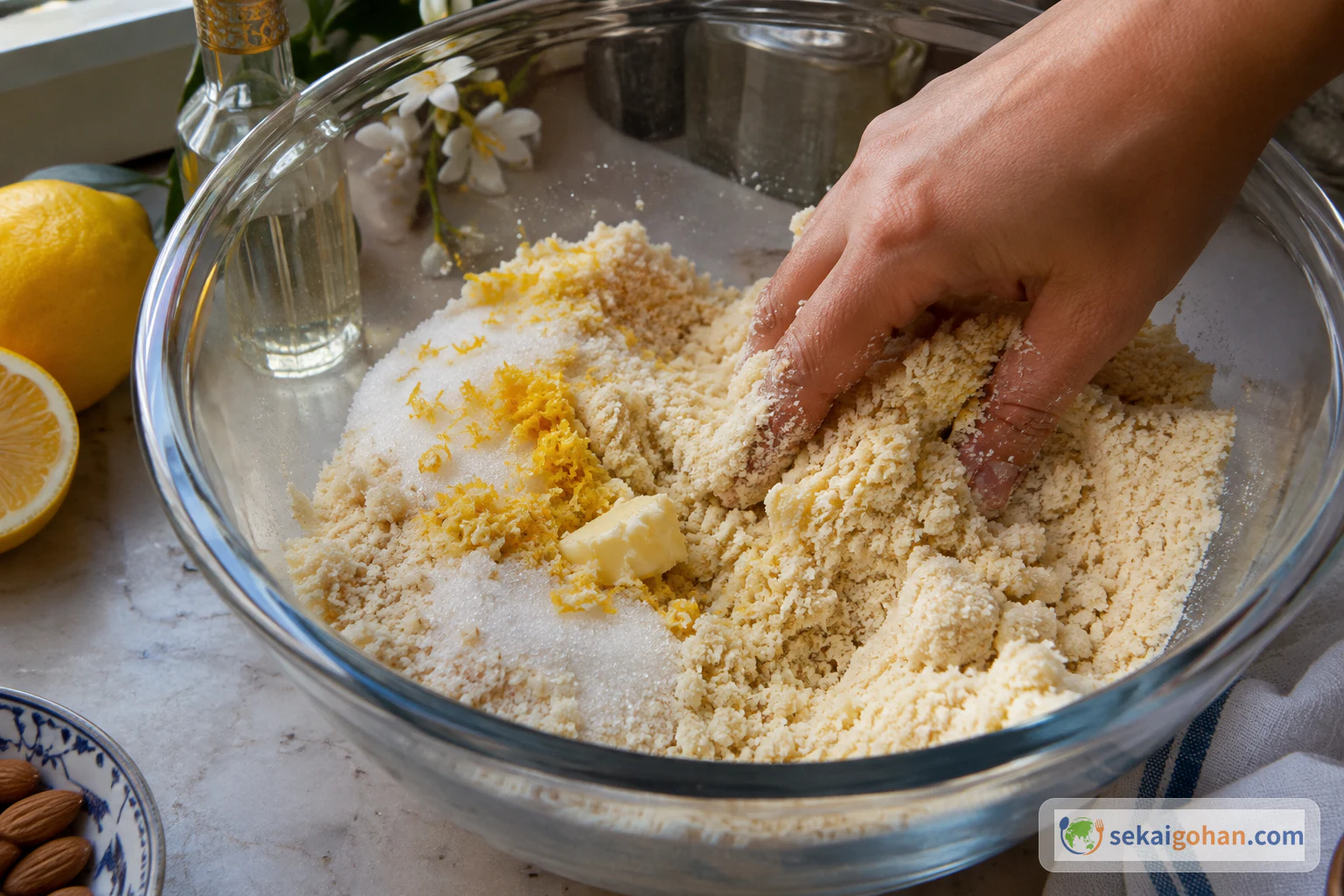
The dough is ground almonds, sugar and egg, perfumed with lemon and orange flower water and softened with a small knob of butter. There is no wheat flour in it at all. What holds a mchewek together is almond paste, so the texture is closer to marzipan than to shortbread. A finished cookie is small, about the size of a walnut, and heavy for its size.
The look is what people remember. The coat of chopped or flaked almonds stands up from the surface, and the name is usually explained by that look: a bristly cover that brings to mind a fan or the quills of a hedgehog. You will also see the cookie written as lemchewek.
Mchewek and lemchewek are the same cookie. Search for both when you shop for ideas or look for photos of how home cooks finish theirs.
Mchewek are celebration baking. They are made for Eid al-Fitr, for weddings and for other festive days, when trays of small cookies go out to guests. They also sit happily beside a cup of coffee on an ordinary afternoon. On a festive table they share space with other small almond sweets, and it helps to tell them apart. Mchewek are round and coated in almonds. Tcharek is a crescent. Tunisian makroud belongs to another family entirely, a semolina dough wrapped around dates. For more dishes from the same kitchen, start at Algeria.
Ingredients (makes 24)
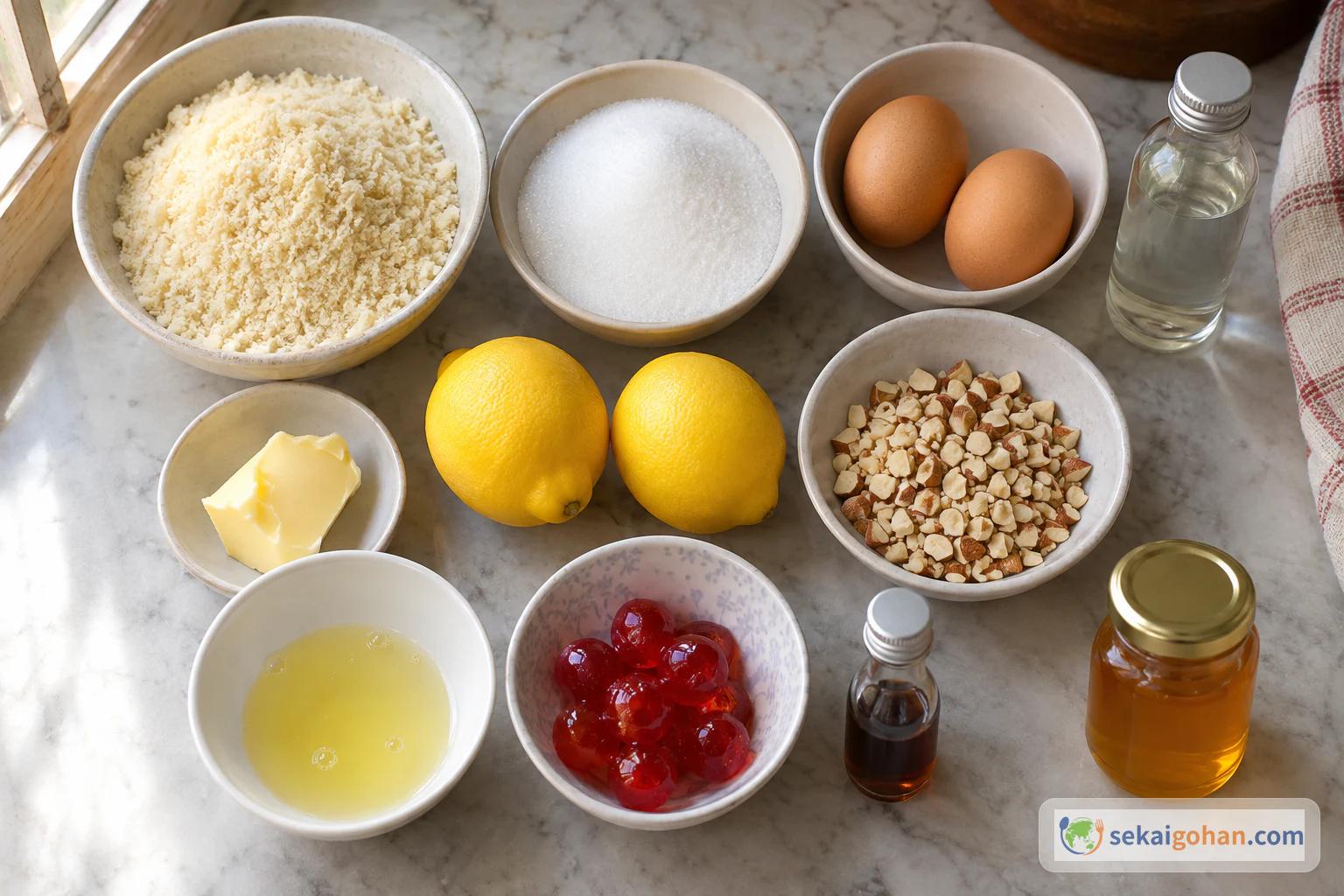
Mchewek contain almonds (tree nuts), egg and milk (from the butter). If you finish them with honey, do not give them to babies under 1 year old.
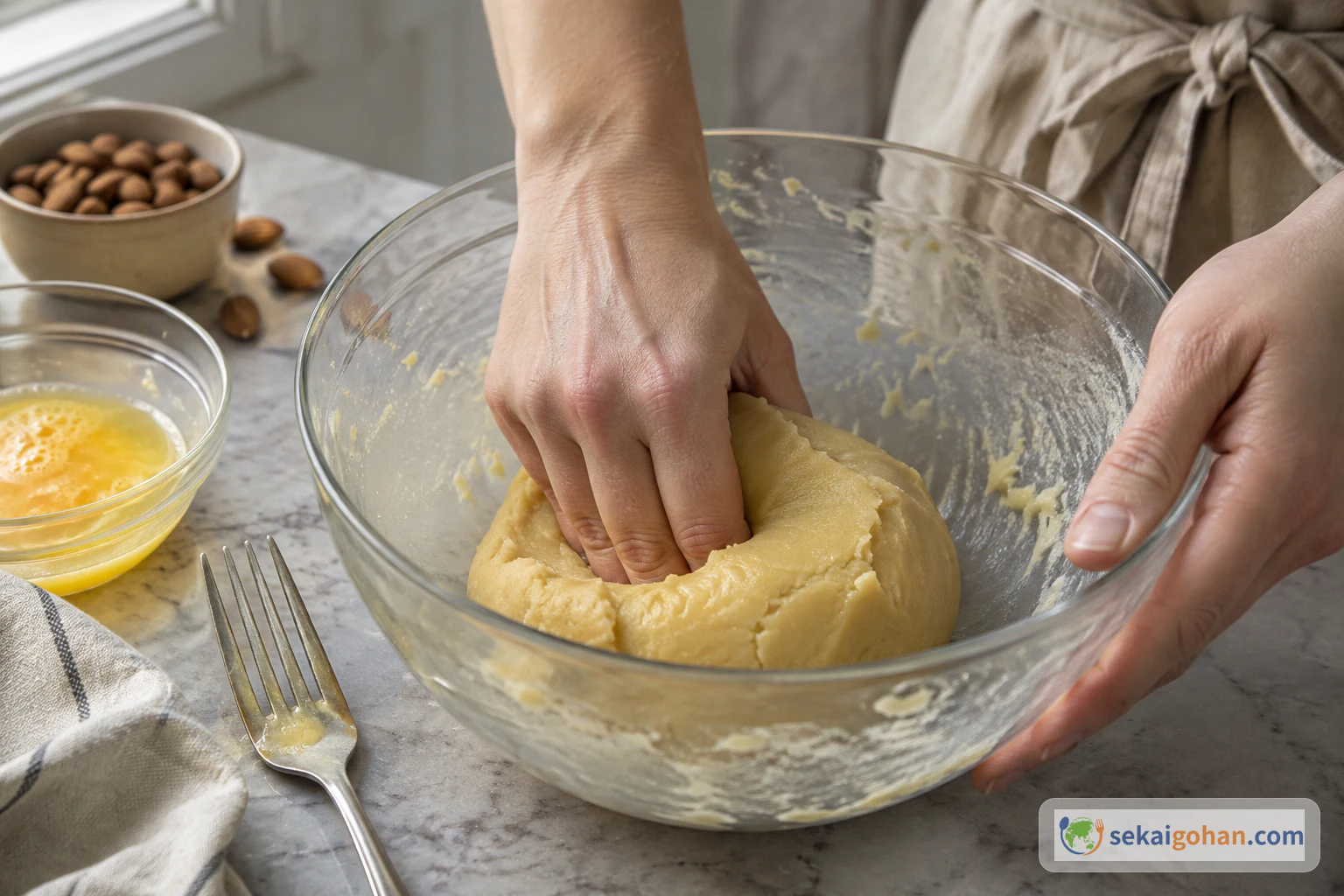
Eggs vary in size, so the number of eggs is a guide, not a fixed amount. Beat them together and pour them in gradually. Stop when the dough is soft and even and holds together without sticking to your hands. Too much egg makes a sticky dough.
Equipment
- Large mixing bowl
- Fork and a small bowl for beating the eggs
- Small bowl for the egg white
- Shallow dish for the almond coating
- Fine grater or zester
- Kitchen scale
- Baking sheet lined with parchment paper
- Wire rack
- Pastry brush (if glazing)
- Small paper cases
- Airtight container
Choosing and Substituting
Blanched almond powder is the one ingredient to get right. Look for the skinless kind sold for baking. Powder made with the skins on bakes into a darker, browner cookie with a heavier almond taste. For the coating, buy unsalted raw almonds and chop them, or use raw flaked almonds. Skip roasted or dry-roasted nuts. Roasted almonds brown too early in the oven, and cookies coated in roasted white almonds have been known to spread.
Orange flower water is sold in Middle Eastern and North African grocers, in import shops and online. You can leave it out. The cookies then taste of lemon and almond alone, and you lose the floral note that marks them as North African. Candied cherries are the baking kind, red and glossy. They are optional, and a cookie without one is still finished. Choose unwaxed lemons, because the whole zest goes into the dough.
| Keep for the taste | Can be left out |
|---|---|
| Blanched almond powder, raw almonds for the coat, lemon zest | Orange flower water (changes the aroma), vanilla, candied cherries, honey glaze |
Method
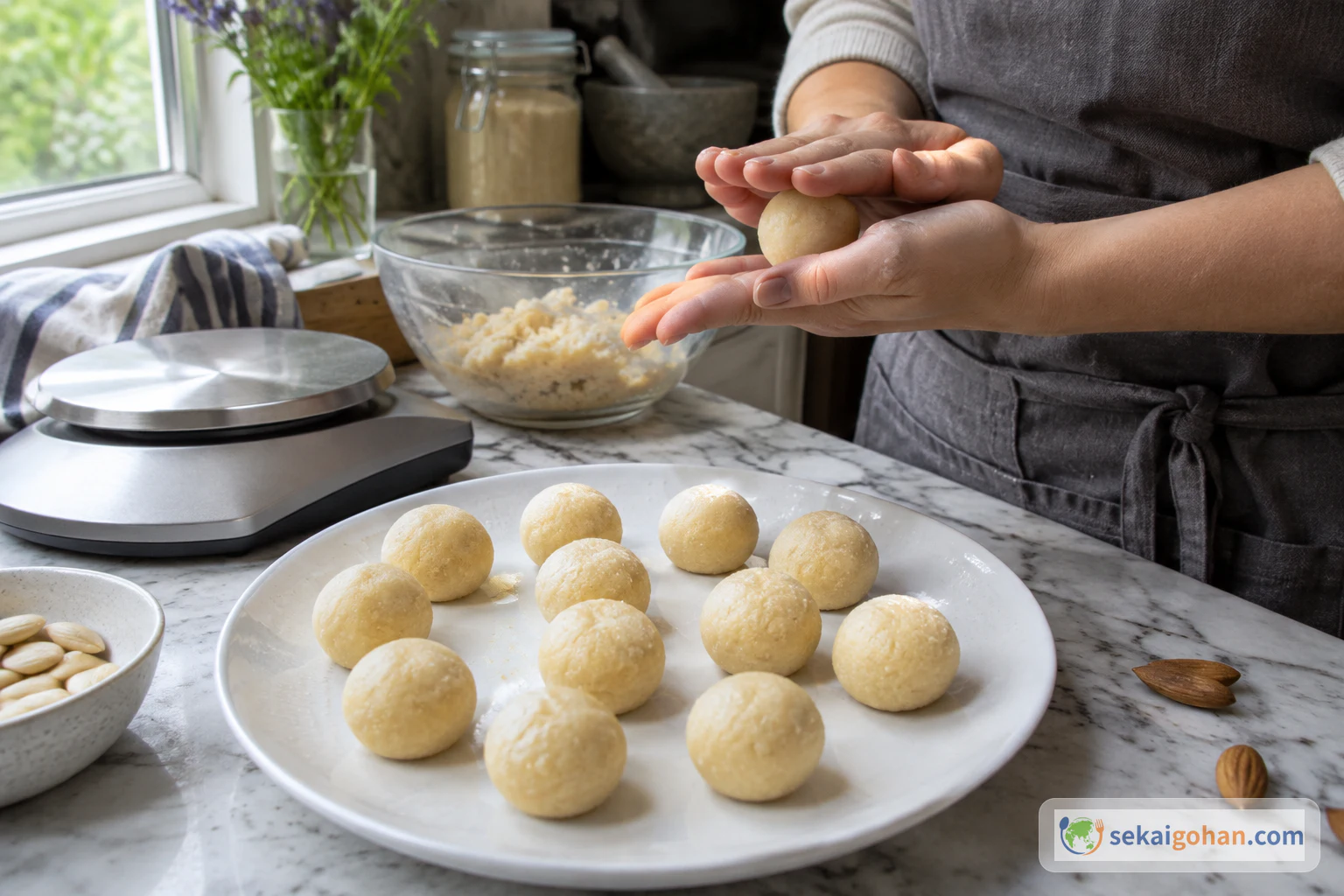
The work is quick and moves in one line. Mix the dough, roll and weigh the balls, then coat them. Preheat the oven while you set up the egg white and almonds, so the tray goes in as soon as the last cherry is on. The bake is the only hands-off stretch, and the cookies need watching near the end.
The coat bakes for the whole time, so it has to start raw. Raw almonds turn pale gold during the bake. Roasted almonds are already colored when they go in, and cookies coated in them have been known to spread.
When It Goes Wrong
| What you see | Why | What to do |
|---|---|---|
| The dough sticks to your hands and slumps on the plate | Too much egg | Stop adding egg. Next time add it in smaller pours and stop at a soft dough that holds together |
| The dough stays crumbly and will not form a ball | Not enough egg | Work in more beaten egg a little at a time until the dough presses together |
| The cookies spread flat in the oven | Roasted almonds in the coat | Coat with raw almonds |
| The almonds brown before the inside is set | Roasted almonds, or an oven running hot | Use raw almonds and take the tray out at pale gold |
| Almonds fall off the baked cookie | The ball was not wet all over with egg white | Dip each ball fully so the whole surface is wet before rolling |
| The cookies come out darker than expected | Almond powder with the skins on | Use blanched almond powder for a pale, even color |
Serving, Variations and Storage
At the table
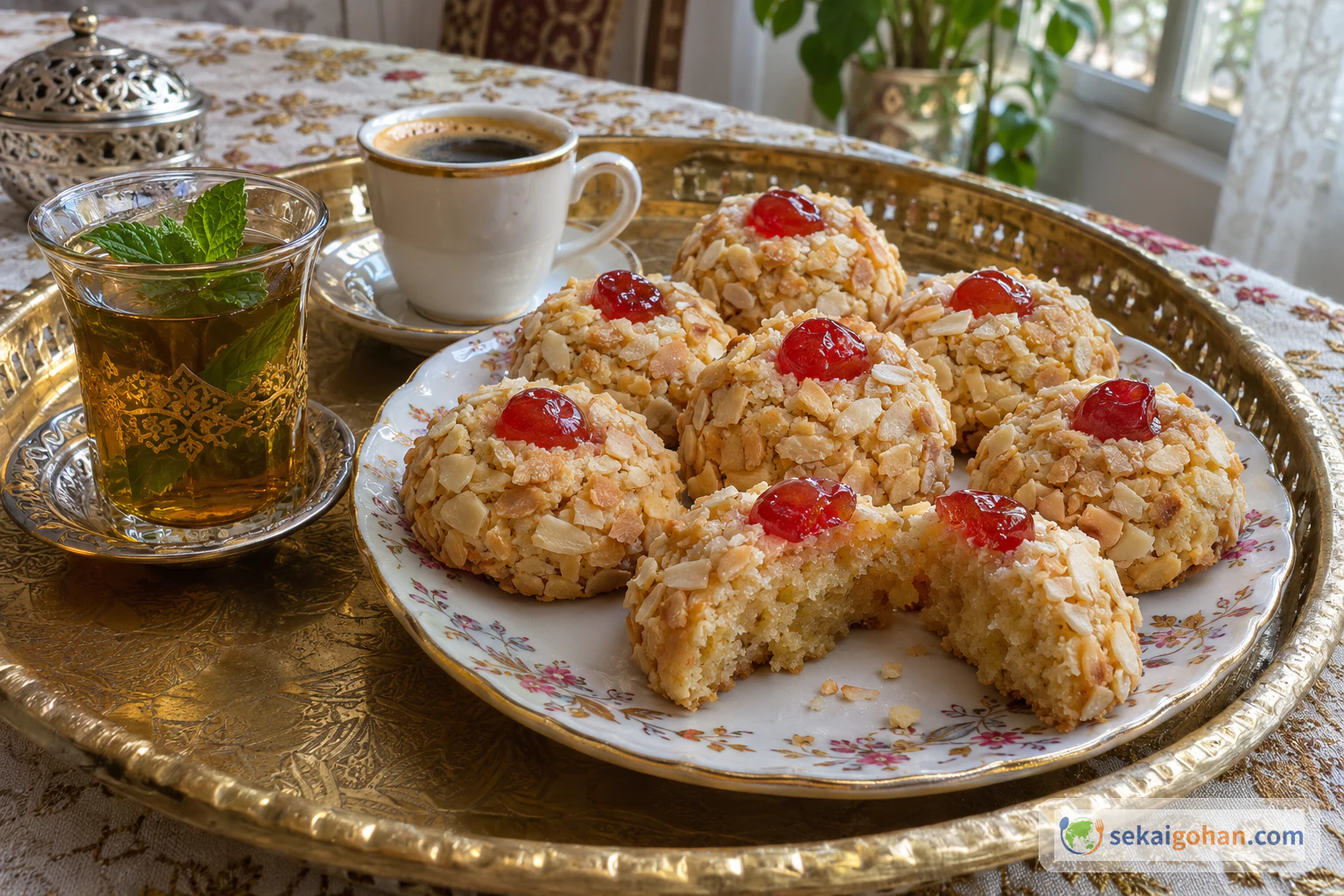
Set the cookies out in their paper cases on a tray, where each guest can lift one without touching the next. They go with a cup of coffee, and they fit in on a holiday tray among other small sweets. Break one open and you see the inside: dense and moist under the crisp almond shell.
Variations
- Honey dough. Some households sweeten the dough with honey and a little powdered sugar and lift it with baking powder. The result is softer and more honeyed. It is a different formula and bakes for a shorter time at a lower heat, so make it as its own recipe rather than swapping honey into this one.
- Coconut coat. Rolling the balls in coconut instead of almonds gives a whiter, softer shell with a tropical sweetness. The almond center stays the same.
- Whole almond on top. Press a whole almond into the top in place of the cherry. The cookie then looks plainer, all almond, with no red center.
Storage
Once the cookies are completely cool, keep them in their paper cases in an airtight container at room temperature for about 15 days. To keep them longer, freeze for up to 3 months. As a precaution, in hot, humid weather keep the container in the refrigerator or freezer instead of on the counter.
Frequently asked questions
Are mchewek gluten-free?
There is no wheat flour in the dough, but do not call them gluten-free on that basis. Almond powder, candied cherries and vanilla sugar are packaged ingredients. Check each label for gluten and for cross-contact if you are baking for someone who must avoid it.
Can I use flaked almonds instead of chopped?
Yes. Raw chopped and raw flaked almonds both work for the coat. Flaked almonds give a flatter, more layered look, like overlapping scales. Chopped almonds stand up in points and give the bristly look the cookie is known for.
I have seen mchewek baked hotter and faster. Which is right?
Versions differ in formula and in the size of the ball, so the baking heat and time differ with them. For this dough and a ball of just under 1 oz (25 g), bake at 330°F (165°C). Take the cookies out when the almonds are pale gold.
Can I cut the recipe in half?
Yes. Halve the almond powder, sugar, butter, zest, orange flower water and coating almonds. Add beaten egg a little at a time until the dough comes together, as you would for the full batch. Keep the balls at the same weight, so the baking time stays the same.