
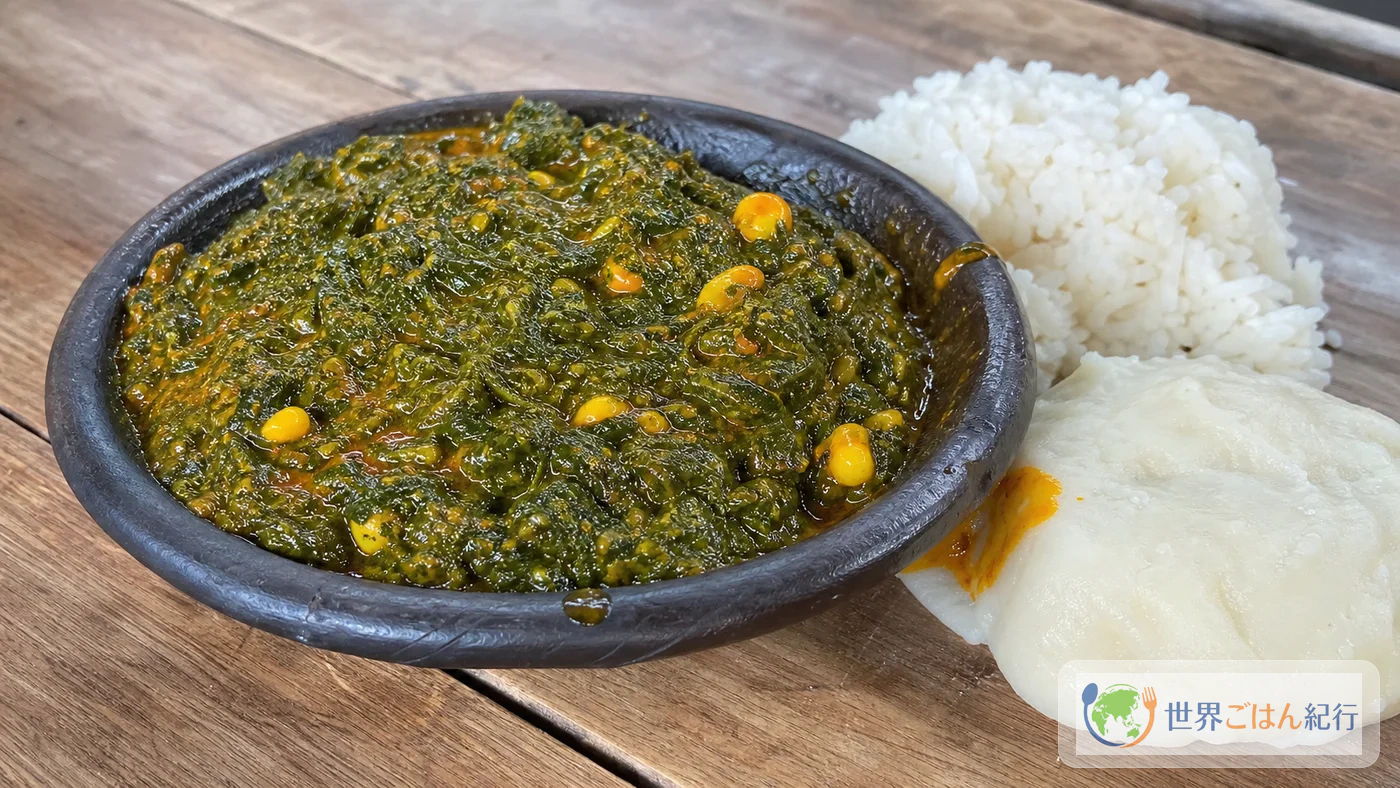
In the pot, the green of the leaves mixes with the yellow of the corn
When you cook Cameroonian food outside Cameroon, the first thing that gives you pause is "the leaves." Bitterleaf for ndolé, cassava leaves for moambé. Just hearing the names is enough to stop your shopping. Sanga (Sanga / Saŋa) is the same: locally, cassava leaves or a leafy green called Nzom, corn and palm nut are simmered into a thick green pot.
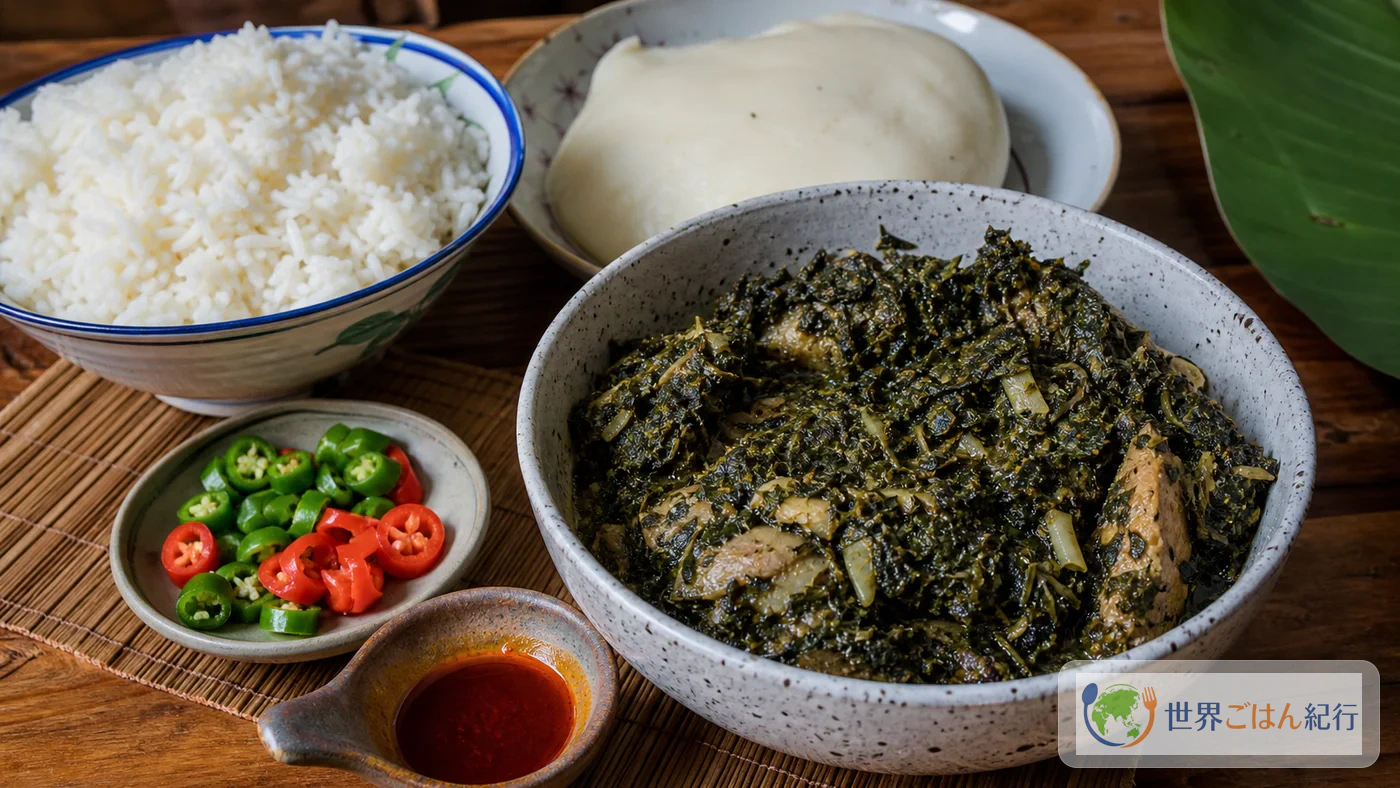
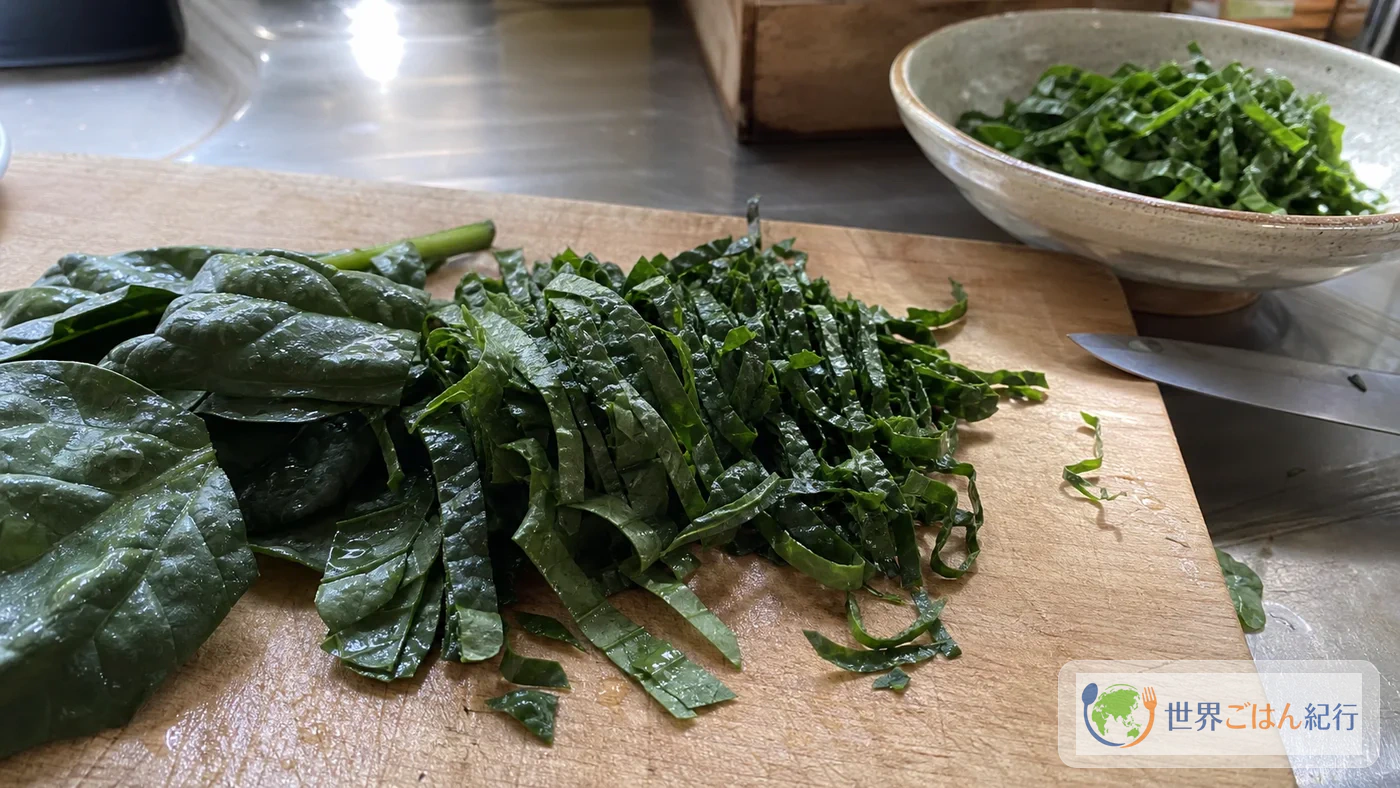
But looking for fresh cassava leaves and preparing them is not realistic in most home kitchens, and it is an ingredient you are better off not forcing for safety reasons. This article builds the outline of sanga from kale and komatsuna, with the sweetness of corn and the aroma of red palm oil. It is not a perfect reproduction of the local dish; the aim is "within what you can make where you live, what to keep to make it taste like sanga."
If you are widening your Cameroonian cooking, setting it beside the same country's ndolé (in Japanese) shows the difference clearly. Ndolé is a feast of peanuts and strong bitterness, while sanga is an everyday-leaning pot that wraps the sweetness of leaves and corn in palm. If you go on to a dish that steams beans in leaves, pair it with koki and you can compare how the aroma of red palm oil changes between a stew and a steamed dish. Once you are used to palm flavors, it also leads to Congo's poulet moambé.
What sanga is: a leafy-green stew of central and southern Cameroon
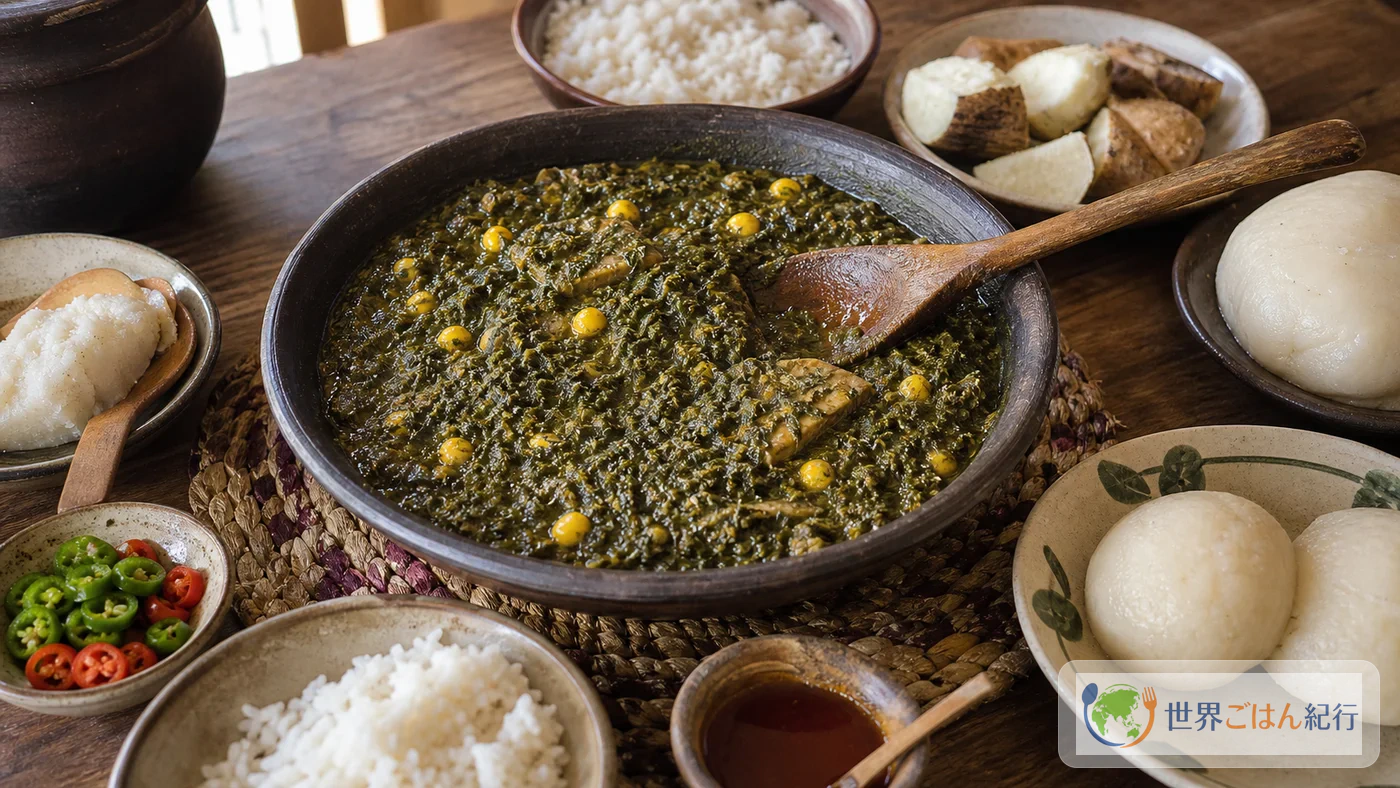
Sanga is often introduced as a dish loved in central and southern Cameroon. WIPO's Cameroon food-culture project also names sanga as one of the country's culinary traditions. A French-language Cameroonian ingredients site describes a method using Nzom or eggplant leaves, fresh corn kernels and palm nut purée, with a little sugar added.
Some English-language recipes describe sanga as a combination of "cassava leaves, palm oil, maize." The Vegan Society's recipe uses kale in place of cassava leaves and simmers it with palm nut cream and corn. In other words, the kind of leaf and the way sweetness is introduced vary by region and household, but the shared pillars are these three.
| Pillar of sanga | The form you see locally | What to keep elsewhere |
|---|---|---|
| Leafy greens | Cassava leaves, Nzom, eggplant leaves and others | Chop greens fine and simmer until soft so they blend into the whole pot |
| Corn | Fresh corn kernels | Frozen or canned is fine, but add near the end to keep the sweetness and the kernels |
| Palm | Palm nut purée, red palm oil | Don't overdo it; add a little earthy aroma and the outline of red oil |
Cassava leaves contain cyanogenic glycosides and need proper processing. Food Standards Australia New Zealand describes ways to reduce the risk, such as pounding the leaves thoroughly and washing them or soaking them in warm water, but it is hard to judge making them safe from fresh leaves at home. This article does not use the method of picking and using raw cassava leaves. If you have no reliable processed frozen product, make it with kale, komatsuna or spinach.
Ingredients (serves 4)
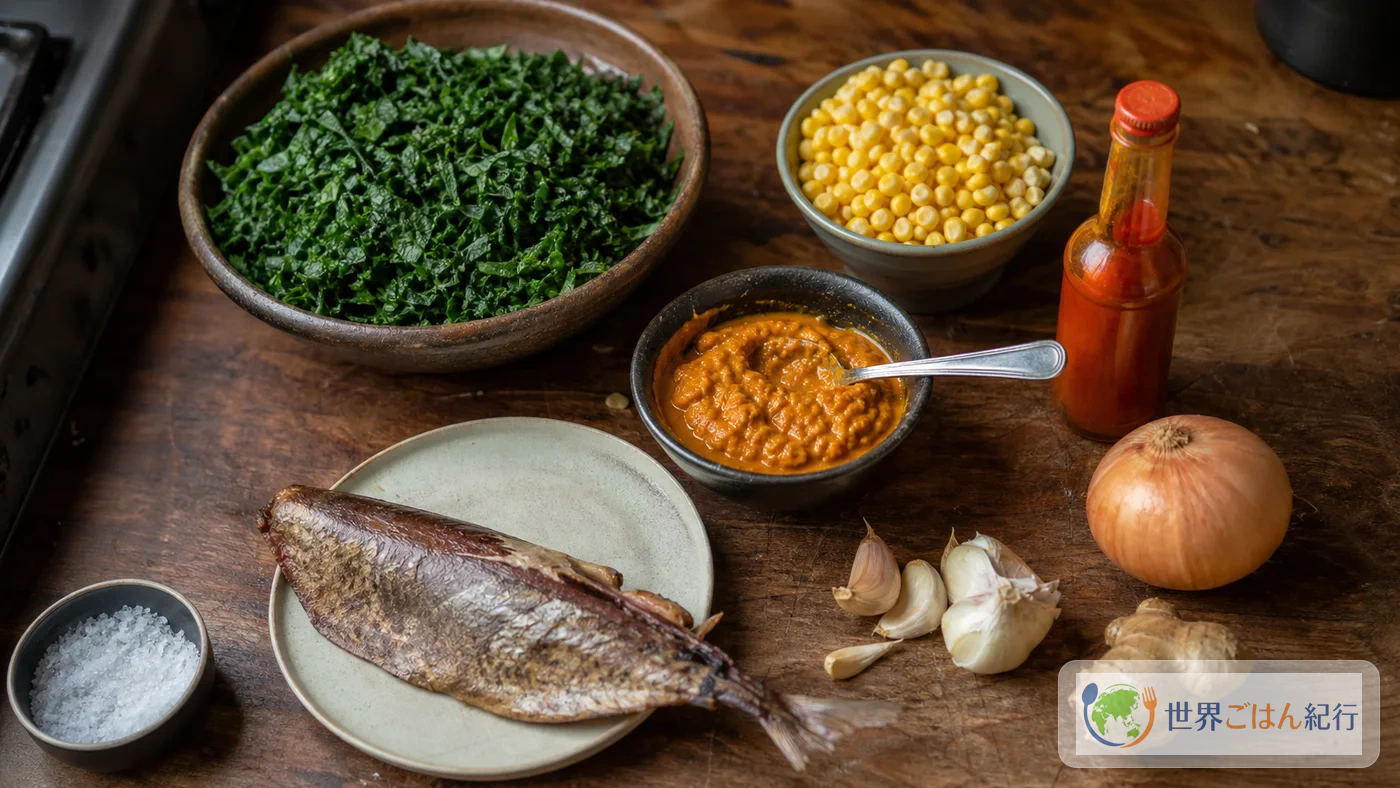
This amount is for four people eating with rice or fufu. If you can get palm nut cream, the dish gets closer to the local one, but for the first time, red palm oil and a little coconut milk are used to move only the direction of aroma and body.
If you leave out the smoked fish and dried shrimp, use 5 g dried shiitake powder, 1.2 tsp salt and 1/3 tsp white pepper. The umami is a little lighter, but the sweetness of corn and greens comes forward.
How to replace leafy greens and palm elsewhere
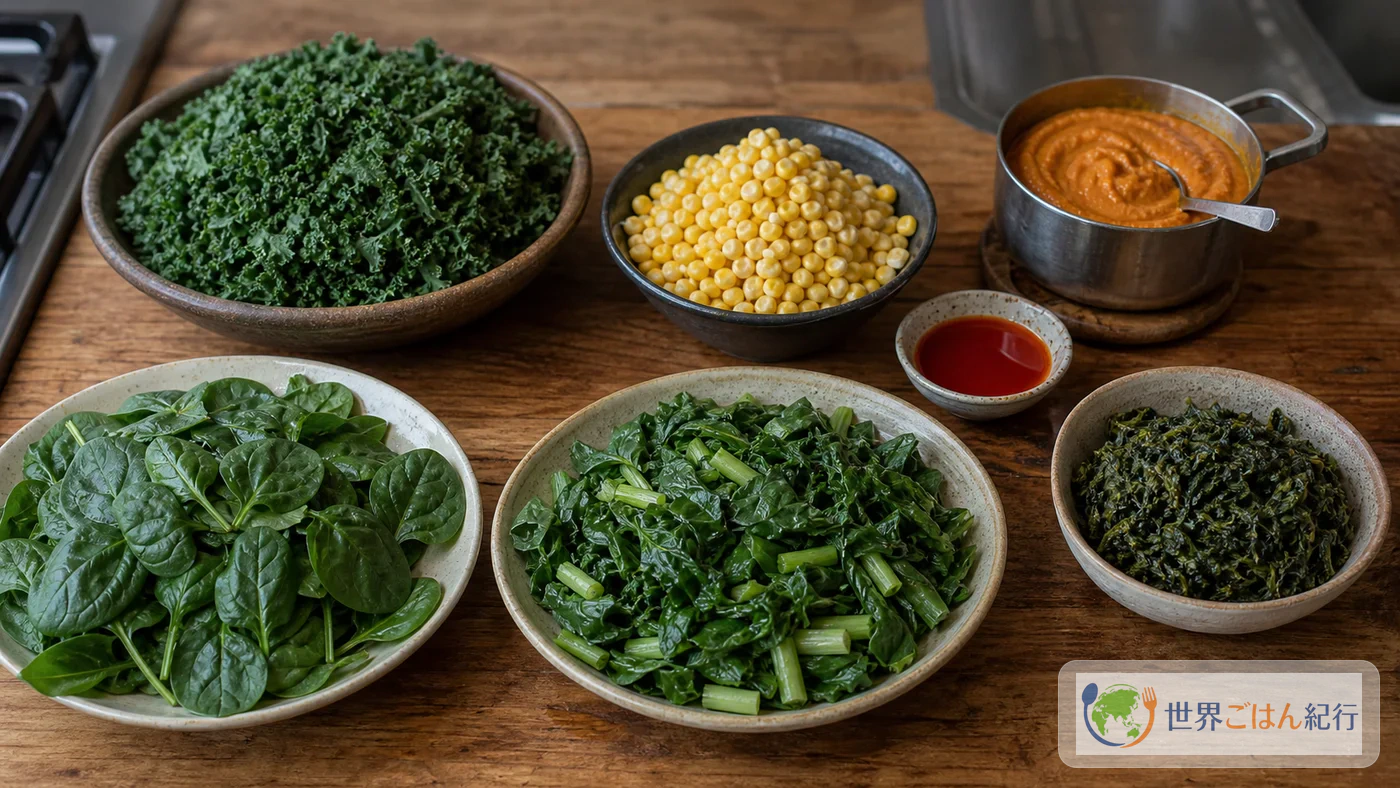
What to keep in sanga is the amount of leaves, the grain of the corn and the aroma of palm. Conversely, if you chase ingredient names at the expense of safety and availability, it won't last in your kitchen.
| Uncertain ingredient | Closer to the original | Realistic elsewhere | How to think about the substitution |
|---|---|---|---|
| Cassava leaves | Use a processed frozen product | 250 g kale and 150 g komatsuna | Make up the slight bitterness and fibrous feel with kale |
| Nzom, eggplant leaves | Use the local leaves | Spinach, komatsuna, Malabar spinach | Don't pick wild plants or unidentified leaves |
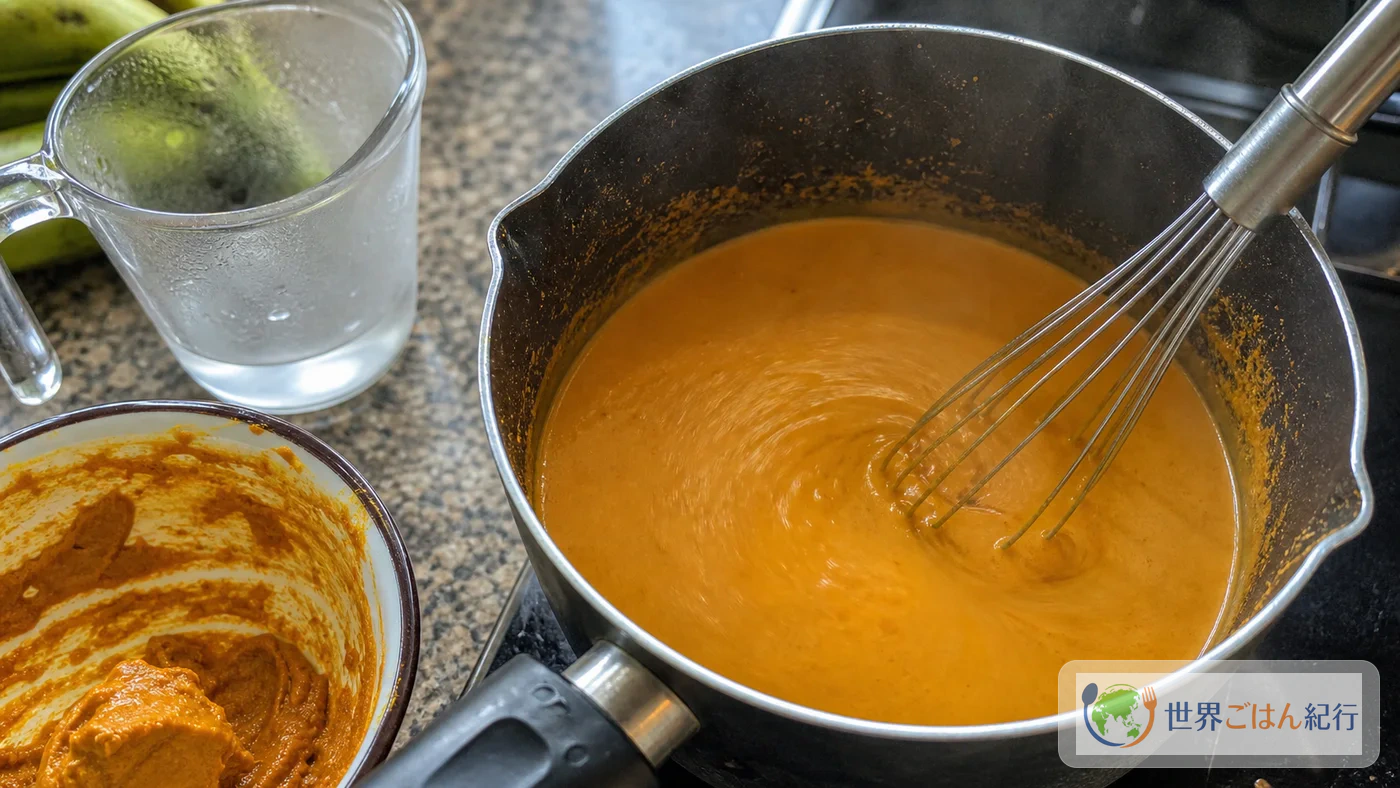
| Palm nut purée | Use palm nut cream | Red palm oil and coconut milk | Not the same taste, but you can build the oil aroma and body |
| Fresh corn | Take the kernels off fresh ears | Frozen corn | Don't cook it too long from the start; keep the kernel texture |
| Smoked fish | Smoked fish | Grilled salted mackerel, dried shrimp | Add the fish aroma in small amounts; decide salt last |
Red palm oil can also be used in egusi soup (in Japanese) and red red. One bottle's first use can be small; think of about 1 to 4 tbsp per dish. Cassava flour goes not into the sanga itself but into the fufu served beside it. Pairing it with fufu moves sanga from "a vegetable side dish" toward a Central African table.
With corn, prioritize the grain over the sweetness
What trips people up in sanga is the corn, not the leaves. Corn at ordinary supermarkets is very sweet, and canned corn, if you add the liquid too, moves the pot straight toward a sweet-corn stew. Local fresh corn has not just sweetness but also a floury feel when bitten, the way the hull remains, and a sense of being the same weight as the leaves in the pot.
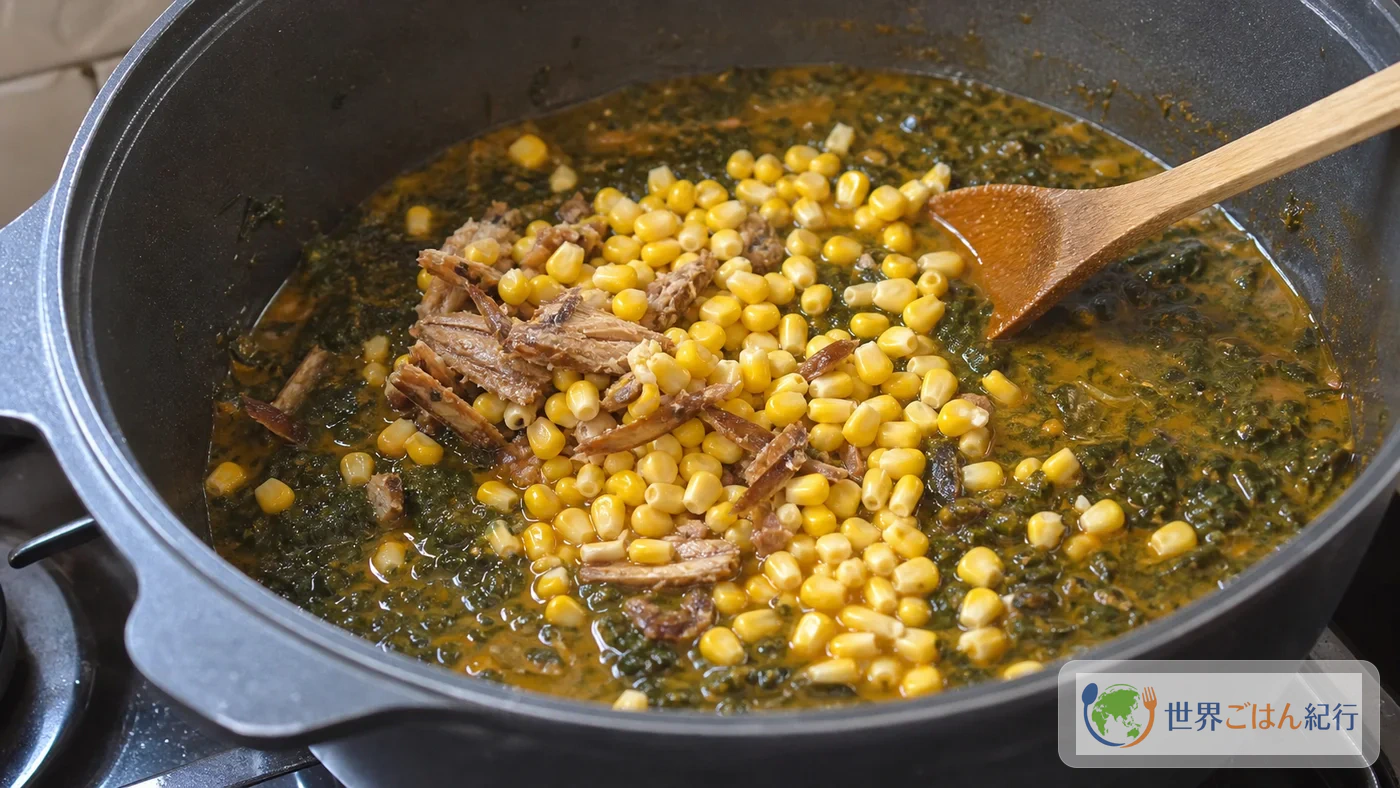
For a first try, frozen corn is easiest to handle. It goes in without thawing, the kernels don't break easily, and the liquid in the pot is easy to read. On a day you use canned, drain it in a sieve for 2 minutes, and if it is very sweet add a few drops of lime. When fresh corn is in season, cutting the kernels off with a knife gives a better aroma, but add it near the end.
| Form of corn | Suited to | How to use | Caution |
|---|---|---|---|
| Frozen corn | First try, weekdays | Add frozen at step 5 | Releases water, so be sure to reduce it at step 6 |
| Fresh corn | Summer, days you want aroma | Cut the kernels off and add at step 5 | Don't put the cob in the pot; at most use it separately to make stock |
| Canned corn | Days you cook from the pantry | Drain, and omit the sugar if sweet | Adding the liquid pushes it toward a sweet side dish |
| Hominy | Days you want less sweetness | Drain and simmer for just 6 minutes at step 5 | Kernels are large, so chop the leaves fine |
With hominy, the color of sanga becomes slightly more rustic. With less sweet aroma, the red palm oil and the fish come forward. This article uses frozen corn as the standard, but those who want less sweetness can lean toward hominy, which also links to East African grain dishes such as githeri and makes pantry items easier to reuse.
What to buy for this dish
For shopping for sanga, it's safest not to chase every local ingredient but to look first at the ingredients that change the outline of the dish. Kale, komatsuna, corn and onion are fine from an ordinary supermarket. What is worth seeking at an African grocer or online is the red palm oil that ordinary oil cannot easily replace, the cassava flour that extends to fufu and eba, and the dried shrimp powder that can add a bit of the aroma of smoked fish.
| Buying priority | Ingredient to look for | Role in the dish | What you can get nearby |
|---|---|---|---|
| Top | Red palm oil | Aroma and color that move greens and corn toward a Central African stew | Using only neutral oil moves it toward a different dish |
| High | Cassava flour, fufu mix | Makes sanga a dish scooped with a staple, not a side for white rice | White rice is fine the first time |
| Medium | Dried shrimp powder, dried shrimp | Adds a little ocean umami when there is no smoked fish | Not needed on days you use grilled salted mackerel |
| Low | Palm nut cream | Closest to the local dish, but hard to find at times | Move toward a home version with red palm oil and coconut milk |
Red palm oil is the ingredient that pushes the aroma of sanga straight toward Central Africa. With only ordinary neutral oil it tends to become a stew of greens and corn, so it is worth adding even a little.
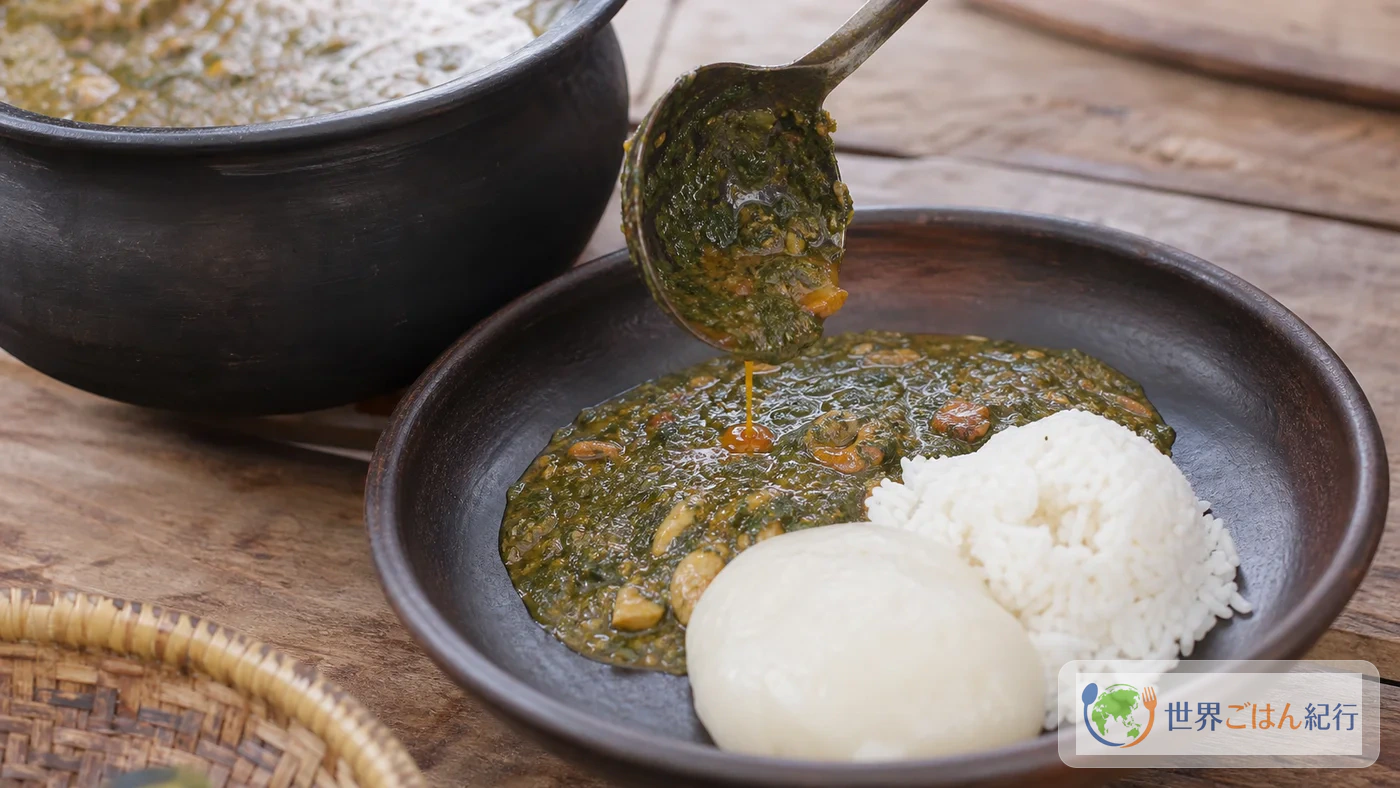
On the days you make fufu too, using cassava flour changes the feel. White rice is delicious too, but scooping the green stew with a sticky staple brings out the body of sanga.
On days you can't get smoked fish, crushing a little dried shrimp and adding it gives the pot depth. It isn't needed on days you use salted mackerel, but it is insurance when you want to make up the fish aroma with another dried ingredient, or when the flavor feels flat with only corn and greens. If you have a shellfish allergy, don't use it and substitute dried shiitake powder.
If you buy more, the order red palm oil, cassava flour, dried shrimp powder is enough. Hunting for palm nut cream gets you closer to the local dish, but making it essential from the first try weighs heavily on the kitchen. Start by building aroma with red palm oil, use cassava flour on days you serve fufu, and add a little dried shrimp powder only when the fish aroma falls short.
How to make it: cook the leaves down soft, leave the corn for last
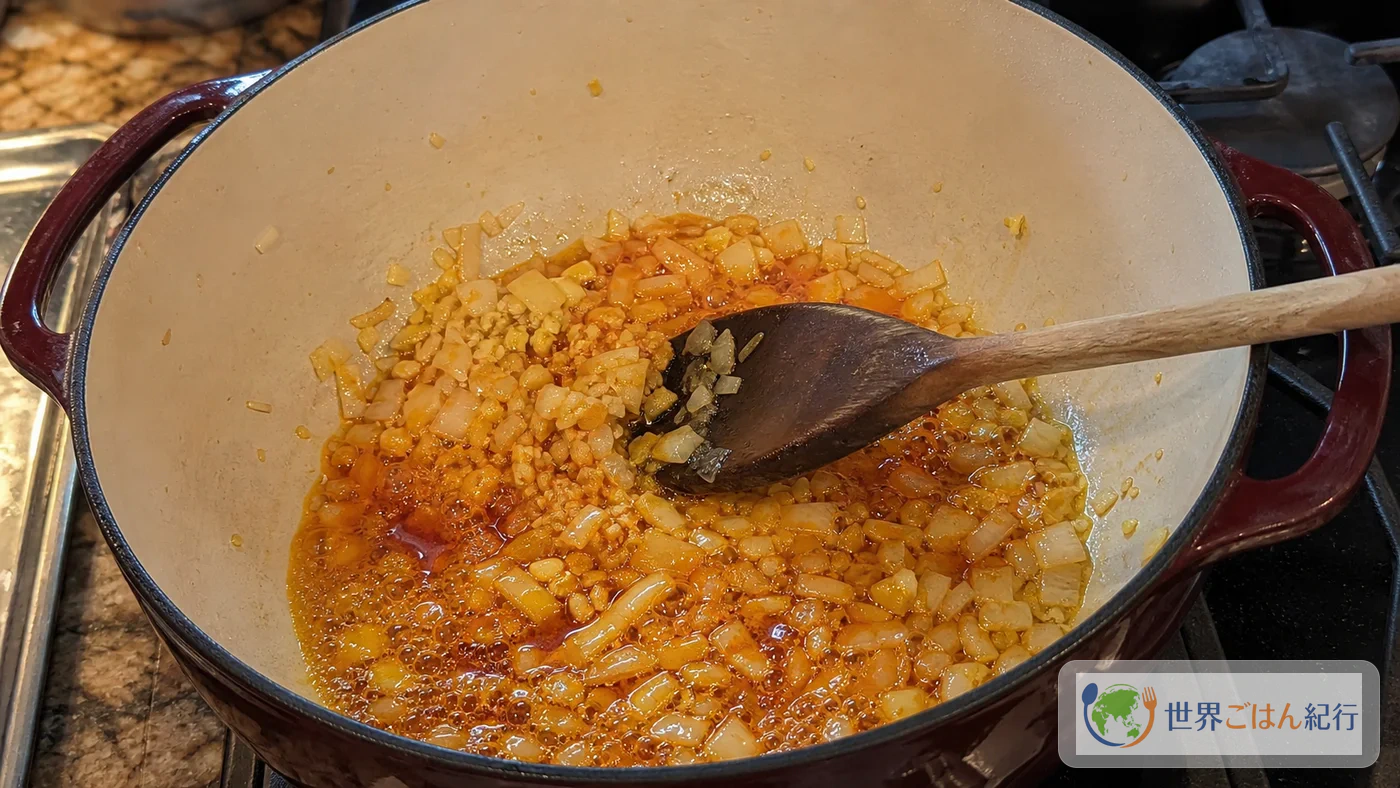
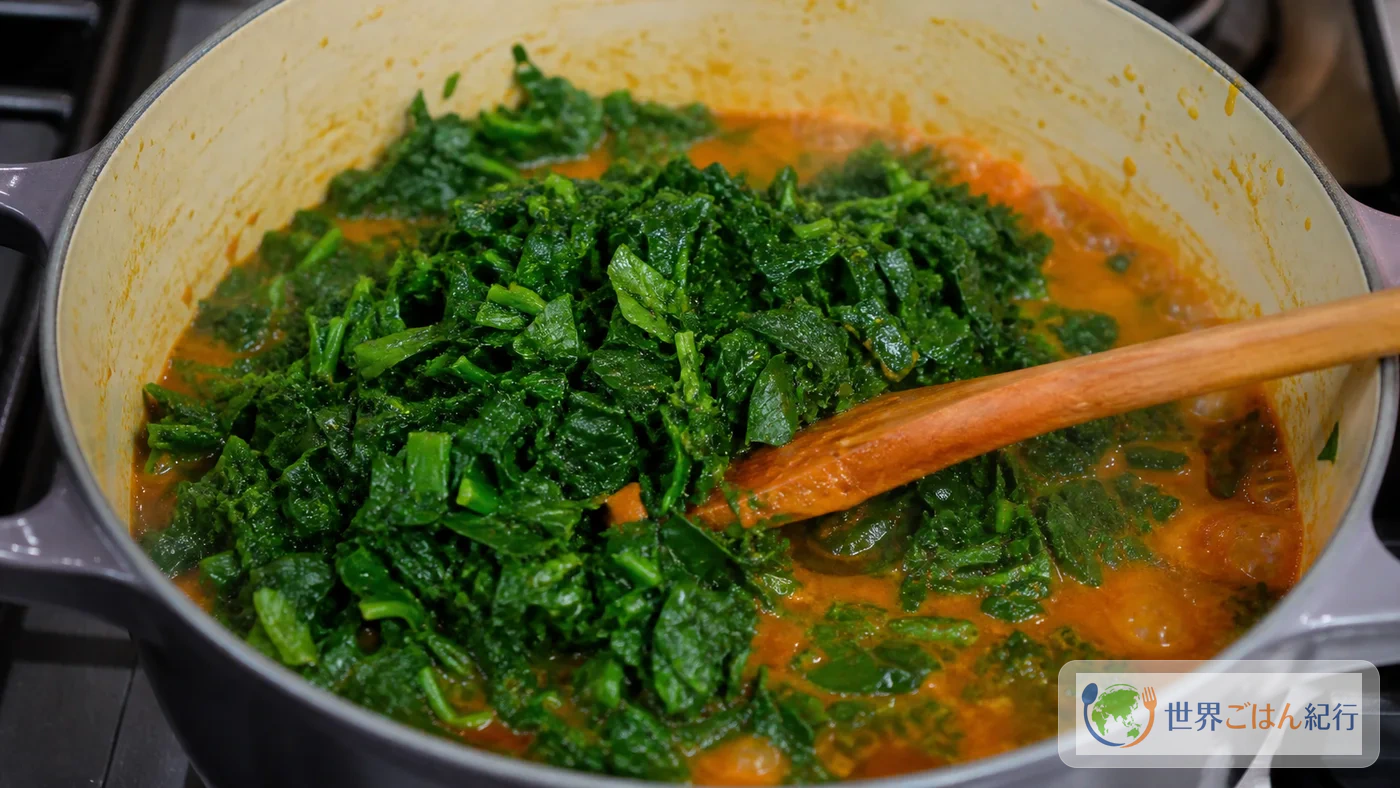
Sanga is made in this order: chop the leaves, sauté the aromatics, dissolve the palm, cook the leaves, add the corn, reduce to the right thickness, and plate. Adding the corn early brings out sweetness but makes the kernels too soft. Adding it near the end and keeping yellow grains is easier to do in a home kitchen.
Where it tends to go wrong
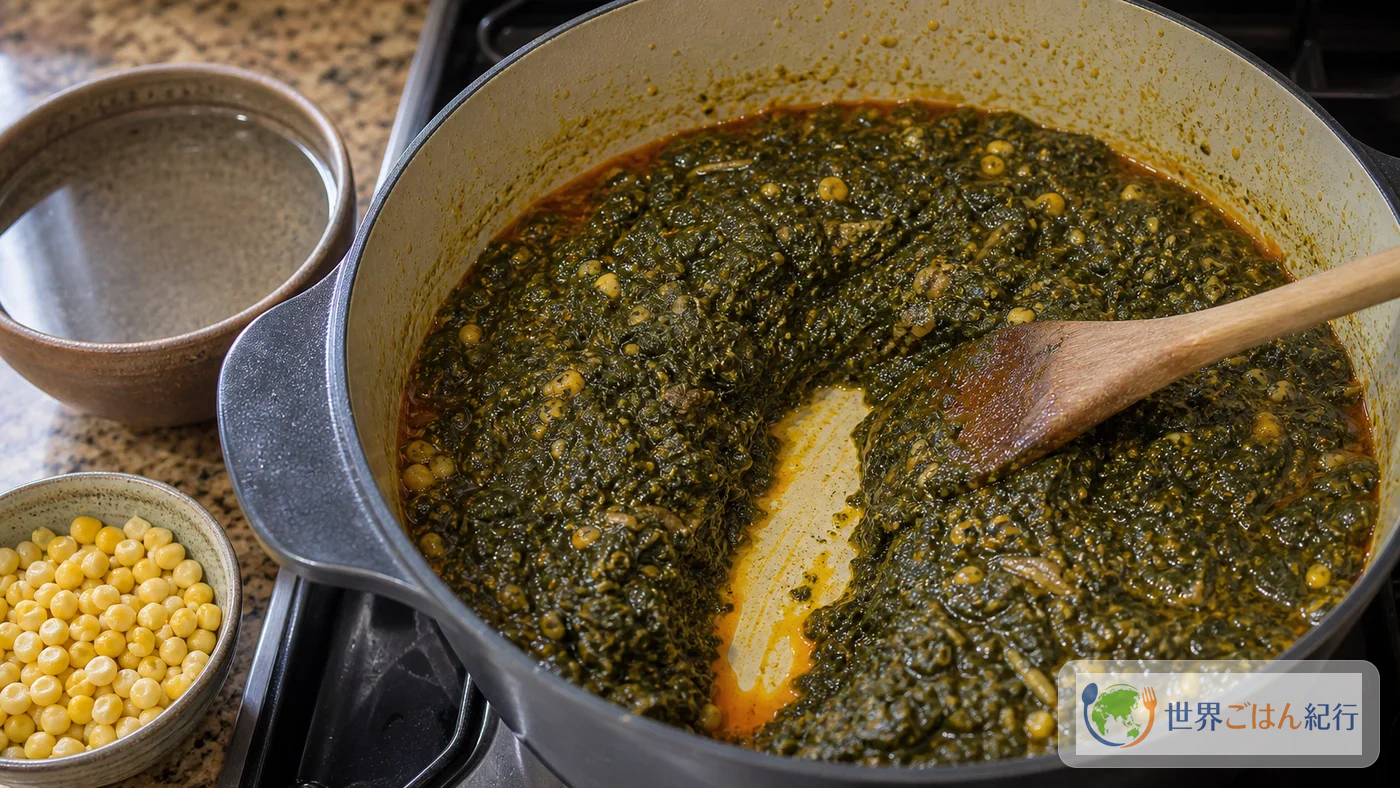
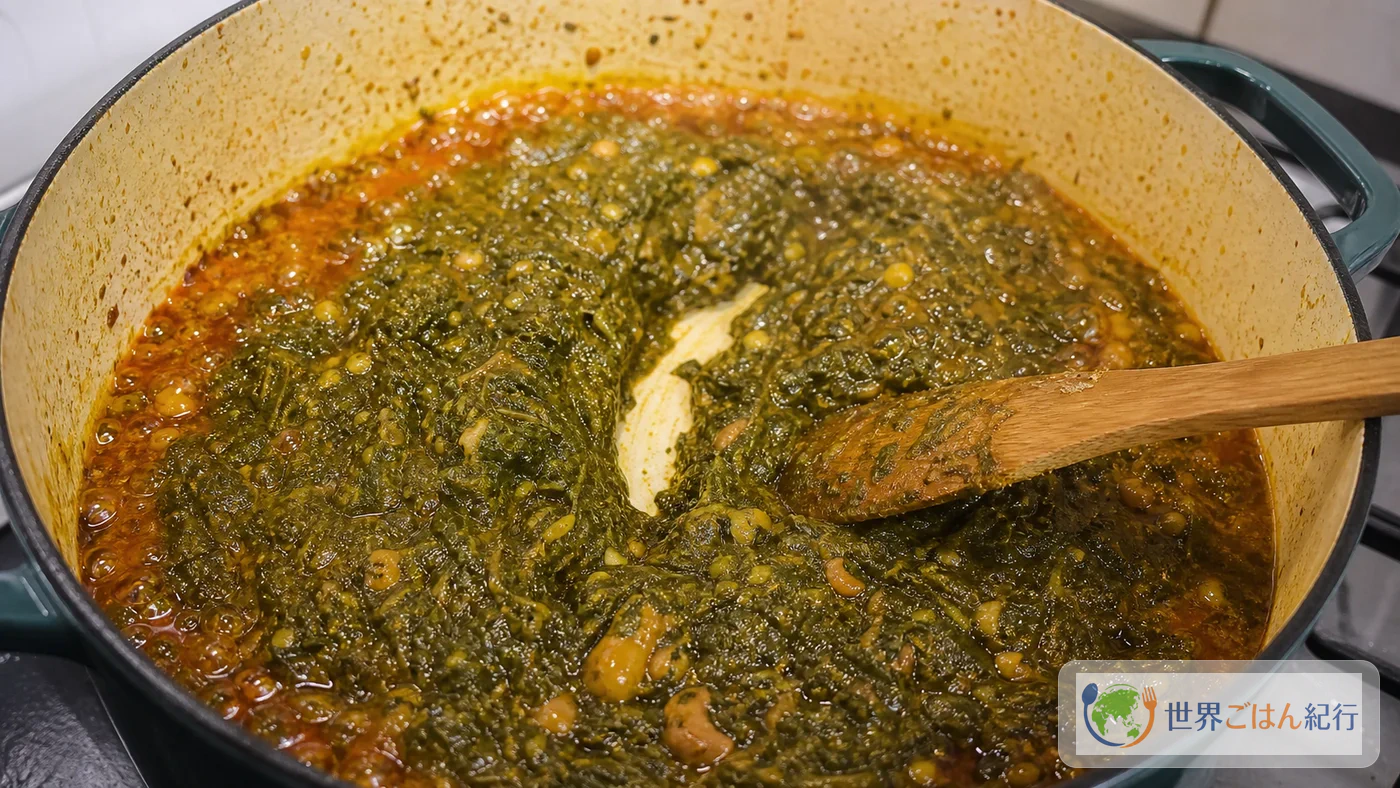
Sanga is decided less by flashy technique than by how you let the water escape. Because so many leafy greens go in, at first it inevitably looks watery. If you raise the heat then, only the bottom scorches and a grassy smell remains. Separate the time with the lid on and the time with it off, at low to medium-low heat.
| Problem | Cause | Fix |
|---|---|---|
| Watery | Water from the leaves, liquid from canned corn, the lid kept shut too long | Remove the lid and reduce 10 more minutes over low heat |
| Bitter | Too many kale stems, scorched palm oil | Remove thick stems, and add the aromatics before the oil smokes |
| Corn too soft | Added from the start and cooked long | Add at step 5 and stop at about 8 minutes |
| Fish is too salty | Didn't account for the salt in the mackerel or dried shrimp first | Salt last. If strong, add 50 ml water and simmer 5 minutes |
| Palm aroma is heavy | Too much red palm oil | Next time 1.5 tbsp. Cut it with a few drops of lime at the end |
Because information about sanga in other languages is limited, it is a dish where a reader easily gets lost at the stove if it ends at "ingredients substituted." Showing the water, bitterness, timing of the corn and weight of the palm oil in advance raises the success rate of the first attempt.
How it is eaten locally and how to plan the menu
Sanga is less a self-contained greens dish than one that suddenly shows its character when eaten with a staple. Scooping it a little at a time with fufu brings the fibers of the leaves and the palm oil together. On a day you serve it over white rice, finishing it slightly looser makes it easier to eat.
The same country's ndolé (in Japanese) leans rich with peanuts and bitterleaf, so putting it beside sanga shows the difference in how leafy greens are used. If you have made West African seed stew egusi soup (in Japanese), it helps to think of sanga as more corn-leaning, a light-to-eat stew of oil and leaves. To taste the aroma of red palm oil not in leaves but in an emulsified yellow soup, move on to achu soup (in Japanese), poured over a mound of cocoyam; it makes for a completely different table even in the same Cameroon.
For a menu, these combinations are realistic.
| Menu | Suited to | How to combine |
|---|---|---|
| Sanga, rice, grilled fish | Weeknight dinner | Keep the fish out of the sanga on a separate plate so salt is easier to control |
| Sanga, fufu, boiled egg | Weekend Central African menu | Make the fufu the star and reduce the sanga thicker |
| Sanga, poulet moambé, rice | Days you compare palm dishes | Reduce the sanga's red palm oil to 1.5 tbsp to avoid heaviness |
| Sanga, sukuma wiki, rice | Days you use up greens | Stir-fry sukuma wiki lightly and keep sanga a stew |
Storage and making ahead
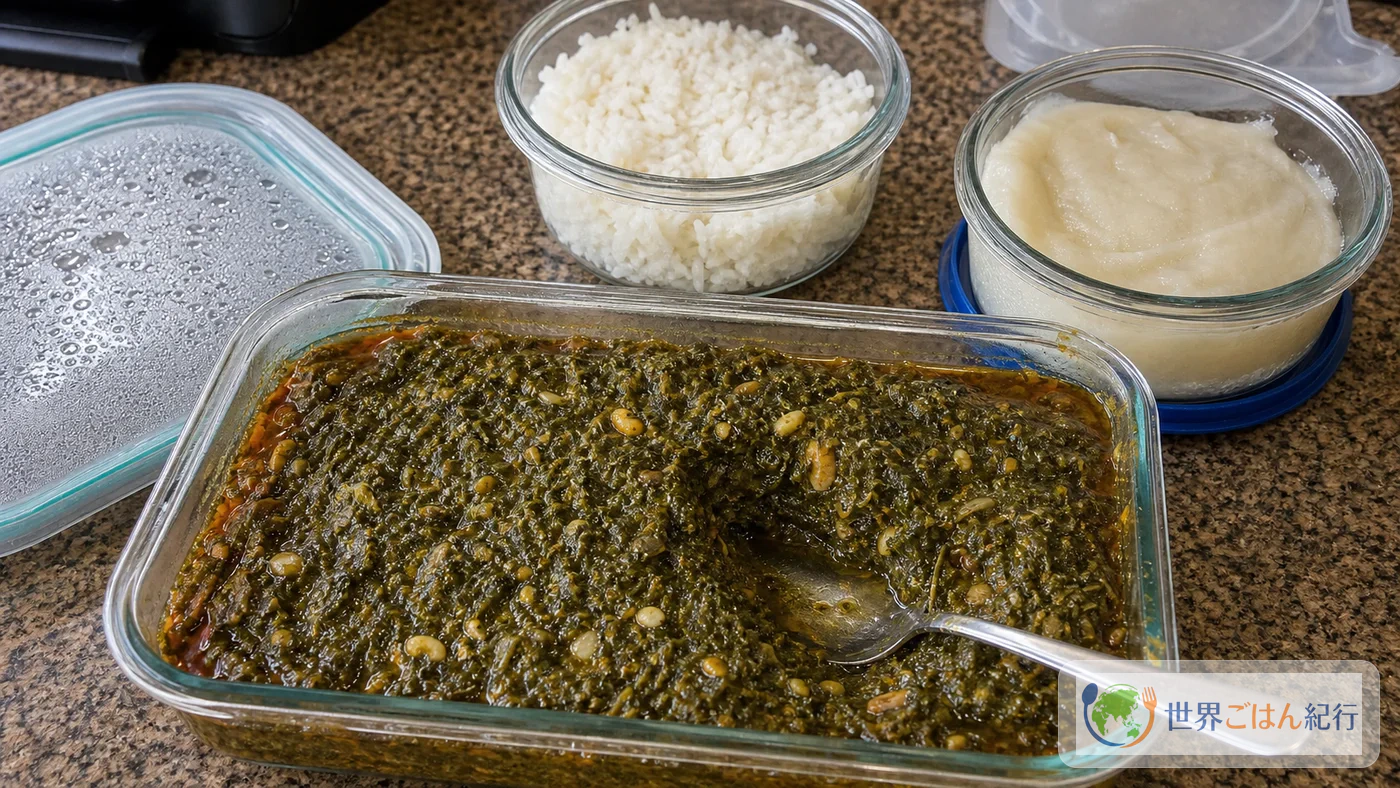
Sanga with fish in it should be eaten by the next day in the refrigerator. Let the heat go within 30 minutes, divide into shallow storage containers and refrigerate. Even if you make it without fish, the water in the leafy greens is high, so within 2 days in the refrigerator is safe.
To reheat, put one portion of sanga and 2 tbsp water in a pot and warm over low heat for 5 minutes. In a microwave, heat at 600 W for 1 minute 30 seconds, stir through, and heat 40 seconds more. The surface alone tends to get hot, so stirring partway is important. Freezing lowers the texture, but without fish it keeps up to 2 weeks. After thawing, liquid comes out, so reduce it for 5 minutes over low heat with the lid off.
Frequently asked questions
Can I make it without cassava leaves?
Yes. In fact, starting with kale and komatsuna is safer and has fewer failures in a home kitchen. You won't get the flavor of cassava leaves itself, but you keep the structure of finely chopped leaves cooked in a palm-type oil.
I don't have palm nut cream
Substitute 2 tbsp red palm oil and 150 ml coconut milk. You will not get the fibrous feel and body of palm nut cream, though. If you find palm nut cream, palm fruit pulp or palm soup base at an African grocer or online, loosening it with water and using it brings you closer.
Is it unsatisfying without fish?
It can be eaten without fish, but to add depth to the pot, add 10 g dried shrimp in households where shellfish is fine, or 5 g dried shiitake powder or 50 ml kombu stock where it is to be avoided. It is not the same as the aroma of smoked fish, but it keeps the dish from going flat with only greens and corn.
Is it a sweet dish?
Some Cameroonian recipes add sugar at the end. In this article it is only 1 tsp. If the corn is sweet, 0 g is fine, and even if you want to push it toward a sweet side dish, keeping it to 2 tsp or less won't get in the way of the palm and fish aromas.
Why does the corn get too soft?
It was added too early. The aroma of sanga is built by cooking the leaves and palm first, and the corn is added for the last 8 minutes. With canned corn, drain the liquid and avoid stirring too much so the kernels don't break.
Sources
- WIPO, IP and Gastronomic Tourism: Cameroon
- The Vegan Society, Sanga (palm nut soup, Mbanga)
- Épices du Cameroun, Le Sanga
- Food Standards Australia New Zealand, Cassava and bamboo shoots



