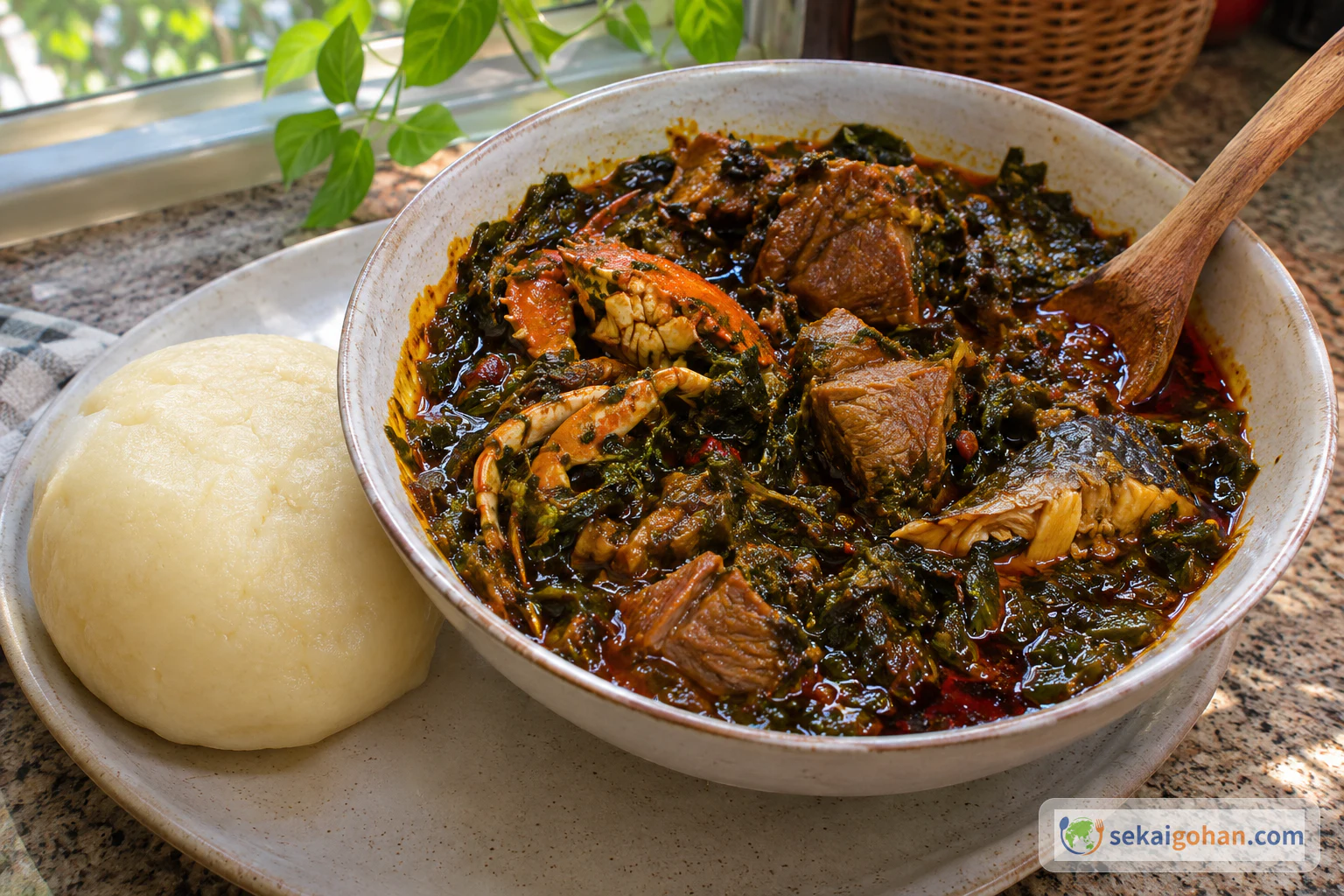
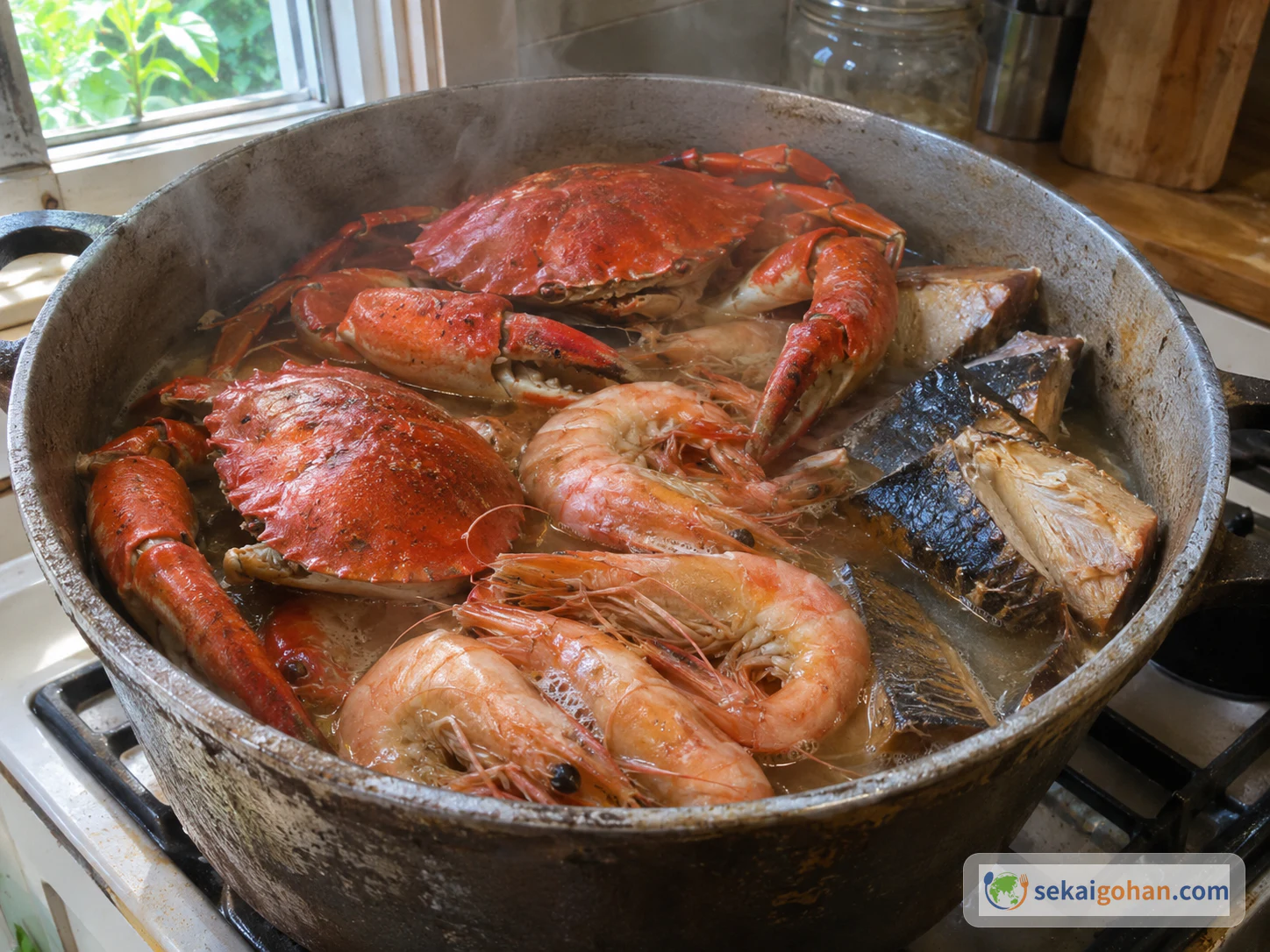
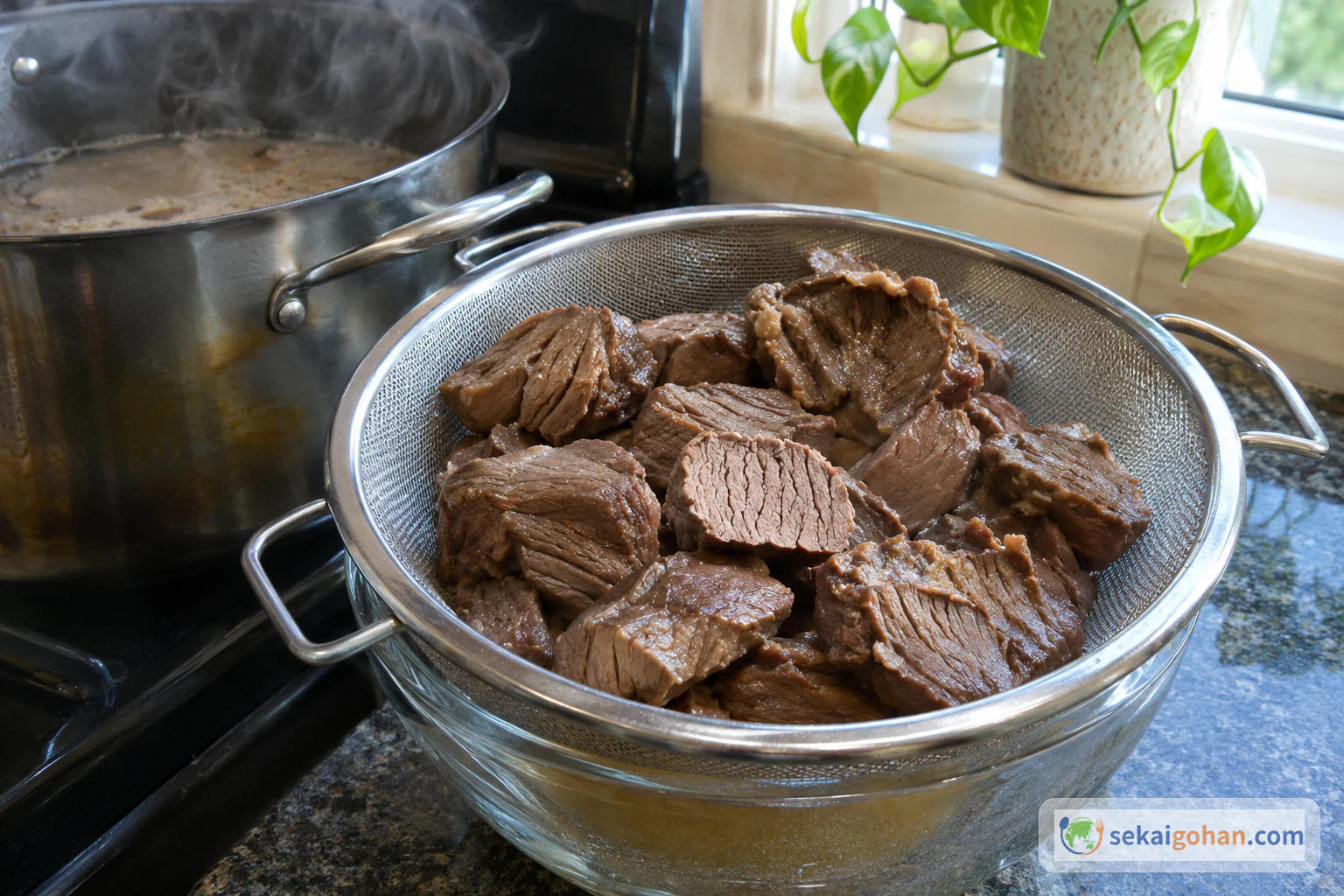
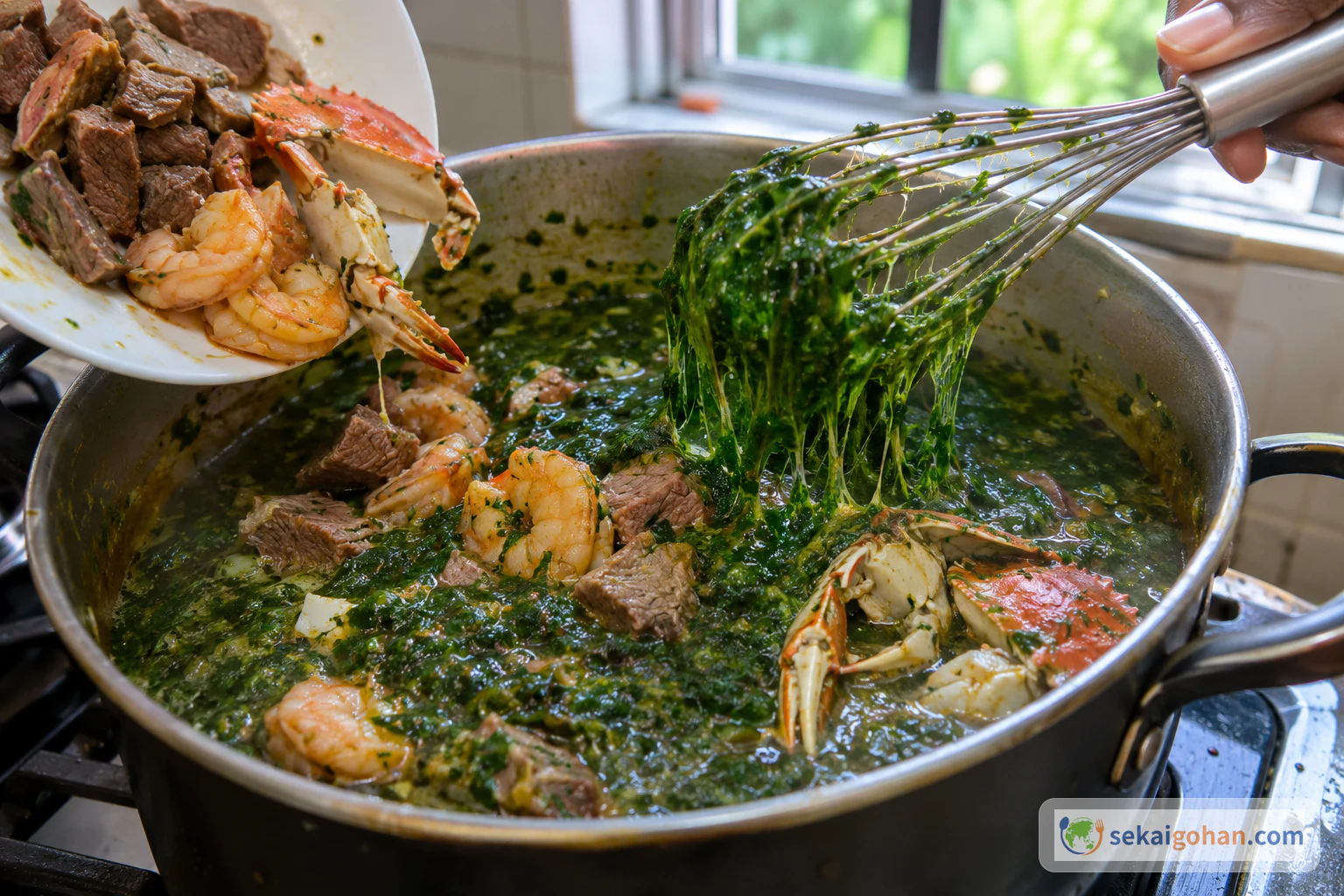
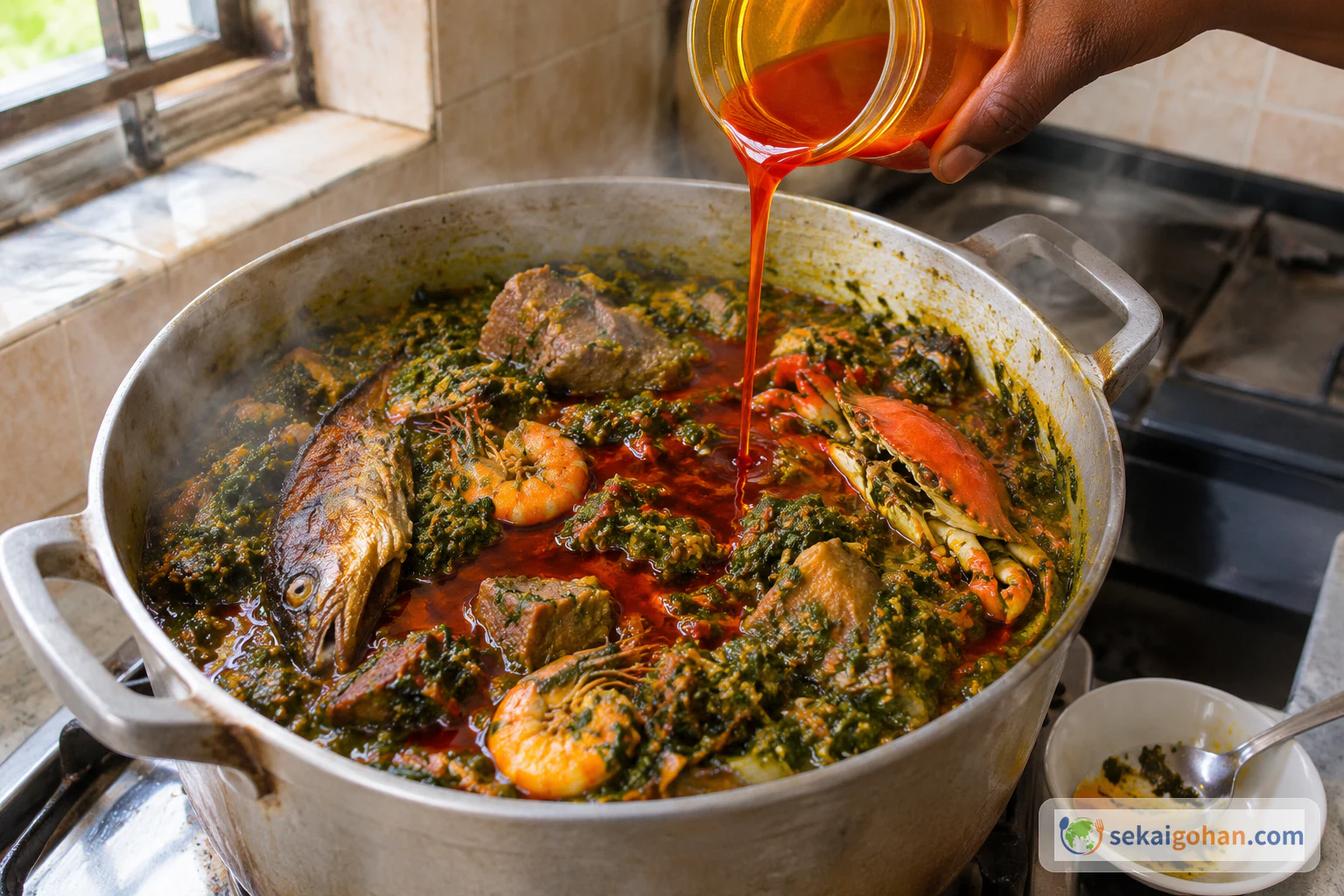
The best moment comes when the finely chopped leaves go into the hot broth and the whisk starts working. After a few hard strokes the green breaks down into a thick, glossy sauce, and it pulls up in threads every time you lift the whisk. In go the beef, crab, shrimp and smoked fish, and then a thin stream of palm oil that spreads a red sheen over the green.
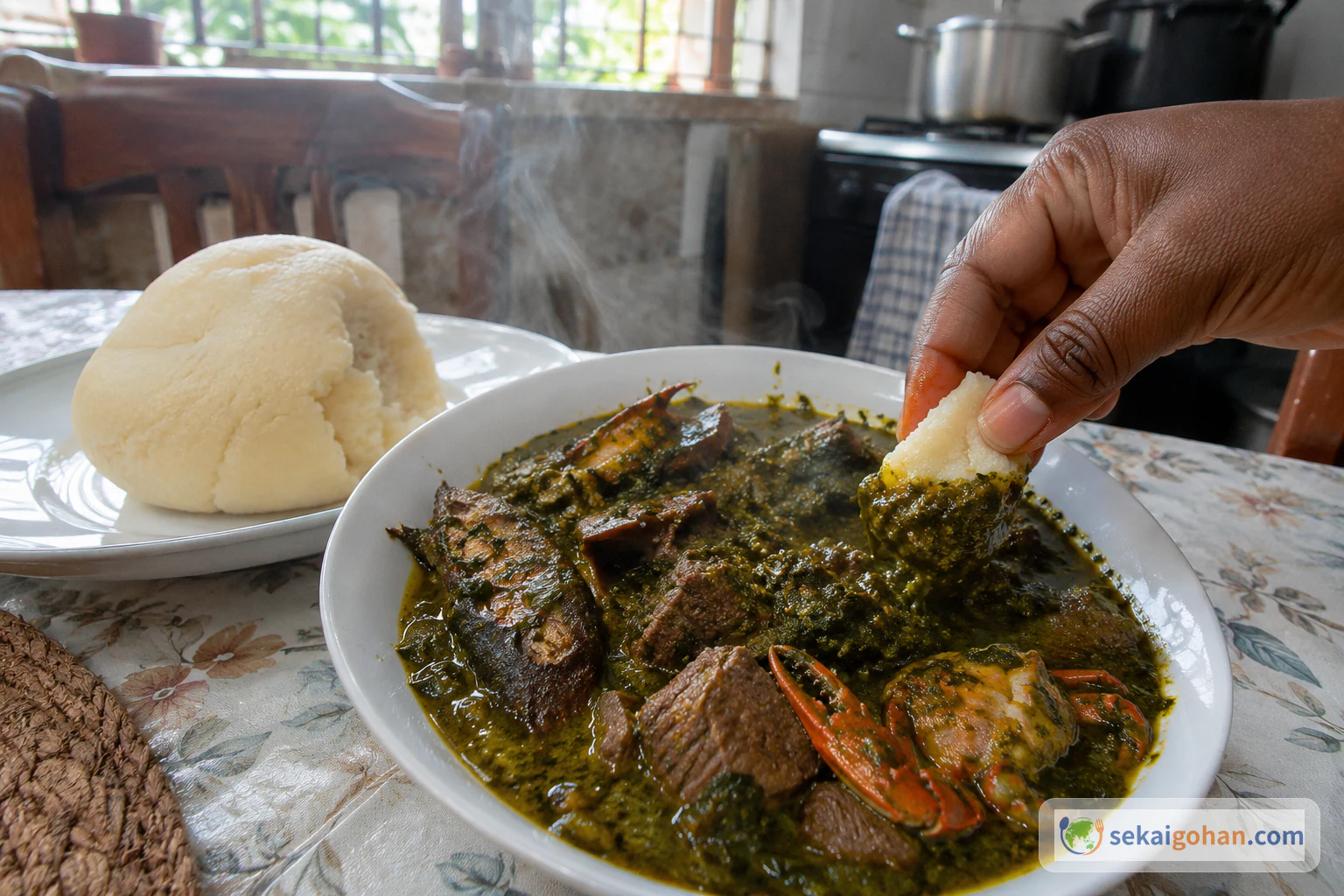
Adémè déssi is a Togolese sauce made from jute leaves. At the table it sits next to ewokoumè, a pale maize dough you tear by hand and use to scoop up the sauce. It tastes soft and green, with smoke from the fish, the sea from the crab and shrimp, and the warm richness of palm oil running through it.
A Sticky Green Sauce and a Dough to Carry It
A Togolese meal is usually built from two parts: a staple dough and a sauce. The dough goes in the middle and the sauce beside it. You eat by tearing off a piece of dough, pressing a small hollow into it with your fingers and scooping up the sauce. That's why the stickiness of adémè déssi matters so much. A thin sauce would run off the dough. A sauce that pulls into threads stays on it, all the way to your mouth.
The leaves have several names, and you'll need them all when you shop. The stickiness comes from the leaves alone. Chopped fine and beaten into hot liquid, they turn slick and stretchy, the same quality okra lovers look for, though here it comes entirely from a leaf. Households differ on the rest of the pot: which fish, which shellfish, whether there is meat, and which oil. The pot here takes from both land and sea, with beef next to smoked fish, shrimp and crab, all finished with palm oil.
You'll see the sauce written Adémè déssi, Adémédéssi or Ademe dessi. The leaves are sold as jute leaves, corète, lalo or adémè. The dough served with it is ewokoumè, and with jute leaf sauces you'll also see akume or akoumé.
Ewokoumè is a slightly fermented maize dough, smooth and pale, made to be torn. Its relatives stretch across the region. Akoumé is a stiff dough made from millet, sorghum, maize or cassava flour, shaped by hand and eaten with meat and fish sauces. Next door in Ghana, banku is a fermented corn dough eaten the same way. If you like how the leaves and palm oil work together here, kontomire stew builds its flavour from leaves, red palm oil and dried shrimp. Benin's amiwo cooks the maize itself in red palm oil.
Ingredients (serves 5)
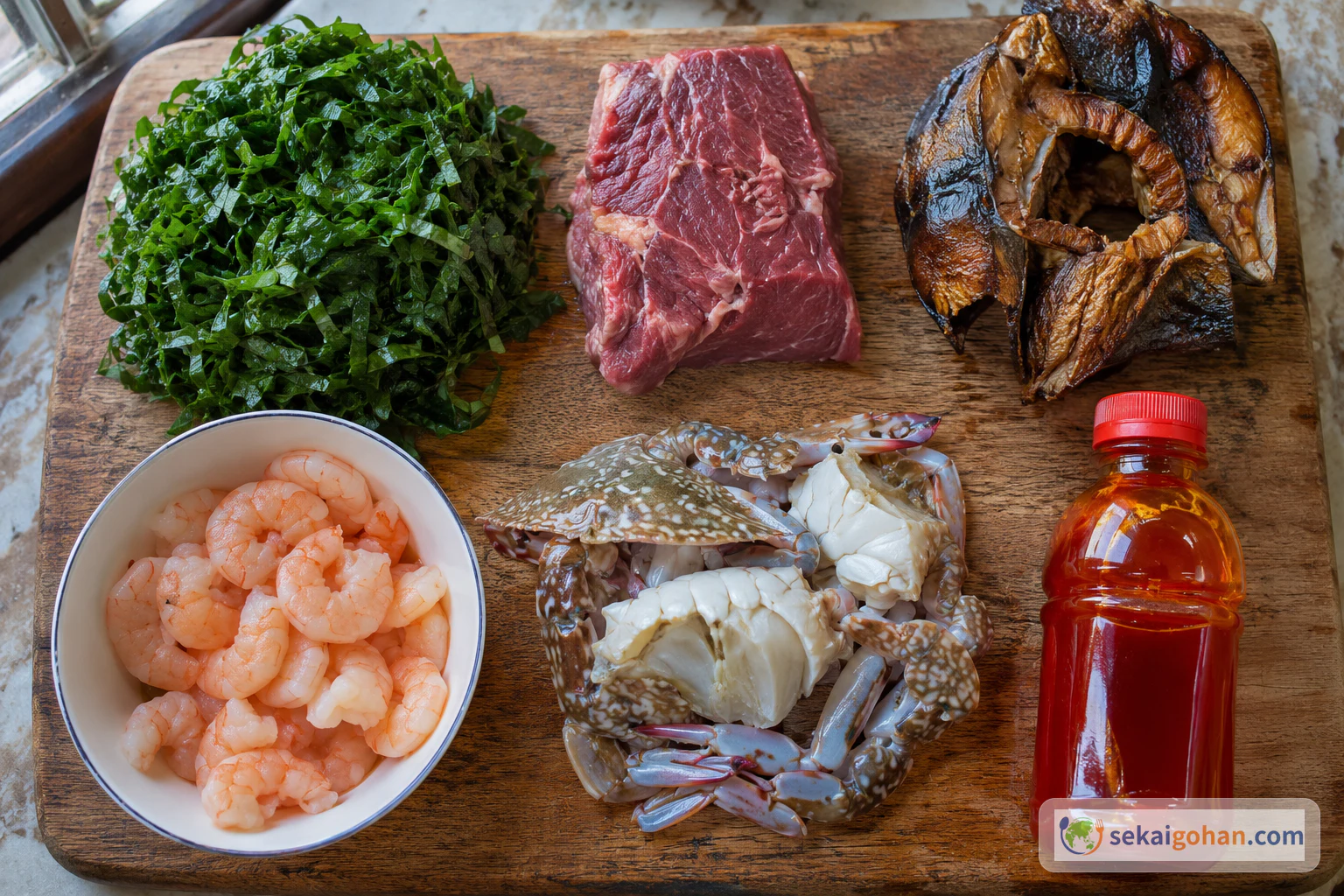
The leaves, beef, smoked fish, shrimp and crab all come in equal weights, so the sauce is as much meat and seafood as it is leaves. Every amount here is approximate.
The leaves have to be finely chopped before they reach the pot. Fine pieces break down quickly under the whisk and release their slime all at once. Coarse pieces stay leafy and keep the sauce loose.
This sauce has a lot of crustaceans (shrimp and crab) and fish (smoked fish). Keep it away from anyone with a shellfish or fish allergy. All the seafood is cooked through before it goes into the sauce, so never serve any of it raw.
Equipment
- Large knife and cutting board, for chopping the leaves fine
- A pot for the seafood
- A second pot for boiling the beef
- A sauce pot big enough to hold everything at the end
- A sturdy whisk
- Colander
- Tasting spoon
Choosing and Substituting
The one ingredient worth searching for is the leaf. Look for jute leaves, corète, lalo or adémè, fresh or frozen, at African and international grocers or online. Search under all four names, because shops label it differently. Smoked fish and dried shrimp are usually in the same shops. For palm oil, look for red palm oil.
| Ingredient | What to buy | What a swap does |
|---|---|---|
| Jute leaves | Any of the four names, chopped fine | Spinach gives you a green sauce with no threads. The taste and texture move far from adémè, so keep the real leaf |
| Shrimp | Fresh or dried | Both belong here. Fresh shrimp must be cooked through in step 1 |
| Smoked fish | Whole or in pieces | It gives the pot its smoke. Fresh fish loses that note |
| Palm oil | Red palm oil | Neutral oil leaves the sauce plain green, without the red gloss and warm flavour |
| Crab | Whole crabs, cleaned well | Adds depth from the shell. Clean it thoroughly, because grit ends up in the sauce |
The parts that make it taste right are the finely chopped jute leaf, the smoked fish and the palm oil. Beef, shrimp and crab are where households differ.
Method
The work runs in three pots. The seafood cooks first and is set aside with its liquid. The beef boils alongside, and that's your hands-off stretch. The sauce comes together fast at the end, so have the meat, the seafood and the dough ready before the leaves go in. Serve it the moment it's done.
Leaves cooked too long dry out and lose their stickiness. Keep the beef and seafood within reach so you can add them as soon as the sauce threads, then finish and serve.
Stirring the palm oil into the finished sauce keeps its colour and warm flavour on top of the green. Added earlier, it would just cook into the pot along with everything else.
When It Goes Wrong
| What you see | Why | What to do |
|---|---|---|
| The sauce is thin and won't thread | The leaves were chopped too coarsely or whisked too gently | Chop the leaves finer and beat harder until threads pull up from the whisk |
| The sauce turns dry and the stickiness fades | The leaves stayed on the heat too long | Loosen it with a little hot broth and serve right away. Next time, add the meat and seafood as soon as the sauce threads |
| Shrimp are grey or glassy in the middle | Not cooked through in step 1 | Put them back over the heat until they're opaque all the way through |
| The beef is red at the centre | The pieces needed more time | Put them back in boiling water until a cut piece shows no red |
| The sauce tastes flat | Not enough salt | Salt to taste in step 4, before the palm oil goes in |
At the Table and Beyond
Serving
Put the pot or a big bowl of sauce in the middle, still steaming, with a plate of smooth ewokoumè next to it. Everyone tears off dough with their fingers and scoops up sauce, pulling out pieces of crab, beef and fish as they go. Eat it hot. The threads are longest just off the heat. The crab is easiest to eat by hand, so put out a bowl for the shells.
Variations
- Dried shrimp instead of fresh. This changes the sea flavour from sweet and fresh to deeper and more concentrated. It goes in at the same point in step 1.
- Leaves cooked in a little water first. Some households cook the leaves alone in a small amount of water to bring up the stickiness, then add fish, shellfish, garlic, onion, ginger and palm oil. This version has more aromatics in the background.
- Frozen leaves with ginger and onion paste. Another approach starts from frozen jute leaves and cooked meat, then seasons with ginger and onion paste, black pepper, chilli and lanhoin or a stock cube. It has more heat and a sharper aromatic edge.
- Red oil, potash and lanhoin. One Togolese cook's version uses beef, smoked fish and red oil, seasoned with liquid potash and lanhoin, with no crab or shrimp. It's more of a meat-and-smoke sauce than a seafood one.
Frequently Asked Questions
Why whisk the leaves instead of stirring them?
Beating breaks the finely chopped leaves down even further and pulls the slime out of them fast. A spoon only pushes the pieces around, so the sauce stays loose and leafy. Use a sturdy whisk and keep it moving until the threads appear.
Why cook the seafood and beef in separate pots?
They need different times: about 8 minutes for the seafood and about 20 for the beef. Cooking them apart lets each one finish properly without overcooking the shrimp. It also means the leaves only have to meet hot broth and come together at the end, which keeps the sauce sticky.
What can I serve it with if I can't make ewokoumè?
Use any smooth, stiff dough you can tear by hand. A maize dough is the closest match. In southern Togo the usual partner is a smooth corn dough, while in the north, yam and cassava staples go with sauces. White rice will hold the sauce, but you lose the tear-and-scoop way of eating.
Should I use fresh or dried shrimp?
Either works here. Fresh shrimp give a sweeter, softer bite and have to turn opaque all the way through in step 1. Dried shrimp give a stronger, more savoury sea flavour, and they go in at the same point.