The scent of peanuts rises from the pot of simmering greens
On the day you chop a mountain of greens, you feel a little uneasy just before they go in the pot. Will this much really fit? But if you pile komatsuna and kale on top of the onion and tomato, cover, and wait a few minutes, the greens sink to about half. Then you pour in the peanuts thinned with hot water, and the smell of the kitchen changes at once. It is the moment the green scent of the leaves is joined by the sweet richness of peanuts.
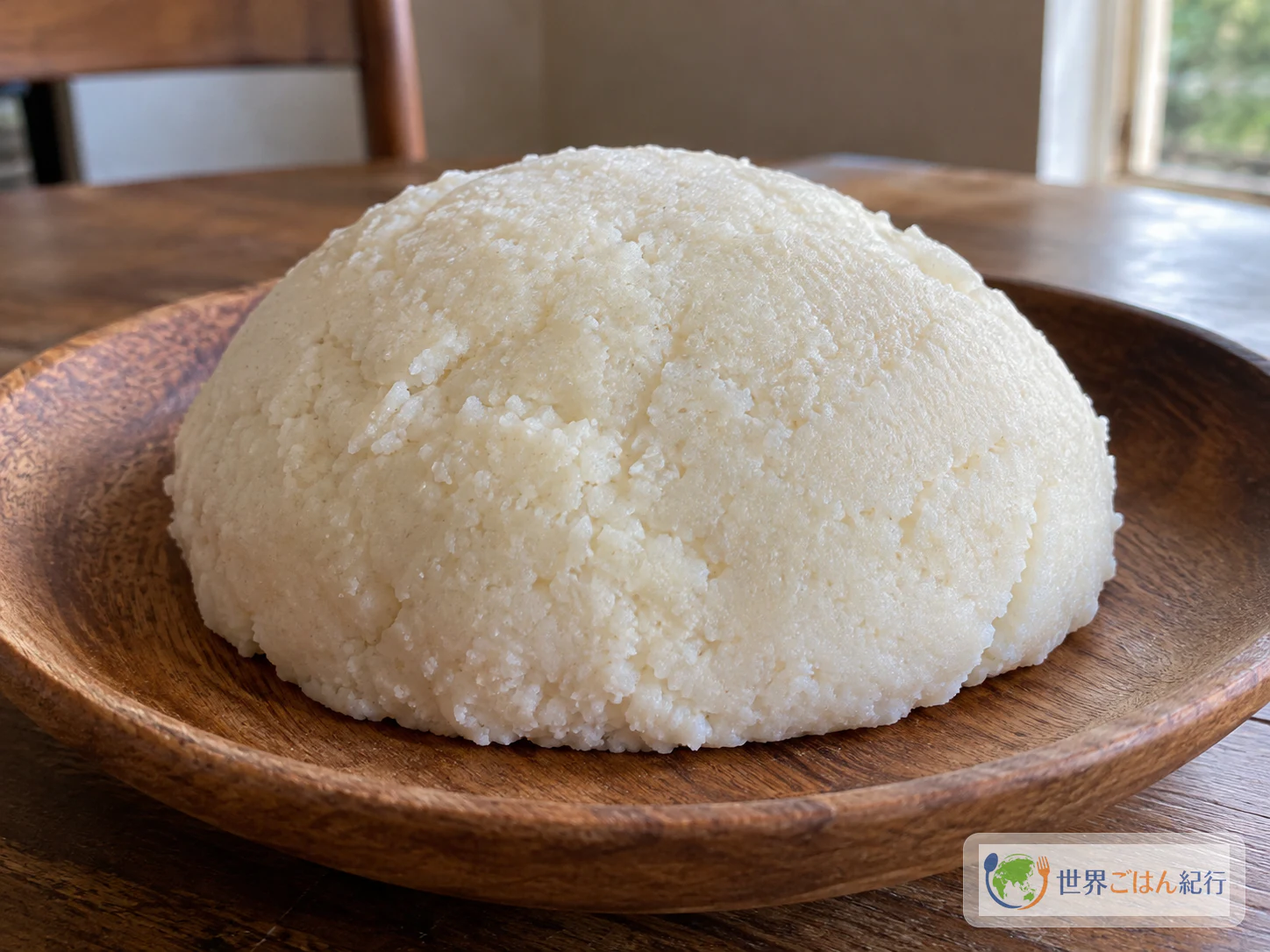
Ifisashi (Ifisashi) is a stew of greens and peanuts eaten in Zambia. On location it is made with whatever leafy vegetables are available that day, such as pumpkin leaves called chibwabwa, cabbage, and spinach. The staple is nshima (Nshima). You tear off the staple made by cooking white cornmeal and scoop up the greens coated in peanut sauce.
A dish in a similar direction is Ghana's groundnut soup. That one leans toward a rich soup with chicken and tomato. Ifisashi is a homey plate with no meat, centered on greens and peanuts. To make it in your own kitchen, there are three points to keep. Use unsweetened peanuts, do not let the greens release too much water, and decide the thickness over low heat without scorching the peanuts.
| Item | Guide |
|---|---|
| Quantity | 4 servings |
| Prep | 20 min |
| Cooking | 30 min |
| Total | about 50 min |
| Staple to serve with | Nshima, ugali, white rice |
| Spiciness | Almost none. Chile is optional |
Ingredients (serves 4)

This quantity is enough for 4 people with nshima or rice. Greens shrink a lot when cooked, so use more than looks right at first. It can be made with unsweetened peanut butter alone, but adding a little coarsely crushed roasted peanuts gives a toasty bite.
This recipe uses a lot of peanuts. If you have a peanut allergy, think of it as a different dish rather than a substitution. Replacing with sesame paste or soy milk may look similar, but it becomes a different dish from the toasty flavor of ifisashi.
What to keep and what to change in a home kitchen

You do not need to look for chibwabwa, the pumpkin leaves, as on location. What matters more than the kind of leaf is chopping thick-textured greens finely and letting them absorb the peanut sauce. Komatsuna alone is light and spinach alone tends to be watery, so using half komatsuna and half kale makes it easier to handle.
| Ingredient in question | Closer to the original | Realistic choice | Reason |
|---|---|---|---|
| Greens | Pumpkin leaves, cabbage, spinach | 250 g komatsuna and 150 g kale | Easy to balance thickness, bitterness, and water |
| Peanuts | Crush roasted peanuts to a paste | Unsweetened peanut butter and crushed peanuts | Less likely to clump even on a first try, and the toasty flavor remains |
| Staple | Nshima | Ugali, white rice | Even without cornmeal, it can be eaten with rice |
| Heat | Some households leave it out | A little chile powder | The star is not heat but the richness of greens and peanuts |
| Oil | Household cooking oil | Rice bran oil, canola oil | Not making palm oil essential keeps the mildness characteristic of ifisashi |
Among other greens dishes, Cameroon's sanga puts the aroma of corn and palm forward. Ifisashi has peanuts as the star, so not adding too much red oil or strong fish aroma keeps its outline.
Shopping essentials

Komatsuna, onion, tomatoes, and rice bran oil are fine from an ordinary grocery store. What is worth looking for online is the unsweetened peanut butter that decides the flavor, the cornmeal that brings you closer to nshima, and a small food processor that can crush peanuts coarsely. Once you buy sweet peanut cream you cannot undo it, so be careful about this alone at the start.
For unsweetened peanut butter, choose one where sugar and sweeteners do not stand out. It can be made with a chunky type, but for the first time, adding self-crushed peanuts to a smooth type makes the thickness easier to adjust.
On days you want to go as far as nshima, prepare white cornmeal. Meals vary in origin and grind, so at first, knead leaving about 50 ml of the water aside, check the firmness, and add; this is less likely to fail.
Crushing roasted peanuts coarsely gives a texture that peanut butter alone has trouble producing. A knife can do it, but a tool that runs briefly with a small amount can be reused for other paste dishes besides ifisashi.
Method
Ifisashi is made in this order: chop the greens, thin the peanuts with boiling water, sauté the aromatics, wilt the greens, combine with the peanuts, and decide the thickness over low heat. The surest way to prevent scorching is not to raise the heat to high once the peanuts are in the pot.
With nshima, you understand what the thickness means

Ifisashi is not a greens dish that is complete on the plate; it is completed by eating it with a staple. Nshima is a staple made by cooking white cornmeal, close to East Africa's ugali. You tear it by hand, make a hollow, and scoop up the greens coated in sauce, so a thickness that clings smoothly, not a runny one, is easier to eat.
On days you cannot get white cornmeal, firmly cooked white rice is enough. However, when serving with rice, finish the ifisashi a little thicker. With too much liquid the grains of rice swim and the peanut aroma seems thin. Conversely, when pairing with nshima or fufu, too heavy a sauce sticks to the staple, so keep it to a thickness that falls in a thick line from a wooden spoon.
For a meal, ifisashi, nshima, grilled fish or salted chicken, and a little sour tomato salad come together well. It can also be the main dish on a meatless day, but the fat of the peanuts is very filling, so a light side suits it.
Where it is easy to go wrong
| Problem | Cause | Fix |
|---|---|---|
| Turns sweet | Sweetened peanut cream was used | Hard to reverse. Next time use unsweetened and adjust with salt |
| Scorches | Heat was raised to high after the peanuts went in | Lower the heat and trace the bottom every 2 minutes |
| Watery | The greens were not drained enough or the lid was kept on too long | Remove the lid and cook down over low heat 5 minutes at a time |
| Gritty and dry | The peanuts went in the pot without being thinned with boiling water | Add boiling water in portions in a bowl and make it a sauce first |
| Grassy | The leaves were cut too large or undercooked | Chop to 5 mm to 1 cm widths and wait until wilted over medium-low heat |
The most common mistake is rushing to a boil after the peanuts go in. Even if the surface of the pot is calm, the heavy paste settles at the bottom. Simmer slowly over low heat, trace the bottom, and decide the flavor after resting. These three make the result much more stable.
Storage and reheating

Finish ifisashi within about 2 days in the refrigerator. Move it to a shallow storage container and put on the lid after it has cooled somewhat. If nshima goes in the same container it absorbs moisture and turns hard, so always store them separately.
To reheat, put the ifisashi in a pot, add 2 tbsp water, and warm over low heat for 5 minutes. In a microwave, heat at 600 W for 1 minute 30 seconds, stir once, and heat 40 seconds more. Peanut sauce tightens when cold, so adding a little water when reheating keeps it from scorching.
It can be frozen, but the texture of the greens suffers. If freezing, wrap single servings flat and use within 2 weeks. After thawing, water comes out, so remove the lid and simmer 3 minutes over low heat, and adding a little crushed peanuts at the end brings back the aroma.
Frequently asked questions
Can I make it with spinach alone?
Yes. But spinach alone releases water easily and the finish is softer. If you use it without blanching, cut it in 1 cm widths, not 5 cm, and add about 3 minutes of cooking down with the lid off. Mixing in half komatsuna helps the greens keep their shape.
Can the peanut butter be chunky?
It can be made with chunky. For the first time, use smooth unsweetened and crush roasted peanuts yourself to add, so the thickness is easier to read. If you use chunky alone, knead it well before adding the boiling water so large lumps do not go into the pot.
Is it not ifisashi unless I make nshima?
Nshima brings you closer even in the way of eating, but it is also delicious with white rice. A realistic approach is to succeed with the ifisashi itself the first time and move on to a cornmeal staple next time. On days with white rice, cooking the ifisashi down a little thicker helps it cling to the rice.
Can I add meat or fish?
How side dishes and main dishes are paired varies by household, but in this recipe no meat or fish goes in so that the outline of greens and peanuts shows. On days it feels lacking, adding fish grilled on a separate plate, salt-boiled chicken, or a tomato salad keeps the flavor from getting muddy.