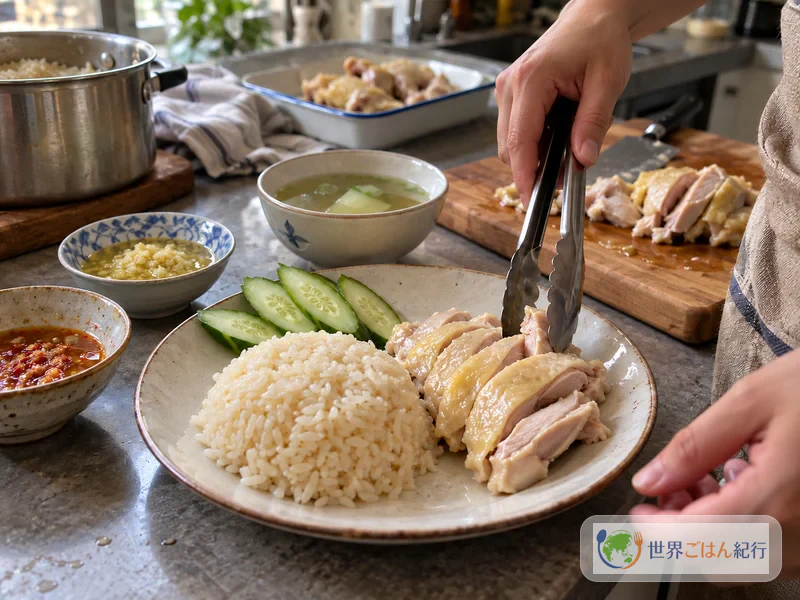
A whole bird sinks into hot water in a riverside kitchen
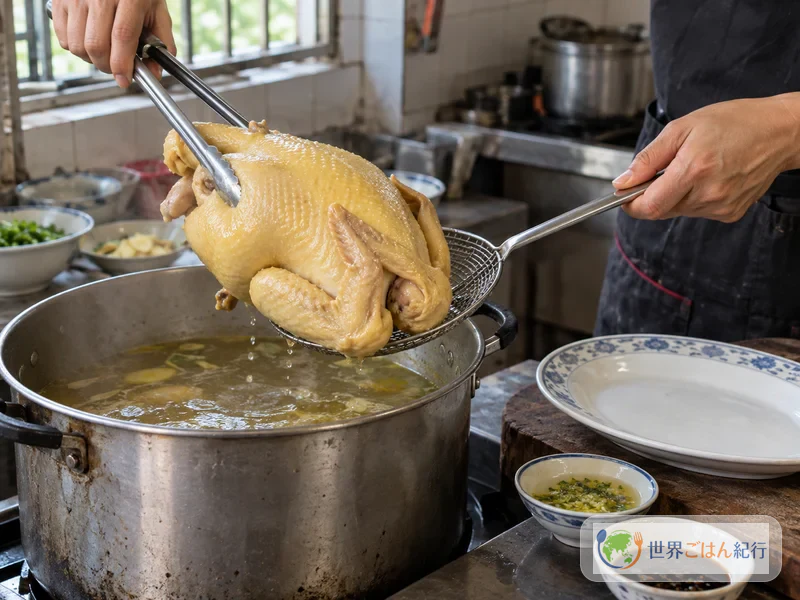
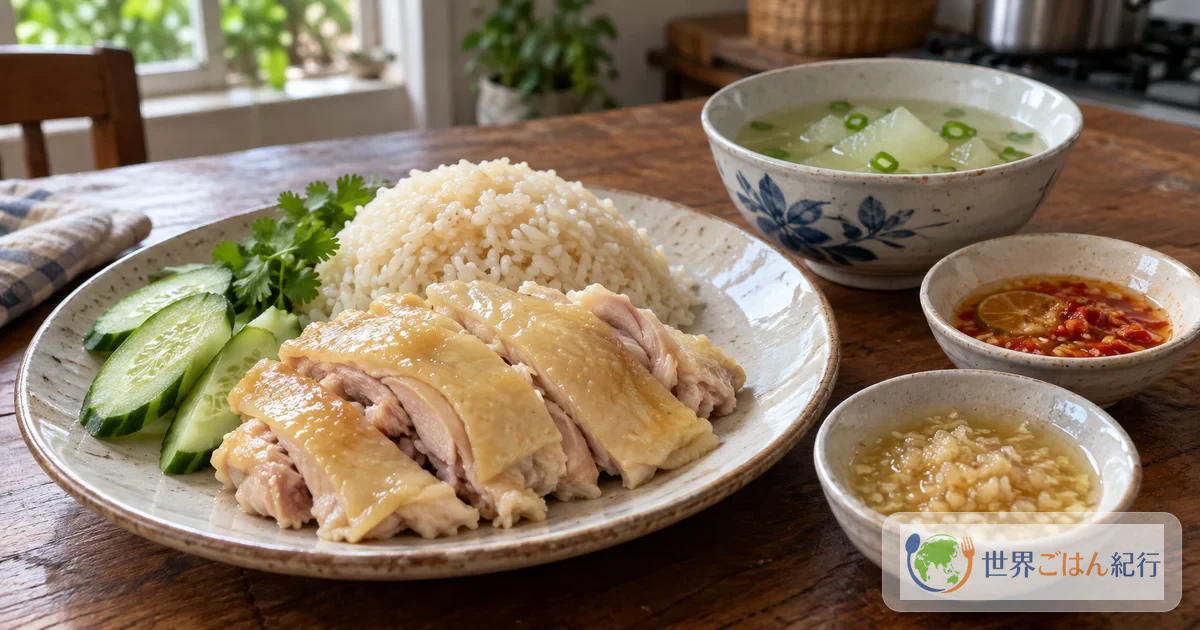
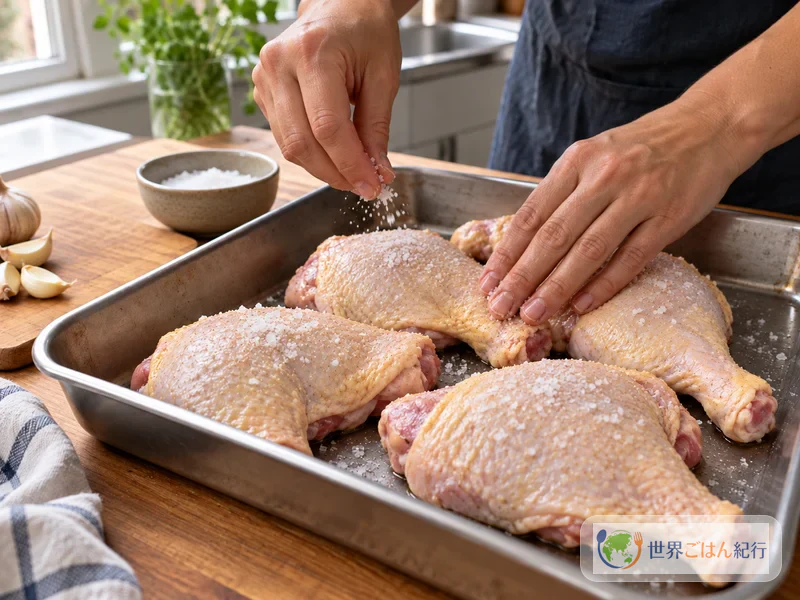
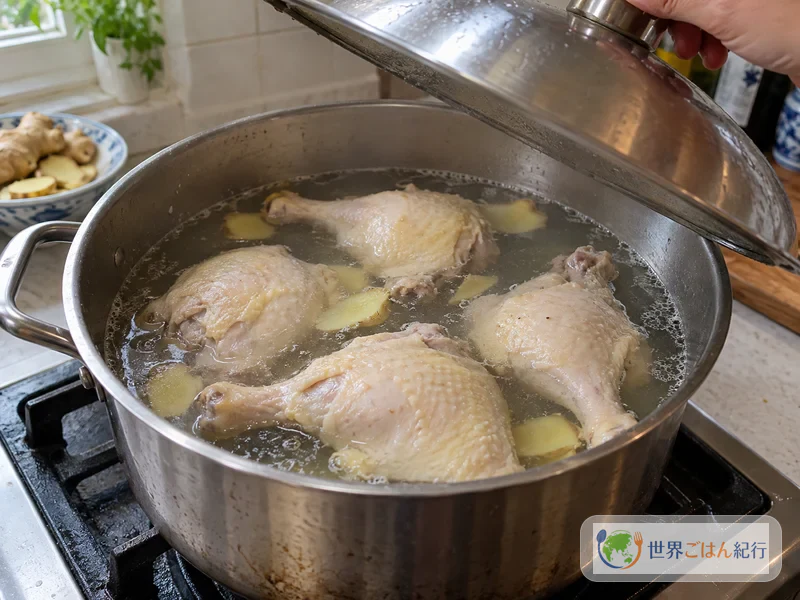
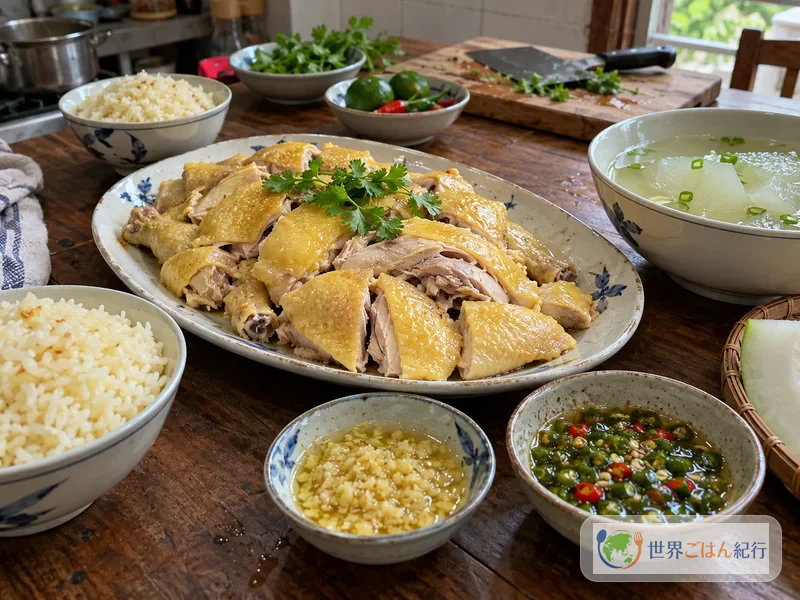
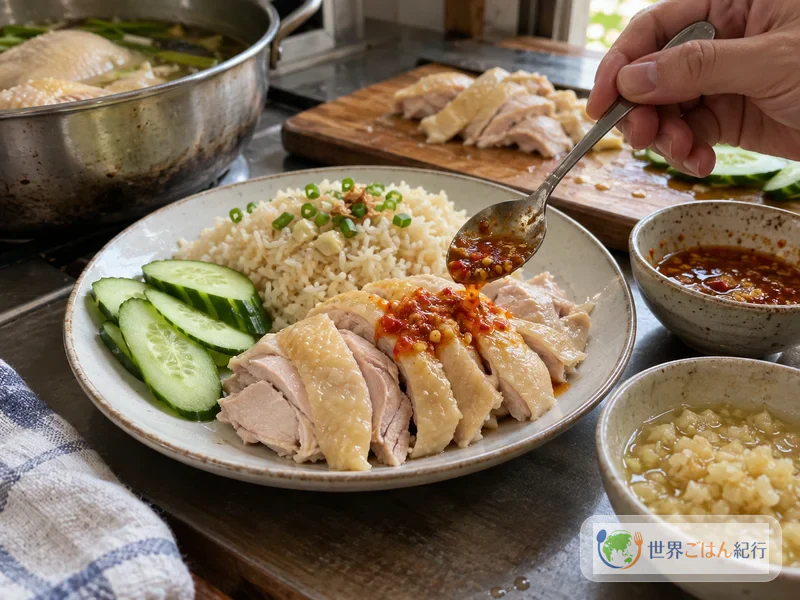
In a riverside kitchen, water over a wood fire shivers just below a boil. When Saveur visited Wenchang in 2016, the midday routine went like this: a chicken whose cavity had been rubbed with salt and ginger was lowered into the water, lifted out, and chopped whole into bite-size pieces, then served with a sauce of ginger, garlic, red chili and sesame oil brightened with calamansi juice. The big platter held the sliced poached chicken, rice cooked in chicken fat, and small dishes of sauce.
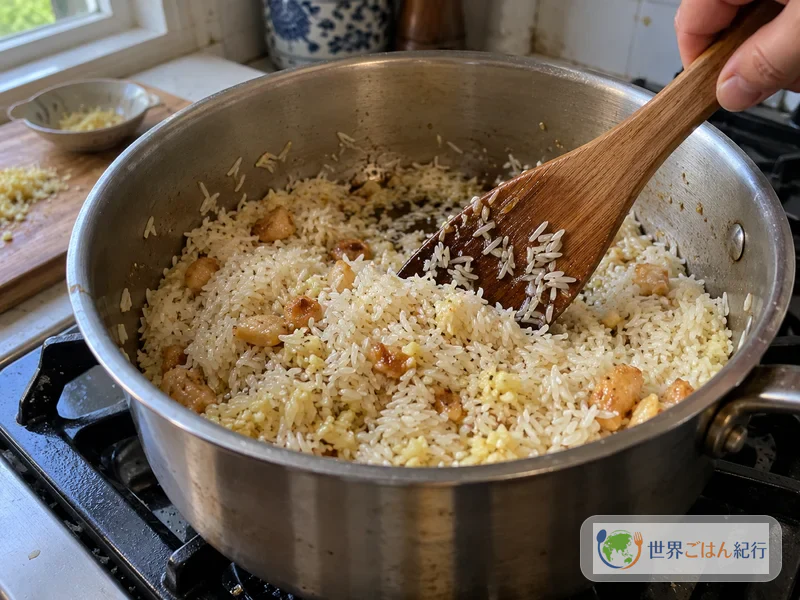
Wenchang chicken (文昌鸡) is both a breed of chicken from Wenchang on Hainan island and the name of the dish made with it. The birds eat coconut and peanut-pressing leftovers, and they are prized for tender meat and a good layer of fat. Poach one, cook rice in the broth, put the two together, and you have what is called chicken rice (鸡饭, written 文昌鸡饭 in Hainan). Thailand's khao man gai and Singapore's Hainanese chicken rice are sister dishes that spread from this home of chicken rice.
Cooking it in a home kitchen means clearing two hurdles. The first is the bird itself: Wenchang chicken is hard to find outside Hainan, so we substitute a good grain-fed chicken (the SBS recipe also suggests corn-fed chicken). The second is heat. Overcooking wipes out what makes poached chicken (bai qie) so good, the fatty skin and moist meat, so overcooking is the enemy. You avoid it with the barest simmer, residual heat and a check of the internal temperature. This home version uses four bone-in chicken thighs (about 1.2 kg); the FAQ covers a whole chicken.
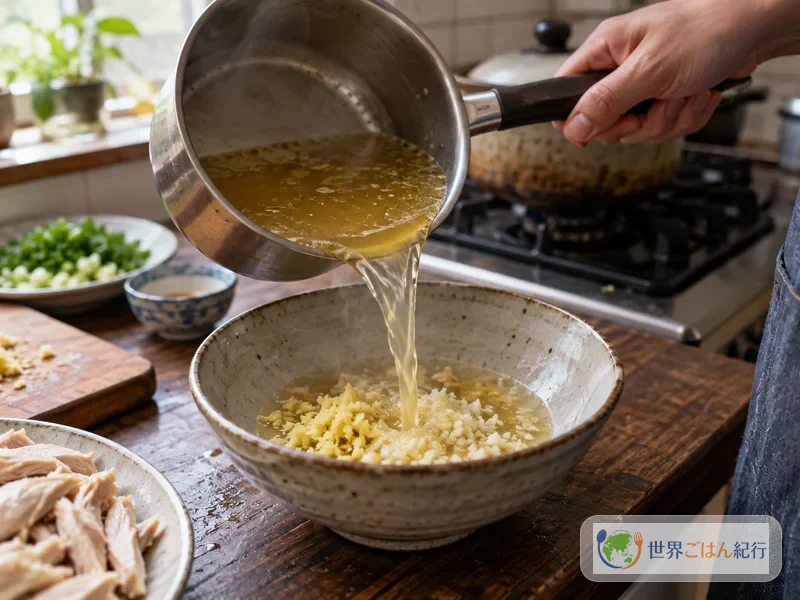
The plate is built from four parts: chicken, chicken-fat rice, two sauces and a clear soup. Thailand's version has a single fermented-soybean sauce and Singapore's has three, so two sauces is what gives this plate its character. The poaching liquid from one bird is used up in three portions: for the rice, for the sauce and for the soup.
The home of chicken rice: coconut-pecking birds and a table that sailed south
Hainan is China's southernmost island, and Wenchang is a town in its northeast. According to the raising practices Saveur confirmed on a Wenchang farm, Wenchang chickens run free and peck at coconuts. Besides coconut they eat rice, peanut cake (the pressed leftovers from peanut oil) and yam. The SBS profile also lists corn and sweet potato in the feed. An adult bird weighs about 1.4 kg (about 3 lb), smaller than an American broiler (over 4 lb). Saveur's tasting notes describe a yellowish, fatty skin with a springy bite.
In the SBS recipe introduction, Wenchang chicken is counted among Hainan's four famous delicacies. The traditional method is bai qie, poaching: the bird is held in nearly boiling water to keep it tender and eaten with a sauce of ginger, garlic and salt.
Still, poaching being favored doesn't mean bai qie is the only right way, and that is part of what makes the region interesting. Saveur's reporting notes a fried version in which poached chicken is stir-fried in peanut oil and dark soy, and a salt-baked chicken buried in a mound of salt. Saveur visited Wenchang in 2016 and spoke with Sung Shen Mei, owner of a chicken rice eatery that says it has been running since 1927. Local plates sometimes include clotted chicken blood or gizzards, which you can skip in a home version.
From the 19th into the 20th century, many people left Hainan for Nanyang, the South Seas (Singapore, Malaysia and elsewhere), and many of them took up work in food and lodging. According to Saveur and Duncan Lu's article for SBS Food, Wenchang chicken rice developed in many places as Hainanese chicken rice after leaving the island. Chicken rice bloomed after it left the island. In Singapore it grew into a national dish as Hainanese chicken rice (in Japanese), and in Thailand it took root as khao man gai (in Japanese). Duncan Lu's SBS Food article says southern Vietnam also has a line of it, com ga Hai Nam. Pho ga, where the poached-chicken broth is served with noodles, is another Vietnamese dish that treasures the poaching liquid.
Bai qie means "cut white": a way of poaching without adding color and then cutting the bird up. Wenchang chicken rice is written 文昌鸡饭 in Chinese, and Hainanese chicken rice (海南鸡饭) is the name it took after leaving the island. Thailand's khao man gai means "chicken-fat rice." The chicken rice tradition travels under different names in different languages.
Calamansi is a small citrus whose aroma sits between lime and kumquat. According to Saveur, Wenchang eateries squeeze it into the sauce in place of vinegar. The SBS recipe offers kumquat as a substitute for calamansi and also describes a preserved sauce of calamansi and chili kept in salt for two weeks. Lime, kumquat, yuzu or sudachi can stand in. Their acidity is sharper in different ways, so start with a little and add more.
Ingredients (serves 4)
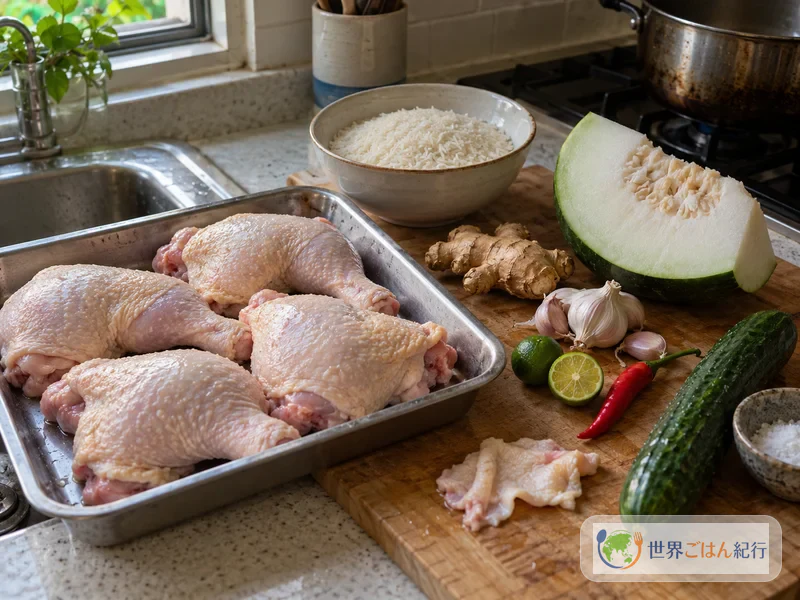
This is a standard recipe adjusted for home cooks, made with four bone-in, skin-on chicken thighs. The salt is rubbed into the chicken rather than added to the water, so the poaching water stays unsalted. Use the broth in portions: 400 ml for the rice, 120 ml for the sauce, and the rest for the soup. The nutrition values shown are per-serving estimates calculated from this ingredient list, not measured values.
Cook meat to 75°C (167°F) at the center for at least 1 minute as a guide to preventing food poisoning (Japan's Ministry of Health, Labour and Welfare). Keep juices from raw meat away from foods eaten raw and foods already cooked. Wash knives and cutting boards that touched raw meat, then pour boiling water over them. If you stop cooking partway, put the food in the refrigerator, and cook it thoroughly when you resume.
Method
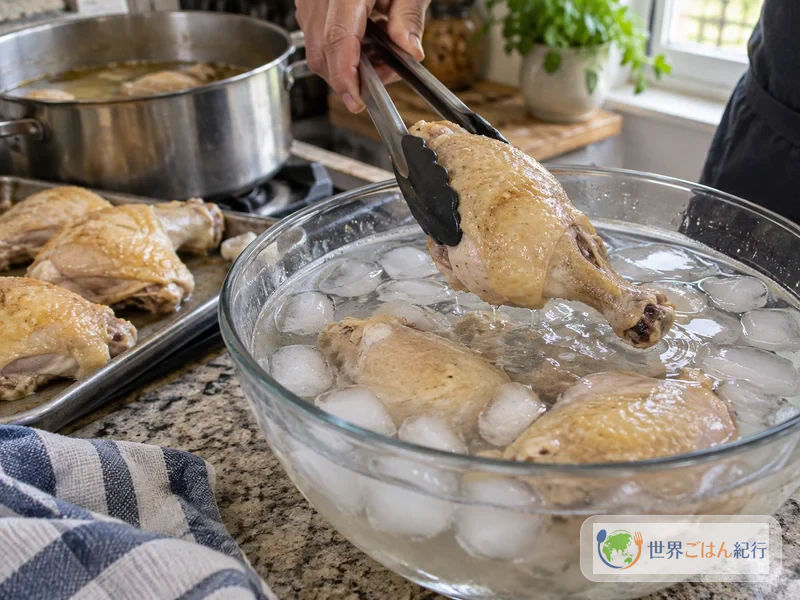
If you work on the rice and sauces while the chicken poaches, you can have it on the table in about 1 hour 40 minutes. Split the poaching liquid into 400 ml for the rice, 120 ml for the sauce, and the rest for the soup.
Fixing what goes wrong
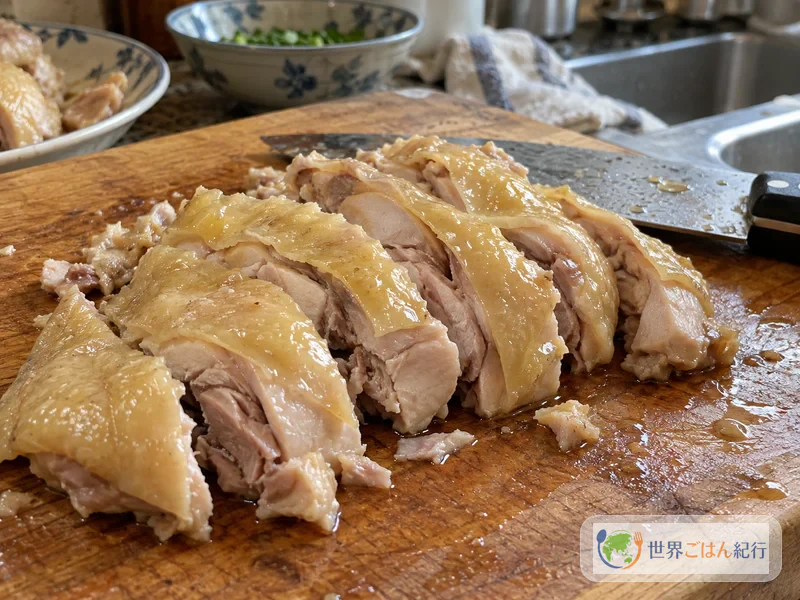
Poaching problems fall into three groups: chicken, rice and sauce. Most failures come down to heat and liquid, and the fix is almost always in one of three places: the heat under the pot, the amount of broth, or the fat in the sauce.
The chicken is tough or the skin has split
The cause is boiling. A hard, rolling boil shrinks the meat and splits the skin. Bring the water back down to the barest simmer and give the chicken time to finish in residual heat, not at a boil. Check the center temperature, and if it's short, add 5 minutes at a time on low heat.
The rice is sticky
The cause is too much broth or rice that wasn't drained well. As soon as it is cooked, fluff it from the bottom of the pot, and next time use 1 tbsp less broth. Short-grain rice turns sticky easily, so cut back on liquid and don't skip the step of stir-frying the rice before cooking.
The sauce is watery
The cause is broth with no fat in it. Skim the broth again, taking the fat along with it, and it recovers. If there still isn't enough fat, add 1 tsp chicken fat. Taste after pouring and add salt then; adding it first makes the sauce too salty when there's little fat.
You can't find sudachi, or the citrus is bitter
Calamansi juice, kumquat (the substitute the SBS recipe suggests), yuzu or lime will work. Bitterness comes mostly from the seeds and peel, so remove the seeds before squeezing and don't squeeze the sudachi segments whole. If the acidity is too strong on a given day, add it from 1 tbsp and taste.
Store the leftovers separately and they stay good until the next day
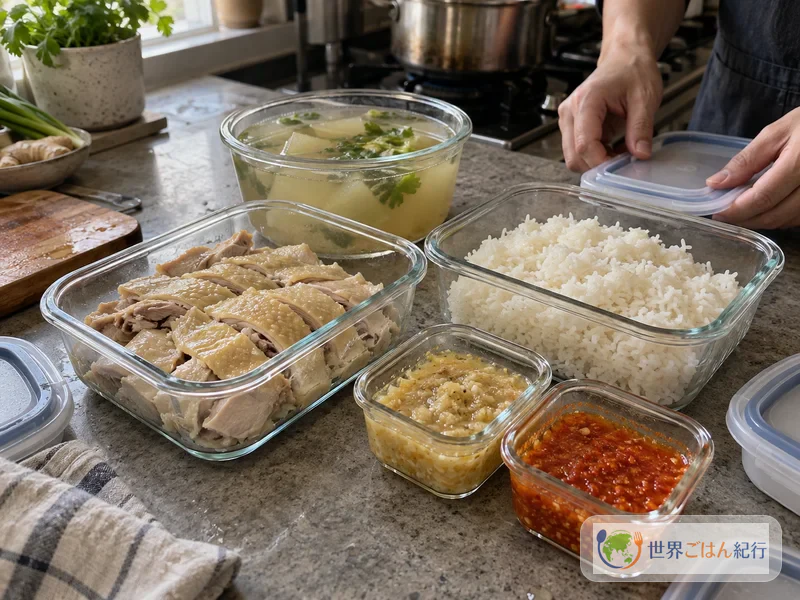
The chicken, rice, two sauces and soup should not go into one container; keep them apart and cool them quickly. Once the steam has gone, portion them into shallow containers and cool them fast (Japan's Ministry of Health, Labour and Welfare). The UK's FSA advises getting food into the refrigerator within 1-2 hours of cooking. The refrigerator should be at 0-5°C, and leftovers should be eaten within 48 hours (2 days) or frozen (FSA). Finish cutting boards and knives with boiling water (Japan's Ministry of Health, Labour and Welfare).
When reheating, heat to at least 75°C at the center (Japan's Ministry of Health, Labour and Welfare). Warm the chicken gently with 2 tbsp of broth spooned over it, and reheat the rice with just a mist of water. Scoop sauces out with a clean spoon and use them up soon. Leftover broth can be frozen and used as stock for stir-fries (adapted from Duncan Lu's SBS Food recipe). You can also slice the chicken cold and eat it salad-style with the sauces and cucumber, but keep that separate from a day when you reheat it.
The next day, fried
The next day, fried. In Wenchang there is a fried version in which poached chicken is stir-fried in peanut oil and dark soy (Saveur's reporting). At home, cut leftover chicken into bite-size pieces, heat 2 tbsp peanut (or neutral) oil, sear skin side down for 2-3 minutes, and toss in 1 tbsp dark soy sauce. The amounts are a home-cooking guide. It's done when the edges of the skin turn crisp and the sweet-salty soy smells good.
Tasting it against its siblings
The sister dishes of chicken rice are easiest to tell apart by the number of sauces. Cucumber and a clear soup are plenty on the side. A sour little dish suits chicken rice better than adding a heavy stir-fry.
| What you want to taste | Matching article | Character of the sauce |
|---|---|---|
| Three sauces, changing with every bite | Hainanese chicken rice (in Japanese) | Chili, ginger and dark soy served separately |
| A deep fermented-soybean sauce to wake up mild chicken | Khao man gai (in Japanese) | The punch of tao chiao, ginger and vinegar |
| The poaching broth with noodles | Pho ga | Sends the chicken's aroma into the soup |
Frequently asked questions
Q1. Can I make it with a whole chicken?
Yes. SBS's original recipe poaches two whole chickens of about 1.7 kg each for 45 minutes. For a home kitchen, a whole chicken of about 1.3 kg needs roughly 35-40 minutes plus 15 minutes of resting. Rub salt and ginger into the cavity (the method of Wenchang eateries, per Saveur). Check for 75°C at the center in a thick spot such as where the leg meets the body. A thermometer gives peace of mind.
Q2. Can I get Wenchang chicken?
Outside Hainan, Wenchang chicken is hard to find. A grain-fed (corn-fed) chicken is considered a close substitute (a note in the SBS recipe). Grain-fed chicken is the substitute; choose bone-in, skin-on meat with a good layer of fat. The skin's fat and the moist meat are the heart of bai qie. When you have a premium-brand bird, poach it for a shorter time and add time as you check, which makes failure less likely.
Q3. Do I use all of the poaching liquid?
Yes. Divide the strained liquid into 400 ml for the rice, 120 ml for the sauce, and the rest for the soup. For the sauce, take the liquid with its surface fat; for the soup, use the clearer liquid from the middle. Leftover broth freezes well and can be used as stock for stir-fries (adapted from Duncan Lu's SBS Food recipe).
Q4. How is it different from khao man gai?
The number of sauces is the core difference. Wenchang chicken rice has two dishes, a hot sauce and a citrus sauce used in place of vinegar. Khao man gai has a single sauce of tao chiao (fermented soybeans). For the rice, Wenchang chicken rice cooks it only with chicken fat, ginger, garlic and salt, while khao man gai is also a chicken-fat rice but seasons it differently. Some Hainan cooks skip the ice water. For a fuller side-by-side, see the khao man gai article (in Japanese).
Sources
- SBS Food "Wenchang chicken" (Adam Liaw, Destination Flavour China) (Checked: rubbing salt over the whole bird for 10 minutes, lowering it into the water up and down, 45 minutes at the barest simmer, 15 minutes in ice water and 5 minutes less poaching if the ice bath is skipped, the sauce made by pouring hot poaching liquid, kumquat as a substitute, and the description of Hainan's four famous delicacies. Accessed and checked 19 October 2026 JST)
- SBS Food "From Hainan to Saigon: How Hainanese chicken took flight" (Duncan Lu) (Checked: the Wenchang chicken feed and breed, the migration routes, the method of cooking rice in chicken fat and poaching liquid, and freezing leftover broth. Accessed and checked 19 October 2026 JST)
- Saveur "The World's Best Chicken Comes From Hainan" (Kevin Pang) (Checked: the scene in a Wenchang eatery, the eatery founded in 1927 and its owner's account, the method of rubbing salt and ginger into the cavity, the sauce of ginger, garlic, red chili, sesame oil and calamansi, the fried version and salt-baked chicken, and the farm feed and adult bird weight. Accessed and checked 19 October 2026 JST)
- Ministry of Health, Labour and Welfare (Japan) "Preventing food poisoning at home" (Checked: cooking to 75°C at the center for at least 1 minute, managing raw meat juices, boiling water for knives and cutting boards, cooling in small shallow portions, and reheating to 75°C or higher. Accessed and checked 19 October 2026 JST)
- Food Standards Agency "How to chill, freeze and defrost food safely" (GOV.UK) (Checked: refrigerator at 0-5°C, chilling within 1-2 hours of cooking, and eating leftovers within 48 hours or freezing them. Accessed and checked 19 October 2026 JST)
- Supplementary: Wikipedia "Wenchang chicken" (Checked the breed, the name bai qie, the yellowish skin, and lineage. Not used as a main basis for the text. Accessed and checked 19 October 2026 JST)
- Supplementary: Wikipedia "Hainanese chicken rice" (Checked alternate names, the 文昌鸡饭 spelling, and the name khao man gai. Not used as a main basis for the text. Accessed and checked 19 October 2026 JST)