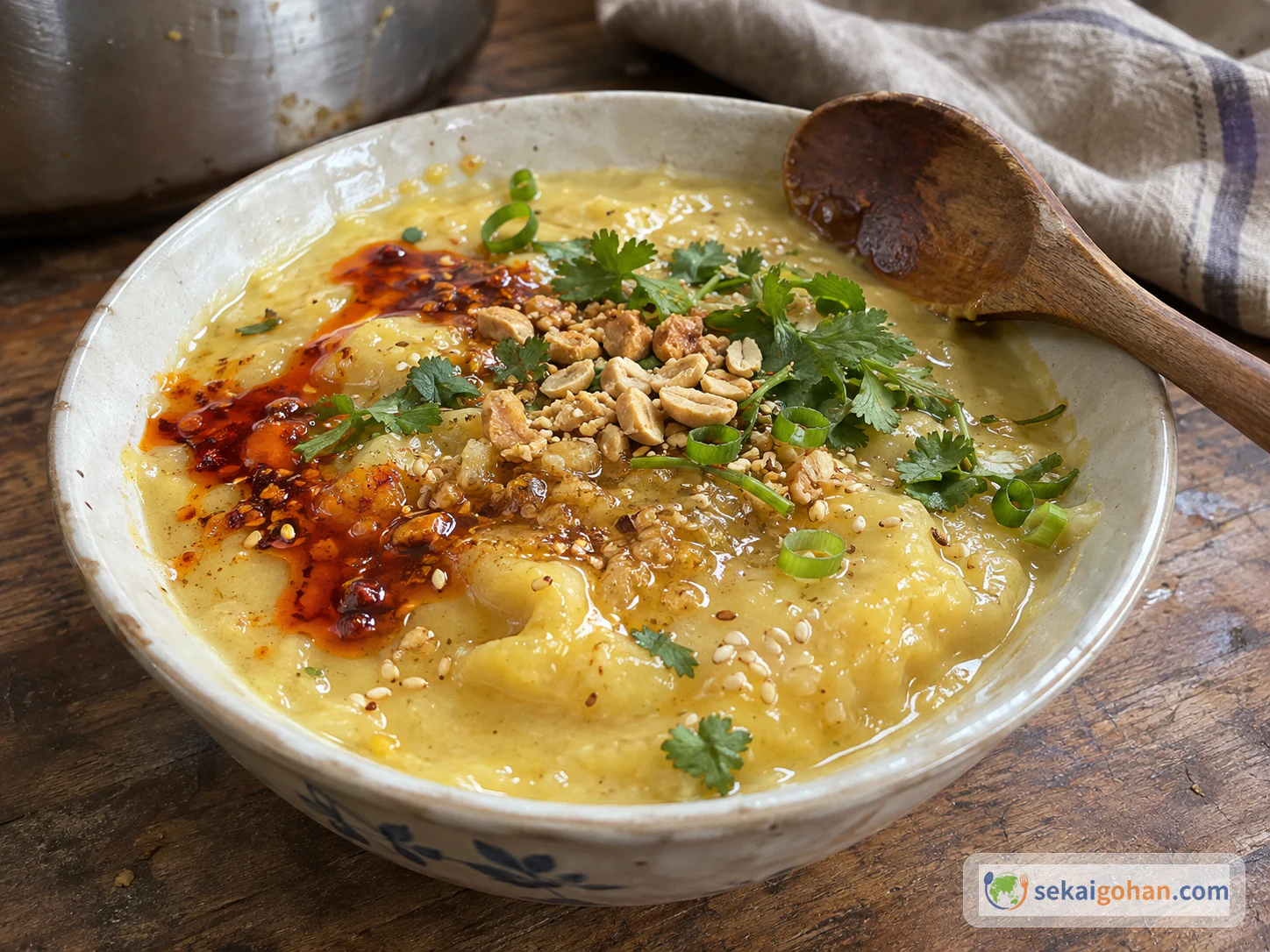
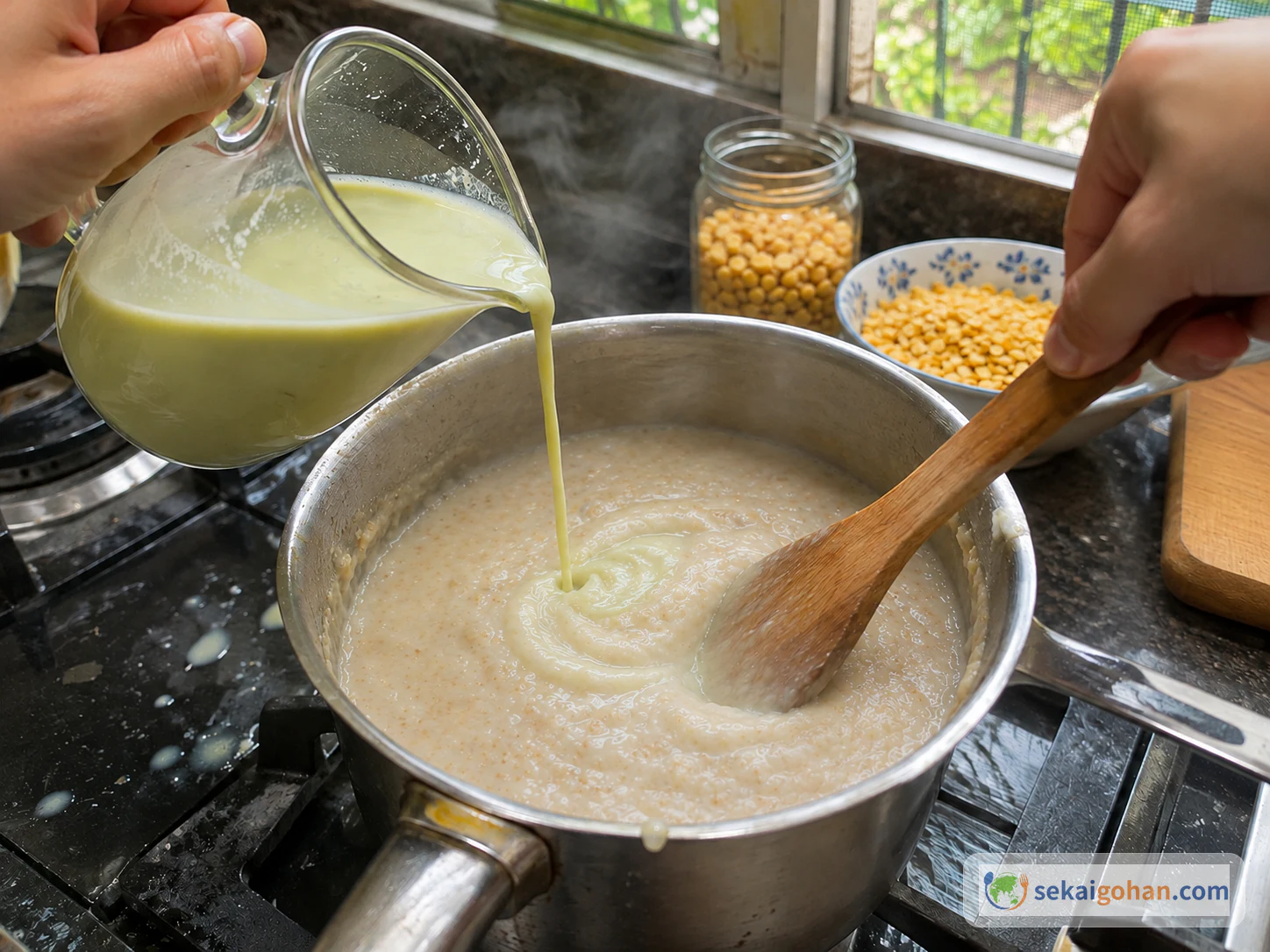
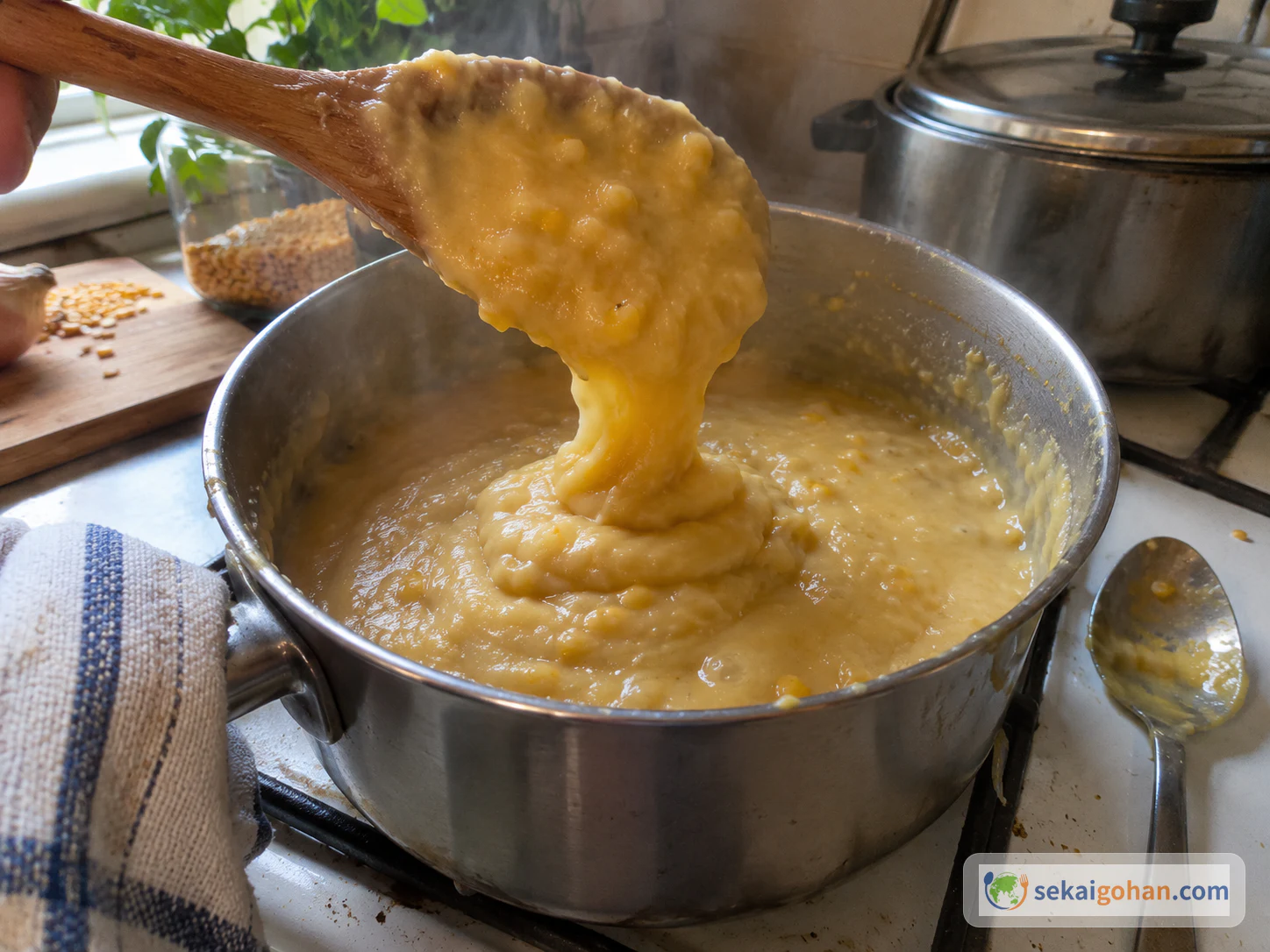
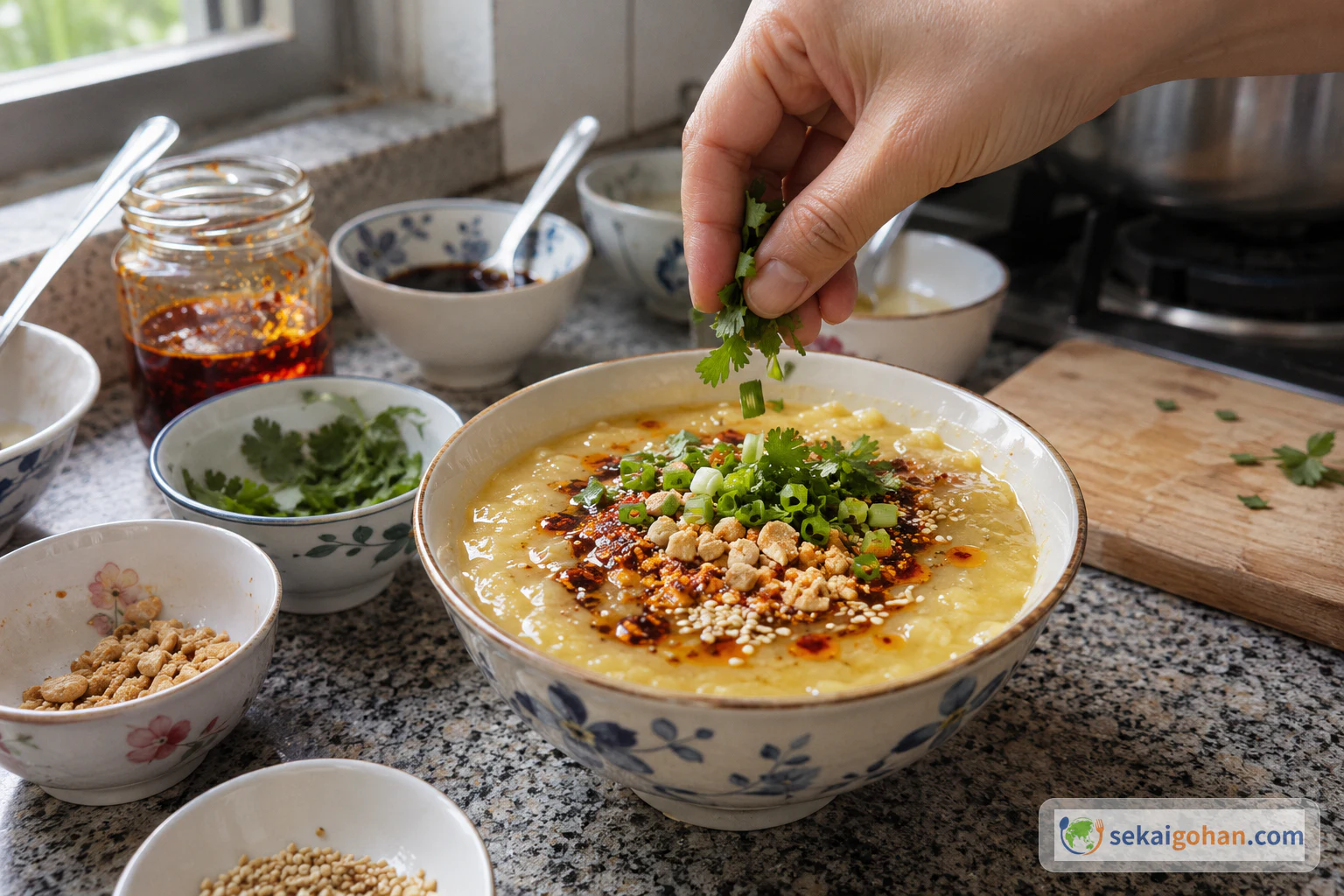
Lift the wooden spatula out of the pot and the porridge falls back in a slow, glossy ribbon that folds onto itself instead of sinking flat. That is the moment the pot is ready. Xidoufen (稀豆粉) is a hot porridge of yellow split peas from Yunnan in southwest China, a breakfast staple in Kunming and Tengchong. It tastes of sweet, toasty peas under a slick of red chili oil, with garlic oil, sharp ginger water, crushed peanuts and a handful of cilantro and scallion stirred through at the table.
In Tengchong, many people start the day with a bowl. There it comes out golden and fine on the tongue, and people either stir their condiments straight in or eat it with flatbreads, rice noodles or fried dough sticks.
Yunnan's Pea Country and the Bowl That Starts the Day
Peas run through the cooking of central, southern and western Yunnan, and the belt carries on across the border into the Shan State of Burma. The same yellow split pea becomes several different foods along that belt: a set jelly, noodles, fried snacks, and this hot porridge. Xidoufen can be made three ways: from whole peas that are soaked, ground, washed, settled and cooked; from instant pea flour; or from skinned split peas, which is the method below.
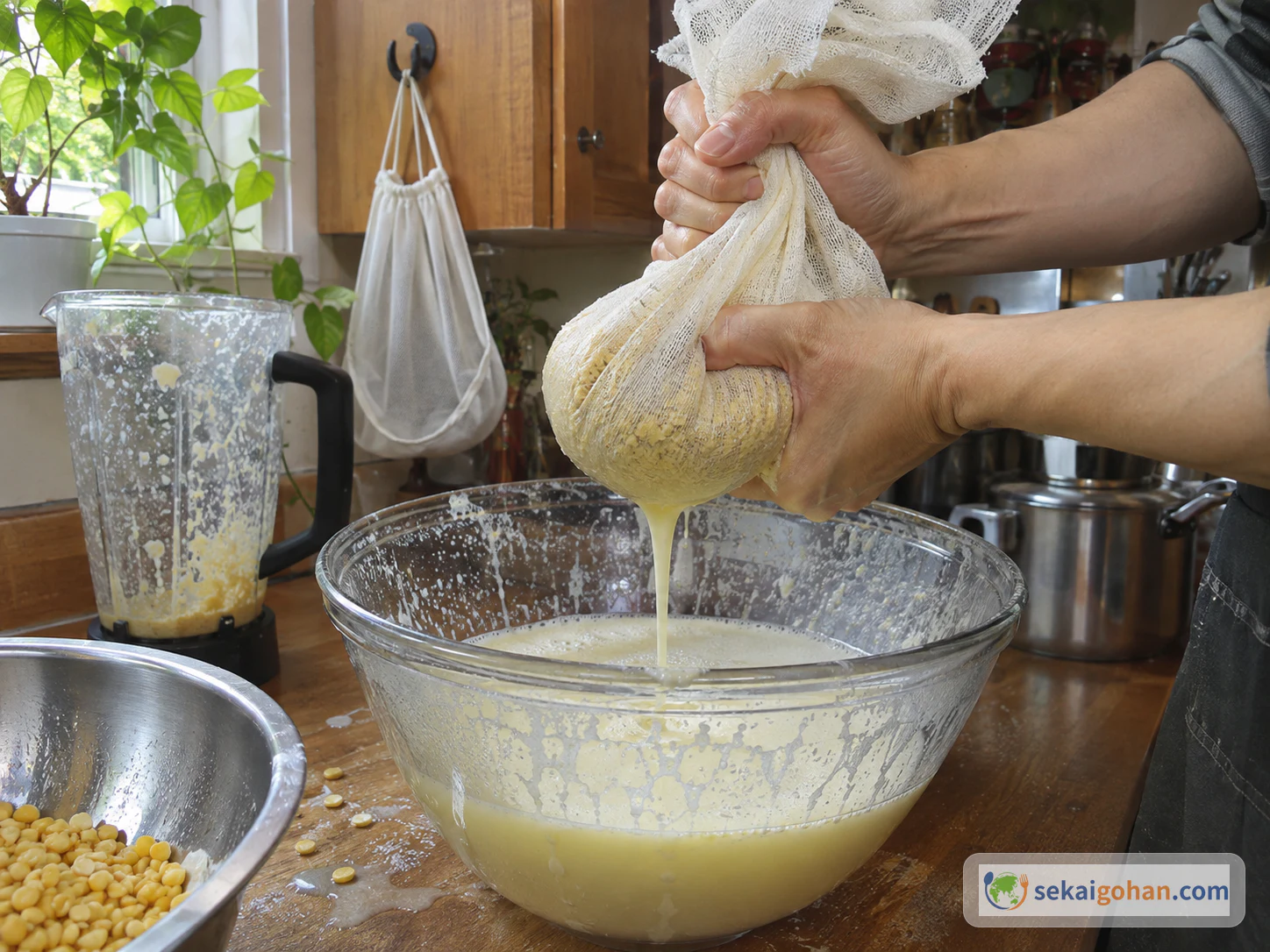
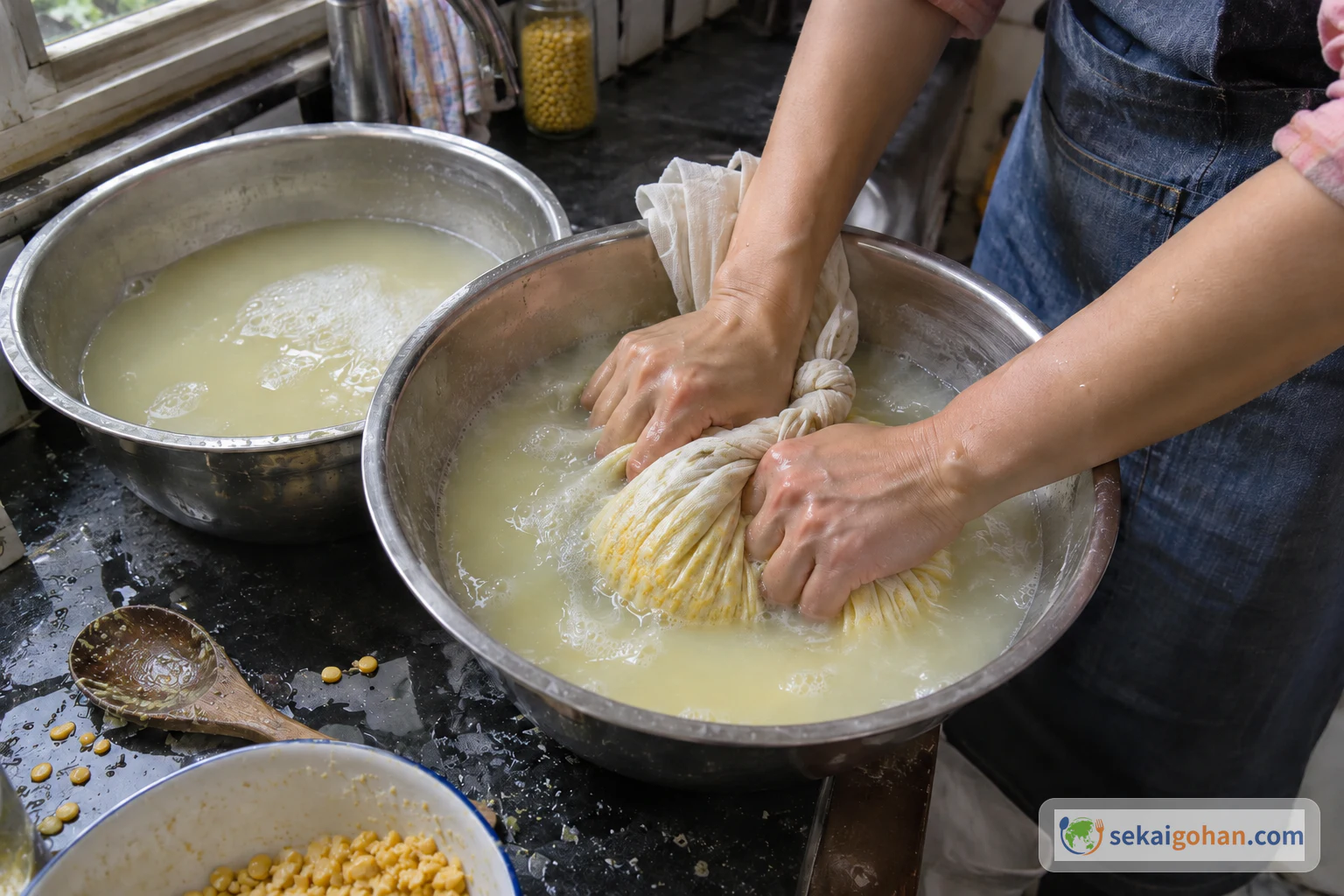
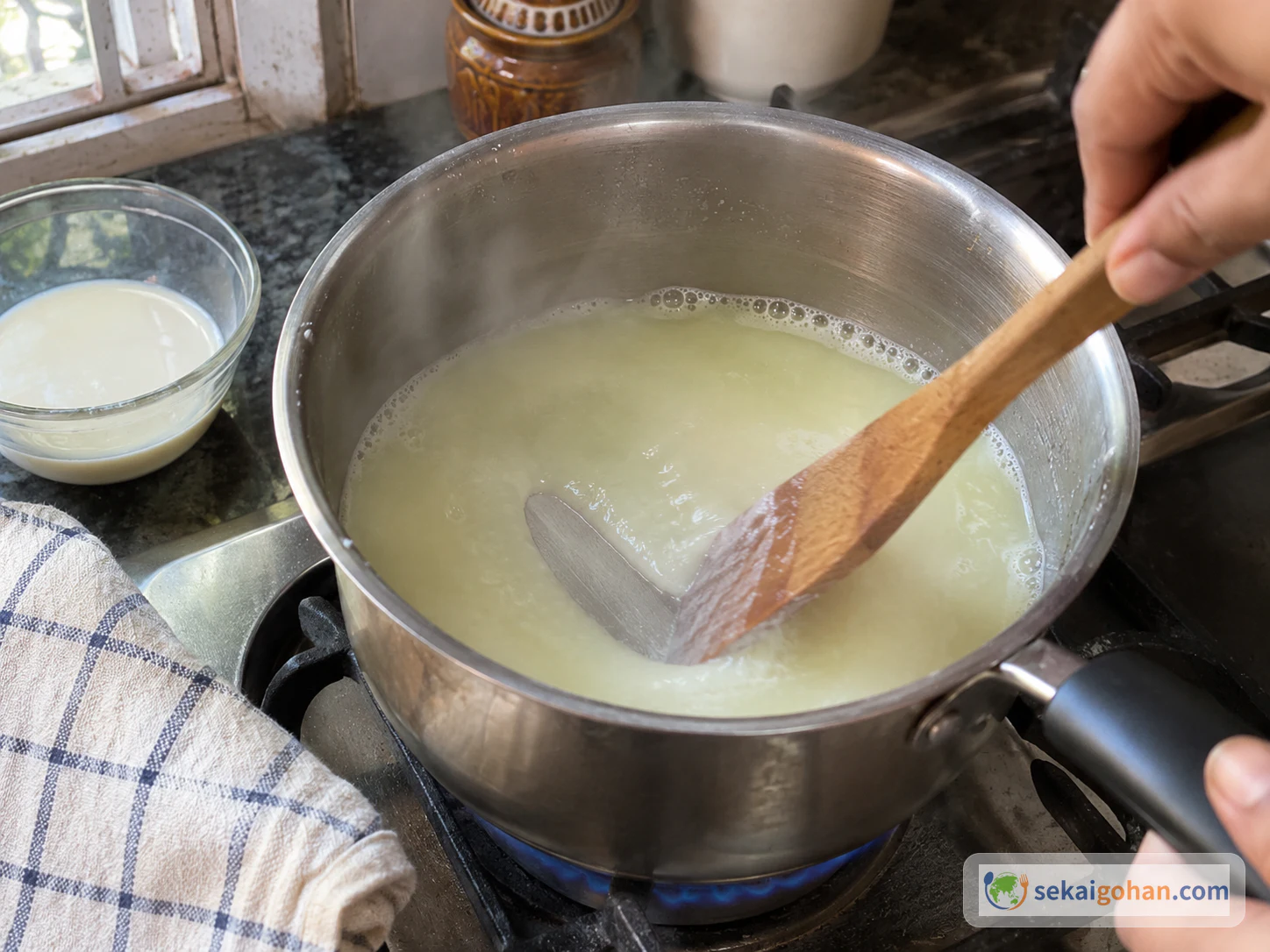
The structure is always the same. Soaked peas are ground with water and strained, and the pulp is washed to pull out the last of the starch. The thin washing liquid goes into the pot first, and the thick, starchy milk follows a thread at a time. Tengchong cooks build it this way with a hanging slurry, preparing a clear slurry and a thick slurry separately before they meet in the pot.
稀 means thin or runny and 豆粉 means pea flour, so the name reads as "thin pea flour". In Jingdong and elsewhere around Pu'er it goes by xixifen (稀稀粉), and in Tengchong it is sold as Tengchong xidoufen.
Xidoufen and wandoufen
Search for the dish and wandoufen (豌豆粉, also 豌豆凉粉) turns up beside it. Both come from the same peas. Cooked thinner and eaten hot, it is xidoufen; cooked thicker, strained through cloth and left to set, it is wandoufen, a yellow pea jelly sliced and eaten cold. Leftover xidoufen also firms up as it cools and gets eaten with the same condiments, so in a home kitchen the line between the two blurs. The craft of Chenggong wandoufen, the jelly, entered Kunming's third list of intangible cultural heritage in 2010. Pu'er listed xidoufen itself as city heritage in 2020, a separate food and a separate year.
Around the province
Tengchong mornings pair xidoufen with ersi, the local rice noodles, and a grilled erkuai rice cake on the side. At the 2018 Spring Festival, Tengchong xidoufen, with Mucui Xidoufen as its best-known name, appeared in episode 2, "Fragrance" (香), of A Bite of China. Tengchong condiments run to cilantro, soy sauce, chili, Sichuan pepper oil and the brine from fermented tofu.
In Jingdong Yi Autonomous County, part of Pu'er, the peas are soaked ahead, ground, left to settle and cooked with careful heat. The heat and the stirring drive off the raw beany smell and leave the pea fragrance. It is eaten with flat rice noodles (migan), round rice noodles, youtiao or plain rice, with sesame, peanuts, garlic chives and bean sprouts on the side. In Pu'er, Wang Hong, a Yi cook, has kept making it, and one account traces the dish to the Central Plains in the Hongwu reign of the Ming (1368–1398), carried to Yunnan by migrants and kept by the Yi. Where it first began is not settled.
The dish has also travelled with families. Peng Shuhua, born in Shuangjiang County in Yunnan, left via Mae Sai in Thailand and reached Guangfu in Hualien, Taiwan, around 1970. At home Peng soaks and grinds the peas, lets the liquid settle into clear slurry and sunken starch, boils the clear part and adds the starch bit by bit. The porridge goes over rice noodles, two ladles to a bowl, with vinegar water, garlic oil, chili oil and an oil of Sichuan pepper and caoguo. Peng never measures, cooking with whatever container is at hand, and cannot put the ratio into numbers. For more from across the country, see the China country page.
Ingredients
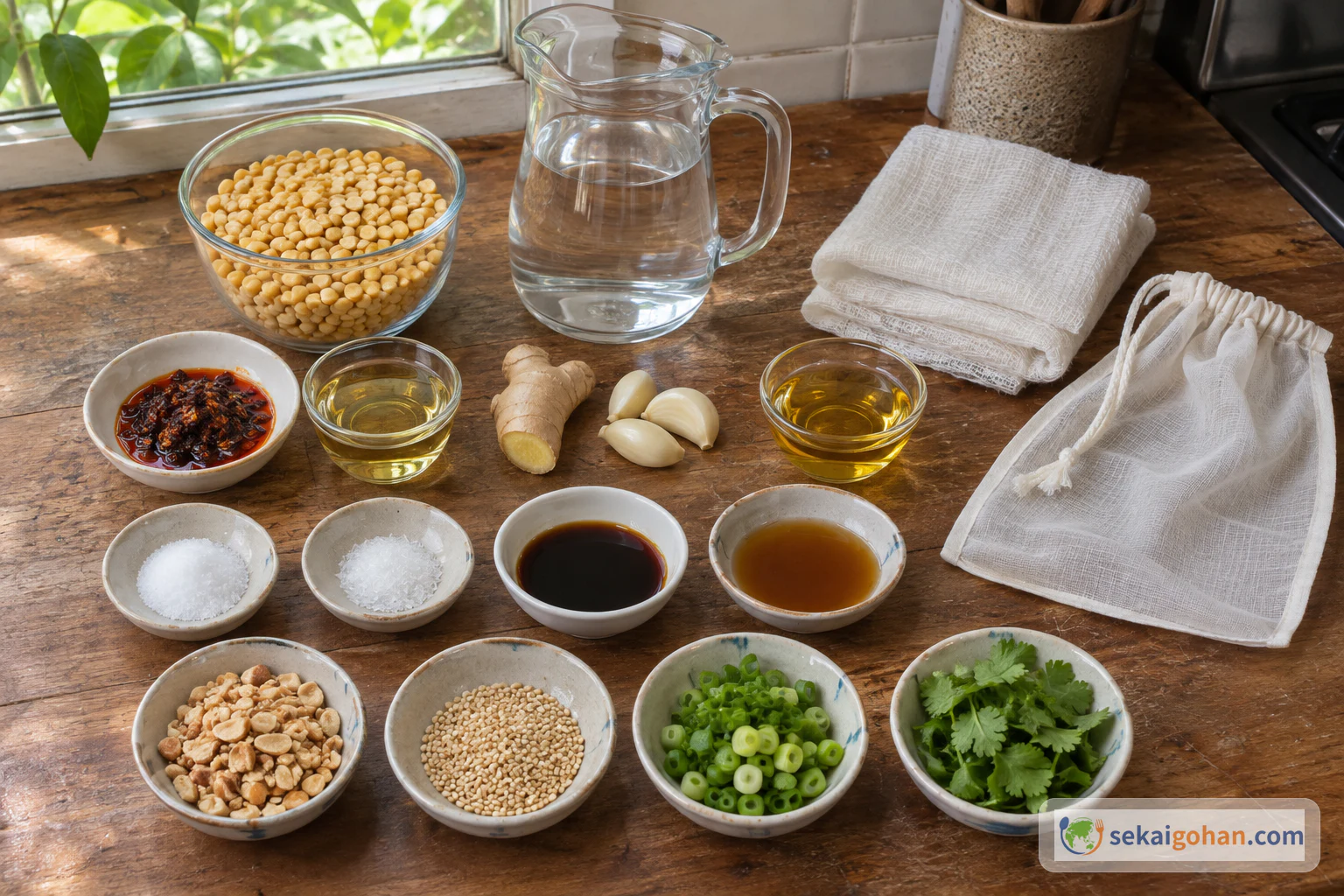
The porridge itself is only peas and water, weighed on a scale. Salt never goes into the pot: it belongs to each bowl. The chili oil and garlic oil make more than one bowl needs.
This dish contains peas (a legume), peanuts (crushed peanuts and peanut oil), sesame, and soy (light soy sauce). Some Lao Gan Ma products contain soybean oil and wheat. Check the ingredient label on everything you buy.
Equipment
- Kitchen scale
- Bowl and sieve for soaking and draining
- Blender
- Nut milk bag, or cheesecloth folded double
- Heavy saucepan
- Wooden spatula that reaches the corners of the pot
- Small pan for the chili oil and garlic oil
- Grater for the ginger
Choosing and Substituting
Yellow split peas are sold as split peas or yellow split peas in supermarkets, import grocers and online. Green split peas work the same way and give a porridge tinted pale green instead of gold. Canned or frozen cooked peas do not work: the whole method depends on washing raw starch out of ground peas.
Never thicken with potato starch, cornstarch or rice flour. The result has no pea flavor or pea protein and turns into a different food. Chinese pea flour (豌豆粉, yellow pea flour) is a real shortcut, covered in the questions below; Indian split pea flour (dal flour) is a different product.
Lao Gan Ma is sold at Chinese grocers and online. Without it, use a crunchy chili oil with some dried chili; the aroma changes, and some products are saltier, so taste before the full spoonful. Chinese light soy sauce is lighter and thinner than an all-purpose soy sauce; if you only have the latter, use the same ½ tsp, with a darker color and stronger smell. Vegetable oil stands in for peanut oil with a weaker toasty note, but not sesame oil, whose aroma takes over. MSG can be left out, leaving the bowl less savory. If cilantro is not for you, use scallion alone. Ersi and erkuai are hard to find outside Yunnan; dried round rice noodles (mixian) and frozen youtiao are the closest buys.
Method
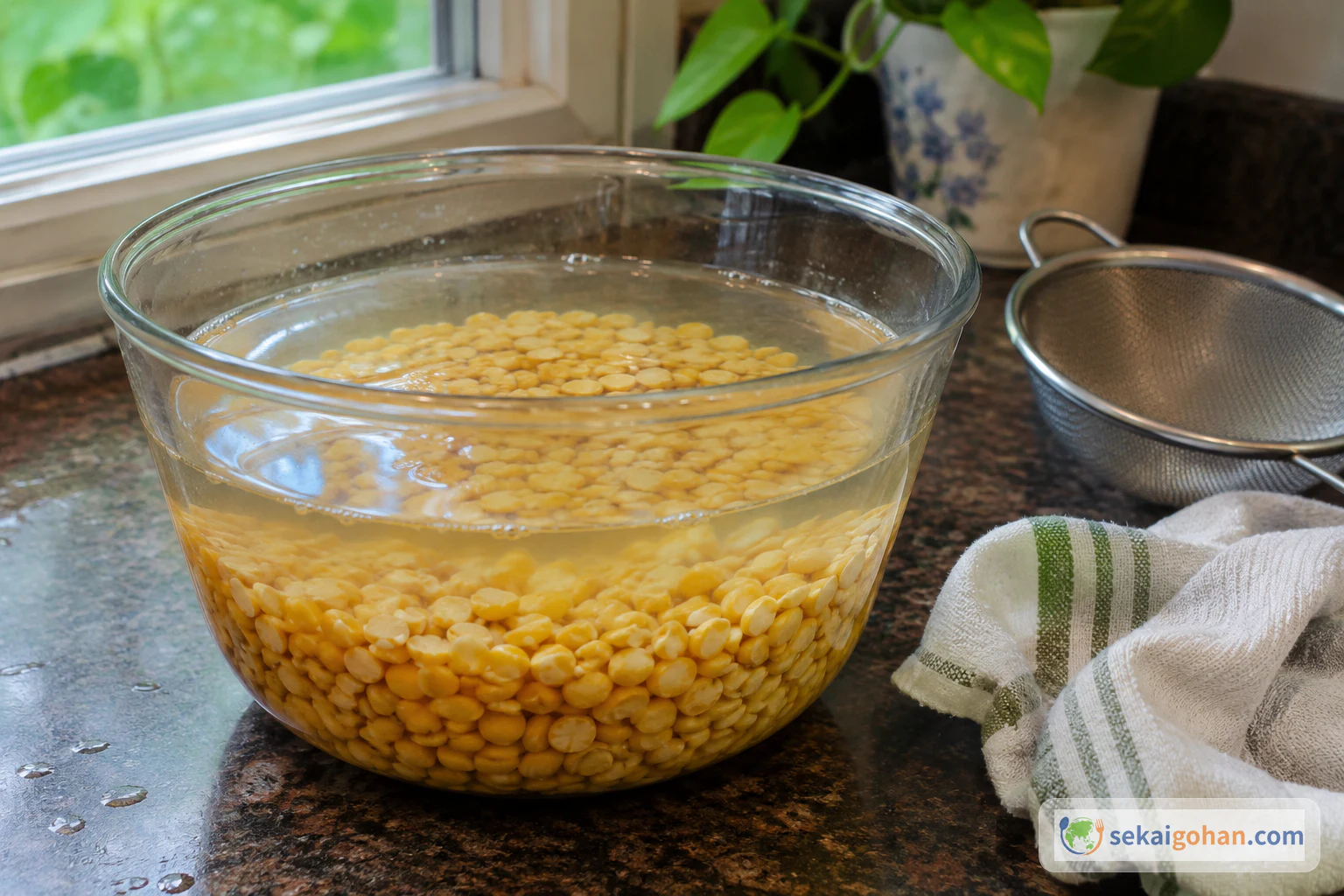
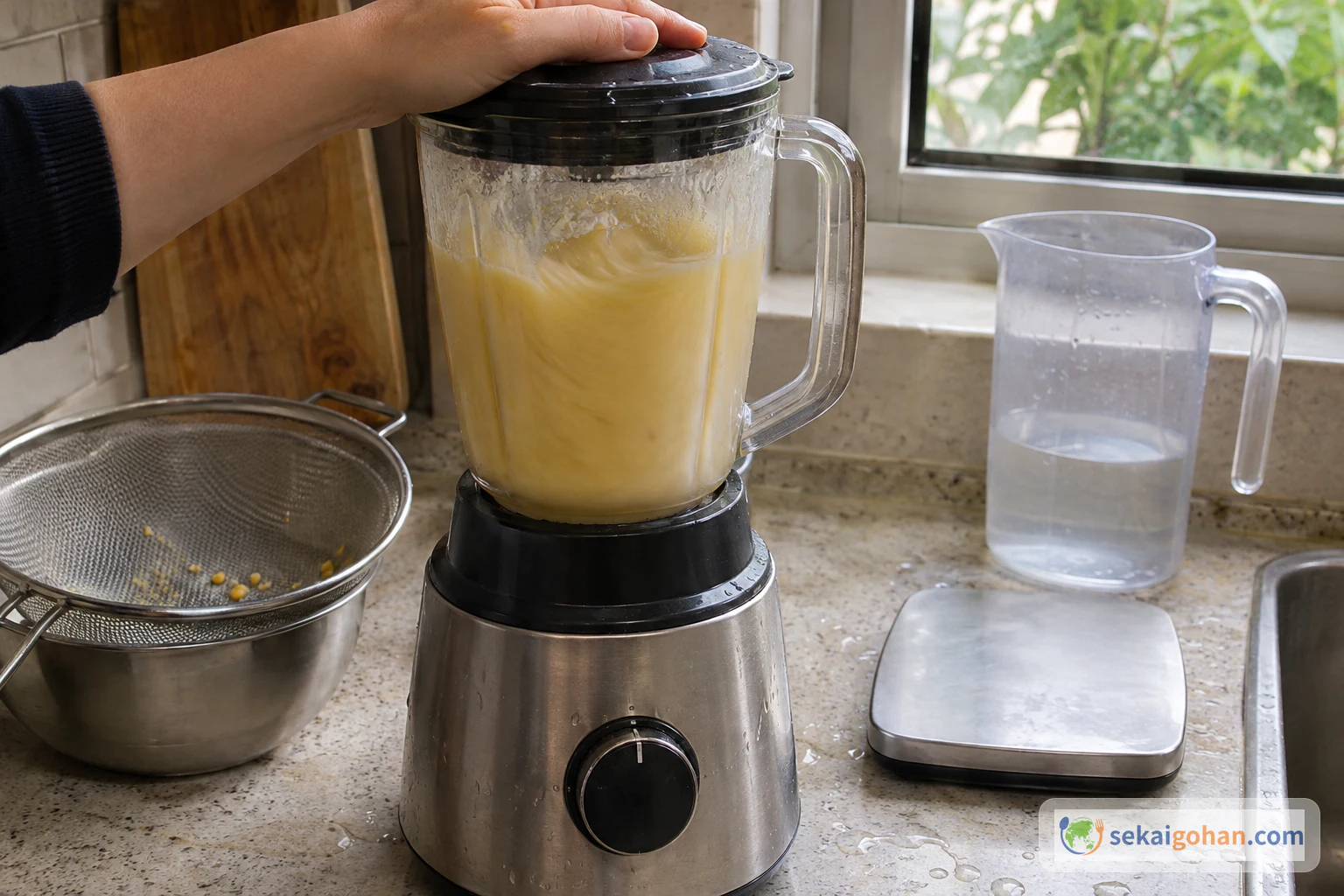
Soak the peas the night before. On the day, the bowls of liquid come first: blend, strain and wash the pulp so the thin and thick liquids are ready before the stove goes on. Make the seasonings next, because once the porridge starts cooking it needs your hand on the spatula without a break, and it starts setting as soon as it cools.
Make the seasonings before the pot goes on:
- Chili oil: warm 2 tbsp Lao Gan Ma with 2 tbsp oil over medium heat for about 2 minutes, until the oil runs red and smells of chili. Do not let it scorch.
- Ginger water: grate the ginger with ⅛ tsp salt, then stir in 2 tbsp hot water.
- Garlic oil: mince the garlic and cook it in the ¼ cup (60 ml) peanut oil over medium-low heat for about 5 minutes, until golden. Strain, keeping the oil and the crisp garlic separately.
Cook the peas through; undercooked peas are hard to digest. Thick starch paste spatters and sticks. After the thick milk goes in, keep the heat at medium or below, use a heavy pot and a spatula that reaches the bottom, and never stop stirring.
Each bowl gets its own salt so the seasoning stays right however much someone eats. Salt stirred into the whole pot cannot be taken back out.
When It Goes Wrong
| What you see | Why | What to do |
|---|---|---|
| Lumps | Thick milk went in all at once, or was not stirred before adding | Lower the heat and work them loose from the bottom with a whisk. Next time, add it in a thin stream |
| Scorched bottom | Heat above medium, a break in stirring, or a thin pot | If it smells burnt, move the porridge to a clean pot without scraping; the burnt taste spreads. Use a heavy pot and keep the spatula on the bottom |
| Too thin | Too much water, or not cooked long enough | Keep cooking and stirring. Do not add flour or starch |
| Gritty | Short blending or a loose strain | Blend longer and strain through a double layer of cloth |
| Grassy, beany taste | Not cooked enough | Give it 1 to 2 more minutes, stirring the whole time |
| Too thick before you can ladle it | Cooked past the ribbon stage | Loosen with a little hot water before taking it off the heat |
| Set solid after cooling | The starch firms as it cools | Rewarm over low heat, stirring. It reheats in the bowl in a microwave too, but it spatters, so watch it |
Serving, Variations and Storage
At the table
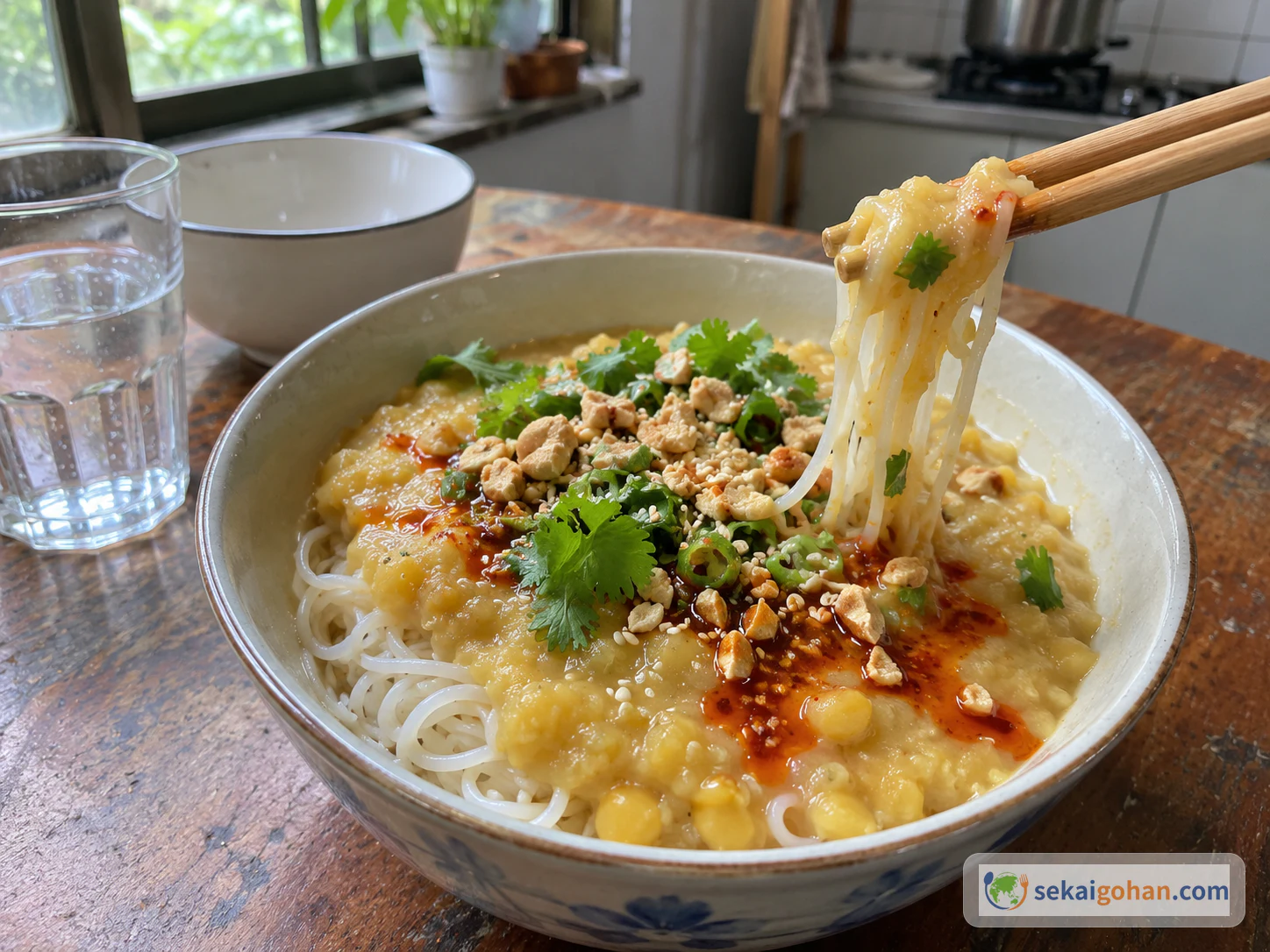
The Kunming bowl is the one above, seasoned and stirred, in a small bowl. Add youtiao: heat it and cut it into ½-inch rings to dip or drop in. For a fuller meal, put cooked rice noodles in the bottom of a deep bowl and ladle the porridge over them, then season as usual. Over noodles the porridge works as sauce, and one bowl's worth is enough to coat them.
Variations
- Tengchong-style heat: halve the chili oil and add a little Sichuan pepper oil. The numbing tingle pushes the sweetness of the peas forward.
- More ginger: raise the ginger water to as much as 1 tbsp per bowl for a warming morning bowl, and go lighter on the salt since the ginger water carries its own.
- Fried garlic on top: scatter the crisp garlic left from the garlic oil over the bowl for small bursts of crunch. Garlic fried too dark turns bitter.
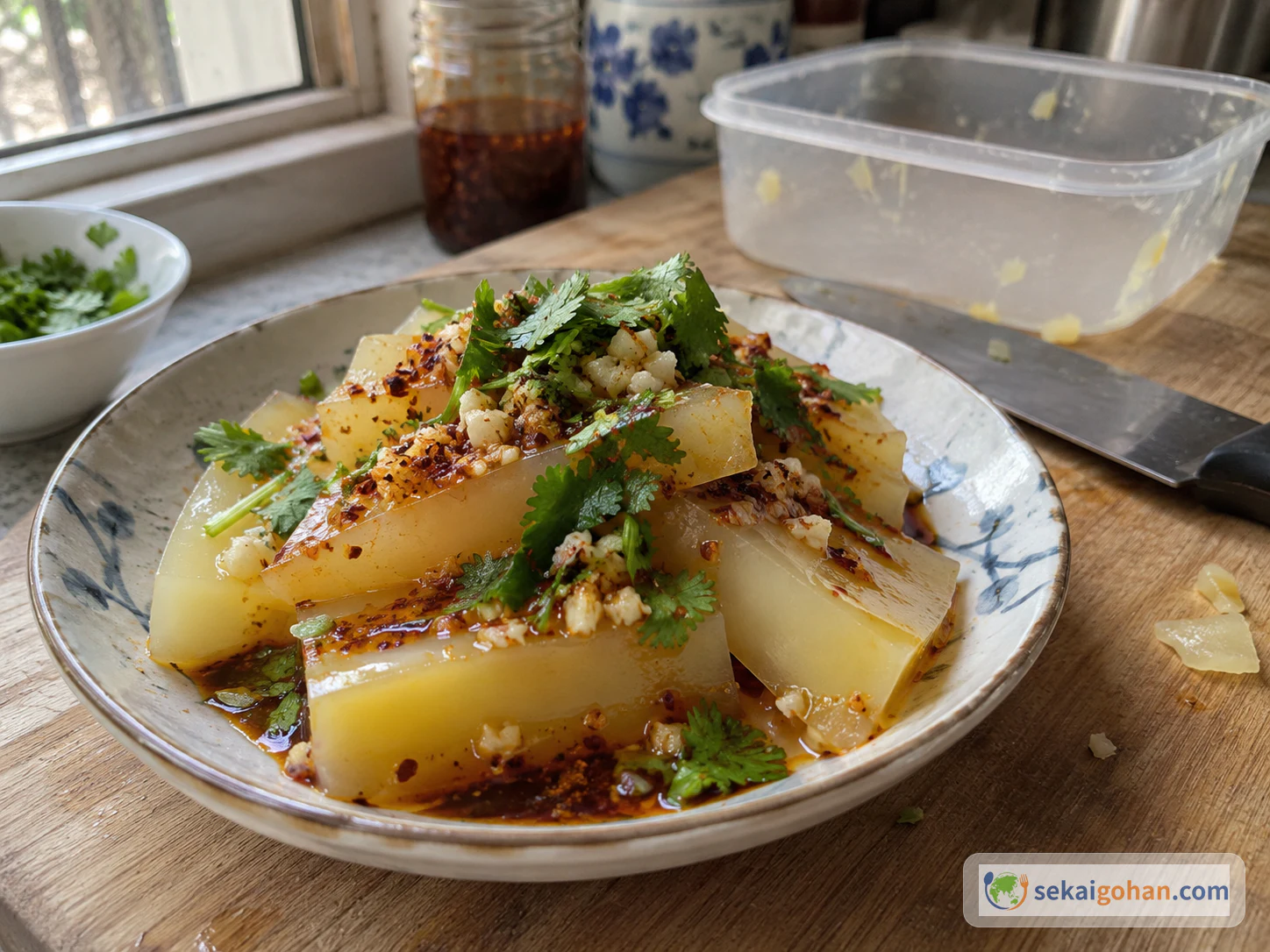
- Cold pea jelly: pour leftover porridge into a container, refrigerate until set, and cut it into slabs. Dress with chili oil, scallion, cilantro, ginger juice, minced garlic, MSG, soy sauce, black vinegar, sesame oil and Sichuan pepper oil. Wandoufen proper is cooked thicker from the start, so home-set porridge comes out softer.
Storage
Hot porridge holds safely at 149°F (65°C) or above, and cold dishes belong at 50°F (10°C) or below. Do not leave it at room temperature for long, before or after cooking. Divide leftovers into shallow containers so they cool quickly, cover and refrigerate. Some cooks leave the porridge at room temperature for a few hours to set into jelly; set it in the refrigerator instead. Reheat in a pot over low heat, stirring, until it reaches 167°F (75°C), and loosen with a little hot water if it separates. Pour leftover chili oil and garlic oil into a covered container and refrigerate.
Frequently Asked Questions
Can I use pea flour instead of soaking split peas?
Yes, as its own batch with its own amounts. Mix 1¾ oz (50 g) Chinese pea flour with 3½ oz (100 g) water and leave it for 30 minutes. Bring 1 lb (450 g) water with ¾ tsp kosher salt almost to a boil, stir in the flour mixture and cook over medium heat for 10 to 12 minutes, stirring constantly; this serves 2. Do not mix these amounts with the split-pea recipe, and leave out the per-bowl salt when the pot is already salted.
Can I make a double batch?
Scale everything by the same factor: 7 oz (200 g) peas, peas plus water to 1 lb 12 oz (800 g) for blending, and 14 oz (400 g) water for each of the two washes. A double batch scorches more easily, so use a wider heavy pot.
Can I skip washing the pulp?
Skip it and there is no thin liquid to start the pot with. The porridge loses both body and depth, because much of the starch stays behind in the cloth.
What do I do with the leftover pulp?
Discard the pulp after the second wash; the starch has gone into the two liquids.