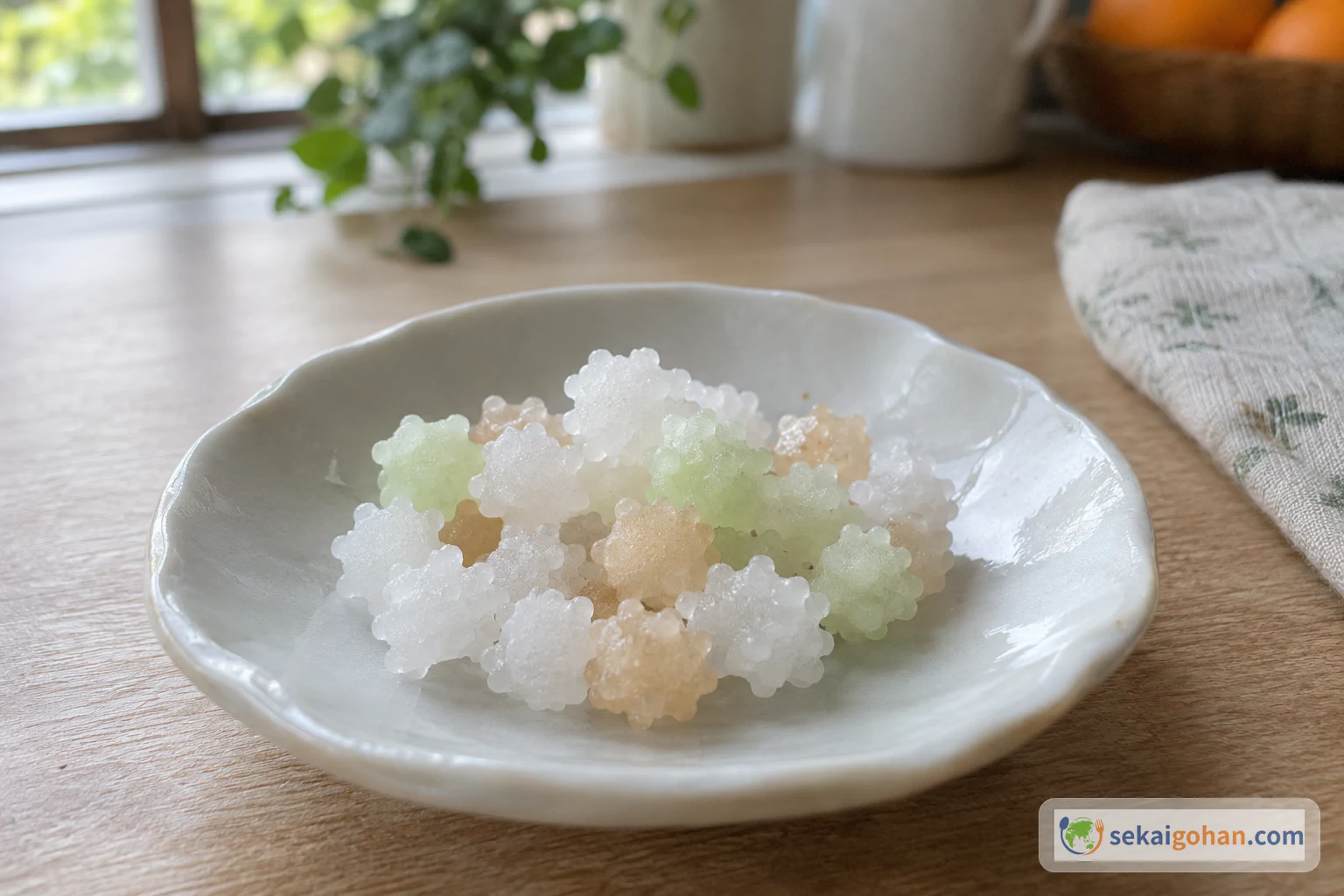
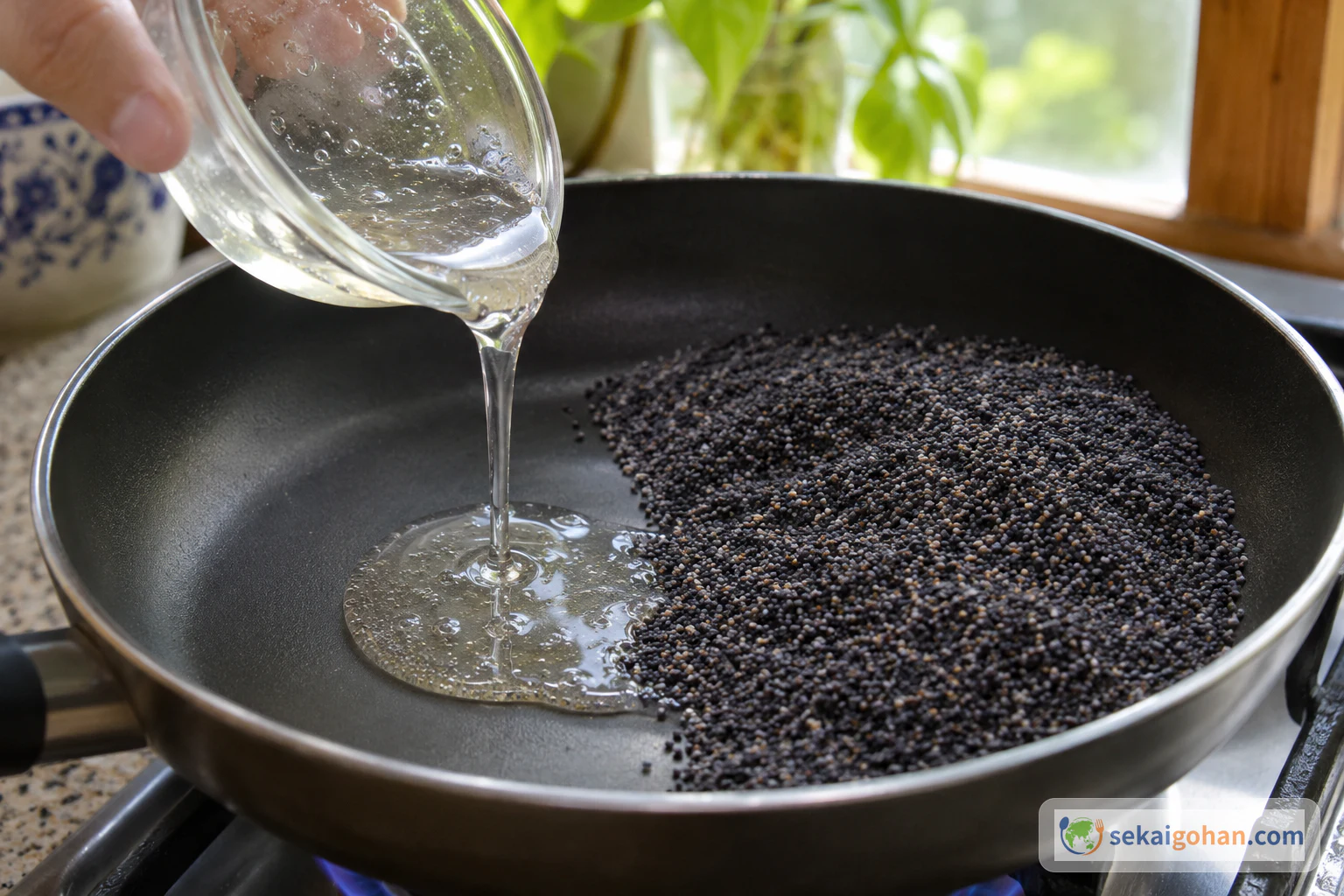
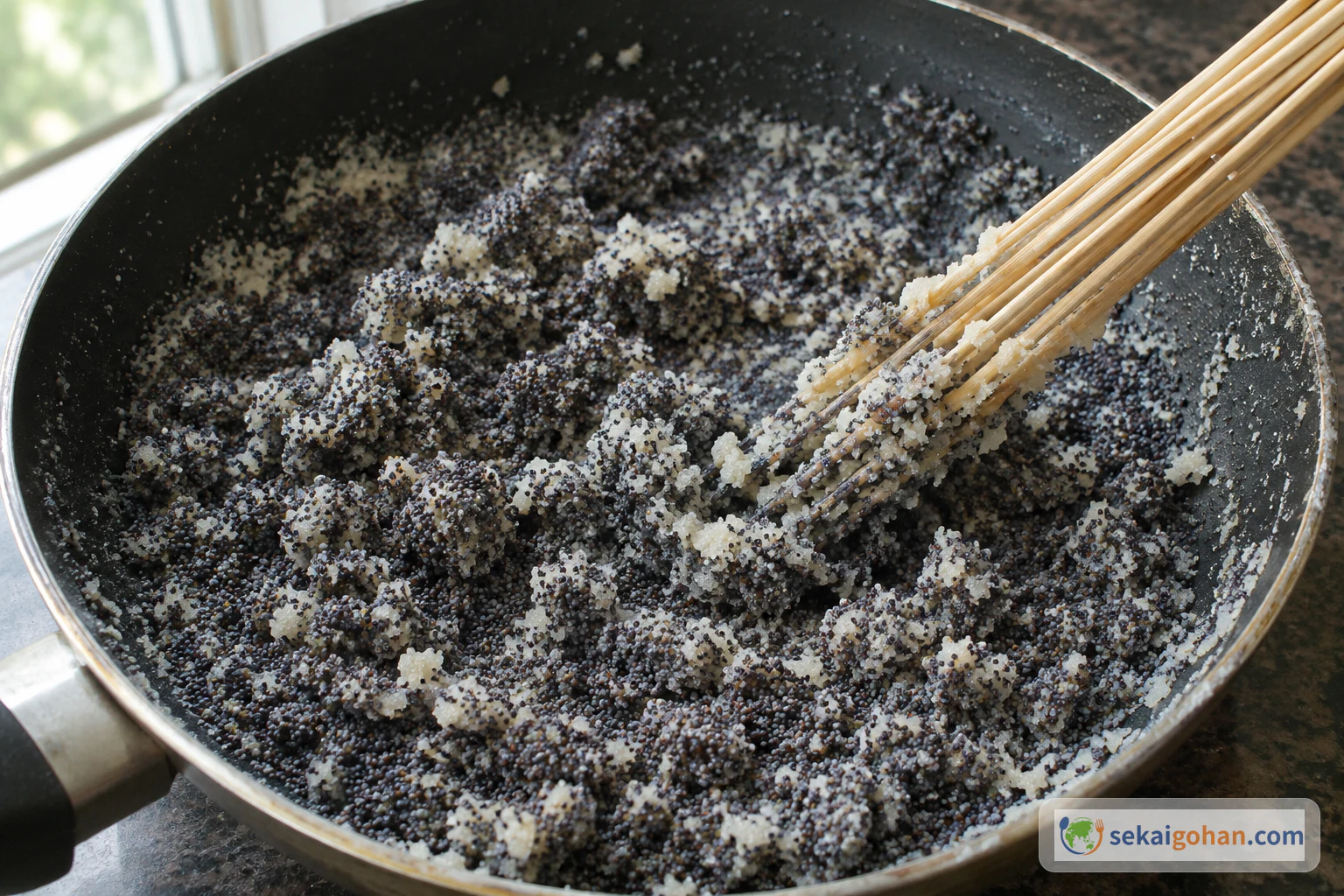
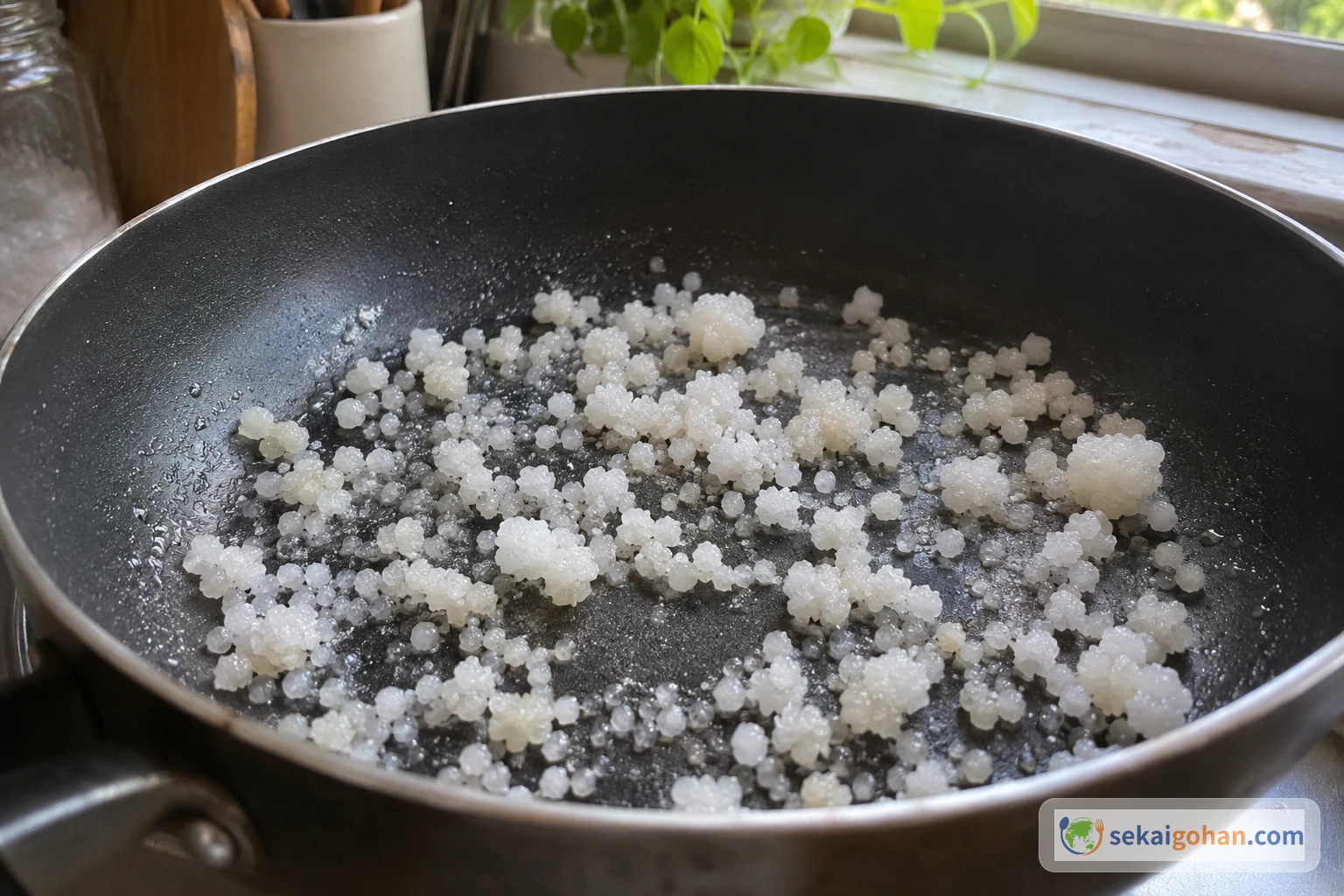
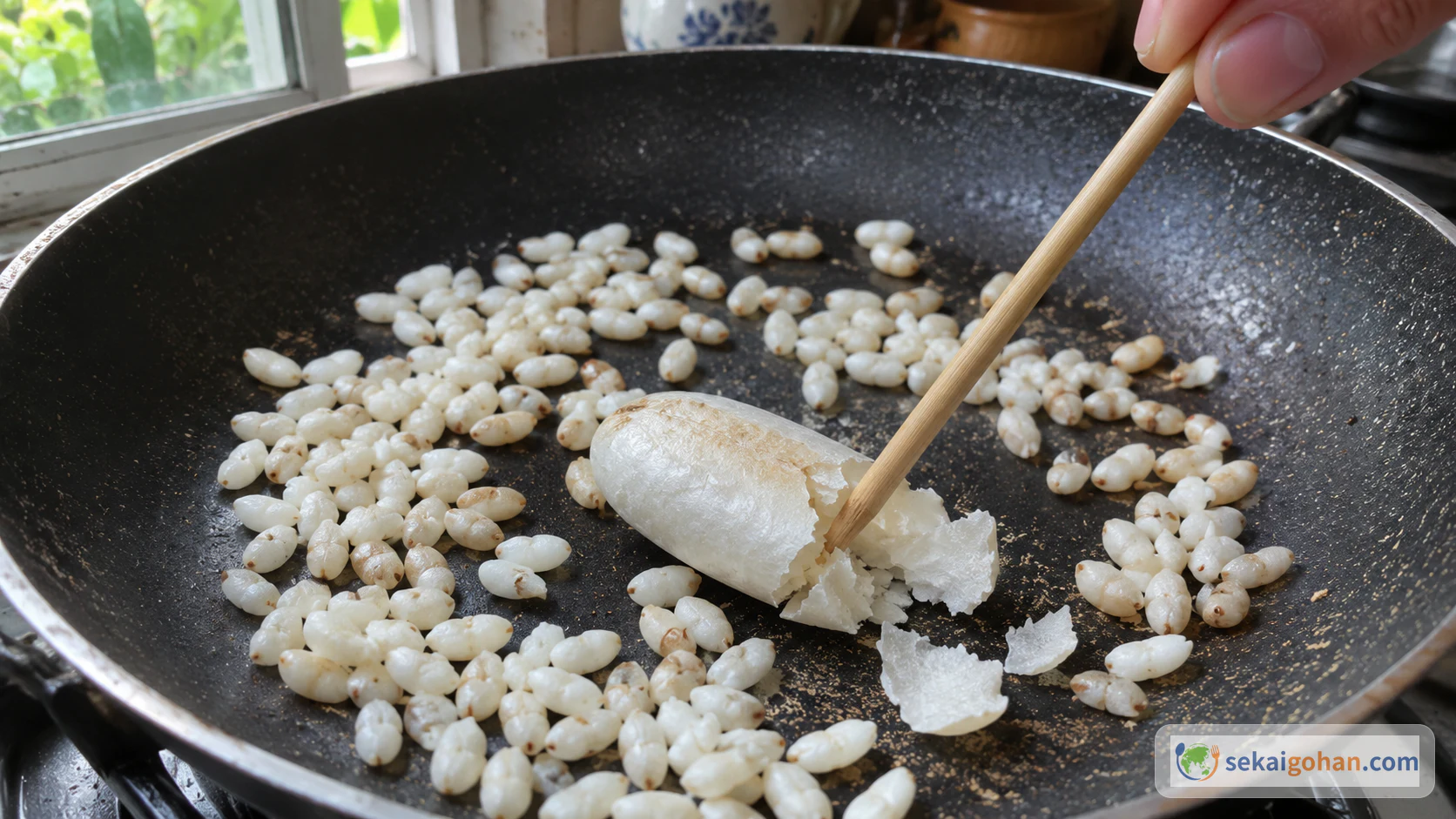
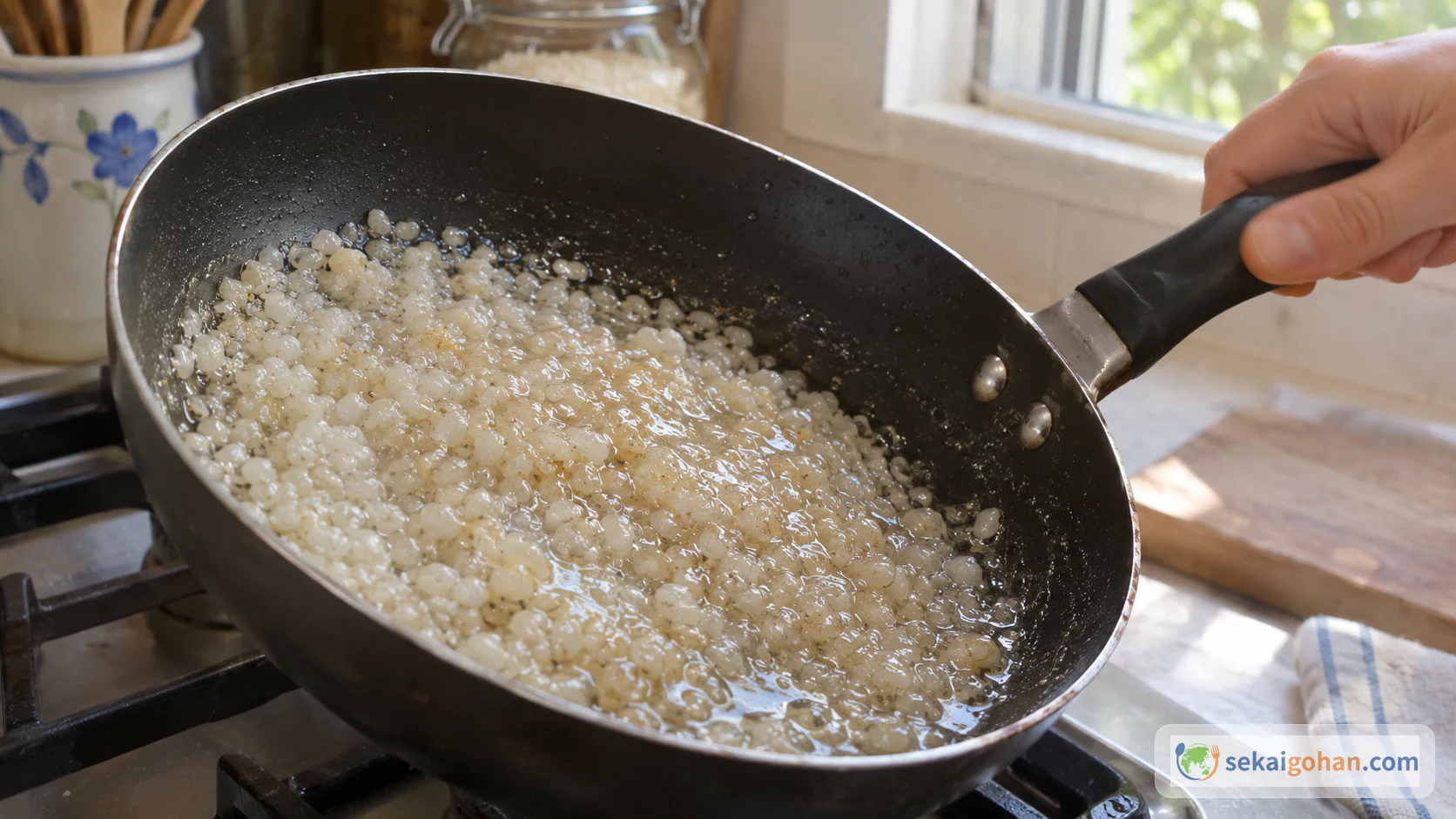
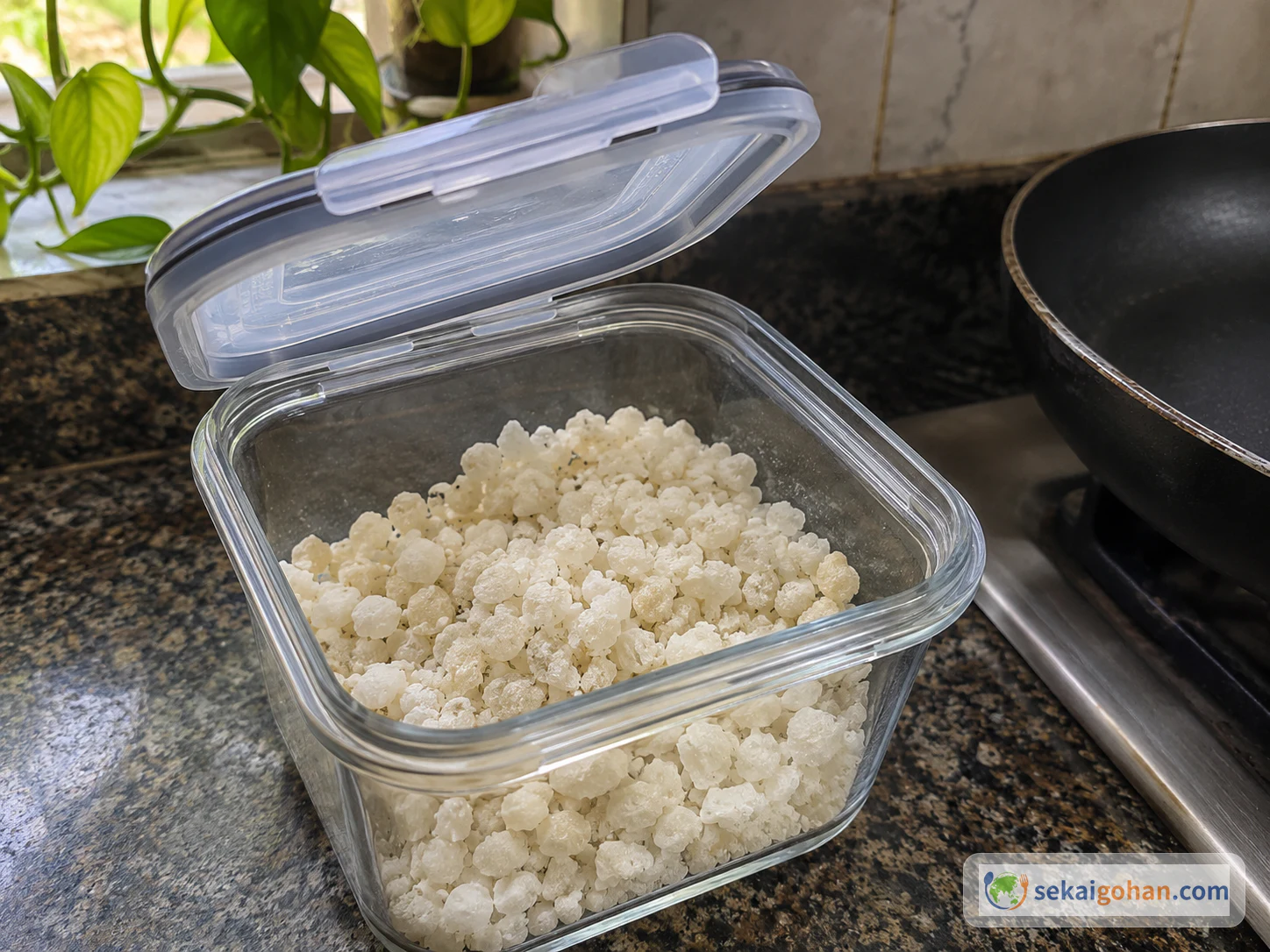
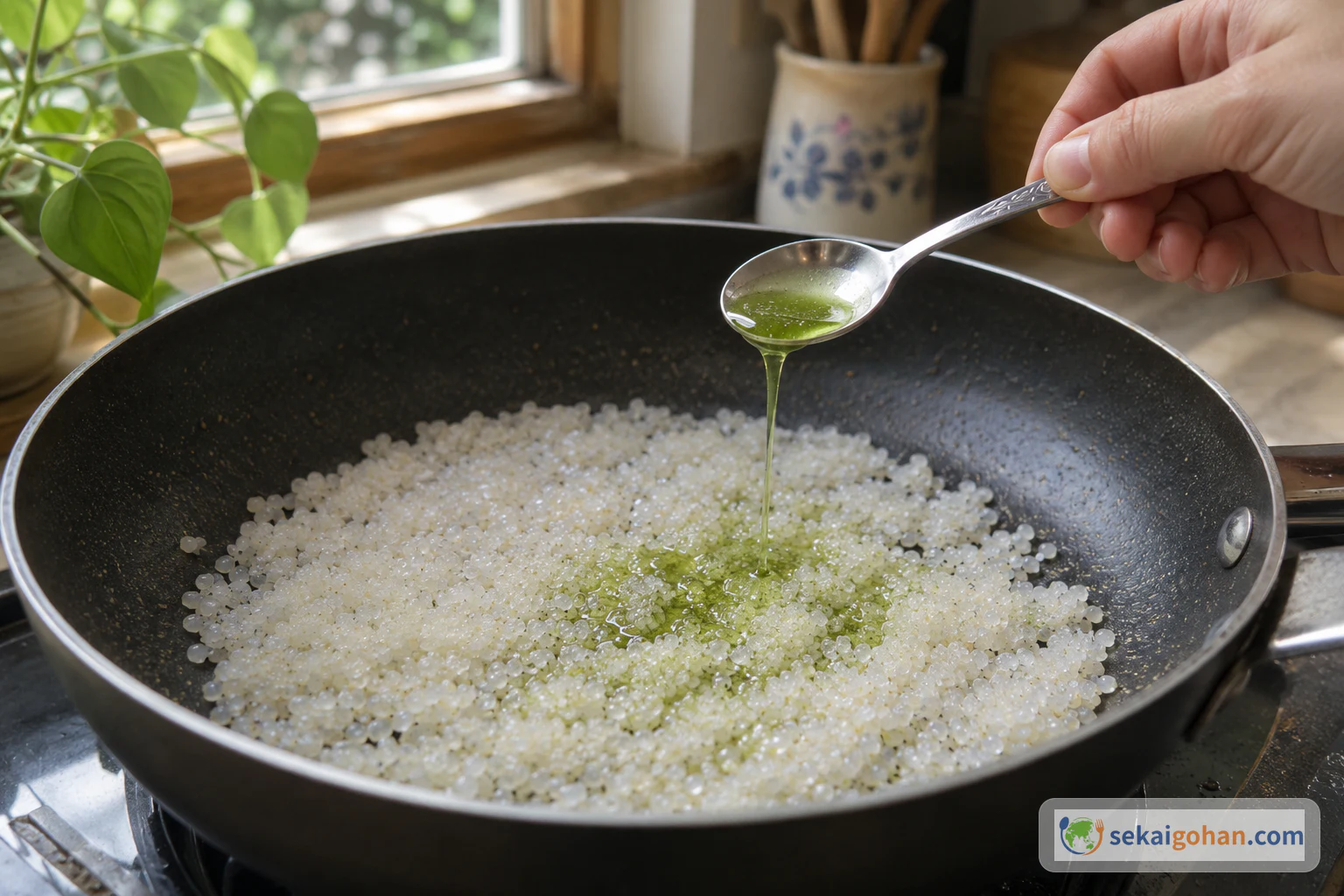
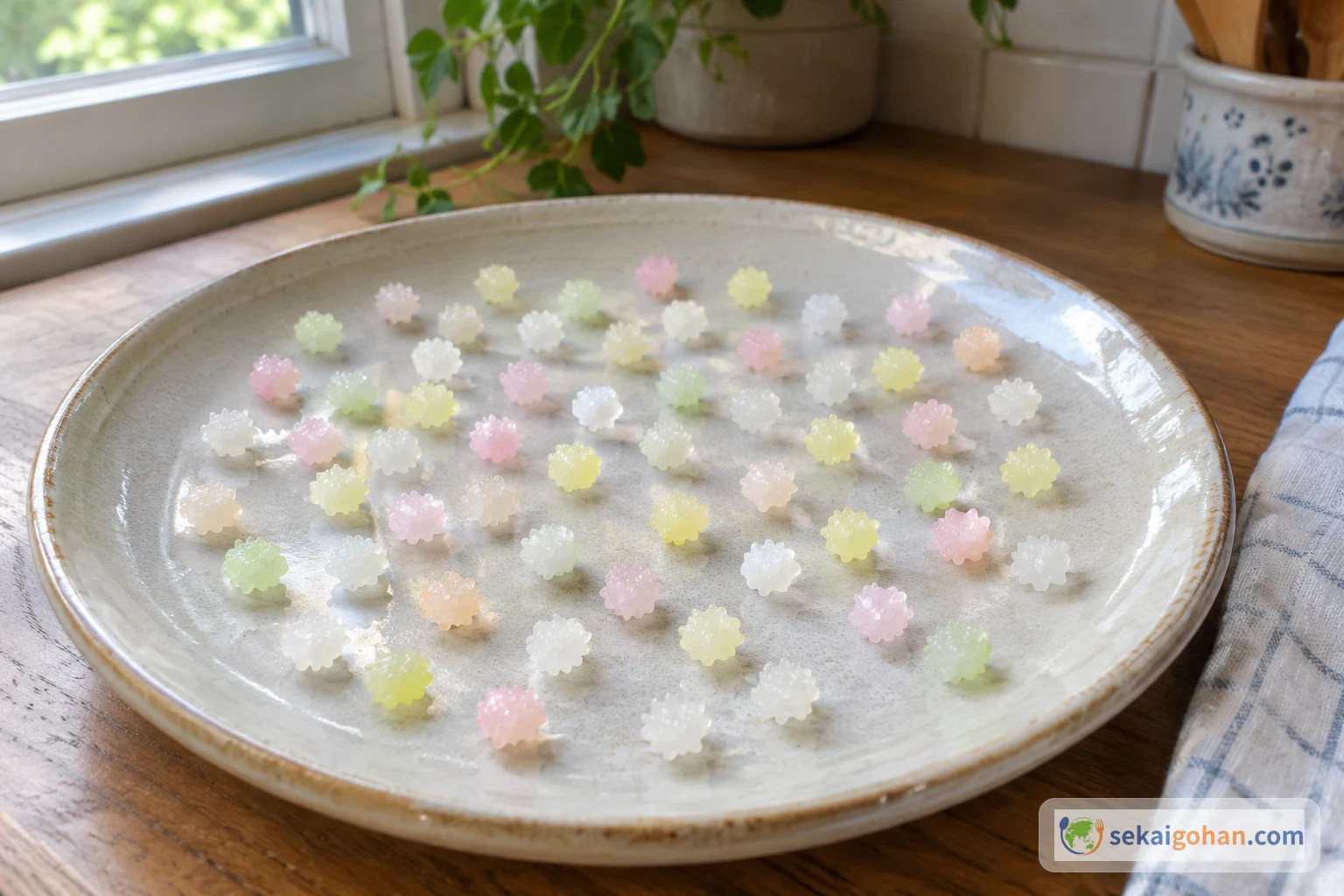
The syrup at the edge of the pan foams, thickens and starts to pull. You lift the pan off the heat and stir hard with a bundle of bamboo skewers, and the wet poppy seeds turn white and dry, as if someone had dusted them with powder. That is one round. Konpeitō is many rounds of it, spread across most of a week, until the seeds have become hard little sugar grains, ideally with short points. It is a pointed sugar sweet of Japan, and the home version is made in an ordinary frying pan.
Points That Grow One Coat at a Time
In a confectioner's workshop, konpeitō starts as coarse sugar crystals called zarame. They go into a wide, tilted pan called a dora that turns slowly over heat. Syrup made from granulated sugar and water is poured over the rolling grains, the coat dries, and the next coat goes on. This continues day after day. A full batch takes about two weeks, and even the smallest pieces need at least two days. The confectioner adjusts the heat and the amount of syrup to the day's temperature and humidity and to how the grains are tumbling. There is no fixed formula for this. It is a skill learned over years of training, which is why making konpeitō the workshop way is so hard for one person at home.
Why the points appear
The points come from heat, not from a mold. Where a grain touches the hot surface of the pan, the syrup dries and hardens first. The next coat of syrup clings best to those hardened spots, so they keep building outward while the rest of the grain grows more slowly. A finished workshop piece carries about 24 points. The same idea runs through the home frying-pan method: thin coats, dried one after another, slowly building on what is already there.
Three ways of making it
Older workshop methods use poppy seeds or irako, a granular rice product, as the core, and take about twelve to fourteen days. Some cheaper commercial konpeitō is made faster, with sugar-crystal cores in a cylindrical drum, in as little as one night. An early method boiled rock sugar with twice its volume of water, strained it, reduced it by half, and fed it a little at a time to poppy seeds stirred with a tea whisk. The home method below goes back to the poppy-seed core and swaps the turning pan for a frying pan and your own hands.
| Home frying pan | Workshop tilted pan | |
|---|---|---|
| Core | Poppy seeds | Zarame (coarse sugar); poppy seeds or irako in older methods |
| Syrup | Granulated sugar and water, equal parts | Granulated sugar and water |
| Heat and movement | Very low heat, stirred by hand with skewers | A heated dora that turns and rolls the grains |
| Time | Six to seven days, with breaks | About two weeks; at least two days for small pieces |
| When it is done | When the grains reach the size you like | Judged by the confectioner |
ALIC describes konpeitō as a sugar sweet that came to Japan from Portugal. Today it sits alongside other sweets as part of the food of Japan, and it often shows up at celebrations.
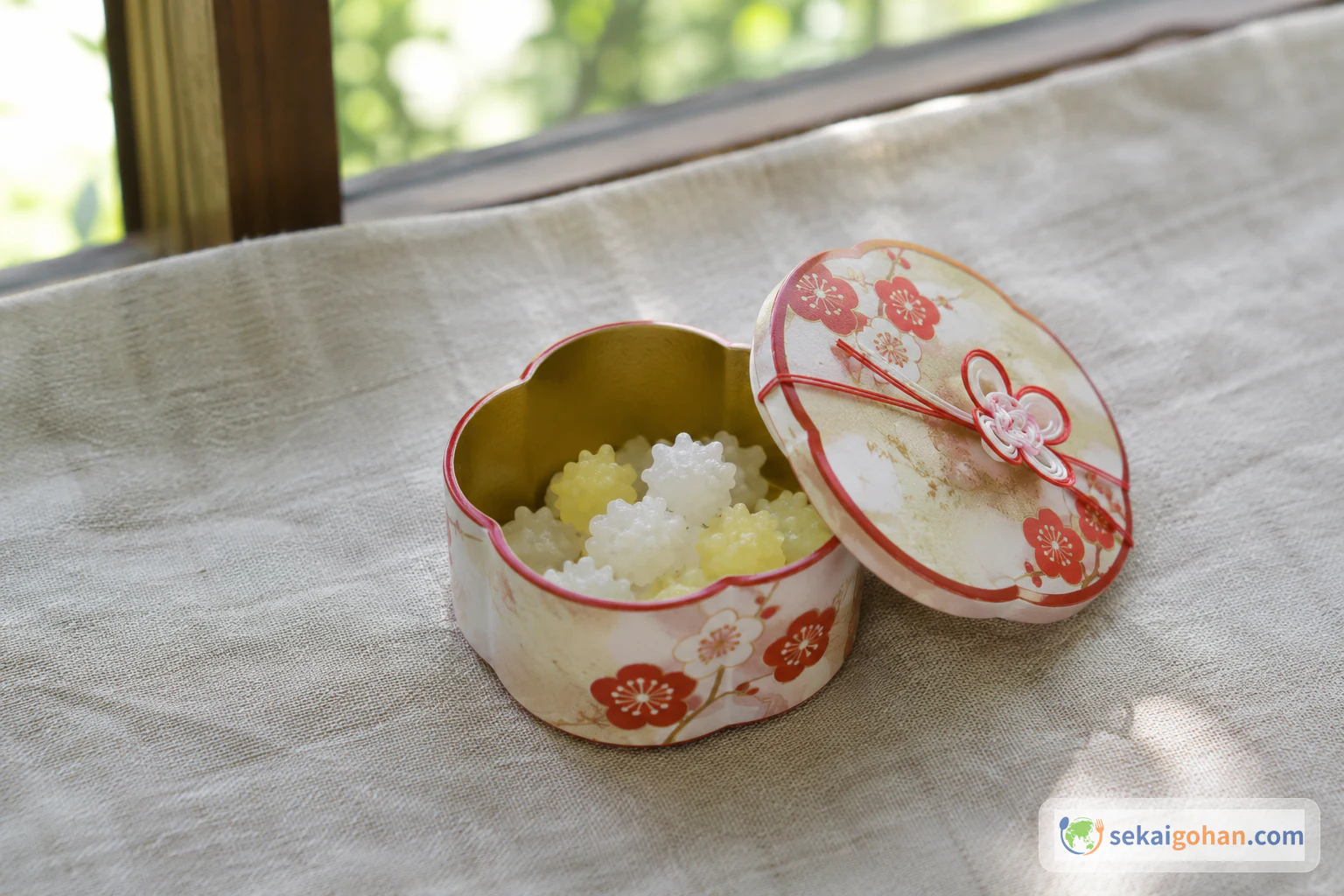
At celebrations, konpeitō is often packed into a bonbonnière, a small decorative sweets container given as a keepsake. The candy is small and light, so a few grains fill the box and the container itself becomes the gift.
Ingredients
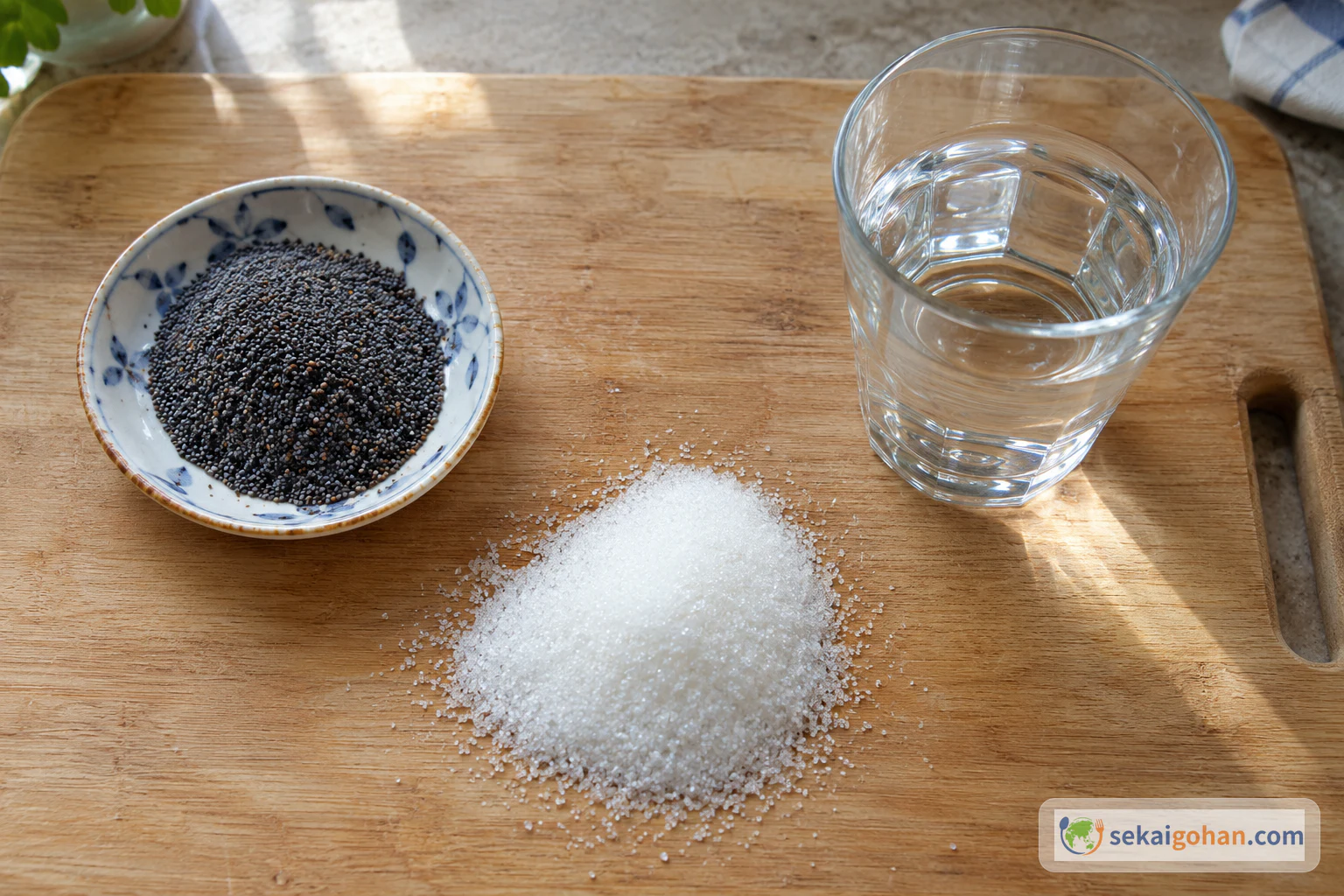
The water and the colored liquids do the same job. Each batch of syrup uses one or the other, never both. The sugar is your whole supply for the week. You dissolve it a little at a time as the work goes on, rather than turning it into syrup all at once.
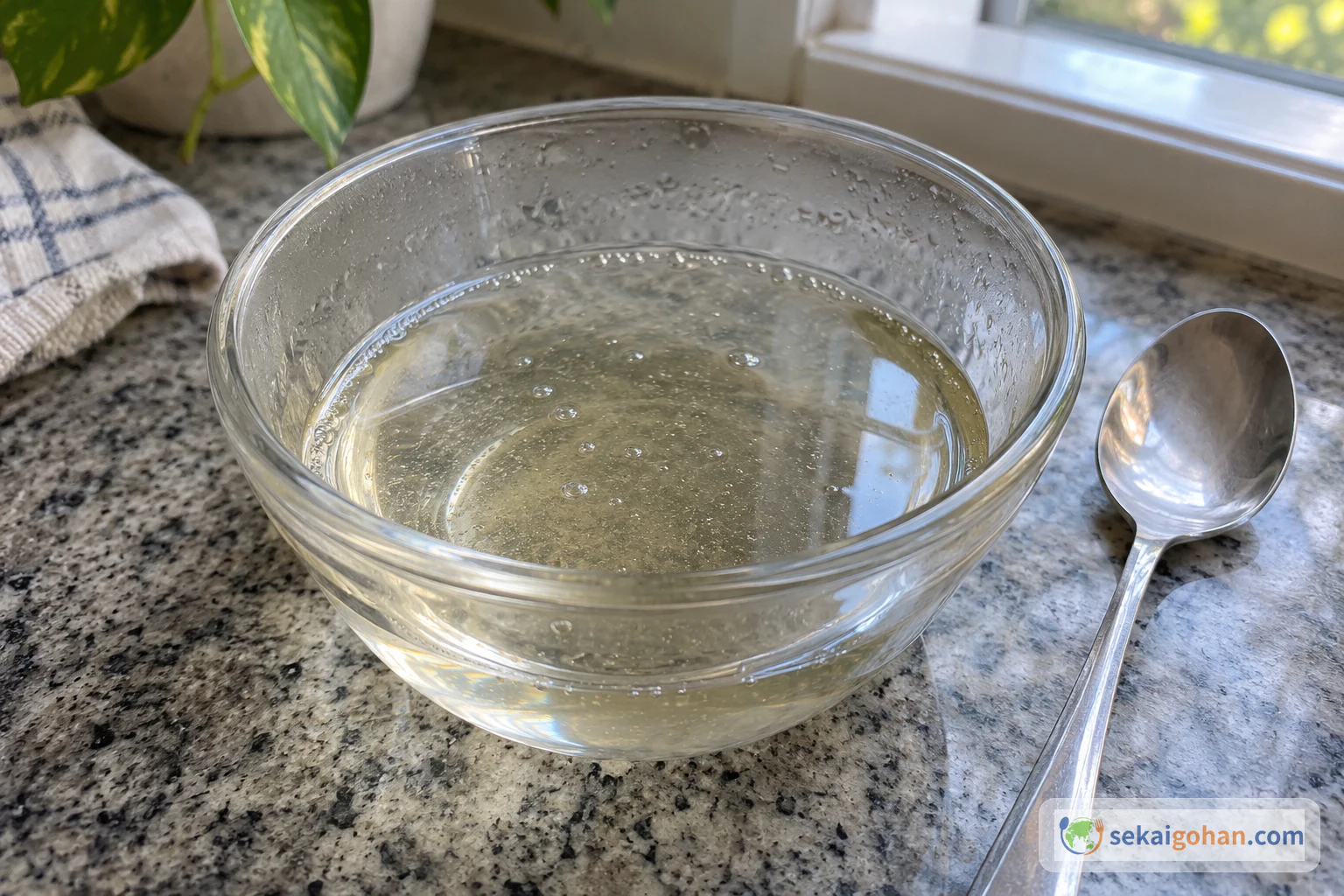
Mix each fresh batch of syrup at one part sugar to one part water. Coats that keep the same strength from round to round dry the same way, so the grains build evenly.
This candy is built on poppy seeds. If you are making it for someone with food allergies, check the labels on the poppy seeds, instant coffee, matcha and juice you use.
Equipment
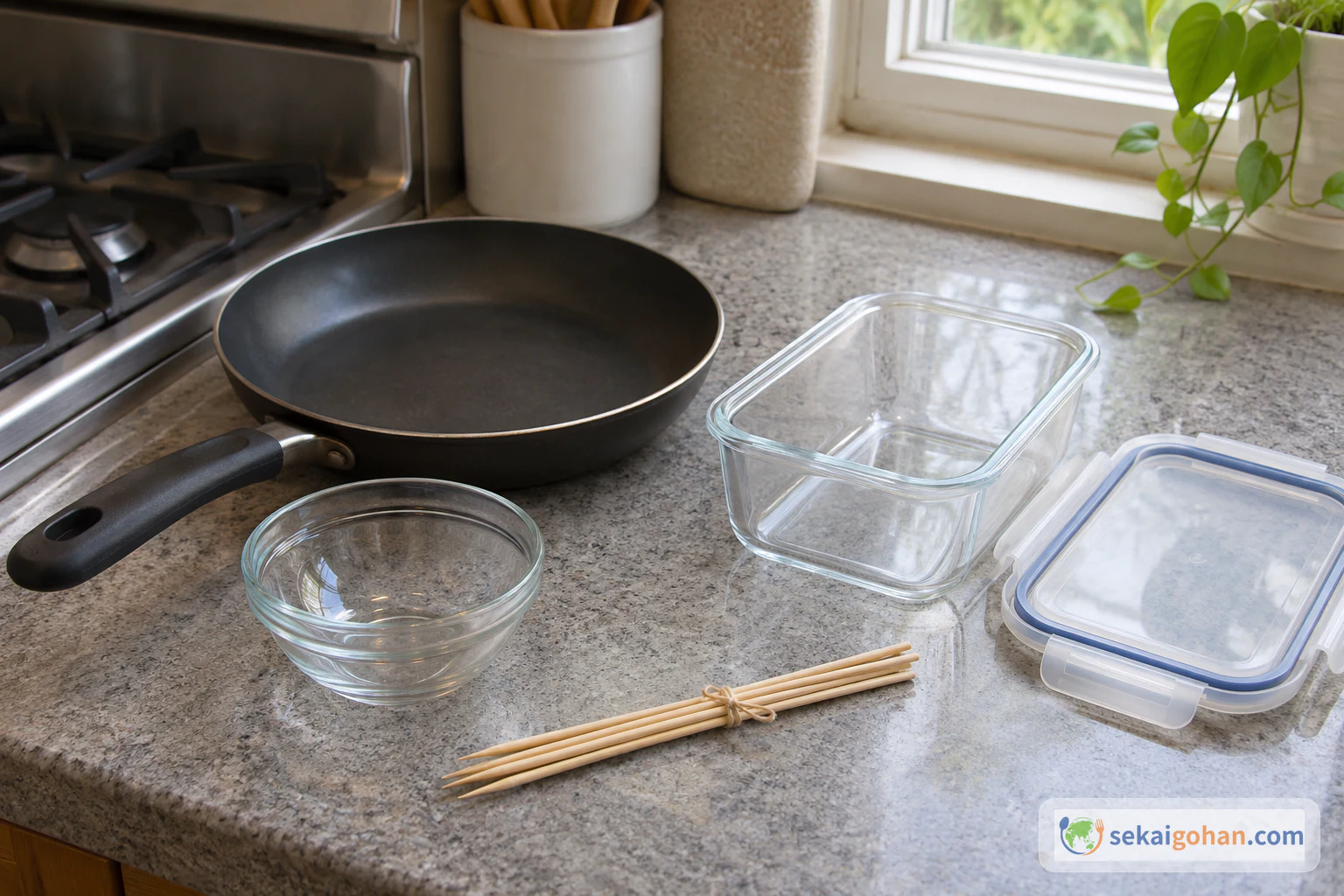
- A small heatproof bowl, for making the syrup
- A microwave
- A frying pan that holds a very low heat steadily
- Bamboo skewers, four or five tied into a bundle
- An airtight container or a plastic bag, for keeping the grains between sessions
Buying the Seeds and Choosing the Colors
Poppy seeds are the one ingredient worth looking for. Spice shops, baking suppliers and online grocers are the places to look, and a batch needs only a spoonful. Granulated sugar from any supermarket is exactly right. It is the same sugar workshops dissolve for their syrup, and its clean sweetness is the whole flavor of plain konpeitō.
To keep the result close to the konpeitō made in Japan, three things stay fixed: the poppy-seed core, granulated sugar, and syrup made in small batches. The turning pan is the part you let go of. A frying pan and a bundle of skewers take its place.
For colored batches, choose by the finish you want. Grape, blueberry and strawberry juice each give a fruit tint and a light fruit aroma. Strong instant coffee gives brown grains that smell of coffee. Strong matcha turns them pale green with a tea aroma. Make the coffee and matcha strong, because their color and aroma are spread across many thin coats.
Method
The whole week runs on one pan and one small bowl. Each round follows the same rhythm: pour a little syrup, let it foam, pull the pan off the heat, stir until dry, then let the pan cool. The time you don't spend working is the cooling between rounds and the nights the grains rest in their container. Keep the heat at its lowest for the whole job. The goal is to dry thin coats, not to cook the sugar.
The work stops and restarts cleanly, so do a few rounds whenever the stove is free. Short, steady sessions over several days build better grains than one long push.
Syrup straight from the microwave, and sugar in a hot pan, burn skin quickly. Hold the bowl with a dry cloth, keep children away from the stove while you work, and wait until the pan has cooled before you touch it.
When It Goes Wrong
| What you see | Why | What to do |
|---|---|---|
| The syrup browns or smells burnt in the bowl | The microwave ran too long without anyone watching | Discard it and make a fresh small batch, watching through the door the whole time |
| The grains stay wet and sticky after stirring | The coat has not dried yet | Warm the pan briefly over low heat and stir again until white and powdery |
| The syrup in the bowl crystallizes on its own | Too much syrup was made at once and crystallized on its own | Make smaller batches more often |
| A few grains grow much larger than the rest | Some grains pick up more syrup each round | Break the oversized ones with a skewer and keep the batch even |
| The points are few or blunt | Temperature, the amount of syrup and humidity all change the result, and luck plays a part | Keep the coats thin and the heat low, and keep going with more rounds |
Colors and Keeping
Colored batches
One batch of grains can carry several flavors. Fruit juices give a soft tint and a light fruit aroma. Coffee turns the grains brown and gives them a roasted smell. Matcha gives pale green grains that taste faintly of tea. Plain white konpeitō, made with water only, keeps the clean taste of sugar. White, pale green and light brown grains mixed in one dish look like a celebration box on its way to the table.
Keeping finished konpeitō
Once they are completely cool, keep the finished grains in an airtight container, away from humidity. Grains you are still working on go in the same kind of sealed container or plastic bag between sessions, as in step 7.
Frequently asked questions
Will my konpeitō have points like the ones from a shop?
How many points form in a frying pan depends on temperature, the amount of syrup and humidity, and partly on luck. Thin coats, low heat and many rounds give the points their best chance to build. Even grains with only short, uneven points are still konpeitō, made the slow way.
Does the weather change how it goes?
Yes. Workshops adjust the heat and the amount of syrup to each day's temperature and humidity. At home, keep working in small amounts and trust the white, powdery cue over any fixed count.
What do I do with a batch that never crystallizes?
The sugar and water can still be used. Use them to sweeten simmered dishes, just as you would use sugar. Then start fresh with new poppy seeds and smaller batches of syrup.