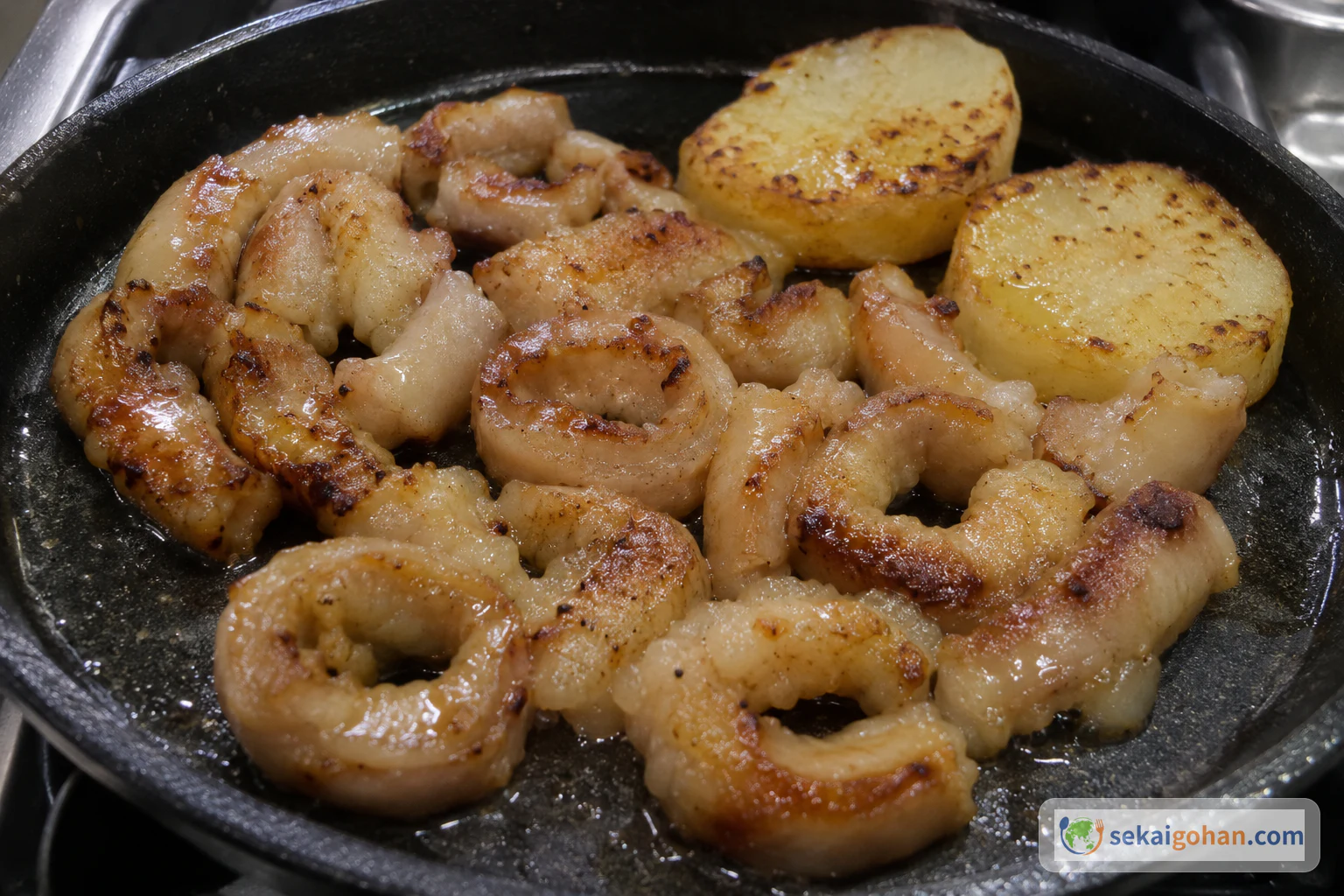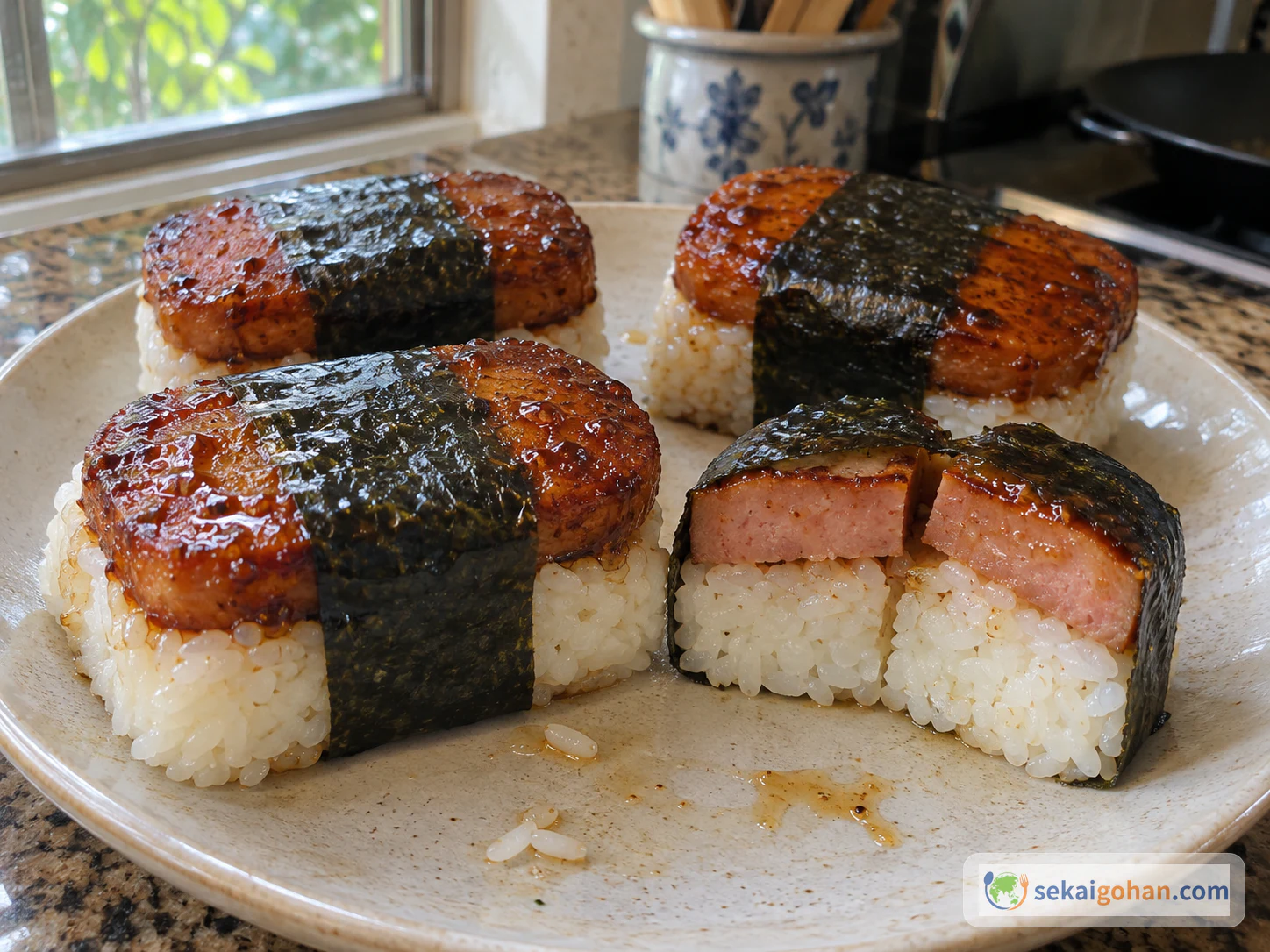
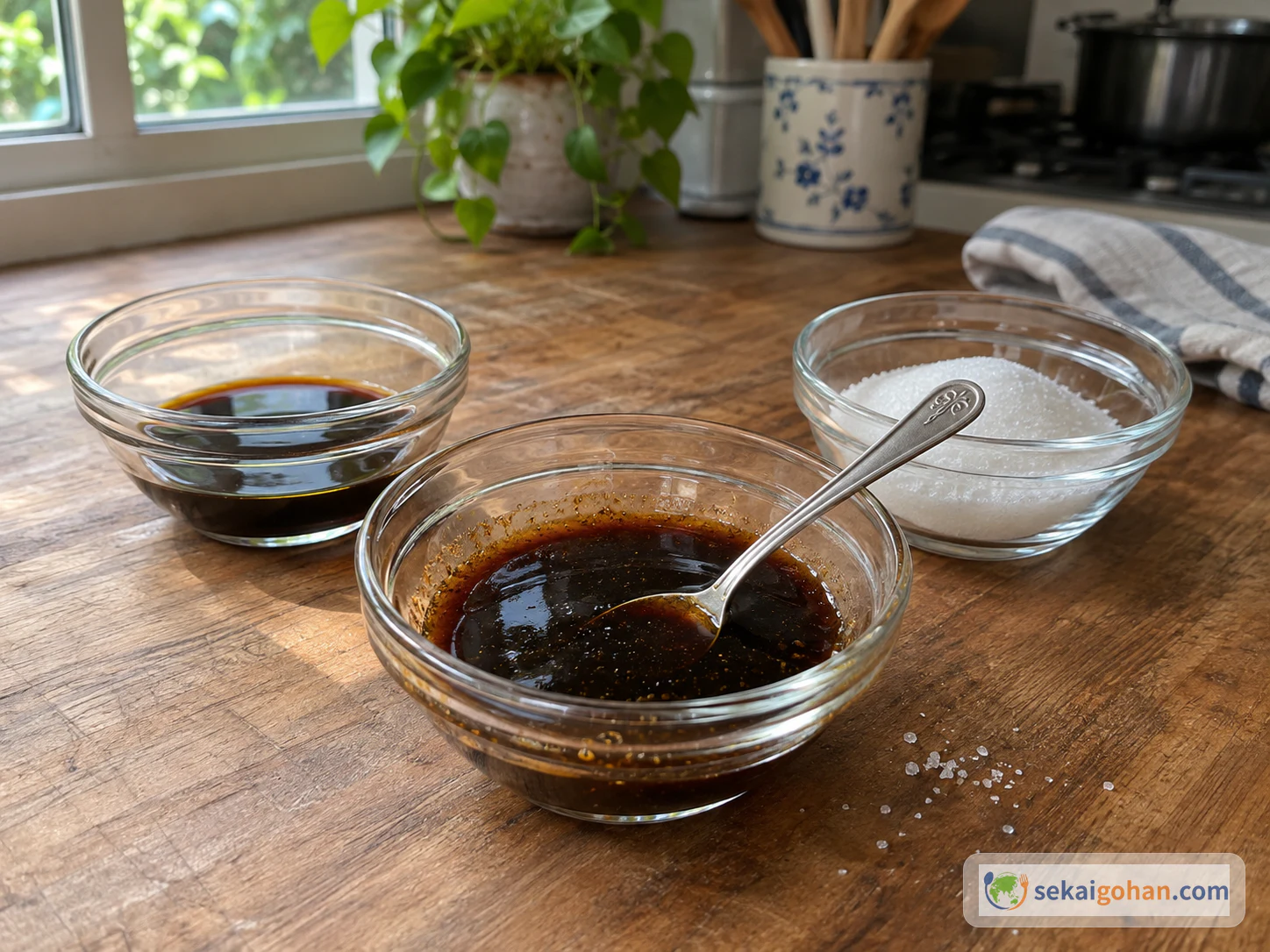
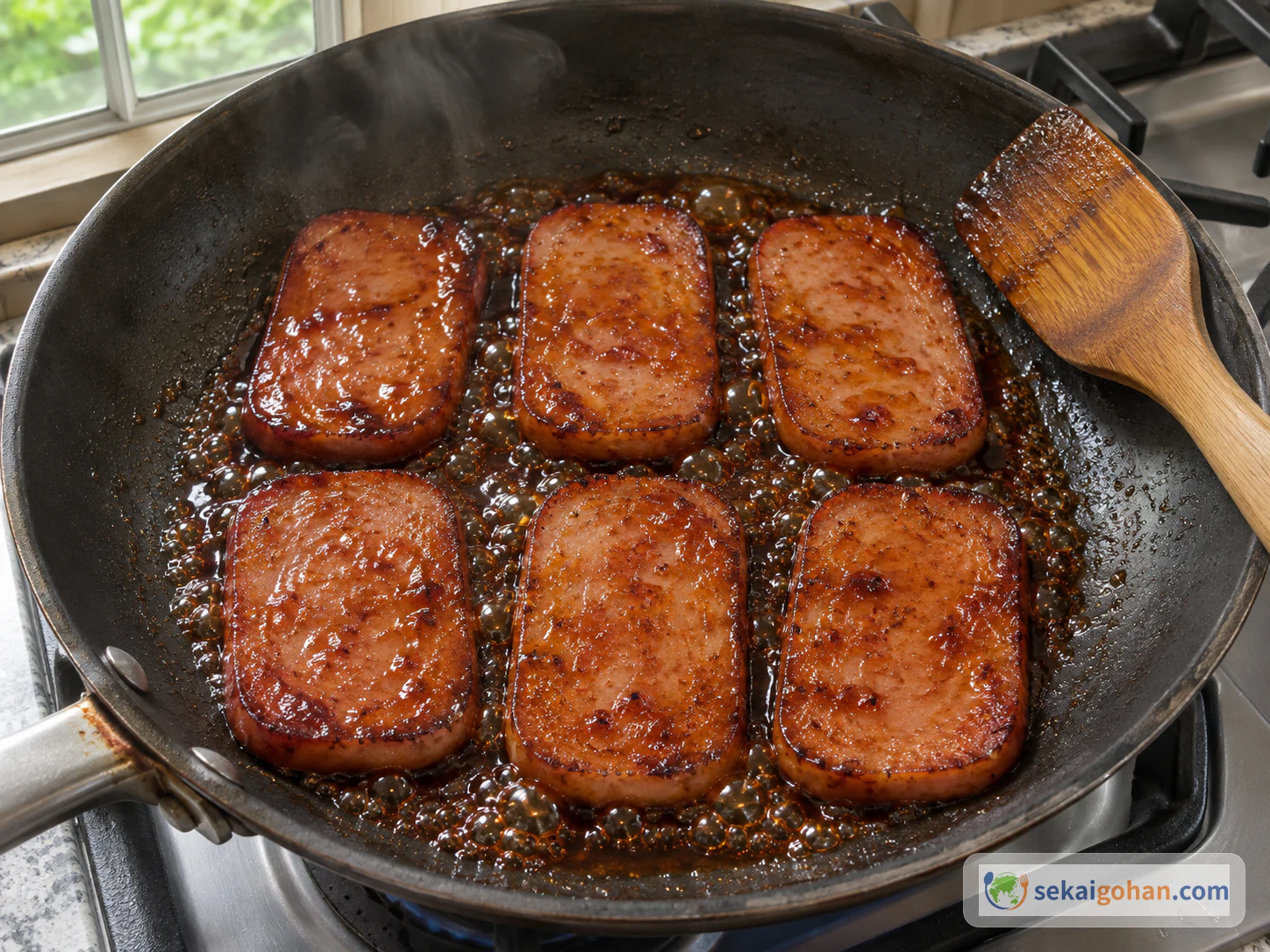
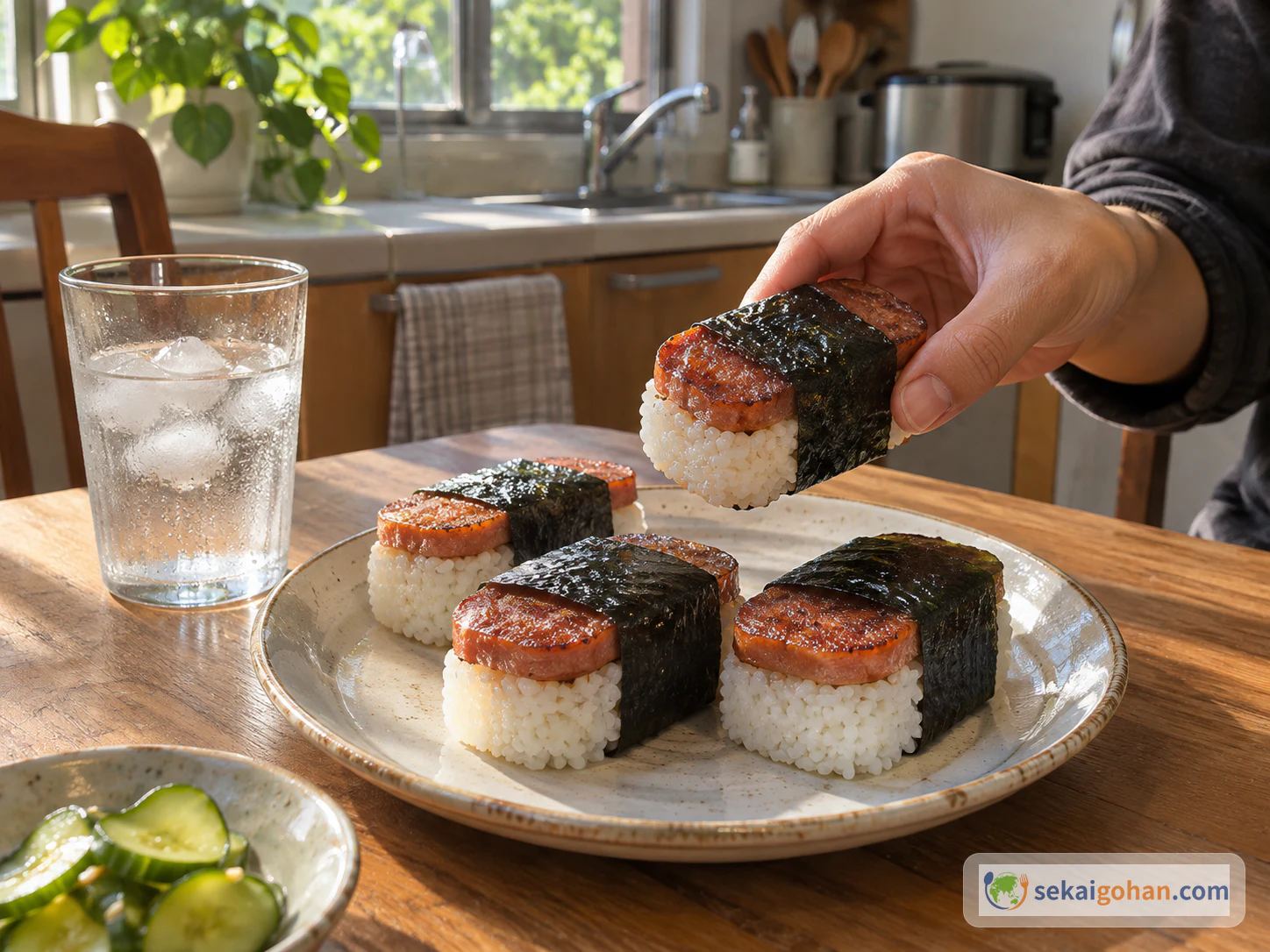
The soy sauce and sugar hit the hot pan and foam up around the Spam. Within a minute or two they thicken into a dark, sticky glaze, and the kitchen smells of caramel and salt. That glazed slice goes on top of a firm block of white rice, a band of nori goes around the middle, and you have Spam musubi, the snack Hawaii eats all day. In Hawaii you find it everywhere, in convenience stores, gas stations, supermarket delis and plate-lunch counters, wrapped in clear plastic and often still warm. One bite gives you crisp nori, then salty, sweet meat with browned edges, then soft rice that holds together until the last mouthful.
A rice ball that grew up in Hawaii
Spam musubi is a Hawaiian dish. It comes out of the Japanese American community there. The word comes from Japanese: omusubi is the polite word for a rice ball, the same thing as onigiri. Japanese immigrants brought the habit of carrying rice pressed into a shape you can hold in one hand, and that habit stayed in Hawaii's kitchens and in its everyday speech. For the rice dishes of Japan itself, start from our Japan pages.
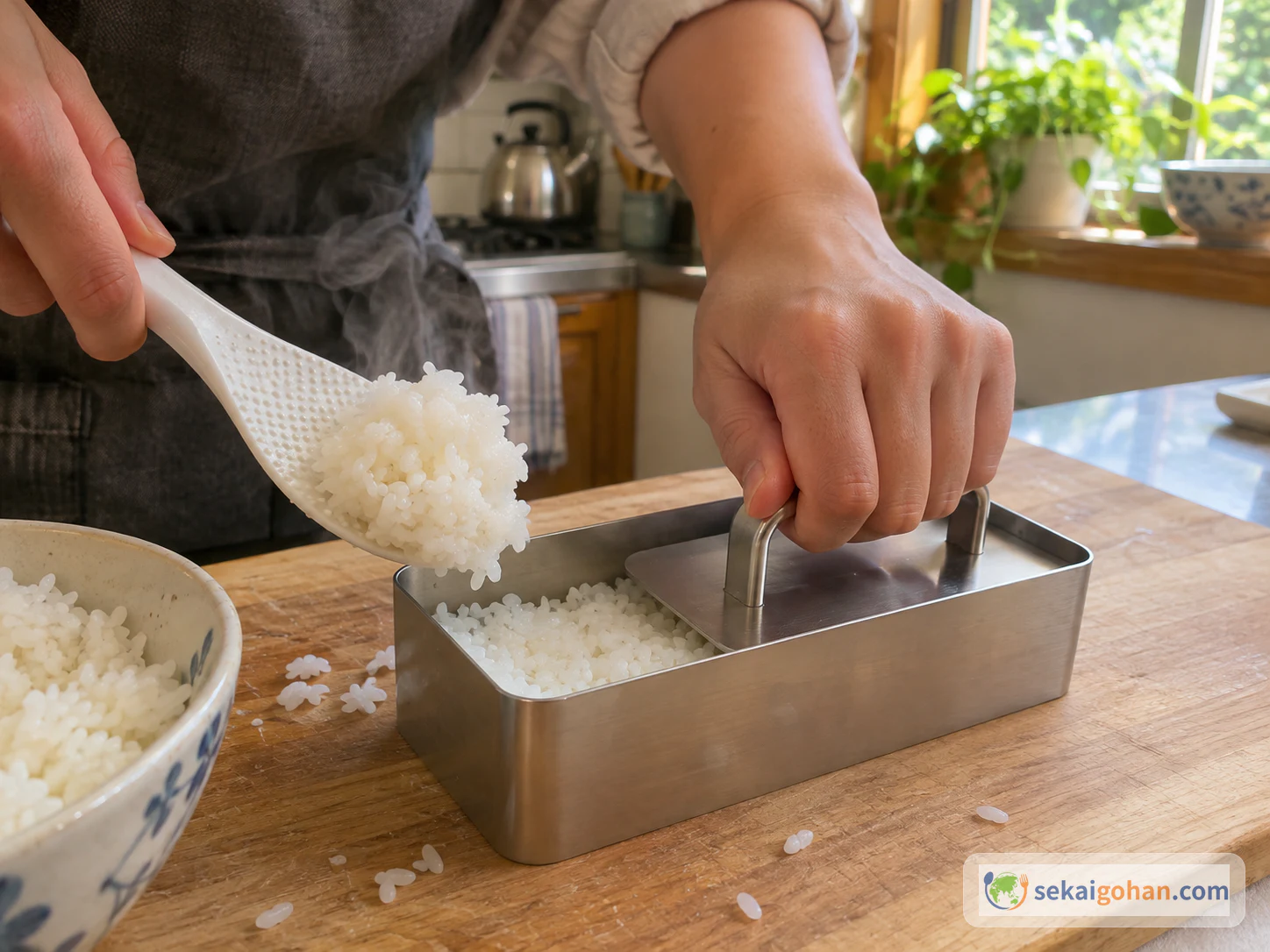
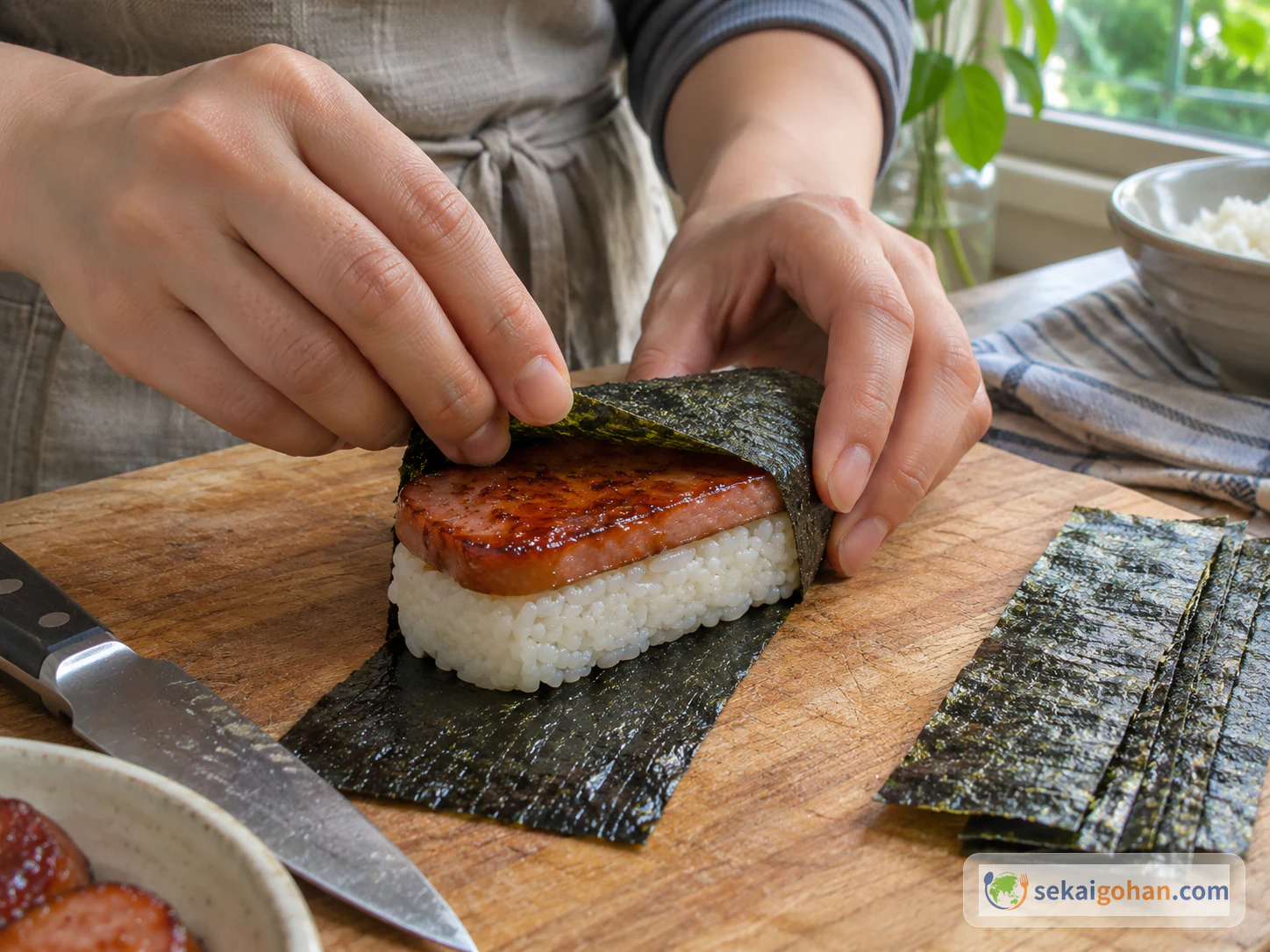
The shape is what sets it apart from a Japanese rice ball. The rice is pressed square in a mold, a slice of fried Spam sits on top or in the middle, and the nori goes around the block as a narrow belt. Nearly every local household owns a musubi mold, a rectangular frame with a flat press that is the same size as the slice of Spam.
Why Spam
Spam's place in Hawaii is usually traced to the Second World War. The US military ate it in huge quantities, Hawaii was home to major bases, and the tins became part of the islands' pantry. Putting a fried slice on a block of rice is usually credited to a Japanese American woman in Hawaii. On Kauai, the first Spam musubi is credited to Barbara Funamura. Where and when the dish first appeared is not settled.
Where it turns up
Today some musubi shops build their whole business on it. At home it gets made in batches of a whole can and more, wrapped one by one and carried to potlucks, school games and the beach, so a family or a team can eat with their hands and no plates. Waikiki holds a yearly Spam Jam, where restaurants serve new Spam dishes. At the same time, some households in Hawaii never eat Spam at all, so picture one snack that many families share, with plenty of variety around it.
The classic musubi has the Spam on top, so the slice and the rice show on each side of the nori belt. Many cooks prefer to bury the slice between two layers of rice. It is easier to eat and holds together better, and you will see both on the same shelf.
Ingredients (makes 8 musubi)
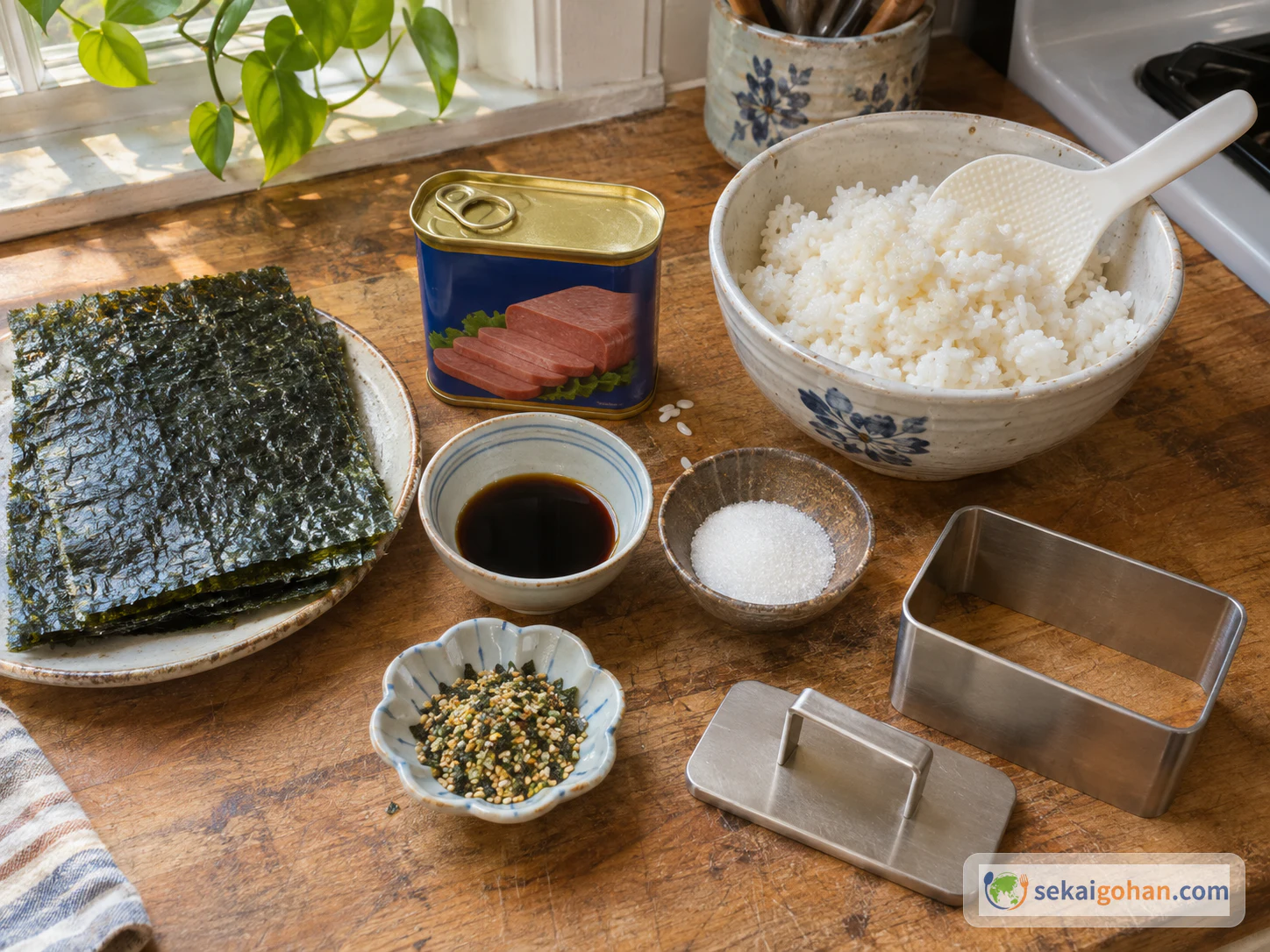
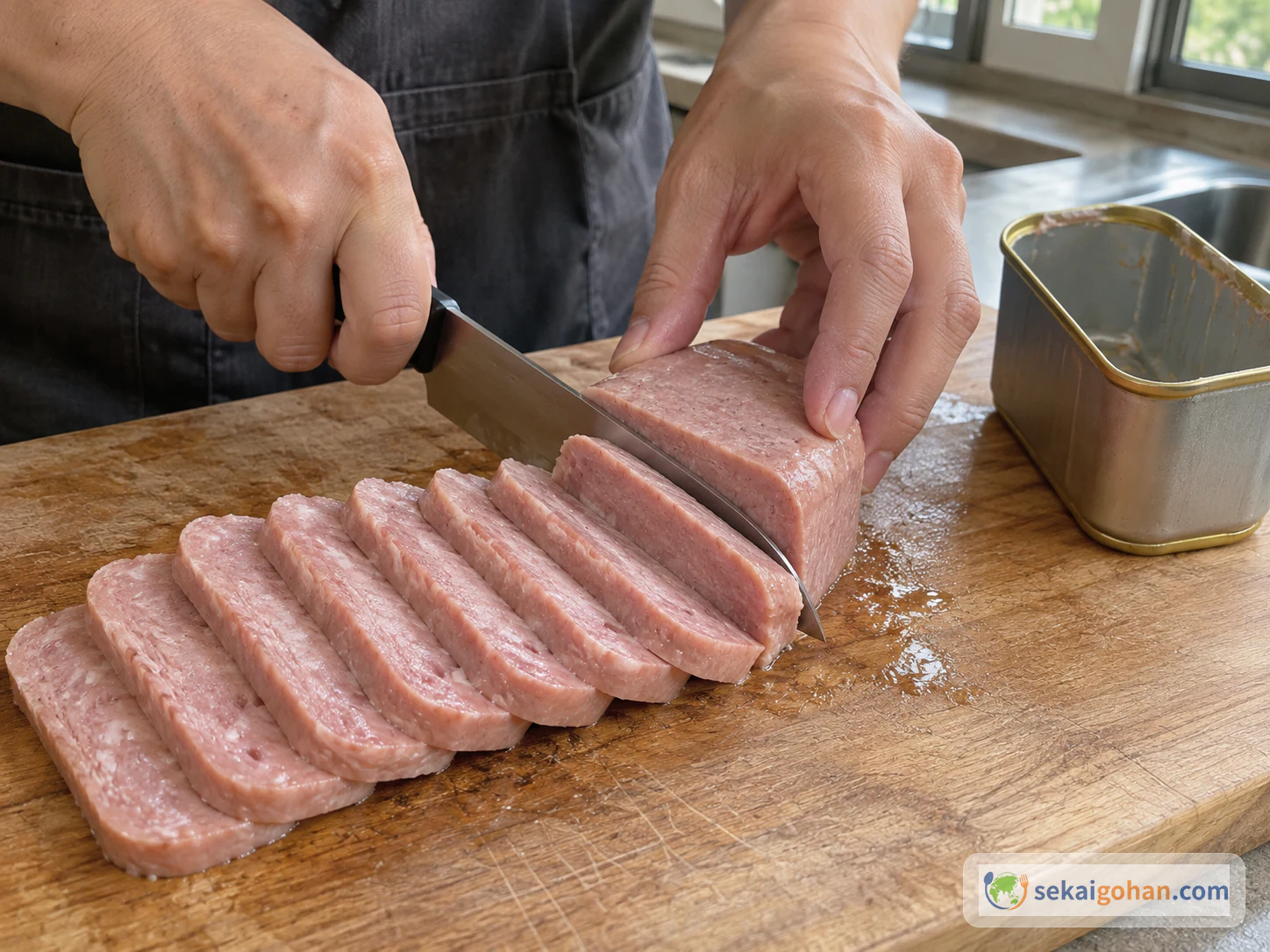
One can of Spam gives eight musubi. If you cut the slices thinner, it stretches to ten.
For a half batch, use 1½ cups uncooked rice, 1 tbsp each of soy sauce and sugar, 1½–2 tbsp furikake and 4 slices (half a can) of Spam. That makes 4 to 5 musubi. Keep the soy sauce and sugar equal, whatever size batch you make.
Soy sauce contains wheat and soy. Furikake and sesame seeds contain sesame, and nori is seaweed. Spam is pork, and the can lists its other ingredients. Furikake blends vary widely, so read the label on every pack you use.
Equipment
- Musubi mold with its press (or an empty Spam can and plastic wrap)
- Rice cooker or a heavy pot with a lid
- Knife and cutting board
- Small bowl and spoon
- Frying pan and spatula
- Plate for the fried Spam
Choosing and substituting
The glaze decides the taste. Spam is already salty, but the equal parts of soy sauce and sugar turn it into musubi, so make the glaze in full, whatever else you change. Japanese dark soy sauce (koikuchi) is the closest match. Japanese light soy sauce, or Chinese light and dark soy sauces, give a different color and a different balance of salt and sweet. Any plain white sugar works.
Use short-grain rice, sold as sushi rice or Japanese-style rice. Long-grain rice will not stick when pressed, so the block crumbles apart. Okinawan pork luncheon meat is a possible swap, but its salt, fat and aroma are different, so expect a different musubi. Furikake is optional. Without it the rice tastes plainer and the bite has less seaweed and sesame flavor.
You can make every musubi with the empty Spam can lined with plastic wrap. A mold only makes the pressing quicker when you are making a lot.
Method
Start the rice first. It is the only hands-off stretch, and while it cooks you slice the Spam and mix the glaze. The frying takes only a few minutes. The assembly is a short routine you repeat for each musubi, so set up the mold, rice, furikake and fried Spam side by side before you begin.
Steam from hot rice softens nori fast. Let the rice cool slightly before pressing, and wrap close to eating time, so the nori still crunches.
When it goes wrong
| What you see | Why | What to do |
|---|---|---|
| The glaze turns dark and bitter | The sugar burned over too much heat | Turn the heat down as soon as the glaze goes in, and pull the slices once it turns sticky |
| The block crumbles when unmolded | The rice was pressed too lightly, or it is not short-grain | Press harder until the corners are full; use short-grain rice |
| The rice is hard and dense | It was packed too hard | Press only until the shape holds |
| The nori is soggy and hard to bite through | Hot rice steamed it, or it was wrapped long before eating | Cool the rice slightly first and wrap close to serving |
| The nori end springs open | Dry nori does not stick to itself | Press a grain or two of rice under the end |
| Too salty | Slices cut thick | Cut the can into 10 thinner slices next time |
Serving, variations and storage
At the table and on the go
Spam musubi is finger food. People make it for gatherings and outings, where everyone takes one from the platter. At home, serve it on a plate as a snack or light lunch. Egg, bacon, avocado or cheese turn up in deluxe versions. Treat those as their own musubi and keep the basic one as it is.
Variations
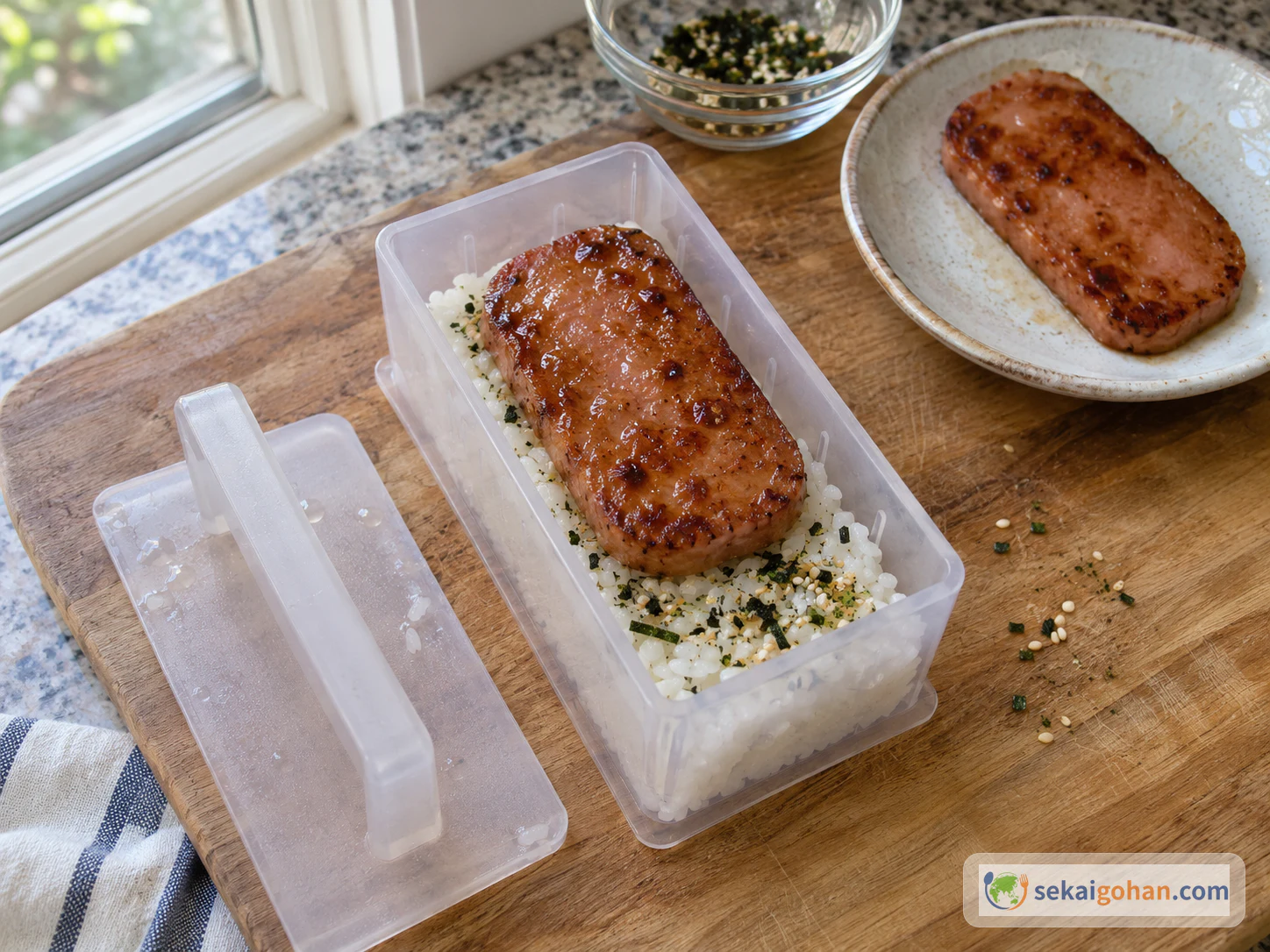
Spam in the middle. Cut the nori sheet in half lengthwise instead of thirds. Press about ½ inch (1.3 cm) of rice into the mold, then add furikake, the Spam slice, more furikake and a second layer of rice. Press, unmold and wrap. This version is easier to eat and holds together well, and the wider nori covers more of the block.
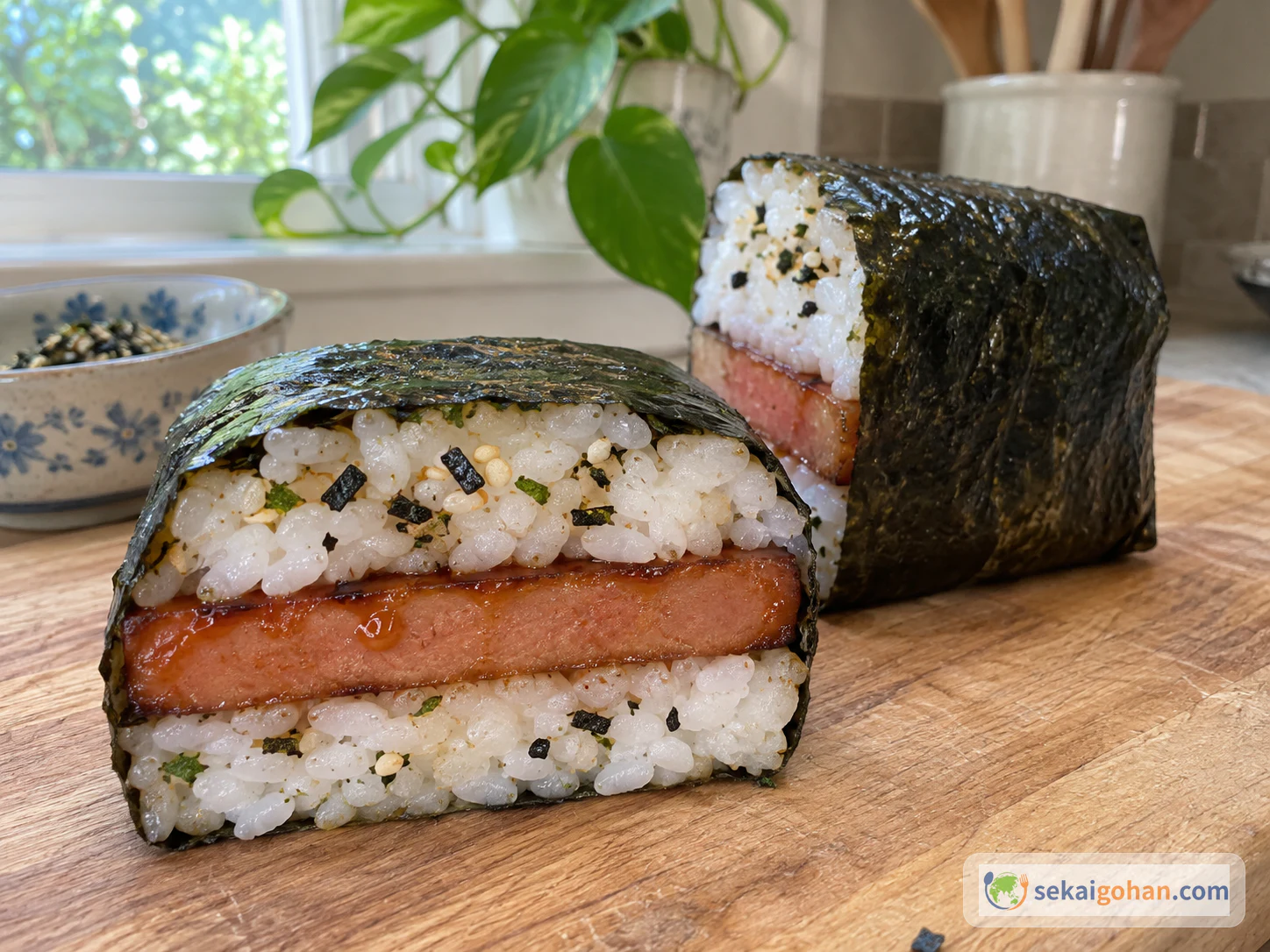
Furikake mixed in. Fold the furikake through the rice before pressing instead of sprinkling it on top. Each bite has the seasoning all the way through, with no distinct layer under the Spam.
Ten thinner slices. Cut the can into 10 slices for 10 musubi. Each one has less Spam in proportion to rice, so it tastes milder and less salty.
A narrow belt. Cut the nori into quarters for a slim band that leaves more rice and Spam showing. It makes a smaller-looking musubi that suits a lunchbox.
Carrying and leftovers
Cooked rice left at room temperature is the risk here. Spores of the bacterium Bacillus cereus survive cooking. If the rice sits warm, they germinate and produce a toxin that causes food poisoning. Any musubi you won't eat right away must be held above 140°F (60°C) or at 39°F (4°C) or below. To chill, bring it down to 68°F (20°C) within 2 hours, then to 39°F (4°C) within the next 4 hours.
Let the rice cool before packing so steam doesn't collect in the container. Carry the musubi in an insulated bag with ice packs, keep them away from warm places, and eat them early. Follow the label on the can for storing opened Spam.
For leftovers, wrap each musubi individually or seal them in a covered container, and refrigerate promptly. To reheat, cover with a damp paper towel and microwave for about 1 minute, until hot through. The nori softens in storage, so reheated musubi have a softer wrap than fresh ones.
Frequently asked questions
My rice cooker came with its own small cup. How much rice is that?
The 3 cups are US cups of 240 ml, so 720 ml of uncooked rice. A Japanese rice-cooker cup holds 180 ml, so that is about 4 of those cups. Cook it to the water line for 4.
Can I put the Spam on without frying it?
Fry it. The browned, crisp edges and the glaze make the dish, and an unfried slice tastes flat and soft. Cooked processed meats such as ham are best heated anyway before they go into food you carry.
Can I use less sugar in the glaze?
You can, but the musubi changes. The sugar is what turns into the gloss and the sticky caramel edge, and it balances the salt of the Spam and soy sauce. With less sugar the glaze stays thin and the slice tastes saltier.
Can I use brown rice or mixed rice?
Yes. Expect a chewier, more separate grain. Adjust the water to suit the rice, and press firmly, since it holds together less readily than white short-grain rice.