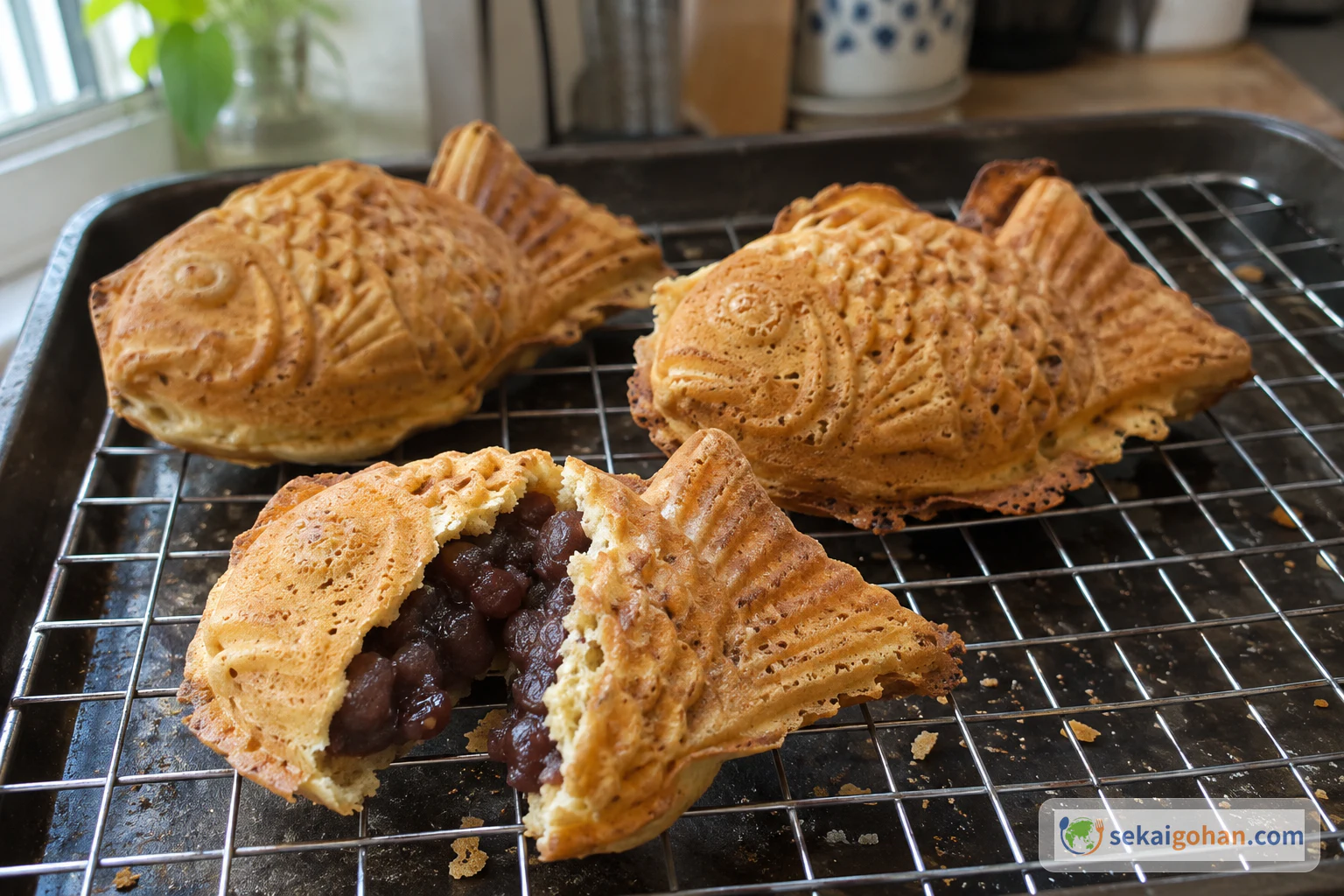
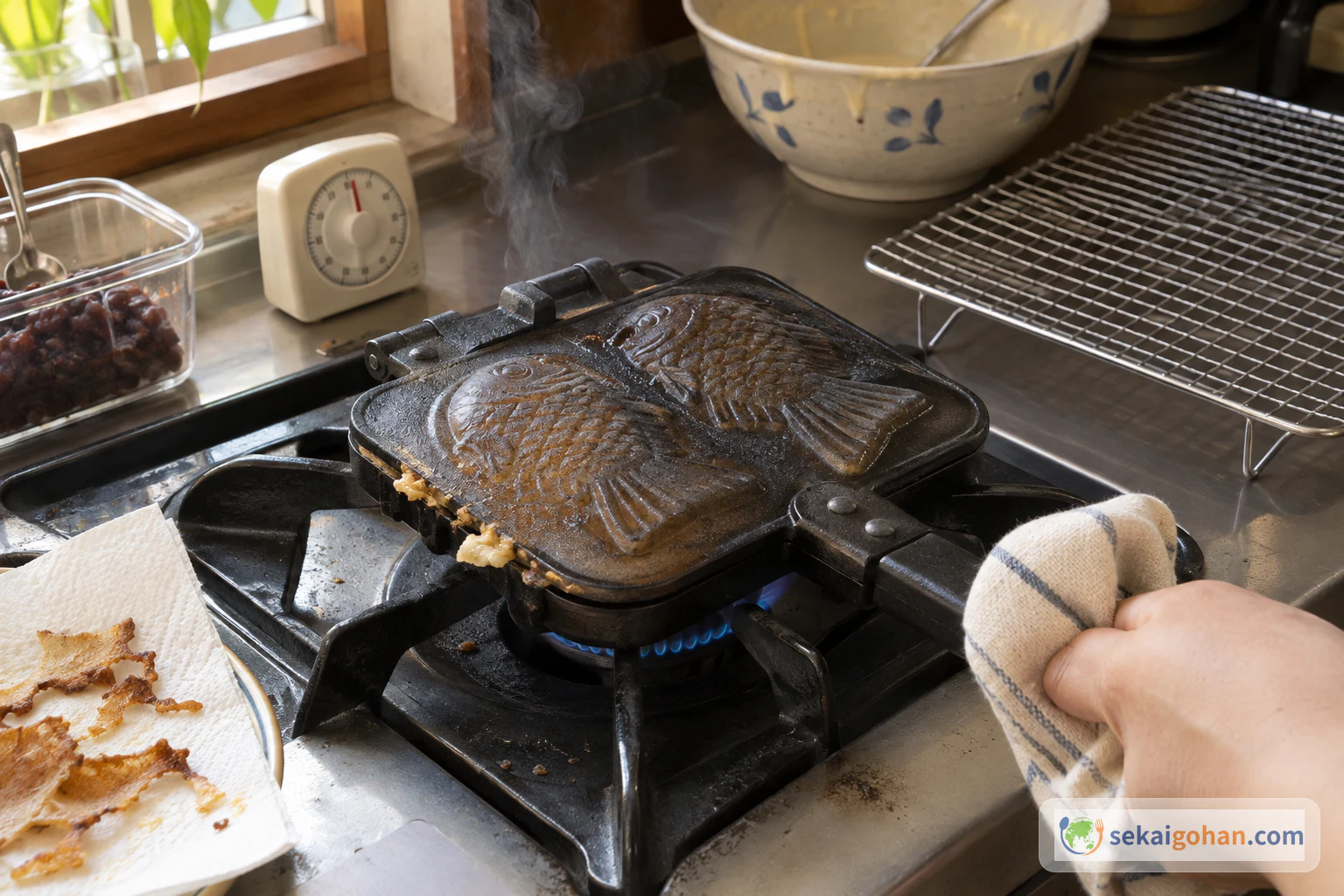
The iron mold swings open over a low gas flame. Inside lies a golden fish, its scales and fins pressed into a thin, crisp crust, and the tail is warm with sweet red bean paste. Taiyaki is a Japanese sweet made by sealing bean paste inside a flour batter and baking it in a fish-shaped metal mold. You eat it hot, out of a paper wrapper, held in one hand. The crust snaps at the edges and turns soft where it meets the filling. The paste is dense and only lightly sweet, and you can taste the beans in it.
A Lucky Fish from a Tokyo Sweet Shop
Taiyaki grew out of imagawayaki, the round griddle cake filled with bean paste that also goes by kaitenyaki in some places. The story usually told begins in 1909 (Meiji 42). Seijiro Kanbe, founder of Naniwaya Sohonten in Tokyo's Azabu-Juban, started selling imagawayaki and found no buyers. He then tried a turtle-shaped version, and that failed as well. When he switched to a sea bream mold, the cakes finally sold. Where taiyaki first appeared is not fully settled, and one account places its birth in Kojimachi, Tokyo, rather than Azabu.
The choice of fish makes sense. Sea bream, tai, is Japan's celebration fish. Its name echoes medetai, "auspicious," and its red color is also counted among the reasons it is considered lucky. At the time it was also an expensive fish that most people could not afford. A cake shaped like one offered a taste of that good luck at an everyday price, and taiyaki has carried that festive, lucky feeling ever since. It is sold at street stalls, at festivals and in specialty shops. People eat it warm while walking along, often straight from the wrapper.
Fans sort taiyaki into "wild" (tennen) and "farmed" (yōshoku). Wild fish are baked one at a time in single-cavity irons called itchō-yaki. Farmed fish come from molds that bake several at once. The joke is usually traced to one writer who loved taiyaki, and it has since become standard among enthusiasts.
The two styles eat differently. Wild taiyaki tends to have a thin, crackling crust and a bigger share of filling. Farmed taiyaki is thicker and fluffier, and it is where most of the experiments happen: custard, chocolate, chewy rice-flour dumplings and new kinds of batter. Neither style is better. The batter in this recipe sits on the thin, crisp side. It uses both baking soda and baking powder, plus an egg for richness and color, which makes a crust that browns deeply without turning cakey. More of Japan's home cooking is collected on the Japan page.
Ingredients (makes about 6 taiyaki)
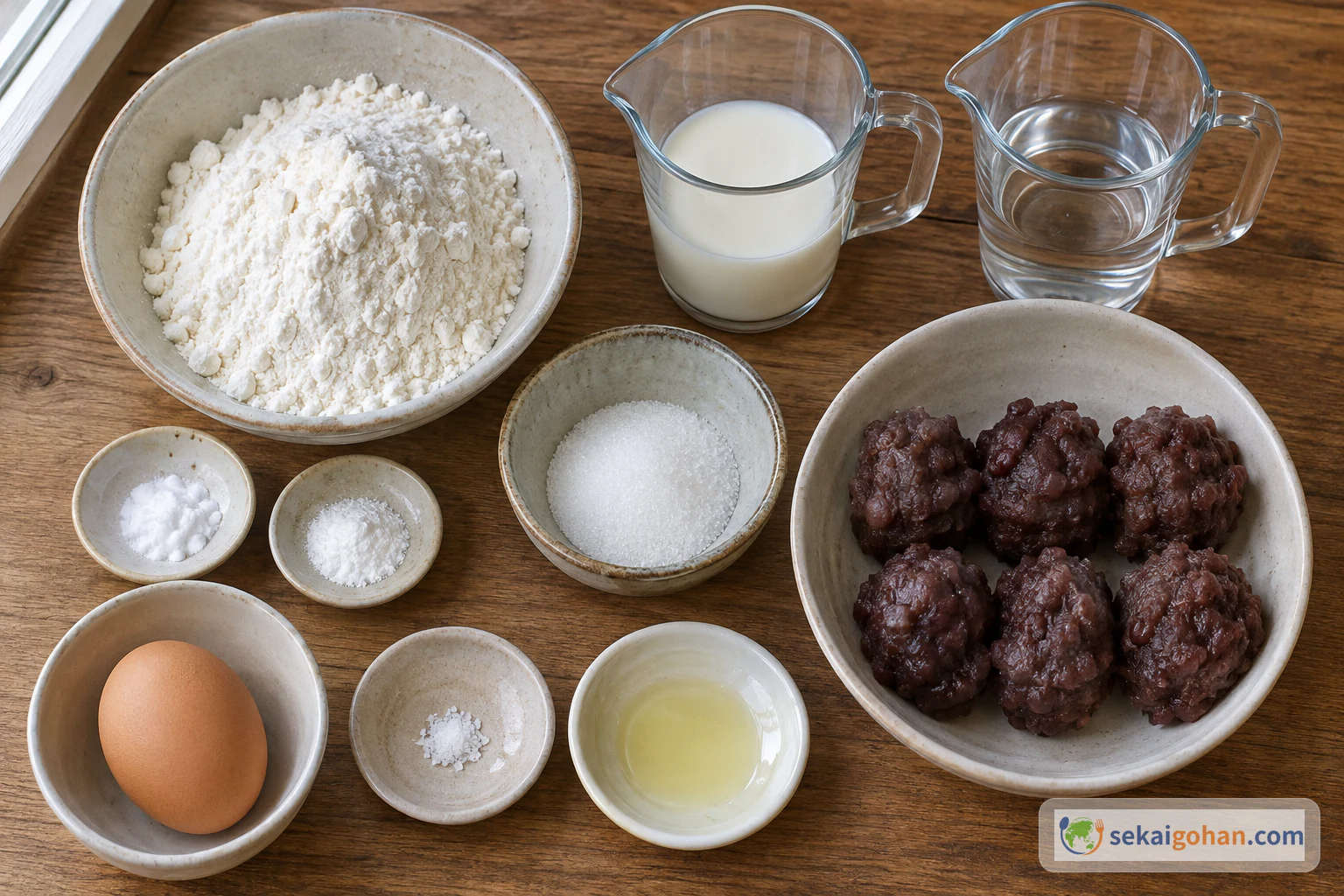
Weigh the milk and water on the scale along with everything else. A pinch of salt really means a pinch. Check the label on store-bought bean paste, since ingredients vary from brand to brand.
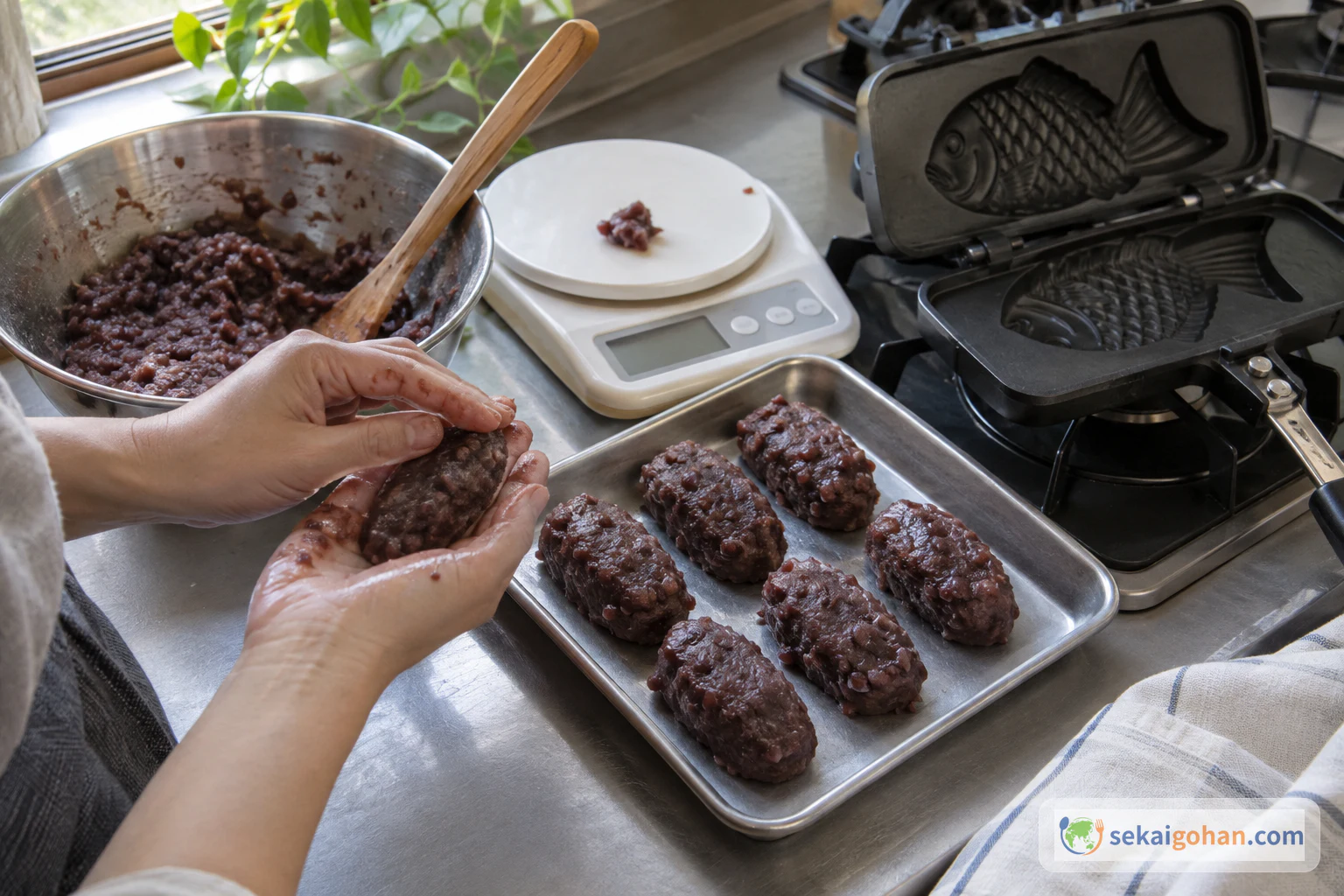
Roll each 1¾ oz (50 g) portion into a log slightly shorter than the fish mold. Once the pan is hot there is no time left to shape filling. A log of the right length reaches into the tail without poking out at the head.
This recipe contains wheat, egg and milk. Check store-bought bean paste for other allergens and additives.
Equipment
- Stovetop taiyaki pan (hinged, fish-shaped, cast iron)
- Kitchen scale
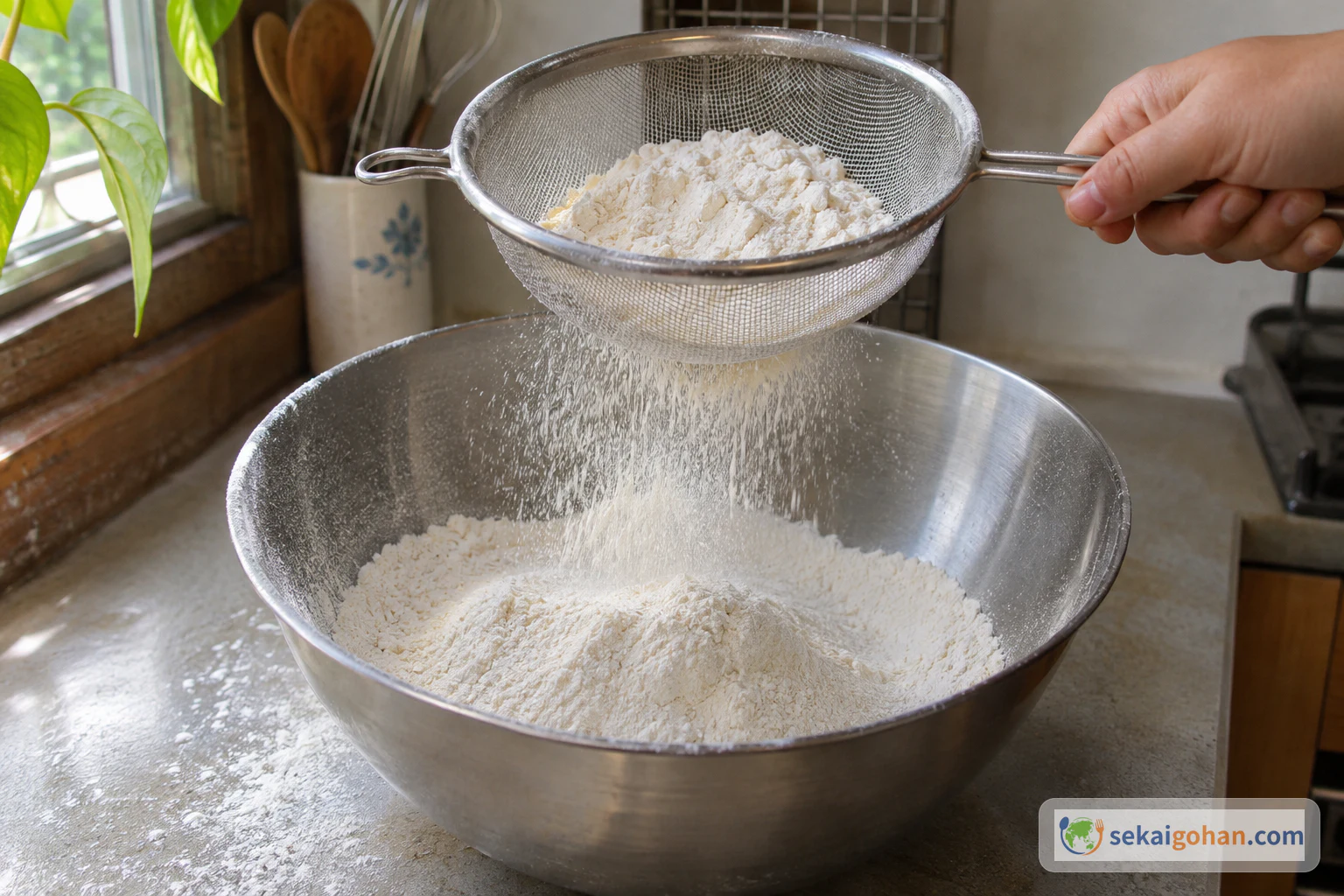
- Fine-mesh sieve
- Two mixing bowls and a whisk
- Plastic wrap
- Tablespoon or small ladle for the batter
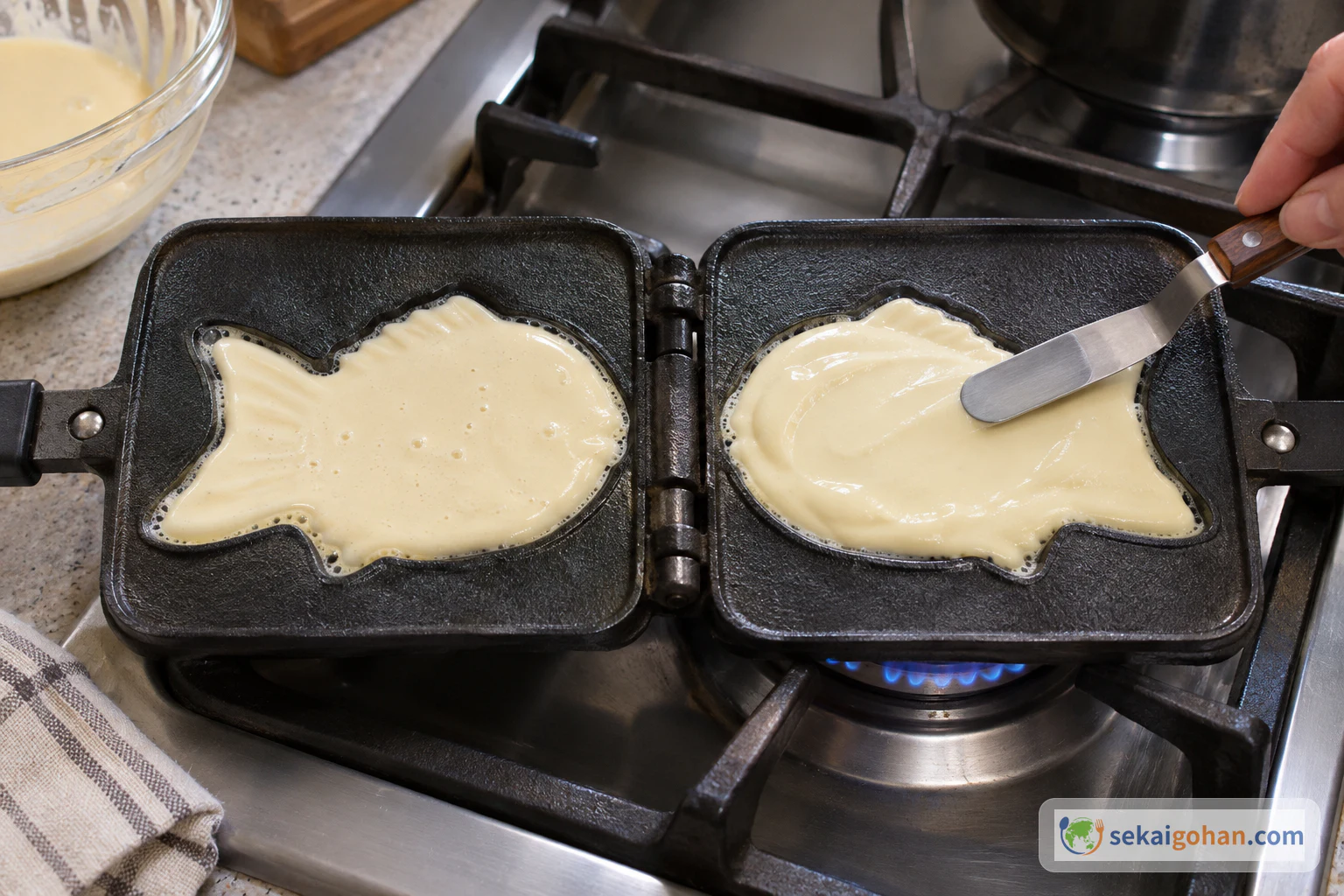
- Small offset spatula (handy for smoothing batter and moving the paste)
- Silicone brush (handy for looking after the pan)
- Wire rack and paper towels
Choosing and Substituting
Everything here is easy to find. Look for red bean paste in the Japanese sweets aisle of an Asian grocery, at a baking-supply shop or online. Chunky tsubuan gives the classic bite, with whole beans in every mouthful. Smooth koshian makes a silkier filling. Use the same weight.
Cake flour matters more than anything else on the list. All-purpose or bread flour forms more gluten, and the crust comes out tougher and chewier. Superfine or caster sugar can replace granulated sugar at the same weight. Keep both the baking soda and the baking powder. The soda gives color and the thin, crisp crust, the powder gives lift, and dropping either one changes the crust. An egg-free thin-crust taiyaki exists, but it is a different batter with its own proportions. Leaving the egg out of this one, or making up for it with extra liquid, does not produce it.
The pan decides the most. A single-cavity iron bakes in the wild style, and multi-fish molds work too. A pan for imagawayaki bakes the same batter and filling as round cakes. Hot-plate style molds heat differently from a pan over a gas flame, so follow the maker's instructions and judge by color.
Method
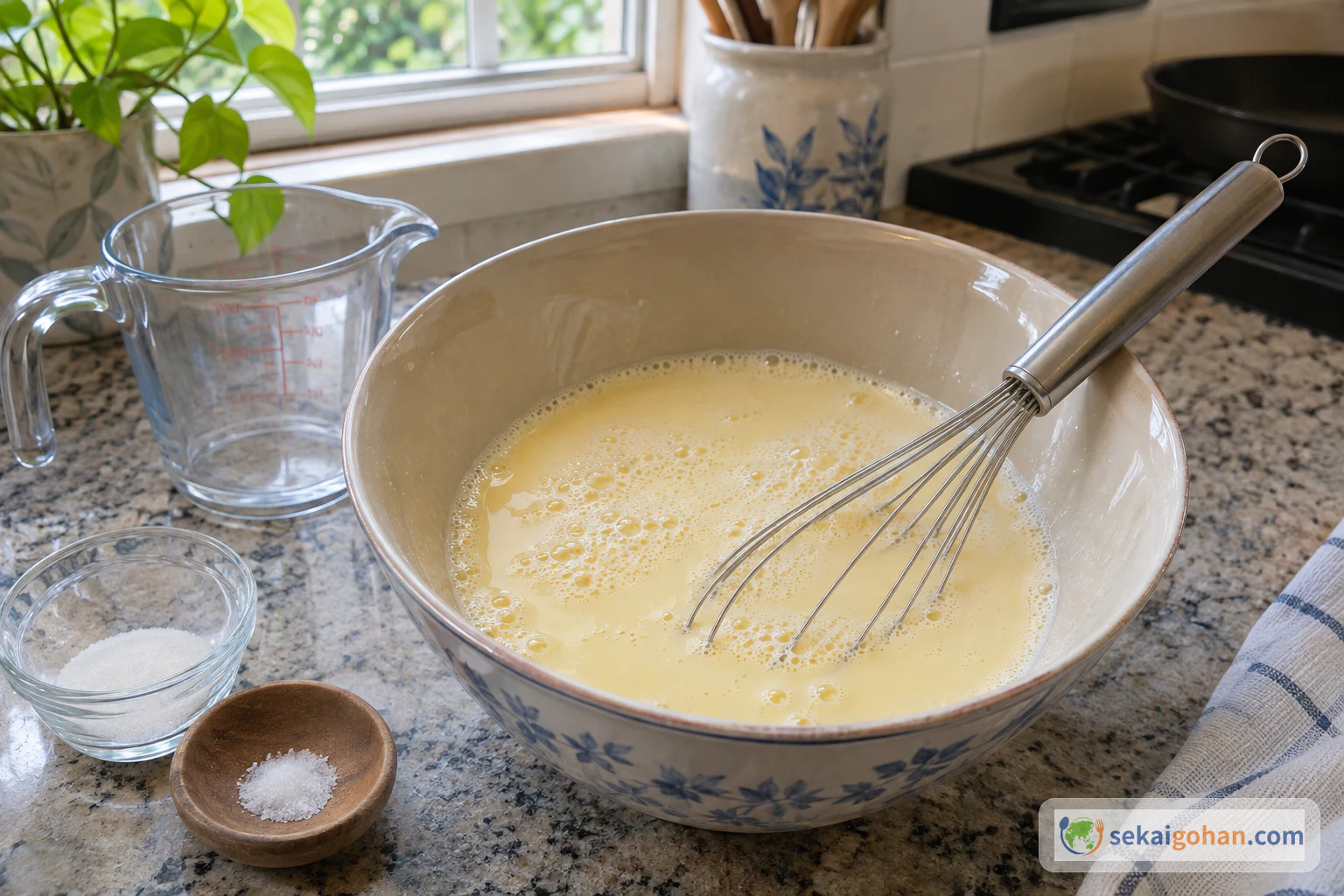
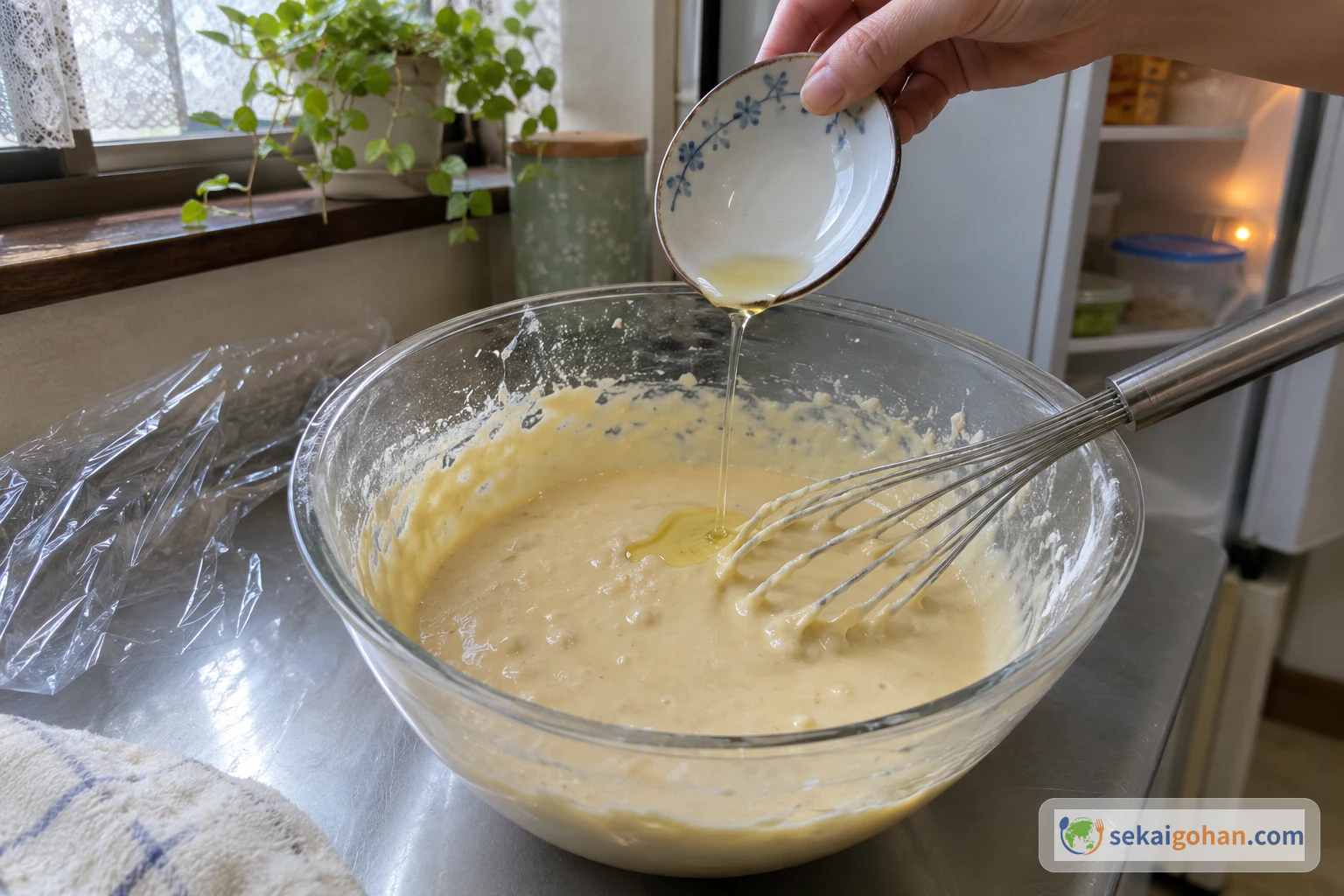
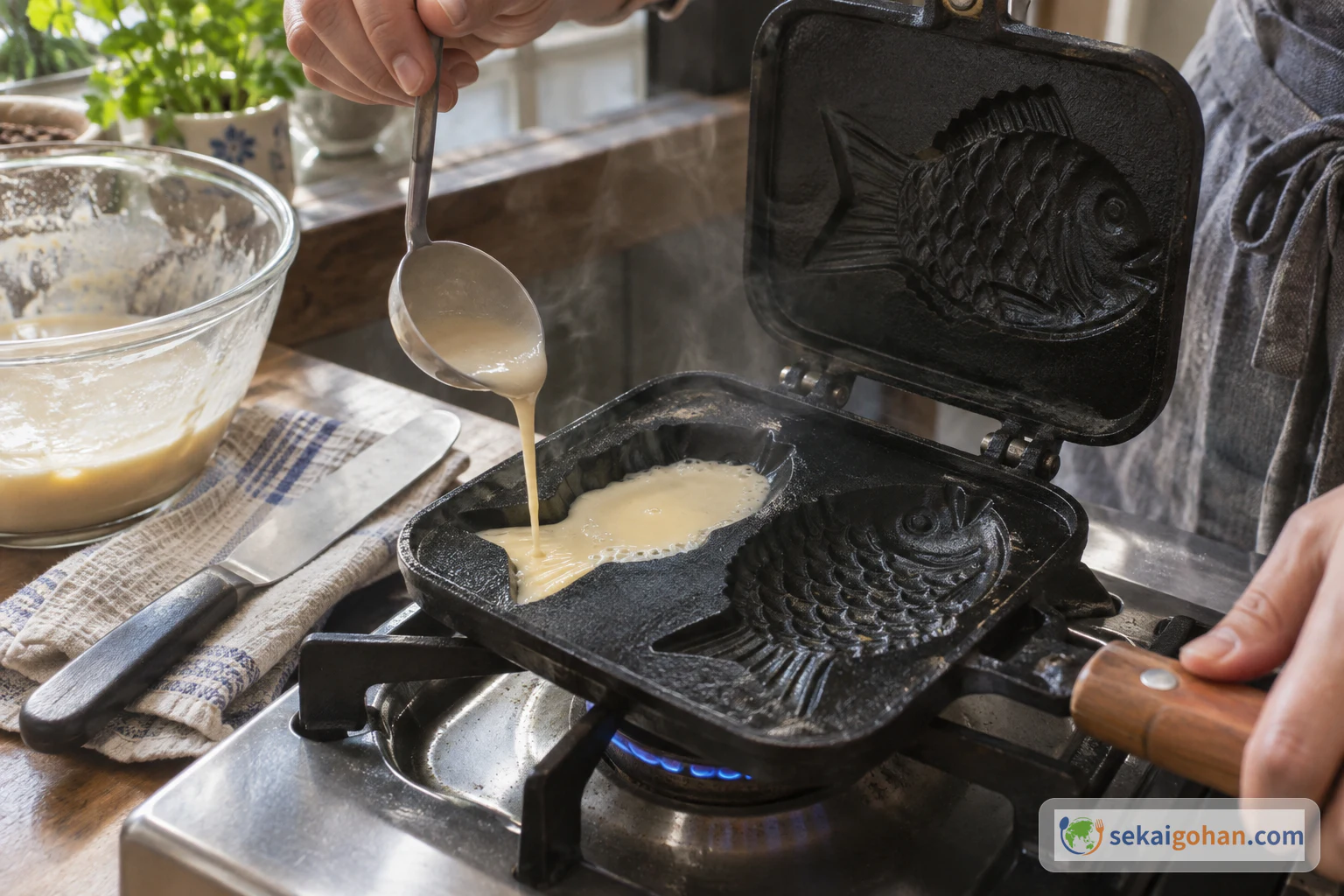
Shape the paste first, then mix the batter and give it about 30 minutes in the fridge. That rest is the only hands-off stretch. Once the pan is hot, the rhythm runs pour, set, fill, cover, bake, flip, so have the paste logs, batter, spoon and rack within reach before you light the burner.
Freshly baked bean paste is extremely hot. Paste that has leaked out can sit on the open mold, so keep your fingers away from it. Let the taiyaki cool slightly before handing them to children.
If the batter lands without a sizzle, the pan is not hot enough yet, and the crust will stick. Give the iron more time on low heat rather than turning the flame up.
When It Goes Wrong
| What you see | Why | What to do |
|---|---|---|
| Paste bursts out, scorches and blackens the mold | The paste was not fully covered, so it swelled in the heat and broke through | Seal every bit of paste under batter before closing. Wipe the scorched spots off before the next fish |
| Crust sticks and tears when you open the pan | The mold was not hot enough when the batter went in | Heat the whole pan through on low before pouring, and listen for the sizzle |
| Crust is thick and fluffy, not crisp | Too much batter poured, or the batter was overmixed | Keep to the thin spoonfuls in the steps and stir only until combined |
| The tail is empty | The paste log was too long or too short for the mold | Shape the logs a little shorter than the mold and press them toward the tail first |
| Patchy, uneven browning | Heat too high | Turn the flame down to low and let each side take its full time |
Serving, Variations and Storage
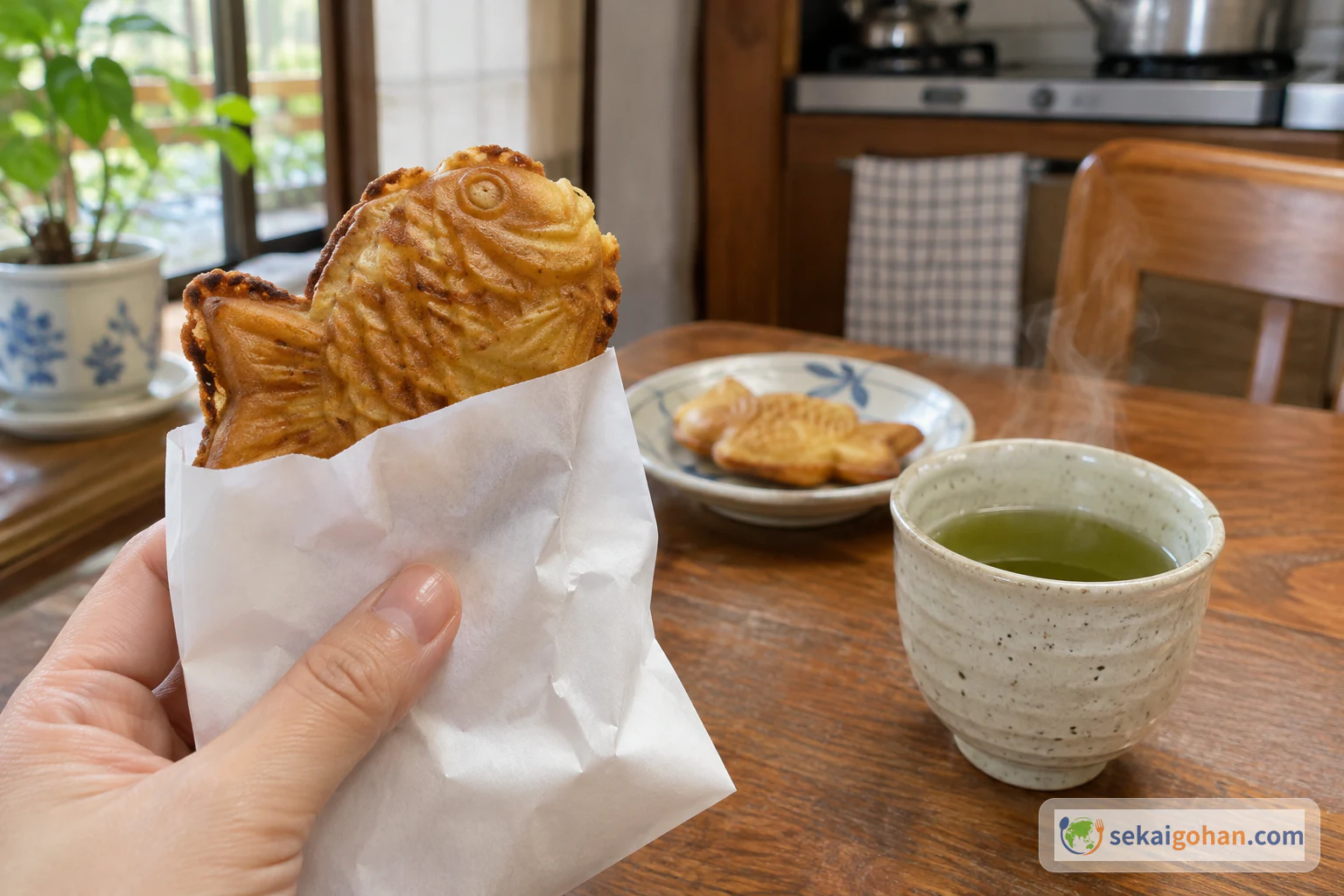
At the table
Taiyaki is best within minutes of leaving the mold, while the crust still crackles. Wrap each fish in a sheet of paper so you can hold it, and pour hot green tea alongside.
Variations
- Smooth koshian: the filling turns silky and the bean texture disappears. Few shops use it. The usual explanation is that chunky paste matches the crust's texture better.
- Custard cream: the most common filling besides bean paste. It is wetter, so a gap in the batter will make it burst. Cover it with extra care.
- Chocolate or chocolate custard: melts quickly in the heat. Seal it completely inside the batter.
- Matcha custard: the dark green filling can fool you about browning, so judge doneness by the color of the crust at the edges.
- Shiratama (small rice-flour dumplings): adds a soft, chewy bite next to the paste. Check that the fish is golden and releases cleanly before you take it out.
Storage and reheating
Let leftover taiyaki cool on the rack. Refrigerate them in a covered container for up to 2 days, or freeze for up to 1 month. Reheat in a 180°C oven or toaster oven until the crust is crisp again and the filling is warm all the way through. These storage times and the reheating temperature are a home-recipe guideline, not an official food-safety standard.
Frequently asked questions
Can I make taiyaki without a taiyaki pan?
You need a mold. The fish shape and the way the batter wraps the filling both come from the hinged iron. An imagawayaki pan makes the same batter and paste into round cakes.
Why does the batter use both baking soda and baking powder?
They do different jobs. Baking soda deepens the browning and keeps the crust thin, and baking powder gives the lift. Together they make the golden, crisp crust. Using only one gives you a different crust.
Can I make it egg-free?
Egg-free thin-crust taiyaki is its own recipe, with different proportions of flour, milk and leavening. Leaving the egg out of this batter throws off its balance. If you need it egg-free, start from a batter designed without egg.
How much batter goes into each fish?
Use about 1 tbsp on the first side, about 1 tbsp on the second side, and a scant 1 tbsp over the paste. Bigger or smaller molds need a little more or less. Aim for a thin layer that covers the bottom of the mold, with enough on top to hide the paste completely.