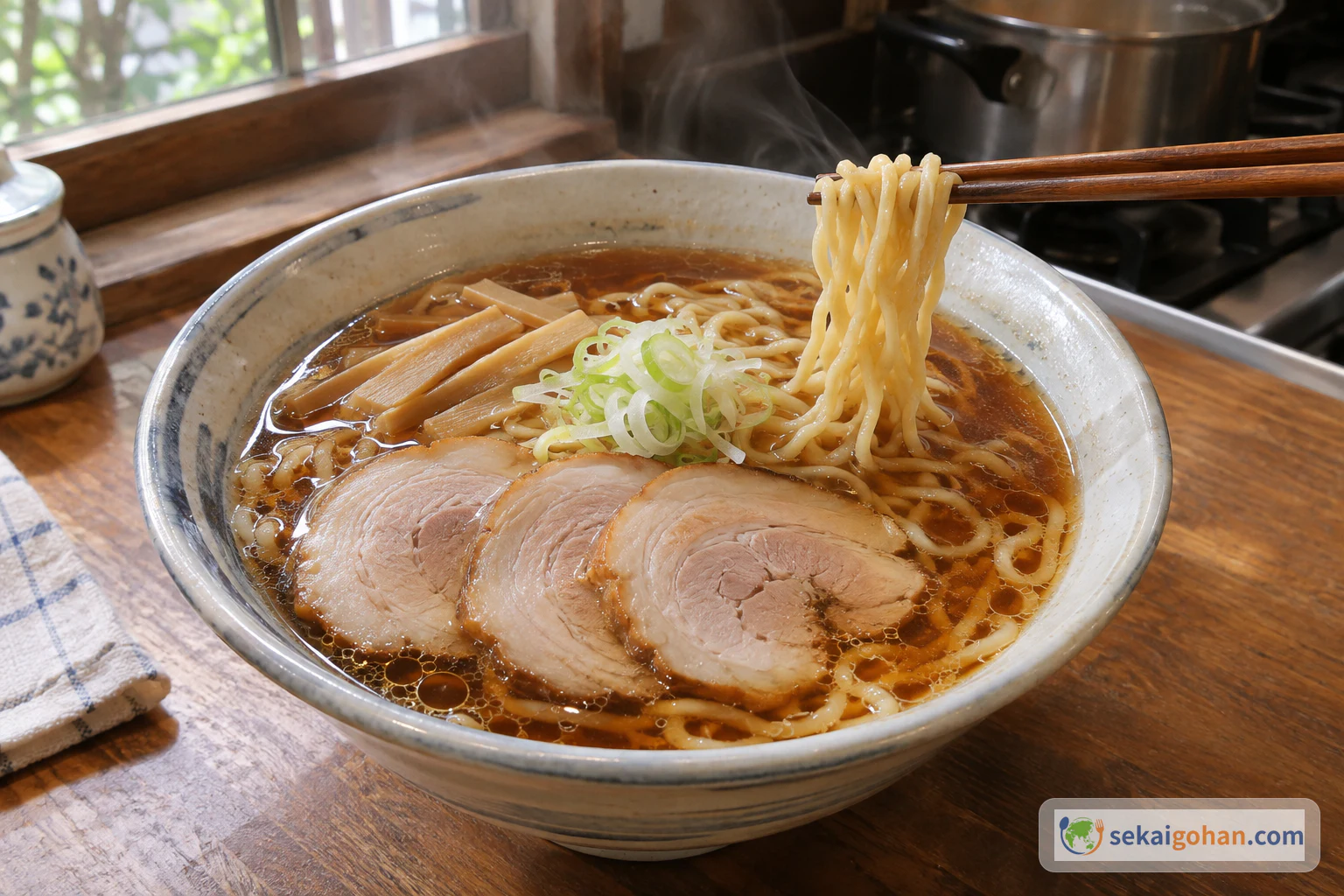
Takayama ramen with thin curly noodles, pork belly chashu, menma and chopped long onion in a clear, deep amber soy broth
Serves4 servings
CuisineJapanese (Hida)

Takayama Ramen: Hida Clear Soy Broth with Thin Curly Noodles

Takayama ramen from Hida in Gifu, Japan: chicken and fish broth with the soy simmered in, how to keep it from clouding, and which thin curly noodles to buy.

Level: Intermediate

Cooking flow

Cooking steps

STEP 11 / 10

Soak the kombu and blanch the bones

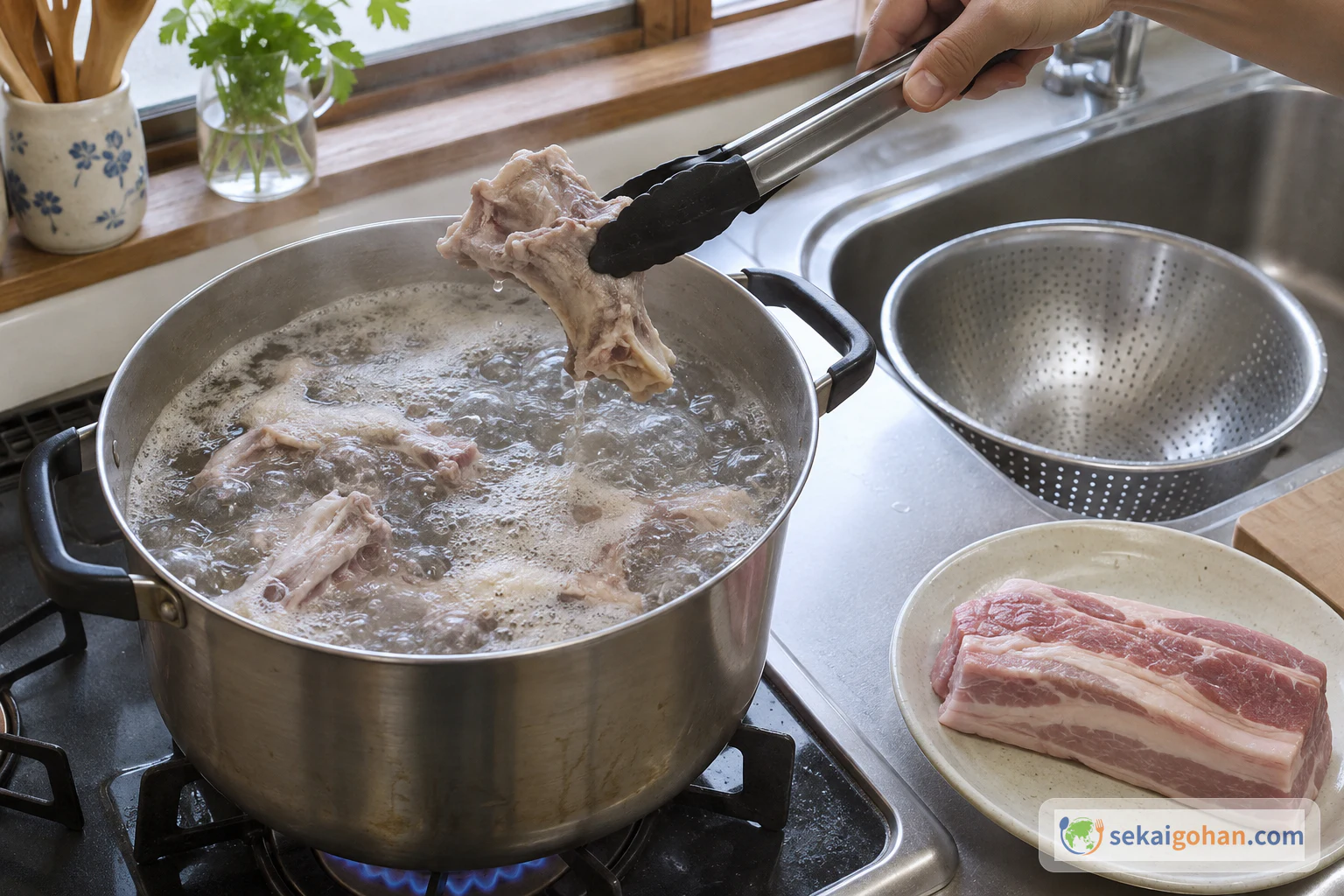
Chicken carcasses blanched for 2–3 minutes in boiling water, then drained in a colander and rinsed under running water
The grey foam on the blanching water is exactly what you're keeping out of the stockpot

Put the kombu in a bowl with the first quart of water and leave it to soak while you deal with the bones. Bring a large pot of water to a rolling boil, drop in the chicken carcasses and boil them for 2–3 minutes. Tip them into a colander and rinse under running water, rubbing off blood and grey scum. Rinse the pork belly and pat it dry. The bones are ready when they look pale and clean, with no dark blood left in the crevices.

STEP 22 / 10

Fill the stockpot and bring it up

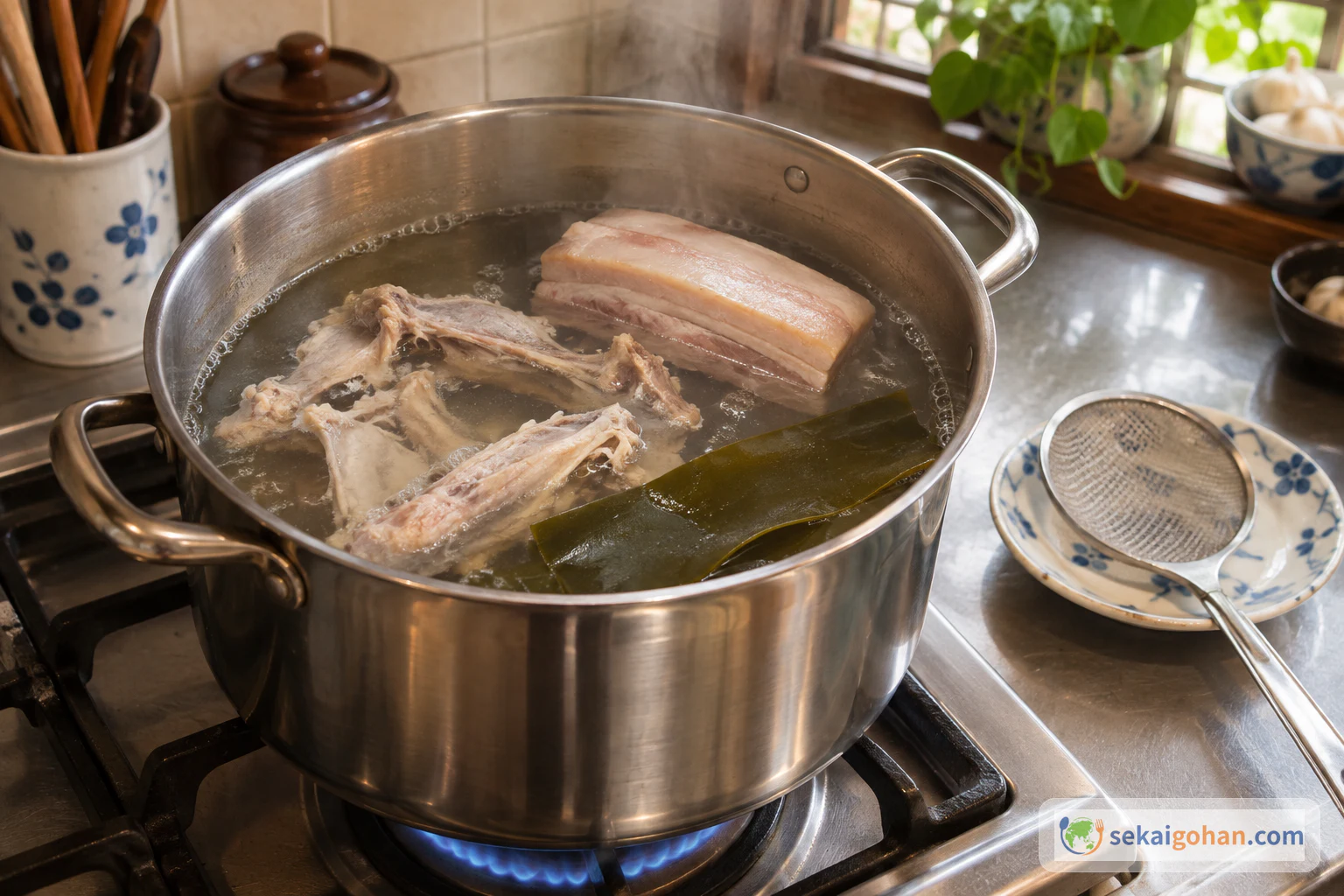
A pot with kombu soaking in water, the chicken carcasses and pork belly added, just starting to heat over medium
Everything should sit under the water, the pork belly fully submerged

Pour the kombu and its soaking water into the stockpot. Add the blanched bones, the pork belly in one piece and the second quart of water. Set the pot over medium heat and let it warm up slowly. Watch the edge of the pot: when small bubbles start to rise there and the first scum gathers on the surface, it is time to lower the heat.

STEP 33 / 10

Skim and simmer slowly

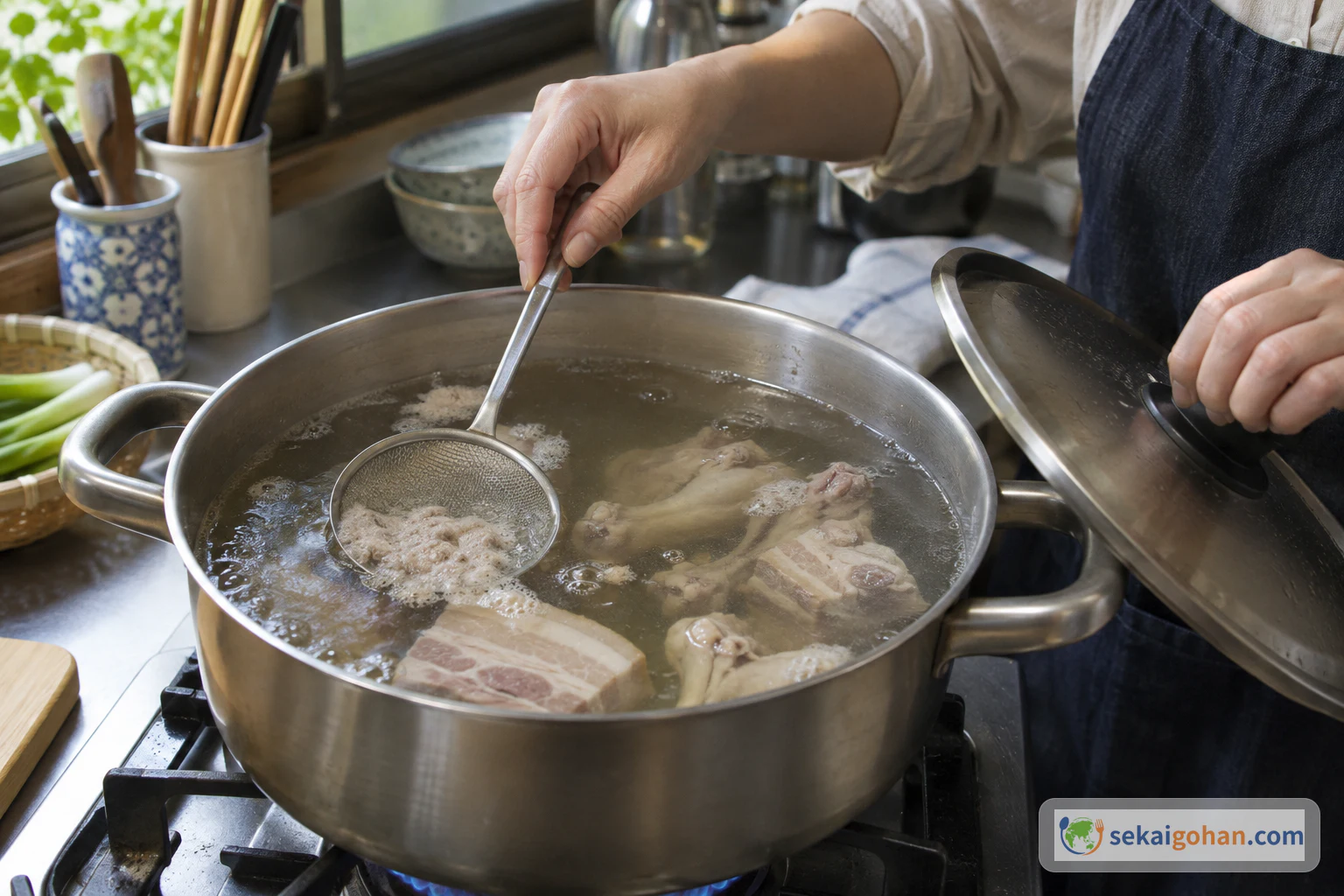
Carefully skimming scum from the gently simmering broth with a fine wire skimmer
Skim from the surface only; the bones and pork should stay visible through the broth

Turn the heat down until only small bubbles break the surface. Skim off the grey-brown scum with the fine skimmer, and come back to it each time more rises. Let the pot simmer slowly and patiently, without stirring the bones. Carry on until the foam on top is fine and settled, the broth is still clear, and the meat is starting to fall away from the chicken bones.

STEP 44 / 10

Add the aromatics

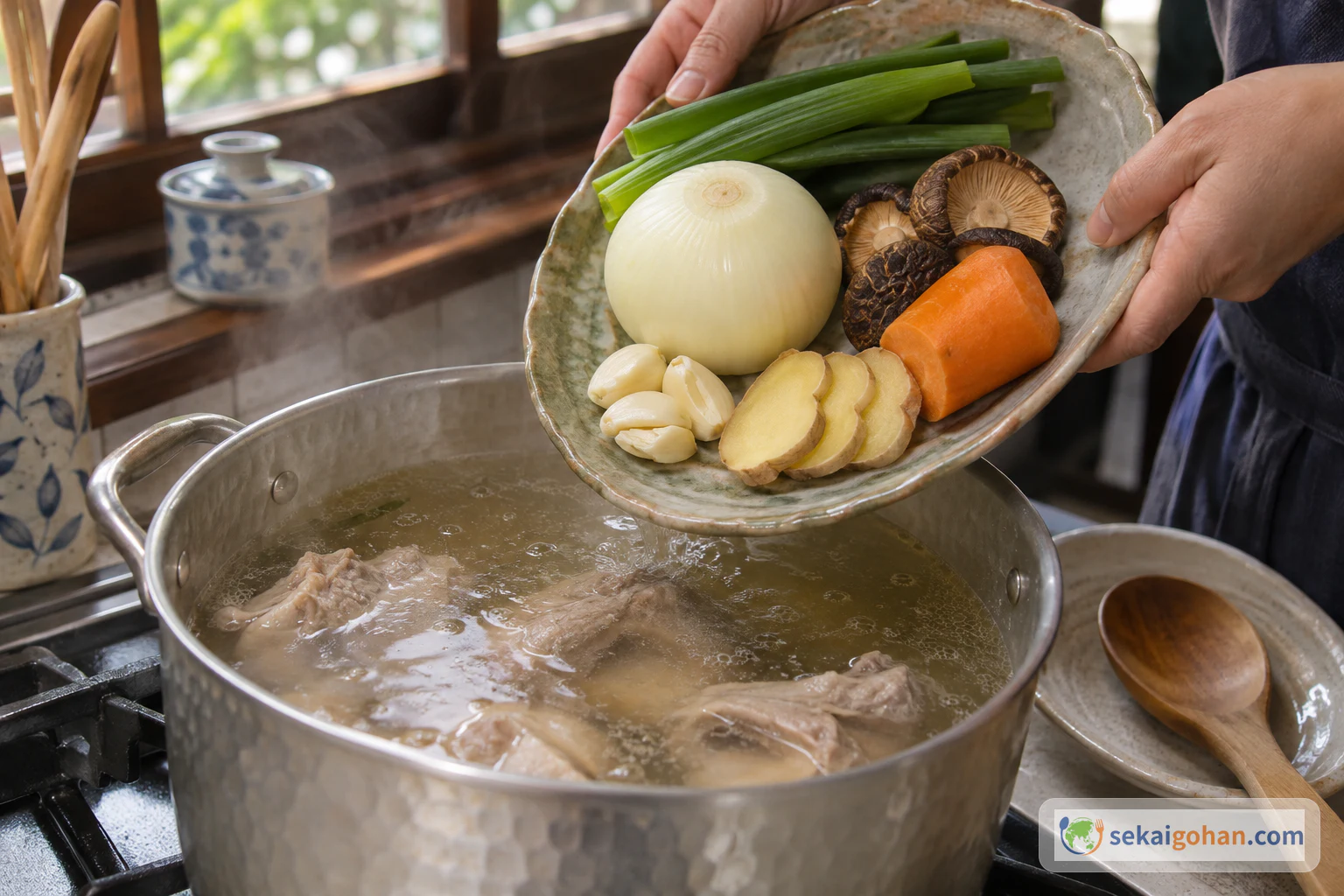
Onion, carrot, long onion greens, ginger, garlic and dried shiitake added to the broth
Lower the vegetables in gently so the broth isn't churned up

Add the onion, carrot, long onion greens, ginger, garlic and dried shiitake. Put the onion and carrot in whole so they can be lifted out in one piece later. Keep the heat low and let the vegetables simmer in the broth. Keep simmering until the onion is soft, then move on.

STEP 55 / 10

Steep the bonito and sardines

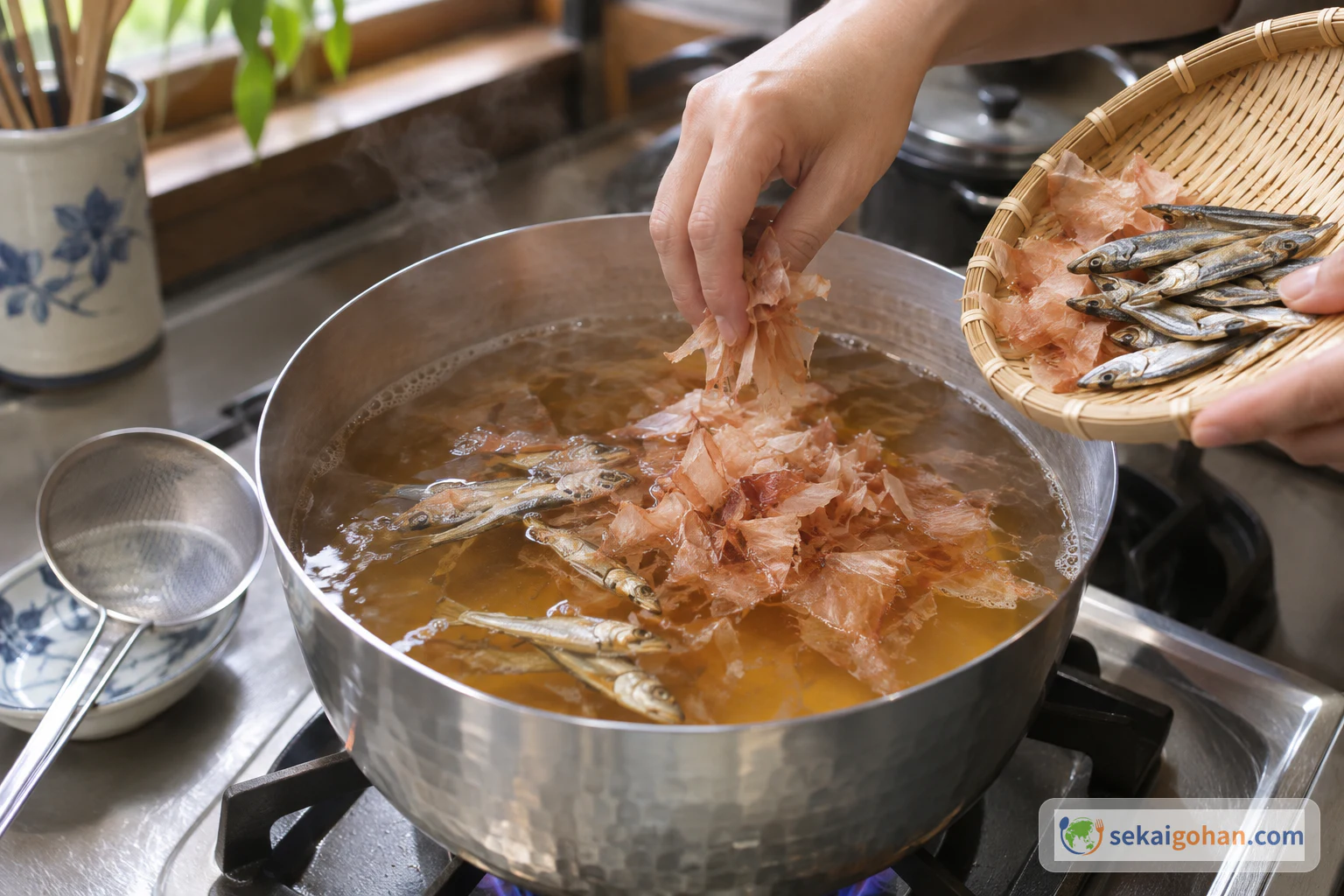
Thick-shaved bonito flakes and dried sardines added to the broth and simmered briefly until fragrant
Let the flakes spread across the surface; don't push them under with the skimmer

Add the thick-shaved bonito flakes and the dried sardines. Keep the pot at a gentle simmer and stay close, because this stage is short. Fish left in too long turns the broth harsh and cloudy. Move on as soon as a strong bonito aroma rises from the pot.

STEP 66 / 10

Add vinegar and sake, then strain

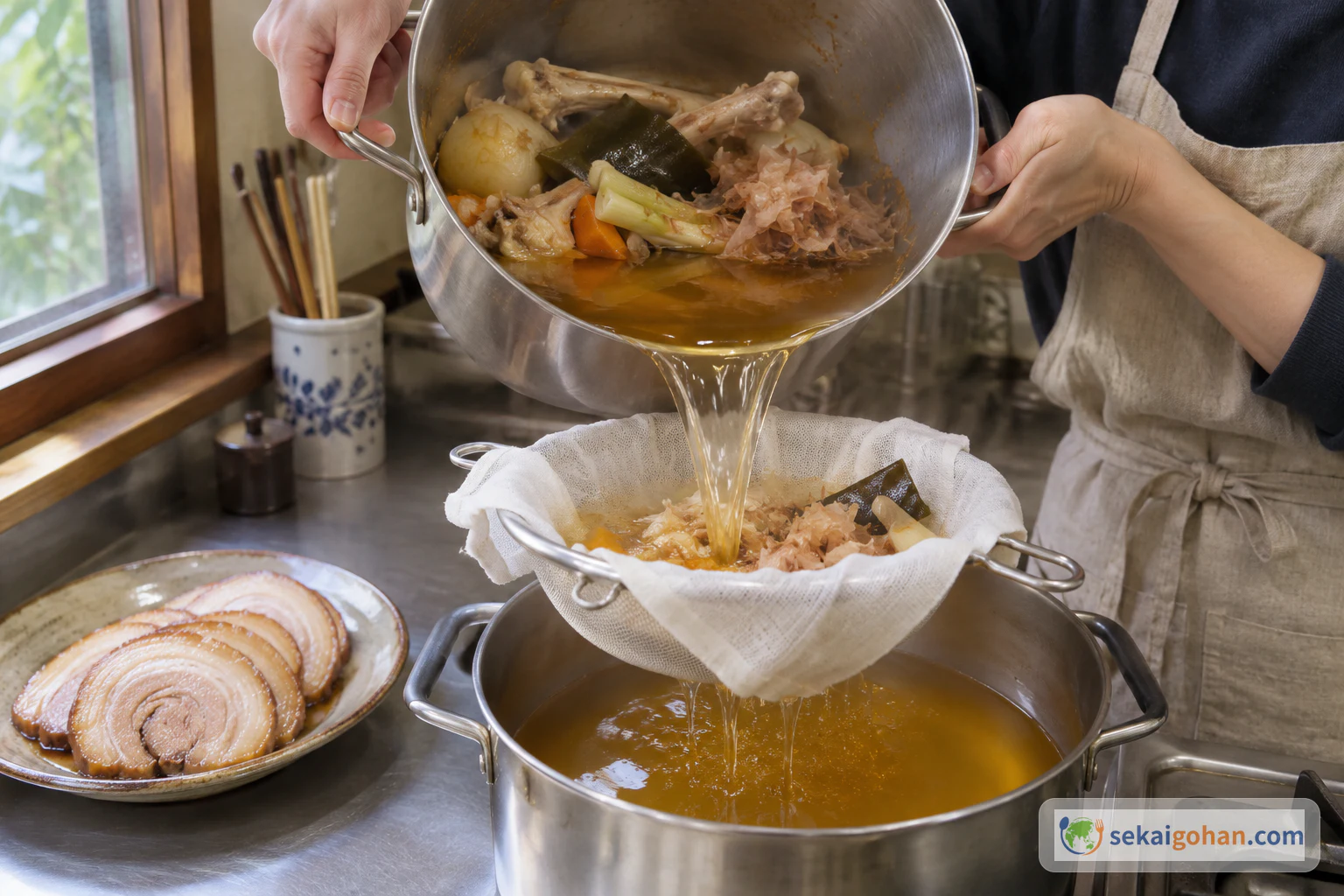
Straining the broth through a fine sieve lined with a straining cloth, catching the clear broth below
Pour slowly; the cloth catches the fine fish flakes that a sieve alone lets through

Pour in the vinegar and sake, let the pot return to a brief boil, then turn off the heat. Lift out the pork belly and set it on a plate to cool, and lift out the whole onion and carrot too: eat them as a pot-au-feu-style side, or discard them with the rest. Line a fine-mesh sieve with the straining cloth, set it over the second pot and pour the broth through. You are done when about 6¼ cups (1.5 L) of clear, glossy broth sits in the pot and the bones, kombu and fish stay behind in the cloth.

STEP 77 / 10

Stir in the tare and simmer

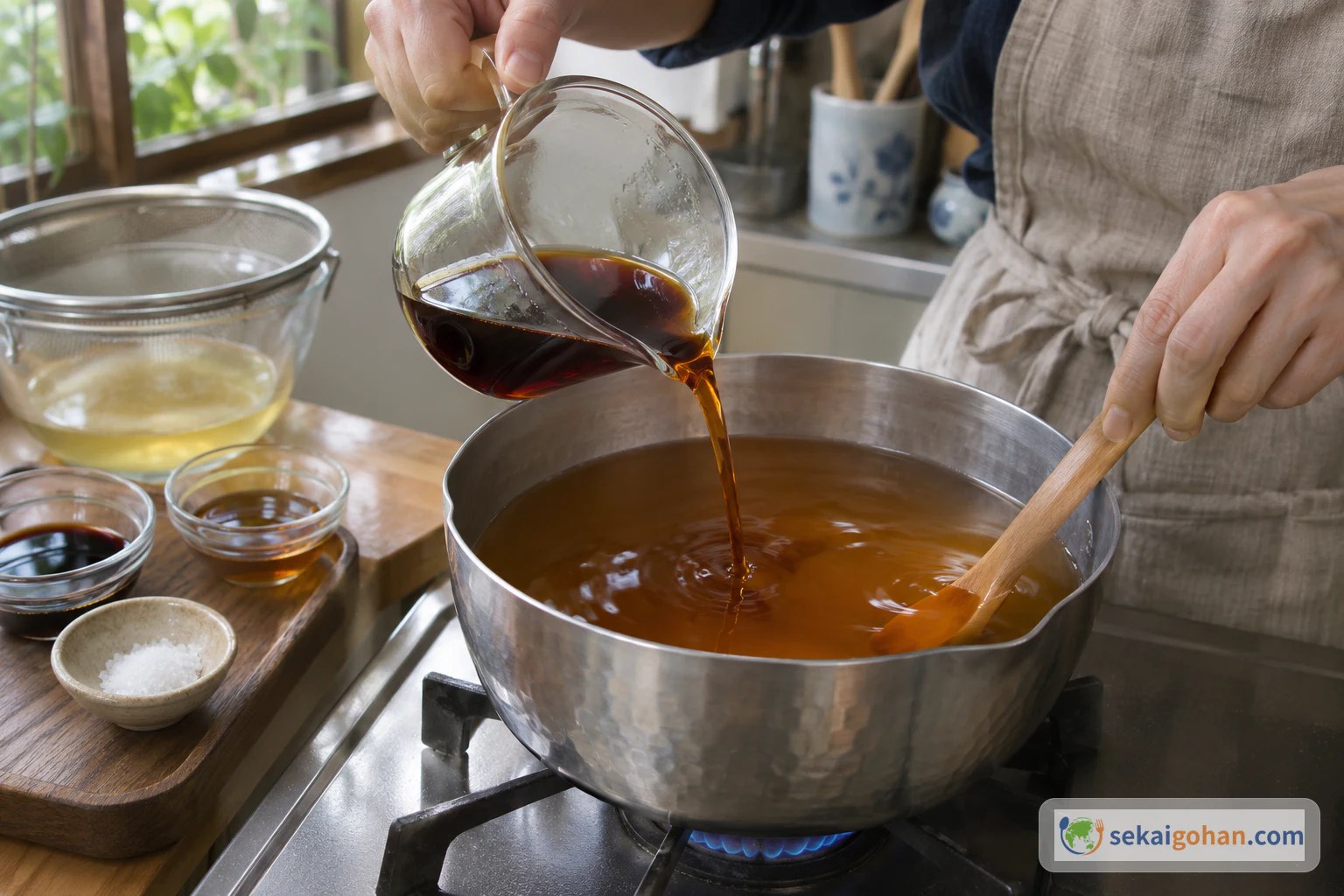
Pouring the tare of dark soy sauce, light soy sauce, mirin and salt into the strained broth and simmering on low heat
Pour in a thin stream and stir slowly so no foam forms

Mix the dark soy sauce, light soy sauce, mirin and salt in a jug. Set the strained broth over low heat, pour in about four-fifths of the tare, stir slowly and taste. Add the rest only if the broth needs it; if it already tastes too salty, add a little hot water. Keep it on low so the soy and broth simmer together. It is ready when the broth has turned a deep, glossy amber and tastes balanced to you.

STEP 88 / 10

Slice the chashu and cook the menma

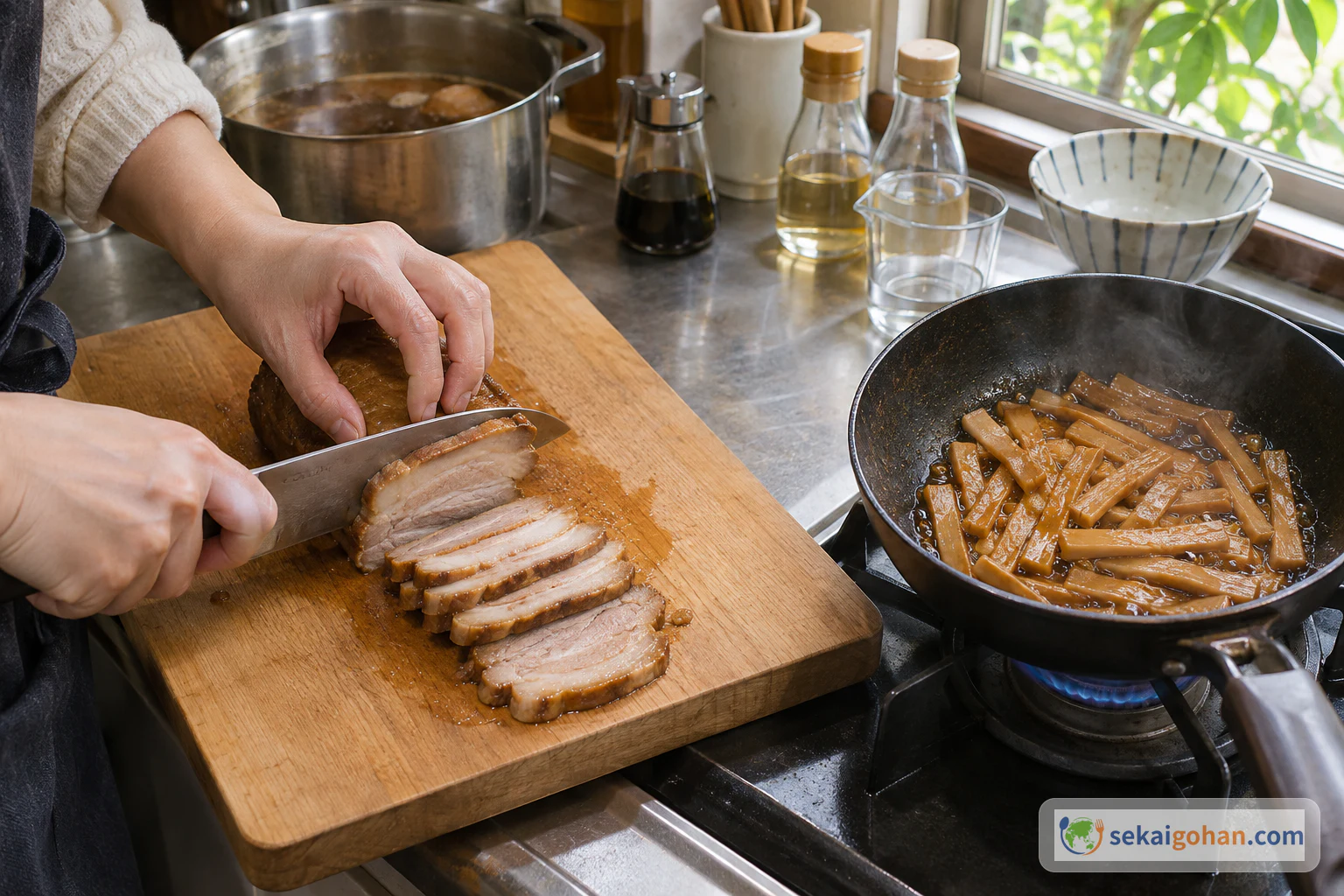
Slicing the broth-simmered pork belly and finishing the menma by simmering it down in its seasonings
Cutting across the grain keeps the belly slices tender and in one piece

Slice the cooled pork belly across the grain into neat slices; it goes into the bowls with only the flavour of the broth it cooked in. Desalt the menma as its pack directs, then taste a piece before seasoning. Warm a little sesame oil in a small frying pan and stir-fry the menma, then add the mentsuyu, soy sauce, sake, mirin, sugar, salt and pepper with enough water to cover. Simmer until the liquid has almost gone and the menma looks glossy.

STEP 99 / 10

Cook the noodles one portion at a time

STEP 9

Fill the bowls with hot water to warm them, and keep the broth hot on low. Bring a large pot of water to a rolling boil. Cook one portion of noodles at a time for the time on the pack, loosening the strands with chopsticks as they go in. Thin low-hydration noodles soften fast, so drain them hard the moment the time is up, while they still spring back when bitten.

STEP 1010 / 10

Assemble the bowls

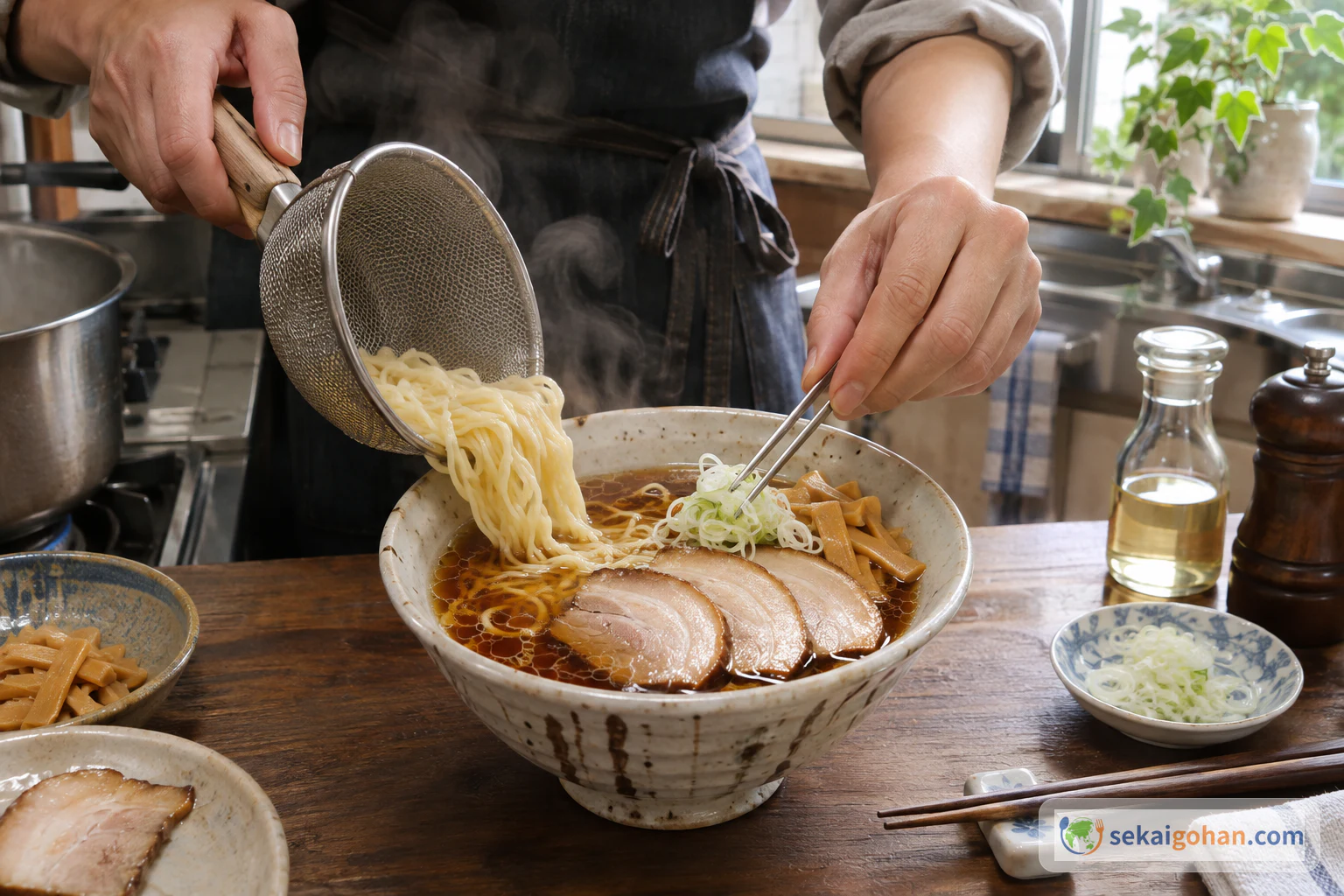
Pouring broth into the bowl, then adding the boiled thin curly noodles, chashu, menma and chopped long onion in turn
Broth first, then noodles: they should drop into hot soup, not sit in an empty bowl

Tip the water out of a warmed bowl and ladle in about 1½ cups (375 ml) of hot broth. Slide in the drained noodles and fold them once so they lie in the broth. Lay the chashu, menma and chopped long onion on top. Serve the bowl while the steam is still rising, and drop the next portion of noodles into the water.

0 / 0
Ingredients

Ingredients

1 / 1

Ingredients

Ingredient Amount Role
Dark soy sauce (koikuchi shoyu) ¼ cup (60 ml) Tare: the main saltiness and the amber colour
Light-coloured soy sauce (usukuchi shoyu) 2 tbsp (30 ml) Tare: adds salt while holding the colour back
Mirin 2 tsp (10 ml) Tare: sweetness and gloss
Salt 0.1 oz (2.7 g) Tare: fine-tunes the saltiness; weigh it
Chicken carcasses (torigara) 1¾ lb (800 g) Broth: the base of the stock
Pork belly, in one block 14 oz (400 g) Broth and chashu: simmers in the stock, then sliced for the bowls
Thick-shaved bonito flakes (atsukezuri katsuobushi) 1.4 oz (40 g) Broth: smoky fish depth; anywhere from 0.7 oz (20 g) up suits a lighter fish note
Dried sardines (niboshi) 0.7 oz (20 g) Broth: savoury fish backbone
Kombu ½ oz (15 g) Broth: soaks in the first quart of water
Dried shiitake 0.1 oz (3 g) Broth: earthy depth
Onion, peeled 1, whole Broth: sweetness
Carrot 3 oz (80 g), whole Broth: sweetness and colour
Long onion (naganegi), green part 1 stalk's worth Broth: aroma
Ginger, thinly sliced 4 slices Broth: aroma
Garlic, peeled 4 cloves Broth: aroma
Vinegar 1 tbsp Broth: goes in just before straining
Sake 3½ tbsp (50 ml) Broth: goes in just before straining
Water, for soaking the kombu 1 quart (1 L) Broth
Water, added to the pot 1 quart (1 L) Broth
Salt-preserved bamboo shoots (shiozuke menma) 3 oz (80 g) Menma
Sesame oil a little Menma: for stir-frying
Mentsuyu 1 tbsp Menma: seasoning
Soy sauce 1 tbsp Menma: seasoning
Sake 1 tsp Menma: seasoning
Mirin 1 tsp Menma: seasoning
Water enough to cover Menma: simmering liquid
Sugar a pinch Menma: seasoning
Salt and pepper a little Menma: seasoning
Fresh thin curly ramen noodles, low-hydration 4 portions, 3½–4 oz (100–110 g) each The noodle that defines the bowl
Long onion (naganegi), white part, chopped as needed Topping
Vinegar and black pepper as needed On the table
0 / 0

In Takayama the bowl arrives small and dark. A clear, deep amber broth, a tangle of thin curly noodles, slices of pork belly, a little pile of menma and a pinch of chopped long onion: nothing else is on top. The portion is light enough that people eat it between meals, the way other towns reach for a snack. This is Takayama ramen, the chuka soba of the Hida mountains in Gifu Prefecture, Japan. The broth is chicken with dried sardines and bonito, and the soy goes into the pot rather than the bowl, so it tastes clean and savoury, with a deep, slightly sweet soy note running through the chicken and fish.

Soba Means Chuka Soba in Takayama

Ask for soba in Takayama and you get this bowl. Locally, "soba" means chuka soba, the Chinese-style wheat noodle soup, and buckwheat noodles are called nama soba or nihon soba to tell them apart. Hardly any shop in town puts the word ramen on its sign. The noodle portion is small, about 3½ oz (100 g), and every shop keeps a children's ramen on the menu, which says a lot about when people eat it: as a bite in the afternoon as much as a meal.

Kanto soy, Kansai noodles

Takayama was a direct territory of the Edo shogunate, and a strong soy sauce culture grew up there. Chuka soba took on a dark, Kanto-style soy flavour, while the town's buckwheat noodles and udon, shaped by Kyoto influence, stayed lighter and Kansai-style.

The soy goes into the stockpot

Most ramen shops put tare in the bowl and pour broth over it. Takayama shops pour soy sauce and mirin straight into the stockpot and simmer the broth with them, a method that is rare in Japan and known simply as the Takayama way. With no separate tare to swap, salt and miso versions never really took hold, so the town's ramen is soy. The method has a second effect you can taste across a day: as the pot reduces, the broth gets stronger, lighter at noon and deeper by night, and regulars talk about the hour of broth they like best.

The frame is shared but every shop draws it differently. The balance of chicken, seafood, vegetables and shiitake changes from counter to counter. Kikyoya, open since 1951, simmers its broth for more than ten hours, and Miyagawa Chuka Soba, open since 1975, makes its own straight noodles with little water in the dough, even though thin curly noodles are what most shops serve.

A night stall in 1938

The usual starting point is 1938, when Masago Soba began selling chuka soba from a street stall. Its founder, Tokimune Sakaguchi, worked as a cook in a ryotei by day and pulled the stall at night; by the usual account he learned to make Chinese noodles watching Chinese cooks while training at Gajoen in Shibaura, Tokyo. Tsuzumi Soba (1956), Nakatsubo (1964) and Jingoro (1983) followed among the older names, and at last count the town had more than thirty shops. The anime film Your Name, in which the main characters order Takayama ramen, is commonly credited with sending a new wave of visitors looking for a bowl.


Ingredients (serves 4)
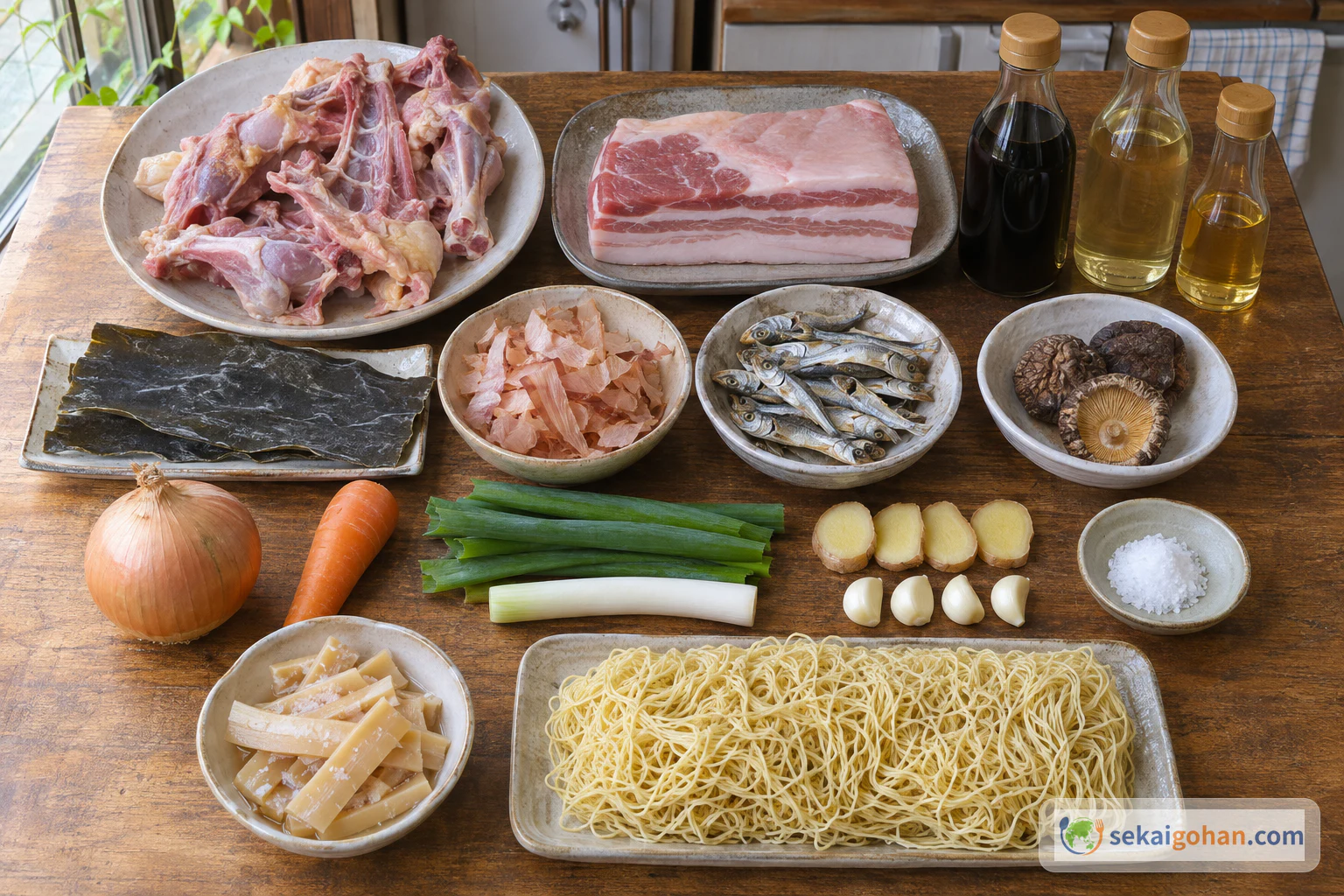
Chicken carcasses, pork belly, kombu, bonito flakes, dried sardines, dried shiitake, onion, carrot, long onion, ginger, garlic, soy sauces, mirin, salt, menma and Chinese wheat noodles laid out on a table
Separate the green tops of the long onion for the broth from the white part you'll chop for the bowls

The broth comes out at about 6¼ cups (1.5 L), which gives each bowl about 1½ cups (375 ml). The tare, broth and menma below are all sized for four bowls.

Buy the noodles by their spec

Takayama noodles are low-hydration, with roughly 28–32% water in the dough, thin, curly and square in cross-section, cut on a #20 cutter, in portions of 100–110 g. Look for fresh chuka noodles labelled low-hydration and thin curly. That firm, curly strand holds the clear broth instead of soaking it up.

Allergen information

Wheat (noodles), soy (soy sauce, mentsuyu), fish (bonito flakes, dried sardines) and sesame (sesame oil). Check the label on bought noodles; many contain kansui and other additives. Eggs are only in the seasoned-egg variation.

Equipment

  • A large stockpot of at least 4¼ quarts (4 L), to hold both quarts of water with the bones, pork and vegetables
  • A second pot or a large bowl to strain into
  • A fine-mesh sieve and a cotton straining cloth
  • A fine wire skimmer
  • A large pot for boiling the noodles
  • A colander
  • A small frying pan for the menma
  • A cutting board and sharp knife
  • Four ramen bowls

Choosing and Substituting

Chicken carcasses come from a butcher or the meat counter of a larger supermarket. Carcasses with the neck still attached give the broth more body, so take them when you see them. Thick-shaved katsuobushi, niboshi, kombu, dried shiitake, salt-preserved menma and both kinds of soy sauce are all at Japanese grocers and online. Ordinary thin bonito flakes work, but they give up their flavour much faster, so steep them for less time or they turn the broth harsh.

The two soy sauces matter. Dark soy brings the colour and most of the salt; light-coloured soy adds salt without darkening the broth further. If you can only find dark soy, use 6 tbsp (90 ml) of it in place of both: the broth comes out darker and tastes different, but it still reads as Takayama ramen. Chinese light or dark soy and Korean soy differ in salt and colour and give a different bowl. Mirin-style seasoning has different alcohol and sugar from true mirin; use it if that is what you have, and taste the tare before you commit to all of it.

What carries the taste of Takayama abroad is short: a clear broth cooked over gentle heat, soy simmered into that broth, low-hydration thin curly noodles, pork belly cooked in the stock, and only menma and onion on top. Hida onion and homemade noodles can wait for a second round.


Method

Start by soaking the kombu, then blanch the bones while it softens. The long stretch in the middle is hands-off apart from skimming. The pork comes out of the pot when you strain, so slice it and cook the menma while the seasoned broth sits on low heat. At home, add the soy to the strained broth and let the two simmer together. Sekai Gohan has not cooked this recipe as a whole in its own kitchen, so taste and adjust as you go. Noodles come last, one portion at a time.

Gentle heat keeps it clear

From the first bubble to the last, keep the broth at a slow simmer, never a rolling boil. A hard boil churns the fat into the broth and turns it cloudy, which pulls it away from the clear soy bowl Takayama is known for.

Raw chicken and hot broth

Cook the chicken bones and pork belly through. Wash every board, utensil and cloth that touches the raw bones before it touches anything else. Blanching water and the full stockpot are heavy and very hot: strain with both hands and pour slowly.

Finish noodles and broth separately

Keep the broth hot and the noodles apart until the last moment, and combine them right before the bowl goes to the table. Cooking one portion at a time is slower, but a single portion of thin noodles stays springy where a crowded pot goes soft.

When It Goes Wrong

What you see Why What to do
The broth is cloudy It boiled hard, or the scum sat too long before skimming Hold it at a slow simmer from start to finish and skim as soon as scum rises
The soy tastes sharp or too salty Soy sauces differ in salt from brand to brand Add four-fifths of the tare first, taste, then top up; loosen an over-salted pot with hot water
A raw, gamy smell lingers The bones weren't blanched and rinsed well enough Never skip the blanching; rinse until the bones look clean
A harsh, bitter fish note The bonito and sardines steeped too long, or there were too many sardines Strain soon after the aroma peaks; use fewer sardines next time
The noodles are soft and swollen They sat in the water or the broth too long Warm the bowls, cook one portion at a time and assemble at the last moment

Serving, Variations and Storage

At the table

Set out vinegar and black pepper. Many people in Takayama pour some vinegar into the bowl partway through, and it brightens the dark soy against the fish. The small portion suits an afternoon bowl or a light supper, and on New Year's Eve some Takayama families eat chuka soba as their year-end noodles, often ordered in from a local shop.

Variations

  • Hida onion in season. Hida ippon-futo negi is one of Gifu Prefecture's certified Hida-Mino traditional vegetables, grown in Takayama and Hida, and comes into season as the frosts arrive, from late autumn into winter. Chop the white part thickly: its strong sweetness rounds out the dark soy.
  • Kombu vinegar. Takayama Ramen Sanmachi puts kombu vinegar on its tables. Soak a piece of kombu in vinegar and use that at the table; it adds a softer, savoury acidity in place of plain vinegar's sharpness.
  • Homemade low-hydration noodles. With a noodle machine you can make your own: 12½ oz (350 g) Menyuki ramen flour, 0.12 oz (3.5 g) salt, 0.13 oz (3.6 g) powdered kansui and a scant ½ cup (108.4 ml) water, a 33% hydration dough, cut on a 1 mm cutter and crimped curly. It needs a noodle machine, and Sekai Gohan has not tried this formula.
  • Seasoned egg. Tsuzumi Soba offers eggs three ways, raw, boiled and seasoned. Soft-boil eggs, peel them and soak them in some of the seasoned broth for a richer bowl; this adds egg to the allergens.

Storage

Cool leftover broth quickly, move it to a clean covered container and refrigerate it; as a rough guide, use it within 3 days. It also freezes in portions. Bring stored broth back to a full boil before serving. Boil noodles only for the bowls you are about to eat, and never keep cooked noodles.

Frequently Asked Questions

How does it differ from tonkotsu ramen?

Tonkotsu broth is pushed hard until the pork bones cloud it milky. Takayama broth goes the other way: chicken, dried fish and vegetables at a slow simmer, kept clear, with the soy cooked into it. The bowl is lighter, and the soy and fish carry the flavour.

Why does my second bowl taste stronger than the first?

The broth keeps reducing as it sits on the heat, which is the same thing that makes shop broth deeper at night. Keep it on the lowest heat between bowls. If it gets too strong, stir in a little hot water before ladling.

What if I can't find Hida onion?

Use a sweet white long onion, Japanese naganegi or a similar variety, and chop the white part for the bowls. The bowl comes out close, with a little less sweetness against the soy.

Can I use seasoned menma from a jar?

Yes. Seasoned menma needs no desalting and no further seasoning, so skip the menma part of step 8 and warm it briefly instead. Taste it with the broth and adjust to your liking.
Sources

  • yoshi, "家で作る「飛騨高山ラーメン」" (Takayama ramen made at home), Yahoo! News Expert. Four-serving quantities for the tare, broth and menma; broth yield of about 1.5 L at 375 ml per bowl; the homemade noodle formula; the soy and broth simmered together; whole onion and carrot eaten afterwards. https://news.yahoo.co.jp/expert/articles/f0e79f6a2b831a5047fe0af93355a2ca74fd1b8a
  • RamenCookingCH, "飛騨高山ラーメンの作り方" (How to make Hida Takayama ramen), Ramen Cook. Carcasses with necks attached; toppings; vinegar on Takayama tables; Hida onion season. https://ramenchef-japan.com/hidatakayama/
  • Cookpit Co., Ltd., "まさごそば風インスパイアラーメンのレシピ" (Masago Soba–inspired ramen). Blanching and rinsing the chicken bones; seasoning the broth with soy and mirin in the pot; the 1938 stall and its founder; broth strengthening over time; the name soba and New Year's Eve chuka soba. https://cookpit.jp/local-ramen/161/
  • Shin-Yokohama Raumen Museum, "全国ご当地ラーメン - 高山ラーメン" (Regional ramen: Takayama ramen), Rapedia. Noodle specification; broth style and soy added to the stockpot; toppings and pork belly chashu; local names; small portions and children's ramen; Hida onion; history and the soy culture of the shogunate territory. https://www.raumen.co.jp/rapedia/study_japan/study_raumen_takayama.html
  • Hida Takayama Travel Guide (official), "ラーメン激戦区・高山で出会う、忘れられない一杯「高山ラーメン」" (Takayama ramen). Broth style and the Takayama method of simmering soup and tare in one pot. https://www.hidatakayama.or.jp/special/detail_467.html
  • Gifu Prefecture official tourism site, "飛騨高山ご当地グルメ!~高山ラーメン(中華そば)6選~" (Six Takayama ramen shops). Differences between shops; local names and New Year's Eve chuka soba; 1938 origin at Masago Soba; shop count; Your Name; founding years of established shops. https://www.kankou-gifu.jp/blog/detail_224.html
  • Gifu Prefecture, "飛騨・美濃伝統野菜" (Hida-Mino traditional vegetables). Hida ippon-futo negi as a certified traditional vegetable grown in Takayama and Hida. https://www.pref.gifu.lg.jp/page/3241.html