Yangnyeom-tongdak: A Crackling Crust Under a Glossy Red Sauce
Fry the wings twice so the coating sets hard, then toss them in the hot sauce only briefly, just before eating. Manage two numbers separately: the oil temperature, and the internal temperature of the thickest part of the meat.
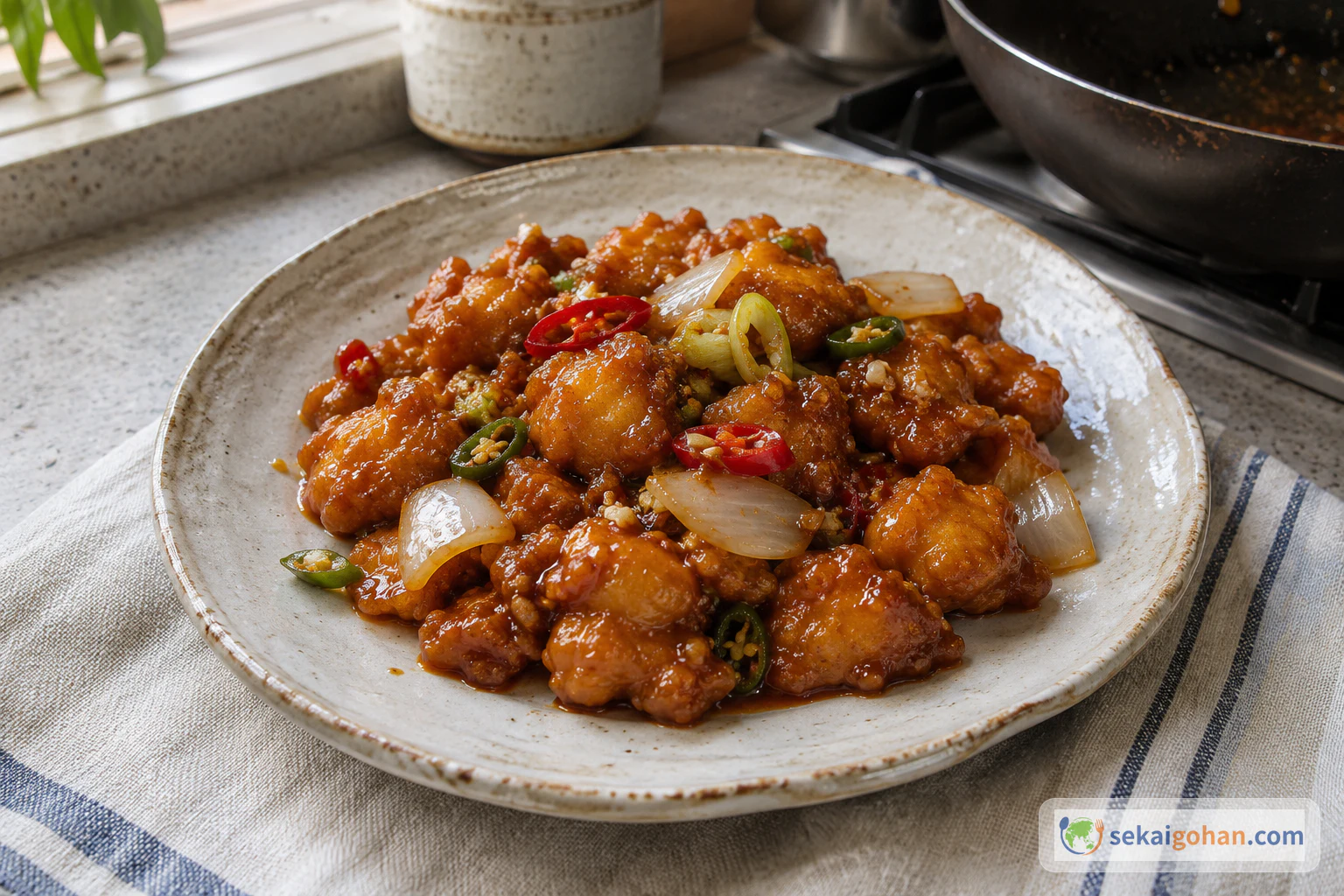
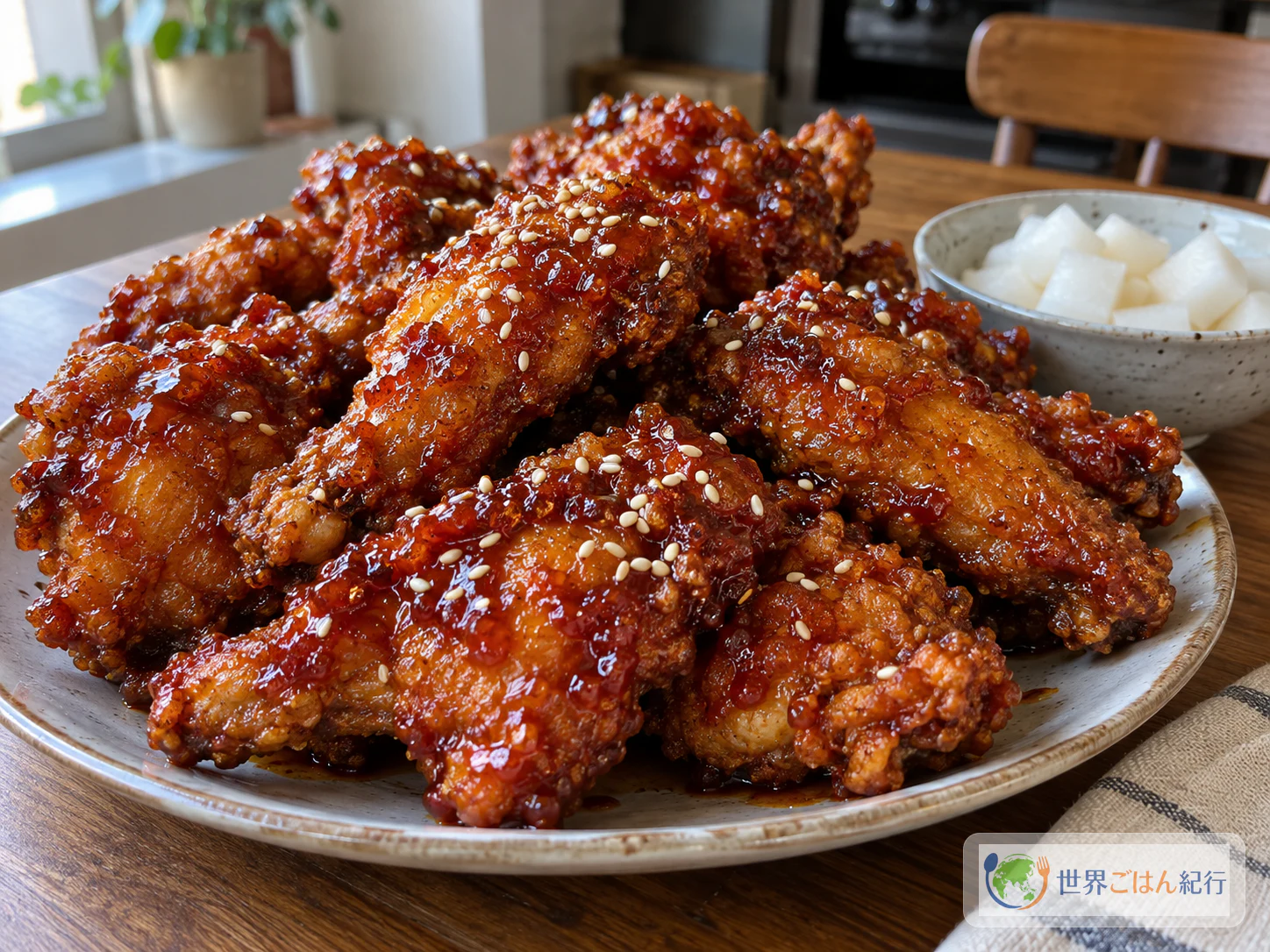
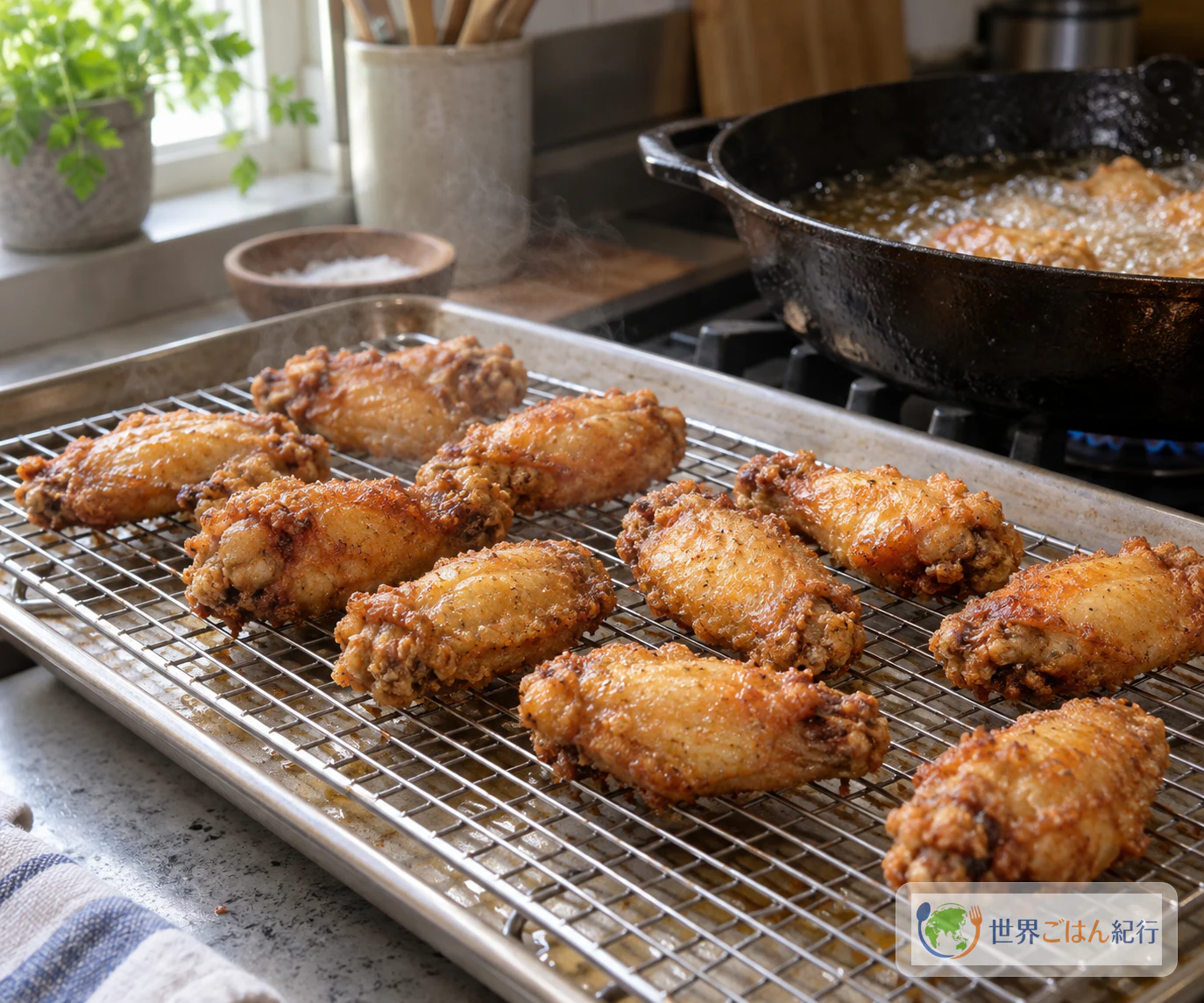
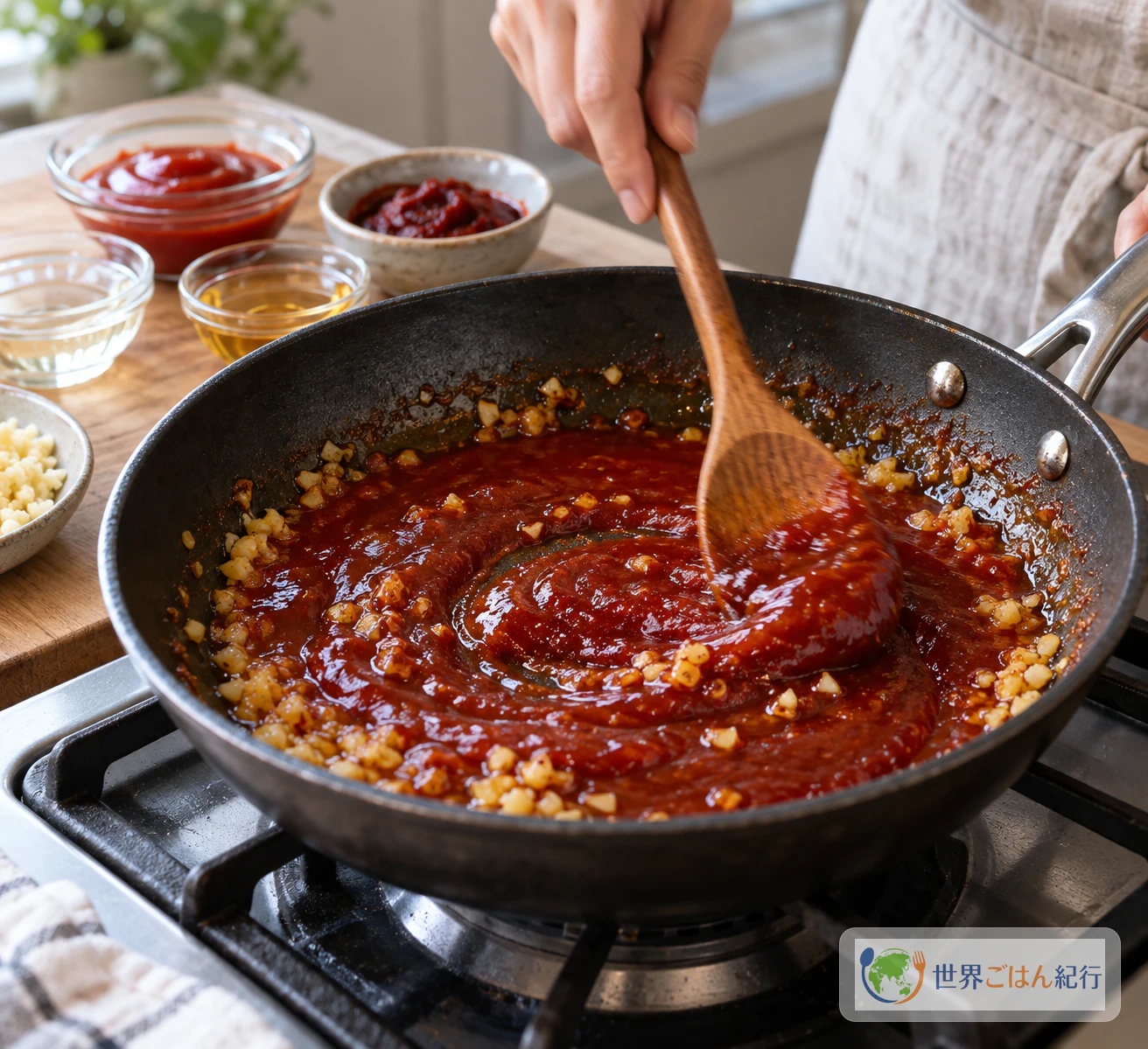
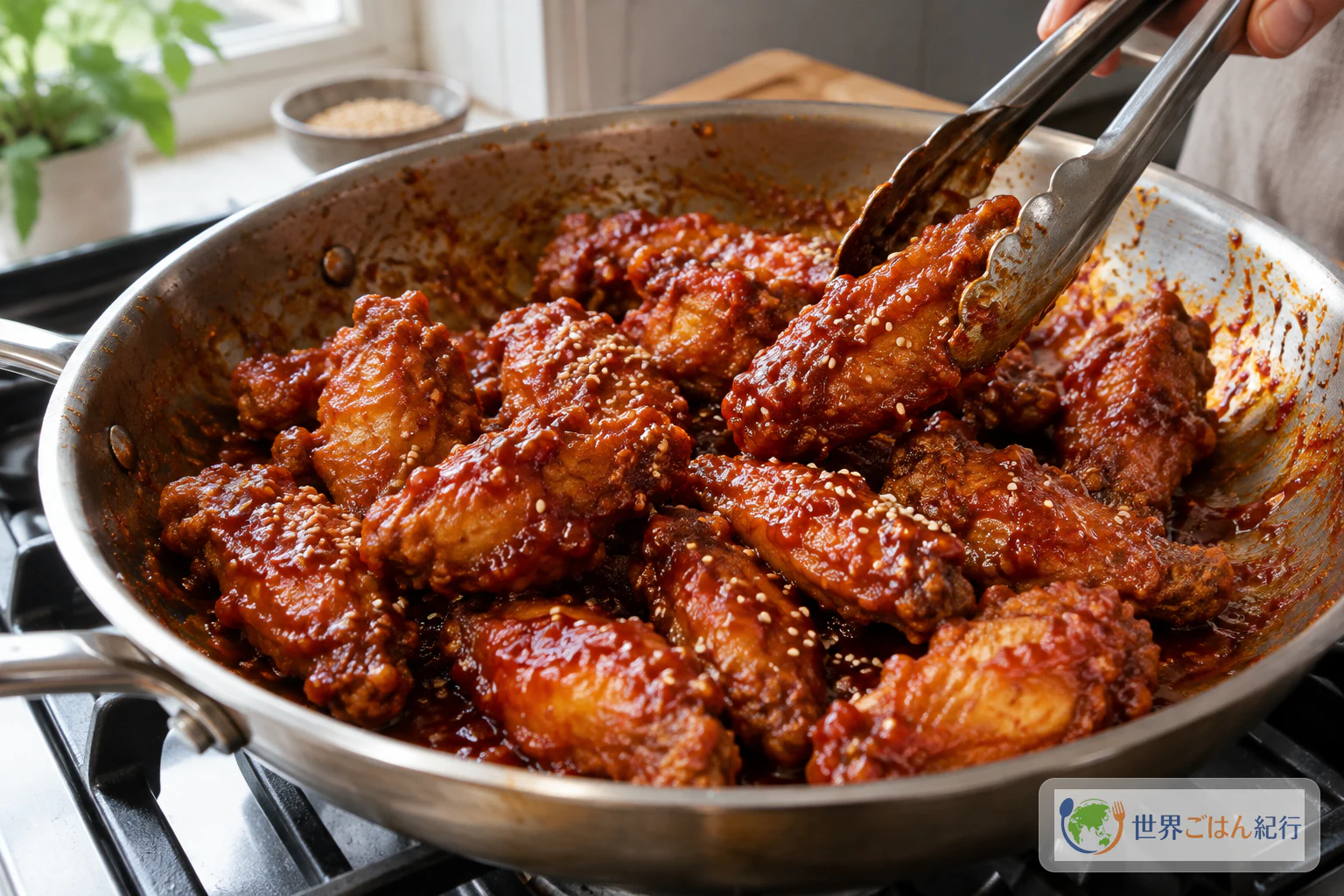
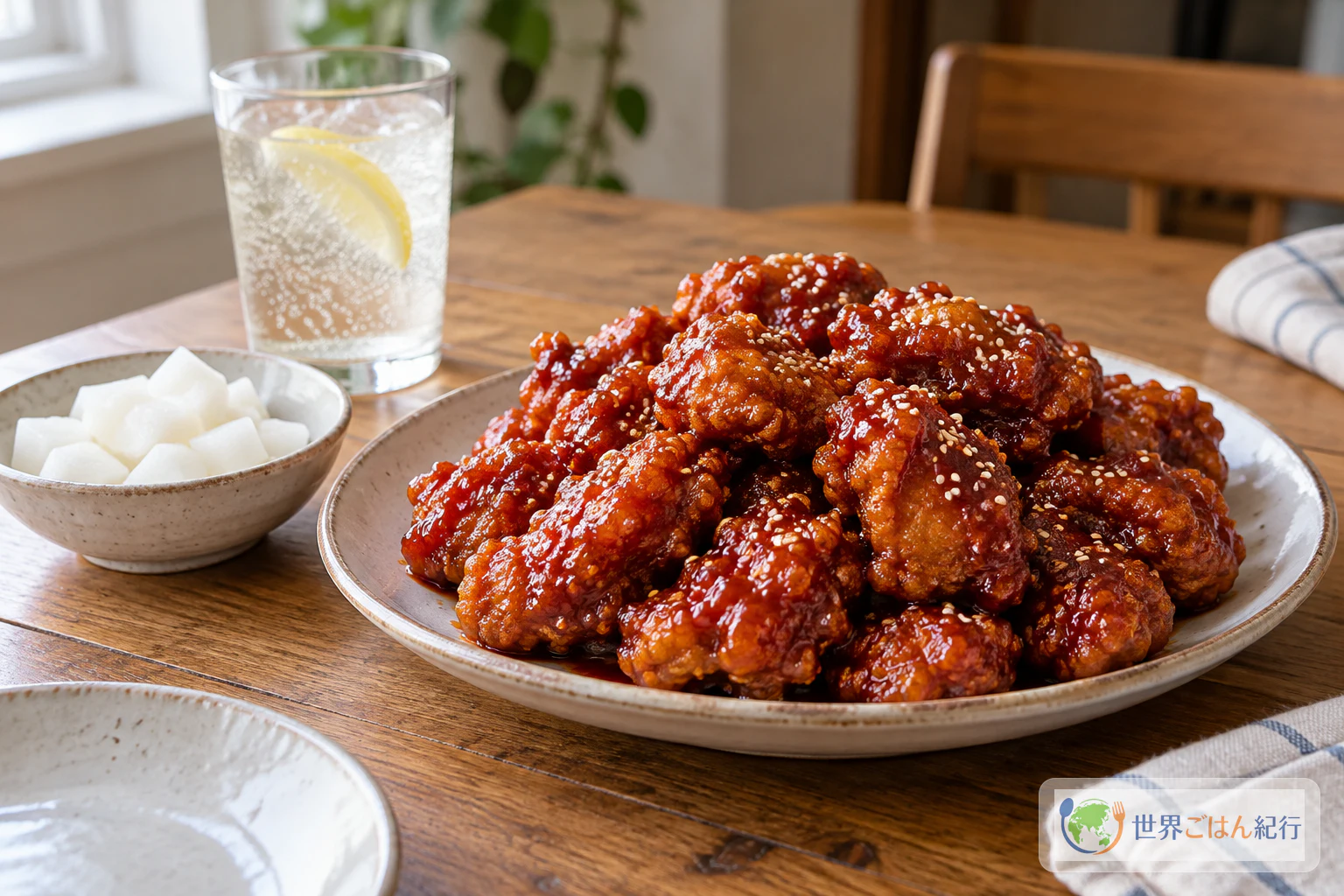
The wings come out of the oil for the second time, deep golden and craggy. A small pan of brick-red sauce made from gochujang, rice syrup and ketchup is bubbling beside the stove. The hot wings go in and are tossed for a few seconds. A sprinkle of sesame seeds follows, and the plate goes straight to the table next to a dish of white, cubed chicken-mu radish.
This dish from Korea is yangnyeom-tongdak (양념통닭), also called yangnyeom-chikin (양념치킨): Korean fried chicken coated in a sweet, sour and spicy sauce. "Korean fried chicken" covers several styles. This recipe focuses on one of them, the sauce-tossed type with a fairly thick coating. It follows the amounts and method published by the Korean cooking writer Maangchi.
Yangnyeom means roughly "seasoned" or "seasoning sauce." Maangchi explains tongdak as "whole chicken," but her recipe uses chicken wings. Don't read the name as a promise that a whole bird goes into the pot.
For a home cook, the two hard parts are keeping the oil in range and making sure the meat is cooked through at the center. Neither is complicated with a thermometer, and the steps below show where to use it.
Two Fries, Two Temperatures
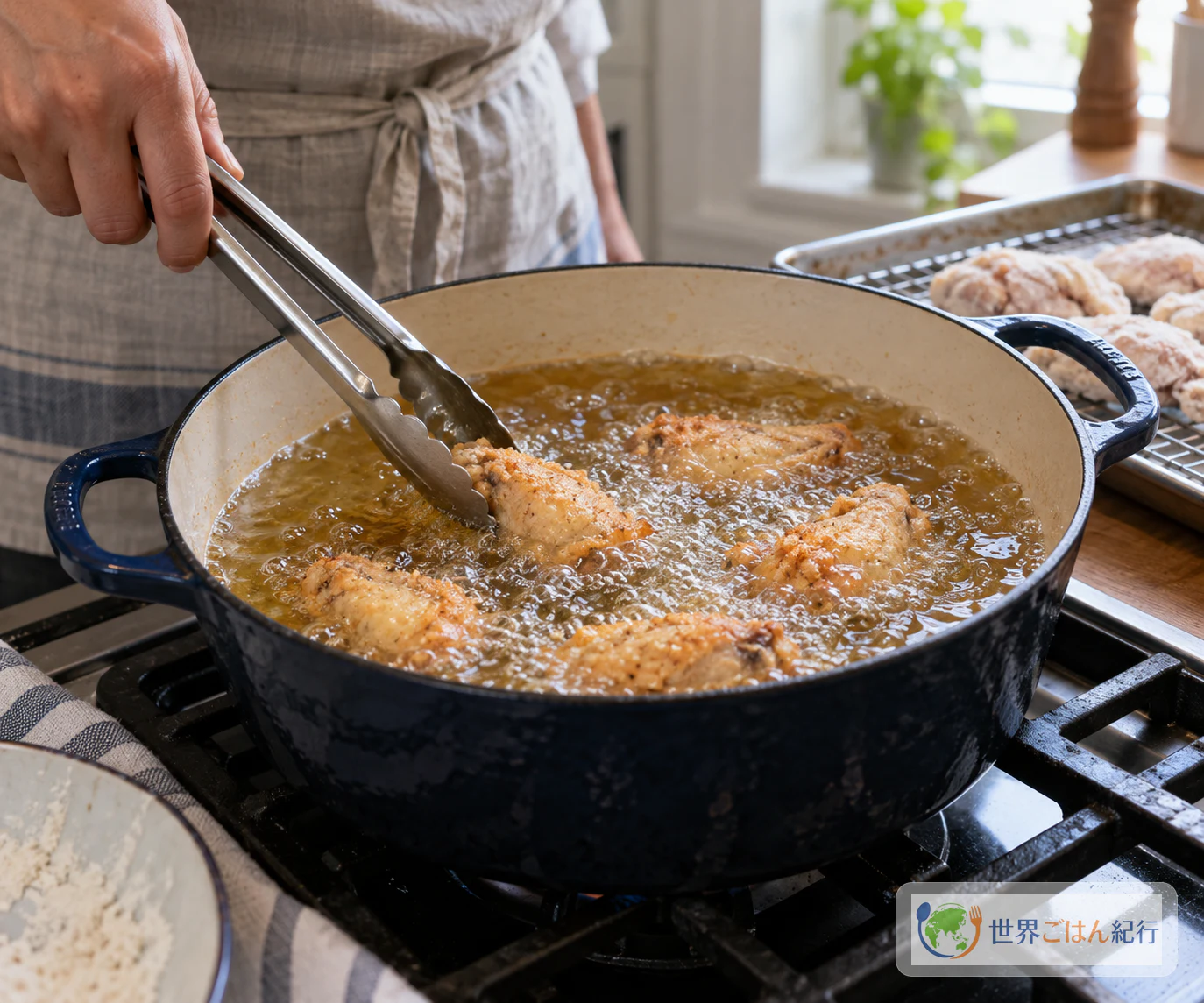
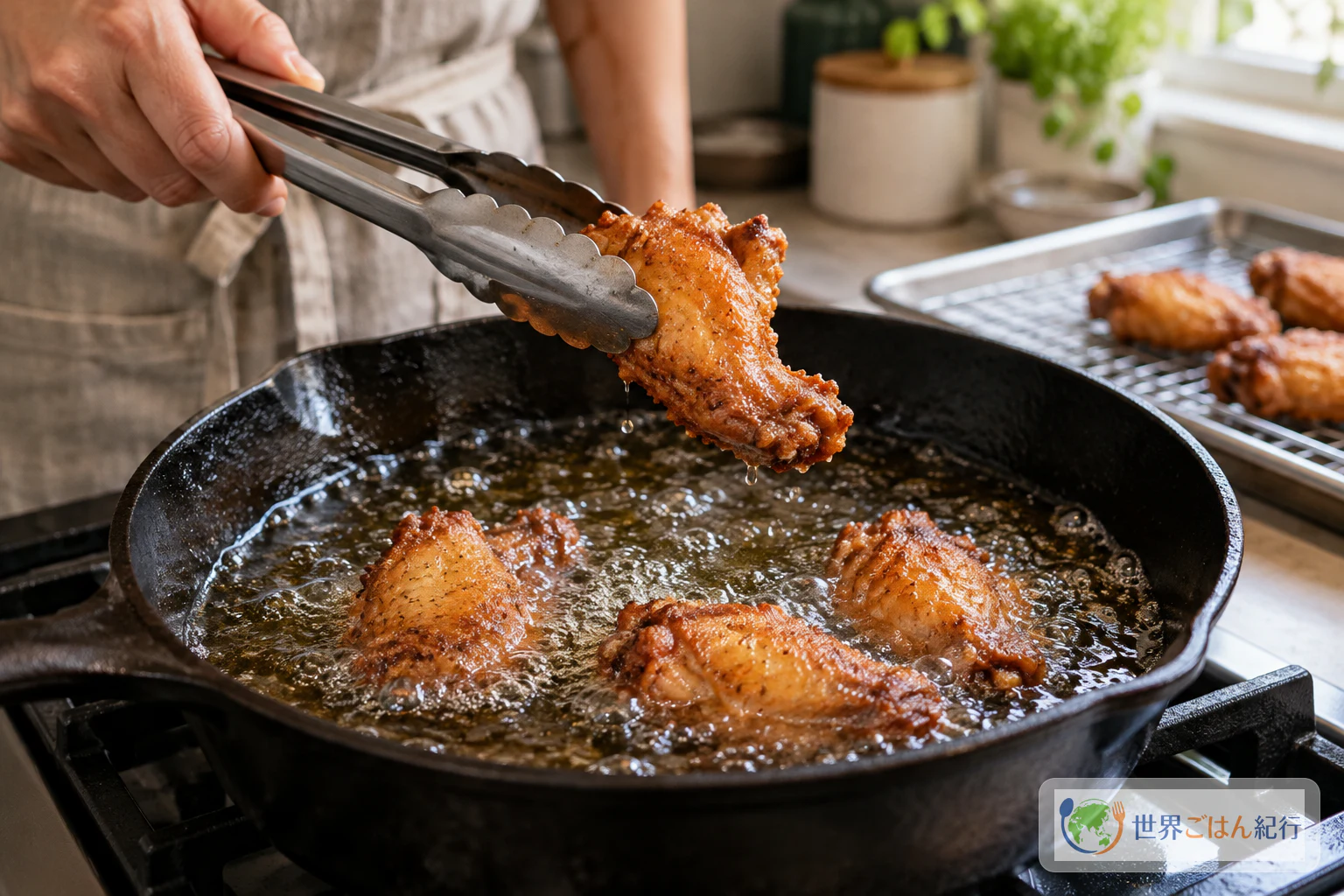
Maangchi's recipe fries the wings twice. The aim of the first fry is to cook the chicken through. The aim of the second is to finish the surface so the coating turns harder and crisper and stands up better to the sauce.
Maangchi's introduction describes the second fry as hotter. Her written steps, however, give the same range of 330–350°F (about 166–177°C) for both fries. This recipe follows the written steps: after the first fry, bring the oil back into that same range before the second fry. Each fry takes about 12 minutes in the source.
That 330–350°F figure is the oil temperature. It says nothing directly about whether the chicken is safe to eat. For the meat, this recipe uses a separate guideline from Japan's Ministry of Health, Labour and Welfare: heat the center of the meat to 75°C and hold it there for at least 1 minute. The USDA lists 165°F (73.9°C) as the safe minimum internal temperature for poultry. The frying time depends on the size of the wings, your pot and the amount of oil, so treat the 12 minutes as a guide and the thermometer reading in the thickest part as the deciding check.
Ingredients for 3 to 4 Servings (Chicken Wings, 2 Pounds)
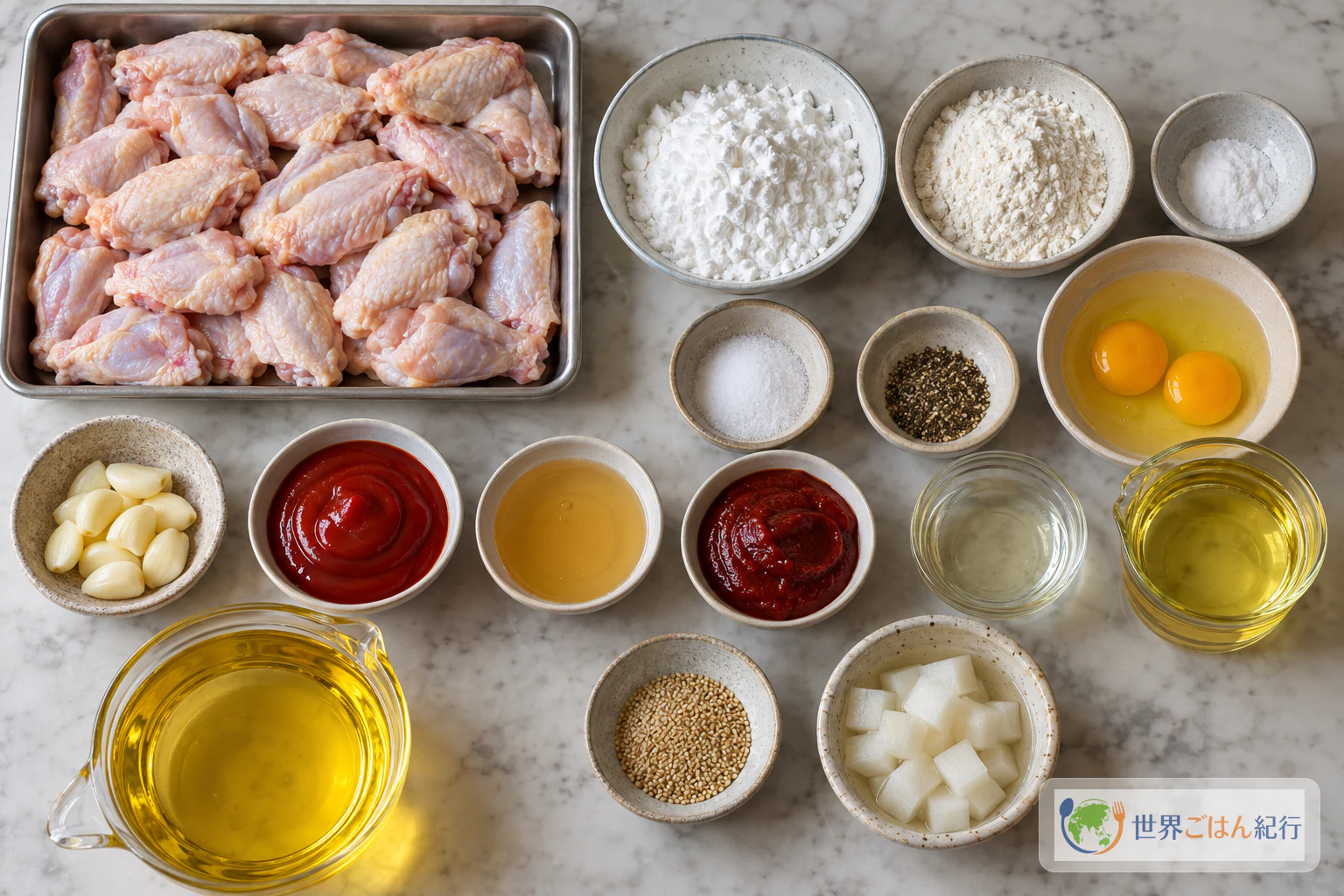
These are Maangchi's amounts, kept in her original US units. Measure with cups and spoons rather than converting to grams. If your package of wings is not exactly 2 pounds, check the weight on the label and scale the other amounts to match.
A note on the sauce oil. Use 2 teaspoons of vegetable oil in the sauce, once only.
This recipe contains egg, wheat and sesame. Gochujang may contain soy or wheat, depending on the product. Check the labels on gochujang, rice syrup, ketchup and the starches, including any shared-facility statements. Keep the cutting board, bowl, tongs and plate used for raw chicken separate from those used for serving.
Choosing and Substituting the Key Items
| Item | What to look for | If you substitute |
|---|---|---|
| Gochujang | Korean gochujang. It carries both the heat and the fermented depth of the sauce | Miso mixed with chili does not produce the same sauce |
| Rice syrup | Labeled rice syrup or ssal-jocheong | Starch syrup (such as Japanese mizuame) is a close option, but its sweetness and thickness differ. Honey changes the aroma and burns more easily, so it is not a simple one-for-one swap |
| Potato starch | Check that the label says potato starch | Japanese katakuriko is commonly potato starch, but check the label rather than assuming it is identical |
| All-purpose flour | Ordinary all-purpose flour | Lower-protein flour such as cake flour can be used, but the texture of the coating will differ |
| Kosher salt | Kosher salt as written | Table salt has a different grain size and saltiness, so the same volume is not an exact substitute |
| Chicken-mu | Optional; not part of the recipe itself | Leave it out if you can't find it |
Equipment
- Heavy, deep pot or deep skillet, large enough that oil 2 inches deep leaves plenty of room below the rim
- Thermometer that can read both oil temperature and the internal temperature of meat, or one of each
- Long tongs
- Wire rack set over a tray
- Fine-mesh skimmer for lifting out loose bits of coating
- Large bowl for coating the wings
- Skillet for the sauce, wide enough to toss the wings in
- Separate plate and utensils for raw chicken
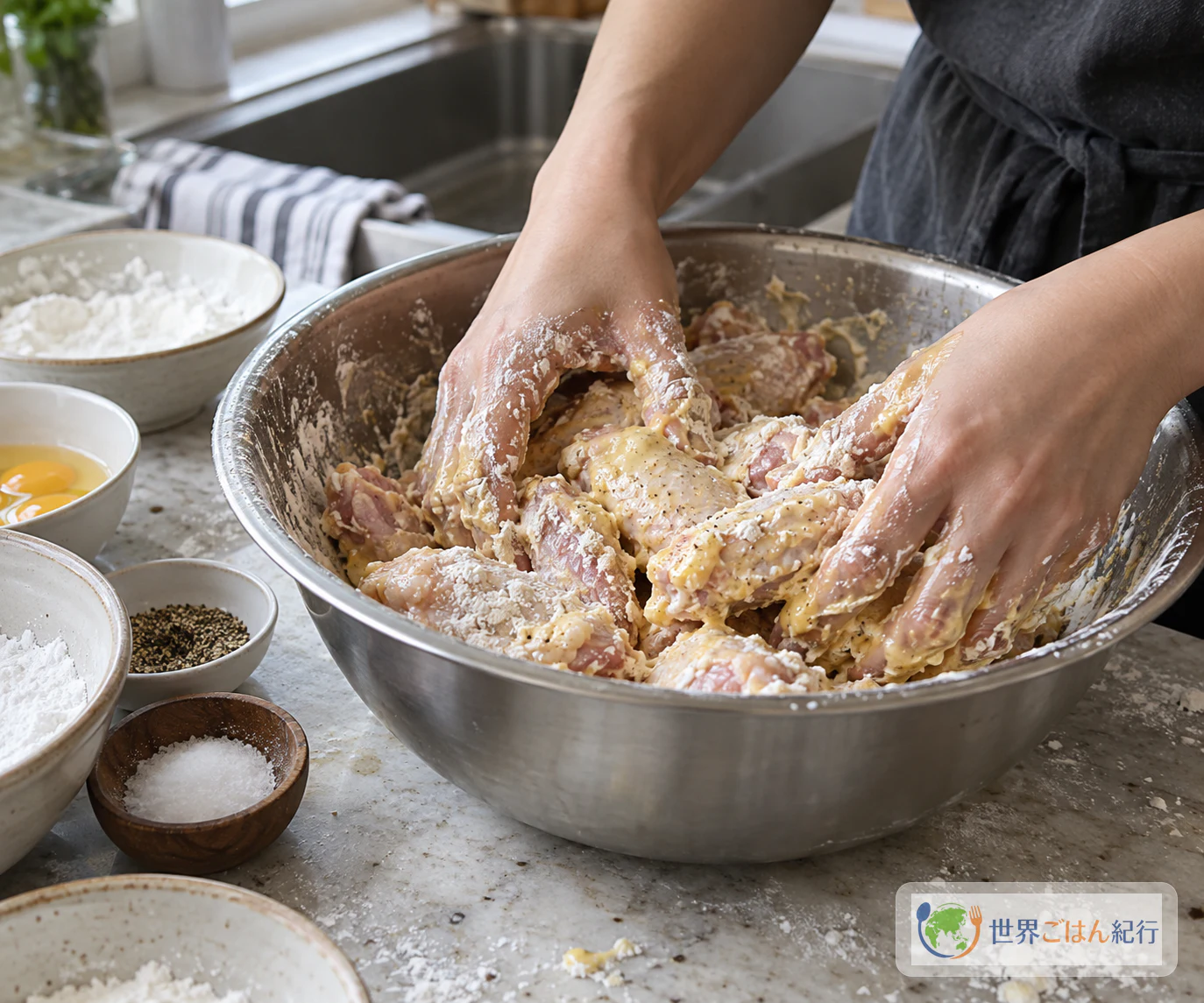
Method: Coat, Fry, Rest, Fry Again, Toss
Have the sauce ingredients measured and the wire rack ready before the oil goes on the heat. The second fry and the toss happen quickly, and the coating is at its best just after it leaves the oil.
Doneness, Crispness and Fixing Problems
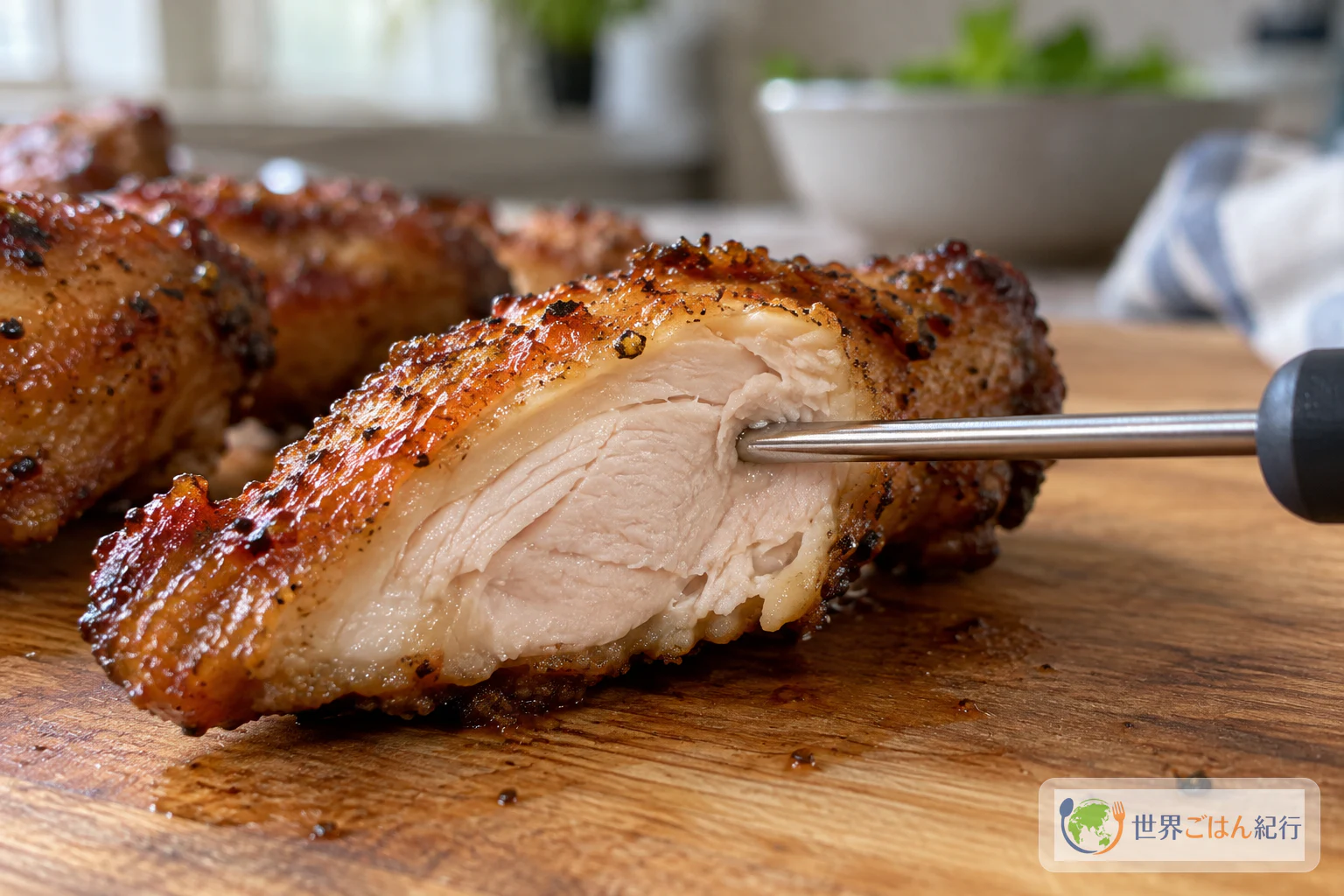
When you cut a wing open, the meat at the center should be opaque, with no raw or pink-looking areas. Color alone is not proof of doneness, though. Rely on the thermometer reading in the thickest part, with the probe away from the bone.
A crisp result comes down to three habits: fry a few pieces at a time so the oil stays in range, drain the wings on a rack rather than piling them up, and toss them in the sauce only briefly, right before eating.
| Problem | Likely cause | What to do |
|---|---|---|
| Coating turns sticky or soggy | Pot overcrowded, so the oil temperature dropped; wings left sitting in the sauce | Fry in smaller batches and keep the oil at 330–350°F. Toss the wings right after the second fry and serve immediately |
| Coating darkens too fast, or bits float in the oil | Oil too hot; loose coating burning in the pot | Watch the thermometer and adjust the heat. Skim out loose bits between batches. Don't keep using oil that has burned. In a small pot, fry fewer pieces |
| Golden outside but under temperature inside | Pieces large or uneven; oil too cool or too crowded | Return to the oil and keep frying until the thickest part reaches 75°C for at least 1 minute |
| Sauce thick and stiff | Heated too long | Warm it only briefly over low heat, and take it off the heat as soon as the wings are tossed. Thinning it with water is a departure from the source and makes the flavor lighter |
Variations
These changes adjust how you serve or prepare the dish. Some depart from the source recipe, as noted.
- Sauce on the side. Serve the sauce in a bowl for dipping. The crust stays crisp to the last piece.
- Fried and seasoned side by side. Leave some wings plain, the way fried-style chicken is served, and toss the rest in sauce. You can taste the difference between the two types at one table.
- Milder heat. Reducing the gochujang lowers the heat but also changes the sweet-sour-spicy balance of the sauce. This breaks from the source ratio, so adjust a little at a time.
- One cut only. Using only wing flats or only drumettes makes the pieces more uniform in size. The frying time will need adjusting, so check each batch with the thermometer.
- With chicken-mu. The cool, sour radish resets your palate between bites of the sweet and spicy chicken.
"Chikin" in Korea: How Fried Chicken Is Eaten
According to the Encyclopedia of Korean Culture, the Korean word chikin (치킨) is commonly used to mean fried chicken dishes, not chicken in general. The encyclopedia describes a shift from a fad for whole chicken roasted in electric ovens to cut-up fried chicken. It names Lim's Chicken in 1977 and describes yangnyeom chicken becoming popular in the mid-to-late 1980s.
VISITKOREA, the Korea Tourism Organization's site, describes fried chicken spreading in the 1970s. Its account also mentions Lim's Chicken in 1977 and Pelicana in 1981. Maangchi recalls yangnyeom-tongdak becoming widespread in the early 1980s, along with her memories of chicken shops and takeout. These are different sources describing the period in different ways, so it's best not to name a single inventor or origin date.
VISITKOREA presents fried chicken as a food for watching sports, holidays and festivals. It also introduces chimaek, fried chicken with beer (maekju). The same organization describes Daegu as a center of the chicken industry. That says something about Daegu, not that every style of Korean fried chicken comes from there.
The VISITKOREA article also distinguishes a crispy type with a thick coating from an "embo" type with a thin coating. This recipe is the thick-coated kind, finished with sauce.
Maangchi suggests serving the chicken with chicken-mu and beer or a non-alcoholic drink. Beer is a common pairing, not a requirement. A soft drink at the family table works just as well.
VISITKOREA also publishes its own yangnyeom chicken recipe, which uses a whole chicken and a different coating and sauce. Its ingredients include ginger juice and strawberry jam. It is a separate recipe, and none of its amounts are mixed into this one.
Not to be confused with
- Dakgangjeong is a different fried chicken dish, which Maangchi publishes as a separate recipe. It is not the same as yangnyeom-tongdak.
- Dakgalbi is a stir-fried chicken dish, not deep-fried.
- Andong jjimdak is braised chicken, a useful contrast to frying.
For a Korean meal with more heat and fermented flavors on the table, kimchi jjigae is a natural companion.
Frequently Asked Questions
Can I use only potato starch and skip the flour?
The source recipe uses both: potato starch as the main starch, and flour for extra structure. Using only starch is a change from the source, and the coating will turn out differently. For a first attempt, follow the recipe as written.
Can I skip the second fry?
The double fry is central to this recipe. The first fry cooks the chicken through, and the second firms up the crust so it can stand up to the sauce. A single fry is not the source method and is likely to give a softer coating. However you fry it, the thickest part of the meat still needs to reach 75°C for at least 1 minute.
Can I make it less spicy?
You can reduce the gochujang, but that also changes the balance of sweetness, acidity and savoriness, so the result moves away from the original. Another option is to serve the sauce on the side, so each person decides how much to use.
Can I use cuts other than wings?
The source recipe uses wings. Other cuts are different in size and thickness, so the frying time changes. Don't go by the 12 minutes. Check the thickest part of every batch with the thermometer.
Can I make it ahead?
It is at its best freshly fried and tossed. Once sauced, the crust softens as it sits. This recipe gives no refrigeration time or storage period for cooked chicken. If you reheat leftovers, think of crispness and safety separately. Texture will not fully return, and the center should be heated through again and checked with the thermometer.
Sources
- Maangchi, "Sweet, sour, & spicy Korean fried chicken (Yangnyeom-tongdak)." The names 양념통닭 / 양념치킨 and their meanings, the ingredients and amounts for 3 to 4 servings, frying oil at 330–350°F and 2 inches deep, two fries of about 12 minutes each, the sauce method, the author's memories of the early 1980s and chicken takeout, and serving with chicken-mu and beer or a non-alcoholic drink. A cooking writer's recipe and personal recollection, not a complete history of Korea. https://www.maangchi.com/recipe/yangnyeom-tongdak
- Korea Tourism Organization / VISITKOREA, "Yangnyeom Chicken Recipe: Korean Food." A separate yangnyeom chicken recipe using a whole chicken and a different coating and sauce, paired with beer. Used for comparison only; none of its amounts are used here. https://english1.visitkorea.or.kr/enu/FOD/FO_EN_EC_Recipes.jsp?cid=1928339
- Korea Tourism Organization / VISITKOREA, "Fried Chicken: Find it in Daegu, Korea's Crispy Capital." Fried chicken at sports events, holidays and festivals; the article's account of 1970s fried chicken, Lim's Chicken (1977) and Pelicana (1981); crispy versus thin-coated "embo" styles; Daegu's chicken industry and chimaek. https://english.visitkorea.or.kr/svc/contents/contentsView.do?vcontsId=221290
- Academy of Korean Studies, Encyclopedia of Korean Culture, "치킨 (Chicken)." The Korean use of chikin for fried chicken dishes, the shift from electric-oven roast chicken to cut-up fried chicken, Lim's Chicken (1977), and yangnyeom chicken's popularity in the mid-to-late 1980s. https://encykorea.aks.ac.kr/Article/E0079963
- Ministry of Health, Labour and Welfare (Japan), "お肉はよく焼いて食べよう" (Cook meat thoroughly). The guideline to heat the center of meat, including chicken, to 75°C for at least 1 minute. https://www.mhlw.go.jp/stf/seisakunitsuite/bunya/0000049964.html
- USDA Food Safety and Inspection Service, "Safe Minimum Internal Temperature Chart." The US safe minimum internal temperature for poultry of 165°F (73.9°C), and checking the thickest part away from the bone. https://www.fsis.usda.gov/food-safety/safe-food-handling-and-preparation/food-safety-basics/safe-temperature-chart