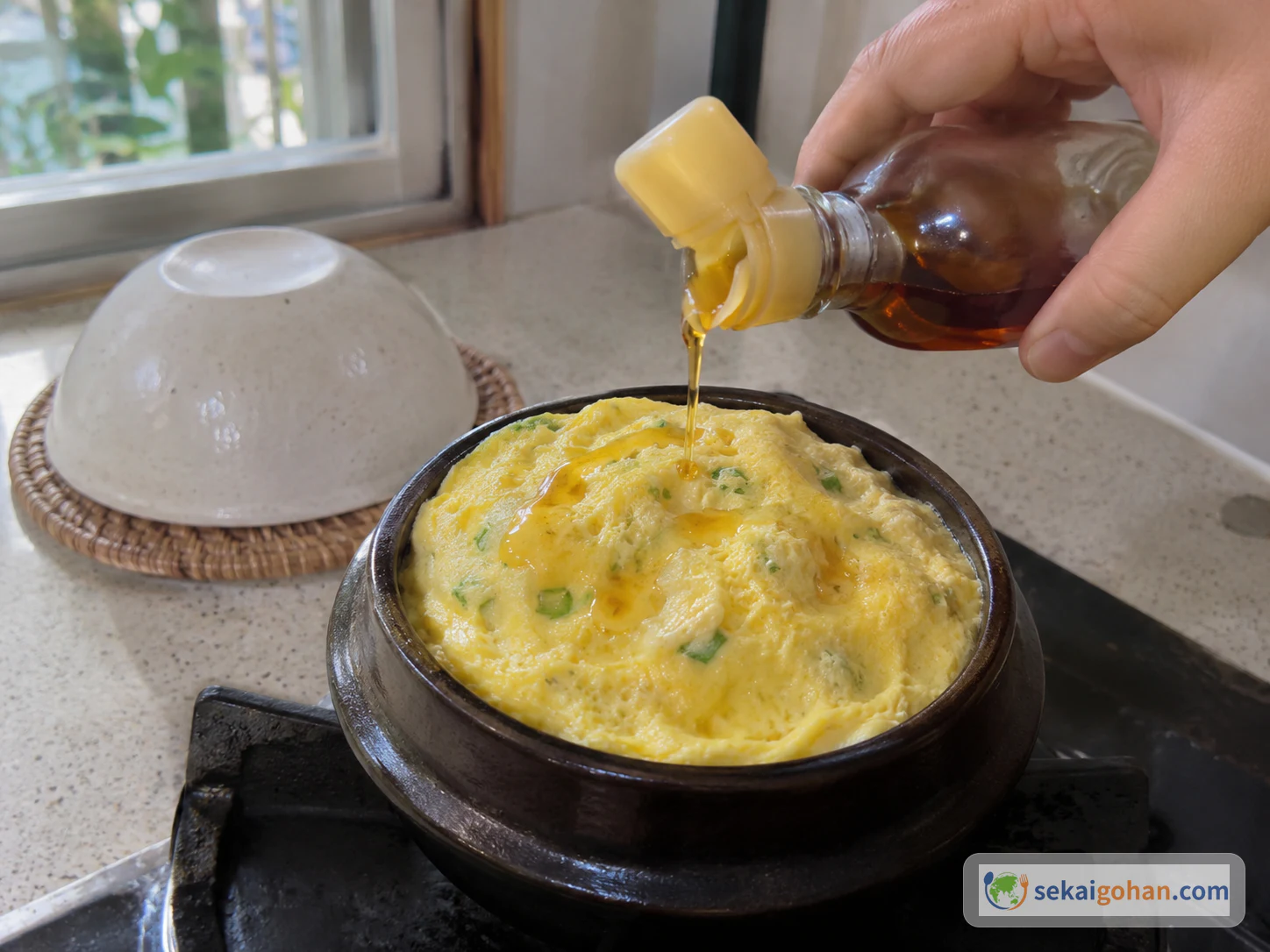
Gyeran jjim: A Soft, Savory Egg That Comes to the Table in Its Pot
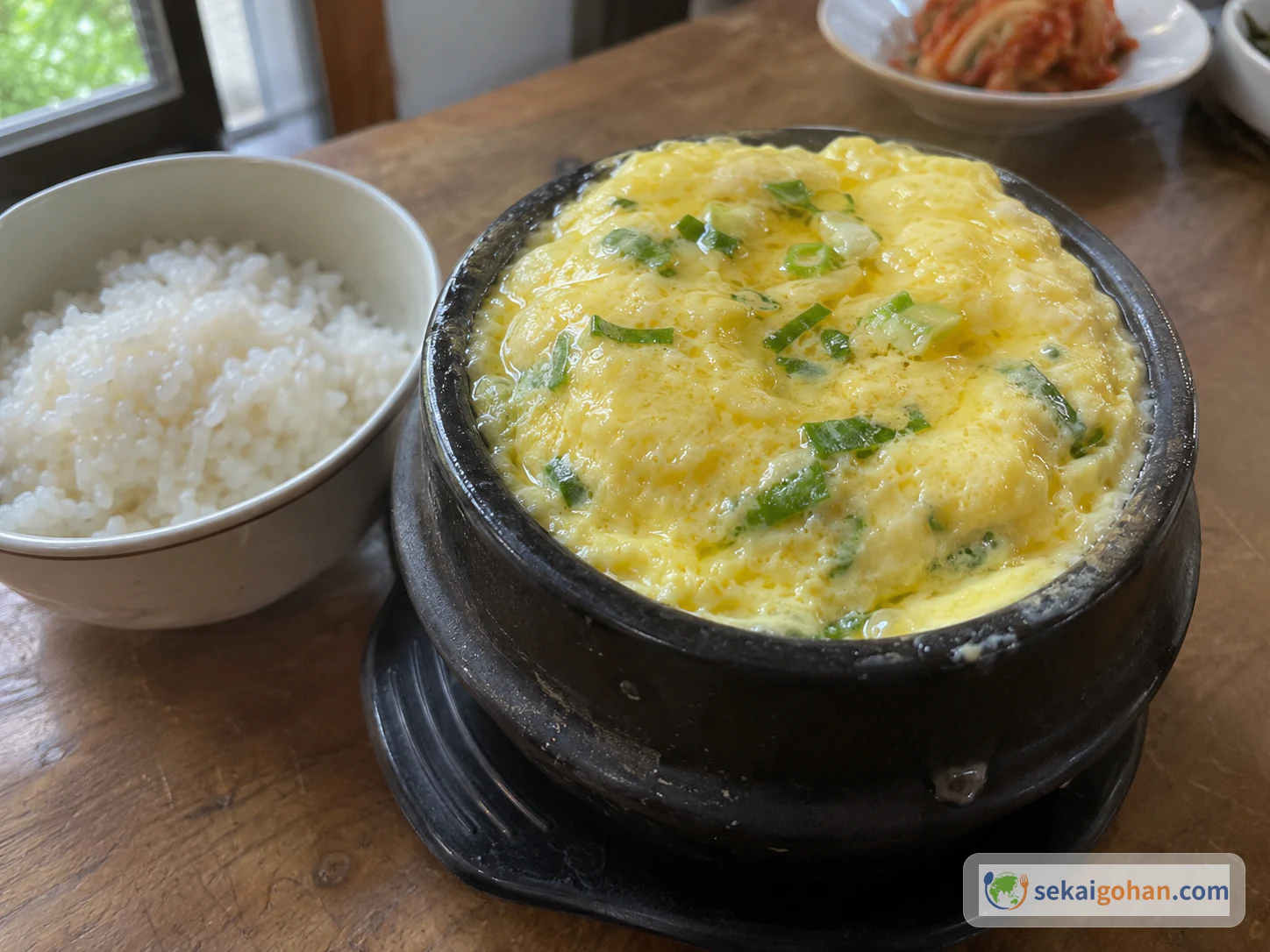
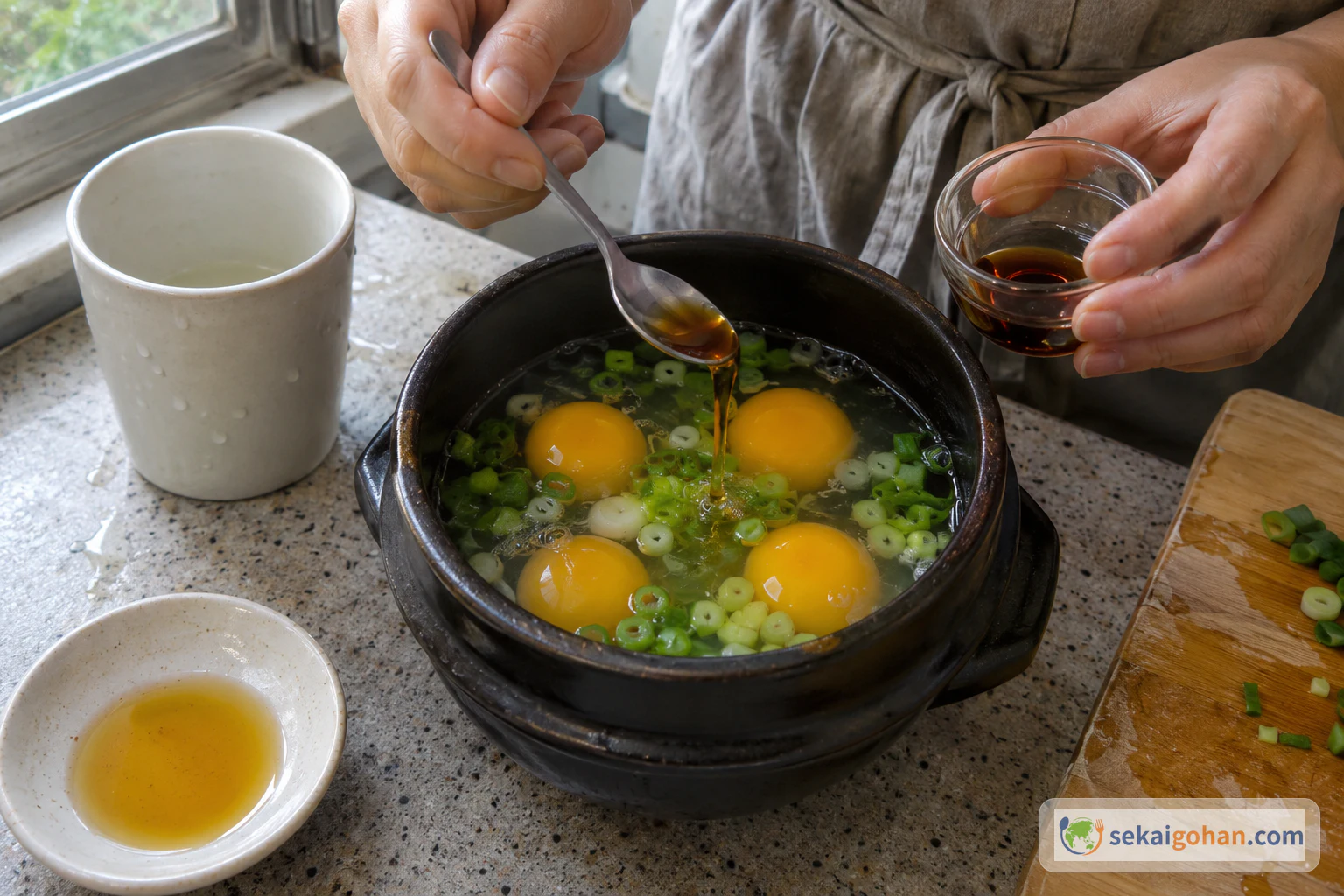
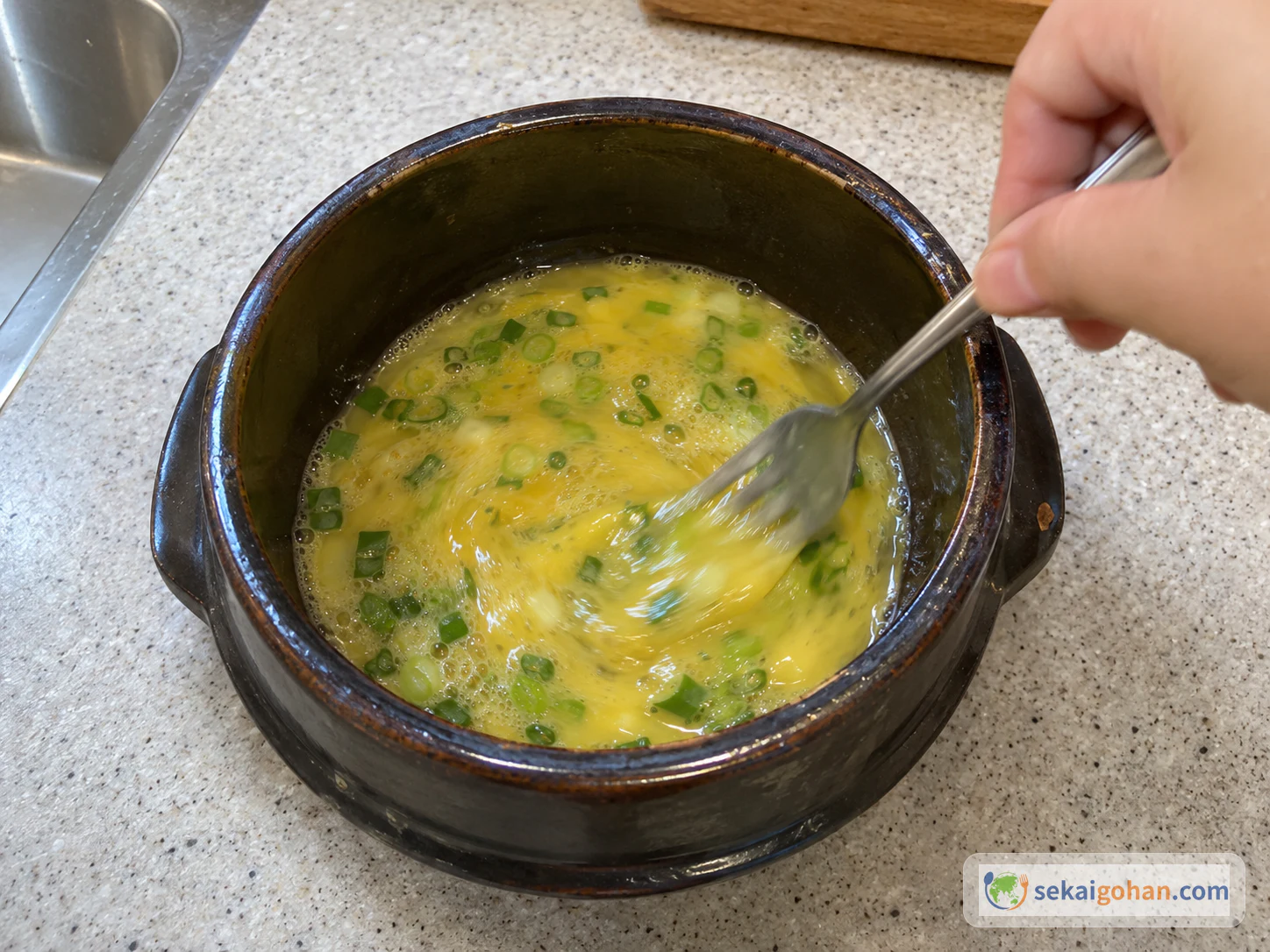
Four eggs, water, fish sauce and green onion, mixed raw in a small earthenware pot, covered and cooked gently. Toasted sesame oil goes on only at the end, and the pot goes straight to the table with rice.
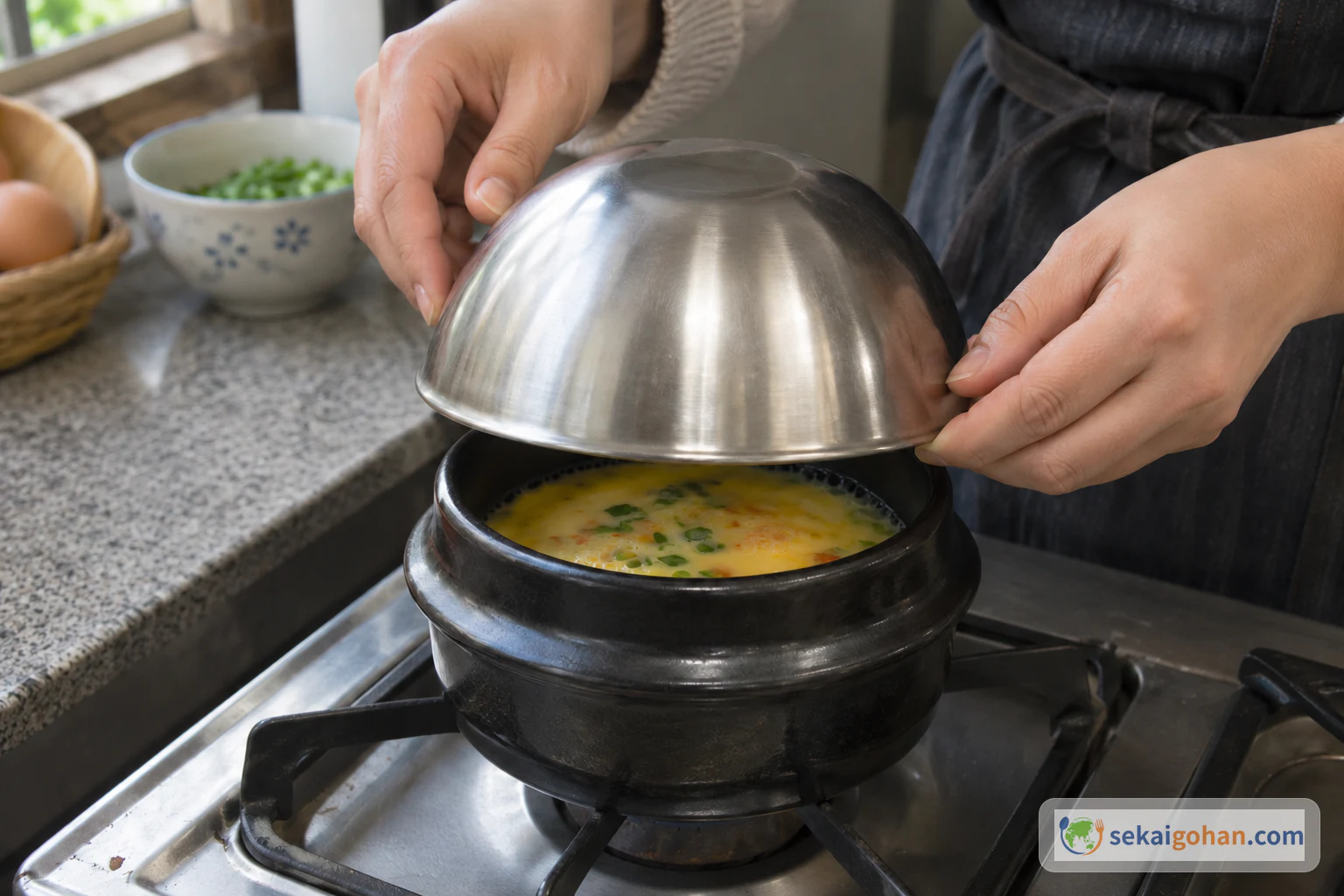
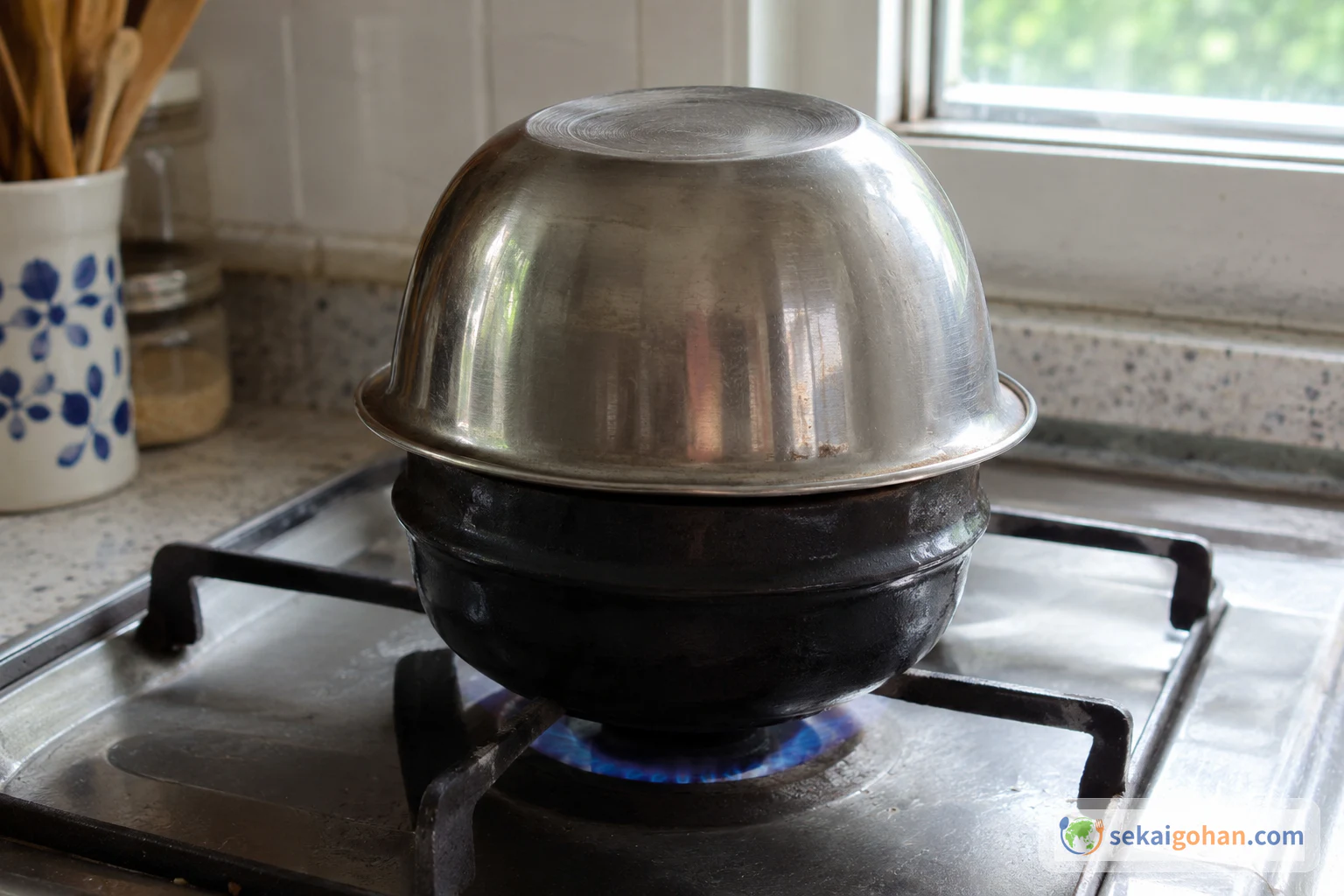
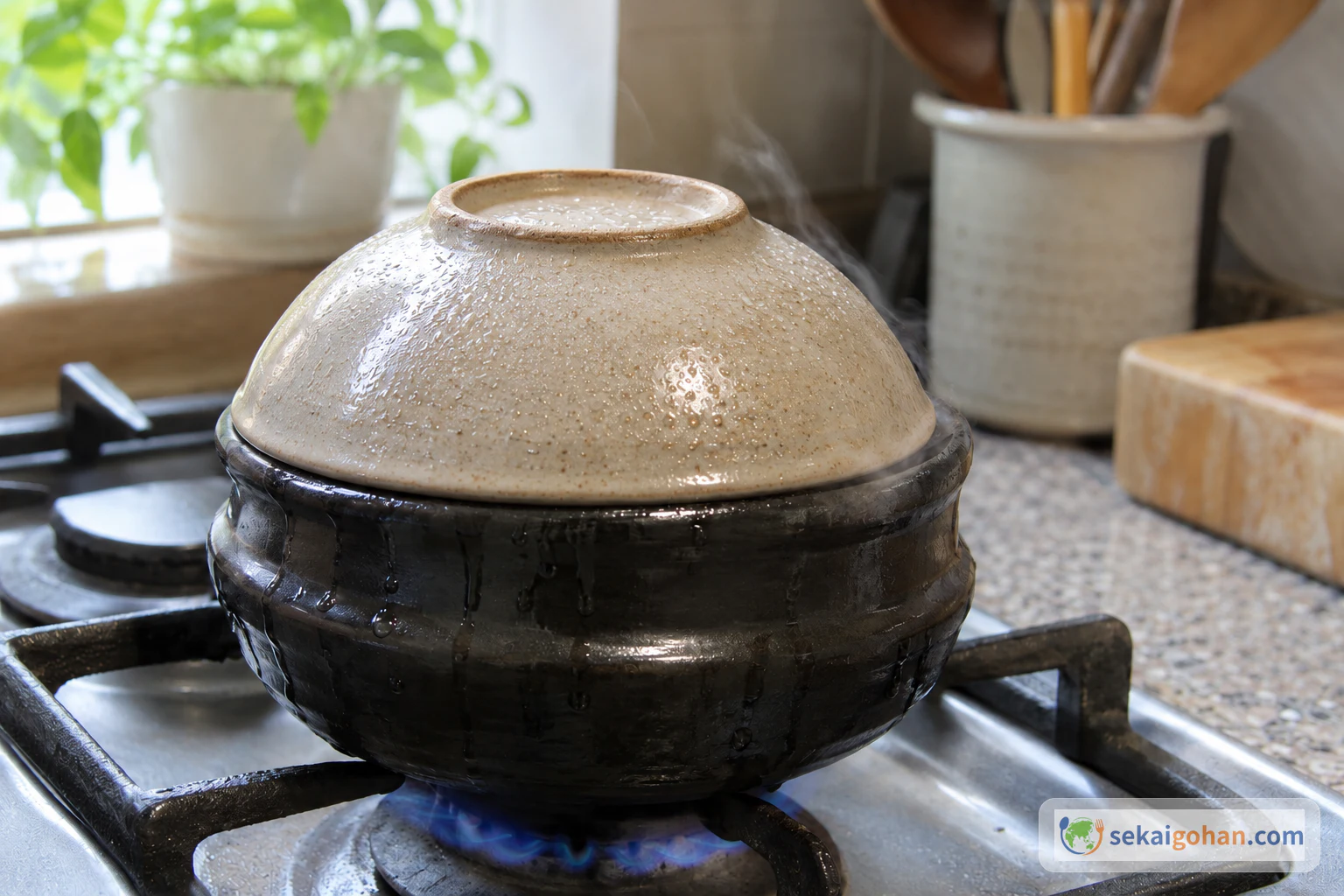
A small earthenware pot sits under an upturned bowl on a low flame. Toward the end, steam slips out around the edge of the cover, liquid starts to run down the sides of the pot, and a nutty aroma rises. Those are the signs the cook watches for in this version of gyeran jjim (계란찜), a Korean egg dish that the Korea Tourism Organization describes as savory with a soft texture.
This article follows one published home recipe: Maangchi's "Steamed egg in an earthenware bowl / Ttukbaegi gyeranjjim," which she presents as a warm, shareable side for rice. It is cooked in a 3-cup ttukbaegi (뚝배기), a small Korean earthenware pot, directly on the stove. Her recipe offers a few choices, and this article keeps to one consistent set of them so that the ratio and the method stay together: four large eggs from her 4–5 egg range, the water-and-fish-sauce liquid rather than salted chicken broth, and the earthenware pot rather than a saucepan.
This recipe has not been kitchen-tested by Sekai Gohan. The amounts, time and cooking cues below come from the published recipe, and the food-safety information comes separately from public guidance.
Gyeran (계란) means egg and jjim (찜) means a steamed dish. Another Korean name for it is dalgyaljjim (달걀찜). Romanized spellings vary: gyeran jjim, gyeranjjim and gyeran-jjim all refer to the same dish.
What Is Gyeran jjim?
Gyeran jjim is a Korean savory steamed egg dish with many household and restaurant versions. Korean Bapsang calls it a savory egg custard and a side dish eaten both at home and in restaurants, and explains the name as "egg" plus "steamed dish." Maangchi's page likewise explains that gyeranjjim means steamed egg, and presents her earthenware-pot version as something to share alongside rice.
The dish does not have one fixed role on the table. VISITKOREA describes it as a typical Korean egg dish and notes that steamed eggs may also be served as an appetizer in a course menu. So it can be a side next to rice at home or one course in a longer meal.
Versions differ in their liquid, seasoning and cookware. VISITKOREA describes eggs whisked with water and salt and steamed in a pot, with anchovy broth as an option for a richer taste. Korean Bapsang gives its own separate recipe with anchovy broth and other seasonings. Maangchi's updated earthenware version uses water and fish sauce and, she says, is a simpler method developed for home cooks; it replaces her earlier way, which called for frequent stirring. Because each author's ratio and method belong together, this article uses only Maangchi's updated earthenware method and lists the other versions separately further down.
No single regional origin or history is given here; the sources used for this article do not provide one.
Ingredients
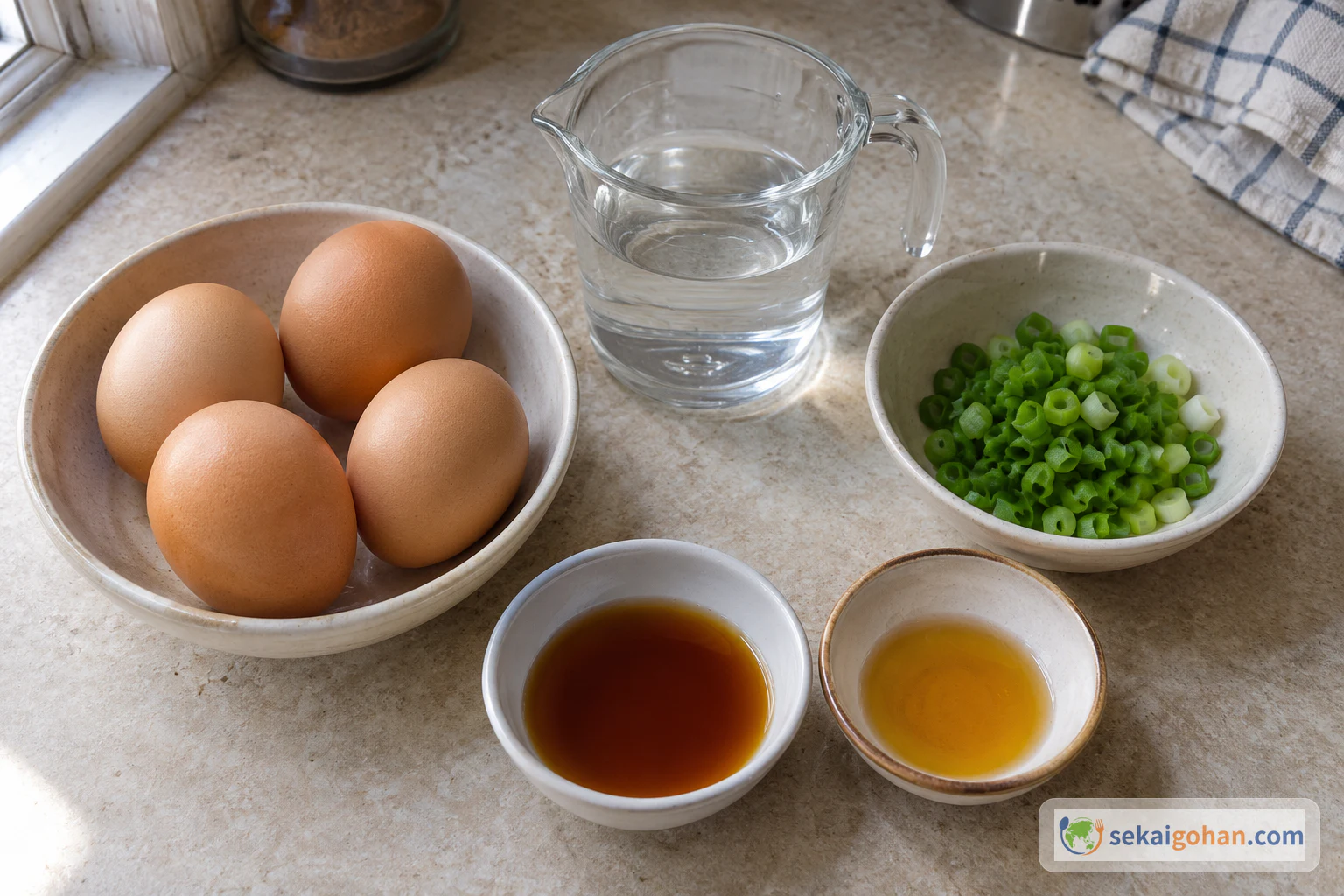
This recipe contains egg, fish (in the fish sauce) and sesame (in the sesame oil). Check the label and allergen notice of the particular fish sauce you buy.
Equipment
- A 3-cup ttukbaegi (뚝배기), a small Korean earthenware pot that can go directly on the stove
- A dome-shaped, heat-safe ceramic or stainless-steel bowl that can sit over the pot as a cover
- A fork or whisk
- A measuring cup
- Measuring spoons
Choosing the Fish Sauce, Oil and Pot
Eggs and green onion are ordinary supermarket items. Use large eggs.
Fish sauce is the only seasoning in this version. Use a general fish sauce and check the label for fish and salt content. Do not substitute soy sauce, salt or salted shrimp.
Use toasted sesame oil to finish the cooked egg.
The pot and cover are the distinctive pieces. Use a 3-cup ttukbaegi (뚝배기) covered with a dome-shaped, heat-safe bowl. If using another pot, confirm that it is safe for direct stovetop heat; timing and results may differ.
Method: Mix in the Pot, Cover, and Watch for the Steam
Everything happens in the ttukbaegi: combining, mixing and cooking. The cover goes on before the heat does, and stays on until the end.
Texture Cues, Food Safety and Common Misses
Watch for steam, liquid running down the pot and a nutty aroma near the end of cooking. They describe cooking progress. They are not a measured temperature, and neither the 12–13 minutes nor a photograph of steam proves what temperature the center of the egg has reached.
Japan's Ministry of Health, Labour and Welfare gives a general household guideline for cooked foods of heating until the center reaches 75°C for at least one minute. Japan's Ministry of Agriculture, Forestry and Fisheries says that eggs sold in Japan are produced with raw consumption in mind, and recommends that people who are concerned or unwell heat the whole food to 70°C. Neither figure comes from the recipe author, and this recipe has not been checked against either guideline in a home pot. If you want a measured check, an accurate food thermometer is the tool for that; the soft texture the recipe aims for is a separate consideration.
| If you are tempted to… | What this recipe does instead |
|---|---|
| Stir the egg often while it cooks | Keep the pot covered and cook without stirring |
| Add a pinch of salt | The 4 teaspoons fish sauce are the only seasoning in this version |
| Oil the pot or add sesame oil to the raw egg | The sesame oil is drizzled on only after cooking, once the cover is off |
| Scatter extra green onion on top | The one chopped green onion is mixed into the raw egg; it shows through the cooked egg without a separate garnish |
| Swap in a saucepan timing, a water bath or a microwave | Those belong to other methods with their own times; this recipe uses the earthenware pot on the stove for about 12–13 minutes |
| Judge doneness by the photo alone | Use the recipe's cues in the pot, and the public guidance above if you want a measured temperature |
Serving: A Warm Pot to Share Beside Rice
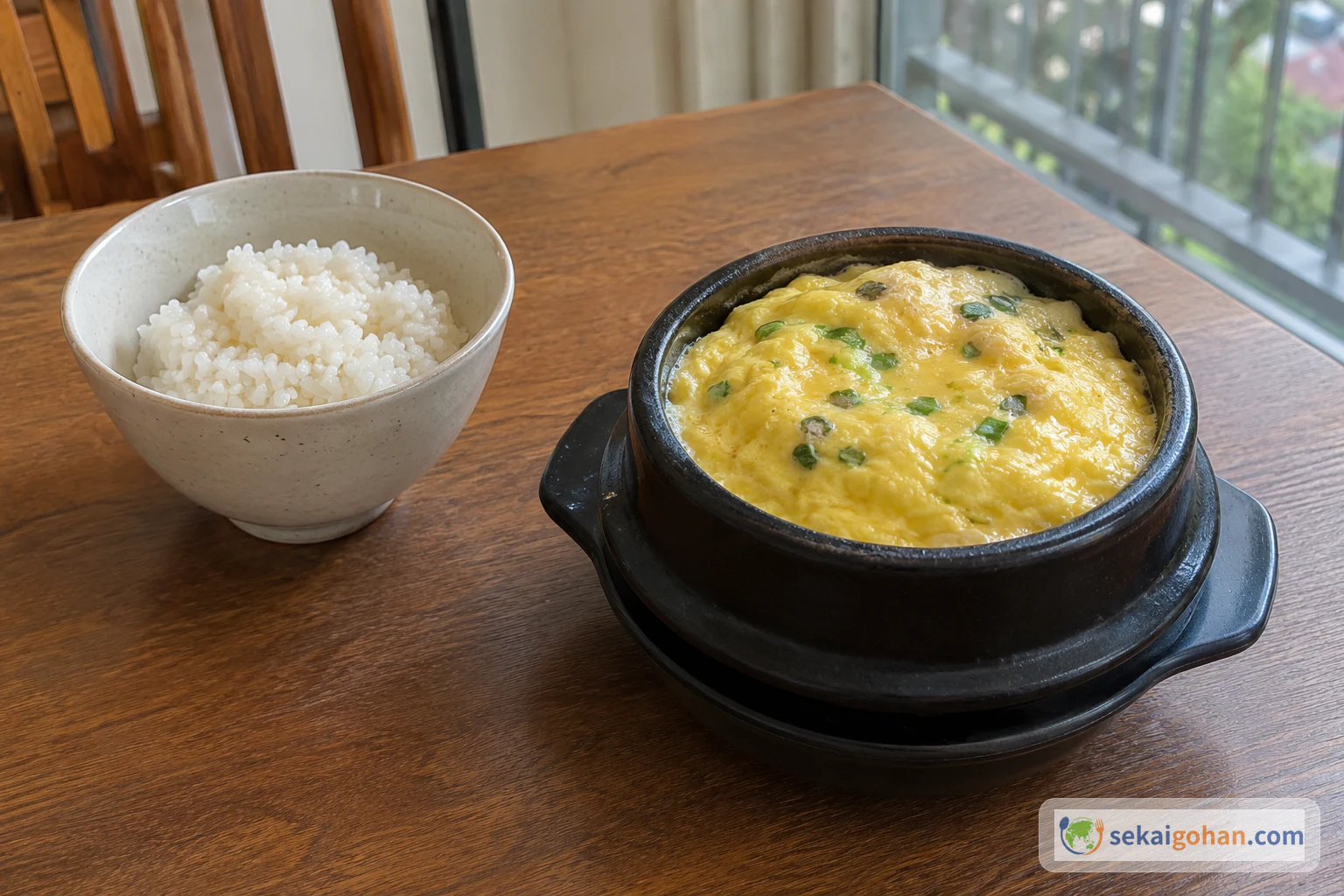
Bring the ttukbaegi straight from the stove to the table. Maangchi presents this earthenware version as a warm side for sharing with rice, and recommends serving it right away. Rice stays in its own bowl; it is not part of the egg mixture. As VISITKOREA notes, steamed eggs can also appear as an appetizer in a course menu, so the dish is not limited to one place in the meal. For more dishes from the same table, see South Korean recipes.
Leftovers
This dish is meant to be eaten as soon as it is cooked. If some is left over, follow Japan's Ministry of Health, Labour and Welfare general household guidance: cool it promptly in shallow containers, don't leave it at room temperature for a long time, and reheat it thoroughly before eating. No dish-specific storage period is given, and no reheating method is offered that keeps the just-cooked texture.
Other Versions You May Meet
These are separate choices from separate recipes. Each keeps its own ratio and method; none of them is mixed into the recipe above.
| Version | What changes | How to treat it |
|---|---|---|
| Maangchi's broth choice | 1 cup salted chicken broth in place of 1 cup water with 4 teaspoons fish sauce | Swap the pair together; don't use both. It also changes the allergen profile, so check the broth label |
| Maangchi's saucepan choice | A small heavy-bottomed stainless saucepan instead of the ttukbaegi, with its own shorter time | A different cookware path; follow her timing for that pan, not the earthenware timing |
| Korean Bapsang's version | Anchovy broth, about 1/4 cup liquid per egg for a silky texture, and seasoning with salted shrimp (saeujeot), fish sauce or salt; it also describes stovetop, water-bath and microwave methods | A different author's ratio and method, not a correction to the recipe above |
| Korean Bapsang's home additions | Chopped carrot, onion or zucchini; salted pollack roe (myungranjeot, 명란젓) as a family variation | No amounts are given for these additions |
| VISITKOREA's outline | Eggs whisked with water and salt, with anchovy broth as an option for a richer taste | A general description without quantities or timing |
Gyeran jjim and Chawanmushi Are Different Dishes
Gyeran jjim is not "Korean chawanmushi." Japanese chawanmushi is a steamed egg custard commonly built on egg and dashi, with fillings added in stages. The gyeran jjim in this article uses water and fish sauce with green onion, is mixed and cooked directly in an earthenware pot on the stove, and is finished with toasted sesame oil. They have their own names, formulas and places at the table; neither is a regional version of the other.
Frequently Asked Questions
What does gyeran jjim mean?
Gyeran (계란) means egg and jjim (찜) means a steamed dish, as Korean Bapsang explains; Maangchi's page also explains gyeranjjim as steamed egg. Dalgyaljjim (달걀찜) is another Korean name for the dish.
Does this recipe use salted shrimp?
No. In this version, the seasoning is 4 teaspoons fish sauce with 1 cup water, and nothing else. Salted shrimp (saeujeot) appears as a seasoning option in Korean Bapsang's separate recipe.
What is a ttukbaegi?
A ttukbaegi (뚝배기) is a small Korean earthenware pot. This recipe uses a 3-cup ttukbaegi directly on the stovetop, with a dome-shaped heat-safe bowl as its cover.
How many servings does it make?
The recipe page gives no numeric serving count. It presents the pot as a side to share with rice, so this article does not state a yield.
How much is 1 cup in milliliters?
The recipe page states 1 cup without a milliliter conversion, so this article keeps it as 1 cup rather than guessing a figure.
Is this the same as chawanmushi?
No. Chawanmushi is a Japanese steamed egg custard commonly made with egg and dashi and staged fillings. This gyeran jjim uses water and fish sauce in a directly heated earthenware pot. They are separate dishes.
Can I use a different cover?
The recipe calls for a dome-shaped, heat-safe ceramic or stainless-steel bowl placed over the pot. No other cover is offered here, so if you use something else, make sure it is heat-safe, and don't expect the same timing or result.
Can I make it in the microwave?
This recipe does not use a microwave. Korean Bapsang describes a microwave method as part of its own separate recipe; if you want that route, follow that recipe as a whole rather than mixing it with the earthenware method here.
Sources
- Maangchi, "Steamed egg in an earthenware bowl / Ttukbaegi gyeranjjim 뚝배기 계란찜," updated 2025-03-05. The recipe followed in this article: ingredients (4–5 large eggs, of which 4 are used here; 1 green onion; 1 cup water with 4 teaspoons fish sauce or 1 cup salted chicken broth; 2 teaspoons toasted sesame oil), the 3-cup ttukbaegi and dome-shaped heat-safe cover, medium-low heat for about 12–13 minutes with steam, condensation and aroma cues, serving right away with rice, the separate stainless-saucepan option, and the dish's role as a shareable side. https://www.maangchi.com/recipe/ttukbaegi-gyeranjjim
- Korean Bapsang, "Gyeranjjim (Korean Steamed Eggs)." The meaning of gyeran and jjim, the alternate name dalgyaljjim, the dish as a savory egg custard and side dish at home and in restaurants, and its own separately authored ratio, seasonings, home additions and cooking methods, used here only as context for other versions. https://www.koreanbapsang.com/gyeranjjim-korean-steamed-eggs/
- Korea Tourism Organization, VISITKOREA, "Steamed Eggs (계란찜 / Gyeranjjim)." Gyeranjjim as a typical Korean egg dish with a savory taste and soft texture, eggs whisked with water and salt and steamed in a pot with anchovy broth as an option, and its possible role as an appetizer in a course menu. https://english.visitkorea.or.kr/svc/contents/contentsView.do?vcontsId=178916
- Ministry of Health, Labour and Welfare, Japan, "家庭での食中毒予防" (Preventing food poisoning at home). The general household guideline of a 75°C center temperature for at least one minute for cooked foods, and advice on cooling leftovers promptly in shallow containers, not leaving prepared food at room temperature for a long time, and reheating thoroughly. https://www.mhlw.go.jp/stf/seisakunitsuite/bunya/kenkou_iryou/shokuhin/syokuchu/01_00008.html
- Ministry of Agriculture, Forestry and Fisheries, Japan, "特集「疑問解消! たまごのヒミツQ&A」" (Egg questions answered). That eggs sold in Japan are produced with raw consumption in mind, and the recommendation that people who are concerned or unwell heat the whole food to 70°C. https://www.maff.go.jp/j/pr/aff/2404/spe1_01.html