Flanders' Art of Beer
Belgium is known for chocolate and waffles. But ask Belgians themselves which dish represents the country, and many will name carbonnade flamande without hesitating.
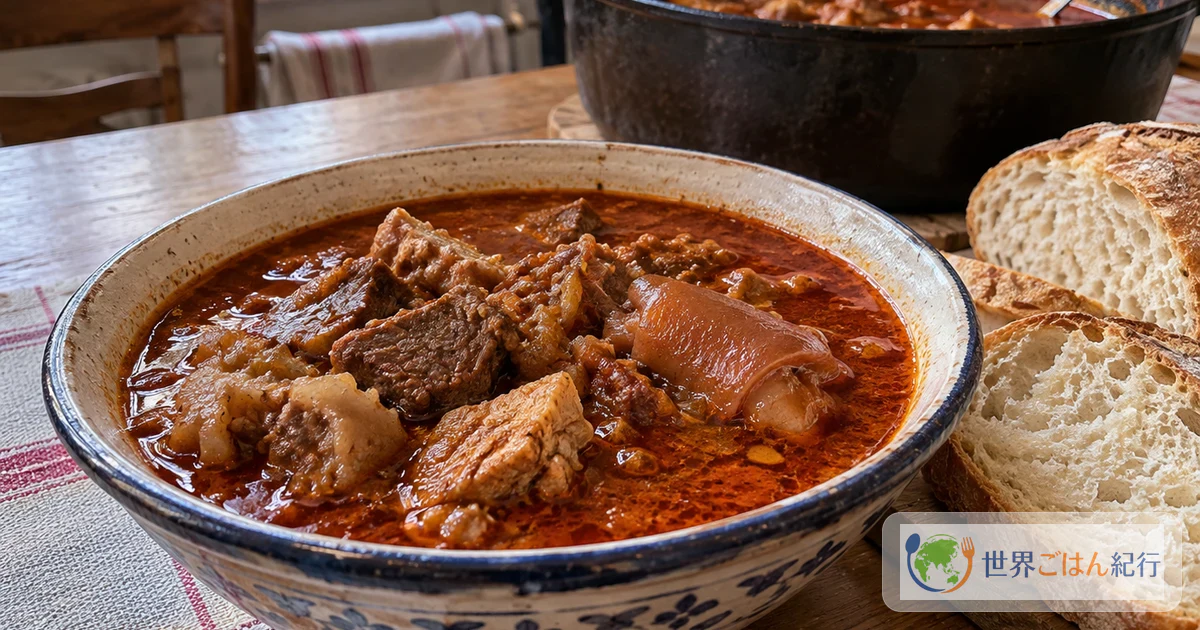
Carbonnade is a stew from Flanders in which beef is braised slowly with Belgian beer, onions, brown sugar and mustard. Where Burgundy in France makes beef bourguignon with wine, Flanders makes carbonnade with beer. The amber sauce layers sweetness, bitterness and umami, and eating it with frites (Belgian-style fried potatoes) is a national pleasure.
In Dutch it is also called stoofvlees or stoverij, and it is eaten not only in Belgium but also in the Netherlands and in French Flanders in northern France.
"Carbonnade" in French means "grilled over charcoal" and originally referred to braising meat that had been grilled over coals. "Flamande" refers to Flanders (today the Dutch-speaking north of Belgium). In Dutch it is called "stoofvlees" (braised meat) or "stoverij".
Detailed information about carbonnade is thin in Japanese. In English it is widely known as "Belgium's answer to beef bourguignon," and many detailed recipes are published. European stews such as Croatia's pasticada (in Japanese) and Hungarian goulash are getting more attention, but carbonnade is still little known. Compared with Gaisburger Marsch (in Japanese) from southwest Germany, which brings beef broth and noodles together in one dish, this is a stew where the bitterness of beer and the sweetness of onions come forward. This article explains carefully how to get an authentic flavor with beer and ingredients you can find in an ordinary store.
Ingredients (serves 6)

Cooking tips
Inexpensive beer is fine, but use "a beer you would enjoy drinking." The alcohol cooks off, but the malt flavor, sweetness and bitterness of the beer stay. Lagers and pilsners are too bitter, so choose a brown ale, a dubbel or a stout-type beer.
Bread simply dropped in is only a thickener. Spread with mustard, when the bread dissolves, the mustard's pungency and aroma spread evenly through the whole sauce. Skip it and the result feels like "something is missing."
Carbonnade is reliably better reheated the next day than on the day it is cooked. The sauce fully soaks into the meat and the beer's edges soften into a mellow flavor. Making extra so you have some for the next day is the Belgian way to enjoy it.
The first, lower-temperature fry (160°C) cooks the inside of the potato and gelatinizes the starch. The second, hotter fry (190°C) drives off surface moisture at once and creates the crisp texture. It is the same idea as the two-stage "boil then pan-fry" cooking of Polish pierogi (in Japanese): finishing the surface and the inside separately.
Variations
Pork carbonnade
Use 1 kg pork shoulder instead of beef. Pork tends to become tender faster than beef, so shorten the braise to 3 hours. The sweetness of pork fat goes well with the bitterness of beer for a richer result. There are pork-based braises in many places, like Serbian ćevapi (in Japanese).
Lamb carbonnade
You can also make it with lamb. The lamb's flavor harmonizes with the thyme, and the bitterness of the beer tames the gaminess.
Slow cooker version
After steps 1–2, put everything in the slow cooker and cook on LOW for 8 hours. Set it in the morning and it's ready by evening.
Vegan version (mushroom carbonnade)
Use 400 g mushrooms and 300 g seitan (wheat gluten) instead of beef. Mushroom umami and beer richness combine for a depth you would not guess is meatless. Also recommended if you like bean-and-vegetable European braises such as North Macedonia's tavče gravče (in Japanese).
Chocolate beer version (indulgent style)
Using a chocolate stout adds cocoa flavor and an extremely rich sauce. Melting in 10 g dark chocolate at the end creates a deep complexity reminiscent of Mexican mole poblano.

Background of the dish
A dish born of Flemish beer culture
The exact origin of carbonnade is unclear, but it is said to have been made in Belgium by at least the 18th century. In the low-lying Flemish plains, where grapes grow poorly, brewing flourished, and wine was an imported luxury.
Braising meat in the everyday beer was a natural choice. Even today, abbey-style brown beers are the standard.
In contrast with beef bourguignon
Beef bourguignon (wine braise), the great dish of French cooking, and carbonnade (beer braise) are often compared. As Burgundy is wine country, Flanders is beer country, and each cooks meat in its proudest local brew: a typical example of a food culture rooted in terroir.
The malt sweetness and hop bitterness of beer create a complexity different from the tannins of wine, and the synergy with mustard and brown sugar is a flavor unique to this dish that wine braises do not have.
The frites origin dispute
Belgium and France have a long-running dispute over where frites (fried potatoes), the essential partner of carbonnade, originated. In France they are known as "French fries," but Belgians insist that "frites originated in Belgium and should be called Belgian fries."
According to Belgian lore, in the 17th-century Meuse valley, residents who fried small fish to eat, when the river froze in winter and the fish could not be caught, instead cut potatoes into fish shapes and fried them. Whether it is true is unclear, but in Belgium the culture of the frites stand (fritkot) was recognized as intangible heritage of the Flemish Community in 2014, and is also registered in other regions such as Brussels.
Carbonnade at the modern Belgian table
In modern Belgium carbonnade holds an unshakable place as the king of home cooking. Gathering the family around carbonnade at Sunday lunch is a tradition in many Flemish households. Butchers readily sell beef for braising, and each household differs in its brand of beer and degree of sweetness.
At the same time, modern Belgian restaurants in Brussels and Antwerp are reinterpreting carbonnade. Some restaurants keep the traditional flavor while working on the plating and accompaniments. Just as goulash is updated in modern Hungary, traditional dishes keep evolving.

Nutrition (per serving, 6 servings total)
Most of the alcohol cooks off in braising, but the B vitamins, minerals (magnesium, potassium) and fiber in the beer remain in the sauce. Together with the high-quality protein and iron of the beef, it is a well-balanced dish.
| Nutrient | Amount |
|---|---|
| Calories | 520 kcal |
| Protein | 38 g |
| Fat | 18 g |
| Carbohydrates | 42 g |
| Fiber | 4 g |
| Sodium | 650 mg |
About 5% of the alcohol remains after a 4-hour braise, so children and pregnant women should take care. Using non-alcoholic beer instead keeps the flavor to a degree while making it alcohol-free. The calories for the frites (about 300 kcal) are not included above.
Dishes to make alongside
- Belgian waffles (in Japanese) - The day after the beer stew, you can continue on to a Belgian street-walking snack.
- Waterzooi (in Japanese) - Another Flemish, Belgian stew, with chicken or fish in cream.
- Stuffat tal-fenek (in Japanese) - A Maltese home dish of rabbit braised in wine, to compare a southern European braising culture with the beer stew.
FAQ
These are common questions from people making carbonnade for the first time, from choosing beer to storage.
Q1. Can I make it with Japanese beer?
Yes. Dark Japanese beers (Asahi Kuronama, Kirin Ichiban Shibori Kuro) or craft beer (Yona Yona Ale) work well. What matters is choosing "a dark beer with sweetness and malt character." Avoid ordinary lagers (Super Dry, Kirin Lager and the like), because they become too bitter.
Q2. Do I really need to braise it for 4 hours?
At least 3 hours is needed. At 3 hours the meat is tender, but at 4 hours it falls apart with a fork and the sauce is far deeper. A pressure cooker can shorten it to about 1–1.5 hours, but a slow braise gives the sauce more complexity.
Q3. Is it good the next day?
It is better the next day. In Belgian homes, too, "make it Sunday, eat it Monday" is the rule. It keeps for 3 days in the refrigerator, and 1 month frozen. Reheat slowly over low heat.
Q4. What happens if I leave out the mustard bread?
The sauce loses some body and flavor. Without bread, you can dissolve 1 tbsp flour in 3 tbsp water and add it at the end of the braise to supply the thickening alone. But the mustard flavor must be added separately, so stir in 1 tbsp Dijon mustard at the end.
Q5. Can I serve it with something other than frites?
Of course. Mashed potatoes, boiled potatoes and pasta (tagliatelle) also go well. In Belgian restaurants, bread is sometimes served to soak up the sauce. Just be prepared for a Belgian to tell you indignantly that "carbonnade can only be eaten with frites."
Related European dishes
If carbonnade has caught your interest, try other European braises too.
- Pasticada (in Japanese): A Croatian braise with prunes and wine. A chance to compare "wine versus beer" braises
- Goulash: A Hungarian paprika stew. A Central European specialty in which spice transforms the meat
- Svíčková (in Japanese): A Czech tangy cream braise. Shows the diversity of European braises
Also try another stew from Europe.
- Borscht (in Japanese): A red Ukrainian stew. The sweet-and-sour beet contrasts well with the bitterness of carbonnade's beer
Sources
- Wikipedia, "Flemish stew" (name, thickening with mustard-spread bread, pairing with frites; accessed 22 October 2026)
- Do Eat Better Experience, "Flemish stew and waterzooi in Bruges" (regional dishes of Bruges; accessed 22 October 2026)
- erfgoed.brussels, "Fritkot - inventarisfiche" (fritkot culture in the Brussels intangible heritage inventory; accessed 22 October 2026)
- Van Waerebeek, Ruth. Everybody Eats Well in Belgium Cookbook. Workman Publishing, 1996. (Belgian recipe collection)
- Scholliers, Peter. Food Culture in Belgium. Greenwood Press, 2009. (Belgian food culture)