In front of the oven, the scent of sesame and cheese rises
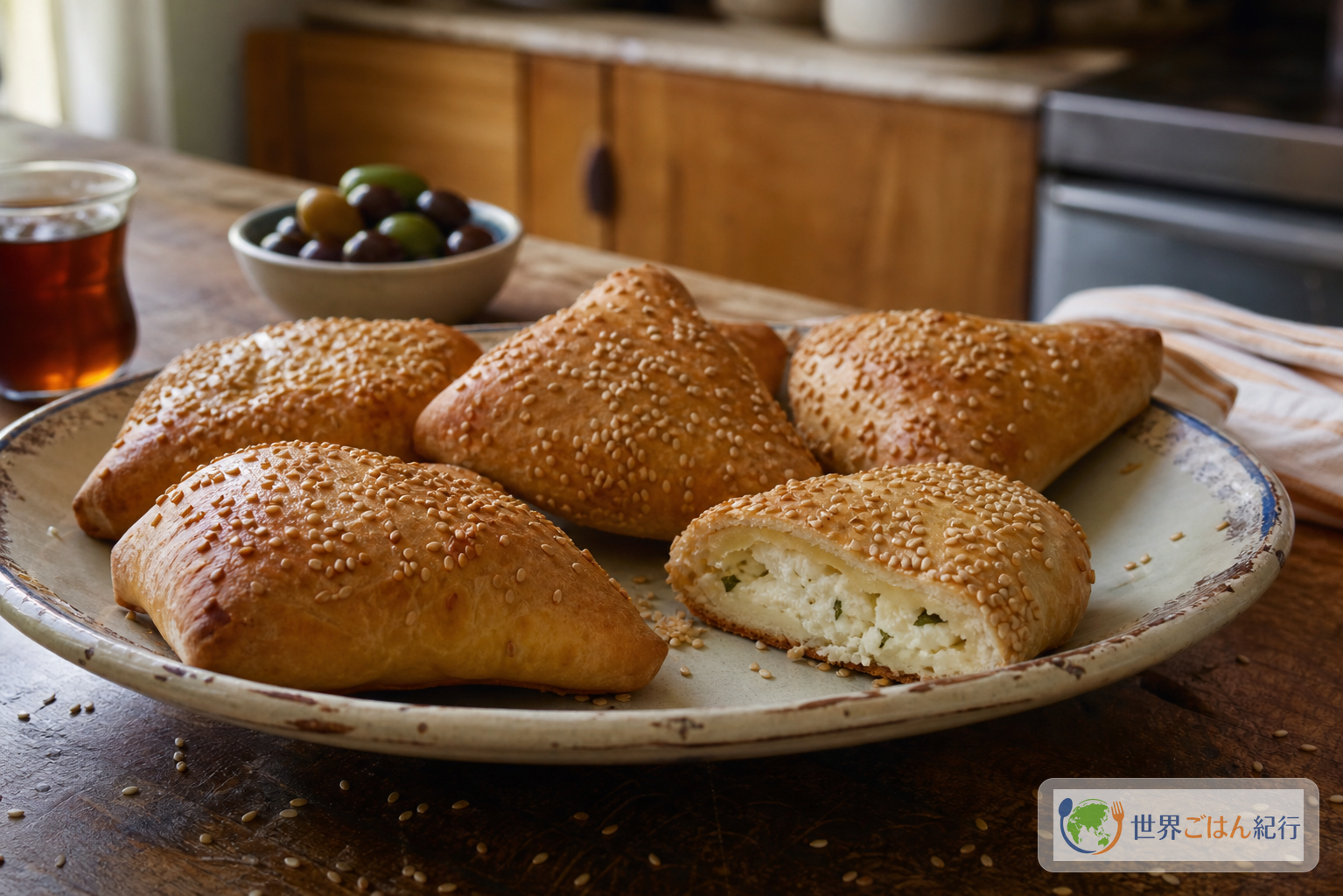
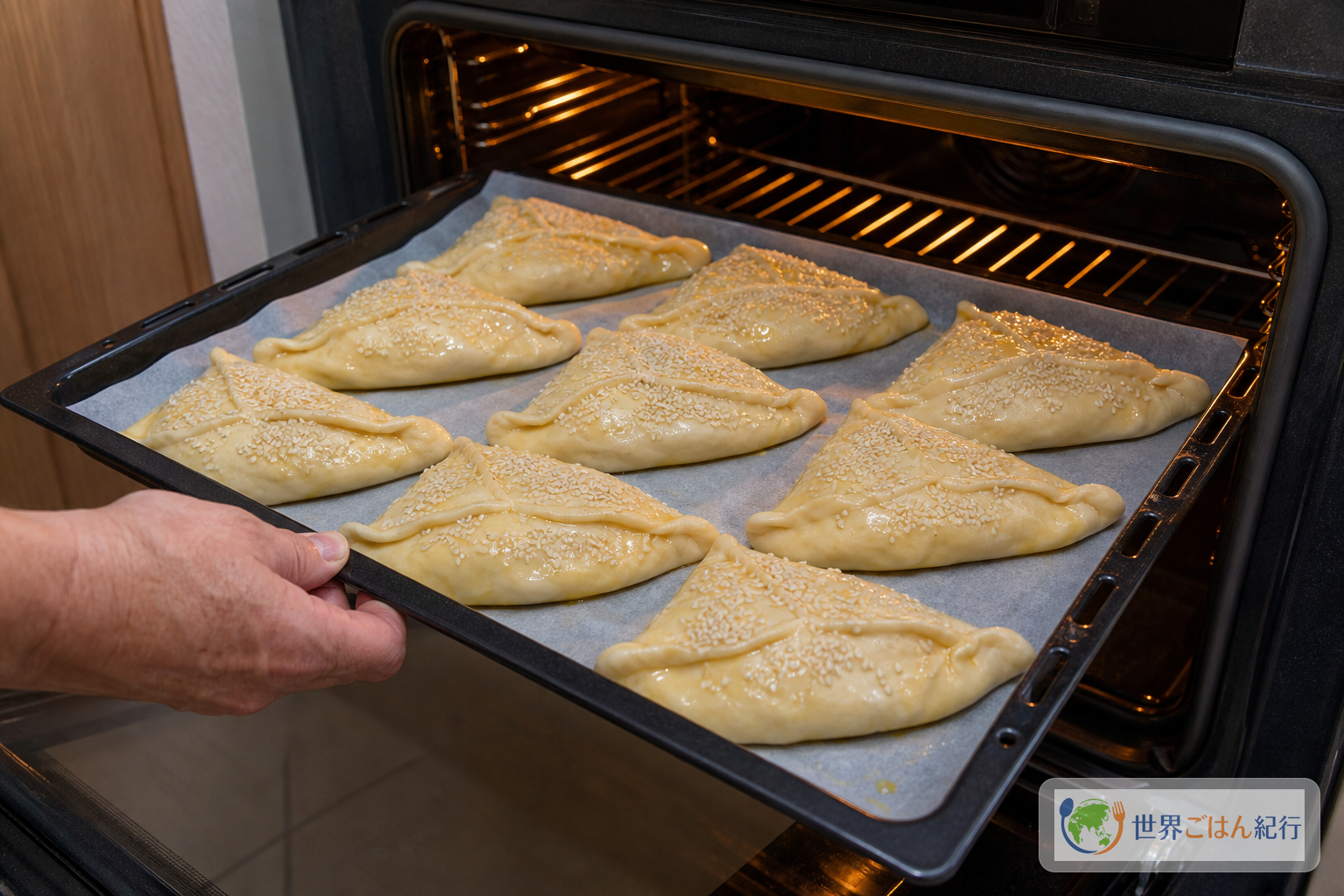
When you bake flaouna, the sesame scent comes first. Next the sweet smell of the egg-washed dough, and a little later the slightly green smell of cheese and mint. Each time you peek into the oven, the folded corners have puffed and the sesame on the surface is coloring in scattered specks. Even in a home kitchen, this waiting time is great fun.
Flaouna (plural flaounes) is a cheese-filled bread baked in Cyprus around Easter. Locally, the shape and flavor differ between Greek Cypriot and Turkish Cypriot households: salty ones, sweeter ones, ones with raisins, ones wrapped square, ones closed into triangles. What they share is a filling centered on cheese, sesame on the outside, and the aroma of mahlepi (mahaleb) and mastiha (mastic).
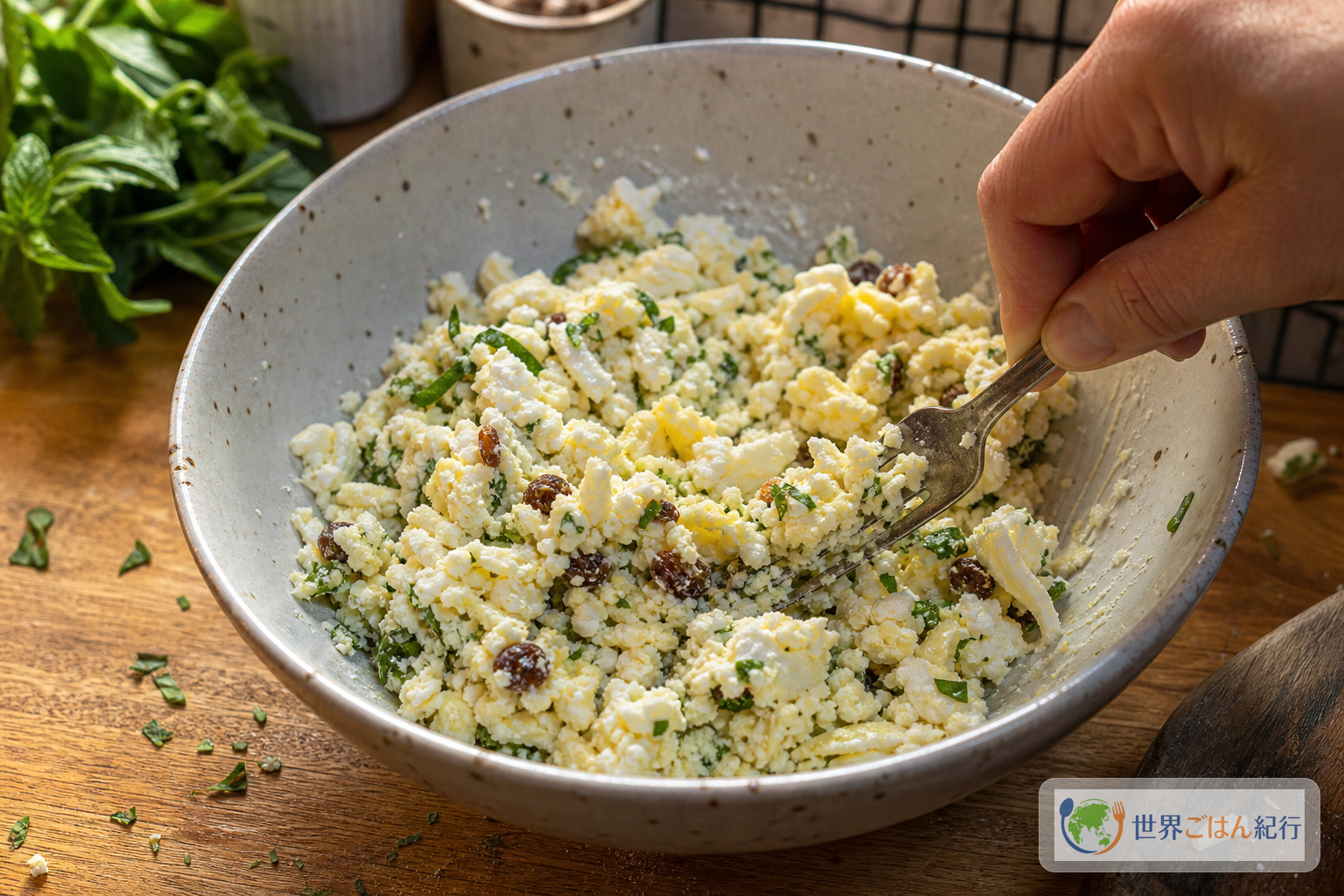
The hard part of making it outside Cyprus is that the local flaouna cheese is hard to get. Here we combine halloumi, feta, and ricotta or cottage cheese. It is not a perfect recreation, but by dividing the roles of saltiness, springiness, white crumbliness, and milky sweetness among them, you come close to the bite that is flaouna, neither a pizza bread nor a cheese pie.
If koupepia shows Cypriot home cooking through vine leaves, lemon, and mint, flaouna shows the island's festive table through wheat, dairy, and fragrant seeds. As a fermented dough wrapped around cheese it can be compared with Georgian khachapuri, but flaouna has a clear sesame coating and an Easter context.
What is flaouna? A cheese bread baked for Easter
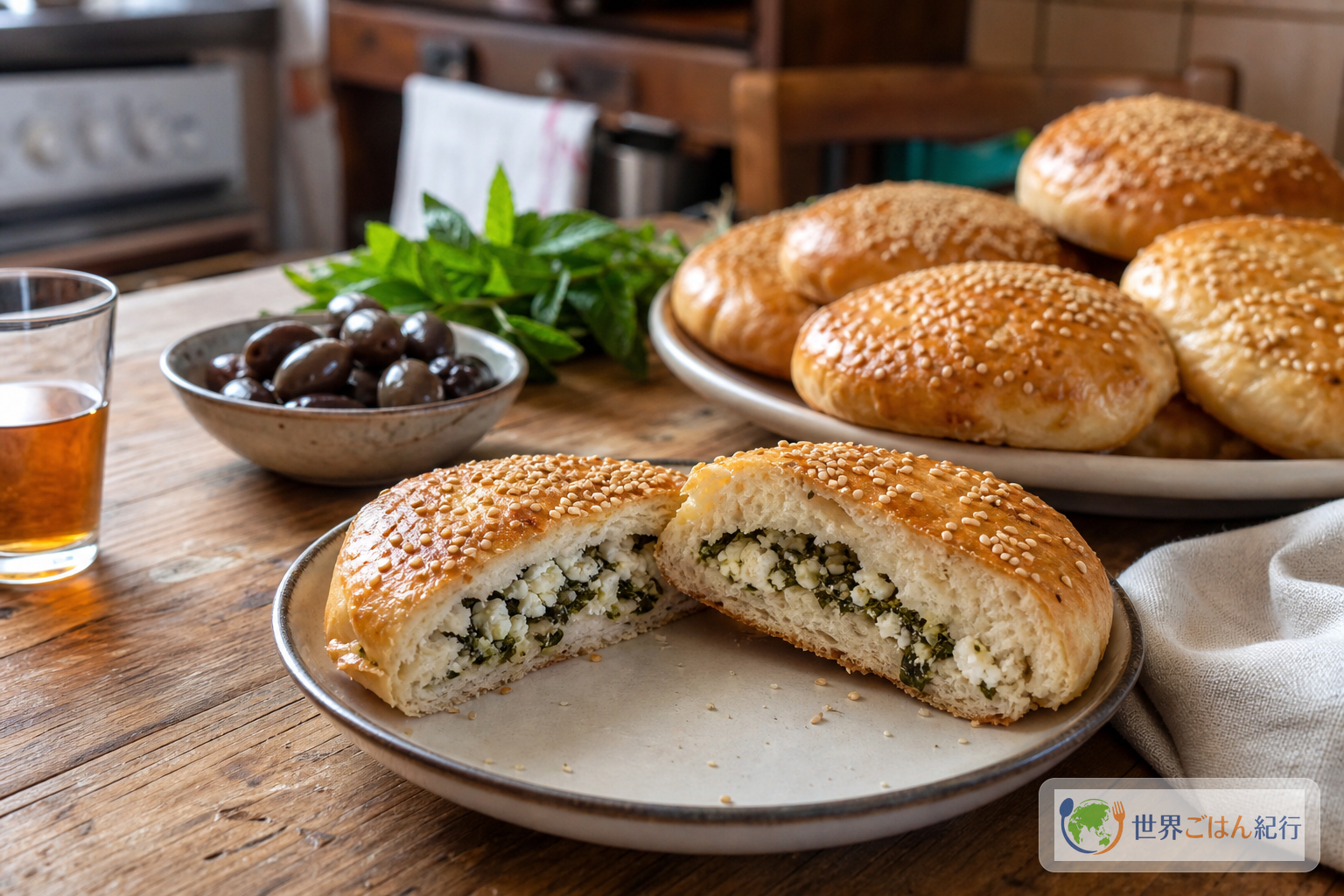
Flaouna is known as a dish baked at home around Cypriot Easter. A cheese filling is wrapped in a fermented dough and baked with sesame on the outside, so by category you could call it "cheese bread." Locally, though, its presence is larger than an everyday savory bun: it is a seasonal dish that families bake in quantity and share with relatives and neighbors.
The name is written flaouna in English and flaounes in the plural. In Greek it is φλαούνα, and in Turkish-influenced usage it is sometimes written pilavuna. The direction of flavor differs quite a lot by household. Households that put saltiness forward lead with halloumi and salty cheese, while sweeter ones add raisins and a little more sugar.
| What to look at | What is valued locally | How to translate it for a home kitchen |
|---|---|---|
| Cheese | Flaouna cheese, halloumi, anari, and others | Divide roles among halloumi, feta, and ricotta or cottage cheese |
| Aroma | Mahlepi, mastiha, mint | Use a small amount of what you can get, and do not let it become a heavy perfume |
| Outside | Heavily coated in sesame | Coat the sides, not just one face |
| Shape | Triangles, squares, open parcels; varies by household | For the first time, a square shape with four corners raised is least likely to fail |
| How it is eaten | Easter breakfast, snack, a baked treat to share | Let it rest fresh from the oven, and rewarm lightly the next morning |
What we make here is a version that keeps saltiness as the main line while adding a small amount of raisins to keep a Cypriot sweet-and-savory note. It is balanced so that, without leaning too far toward a sweet pastry, it can be eaten as a savory cheese bread at breakfast or lunch.
Ingredients (serves 4, makes 8 pieces)
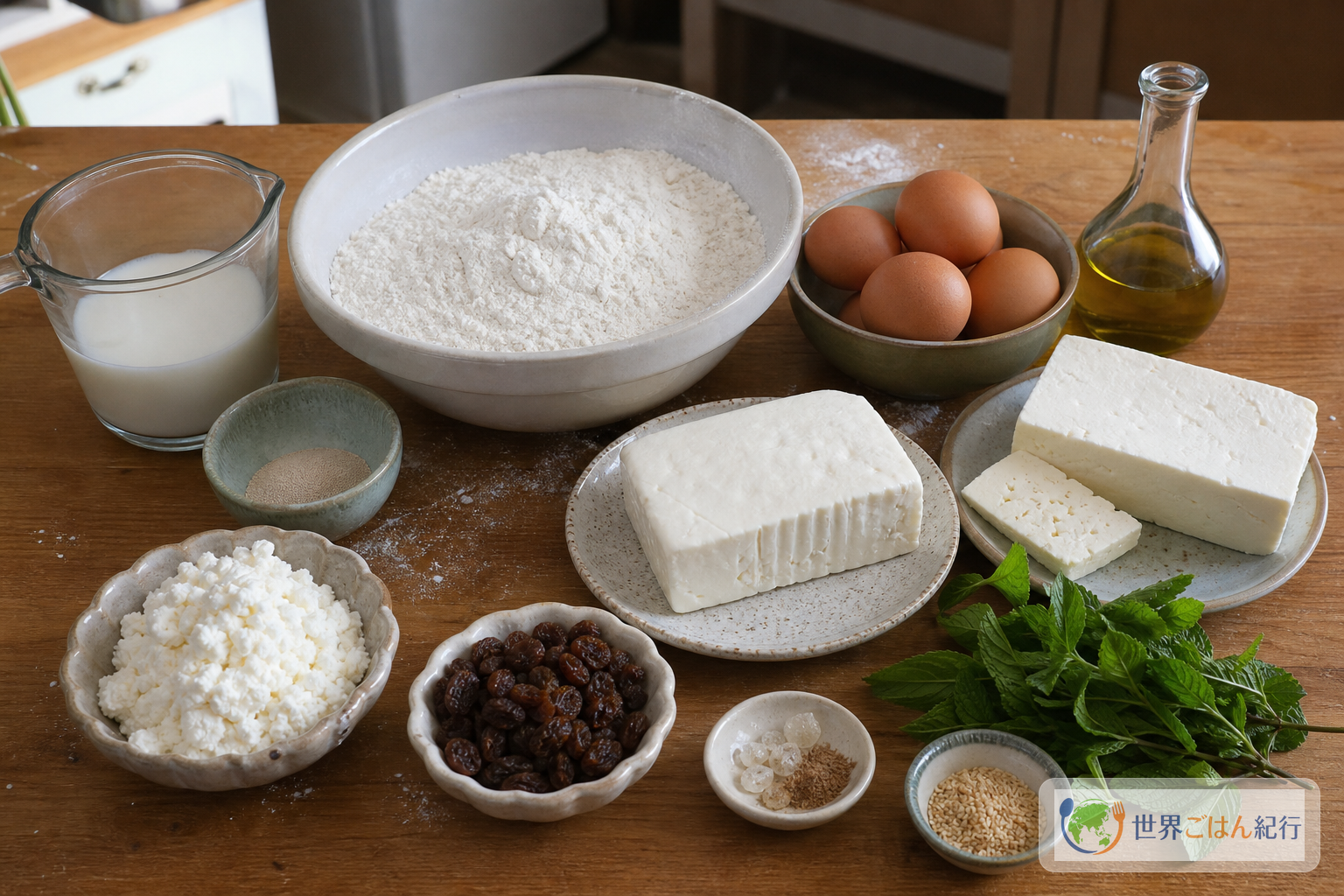
Making 8 lets you eat them fresh and also enjoy rewarming them the next morning. Because the saltiness of cheese varies a lot by product, if the cheese seems very salty, add 20 g ricotta to the filling.
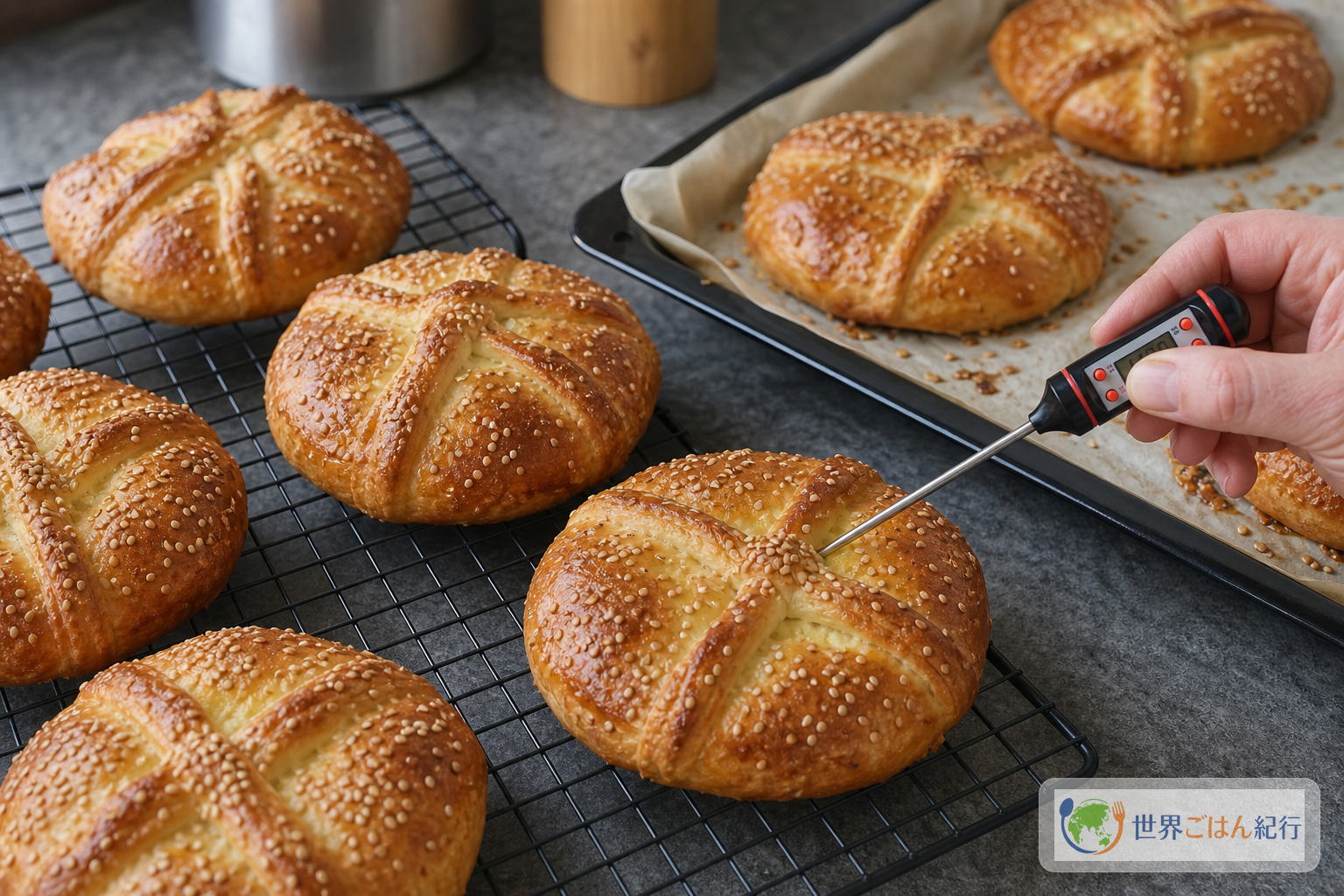
This dish contains wheat, egg, dairy, and sesame. Because the filling uses egg, check that the baked result is hot through the center and that the cheese moisture has set without running. If you use a thermometer, aim for 75°C or higher at the center.
Where to draw the line on substitutes
To keep the flaouna character, you want to include either halloumi or feta. If you replace both with ordinary pizza cheese, it only stretches when baked and moves away from the white, crumbly filling of the local version. Conversely, mahlepi and mastiha are hard to find, so there is no need to aim for perfection from the start.
| What you want to replace | Usable substitute | Effect on the result |
|---|---|---|
| Flaouna cheese | A combination of halloumi, feta, and ricotta | Divides saltiness, springiness, and crumbliness |
| Halloumi | 150 g paneer and 60 g feta | The springiness is close, but the Cypriot character weakens a little |
| Ricotta | 200 g cottage cheese | Gives a grainy texture. Drain if wet |
| Mahlepi | 2 g orange zest and 0.2 g nutmeg | The aroma is different, but it covers the direction of sweet milky fragrance |
| Mastiha | Leave out | The resinous afterglow disappears, but it is easier to make |
| Raisins | Omit and cut sugar to 12 g | Leans savory and goes well as a meal bread |
What to protect is the saltiness and crumbliness of the cheese, the mint, the sesame, and a small sweet aroma. Even with cheeses you can easily buy, if you do not break these four, you can bring it close enough to serve as flaouna.
Aromas and tools worth thinking about when shopping
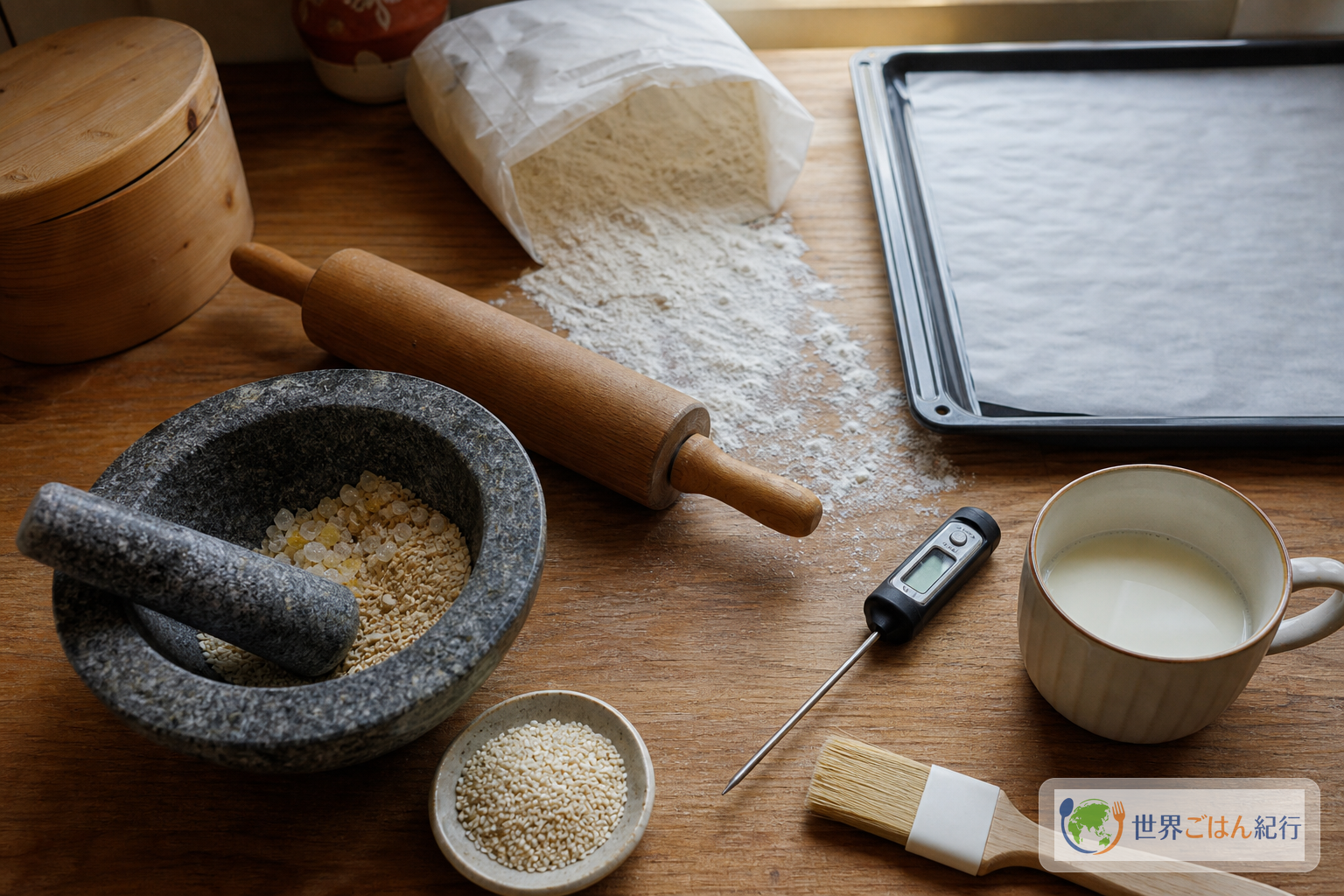
Mahlepi and mastiha can sometimes be found at shops that handle Greek, Cypriot, Turkish, and Levantine groceries. When searching, also try the spellings mahlepi, mahlab, mahaleb, mastiha, and mastic resin.
The tools most worth adding are a mortar to crush aromatics fine, a rolling pin to roll thinly and evenly, and a thermometer to check fermentation and doneness. They are not flaouna-only; they also work for cheese-dough dishes like khachapuri and achma (in Japanese: achma).
Whole pieces of mastiha hit hard inside the filling. Mixing in a pinch of sugar and crushing in a mortar keeps the powder from scattering and makes it easier to distribute through the cheese.
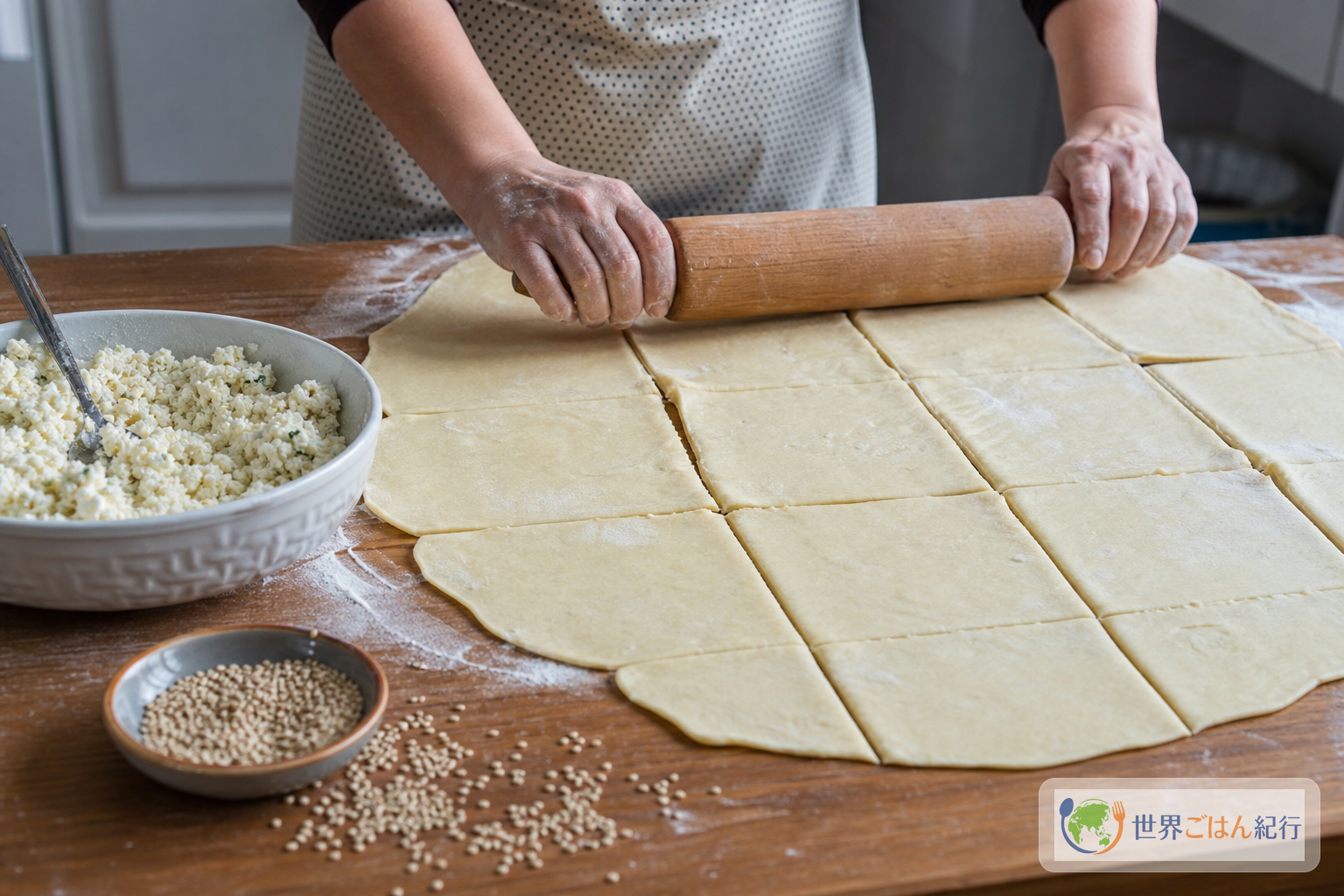
A rolling pin around 30 cm is an easy length for evenly rolling out 8 pieces of dough. If only the center is thick, the bread part turns heavy after baking and does not come together with the cheese.
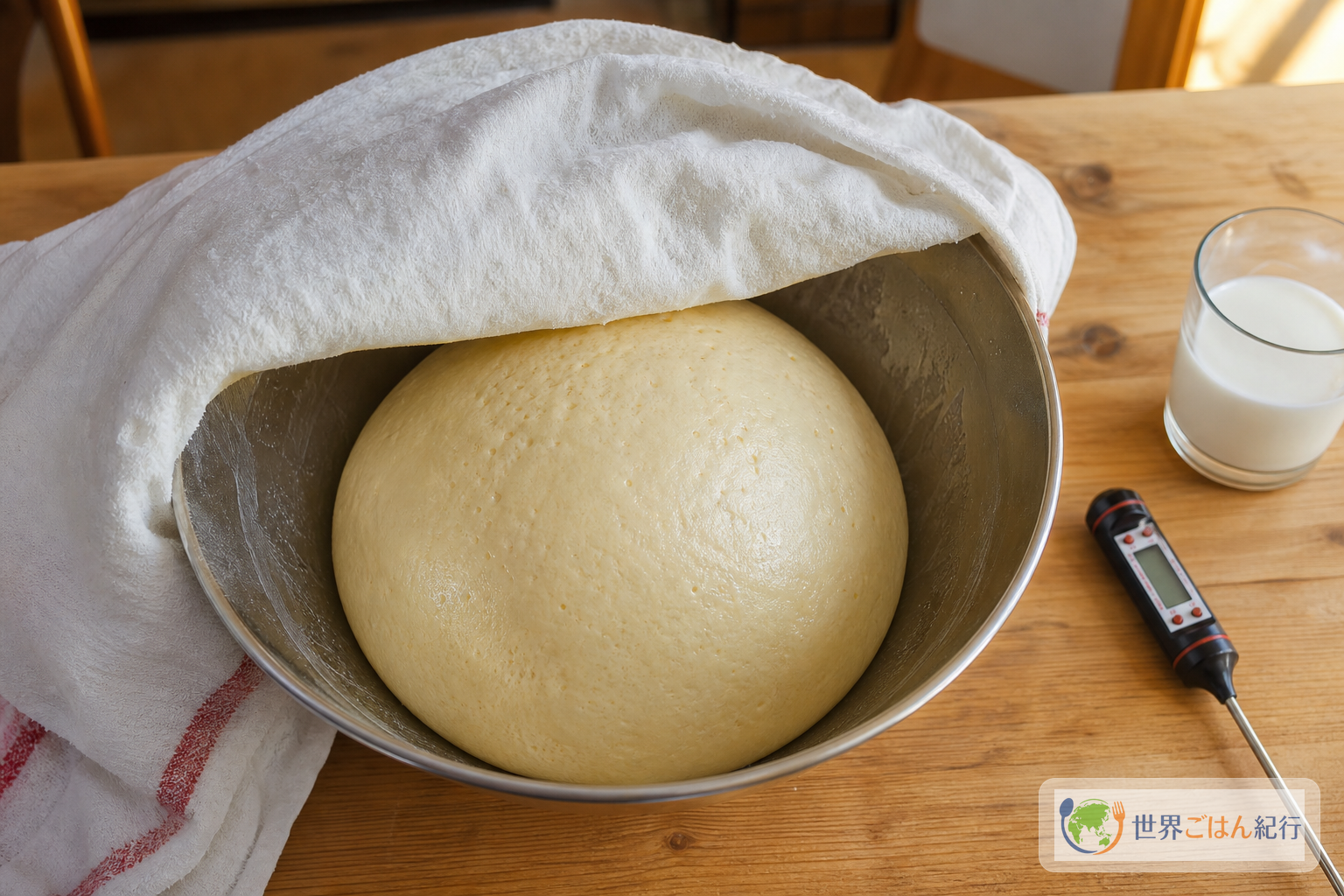
A thermometer that lets you check the temperature of the warm milk, fermentation at room temperature, and the center of the baked bread greatly reduces first-time failures with fermented dough. It makes it easier to get a liquid at 35 to 38°C than going by feel alone.
Method: watch the fermentation, filling, wrapping, and browning
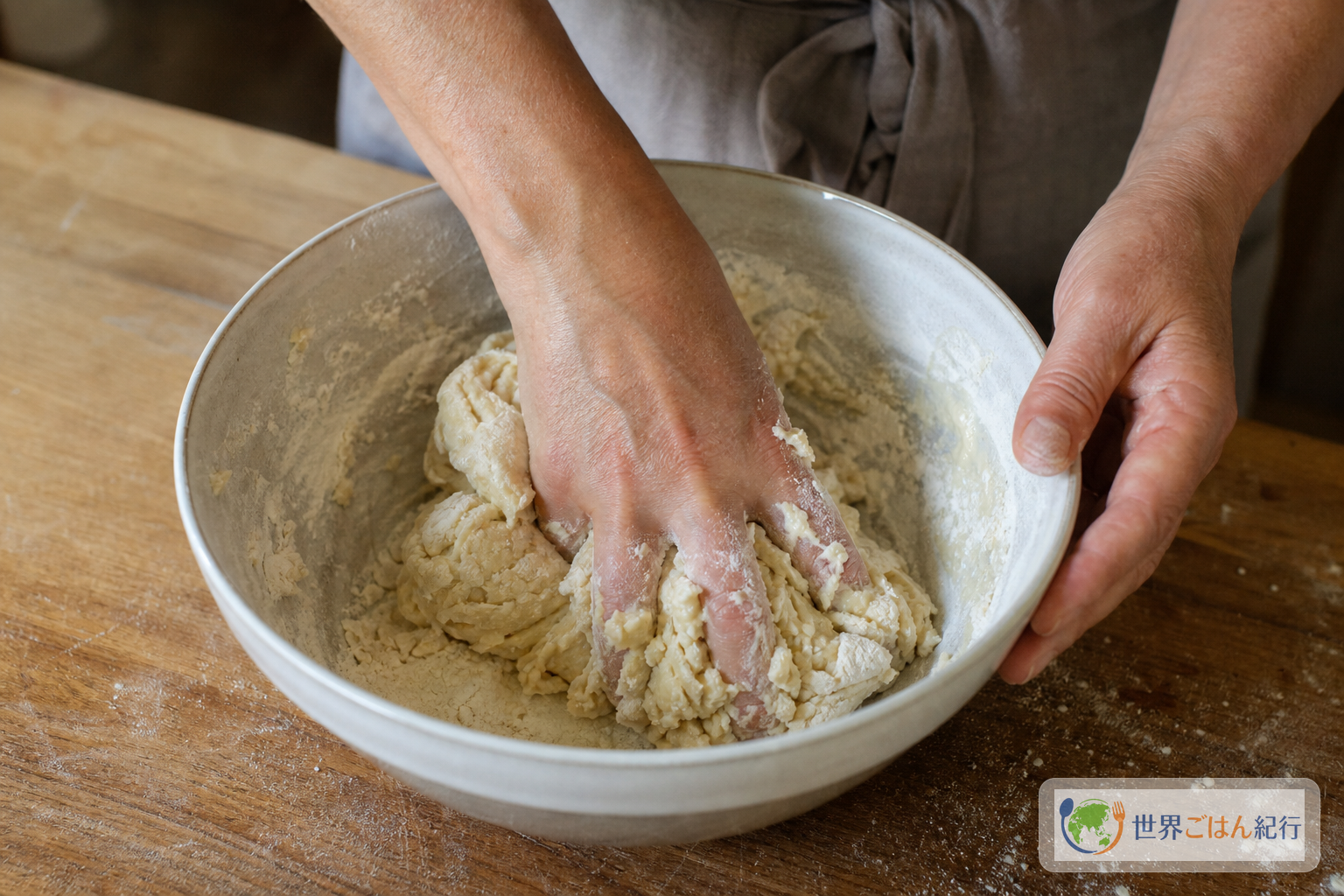
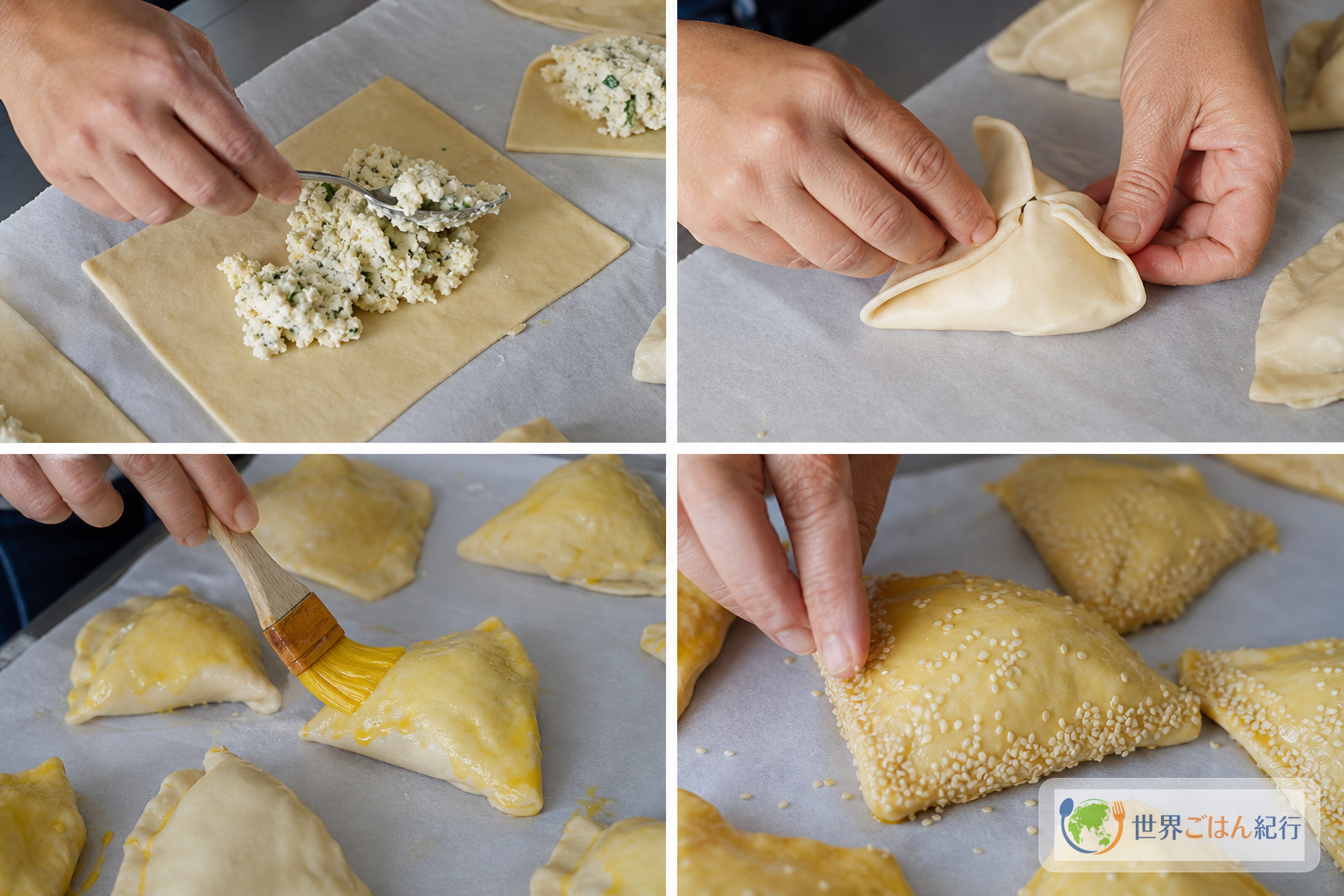
Flaouna is less a dish you knead than a dish you wait for. Don't rush the dough, don't make the filling too wet, coat the sesame all the way to the sides, and rest it a little after baking. Keep to this order, and it is easy to eat both fresh from the oven and the next day.
Where to draw the line to get close to the real thing in a home kitchen
What you will be most unsure about is "which cheeses are acceptable." Halloumi gives the springiness and saltiness of Cyprus, but it is expensive and some shops do not carry it. Feta has strong saltiness and tang, and ricotta or cottage cheese makes the white crumbliness. The reason to mix the three is not to play at imitating a local cheese's name but to divide the roles when baked.
| What to decide | Protect | Fine to replace |
|---|---|---|
| Direction of the cheese | Saltiness, springiness, white crumbliness | The ratio of halloumi, feta, and ricotta |
| Aroma | A small amount of either mahlepi or mastiha | If you have neither, lightly make up with citrus and nutmeg |
| Outside | Sesame all the way to the sides | The difference between white and golden sesame is acceptable |
| Sweet-and-salty | Keep sugar and raisins to a small amount | To lean salty, leave out the raisins |
| Shape | Leave the center slightly open to show the filling | Triangle, square, or rounder shapes count as household differences |
If you add pizza cheese, keep it to 60 g in total. Too much leaves only melting power, and when you cut it the cheese makes strings, a different bread. Flaouna is not a dish that shows off stretchy cheese; it is a dish where you bite into a filling of baked egg and cheese held together.
Mahlepi has a sweet, almond-like aroma and mastiha an afterglow close to pine resin and herbs. Neither becomes more authentic by increasing the amount. About 1 g each of powder, or about 0.2 g if whole mastiha, is enough. If the aroma comes too far forward, it feels like eating perfume rather than cheese.
Causes of failure and how to fix them

Flaouna failures mostly come down to dough thickness, moisture in the filling, and judging doneness. Even if the look is a little rough, it can be eaten deliciously if the color and the filling inside are right. Conversely, even if the shape is pretty, a lukewarm center and running cheese make it hard to eat.
| State | Main cause | Response on the spot | Adjustment next time |
|---|---|---|---|
| Filling runs | Ricotta too wet, underbaked | Bake 5 more minutes at 190°C | Drain the cheese for 10 minutes and increase semolina by 5 g |
| Dough is hard | Too much flour added, underfermented | Use a little water spray when rewarming | Increase milk by 10 ml and extend fermentation by 10 minutes |
| Only the surface browns dark | Top heat too strong, rack too high | Loosely cover with aluminum foil | Bake on the middle rack and keep to 190°C |
| Bottom is pale | Baking sheet cold, too much oil on the paper | Put on the lower rack for 5 more minutes | Preheat thoroughly and brush the oil thinly |
| Aroma is medicinal | Too much mastiha | Eat with lemon or salad | Hold to 0.2 g and crush it with sugar |
| Sesame falls off | The outside of the dough dried | Re-brush a thin layer of egg wash before baking | Do not let the dough dry before wrapping |
If the dough tears, tuck that part inward and wrap again. Flaouna is not sealed completely like a dumpling, so it is fine if the filling shows a little. In fact, a shape with the center open makes the cheese aroma rise more.
How to eat it, storage, and rewarming

Eat it fresh from the oven after resting 10 minutes. Cut piping hot, the cheese filling runs easily and the aroma does not settle. Cut a little cooled, the white filling holds together and the aroma of mint and sesame is easier to catch.
For a light Cypriot-style table, olives, cucumber, tomato, and tea are enough. To make it more of a meal, pair it on another day with a Greek-style salad (in Japanese: Greek salad) or moussaka, and the flow of eastern Mediterranean dairy, herbs, and baked dishes shows.
For storage, let it cool a little, put it in an airtight container, and finish it in about 3 days in the refrigerator as a guide. If freezing, wrap each one in plastic wrap, put them in a storage bag, and keep to about 1 month as a guide. To rewarm: from the refrigerator, 7 to 8 minutes in a toaster oven at the equivalent of 180°C. From the freezer, thaw half a day in the refrigerator and then rewarm 10 to 12 minutes at the equivalent of 180°C. A microwave alone leaves the dough limp, so heating at 600 W for 40 seconds and then moving to the toaster oven helps restore the texture.
Frequently asked questions
I have neither mahlepi nor mastiha. Is it worth making?
Yes, though the outline of the aroma will be weaker. The first time, I recommend covering lightly with 2 g grated orange zest and 0.2 g nutmeg and learning the structure of cheese, sesame, and mint first. Next time, if you find mahlepi or mastiha at an import grocery, add just a little to see the difference.
Can I make it without halloumi?
Yes. A combination of 120 g feta, 250 g ricotta, and 150 g paneer keeps the saltiness and the white crumbliness. The springiness peculiar to halloumi weakens, though. Combining several white cheeses gets closer than making it with pizza cheese alone.
Should I put in the raisins?
If you want to lean toward the Cypriot sweet-and-savory home style, a small amount is interesting. To put saltiness forward as a meal bread, leave them out. If you leave them out, cutting the dough's sugar from 18 g to 12 g keeps the sweetness from lingering.
How much can I prepare the day before?
The filling can be mixed the day before and stored in the refrigerator. For the dough, rather than going as far as the first fermentation, weigh out the ingredients and knead on the day; the aroma is steadier. If you must make the dough the day before, refrigerate it right after kneading and let it stand 60 minutes at room temperature the next day before dividing.
How is flaouna different from khachapuri?
Both are fermented-dough dishes that use cheese, but their purposes differ. Khachapuri is Georgia's national cheese bread, with shapes that vary by region. Flaouna is tied to Cypriot Easter, and combinations of aromas like sesame, mahlepi, mastiha, mint, and raisins stand out.
Sources
- Cyprus Food Museum. "Flaouna." https://www.cyprusfoodmuseum.com/en/sylloges/trofima/flaouna (accessed 2026)
- Cyprus Food Museum. "Flaounes recipe." https://www.cyprusfoodmuseum.com/en/sylloges/paradosiakes-syntages/flaounes (accessed 2026)
- Wikipedia. "Flaouna." https://en.wikipedia.org/wiki/Flaouna (accessed 2026)
- My Cyprus Travel. "Flaounes: Cyprus' Easter cheese bread." https://mycyprustravel.com/flaounes-cyprus-easter-cheese-bread/ (accessed 2026)
- USDA Food Safety and Inspection Service. "Safe Minimum Internal Temperature Chart." https://www.fsis.usda.gov/food-safety/safe-food-handling-and-preparation/food-safety-basics/safe-temperature-chart (accessed 2026)