The story of gazpacho, a summer feast with no fire
On a hot shopping trip, the red of a ripe tomato can look almost too bright. It is soft from the moment it goes in the bag, and it might spoil before you get home, but that ripeness is exactly the sign of flavor. Cut one, and the juice spreads over the board, mingling with the scent of green cucumber and pepper, garlic, vinegar and olive oil. No pot, no flame, just a blender, and a breeze from southern Spain stirs in your kitchen. Gazpacho is a very kind dish for a summer kitchen.

Gazpacho (gazpacho / gazpacho andaluz) is the signature cold soup of Andalusia in southern Spain. Britannica describes it as a Spanish dish, especially an Andalusian cold soup, made from a mixture of tomato, garlic, olive oil, vinegar, onion, cucumber, pepper, and breadcrumbs or bread. The official recipe from Spain's tourism board, Spain.info, likewise combines 1 kg of ripe tomatoes, green pepper, garlic, country bread, extra-virgin olive oil and sherry vinegar, and serves it with chopped vegetables and hard-boiled egg.
But gazpacho was not originally a tomato dish. As Andalucia.com and Britannica note, the early form of gazpacho was close to a laborer's meal of bread, water, vinegar, olive oil and garlic, and tomatoes and peppers were added only after they reached Spain from the New World. The red soup we picture today is easiest to understand as the old wisdom of soaked bread meeting Andalusia's summer vegetables.
Cooks making it at home tend to run into four problems: it turns watery, the garlic is too strong, a raw green note lingers, and the saltiness blurs once it is chilled. The solutions are not difficult. Use ripe tomatoes, thicken lightly with bread, season the vinegar and salt a little firmly, and let the flavor settle in the refrigerator at the end. Right after blending, it is fine if it tastes "a bit sharp." Once chilled, the edges soften and the roundness of the olive oil comes through.
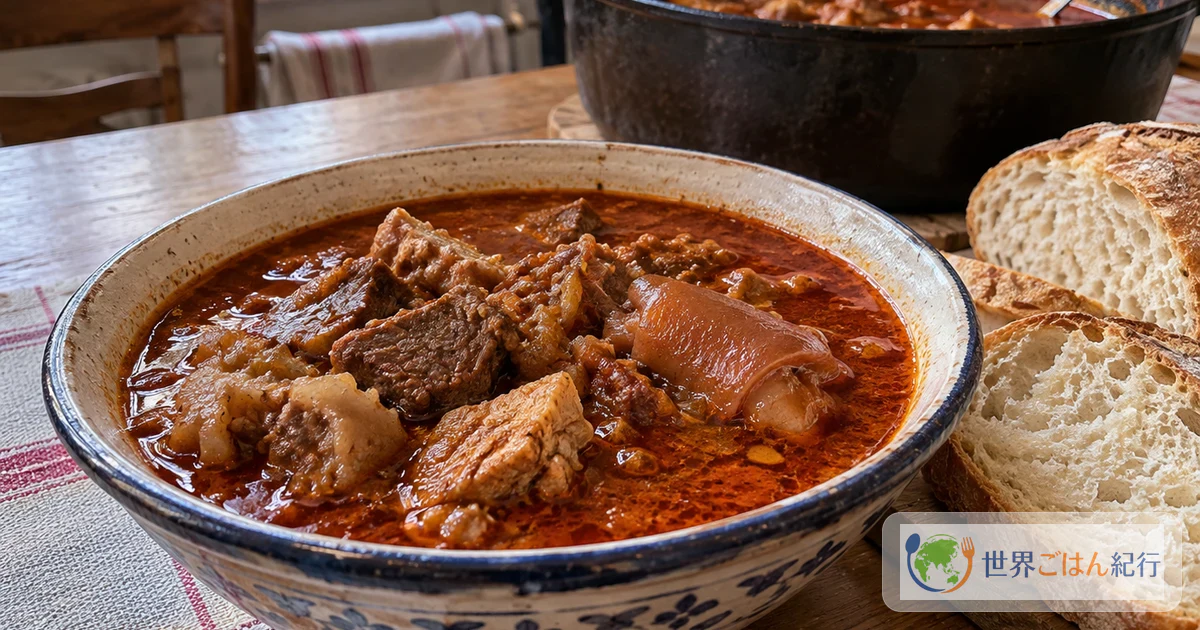
If you are building a Spanish table, it pairs well with another Spanish rice dish, Paella Valenciana (in Japanese), and with the Madrid stew Cocido Madrileño (in Japanese). Gazpacho for a summer starter, paella for a weekend centerpiece, cocido for a big pot on a cold day. Set side by side, the temperature range of Spanish cooking shows how different the rhythm of the kitchen can be within one country.
We keep the basics of the Andalusian style while leaning on ingredients you can find at an ordinary grocery store. If you have no sherry vinegar, use white wine vinegar; if you have no old bread, use sandwich bread; if you have no Spanish pepper, use a regular green bell pepper. What matters is that, since no heat is used, you give the vegetables their freshness and the chilling its proper time.
Ingredients (serves 4)
Gazpacho has few ingredients, so there is nowhere to hide. No special meat or spices are needed, but you are more likely to succeed if you do not compromise on the tomatoes. Choose ripe tomatoes that feel a little heavy, smell fragrant, and have taut but yielding skin, rather than hard, pale ones. In midsummer, a mix of ripe slicing tomatoes, medium tomatoes and ripe sweet tomatoes is also delicious. In winter or spring, mixing in a few flavorful cherry tomatoes gives it definition.

This recipe uses wheat (bread, croutons), and egg if you use it as a garnish. If you avoid gluten, leave out the bread and adjust the thickness with the amount of tomato and the emulsification of the olive oil. Gazpacho is not cooked, so, as the FDA and FoodSafety.gov recommend, wash the vegetables well under running water, cut away any damaged parts, and refrigerate promptly after cutting.
To get the characteristic gazpacho aroma, it is worth choosing the olive oil and vinegar with a little care. The acidity of tomatoes alone leaves the flavor flat, and vinegar that is too strong makes it shallow. With both oil and acid as support, a cold soup becomes satisfying.
Sherry vinegar gives gazpacho its outline. You can make it with rice vinegar, but if you want to get closer to the aroma of Spanish cooking, it is worth seeking out once.
The bread is added not to make the soup heavy, but to bind the water of the vegetables to the olive oil. Soaking old bread in water before use lets it blend finely and makes the texture a little rounder. You can make it without bread, but then it becomes a thin, drinkable type.
How to make it: chill it and adjust the flavor
With no heat involved it looks easy, but the flavor of gazpacho is decided by cutting, letting the flavors meld, emulsifying and chilling. You can also put everything into the blender at once and drink it. But if you let the vegetables meld with salt and vinegar for just 10 minutes, the tomato juice comes out, the blender runs more smoothly, and the flavor comes together more easily.
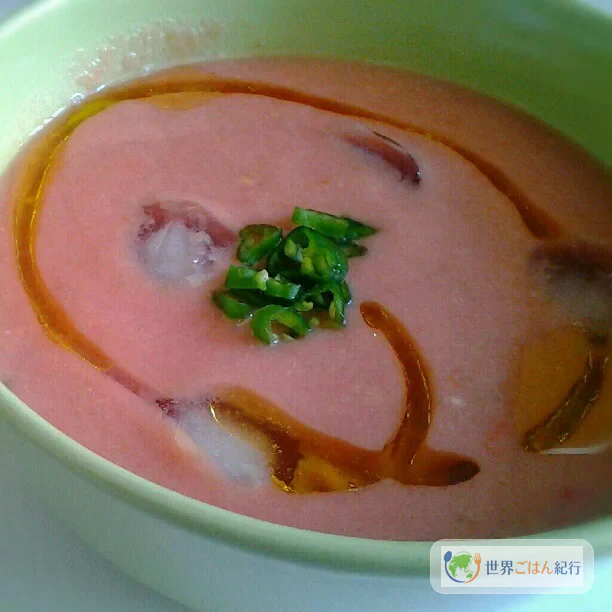
Cold food gives off less aroma and saltiness than it does at room temperature. If you season it perfectly right after blending, it can blur once chilled. After chilling, fine-tune in units of a pinch of salt, 1 tsp of vinegar, or 1 tbsp of water.
Cooking tips: small ways to avoid a raw green taste
The blender affects the result of gazpacho considerably. If you want a smooth, drinkable type, a blender powerful enough to crush ice makes it easier. If you want a coarser soup to eat with a spoon, a stick blender is enough.
Most of the reason people dislike gazpacho is not that the tomatoes are bland but that the greenness of the cucumber, pepper and garlic comes forward. Because it is not cooked, the sharp edges of the aromas remain as they are. That is exactly why small adjustments work: use less, remove the seeds, chill it, and round it out with oil.

Raw garlic can taste sharper the colder it gets. Start with 1/2 clove for four servings, and if it is not enough, increase it next time. Removing the germ softens the aftertaste a little.
Cucumbers with a strong aroma can show a greenness from the skin. Peel the skin in stripes so only half is removed, lightly remove the seedy center, and leave it for 10 minutes with salt and vinegar. These three steps make the whole gazpacho easier to drink.
Too much bread brings it closer to a thick, creamy salmorejo. Since you want gazpacho to stay light enough to drink, about 40 g for four servings is easy to handle. On days you want it lighter, leave out the bread and reduce the olive oil to 50 ml.
If you will drink it from a glass, straining it once through a fine sieve improves the mouthfeel. If you will eat it from a soup plate, it is also delicious unstrained, with the texture of the vegetables left in. The fibers left after straining can be stirred into tomato sauce or curry, so nothing is wasted.
If you add ice to make it cold, it quickly gets watery. If you are in a hurry, chill the bowls, refrigerate the ingredients beforehand, or replace part of the final water with 2–3 ice cubes, and no more. Chilling without diluting the flavor tastes better down to the last sip.
Gazpacho suits making ahead, but not long storage. Because it uses cut raw vegetables as they are, keep it refrigerated in a clean container and finish it the same day if possible, and the next day at the latest. FoodSafety.gov advises refrigerating cut fruit and vegetables within 2 hours, or within 1 hour when the temperature is 32°C or above. If you bring it to a summer gathering, use a cooler bag and ice packs, and avoid leaving it at room temperature for long.
For storage, choose a container that does not take on odors and is easy to pour from in the refrigerator. If you make it in the morning and drink it at noon, keeping it in a glass pitcher or a lidded bottle makes it easy to bring to the table.
If the tomatoes are bland in winter or spring, using half ripe tomatoes and half canned tomatoes stabilizes the flavor. Keeping the aroma of the fresh vegetables makes it more gazpacho-like than relying on canned tomatoes alone.
Storage and carrying: serving it safely in summer
Gazpacho is not "safe because it is cold." It is a dish in which you drink cut raw vegetables all together. Not using heat is its charm, but a clean cutting board, refrigeration and finishing it early support both flavor and safety. Making it in the morning and drinking it at noon, or making it the day before and finishing it by the next day's lunch, is the most manageable distance for a home kitchen.

| Situation | Guide | How to handle it so it does not fail |
|---|---|---|
| Drinking right after making | After 1 hour of refrigeration | Taste after chilling. Fine-tune salt and vinegar at the end |
| Make-ahead | Same day to next day | Refrigerate in a clean airtight container. Shake well before drinking |
| Bringing to a gathering | Within 1 hour of travel | Use ice packs and a cooler bag; don't leave it at room temperature |
| Leftovers | Until the next day | If the flavor has dropped, don't drink it raw; cook it into a tomato sauce |
FoodSafety.gov advises refrigerating cut fruit and vegetables within 2 hours, or within 1 hour when the temperature is 32°C or above. Outdoors or in a car in summer, it gets hotter than you would imagine, so rather than leaving the whole pitcher out on the table, it is safer to portion it and pour only what you need. The FDA also recommends washing produce eaten raw under running water, cutting away damaged parts, and keeping it separate from utensils used for meat and seafood.
When a make-ahead batch separates, it is not necessarily a sign of spoilage. The tomato water, bread fibers and olive oil simply separate over time, so if nothing smells off and it has stayed refrigerated, shake it well before pouring. Conversely, do not eat it if it has a strong sour smell, is foaming, or smells fermented when you open the lid.
A big pitcher looks nice, but each time you drink, it spends longer out at room temperature. Divided into two 300–500 ml bottles, it is easy to assign them to breakfast, lunch and gatherings, and it also chills faster in the refrigerator.
Variations
Gazpacho leaves a lot of room for each household. The Andalusian backbone is tomato, bread, vinegar, olive oil, garlic and water. From there, you can make it lighter, richer, or add garnishes to suit the time you eat and what you serve with it.

Light and drinkable, without bread
Leave out the bread, reduce the water to 50 ml, and use 50 ml olive oil. It is thin, with a mouthfeel close to a morning vegetable juice. It is a little less filling, so serving croutons and hard-boiled egg on the side turns it into a light lunch.
A winter version with canned tomatoes
In seasons when fresh tomatoes are weak, use half and half: 400 g ripe tomatoes and 400 g canned whole tomatoes. Canned alone tends to give a cooked aroma and loses freshness. Combining fresh cucumber, pepper and onion brings back the character of a cold soup. Start with slightly less salt, taking into account the salt in the can.
A richer, salmorejo-leaning version
Increase the bread to 80 g and the olive oil to 80 ml, and blend without adding water, and you get a thick tomato cream close to Córdoba's salmorejo. Topped with hard-boiled egg and cured ham, it feels like a one-plate meal rather than a starter. It is heavier than gazpacho, though, so it suits serving in small bowls.
A summer version with watermelon
Replacing 200 g of the tomatoes with watermelon makes it easier to drink thanks to the fruit's sweetness. Reduce the vinegar to 20 ml and make the salt a little stronger. If it leans only sweet, it becomes closer to juice than a dish, so keep its outline with black pepper and olive oil.
As a starter for paella
On the day you make Paella Valenciana (in Japanese), serving gazpacho in small glasses lightens the start of the meal. Paella is richly satisfying with rice and oil, so a cold, tart starter suits it. If you make the gazpacho first and put it in the refrigerator, the starter is ready by the time the rice is cooking, which is a help.
As a break between rich stews
On a day of the heavy chickpea and meat stew Cocido Madrileño (in Japanese), gazpacho suits being kept for a light snack the next day better than being served as a starter. A small cold glass of gazpacho before reheating the leftover cocido clears out the vegetables in the refrigerator and changes the rhythm of the table.
Background of the dish: fields, bread and olive oil
The interest of gazpacho lies less in lavish ingredients than in a practicality close to a field worker's lunch. Andalucia.com describes the scene of people working outdoors in the hot Andalusian summer who combined bread, garlic, olive oil, salt, ripe tomatoes, vinegar and water into a cold meal. Pounded in a mortar and chilled in an earthenware vessel, it quenched thirst while giving energy. It is less a modern blender dish than a kitchen's wisdom against the heat.

The tomatoes and peppers essential to today's red gazpacho are not vegetables Europe has had for long. Britannica explains that the tomato and green pepper, the stars of the modern version, entered Spain from the New World from the 16th century onward. In other words, an old dish of bread and oil combined with vegetables from the Americas to become today's red cold soup.
The Andalusian tourism board's explanation of olive oil positions extra-virgin olive oil as indispensable to gazpacho and salmorejo. Indeed, if you think of oil as a decoration drizzled on at the end, the flavor becomes too light. In gazpacho, the oil binds the tomato water and vinegar, rounds off the roughness of the bread, and gives a cold soup its satisfying quality. Using old bread rather than throwing it away, making the most of ripe vegetables, and eating without heat is an idea that suits home cooking everywhere. A tomato softened in the refrigerator, a leftover cucumber, a pepper you want to use up: vegetables that would get lost in a stir-fry become the stars in gazpacho.
On the other hand, recipes can tend toward "easy with tomato juice" or "substitute vegetable juice." That is convenient on busy days too, but reading basic recipes in English and Spanish, the core of gazpacho is "grinding raw vegetables." Spain on a Fork's Andalusian recipe also centers on blending ripe tomatoes, cucumber, green pepper, garlic, sherry vinegar, olive oil, water and salt, and chilling it well. Since no heat is used, the water of the ingredients and the emulsification of the oil are at the heart of the dish.
Gazpacho is often described simply as a "cold tomato soup," but in English- and Spanish-language sources it is discussed as an old food culture that goes back to bread, water, vinegar and olive oil. Seen not as a tomato-flavored smoothie but as a meal that makes use of old bread, emulsifies summer vegetables, and cools the body in a hot region, the meaning of the proportions becomes clear.
Frequently asked questions

How long does gazpacho keep?
Refrigerate it in a clean airtight container and finish it the same day if possible, the next day at the latest. It is a soup of unheated raw vegetables, so it is not suited to long storage. It separates as time passes, which is natural. Mix it well before drinking, and do not eat it if the smell or acidity seems off.
Can I make it with only canned tomatoes?
You can, but it loses freshness. If you use only canned tomatoes, increase the cucumber, pepper and onion a little and make up the raw-vegetable aroma with vinegar and olive oil. The recommended way is to use half fresh and half canned. Even in winter, the red color and acidity stay stable, and the lightness typical of gazpacho remains.
Is it not authentic without bread?
Bread is said to be closer to the old form, but in modern home kitchens a light gazpacho without bread is also made often. The bread adjusts thickness and mouthfeel. If you want to avoid gluten, rather than forcing in a substitute flour, it is more natural to leave out the bread, reduce the liquid, and add the olive oil gradually to emulsify.
Can I fix it if the garlic is too sharp?
You cannot fully undo it, but adding 100 g tomato, 2 tbsp water and 2 tsp olive oil and blending again softens it. Even resting it in the refrigerator for 1 hour rounds off the edges a little. The first time, start with 1/2 clove and increase it next time to suit your family.
Can gazpacho be frozen?
We do not recommend it. Freezing separates the fiber and water of the vegetables, and after thawing it tends to turn gritty. If you expect leftovers, keep only what you will drink the next day, and cook the rest into a base for tomato sauce or curry to waste less.
What dishes does it go with?
It goes with grilled fish, chicken, omelets, sandwiches and paella. On a hot day, serving a small glass as a light starter makes the meal easy to begin. Compared with other European soups, setting it beside the warm Caldo Verde (in Japanese) or the bean soup Fasolada shows how differently soups are used across seasons.
Sources
- Encyclopaedia Britannica "Gazpacho" (https://www.britannica.com/topic/gazpacho), accessed 2026
- Spain.info "Recipe: Gazpacho. Spanish cuisine" (https://www.spain.info/en/recipe/gazpacho/), accessed 2026
- Andalucia.com "Gazpacho Andaluz" (https://www.andalucia.com/taste/gazpacho/rec1.htm), accessed 2026
- Spain on a Fork "Authentic Spanish Gazpacho Recipe Gazpacho Andaluz" (https://spainonafork.com/authentic-spanish-gazpacho-recipe/), accessed 2026
- Andalucia.org "Aceites" (https://www.andalucia.org/es/gastronomia/sabores-de-andalucia/aceites), accessed 2026
- FDA "Selecting and Serving Produce Safely" (https://www.fda.gov/food/buy-store-serve-safe-food/selecting-and-serving-produce-safely), accessed 2026
- FoodSafety.gov "Fruit and Vegetable Safety" (https://www.foodsafety.gov/blog/fruit-and-vegetable-safety), accessed 2026