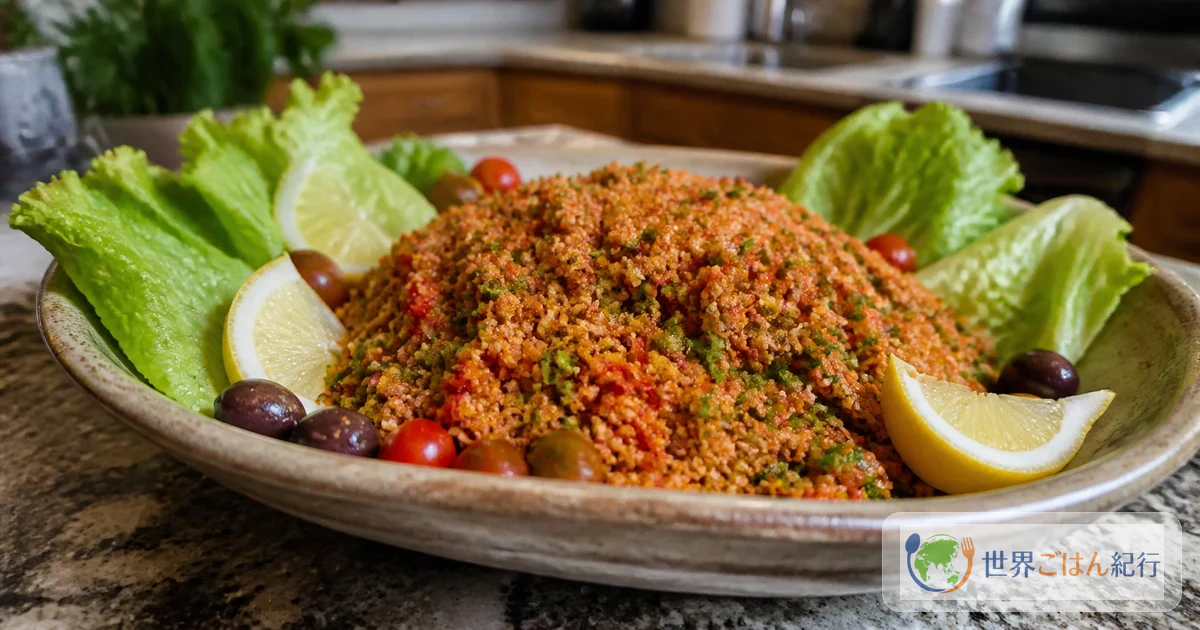
A Golden Jewel: The Finest Rice Cake of Persian Cooking
Ask an Iranian "what is the most beautiful Persian dish?" and many will name tahchin (تهچین / Tahchin). Layers of rice dyed golden with saffron. A perfect round wearing a crackling crust (tahdig). This dish charms not only the palate but also the eye.
In Persian, tah means "bottom" and chin means "to arrange or lay out." Tahchin is thus "what is laid down at the bottom": the golden crust that forms when rice is pressed into a pot and baked slowly is the essence of the dish.
Rice dishes (polow) hold a special place in Iranian food culture. The art of Persian rice cooking was refined to a high degree in the court cuisine of the Safavid dynasty (1501–1736): the delicate skill of cooking basmati so every grain is plump and never crushed.
Tahchin is the culmination of that technique. Saffron, yogurt, and egg yolk, three "golden ingredients," are worked into the rice. Chicken or lamb is sandwiched in the middle and baked. It looks as showy as a cake, and it tastes deep and gentle. In Iran it is a celebration dish, served on special days such as weddings and Nowruz (Persian New Year), and when entertaining guests.
A traditional Iranian rice cake: basmati rice dyed golden with saffron, mixed with yogurt, egg yolk, and butter, layered around chicken or lamb in a mold, and baked in the oven. Its biggest appeal is the crisp crust (tahdig), and it concentrates the best of Persian cooking technique into one dish.

Ingredients (serves 6)

Saffron: Understanding the Soul of Persian Cooking
What decides the flavor of tahchin above all is saffron. Saffron is the stigma of a kind of crocus (Crocus sativus). It is picked by hand and dried. About 150,000 flowers are needed for 1 kg. This is why it is called "the world's most expensive spice."
What makes Iranian saffron special
Iran is said to account for about 90 percent of the world's saffron production.[3] Saffron from Gonabad and Birjand in Khorasan is especially famous.
Saffron available in many places is mostly Spanish (La Mancha). Iranian saffron is sometimes sold at Iranian grocery stores. It is an expensive spice, but a single use is only about 0.3–0.5 g.

How to spot fake saffron
Unfortunately, saffron is a spice with a great deal of fake and poor-quality product. Use these points to tell the real from the fake.
- Color: Real saffron threads are deep red with slightly orange tips. Threads of a uniform red all over may be artificially colored fakes
- Aroma: It has a distinctive sweet, honey-like fragrance. Odorless saffron is fake
- Water test: Real saffron put in water releases golden color slowly (over 10–15 minutes). If the color comes out immediately, a coloring agent has been used
- Price: Be suspicious of extremely cheap saffron
Tahchin Variations
Tahchin-e morgh (chicken tahchin)
The most standard variation, introduced in this article. It is the most common in Iranian homes, and I recommend this chicken version if you are making tahchin for the first time.
Tahchin-e badenjan (eggplant tahchin)
A vegetarian version that sandwiches thinly sliced, pan-fried eggplant in place of the chicken. The sweetness of the eggplant and the aroma of the saffron rice blend wonderfully. The key is to use eggplant seasoned with turmeric and dried mint.
Tahchin-e gosht (lamb tahchin)
A luxurious version that uses slow-cooked, shredded lamb shank or shoulder in place of the chicken. It is served on the most formal occasions, such as Nowruz (Persian New Year) and weddings. Lamb stewed with cumin and cinnamon goes exceptionally well with saffron rice.
Tahchin-e mahi (fish tahchin)
A variation popular in Gilan Province on the Caspian coast. White fish fillets (sea bass or sea bream) are seasoned with herbs (dill and cilantro) and sandwiched in the saffron rice. A connoisseur's dish that offers the delicate flavor of seafood.
If you like Middle Eastern dishes with lamb, try mansaf (in Japanese) too. And if the eggplant variation interests you, it may be fun to compare it with moussaka (in Japanese), which also features eggplant.
The Persian Table: Serving Tahchin Properly
The traditional Iranian meal is laid out on a large cloth called a sofreh, with all the dishes set out at once. If tahchin is the star, these sides make the perfect Iranian pairing.
Classic side dishes
- Sabzi khordan: a plate of fresh herbs. Basil, mint, tarragon, radishes, and scallions are bundled on a plate. It always appears on the Iranian table as a "raw salad"
- Mast-o-khiar: a cucumber yogurt salad. Sometimes with dried mint and walnuts. A refreshing palate cleanser
- Salad shirazi: a bright salad of diced cucumber, tomato, and red onion with lemon juice and dried mint. Originated in Shiraz
- Doogh: a carbonated yogurt drink, seasoned with dried mint and salt. Iran's national drink

The Difference Between Tahchin and Tahdig
If you know Iranian food, you may have heard the word "tahdig." Tahchin and tahdig are closely related but are different dishes.
| Tahchin | Tahdig | |
|---|---|---|
| Form | Shaped like a cake and baked | The crust formed at the bottom of the pot |
| Ingredients | Rice + yogurt + egg yolk + filling | Rice only (or potato/lavash) |
| Cooking | Baked in the oven | Steam-cooked on the stovetop |
| Serving | Flipped out as a cake | Peeled from the pot bottom and served alongside |
| Difficulty | Intermediate (relatively stable because a mold is used) | Advanced (fine heat adjustment is hard) |
Tahdig refers to "the crust at the bottom of the Persian pot" itself. It is made not only with white rice but also with thin potato slices or flatbread (lavash). Tahchin, on the other hand, is saffron rice mixed with yogurt and egg yolk and baked in a mold. The crust is only part of its charm.
Rice dishes enjoyed for the crust at the bottom of the pot exist around the world, such as Korea's nurungji and the socarrat of Spanish paella, but tahchin's method of packing into a mold, baking, and flipping out is unique to Persian cooking. Comparing it with biryani as a saffron rice dish may be fun too.
Where to Find Iranian Ingredients
The highest hurdles in making tahchin are getting barberries (zereshk) and saffron. They can be found in these ways.
Online shops
- Searching for "Iranian saffron" and "dried barberries" turns up several shops. Saffron can be bought from 1 g
- Online shops specializing in Persian groceries carry basmati, barberries, saffron, dried limes, and more
In stores
- Halal and Middle Eastern grocery stores: these are very likely to stock basmati rice and saffron
- Large supermarkets: some carry basmati and saffron
Barberry substitutes
If you cannot get barberries at all, finely chopped dried cranberries can approximate the look. The taste is quite different, however. The sharp sourness of barberries cannot be reproduced with cranberries. Get the real thing if you can. Iranian barberries have no seeds inside and can be eaten whole.
If you are shopping at a Middle Eastern grocery store, it is efficient to get the ingredients for shakshuka and falafel (in Japanese) at the same time.
Culture and History: The Story of Persian Food Woven by Tahchin
Origins: the Safavid court cuisine
The exact origin of tahchin is not recorded in the texts. It is thought to belong to the lineage of Safavid (1501–1736) court cuisine. The Safavids made Isfahan their capital, and the dynasty built a golden age of Persian art and gastronomy. The refined rice techniques developed by court cooks in this era are said to have laid the foundation for tahchin.
Saffron is a spice that has long been grown in Persia and is still indispensable to Iran's celebration rice dishes. The filling differs by region and household, with lamb or eggplant sandwiched in place of chicken.
Nowruz and tahchin
Nowruz, the Persian new year, is celebrated around March 20 (the spring equinox). It is the most important holiday across a wide cultural area including Iran, Afghanistan, Tajikistan, and Kurdish regions. For Nowruz, the "Haft-Seen," a display of seven items beginning with S, is prepared, and at the table the herb rice with fish, "sabzi polo ba mahi," is well known. Tahchin is also one of the feast dishes made at such celebrations and when guests come.
Why is tahchin a "special occasion dish"? Because it uses expensive saffron without holding back and goes through time-consuming steps. It carries the message "I did my best to welcome you." In Iranian homes, when an important guest is coming, the mother or grandmother puts her full skill into making tahchin.
Nowruz is inscribed on UNESCO's Intangible Cultural Heritage list through a joint nomination by several countries, including Iran.[4] At the table that welcomes the new year, different feasts appear depending on the region and household.
More to Cook Alongside
- Jareesh (in Japanese): shares ingredients and aromas from the same region.
- Kebab sauce: shares ingredients and aromas from the same region.
- Fesenjan (in Japanese): lets you cook on through the same country's table.
FAQ
Q1. Can I make tahchin without saffron?
Saffron is the most important ingredient, affecting the color, aroma, and taste of tahchin. Making it without saffron is technically possible, but it can hardly be called tahchin any more. Turmeric can be used to color it, but the aroma is completely different. I strongly recommend using real saffron, even a small amount.
Q2. Can I use jasmine rice or Japanese rice instead of basmati?
Jasmine rice is a long-grain rice, so the result comes close to basmati. However, the direction of the aroma differs. Japanese rice (short-grain) holds a lot of moisture and turns sticky. It makes it hard to get the separate-grain texture of tahchin and the crisp crust. I recommend using basmati.
Q3. What if I have no oven?
You can use a heavy pot (a cast-iron pot such as a Le Creuset) over very low heat on the stovetop for 60–80 minutes. Coat the bottom of the pot with plenty of butter, seal the lid tightly, and steam-bake. Heat adjustment is difficult, however, so I recommend the oven for first-timers.
Q4. How do I reheat cold tahchin?
Leftovers keep for 3 days in the refrigerator. Reheating is best in a 180-degree oven for 15–20 minutes, covered with aluminum foil to keep it from drying. A microwave also works, but the crispness of the crust is lost. To revive the crust, melt butter in a frying pan and cook the bottom of a sliced piece over medium heat for 2–3 minutes.
Q5. Can I freeze tahchin?
Slice the baked tahchin, wrap each piece in plastic wrap, and freeze, and it keeps for a month. The best way to thaw is overnight in the refrigerator, followed by warming in the oven.
Summary: Falling in Love with the Golden Crust
Tahchin is "edible art," born of the skill of Persian rice cooking. The golden color of saffron. The mild sourness of yogurt. The richness of egg yolk. The vivid sourness of barberries. The jade green of pistachios. Every element produces a beauty and flavor that is carefully calculated.
Making tahchin at home is by no means impossible. If you can get basmati and saffron, the other ingredients are all at the supermarket. What matters most are "how far you parboil the rice" and "using plenty of butter." Get those two right and when you first meet the golden crust, you will be hooked on Persian cooking.
If you are interested in Middle Eastern cooking, see the guide to Middle Eastern cuisine (in Japanese). You can also enjoy the difference from biryani, another rice dish that makes use of saffron. Home cooking from across the Middle East is also worth a look, such as Turkish dolma (in Japanese) and Lebanese mujaddara. For spiced meat dishes, kebab, kofte, and shawarma are recommended. As more Middle Eastern grain dishes, tabbouleh and Jordan's mansaf (in Japanese) are worth trying too.
Sources
- Batmanglij, Najmieh. Food of Life: Ancient Persian and Modern Iranian Cooking and Ceremonies. Mage Publishers, 2011.
- Shafia, Louisa. The New Persian Kitchen. Ten Speed Press, 2013.
- Roden, Claudia. The New Book of Middle Eastern Food. Knopf, 2000.
- [1] Tahchin – Persian Savory Rice Cake — Unicorns in the Kitchen (accessed 2026-10-22)
- [2] Tahchin — SBS Food (accessed 2026-10-22)
- [3] Saffron — Wikipedia (accessed 2026-10-22)
- [4] Nawrouz, Novruz, Nowrouz, ... — UNESCO Intangible Cultural Heritage (accessed 2026-10-22)