The Story of Storing Hummus: Enjoying It the Day After You Make It
The moment you stop the food processor, the scent of tahini and lemon lingers in the kitchen. Make hummus properly once and you end up with more in the bowl than you expected. At dinner you spread it on pita, the next morning you put it on toast, and there is still some left. That is when a practical question suddenly matters: how many days does hummus keep?
Hummus is acidic, so it looks as though it should last, but the kind you make at home has neither preservatives nor heat sterilization. It is safest to think of it as a make-ahead dish that is always refrigerated, a mix of chickpeas, tahini, lemon and garlic. Food-safety information in English also repeats three points for make-ahead dishes and dips once opened: airtight, cold and a clean spoon.
This article centers on homemade hummus and covers refrigerating, freezing, thawing, how to tell it has spoiled and ideas for finishing it. The storage time changes with the temperature of your refrigerator, the hygiene when you made it, the amount of garlic and lemon, and how long it sat on the table. Rather than "barely still edible," I lean toward shorter guidelines that a home kitchen can follow without strain.
Hummus is not a dish to keep at room temperature. The FDA recommends not leaving food that needs refrigeration at room temperature for more than 2 hours, and refrigerating within 1 hour when the temperature is above 32°C (90°F). Rather than putting back what you set out on the table again and again, it is safer to move only what you will eat onto a small plate.
Set next to falafel (in Japanese), tabbouleh and shawarma, hummus goes quickly. If there is still some left, thinking of the storage steps as part of the cooking makes the next day's bread and vegetables a little more fun.
Quick Reference: How Long Hummus Keeps
You open the refrigerator and yesterday's hummus comes out from the back of a white container. The smell is fine. But the time spent wondering "was that yesterday or the day before?" is something people who like cooking know well. The most useful thing in a storage article is, in the end, a table that cuts down this hesitation.
| State | Where kept | Guide | Point |
|---|---|---|---|
| Homemade hummus | Refrigerator (4°C / 40°F or below) | 2–3 days | Portion into clean containers. Estimate short at home |
| Homemade hummus | Freezer (-18°C / 0°F or below) | 1 month as a flavor guide | Short, to avoid texture decline rather than for safety |
| Store-bought hummus after opening | Refrigerator (4°C / 40°F or below) | Up to 7 days as a guide | The label and storage conditions come first. Write the opening date |
| Hummus set out on the table | Room temperature | Within 2 hours | Shorter in summer or in a heated room |
| Hummus after thawing | Refrigerator | 24–48 hours | Avoid refreezing and finish early |
FoodSafety.gov's cold storage chart explains that finishing refrigerated food at home in a short number of days leads to safety, with 3 to 4 days a benchmark for cooked leftovers. Hummus is not a meat dish, but it is a moist paste made at home. And it is often eaten dipping bread or vegetables, so spoons and crumbs easily get in. That is why this site takes 2–3 days in the refrigerator for homemade hummus as the basic guideline.
Store-bought products are made differently. Some use high-pressure processing or packaging designed for preservation, and there is information that gives about 7 days after opening as a guide. But this applies only when the product has been properly refrigerated and handled cleanly. Avoid stretching it with the same feeling you have for homemade, thinking "it's fine because there is lemon in it."
The FDA explains that food properly frozen at -18°C (0°F) stays safe for a long time but loses aroma and texture as time passes. Hummus easily separates the oil of the tahini from the starch of the chickpeas, so about one month or less is a realistic guide for good taste at home.
Ingredients and Tools for Storing
What you need to store hummus is not any special preservative. If anything, the flavor keeps better if you do not do anything extra. What matters is reducing the surface in contact with air, not putting back what was set out on the table, and leaving the date where you can see it. Just these three cut mistakes considerably.
Choose containers that are not too large
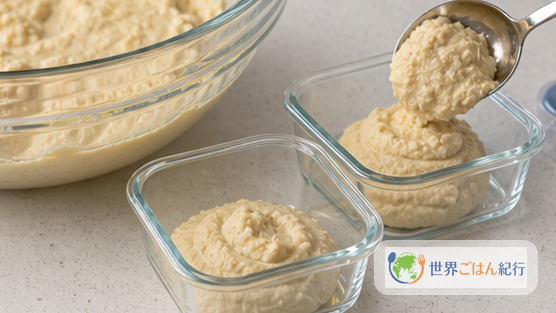
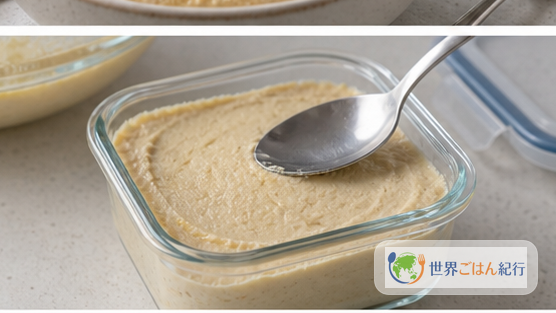
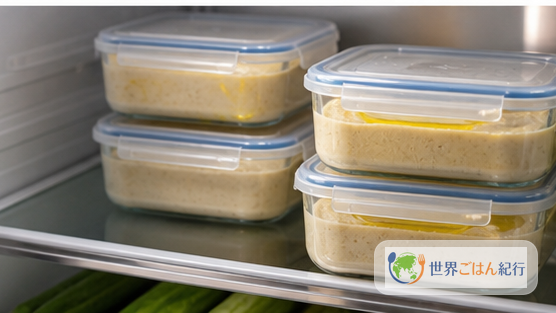
Spreading hummus thinly in a big container increases the surface in contact with air. The basic approach is to divide it into amounts you will eat in 2 days for the refrigerator, and amounts you will use at one time for the freezer. At home, dividing into "breakfast," "dip" and "freezer" is easier to handle than "putting all the rest in one container."
Keep the olive oil film thin
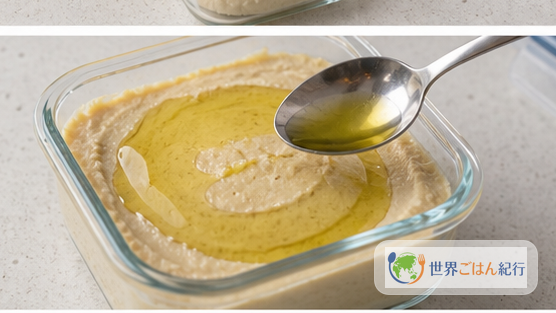
At Middle Eastern tables hummus gets a generous pour of olive oil, but storage is different. 1–2 tsp spread thinly, just enough to keep the surface from drying, is enough. A thick layer of oil makes the aroma heavy in the refrigerator, and when you spread it on bread the next day it tastes oily.
The more garlic, the sooner to eat
Hummus made with a lot of garlic gets a stronger aroma the next day. This is not spoilage, but a sign that the balance of flavor is easily lost. For make-ahead, use less raw garlic and add aroma right before eating with olive oil or paprika; it is more stable.
The storage containers can also be reused for sauces and sides such as tandoori chicken side dishes. The aroma of garlic and cumin lingers, so glass is worth choosing over plastic.
If you make hummus often, it is easier to set up your tools not only for storage but for the blending stage. The smoother the hummus turns out, the easier it is to bring back after it stiffens in the refrigerator.
How to Refrigerate
Starting the storage work after you have finished eating hummus is a little bothersome. I recommend setting aside the portion to store before you plate it. If you portion it while no one's spoon has been in it yet, concerns about hygiene drop a great deal.
Refrigerated hummus gets stiff. Take it out of the refrigerator 10 to 15 minutes before eating, add a few drops of lemon juice, 1 tsp ice water and a little olive oil, and mix, and the mouthfeel returns close to freshly made. Too much water blurs the flavor, so adjust in teaspoon units.
How to Freeze Hummus
Freezing hummus looks suited to it but has a quirk. The starch of the chickpeas easily turns grainy when frozen, and the oil of the tahini easily separates on thawing. Even so, it helps a great deal for a busy week's breakfast or when you want one more dish at dinner. The points are "thin, small and eaten early."
Freeze in single portions
If you take about 150 g as one unit, it covers 2–3 slices of toast for breakfast, one plate of vegetable dip, or sandwiches for two. Freezing a lot leaves you unable to finish it after thawing, and you are back to hesitating. It works if you divide it not as "extending leftovers" but as "preparing a future meal ahead."
In a freezer bag, thin and flat
Put the hummus in a freezer bag and flatten it to a thickness of about 1–1.5 cm. Press out the air, write the date and put it in the freezer. Frozen as a thin slab, it thaws easily in about half a day in the refrigerator, and if needed you can break it and take out only a little.
In a container, protect the surface
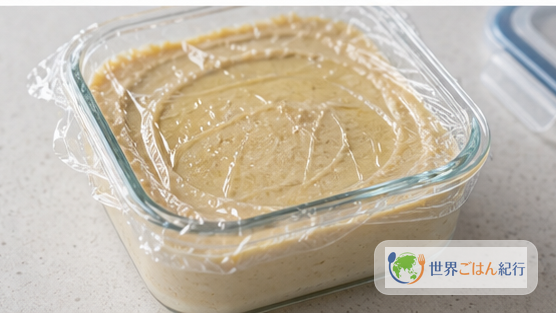
When freezing in a container, press plastic wrap against the surface and then put on the lid. It easily absorbs freezer odors, so it is safer not to put it near garlic, fish or curry. Within one month, the change in taste is relatively small.
Thaw slowly in the refrigerator
Left at room temperature, only the surface warms first, which raises food-safety concerns. The basic way is to move it to the refrigerator the night before and use it the next day. If you are in a hurry, run cold water over the bag as it is, taking care that water does not get in. Thawing in a microwave easily separates the oil, so this site does not recommend it.
Mix again after thawing
Thawed hummus may show a little liquid on top. This is not necessarily spoilage. Mix well with a clean spoon; if it is stiff, add 1 tsp ice water, if the aroma is weak a few drops of lemon juice, and if the richness is weak 1 tsp tahini. Restore it little by little while tasting.
Once thawed, hummus is safest finished within 24–48 hours. Refreezing not only ruins the texture but complicates temperature control during thawing. This is the reason for freezing in portions.
How to Tell Hummus Has Spoiled
The hardest part of storage is the final judgment rather than the numbers. Even within 3 days, hummus that sat long on the table or had a spoon in it many times leaves doubt. Conversely, if there is only a little liquid on the surface, it may be simple separation.
Signs to throw it out
Mold on the surface, a strong sour smell, fizzing, stringiness, or a clearly strong bitterness or sharpness. If any of these is present, do not eat it. Also avoid removing just the moldy part. Pasty foods let it spread inside easily, so you cannot judge by the surface alone.
Think of separation and spoilage as different
A little olive oil or liquid floating on top is common in hummus. It separates especially easily after freezing. If the smell is normal, the days are few and there is no mold or fizzing, it can sometimes be eaten after mixing again. But if either "I don't know when it was made" or "it sat out on the table for a long time" applies, it is better not to force yourself to finish it.
Watch for a change in the garlic smell
Hummus with garlic gets a stronger aroma the next day. This is a common change. But a sharp spoiled smell, fermented-looking bubbles or a sourness that stings the tongue are another matter. If you feel something off that is different from the sourness of lemon, do not keep tasting; throw it out.
Go shorter when serving family
When small children, older adults, pregnant women or people with weakened immunity will eat it, do not push the storage days. The FDA also explains that food safety cannot always be judged by appearance or smell alone. "When in doubt, throw it out" is not food waste but safety management.
Hummus is a dip, so double-dipping easily happens. On days when you eat directly from the big dish, set aside the portion to store first. Do not return what is left in the dish served at the table to the storage container; it is safest to finish it that day.
Ideas for Finishing Leftover Hummus
The best method of storage is actually "to finish it quickly and deliciously." Still, pita every time gets boring. Hummus has the richness of beans and the sourness of lemon, so it can go to sauces, coatings, dressings and the thickness of soup.
Spread on morning toast
Mix the refrigerated hummus lightly and spread it thickly on toast. Topped with olive oil, black pepper, a boiled egg and tomato, it is quite satisfying as breakfast. It is lighter than butter and keeps you fuller than jam, so it is a use where you easily feel the value of making ahead.
Make it a vegetable dip
Cut carrot, cucumber, celery and bell pepper and just sprinkle paprika powder on the hummus. Hummus that has stiffened a little on its second day in the refrigerator is, if anything, easier for vegetables to dip into. Together with tabbouleh, it makes a satisfying plate from vegetables alone.
Use it in place of mayo in a sandwich
When filling with chicken ham, grilled eggplant, lettuce and tomato, spread hummus on the bread. It brings more acidity and bean aroma than mayonnaise and makes a shawarma-style lunch. When putting in watery vegetables, spreading the hummus a little stiff keeps the bread from getting soggy.
Turn it into a pasta sauce
Mix 3 tbsp hummus, 2 tbsp pasta cooking water, a little lemon juice and 1 tsp olive oil, and toss it with short pasta. It separates easily if you keep it on the heat, so the trick is to toss it after turning off the heat. Adding cumin or chili makes it like a bean cream sauce.
Dissolve it into soup
Dissolve about 2 tbsp hummus into a vegetable soup or chicken broth. The chickpeas and tahini add body and a mouthfeel like a puréed soup. When the texture of frozen hummus has declined a little, this is the use that consumes it with the least strangeness.
Serve with a falafel plate
On a day you fry falafel (in Japanese), refrigerated hummus is the best partner. Without making a new tahini sauce, adding a little lemon juice and water to the hummus makes a dip that catches freshly fried bean croquettes.
Background of the Dish: Meze Culture and Make-Ahead
In the Middle Eastern meze culture, hummus is not a dish that is complete on one plate. On small plates you line up hummus, tabbouleh, moutabal, olives, pickles, grilled meat and bean dishes, and scoop a little at a time with bread. A big plate is at the center of the table and hands reach out as people talk. That is exactly why, in home storage, it is important to separate the "shared dish" from the "storage container."
If you know the storage steps as well as the method, hummus becomes easy to make casually. The guideline for store-bought products once opened, separation after freezing and avoiding double-dipping are all knowledge that is useful at home as it is. Households that cannot finish hummus in one sitting make it more often when they know the storage steps.
Storage is not a rule to take away the pleasure of cooking. The smoothness of the day it is made, toast the next morning, a plate on a weekday from what you froze. It is a technique for separating each way of eating. On a day you line up several mezes, like the overview of Middle Eastern cuisine, storing a small portion of hummus leads to the next dish.
Frequently Asked Questions
How many days does hummus keep in the refrigerator?
For homemade, take 2–3 days as a guide. In US food-safety information the general refrigerator storage of leftovers is 3–4 days, but hummus at home is a dish often used as a dip, and spoons and crumbs easily get in. This site advises a shorter time, leaning toward safety.
Can I eat store-bought hummus for 7 days after opening?
For store-bought products, the label on each product comes first. In English-language sources a 7-day guide after opening, referring to the USDA FoodKeeper, is given. But that applies only when the refrigerator temperature is 4°C (40°F) or below, it has been handled cleanly, and there is no off smell or mold. Do not assume homemade hummus keeps for 7 days in the same way.
Can I carry hummus at room temperature?
Basically avoid it. The FDA recommends not leaving food that needs refrigeration at room temperature for more than 2 hours, and refrigerating within 1 hour in hot conditions. For a potluck, use ice packs and a cooler bag, and at the venue put out only what will be eaten.
My frozen hummus separated. Can I eat it?
If the date is recent, it was thawed in the refrigerator and there is no mold or off smell, separation is often just a change in texture. Mix well and restore with small amounts of ice water, lemon juice and tahini. But if there is fizzing, a strong sour smell or stringiness, do not eat it.
Does a layer of olive oil on top make it last longer?
It prevents drying but does not greatly extend the storage time. Even under the oil film, it spoils if the container or spoon is dirty. Think of olive oil as "an aid to keeping it tasty," and put day tracking and refrigerator temperature first.
Refrigerated hummus got stiff. How do I restore it?
Take it out of the refrigerator 10 to 15 minutes before eating, and mix in 1 tsp ice water at a time, a few drops of lemon juice and a little olive oil. Adding a lot of water suddenly dilutes the flavor, so adjust in teaspoon units. Running it in the food processor for just 10 seconds restores it more smoothly.
Is the same storage fine for hummus without tahini?
Even without tahini or white sesame paste, it is still a paste of chickpeas. Take 2–3 days in the refrigerator and 1 month in the freezer as a guide. Variations mixed with yogurt or tofu spoil even more easily, so finishing them by the next day is safest.
Can I put leftover hummus in a lunch box?
Only if you use ice packs and a cooler bag and can keep it cold until you eat. It is not suited to summer or long carrying. If using it in a lunch box, limit it to a thin spread on bread as a sandwich, kept cool and eaten by lunchtime.
Summary: Portion Hummus for 2–3 Days, Freeze for a Month
The answer to storing hummus is simple. Homemade is 2–3 days in the refrigerator, freezer is 1 month with taste first, and what has been put on the table is within 2 hours. Portion it right after making, use a clean spoon and write the date. Just this cuts a great deal of the time spent wondering "can I still eat it?"
Hummus gets a little stiff after refrigeration, but it comes back if you add ice water, lemon juice and olive oil a little at a time. When the graininess after freezing bothers you, turning it into toast, sandwiches, soup or pasta sauce finishes it naturally.
The next time you make hummus, set the storage container beside you from the start. The moment the scent of tahini rises in the kitchen, half of tomorrow's breakfast is already decided. Combine the authentic hummus recipe, how to make falafel (in Japanese) and how to make tabbouleh, and even a make-ahead table gets a little livelier.
Sources
- FoodSafety.gov "Cold Food Storage Chart" https://www.foodsafety.gov/food-safety-charts/cold-food-storage-charts
- FDA "Are You Storing Food Safely?" https://www.fda.gov/consumers/consumer-updates/are-you-storing-food-safely
- USDA FSIS "Leftovers and Food Safety" https://www.fsis.usda.gov/food-safety/safe-food-handling-and-preparation/food-safety-basics/leftovers-and-food-safety
- EatingWell "How Long Does Hummus Last in the Fridge?" https://www.eatingwell.com/article/8020665/how-long-does-hummus-last-in-the-fridge/
- World Health Organization "Five keys to safer food manual" https://www.who.int/publications/i/item/9789241594639