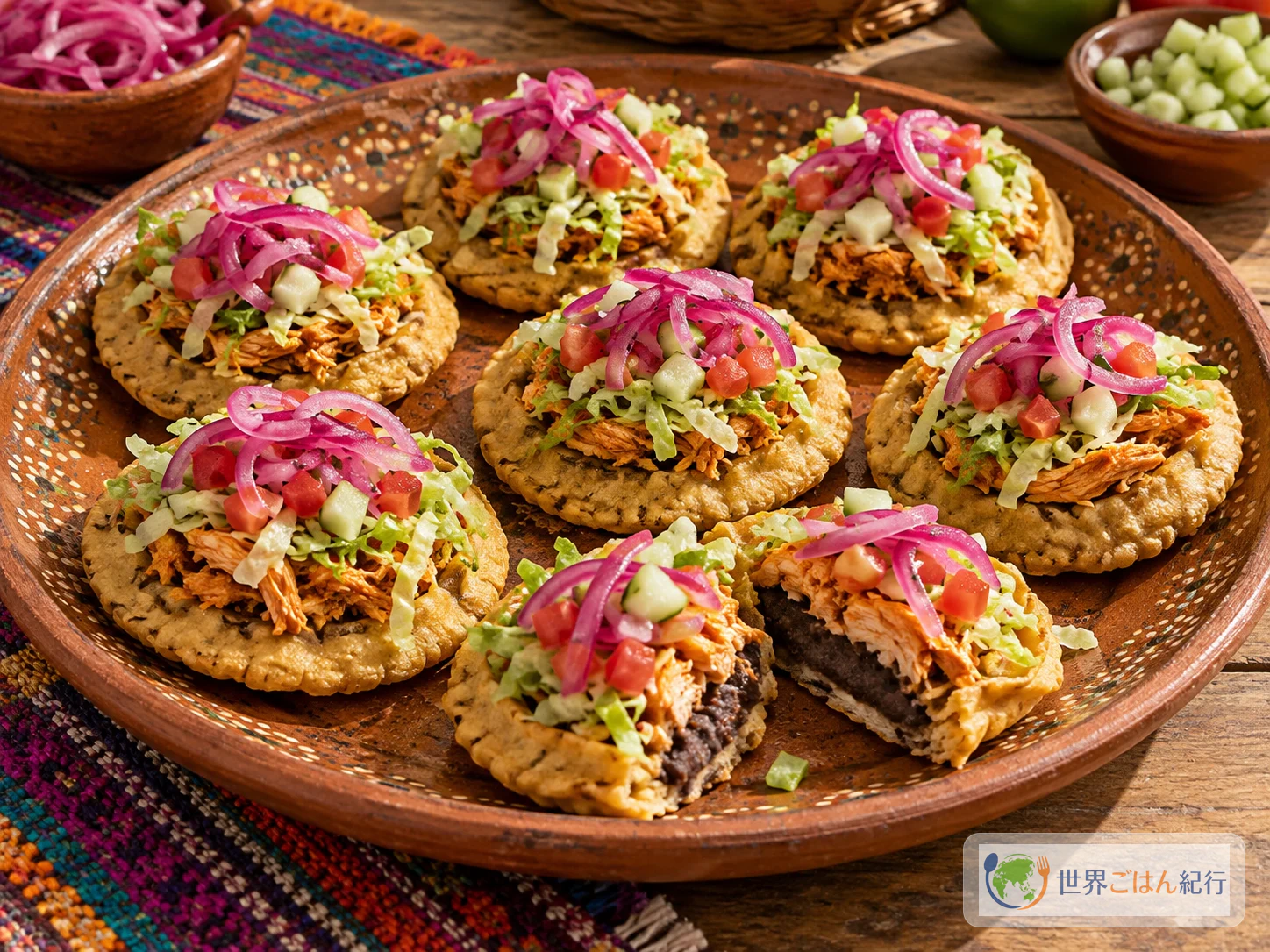
Just by pinching the edge, it stops being an ordinary tortilla
Up to the point of mixing flour with water and pressing it round, it resembles a tortilla. But when you pinch the rim of the hot dough fresh off the griddle all the way around with your fingers, it suddenly becomes a small plate. Spread beans thin on it, then layer salsa, lettuce, radish and white cheese. Sope (sope / sopes) is the Mexican dish in which you eat this "thick corn vessel."
It isn't wrapped around a filling like a taco, nor is it large and dried like a tlayuda. A sope is small, thick, and has a rim. The rim exists to hold the beans and salsa, so if it is too shallow the moisture runs off before you eat. If it is too thick, the outside is savory but the center stays floury.
In Mexican cooking it is counted among antojitos, snacks and street foods. Larousse Cocina describes sope as a dish where a thick round tortilla is pinched by hand to form a rim and topped with beans, salsa, meat, cheese and so on. In English it is sometimes described as "little bowls of masa," but it is not really a vessel: the star is the masa dough itself.
What makes you hesitate at home isn't the lavish toppings. It is how close to the original to take the flour, what thickness to cook it to, and how to form the rim while it is hot. This recipe assumes masa harina and scales to amounts that are easy in a home skillet or on a griddle. It also covers how to think on days you have a different flour, but it does not give you an escape route that turns it into something else with ordinary wheat flour or canned corn.
Among other Mexican street foods, if you want to eat with the chew of bread and fried meat, cemita poblana is another way in. Sope has a corn base; cemita stars sesame bread and the aroma of chipotle.
The core of a sope is not the toppings but the masa and the rim
A sope is not a dish that works with any topping. Its outline is set by "the aroma of masa, thickness, rim, and the thickness of the beans." Salsa and cheese stand out, but if the base is weak it collapses on the first bite.
| Element | The local axis | What to protect in a home kitchen |
|---|---|---|
| Dough | Masa from nixtamalized corn | Choose a flour labeled masa harina |
| Thickness | Thicker than a tortilla, with a rim you can pinch | About 9 cm across and 7 mm thick |
| Rim | Pellizcar, pinch it up right after cooking | Work fast, pinching through a cloth so you don't burn |
| Beans | Frijoles refritos, a thick bean paste | Reduce until a spatula leaves a trail; don't leave watery |
| Salsa | Red, green, very hot and so on, varying by region | A red roasted-tomato salsa for acidity and aroma |
Nixtamalization is the traditional Mexican technique of treating corn in alkaline water. In the Mexican government's agricultural information too, nixtamalización is presented as the foundation of corn culture. Cornmeal and polenta flour, widely sold elsewhere, differ in grind and processing, so mixed with water as they are, they have trouble giving a sope-like aroma and cohesion.
South American white corn flours such as Harina P.A.N. suit arepas but are different from Mexican masa harina. If that is all you can get, you can enjoy a sope-style thick cake. But the water content and browning change and drift from the state described here, where "the pinched rim stands up supple." For the first try, look for a bag labeled masa harina, instant corn masa flour or nixtamalized corn flour.
A sope forms a rim on thick masa to hold toppings. A taco wraps in a thin tortilla, chilaquiles coats fried tortillas in salsa, and tamales wrap masa dough and steam it. Even with the same corn, how the moisture is released and the form in which it is eaten are completely different.
Ingredients (serves 4)
This amount makes 8 sopes about 9 cm across. Two per person is a light meal, or one per person is enough if you add a meat dish or soup.

This dish uses dairy at the finish. Canned beans, cheese and salsa ingredients may contain soy, milk or wheat depending on the product. The oil for shallow frying gets hot, so don't overlap the work of pinching the rim with the work at the oil in the same step.
Shopping questions
Prioritize flour labeled "masa harina," and if you can't find it, don't be steered to a different flour. On the other hand, tools and aromas that decide how a sope turns out are worth choosing as things you can use many times.
With a large flat griddle you can cook the sopes in one go. A skillet works too, but the more you cook, the more the temperature drops, so for a family-size batch the width of the flat surface matters.
Roasted-tomato salsa can be made in a blender, but for a small amount, crushing in a mortar is less likely to turn watery. If some coarseness remains, the flavor doesn't sink between the beans and lettuce.
Dried oregano is a small amount, but it is the aroma that pushes the beans and salsa toward Mexican cooking. It also goes into pozole rojo and tacos al pastor.
Method
Sopes go in the order masa dough, salsa, beans, cooking, forming the rim, shallow frying, assembly. The beans and salsa can be made the day before, but shaping the dough on the day you eat keeps more aroma.
Thick work gloves are safe, but they dull your fingertips and tend to make a thick rim. A thin clean cloth, folded, makes it easier to avoid the heat while adjusting the width. If you worry about burns, cook just one first and practice.
Where it goes wrong and how to fix it
With so few ingredients, the moisture of the dough and the timing of the rim show directly. Adding more toppings won't hide a failed base.

| Failure | Cause | Fix |
|---|---|---|
| Dough cracks | Too little water, not rested enough, pinched after it cooled | Add water 1 tsp at a time, rest 8 minutes, pinch right after cooking |
| Floury center | Too thick, heat too high so only the outside cooked | Keep it 7 mm thick and dry the surface over medium heat |
| Greasy bottom | Oil too cool, fried too long | Wait for fine bubbles, aim for 1 minute per side |
| Toppings run | Beans loose, rim shallow, salsa watery | Beans to a spoon-trail thickness, rim 8 mm, reduce the salsa |
| Hard to eat | Piled toppings high | Spread beans low, keep leaves light, squeeze lime just before eating |
The most common failure is pressing dough that is dry. Masa harina takes a little time to absorb water. Even if it looks right the moment you mix it, it can firm up as it rests. After resting, squeeze it again, and if it cracks, add water.
Another is rushing the number cooked at once. If the griddle cools, it takes longer to dry the surface and the dough turns heavy. In a home skillet 2 at a time, on a griddle 3 or 4 at a time is manageable.
How to eat them and thinking about toppings
A sope is completed last, at the table. A hot base gets beans, then cold vegetables and salsa layered on, so the temperature contrast is part of the pleasure. If you plate everything first and leave it, it looks tidy but the bottom goes damp.

You can top with meat, but for a first try it is easier to avoid failure by learning the base with beans and salsa. For chicken, toss shredded chicken breast in a little salsa before topping. For pork, a version lightened with salt and lime suits better than a sweet-hot direction like tacos al pastor. Piling on meat erases the aroma of the masa.
Depending on region and shop, salsa verde, chorizo, chicharrón, chicken, beef, crema and avocado may go on top. You don't need to gather all of them at home. The order to protect is beans, salsa, crunch, acidity: beans stabilize the base, salsa sets the flavor, lettuce and radish give lightness, and lime closes it.
If sopes are the whole meal, a soup such as pozole rojo beside them connects the body of the corn with the warmth of the soup. For something lighter, as with pupusas, you can put it on one plate with more salsa and vegetables.
Storage and making ahead
Dough left long as rolled balls dries out. If you make ahead, go as far as cooking and forming the rim. Once fully cool, put them in a container without overlapping; the guide is up to 2 days refrigerated.
To eat, warm a skillet over medium heat before topping and re-crisp 1 minute per side. Frying a refrigerated sope as it is makes the oil spatter from surface moisture, so first drive off the moisture in a dry skillet. Re-crisping alone is savory enough. To bring back the lightness of the shallow fry, about 40 seconds per side in 2 tsp oil is enough.
Beans keep about 3 days refrigerated, and salsa about 2 days. But prepare the lettuce, radish, cheese and lime just before eating. A fully assembled sope isn't suited to storage. The bottom goes damp and cracks easily, so if some is left over, remove the toppings and rewarm only the base.
FAQ
If I have no masa harina, can I make it with cornmeal?
You can, but it moves close to a different thing from a sope. Cornmeal differs in grind and processing, and even absorbing water it doesn't give the same stickiness. If you must use it, you can knead with hot water, rest it, and add 2 tsp potato starch to help it hold together. But the rim cracks easily and the aroma changes. For the first try, looking for masa harina is the shortcut.
Can I just cook it and not fry it?
Yes. Cook both sides on a griddle, form the rim, and re-crisp over medium heat about 40 seconds per side. The light crispness of a street stall is weaker, but there is less oil and it is easy to handle for a weekday meal. Just be sure not to let the salsa turn watery.
Can I use black beans for the beans?
Yes. They are darker than pinto beans and a little stronger in aroma. If you use canned, don't put in all the can liquid; mash only the beans with oil and onion, then bring back liquid a little at a time. Don't use sweet baked beans.
Does it work without cheese?
It works. If you leave the cheese out, make the lime and onion a little stronger and don't cut back too much on salt in the salsa. If you want to avoid dairy, a little avocado or roasted mushrooms gives satisfaction. But too many toppings overwhelm the rim.
What is the difference between sope and gordita?
Both use thick masa dough, but a sope is a form where you pinch a rim and put toppings on top. A gordita is often a form where the filling is stuffed inside or the dough is split and filled. It is easy to understand by whether you eat it "layered on top" or "put inside."
Sources consulted
- Larousse Cocina, "Sope" https://laroussecocina.mx/palabra/sope/ (accessed 1 June 2026)
- Wikipedia, "Sope" https://en.wikipedia.org/wiki/Sope (accessed 1 June 2026)
- Gobierno de México, "Nixtamalización, una tradición muy mexicana" https://www.gob.mx/agricultura/articulos/nixtamalizacion-una-tradicion-muy-mexicana?idiom=es (accessed 1 June 2026)
- King Arthur Baking, "Sopes Recipe" https://www.kingarthurbaking.com/recipes/sopes-recipe (accessed 1 June 2026)
- Hunter Angler Gardener Cook, "How to Make Sopes" https://honest-food.net/how-to-make-sopes/ (accessed 1 June 2026)