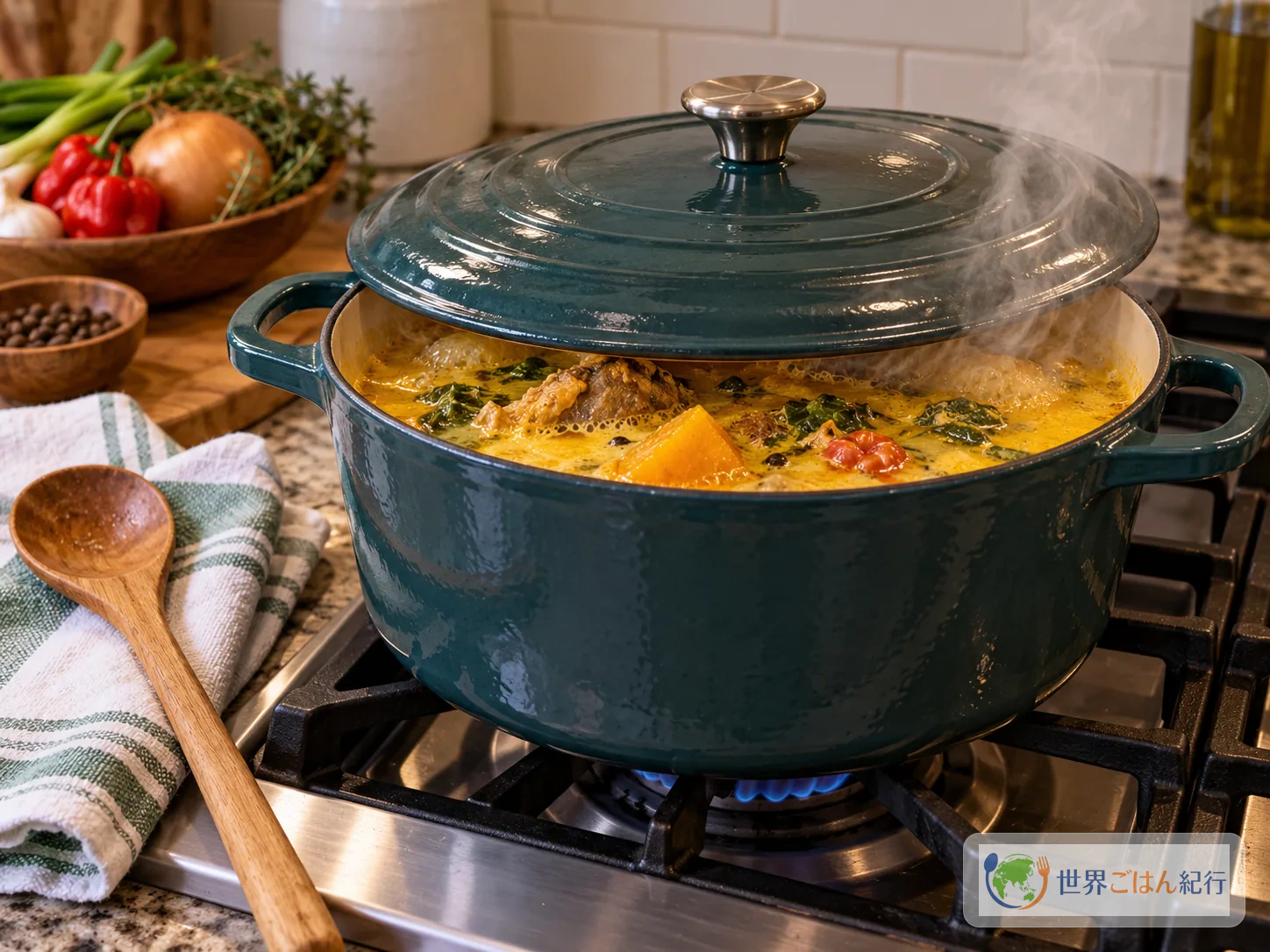
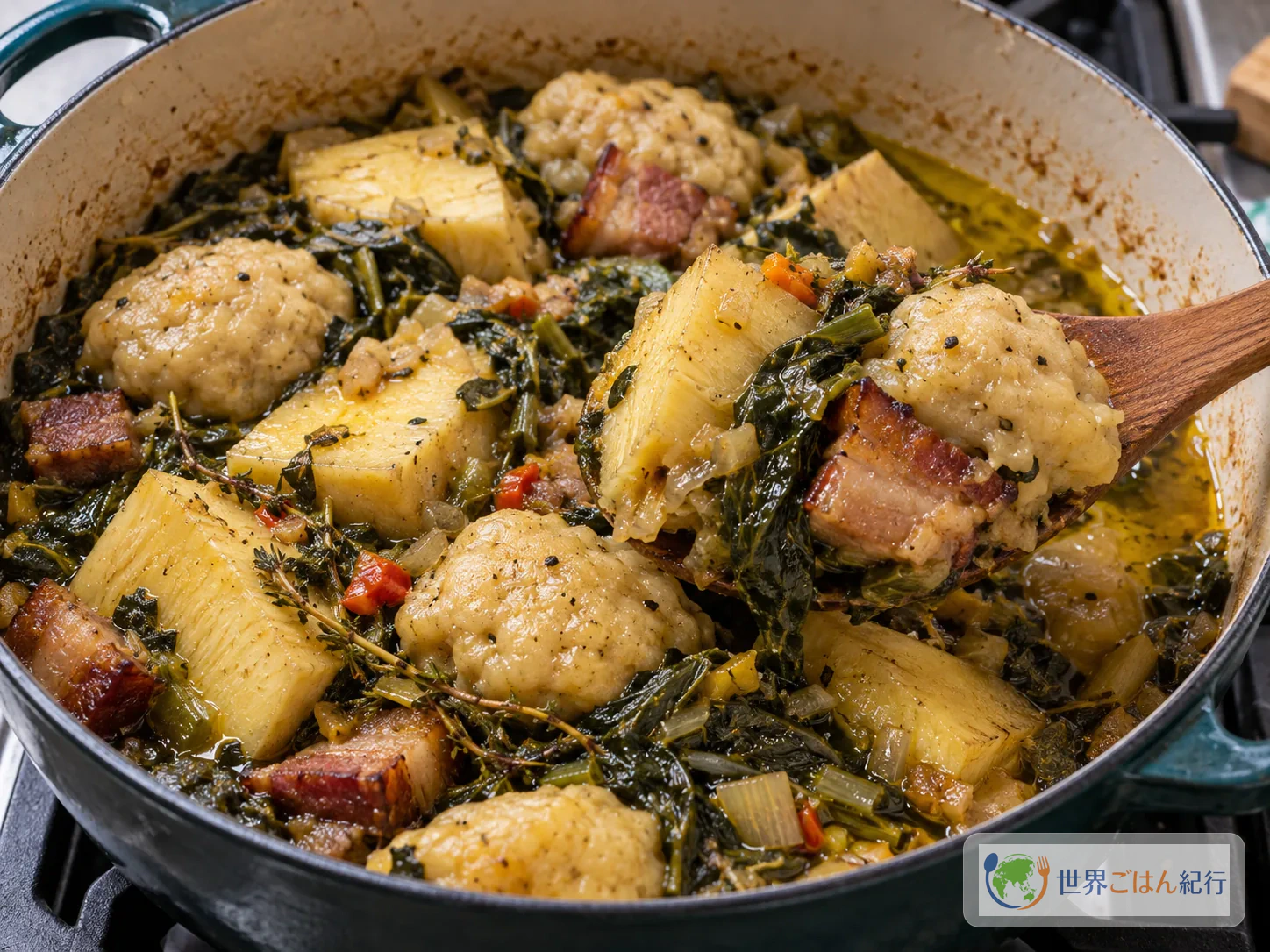
Lift the lid, and Grenada's big pot becomes the table
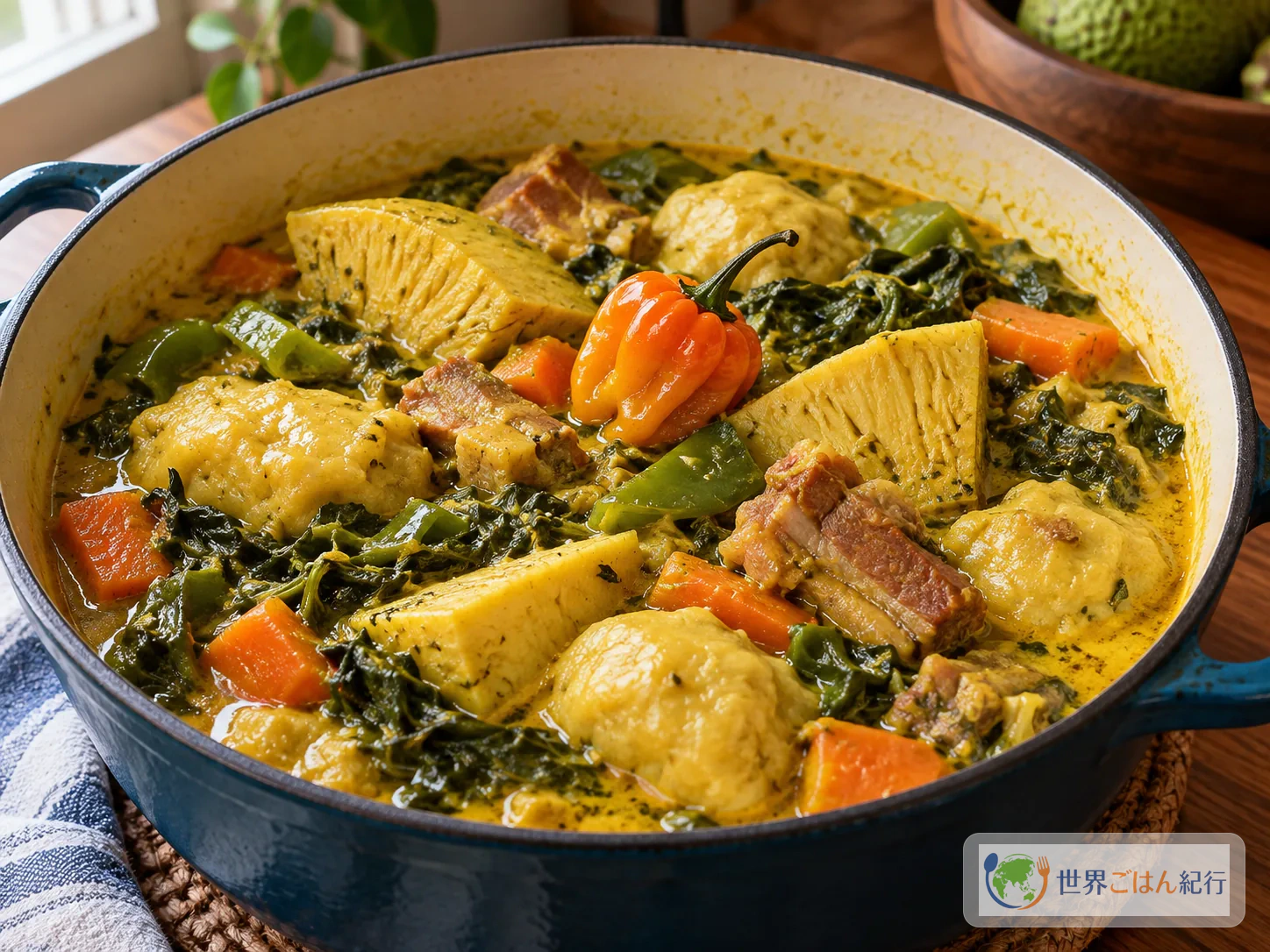
At the bottom of a big pot, breadfruit and salted meat. Above them, vegetables, and on top, leafy greens and dumplings. Beside the fire, the pot simmers quietly. According to NPR's reporting on the island, oil down is a dish that people make by bringing ingredients together, and it turns up at family tables, at special gatherings, at Carnival, and at weekend meals. Rather than one person preparing everything, each person entrusts what they have to one pot. A big pot of ingredients brought together is where the dish starts. And the cooking begins not by mixing but by building an order inside the pot. That is why it deserves to be called a dish for the days when people gather.
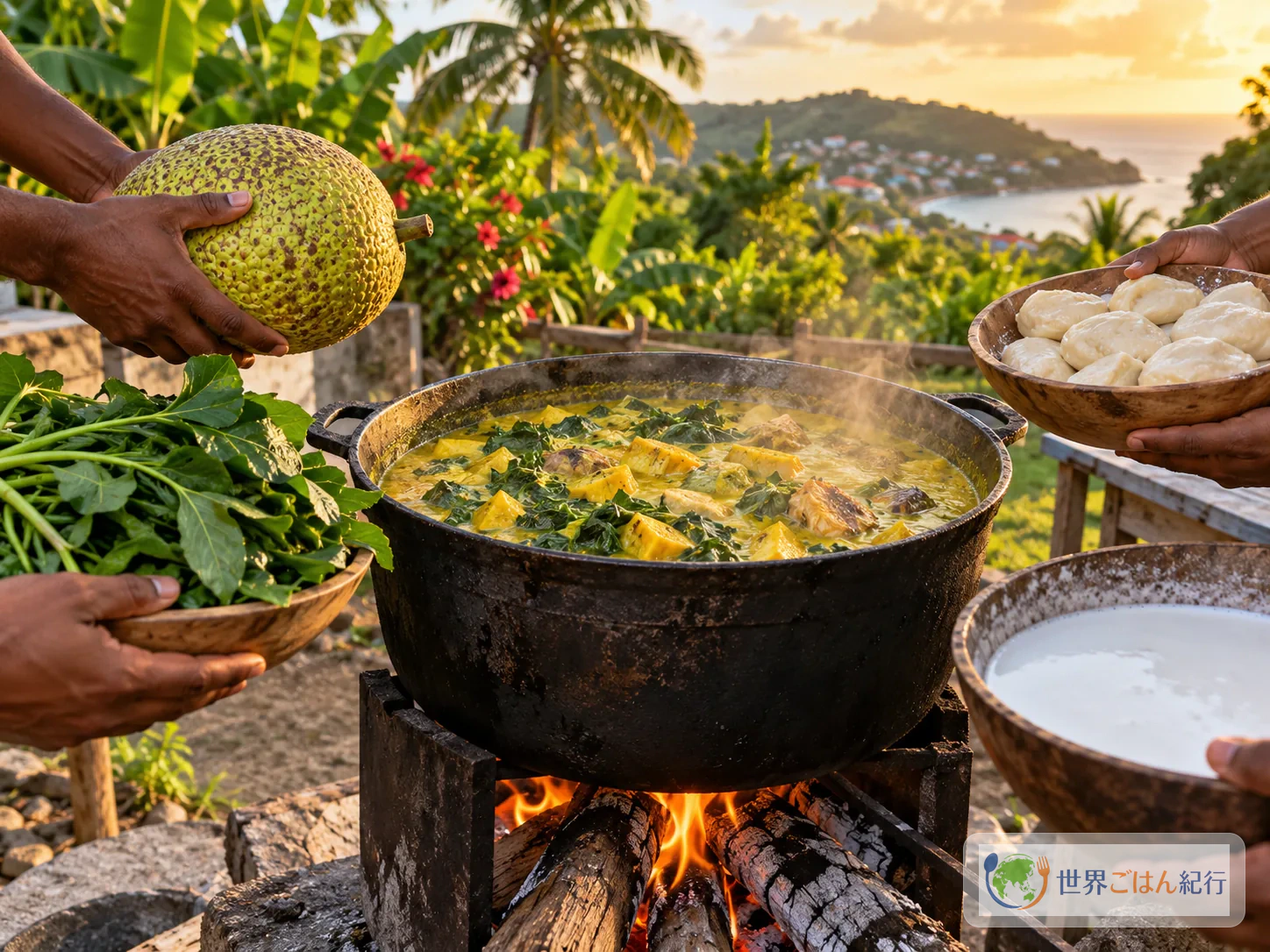
The name "oil down" comes from the coconut oil and meat juices that settle to the bottom of the pot as it cooks. NPR explains that this is how the dish got its name. The Government of Grenada presents it as a national dish in which salted meat or chicken, dumplings, breadfruit, and callaloo (young dasheen leaves) are cooked in coconut milk with herbs and spices. In other words, it is not a dish that ends as a watery soup. You wait until the breadfruit or potatoes have taken up all the cooking liquid and rings of coconut oil show at the bottom of the pot. A big pot on the island and four servings at home differ, though, in quantity and in the strength of the fire. We can't claim that it will look or smell the same.
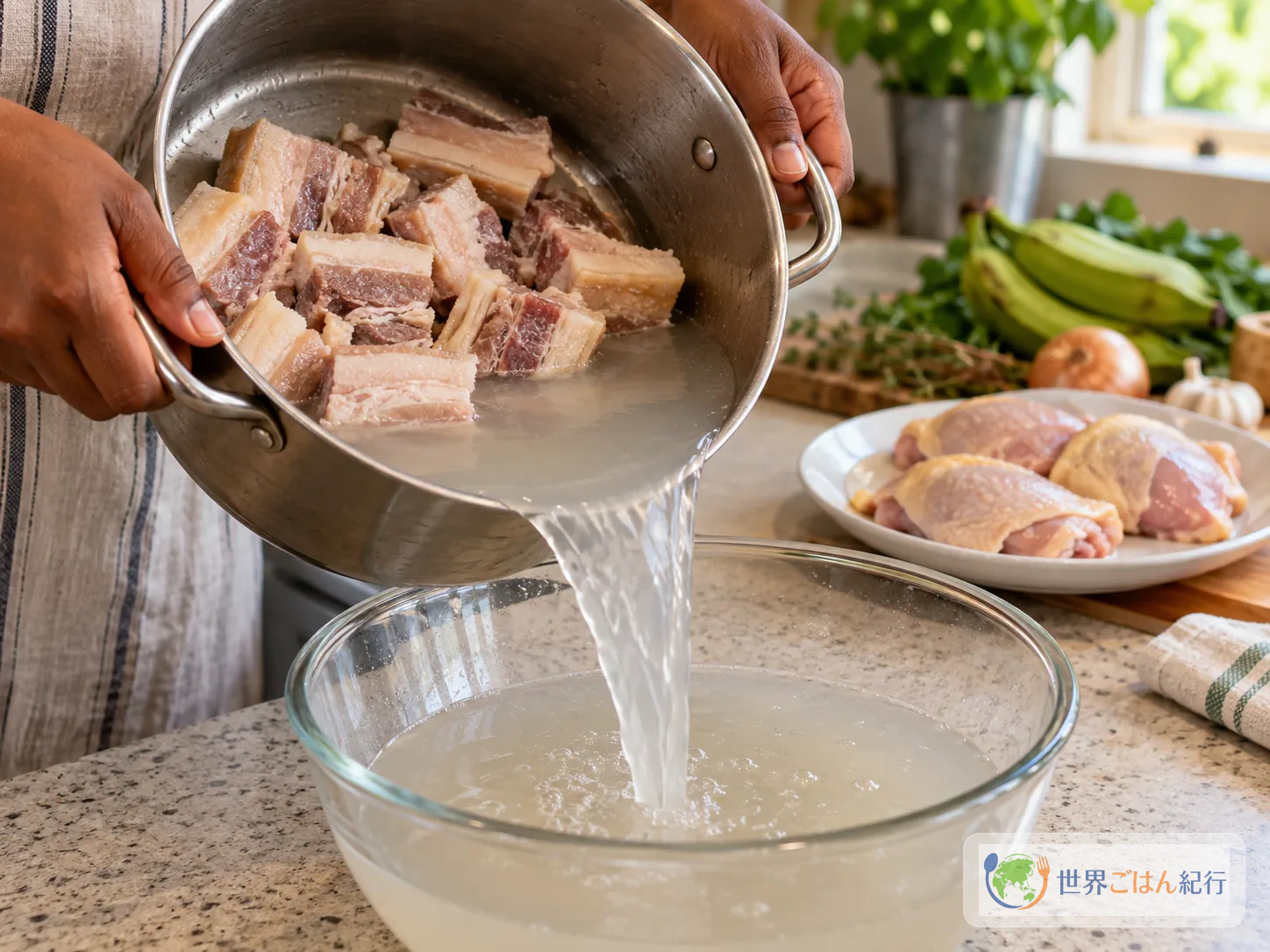
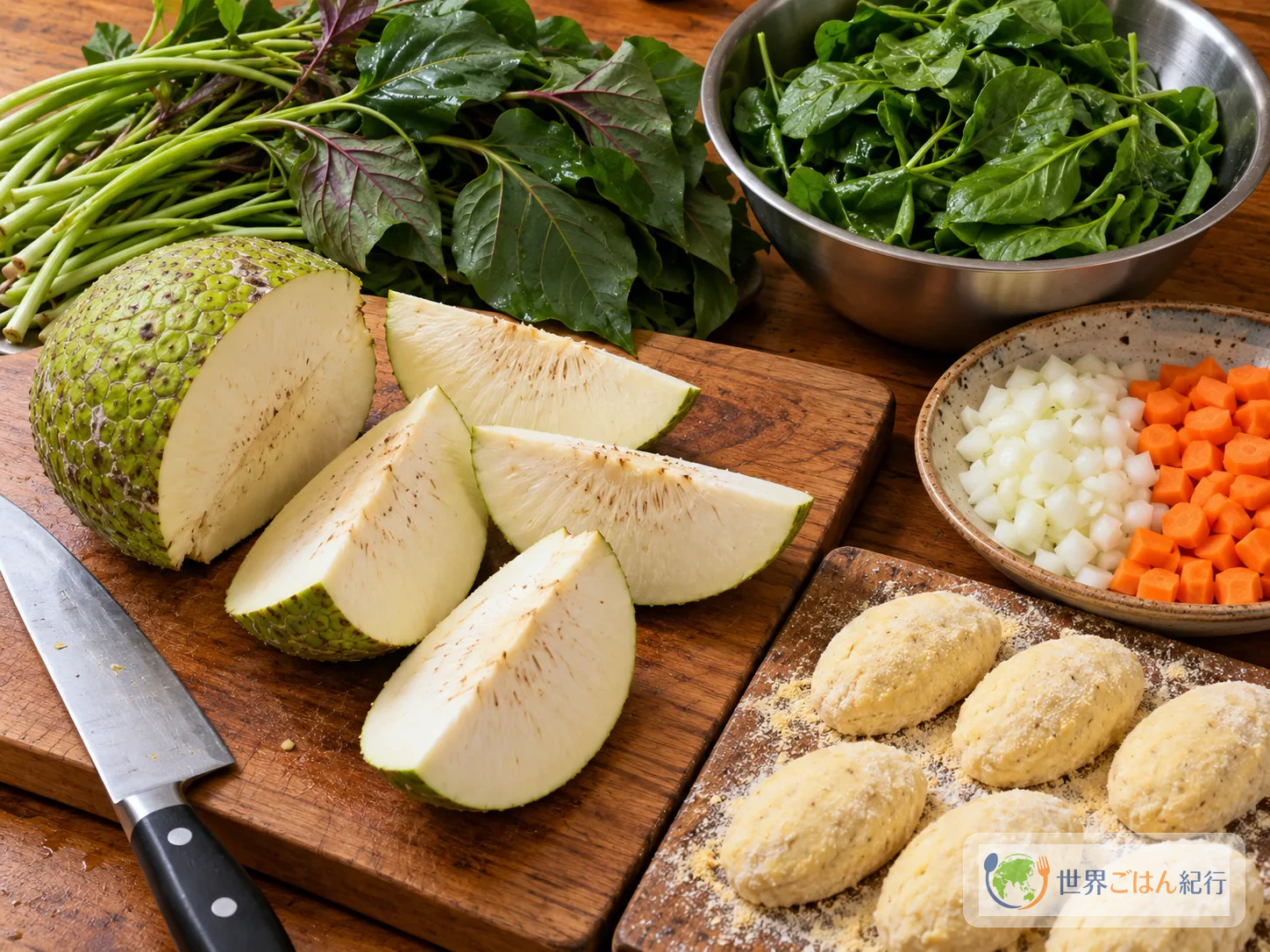
The four servings in this article put 700 g of breadfruit in the lead role. If you can't get it, replace it with 700 g of large-cut potatoes. The aroma and texture of breadfruit will be missing, but the way the breadfruit sits at the bottom of the pot is the same. Keeping the layering even with potatoes is the backbone of the dish. For the meat there are two versions: salted pork and chicken thighs. Salted pork needs an overnight desalting, so desalt the salted meat first. Chicken thighs skip the desalting, so choose whichever is easier to get. In the sources, callaloo is the name for young dasheen leaves. Where it can't be found, spinach substitutes, but do not think of it as the same thing as the leaf used on the island.
Island Learning Grenada presents oil down as the national dish of Grenada, Carriacou, and Petite Martinique. It is eaten year-round, and it appears even more in February, Independence month. The Embassy of Grenada also reported serving oil down at an international cultural event in 2024 as the "national dish" and a "taste of cultural heritage." But being a national dish does not mean there is a single fixed recipe. What goes in changes by island, by household, and by gathering.
Breadfruit and coconut put the island's history in one pot
The ingredients that go into the pot each reached the island by a different road. The NPR article links callaloo (dasheen) to early Caribbean cultivation. Bananas are a crop that came from Asia by way of Europe, salt cod is a preserved food that came from Canada, breadfruit comes from the Pacific, and turmeric is tied to South Asian migrants. Caribbean leafy greens sit beside breadfruit from the Pacific, and South Asian turmeric pours its yellow over them. No origin can be reduced to one people or one event. That ingredients with different histories simmer together in the same pot itself reflects the layering of the island's culture.
NPR quotes a local voice calling oil down a "social thing." At gatherings where people bring ingredients, home cooking and the big outdoor pot are continuous. The contents aren't uniform either: salted meat, chicken, seafood, crab, conch, even vegetable-only versions, and the choice of meat and vegetables differs by family and gathering. The four servings in this article don't hide that range. It sets a salted pork version and a chicken version side by side, and later mentions not to carry over the cooking times if you use seafood.
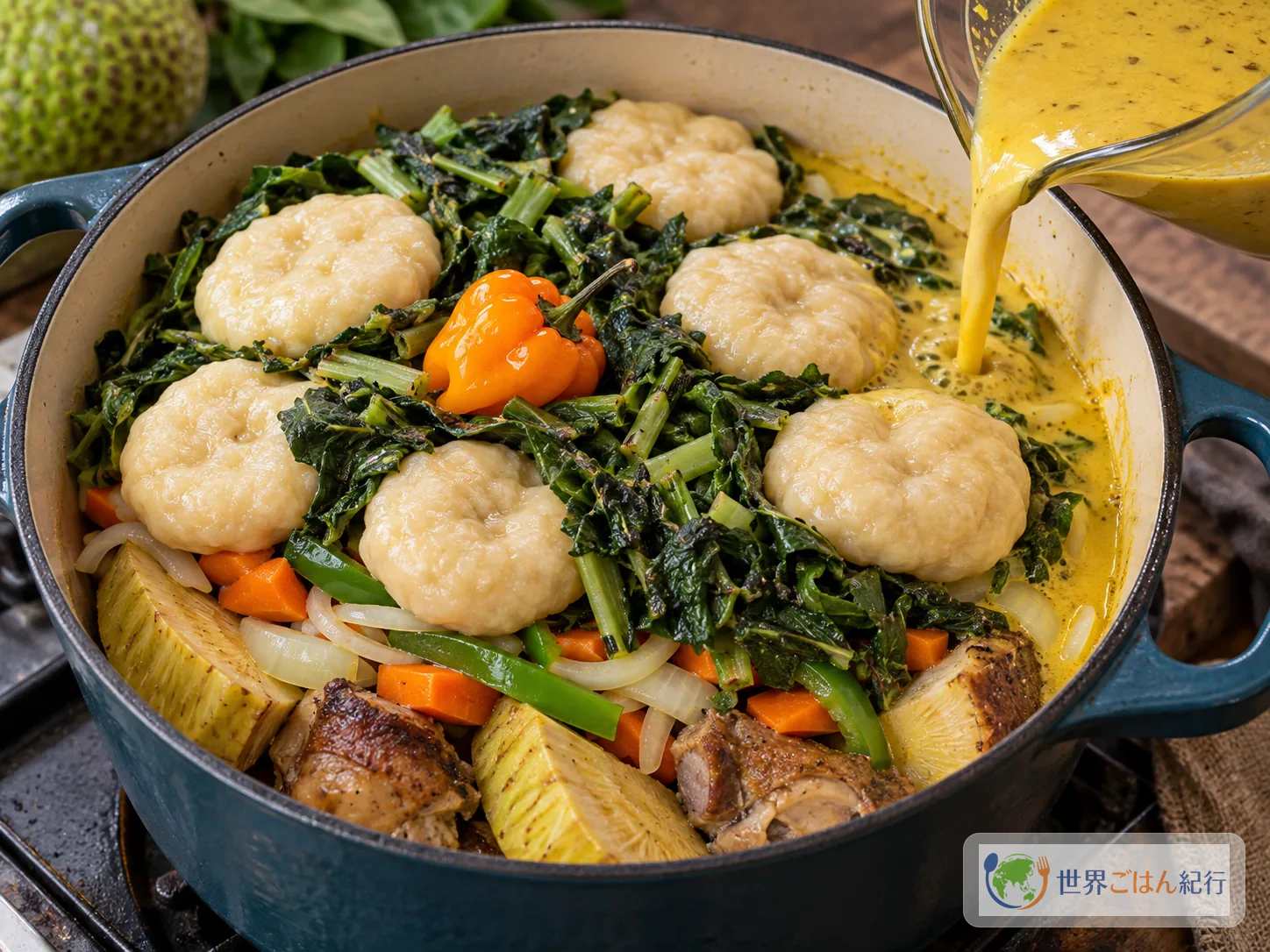
What matters in the handling of this dish is not stirring. Island Learning Grenada names "packing of the pot" as an important technique: starting with the breadfruit, layering vegetables and meat, and putting dumplings and callaloo on top. NPR also gives the common order, with breadfruit and meat at the bottom, vegetables in the middle, and callaloo and dumplings on top, while noting that each household argues over the order. When you cook it at home, don't keep stirring from the bottom with a wooden spoon; shake the pot gently so the ingredients don't break up. Don't stir from the bottom. Keep the leaves and dumplings on top. Add only enough liquid to reach everything, and don't rush the heat until the liquid is gone. It is a stew you pack, and then wait for.
The yellow of oil down comes from turmeric, which is sometimes called "saffron" locally, as Island Learning Grenada and NPR explain. It does not mean the expensive saffron threads, however. In the ingredient list we write turmeric. Mixed into the coconut milk and spread through the pot, the yellow spreads as a marker of color as well as fragrance.
Related recipes that use up the ingredients
- Run down: Jamaica's seafood coconut stew: another Caribbean pot that cooks coconut milk down, for comparing how seafood is cooked.
- Pelau: Trinidad's browned chicken and rice (in Japanese): moves on to the idea of layering ingredients in a one-pot dish and the difference in aroma from caramelized sugar.
- Kuku paka: Kenyan coconut chicken (in Japanese): answers the next question about coconut milk chicken, in the difference between pan-roasted-then-simmered and layered cooking.
Ingredients (serves 4)
This version is based on the Government of Grenada's official recipe and the official DBE recipe. The weights and liquid amounts for four servings are editorial conversions, not a fixed local formula. The backbone is breadfruit, salted meat, leafy greens, and coconut milk. Use hard, unripe breadfruit. A large potato can replace it, but the characteristic aroma and the floury stickiness of breadfruit will change. If you don't have callaloo (young dasheen leaves), use spinach. Where "callaloo" is written elsewhere, it does not mean kohlrabi. The key amounts are 700 g breadfruit, 400 ml coconut milk, and coloring it yellow with turmeric.
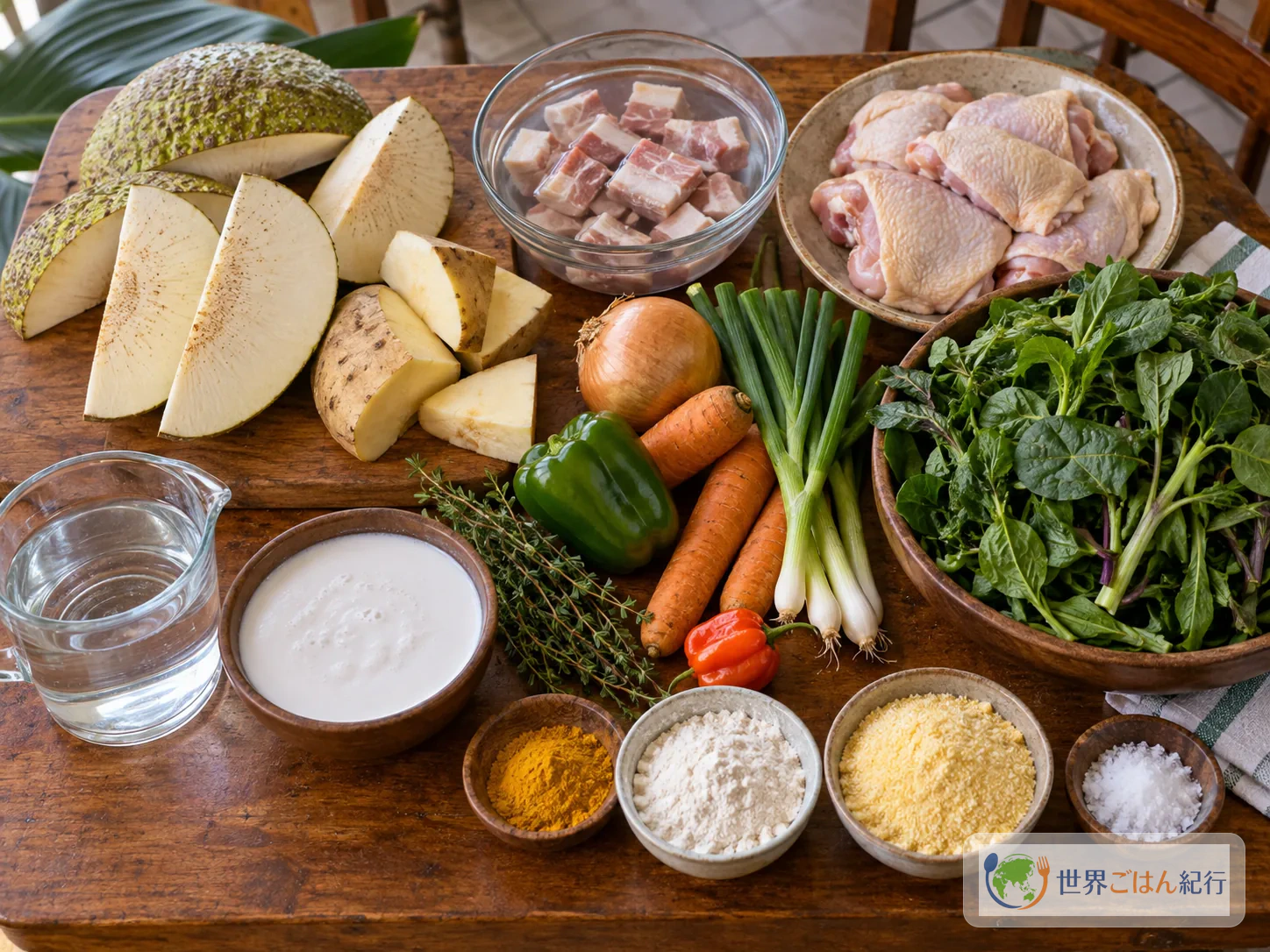
Salted meat is high in salt, so soak it and parboil it before use, and decide the finishing salt by tasting. Do not put the water used for desalting back into the dish. The dumplings contain wheat and corn. Because the ingredients vary in coconut, seafood, and meat, check your family's allergy information and the labels on what you buy. For the chicken version, do not reuse the knife, cutting board, or tongs that touched raw meat on the cooked ingredients. Also check that the center has reached 75°C for at least 1 minute.
Instructions: cut, desalt, knead, and layer to build an order in the pot
The work in the kitchen divides into four: cutting, desalting, kneading, and layering. Cut the breadfruit into 8 pieces and remove the core, parboil the salted meat, and prepare the onion, carrot, leafy greens, and chives before putting everything in one pot. The dumplings are made of wheat flour, cornmeal, salt, and lukewarm water, rested for 10 minutes, then shaped into long pieces. That is the preparation; the heart of the dish is packing the pot. Parboil the salted meat 3 times, rest the dumplings 10 minutes, and put the breadfruit at the bottom. Not stirring from the bottom during the simmer is the point that lets the breadfruit soak up the liquid without breaking. Even if the pot seems about to scorch, don't stir the ingredients; adjust only the heat and the liquid.
If you feel like turning things over from the bottom partway through the simmer, hold back. Turning breaks the breadfruit, sinks the dumplings, and clouds the liquid. If the pot is at a temperature you can hold, give the handles a short shake with both hands. The key is to shake, not stir. If the pot can't be shaken, lower the heat and set the lid slightly ajar to let steam out. If you add liquid, add boiling water 50 ml at a time, from the edge of the pot. And don't stir the scorched bottom back in.
When opening the lid, keep your face away and lift the side farthest from you first to let the steam out. The liquid contains oil, so don't keep it at a hard boil. In the chicken version, don't reuse the cutting board or tongs used for raw meat on the cooked dumplings or leafy greens. Check with a thermometer that the center has reached 75°C for at least 1 minute. If you break the Scotch bonnet, use gloves and keep it away from your eyes and mucous membranes. For aroma only, put it in whole and take it out.
Translating "cooked down" to a home pot
According to Island Learning Grenada, a stove takes about an hour, while over a wood fire (fireside), where the pot is large and the fire uneven, it can take several hours. The 50 to 60 minutes of this home version is a guide for four servings in a 24 cm pot. It varies with the firmness of the breadfruit, the thickness of the pot, the heat, and how the meat was prepared. The sign to turn off the heat is in the pot, not the clock. The liquid is gone, a skewer goes through the hard ingredients, the center of the dumplings is not raw, and a thin film of oil shows. It is when these four are all present. Watch the moisture, not the time, check that a skewer goes through, and keep your eye on the golden oil at the bottom of the pot.
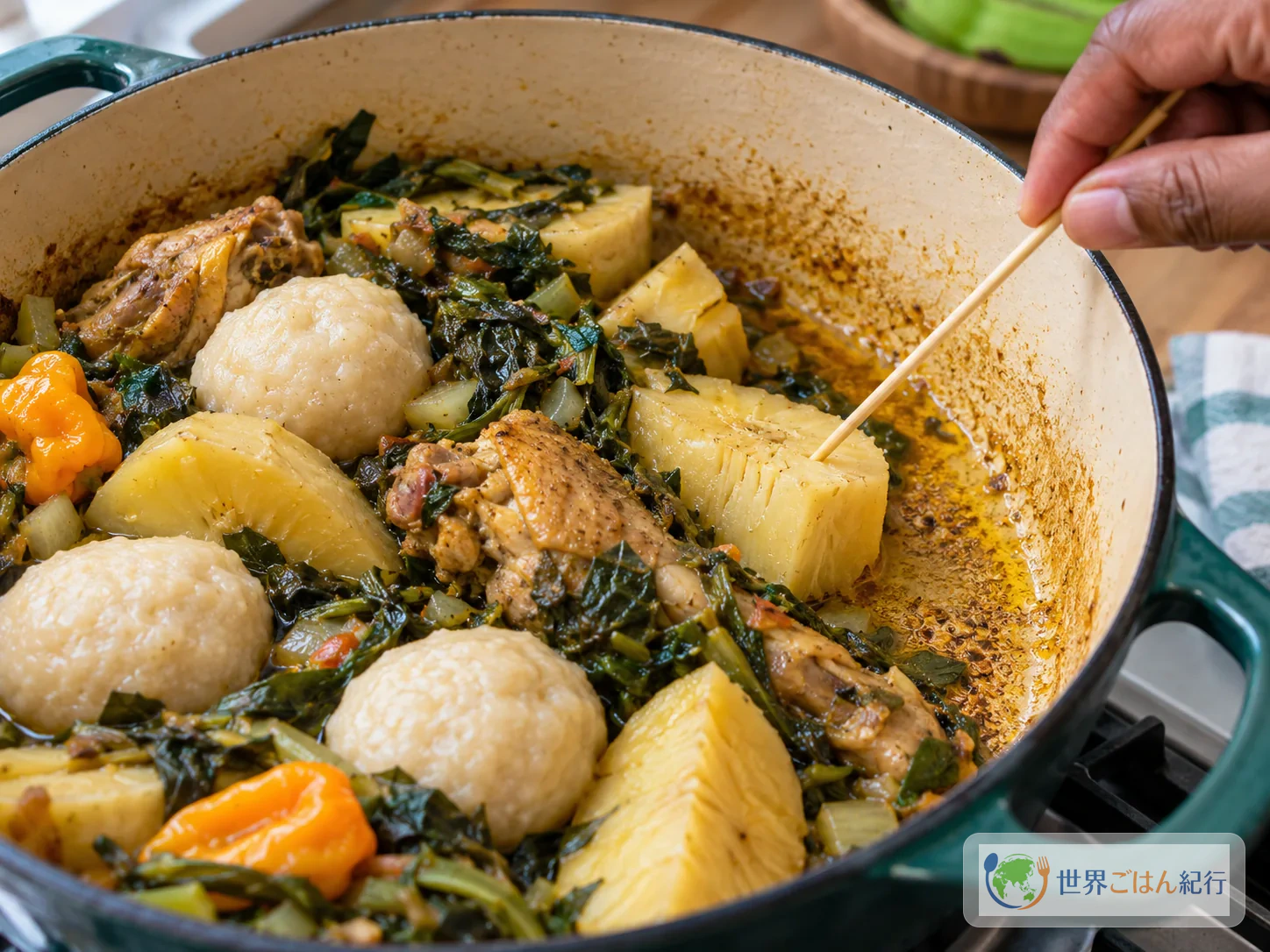
Breadfruit can be replaced by potato, yam, or firm sweet potato, though the sweetness and the way it breaks down will change. If you use potatoes, cut them in the same large shapes as the breadfruit. Callaloo (dasheen) can be replaced with spinach. You can make it without the dasheen, but the stickiness and aroma of the leaf will be weaker. Salted pork can be replaced with chicken thighs, and in that case you don't desalt the chicken. The order in which things go into the pot doesn't change either. For turmeric, choose a powder under its ordinary name, and do not turn the local name "saffron" into saffron threads.
Island Learning Grenada and NPR describe a range that includes salt fish, crab, conch, chicken, and meatless versions. Seafood breaks easily, and chicken needs its center temperature checked. A vegetable-only version has none of the salt that salted meat gives off. When you change the ingredients, watch how the liquid reduces and when to stop the heat separately for each. The four servings in this article have the salted pork version and the chicken version as the main plans. If you add crab or salt fish, treat it as one example of regional variation. Specific cooking times for seafood cannot be inferred from the meat versions in this article.
In the sources, callaloo is the name for young dasheen leaves and is a different thing from kohlrabi (the bulb vegetable). The substitute table says spinach. In the Grenadian sources turmeric is sometimes called saffron. The ingredient list uses turmeric throughout, so there is no need to buy saffron threads. Also, in Grenada, Carriacou, and Petite Martinique there is a range in both the combination of ingredients and the use of fire. This article is one example, scaled down to a home pot.
Scooping the big-pot dish into a table for four
As NPR describes, oil down is eaten at family tables and gatherings. From the pot, scoop the breadfruit (or potatoes), dumplings, meat, and leafy greens together onto a plate. Spoon the oil left by the coconut liquid over the top. It is not a dish that must be served with rice. The basic way is to scoop together from the pot and put the dumplings and greens on the same plate. To separate the heat, take the whole Scotch bonnet out of the pot and set hot sauce or lime on a separate plate. That means moving the heat to a separate plate. This is a suggestion for serving at home, not something we saw while visiting the local way of serving.
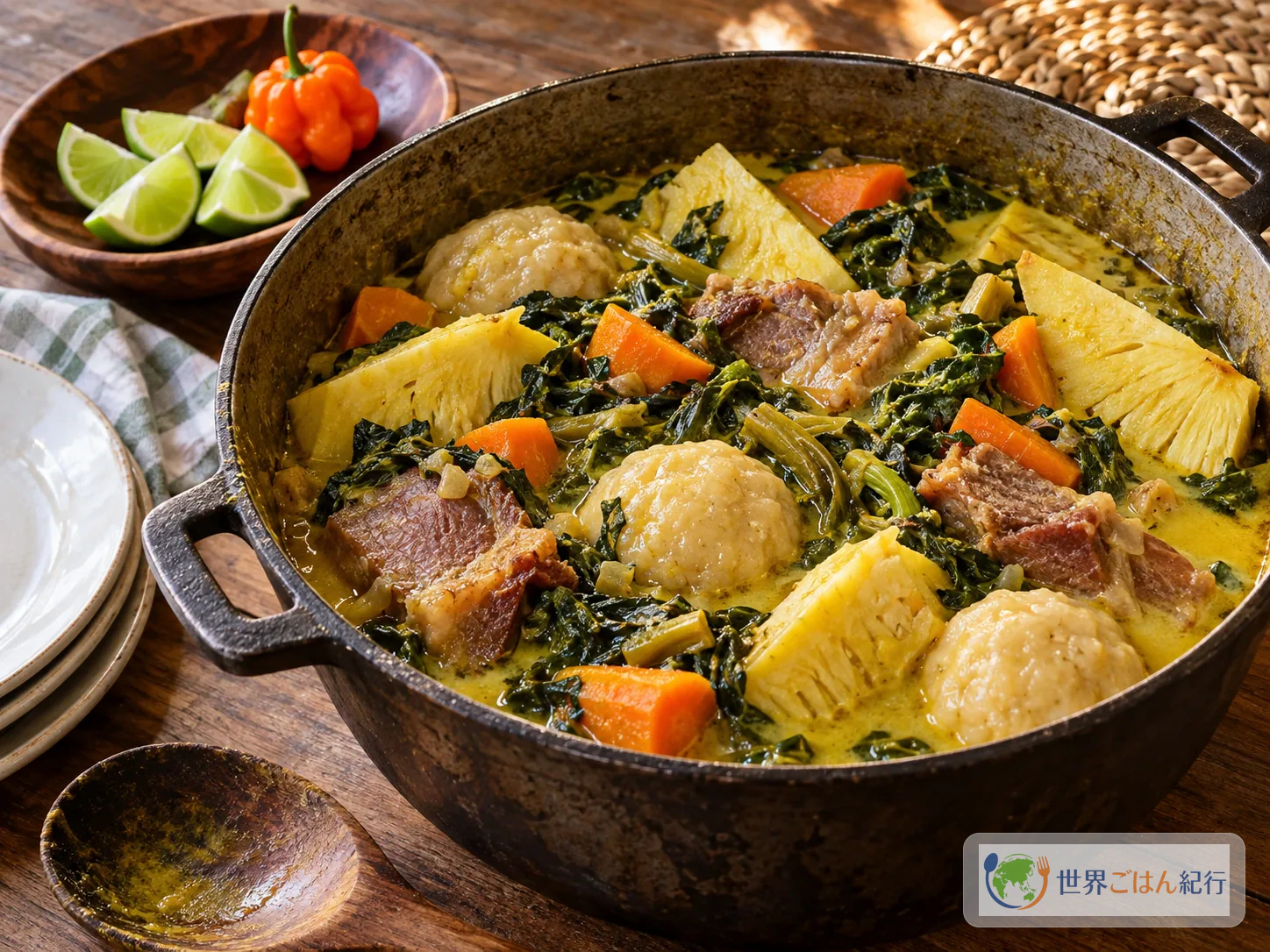
When you finish eating, don't leave the pot at room temperature for long; divide it into shallow airtight containers and cool it. For the chicken version, don't reuse tools used for raw meat on the finished dish. A cautious guide for households is to finish it by the next day. If there is an off smell or sliminess, or if it has been left at room temperature for a long time, discard it without tasting. The number of storage days depends on household equipment and handling, so it can't be guaranteed in general. To reheat, return only what you will eat to a pot and heat it over low heat until hot all the way through. If the moisture is short, add a little boiling water. For the chicken version, check that the thick part has reached 75°C for at least 1 minute.
When you eat it the next day, reheat the breadfruit (or potatoes) without breaking it up too much, and scoop the dumplings and meat together. If the moisture has reduced, add just a little boiling water and use low heat. Versions with different ingredients, such as the meatless or chicken versions, are best labeled on the storage container so they don't get mixed up with portions for family members who differ in heat tolerance or allergies. Rather than remaking it into a different stew, reheat it as it is, within the range where you finish it by the next day.
FAQ
Is it still oil down without breadfruit?
You can make it with potato, yam, or firm sweet potato. But the aroma and stickiness of breadfruit and how it absorbs the liquid will change. Cut the substitute root into large wedges as well, and keep to the order of placing it at the bottom of the pot. If you cut it small, it breaks down and clouds the whole pot. If you can get breadfruit, you'll have a dish closer to the local one. That doesn't mean the potato version has to be called fake.
What should I buy for callaloo?
In the sources, callaloo is the leaf of young dasheen. If you can't find it, use 200 g spinach, remove tough stems, and chop coarsely. Kohlrabi is a different vegetable, so don't choose by the name alone. Spinach cooks easily, so put it on the top layer of the pot and don't cook it too long.
Should I choose salted meat or chicken?
Salted pork gives you the saltiness and the outline of a preserved food. In exchange, it needs an overnight soak and 3 parboilings. Chicken thighs need no desalting and the preparation is short. For the chicken version, prioritize handling of raw meat and a center temperature of 75°C for at least 1 minute. If you can't decide, we recommend learning the layering and how to read the cooking-down with the chicken version first, then moving on to the salted-meat version. Do not replace the salted meat with ordinary bacon.
Why don't I stir the pot?
Oil down is a dish that keeps its structure of layers, from the hard ingredients at the bottom to the leaves and dumplings above, with liquid circulating from below. Stirring from the bottom breaks the breadfruit, sinks the dumplings, and makes the thickness of the liquid uneven. Shake the pot gently and add boiling water a little at a time from the edge. It is not a dish where you turn the ingredients; you wait until the liquid is absorbed and the oil shows.
Can I eat oil down the next day?
Divide it into shallow containers, refrigerate, and, to be cautious, finish it by the next day. Discard anything left at room temperature for long or that has an off smell or sliminess. Reheat only what you'll eat over low heat until hot to the center, and for the chicken version check that the thick part has reached 75°C for at least 1 minute. Restore the moisture with boiling water, and don't reheat the whole batch repeatedly. The salted-meat version tastes saltier when it cools. Don't add salt after reheating.
Sources
- Government of Grenada: National Symbols (checked for its standing as the national dish, the main ingredients, parboiling the salted meat, and the official breadfruit and coconut milk recipe. Accessed and checked 2026-09-30 JST)
- Island Learning Grenada: Discover Grenada's National Dish - Oil Down (checked for its standing in Grenada, Carriacou, and Petite Martinique, regional variation in ingredients, packing the pot, differences in fire, and the distinction between saffron and turmeric. Accessed and checked 2026-09-30 JST)
- Embassy of Grenada: Grenada at Winternational Embassy Showcase 2024 (checked for the record of serving the national dish, oil down, at an international cultural event. Accessed and checked 2026-09-30 JST)
- Capital Public Radio / NPR: This Hearty Stew Is A One-Pot Lesson In Grenada's History (checked for communal cooking, the origin of the name, the history of the ingredients, regional variation, packing the pot, and substitutes. Accessed and checked 2026-09-30 JST)
- Daughters of the British Empire: Oil Down Recipe (checked for ingredients, layering, the roughly one-hour simmer, and the dumpling formula, based on the government recipe. Accessed and checked 2026-09-30 JST)
- Ministry of Health, Labour and Welfare (Japan): Preventing food poisoning at home (checked for the 75°C for at least 1 minute center temperature for chicken, separating utensils, and avoiding leaving food at room temperature. Accessed and checked 2026-09-30 JST)