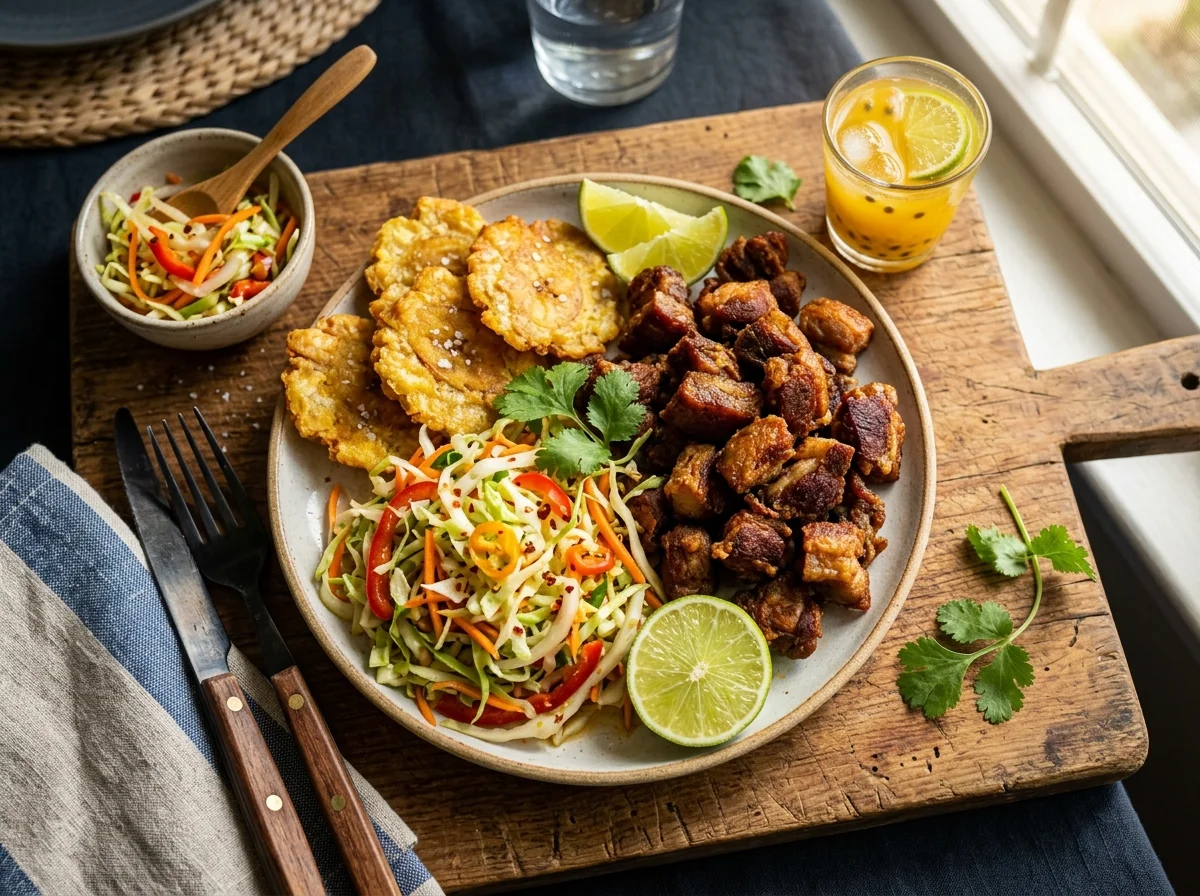
Griot, Haiti's national dish: golden, crisp pork with pikliz and bannann peze
Prep30 min
Cook1 hr 30 min
Serves4 servings
CuisineHaitian

Griot: Haiti's National Dish of Spicy Fried Pork

A real recipe for griot, Haiti's national dish: pork shoulder marinated in citrus and spices, then cooked twice, a fried-pork dish unique to the Caribbean. Covers how to make epis (Haitian spice paste), the pikliz and bannann peze that go with it, and the food culture behind it, based on English-language sources.

Total: 2 hrLevel: Intermediate

Cooking flow

Cooking steps

STEP 11 / 8

Make the epis

10 min

Making epis in a food processor: a vivid green paste
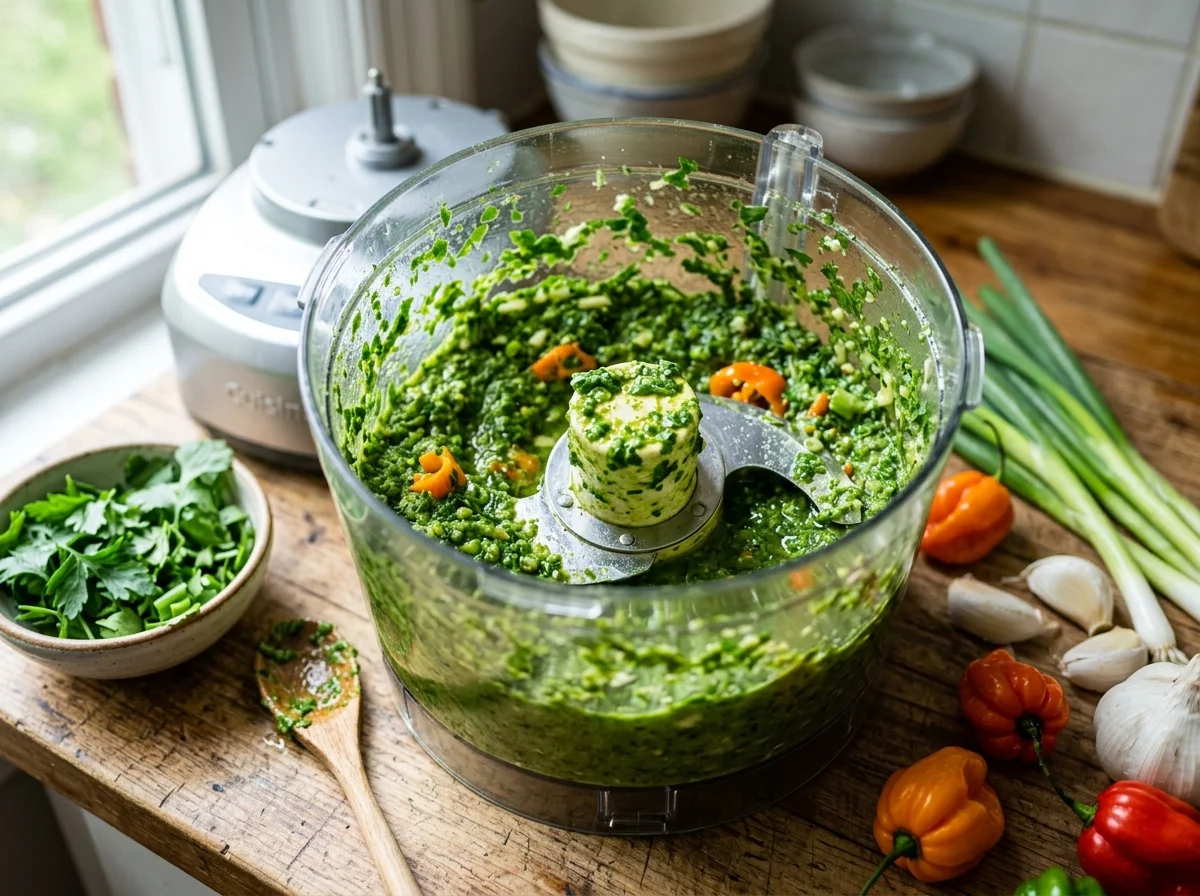
Epis, the all-purpose Haitian spice paste. The green of parsley and scallion is vivid, and the heat of Scotch bonnet and the fragrance of thyme rise from it

This is the spice paste that is the foundation of Haitian cooking. Put the parsley, scallions, garlic, onion, thyme, Scotch bonnet (seeded), cloves, black pepper, vinegar, and vegetable oil all into a food processor and blend until it becomes a smooth paste. In about 30 seconds you get a uniform green paste.

Put what is left over in an airtight container and it keeps for 1 week in the refrigerator; freeze it in an ice cube tray and it keeps for 3 months.

STEP 22 / 8

Marinate the pork

15 min (plus at least 1 hour)

Marinating pork with epis and citrus juice in a bowl
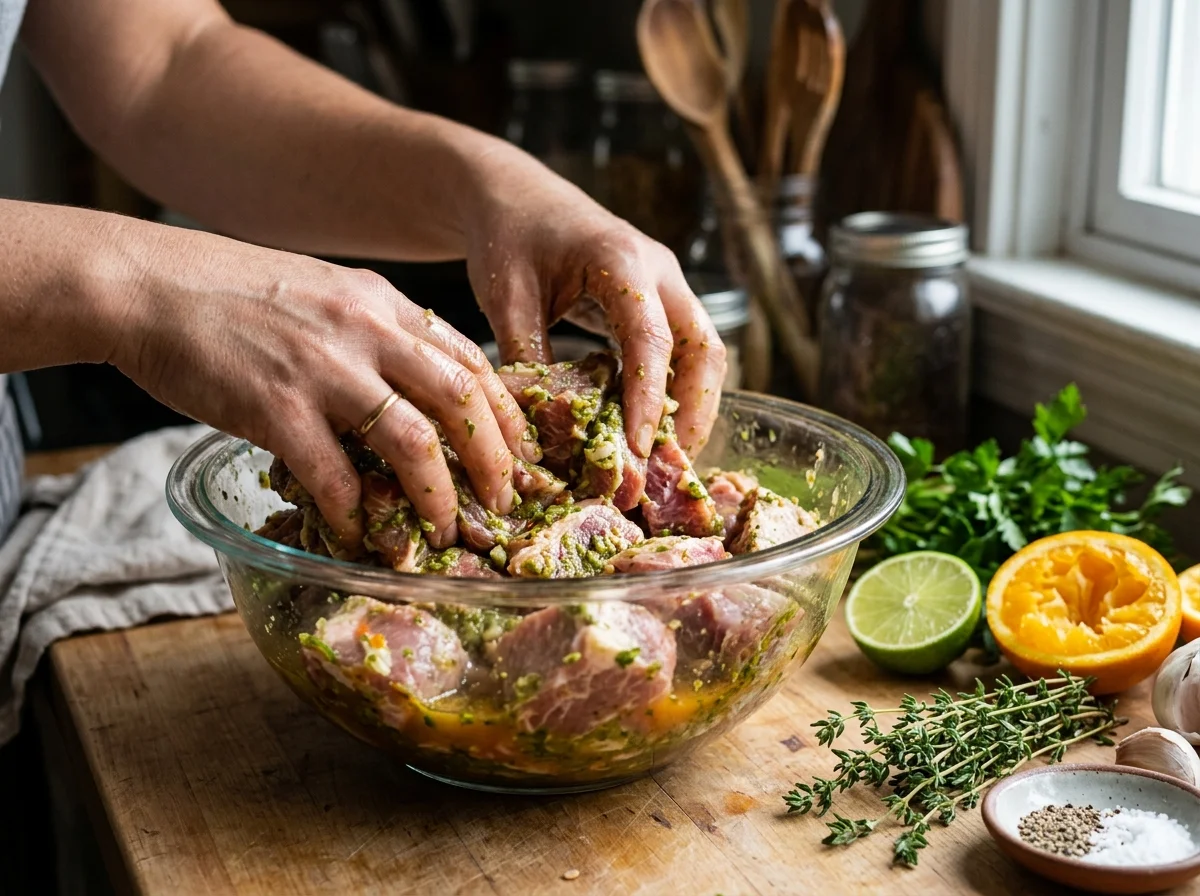
Rub the pork with epis and citrus juice. The green spice paste covers the meat and the citrus fragrance rises. Left overnight, the flavor deepens a great deal

Cut the pork shoulder into 3–4 cm cubes. Do not trim the fat; leave it on. This fat later produces the crisp texture.

Put the pork in a bowl, add 4–5 tbsp of the epis, 120 ml bitter orange juice (or orange plus lime), the juice of 2 limes, 2 tsp salt, and 1 tsp black pepper, and rub it in thoroughly by hand. Cover with plastic wrap and marinate in the refrigerator for at least 1 hour, ideally overnight (12 hours).

Marinating time decides most of the flavor

If you have time, marinate it the evening before and cook it the next day. A short marinade gives flavor only on the surface; the longer time lets the citrus acid loosen the fibers of the pork and carries the epis spices to the center.

STEP 33 / 8

Simmer the pork

45 min

Pork simmering together with the marinade in a pot
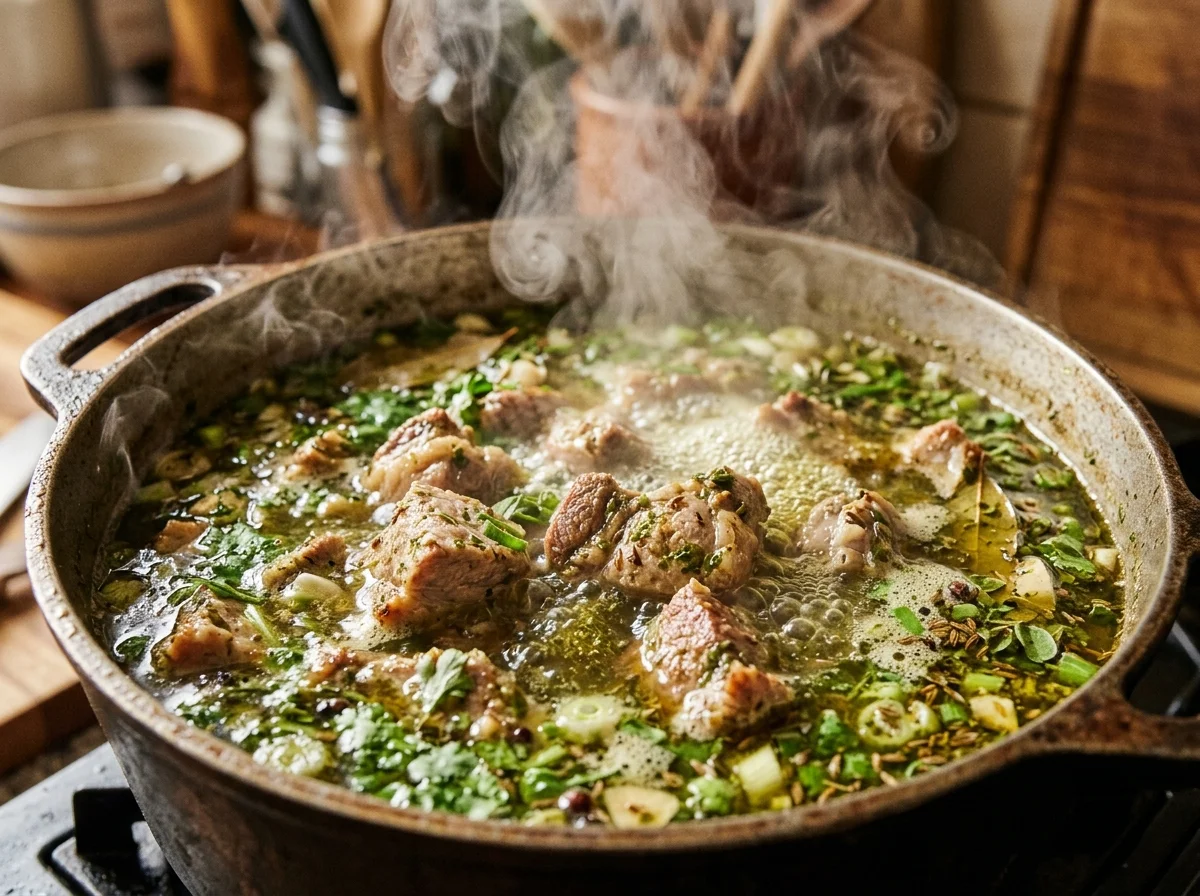
Simmered in its marinade. In a liquid where the green of the epis and the acidity of the citrus have blended, the pork slowly softens

Move the marinated pork, with its marinade, to a heavy pot and add 200 ml water. Bring to a boil over high heat, then lower to low, cover, and simmer for 45 minutes. Turn the pieces over once along the way.

This simmering step is the secret of griot. As the pork cooks slowly together with the marinade, the spice flavor penetrates completely and the meat becomes so tender it comes away from the bone. At the same time the fat turns soft and creamy, setting up the dramatic crisping in the pan-frying that follows.

When the liquid has reduced by about half, take the pork out onto a tray. Do not throw this liquid away; you will use it to finish.

STEP 44 / 8

Pan-fry the pork

15 min

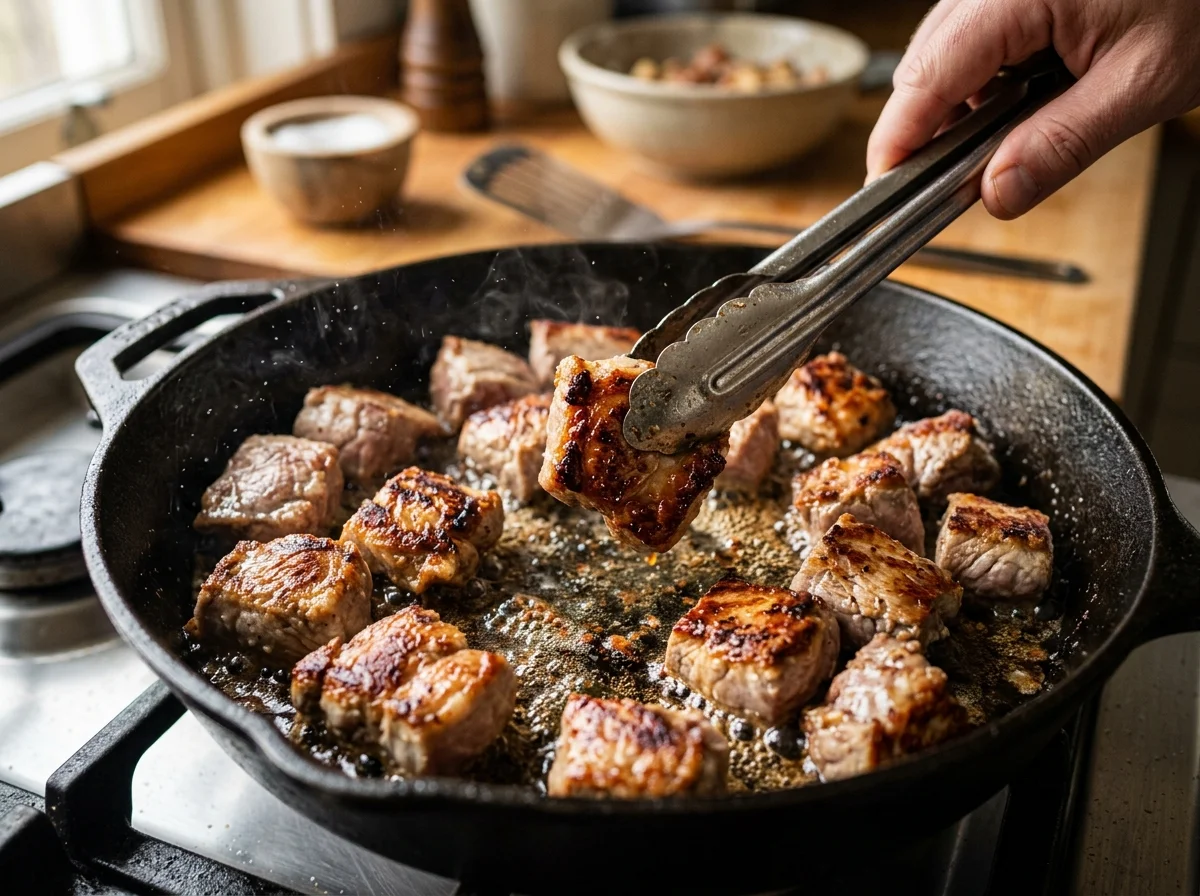
Pan-frying pork until golden in a skillet
The core of cooking twice. The simmered, softened pork is pan-fried at high heat. The moment the surface turns crisp and golden

From here is the real heart of griot, the "second cooking." Put 4 tbsp vegetable oil in a skillet and heat over medium-high heat. Blot the simmered pork lightly with paper towels and arrange it in the pan.

Pan-fry for 3–4 minutes per side, until every side is golden and crisp. Do not cover. Covering traps steam and loses the crispness. The fatty parts brown especially fragrantly.

A tip for maximizing crispness

Pork that has finished simmering is soft, so after taking it out onto a tray, let it rest for 15–20 minutes so the surface dries. Putting pork with a dry surface into hot oil lets the Maillard reaction proceed efficiently and makes a thin, crackling crust.

STEP 55 / 8

Finish with the cooking liquid

3 min

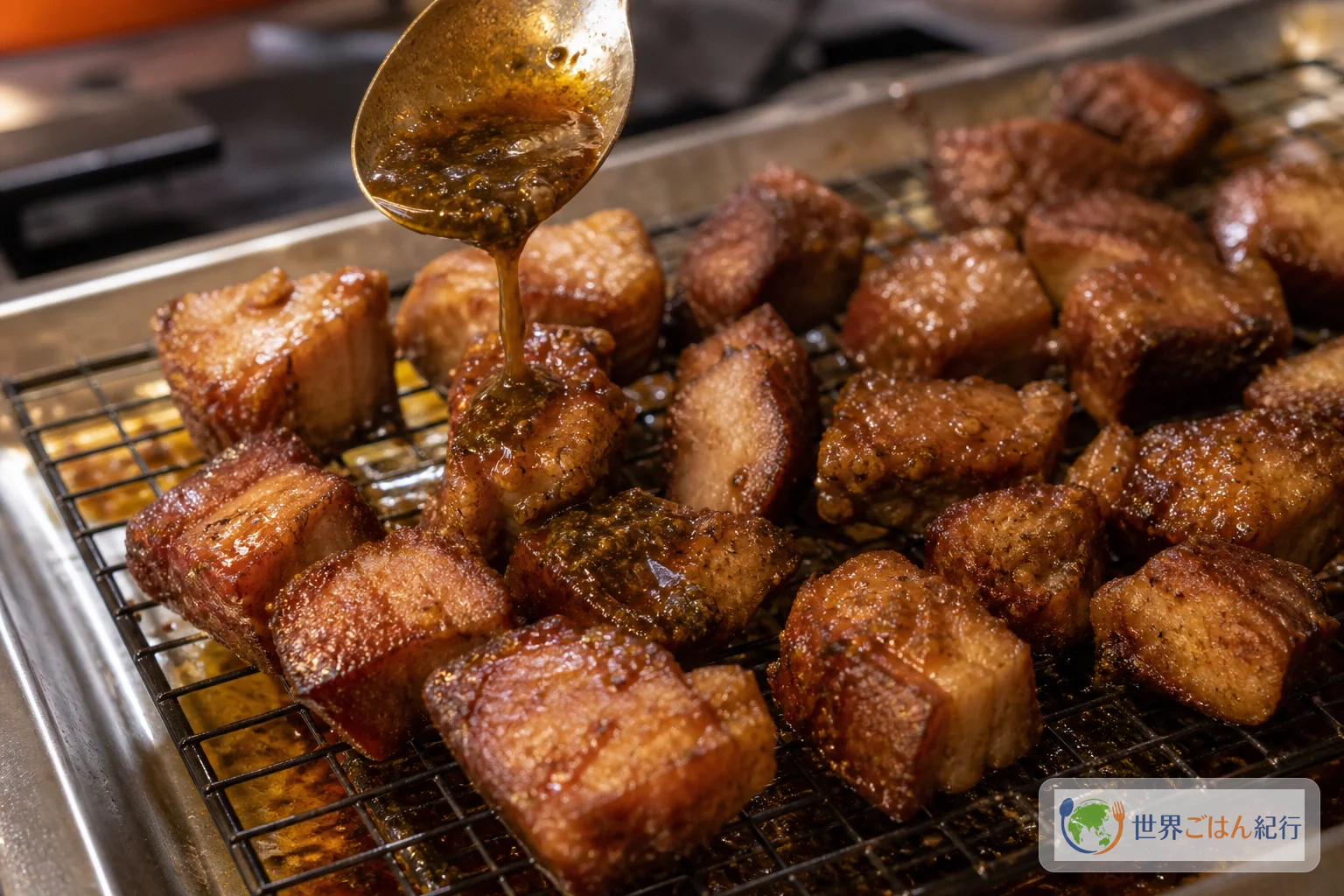
Spooning cooking liquid over the pan-fried pork to bring back the spice flavor
Spoon a little cooking liquid over the crisp pork and let it take on aroma without reheating

Take the pan-fried pork out onto a tray and spoon over 3–4 tbsp of the cooking liquid set aside in step 3. This last touch layers more spice flavor onto the crisp surface and completes the "coat of spice" characteristic of griot. After spooning on the liquid, do not fry it again; go straight to plating.

STEP 66 / 8

Make the pikliz

10 min (plus 30 min to pickle)

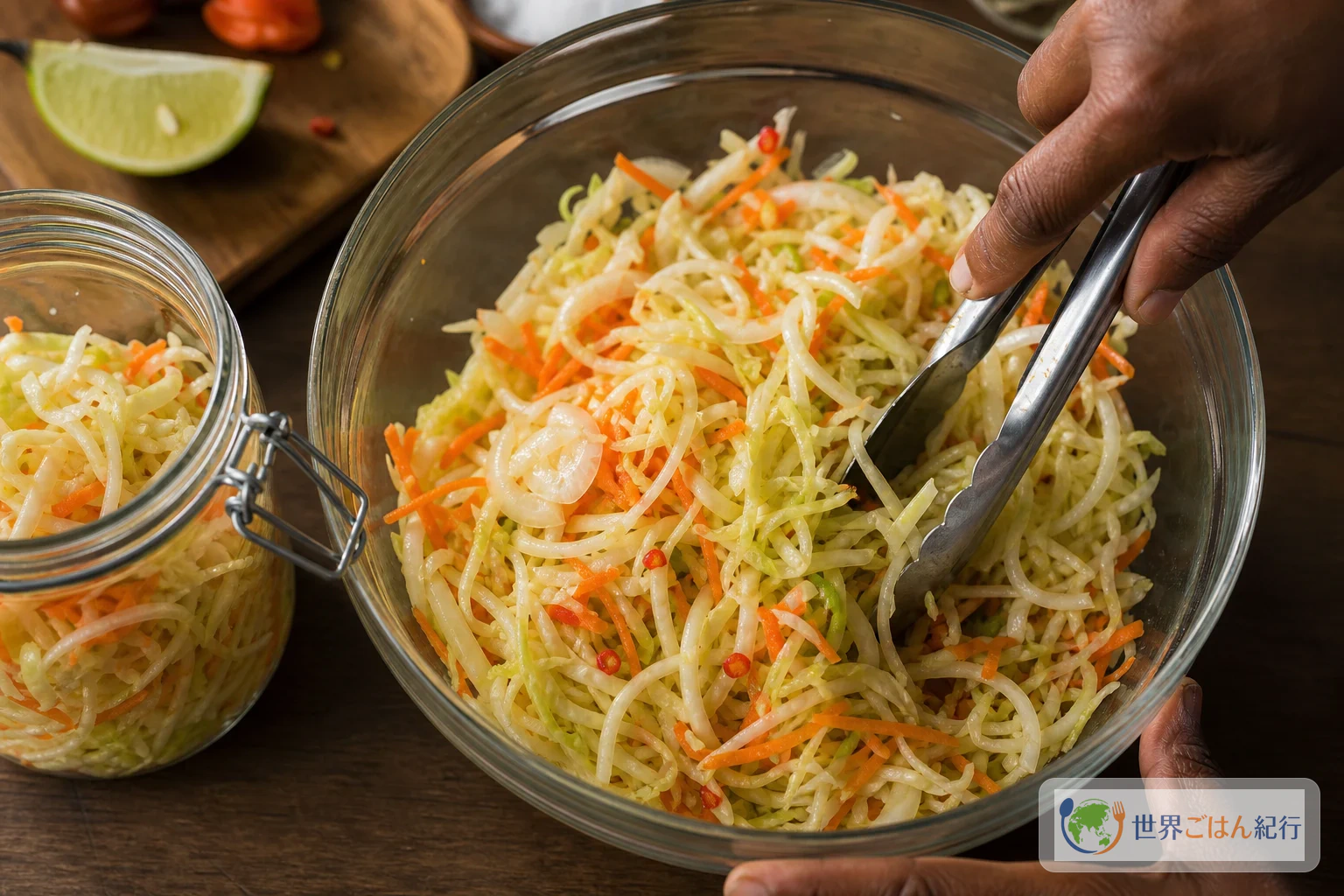
Tossing cabbage and carrot pikliz with the sour pickling liquid
The liquid has coated the whole of the vegetables; leave at least 30 minutes while keeping the crunch

In a bowl put the shredded cabbage, carrot, and onion, add the minced Scotch bonnet, lime juice, white wine vinegar, and salt, and mix well until the pickling liquid has reached all of the vegetables evenly. Let it pickle for at least 30 minutes. The longer it sits, the mellower the acidity becomes while the vegetables keep their crunch.

Pikliz is Haiti's version of "coleslaw plus pickles," and it is indispensable in cutting the richness of griot with sourness and heat.

STEP 77 / 8

Make the bannann peze

15 min

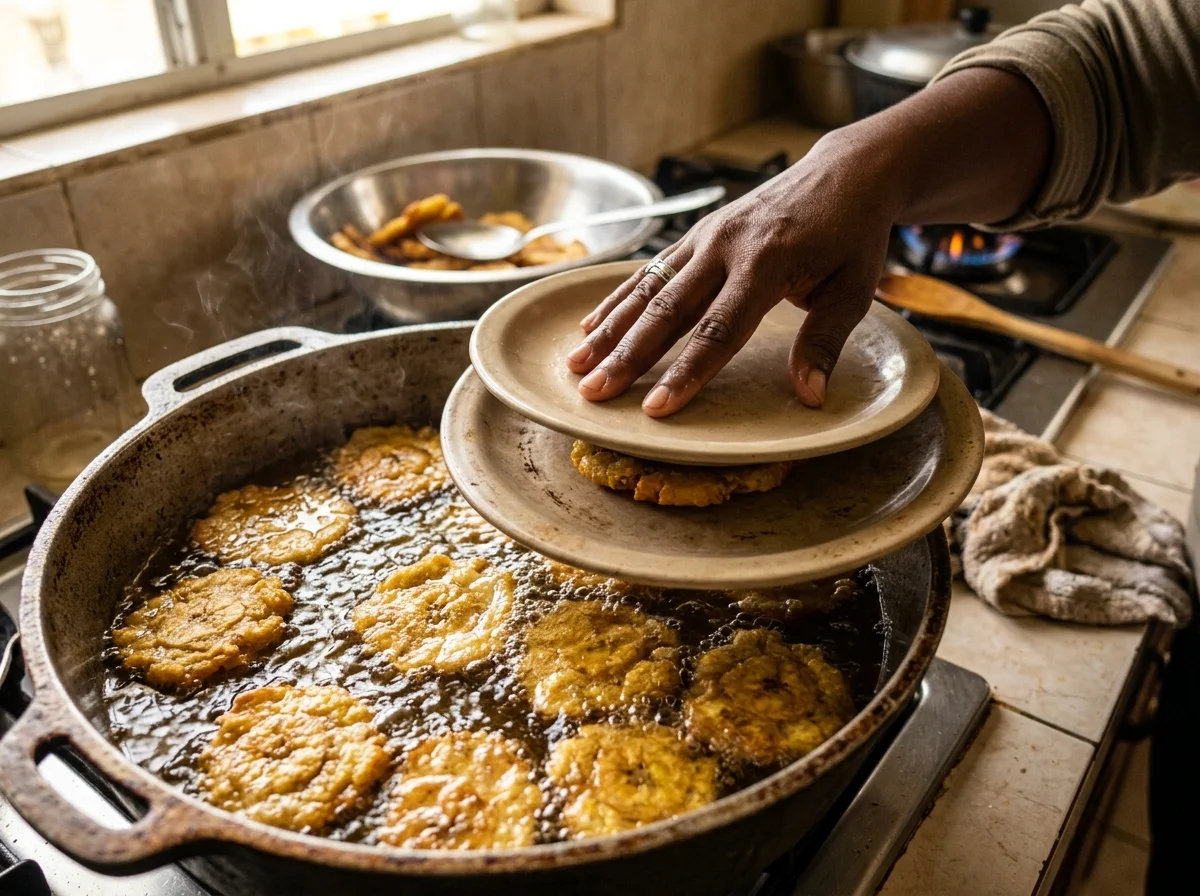
Pressing the plantains and frying them twice for bannann peze
Double-frying bannann peze. The once-fried plantain is pressed flat and fried again to achieve a crisp texture

Peel the plantains (or green bananas) and cut them into 2 cm rounds. Fry in 170°C oil for 2 minutes per side and take them out once. The point is to take them out while they are still yellow.

Press the fried rounds firmly against a flat surface (a cutting board or the bottom of a plate) until 1 cm thick. The more even the thickness, the more evenly crisp they will be after the second frying. Fry again in 180°C oil for 1–2 minutes per side until golden. Sprinkle with salt. Crisp outside, fluffy inside: that is bannann peze.

STEP 88 / 8

Plate

5 min

Beautifully plated griot, bannann peze, and pikliz
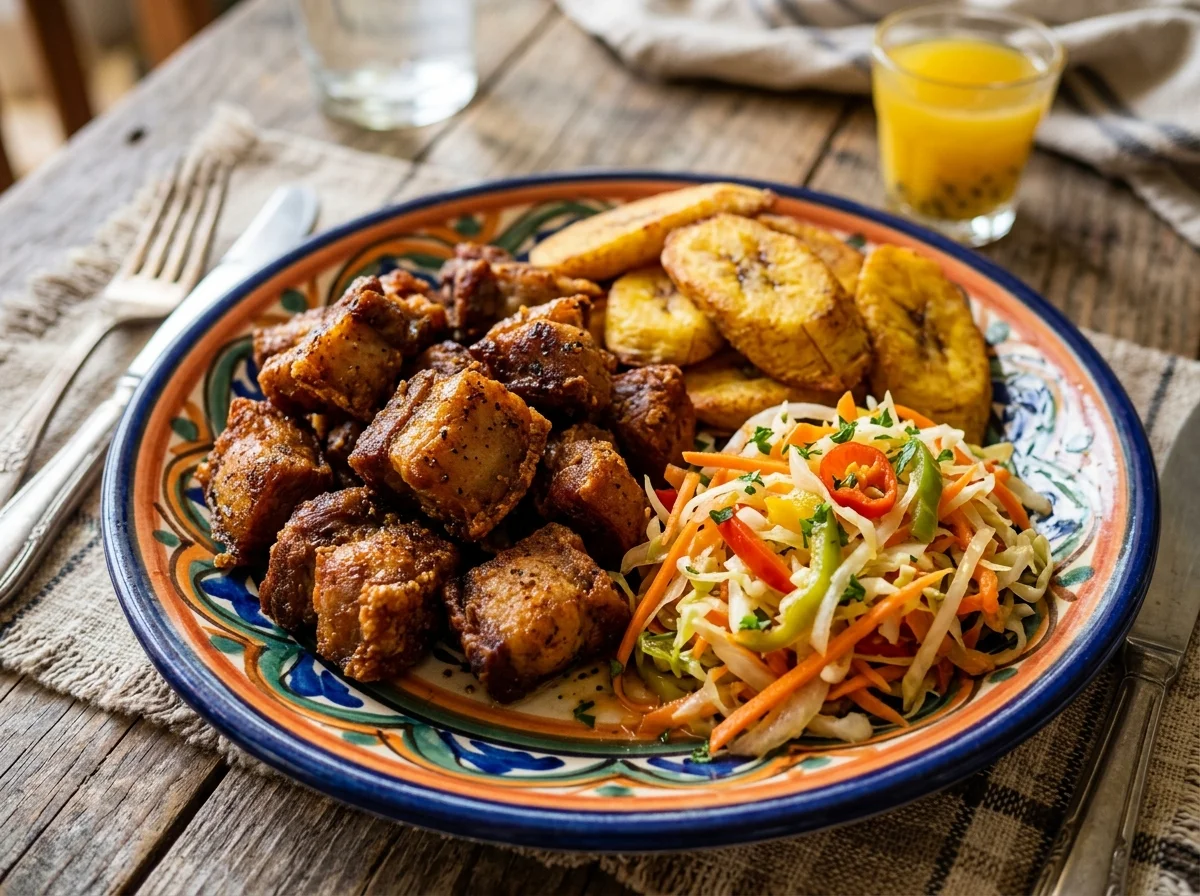
A finished plate of griot. Golden, crisp pork, fluffy bannann peze, and crunchy pikliz. Three textures and flavors on one plate, Haiti's national dish

Heap the griot on a large platter, line the bannann peze alongside, and add the pikliz. In Haitian homes it is often served with diri kole (rice and beans cooked together, a red-rice-like dish), but white rice is also delicious.

The Haitian way of eating is to alternate bites of griot and bannann peze and refresh the mouth with pikliz in between. Fat, sweetness, sourness, and heat travel around the mouth in exquisite balance.

0 / 0
Ingredients

Ingredients

1 / 4

Main ingredients

Ingredient Amount Substitutes & notes
Pork shoulder (in a block) 800 g A cut with a moderate amount of fat is ideal. Pork belly also works
Juice of bitter orange (naranja agria) 120 ml Can be replaced with 60 ml orange juice plus 60 ml lime juice
Limes 2 (juice) —
Salt 2 tsp —
Black pepper 1 tsp —
Vegetable oil (for pan-frying) 4 tbsp —
About bitter orange

Bitter orange (Seville orange / naranja agria) is a key citrus in Haitian cooking, with a sourness and bitterness between an ordinary orange and a lime. In Japan the closest variety is daidai. If you can't find it, mixing sweet orange juice and lime juice 1:1 reproduces it well enough. A small amount of grapefruit juice added will also bring back the characteristic bitterness of bitter orange.

2 / 4

Epis (Haitian spice paste)

Ingredient Amount Substitutes & notes
Parsley 1 bunch (30 g) —
Scallions 4 —
Garlic 6 cloves —
Onion 1/2 —
Thyme (fresh) 2 tsp 1 tsp if dried
Scotch bonnet 1 (seeded) Habanero can be used. Half for less heat
Cloves (ground) 1/4 tsp —
Black pepper 1/2 tsp —
Vinegar 1 tbsp Apple cider vinegar recommended
Vegetable oil 1 tbsp —
What epis is

It means "spices" in Haitian Creole. It is the all-purpose marinade paste of Haitian cooking, a kind of Haitian sofrito. Built around parsley, scallions, garlic, thyme, and Scotch bonnet, with a recipe that varies from household to household. A bit of Haitian household wisdom is to make plenty, keep it refrigerated (1 week) or frozen (3 months), and use it in everyday cooking. Compared with the jerk seasoning of jerk chicken, it has a higher proportion of herbs and a more delicate, complex flavor.

3 / 4

Side dish: bannann peze (fried plantain)

Ingredient Amount Substitutes & notes
Plantains 2 Unripe green bananas can be used
Salt 1/2 tsp —
Vegetable oil (for frying) As needed —
4 / 4

Side dish: pikliz (pickled vegetables)

Ingredient Amount Substitutes & notes
Cabbage 1/4 head (shredded) —
Carrot 1 (shredded) —
Onion 1/2 (thinly sliced) —
Scotch bonnet 1/2 (minced) 1 dried red chile can stand in
Lime juice 3 tbsp —
White wine vinegar 3 tbsp —
Salt 1/2 tsp —
0 / 0

The "Cooked Twice" Magic of the Pearl of the Caribbean

Haiti occupies the western third of the island of Hispaniola in the Caribbean. The first Black republic in the world, it won its independence in 1804, and it is a treasury of a distinctive Creole cuisine in which the food culture of the French colonial era, African cooking techniques, and ingredients of the Indigenous Taíno people of the Caribbean have fused. At the summit of Haitian cooking stands griot.

Griot (also griyo) is a signature meat dish of the Caribbean, a "cooked twice" fried-pork dish in which pork shoulder, generously marinated in citrus juice and the spice paste called epis, is first simmered and then pan-fried. At the first bite you are surprised by the toasty crispness of the outside, and then juices full of spice flood the mouth from within. Browned and crisp on the surface, moist and juicy inside: two contradictory textures living in a single piece of meat. This is Haiti's national dish.

What griot means

In Haitian Creole it means "fried pork." It is said to derive from the French "grillot" (a piece of grilled meat), but the exact etymology is debated. It resembles the Dominican Republic's chicharrón de cerdo and Cuba's masitas de puerco, but the Haitian style is distinguished above all by the deep spice flavor from the citrus marinade and epis, and by the two-stage method of simmering and then frying. It stands alongside Trinidad's doubles (in Japanese) and Jamaican jerk chicken as a representative Caribbean dish.

In English, countless recipes are published under "griot recipe" and "Haitian fried pork," and Haitian American food bloggers compete in re-creating their "mother's taste." This article explains the method of authentic griot as handed down in the Haitian communities of Miami and Montreal, using ingredients you can find at an ordinary supermarket.


Ingredients (serves 4)


Cooking Tips

Don't be stingy with the citrus in the marinade

The depth of flavor in griot is directly tied to the amount of citrus juice. In Haitian homes they use enough citrus juice to completely submerge the pork. The 120 ml in the recipe is the minimum, and if the surface of the meat is out of the juice, add more. The citrus acid changes the proteins of the pork so that it softens, and at the same time takes away any gaminess.

Never throw away the cooking liquid

The liquid from step 3 is a "liquid jewel" in which the savor of epis and citrus is concentrated. Besides spooning it over at the end, using it as the cooking liquid for diri kole (rice and beans) deepens the flavor surprisingly. Freeze any that is left and use it as the base for the next griot or stew.

How to handle Scotch bonnet

Scotch bonnet is a chile with heat comparable to habanero (100,000–350,000 SHU). The heat compounds concentrate in the seeds and the white ribs (placenta), so if you want less heat, remove them carefully. We strongly recommend wearing rubber gloves when cutting it. Touching your eyes or mucous membranes causes severe pain, so be careful.

Always press the twice-fried bannann peze

If you skip the step of pressing the once-fried plantain, you get only thick-cut fried banana. Pressing increases the surface area and raises the crispness dramatically in the second frying. The pressure should be "boldly, as long as the banana doesn't split." A flat-bottomed plate or the bottom of a mug presses it evenly.


Variations

Chicken griot (Griot Poulet)

Use 800 g bone-in chicken thighs in place of pork. The epis and citrus marinade are the same, but the simmering time is shortened to 30 minutes. Pan-fry longer on the skin side, 5 minutes, and 3 minutes on the other side. The chicken skin turns crackling, and you get a lightness different from pork griot. In Haiti it is called griot poulet and is a familiar variation for times when pork is hard to get.

Goat griot (Tassot Cabrit)

600 g goat meat cooked by the same method as griot is "tassot cabrit." In Haiti it is a popular dish that stands equal to pork griot. Goat meat is simmered longer than pork, for 60 minutes, until fully tender, before pan-frying. The characteristic gaminess of goat is transformed by the citrus and epis, leaving deep savor. Goat meat can be found at halal butchers.

Air fryer version

Instead of pan-frying, heat in the air fryer at 200°C for 12–15 minutes. Turn the pieces over once along the way. The amount of oil is greatly reduced, but since the pork itself carries fat from the simmering step, the surface still crisps well. Braised meat dishes like Indonesia's rendang (in Japanese) and Turkey's köfte also pair well with an air fryer.

Lime and honey version

Add 2 tbsp honey to the marinade. The sweetness of honey joins the acidity of citrus and caramelizes during pan-frying for a beautiful glossy finish. It is a variation favored in the Cap-Haïtien region of northern Haiti and is also popular as a seasoning for children.
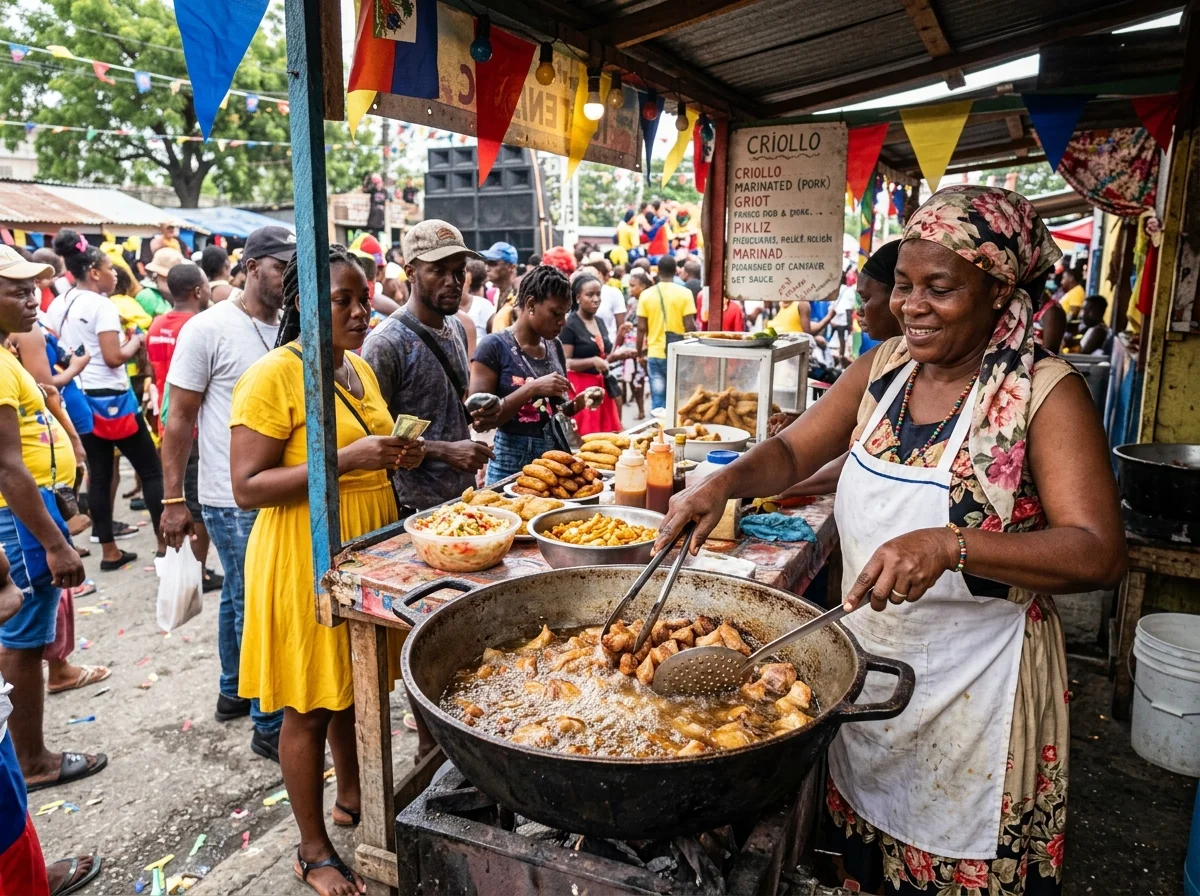
A street stall in Haiti selling griot during Carnival (Rara)
A stall at Haitian Carnival. Griot is fried boldly in a big pot and served on paper plates with pikliz and bannann peze

Background to the Dish

The three roots of Haitian cooking

Haitian cooking is a Creole cuisine in which the foods of three cultures have fused. First, the cooking techniques of the French colonial era (sauce culture, the use of herbs). Second, the ingredients and cooking methods of people brought from West Africa (okra, plantain, one-pot cooking). Third, the food culture of the Indigenous Taíno people of the Caribbean (cassava, chile, smoking techniques).

The two-stage method of simmering and then frying is said to be influenced by the French confit (a technique of cooking in fat), the citrus marinade technique to come from West Africa, and the spice paste culture to come from the Taíno; in griot these melt into one.

Revolution and the national dish

The Haitian Revolution of 1804 is the only successful slave revolution in world history, in which the enslaved defeated the French colonial power and won independence. In the course of that revolution, dishes that workers had once made quietly on the plantations, griot among them, in which pork is deodorized with citrus and fried, are said to have been raised to national dish status as a symbol of freedom.

The anthropology of epis

Epis is not merely a spice paste but something that embodies Haitian home culture. Its recipe is passed down orally, and every household has the pride of "our epis is the best." A Haitian house without a jar of epis in the refrigerator is hard to imagine: it is a seasoning, and at the same time the very smell of home.

Haitian food and the diaspora

Since the 2010 earthquake, the Haitian diaspora has spread Haitian food around the world. Haitian restaurants have rapidly increased in New York, Miami, Montreal, and Paris, and griot in particular has gone viral on social media as an "ambassador of Haitian taste," with Haitian food influencers continuing to share their mothers' recipes.
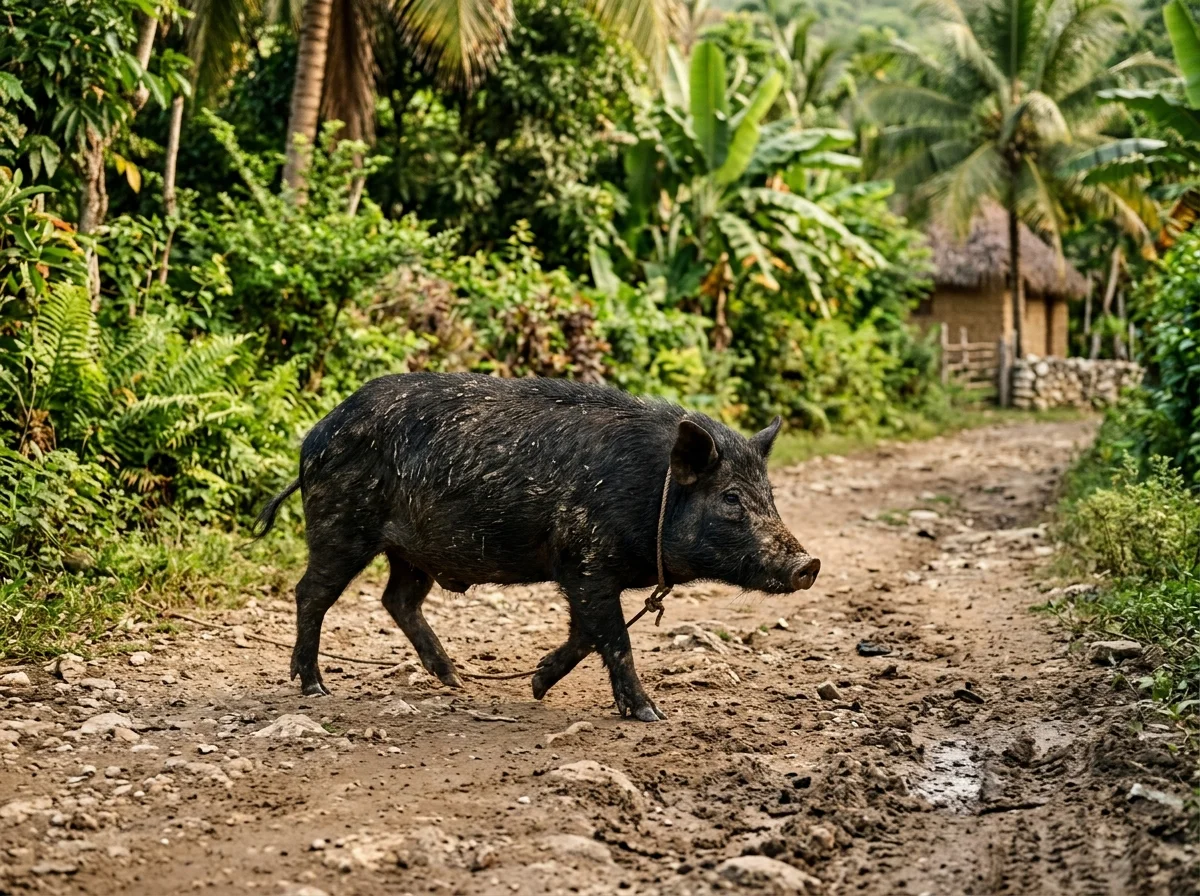
Creole black pigs native to Haiti walking down a country road
Haiti's native Creole black pig. Once nearly wiped out, its numbers are slowly recovering thanks to a restoration program

Also Worth Reading

Griot is a dish representing the Creole food culture of the Caribbean. Do try the spiced dishes of neighboring countries as well.


More to Cook Together

  • Chimichurri - Reuses ingredients and aromas from the same region.
  • Empanada (in Japanese) - Reuses ingredients and aromas from the same region.

Frequently Asked Questions

What is the difference between griot and carnitas?

Mexican carnitas is a dish in which pork is slowly confited in lard, with the surface browned at high heat at the end. Griot is marinated in citrus and spices, simmered in liquid, and then pan-fried. In carnitas the richness of fat is the star; in griot the star is the acidity of citrus and the complex spice character of the epis.

Can I use epis in other dishes?

Yes. Epis is an all-purpose seasoning in Haitian cooking and works with chicken, fish, beef, stir-fried vegetables, soups, and almost anything. If you make plenty and freeze it, a spoonful added to everyday cooking brings Haitian flavor. Using epis to season fried chicken gives a completely different taste from the usual.

Can I use pork belly instead of pork shoulder?

Yes. Belly has more fat, so it crisps even more in the pan. However, total calories go up, so serve more pikliz to balance it. Belly is also commonly used at Haitian street stalls.


Nutrition (per serving, of 4)

Nutrient Amount
Energy 520 kcal
Protein 38 g
Fat 28 g
Carbohydrate 32 g
Fiber 4 g
Sodium 680 mg
Vitamin C 42 mg
Iron 2.8 mg