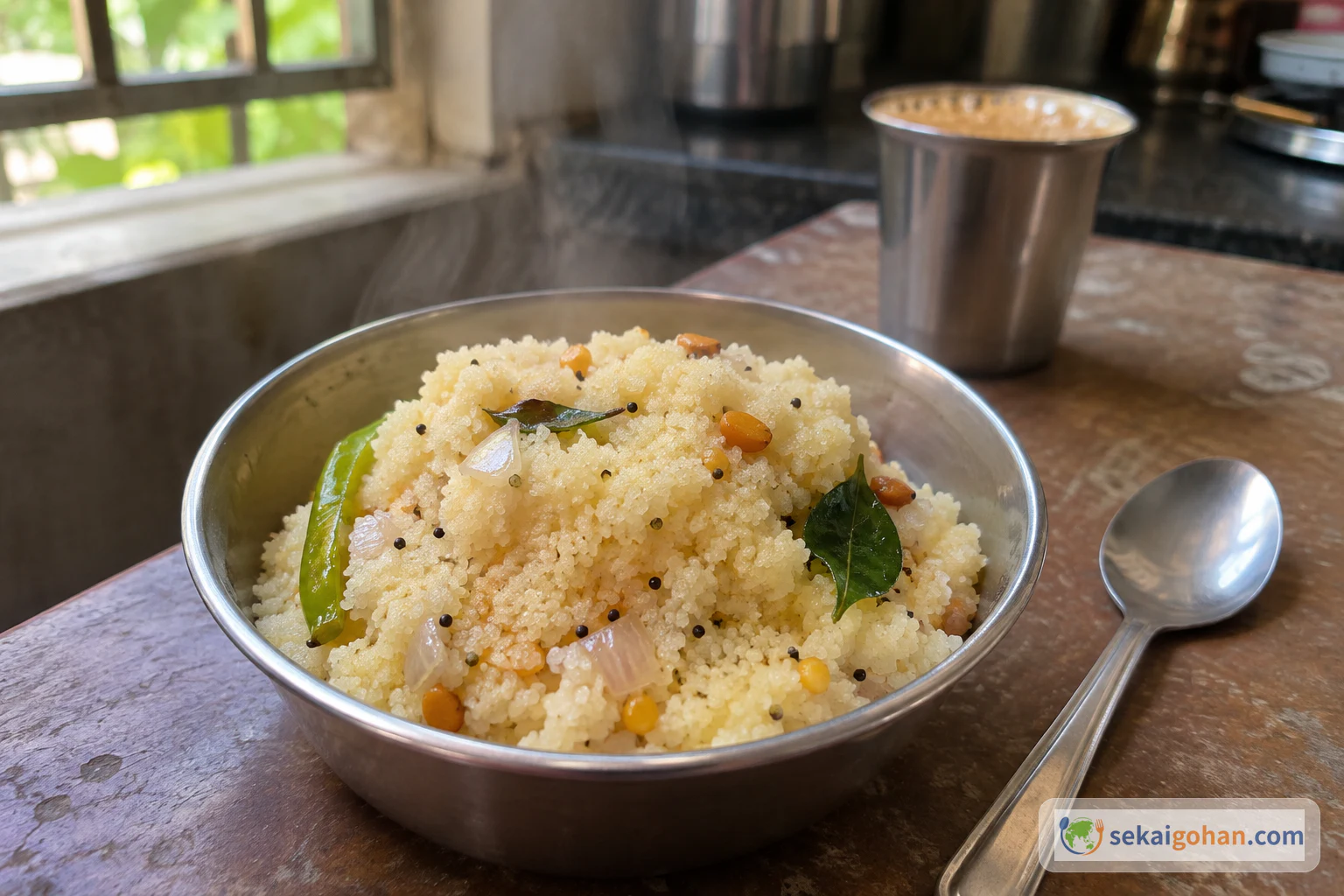
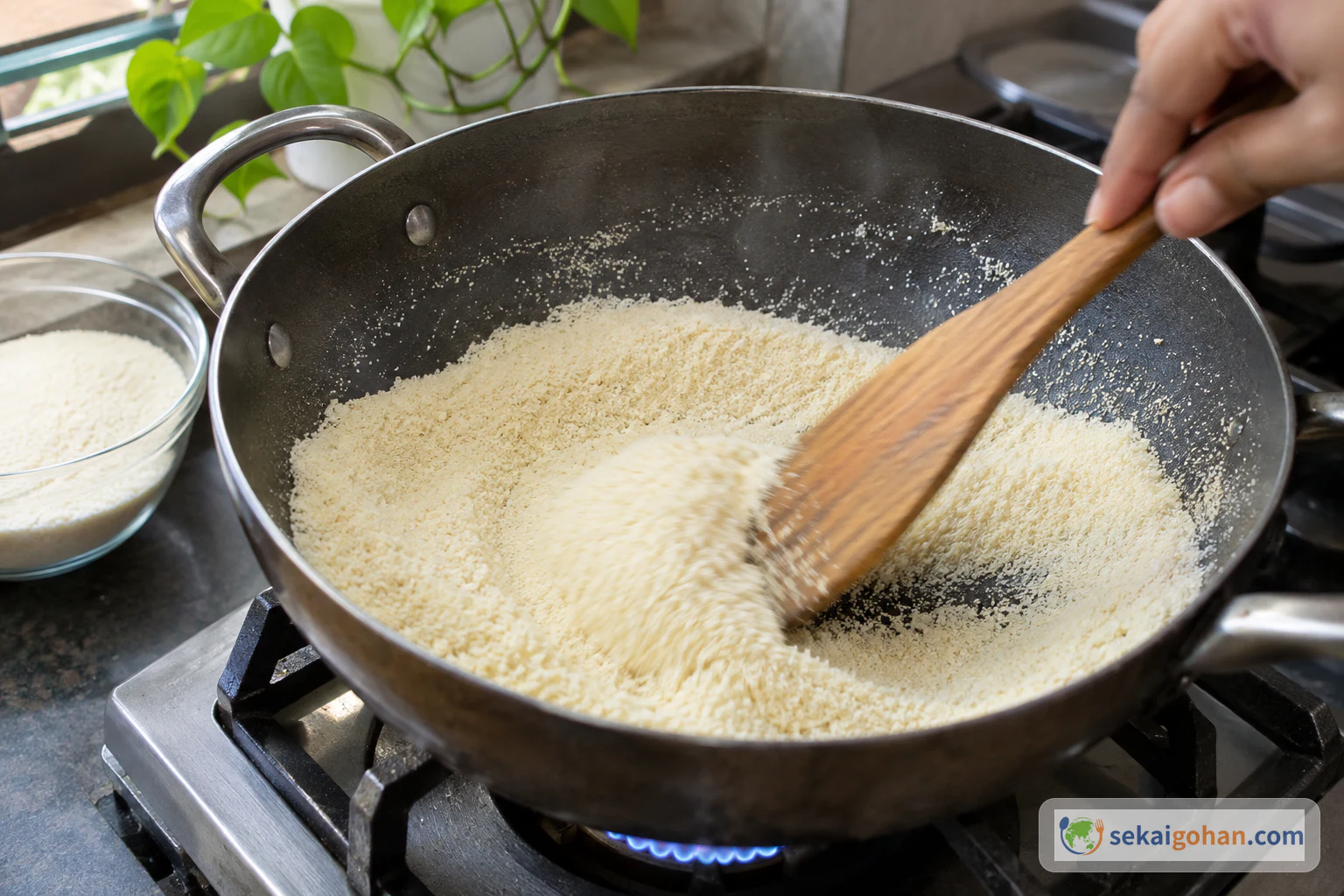
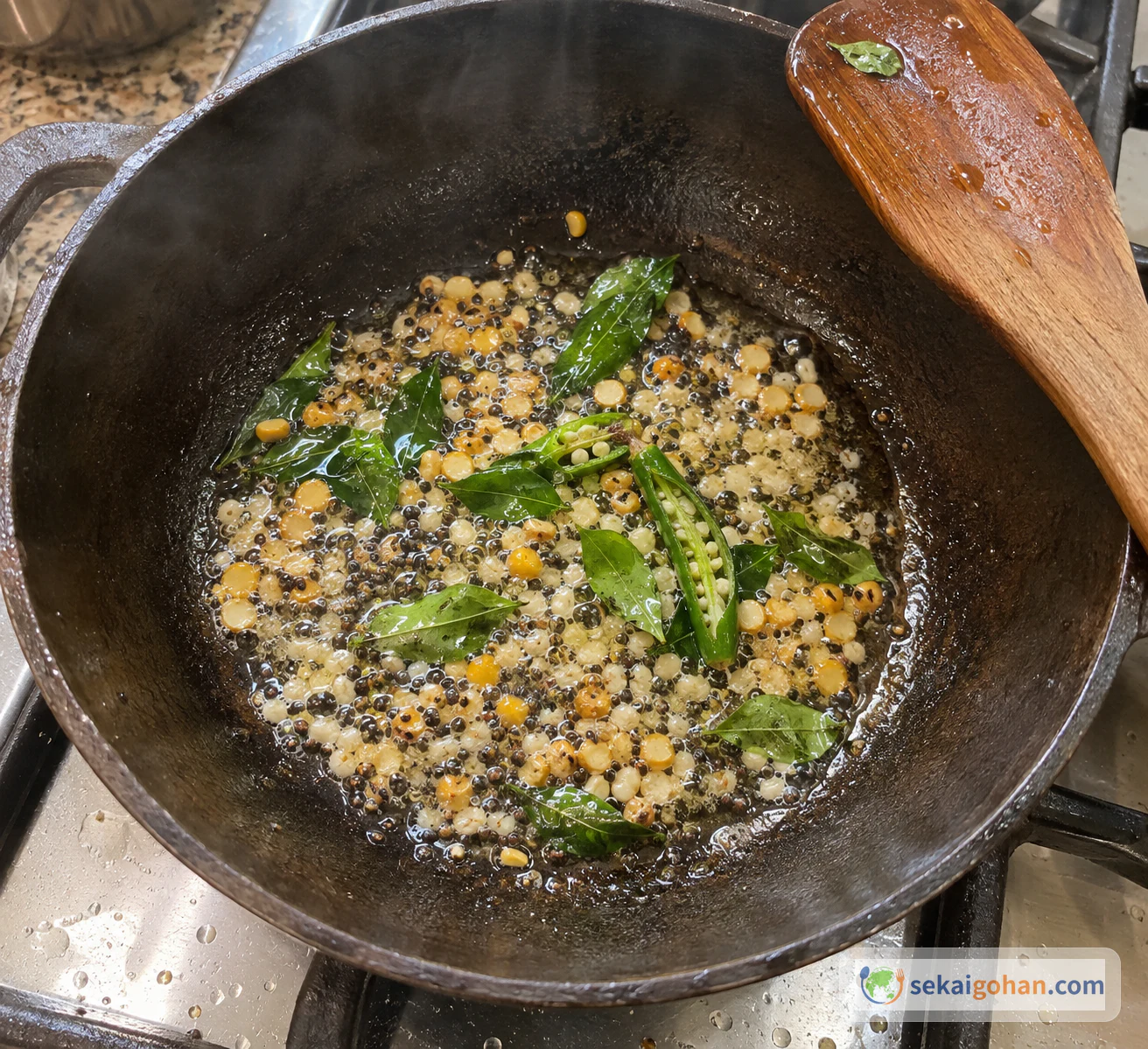
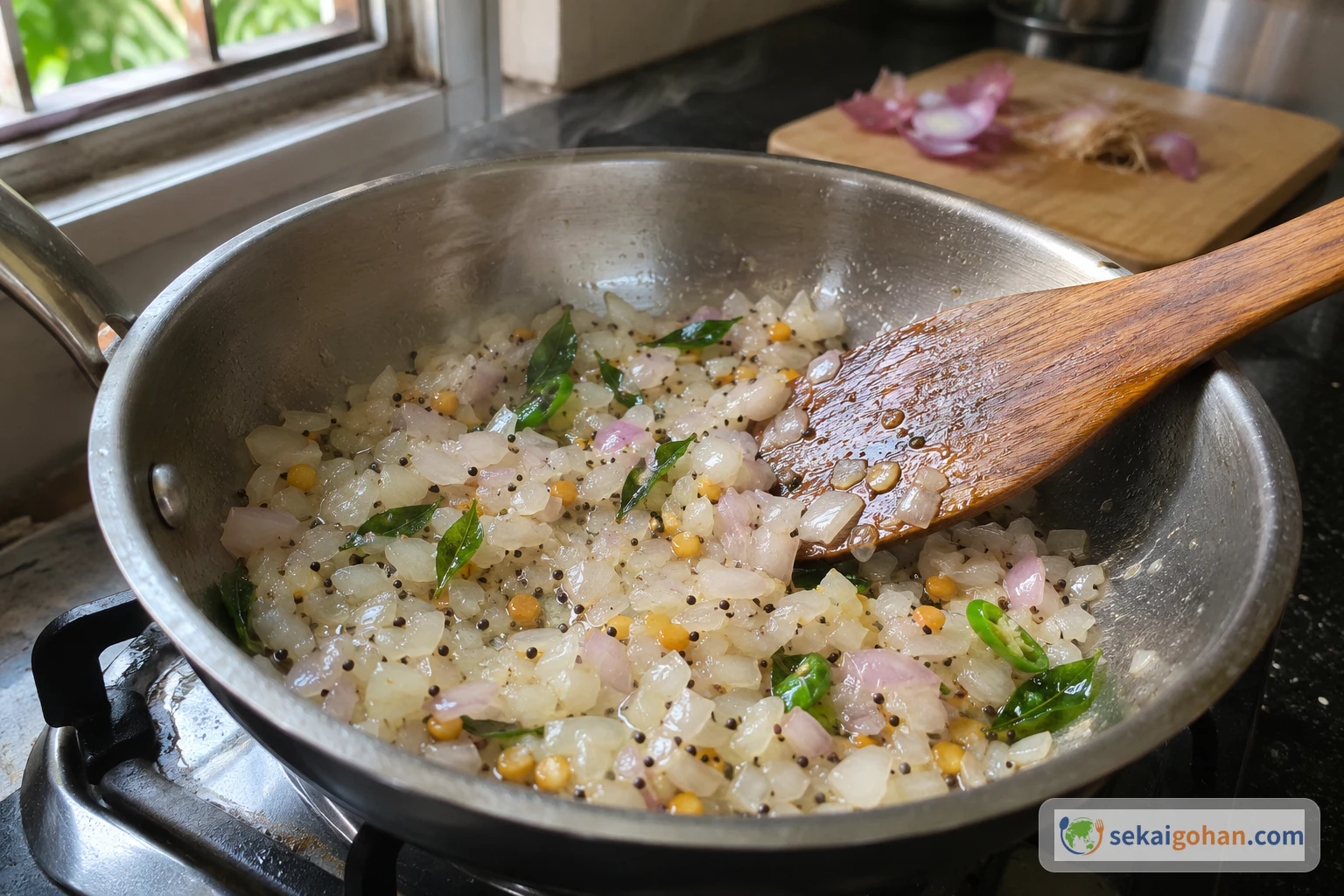
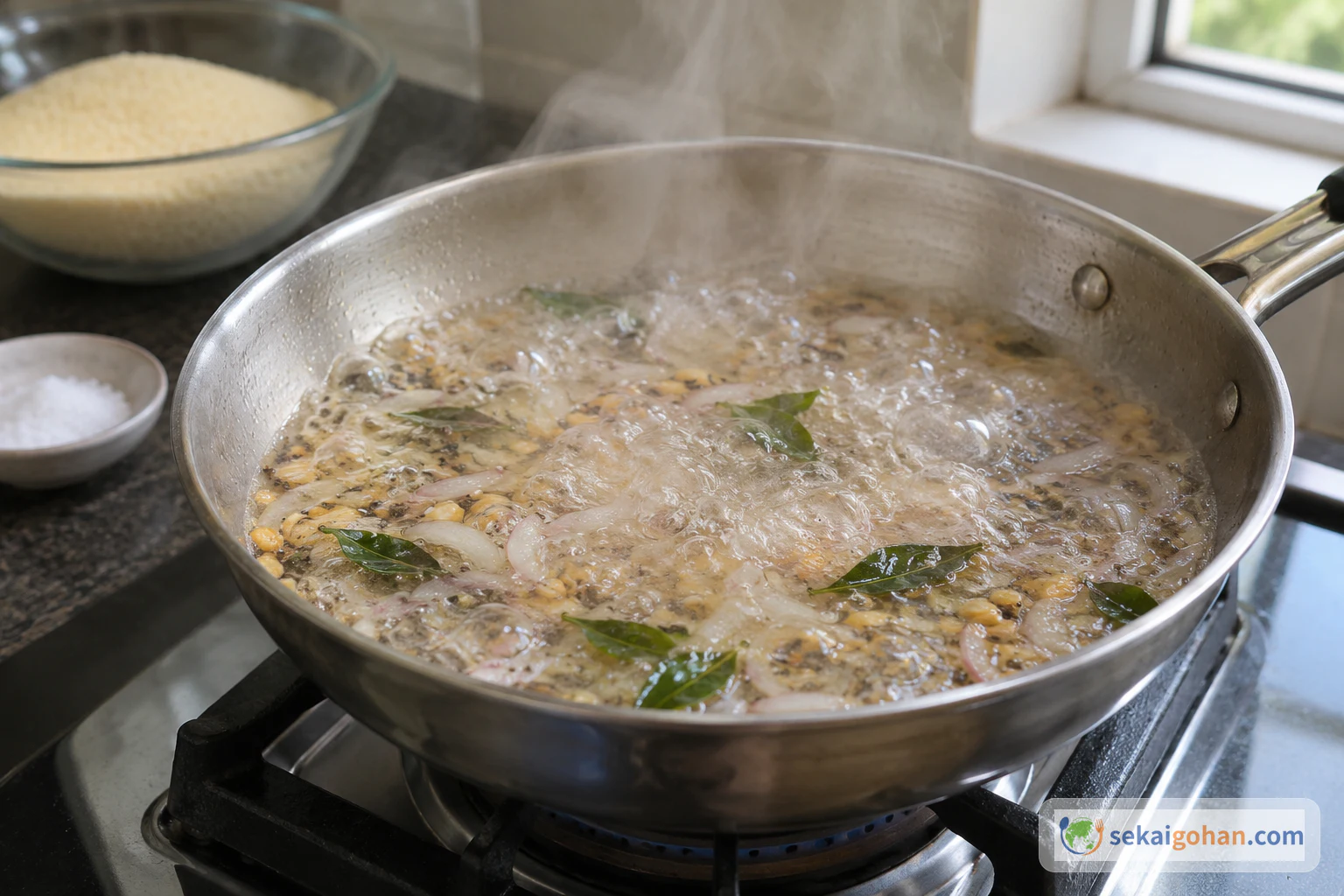
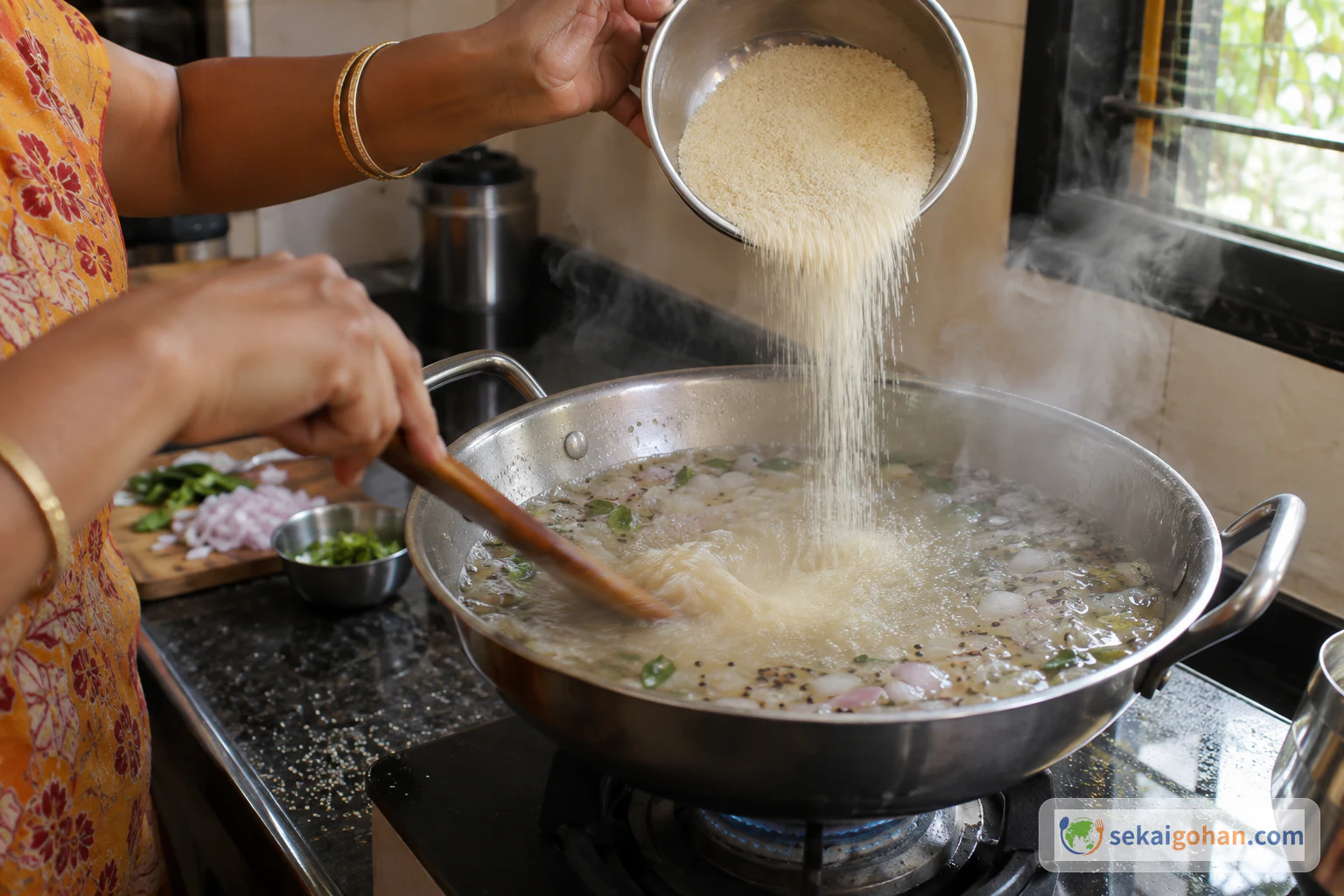
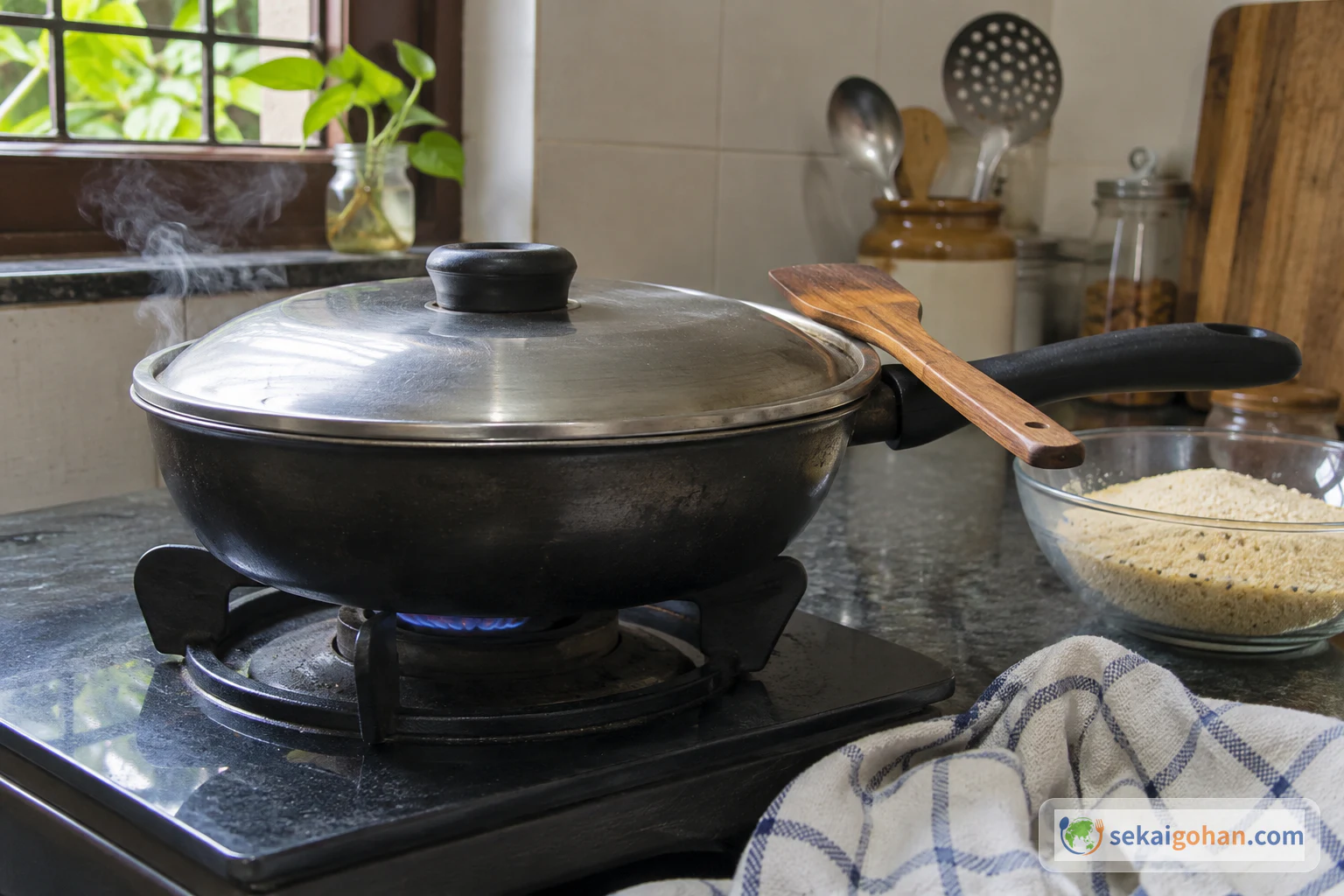
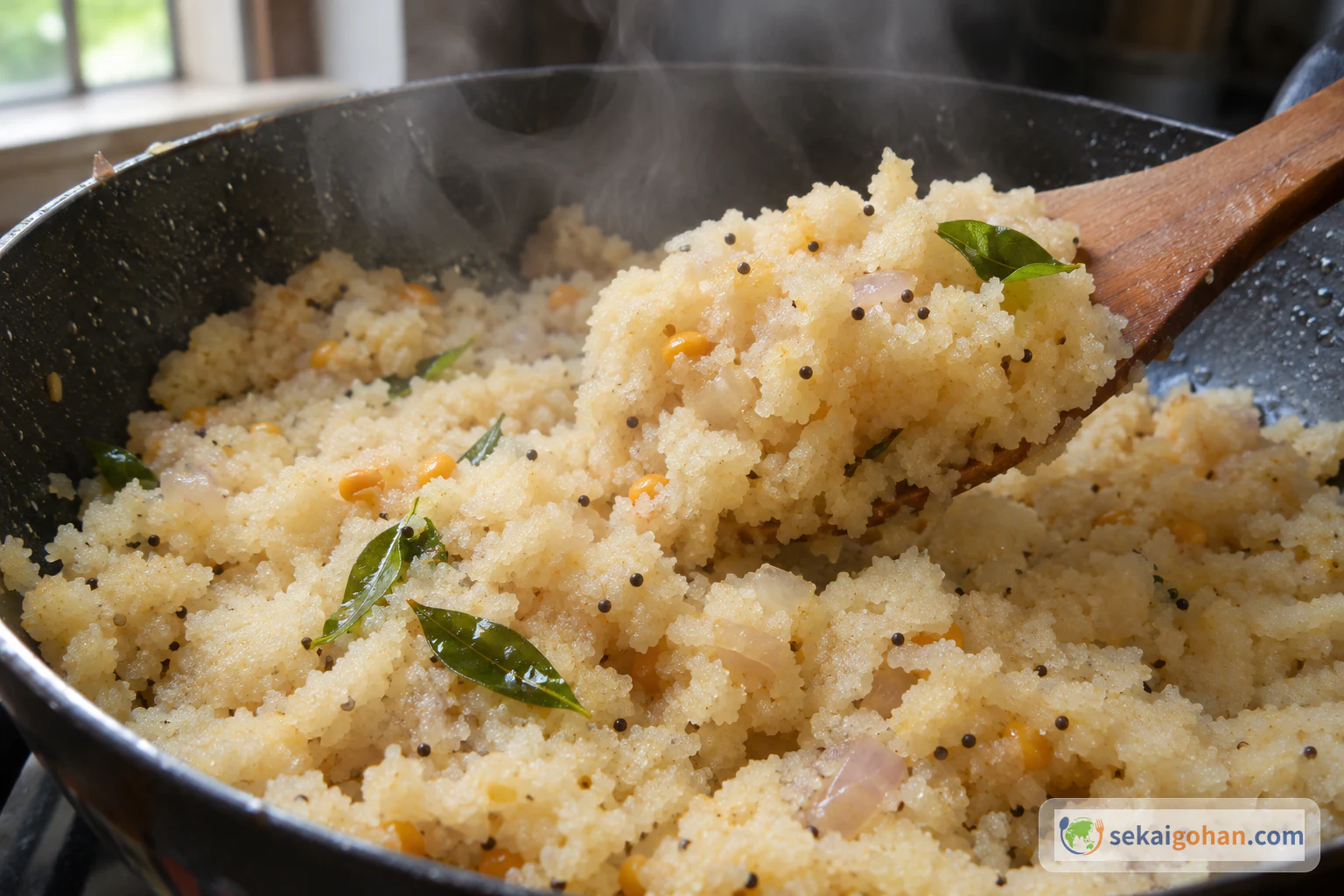
The semolina goes into a dry pan first. For a while the only sound is the spatula moving through it, and a smell like warm toast comes up off the grains. Then the oil goes in, black mustard seeds crackle against the metal, the dals turn gold and the curry leaves hiss. The water comes to a hard boil, the semolina streams in under a moving spoon, and a few quiet minutes under the lid later you have upma. It is soft grain that holds together on the spoon and falls apart in the mouth, salty and nutty, with a sharp edge from the mustard and green chilli. In South India it is everyday breakfast and evening tiffin. People order it at the counter with a tumbler of filter coffee, and at home it is on the table in about twenty minutes.
Salt and Flour: Where Upma Comes From
The name explains the dish. Upma comes from the Tamil uppu-mavu, "salt-flour": a ground grain cooked in salted water and made fragrant with a hot-oil tempering. Every language in the south has its own name for it, and every family cooks it slightly differently.
In Tamil it is uppuma, in Kannada uppittu or kharabath, in Malayalam uppumavu, and in Telugu upma or uppindi. Marathi speakers say saanja or upit, and in Konkani it is rulanv. On a menu, any of these names will get you a plate of upma.
From rice to rava
According to a BBC Travel feature, the history starts with rice: the oldest upma was made from broken rice or flour. By the late nineteenth century, in cookbooks such as the Pakashastra, printed in Madras in 1891, the rice version was called sada upma, plain upma. Rice shortages followed, worst of all during World War Two, and wheat and semolina were promoted in their place. In southern kitchens semolina came to be handled the way rice had been, and rava upma became the standard. This account rests on that one feature, so treat the details as its telling of the story. Semolina is the upma most people know today.
Tiffin counters, weddings and school mornings
"One plate upma, one filter coffee without sugar, please!" You hear that order across South India, at breakfast and again at dinner, in tiffin houses and in Udupi restaurants. Upma is also a regular at South Indian weddings. A Hyderabad wedding caterer describes it as a standard because it is inexpensive, easy to cook in large quantities and needs few accompaniments.
It also feeds schoolchildren. Tamil Nadu's Chief Minister's Breakfast Scheme started on 15 September 2022 and serves about 17.35 lakh students (roughly 1.7 million) in 34,987 schools. Its five-day menu put upma on Mondays and Thursdays, khichadi on Tuesdays and Fridays and pongal on Wednesdays, with upma and khichadi made from rice and rava, and also from wheat rava and semiya. In April 2025 the state's Social Welfare Minister told the Assembly that rice upma would be replaced with pongal and sambar from the next academic year. For more dishes from the same kitchens, see the India page.
The wider family
Upma is defined by its method more than by one grain. Karnataka has masala upma, also called kharabath, which is sharper with chilli and masala. Tamil Nadu makes it with whole or cracked wheat. Andhra Pradesh and Telangana pair upma with pesarattu. Rice upma, corn upma, semiya upma made with vermicelli and aval upma made with flattened rice all use the same idea with a different starch. Each of these has its own proportions, so treat them as separate recipes. Upma is never fermented, unlike idli and dosa. It goes from a cold pan to the table in one session.
Ingredients (serves 4)
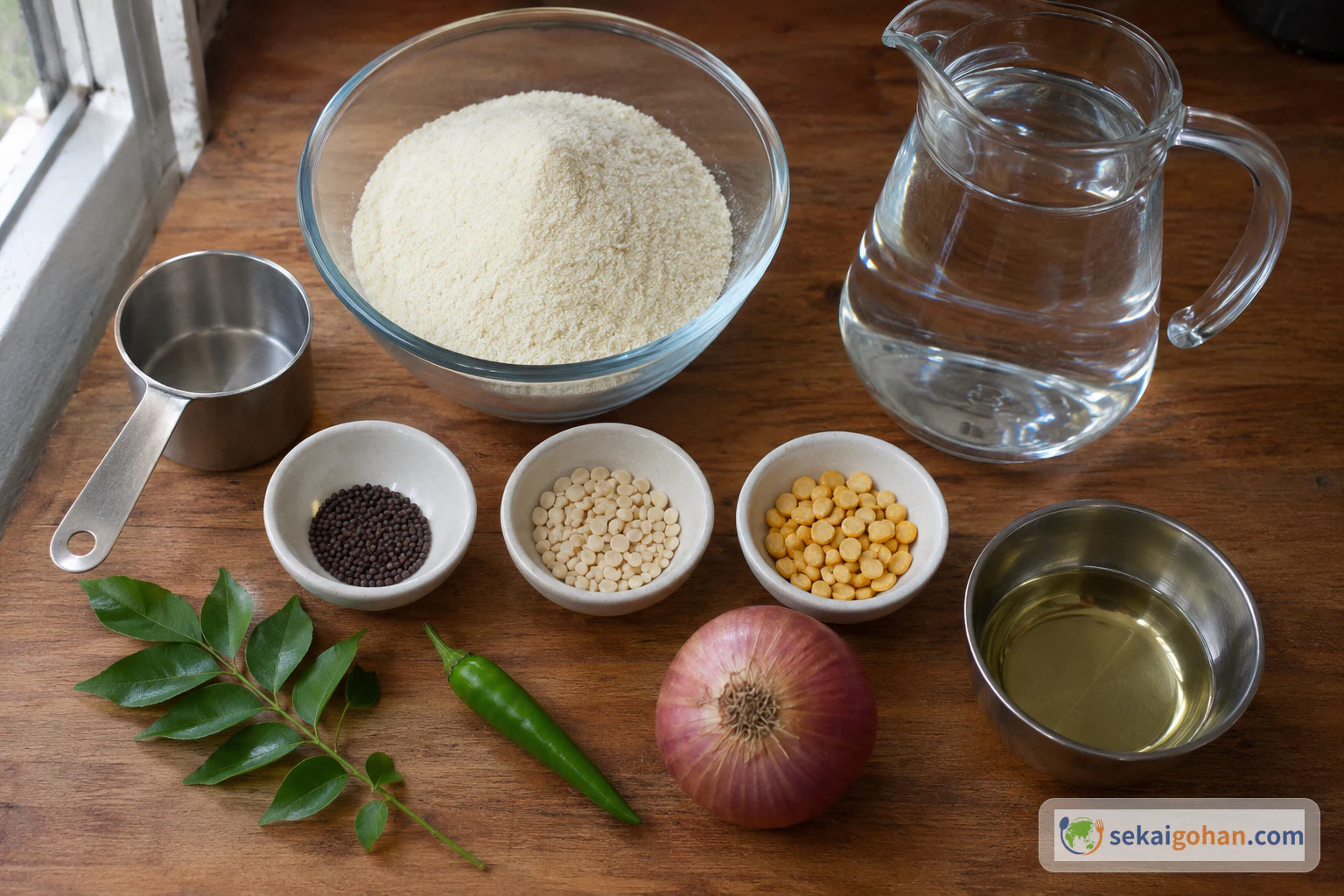
The dish depends on the ratio of 1 part rava to 2½ parts water by volume. Use the same cup for both and the proportions hold, whatever size your cup is.
Semolina is wheat and contains gluten. Ghee, or butter if you use it, contains milk; with oil alone the dish is dairy-free. This version has no nuts. The green chilli adds heat.
Equipment
- Heavy-bottomed pan with a lid
- Wooden spatula
- Measuring cup
- Small bowl or plate for the roasted rava
- Cutting board and knife
Choosing Semolina, Dals and Curry Leaves
The grind of the semolina decides the texture before you light the stove. Coarse semolina gives fluffy upma, and fine semolina turns it mushy. At an Indian grocer or online, look for rava, Bombay rava or sooji. The durum semolina sold in supermarkets for pasta and baking is usually ground finer. It still makes upma, only softer and closer to porridge. If fine semolina is all you have, the best amount of water for it has not been established; start with a little less than the table gives and watch how it behaves.
The tempering is what makes it taste like the south, and each part does a specific job:
| Ingredient | Where to find it | If you swap or skip it |
|---|---|---|
| Mustard seeds | Indian grocers, spice aisles; buy whole brown seeds | Mustard powder will not pop in oil and cannot replace them. Without the seeds the dish loses its main note |
| Curry leaves | Fresh, frozen or dried at Indian grocers and online | You can leave them out, but the South Indian character fades. Bay leaf and basil smell completely different and are no substitute |
| Urad dal and chana dal | Indian grocers, sold split and skinned | You can omit them, but you lose the toasty layer and the bits of crunch. Whole chickpeas or soybeans cook at a different pace and don't work here |
| Green chilli | Supermarkets, Asian grocers | A dried red chilli gives a flatter, drier heat; leaving it out makes the upma very mild |
| Ghee | Indian grocers, many supermarkets | Oil is lighter and ghee is fuller. Butter works in place of ghee, with a dairy sweetness |
| Onion | Anywhere | It is optional. Without it the upma is lighter and the toasted wheat comes forward |
Frozen curry leaves keep well and are worth buying if you will cook more South Indian dishes. The dals are needed only in small quantities, so a small bag is enough.
Method: Roast, Temper, Pour
Chop the onion and set out every ingredient before you begin, because once the tempering starts there is no time to stop. Everything happens in one pan. You toast the rava dry and set it aside, build the tempering in the same pan, boil the water on top of it, and stir the rava back in. The only hands-off time is the short rest under the lid.
When It Goes Wrong
| What you see | Why | What to do |
|---|---|---|
| Lumps of dry flour inside | The rava went in too fast, or the water wasn't fully boiling | Cover and leave on low for a few minutes, then break the lumps with the spatula. Next time pour slowly and keep stirring |
| Soft and sticky, like porridge | Too much water, or the semolina is fine-ground | Serve it soft. Next time buy coarse rava and keep to 2½ cups of water |
| Dry, floury and crumbly | Too little water, a rest that was too short, or over-roasted rava | Cover and steam on low a little longer, stirring once or twice |
| Bitter, scorched smell | The rava browned or stuck during roasting | Start again. Burnt grain flavors the whole pan. Roast over medium, stir constantly, and tip the rava out at the first hint of color |
| Too salty | Salt grain size changes how much a teaspoon holds | Serve with plain coconut chutney. Next time use a little less salt and adjust at the end |
Serving, Variations and Making Ahead
What goes on the table
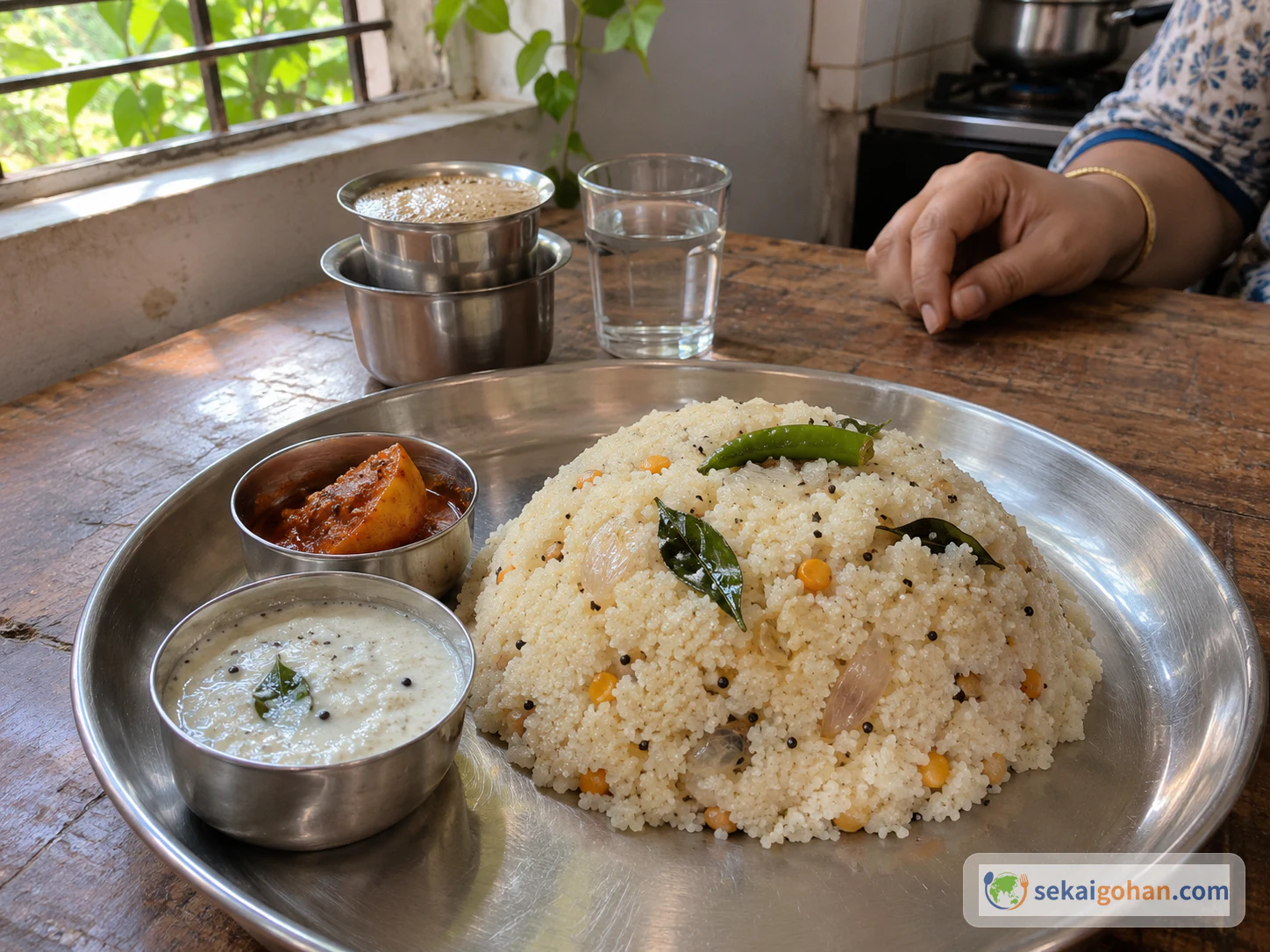
Upma is fairly dry, so it is served with something wet or sharp. Sambar or coconut chutney moistens the grains, and a spoon of lemon pickle cuts through the salt. Some people sprinkle on a little sugar instead. Hot coffee goes with it, and in South Indian homes and tiffin houses that means filter coffee in a steel tumbler. Make it for a working morning, a light supper, or whenever you need breakfast for many people without much work.
Variations
- Vegetables: fry carrots, corn or peas after the tempering, before the water goes in. The vegetables release moisture, so as an editorial suggestion, use a little less water. You get a heartier, more colorful plate.
- Lemon and coconut: squeeze lemon over the finished upma and scatter fresh grated coconut on top. The acid sharpens the salt and the coconut adds sweetness and chew.
- Ginger or tomato: either can be added. Ginger brightens the flavor, and tomato makes it softer and slightly tangy.
- The Kerala way: serve uppumavu with banana mashed by hand on the side. Its sweetness rounds out the chilli and salt, and it is a common breakfast there.
Making ahead and leftovers
For the fastest morning, make the dish up to the tempering stage, cool it and refrigerate it for up to a day. Just before serving, bring it back to a boil with the water and salt and finish from step 5. No storage time is published for finished upma; as an editorial suggestion, cool it, cover it in a clean container, refrigerate it promptly and eat it the next day. Reheat it in a pan or the microwave, sprinkling on a little hot water if it has dried out.
Frequently Asked Questions
How is upma different from khichdi and pongal?
The grain is different. Upma is semolina cooked into soft, separate grains. Khichdi cooks rice with lentils, and ven pongal is rice with moong dal, so both are closer to a savory porridge. They appear together on breakfast menus in the south, but each tastes and feels different on the spoon.
How spicy is upma?
It is mild. One green chilli spread through four servings gives a little warmth, and the mustard adds a sharp tingle rather than burning heat. For more fire, look for masala upma (kharabath), which is cooked with red chilli and masala.
Can I make upma with cracked wheat, rice or vermicelli?
Yes, and each is its own dish: cracked-wheat upma, rice upma, semiya upma. The tempering is the same, but the grain absorbs water at a different rate. Follow a recipe written for that grain instead of using the semolina ratio.
Is upma only for breakfast?
No. Tiffin houses serve it at breakfast and again at dinner, and weddings serve it in large batches. Its speed makes it a good weeknight supper, especially with sambar alongside.