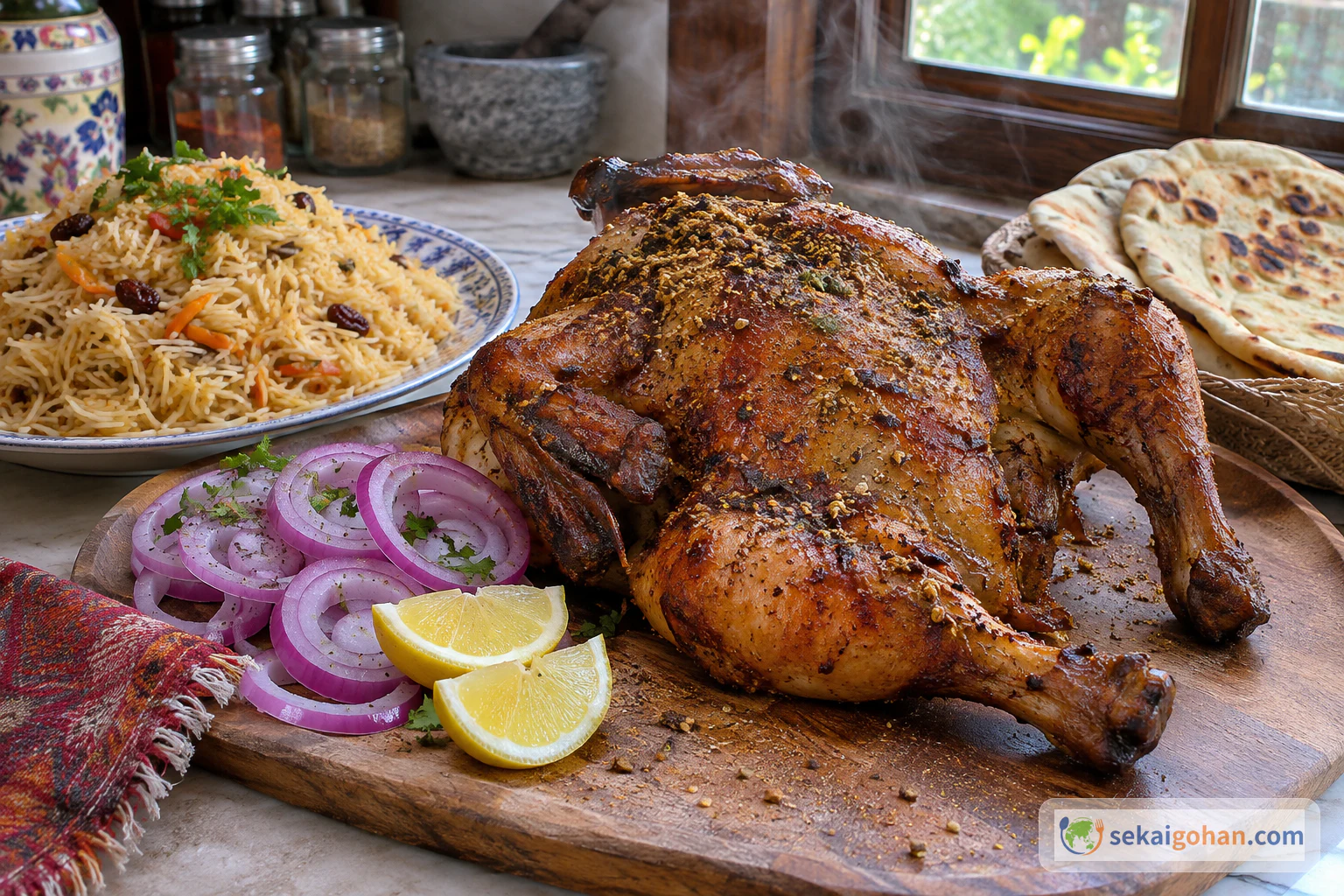
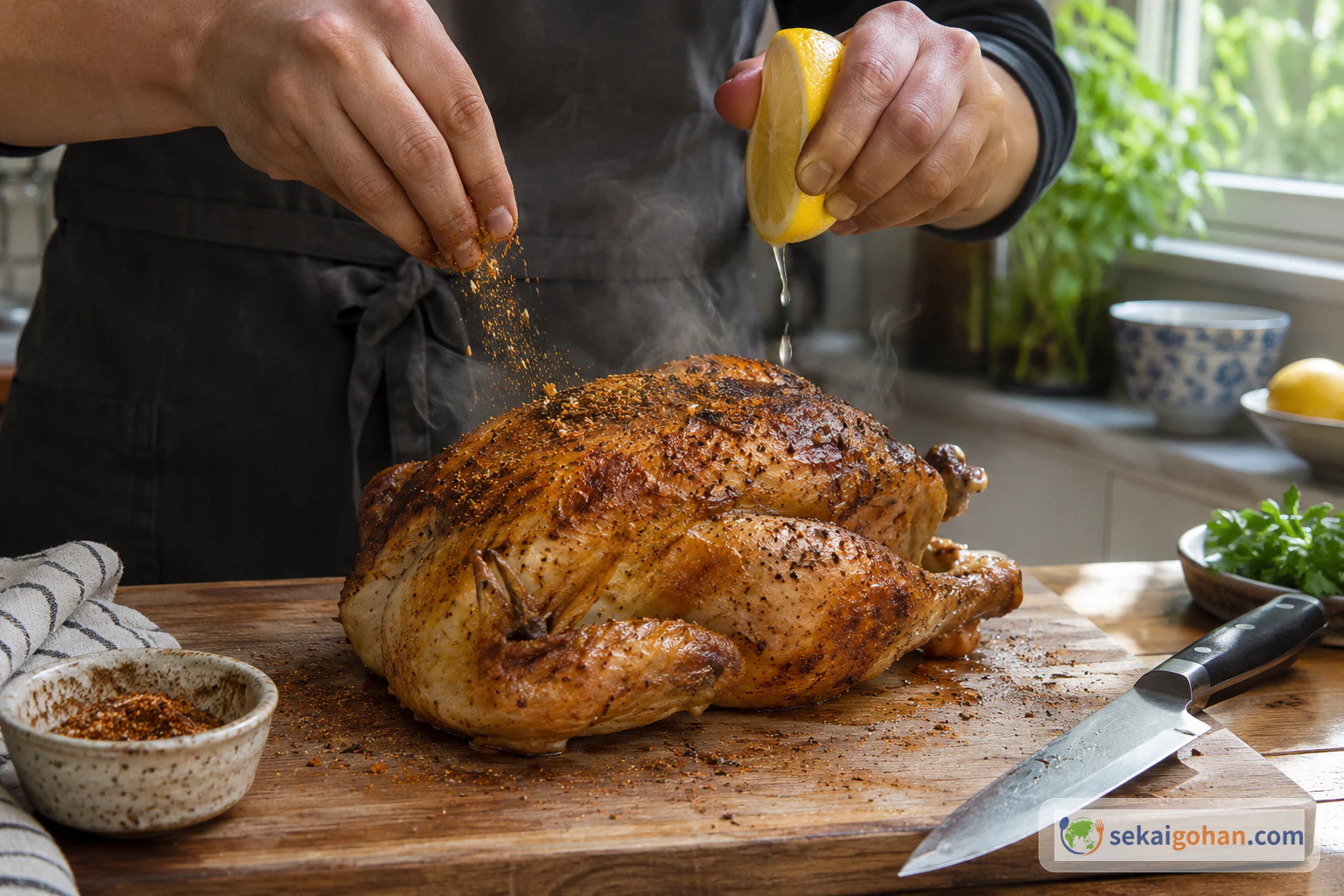
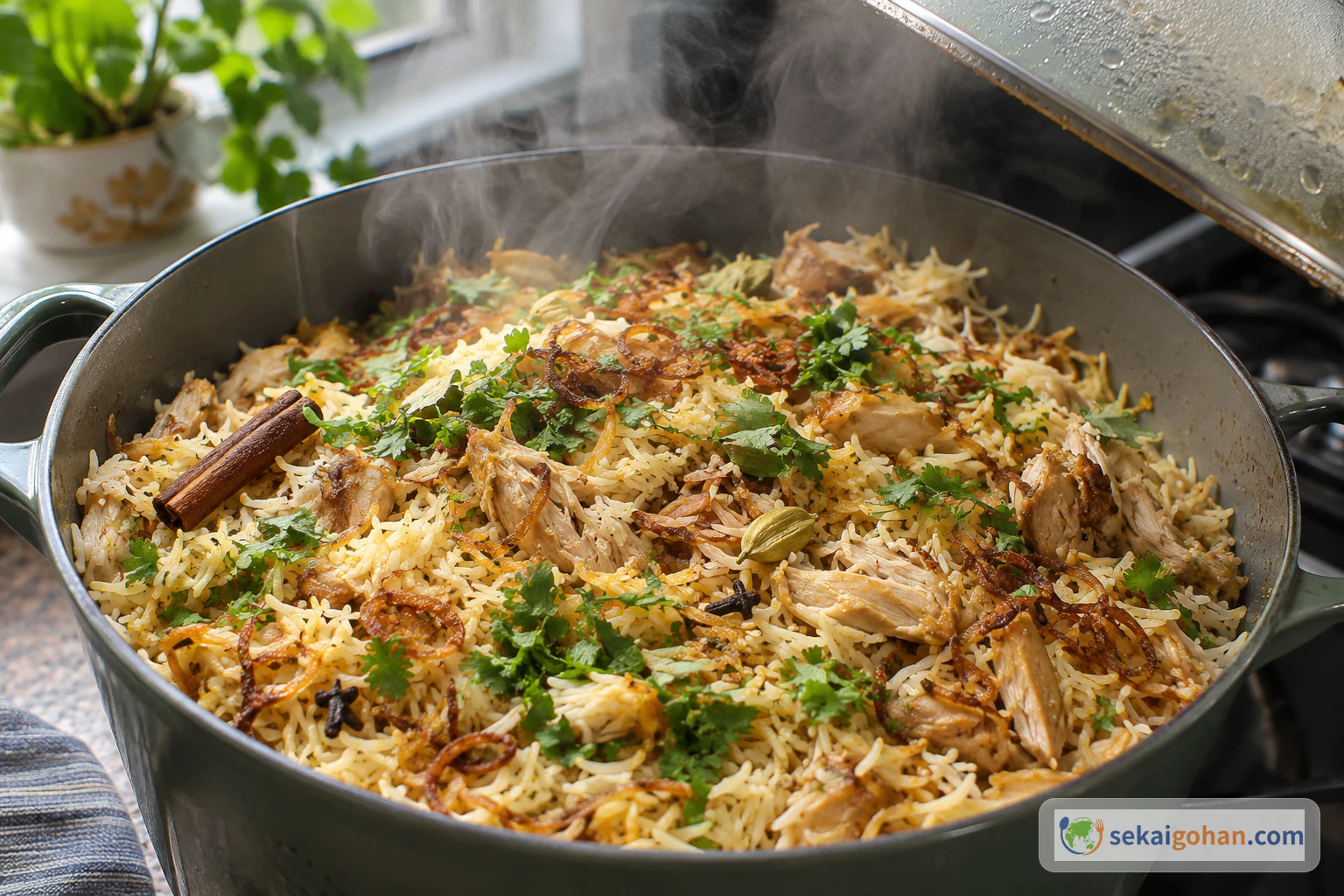
Finished Balochi-style roast chicken (sajji): a whole chicken with golden skin on a wooden board, served with rice pilaf, onion and lemon
CuisinePakistani

Sajji: Balochi Brined and Spice-Roasted Whole Chicken

Sajji from Balochistan, Pakistan, as a home-oven whole chicken: an overnight salt and vinegar brine, toasted spice paste, a thigh check, and a separate pilaf.

Level: Intermediate

Cooking flow

Cooking steps

STEP 11 / 11

Brine the chicken overnight

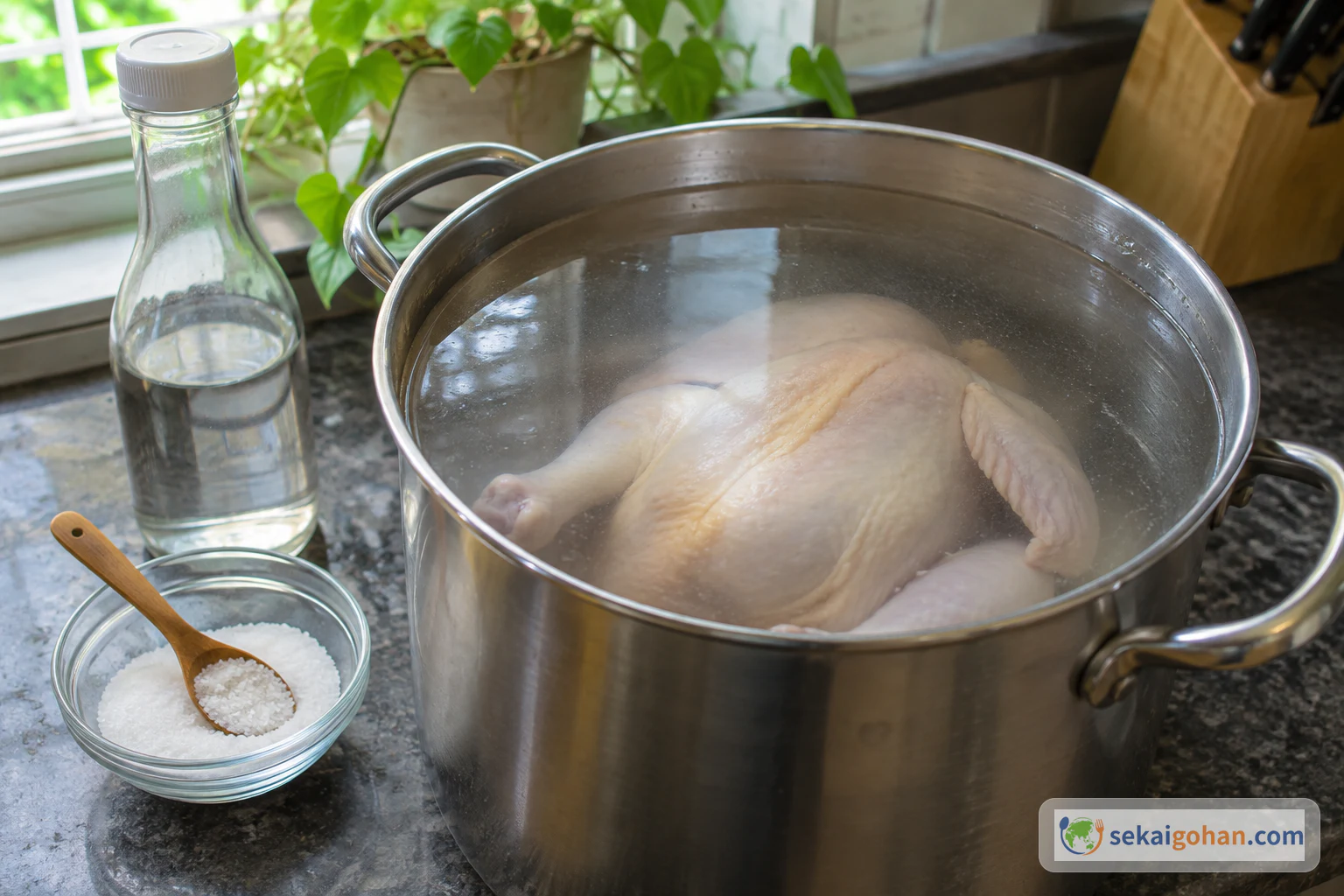
A whole chicken submerged in cold water with salt and vinegar, ready for the refrigerator
The whole bird sits below the waterline, with no part sticking out

Rinse the inside of the cavity well under cold water. Fill a container with enough cold water to cover the chicken completely, and stir in 2 tbsp salt and ½ cup (120 ml) vinegar until the salt dissolves. Sink the chicken fully into the brine and refrigerate it for at least 12 hours, or overnight.

STEP 22 / 11

Rinse and dry the bird

STEP 2

Lift the chicken out and pour the brine away. Rinse the chicken once under cold water. Pat it dry with paper towels inside and out, pressing into the folds under the wings and legs. Pat until no surface moisture is left.

STEP 33 / 11

Toast, grind and divide the spices

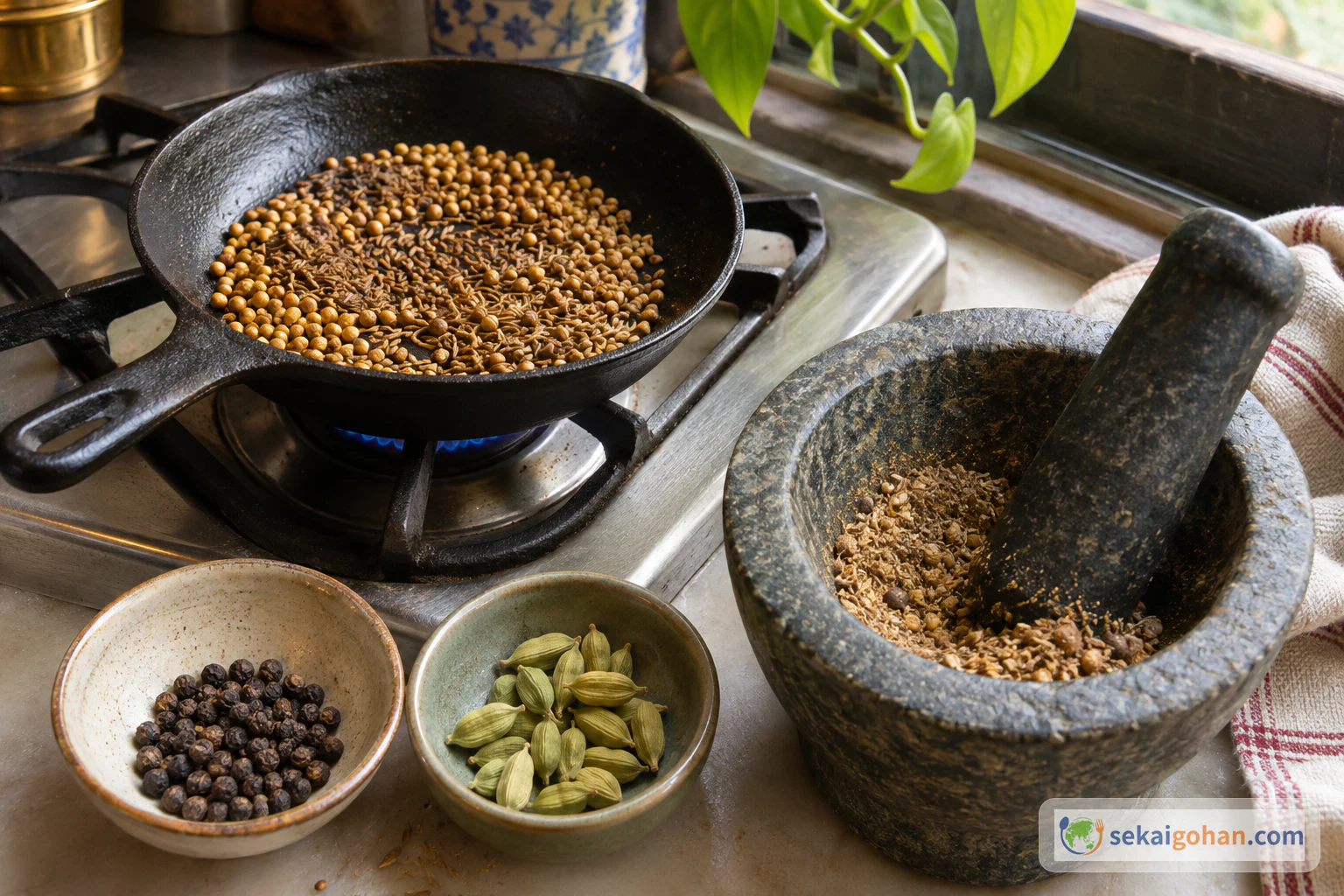
Coriander, cumin and ajwain dry-roasting in a cast-iron pan beside a mortar of coarsely ground spice
Take the pan off the heat while the seeds are still light; ground coarse, they show as visible flecks

Put the coriander, cumin and ajwain in a small dry pan over medium heat and shake it often. Toast until the coriander turns faintly golden, then tip the seeds out of the hot pan and grind them coarsely. Mix in 2 tsp salt, 1 tbsp black pepper and 1 tsp cardamom powder. Divide the mix into two equal halves, one for the paste and one for finishing, and set the finishing half aside.

STEP 44 / 11

Blend the paste

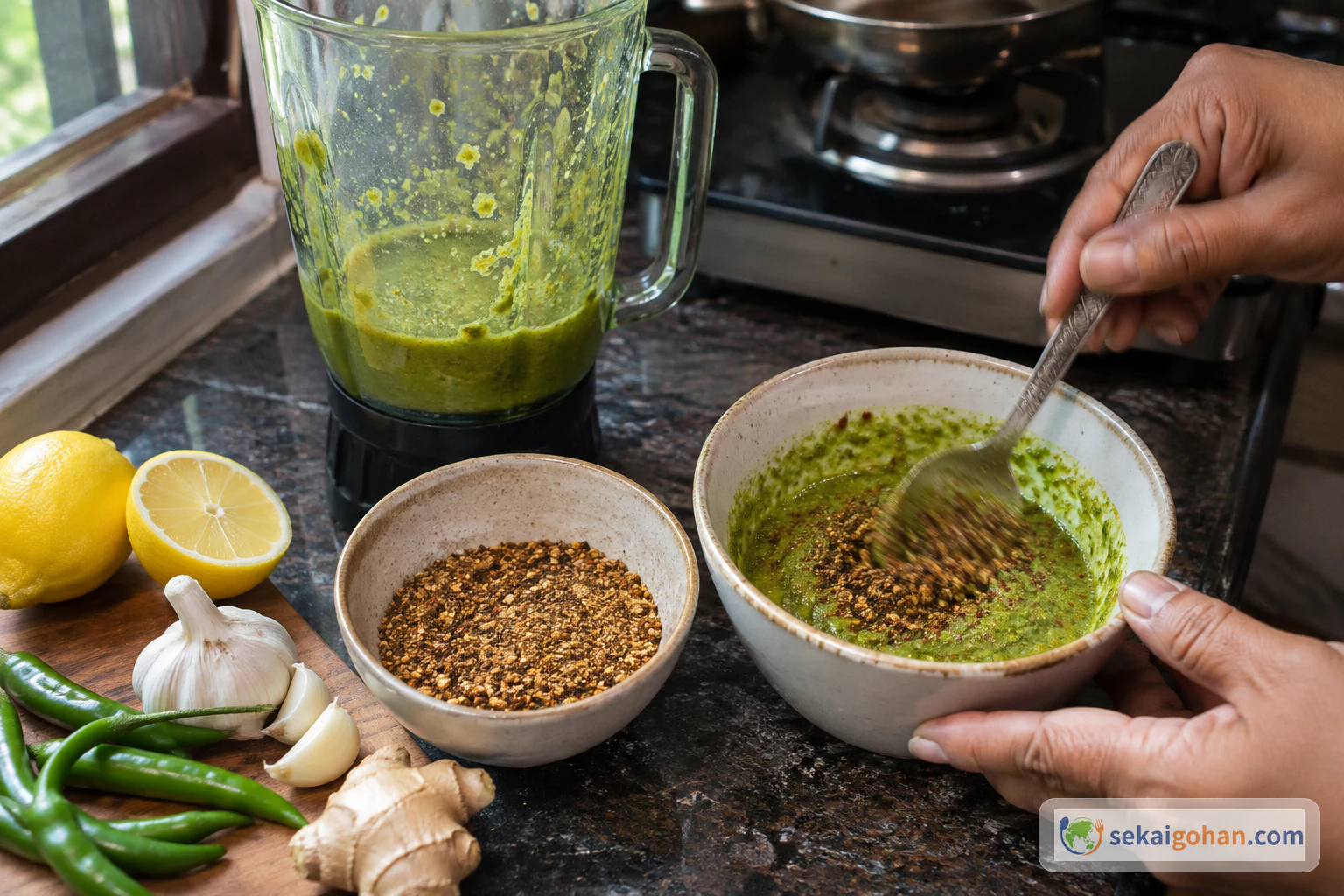
A blender jar of green lemon-chili paste next to a bowl where the roasted spice mix is stirred in
Stir the spice in by hand after blending, so the coarse grind keeps its texture

Put ¼ cup (60 ml) lemon juice, the green chilies, garlic and ginger in a blender. Blend until the chilies and ginger disappear into the liquid. Scrape the paste into a bowl and stir in one half of the spice mix. Stir until the spice is evenly mixed through.

Two halves, two jobs

Keep the finishing half of the spice mix in its own bowl, well away from the paste and the raw chicken. That half goes onto the cooked bird, so it must stay clean, and it brings back the fresh toasted aroma that the long roast softens.

STEP 55 / 11

Coat the chicken and let it sit

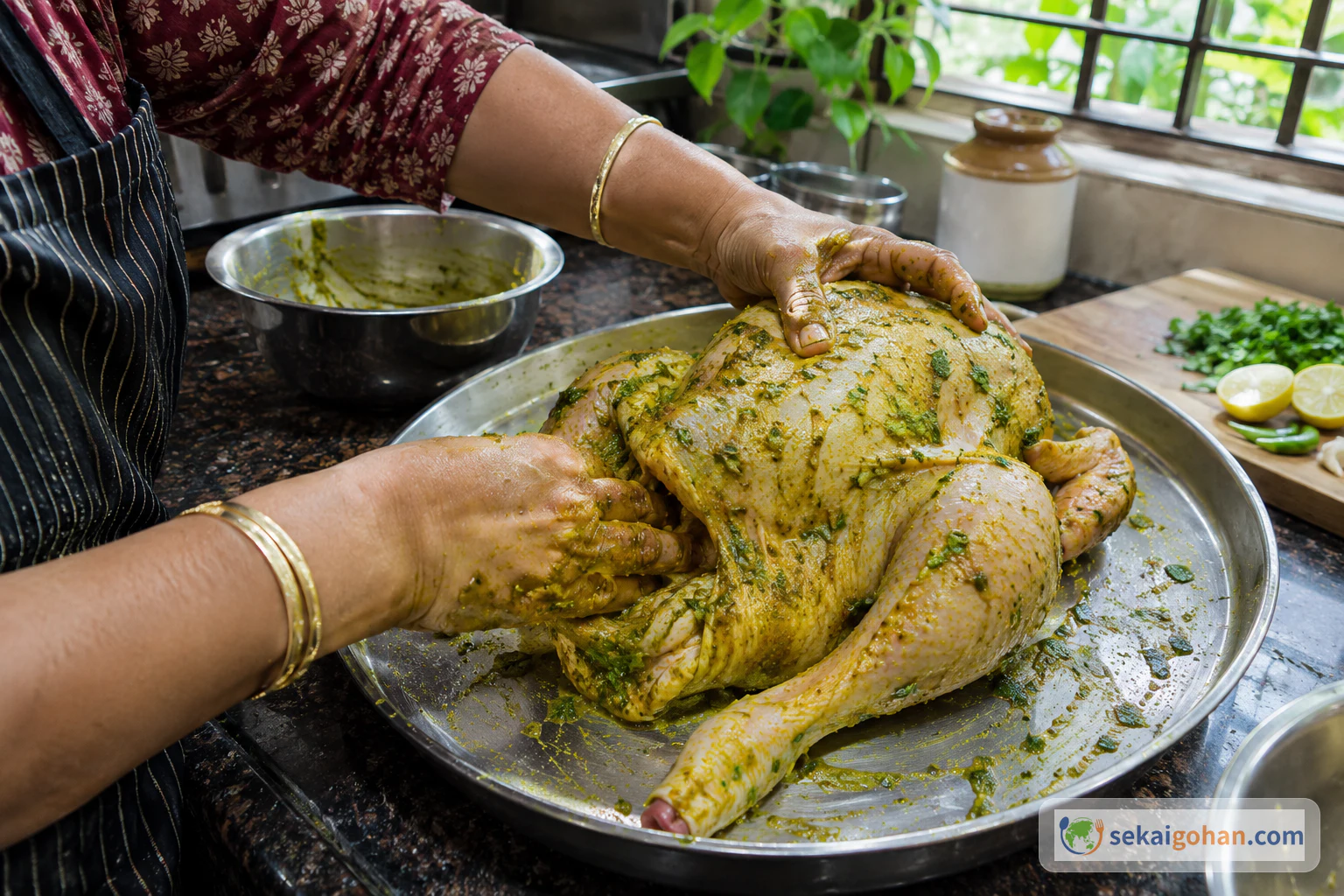
Hands spreading green-flecked spice paste over a whole chicken on a steel tray
Push the paste into the creases where the legs meet the body

Set the chicken on a tray and spread the paste over the whole outside with your hands. Work it under the wings and around the legs, then rub the inside of the cavity as well. Leave the chicken on the counter for 15 to 20 minutes to come to room temperature. Preheat the oven to 320°F (160°C) during this time. Move on when every surface is coated.

STEP 66 / 11

Truss the bird

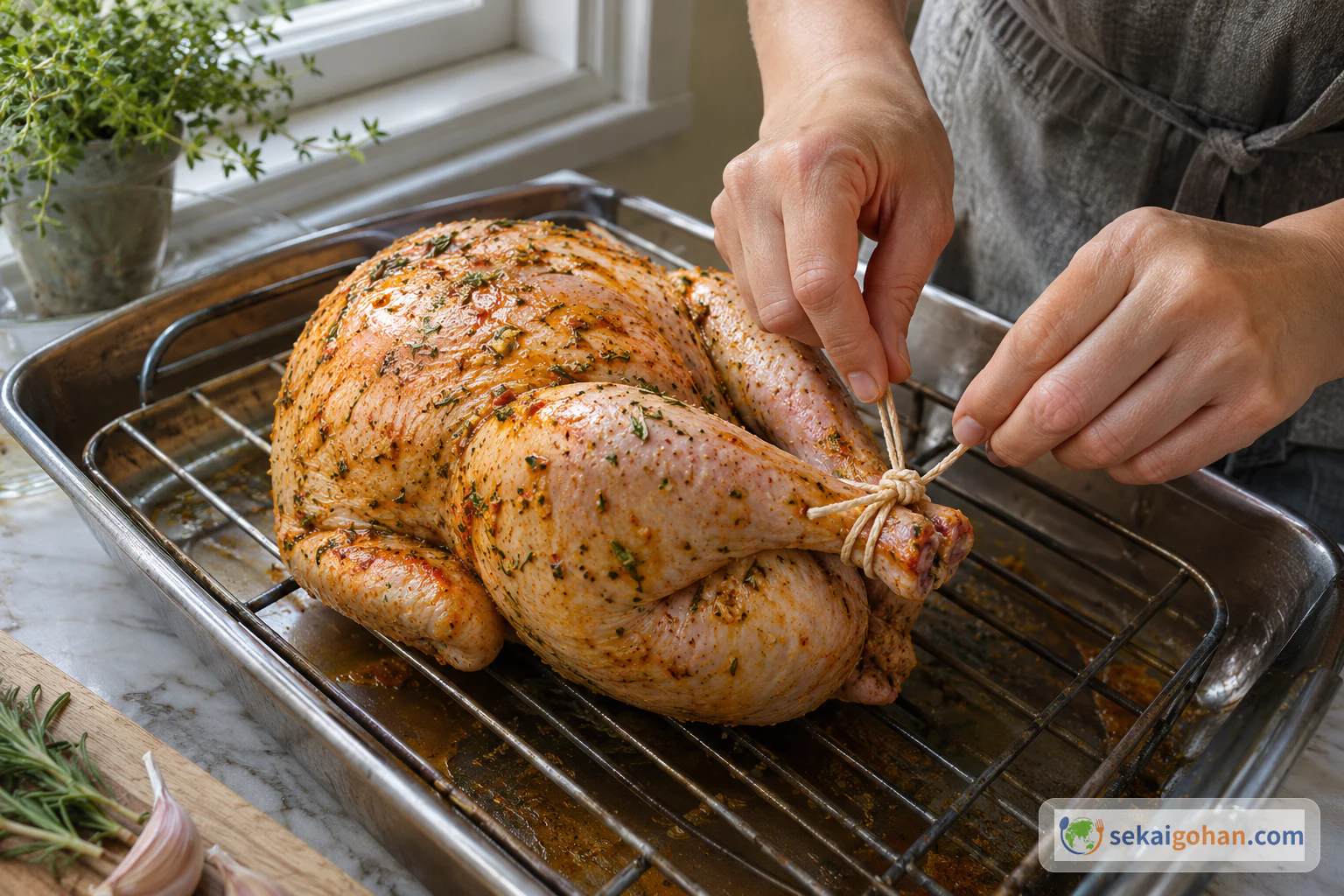
A marinated chicken on a roasting rack with its legs tied with twine and wings tucked under
A tight knot at the ankles keeps the legs close to the breast so the bird browns evenly

Cross the ends of the legs and tie them tightly together with kitchen twine. Tuck the wing tips under the body. Set the chicken on the rack over its tray, or fix it on the rotisserie. The bird is ready for the oven when it sits compact and even, with nothing sticking out to scorch.

STEP 77 / 11

Roast until golden

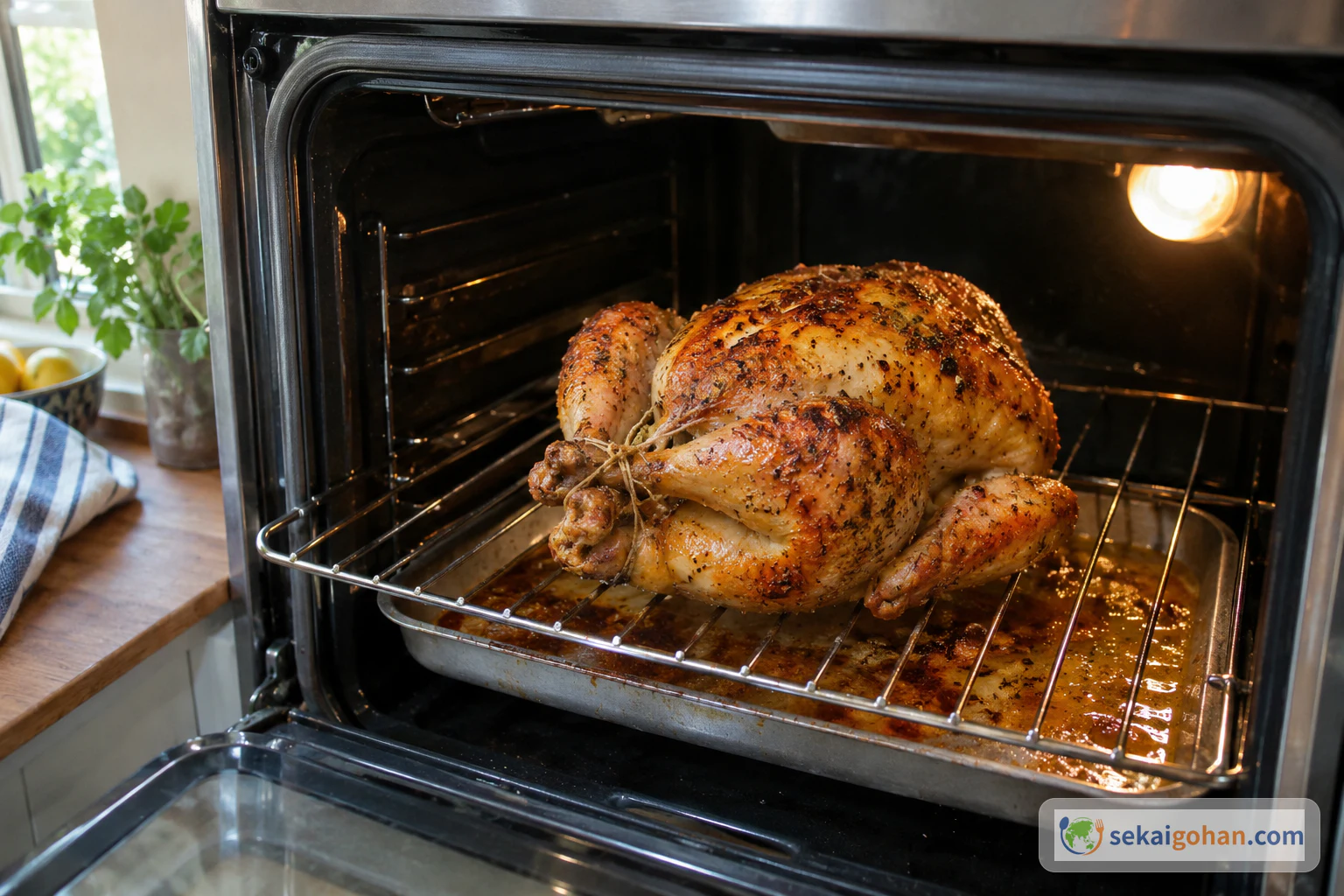
A trussed chicken roasting on a rack over a drip tray inside a home oven, its skin turning golden
Halfway through the skin is already gold, and the spice flecks are darkening

Roast the chicken at 320°F (160°C) for 40 to 50 minutes. On a rotisserie, set a drip tray underneath to catch the juices. On a tray, turn the chicken over at about 20 minutes so both sides color. Roast until the skin is deep golden all over, with the spice flecks dark against it.

STEP 88 / 11

Check the thigh

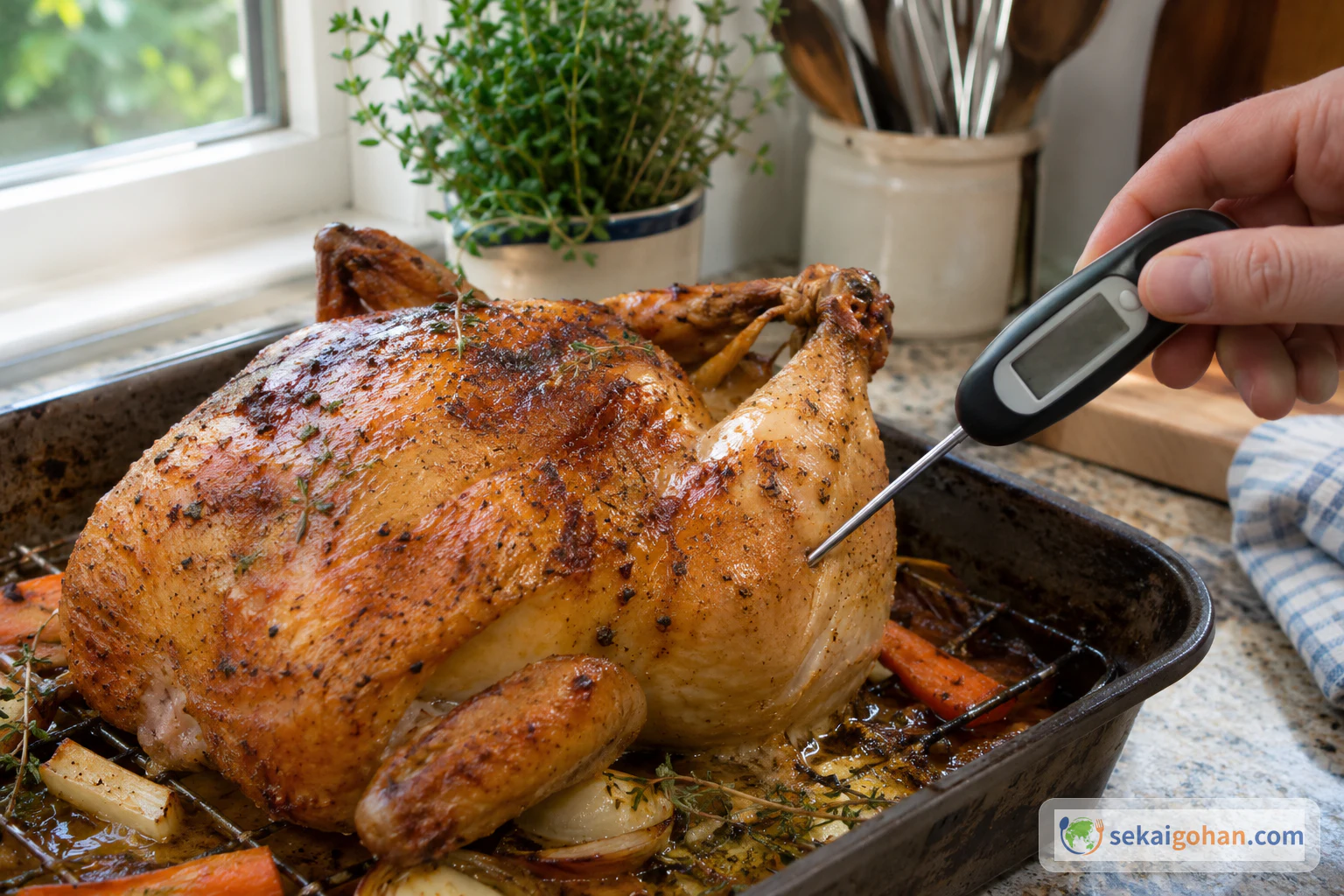
A digital thermometer inserted into the thickest part of a roast chicken's thigh
Angle the probe into the meatiest part of the leg, where the bird cooks last

Push an instant-read thermometer into the thickest part of the thigh, keeping it off the bone. The chicken is done at 165°F (74°C). If it reads lower, return the bird to the oven and check again in a few minutes. A second sign is the juice: pierce between the thigh and the body, and it runs clear.

Trust the thermometer over the clock

The 40 to 50 minutes fit a bird of about 2 lb (900 g). A larger chicken or an oven that runs cool needs longer, and a small bird finishes sooner. Pull it as soon as the thigh reads 165°F (74°C), and the breast stays juicy.

STEP 99 / 11

Rest and finish

A rested roast chicken on a wooden board being sprinkled with spice and squeezed with lemon
The heat of the skin brings up the scent of the fresh spice as it lands

Move the chicken to a board and let it rest for 10 to 15 minutes. Snip off the twine. Sprinkle the reserved half of the spice mix over the skin and squeeze the reserved lemon juice over it. Carve once the rest is over.

STEP 1010 / 11

Start the pilaf aromatics

STEP 10

While the chicken rests, heat 2 tbsp ghee in a heavy pot over medium heat. Add the onion, cumin seeds, cardamom, cinnamon and clove, and fry until the onion turns golden. Stir in the ginger-garlic paste and cook for 1 minute, until the raw smell fades. When the chicken has rested, pull 9 oz (250 g) of meat from it, leaving skin and bones behind, and shred it.

STEP 1111 / 11

Cook the rice

A pot of basmati pilaf just uncovered, with whole spices, golden onion, shredded chicken and fresh coriander
When the lid comes off, the grains stand apart, with the whole spices sitting on top

Add the shredded chicken and the rice to the pot and stir until every grain glistens with ghee. A short soak of the rice beforehand is the traditional way and you can do it here as well. Pour in a scant 2 cups (450 ml) water, salt it, and bring it to a boil. Cover and cook over low heat for 15 to 18 minutes, then scatter fresh coriander over the top. The pilaf is done when the water is absorbed and the grains are tender and separate.

0 / 0
Ingredients

Ingredients

1 / 3

Chicken and brine

Ingredient Amount Role
Whole chicken, skin on 1, about 2 lb (900 g) The roast. Leave it whole and uncut
Cold water Enough to cover the chicken completely Brine base
Vinegar ½ cup (120 ml) Brine; gives the meat its light sourness
Salt 2 tbsp Brine; seasons the bird through
2 / 3

Spice rub and paste

Ingredient Amount Role
Coriander seeds 1 tbsp Toasted and ground; warm, citrusy base
Cumin seeds 2 tbsp Toasted and ground; the main spice note
Ajwain (carom seeds) 1 tsp Toasted and ground; sharp, herbal bite
Salt 2 tsp Mixed into the rub, separate from the brine salt
Black pepper powder 1 tbsp Heat in the crust
Green cardamom powder 1 tsp Sweet, floral lift
Lemon juice ¼ cup (60 ml), plus a little for finishing Paste base and final squeeze
Green chilies 4 Heat and fresh green flavor in the paste
Garlic 2–3 cloves Paste
Ginger 1-inch (2.5 cm) piece Paste
3 / 3

Pilaf

Ingredient Amount Role
Basmati rice 9 oz (250 g) Long, separate grains
Ghee 2 tbsp Frying fat and richness
Onion ½ Fried golden for sweetness
Ginger-garlic paste ½ tbsp Aromatic base
Roasted sajji chicken, shredded, skin and bones removed 9 oz (250 g) Turns the rice into sajji pulao
Cumin seeds ½ tsp Fried in the ghee
Green cardamom pods 1 Whole spice
Cinnamon stick ½ Whole spice
Clove 1 Whole spice
Water Scant 2 cups (450 ml) Cooking liquid
Salt To taste Seasoning
Fresh coriander leaves To taste Finishing
0 / 0

In Uthal, in Balochistan, sajji cooks on skewers between two fires, one burning on each side, so the meat browns all the way around at once. At home the bird roasts in the oven instead, and the kitchen fills with toasted cumin, coriander and lemon while the skin goes from pale to deep gold. Sajji is a whole roast seasoned mostly with salt. The flavor is clean and direct: a salty, slightly sour bird from an overnight brine, warmed by black pepper and green chili, with the sharp, caraway-like bite of ajwain running through the crust.

Sajji in Balochistan: Whole Meat, Salt and Fire

Sajji comes from Balochistan, the southwestern province of Pakistan. The traditional form uses a whole goat or lamb, rubbed with salt, stuffed with rice and cooked in an earth oven or over open fire. The seasoning stays spare. Many cooks use salt alone, and with lamb some spread a paste of green papaya over the meat before it goes to the fire. The photographs from Uthal show the dual-sided fire at work, the skewered meat held between two beds of coals.

Outside its home ground the dish travels in other cuts. Cooks make it with chicken, leg of lamb or mutton. In cities and at commercial sajji stalls, chicken is the usual choice because it costs less than a whole lamb. Fillings also change from cook to cook, with potatoes as well as rice packed inside.

The rice belongs to the meal one way or another. Traditionally it either cooks under the roasting meat, catching what drips down, or is cooked separately with the meat juices stirred through. Shredded roast meat folded into pilaf becomes sajji pulao, and the pilaf in this recipe follows that path, using meat pulled from the roasted bird. If you want rice and meat cooked together in one pot, Sindhi biryani is the dish to turn to. For a chicken dinner from the same country built around a pan instead of a fire, try chicken karahi.

This version is built for a home oven. A whole chicken spends a night in salt and vinegar brine, takes a paste of lemon, green chili, garlic, ginger and freshly toasted spices, and roasts low and steady. The rice goes in its own pot, and the bird stays empty, which lets you pull it from the oven the moment the thigh is done.

Kaak, the bread cooked on a stone

One bread served with sajji is kaak. The dough is wrapped around a stone and baked over open fire. Naan or roti is also served with it.


Ingredients
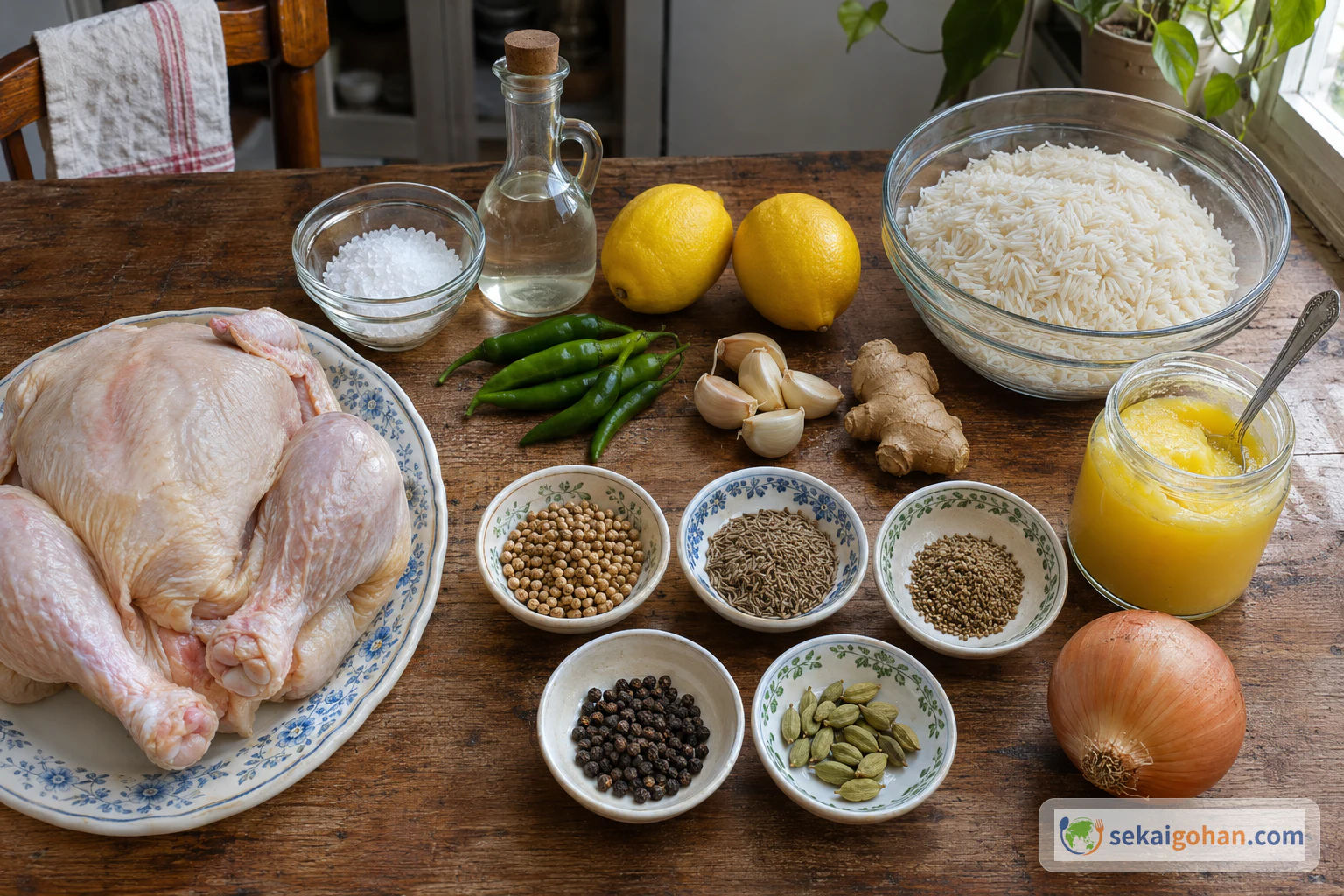
Ingredients for sajji: whole chicken, vinegar, salt, lemon, green chilies, garlic, ginger, coriander, cumin and ajwain seeds, black pepper, green cardamom, basmati rice, ghee and onion
Toast the three whole seeds yourself; the cardamom and black pepper go in already ground
Allergen information

Ghee is a dairy product (milk). Raita served on the side is made with yogurt (milk).

Equipment

  • A container or pot large enough to submerge the whole chicken, that fits in your refrigerator
  • Small heavy pan for toasting seeds
  • Mortar and pestle or spice grinder
  • Blender
  • Oven with a rotisserie, or a roasting tray with a rack
  • Drip tray (for the rotisserie)
  • Kitchen twine
  • Instant-read digital thermometer
  • Heavy pot with a lid for the pilaf

Choosing and Substituting

Ajwain is the one spice worth a trip to a South Asian grocer or an online order; look for it under carom seeds. It gives the crust its sharp, herbal edge. Leave it out if you cannot find it, and the bird tastes more of cumin and pepper alone. Green cardamom powder comes from the same shelf; buy it ground, or grind the seeds from green pods yourself. Basmati rice is sold at import grocers and online, and its long, separate grains are what the pilaf is meant to have.

The rest comes from an ordinary supermarket. Choose a whole chicken of about 2 lb (900 g), skin on, as small birds are sold. Any plain white vinegar or rice vinegar works for the brine. The four green chilies set the heat of the paste; use fewer for a milder bird. Green papaya paste belongs to the lamb versions roasted over coals and has no place in this chicken.

Toast whole, grind coarse

Buy coriander, cumin and ajwain as whole seeds. Toasting them just before grinding gives the crust far more aroma than ready-ground spice, and grinding them coarse leaves small crunchy flecks on the skin.


Method: Brine Overnight, Roast by Temperature

The work begins the evening before, when the chicken goes into the brine for at least 12 hours. The next day, rinse and dry the bird, then toast the spices and blend the paste while it sits on the counter. Wash the lemons, green chilies, onion and fresh coriander well under running water before using them. The 40 to 50 minutes in the oven are hands-off apart from one turn on a tray. Start the pilaf aromatics while the chicken rests, then cook the rice with meat pulled from the roast.

Raw chicken

Keep the brining chicken in the refrigerator the whole time; never leave it out at room temperature. Keep raw chicken, its brine and anything that touched them away from other food, and pour the brine away after use. The chicken is done only when the thickest part of the thigh reaches 165°F (74°C).

When It Goes Wrong

What you see Why What to do
The breast is dry while the thigh is still under temperature The breast cooks faster than the legs Lay foil over the breast and keep roasting until the thigh reads 165°F (74°C)
The skin is pale and soft The skin was still wet when it went into the oven Next time, pat it completely dry after rinsing off the brine
The meat tastes too salty The brine was left on the bird Rinse the chicken once after brining before drying and coating it
The ground spice tastes bitter The seeds toasted past golden Toast only until the coriander turns faintly golden and tip the seeds out of the pan straight away
The thigh is under temperature at 50 minutes A larger bird or a cool oven Keep roasting and check every few minutes until it reads 165°F (74°C)

Serving, Variations and Leftovers

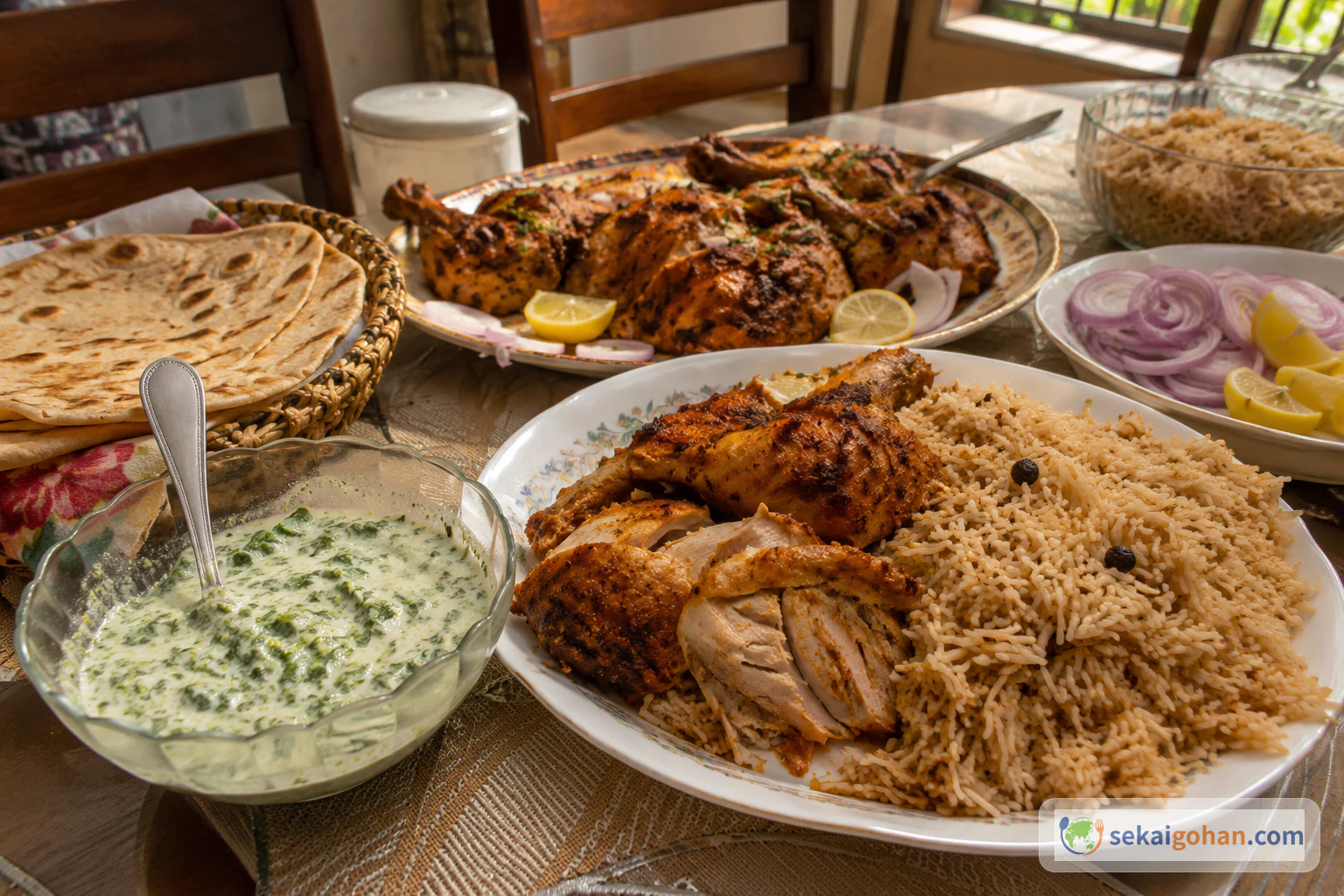
A dinner table with carved sajji, pilaf, raita, roti, sliced onion and lemon wedges
Raw onion and lemon wedges sit beside the meat so everyone can sharpen their own plate

Carve the chicken and set it out with the pilaf. Raita cools the pepper and chili, and naan or roti is good for tearing and wrapping pieces of meat. Sliced raw onion and lemon wedges round out the table, so everyone can add more sourness to their own plate.

Variations

  • Salt only. Season the bird with salt alone, the way much sajji is made in Balochistan. The meat tastes of itself, with no spice crust.
  • Green papaya paste. With lamb, cooks spread green papaya paste over the meat before roasting. Green papaya is hard to find outside the region, and this chicken does without it.
  • Skinless, under foil. Remove the skin, score the meat, wrap it in foil and roast at 200°C for 30 minutes. Remove the foil, brush with ghee or butter and grill for about 10 minutes. The meat stays moist under the foil, and the grill gives back some color. As with the whole bird, the thickest part of the thigh must reach 165°F (74°C).

Leftovers

Let leftover chicken and pilaf cool, then refrigerate them and eat them soon. Reheat until hot all the way to the center.

Frequently asked questions

Can I brine for less than 12 hours?

Plan for 12 hours or overnight. Start the brine the evening before, and the bird is ready to rinse and coat the next day. The rest of the recipe is timed around that full brine.

Can I stuff the rice inside, as in the traditional version?

You can, but it changes the roast. The center of the stuffing must also reach 165°F (74°C), along with the deepest part of the thigh and wing and the thickest part of the breast. Let the bird stand for 20 minutes before taking the stuffing out. Cooking the rice separately is safer and cooks more evenly, which is why it goes in its own pot here.

How spicy is it?

It has a clear pepper warmth from the tablespoon of black pepper and a fresh green heat from the chilies in the paste. The chilies are the part to adjust. Use fewer of them for a milder bird, and keep the black pepper as it is, since it gives the crust its character.
Sources