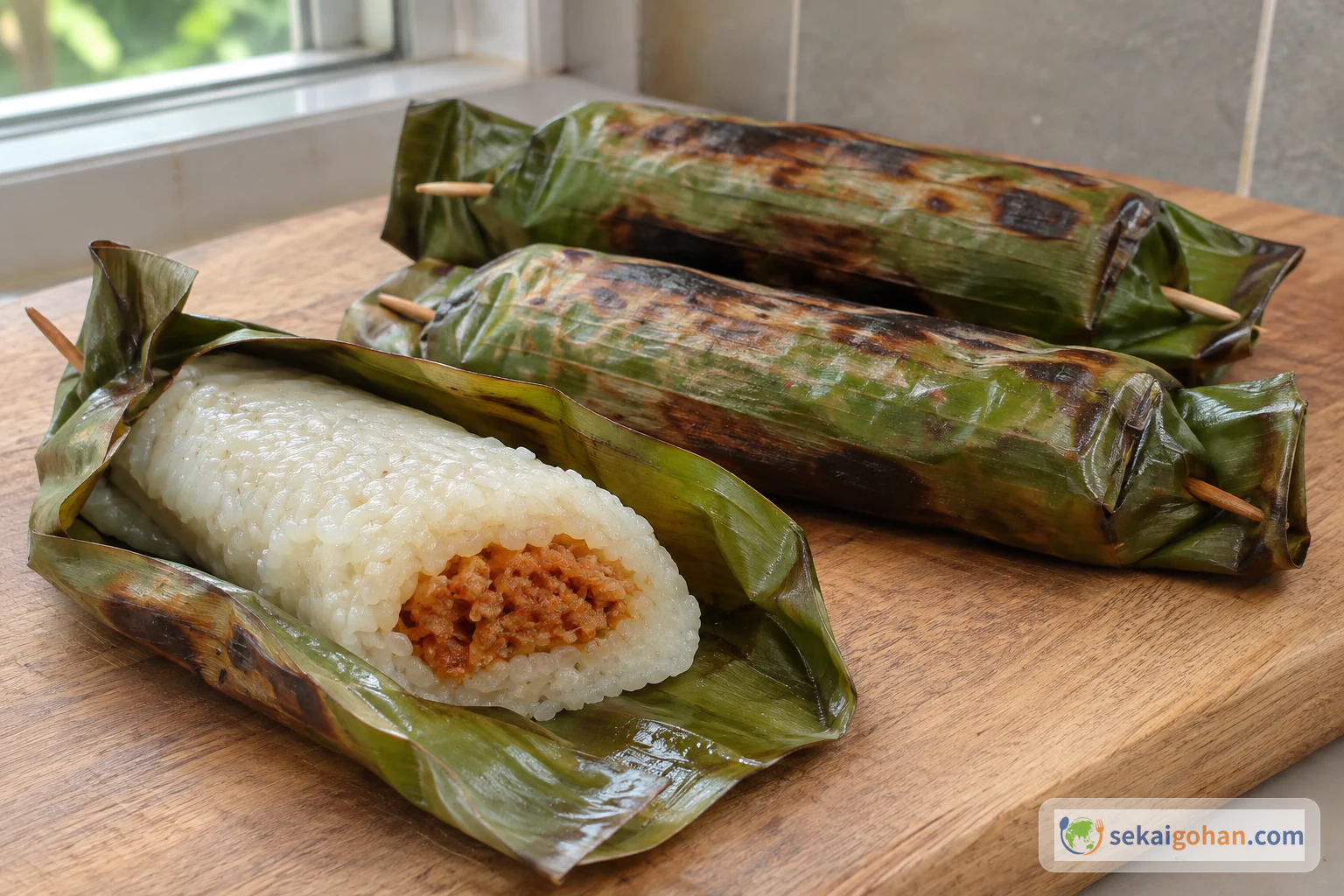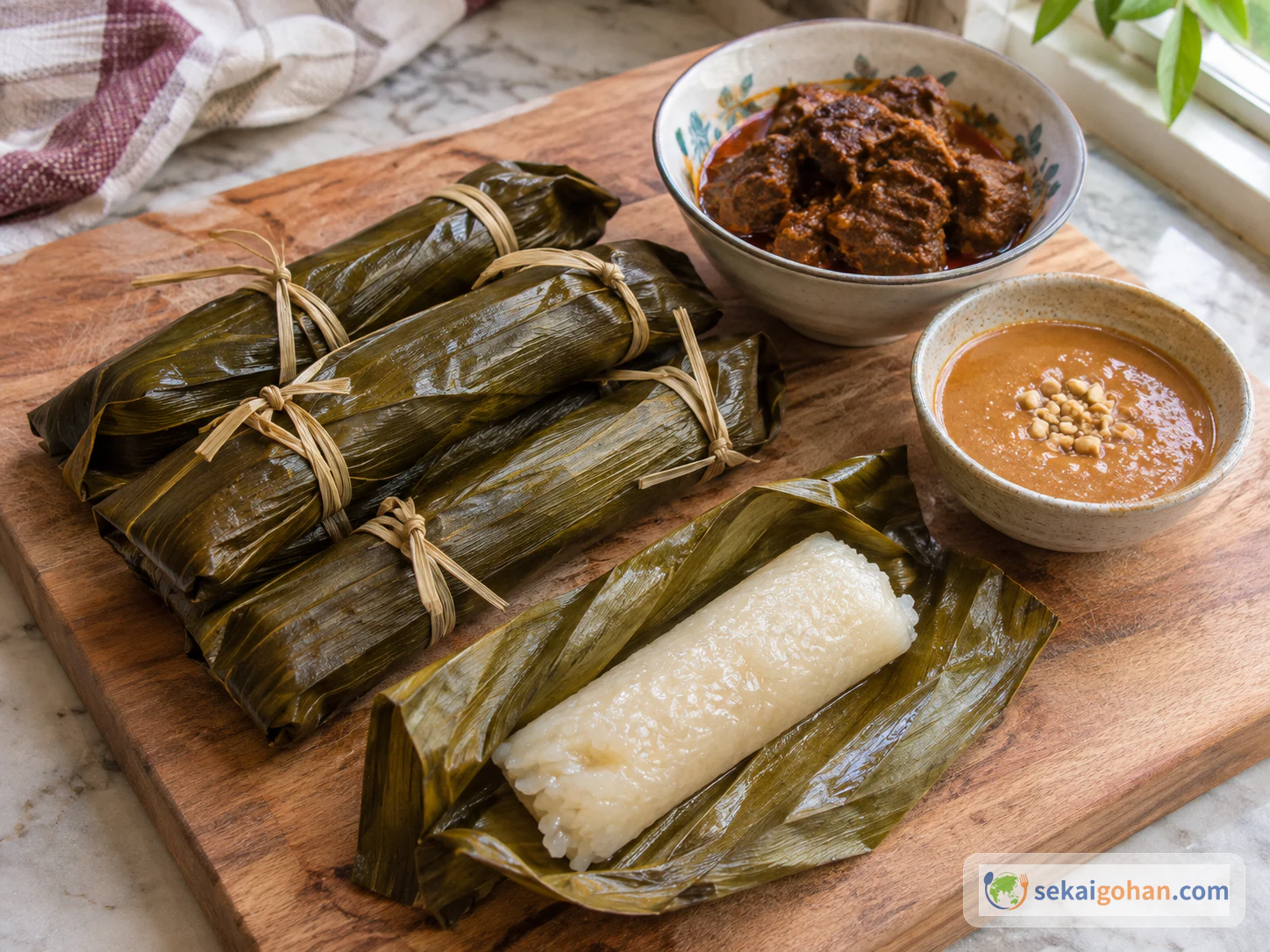
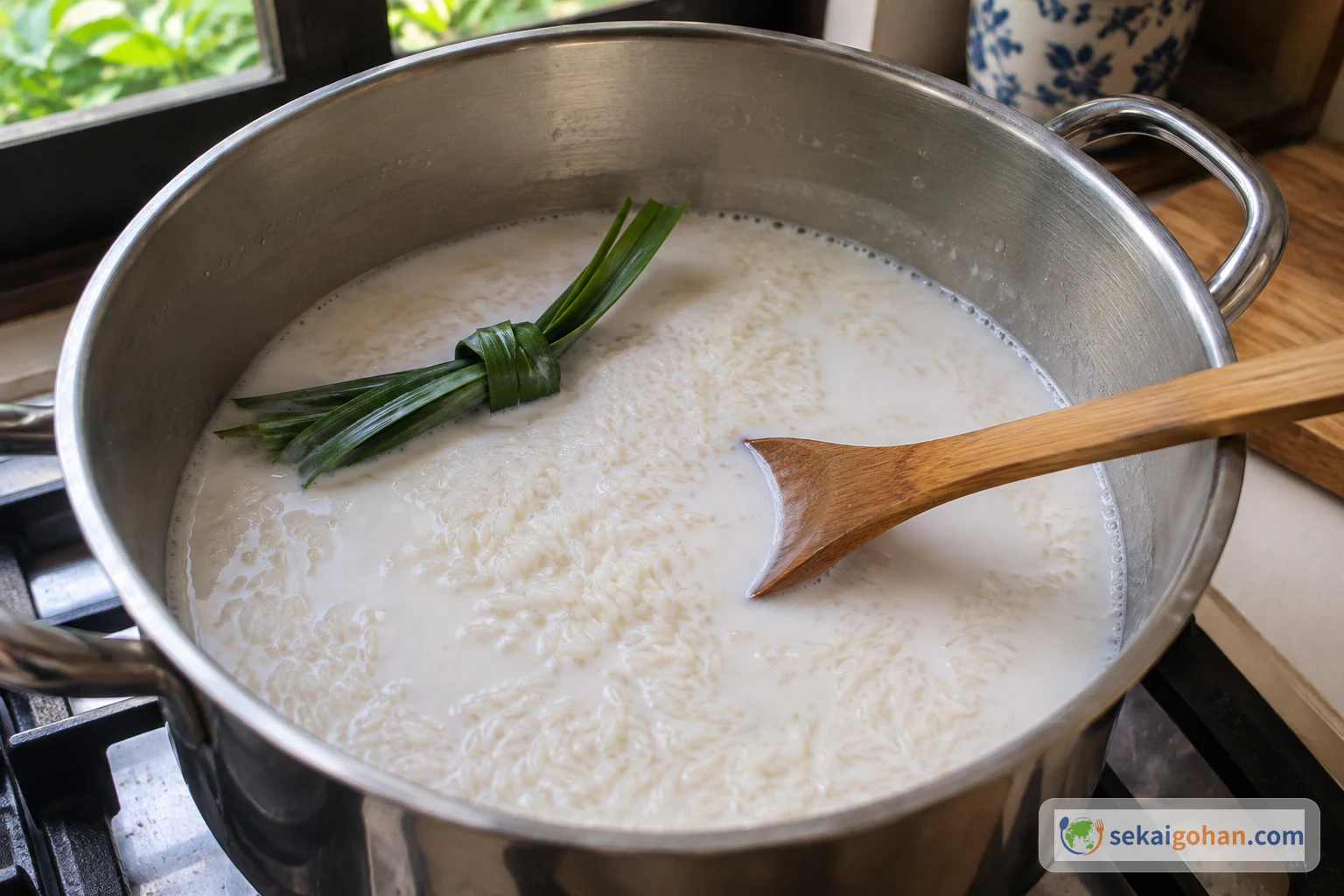
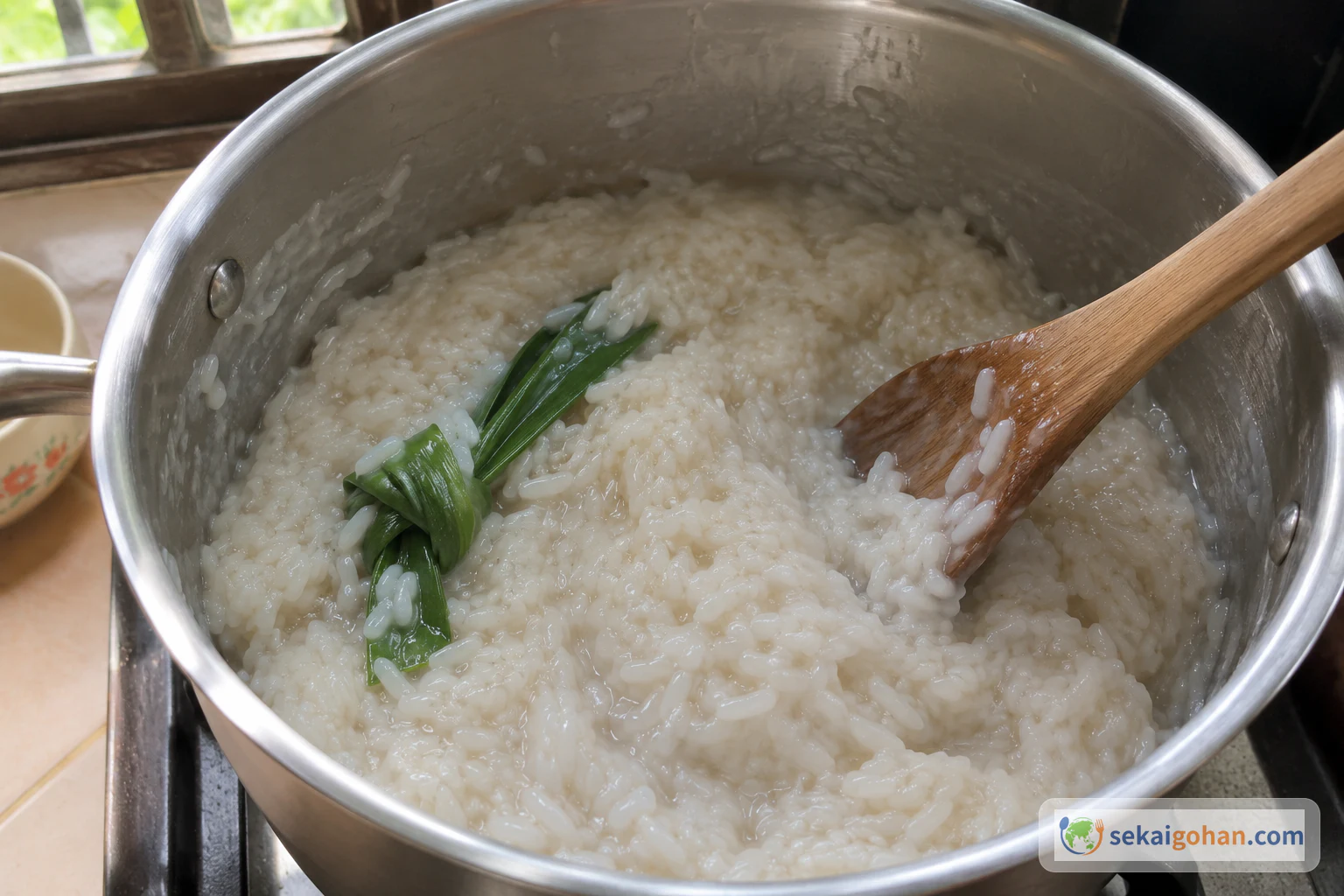
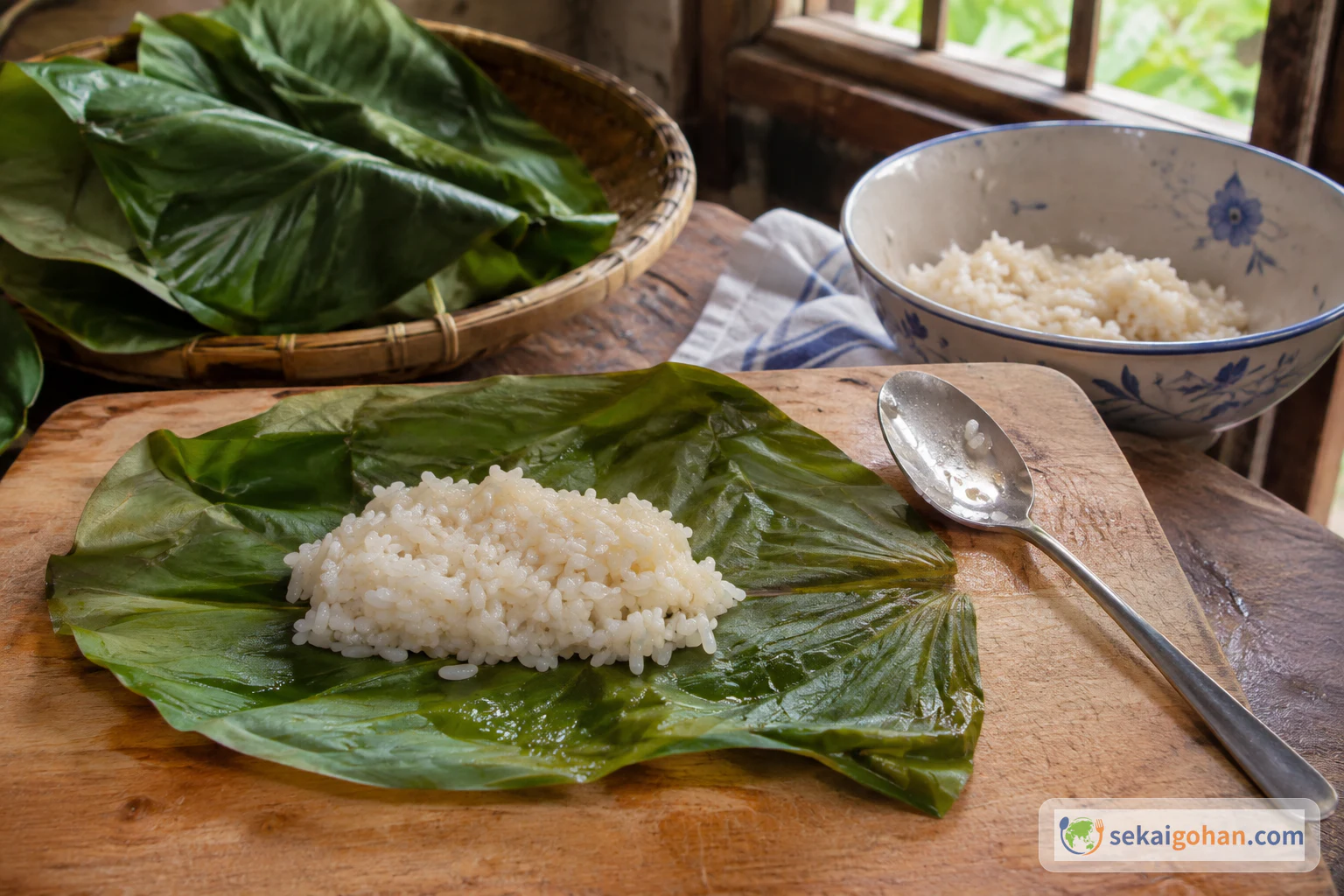
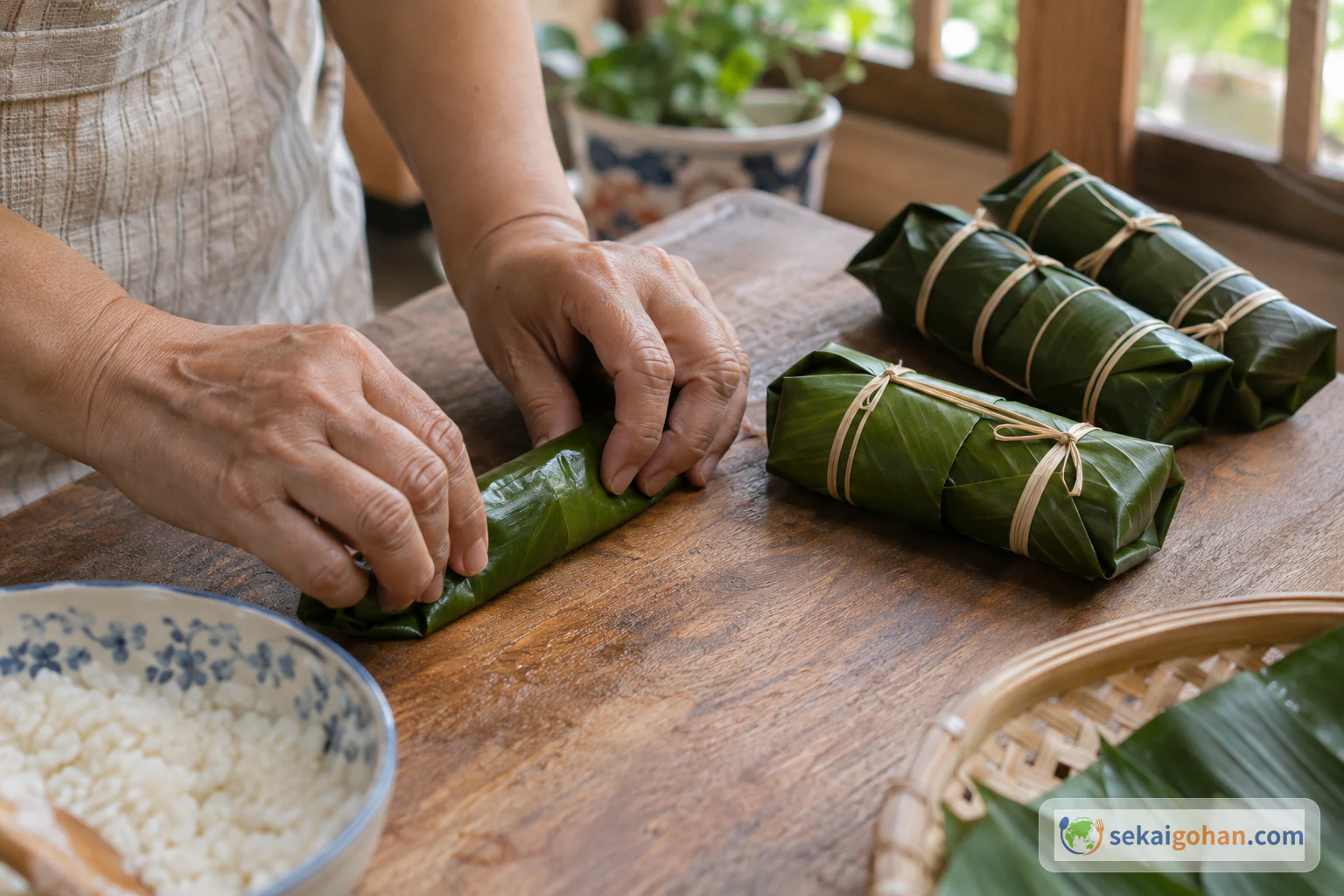
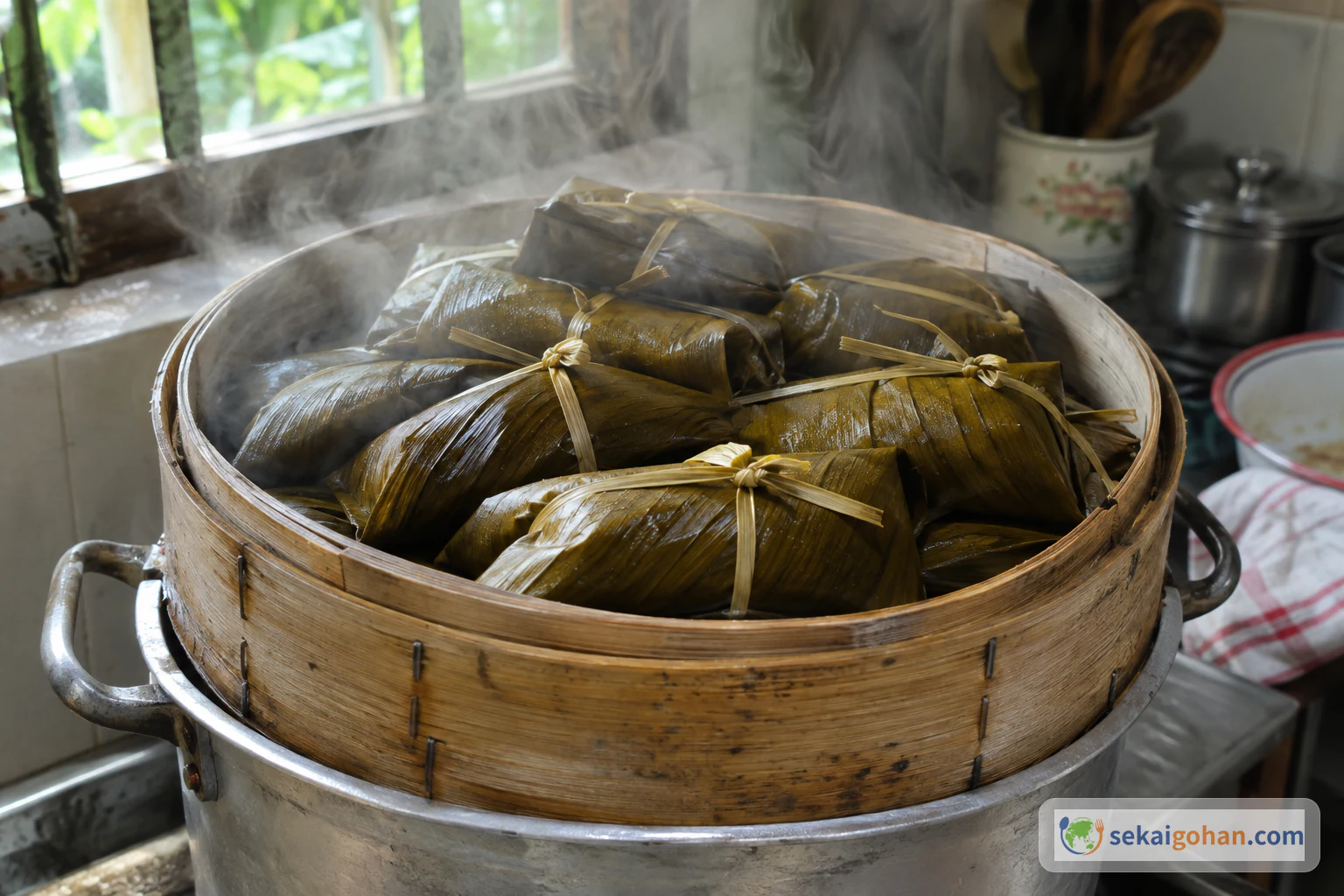
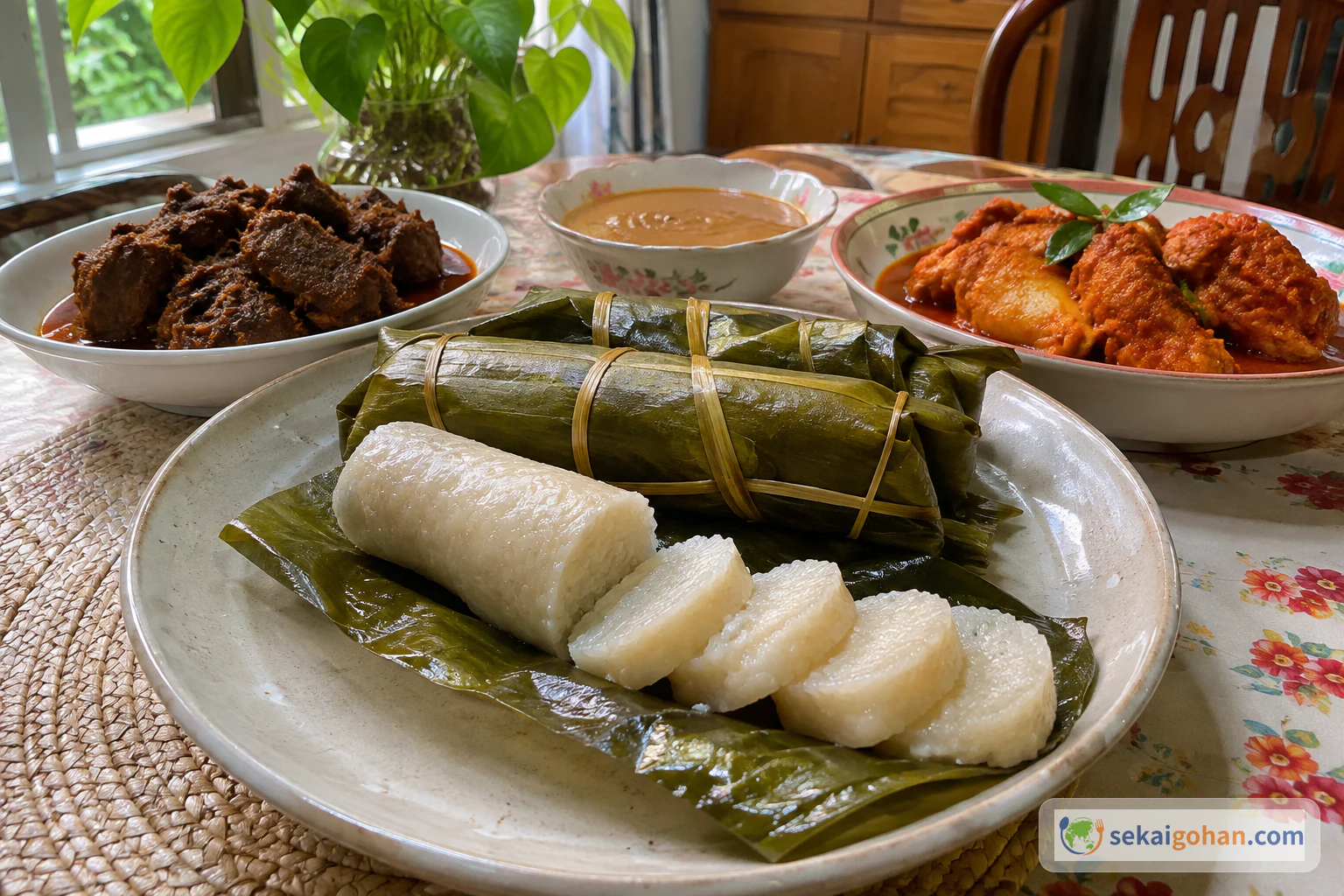
When the steamer lid comes off, the bundles have turned dark and soft, and the kitchen fills with coconut and the grassy sweetness of pandan. Each slim roll is a leaf wrapped around a stick of glutinous rice that was half-cooked in coconut milk before it went in. Peel the leaf back and the rice is pale, glossy and dense, with just enough salt to make it savoury. This is kelupis, made in Brunei and across Sabah, Sarawak and Labuan, and set out on platters for weddings and the morning of Hari Raya. It goes on the table next to rendang, curry or peanut sauce,.
Rolled by the Hundred for Weddings and Hari Raya
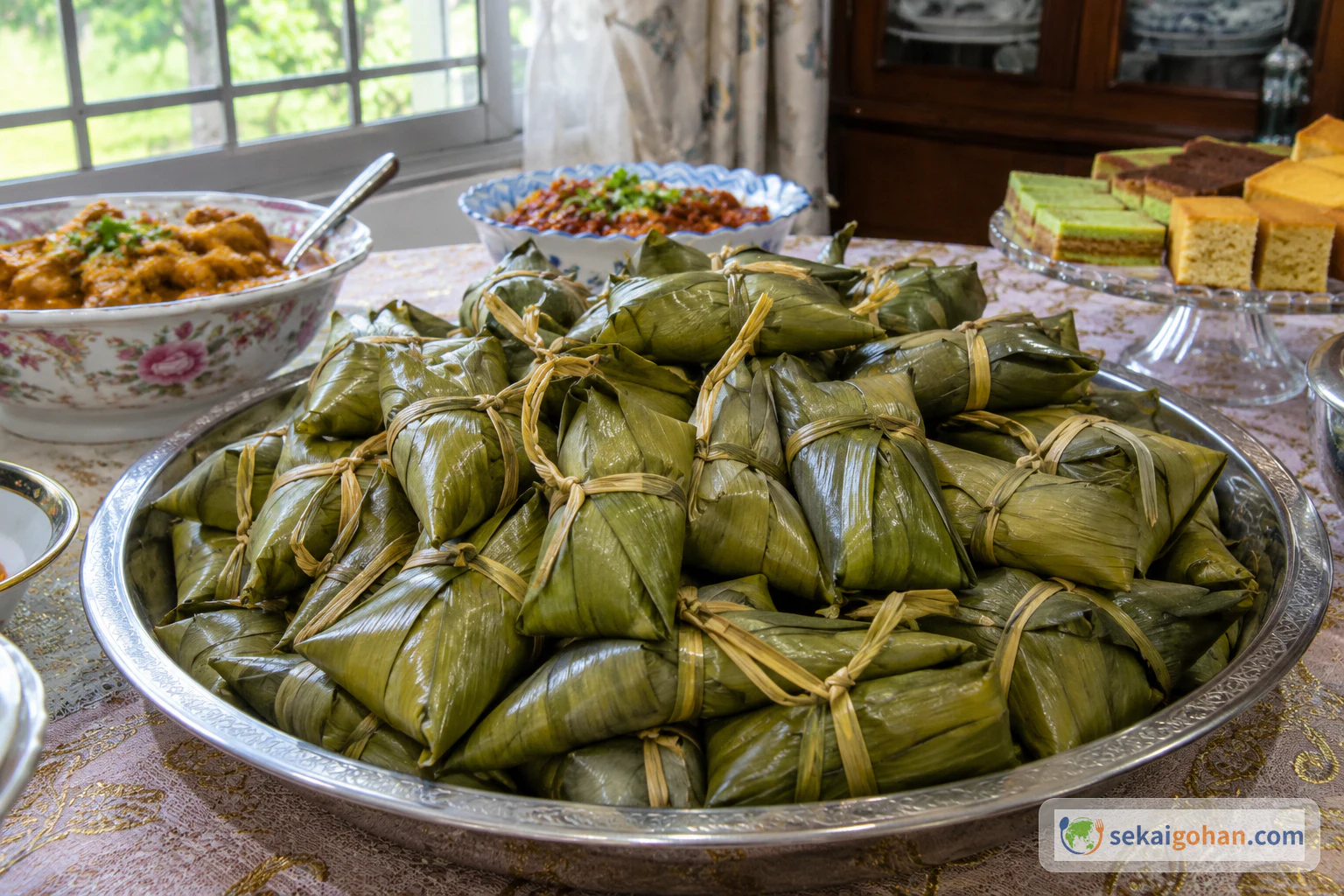
Kelupis shows up when many people gather. In Bisaya communities it is the snack served at weddings and other special occasions. It also appears on the morning of Hari Raya and at a doa selamat, a prayer gathering. A dish for that many guests is rarely made by one pair of hands. Making about a hundred rolls takes six to seven hours from preparing the rice to wrapping and cooking, and the wrapping is the longest part. So the work is shared, with several people sitting around the rice and the stacked leaves, rolling one bundle after another.
In Sabah, Bruneian, Bisaya, Dusun and Kedayan communities all make kelupis. Each wraps it a little differently, and the texture shifts slightly from one community to the next.
Brunei's national dish is ambuyat, a sago-starch dish. Kelupis sits on the same festive tables but belongs to the world of rice: glutinous grains, coconut milk and a leaf wrapper, eaten in firm slices. You can find more of the country's cooking on the Brunei page.
The wrapping leaf is called nyirik, ngirik or irik, and the spelling shifts from one kitchen to the next. It is a broad, dark green, palm-like leaf, usually identified as Phacelophrynium maximum or Licuala grandis. It gives kelupis its shape and a faint green aroma that steaming draws into the rice.
Ingredients
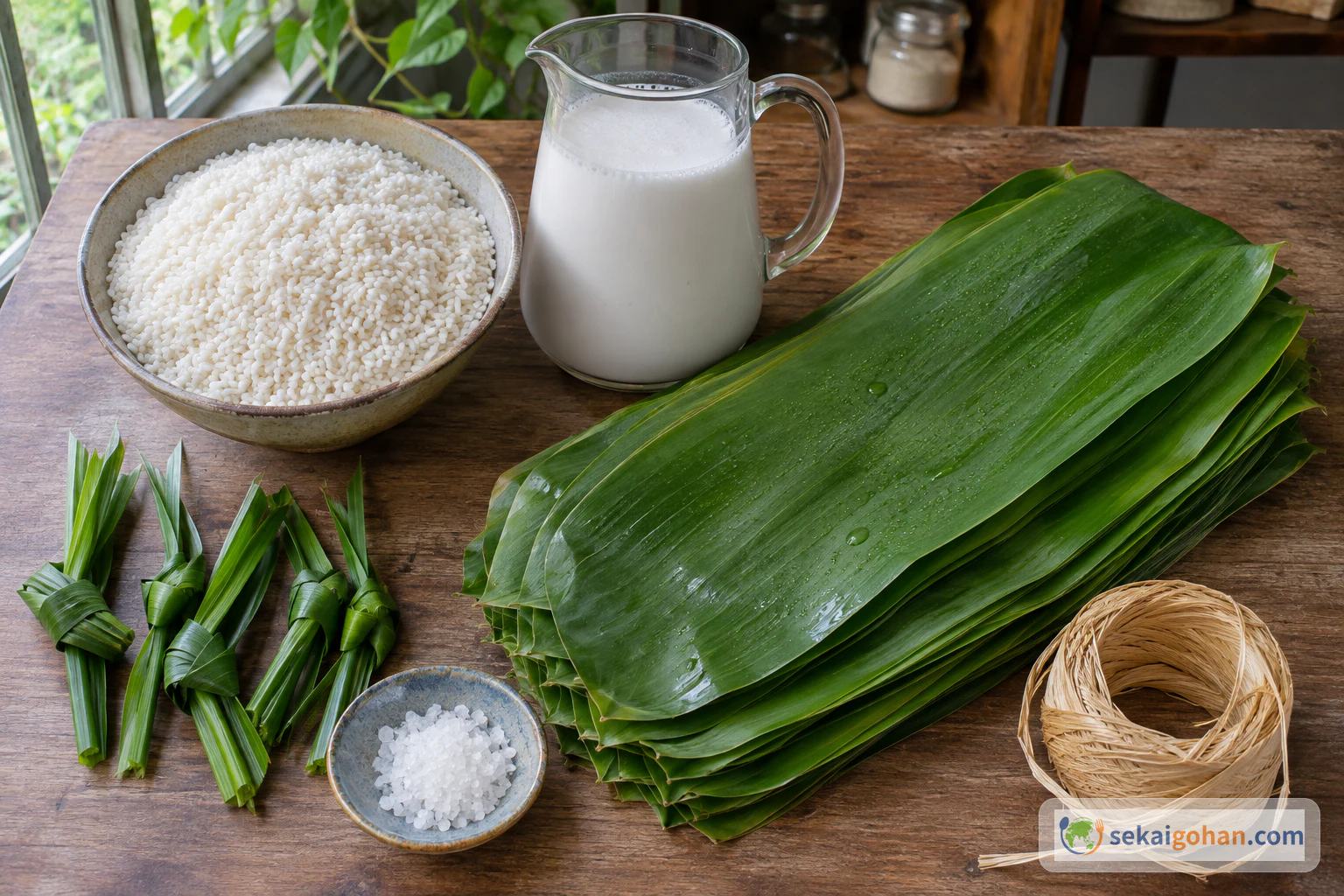
Thirty leaves make up to thirty rolls, each holding 2 to 3 tablespoons of half-cooked rice. Lay the leaves out and check them for tears before the rice goes on the stove. Once the rice is ready, you want to roll it while it is still warm and pliable.
Coconut milk is the main liquid in the rice. Peanut sauce, a usual accompaniment, contains peanuts. Check the labels on carton coconut milk and any ready-made sauces for other allergens.
Equipment
- Wide, heavy pot
- Wooden spoon
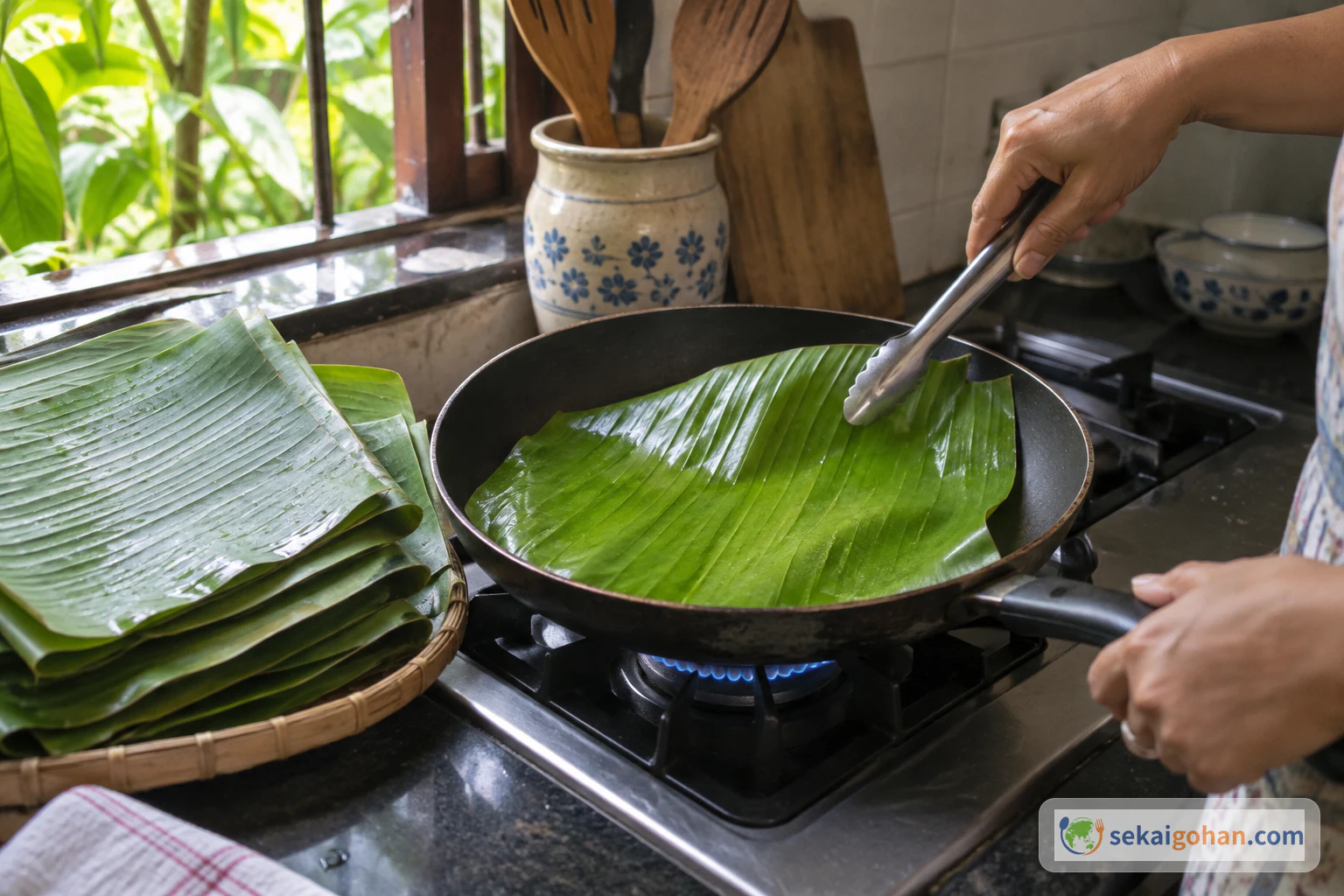
- Dry pan or low gas flame for softening the leaves
- Tongs
- Spoon for portioning the rice
- Wooden board for rolling
- Bamboo or metal steamer set over a pot
- Food-safe raffia string (optional)
Choosing the Rice, Coconut Milk and Leaves
What keeps kelupis tasting like itself is glutinous rice, coconut milk and the scent of pandan, half-cooked together, wrapped and steamed. Everything else has some room.
Glutinous rice. Any glutinous (sticky) rice from an Asian grocer works. Rice sold as "milk glutinous rice" is the best choice if you can find it. Ordinary long-grain or jasmine rice will not bind into a firm roll.
Coconut milk. Fresh or carton coconut milk is best. Canned coconut milk varies in thickness from brand to brand, so add water as needed until the rice cooks to the half-done stage described in the method.
Pandan. Frozen pandan leaves from Asian grocers work in place of fresh. Dried leaves also bring the fragrance. Pandan paste is a different product, so it is not a measure-for-measure swap for the leaves.
Wrapping leaves. Nyirik leaves are hard to find outside Borneo. Banana leaves, sold frozen at Asian grocers, are the easiest swap and can be softened and rolled the same way. Aluminium foil on the inside is another option. Both change the result: the aroma and flavour shift away from the leaf used where kelupis comes from, and foil adds no fragrance at all.
Method
Everything moves in one direction. The rice cooks to half-done in the pot, the leaves are softened while the rice is still warm, and then comes the rolling, which takes the most time. Steaming is the one hands-off stretch. Have the steamer set up and the leaves stacked before you start the rice, so nothing cools while you wait.
When It Goes Wrong
| What you see | Why | What to do |
|---|---|---|
| The rice is too hard to shape and the grains fall apart | It came off the heat too early | Return it to medium heat with a splash of water and stir until it starts to hold together |
| The rice is mushy and smears across the leaf | It cooked past half-done in the pot | Roll gently; next time stop while the grain still has a firm core |
| The leaf cracks when you fold it | It was not softened enough | Pass it over low heat again until it turns glossy and limp |
| Rolls burst open in the steamer | The wrap was loose or the ends were not folded tight | Roll more snugly, fold the ends hard, and tie with raffia |
| The rice is still hard at the centre after steaming | The rolls needed more time | Steam toward the full hour and check a test roll again |
Serving and Storage
At the table
Kelupis is eaten alongside something rich and saucy. Rendang is the classic partner, with red-cooked chicken, peanut sauce or curry also on the table. The rice is dense and only lightly salted, so a mouthful of roll with a spoon of sauce carries both. At weddings, Hari Raya mornings and doa selamat gatherings the rolls come out on big shared trays, and guests unwrap them as they go.
Cooking the coconut milk first
There is another way to cook the rice. Bring the coconut milk to a boil first and cook it down until oil rises to the surface, then add the rice and cook until it holds together in one mass. This is a different method from the one above, so do not mix the two. Reducing the coconut milk first is how the larger-batch version is made.
Leftovers
Rice cooked in coconut milk spoils quickly. Do not leave kelupis sitting out at room temperature. Cool what you will not eat soon, then refrigerate it promptly in a covered container.
Frequently asked questions
How is kelupis different from burasak?
Both are leaf-wrapped rice from the same part of Borneo. Kelupis is made with glutinous rice, which steams into a dense, sticky roll. Burasak is made with ordinary rice.
Is kelupis sweet?
It leans savoury. The rice is seasoned with salt and perfumed with coconut and pandan, so it pairs with rendang, curry and peanut sauce. Eaten plain it tastes rich and gently salty.
Do I have to tie the rolls?
Raffia is there for rolls that will not stay closed. If you roll tightly and fold the ends firmly, many bundles hold on their own. Tie any that spring open, and use food-safe string.
Did kelupis start in Brunei or in Sabah?
Where it began is not settled. One account holds that Bruneian people brought it to Sabah. Today it belongs to Brunei, Sabah, Sarawak and Labuan, and each community wraps it in its own way.