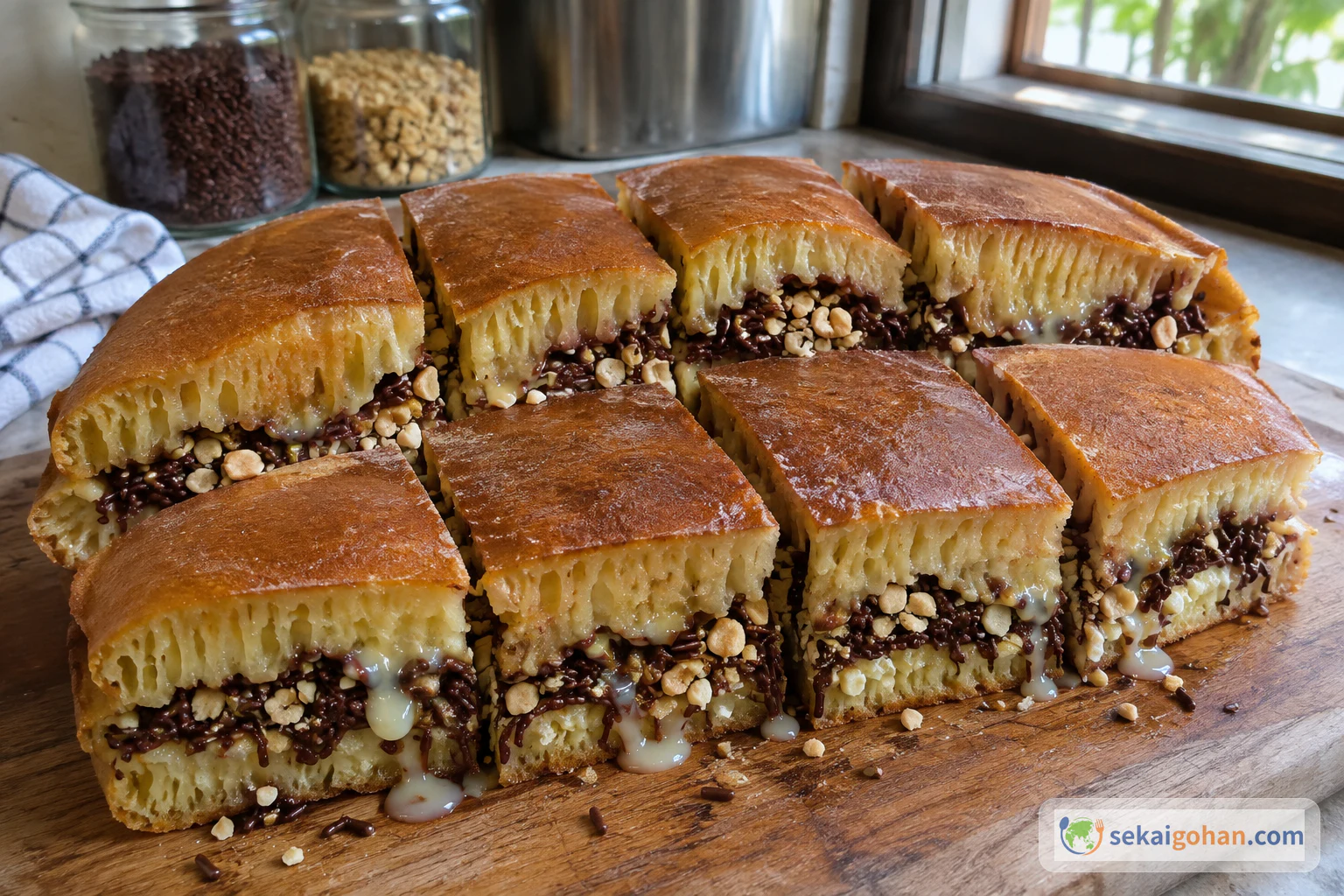
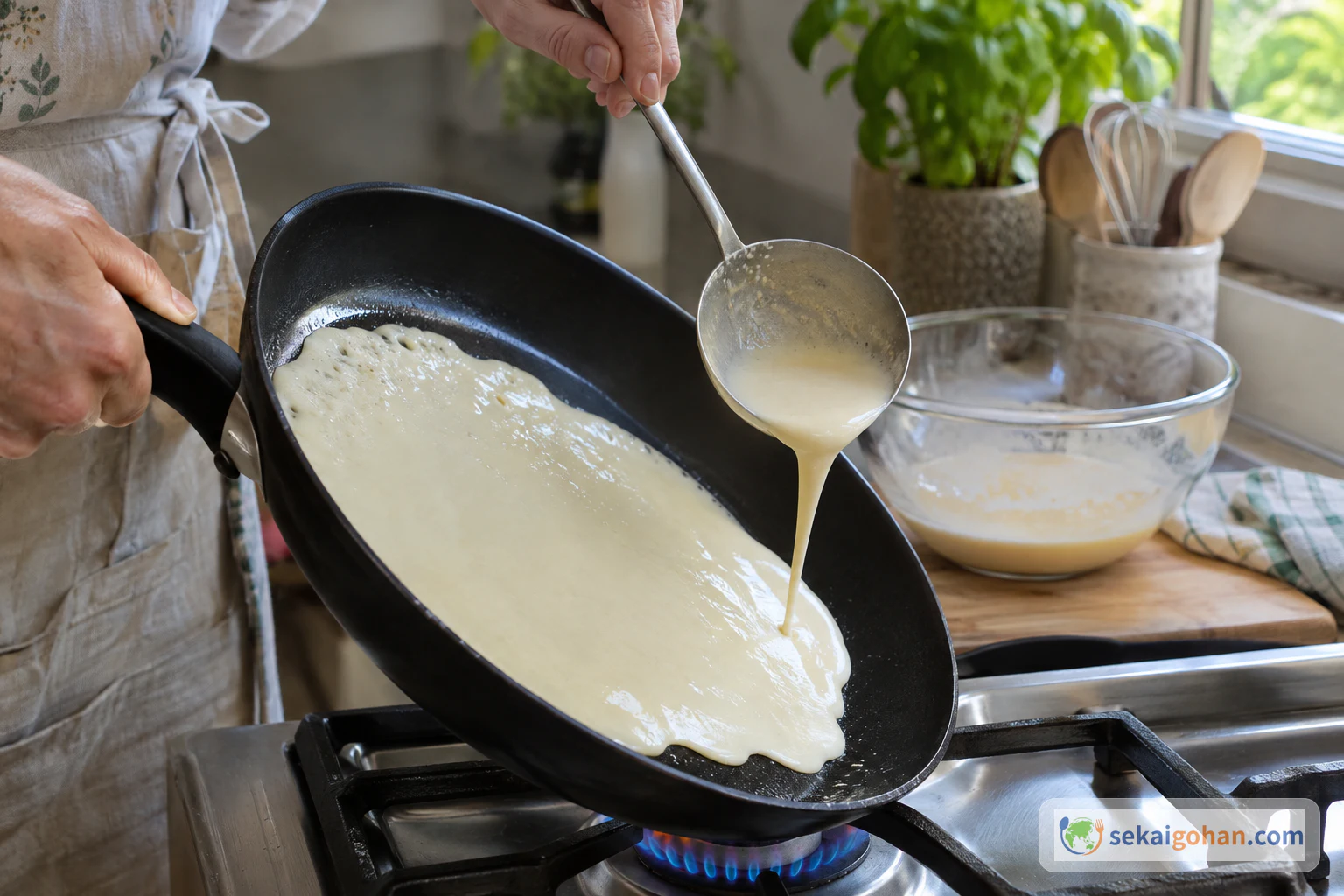
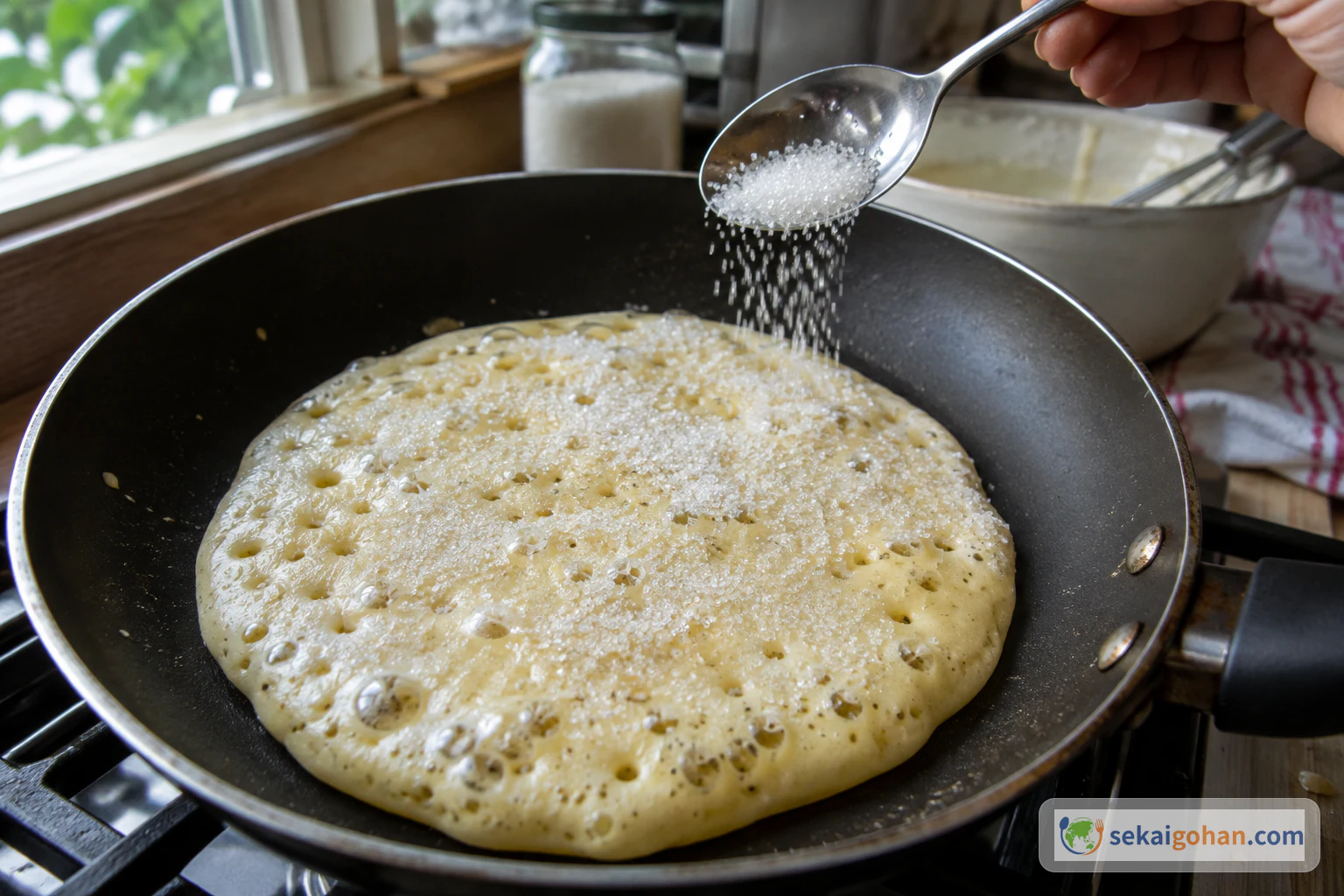
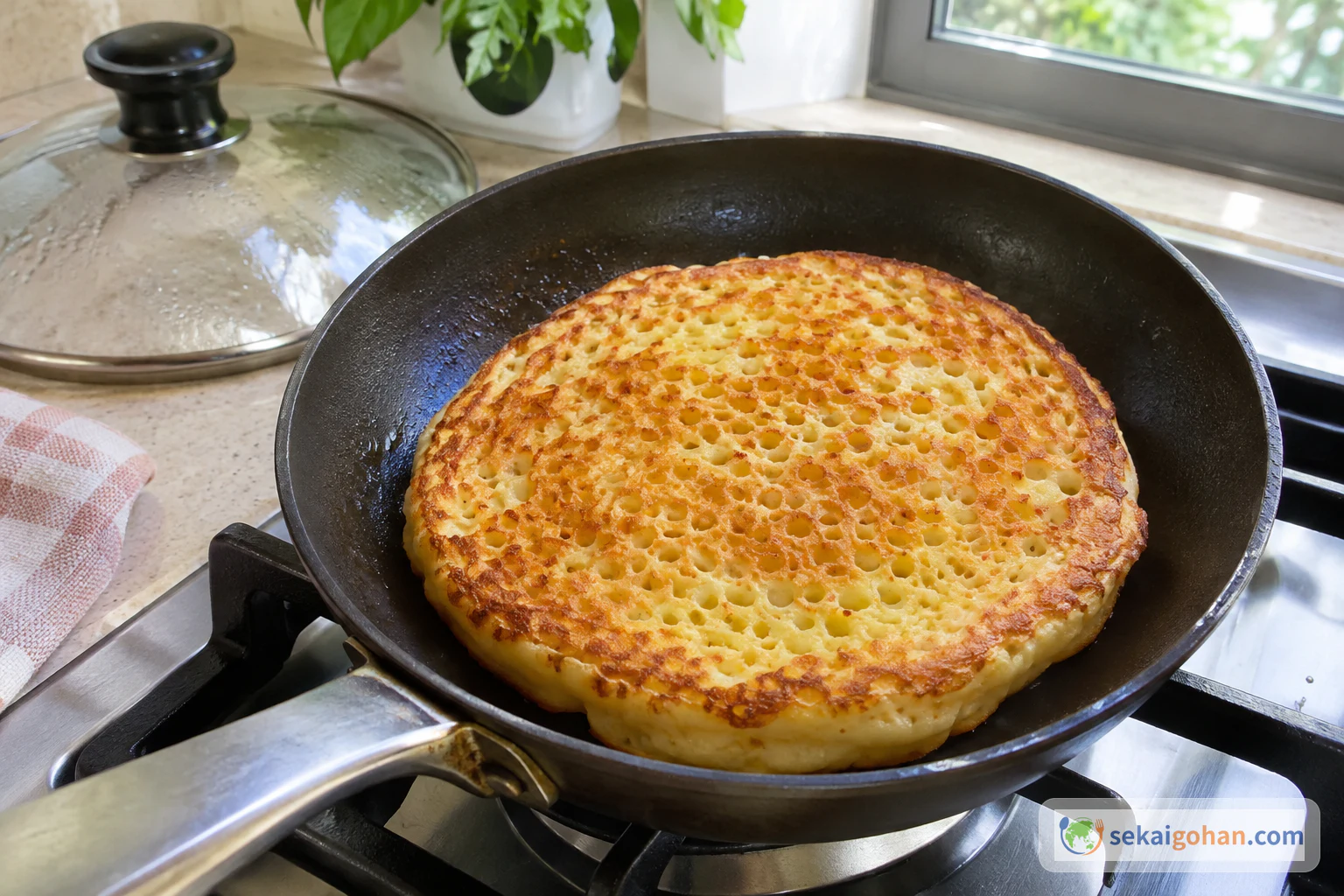
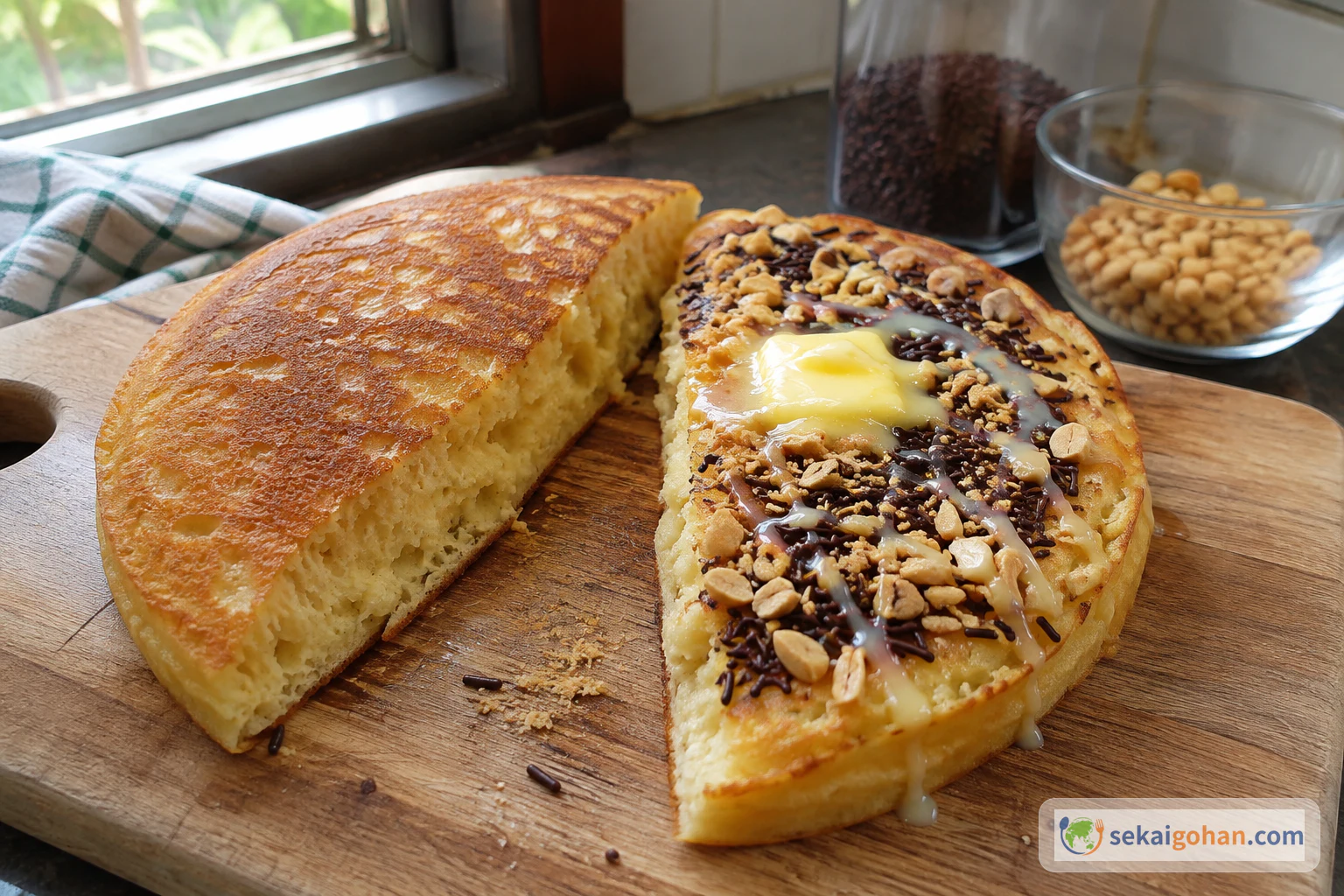
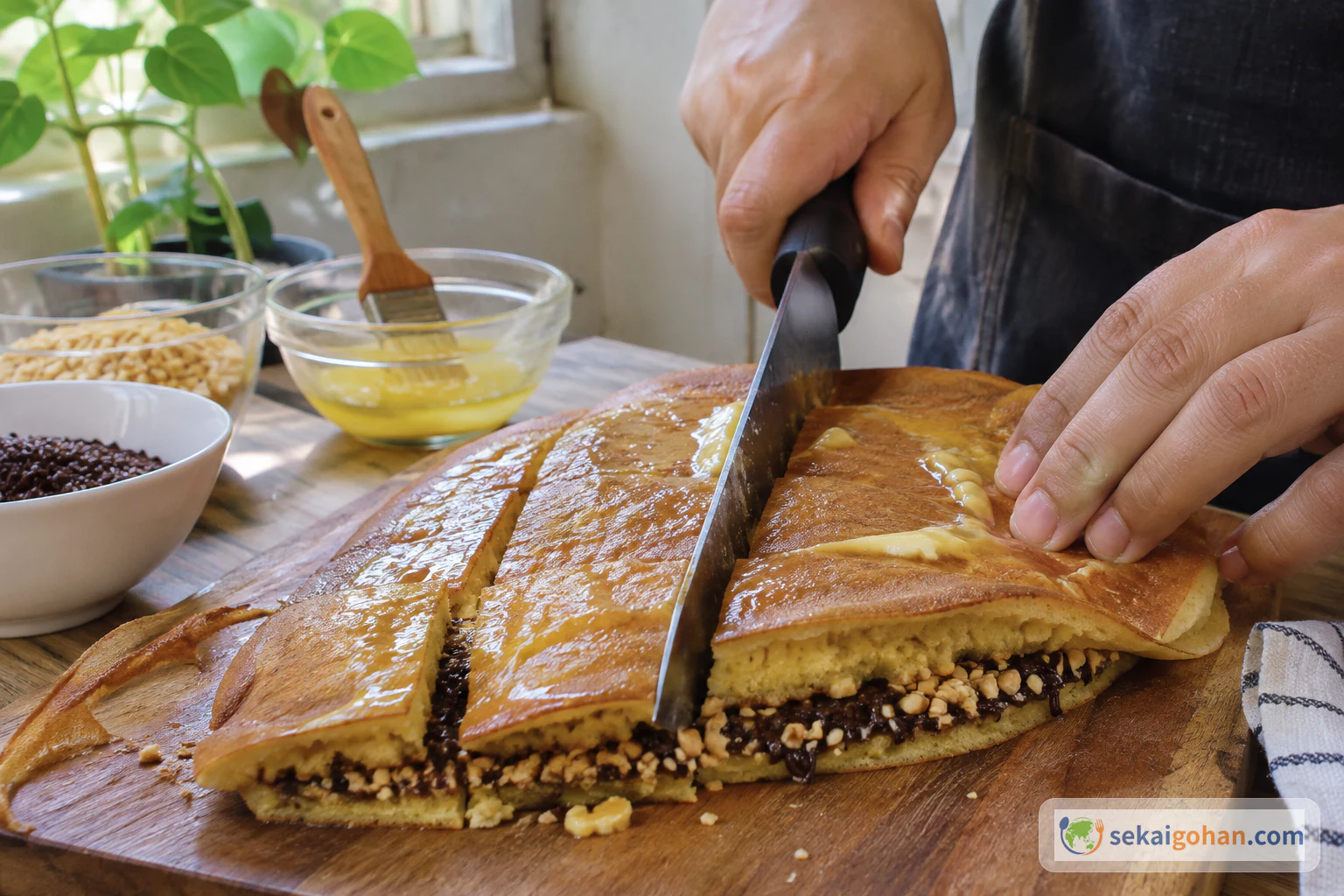
The batter hits a hot pan, spreads to the rim, and within moments small holes start opening across its surface, one after another, until the whole disc looks like a honeycomb. Sugar goes over the top, a lid goes on, and when it comes off the pancake is golden at the edge and dry on top. Then it is slathered with butter, buried in crushed peanuts and chocolate sprinkles, run with condensed milk, folded and cut into wedges. In Brunei this thick, sweet, folded pancake is called kuih Malaya, and it is sold hot at the evening stalls. Each bite is crisp at the rim, soft and springy inside, with melted butter and sugar pooled in the holes.
One Pancake, Many Names Across the Region
What Brunei calls it
In Brunei the sweet goes by kuih Malaya, also spelled kueh Malaya. The name is usually said to have arrived with people who came over from Malaysia, and the fillings are the same as in Indonesia. At the Gadong night market, which runs from 4 p.m. to 11 p.m., it appears as Kuih Melaya, a peanut pancake that Brunei took from Malaysia's apam balik. Vendors there each have their own fillings: chocolate chips, peanut butter, biscuit crumbs, melted cheese. The food in the market is halal.
The batter in this recipe is the thick Indonesian style. It is the same family of sweet that Brunei eats as kuih Malaya, and it gives the deep honeycomb that makes the folded wedge so satisfying to bite. Malaysia also has a thinner, crisper apam balik made with milk in the batter, which is a different recipe with its own proportions.
Brunei says kuih Malaya. Malaysia says apam balik. Singapore says min jiang kueh. In Indonesia it is martabak manis, terang bulan, kue Bandung, martabak Bangka, apam pinang or hok lo pan, depending on where you are. The word martabak is usually traced to the Arabic murtabak, meaning folded.
From Bangka to Bandung
Where the pancake began is not settled. One account starts on Bangka island, where Chinese settlers made a pancake called hok lo pan; whether it came with Hakka or Hokkien families is still argued. A man named Hioe Kiew Sem is said to have sold it in Bandung, and there it took the name martabak manis, sweet martabak, set against martabak asin, the salty one. The earliest filling was sesame and sugar. Cheese, chocolate and matcha came later.
For something savoury from the same country, Brunei's ambuyat sits at the opposite end of the table. More dishes are gathered on the Brunei country page.
Ingredients
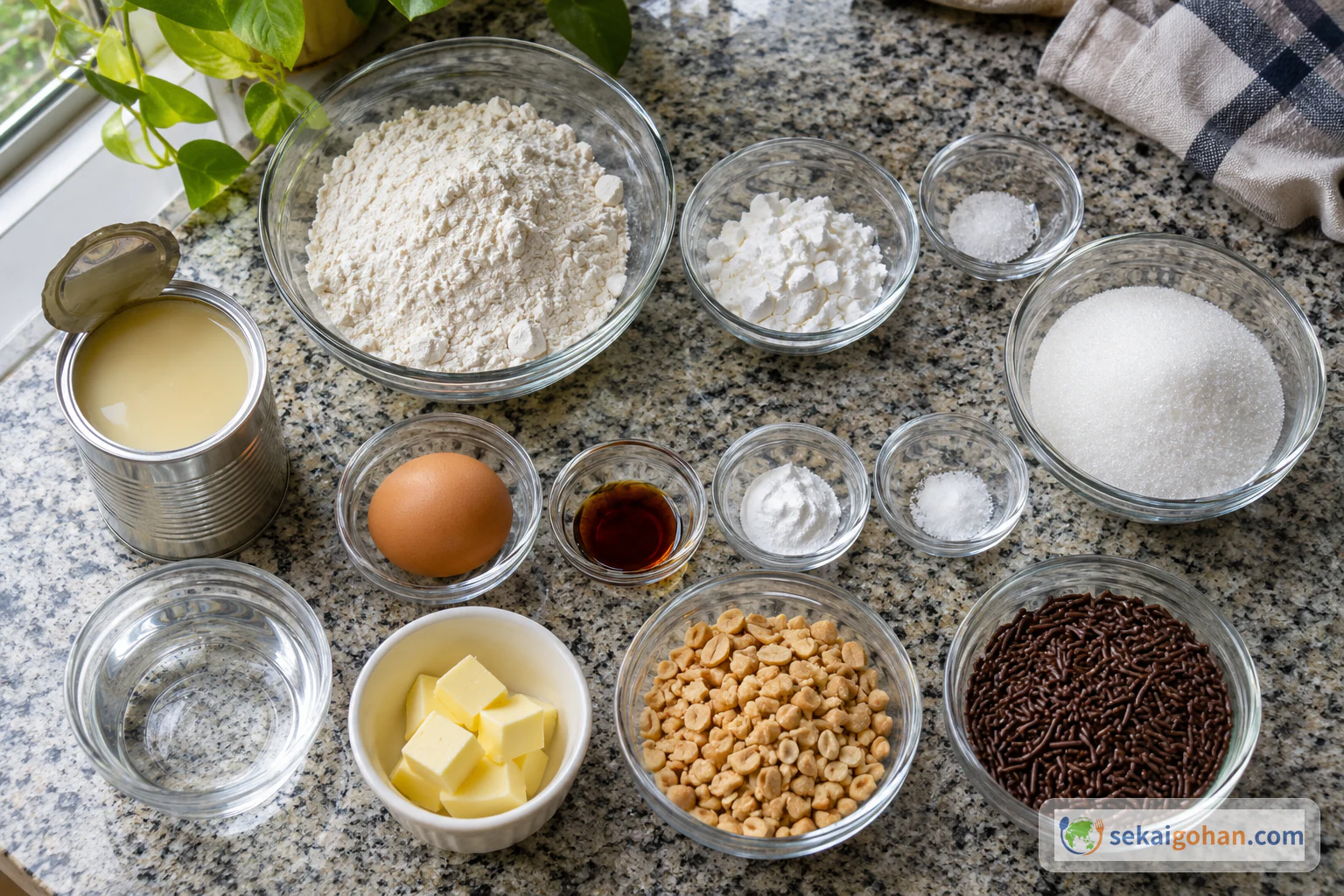
This makes two pancakes in a 9½-inch (24 cm) pan, each cut into 8 wedges. One egg goes into the whole batch of batter, for both pancakes.
This contains wheat, egg, milk (butter and condensed milk) and peanuts. Read the label on the chocolate sprinkles for other allergens.
Equipment
- Heavy-bottomed 9½-inch (24 cm) nonstick frying pan with a lid
- Digital kitchen scale
- Sifter or fine sieve
- Large mixing bowl
- Balloon whisk
- Plastic wrap
- Small cup for the leavening
- Ladle
- Wooden cutting board and a large knife
- Spatula
Choosing and Substituting
Everything here is supermarket stock except, sometimes, the sprinkles. Buy unsalted roasted peanuts and crush them yourself; salted ones throw off the sweetness. Chocolate sprinkles sit in the baking aisle.
- Cornstarch: if you have none, use the same amount of flour. The pancake loses a little of its crisp-tender spring. Potato starch behaves differently and does not belong here.
- Flour: plain all-purpose. Weigh it at 225 g rather than trusting a cup scoop, since the batter's thickness decides how the holes form.
- Pan: the 9½-inch (24 cm) size matters as much as any ingredient. A smaller pan makes the pancake too thick and it burns; a larger one makes it thin, and the honeycomb flattens out.
- Fillings: swap the chocolate sprinkles for chocolate chips, as some Gadong vendors do. The texture turns chunkier and the chocolate melts in pockets instead of a coat.
Method
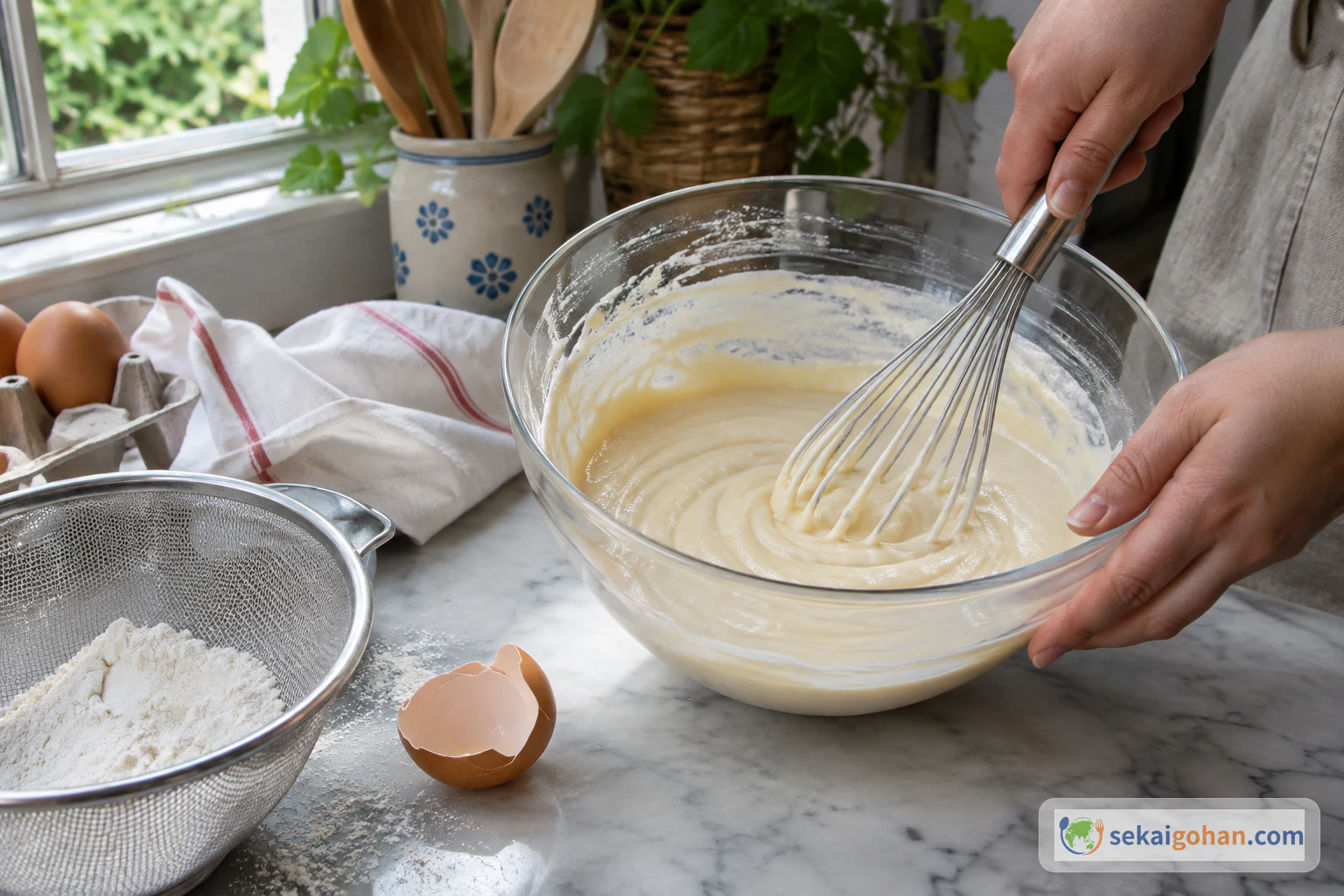
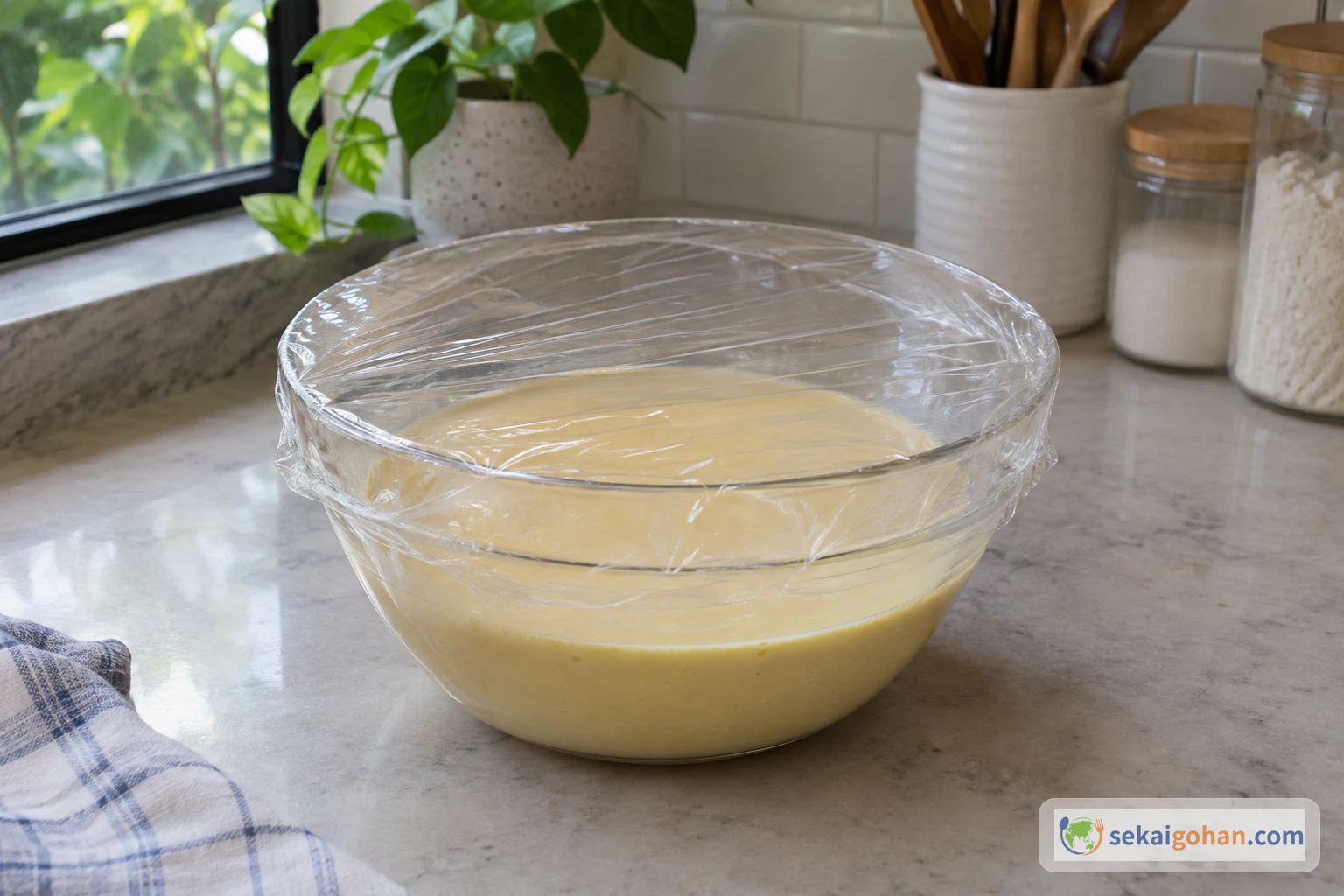
The batter is mixed first and then rests for at least 1 hour, which is your hands-off time; start heating the pan as the rest ends. The leaveners go in only at the last moment, right before the first pour. Each pancake then needs your full attention at the stove, and the second follows the first with the batter that is already leavened. From the first sift to the last wedge, allow about 1 hour 45 minutes.
The pan stays very hot between pancakes and the melted butter and condensed milk run hot. Handle the pan by its handle, slide the pancake off with a spatula rather than your fingers, and let the wedges cool a moment before biting.
When It Goes Wrong
| What you see | Why | What to do |
|---|---|---|
| Few holes, a flat dense top | The pan was not hot enough, or the leavening went in too early | Heat the pan longer before pouring, and add the leaveners right before the batter goes in |
| Pancake very thick, burnt underneath | The pan is too small for this amount of batter | Use a 9½-inch (24 cm) pan and keep the heat low once the lid is on |
| Pancake thin and crisp all through | The pan is too large | Move to a 9½-inch (24 cm) pan for the thick honeycomb |
| Top still wet under the lid | Pulled too early | Re-cover and keep cooking on low until no wet patches remain |
| Edge soft, no frill | The batter was not swirled to the rim | Swirl the pan firmly right after pouring so batter reaches the sides |
Serving and Variations
At the table
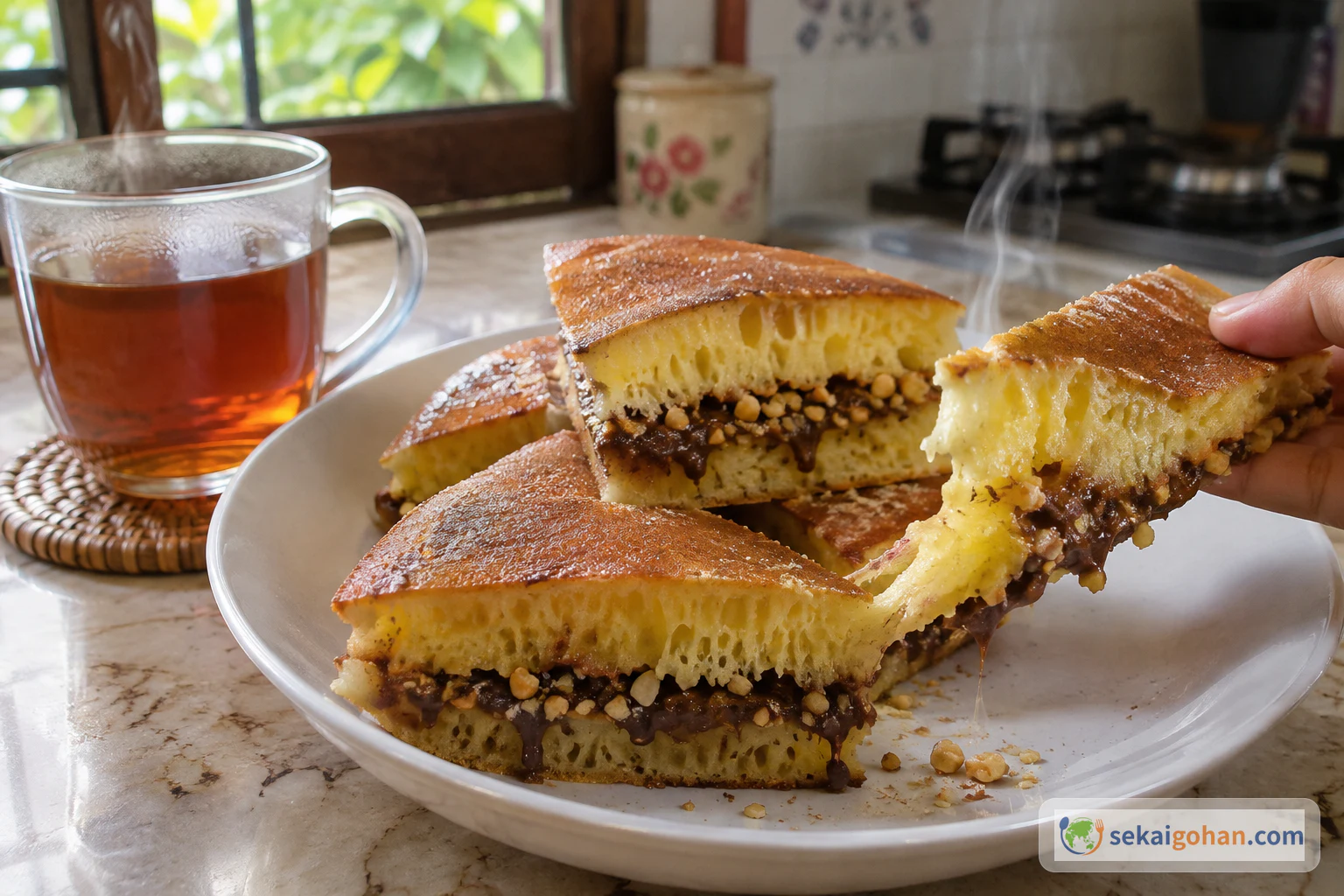
Eat it warm, fresh from the board, while the rim still crackles and the butter is liquid in the holes. Two pancakes make 16 wedges, enough for a plate set in the middle of the table for everyone to reach into. In Brunei it is evening food, bought hot at the night market.
Variations
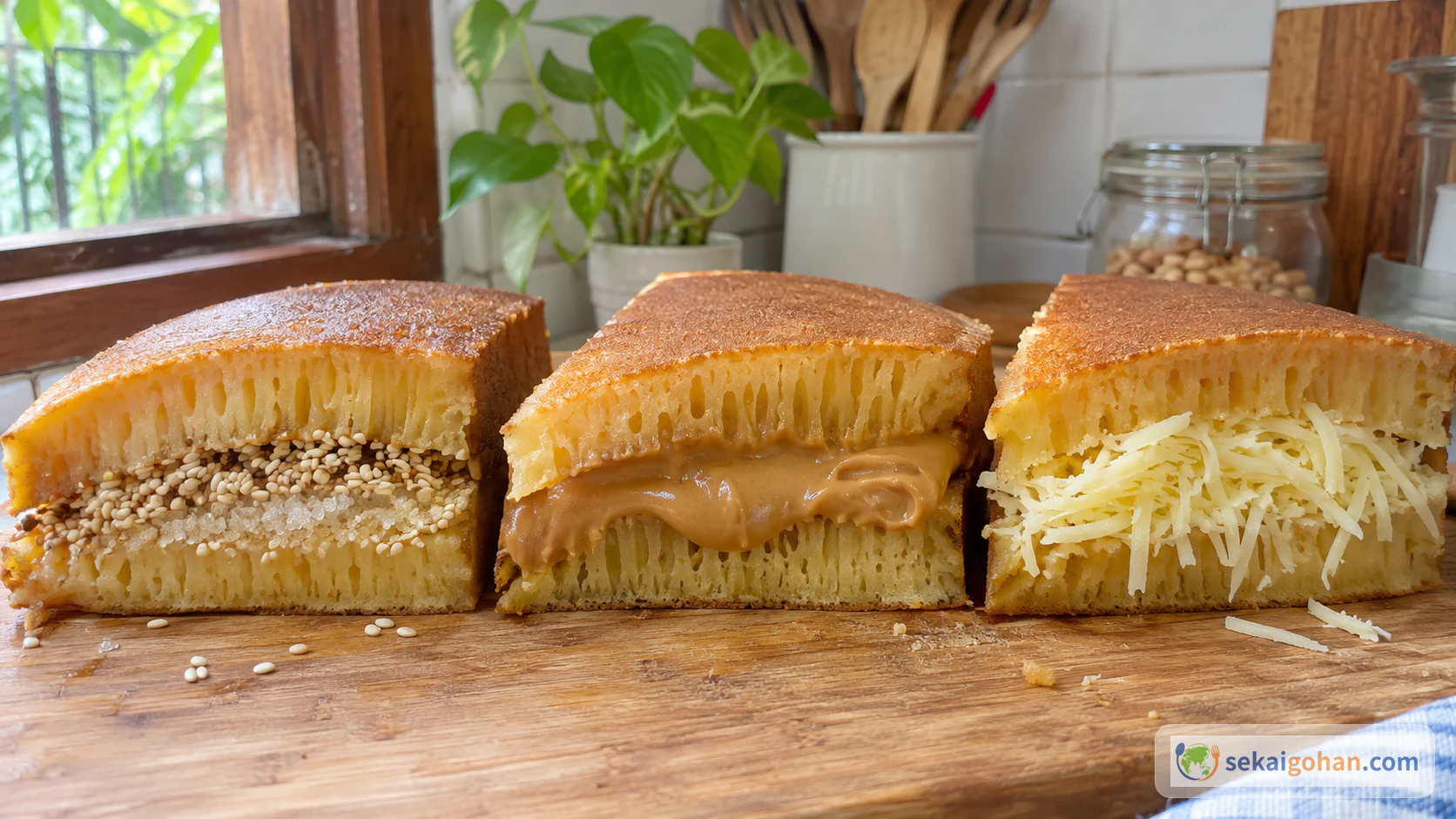
- Sesame and sugar: the earliest filling. Nutty and crunchy, with clean sweetness and no chocolate.
- Peanut butter: one of the fillings Gadong vendors use. Spread it on the hot halves so it melts; richer and saltier than crushed peanuts.
- Melted cheese: another night-market filling. Salty and stretchy against the sweet crumb.
- Condensed milk alone: the simplest version. Pure sweetness soaked into the holes, with the pancake's own crisp rim doing the work.
Frequently Asked Questions
Is this the same as savoury martabak?
No. Savoury martabak (martabak asin) is the salty counterpart. Martabak manis shares the name, usually traced to the Arabic word for folded, but it is a thick, sweet, leavened pancake.
Can I use milk in the batter instead of water?
Milk in the batter leads to the thinner, crisper style of apam balik made in Malaysia, which uses its own proportions. For the thick honeycomb pancake, keep to water.
How much condensed milk should I use?
Pour generously, to taste. It is the last layer over the butter, peanuts and sprinkles, so how far you go decides how sticky and sweet each wedge is.
Is kuih Malaya halal?
The food at Gadong night market is halal. At home, check the halal certification on your butter, sprinkles and condensed milk if that matters for your table.