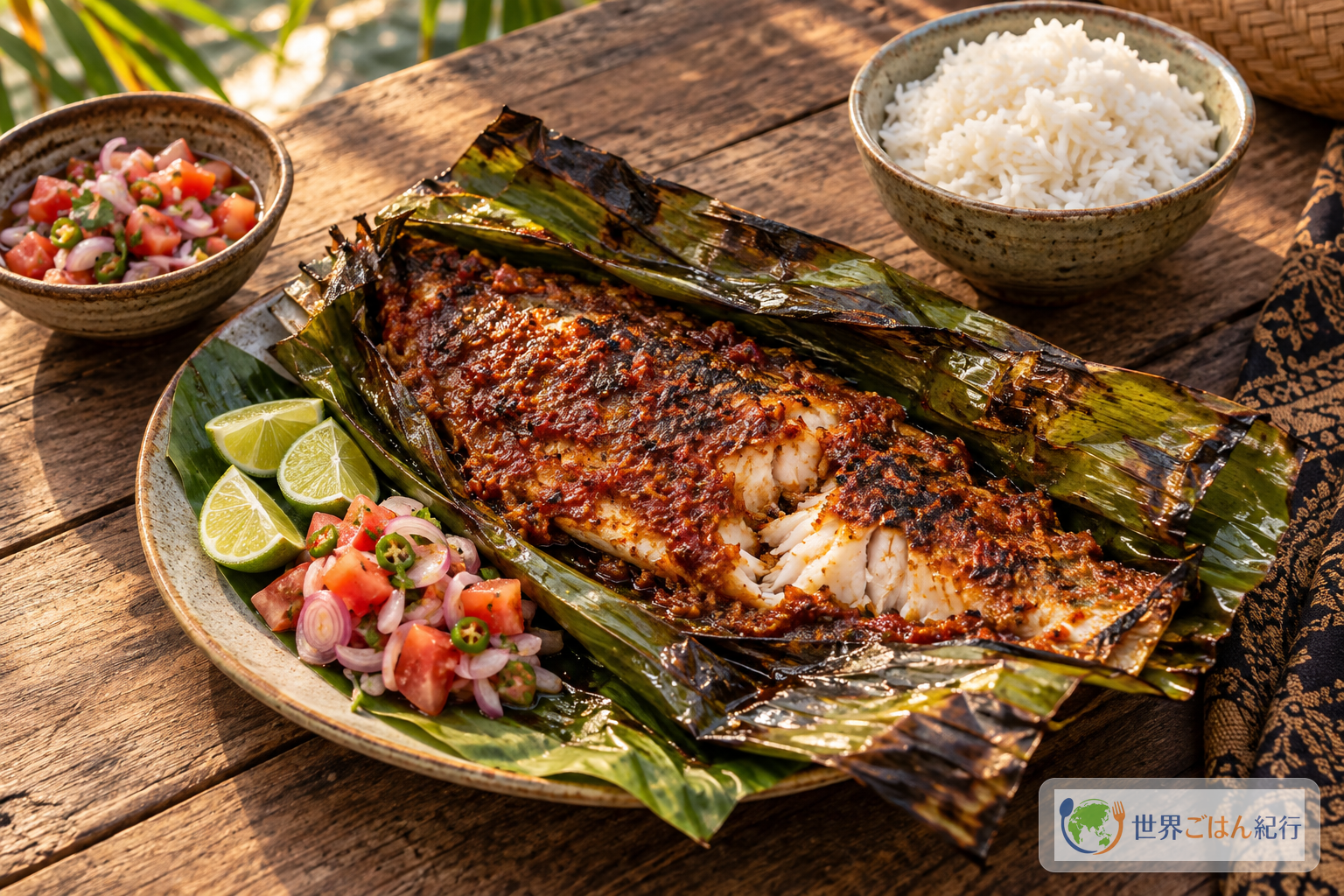
A table in eastern Indonesia, where a clear porridge is wound around chopsticks
It is not the steam of fresh rice. It is a nearly clear, sticky sago porridge that you wind up with chopsticks. It is white but not rice, smooth but not noodles. Papeda puzzles you a little the first time you see it, and then the moment it sinks into yellow fish soup, it suddenly makes sense.
Papeda is a sago porridge eaten in the Maluku Islands and Papua in eastern Indonesia. Starch taken from the sago palm is stirred with boiling water until it turns translucent and strongly sticky. On its own it is mild and hardly asserts itself. That is exactly why, paired with ikan kuah kuning, a yellow fish soup scented with turmeric, lemongrass and makrut lime leaves, the porridge takes in the soup's sourness and the umami of the fish.

The hard part outside Indonesia is judging the state of the porridge more than finding ingredients. If you can't get sago starch, tapioca starch gives a similar stickiness, but get the water temperature and stirring wrong and white lumps remain. Boil the fish soup hard and the fish falls apart and the turmeric aroma turns heavy. This article is based on sago starch, and also gives the water and heat for making it with tapioca starch.
Among other Indonesian dishes, there is rendang (in Japanese) for rich meat, soto ayam for yellow chicken soup, and rawon for black beef soup. Papeda differs from them: the porridge at the center makes no claim on flavor, and the dish is completed by eating it together with the soup. It is a plate that lets you experience, in your own kitchen, the staple of the eastern islands that is easy to miss if you look only at rice-eating Indonesia.
Papeda is the Indonesian spelling. It is eaten around Maluku, Ambon, Papua and West Papua, and local introductions treat it as a staple made from sago. This article calls the yellow fish soup "kuah kuning."
Background: where sago, not rice, is the staple

To understand papeda, it is quicker not to see Indonesia only as a land of rice. In Java and Bali rice tends to sit at the center of the table, while in Maluku and Papua sago has long supported daily life as the staple. The English-language pages of Indonesia's tourism ministry also describe papeda as a traditional food of Maluku and Papua made from sago.
In introductions to the area around Fakfak in West Papua, papeda and yellow fish soup are spoken of together. Sago porridge is eaten less by chewing than by letting it coat itself in the soup and swallowing. Locally it is wound up with a wooden tool called a gata-gata, or a tool like long chopsticks, and moved to the plate. At home, holding two disposable chopsticks slightly apart and turning the porridge gives plenty of the feel.
If you treat papeda like rice ladled into a bowl, it is easy to misjudge the portion at first. Papeda is not a dish completed by putting strong saltiness or aroma into the porridge itself. On the plate it takes on the yellow fish soup and passes sourness, heat and fish umami to you bit by bit. So rather than a big serving, winding up a small portion and loosening it in hot soup is easier on people who aren't used to it.
When you bring a Maluku or Papua table into a home kitchen, look at what each ingredient does on the plate rather than matching every name. The sago makes the staple's stickiness, the fish kuah kuning carries flavor, and sambal and lime add outline at the end. Even on a day you lack lemongrass or makrut lime leaves, if you keep three things (cook the fish gently, don't boil off the final sourness, stir the porridge until it is clear), you stay close to how papeda is eaten.
Another important point: don't serve papeda alone as a "novel staple." A plate with only clear porridge makes the flavor hard to imagine. With yellow fish soup, a small dish of heat and light krupuk beside it, stickiness, umami, sourness and crisp texture arrive in turn. Building that order on the plate makes it easier to eat as papeda's own staple, not as a rice substitute.
The yellow soup is not colored by turmeric alone. Shallot, garlic, candlenut, ginger, lemongrass and makrut lime leaves are opened in oil, and the fish goes in gently after. Fish used includes kakap (snapper family), tuna, skipjack and white fish. Elsewhere, cooking-grade cod, swordfish, yellowtail or yellowfin tuna, not sashimi-grade, are easy to use.
| Local element | Role | Practical substitute |
|---|---|---|
| Sago starch | Sticky staple | Sago starch is ideal. Tapioca starch if hard to find |
| Yellow fish soup | Passes flavor to the porridge | Cod, swordfish, yellowtail, yellowfin tuna |
| Lemongrass | Lightens the fish smell | Frozen or dried is fine |
| Makrut lime leaves | Citrus aroma | A few frozen leaves. If none, omit and make up with lime |
| Sambal | Adds heat plate by plate | Store-bought sambal or homemade |
Properly it is the starch of the sago palm. Tapioca starch comes from cassava and is different, but it is widely available and close in clarity and spring, so it works as a home substitute. Made with rice flour or potato starch alone, the stickiness and melt in the mouth go in a different direction.
Ingredients: sago porridge and yellow fish soup
This serves 4. Papeda is the staple, so skip cooking rice separately and make this the center of the meal. If someone isn't used to it, serving less papeda and more yellow fish soup makes it easier to start.
This dish contains fish, nuts, seasonings that may contain shellfish, and depending on the product possibly wheat or soy. If you use sambal, krupuk or store-bought spice pastes, check the ingredient labels.
Shopping: separate the ordinary fish from the aromatics worth buying

Fish can be whatever your local market sells. Rather than forcing a tired fish into a local name, you succeed more by choosing fish that doesn't break up when cooked. Cod has a gentle flavor but breaks easily, so add it last. Swordfish and yellowfin tuna have firm flesh and hold their shape in the soup. Yellowtail releases fat, so a little extra lime juice keeps it from getting heavy.
What is worth ordering is not ordinary vegetables or fish, but the starch, the aromatics and the supporting players at the table. Sago starch is ideal, but if you put home reproducibility first, a small bag of tapioca starch is fine. Buy lemongrass frozen or dried only when you find it; if you can't find a steady source, it remains shopping advice only. Makrut lime leaves, sambal and krupuk also go into ayam betutu and tom yum goong, so they are unlikely to go to waste if you keep cooking Southeast Asian food.
The first time, you don't need to fix everything with imported ingredients. Buy the fish locally, use the herbs you can get, and make up for missing aroma with the final lime. If you shop online, the order is: the starch that makes papeda's stickiness, makrut lime leaves that give the soup its outline, sambal to add heat at the table, and krupuk to break in between the sticky bites.
At the fish counter, look at the thickness of the cut more than the name. Thin cuts cook fast but tend to fall apart in the yellow soup, leaving only crumbs on the plate. If the piece is thick enough to cut into 3 cm cubes, it keeps its shape even at medium-low heat. Swordfish, tuna and yellowtail suit a first try. On a day you use cod, the flavor is milder, but once it is in the pot don't touch it, and ladle the soup over from above instead.
If you find sago starch it is worth trying, but you don't need a big bag from the start. Unused starch absorbs moisture and clumps, so lumps tend to remain next time. The first time, a small bag of about 250 g tapioca starch lets you get a feel for the stickiness, and once you know papeda suits your table, look for sago. What decides the first success is less how unusual the starch is than how you cook the fish and when you add the acid.
| What to buy | Priority | Reason |
|---|---|---|
| Sago or tapioca starch | High | Decides the stickiness of the porridge itself |
| Lemongrass | High | Frozen or dried lightens the fish smell |
| Makrut lime leaves | Medium | Gives the yellow soup its citrus outline |
| Sambal | Medium | Lets you add heat plate by plate without making the whole pot hot |
| Krupuk | Medium | Gives a light texture between sticky bites |
If you can't decide on the starch, a small bag of tapioca is enough to begin. When you find sago, the same water ratio is easy to try, and you can check papeda's stickiness at home.
Makrut lime leaves change the impression of the soup in small amounts. Frozen leaves can go to other curries and soups, so even buying them before lemongrass, you will use them up.
For heat, serving sambal at the table is easier to adjust for a family than putting it in the pot. Mixing a little into the mild papeda also tightens the outline of the fish soup.
Krupuk is not an ingredient in the recipe body, but it is an important supporting player that resets the stickiness midway. For the fried kind, puffing it just before serving keeps it from going damp.
Method: stir until clear, and cook the fish gently
Papeda looks like a dish where you just pour boiling water on starch, but the biggest difference comes at the start of stirring. Loosen the starch in cold water first, then add it to boiling water a little at a time. The fish soup is the opposite: don't stir it too much. Use force on the porridge, and barely touch the fish. Remembering that contrast makes it easier.
Kuah kuning is a yellow soup, but it is not a dish to boil hard like a curry. Once the fish is in, lower to medium-low and stop at small rising bubbles. If the fish breaks up, don't stir; ladle the soup over from above to cook it through.
Branch table for getting closer to the original in a home kitchen
Papeda can be made without every local ingredient. But there are things you can move and things that change the impression of the dish if you move them. In a home kitchen it helps to think in four parts: starch, fish, herbs and acid.
| Doubt | Direction to protect | Practical at home | Direction to avoid |
|---|---|---|---|
| Starch | Sago-derived stickiness | Sago starch, tapioca starch if difficult | Making porridge from rice flour alone |
| Water | Cook until clear | Adjust from 1.1 L water to 120 g starch | Putting starch straight into boiling water |
| Fish | Cuts that keep their shape | Swordfish, cod, tuna, yellowtail | Simmering thin sashimi cuts for long |
| Aroma | Lemongrass and citrus leaves | Frozen lemongrass, makrut lime leaves | Making it Western with bay leaf alone |
| Acid | Add brightly at the end | Lime, lemon | Adding early and losing the aroma |

Made with tapioca starch, the stickiness is a little stronger and it gets heavy as it cools. Start with the same amount of water and if it comes out stiff, add 2 tbsp hot water at a time to adjust. Mixing in potato starch adds stickiness, but it tends to feel floury in the mouth when cool, so it isn't suited as a sole substitute.
For fish, put resistance to breaking ahead of finding the local species. Cod is easy to get but breaks easily, so don't stir after it goes in the pot. Swordfish and tuna keep their shape and suit first-timers. Yellowtail has fat that makes the yellow soup heavy, so raising the final lime juice to 1 1/2 tbsp makes it easier to eat.
Serving: don't mix it all through, loosen it in hot soup
If you plate everything and then mix, papeda suddenly looks heavy. Put a little yellow fish soup in a shallow dish first, drop the wound-up papeda into it, and ladle soup over once more. It is in good shape when a thin film of yellow oil clings to the surface of the clear porridge and the soup drips slowly when you lift it with chopsticks.
At the table, serve sambal, lime and krupuk in small dishes. If heat goes into the pot from the start, the fish aroma and the brightness of the turmeric get harder to see. Eat the first bite as is, add a little sambal on the second, and scoop with a broken piece of krupuk along the way, and even this sticky staple doesn't tire you. For people not used to it, wind small portions and give more soup.
For a family, it works better not to give everyone the same heat from the start. For children and those who avoid heat, give mostly soup and put sambal at the edge of the plate in a portion about the size of a grain of rice. Heat lovers keep more fish aroma by touching the sambal to each bite rather than dissolving it through the whole soup. Papeda absorbs flavor easily, so once strong heat goes in, it can't be undone.
Krupuk is there not as decoration but as a way to rest the stickiness. After two or three bites, the stickiness of sago stays in the mouth. Break the krupuk and dip it in the soup, and crisp and slightly damp parts mix and make the next bite easier. As a substitute, shrimp crackers, thin rice crackers or fried rice vermicelli can play a similar role, but sweet crackers don't suit the soup.
Warming the plate reduces failures. Papeda turns suddenly heavy as it cools, so before plating pour boiling water into the plate, leave 1 minute, and pour it off. Winding a small portion for each person works better than one big platter for keeping clarity and stretch to the end.
What goes wrong: white lumps, stiff porridge, broken fish
White lumps come from putting the starch into boiling water before loosening it in cold water, or from stopping the stirring hand. For small lumps, keep medium-low heat and press them against the side of the pot with a wooden spoon, stirring for 2 minutes. If there are many large lumps, rather than pushing through a strainer, add 4 tbsp hot water to loosen, whisk hard, and reheat.
If it goes too stiff, add 2 tbsp hot water at a time before you turn off the heat. Cold water drops the temperature and can bring the clear porridge back to white. If it is too loose, cook 2 minutes at a time over medium heat. Stir while scraping the bottom and drive off moisture until it hangs in a ribbon from a lifted spoon.
Fish breaks up from boiling too hard and from being touched too much. Once the fish is in, keep the heat where the soup just circulates, and don't move it with chopsticks. To let the flavor settle, ladle soup over from above instead of turning the fish. A broken fish is not a failure, but if you want a good look at the table, move the broken flakes to a small bowl to taste the soup.
If the soup is vague, check acidity before adding more salt. Add 2 tsp lime juice and warm just 30 seconds, and the fish flavor stands up. If it lacks heat, don't make the whole pot hot; put sambal on a separate dish. The more a dish divides a family's heat preferences, the easier it is to finish by adjusting at the table.
Storage and menu: warm the soup first the next day

Papeda is easiest to handle fresh. If any is left, always separate the papeda and the fish soup into different containers. Let them cool slightly and refrigerate within 2 hours. Refrigerated, plan on keeping them until the next day. The fish soup can be eaten the next day, but the fish toughens when reheated, so warm it over low heat.
To reheat, warm the soup first in a pot over low heat for 5 minutes. Put the papeda in a heatproof bowl, sprinkle on 2 tbsp water, cover loosely with plastic wrap, and microwave at 600 W for 40 seconds. Stir once, and if it is still stiff, add 1 tbsp water and heat 20 seconds more. It is hard to bring back to freshly made, so the next day it is more natural to eat it with plenty of soup poured over.
I don't recommend freezing. Papeda separates water on thawing and the stickiness turns gritty. For the fish soup alone, you can take out the fish and freeze the soup part, and next time warm it with new fish. The herb aroma weakens, though, so add lime juice and shiso at the end of reheating.
For a menu, leaving a way out for heat and sourness makes it easier to eat. Put a sambal substitute in a small dish, and for vegetables, light things like cucumber, tomato and boiled greens suit better than a rich peanut sauce such as gado-gado. On a day you want a little rice too, a small portion of coconut-scented nasi uduk pulls it together as a Southeast Asian table.
FAQ
If I have no sago starch, can I make it with tapioca starch alone?
Yes. Replace 120 g sago starch with 120 g tapioca starch and start with the same water. Tapioca tends to come out stickier, though, so if it feels stiff at the end, add hot water 2 tbsp at a time. With rice flour alone you can't get the clear stretch and it becomes a different porridge.
Which fish is least likely to fail?
For a first try, swordfish, yellowfin tuna and yellowtail fillets are easy to handle. Cod has a gentle flavor but breaks easily, so the key is not to touch it once it is in. If you use thin sashimi-grade fish, add it just before turning off the heat and cook it in residual heat.
Do you eat papeda with chopsticks?
Locally, the way described is winding it with a special wooden tool or long chopsticks and moving it to the plate. At home, two disposable chopsticks are enough. Open the chopsticks slightly, put them in the porridge, turn them so it wraps around, and drop it in the yellow soup. You can eat it by spooning too, but winding shows you the fun of the stickiness.
Can I make it without heat?
Yes. Leave out the red chili and put the sambal on a separate dish. The aroma of the yellow soup comes from turmeric, lemongrass and makrut lime leaves, so the dish keeps its frame even without chili. If it feels lacking, adding 1 tsp lime juice rather than heat lifts the fish flavor.
Can I make it ahead?
The fish soup can be made the day before, but papeda is better made just before eating. If you must make it ahead, put only the papeda in an airtight container and sprinkle 1 tbsp water on the surface to prevent drying. The next day, warm it a little at a time in the microwave and bring back the stickiness with hot water.
More Indonesian dishes to cook alongside
Papeda uses sago, not rice, as the staple, so even among Indonesian dishes the pairing differs a little. Rather than rich meat dishes, dishes that add aroma and heat a little at a time suit it.
Sources
Indonesia Travel, the English-language site of Indonesia's tourism ministry, introduces papeda as a sago dish of Maluku and Papua and explains its pairing with yellow fish soup. On another page it takes up Papeda Ikan Kuah Kuning as a dish of West Papua, especially around Fakfak, and touches on sago porridge, fish, turmeric, lemongrass and how it is eaten. The Primarasa recipe was consulted to check the fish, the spice paste, and the water amount and cooking steps for sago starch. The ANTARA News Ambon article was consulted to confirm the aromatics of the yellow fish soup in Maluku and the explanation of stirring sago with boiling water.