

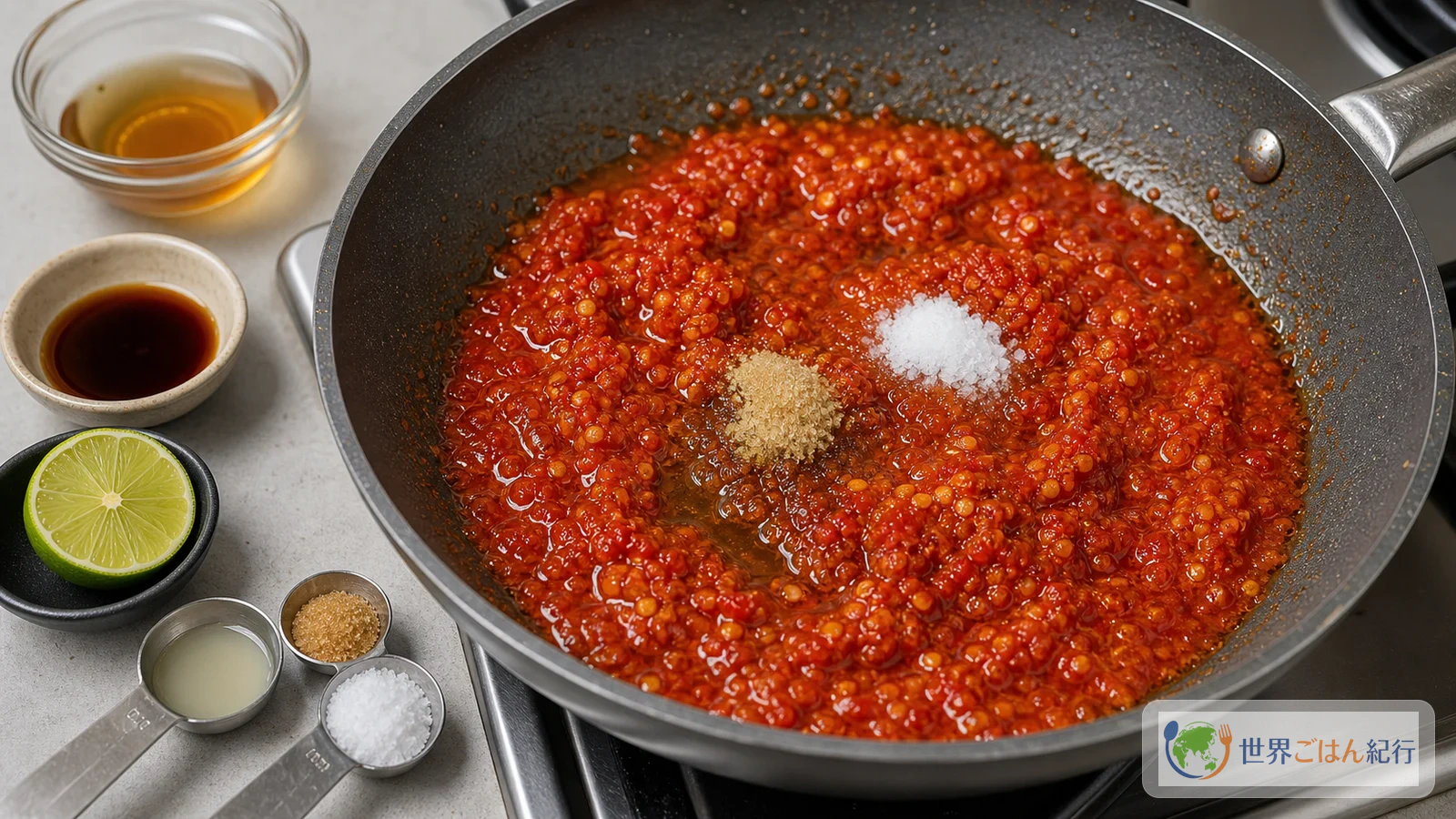

The story of a sambal substitute: one spoonful moves fried rice toward Indonesia
On the day you make nasi goreng, the thing that holds you up in the kitchen may not be the chicken or the eggs, but a small red jar. The recipe says "sambal," "sambal oelek" or "sambal terasi." But the supermarket down the street only has sweet chili sauce, and the specialty shop has it some days and not others. Give up here, and your fried rice drifts toward an ordinary sweet-and-savory fried rice.
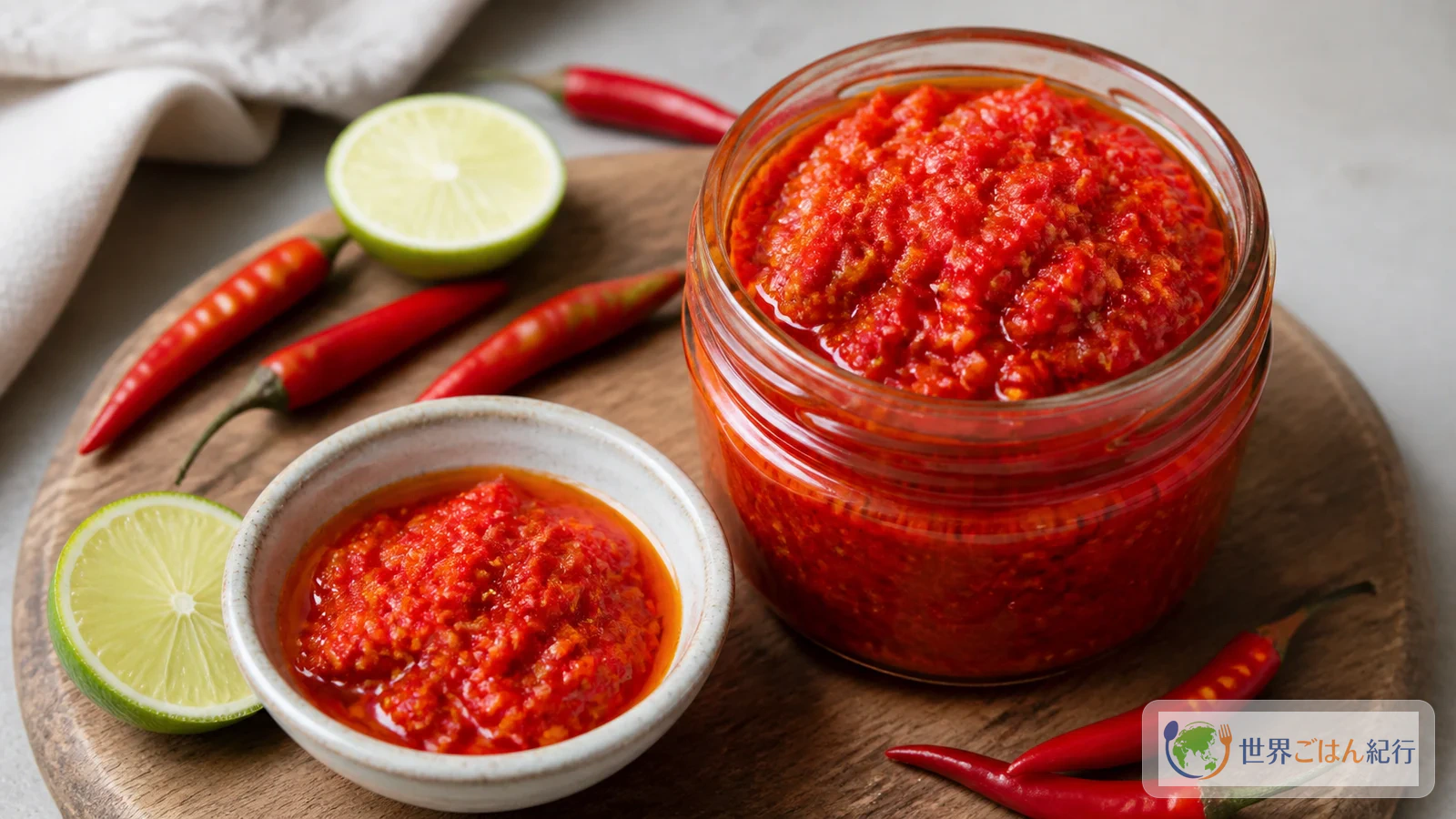
Sambal (sambal / sambel) is an Indonesian chili condiment built around chilies, combined with things like garlic, shallots, lime, tomato and terasi, a fermented shrimp paste. It isn't simply a "hot sauce." It sits next to rice dishes, fried foods, grilled fish, tempeh and satay, a kind of switch for the whole table.
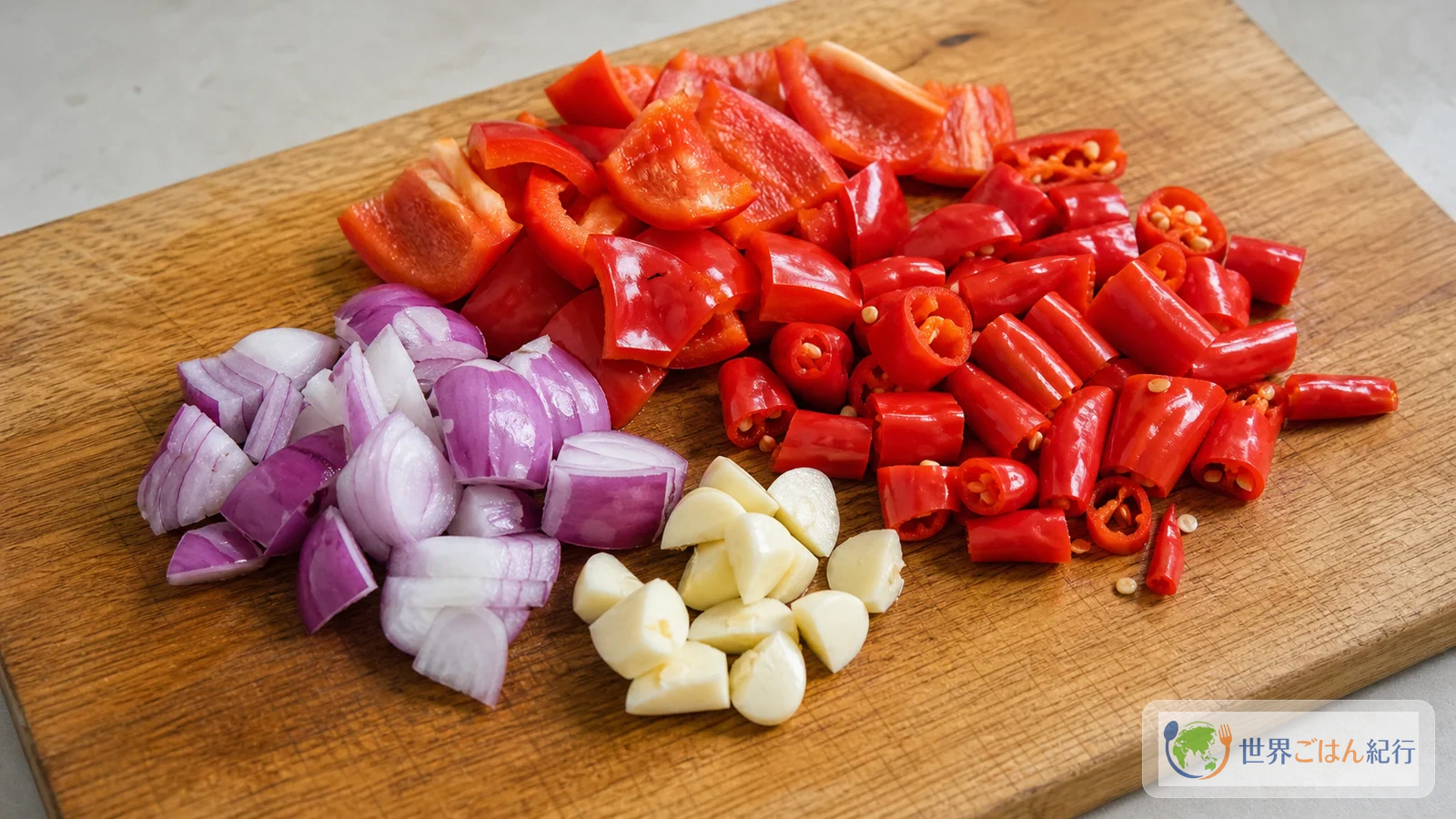
You don't need to gather every authentic ingredient in a home kitchen. The framework to protect is the heat of chilies, the aroma of garlic and onion, a savory shrimp note, the sourness of lime or vinegar, and a little sweetness. Once all five are there, the moment you add a spoonful to nasi goreng (in Japanese), the flavor snaps noticeably toward Indonesia.
This article scales a "sambal substitute for nasi goreng," something you can make on a day with no store-bought sambal, down to a batch that takes 20 minutes. It separates the version for when you can get terasi, the version leaning on dried shrimp, and a version with no shrimp at all, and includes adjustments for households that want less heat. It's a small red condiment worth keeping in the fridge, and a good entry point to our guide to Indonesian food (in Japanese).
We're making a cooked sambal substitute that goes easily with nasi goreng, mie goreng, grilled fish and grilled chicken. This isn't an article that fully reproduces any particular Indonesian sambal; it's about deciding, with ingredients you can buy near home, what to keep and what to swap.
First, know this: sambal isn't one thing
If you remember sambal only as "Indonesian chili sauce," you'll get lost when substituting. In reality its range is so wide, by region, household and dish, that the versions are practically different condiments. A 2022 review in the Journal of Ethnic Foods sorted 110 kinds of sambal from Indonesian cookbooks and explains that the ingredients other than chilies give each one its character.
Four families are especially easy to work with in a home kitchen:
| Name | Role in Indonesia | Main ingredients | How to approximate it at home |
|---|---|---|---|
| Sambal ulek / oelek | A basic ground chili paste | Red chilies, salt, acid | Works with just chilies, vinegar and salt. Good as a cooking base |
| Sambal terasi | Savory, good with rice dishes and fish | Chilies, terasi, garlic, sugar, lime | Make up the savoriness with dried shrimp, fish sauce or anchovy |
| Sambal matah | Balinese raw sambal that adds fragrance | Shallots, chilies, lemongrass, lime | Best eaten right away rather than stored. Too light in aroma to stand in for nasi goreng |
| Sambal bajak | Cooked sambal fried with sugar and oil | Chilies, onion, tomato, sugar, oil | Suits making ahead at home. Easy to round off the heat |
What we're making here sits between sambal terasi and sambal bajak. We soften terasi's intense fermented aroma a little with dried shrimp and fish sauce, which are easier to find, and fry it in oil so it keeps better. Rather than the freshness of a raw sambal matah, we're aiming for a deep red condiment that holds its own next to nasi goreng or rendang (in Japanese).
English-language product labels usually say "sambal oelek," but "ulek" is closer to current Indonesian spelling. Both names relate to the action of crushing in a stone mortar. When you're looking for a jarred product, "sambal oelek" is the label you're more likely to find.
Substitute ingredients: what to keep and what to replace
The most important thing with a sambal substitute is not to think "anything hot will do." Doubanjiang, gochujang, sweet chili sauce and Tabasco are all red and hot, but they differ in salt, sweetness, kind of fermentation and acidity. For nasi goreng, you get closer by keeping a bit of the fresh, green aroma of chilies and a savory shrimp note.
| Indonesian ingredient | Easier-to-find substitute | What it brings | Watch out for |
|---|---|---|---|
| cabai merah (red chilies) | Fresh red chilies, Korean red chilies, dried red chilies + red bell pepper | Heat, red color, fresh aroma | Dried chilies alone make the heat too sharp |
| cabai rawit (small, very hot chilies) | Dried red chilies, frozen Thai bird's eye chilies | Sharp heat | At a table with children, use half the amount or less |
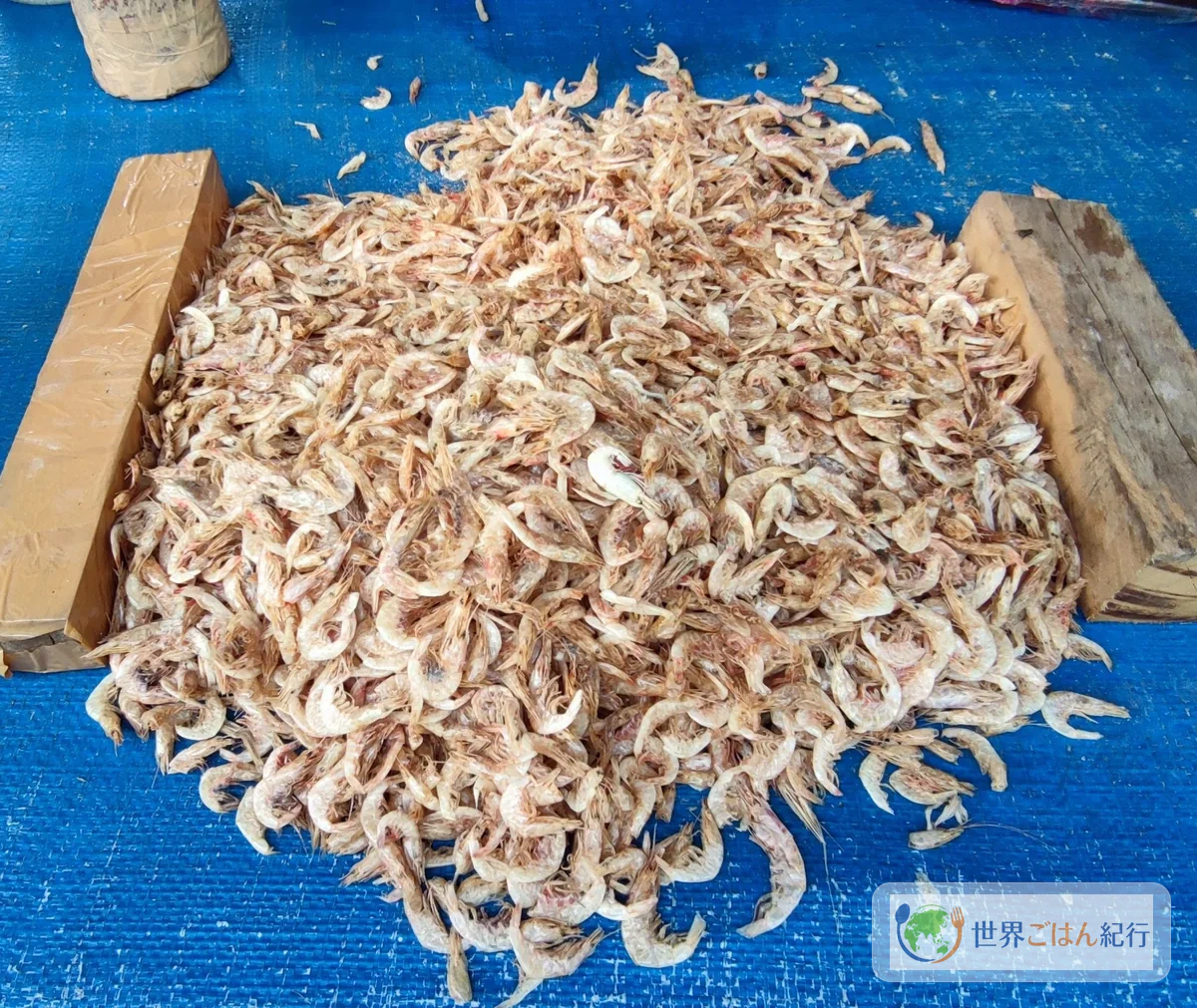
| terasi (fermented shrimp paste) | Dried shrimp, fish sauce, anchovy paste | Fermented aroma, seafood savoriness | Mind shrimp and seafood allergies |
| bawang merah (small red shallots) | Red onion, regular onion, shallots | Sweetness, aroma, body | Cook regular onion a little longer |
| jeruk limau (citrus) | Lime, lemon, rice vinegar | Acidity, aroma | Vinegar alone makes the aroma flat |
| gula jawa (palm sugar) | Light raw cane sugar, dark brown sugar, a little honey | Sweetness that smooths the edges | Too much pulls it toward sweet chili sauce |
The one thing close to irreplaceable is the chili itself. Made with only doubanjiang or only gochujang, the fermented bean-paste and koji character becomes strong, and the result leans Chinese or Korean rather than Indonesian. Terasi, on the other hand, can be replaced. It moves away from the Indonesian aroma, but frying dried shrimp and fish sauce gives home-style nasi goreng plenty of seafood depth.
The basic recipe uses shrimp (dried shrimp) and fish sauce. If you have a shrimp or seafood allergy, leave out the dried shrimp and fish sauce and make up the savoriness with 1/2 tsp white miso and 1 tsp soy sauce. The flavor changes, but it still works as a chili condiment.
Ingredients (an easy batch, about 8 servings)
This amount fills one small storage container. Using 2 tsp to 1 tbsp for nasi goreng for two, it lasts about four meals. For households that don't like heat, halve the chilies from the start and add color and sweetness with red bell pepper.
Six fresh red chilies make it adult-level hot when served with nasi goreng. For the whole family, start with 3 red chilies + 1/2 red bell pepper. Adding heat later is easy; taking it out is hard.
Once you've made sambal, you can use it beyond nasi goreng: on fried noodles, fried chicken, fried eggs and grilled fish. If you can buy a jar, that's fine too, but if you're making a substitute, keeping the ingredients on hand separately gives you more ways to use them.
Shopping priorities
A sambal substitute isn't a dish that gets more authentic the more rare ingredients you collect. For the first batch, it's easier to keep going if you start with things that will still be useful if they linger in your kitchen. Fish sauce goes on to nasi goreng, pad kra pao (in Japanese) and sinigang (in Japanese). Dried shrimp adds savoriness to fried rice, fried noodles and soups. A storage container gets used for any make-ahead condiment.
| Priority | What to buy | If you can't find it nearby | When you can skip it |
|---|---|---|---|
| 1 | Fresh or dried red chilies | Frozen Thai bird's eye chilies, Korean red chilies | If you don't like heat, more red bell pepper is fine |
| 2 | Fish sauce | Other fish sauces such as patis, a little anchovy | If avoiding shrimp and seafood, switch to soy sauce and white miso |
| 3 | Dried shrimp | Terasi, anchovy paste | No need to buy for the seafood-free version |
| 4 | Lime | Lemon, a little rice vinegar | Bottled lemon juice alone is fine for a first batch |
| 5 | Small food processor | Mortar and pestle, or chop finely with a knife | Not needed if you'll only make it once |
If you're unsure what to buy, just look for chilies, dried shrimp, fish sauce and a storage container. Even if you buy a jar of sambal, reading through this substitute recipe once makes it easier to judge whether the jar tastes sweet or strongly fermented, and which dishes it belongs in.
Method: wake up the aroma without scorching
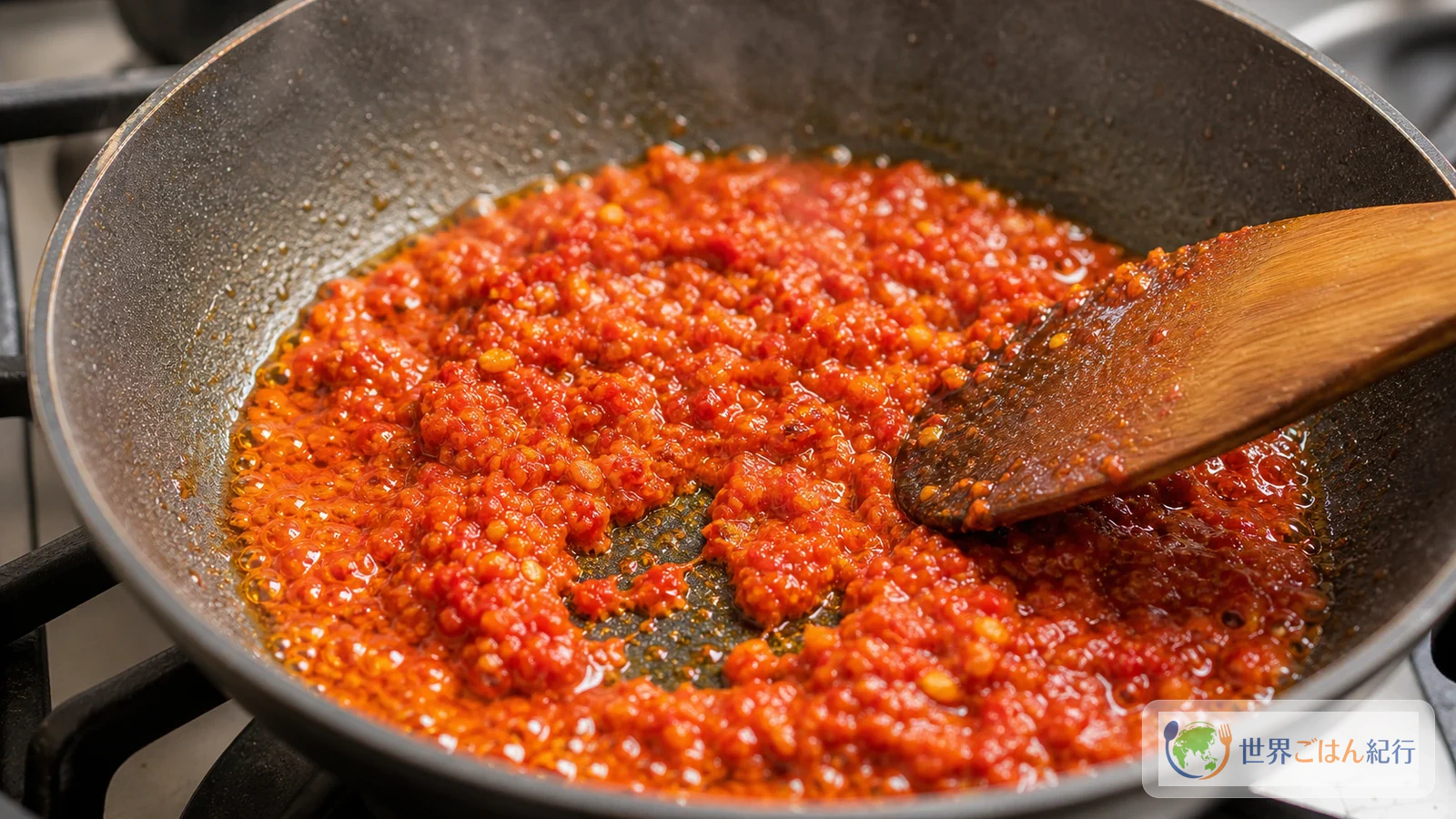
Making sambal is similar to frying spices for a curry. Cooking rounds out the aroma of the garlic, onion and shrimp. But scorching leaves bitterness, so rather than frying fast over high heat, you build the aroma over medium heat while driving off the moisture.
A stone mortar or a mortar and pestle gets closest to the texture of a traditional ulek, but in a home kitchen a food processor is plenty. Run it too long, though, and it turns into a sauce whose moisture is harder to cook off when you fry it. Pulse a few seconds at a time and keep some coarse bits.
Adjusting the flavor for each substitute
The flavor of a sambal substitute changes quite a bit depending on what you have on hand. Knowing "what happens when you add what" here means it won't fall apart next time, even if you eyeball it.
If you have terasi
If you have terasi, leave out the dried shrimp and use 1/2 tsp terasi. Always toast it lightly over a flame or in a dry pan before adding it. Raw, its fermented smell is strong, and in a home kitchen it can be a bit of a shock. Cooking takes the edge off and turns it into a savory depth that settles into the background of nasi goreng.
If you're using only dried shrimp
Dried shrimp doesn't have terasi's fermented aroma, but it's easy to find and forgiving. After soaking, chop it finely or grind it in with everything else, then fry it well in oil. A little of the soaking liquid spreads the seafood aroma. Leftover pieces of dried shrimp scorch easily, so it's safer to keep the heat at medium or below.
If you're making it without shrimp
To leave out shrimp, make up the flavor with 1/2 tsp white miso, 1 tsp soy sauce, and, if you're also skipping fish sauce, a little salt. It's no longer sambal terasi-style, but it works as a chili-and-onion paste. It's actually easier to pair with tempeh, tofu and stir-fried vegetables, and you can repurpose it for small dishes like tahu gejrot (in Japanese), fried tofu soaked in a sweet-sour sauce.
If you're in a hurry with store-bought doubanjiang
Mixing 1 tsp doubanjiang, 2 tbsp finely chopped red bell pepper, 1 tsp lemon juice, 1/2 tsp sugar and 1/2 tsp fish sauce gives you a stopgap red chili condiment. But doubanjiang's fermented broad-bean aroma is strong and pulls away from Indonesian food. Rather than mixing it into nasi goreng, it's best served in a small amount at the edge of the plate.
If all you have is sweet chili sauce
Sweet chili sauce is very sweet and thick, so on its own it doesn't work as a sambal substitute. If you use it, add 1 tsp fish sauce, 1 tsp lemon juice and a little chopped red chili to 1 tbsp sweet chili sauce. Sweetness remains, so use a bit less kecap manis in the nasi goreng itself.
Using it in nasi goreng, mie goreng and grilled dishes
Use different amounts depending on whether you're mixing the sambal into a dish or serving it alongside. Mix in a lot from the start and you can't take the heat back, so the safe approach the first time is "mix in a little, add more on the side if needed."
If you add tablespoons to a stir-fry from the start, you can't undo the heat or the salt. For nasi goreng or mie goreng, bloom 2 tsp in the oil and put 1 tsp at the edge of the plate. This two-stage approach lets everyone at the table adjust their own heat.
| Dish | Amount | When to add | Notes |
|---|---|---|---|
| Nasi goreng for 2 | 2 tsp–1 tbsp | Fry with the other ingredients before adding the rice | The aroma spreads through everything. Start mild |
| Mie goreng for 2 | 2 tsp | Just before adding the noodles and seasonings | Clings easily to noodles, so don't overdo it |
| Rice with a fried egg | 1 tsp | On the side of the plate | Mixing it with the yolk softens the heat |
| Grilled fish | 1–2 tsp | On the side just before eating | Extra lime suits fish |
| Grilled chicken thighs | 1 tbsp | Brush on at the end of grilling, or serve alongside | Brushed on before grilling, it burns easily |
| Fried chicken, fried spring rolls | 1 tsp each | As a dip | More grown-up than sweet chili sauce |
For nasi goreng, use a little less kecap manis than in the nasi goreng ingredients (in Japanese) and start with 2 tsp of the sambal substitute. The sweetness of kecap manis, the salt of fish sauce and the heat of the sambal overlap, so taste before adding the final soy sauce.
Using it in a weeknight nasi goreng
On days when this sambal is in the fridge, nasi goreng comes together much faster. After frying the chicken and onion, drop 2 tsp sambal at the edge of the pan, let it meld with the oil, then add the rice. Waking up the aroma in the oil from the other ingredients first, rather than mixing it straight into all the rice, brings out the smell of chili and dried shrimp.
Use a little less kecap manis than usual. The sambal already contains sugar and fish sauce, so the usual amount of sweet soy sauce doubles up on sweetness and salt. For 400 g rice: 1.5 tbsp kecap manis, 2 tsp sambal, and soy sauce added at the end starting with 1 tsp. If that isn't enough, adding more sambal on the side of the plate makes it easier to suit each person's heat level.
For lunch the next day, rather than mixing it into a stir-fry, it's easier to put a little next to a fried egg. Even just leftover rice, a fried egg, cucumber and sambal gets a little closer to the simple rice plates served at an Indonesian warung (a small eatery). On busy days especially, it's easier to keep going if you don't make the dish carry all the seasoning and leave room to adjust on the side of the plate.
You can also use a little in pad thai (in Japanese) or pad kra pao (in Japanese). But its acidity and aroma differ from Thai chili condiments, so too much muddles the dish's identity. If you're cooking your way around the world, it keeps the outlines cleaner to use it up on Indonesian food days.
Even within Southeast Asia, where the acidity sits differs from dish to dish. In a Vietnamese banh mi (in Japanese) it's the pickled vegetables; in banh xeo (in Japanese) it's nuoc cham; in Filipino adobo (in Japanese) the vinegar braise is the star. Sambal on the side is handy, but keep the amount small enough not to override the main acidity or aroma.
The Malay-style sambal served with nasi lemak (in Japanese) often fries extra onion for sweetness and tastes a little rounder than this nasi goreng version. On days with laksa (in Japanese) or roti canai (in Japanese), start with just a tiny amount at the edge of the plate so it doesn't get in the way of the coconut and curry aromas.
With meat, you can try a little in a small dish not only with satay-style grilled chicken (in Japanese) but also on a day with the strongly aromatic herbal soup bak kut teh. On the other hand, it's too assertive for the gentle seafood flavors of khao piak sen (in Japanese), so if you add any, keep it to a tiny bit at the table.
Troubleshooting: too hot, bitter or watery
With so few ingredients, the cause of a problem in a sambal substitute is easy to find. If you taste it and something seems off, look for the closest symptom in the table below.
| Symptom | Cause | Fix |
|---|---|---|
| Too hot | Too many chili seeds or dried chilies | Fry some finely chopped red bell pepper and add it. Add a little sugar |
| Bitter | Garlic, dried shrimp or chilies scorched | If badly scorched, start over. If mild, add a little sugar and lime |
| Watery | The moisture from the pepper and onion hasn't cooked off | Return to medium-low heat and cook off the moisture |
| Smells too shrimpy | Terasi or dried shrimp undercooked | Add a little oil, reheat and round out the aroma |
| Too sweet | Too much sugar or sweet chili sauce | Add a little lime juice, fish sauce and chili |
| Too salty | The salt in fish sauce, salt and dried shrimp added up | Dilute with fried red bell pepper and onion |
The thing to avoid most is scorching. The bitterness of burned chilies never fully disappears, even with added sugar or acid. Once the oil turns red and the aroma comes up, don't push it any harder over high heat. Nasi goreng itself lives on high heat, but sambal tastes better made without hurrying.
Lime or lemon keeps its aroma when added after the heat is off. Added at the start and cooked down, only the sourness remains and the brightness of the citrus disappears. If the flavor turns heavy after storing, a few drops of lemon juice just before eating bring it back.
Storage and make-ahead: use it up within 4 days in the fridge
This sambal substitute is cooked, but it's a small-batch homemade condiment. It doesn't go through a sterilization process like commercial jarred products. Keep it in a clean container and use it up within about 3–4 days in the refrigerator. USDA FSIS general guidance on leftovers also gives 3–4 days in the refrigerator for cooked leftovers.
Heat, salt and oil may make it look safe, but a small homemade sambal is not a preserved food. Put only what you'll use in a small dish at the table and return the rest of the container to the refrigerator.
A glass container scalded with boiling water and dried is the easiest to manage. Always serve with a clean spoon, and never put a spoon that has touched meat or rice back into the container. It's hard to notice spoilage in a spicy condiment, so if there's an off smell, bubbles, mold or sliminess, throw it out rather than eat it.
| Storage | Guideline | Best uses |
|---|---|---|
| Refrigerator | 3–4 days | A little at a time with nasi goreng, grilled fish or fried eggs |
| Freezer | About 1 month | Wrap in 2 tsp portions in plastic wrap, for stir-fries |
| Room temperature | Not suitable | Put only what you'll serve into a small dish |
To freeze, portion it out in an ice cube tray or by the teaspoon. The aroma fades a little after thawing, but it's plenty good for stir-fries. Herb-heavy raw sambals like sambal matah don't freeze well, but this cooked sambal is comparatively easy to handle.
In hot weather or when eating outdoors, don't leave the whole container out. Put the amount you need in a small dish and return the rest to the fridge or a cooler bag. Don't assume it's safe because it's hot and salty.
Background: the Indonesian table runs on "white rice and red heat"
When cooking Indonesian food, seeing sambal only as a small jar in the condiment aisle misses something. White rice, fried foods, grilled fish, coconut stews, sweet kecap manis. Having a red heat beside those dishes shifts the weight of the whole meal.
The Journal of Ethnic Foods review describes sambal as having been part of Indonesian food culture for centuries, with ingredients and methods that vary by region. Chilies arrived from the 16th century onward, but there was already a tradition of pungent seasoning with pepper and ginger before that, and chilies entered that tradition, leading to today's wide variety of sambals.
What's interesting is that sambal isn't only about showing off heat. The sweetness of Java, the raw shallots and lemongrass of Bali, the fierce heat of Sumatra, the seafood of Sulawesi. Local ingredients go in, and each sambal plays a different role beside the food. Just as miso in Japan changes sweetness and color from region to region, sambal carries the face of its place.
So when you substitute, rather than buying one bottle of red chili sauce and calling it done, thinking about "what am I serving it with today?" keeps you from going wrong. For nasi goreng, savoriness that stands up to rice and sweet soy sauce. For grilled fish, acidity with extra lime. For fried food, a touch more sweetness to balance the oil. Just keeping this idea in mind makes Indonesian food much easier to cook in any home kitchen.
This relationship between rice and heat changes shape little by little across islands and borders. In a dish that cooks spices down, like rendang (in Japanese), the heat goes deep inside; in som tam (in Japanese), raw chilies come forward together with sourness. The table condiments for pho ga (in Japanese) are tools for changing the soup in your own bowl. Making a sambal substitute shows Southeast Asian food not as "a collection of spicy dishes" but as differences in where the heat is placed.
FAQ
The harder question isn't "what can I substitute?" but "how much before it becomes a different dish?" Doubanjiang, sweet chili sauce and gochujang are convenient, but use them a little at a time as sambal substitutes.
Q1. Are sambal oelek and sweet chili sauce the same thing?
No. Sambal oelek is a chili paste built on chilies, salt and acid, with little sweetness. Sweet chili sauce is very sweet and thick; it's handy as a dip for fried foods, but in nasi goreng the sweetness tends to come forward.
Q2. Can I substitute doubanjiang?
It works in a pinch, but doubanjiang's fermented broad-bean aroma is strong and pulls away from Indonesian food. If you use it, keep it to about 1 tsp, add lemon juice, fish sauce and chopped red chili, and serve it at the edge of the plate.
Q3. Can I make a sambal substitute that isn't hot?
Yes. Reduce the red chilies to 1–2 and increase the red bell pepper to 1 whole pepper. The heat is milder, but with the garlic, onion, dried shrimp and lime, it's still a red condiment that suits nasi goreng. If you have children, this is a reassuring ratio to start with.
Q4. Can it taste authentic without terasi?
It won't be a true sambal terasi, but it gets plenty close for home-style nasi goreng. Frying dried shrimp and fish sauce in oil brings out seafood savoriness and an aroma close to fermentation. When you get hold of terasi, add just 1/2 tsp next time and compare the difference.
Q5. Will it keep for a week in the fridge?
For a homemade batch of this size, plan on 3–4 days in the refrigerator. Commercial products are handled differently in terms of sterilization and acidity control. If you want to keep it longer, freeze it in 2 tsp portions and thaw only what you need for stir-fries.
Q6. Can I use it in other dishes from around the world?
In small amounts, yes. It goes well with mie goreng (in Japanese), grilled fish, fried chicken and rice with a fried egg. Crossing borders, use just a little with pad kra pao (in Japanese) or a banh mi (in Japanese). Too much pulls the dish's aroma toward Indonesia, so start with 1 tsp.
Sources
The types of sambal, the idea of cooking terasi before use, and the refrigerator storage guideline are based on publicly available English-language sources and food-safety information, reworked into amounts and steps that are easy to make at home. The amounts in this article are for a home-style substitute recipe and do not reproduce the manufacturing standards of jarred products.
- Reggie Surya, Felicia Tedjakusuma. "Diversity of sambals, traditional Indonesian chili pastes." Journal of Ethnic Foods, 2022: https://link.springer.com/article/10.1186/s42779-022-00142-7
- Journal of Ethnic Foods full text: https://journalofethnicfoods.biomedcentral.com/articles/10.1186/s42779-022-00142-7
- Food Network - What Is Sambal?: https://www.foodnetwork.com/how-to/packages/food-network-essentials/what-is-sambal
- Lin's Food - Sambal Oelek Recipe: https://www.linsfood.com/sambal-oelek-recipe-3-ingredients/
- USDA Food Safety and Inspection Service - Leftovers and Food Safety: https://www.fsis.usda.gov/food-safety/safe-food-handling-and-preparation/food-safety-basics/leftovers-and-food-safety
- Sekai Gohan Kiko, nasi goreng recipe (in Japanese): /recipes/southeast-asia/indonesia/nasi-goreng
- Sekai Gohan Kiko, guide to Indonesian food (in Japanese): /recipes/southeast-asia/indonesia/indonesian-cuisine



