

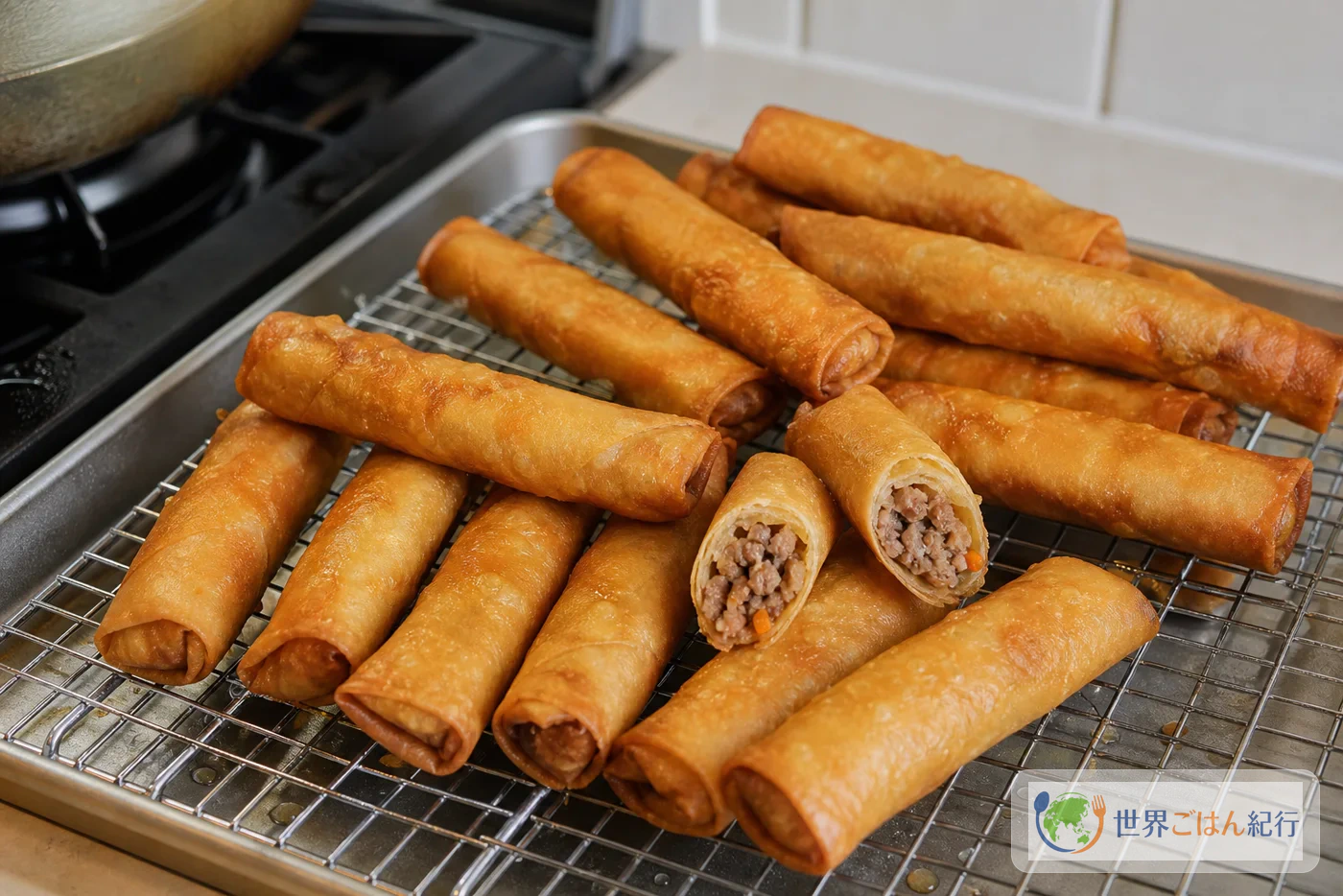
The story of lumpiang Shanghai: thin spring rolls that vanish from the plate first
A kitchen where something is being fried has a small power to draw people in. The oil bubbles finely, the spring roll wrapper turns a pale gold, and the moment one comes out onto the rack you want to taste the end of one. Lumpiang Shanghai is a dish with a strong pull of that kind.
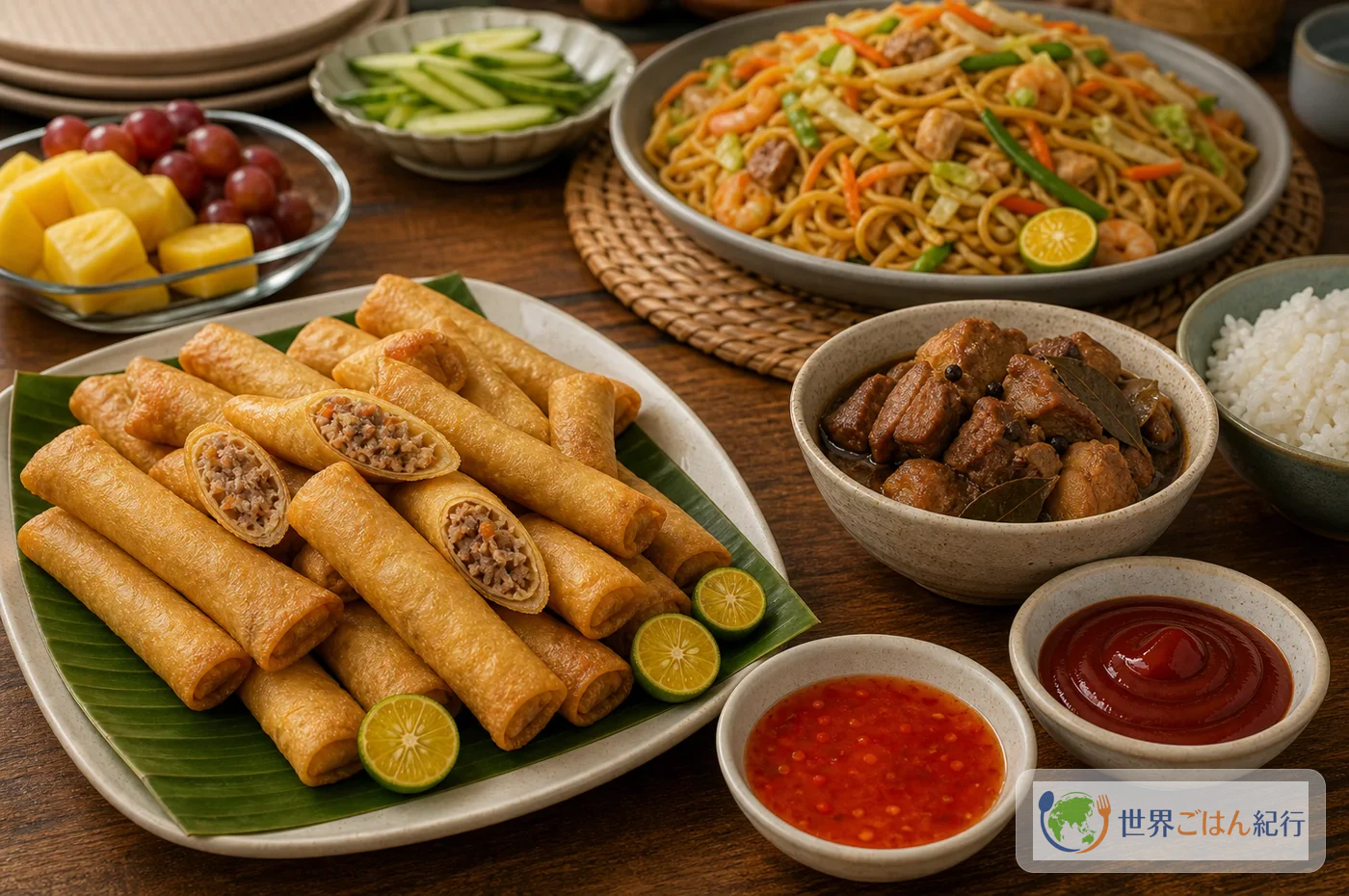
In the Philippines it turns up at birthdays, graduations, Christmas and any day relatives gather. Piled high on a big platter, the rolls are eaten by children with a sweet sauce and by adults with vinegar and garlic. Less a main dish than the first plate that loosens up the mood at the table.
Lumpiang Shanghai is a Filipino spring roll made by rolling ground pork, finely cut vegetables, egg, soy sauce and more in a thin wrapper and frying it. It is slimmer than a Japanese-style spring roll, and the filling is rolled raw and cooked through in the oil. So three things decide the result: the moisture of the filling, the thickness of the roll and the oil temperature.
The worry outside the Philippines is the wrapper. The thin lumpia wrapper used in the Philippines shatters lightly when fried. Ordinary supermarket spring roll wrappers are thicker, and rolled to the same thickness they come out a little heavy. By changing how you cut them and how much filling you use, though, you can get quite close to that texture at home.
To build a Filipino table, pair it with soy-and-vinegar adobo (in Japanese), sour sinigang and the long noodles of pancit canton, and the fried dish alone won't weigh the meal down. For a sweet finish, sapin-sapin, made with glutinous rice and coconut, goes well.
Lumpia is the name for the dish as the Chinese spring roll tradition spread through Southeast Asia. Although "Shanghai" is in the name, today's lumpiang Shanghai has settled into Filipino home cooking as a thin, meat-filled fried spring roll. This article uses "lumpiang Shanghai" throughout.
Background: how a Chinese-style spring roll became a Filipino party plate
Filipino cooking is layered with Chinese, Spanish, American and Malay food culture. Lumpia is a representative example: the spring rolls of Chinese immigrants changed into a form that suits Philippine ingredients, seasoning and festive tables. Though similar to a Chinese spring roll, lumpiang Shanghai is slimmer, has a higher proportion of meat and has more of the character of party finger food.
Read English-language Filipino recipes and the descriptions of lumpiang Shanghai share common points. The filling centers on ground pork with finely chopped carrot, onion, garlic and green onion. A thin wrapper is used. It isn't rolled big but into a slim stick, either cut before frying or rolled short. Both Kawaling Pinoy and Panlasang Pinoy emphasize this thinness as what makes the home version easy to eat.
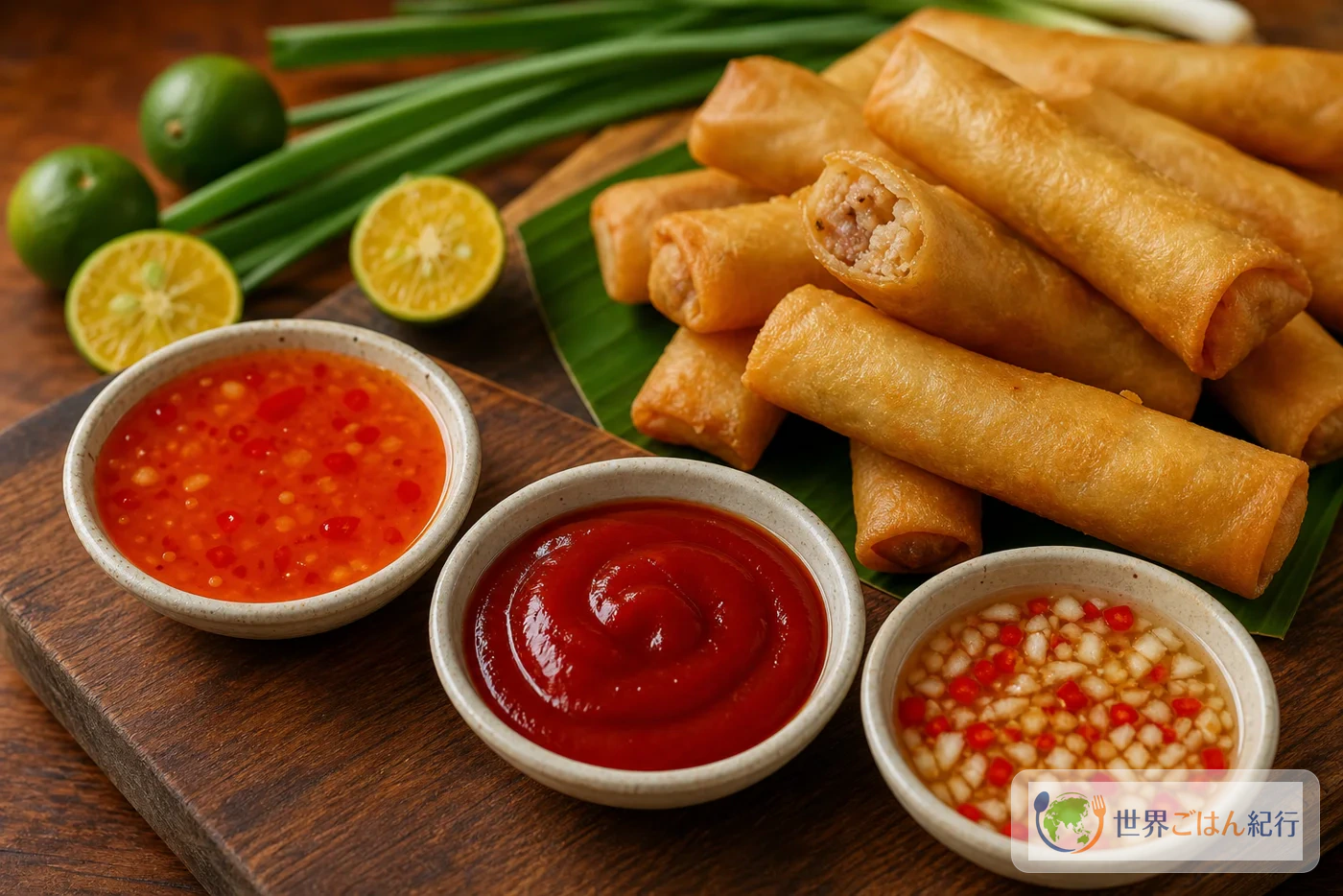
A Japanese-style spring roll often wraps a stir-fried filling in a thicker roll and is eaten as a main dish with rice. Lumpiang Shanghai is a little different. The savory flavor of the meat is sealed in a thin wrapper and made so you can pick up several. The sauces too are not a thick glaze but small dishes like a sawsawan: sweet chili sauce, banana ketchup, or vinegar with garlic and chili.
What is interesting is that, despite the name, it is not a dish that chases "Shanghai-ness." The name keeps its link with Chinese cooking, but in Filipino homes it is remembered as the fried dish set beside the birthday pancit canton, a dish easy to eat even when cooled at a potluck, and the plate children reach for first.
| What to look at | Closer to a Chinese-style spring roll | Filipino lumpiang Shanghai |
|---|---|---|
| Thickness | Thicker, more filling | Slim and easy to pick up |
| Cooking the filling | Often a stir-fried filling is wrapped | A raw meat mixture is rolled thin and fried |
| How it is eaten | Main or side dish | Celebration platter, appetizer, potluck |
| Sauce | Mustard, soy-vinegar, thick sauce | Sweet chili, banana ketchup, vinegar dip |
| Make-ahead | Best fresh-fried | Easy to freeze uncooked |
Seen as a party plate, the reason for rolling thin becomes clear. At a table where relatives gather, what matters is that you can eat it in one bite while holding a plate, that it is still tempting when slightly cooled, and that it works with both a sweet sauce and a vinegar dip. A thick spring roll is dependable as a main dish, but heavy to pick up several of. Lumpiang Shanghai makes the savory flavor of the meat into a small stick so that it can move back and forth between noodles, stews and plain rice.
At home too, keeping in mind this character of a dish that fills the gaps at the table makes menus easier to plan. Rather than making a whole platter of fried food the star, set a small pile beside sour sinigang, soy-and-vinegar adobo (in Japanese) or the long noodles of pancit canton. Not a palate cleanser but a plate to pick one from mid-conversation. Serving it that way is closer to a Filipino festive day.
So this article does not simply thin down a Japanese-style spring roll recipe; it aims to keep the lightness that belongs to Filipino cooking. What to keep: roll thin, don't let the filling get too wet, and serve a sweet-and-sour sauce. With those in place, ordinary supermarket ingredients will still taste like lumpiang Shanghai.
Ingredients (serves 4): how close can ordinary spring roll wrappers get?
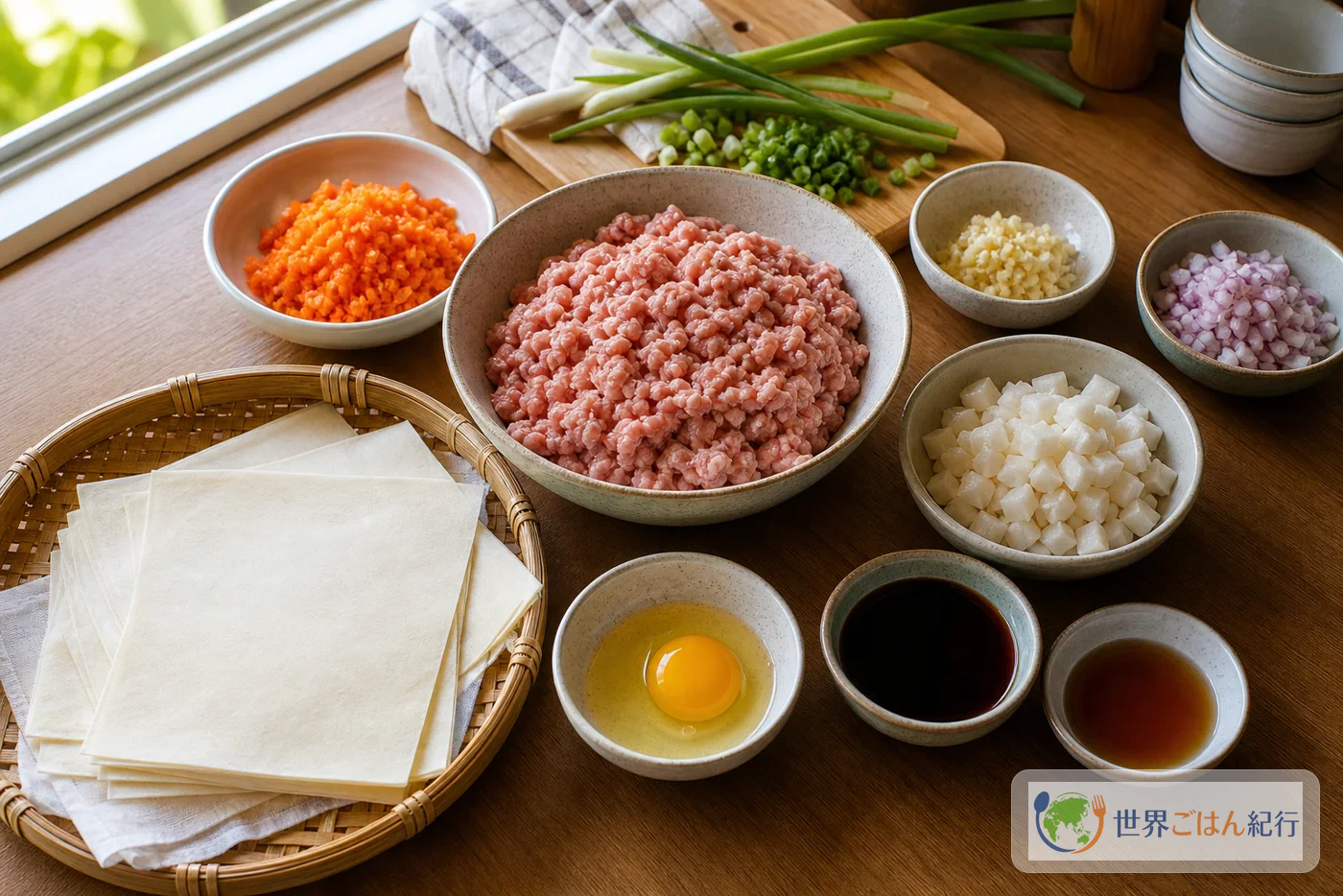
This serves 4 and makes about 24 to 30 slim, easy-to-pick-up rolls. As a main dish it serves 4; as a party plate it stretches to 6 to 8 people.
Seasonings
| Seasoning | Amount | Substitutes & notes |
|---|---|---|
| Soy sauce | 1 tbsp | If you have Filipino soy sauce, mix in half |
| Patis or fish sauce | 1 tsp | If you dislike it, leave it out and add a little more salt |
| Oyster sauce | 2 tsp | Sweetness and savory depth. To avoid seafood, add 1 tsp soy sauce instead |
| Sugar | 1 tsp | Just enough to round off the edges of the filling |
| Salt | 1/2 tsp | Don't overdo it, since a sauce is served alongside |
| Black pepper | 1/2 tsp | Coarsely ground suits it |
| Potato starch or cornstarch | 1 tbsp | Holds the juices in. Too much makes it tough |
This dish contains pork, wheat, egg, soy and seafood. Shrimp, oyster sauce and fish sauce can trigger seafood allergies, so leave them out as needed. Spring roll wrappers may contain egg or dairy depending on the brand.
The first thing to look for is thin wrappers. The filling ingredients are all available at an ordinary supermarket, but the thickness of the wrapper changes the texture a great deal. If there is no Filipino or Asian grocer nearby, search online for "lumpia wrappers" or "thin spring roll wrappers," and if they are frozen, check the thawing instructions.
Method: roll thin and fry without letting the oil temperature drop
Lumpiang Shanghai is easier if you set up your workflow before you start rolling. Mix the filling, keep the wrappers from drying out, line up the rolled ones in a row and fry them in batches. The kitchen turns a bit like a factory, but that repetition is part of the fun.
The first roll is a test of temperature and filling thickness. If only the wrapper darkens quickly, the oil is too hot. If after 5 minutes it is still pale and greasy, the oil is too cool. If the inside is underdone, the roll is too thick. Use this one to adjust before frying everything at once.
On days when the fried food is the star of the table, the soup beside it changes how heavy the meal feels. For a sour counterpoint, sinigang; to lean toward breakfast or a light dinner, steaming arroz caldo with ginger and fish sauce is easy to pair.
A decision table for getting closer to the original in a home kitchen
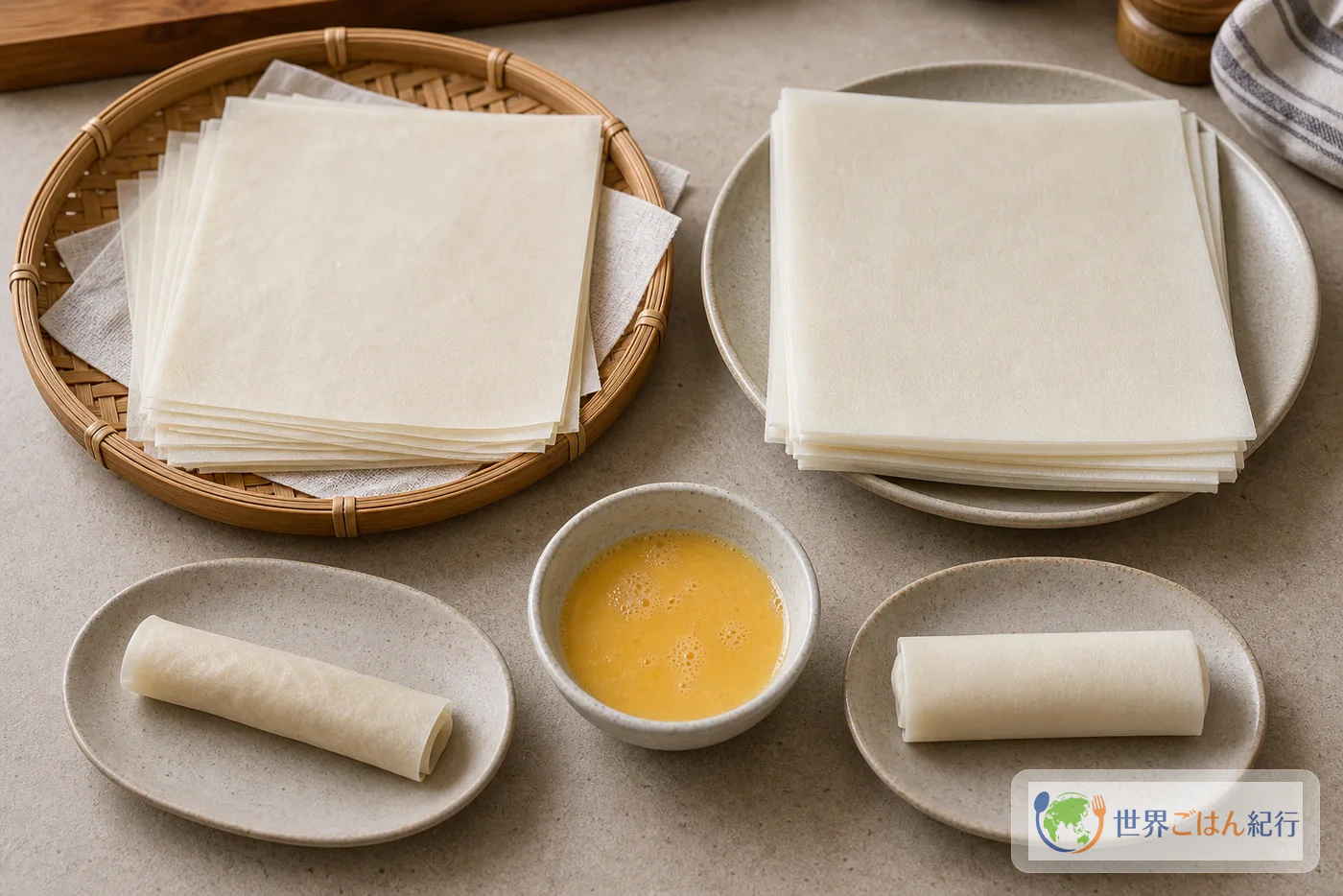
You don't have to use all Filipino ingredients. But knowing which substitutions change the texture will reduce failures.
| The ingredient in question | Closer to local | Realistic at home | Verdict |
|---|---|---|---|
| Wrapper | Thin lumpia wrapper | Spring roll wrappers cut narrow | Roll thick wrappers thin. Rolled fat, they are heavy |
| Meat | Mostly ground pork | Ground pork plus a little shrimp | Shrimp is for aroma. It works without it |
| Texture | Water chestnut, jicama | Lotus root, canned bamboo shoots | Wipe off moisture and chop fine |
| Seasoning | Filipino soy sauce, patis | Dark soy sauce, a little fish sauce | 1 tsp of fish sauce is enough |
| Sauce | Banana ketchup, sweet chili, vinegar dip | Sweet chili, ketchup with vinegar, soy-vinegar | Offering both sweet and sour keeps it from getting boring |
| Frying | Plenty of oil, shallow deep-frying | At least 3 cm of oil in a small pot | A skillet with little oil colors unevenly |
The one thing closest to a non-negotiable is the slimness. Even if the wrapper isn't the authentic one, rolling thin brings you close to the lightness of lumpiang Shanghai. Conversely, packing in filling and rolling fat is good as a spring roll, but it moves away from the lightness of the Filipino party plate.
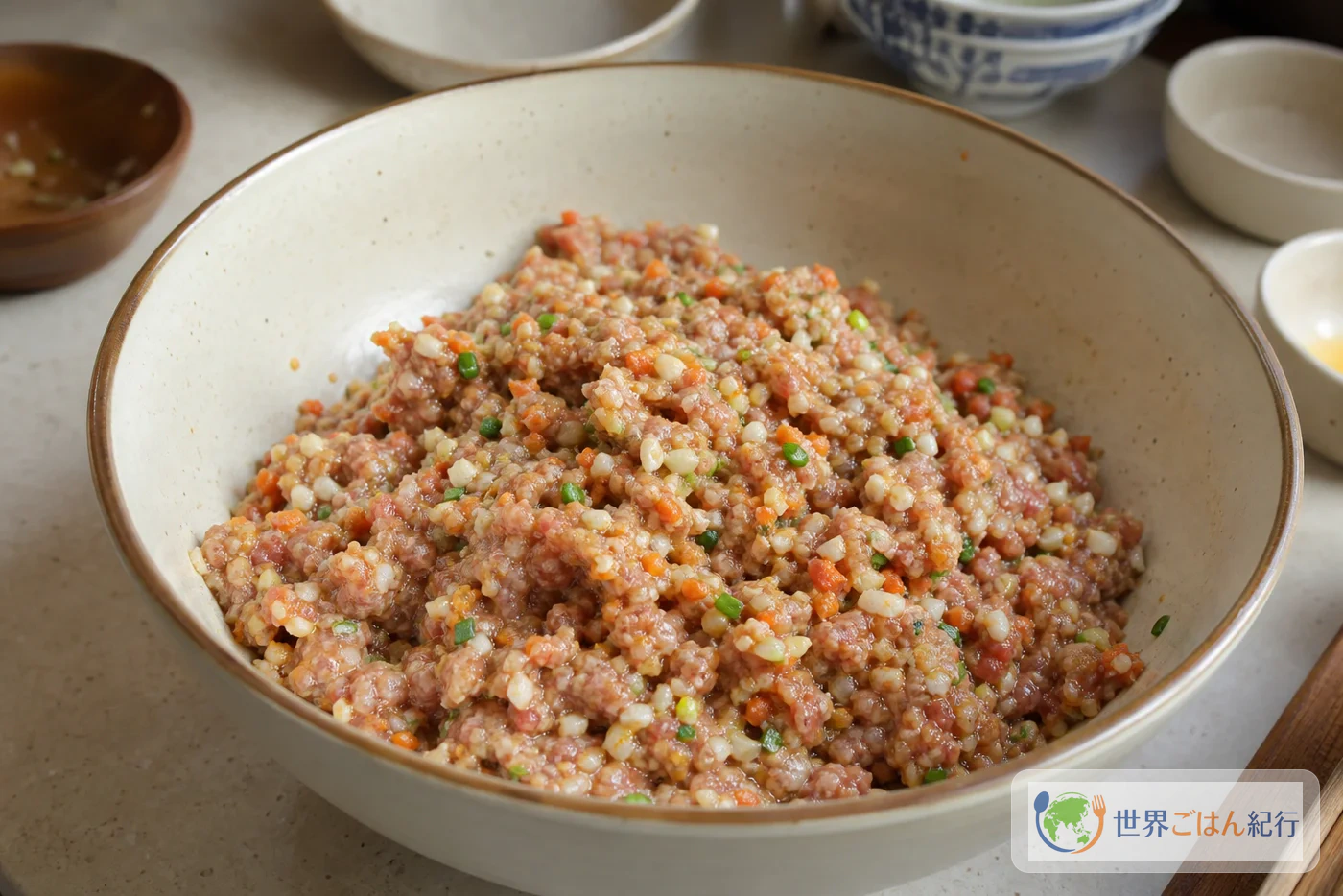
Moisture in the filling matters too. Onion, lotus root and canned bamboo shoots are handy, but if they are too wet, the wrapper goes soft from the inside. After chopping, blot with paper towels so the whole meat mixture doesn't turn soggy.
Fish sauce is worth including, but it isn't the star. Past 1 tsp the aroma comes too far forward. As with the bagoong substitute in Bicol Express (in Japanese), borrowing just a little seafood savoriness is easiest to eat in a home kitchen.
If you buy frozen lumpia wrappers, thaw them slowly in the refrigerator, still in the bag. If you rush by leaving them out at room temperature, only the outside gets condensation while the inside is still stiff, and they tear when separated. After thawing, take out only what you will use and return the rest to the bag so it doesn't dry out. Thin wrappers crack like paper when dry. It is about right to handle them as more delicate than ordinary spring roll wrappers.
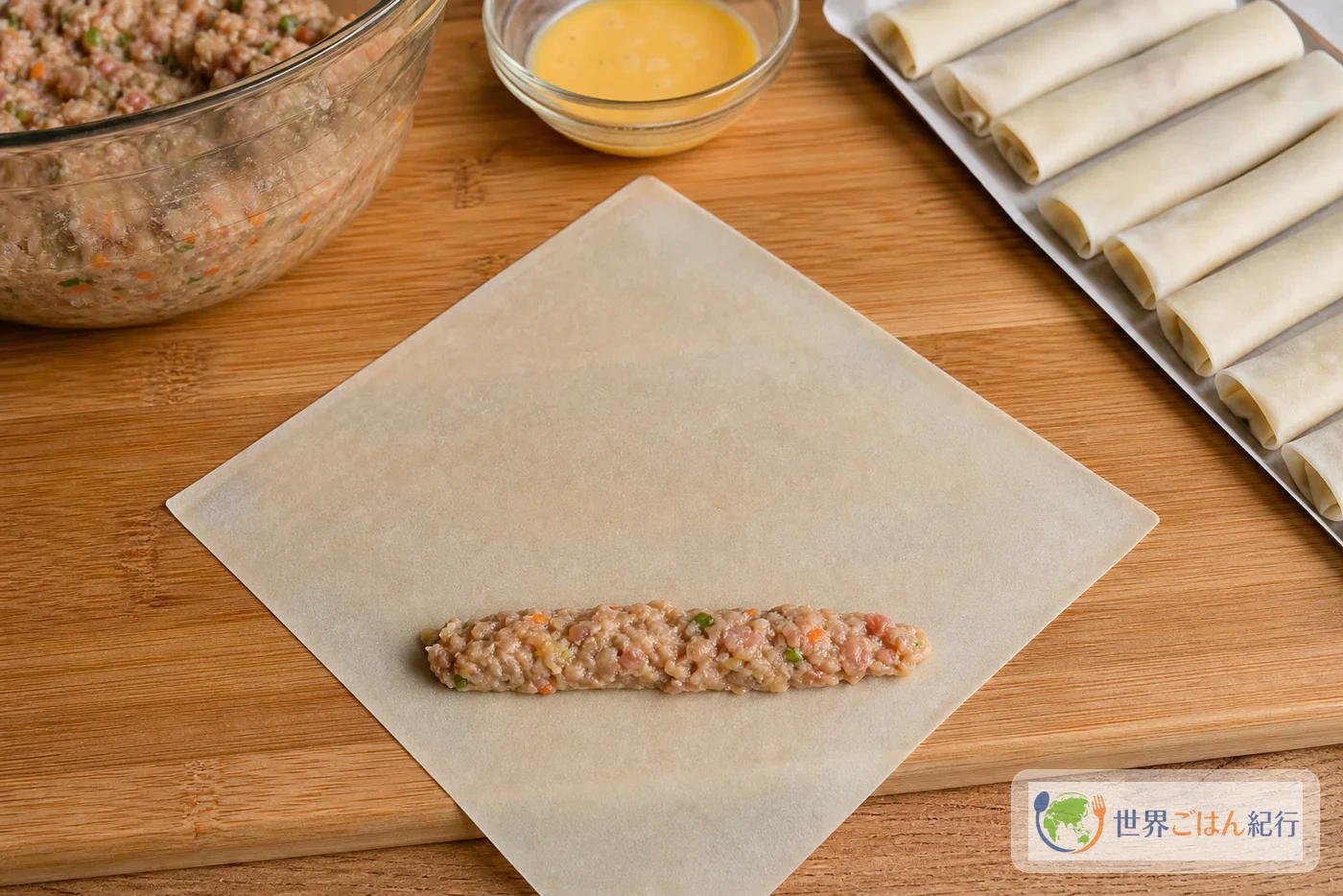
On days you use ordinary spring roll wrappers, decide how to cut them first. Using the square as is tends to make thick rolls, so cutting each into thirds as rectangles and rolling in thin strips is easier to handle. If there aren't enough corners and sealing is difficult, use a paste of 1 tsp flour dissolved in 2 tsp water. It bonds more strongly than egg once dry, but too much shows up white after frying, so only the last 1 cm needs it.
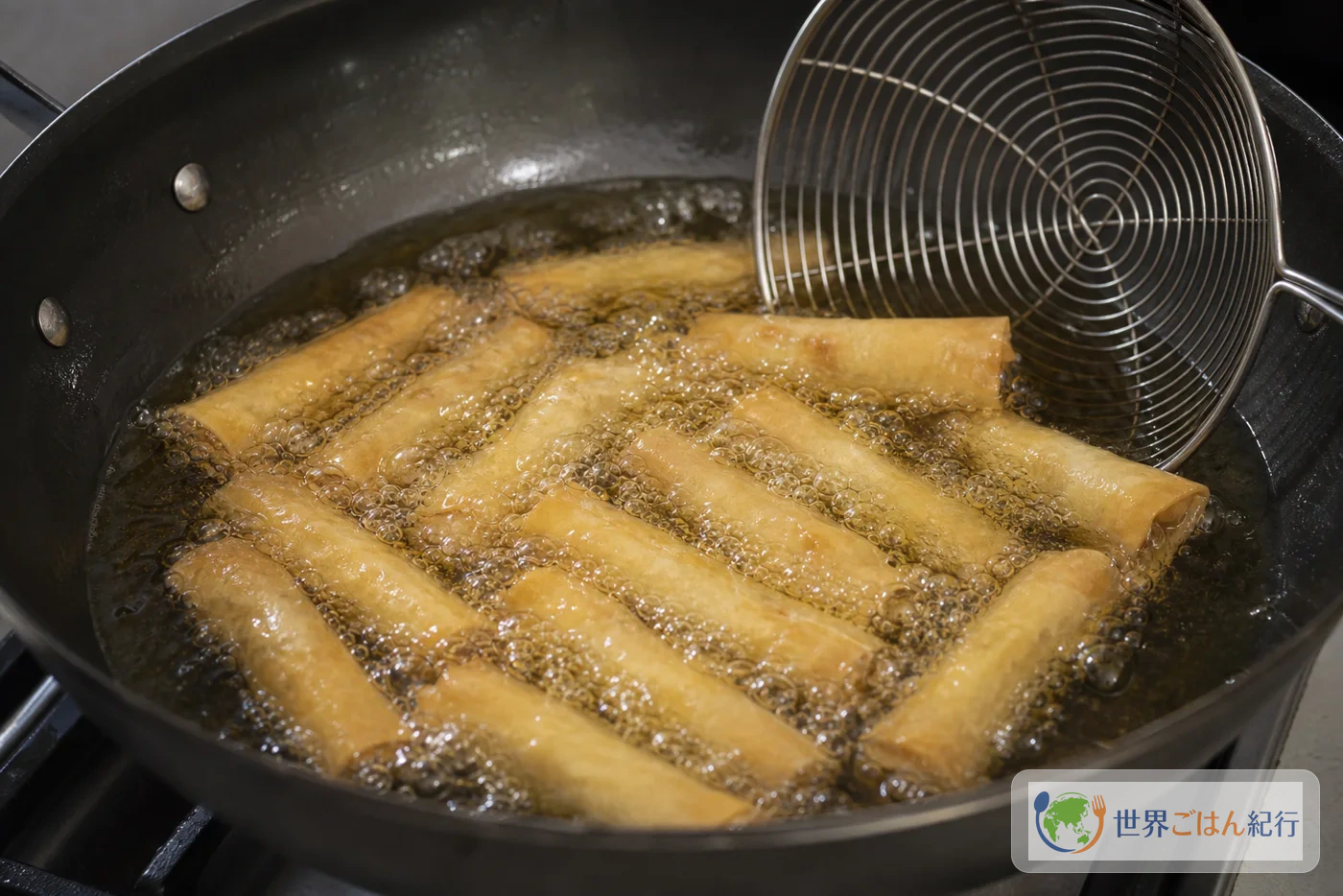
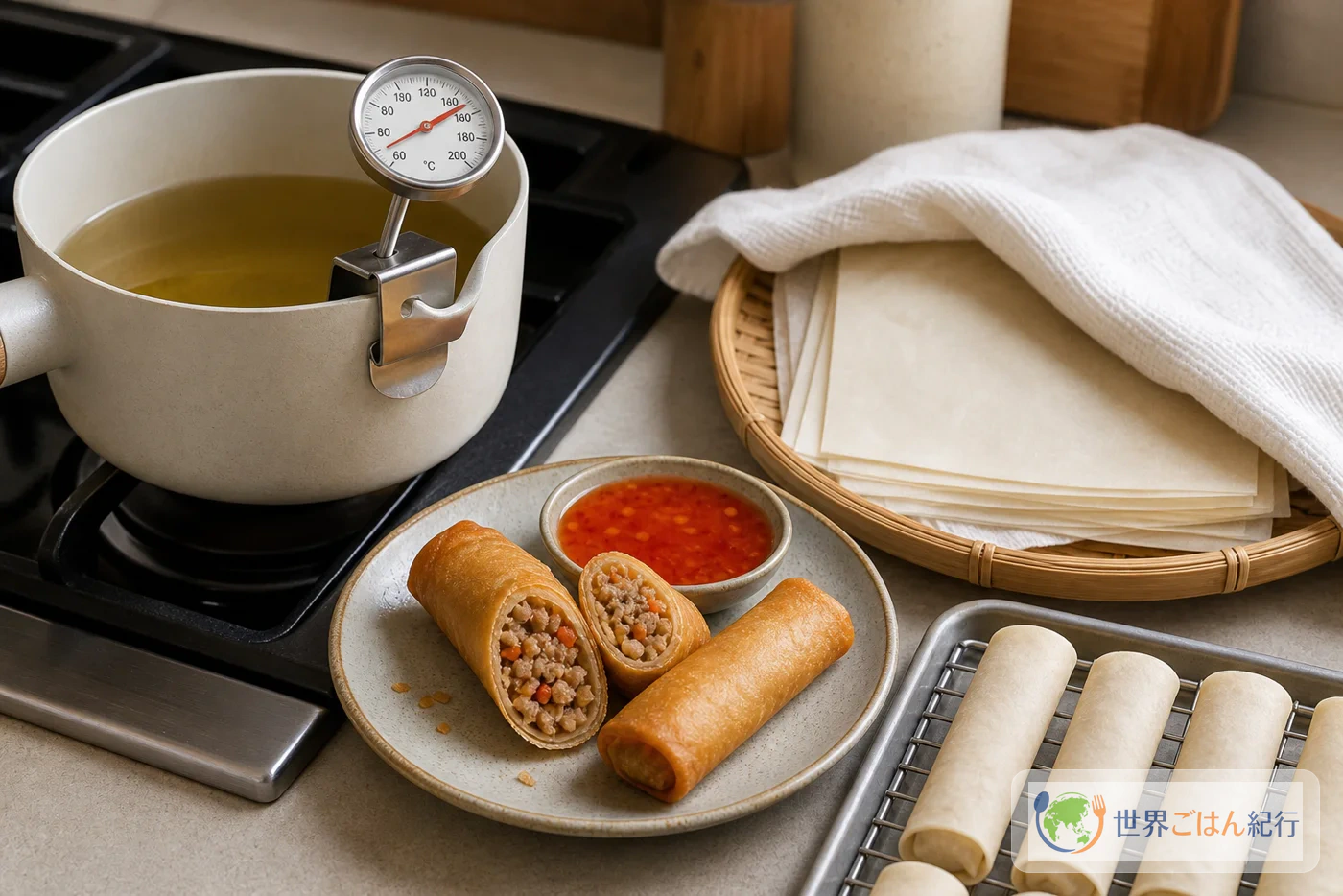
A bigger pot is not necessarily better. On a home stove, a small pot with 3 to 4 cm of oil and 6 rolls at a time makes temperature easier to manage. A 28 cm skillet with shallow oil looks as if it could fry many at once, but the oil temperature drops easily and the edges differ in temperature. Thin lumpia is a short-time job, so put steady temperature ahead of quantity.
What goes wrong: tearing, greasiness, raw centers
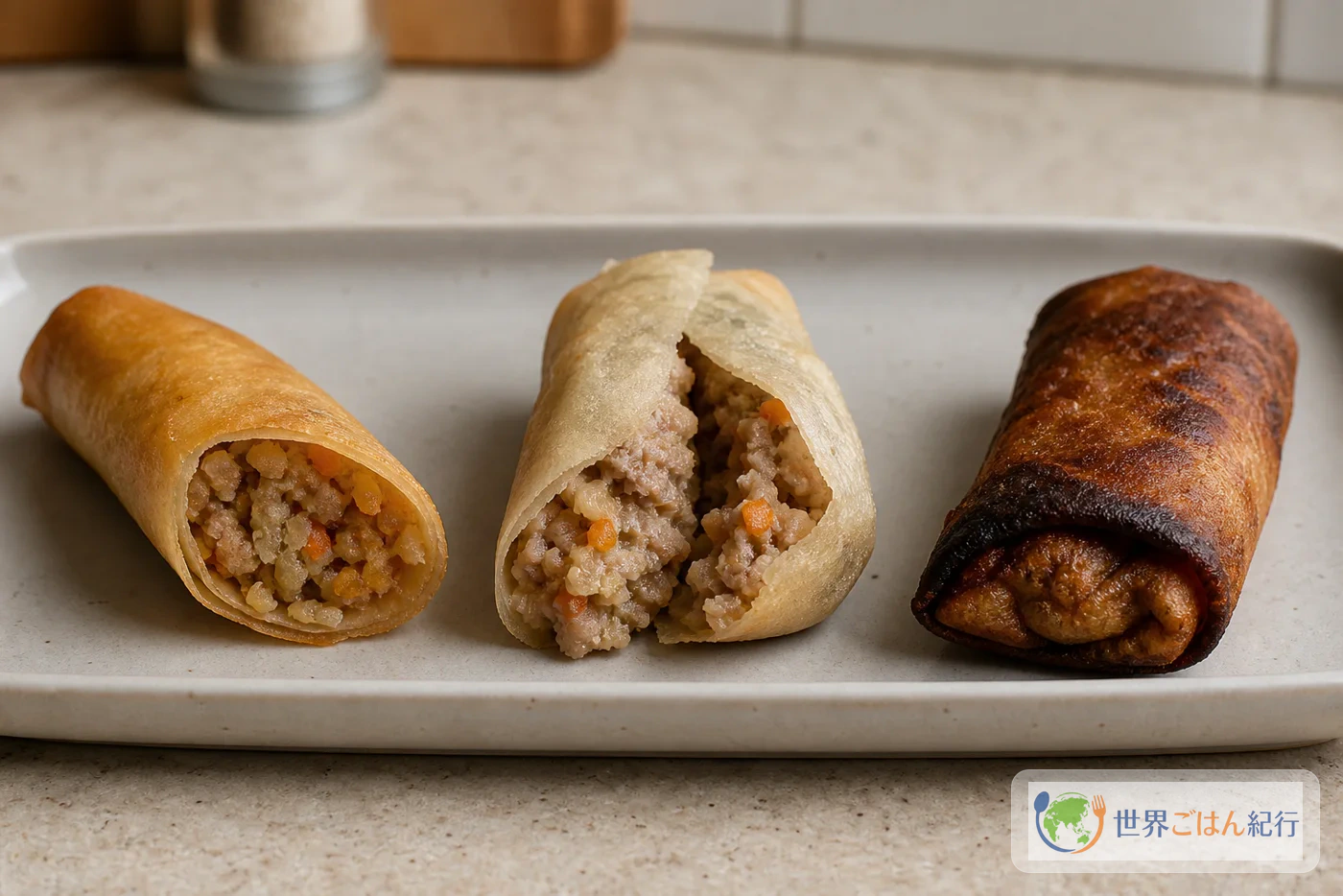
Failures with lumpiang Shanghai show up right away: tearing, greasiness, a burnt wrapper, a raw center. Small adjustments prevent most of them.
| Problem | Cause | Fix |
|---|---|---|
| Wrapper tears | Too much filling, dry wrapper, loose seam | Reduce the filling to a little under 1 tbsp and cover with a damp paper |
| Greasy | Oil too cool, too many in the pot | Bring it back to 170°C or higher before adding the next batch |
| Only the wrapper burns | Oil too hot, filling too thick | Lower to 165°C and roll thinner |
| Raw center | Rolled thick, not fried long enough | Cut one to check, and fry thick ones longer |
| Filling is tough | Overmixed the meat, too much starch | Don't overmix, and keep the starch to 1 tbsp |
| Wrapper goes soft | Stacked after frying | Set on a rack and let the steam escape |
| Flavor is vague | Too little salt in the filling, relying on the sauce | Adjust using a test-cooked bit of filling |
Cool oil seems to warm the lumpia slowly but actually lets the wrapper soak up oil. The temperature drops right after adding to the pot, so don't hurry the next batch; wait until the oil is bubbling again. In a small home pot, 6 at a time is easy to handle.
Oil that is too hot darkens only the wrapper, all at once. The meat mixture inside holds water, so if the outside colors early, it starts to burn before the center is cooked. Without a thermometer, drop in a scrap of wrapper: it should not sink right away but rise with fine bubbles.
Because this uses ground pork and shrimp, cook it through to the center. After frying, cut one open and check that the meat inside is not red and the shrimp is not translucent. Avoid leaving the fried rolls at room temperature for long, and refrigerate leftovers promptly.
Storage and make-ahead: freeze before frying
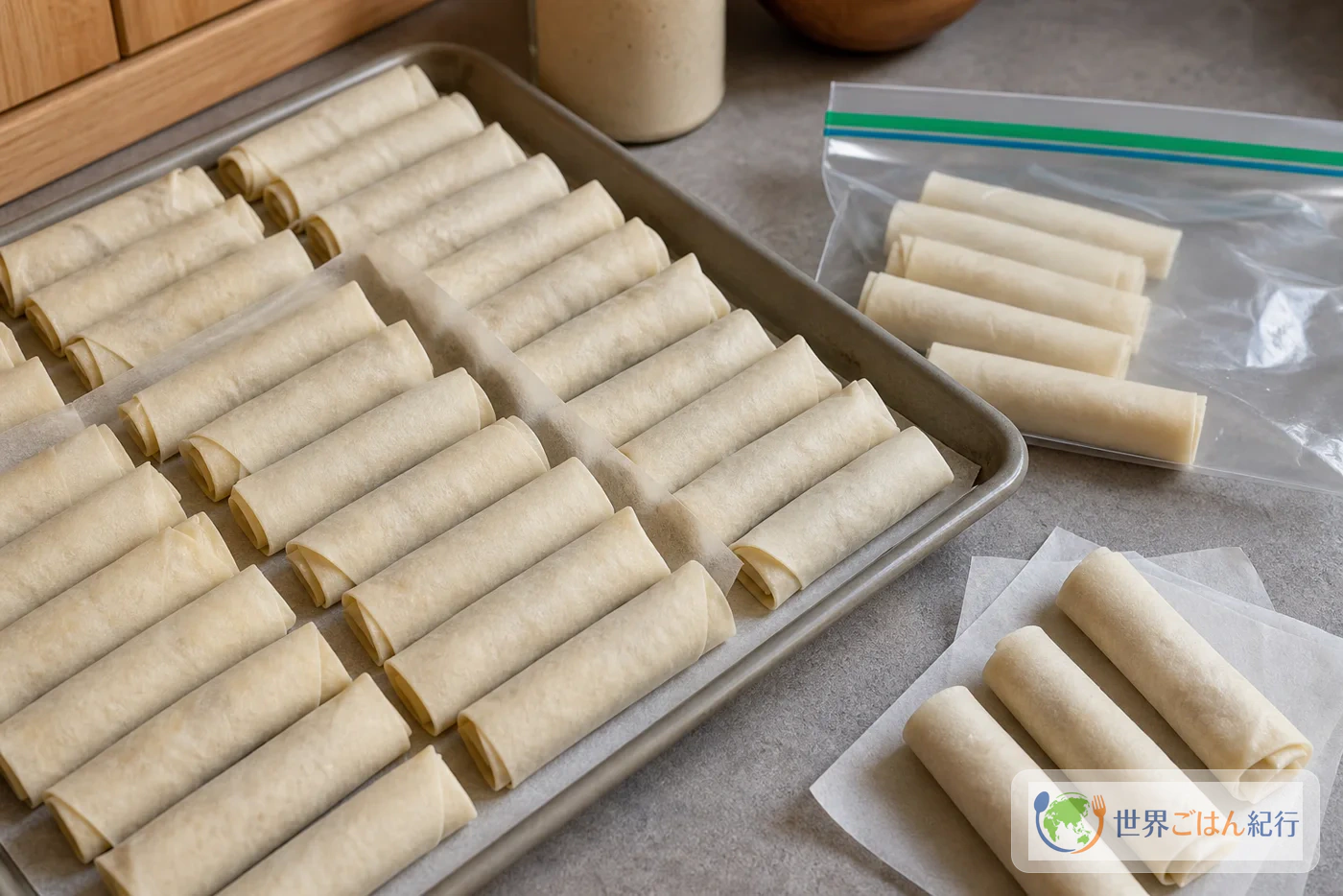
Lumpiang Shanghai suits making ahead. But the easiest point to store them is not after frying but after rolling, before frying. Refrigerating fried ones makes it hard to bring back the lightness of the wrapper.
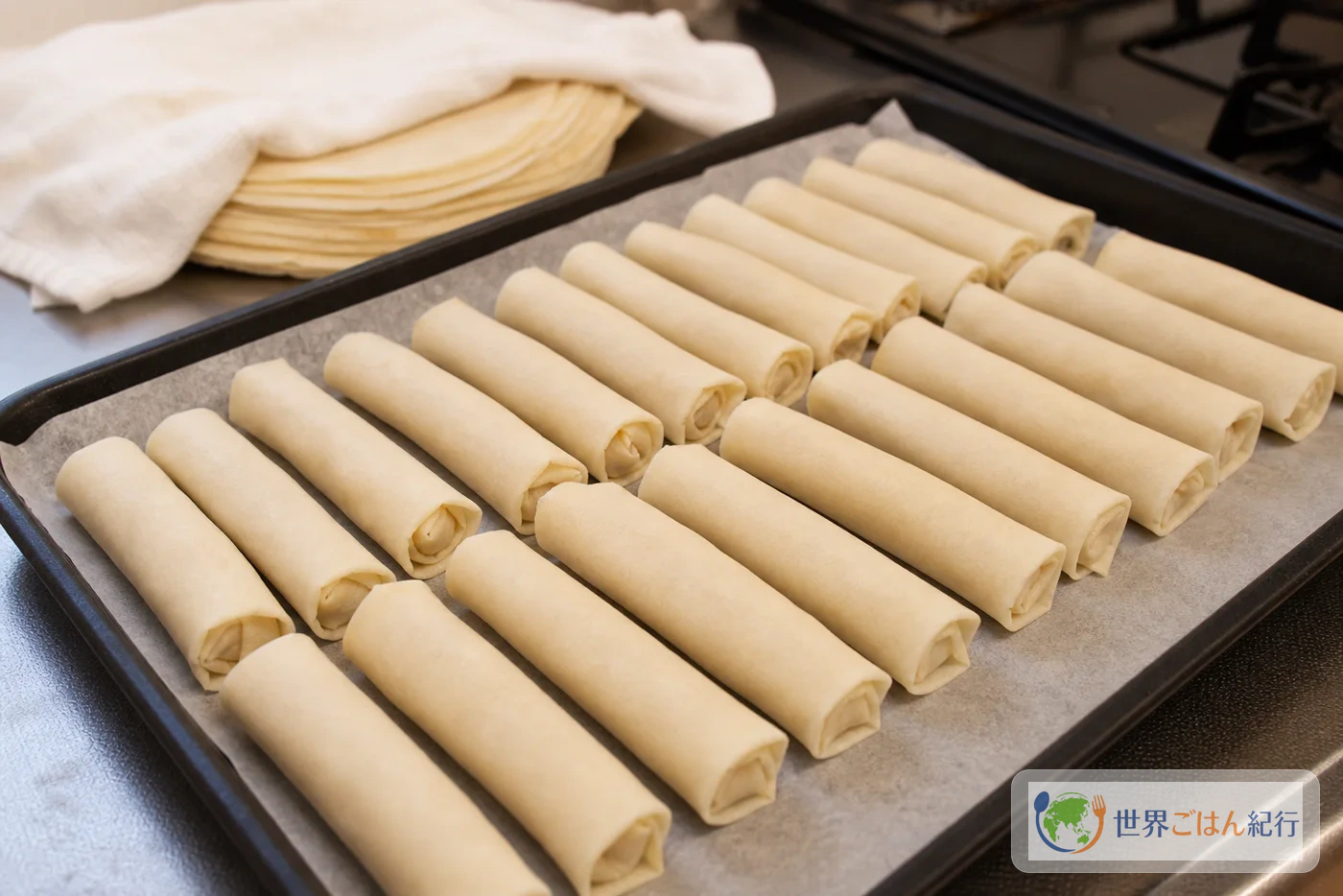
To freeze, line the rolled ones in a single row on a tray lined with parchment paper, not touching. Freeze for 1 to 2 hours, and once the surface is hard, move them to a freezer bag. Kawaling Pinoy also describes freezing them uncooked and frying only the amount you need. At home, using them up within 2 to 3 weeks leaves little chance of freezer odors.
Fry frozen lumpia without thawing. Thawing makes the wrapper damp and prone to tearing. Start with oil a bit lower than usual, 165–170°C, and fry 1 to 2 minutes longer. If the surface colors too fast, lower the heat and let the heat reach the center.
Fried leftovers are best eaten by the next day when refrigerated. Reheating only in the microwave leaves the wrapper limp, so bring the surface back in a toaster oven or skillet. Microwave for just 20 seconds to warm the inside, then bake in the toaster oven for 3 to 4 minutes; the texture does not fully return, but it comes back.
For a lunch box, cool rolls fried in the morning thoroughly and put the sauce in a separate container. Packing them with a wet sauce poured over leaves the wrappers soft by lunchtime. For a potluck too, it is better to cool them a little on a rack and arrange them in a shallow container than to pack them piping hot into a lidded one.
How to eat and what to serve: surround with sour, sweet and noodles
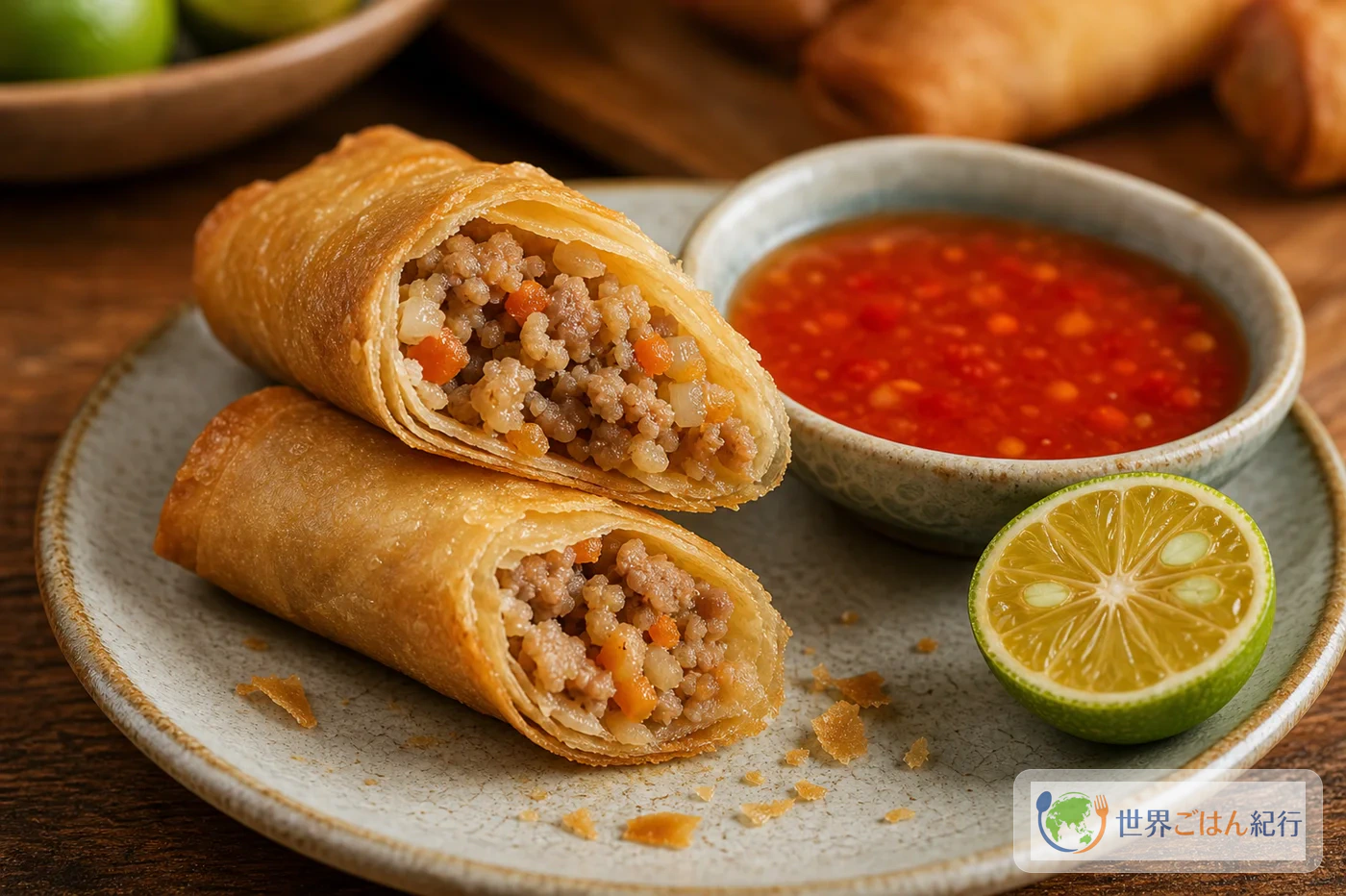
The sauce changes the impression of lumpiang Shanghai. For children and people who like sweet flavors, sweet chili or banana ketchup. To go with drinks, a vinegar dip of vinegar with garlic, black pepper and chili. Rather than choosing one, putting out both a sweet dish and a sour dish makes hands reach for them naturally at the table.
| Sauce | How to make it | When it suits |
|---|---|---|
| Sweet chili | Store-bought, as is | Children, a first try, guests |
| Banana-ketchup style | 3 tbsp ketchup, 2 tsp vinegar, 1 tsp sugar | When you want to lean Filipino |
| Garlic vinegar | 3 tbsp vinegar, 1 clove garlic, a little chili | When you want to eat fried food lightly |
| Soy-vinegar | 2 tbsp vinegar, 1 tbsp soy sauce, black pepper | When you want to lean toward a Japanese table |
| Calamansi | Sudachi, lime, lemon | When you want to add aroma at the end |
The menu is decided by what you put beside the fried dish. To make it Filipino, set a small platter of the long noodles of pancit canton. For a sour soup, sinigang. To add a little soy-and-vinegar braise, adobo (in Japanese). A sweet finish ties it together with sapin-sapin.
On a day with guests, it is easier to eat if lumpiang Shanghai isn't made too much the star. Serving only fried food in quantity is fun at first but gets heavy partway through. Spreading across pancit, a sour soup, plain rice and a sweet dessert gives the "reach for a little at a time" flow of a Filipino festive table.
To branch out among Southeast Asian fried dishes, putting an Indonesian chili condiment, the sambal substitute, alongside makes it more adult. For comparison with noodle dishes, the sweet-soy mie goreng (in Japanese) and the sour, nutty pad thai (in Japanese) are fun contrasts.
Variations: change the filling to suit your family
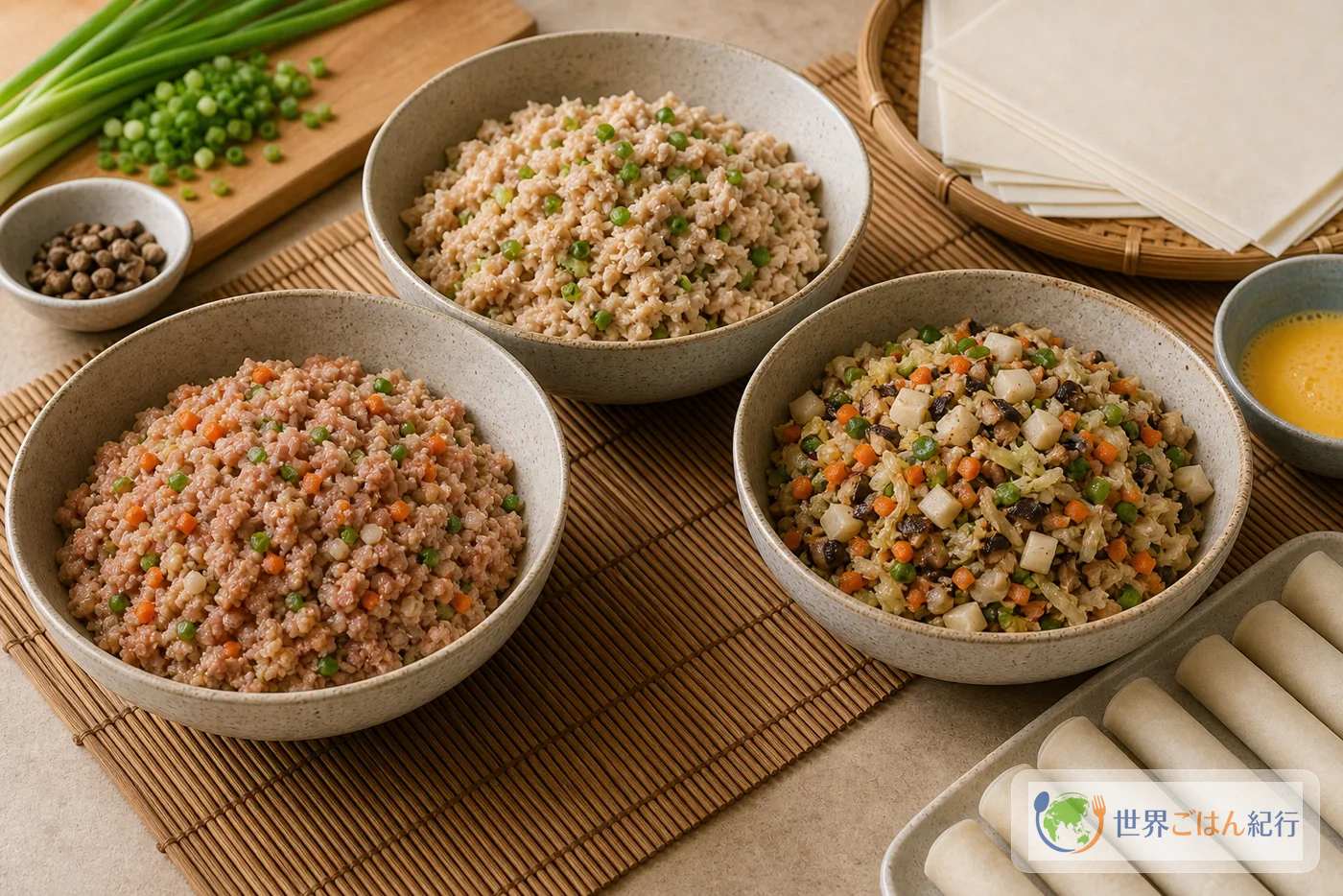
Lumpiang Shanghai accepts changes in its filling. There is an order to changing, though. First protect the wrapper and thickness, then change part of the filling. If you move the wrapper, thickness and oil temperature at once, it is hard to tell where it went wrong.
Without shrimp
Leave out the shrimp and increase the ground pork to 480 g. Since the aroma gets slightly weaker, add 1 more clove of garlic and more black pepper. If you have a seafood allergy, also skip the oyster sauce and fish sauce, and adjust with 1 tbsp soy sauce and 2/3 tsp salt.
Ground chicken version
You can use ground chicken, but because it is lean it tends to be tough. Use ground chicken thigh and mix 2 tsp oil into the filling so it doesn't dry out. If you make it with ground chicken breast alone, use more of the lotus root or bamboo shoot texture and make the sauce sweet and sour.
More vegetables
If you want more vegetables, adding canned lotus root or bamboo shoots is steadier than adding more carrot and onion. Lots of leafy greens or cabbage release water and soften the wrappers. Even with extra vegetables, keep within a range where the whole meat mixture still holds together.
Air fryer version
An air fryer also works. Brush a thin layer of oil on the surface and cook at 180°C for 10 to 12 minutes, turning once partway. However, the fine bubbling and the lightness of wrapper you get from frying in oil is harder to reach. It is handy for everyday lunch boxes, but on your first time, frying in oil shows you what lumpiang Shanghai is meant to be.
If you want to roll them thick
Rolled thick, it has more substance as a spring roll. But as lumpiang Shanghai it cooks through more slowly and loses its easy-to-pick-up quality. If you roll them thick, think of them as an ordinary spring roll with a pre-stir-fried filling, and treat the frying time separately from this article's.
Frequently asked questions
Q1. What is the difference between lumpiang Shanghai and an ordinary spring roll?
A Japanese-style spring roll often wraps a stir-fried filling in a thicker roll. Lumpiang Shanghai rolls a raw filling centered on ground pork thin in a thin wrapper and fries it so you can pick up several as a party or festive dish. Slimness, the proportion of meat and the sweet-and-sour dip are the big differences.
Q2. I only have spring roll wrappers. Can I still make it?
Yes. Cut ordinary spring roll wrappers into thirds, or use small ones, and use a little under 1 tbsp of filling. If the wrapper is thick, the thicker you roll, the heavier it gets. It won't be as light as a thin lumpia wrapper, but rolled thin it is plenty good as a home version.
Q3. Can I pan-bake instead of frying?
You can, but the texture will be different. In a skillet, use a little extra oil and cook over medium-low heat, turning to cover all sides. Because oil doesn't touch the whole wrapper, you won't get the fine crispness of frying. For a lighter version, an air fryer is better.
Q4. Do I thaw frozen lumpia before frying?
No. Thawing makes the wrapper damp and easy to tear. Put them frozen into oil at 165–170°C and fry 1 to 2 minutes longer than usual. Adding too many to the pot drops the temperature suddenly, so fry a few at a time.
Q5. What do I serve if I don't have banana ketchup?
Sweet chili sauce is the easiest. To lean toward Filipino sweet-and-sour, mix 3 tbsp regular ketchup with 2 tsp vinegar and 1 tsp sugar. For adults, a sauce of vinegar with garlic, black pepper and chili also works.
Wrap-up: rolling thin makes the table lighter
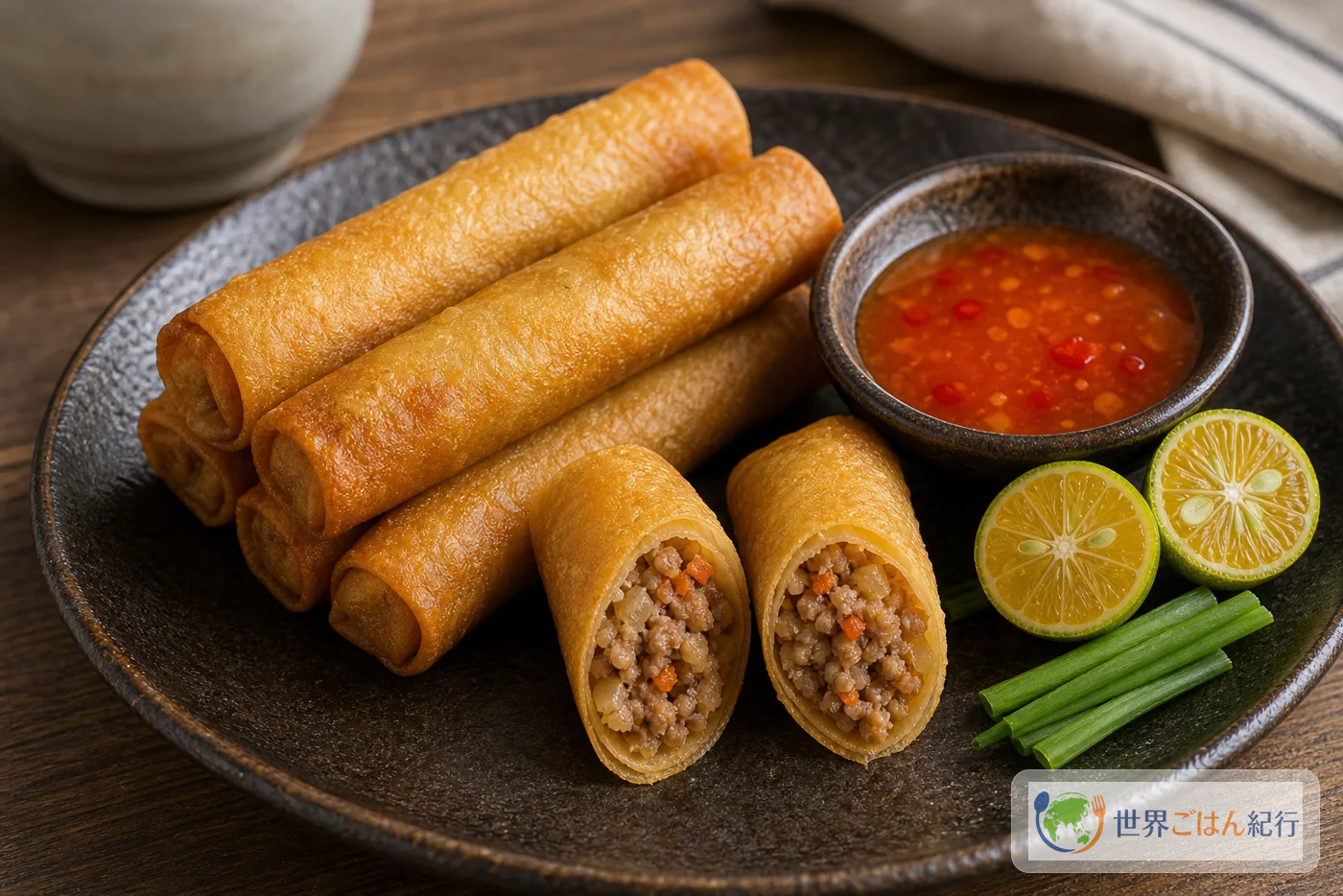
Judged by ingredients alone, lumpiang Shanghai resembles a spring roll. But once you make it, you realize it is a different dish. Place the filling in a thin line, roll in a thin wrapper, fry without letting the temperature fall. Set out a sweet sauce and a sour one. Put it on a big platter and eat it a little at a time with noodles and a sour soup.
What to protect in a home kitchen is not perfect Filipino ingredients. It's three things: slimness, oil temperature and the sourness of the dip. Even with Japanese-style spring roll wrappers, if you hold those, you come quite close to the Filipino party plate.
At first, ground pork, carrot, onion, spring roll wrappers and sweet chili sauce are enough. Next time, add thin lumpia wrappers, banana ketchup, calamansi and a garlic-vinegar sauce. Having a few uncooked lumpia in the freezer makes a weekday dinner or a sudden guest suddenly more fun.
Sources
- Kawaling Pinoy: Lumpia Shanghai, consulted in 2026
- Serious Eats: Lumpiang Shanghai (Filipino Spring Rolls), consulted in 2026
- Panlasang Pinoy: Lumpiang Shanghai Recipe, consulted in 2026
- Epicurious: Lumpia, consulted in 2026



