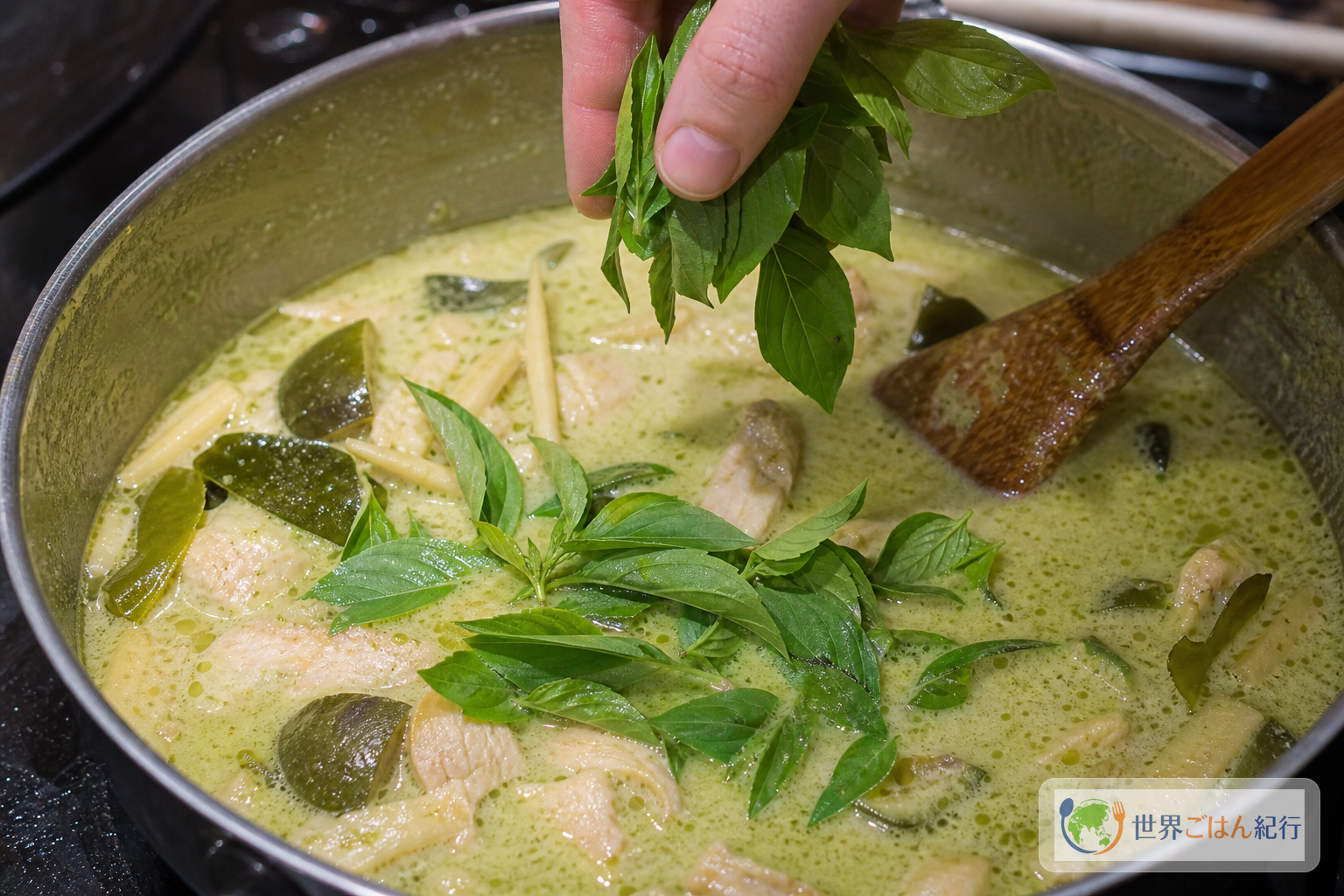
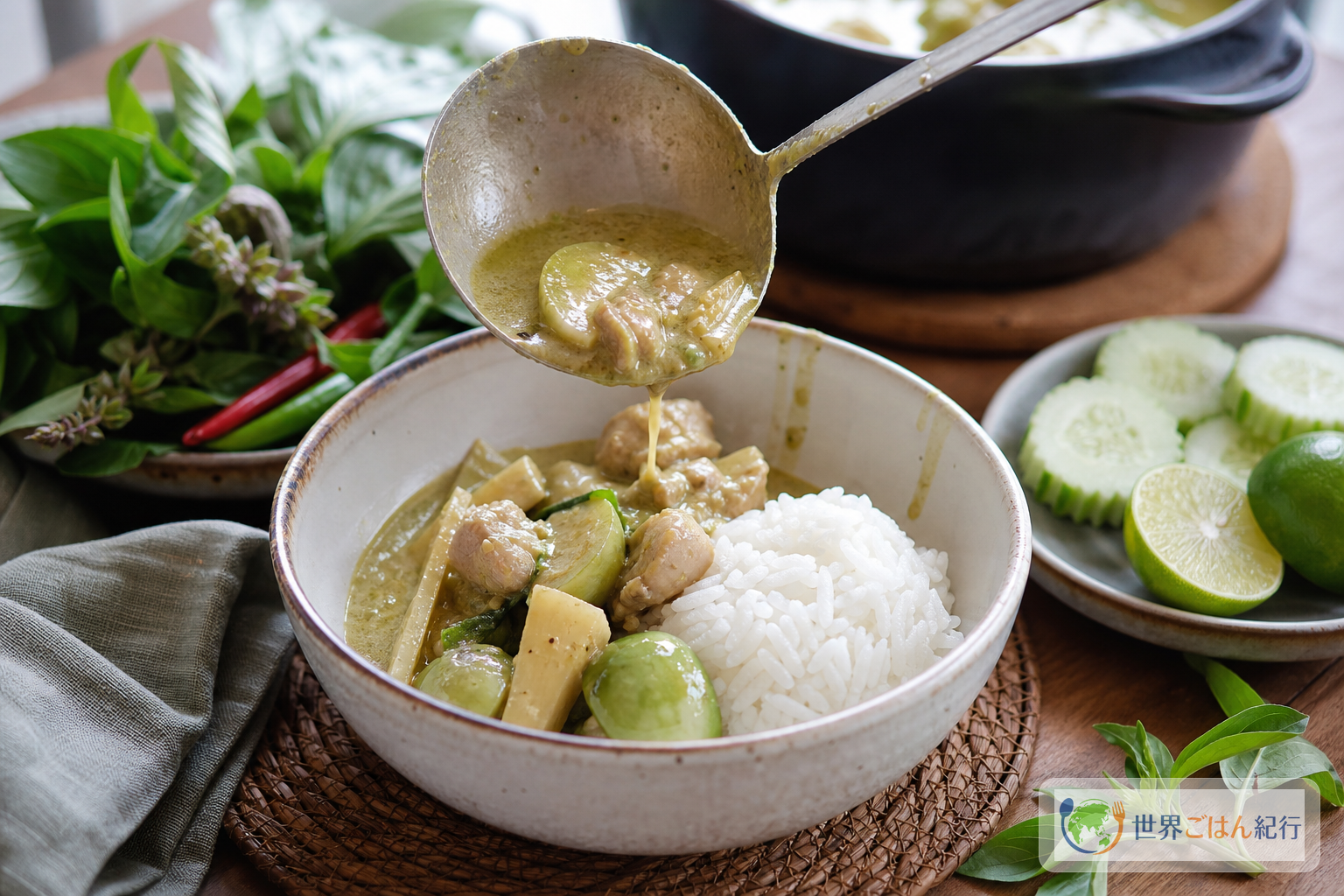
When the green fragrance rises, the kitchen becomes a little bit Thai
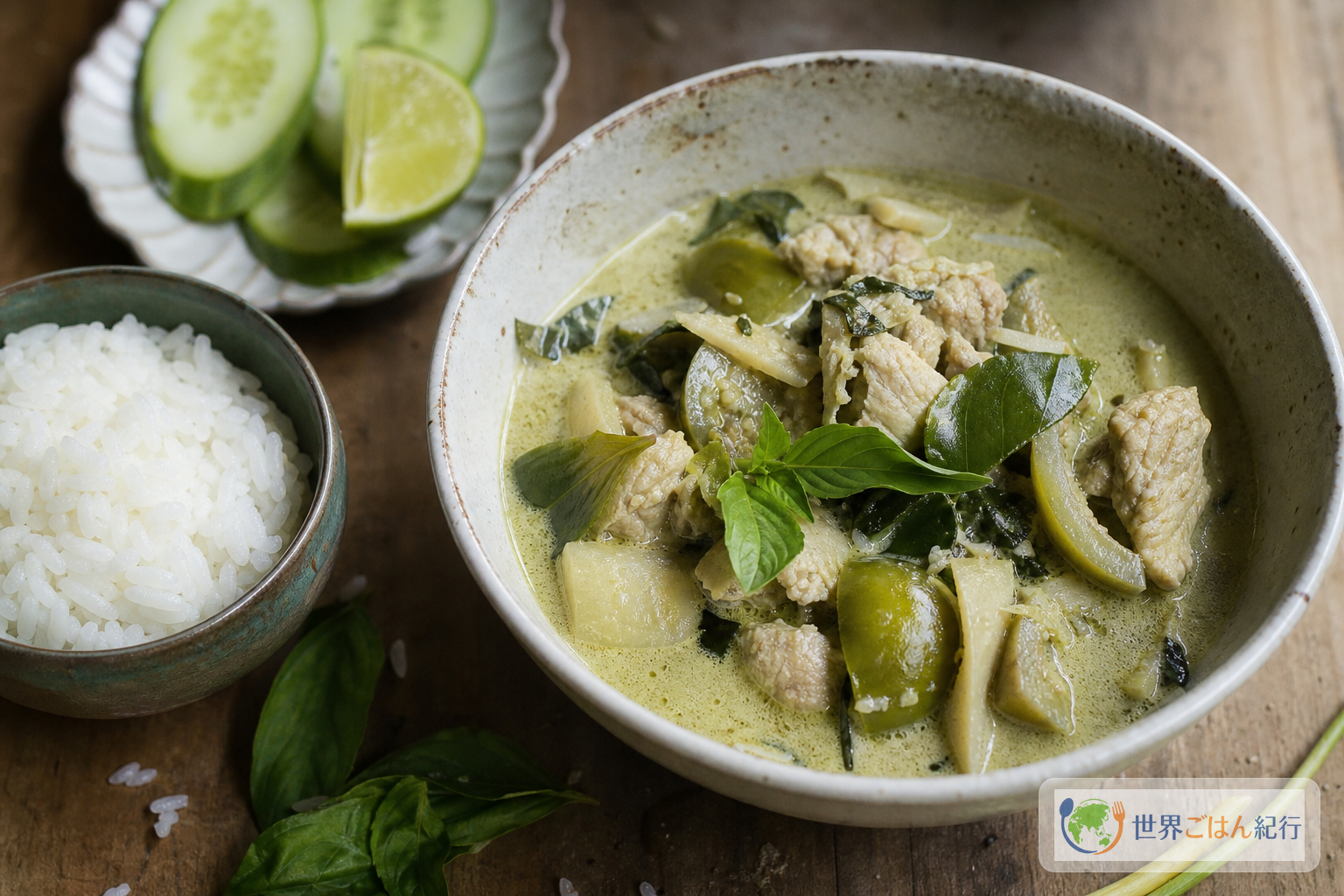
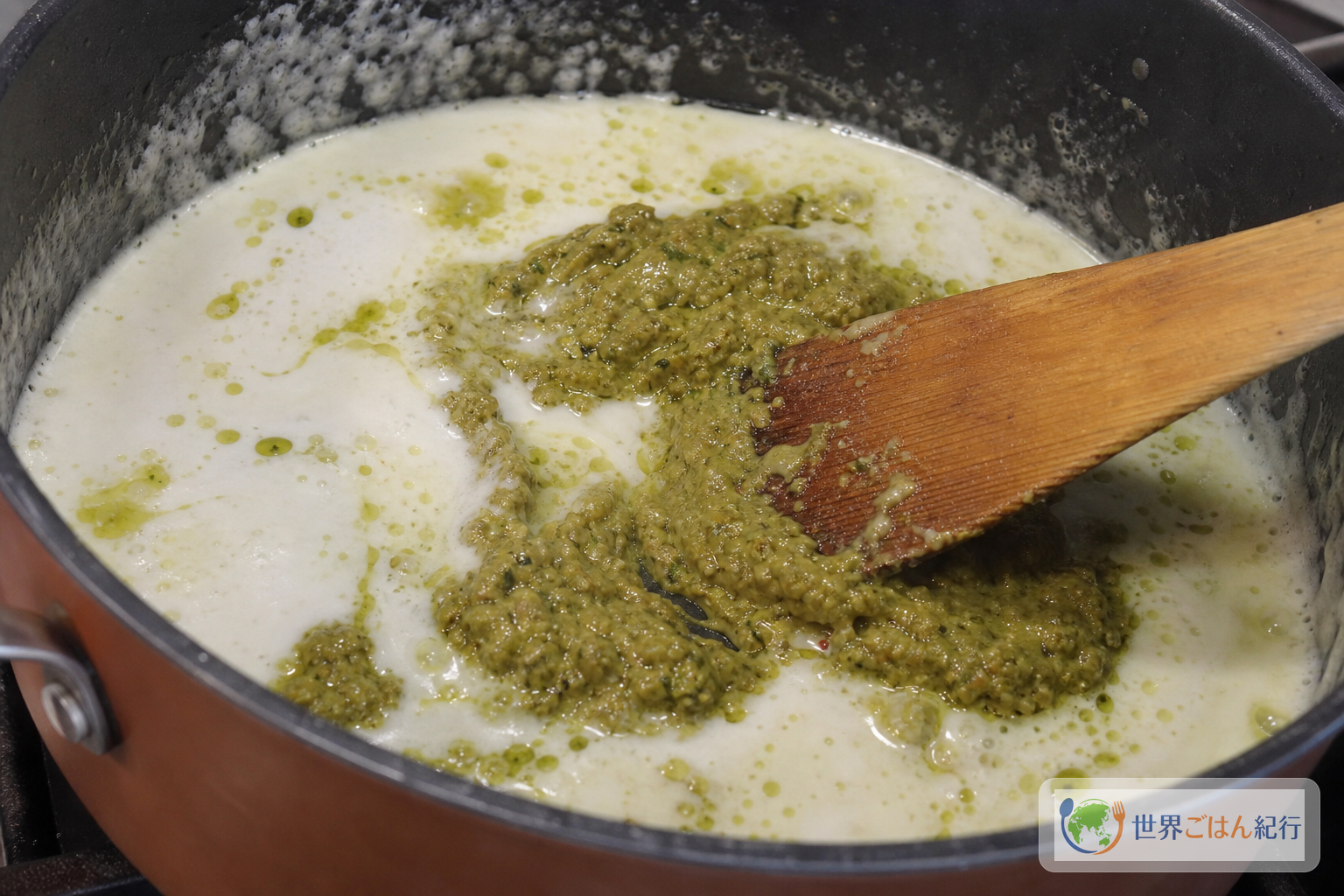
In the evening kitchen, drop the coconut cream that has set on top of the can into the pot. As white bubbles begin to simmer, add the green curry paste; at first it smells a bit raw and green, and gradually the aromas of chile, lemongrass and makrut lime zest round out. Each time you stroke the bottom of the pot with a wooden spatula, pale green oil floats up in spots. That moment is the signal that lifts a home green curry a notch.
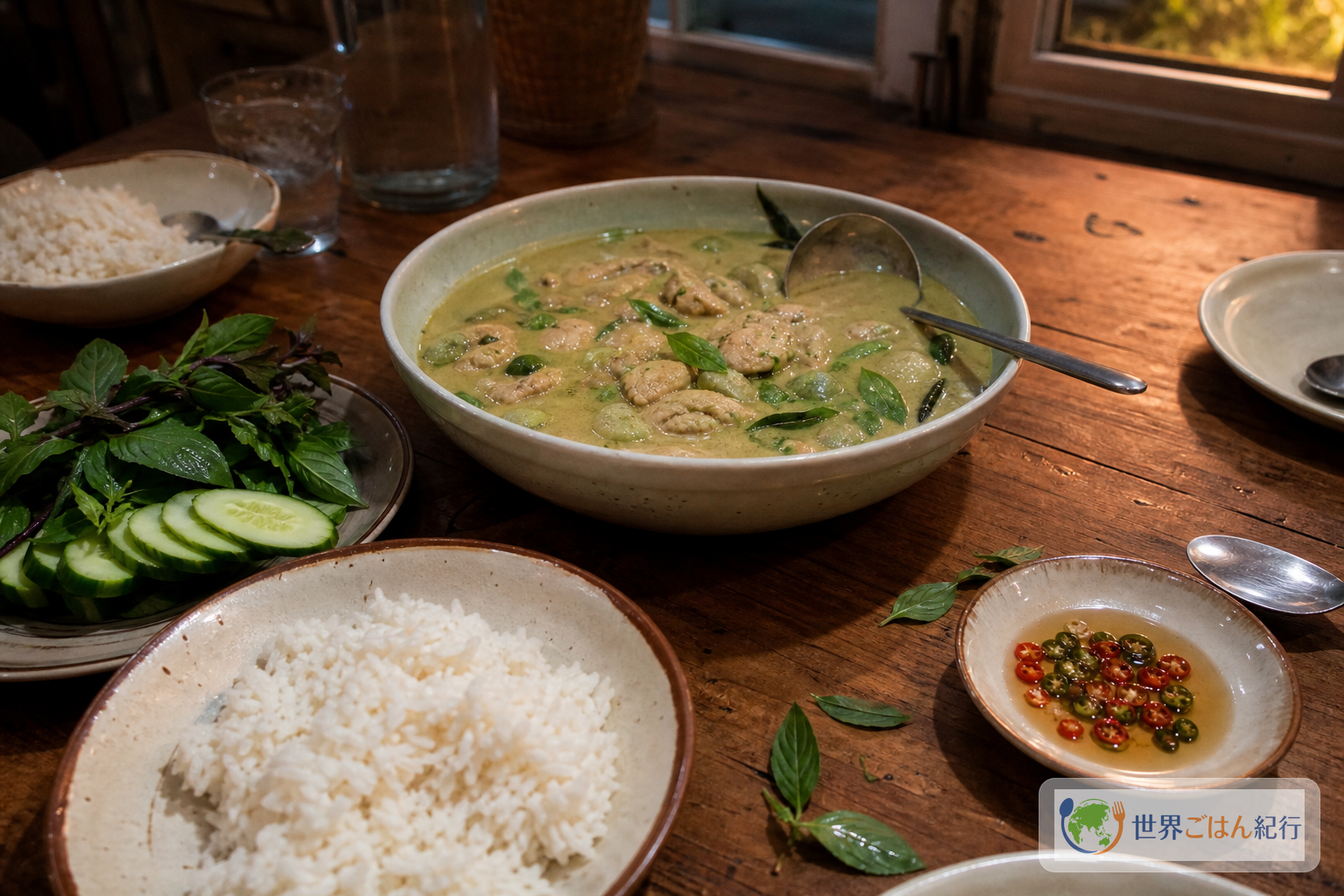
Green curry is แกงเขียวหวาน in Thai, written kaeng khiao wan in the Latin alphabet. Translated literally it looks like "sweet green soup," but the "หวาน" here is explained not only as the sweetness of sugar but also as a way of describing a pale, soft green color. So rather than adding sugar to make a sweet curry, what matters is how you bring together the color of green chiles and herbs, the whiteness of coconut and the saltiness of fish sauce.
There are three hard points when you make it elsewhere. Simmering store-bought paste while it is still raw, boiling coconut milk hard so it turns grainy, and breaking down the eggplant until the sauce turns dark. Conversely, if you wake the paste in oil, cook the chicken first and simmer the vegetables briefly in the second half, you get quite close to a specialty restaurant plate.
If gaeng phet is a curry that pushes with the toasty flavor of red chile, green curry clears lightly with the aroma of green chile and basil. It is not as sweet and heavy as massaman curry, and does not put sourness forward as much as tom kha gai. Over rice, it is a green coconut curry that is hot yet keeps your hand going back for more.
What to protect is frying the green curry paste in coconut oil, not over-simmering the makrut lime leaves so the aroma remains, and adding the basil after turning off the heat. You can substitute for the chicken, eggplant and bamboo shoots, but breaking this order blurs the flavor.
How is it different from red curry?
The Thai word แกง is a broad word close to soup or curry. It includes not only the powdered-spice dishes you might imagine from the word "curry" but also many dishes that use a paste of crushed aromatics and chiles. Green curry is presented as a shared dish of central Thailand, often tied to green chiles, coconut, Thai basil, and chicken or fish balls.
| Dish | Local name | Center of aroma | Note when making it elsewhere |
|---|---|---|---|
| Green curry | แกงเขียวหวาน | Green chile, basil, makrut lime, coconut | Do not leave the paste undercooked, and add the basil last |
| Red curry | แกงเผ็ด | Dried red chile, lemongrass, makrut lime, coconut | Bring out the red oil and do not end at heat alone |
| Massaman curry | แกงมัสมั่น | Coconut, meat, potato, roasted spices | Sweetness and spice are heavy, so it suits a long simmer |
| Tom kha gai | ต้มข่าไก่ | Galangal, lemongrass, coconut, sourness | A soup, not a curry. Bring up the lime at the end |
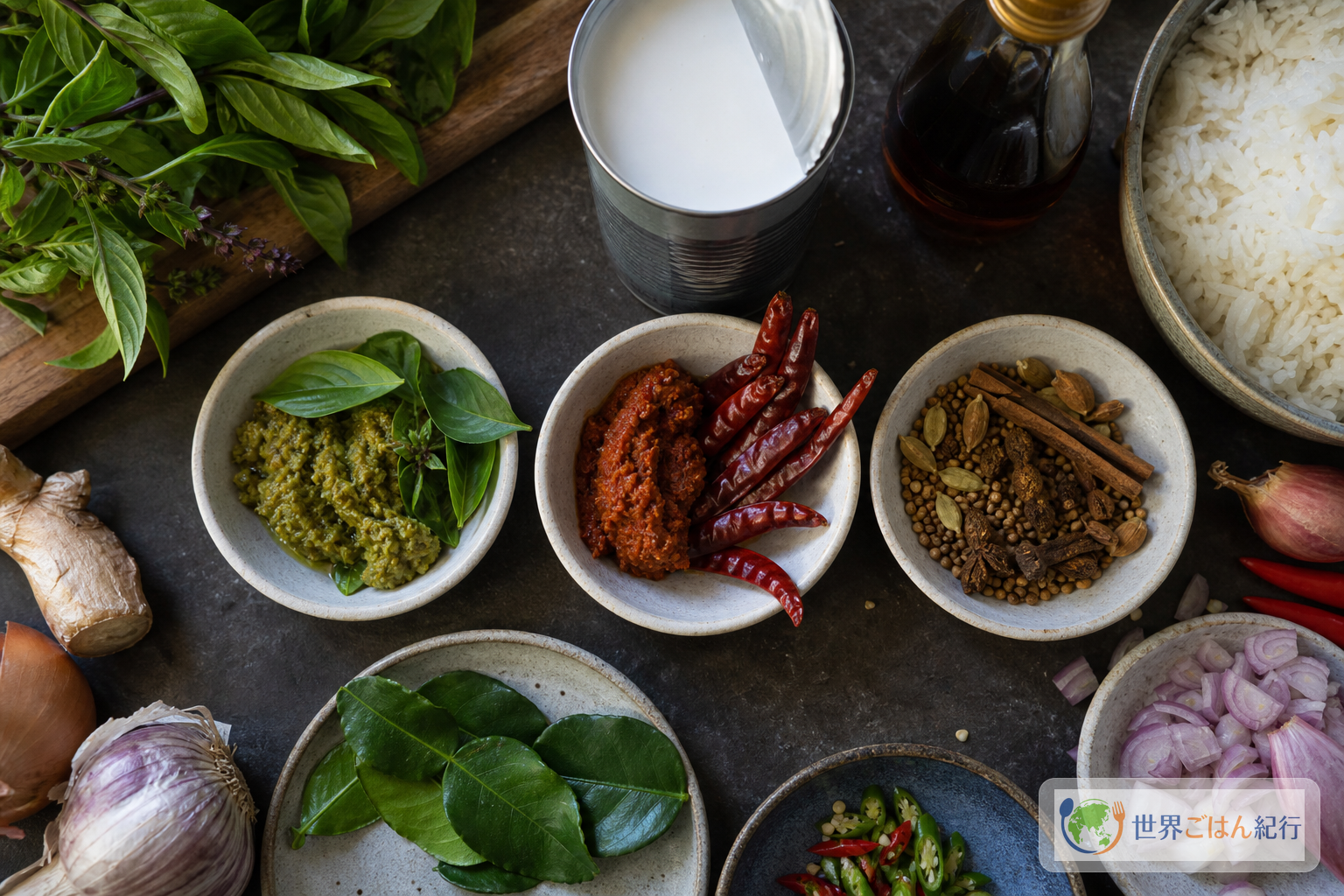
In Thailand, some households crush the paste by hand. Crushing green chile, garlic, shallot, galangal, lemongrass, makrut lime zest, coriander root, cumin, white pepper and shrimp paste in a stone mortar gives a stronger aroma and a more vivid color. But gathering all that every time in a home kitchen leaves you tired before you cook.
This recipe assumes store-bought paste. In return, it uses makrut lime leaves, basil, fish sauce and canned coconut milk properly. Deciding "where to make up for the weak points of store-bought paste" is more practical on a weeknight than making everything from scratch.
Ingredients | Serves 4 in a home kitchen
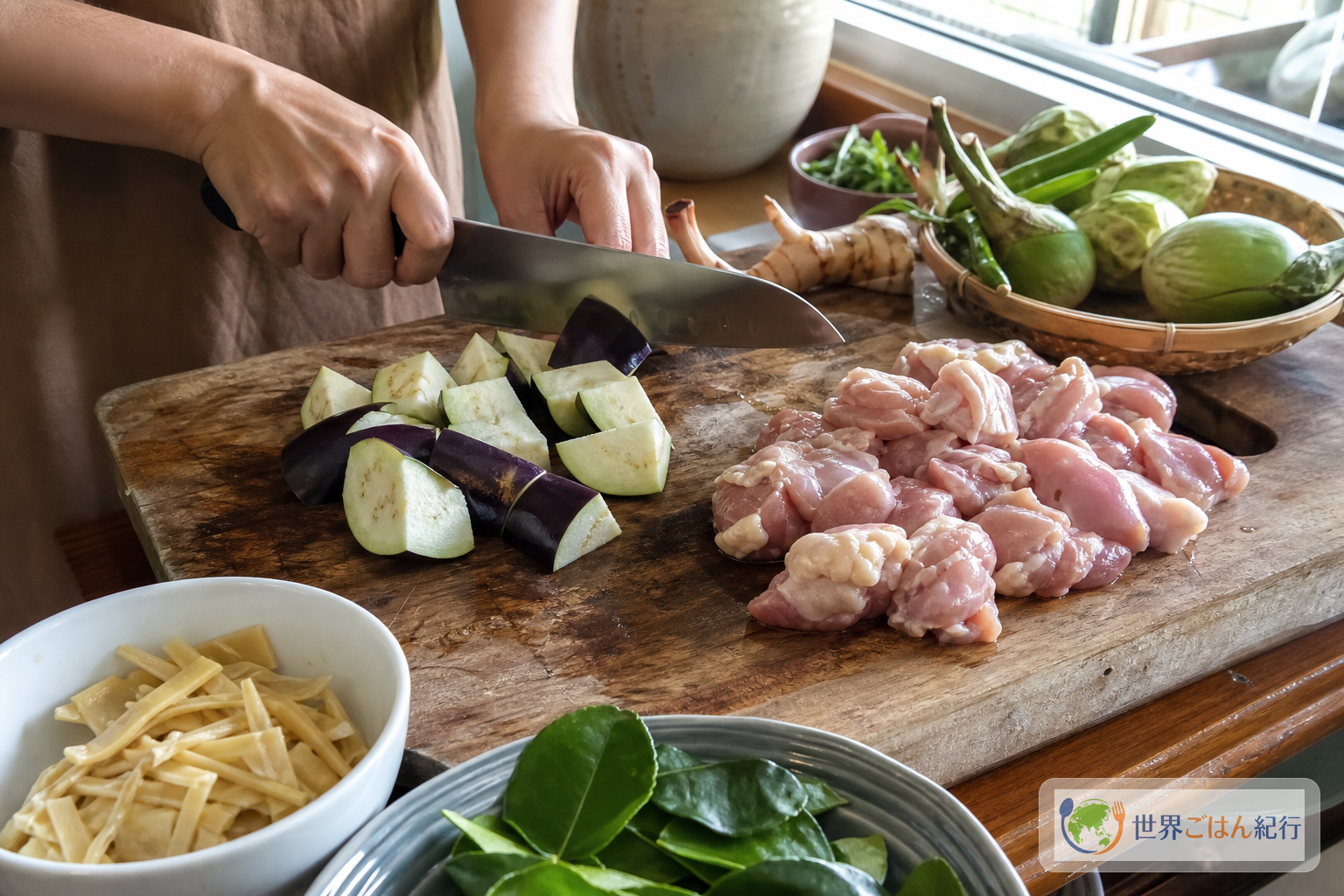
This quantity is for four people to eat over rice properly. With a hot paste, start from 35 g, and with a paste of weak aroma raise it to 45 g. Chicken thigh can be made skin-on or skinless, but skin-on gives more umami to the sauce.
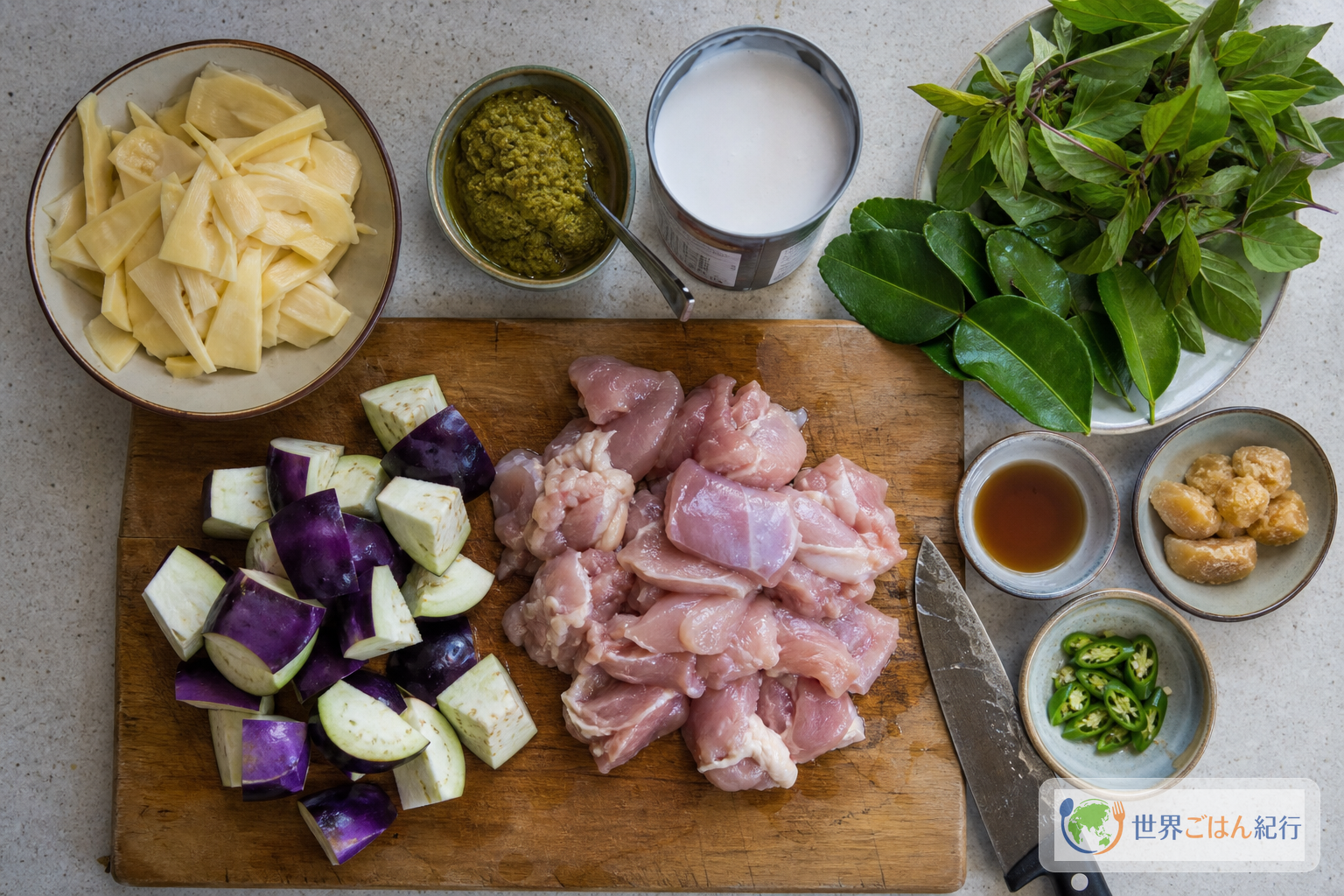
Some store-bought green curry pastes contain shrimp, fish sauce and soy. Fish sauce is also fish-derived. If you have allergies, check the ingredient label before buying. Cook the chicken to a center temperature of 75°C, or until it is white all the way through.
What to hesitate over when shopping
What is worth looking for online or at a specialty store for green curry is not the chicken or eggplant but the core of the aroma. Choose the meat and vegetables you can buy at a supermarket nearby and supplement only the herbs and Thai seasonings you cannot find, and shopping does not get heavy.
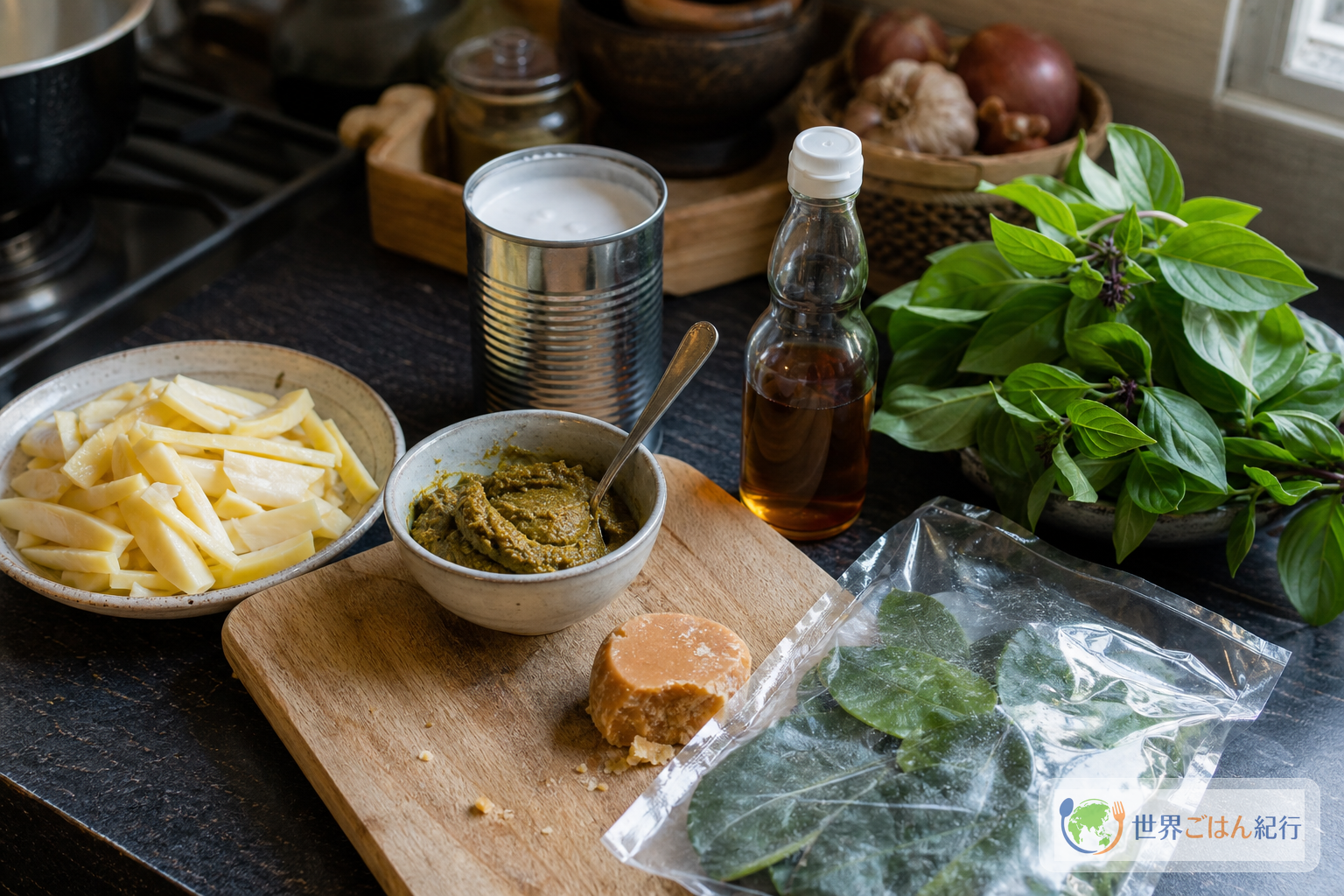
| Priority | What to buy | Reason | Where leftovers go |
|---|---|---|---|
| 1 | Green curry paste | The foundation of the dish. Swapping for red or yellow makes it a different dish | Stir-fried noodles, chicken stir-fry, fried rice |
| 2 | Makrut lime leaves | Adds the green citrus aroma and keeps the curry from getting heavy | Tom yum goong, tom kha gai, khao soi |
| 3 | Coconut milk | Used to fry the paste and to create roundness in the sauce | Laksa, amok, kanom tan |
| 4 | Fish sauce | Adds the fish-sauce umami that salt alone cannot | Gapao, som tam, pad thai |
For green curry paste, I limit this to shopping advice. Look in large supermarkets, Asian grocers or online, and start with a small jar or pouch. A large container is cheaper per gram, but the green aroma fades after opening. For a first try, one of about 40 g that is easy to use up keeps its aroma better until you make it next.
You can make it without makrut lime leaves, but with them the way the aroma rises changes by a notch. Frozen ones are easy to use one at a time and carry over to tom yum goong.
Coconut milk is involved in the step of releasing oil. If the oil does not separate from a carton, switching to canned makes the aroma more consistent.
Fish sauce is in charge of the fish-sauce umami that salt cannot supply. A small bottle is enough, so rather than replacing it with soy sauce alone, add it even in a small amount.
Method: do not drive off the green aroma, and do not break the eggplant
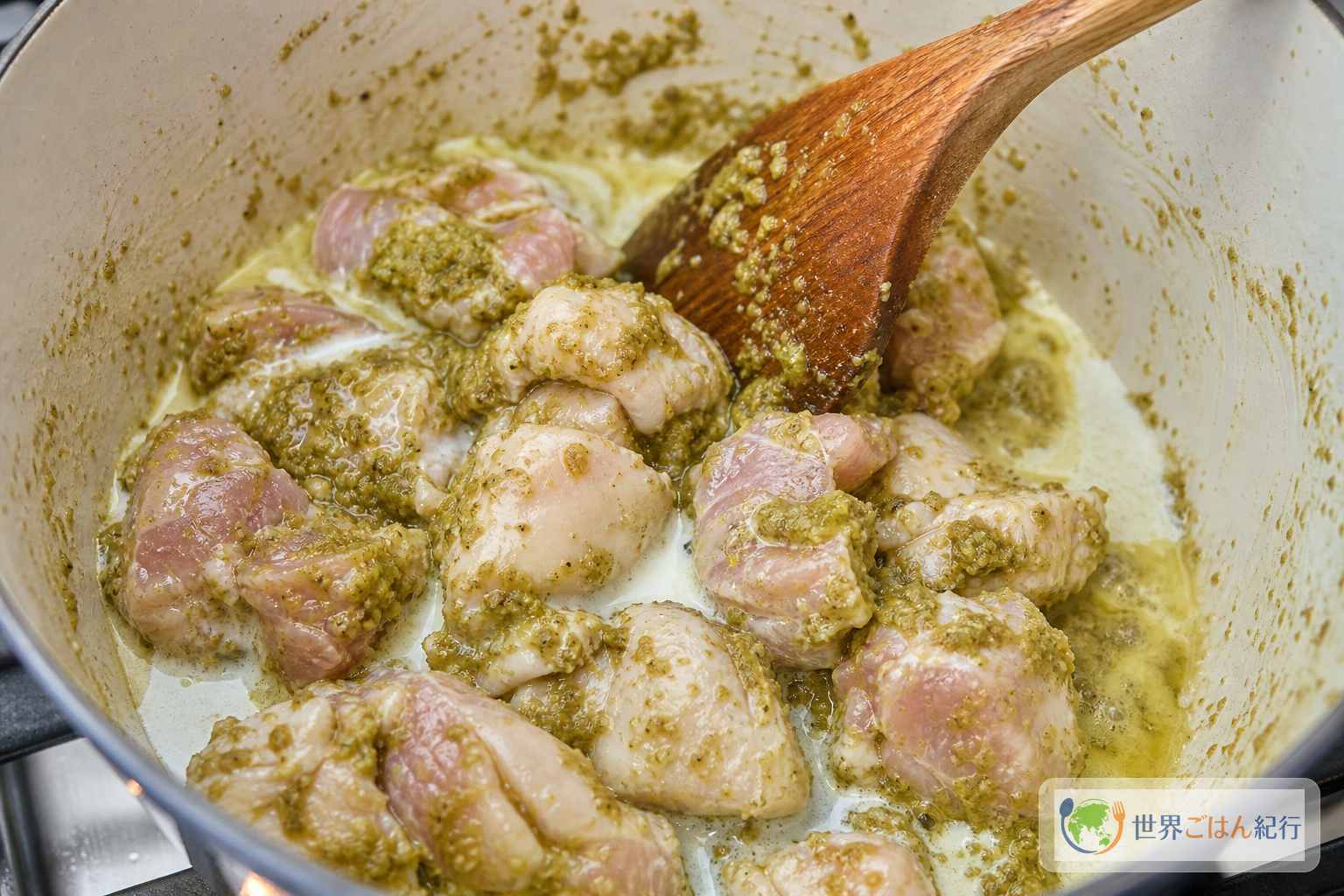
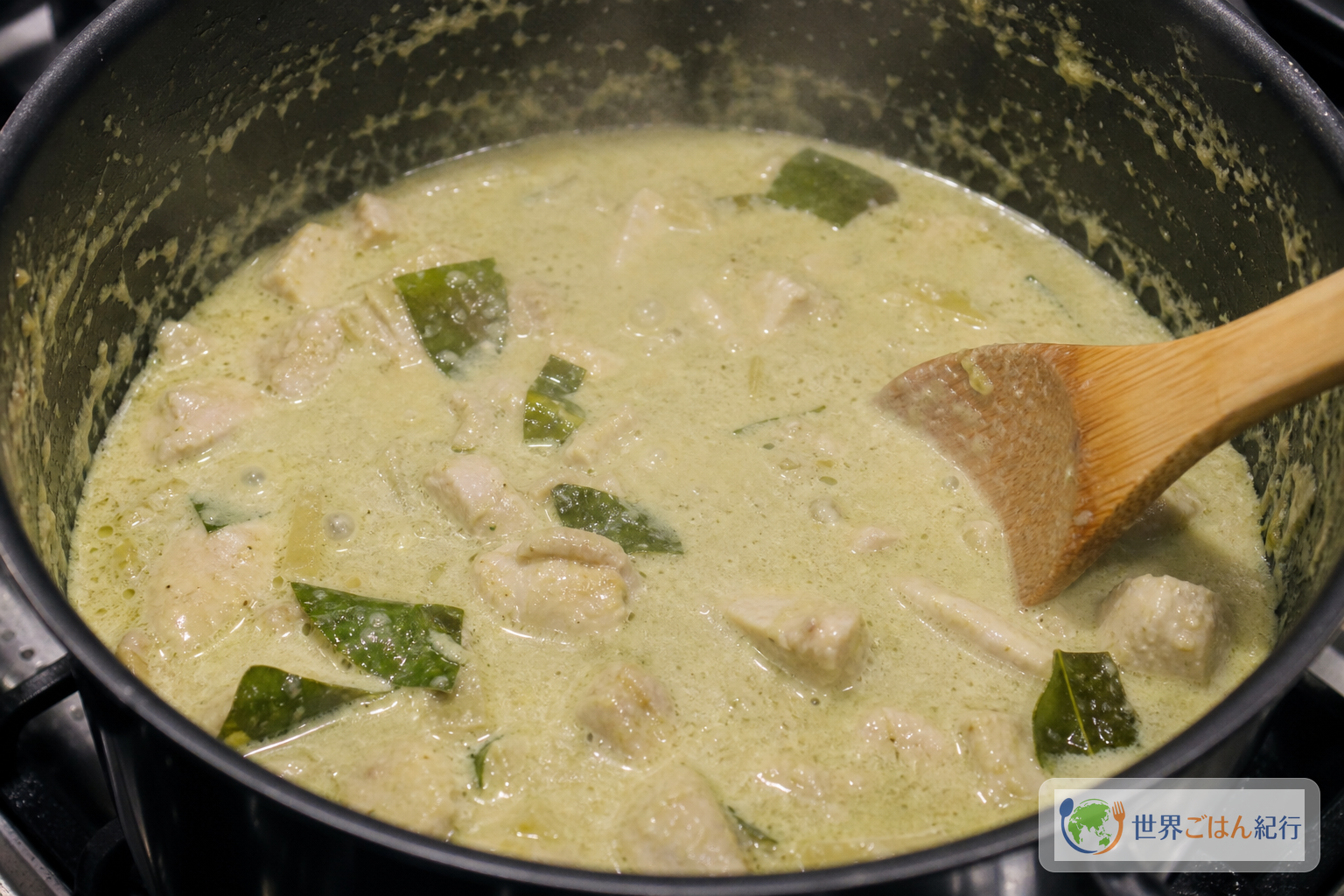
Green curry has a clear order: cut, fry, simmer, finish. If you measure the paste and seasonings and cut the ingredients before starting, you can move on before the paste burns.
Tasting only the pot, it feels a little salty and a little sweet. Over rice it dilutes to just right, so before finishing, check by putting a little curry on 1 tsp of rice to taste.
Substitutes and branches toward the local style
Green curry is a dish with a lot of freedom in ingredients. But if you cook everything the same way, the chicken gets tough and the vegetables break down. Changing the order to match how meat and vegetables cook makes it quite steady even at home.
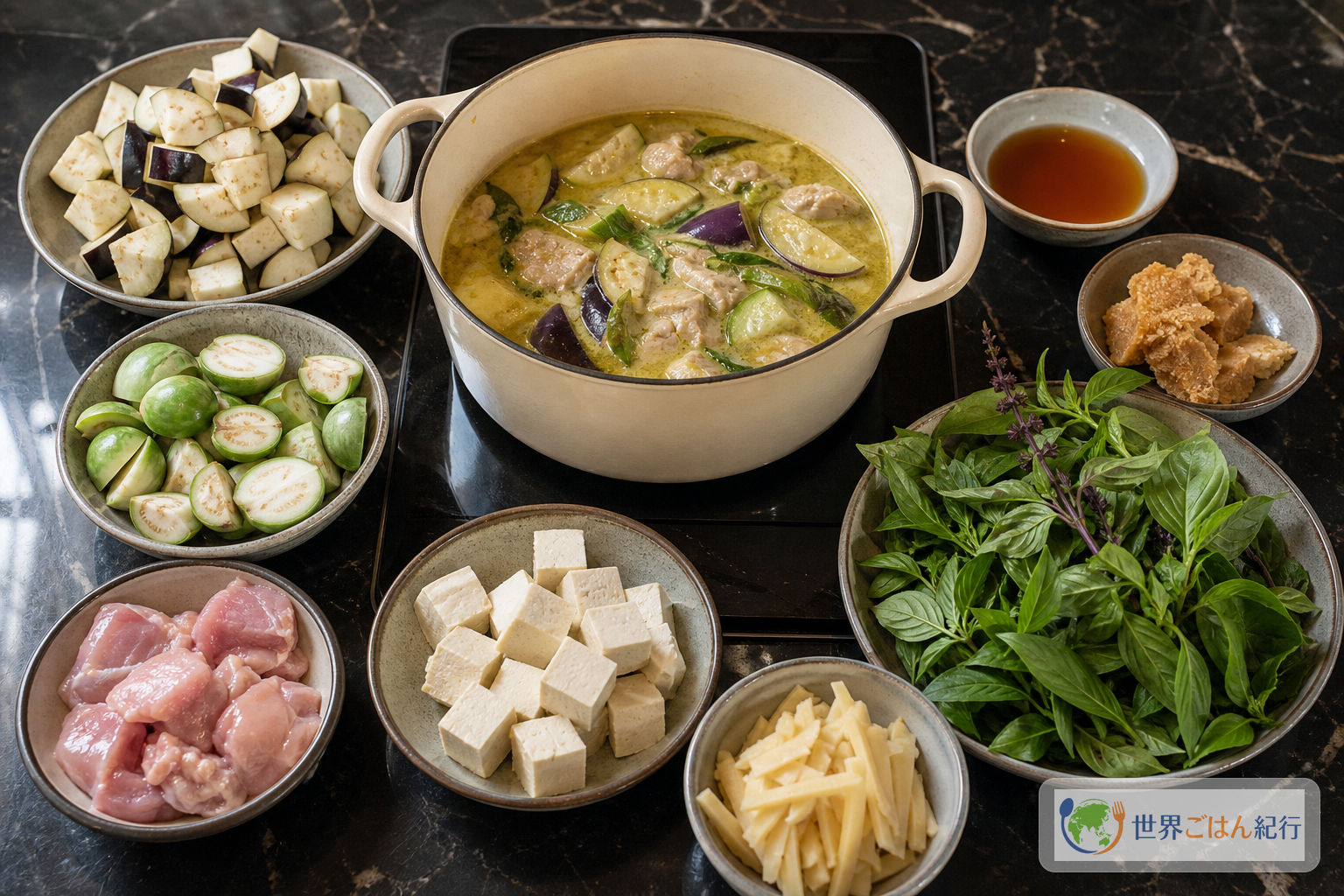
| Ingredient you want to change | How to use it | Cooking guide |
|---|---|---|
| Chicken breast | Slice thinly on the bias and add at the same time as the vegetables | 5–6 minutes over medium-low heat. Stop when white through the center |
| Thinly sliced pork | Cut 3 cm wide and coat in the paste in place of chicken | Simmer after the surface color changes over medium heat |
| Thick fried tofu | Cut into 3 cm cubes and add with the vegetables | 5 minutes over medium-low heat. It is enough if the surface picks up the sauce |
| Thai eggplant | Quarter and soak in water | Around 5 minutes. Do not overcook once the skin is glossy |
| Regular eggplant | Cut into chunks of 3 cm or more | 5–7 minutes. Cut small, it breaks down dark easily |
| No basil | Do not use perilla; add one more makrut lime leaf for aroma | Perilla moves it toward Japanese flavors, so do not put it out as a table herb |
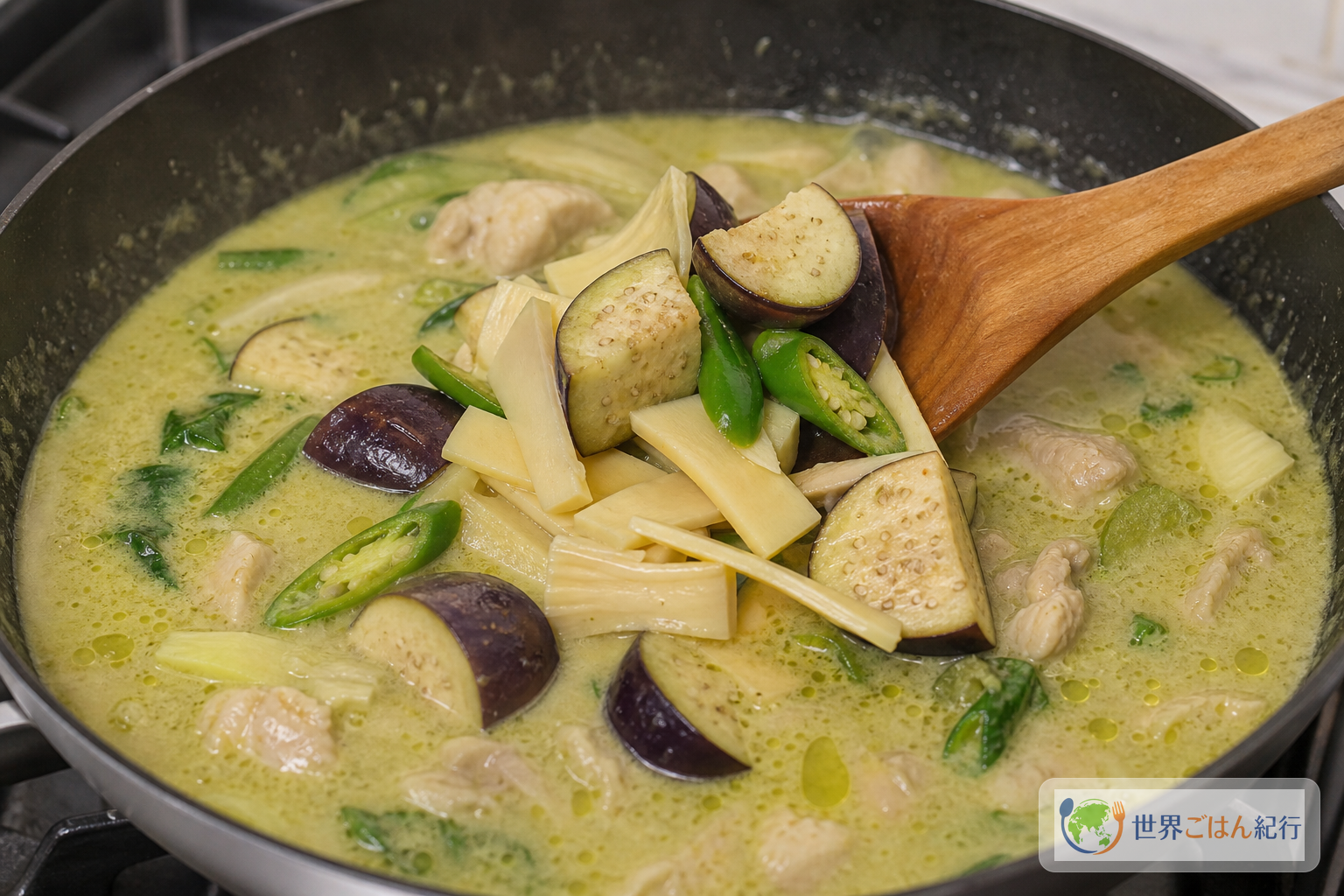
If you can get Thai eggplant, please use it once. Round Thai eggplants have taut skin and keep their shape in coconut sauce, with a slight bitterness when you bite. Regular eggplant is soft and absorbs the sauce well. It is not a bad substitute, but cut small it breaks down quickly, so cutting it large and adding it in the second half suits it.
If you make the paste from scratch, use green chile, garlic, shallot, galangal, lemongrass, makrut lime zest, coriander root, white pepper, cumin and shrimp paste. Coriander root and makrut lime zest are hard to get in many places, so rather than aiming for perfection the first time, adding makrut lime leaves and basil to a store-bought paste to make up the aroma is less likely to fail.
On days you want to eat it with noodles like khao soi, make the green curry a little richer and pour it over somen or rice noodles. If you lean toward the kanom jeen often seen in Thailand, though, use more sauce for the noodles and set cucumber and bean sprouts beside it to lighten it.
Why it goes wrong | dull green, watery, too hot
Green curry failures come more from heat control and order than from lacking ingredients. Dull green, watery, only hot, dark eggplant. These four are easier to fix by watching what is happening in the pot.
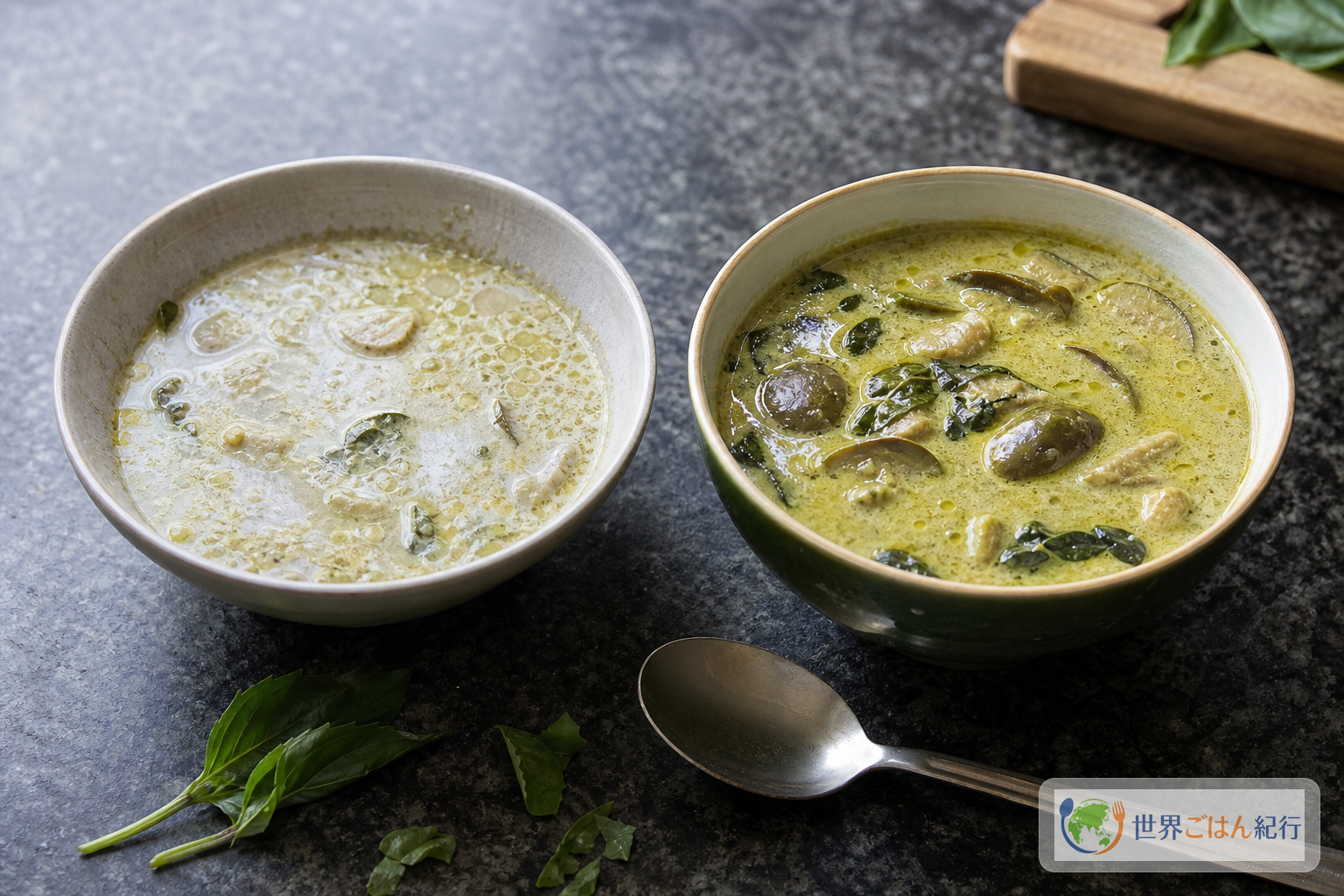
No green oil comes out
Either the canned coconut milk is evenly emulsified or the heat is too low. Before adding the paste, reduce the coconut cream for about 2 minutes over medium heat, and if oil still does not come out, add 2 tsp neutral oil and fry. What matters is not producing a lot of oil but driving off the raw smell of the paste and rounding its aroma.
Watery
Too much water was added or the vegetables released water. Without a lid, simmer over medium-low heat for 3–5 minutes and wait until green oil returns to the surface. Adding fish sauce first just makes it salty, so cook off the water first and adjust the saltiness at the end.
Too hot
Increasing the sugar alone does not remove the heat. Add 100 ml coconut milk, 50 ml water and 1 tsp fish sauce and simmer 3 minutes over medium-low heat to blend it all in. Next time use 30–35 g paste and add chile at the table, and it is less likely to go wrong.
The eggplant turns dark and falls apart
The eggplant was cut too small or simmered long from the start. Cut it into 3 cm chunks and add it after the chicken is cooked. Regular eggplant is softer than Thai eggplant and absorbs liquid easily, so stopping when the skin is glossy and the center is just beginning to soften keeps both color and texture.
Storage and FAQ
Green curry is delicious the next day too, but stored together with rice it absorbs moisture and gets heavy. Just separating curry, rice and herbs changes the aroma when you reheat.
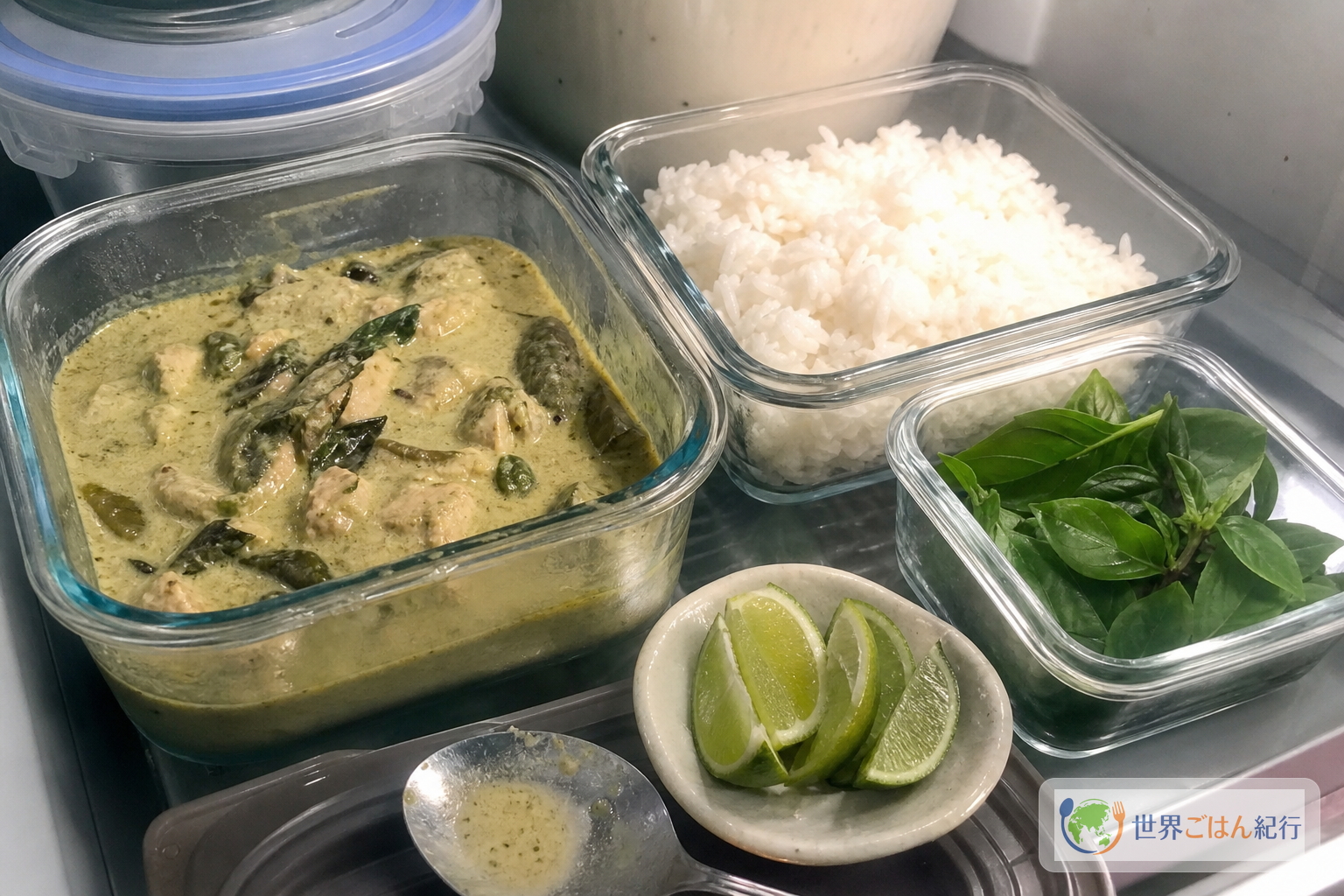
Cool the curry slightly, put it in a clean storage container and finish it within 2 days refrigerated. To reheat, warm over low heat for 5–7 minutes, stirring along the bottom of the pot, without boiling hard. In a microwave, heat at 600 W for 2 minutes, stir once and heat 1 minute more. It is ready to eat when the chicken is hot through the center and green oil has returned to the surface.
If freezing, freeze only the curry, for up to 2–3 weeks. Eggplant softens after thawing, so if you plan to freeze, using more bamboo shoots or thick fried tofu keeps the texture. Do not freeze basil; add it after reheating.
What about children or family who dislike heat?
Reduce the paste to 25 g and increase the coconut milk to 500 ml. Having adults add chile or fish sauce at the table lets you adjust within the same pot. Increasing the sugar too much to dilute the heat makes a sweet curry, so diluting with coconut milk is more natural.
Can I make it with red curry paste?
You can, but as a dish name it moves closer to gaeng phet. The red chile and dry aroma come forward, making it a different dish from the lightness of green chile, basil and makrut lime. On a day when you are making green curry, use green curry paste.
Does regular rice work?
Yes. Regular short-grain rice is sticky, so ladling less curry makes it easier to eat. Thai rice gives a lighter aroma and loosens the heat and the coconut oil more easily, so on a weekend when you want a local feel, jasmine rice suits it.
Do you eat the makrut lime leaves?
They are leaves added to bring out aroma, so if the tough veins bother you, set them aside in the bowl. Tearing them large rather than cutting them small makes them easy to remove when eating. Chopping finely brings out the aroma but leaves them in your mouth, so large pieces are easier to handle at home.