The story of tom kha gai: keeping the aroma of kha in a white soup
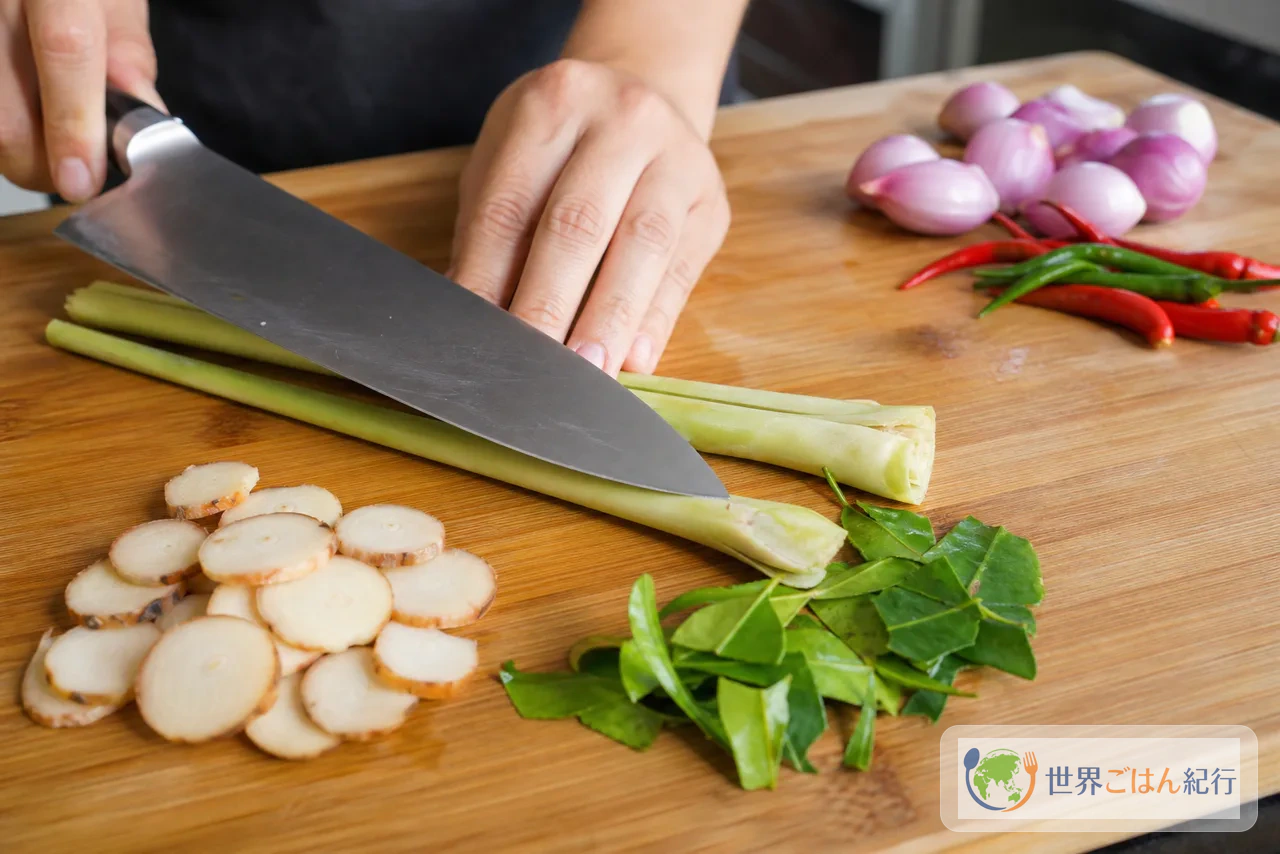
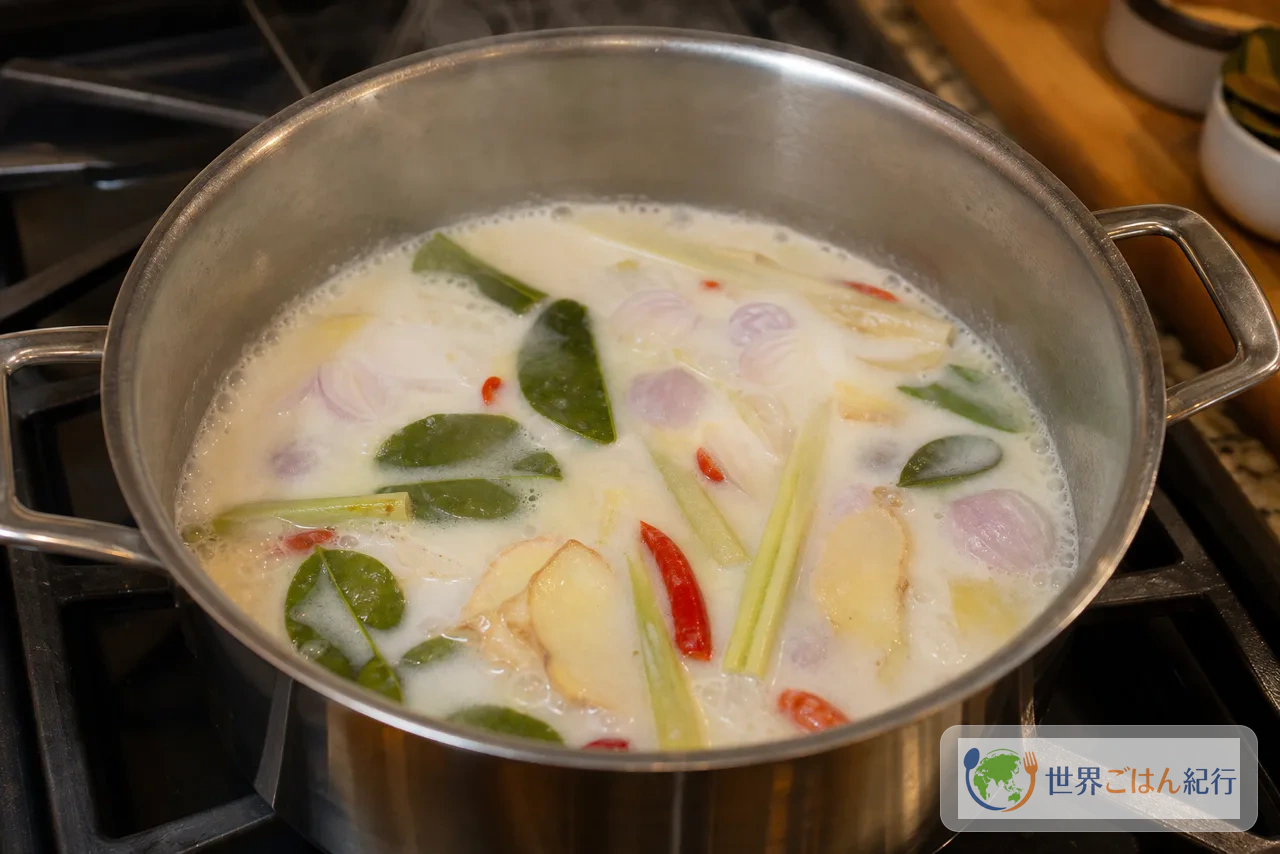
Crush lemongrass on the cutting board in the evening kitchen and a green, lemony fragrance rises. Drop in thinly sliced galangal and torn makrut lime leaves, and instead of a clear broth, white steam coated with coconut milk rises: that is tom kha gai.
Tom kha gai (ต้มข่าไก่ / tom kha gai) is Thailand's chicken coconut soup. "tom" means to boil, "kha" is galangal, and "gai" is chicken. At the center of the name is not coconut but galangal. It is a rhizome that resembles ginger, but the aroma is different, a clean coolness like hard citrus, pine needles, and white pepper together.
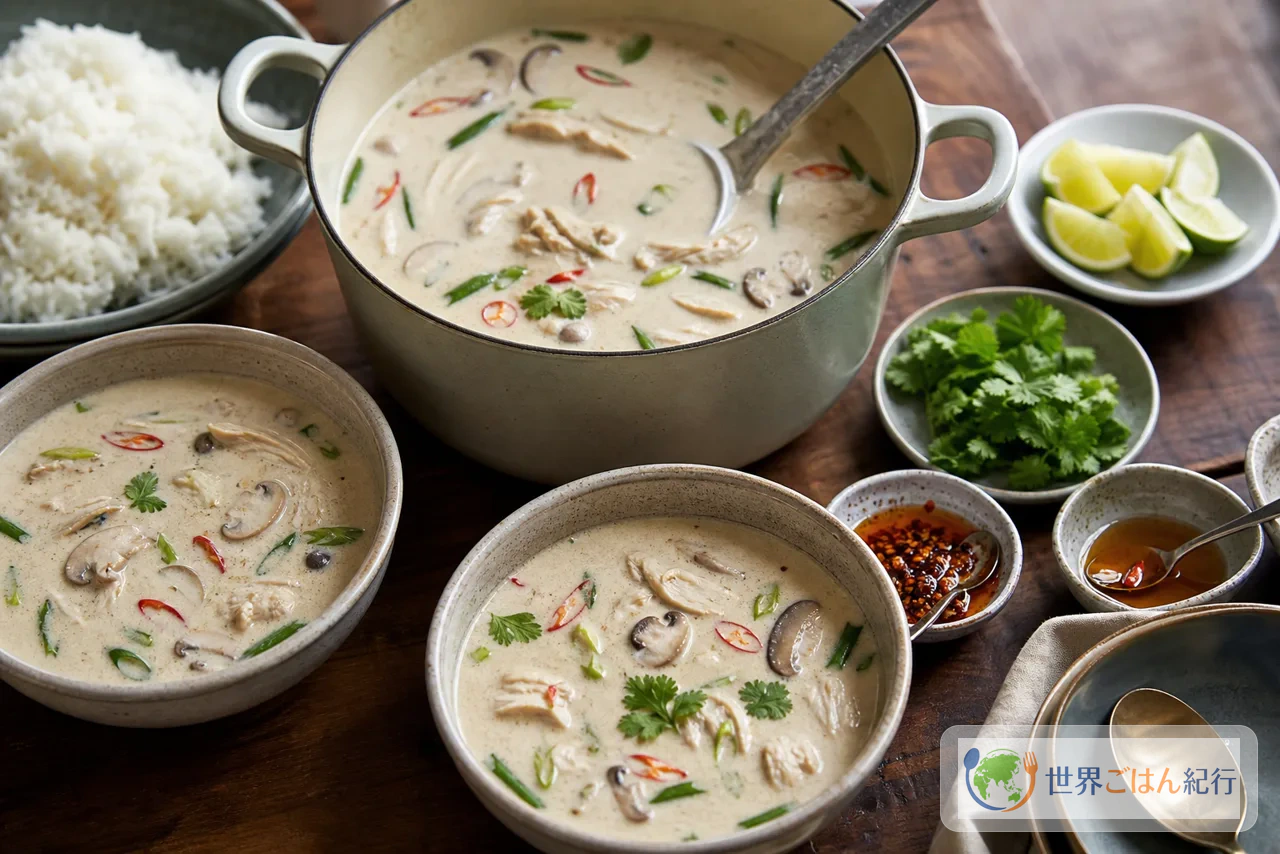
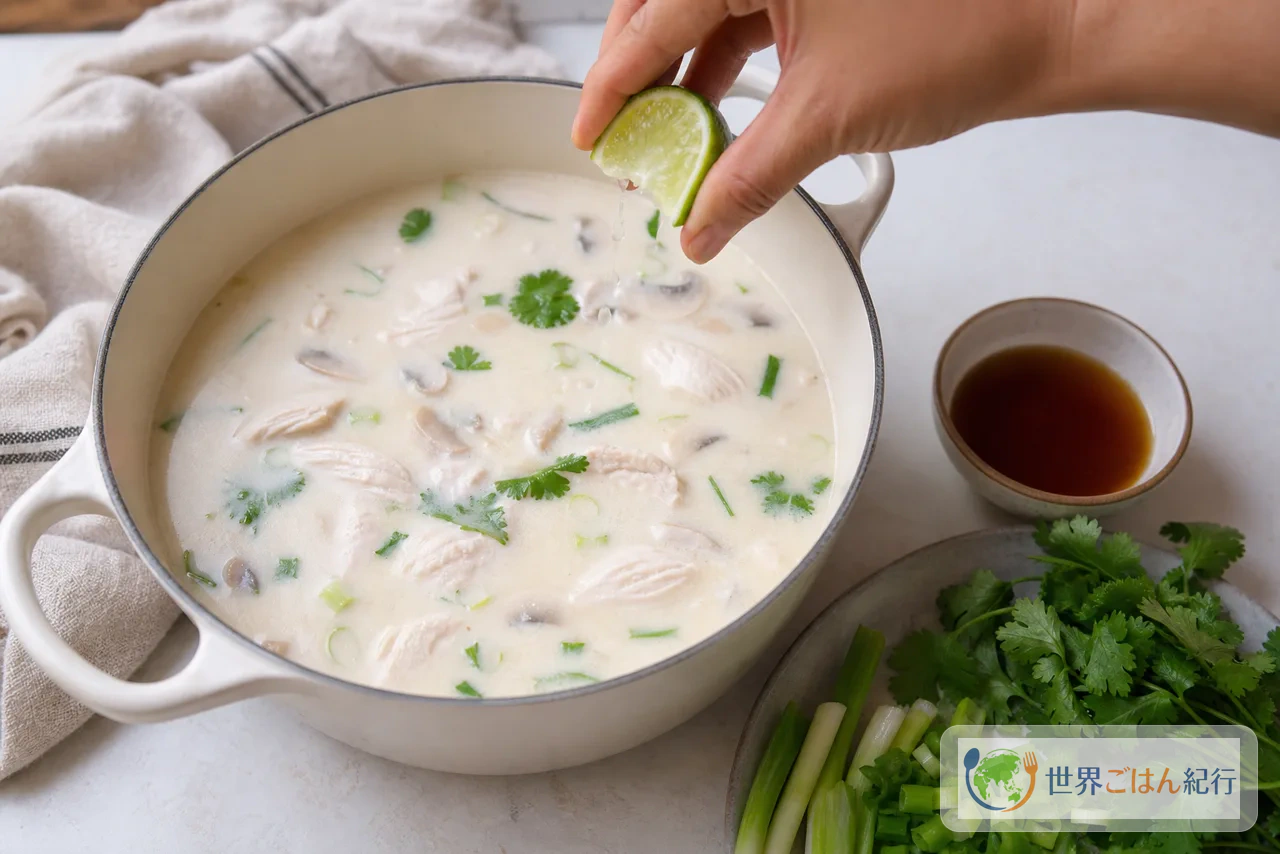
What people worry about when making it at home is temperature more than heat. If coconut milk boils hard, the oil separates and the white soup turns grainy. If lime juice goes in early, the aroma flies off and bitterness tends to appear. Slice the galangal thin, release its aroma over modest heat, and set the sourness at the end with the heat off. If you keep to this order, you get close to that round sourness you taste at a Thai restaurant.
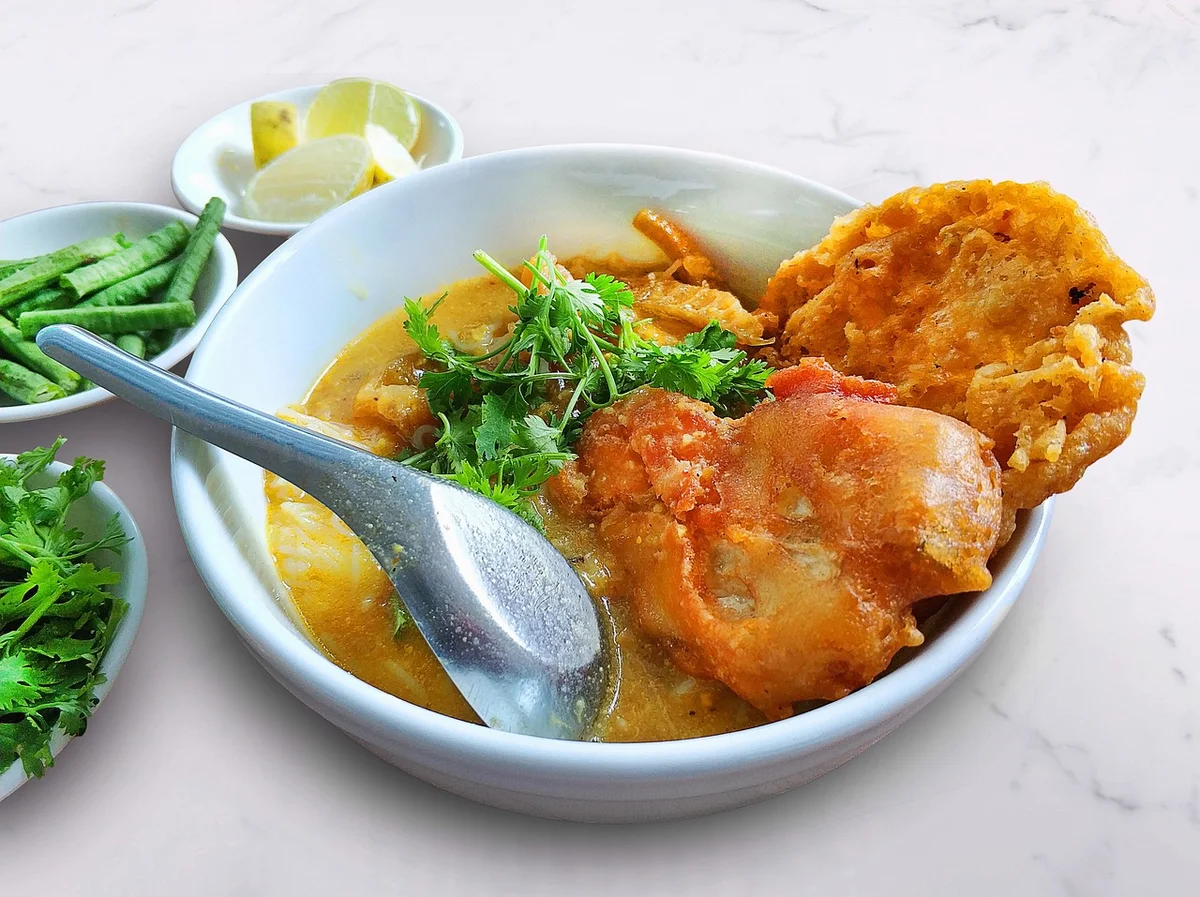
If tom yum goong is a soup that wakes you up with the sharpness of shrimp, chili, and lime, tom kha gai is quieter. It works even with little heat, and with chicken and mushrooms it can be a main dish at dinner. It is not as heavy as khao soi, and placed beside som tam it also receives the heat.
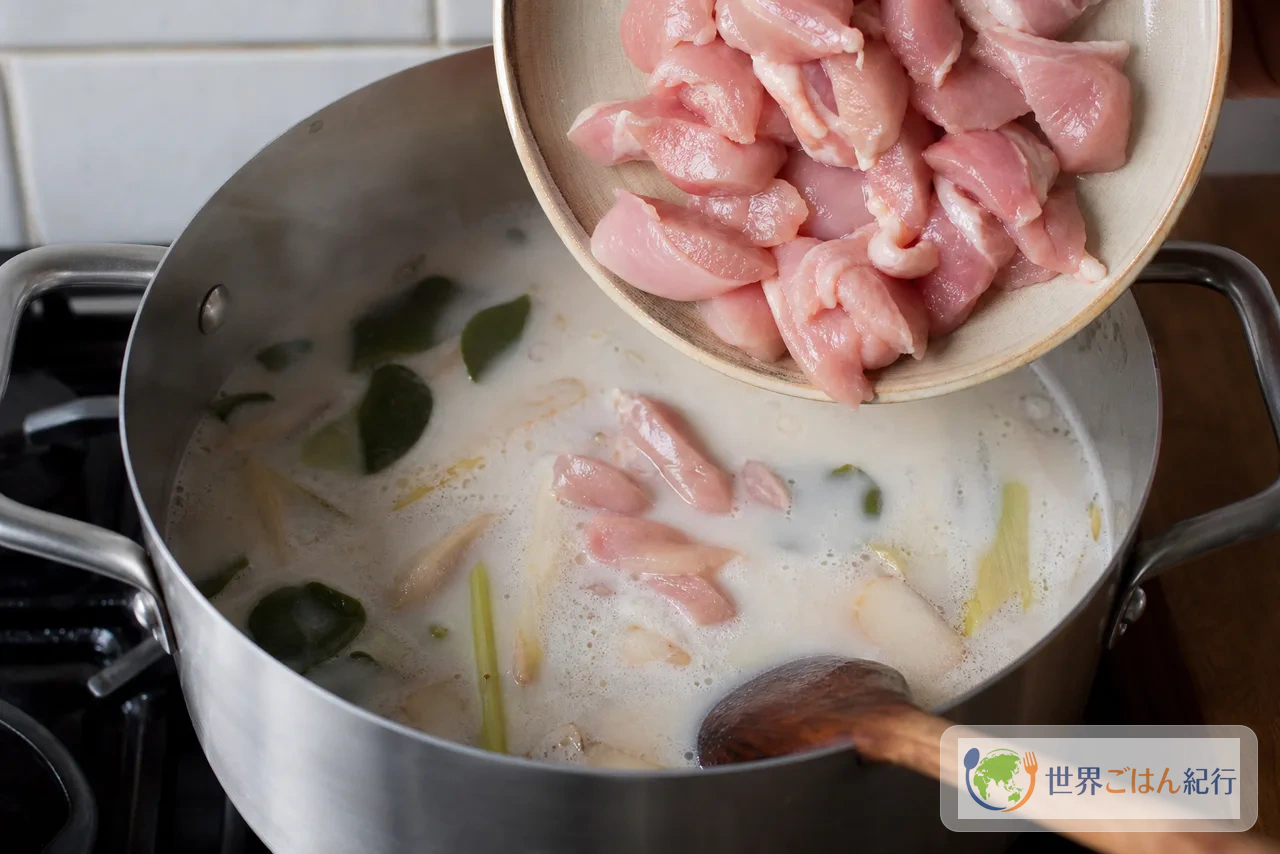
Simmer the herbs first. Slice the chicken thin and cook it briefly. Warm the coconut milk over low heat. Add the lime juice after turning off the heat. Keep these four and the white soup does not turn heavy and the aroma of galangal lasts to the end.
How is it different from tom yum goong?
It is slightly off to think of tom kha gai as "tom yum without the heat." Both use lemongrass, galangal, makrut lime leaves, lime, and fish sauce, but the center of the dish differs. Tom yum goong is a dish that builds shrimp broth with sourness and heat. Tom kha gai makes galangal the star and wraps the chicken in the roundness of coconut.
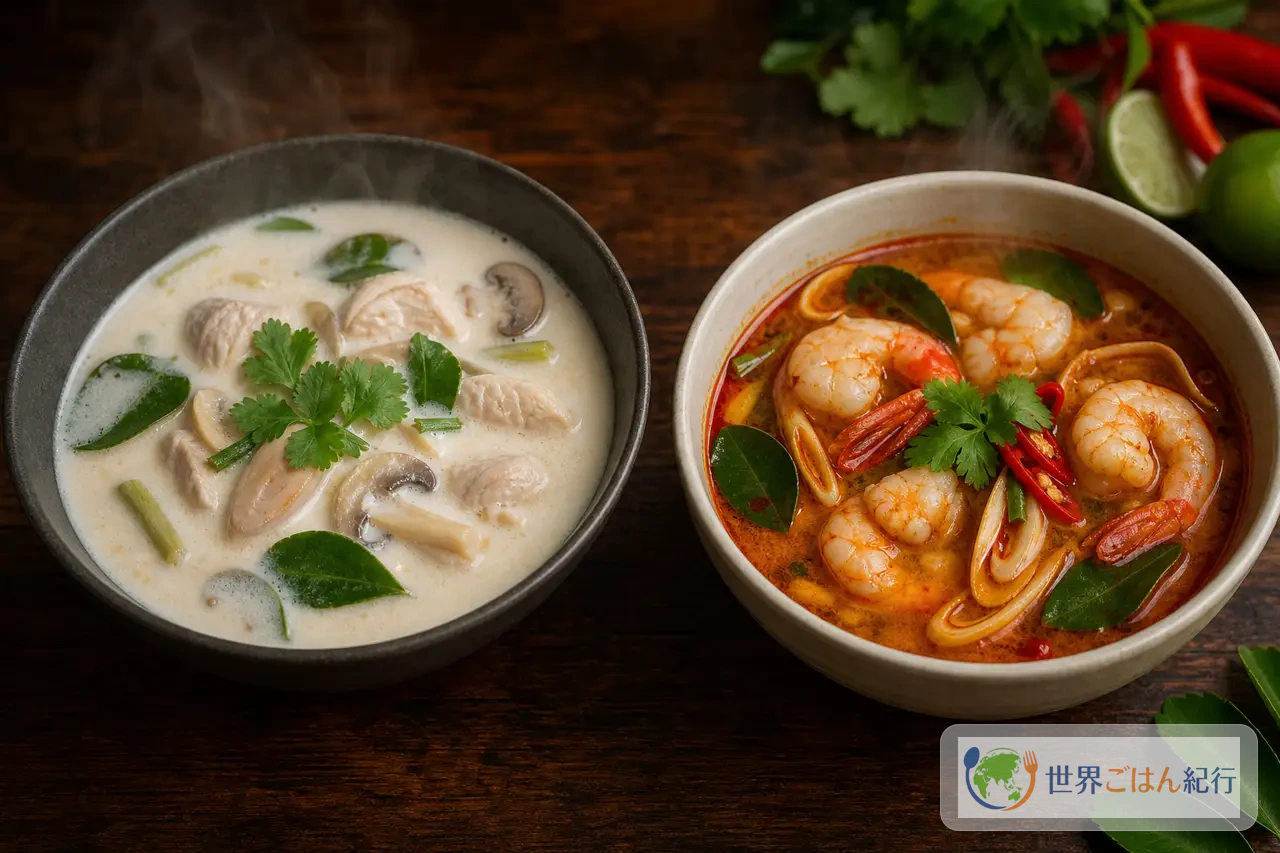
It is convenient to make both on a day you buy the same herbs, but the handling of the pot is different. For tom yum goong, shrimp go briefly into boiling soup and a sharp finish of lime closes it. For tom kha gai, you proceed over modest heat while watching the shaking of the surface so as not to break the whiteness of the coconut milk.
If you hesitate while shopping, look for galangal before chilies or nam prik pao. Tom kha gai works with fewer chilies, but if you leave out the galangal, the "kha" at the center of the name disappears. The fork between getting closer to the original and not is not heat but the root of the aroma.
| Dish | Star | Soup texture | How sourness is built | Home cooking caution |
|---|---|---|---|---|
| Tom yum goong | Shrimp, chili, lime | Clear or cloudy red | Lime used strongly | Do not overcook the shrimp |
| Tom kha gai | Galangal, chicken, coconut | White and mellow | Lime added last | Do not over-boil the coconut milk |
SBS Food presents tom kha gai as a coconut-based soup commonly seen in central Thailand and also mentions examples where tamarind rather than lime juice adds the sourness depending on the region. In the home recipe by Temple of Thai, galangal, lemongrass, makrut lime leaves, and chicken are simmered in coconut milk, and the flavor is set with fish sauce and lime from just before to after turning off the heat. The Thai SELECT Cookbook also advises keeping the heat low during cooking and adding lime juice after taking the pot off the heat.
What matters about how it is eaten locally is not to make tom kha gai too complete as "one bowl of soup per person." At a Thai table, a sour soup, a stir-fry, a salad, and rice are set out at the same time, and you move between flavors with each bite. Nomadette also explains tom kha gai as a dish to eat with rice rather than to finish by drinking alone. To reproduce it at a home dinner, spooning a little soup over a bowl of white rice and eating the chicken and mushrooms like a side dish is about right.
There is a range in how sourness is made too. In many Thai restaurants the aroma of lime comes forward, but using tamarind puree as in SBS Food's recipe moves toward a rounder, slightly fruity sourness. At home you do not need to buy tamarind from the start. But on days you eat it beside a spicy dish, or want to spoon it over rice as a main, cutting the lime a little and bringing forward the saltiness of fish sauce and the sweetness of coconut keeps you from tiring of it.
| What to decide | To lean Thai | To lean toward a home dinner |
|---|---|---|
| Sourness | Add lime after the heat is off, and add more lime in the bowl | Put in a little in the pot and add more at the table |
| Heat | Serve crushed bird's eye chilies or dry-toasted chilies on the side | Keep chilies out of the pot and add only to the adults' bowls |
| Herbs | Use galangal, lemongrass, and makrut lime leaves in large pieces | Remove half of the hard herbs before serving |
| Staple | Eat with jasmine rice | Ordinary white rice is fine. Cooked slightly firm, it suits |
| Ingredients | Straw mushrooms, chicken breast, red shallots | Shimeji, king oyster mushrooms, chicken thigh, ordinary onion |
What comes up repeatedly in English-language Thai cooking guides is that leaving out galangal makes it a different soup. You can still make a delicious chicken coconut soup with ginger. But it is no longer a dish of "kha". If you put effort into one thing on the first shopping trip, finding galangal is worth it.
Show the hard herbs or set them aside?
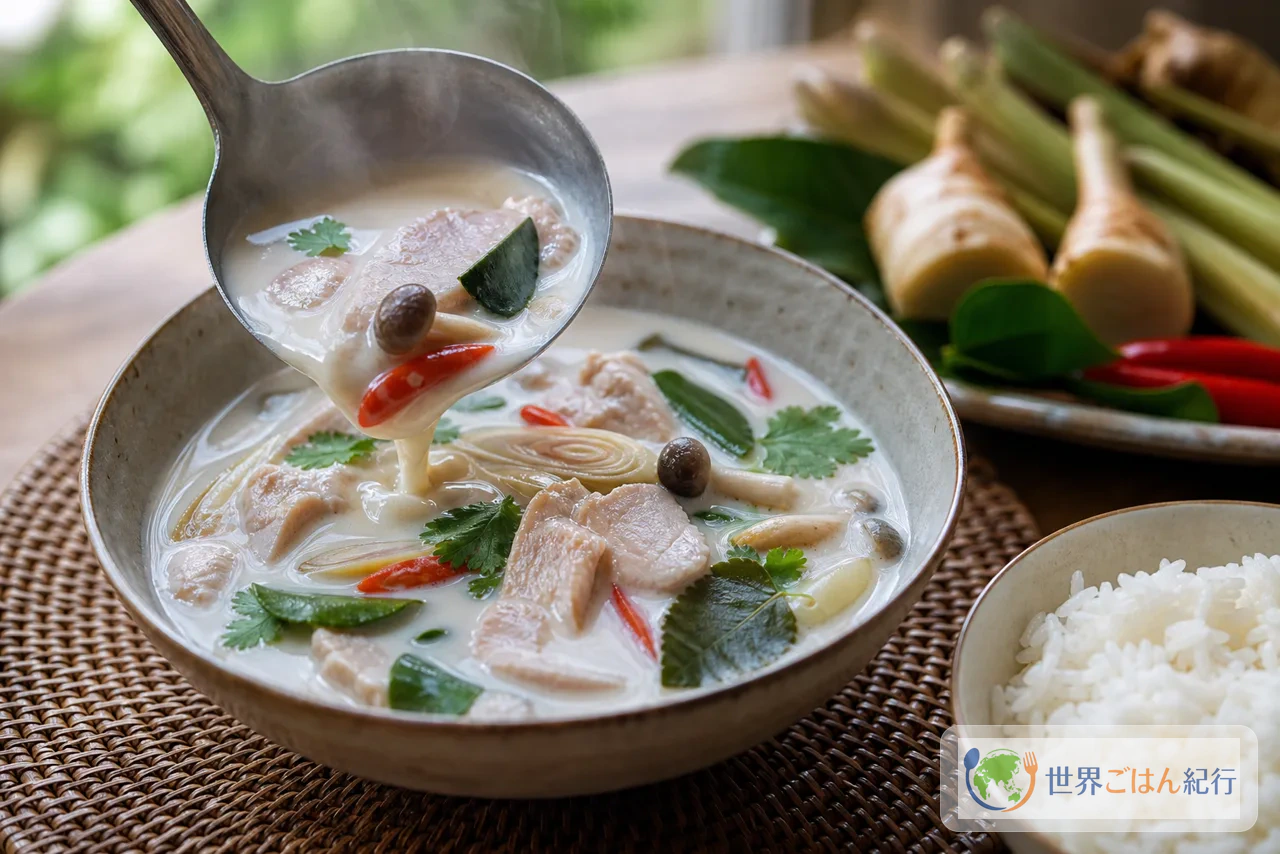
The herbs in tom kha gai are not all ingredients meant to be eaten. Lemongrass is fibrous and galangal is hard to bite through even in thin slices, so you set them aside once they have given their aroma. Leaving a little in the bowl looks Thai, but for someone eating it for the first time it is kinder to add one word: "they are for aroma, so do not force yourself to chew."
Removing everything before serving is easier to eat but tends to look like plain white chicken soup. On days with guests, pull out only the lemongrass and large galangal from the pot and float a single small makrut lime leaf in the bowl, and it conveys that this is a dish of aroma.
| Herb | If leaving it in the bowl | If setting it aside |
|---|---|---|
| Lemongrass | Put just one 5 cm stalk at the edge | The fibers are hard, so pull most out before serving |
| Galangal | Show just one thin slice | Unlike ginger it is hard, so remove it for those unused to it |
| Makrut lime leaves | Float one small torn leaf | Large leaves stay in the mouth, so remove half in the pot |
| Chili | Put in the bowl only for those who like heat | Do not make the whole family pot hot |
If family members differ in how sour they like it, put only 2 tbsp lime juice in the pot and add the rest at the table. If the soup is too hot the sourness flies off, so pour it into the bowl, wait about 30 seconds, and then squeeze the lime to keep the aroma.
Ingredients: shopping to approach the original outside Thailand
This recipe serves 4. Tom kha gai is not a long simmer, so it moves along fast if the ingredients are cut and lined up first. Chicken thigh is easier to handle, and if using breast, slice it thin on the bias and cook it briefly.
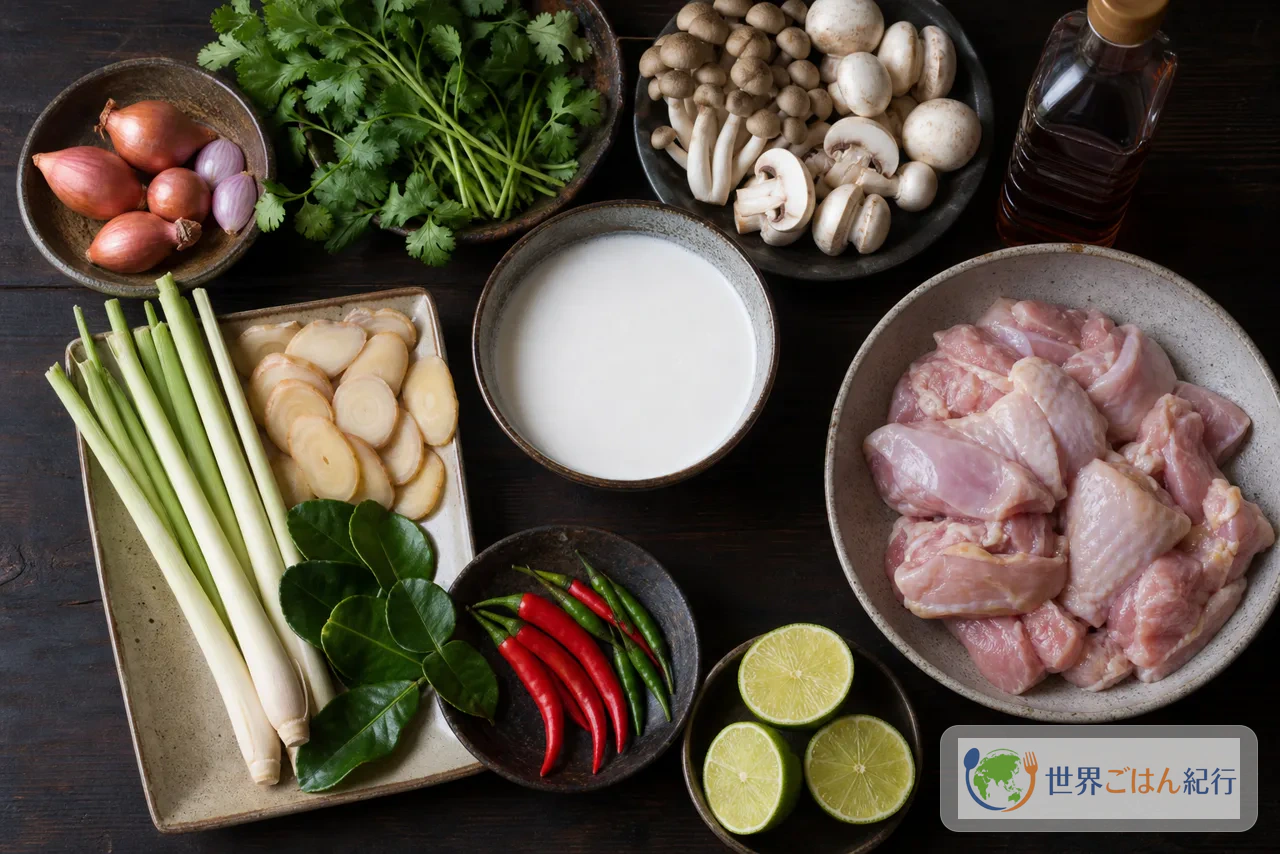
What is worth seeking out at specialty shops or online is not the chicken or mushrooms but the aromatic core and Thai seasonings. Look for galangal at an Asian grocer or in the freezer section, and for lemongrass and makrut lime leaves choose frozen ones you can use in small amounts. Leftovers can go to green curry (in Japanese: green curry) or pad Thai days.
The shopping order is galangal, lemongrass, makrut lime leaves, fish sauce, then coconut milk. Coconut milk is relatively easy to find, so there is no need to look for it first. The Phuket cooking school BrassWok advises that when you find lemongrass and galangal, prepping and freezing them lets you make the dish on any day you want it. At home as well, slicing galangal and freezing it in portions, cutting off only the base of lemongrass and freezing it, and freezing makrut lime leaves with the air pressed out of the bag lowers the hurdle for next time considerably.
| What to buy | Where to look nearby | Judgment about ordering online |
|---|---|---|
| Galangal | Asian grocers, the frozen vegetable section | Look at least once at frozen before replacing it with ginger |
| Lemongrass | Herb section or freezer of a large supermarket | Frozen is more practical than fresh you cannot use up |
| Makrut lime leaves | Thai grocers, frozen herb section | Strong aroma even in small amounts, so frozen suits |
| Fish sauce | Supermarket, Asian grocer | Start with a small bottle. A large bottle is for those who will keep cooking Thai food |
| Nam prik pao | Asian grocers | Can be skipped the first time. Buy it for days you want a stronger restaurant flavor |
You do not need to buy everything in large bags from the first time. The failure in shopping is not running short but having leftovers. On a day you will only make tom kha gai, prioritize small amounts of galangal, lemongrass, and makrut lime leaves, and leave nam prik pao for the second time. Conversely, if you plan to make tom yum goong and gaeng phet too, frozen herbs bought in quantity can be used up.
| Reader's situation | Buying priority | Reason |
|---|---|---|
| Making it for the first time | Galangal, lemongrass, makrut lime leaves | The three that decide the aroma in the dish name. Small amounts are fine |
| Wanting to keep cooking Thai | Fish sauce, frozen lemongrass, frozen makrut lime leaves | Easy to extend into pad Thai, curries, and soups |
| Wanting the strong restaurant flavor | Nam prik pao | Adds sweet-hot and roasted notes, but weakens the white lightness a little |
| Cannot find them nearby | A little ginger, lime zest, lemon juice | On the premise that it becomes a different dish, move only the direction of aroma closer |
On days you are unsure, you do better not to try to gather everything the same day. If at a weekday supermarket you found only coconut milk and fish sauce, buy the chicken and mushrooms and add the herbs on the weekend from an Asian grocer or online. Conversely, on a day you found only herbs at a Thai grocer, there is no need to buy meat and mushrooms there; choosing them for freshness at the supermarket on the way home is enough.
| Shopping route | What to buy that day | What can wait |
|---|---|---|
| A large supermarket only | Coconut milk, fish sauce, chicken, mushrooms, lime | Galangal, makrut lime leaves, nam prik pao |
| Can stop at an Asian grocer | Galangal, lemongrass, makrut lime leaves, nam prik pao | Chicken, mushrooms, cilantro |
| Gathering online | Frozen galangal, frozen makrut lime leaves, frozen lemongrass | Coconut milk, chicken, vegetables |
| Anxious about the first time | Just protect the galangal and fish sauce | Nam prik pao, straw mushrooms, bird's eye chilies |
Divided this way, what to order online narrows naturally. You do not need to look for chicken or mushrooms online. What decides the tom kha gai character is the herbs you can keep in the freezer and fish sauce that salt cannot replace. Having these two in the kitchen shortens the psychological distance on a day you suddenly want to cook Thai.
Lemongrass looks quite different depending on where you buy it. If you can get fresh bundles, use only the white base for this dish and send the green top, uncut, to tea or stock. If buying frozen, ones that keep the shape of the base are easier to set aside in the pot than ones already cut short, and the person eating is less likely to bite hard fibers. Rather than whether to order online, first choosing by "is it a shape that gives aroma in the pot and is easy to remove at the end" reduces failure.
You use only 6 makrut lime leaves at a time, so press the air out of the bag and place it on a flat spot in the freezer. Broken leaves still give aroma, but if they turn to bits they are hard to pick out of the pot. Portion the galangal as slices and wrap the lemongrass cut into 5 cm lengths in plastic wrap. If you plan to make bo kho or bun bo Hue (in Japanese: bun bo Hue) next, the same aromatic shopping serves Vietnamese cooking as well as Thai.
If ordering online, it is enough to choose only what is hard to find nearby and decides tom kha gai's core: as below. Choose coconut milk, chicken, and mushrooms at your regular supermarket, and supplement just the aromatic ingredients and Thai seasonings without strain.
How to portion herbs on the day you buy them
Buying galangal, lemongrass, and makrut lime leaves at an Asian grocer can be too much for one batch of tom kha gai. When you get home, portion them before you start cooking. If you put this off, the aroma weakens in the back of the refrigerator and by next time you think "ginger will do."
The guide for portioning is to bundle one batch of tom kha gai together. Put 40 g galangal, 2 stalks lemongrass, and 6 makrut lime leaves in one bag, and write "tom kha gai, 1 batch" and the date on the outside. Divide another bag for tom yum goong with about 2 stalks lemongrass, 4 makrut lime leaves, and 20 g galangal, and the next menu is easier to decide.
| Herb | How to portion | Dishes easy to move to next |
|---|---|---|
| Galangal | Cut 2 mm thick and wrap 40 g at a time | Tom kha gai, tom yum goong |
| Lemongrass | Cut the bottom 10 cm into 5 cm lengths and wrap 2 stalks' worth at a time | Tom yum goong, bo kho, bun bo Hue |
| Makrut lime leaves | Put in 6 at a time, flat, without removing the ribs | Gaeng phet, khao soi |
| Cilantro stems | Separate from the leaves and put only the stems in a small bag | Aroma for soups, stir-fries |
Frozen herbs keep their aroma better if they go into the pot frozen rather than being thawed and cut. Lightly tap frozen lemongrass with the back of a knife, and put thin-sliced galangal in as is. Frozen makrut lime leaves break easily, so do not rub them roughly in the bag; take out only what you will use.
Satisfaction with shopping is decided not only by the first taste but by whether you can use the same herbs a second time. If you make tom yum goong the week after tom kha gai, you see that the same lemongrass plays different roles in a "white coconut soup" and a "red sour soup." If you can use them up that far, the psychological hurdle of buying local ingredients drops considerably.
Galangal alone is the ingredient tied to the very name of this dish. If you make it once with ginger and feel "something is different," it is worth trying frozen galangal in a small bag next.
Nam prik pao is not required, but it helps on a day you want the lingering richness of a restaurant. Fish sauce adds a fish-sauce savoriness that salt cannot, so if you keep cooking Thai food, keeping a small bottle makes it easier to use up.
Nutrition and allergy notes
The nutrition values in the front matter are estimates for the whole recipe of 4 servings. Per serving, that is roughly 420 kcal, protein 26 g, fat 28 g, carbohydrate 15 g, and salt equivalent about 3 g depending on the fish sauce brand and the strength of the soup. On days you spoon it over rice as a main, make it a little saltier; on days you drink it as a soup, stopping the fish sauce at 2 tbsp and adding more in the bowl is easier to enjoy.
| Ingredient to watch | May contain | Check at home |
|---|---|---|
| Fish sauce | Fish | If you have a fish allergy, do not use it; make a separate dish with salt and a little soy sauce |
| Nam prik pao | Shrimp, fish, chili | Many contain shrimp paste. Omit if you have a shellfish allergy |
| Coconut milk | Coconut | If it does not suit you, do not force it; switch to a chicken-stock-based sour soup |
| Store-bought stock | Wheat, milk, chicken, pork, etc. | Granulated stock labels differ by product, so check the package |
This recipe uses chicken, fish sauce, and coconut. If adding nam prik pao, check the label, as many products contain shrimp. Wash the cutting board and knife used for raw chicken with detergent and keep them from touching cooked herbs or the lime for serving.
Method: do not over-boil, and add sourness at the end
Tom kha gai looks like a soup you simply put in a pot and simmer, but in fact the temperature is divided. Simmer the herbs, cook the chicken quietly, do not over-boil the coconut milk, and add lime after the heat is off. Separate these and the white soup does not get too cloudy and the aroma remains.
Before heating, separate the places where you will set herbs, chicken, and finishing seasonings. Tom kha gai is not a dish where you turn up the heat midway to hurry, so a routine where you do not hesitate in front of the pot protects the flavor.
| Decide first | How to set up in the kitchen | Why it prevents failure |
|---|---|---|
| Simmer the herbs first | Gather galangal, lemongrass, and makrut lime leaves on a small plate | They do not mix with the ingredients, and you will not forget to simmer them |
| Add the chicken spread out | Lay the slices flat on a plate without overlapping | They do not go in as a clump, and cook through to the center in a short time |
| Lime after the heat is off | Put squeezed juice in a small dish at the table side, not next to the pot | You do not add it too early, and can set aroma and sourness last |
| Set aside the hard herbs | Prepare a slotted ladle or small plate | Eaters are less likely to bite lemongrass or galangal |
Substitutes: the aroma to protect and ingredients you can change
Tom kha gai may look hard from the ingredient names, but separating what to protect from what can change makes it easier to make. What to protect is the three layers of galangal, lemongrass, and makrut lime leaves. On days you cannot get all of them, put galangal first, then lemongrass, and look for makrut lime leaves last.
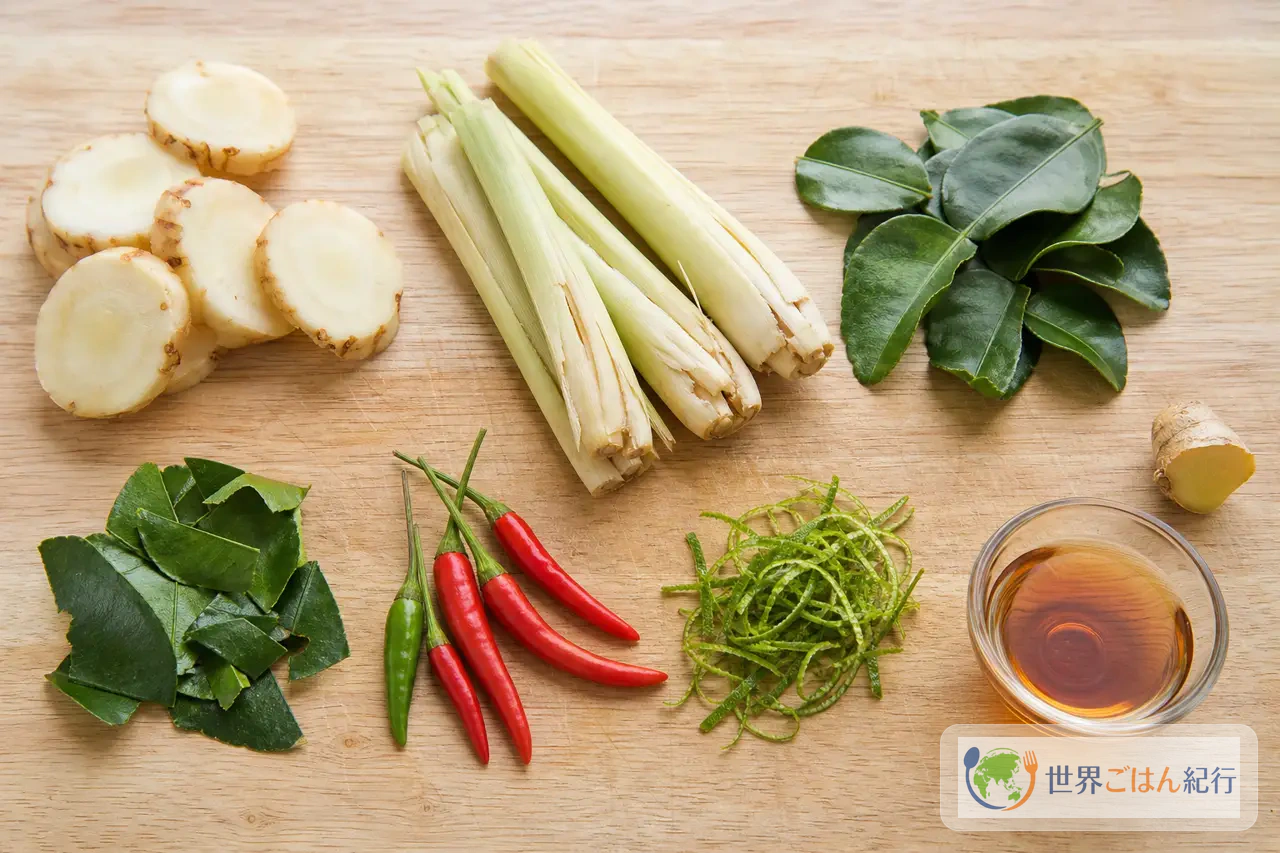
In shopping reality, few supermarkets keep galangal, while lemongrass and makrut lime leaves are relatively easy to find frozen. Thai grocers often sell them in bulk, so buying on the premise of freezing leftover herbs for the next tom yum goong or gaeng phet leaves no waste.
On days you replace it with ginger, thinly grating lime zest to add aroma gets closer to tom kha gai than increasing the ginger. Grating down to the white pith makes it bitter, so keep only the green surface to about 1/4 tsp.
| Ingredient | Can it be replaced | Realistic choice |
|---|---|---|
| Galangal | Can be replaced but is a different thing | Frozen first. If using ginger, limit to 2 thin slices plus a little lime zest |
| Lemongrass | Protect it if you can | Fresh or frozen. Tube products have a rounded aroma, so add half the amount of lime zest |
| Makrut lime leaves | Brings you much closer if you have them | Frozen is convenient. If none, thinly grate a little lime zest |
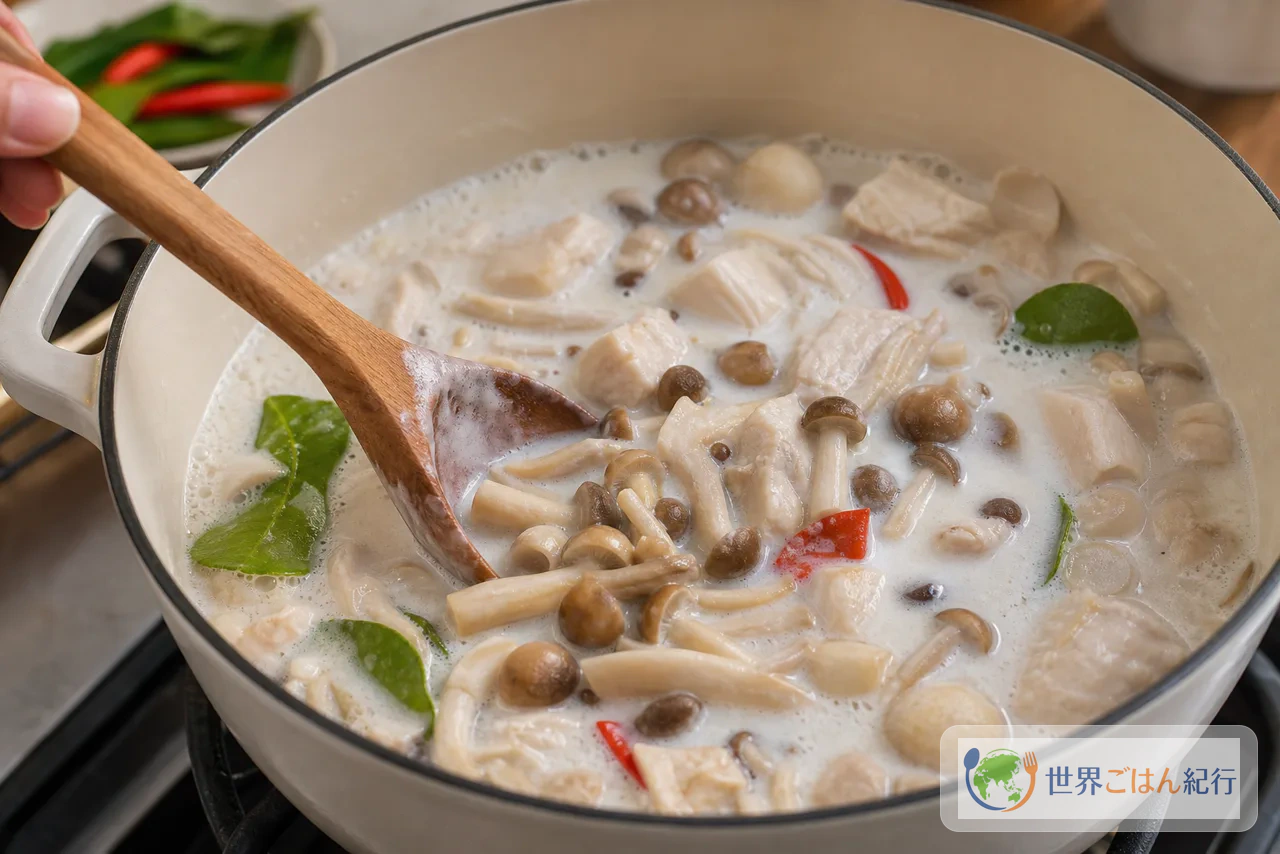
| Straw mushrooms | Easy to replace | Shimeji, king oyster, or button mushrooms are enough |
| Cilantro roots | Easy to replace | Cilantro stems, or omit and use only the leaves to finish |
| Lime | Easy to replace | If lemon, use slightly less and add by tasting at the end |
If you put in a lot of ginger, the flavor moves toward ginger chicken soup. It is not entirely bad, but the character of tom kha gai thins. On days you replace with ginger, use the lemongrass and makrut lime leaves firmly and keep the outline of Thai cooking with fish sauce and lime.
The higher the fat in coconut milk, the thicker it is, and low-fat types are less likely to split but turn watery. For the first time use ordinary canned and give priority to not boiling it hard. Making it with coconut cream alone is heavy, so always thin it with 500 ml of soup.
What goes wrong: fixing splitting, thin, and too sour
A white soup shows failure easily. But rescuing the flavor is not hard. Looking at the cause by temperature, saltiness, sourness, and aroma shows what to add in the pot.
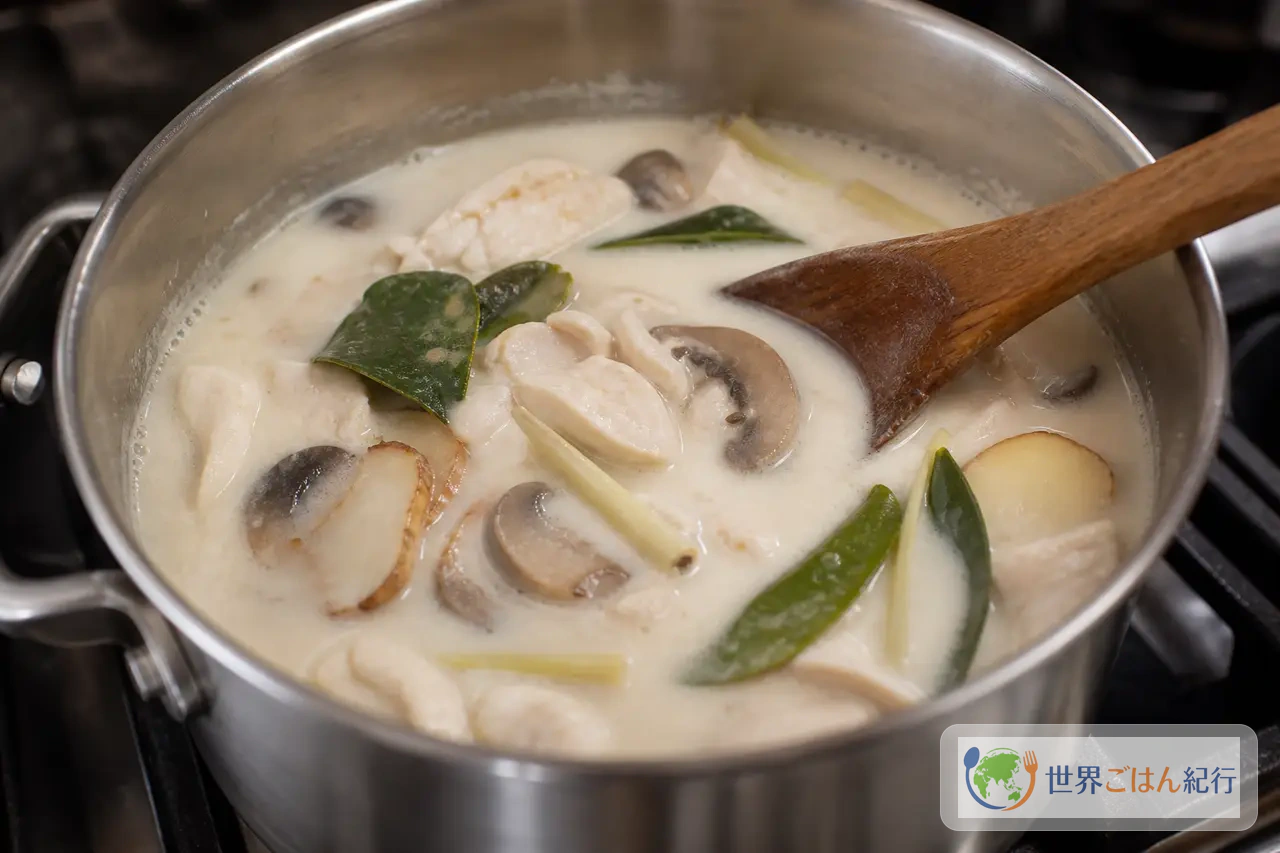
What I most want you to watch is not the center of the pot but the edge. If fine bubbles rise quietly at the edge, the temperature is enough. If large bubbles burst up from the center, it is too strong for tom kha gai. Lower the heat at once and slide the pot off the burner for about 30 seconds, and it is easier to stop splitting and toughening of the chicken.
Taste not from the steaming pot but after taking a little into a small dish. When it is hot the sourness seems weak and you tend to add too much lime. Cool it in a small dish for 30 seconds and check saltiness, sweetness, and sourness in that order, and you are less likely to add the wrong thing.
| Failure | Cause | Fix |
|---|---|---|
| Soup splits | Boiled over high heat | Lower to low heat, add 3 tbsp coconut milk, and stir gently |
| Taste is thin | Not enough fish sauce, too much soup | Adjust with fish sauce 1 tsp at a time and a pinch of sugar |
| Too sour | Added the lime all at once | Add 2 tbsp coconut milk and 1/2 tsp sugar |
| Aroma weak | Herbs simmered too briefly | Add lemongrass and makrut lime leaves and warm 3 minutes over medium-low |
| Chicken is tough | Cut thick, high heat, long cooking | Next time cut 8 mm to 1 cm and finish as soon as it is cooked |
Adding nam prik pao gives the white soup a slight red tint and the roasted chili and shrimp savoriness comes out. It is convenient on days you want to move toward a restaurant's strong flavor, but it weakens the white, quiet impression of tom kha gai. The first time, make it without, and from the second add only 2 tsp, and the difference is easy to see.
When fixing flavor, deciding the order of adding keeps you from hesitating. First saltiness, then sweetness, then sourness last. If you add lime first, only the sourness stands out and you want to add extra fish sauce and sugar. Take about 2 tbsp soup into a small dish and cool it 30 seconds before tasting, and you are less likely to misjudge sourness from the heat of the pot.
| What you taste | Add first | Guide to not overdoing |
|---|---|---|
| Watery, no outline | 1 tsp fish sauce | Stop when the fish sauce aroma rises |
| Only the sourness is sharp | 1/2 tsp sugar, 2 tbsp coconut milk | Not to make it sweet, only to round the corner of the sourness |
| Sweet and blurry | 2 tsp lime juice | Add in the bowl instead of the pot and it is easier to undo |
| Herbs weak | 1/2 stalk lemongrass, 1 makrut lime leaf | Warm 3 minutes and take out; do not keep simmering |
| Heat lacking | A little crushed chili, or chili oil in the bowl | Do not make the whole family pot hot |
Another failure is chopping the herbs too fine. Mincing lemongrass or galangal gives aroma, but fibers remain when eaten and the impression of the soup turns gritty. At home, keep to bruising large, slicing thin, and tearing, and set the hard pieces aside, about half, before serving. If you want a stronger aroma, increase the amount a little rather than chopping, and pull it out in a short time.
For the doneness of the chicken, it is safer not to rely on appearance alone. Japan's Ministry of Health, Labour and Welfare, in its home food poisoning prevention guidance, gives 75 °C at the center for at least 1 minute as a guide for cooked foods. Because tom kha gai is thin-sliced and cooked in a short time, without a thermometer, take out one thick piece and check that the center is not translucent and the juices are not cloudy before moving on to finishing.
How to eat it and storage: over rice or as a soup course
Tom kha gai is better eaten with rice than drunk alone as a soup, for the meaning of the flavor becomes clear. At a Thai table it is set beside a spicy salad, a stir-fry, and white rice, and the roundness of coconut receives the chili and saltiness.
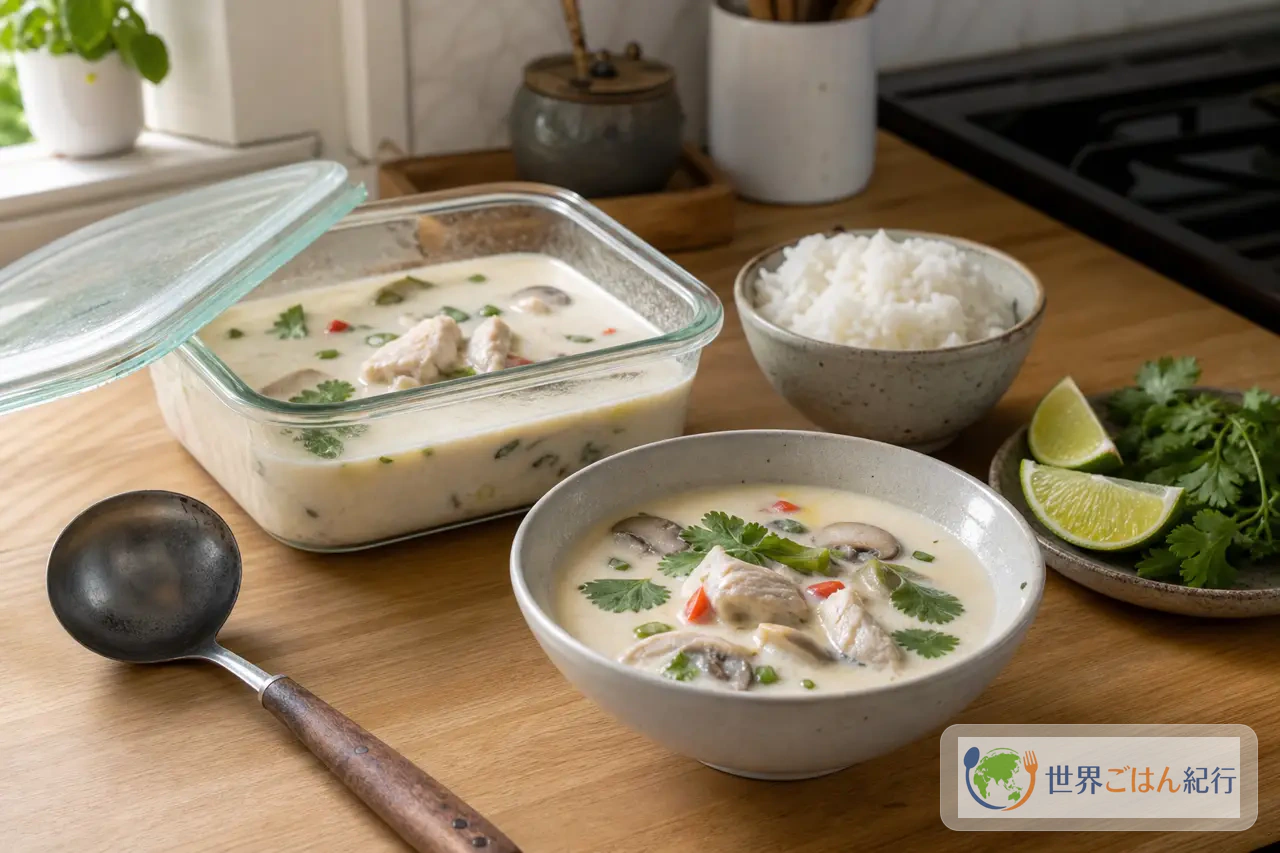
As a menu, it pairs well with any of the spicy green som tam, the sweet-and-sour pad Thai, and khao man gai eaten with chicken broth. On days you want to continue with coconut dishes, connect to Cambodia's amok, and on days you want to extend to noodles, to laksa, and the difference between Southeast Asia's white soups and curries comes into view.
When serving at dinner, adjust the thickness of the pot slightly to the occasion. If dividing into small bowls as a soup, stop the fish sauce at 2 tbsp and add lime in the bowl. If spooning over rice as a main, add 1 tsp fish sauce and a pinch of sugar at the end to move toward a saltiness that does not lose to white rice. If setting it beside a spicy dish, keep chilies out of the pot and let tom kha gai be the resting place.
| How to serve | How to move the flavor | What to pair with |
|---|---|---|
| Small soup bowl | Less fish sauce, add lime in the bowl | Stir-fries, grilled fish, white rice |
| Main spooned over rice | A little saltier, more mushrooms | Jasmine rice, ordinary slightly firm rice |
| Beside a spicy salad | Do not put chilies in the pot | Som tam, a glass noodle salad in the style of yam woon sen |
| Thai menu for guests | Leave the herbs large, lime on the side | Pad Thai, gapao, khao soi |
If you remove all the hard herbs just before pouring into the bowl, it is easier to eat but looks like plain white soup. On days when someone is eating it for the first time, remove the lemongrass and galangal in the pot and float just one small makrut lime leaf in the bowl, and both aroma and ease of eating remain. For someone who bites into an herb, one word that it is not an ingredient but for aroma settles the table.
To store, let it cool, move it to a clean container, and refrigerate for 2 days. Reheat over low heat, stopping when the edge of the pot bubbles gently. In a microwave, heat at 600 W for 1 minute 30 seconds at a time, stirring midway. The lime aroma falls off, so when eating the next day add 1 tsp lime juice in the bowl.
Freezing is not recommended. The coconut milk splits easily and the texture of the mushrooms declines. If you must freeze, remove the herbs, freeze by single serving without separating the ingredients and soup, and after thawing warm over low heat and add 2 tbsp coconut milk.
If making ahead, keep the finishing cilantro and extra lime separate. Stored with leaves in, the color sinks, and heating lime in the pot repeatedly makes the aroma heavy. The next day, warm the white soup over low heat, pour into the bowl, and add lime and leaves, and the lightness of fresh-made returns.
When the flavor blurs the next day, do not add fish sauce right away; restore temperature and sourness first and then decide. Move the soup from the refrigerator to a pot and warm over low heat for 5–6 minutes until the edge of the pot bubbles gently. Boiling here splits it easily, so turn off the heat if the white surface seems about to break. After moving to the bowl, add 1 tsp lime juice and, if still lacking, 1/2 tsp fish sauce in that order, and it does not become too salty.
| Next-day state | How to restore | Amount guide |
|---|---|---|
| Aroma heavy | Warm over low heat and add lime in the bowl | 1 tsp lime juice per serving |
| Saltiness thin | Add lime first and taste, then fish sauce last | 1/2 tsp fish sauce per serving |
| Soup split a little | Warm over low heat and add a little coconut milk | 1 tbsp per serving |
| Chicken feels tough | Spoon over rice and let it take up plenty of soup | 1 ladle of soup per bowl of rice |
If reusing leftover soup the next day, rice fails less than noodles. Adding rice noodles makes the coconut split easily during reheating and the noodles go soft. Warming it with a little white rice like a porridge and adding lime and cilantro at the end lets you finish the broth of chicken and mushrooms without waste. If the heat is lacking, do not put chilies back in the pot; just add a few drops of chili oil in the bowl.
Thai dishes to make alongside
Once you have made tom kha gai, moving to dishes that use the same herbs keeps shopping from going to waste. Frozen lemongrass and makrut lime leaves leave leftovers once bought, so deciding the next menu makes them easier to use up.
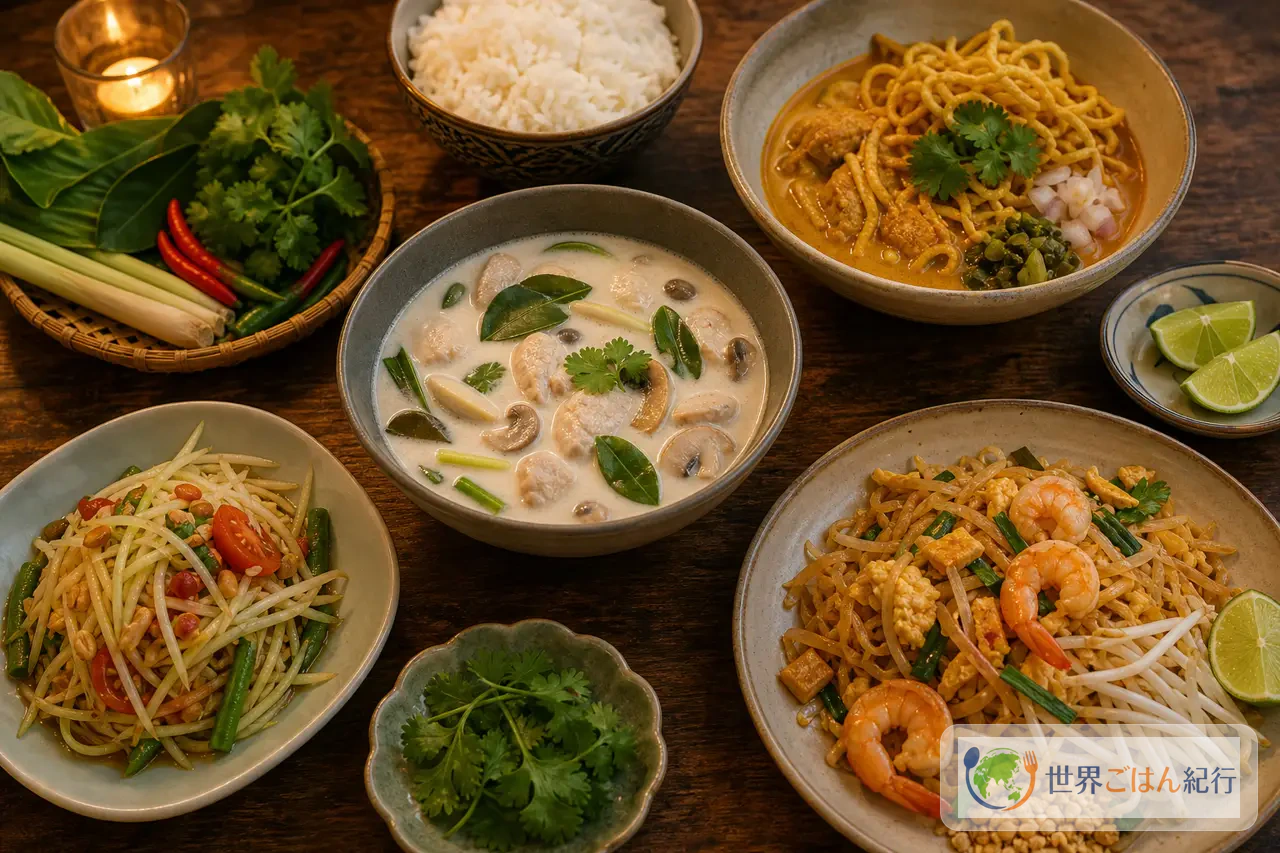
For using the same herbs right away, tom yum goong is the closest destination. Swinging from the roundness of white coconut to the red sourness of shrimp and lime shows clearly the roles of lemongrass and makrut lime leaves.
On a day you want to extend coconut milk to noodles, go to northern Thailand's khao soi. Spice and oil come forward more than in tom kha gai, so even with the same can the center of gravity of the dish changes. If you want to learn another level of using makrut lime leaves, the red curry gaeng phet is good practice.
As a table partner, the spicy green som tam is strong. When your mouth is hot, sipping white tom kha gai makes the roundness of coconut clear. If adding a staple, make a smaller batch of pad Thai and share it with the soup, and it is easier to balance sourness, sweetness, and saltiness.
Deciding even the order in which to use up the herbs you bought makes Thai shopping suddenly easier. Fresh lemongrass loses aroma quickly, so tom kha gai that day and tom yum goong or gaeng phet the next. Makrut lime leaves keep their aroma even frozen and can go to khao soi or green curry (in Japanese: green curry). Freezing galangal in slices and using it in soup again next time is the least wasteful.
| Leftover ingredient | Dish easy to make next | Guide to use |
|---|---|---|
| Lemongrass | Tom yum goong | Bruise the base, simmer, and move to the sour shrimp soup |
| Makrut lime leaves | Gaeng phet | Remove the rib, tear, and raise the aroma of the curry |
| Coconut milk | Khao soi | Use the rest of the can by the next day and extend into a noodle dish |
| Cilantro | Som tam | Leaves to finish, stems for aroma in soups and stir-fries |
| Lime | Pad Thai | Squeeze at the table rather than in the pot and set sourness last |
If setting only two dishes on a weekend, the tom kha gai and som tam combination is the easiest to understand. The white soup receives the heat and the green salad cuts the weight of the coconut. On days you want more of a meal, cook the white rice slightly firm and make only half a batch of pad Thai. Not adding too many carbohydrates keeps the aroma of tom kha gai to the end.
Frequently asked questions
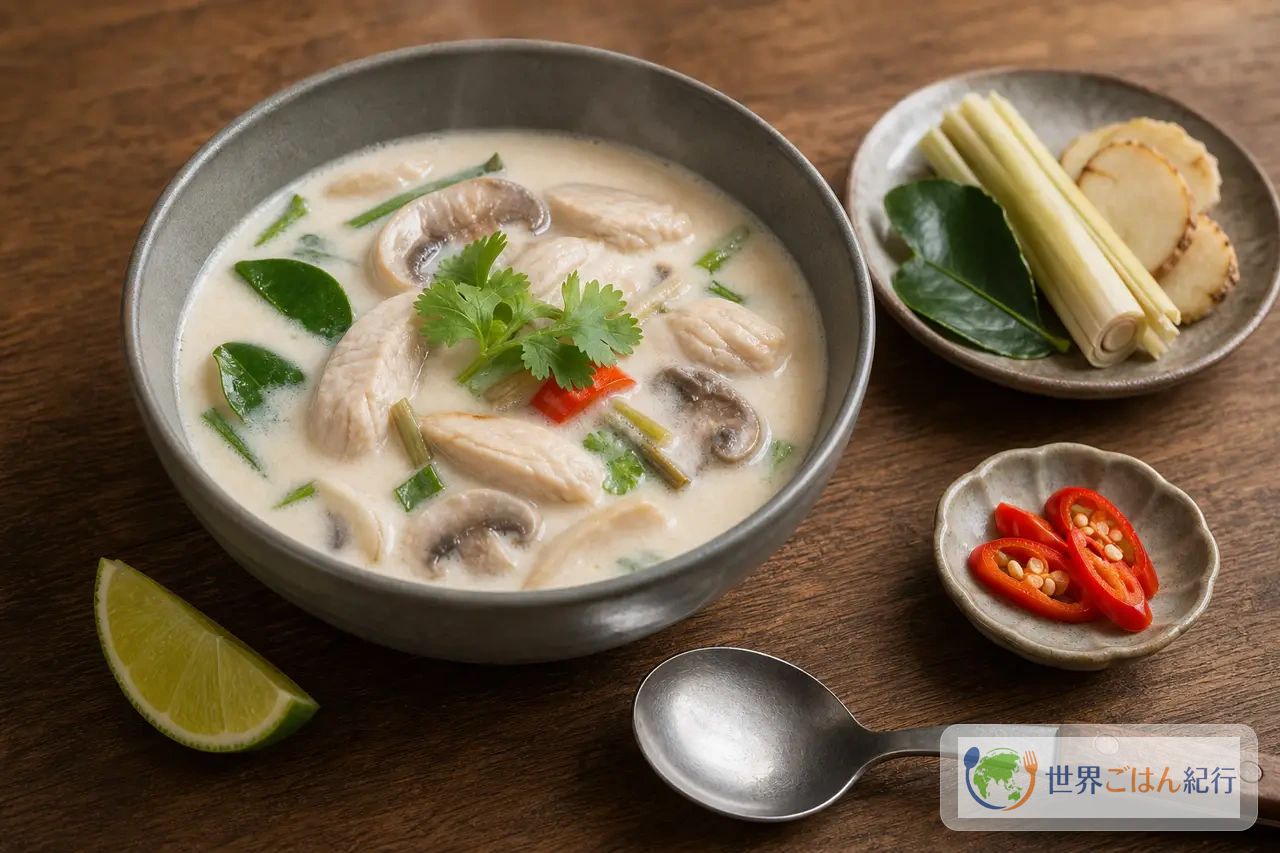
Finally, a summary of the points where people tend to hesitate at shopping and in front of the pot. The ingredient names look a little difficult, but tom kha gai is a dish that is easy to decide if you think in the order herbs, temperature, sourness.
Q1. I have no galangal. Can I make it with ginger?
You can, but the taste is different. Ginger has a warm heat, while galangal has a hard citrus-like aroma. If replacing with ginger, limit it to 2 thin slices and use more lemongrass and makrut lime leaves so it does not lean too far toward ginger flavor.
Q2. The coconut milk split. Can I eat it?
You can. It only looks grainy; it has not spoiled. Lower to low heat and add 2–3 tbsp coconut milk, stirring gently, and it recovers a little. Next time, do not put in the whole amount at the herb-simmering stage; add half in the second half.
Q3. May I make it without heat?
No problem. Even without chilies, the outline remains if you have galangal, lemongrass, makrut lime leaves, fish sauce, and lime. On days you make it for children, leave out the chilies and add crushed chili or chili oil only to the adults' bowls.
Q4. Is nam prik pao required?
It is not required. Adding it brings in the sweet-heat and savoriness of roasted chili and moves closer to a restaurant's strong soup. But the color takes on a red tint and the lightness of white tom kha gai weakens a little. The first time, make it without, and try 2 tsp the second time.
Q5. Are the herbs meant to be eaten?
Lemongrass and galangal are hard, so set them aside as you eat as aroma. Large makrut lime leaves also get set aside. If you prioritize ease of eating, remove about half of the herbs with a slotted ladle before serving.
Q6. Can I make it ahead?
It keeps 2 days refrigerated. When reheating, use low heat and it is important not to boil it. The lime aroma weakens during storage, so adding 1 tsp at a time in the bowl just before eating brings it back near the fresh-made aroma.
Q7. Can I make it with chicken breast?
You can. Slice breast about 7 mm thick, add it to the pot, and cook about 3 minutes over medium-low heat until just before the center turns white. It keeps cooking on residual heat, so cooking it for the same time as thigh makes it dry. On days you want it moist, lightly coat the sliced breast with a pinch of salt and 1 tsp potato starch and keep it refrigerated until just before it goes into the soup, and the surface is protected and it is easier to eat.
Q8. May I add sourness with tamarind?
Yes. As SBS Food presents, there are ways of making it that add sourness with tamarind depending on the region and household. It gives a rounder sourness than lime alone and suits a dinner spooned over rice. To use it, dissolve 1 tsp tamarind paste in the soup, and after turning off the heat add only 2 tsp lime juice, and both aroma and roundness remain.
Q9. Which is better for lemongrass, fresh or frozen?
For aroma alone fresh is stronger, but frozen is perfectly usable at home. In tom kha gai you do not eat the lemongrass: you bruise it, simmer it, and set it aside at the end. So even frozen is easy to handle if it keeps the shape of the base and is easy to pick out of the pot. On days you buy fresh, use the white base in this soup and cut the leftover into 5 cm lengths and freeze them for next time's tom yum goong or bo kho.
Sources
- Thai SELECT Cookbook: Tom Kha Gai — consulted for why to keep the heat low, how to finish by adding lime juice after turning off the heat, and the handling of young and mature galangal.
- Temple of Thai: Thai Chicken Soup in Coconut Milk — consulted for the basic composition of coconut milk, galangal, lemongrass, chicken, fish sauce, and lime.
- Thai Cookbook TV: Chicken and Galangal Coconut Soup — consulted for the home way of cutting herbs large and serving with white rice at the table.
- BrassWok Thai Cooking Class: Tom Kha Gai — consulted for the practice of prepping and freezing lemongrass and galangal when shopping.
- SBS Food: Chicken, coconut and galangal soup — consulted for the explanation of the central Thai coconut-based soup and the regional difference of using tamarind.
- Nomadette: Tom Kha Gai — consulted for the meanings of "tom", "kha", and "gai" and home cautions on handling coconut milk at low temperature.
- Ministry of Health, Labour and Welfare (Japan), "Preventing food poisoning at home" (in Japanese) — consulted for the center temperature of cooked foods including chicken, safety checks, and the approach to reheating.