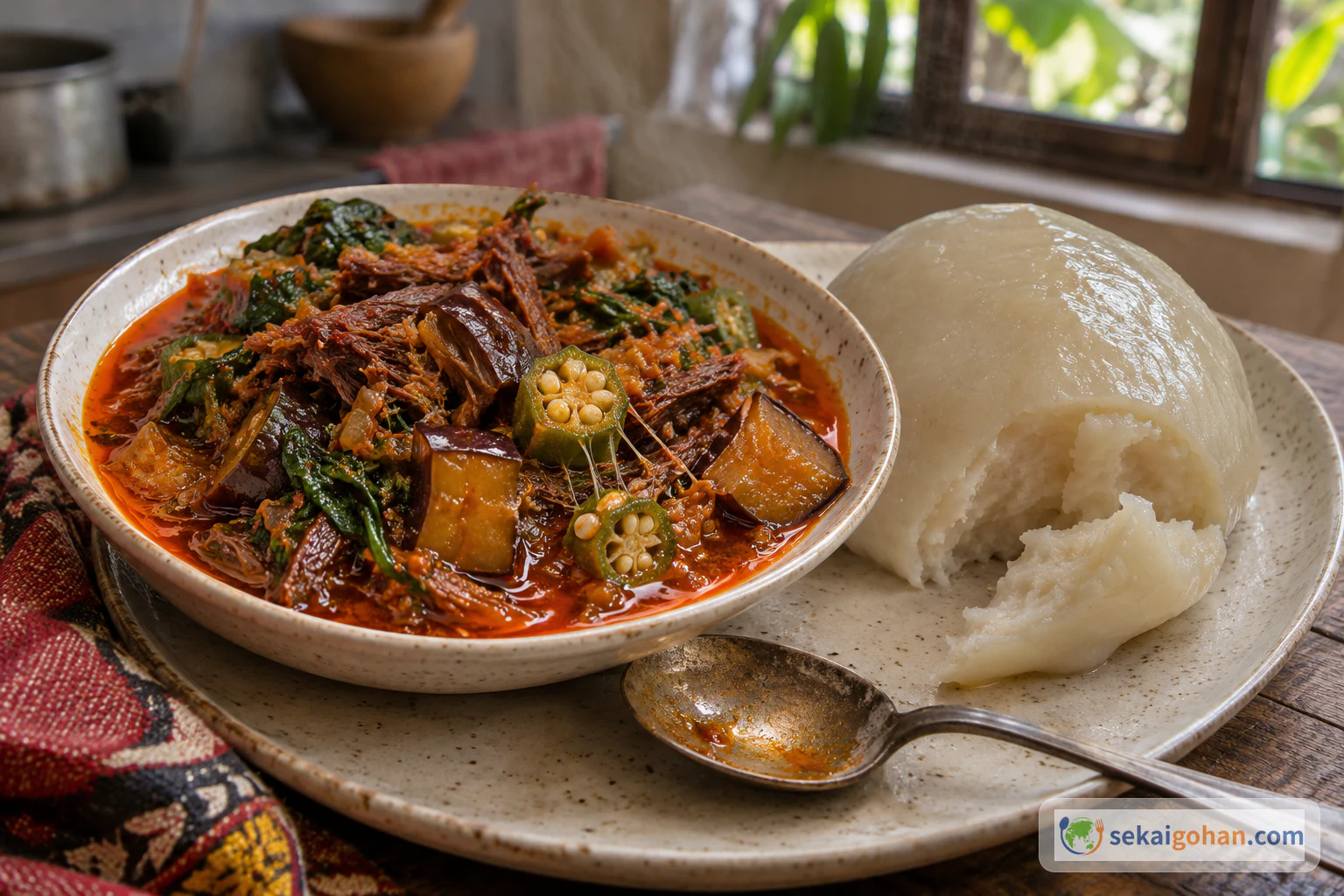
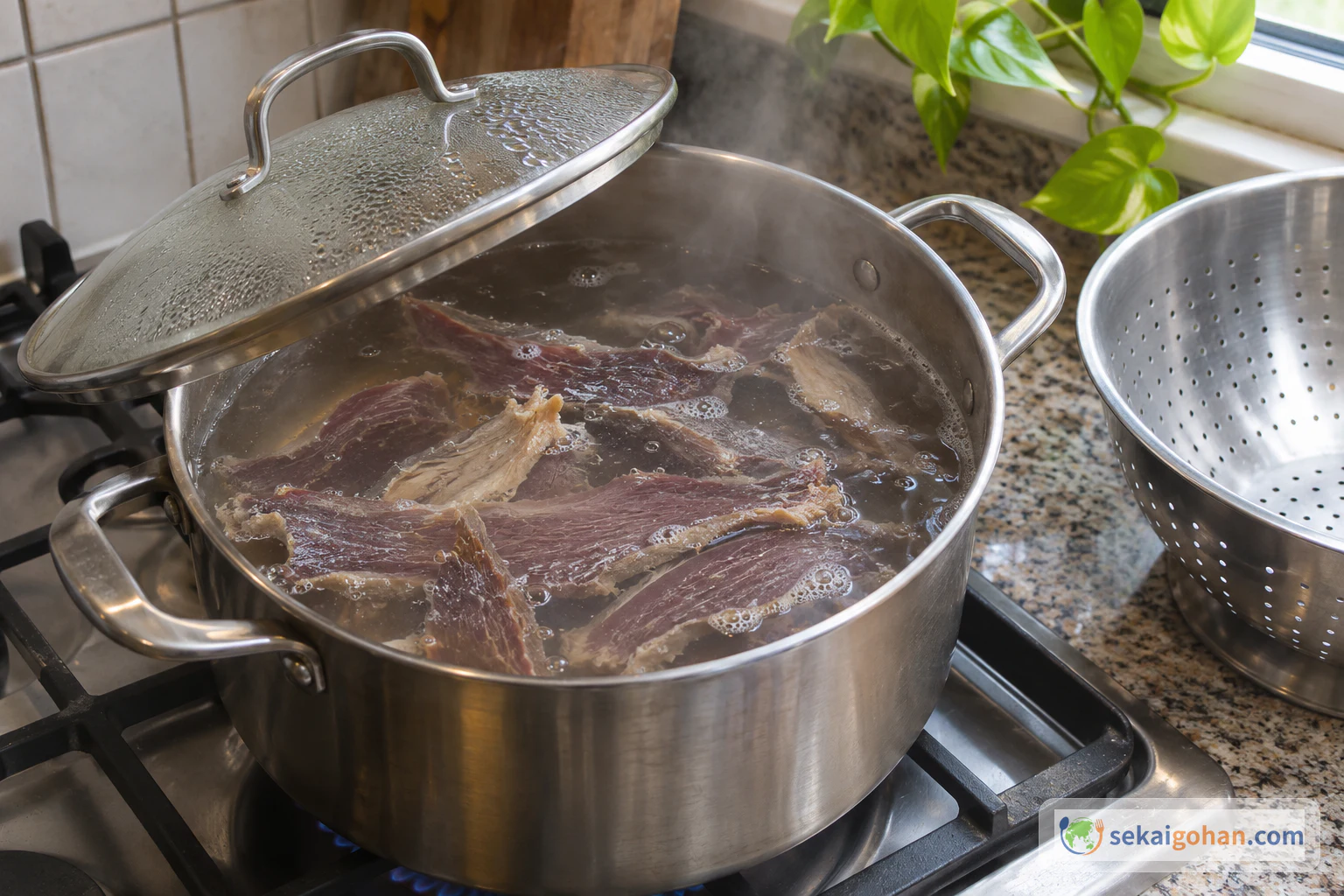
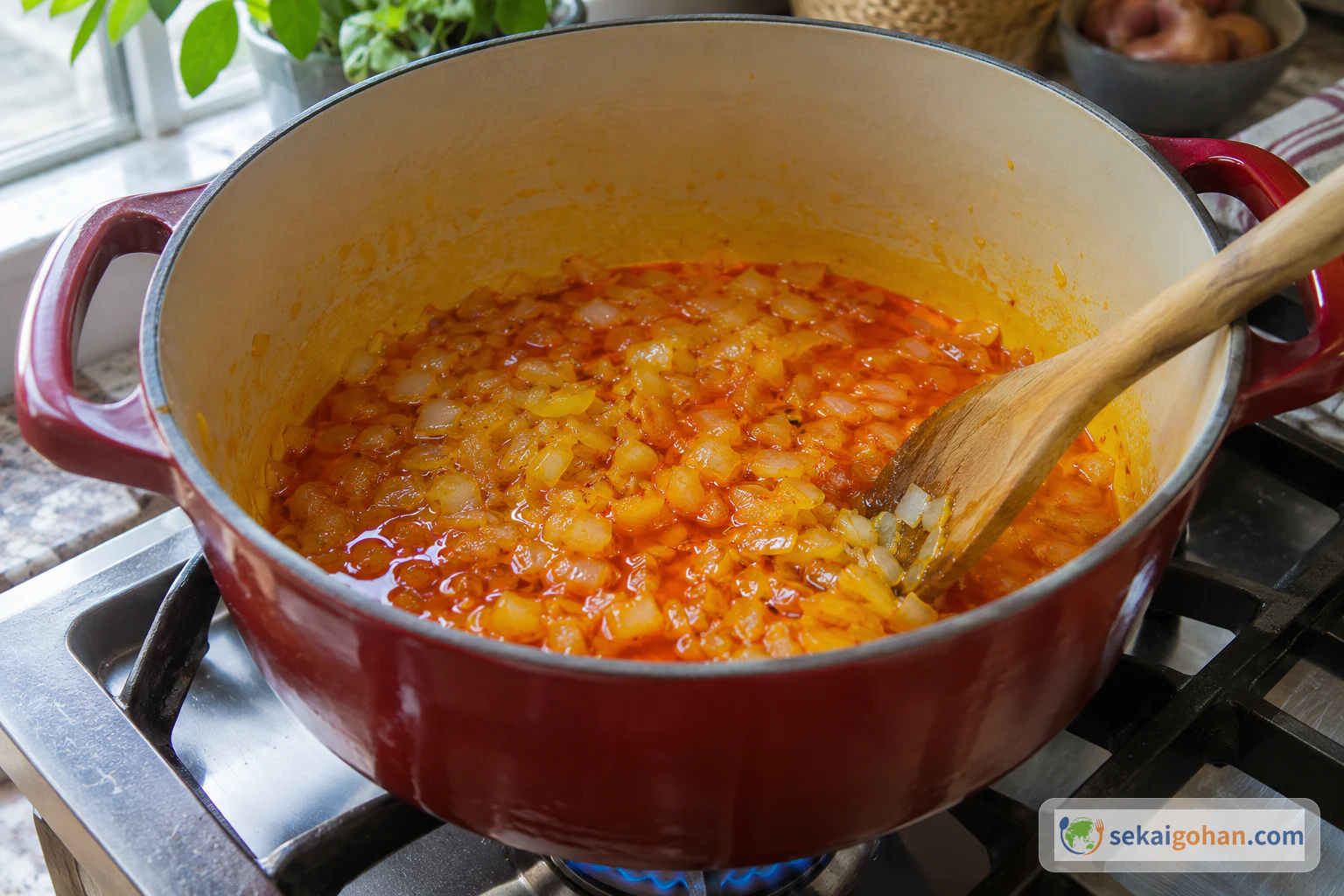
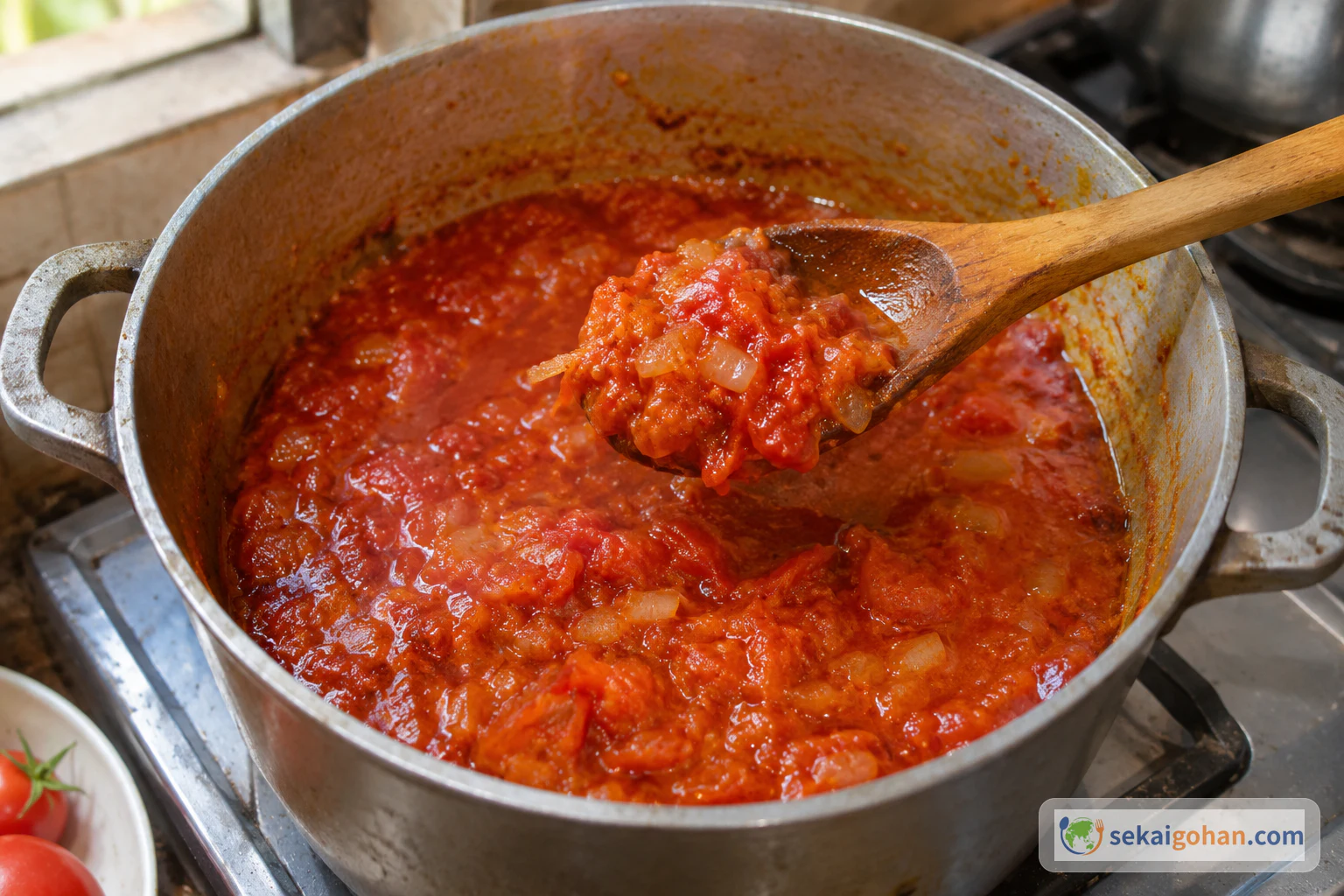
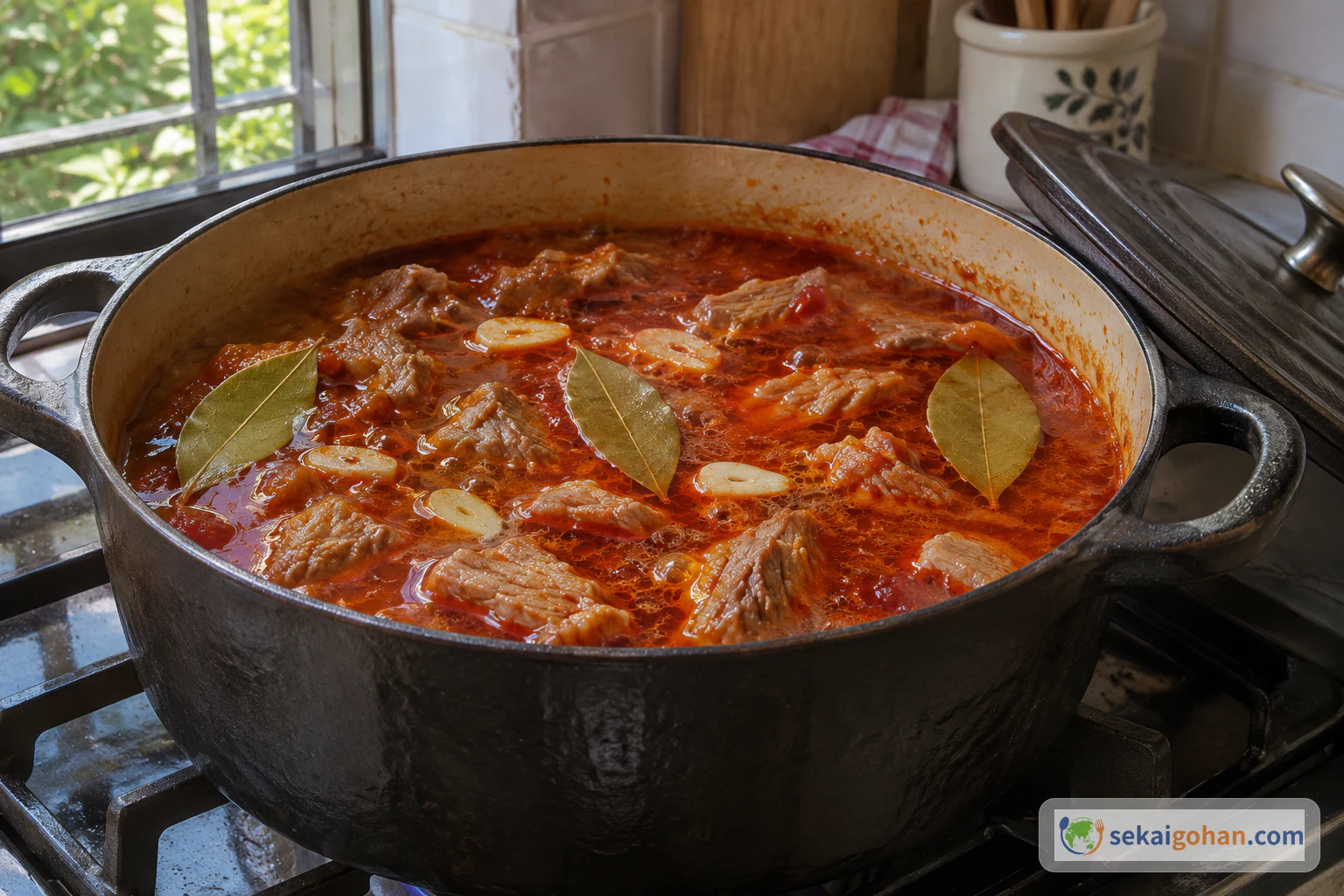
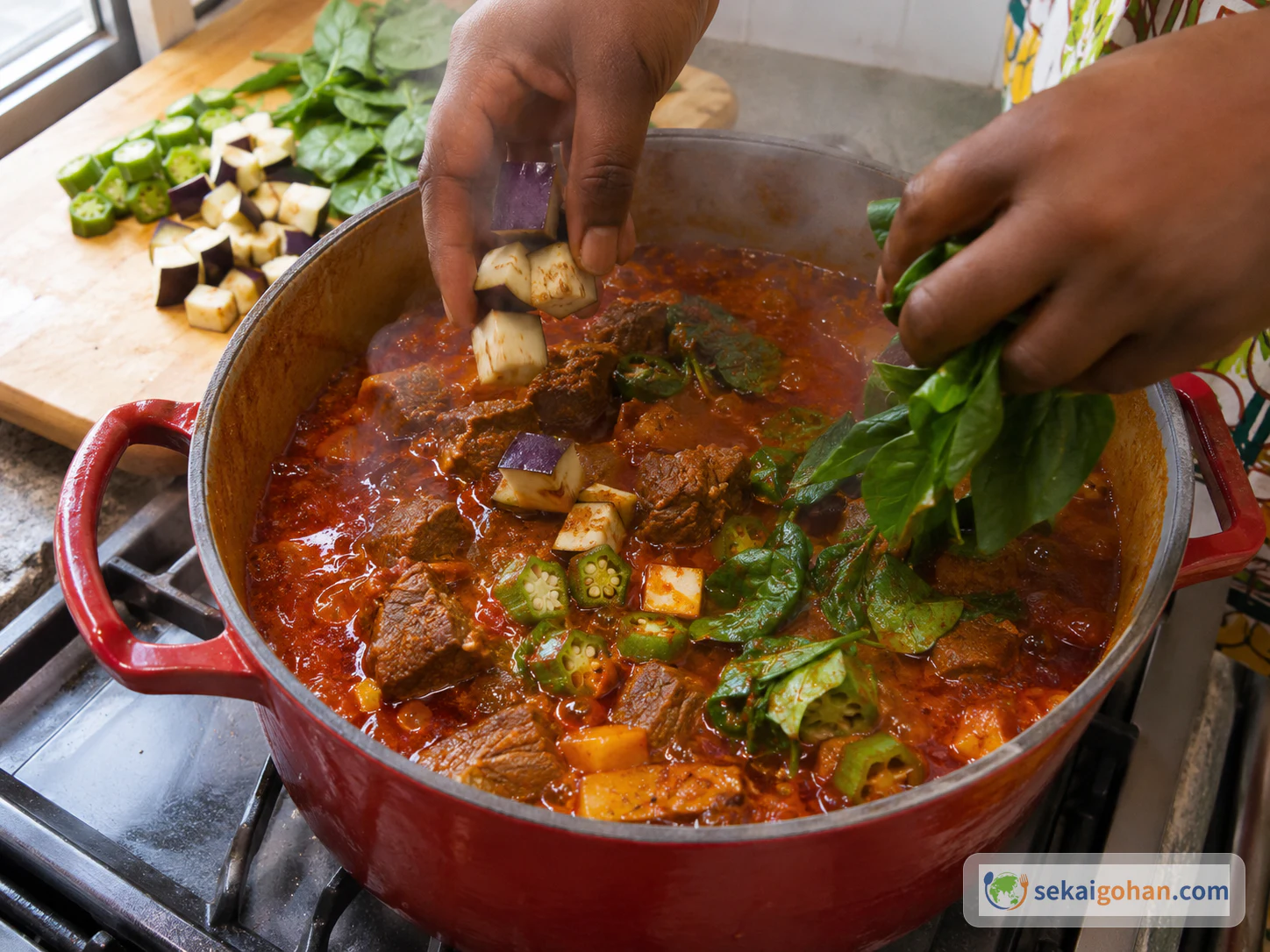
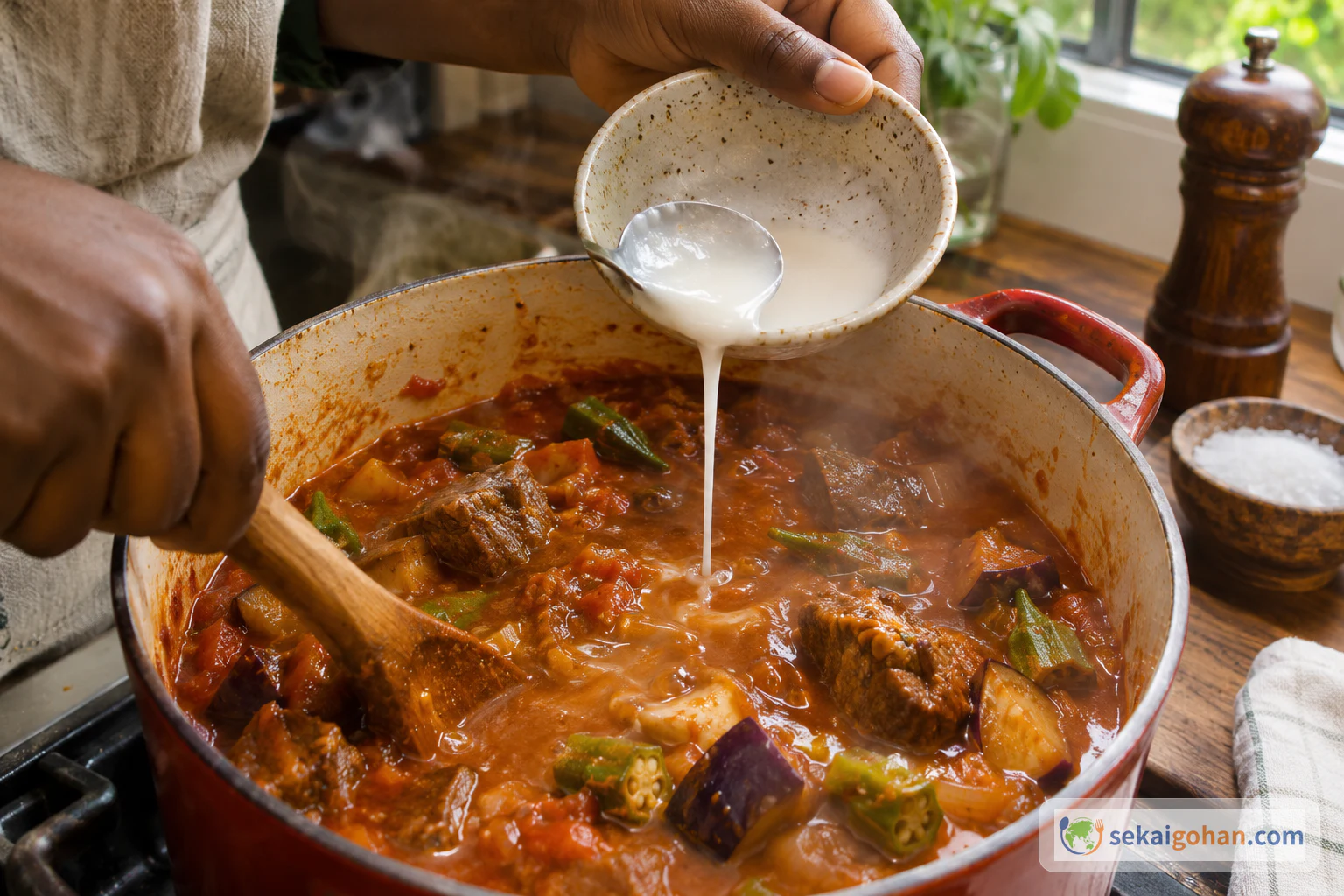
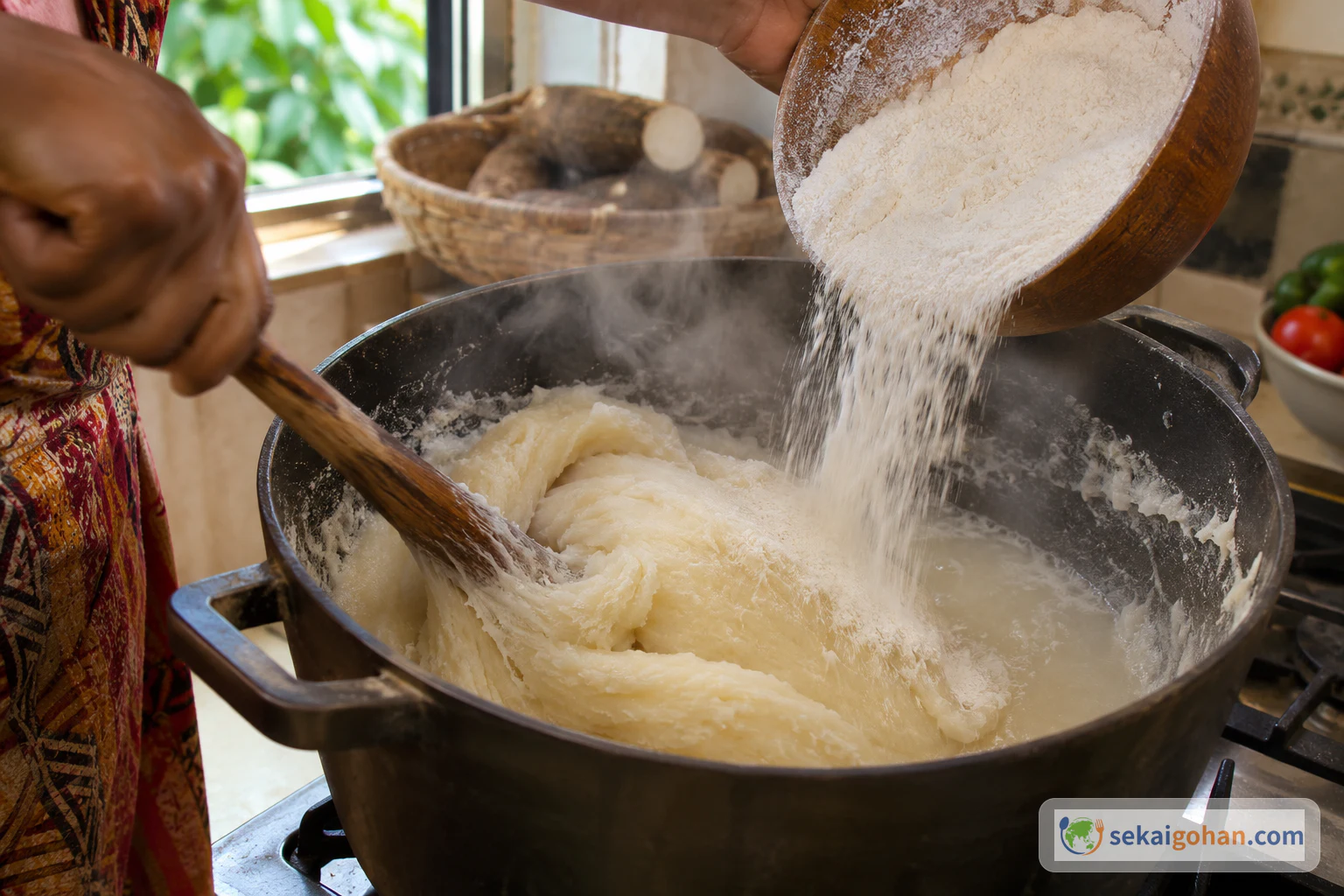
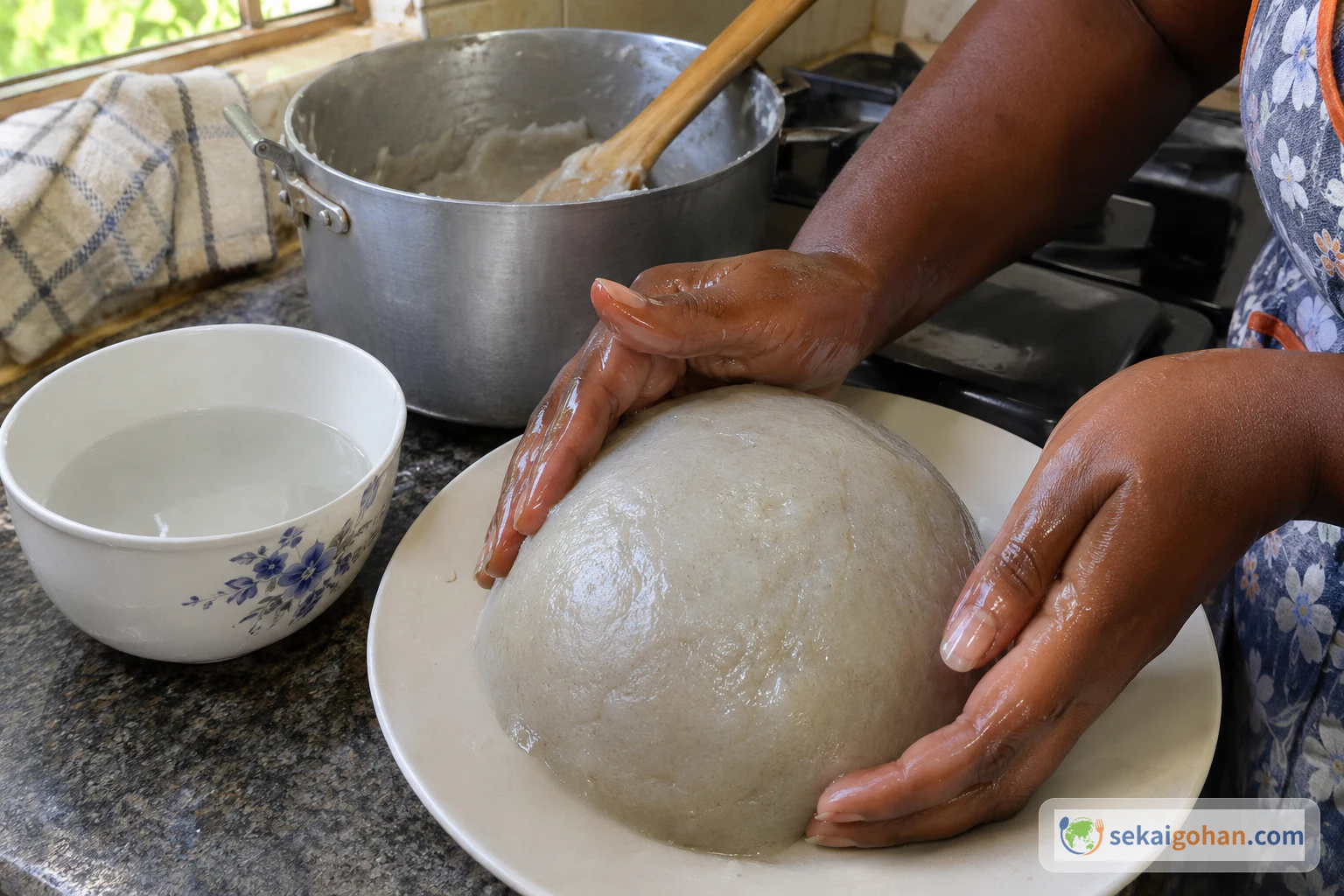
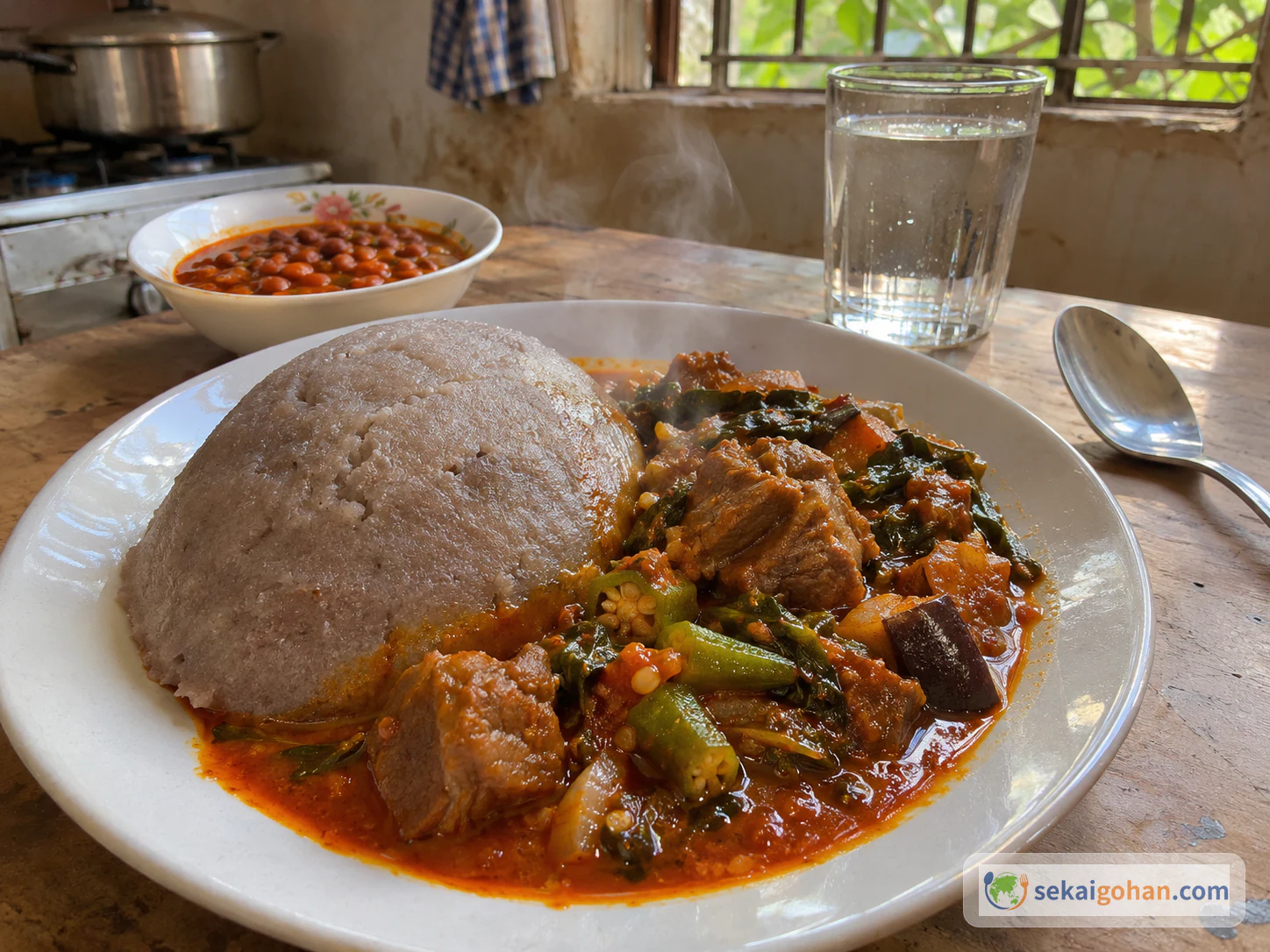
The first hour belongs to the beef alone. Dark, salt-stiff strips sit under a lid at a low simmer, and when you tip them into the colander, the water that runs off carries away the salt you do not want in the stew. After that the pot turns red: palm oil, onion, tomatoes sinking into sauce, then chopped okra that threads everything with fine, glossy strands. Calulú de carne seca is Angola's dried-beef calulu, a stew of beef, tomato, aubergine, greens and okra cooked in red palm oil, served beside a smooth, grey, elastic dome of funge de bombó made from cassava flour. It tastes of long-softened salted meat, the deep warmth of palm oil and the silky body of okra, with the plain funge there to carry every spoonful.
Calulu in Angola: Dried Meat, Okra and a Plate of Funge
Calulu is one of the dishes that stand for Angola and for São Tomé and Príncipe, and in Angola it is counted among the oldest traditional dishes, best known in the north and in Luanda, especially on the Ilha de Luanda. It is cooked two ways: with fish or with carne seca, dried meat. Whichever goes in, the centre of the pot stays the same, okra and aubergine bound together by palm oil, which no calulu goes without.
The two versions part ways at the stove. Fish calulu combines fresh and dried fish with sweet potato leaves and okra, and it is often thickened with maize flour stirred into water. The dried-meat version starts by simmering the beef for an hour to draw out salt and loosen the fibres, then fries the aromatics and braises the meat slowly, finishing with okra and a spoonful of cassava flour slurry. In Angola it is an everyday dish built from what the fields give: tomatoes, aubergine, okra, onion, garlic and the leaves of the sweet potato vine, called gimboa.
The word calulu is usually traced to the Bantu languages. One account links it to kulúlu in the Bacongo language, the name for the dish a woman set aside for her husband after the meal. Where and when the dish first took shape is not settled.
What goes on the table
Calulu almost never arrives without funge. The classic plate pairs it with funge and a side dish of beans cooked in palm oil, feijão de óleo de palma. Funge accompanies most Angolan meals, as does a table shaped by staples such as cassava, palm oil, fish, beans, groundnuts and chilli, and by five centuries of Portuguese rule. The national dish, muamba de galinha, is chicken in the same red oil. You can find more of the country's cooking on the Angola page.
Funge is traditionally eaten by hand. You pull off a piece, press it with your fingers, and use it as an edible spoon to scoop the sauce. Its flavour is deliberately plain, so it soaks up a strong stew without competing. It is also the staple of every important occasion: alembamentos (marriage customs), mukanda (rites of passage), birthdays and funerals. At a feast, turning down funge can be taken as a slight to custom, and people speak of it as food that gives you the strength to pull a cart through a long working day.
Funge de bombó, the grey funge of the north
Funge de bombó, also called funge de mandioca, is made from fuba de bombó, a dried and fermented cassava flour. It cooks to a greyish colour and a soft, sticky, springy texture. This is the funge of northern and eastern Angola and of Luanda; in the south, funge is made from maize flour, fuba de milho. In texture and role it sits close to polenta or East African ugali, and it is the usual partner for both muamba and calulu.
Ingredients (serves 2)
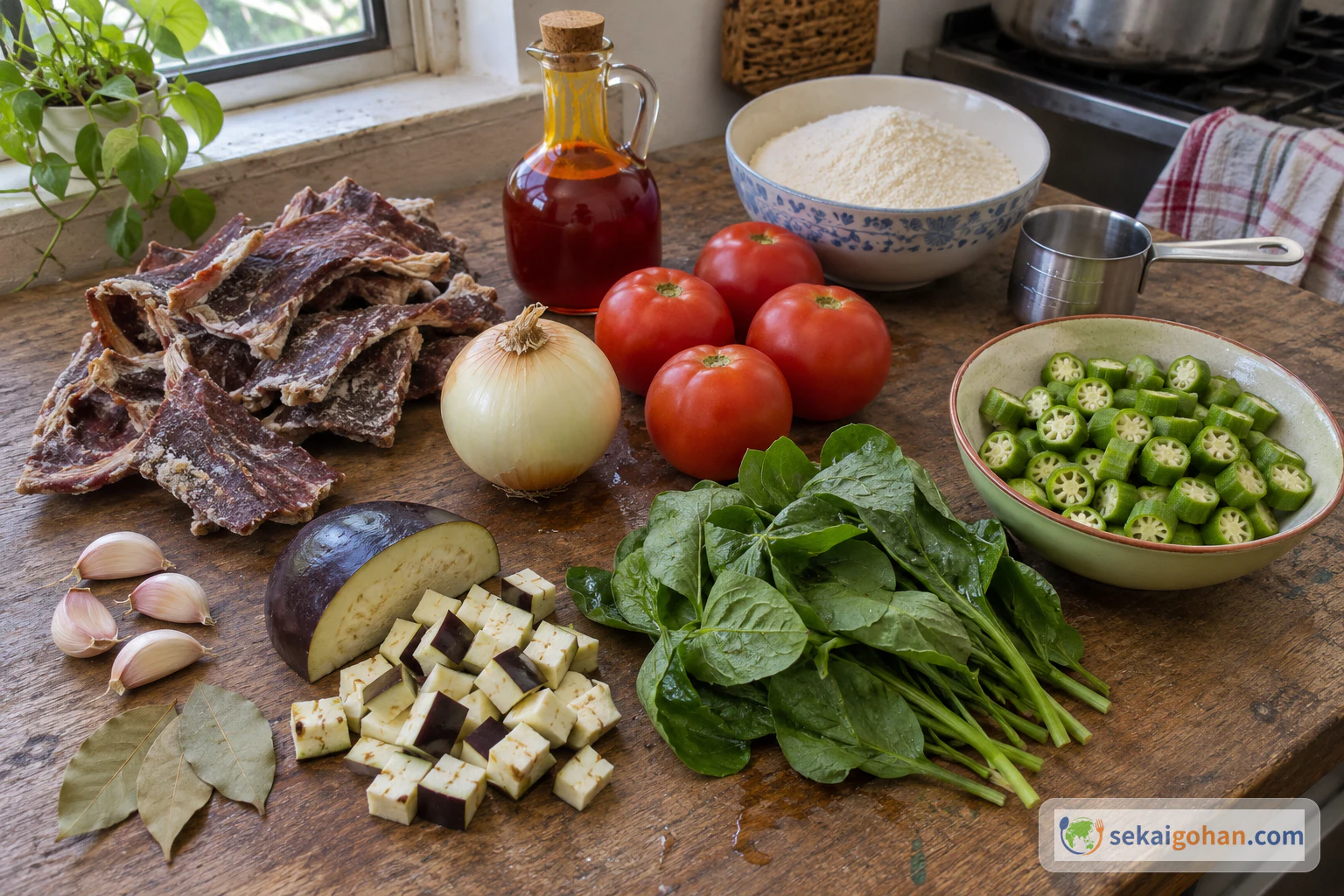
The stew and funge are made from beef, vegetables, cassava flour and palm oil, with no wheat, milk, egg, peanut or shellfish. If you use beef jerky in place of carne seca, read the label: some jerky contains wheat, soy or milk.
Dried beef varies widely in saltiness from one product to the next. Season only at the finishing stage, starting with a little salt and tasting before adding more. Never use the blanching water in the stew.
Equipment
- A large pot for blanching the beef
- A colander or large sieve
- A heavy-bottomed stew pot, 9½-inch (24 cm) or larger
- A second deep pot for the funge
- A long-handled wooden spoon (metal spatulas make funge scorch more easily)
- A small bowl of water for wetting your hands
- Shallow containers for cooling leftovers
Choosing and Substituting
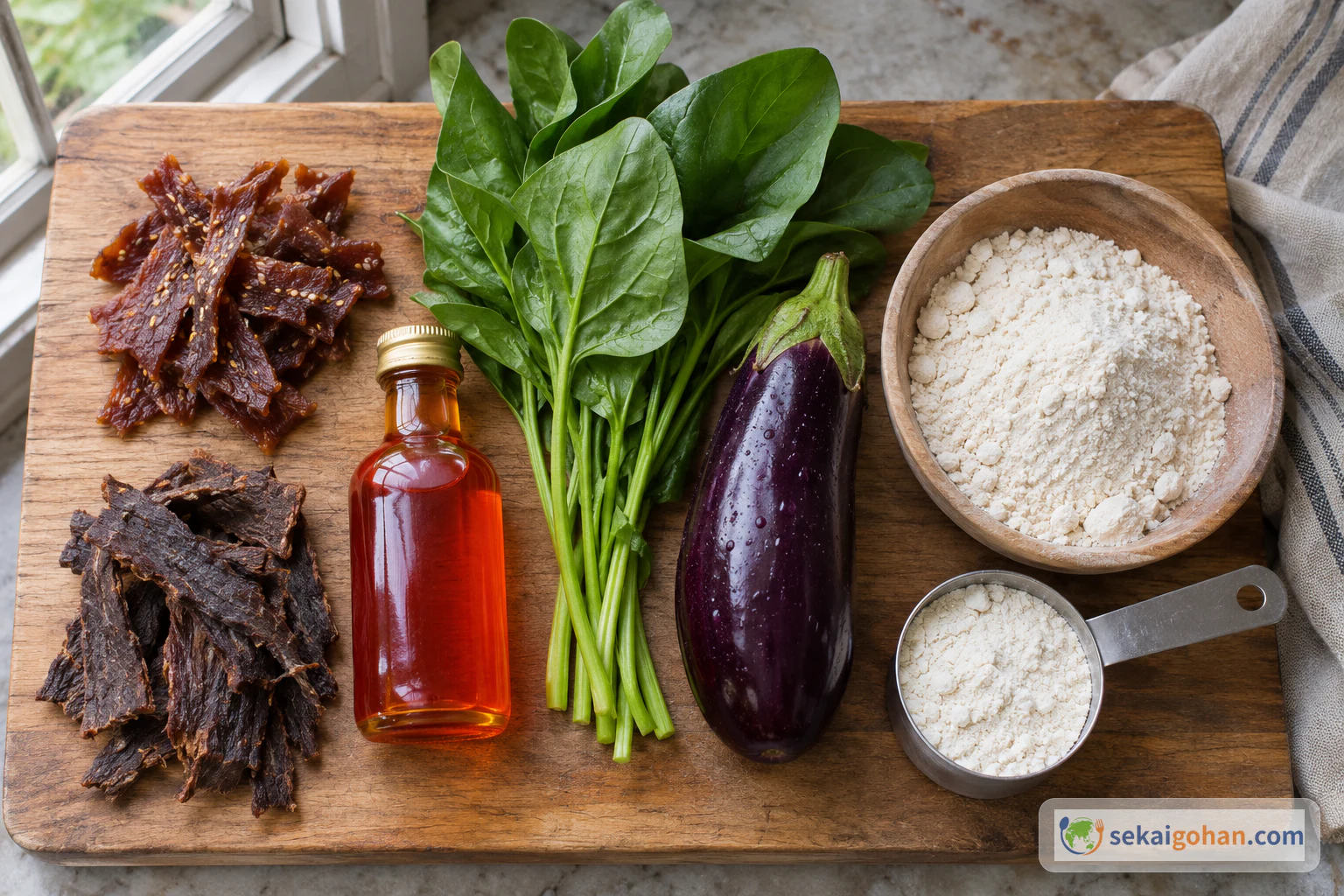
Four things make this pot taste Angolan: the salt of the dried meat, the red aroma of palm oil, the slip of the okra and a plain starch to eat it with. Keep those four, and everything else can bend to your shop.
Salted, dried beef is hard to find outside Angola and its neighbours. Beef jerky or South African biltong stands in well. Many jerkies are glazed sweet and salty, so their salt and sugar differ from carne seca; choose one with a simple ingredient list and set the final salt by taste. Red palm oil is the ingredient to track down: African and international grocers and online shops sell it in small bottles. A neutral oil with a pinch of paprika gets the colour close, but the aroma never comes back, and the stew turns into a different dish.
For the funge and the slurry, buy cassava flour, sold as farinha de mandioca or fuba de bombó. Tapioca starch is a different product, a refined starch made and used in a different way, and it will not cook into funge. Use a white onion; a red onion bleeds its colour into the sauce.
| Ingredient | Closest to Angola | Easy swap | What changes |
|---|---|---|---|
| Dried meat | Carne seca | Beef jerky or biltong | Saltiness and sweetness vary; season at the very end |
| Fat | Red palm oil | Neutral oil with a little paprika | Colour comes close; the palm oil aroma is lost |
| Greens | Sweet potato leaves (gimboa) or cassava leaves | Spinach | Milder and less clingy than sweet potato leaves |
| Staple | Funge de bombó | White rice or firm polenta | The flavour holds; the springy bite of funge is gone |
Cassava contains cyanogenic glycosides and must always be cooked through. Use store-bought cassava flour, and never grind raw cassava root into flour yourself. Cassava leaves carry more of these compounds than the root and need crushing, washing and cooking; use only commercially processed cassava leaves, or use spinach. Fuba de bombó is traditionally fermented, but this recipe uses ready-made flour only; do not ferment cassava flour at home.
Method
While the beef has its first hour in the water, chop the onion, tomatoes, garlic, aubergine and okra so the red base can go straight on when the beef comes out. The long braise is hands-off time; check the liquid now and then. Start the funge as the vegetables go into the stew, so both pots finish together.
When It Goes Wrong
| What you see | Why | What to do |
|---|---|---|
| The beef is tough and hard to chew | Too short a blanch or braise, or heat too low to keep a simmer | Keep braising at a gentle simmer in 30-minute stretches, adding hot water as the liquid drops |
| The stew is too salty | The beef kept too much salt, or the blanching water went into the pot | Add hot water to dilute. Next time, blanch longer and always discard that water |
| Oil sits heavy on top | Too much palm oil, or too little liquid | Keep to 2 tbsp of oil. Spoon a little off the surface |
| The okra has melted and the sauce is thin | The okra went in early and cooked too long | Add it only after the beef is tender, with the other vegetables |
| The sauce is gluey | Too much cassava flour, or over-reduced | Loosen with a little hot water; keep the slurry to 1 tbsp of flour |
| The funge is lumpy | Flour added all at once, or the spoon stopped | Sprinkle the flour in slowly and beat without pause, scraping the bottom |
| The funge stays loose | Too much water for the flour, or too little cooking | Keep working it over low heat, or add flour 1 tbsp at a time |
Serving, Variations and Storage
At the table
Calulu with funge is a full meal, and the beans in palm oil are the usual partner on an Angolan table. Eat the funge by hand if you like: tear off a piece, press a hollow into it with your thumb, and scoop up beef, okra and sauce.
Variations
- Sweet potato leaves (gimboa) for the greens. This brings the stew closer to Angolan home cooking, with more bitterness and a clingier texture than spinach.
- More aubergine. Extra cubes drink up the cooking liquid and make the stew heartier.
- White rice or firm polenta instead of funge. Useful when you have no cassava flour. The stew tastes the same, but the plate loses the springy, sticky bite that only funge gives.
Storage
Cool leftovers quickly in shallow containers, cover them and refrigerate. Reheat in a small pot over low heat with a splash of water, without letting it boil hard, until it is hot all the way to the centre. Leftover sauce is good spooned over rice the next day.
Frequently Asked Questions
Can I double it for four people?
Yes: double every ingredient. A larger load of dried beef needs a longer blanch to give up its salt and soften, so taste and press the meat before you drain it rather than stopping at the hour.
Can I ferment my own cassava flour for a more authentic funge?
No. Fuba de bombó is traditionally fermented, but home fermentation of cassava is not part of this recipe. Use store-bought cassava flour, which is processed to be safe to eat once fully cooked.
Is calulu spicy?
This pot has no chilli. Gindungo, Angola's chilli, is a basic part of the country's seasoning, so bring sliced fresh chilli to the table and let each person add it to their plate.
Can I make funge from cornmeal?
In southern Angola, funge is made from maize flour, fuba de milho, rather than cassava. It works as a staple with calulu, but its taste and texture differ from the grey, springy funge de bombó of the north, east and Luanda that suits this dish.