

Moroccan Cooking Starts with Aroma

Toast a little cumin in the kitchen in the evening, and the usual onion and chicken suddenly smell like a trip abroad. Add a bit of lemon peel, olives, and cinnamon. What is in the pot is still ordinary supermarket ingredients, yet at the moment you lift the lid, you feel as if you were standing in an alley in Marrakech.
Moroccan cooking is less difficult than it looks. What is difficult is knowing where to start shopping. Tagine, couscous, harira, pastilla, zaalouk. The names sound distant, but the cooking actually revolves around onion, garlic, tomato, beans, chicken, lemon, olives, cumin, and cinnamon.
This article is meant to be read before you shop: an overview of Moroccan cuisine, 12 classic dishes, ingredients that are easy to gather, substitutes, and the seasonings worth buying first because they can be reused. If you want to cook one dish first, the fastest route is the step-by-step how to make tagine. To see where it sits within North Africa as a whole, read African cuisine overview alongside it.
Before memorizing dish names, decide whether today you want a stew, a soup, or couscous, the granular pasta. That makes choosing easier. Later in the article is a shopping table divided by supermarket, specialty grocer, and online sources.
Moroccan dishes can contain wheat (couscous, bread, pastilla), nuts (almonds, walnuts), dairy (some sweets and sauces), and eggs (pastilla, briouat). Commercial ras el hanout and harissa may be made on lines that handle nuts and wheat, so anyone with a food allergy should check the ingredient label.
| Today's mood | The dish to make first | What to add to the cart | How easy to reproduce elsewhere |
|---|---|---|---|
| A weekend stew | Chicken tagine | Chicken, lemon, olives, cumin | Can be made in a heavy pot. Hard to fail |
| A light lunch | Couscous with vegetable stew | Couscous, chickpeas, zucchini | Couscous only needs rehydrating, so it is quick |
| Ramadan-style soup | Harira | Lentils, chickpeas, canned tomatoes | Can be made with the feel of a bean soup |
| A make-ahead starter | Zaalouk | Eggplant, tomato, bell pepper | Good if you like roasted eggplant |
Food Culture Background

If you had to describe Moroccan cuisine in one phrase, it is a crossroads of Amazigh (Berber), Arab, Andalusian, Mediterranean, and sub-Saharan African influences. It is close to Spain in the north, faces the Atlantic in the west, borders Algeria in the east, and continues to the Sahara in the south. Port towns, mountain regions, desert, and the court culture of the old capital Fez all overlap within one country.
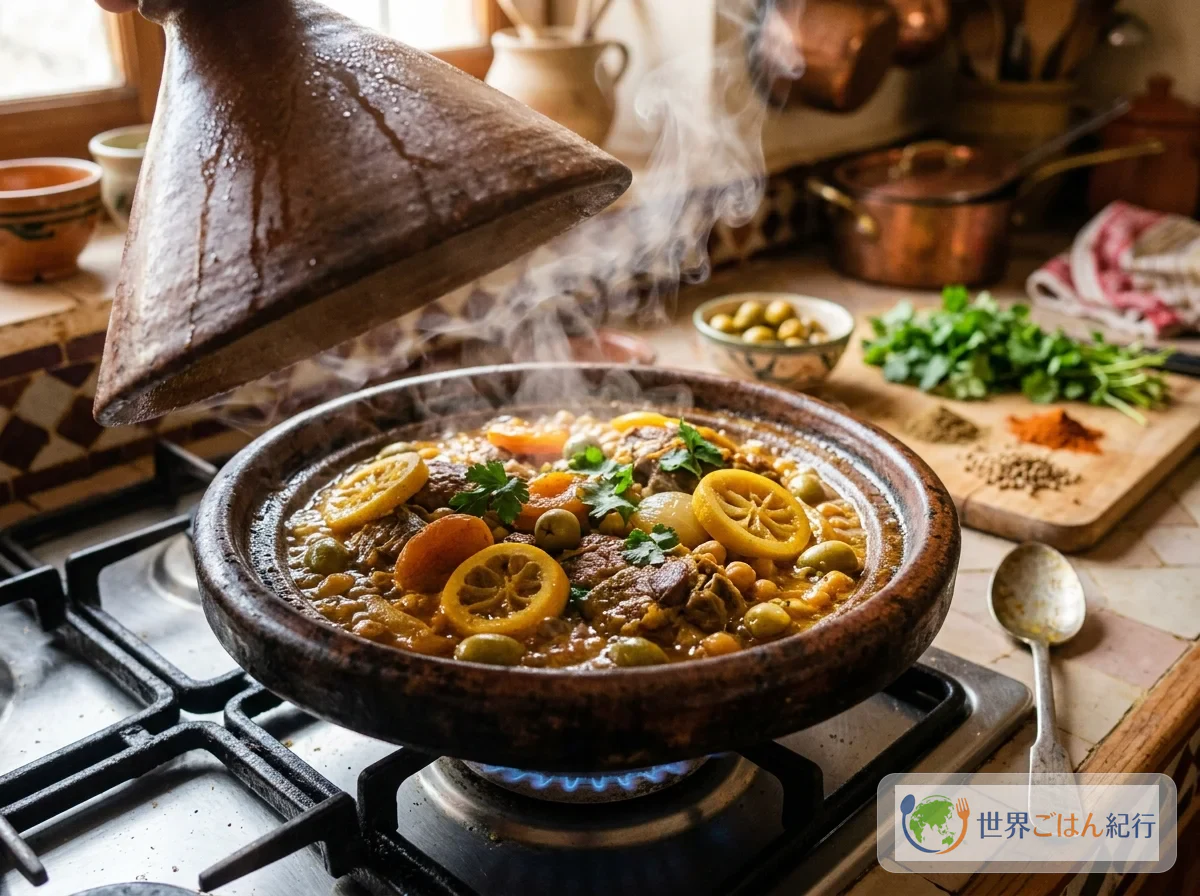
The conical lid of a tagine is shaped to circulate a small amount of liquid inside the pot. Britannica's entry on tagine also explains how the conical lid traps moisture and simmers meat until it is moist and tender. Think of it as the wisdom of making meat and vegetables tender while saving water and fuel in regions near the desert, and the shape makes sense.
Couscous, meanwhile, is not merely a side dish. In 2020 UNESCO inscribed "knowledge, know-how and practices pertaining to the production and consumption of couscous" on the Intangible Cultural Heritage list, on the joint nomination of Algeria, Morocco, Mauritania, and Tunisia. The work itself of rolling semolina by hand, steaming it, and sharing it with the family has become a memory of gathering and community.
Part of the appeal of Moroccan cooking is that sweet and salty sit on the same plate. Lamb with prunes, chicken with preserved lemon, pastilla with powdered sugar and cinnamon. It may be a surprise at a table elsewhere, but for people used to teriyaki and sweet-savory braises, it is in fact an easy flavor to enter.
The sweetness in a Moroccan stew is not dessert sweetness; it rounds the fat of the meat and the spices. Think of dried apricots and prunes as playing the role of mirin rather than sugar, and it is easier to bring them close to home cooking.
Basic Ingredients and Spices

Moroccan cooking does not use spices in the huge quantities of Indian cooking. Instead, small amounts of spice are layered onto onion, meat, beans, and tomato to build depth of aroma. If you are gathering them first, five spices (cumin, coriander, cinnamon, paprika, and turmeric) cover a wide range.
The five aromas to buy first
Cumin is the foundation of Moroccan cooking. It is used in tagine, harira, zaalouk, and kefta. It is also an aroma found in curry powder, so it is a spice that feels familiar in most home kitchens.
Ground coriander lightens the earthiness of cumin a little. Even if you dislike fresh cilantro leaves, ground coriander seed has a citrus-like aroma and is easy to use.
Cinnamon is used in small amounts in meat dishes. Too much turns it into a sweet, but a pinch neatly pulls together the fat of lamb or chicken.
Paprika adds a mild, red aroma and color. It also works for harissa and for North African dishes leaning Tunisian, so it can be spread to chorba frik and chakchouka (in Japanese).
Turmeric is a realistic ingredient for adding color in place of saffron. Real saffron is expensive, so at home it is easier to keep up with a small amount of turmeric for yellow and build aroma with lemon and ginger.
| Ingredient / seasoning | Dishes it is used in | Where to find it | Substitutes |
|---|---|---|---|
| Couscous | Couscous, salads | Specialty grocers, bulk shops, online | Bulgur, pearl barley, firm cooked rice |
| Chickpeas | Harira, couscous | Canned or boiled chickpeas at the supermarket | Boiled soybeans, lentils |
| Preserved lemon | Chicken tagine | Specialty grocers, online, homemade | Lemon peel + salt + a little lemon juice |
| Green olives | Tagine, salads | Supermarket, delicatessen | Black olives, a little capers |
| Ras el hanout | Tagine, meat dishes | Specialty grocers, online | Cumin + coriander + cinnamon + paprika |
| Harissa | Soups, couscous | Specialty grocers, import shops | Chili flakes + paprika + garlic |
| Orange flower water | Sweets, mint tea | Online, baking supply shops | Optional. Make up the aroma with citrus peel |
12 Classic Dishes

Here are 12 dishes that represent Moroccan cooking, including how approachable each is to make at home. You do not need to make them all at once. If you start with tagine, then couscous, and then harira and a starter when you have energy, nothing goes to waste.
1. Tagine
Tagine is the name of the dish and also the name of the pot. The combinations are many: chicken with preserved lemon, lamb with prunes, fish with tomato, vegetables with chickpeas. If you are making your first at home, a chicken tagine with chicken, lemon, olives, onion, cumin, and coriander is the hardest to fail. Detailed amounts and steps are in how to make tagine.
2. Couscous
Couscous is a granular pasta, and steamed semolina is eaten with a vegetable or meat stew spooned over it. The custom of eating it with the family at Friday lunch is well known. Instant couscous is rehydrated with hot water, so it is in fact quicker than cooking rice. With a soup of carrot, zucchini, chickpeas, and chicken spooned over, even a weekday lunch feels Moroccan.
3. Harira
Harira is a thick soup of tomato, lentils, chickpeas, aromatics, and thin noodles. Visit Morocco also presents it as a nutritious soup eaten during Ramadan. It can be made with canned tomatoes, lentils, boiled chickpeas, and a little vermicelli. It is satisfying even without meat and suits breakfast the next day.
4. Zaalouk
Zaalouk (in Japanese) is a starter in which roasted eggplant and tomato are mashed and brought together with cumin, garlic, and olive oil. It is like roasted eggplant with tomato and spices added, and goes with bread or rice. Char the eggplant well and peel it, and you get a smoky aroma.
5. Kefta
Kefta is a meatball or skewer of ground meat mixed with cumin, paprika, parsley, and onion. Kefta tagine, simmered in tomato sauce with eggs dropped in, has an approachability close to shakshuka. It can be made with mixed mince, but using more beef gives it a Moroccan strength.
6. Pastilla
Pastilla is a court dish in which chicken or pigeon, almonds, and egg are wrapped in thin pastry and dusted with powdered sugar and cinnamon. On first tasting you hesitate for a moment over whether it is sweet or salty. At home it can be simplified with spring roll wrappers or phyllo, and the detailed steps from cooking off the filling's moisture through baking are in how to make pastilla (in Japanese). Because it contains almonds and cinnamon, avoid it if you have a nut allergy.

7. Briouat
Briouat are small triangular pastries. The fillings vary: ground meat, chicken, cheese, almonds. They can be fried or baked. Spring roll wrappers make them easy, and chopping leftover tagine filling to wrap makes a dish for the next day.
8. Mechoui
Mechoui is a celebration dish of slow-roasted lamb. A whole roast is hard at home, so it is realistic to move toward lamb chops or lamb shoulder grilled with salt, cumin, garlic, and olive oil. Think of it as the Moroccan counterpart of cultures that roast meat large and share it, like nyama choma and churrasco.
9. Loubia
Loubia is a tomato stew of white beans. It is not flashy, but it is a very easy everyday Moroccan dish. It can be made with canned white beans, canned tomatoes, onion, garlic, and cumin. It is an easy flavor to enter if you like bean curry or chili con carne.
10. Msemen
Msemen is a Moroccan pancake of thinly stretched dough folded and cooked. It is eaten at breakfast or as a snack with honey or butter. Stretching the dough thin is a little fun and suits a weekend morning. It can be made with bread flour, cake flour, and semolina, but even with cake flour alone you get the feel at first.
11. Mint tea
Moroccan mint tea is a sweet tea made from green tea, fresh mint, and sugar. It is indispensable not only after meals but also when welcoming guests. Sencha-style green tea tends to turn astringent, so Chinese green tea or gunpowder green tea gets closer. Start with a small amount of sugar and adjust.
12. Orange and cinnamon salad
A dessert of thinly sliced oranges with cinnamon, a little sugar, and orange flower water. Served after a heavy stew, it lightens the mouth at once. If you do not have orange flower water, a little grated orange zest is enough.
Shopping List

Shopping for Moroccan cooking is hard if you try to gather everything from the start. Center it on what an ordinary supermarket sells first, and limit specialty grocers and online orders to things that "you buy once and use many times," and you can keep going.
What to buy at an ordinary supermarket
Onion, garlic, ginger, canned tomatoes, chicken thighs, lemon, parsley, eggplant, carrots, boiled chickpeas, lentils, and green olives can be gathered at a larger supermarket. If the spice aisle has cumin, paprika, cinnamon, and turmeric, that is enough to start.
What to look for at a specialty grocer
Couscous, harissa, preserved lemon, ras el hanout, dried apricots, dates, almonds, and green tea for mint tea are easier to find at import grocers. Couscous in particular is a dry good that keeps well and can be used again and again in salads, as a soup side, and next to a tagine.
What is worth buying online
A tagine pot, a couscoussier, gunpowder green tea, and orange flower water are more reliable online. You do not need a dedicated pot from the first time, though. Tagine can be made well in a Staub, a Le Creuset, or any heavy pot. Buying the pot can wait until after you have made it twice and want to make it again.
With chicken thighs, onion, lemon, green olives, canned tomatoes, chickpeas, couscous, cumin, cinnamon, and paprika, you can make chicken tagine, easy couscous, a harira-style soup, and even zaalouk. It is a combination that stretches one shopping trip to three meals.
| What to buy | Priority | Dishes it can be reused for |
|---|---|---|
| Ground cumin | High | Tagine, harira, zaalouk, kefta |
| Couscous | High | Couscous, salads, a side for tagine |
| Green olives | High | Chicken tagine, starters, salads |
| Chickpeas | High | Harira, couscous, bean salads |
| Harissa | Medium | Couscous, soups, a sauce for grilled meat |
| Ras el hanout | Medium | Tagine, lamb, roasted vegetables |
| Preserved lemon | Medium | Tagine, fish dishes, salads |
| Tagine pot | Low | Tagine in general. A heavy pot can stand in |
Ingredients and Tools

Moroccan cooking is a genre where it is easy to be uncertain at the first shop. Gathering spices and dry goods you can reuse before buying a dedicated pot makes the dishes appear on your table more often. If you compare prices and stock online, checking these three first wastes the least.
Ras el hanout (a Moroccan spice blend), couscous (about 500 g), and a tagine pot (roughly 25 cm in diameter) are the three to look at.
If you buy spices one jar at a time, prioritize cumin, coriander, paprika, and cinnamon in that order. Ras el hanout is convenient, but the blend differs by shop, so choosing one without added heat or salt makes it easier to use in cooking.
Substitute Ingredient Table

Even with substitutions, Moroccan cooking is enjoyable as home cooking as long as the "direction of aroma" matches. If you aim for perfect reproduction, you will do it only once. To keep going, using close ingredients well matters more.
| Authentic ingredient | Substitute | Tip for using it |
|---|---|---|
| Preserved lemon | Lemon peel + salt + lemon juice | Let it stand 10 minutes and use only the peel. Too much pulp turns it sour |
| Lamb | Chicken thighs, beef shank, pork shoulder | If you dislike the smell of lamb, start with chicken |
| Saffron | A little turmeric | Only adds color. Add aroma with lemon and ginger |
| Couscous | Bulgur, pearl barley, firm cooked rice | Think of it as a staple that soaks up the cooking liquid |
| Fresh coriander | Parsley, celery leaves | If you dislike it, don't force it. Make up the aroma with lemon |
| Harissa | Chili flakes + paprika + garlic | Adding heat at the end makes it easy for the family to adjust |
| Orange flower water | Orange peel, lemon peel | Sweets and mint tea still work without it |
| Phyllo pastry | Spring roll wrappers | Use for the home version of pastilla and briouat |
If you put a lot of harissa or chili into the pot from the start, children and family members who dislike heat cannot eat it. At home it is more realistic to finish with aroma only, then serve each portion and add harissa on the side.
Putting a Menu Together

When serving Moroccan food at a home table, decide on one main and then place a "staple that receives it" and an "acidic side," and it comes together. A tagine alone on a big platter is a little heavy, so build rhythm with couscous, bread, salad, and mint tea.
An easy weekday menu
On a weekday, make a quick tagine with chicken and canned tomatoes and rehydrate couscous with hot water. A salad of cucumber and tomato is enough as a side. Just a squeeze of lemon at the end lightens the spice aroma.
A slow weekend menu
On a weekend, make chicken tagine the main, with zaalouk, couscous, and mint tea. Leftover tagine is also good the next day over rice rather than couscous. Like curry the next day, the spices settle and the flavors blend.
A menu for guests
For guests, show the tagine in its pot and line up zaalouk, a bean salad, and olives as starters for atmosphere. For sweets, the orange and cinnamon salad is enough. Making pastilla too is showy, but you need not push yourself the first time.
Tips for Not Failing in a Home Kitchen

What goes wrong in Moroccan cooking is not the amount of spice but the liquid and the salt. Tagine uses little water, so pouring in water as if for an ordinary simmered dish gives a thin soup with a weak aroma. Conversely, too much preserved lemon or olives turns quite salty when it reduces.
Less water, and add more along the way
When making tagine in a heavy pot, start with little liquid. Water comes out of the onion, meat, and vegetables, so there is no need to pour in plenty from the start. If it looks about to scorch, adding 2 tbsp at a time is enough.
Don't scorch the spices
Cumin and paprika taste good when the aroma is brought out in oil, but they turn bitter if burned. Sauté the onion, add the spices, bring out the aroma for about 30 seconds, and add the liquid or ingredients right away to keep it steady.
Add sweetness little by little
In a tagine with prunes, apricots, or honey, you cannot take back sweetness that has gone in too much. Start with about 70% of the recipe's amount and add more at the end, which suits home cooking better. To tighten up the sweetness, adjust with lemon juice or a little vinegar.
You can do without bread
In Morocco the sauce is often scooped with bread, but at a home table rice is fine. Chicken tagine and loubia in particular go with plain rice. Rather than forcing yourself to buy more couscous on a day you have none, eating it with the staple you have at home is easier to keep up.

Frequently Asked Questions

Q1. Can I cook Moroccan food without a tagine pot?
Yes. A heavy lidded pot, a Staub, a Le Creuset, a clay pot, or a deep frying pan all work. What matters is cooking slowly over low heat and not adding too much liquid. A dedicated pot adds atmosphere, but it is not required for the first time.
Q2. Where can I buy couscous?
You can find it at specialty grocers, some bulk stores, and online. It is a dry good that keeps well and can be used as a staple beside soups and stews. If you cannot find it, bulgur, pearl barley, or firmly cooked rice will still make a meal.
Q3. Is ras el hanout essential?
It is not. With cumin, coriander, cinnamon, paprika, and turmeric you can make the home-version Moroccan aroma. Think of ras el hanout as a convenient shortcut whose blend differs by shop.
Q4. Is Moroccan food spicy?
It is a cuisine of aroma more than heat. Some dishes are served with harissa, but tagine and couscous themselves are not very hot. Heat can be added afterward, so if eating with family, it is recommended to go easy in the pot and adjust once served.
Q5. What do you recommend for a beginner's first dish?
Chicken tagine. It can be made with chicken, onion, lemon, olives, cumin, and coriander, and it is hard to fail in a heavy pot. Next, widening to harira, zaalouk, and couscous lets you use the spices and beans you bought without waste.
Sources
- UNESCO Intangible Cultural Heritage, Knowledge, know-how and practices pertaining to the production and consumption of couscous
- UNESCO, UNESCO's inscription of couscous traditions, an example of international cultural cooperation
- Encyclopaedia Britannica, Tagine
- Encyclopaedia Britannica, Couscous
- Moroccan National Tourist Office, Moroccan Food & Drink
Summary

Moroccan cooking is not something you need a dedicated pot or rare ingredients to begin. Sauté onions, layer on a little cumin and cinnamon, and define the outline with lemon and olives. Start there, and ordinary chicken and beans become a Moroccan plate.
The first step is to make chicken tagine while following how to make tagine. Then serve couscous with it and widen to harira and zaalouk with the leftover spices, and little of your shopping goes to waste. If you want to widen to North Africa as a whole, chorba frik and chakchouka (in Japanese) are good next steps.



