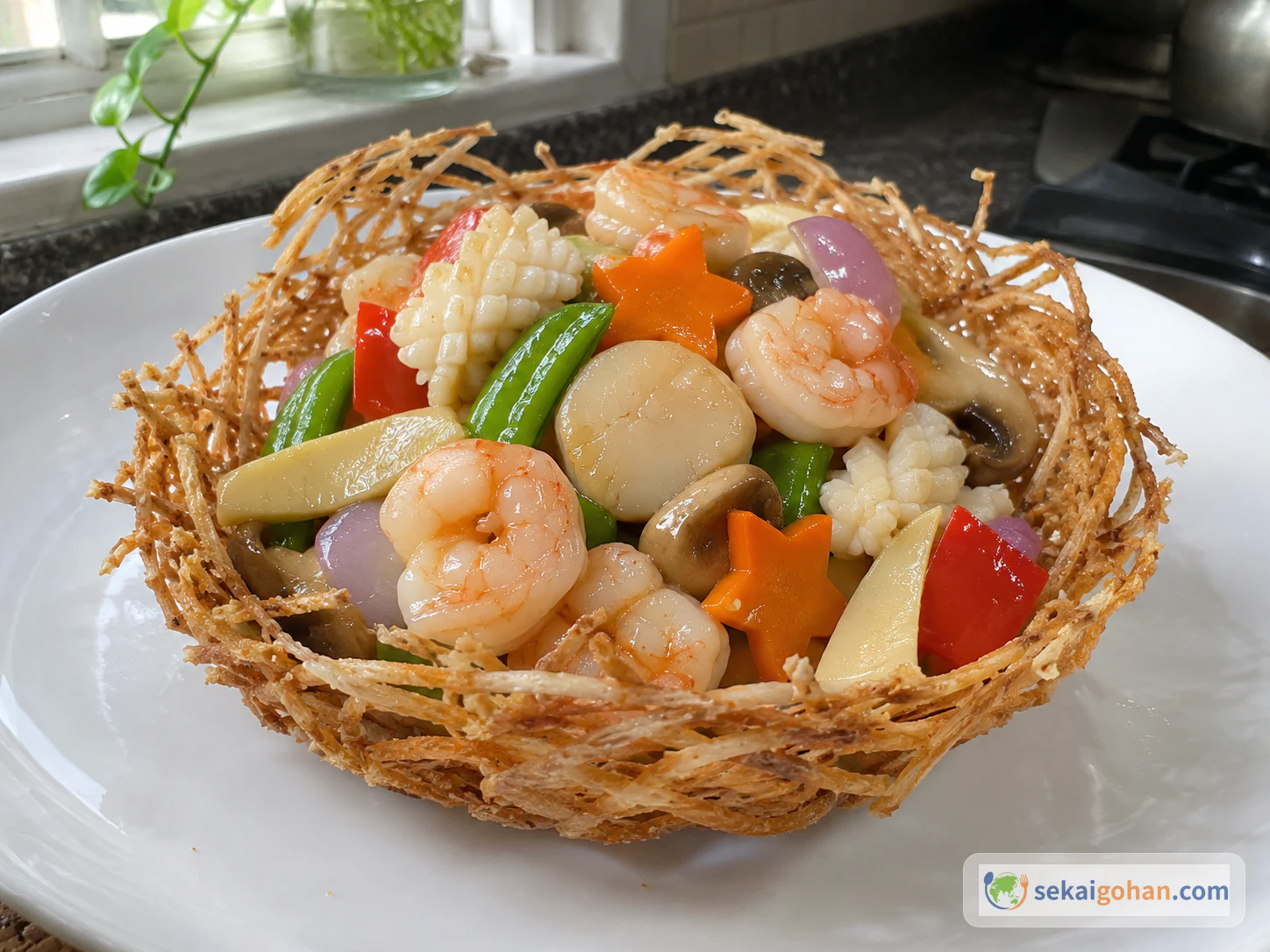
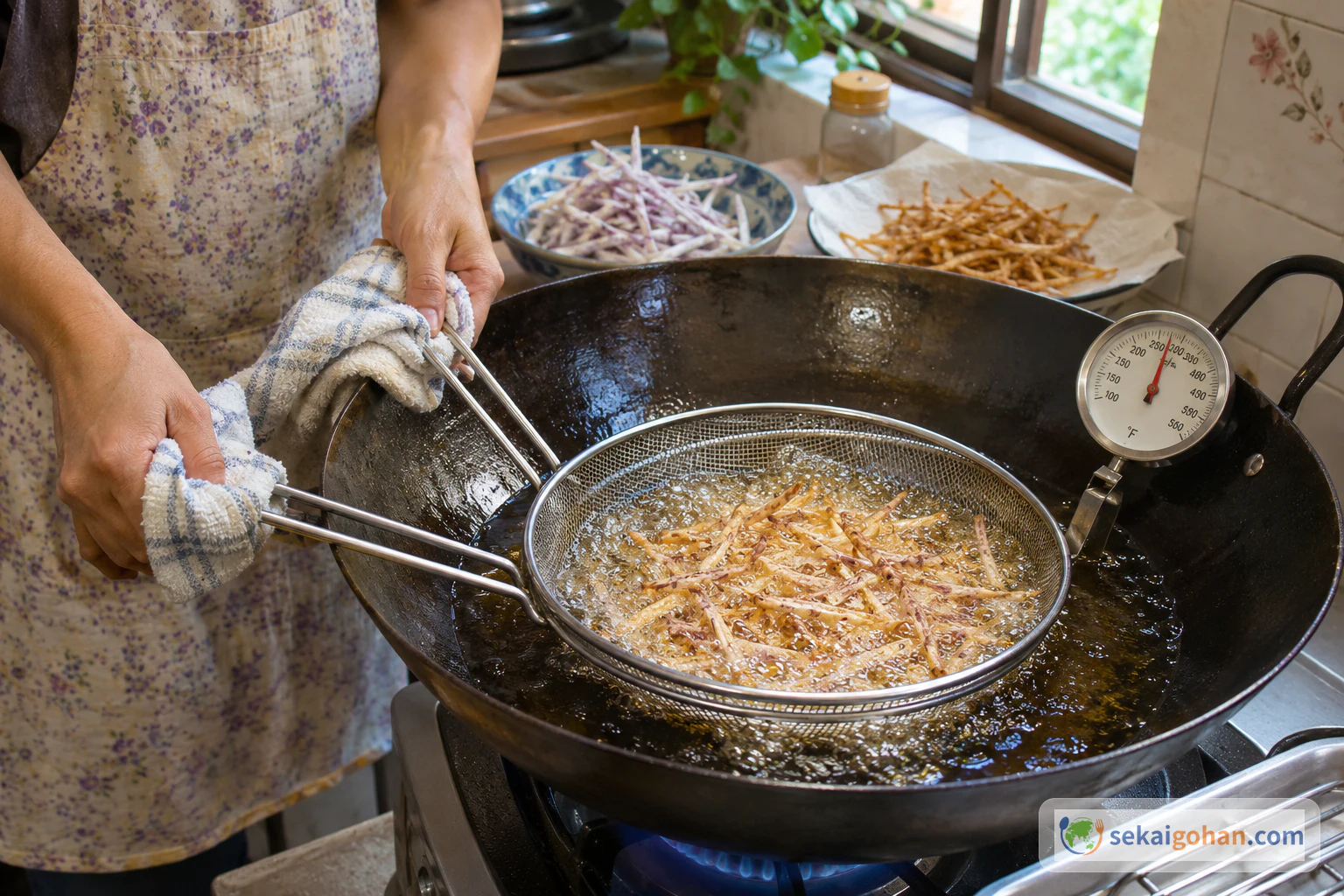
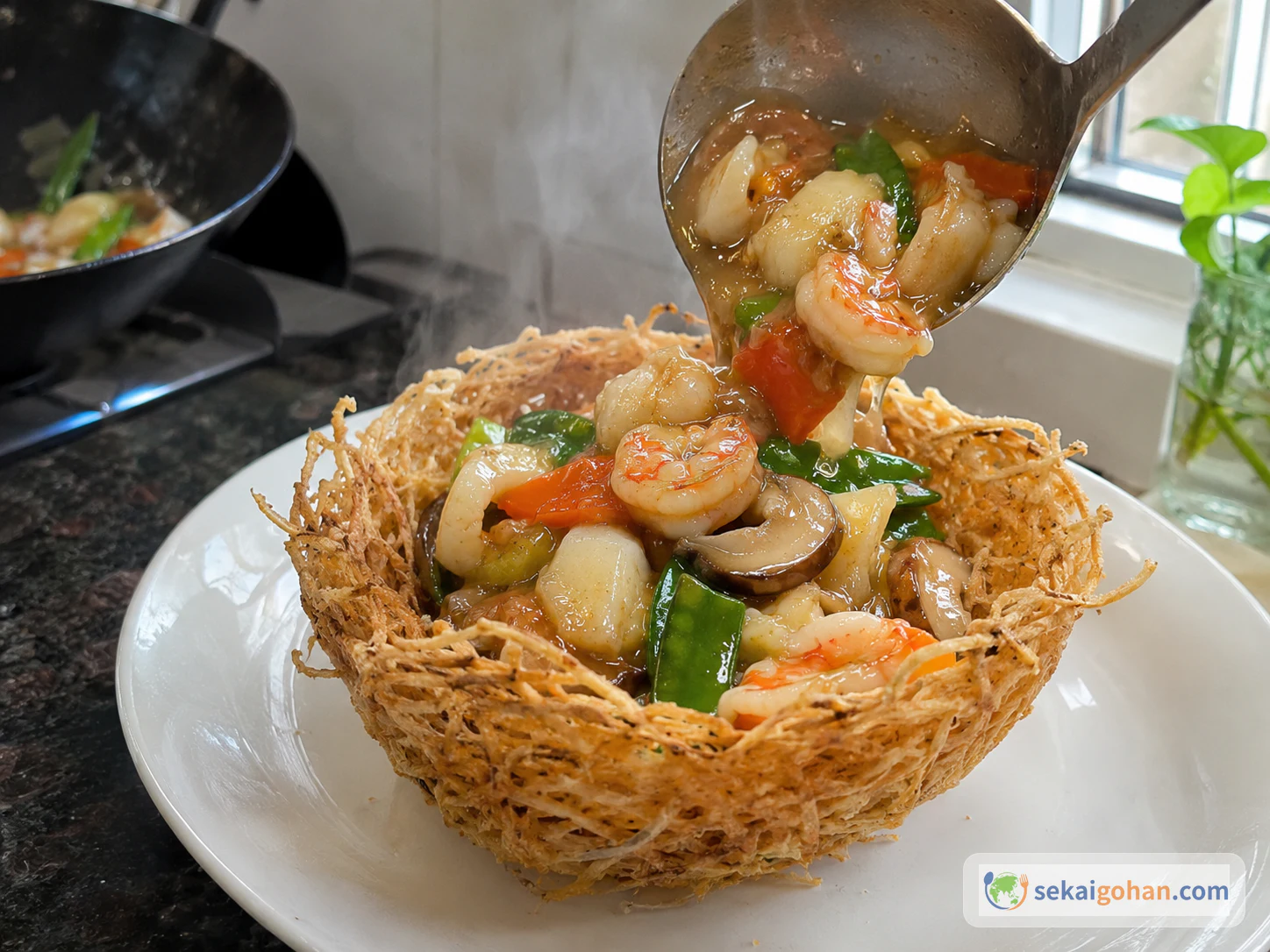
Two wire strainers go into the oil with a lattice of raw taro pressed between them, and the wok answers with a hard, rising boil of bubbles. You tilt the handles slowly, and the pale strands turn gold, then deep gold, until a crisp basket comes out of the oil. Minutes later it is full of shrimp, scallops and curled squid with snap peas, carrot stars and straw mushrooms in a light, glossy sauce scented with ginger and Shaoxing wine. This is seafood bird's nest, a Cantonese banquet dish. There is no bird in it and no real nest. The pleasure is in the contrast: a clean, savory stir-fry against fried taro that shatters when the serving spoon breaks into it.
A Nest Made of Taro, Built for the Banquet Table
The Chinese name is 海鮮雀巢, read hǎi xiān qiǎo cháo in Mandarin and hoi2 sin1 zoek3 caau4 in Cantonese: a seafood "bird's nest." The nest is fried taro cut into fine strands, or in some kitchens fried noodles, and it works as both the plate and the crunch. It belongs to Cantonese cooking in Hong Kong and southern China and is also served in Chinatown restaurants abroad. It sits in the mid-to-upper range of a menu, the kind of dish ordered when the meal matters. You can read more about the wider cuisine on our China page.
Its natural home is the banquet: wedding dinners, celebration meals and upscale Cantonese restaurants, where it arrives at the table whole and is broken open in front of everyone. Shrimp and scallops are lucky foods, which makes the dish a good fit for Lunar New Year.
The filling changes from cook to cook. Shrimp, scallops and squid are the usual center, with snap peas or snow peas, straw mushrooms, white fish and celery as common companions. Some versions keep to shrimp and scallops alone and dip the taro in a coating before frying. Vietnamese-Chinese kitchens make a close relative with a fried egg noodle nest, mì xào giòn hải sản, served in good Chinese and Vietnamese restaurants.
The name trips people up. Bird's nest soup uses the edible swiftlet nest called 燕窩, a different dish entirely. In 海鮮雀巢 the "nest" is the fried taro basket, and every part of it is eaten.
Ingredients (serves 6)
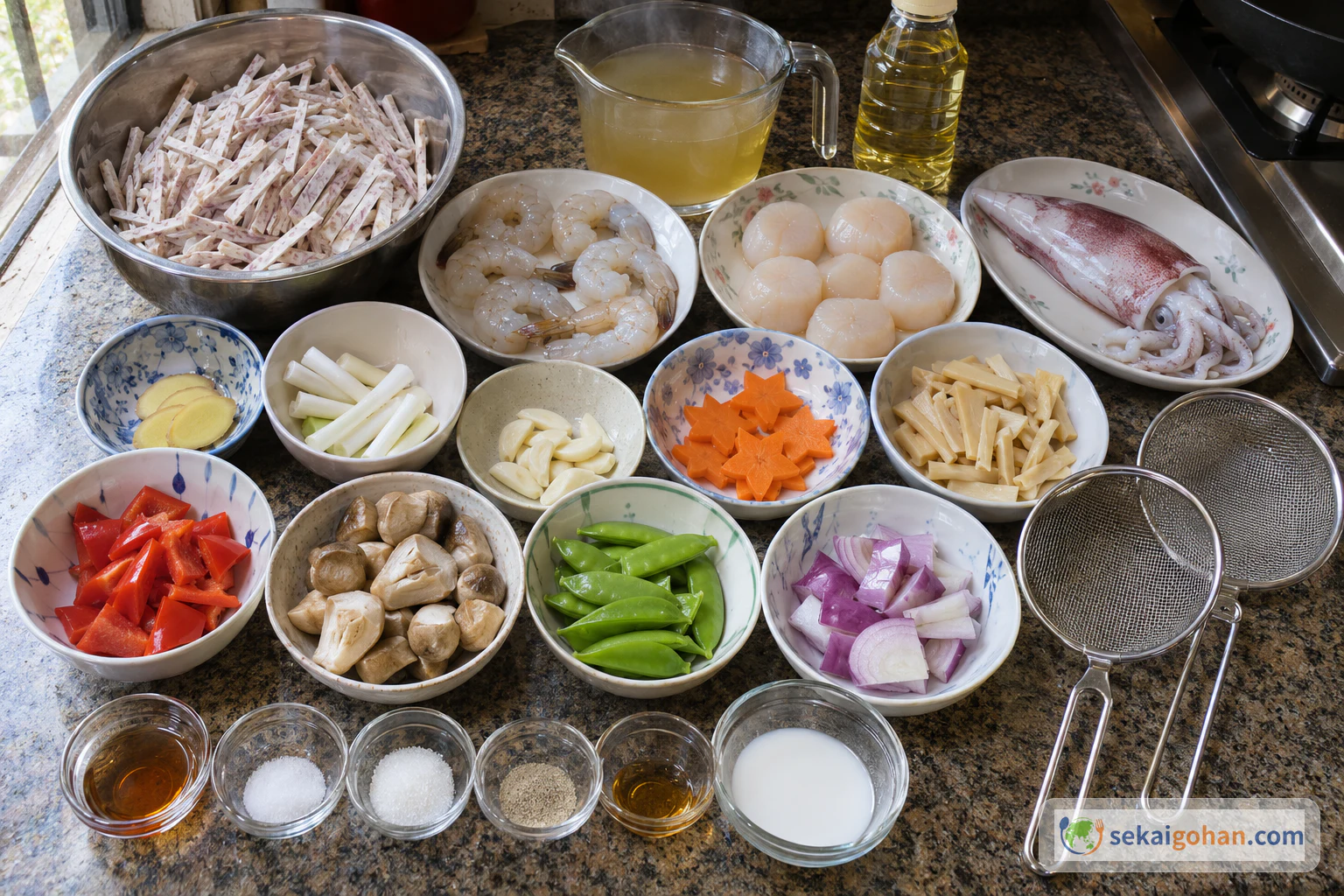
This dish contains crustaceans (shrimp) and molluscs (scallops and squid), along with sesame oil. Check the label of your chicken stock for any other allergens.
Equipment
- Wok or deep, wide pot with plenty of room above the oil
- Two large wire mesh strainers of the same size (stainless steel works well)
- Deep-frying thermometer
- Spider or slotted spoon
- Wok spatula
- Small bowl for the cornstarch slurry
- Large serving platter
- Dry kitchen towel for handling the strainer handles
Choosing and Substituting
Taro is the one thing to shop for. Look for it at a Chinese or other Asian grocery store; it has the starch that glues the strands into a basket without any coating. Other roots have not been tried in this nest, so a swap may change how well it holds together and how it crisps. If you cannot find taro, fried egg noodles make a crisp nest of their own, described under the variations below.
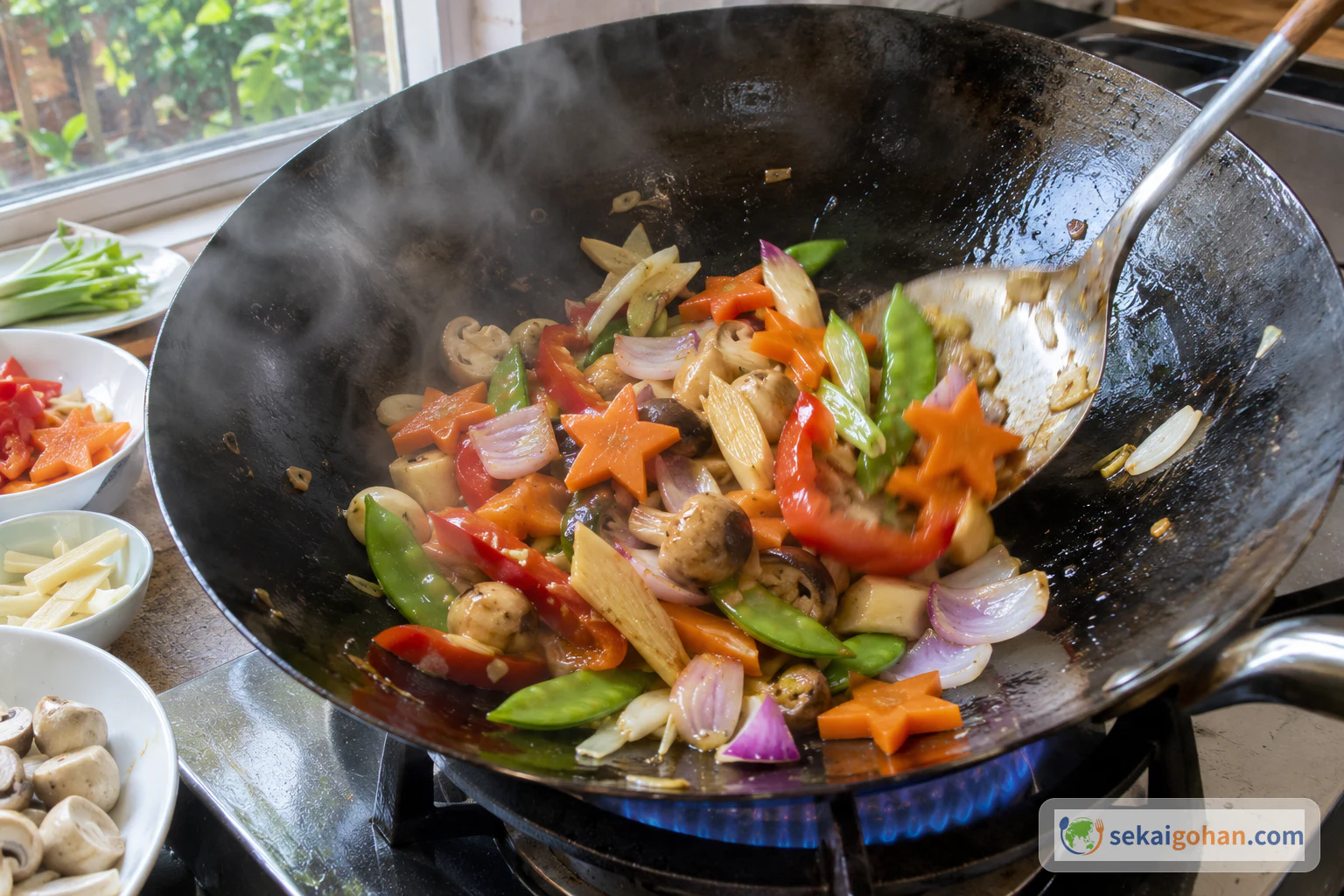
Shaoxing wine, straw mushrooms and bamboo shoots are all sold at the same shop. Straw mushrooms can be fresh or canned, since they go into a hot wok for only moments. Chicken stock can be homemade or bought. The seafood is flexible: white fish, celery and snow peas all belong to the dish, and you can trade the squid or shift the vegetable mix and still have seafood bird's nest. What you should keep is the crisp taro nest and the pale, lightly seasoned sauce; a heavy, dark sauce soaks the nest quickly and hides the seafood.
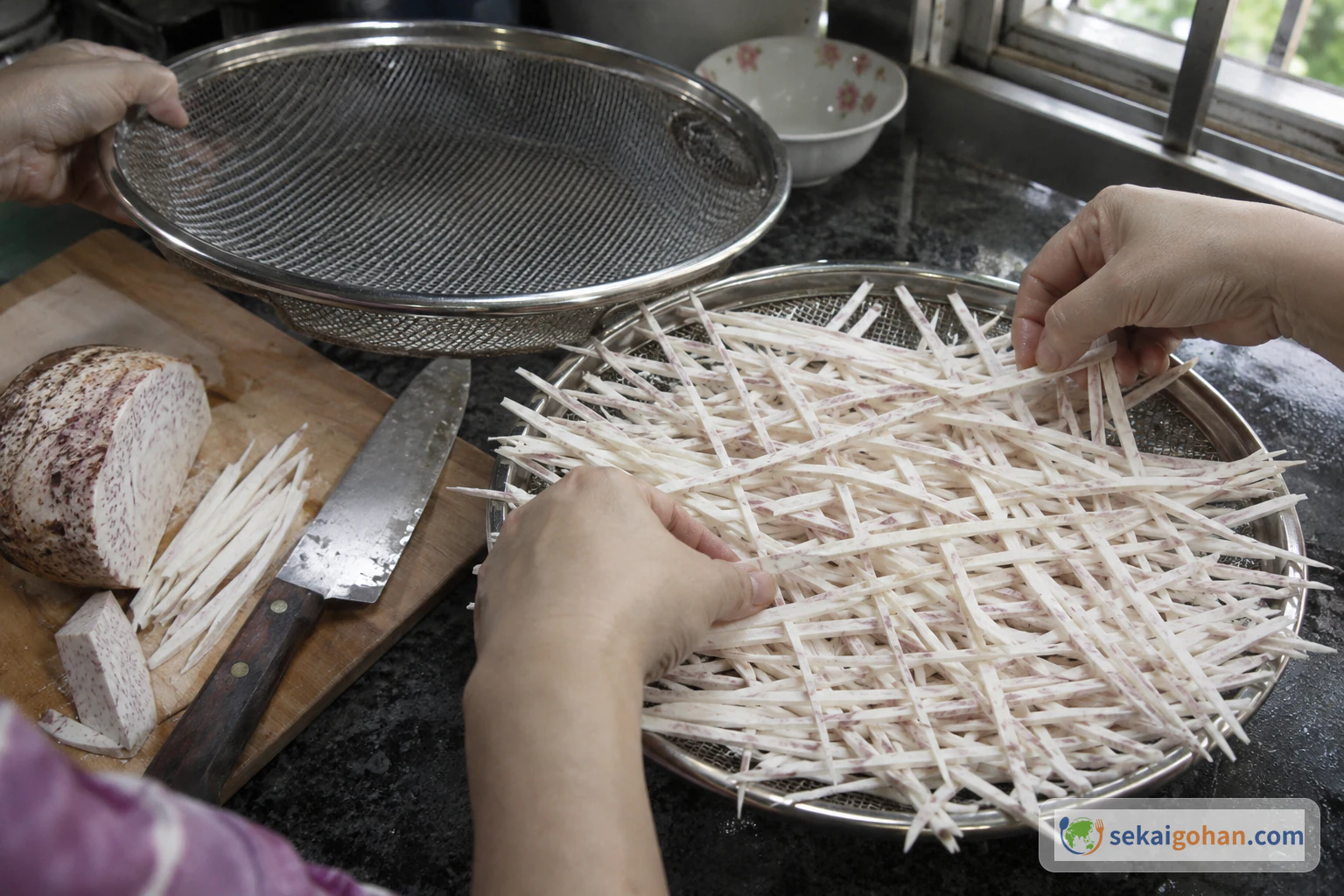
Thin, even matchsticks lace together tightly and fry to an even gold. Thick strands leave gaps in the basket and stay pale in the middle while the edges darken.
Method
Make the nest first; it is the slow part and it can sit on its platter while you cook everything else. Have the seafood cleaned, the vegetables cut and the seasonings measured into small bowls before the stir-fry, because from the moment the ginger hits the oil to the moment the sauce is done, the work runs in seconds, not minutes. Bring the stock to a simmer while the nest fries so it is hot when you need it.
Taro strands are wet, and the oil boils up hard the moment they go in. Use a wok or pot with plenty of headroom so the oil cannot overflow, lower the nest slowly, and keep water, wet hands and wet utensils away from the oil. Hold the strainer handles with a dry towel.
The finish of the nest depends on an even 325°F (163°C). Too cool and the taro drinks oil and stays pale; adjust the burner the moment the thermometer drops, rather than waiting until the nest looks wrong.
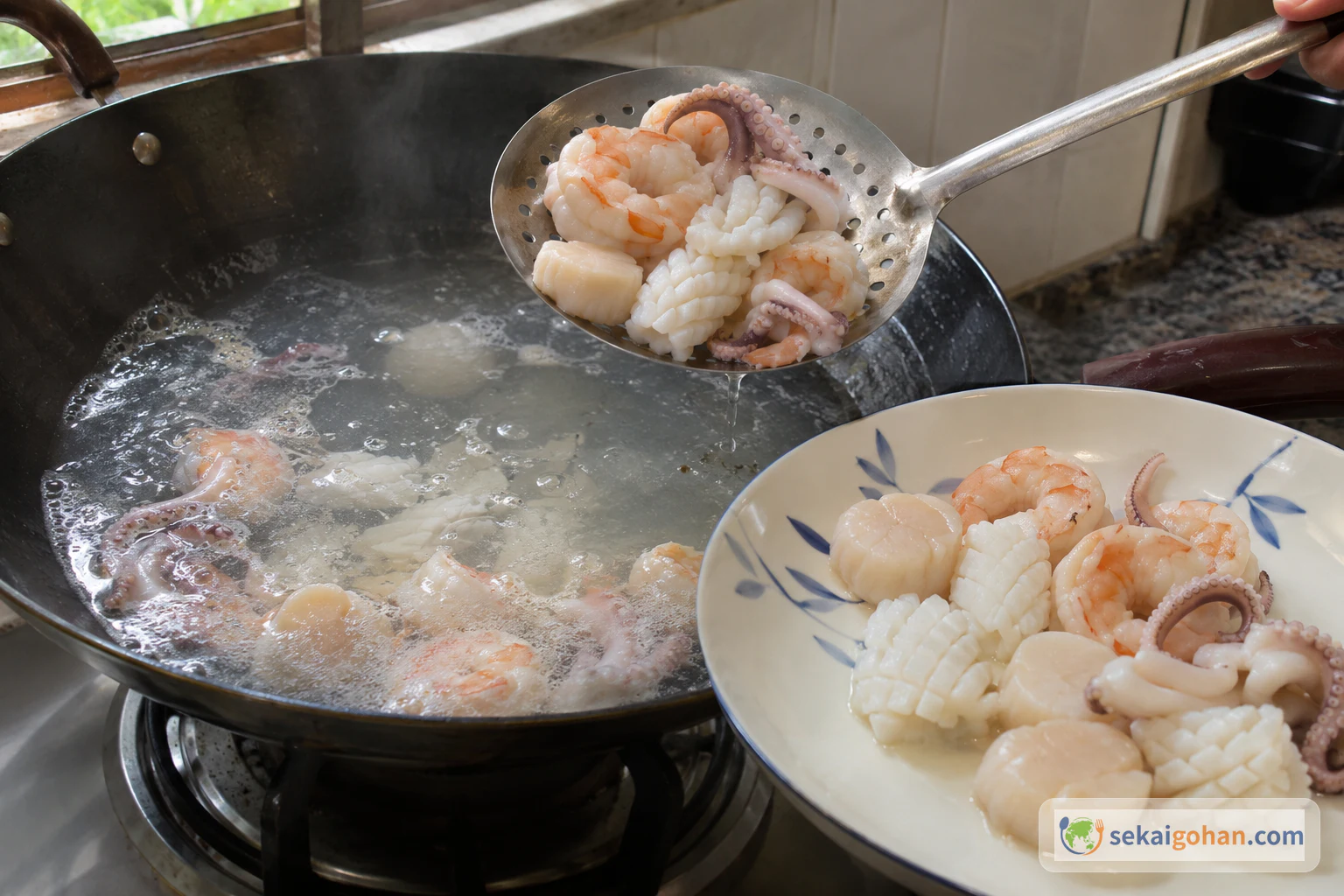
The seafood cooks twice. Pull the shrimp and scallops at about 70% done so the minute in the wok brings them to fully cooked without turning them rubbery.
When It Goes Wrong
| What you see | Why | What to do |
|---|---|---|
| Oil foams up toward the rim when the nest goes in | Moisture in the raw taro boils off all at once | Lower the nest more slowly, pausing as the foam rises, and use a wok or pot with more headroom |
| Nest is pale in places and dark in others | The oil temperature dropped, or part of the nest stayed above the oil | Hold the oil at 325°F (163°C) and keep tilting so the whole nest, rim included, goes under |
| Nest falls apart when you turn it out | Strands were cut thick or laid with gaps | Cut thin, even matchsticks and layer them tightly crisscross before frying |
| Shrimp and scallops are tough | Blanched too long, or the stir-fry dragged on | Blanch only to about 70% done and season the sauce fast once the stock is in |
| Nest turns soft at the table | The filling went in too early | Fill the nest at the last moment and serve at once |
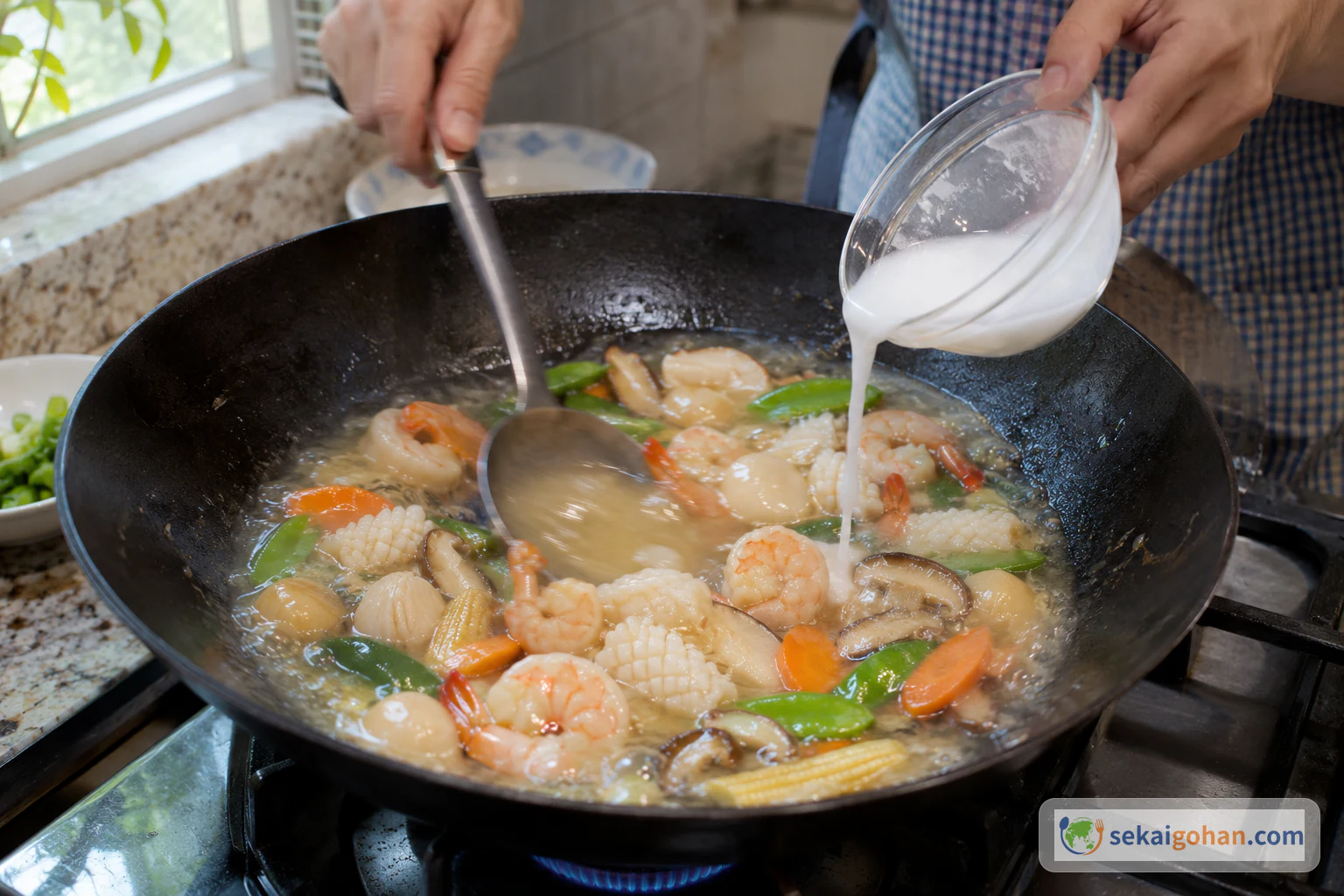
| Sauce is thin and runs to the bottom | No slurry, or not enough | Add the slurry a little at a time until the sauce coats the seafood |
Serving and Variations
At the table
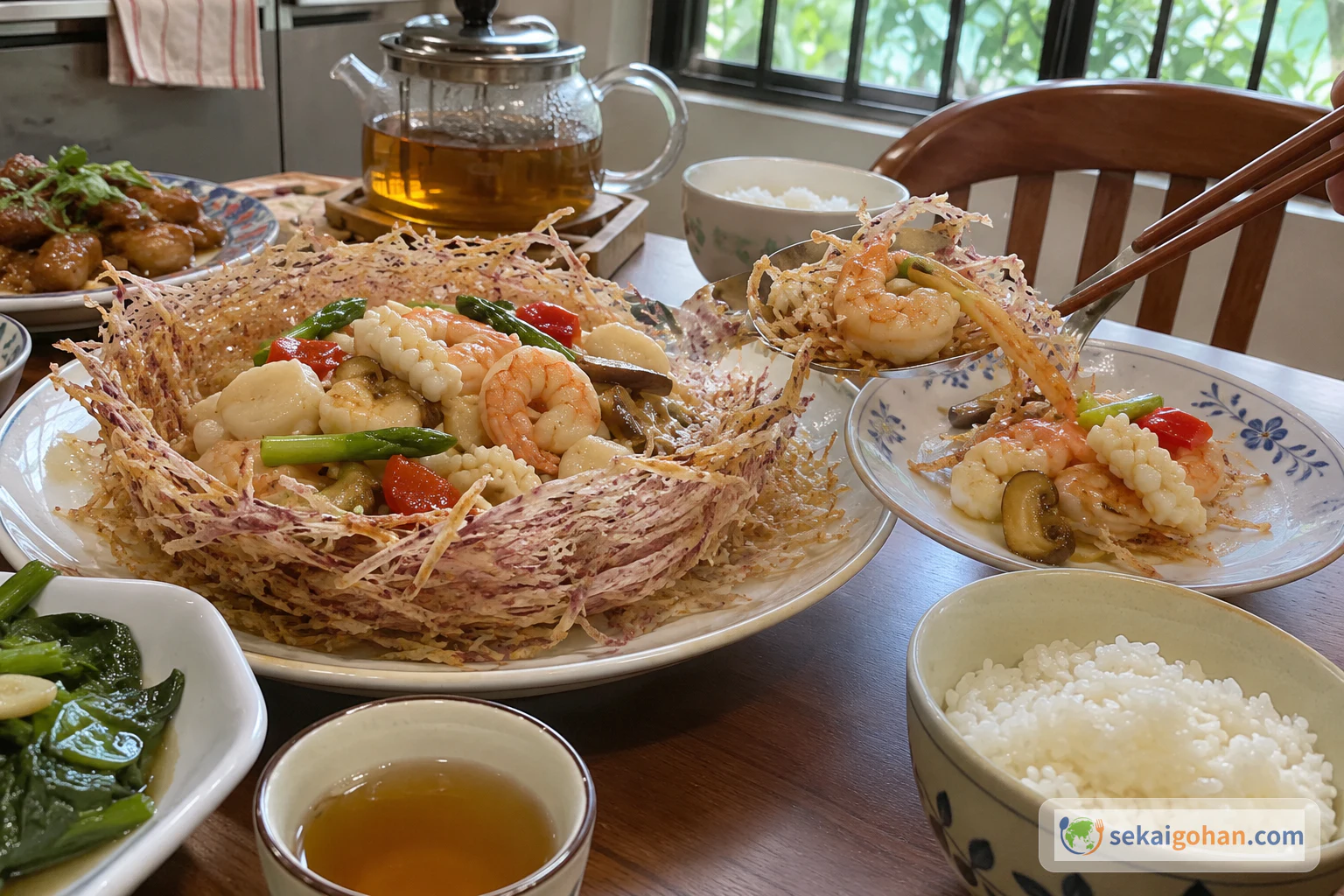
Seafood bird's nest goes to the center of a shared table, and the person serving breaks the nest as they portion it, so each plate gets seafood, sauce and shards of crisp taro together. Steamed rice suits it, and it holds its own beside other stir-fries and a plate of fried rice on a celebration spread. Once filled, the nest softens steadily as the sauce soaks in, so bring it to the table first and eat it while it crackles.
Variations
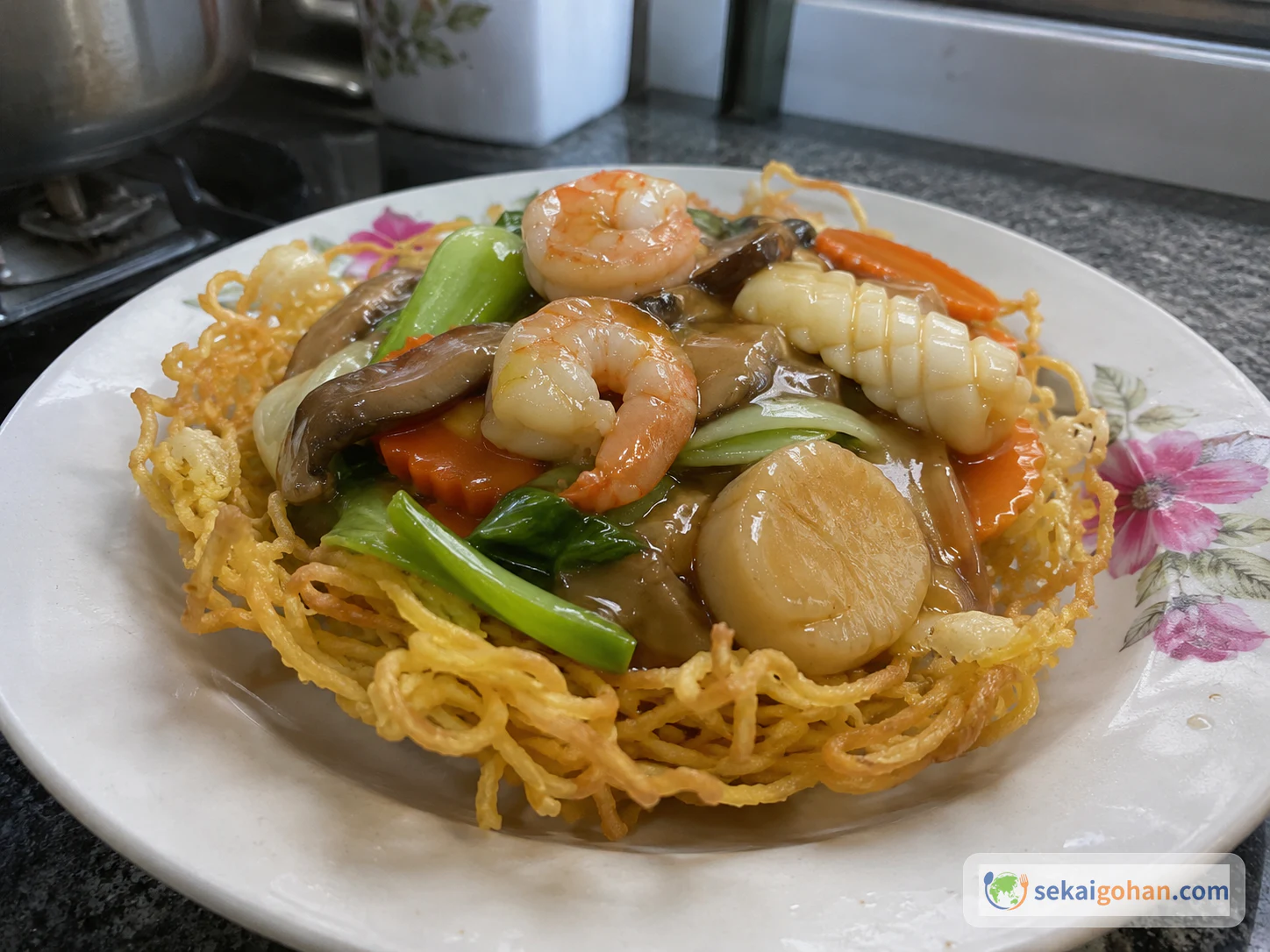
Fried egg noodle nest. The Vietnamese-Chinese version fries egg noodles into a shallow golden nest and tops it with the same kind of seafood stir-fry. The noodles soften gradually as the sauce soaks in, so the dish moves from crisp to tender as you eat. It is also shaped between two strainers or ladles.
Shrimp and scallops only. Leaving out the squid gives a cleaner, sweeter filling built around the two lucky foods, a good choice for a Lunar New Year table.
White fish and celery. Swapping some of the seafood for white fish and adding celery or snow peas makes the filling milder and more crunchy. Add the fish gently and stir less so the pieces stay whole.
Frequently Asked Questions
Can I fry the taro nest ahead of time?
Yes, the nest can be fried the day before. Make the stir-fry on the day and fill the nest only right before serving, since the sauce is what softens it.
How much stock should I use?
Start with 1 cup and adjust it to how much sauce you want. More stock gives a looser sauce for spooning over rice, while less keeps the nest crisp longer.
Do I have to use the cornstarch slurry?
No, it is optional. Without it the sauce stays thin and clear; with it the sauce turns glossy and clings to the seafood. Add it a little at a time and stop as soon as the sauce coats a spoon.
Fresh or canned straw mushrooms?
Either works. Use ½ cup of whichever you find; both cook in a few seconds in the hot wok.