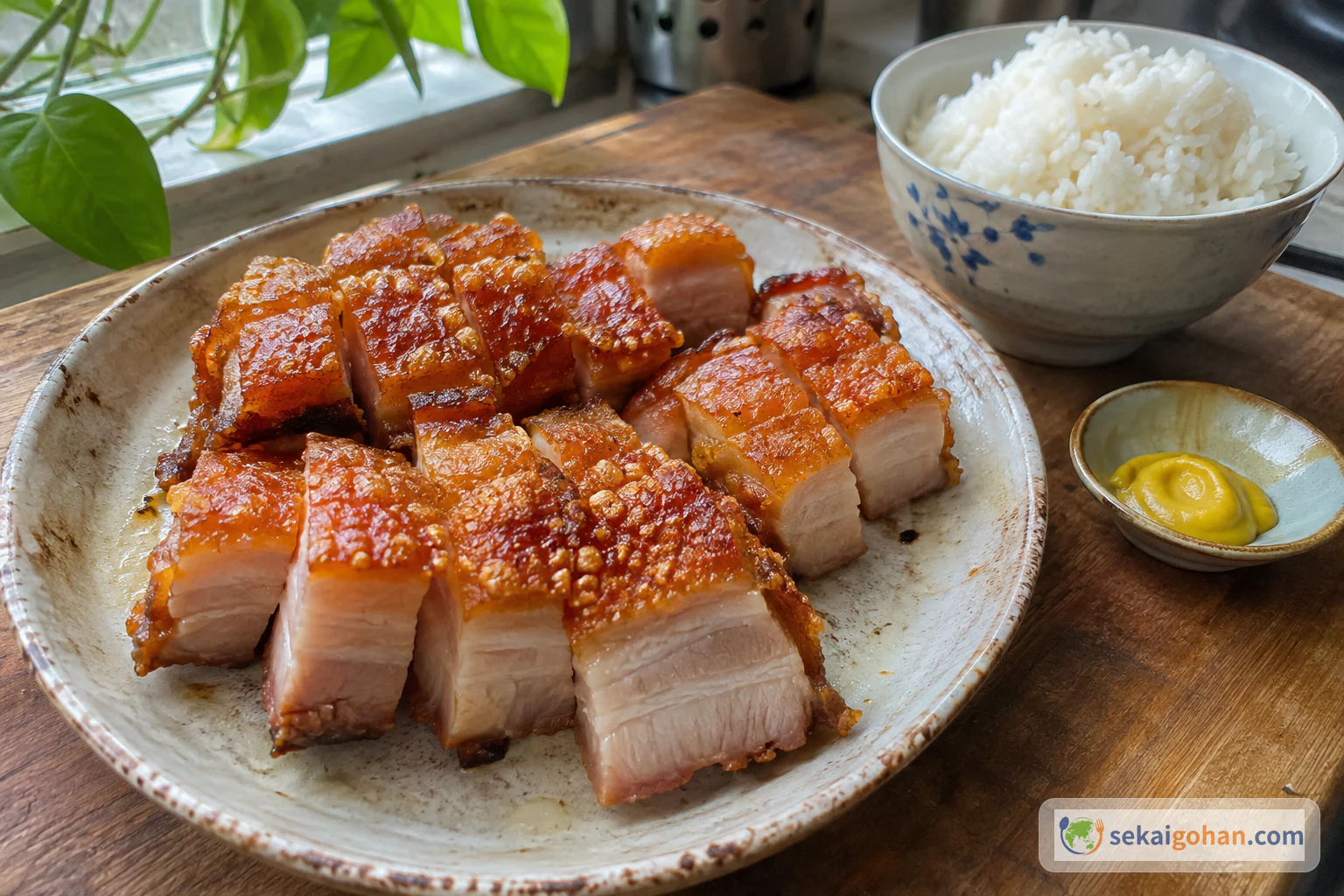
The cleaver comes down on the board, and the skin breaks with a dry crack before the blade reaches the meat. In a Hong Kong roast-meat shop, slabs of siu yuk hang in the window beside char siu, soy sauce chicken and white-cut chicken, and the counter staff chop off exactly the amount you ask for. Siu yuk (燒肉) is Cantonese roast pork belly: a golden, blistered skin that shatters like glass over alternating layers of fat and meat, seasoned with salt, five-spice and fermented bean sauce. It tastes savoury and porky, never sweet, and nearly all the craft goes into that skin. A home oven gets you there with one night in the refrigerator and a pan of water under the rack.
Siu Yuk at the Roast-Meat Counter
Chopped to order
Siu yuk is one of the siu mei (燒味), the roast meats of Guangdong and Hong Kong, and part of the everyday cooking of southern China. Hong Kong even has a word for walking up to the counter and having the shop chop you a portion: 斬料. The meat goes over a plate of white rice for a working lunch in the office districts, and the same roast pork turns up at banquets and feasts. The most popular cut is siu naam zai (燒腩仔), the belly taken from a whole roast pig, and that belly is what a home cook reproduces with a single skin-on block.
The names follow the size. A pig roasted whole is siu zyu (燒豬); once it is chopped and sold by the piece, it is siu yuk (jyutping siu1 juk6). The whole pig is a ceremonial dish, set out for family celebrations, shop openings and ritual offerings, wrapped in red paper or boxed in red for luck, and Hong Kong film crews offer one to bless a new production. Qingming and Chung Yeung are the peak seasons for roast suckling pig, and a whole suckling pig traditionally opens wedding and birthday banquets.
Its closest relative on the shop hook is char siu, and the two work in opposite directions. Char siu is long strips of pork marinated in a sweet sauce and roasted to a layered, sticky glaze. Siu yuk uses no sweet sauce at all: the skin is pricked, dried and roasted until it bursts, and the meat underneath carries a salty, spiced seasoning.
燒肉 simply means "roast meat." The same two characters are read yakiniku in Japan, where they mean Korean-style grilled meat cooked at the table, an entirely different dish. In Cantonese, 燒肉 always means this crackling-skinned pork belly.
From Shunde to the space stove
The roasting craft came to Hong Kong from Shunde in Guangdong. Through the first half of the twentieth century, roast-meat shops were mostly family businesses, and chains spread in the 1960s. At the end of the 1970s, air pollution led to charcoal-roasting licences being stopped, and a hardware shop in Yau Ma Tei, Choi Tung Sing (蔡同盛), built the upright stainless-steel gas oven that took their place. Its name is 太空爐, the "space stove," and it now stands in shop kitchens across the city. Whole pigs in southern China and Hong Kong are still seasoned much the same way, with salt and vinegar, and roasted at high heat.
The crackle
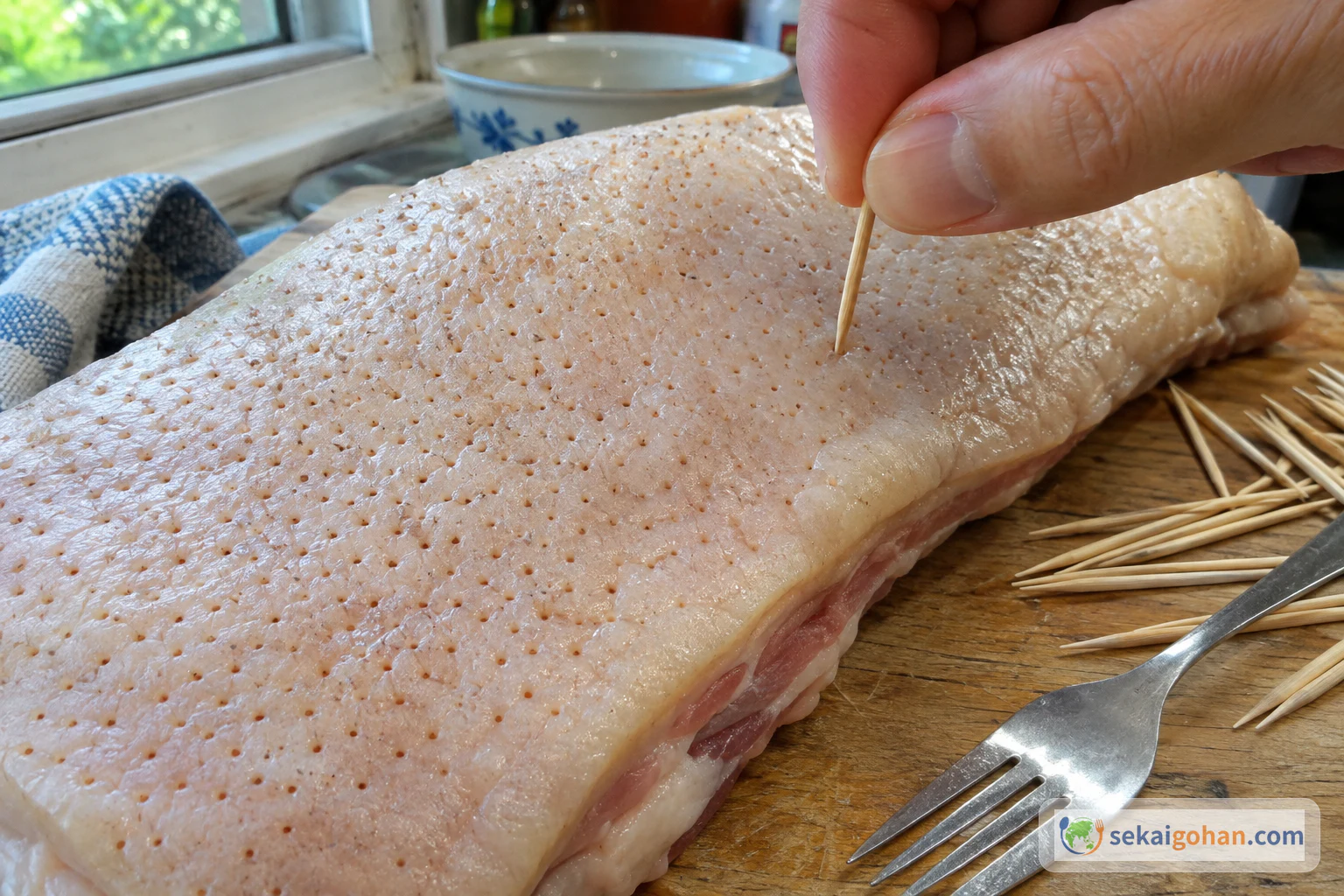
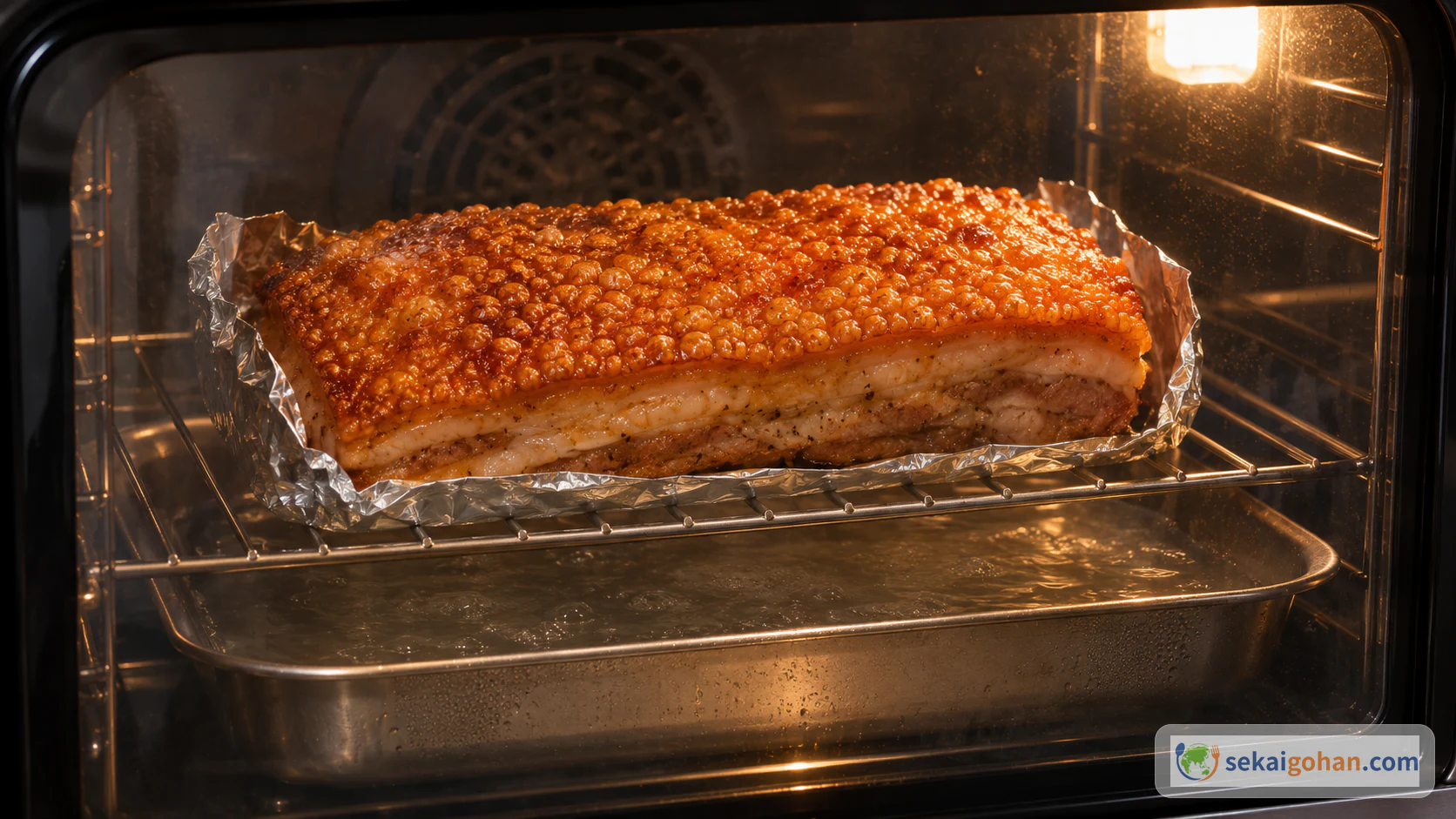
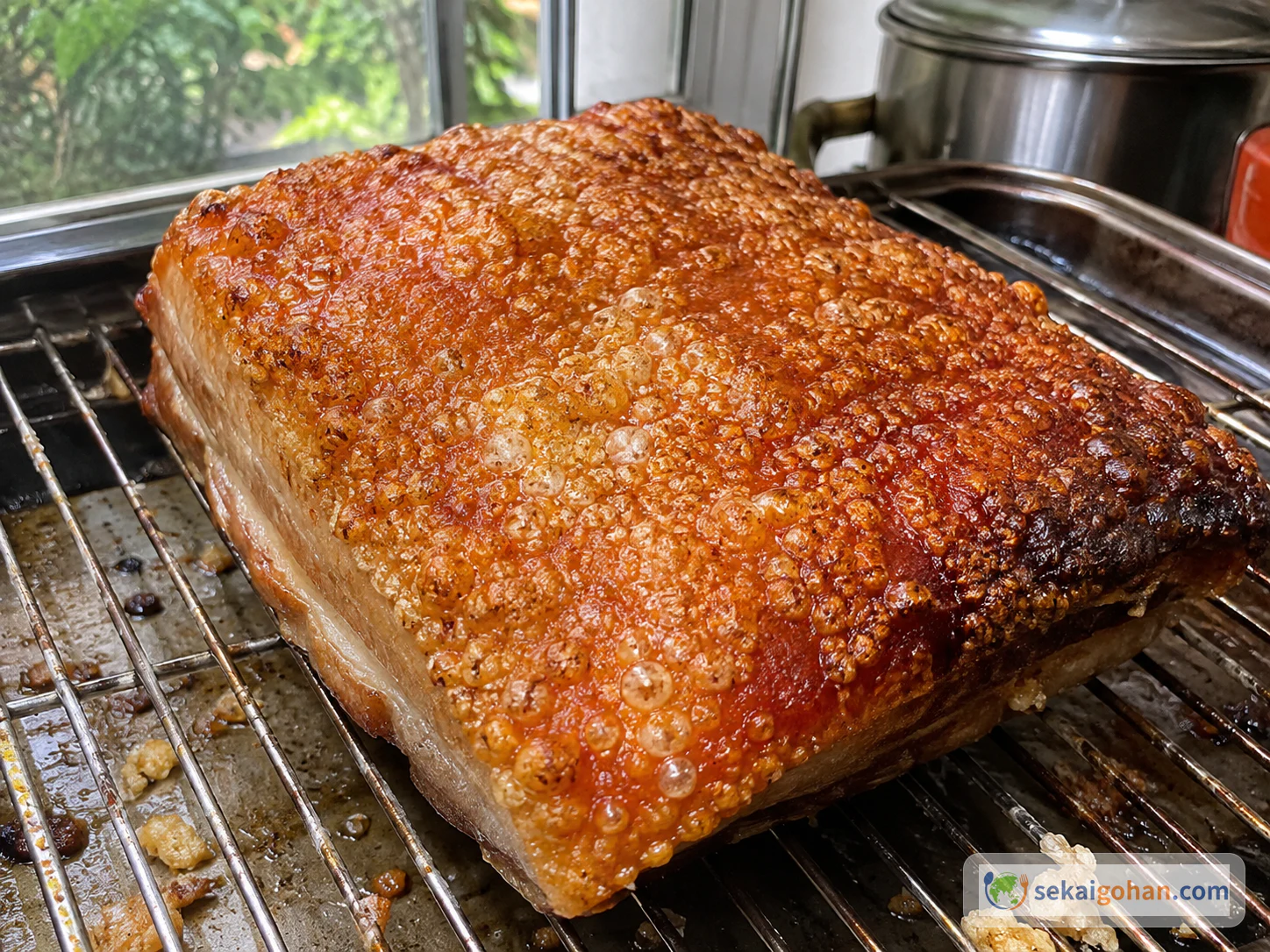
What a Hong Kong eater judges first is 爆花, "bursting flowers": the foamy, blistered pattern the skin forms in the heat. Good skin makes a sharp kacha when you bite or cut it. The shop method is short to describe. Prick the skin all over with a needled tool, brush it with vinegar, let it air-dry, then roast. The finish to aim for is sesame skin (芝麻皮), an even cover of blisters each about the size of a sesame seed. Suckling-pig roasters also make a smooth, glossy "glass skin" (玻璃皮); for siu yuk you want the bubbles. Many of the home versions cooked today came out of Cantonese family kitchens abroad, built around domestic ovens instead of a space stove.
Ingredients (serves 4)
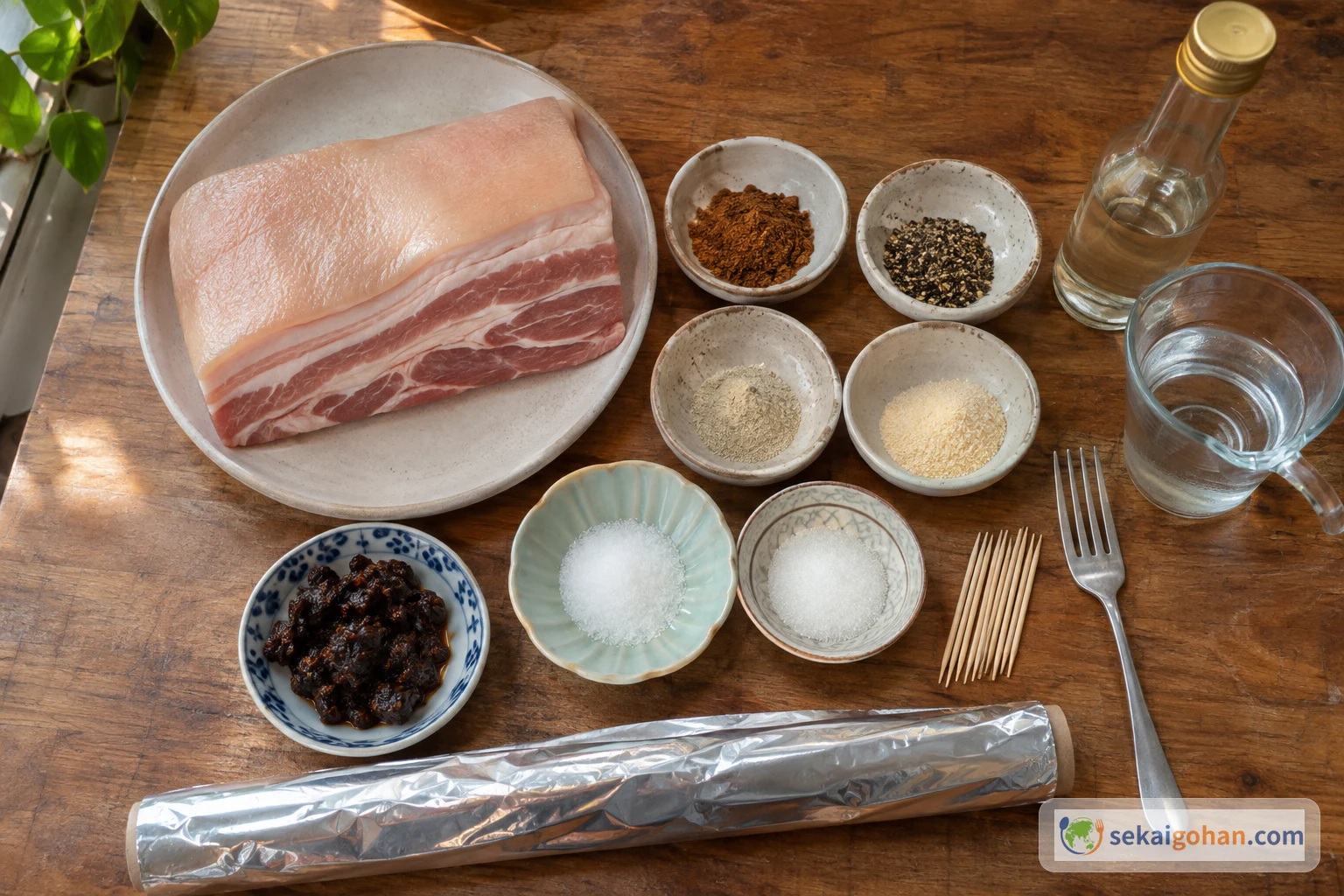
Buy one whole skin-on block, never sliced or cubed belly. Thin slices and grilling cuts have no skin to puff and no depth to stay juicy. A block whose layers show clearly along its side gives the strongest contrast of rendered fat and meat once roasted.
Ground bean sauce is a fermented soybean product, and some brands also contain wheat. Garlic salt blends differ in their additives. Read the labels on both if anyone at the table has a soy, wheat or other allergy.
Equipment
- Pot for blanching, and a bowl of cold water
- Chef's knife and cutting board
- Toothpicks, a fork or a pointed metal skewer
- Paper towels
- Aluminum foil
- Roasting rack set over a rimmed baking pan
- Oven or large toaster oven
- Food thermometer (optional)
Choosing and Substituting
Three things make siu yuk taste like the shop version: a skin-on belly, five-spice and ground bean sauce. Keep all three. Ask at a meat counter for skin-on pork belly as one block; belly with thinner skin roasts to a crisp skin that stays pleasant to bite instead of hard. Five-spice is in most supermarkets, though the blends in Chinese grocery stores sit closer to the roast-shop smell.
Ground bean sauce (磨豉醬, sold in English as "ground bean sauce") is the one item worth a trip to a Chinese grocery or an online order. Nothing else gives the same fermented depth to the meat side. Mashed fermented black beans could stand in as an untested substitute paste, but their aroma falls short of the real sauce.
The rest swaps easily. Plain white vinegar does the same job on the skin as white rice vinegar. If you have only black pepper, use it for the white pepper too; the heat stays, but the aroma changes. Without garlic salt, combine salt and garlic powder, and keep the salt light, because the rub already carries its own plain salt on top.
Run a finger across the skin before you buy. Thin, even skin over clear layers of fat and meat puffs evenly and cracks cleanly. Very thick skin roasts up tough.
Method
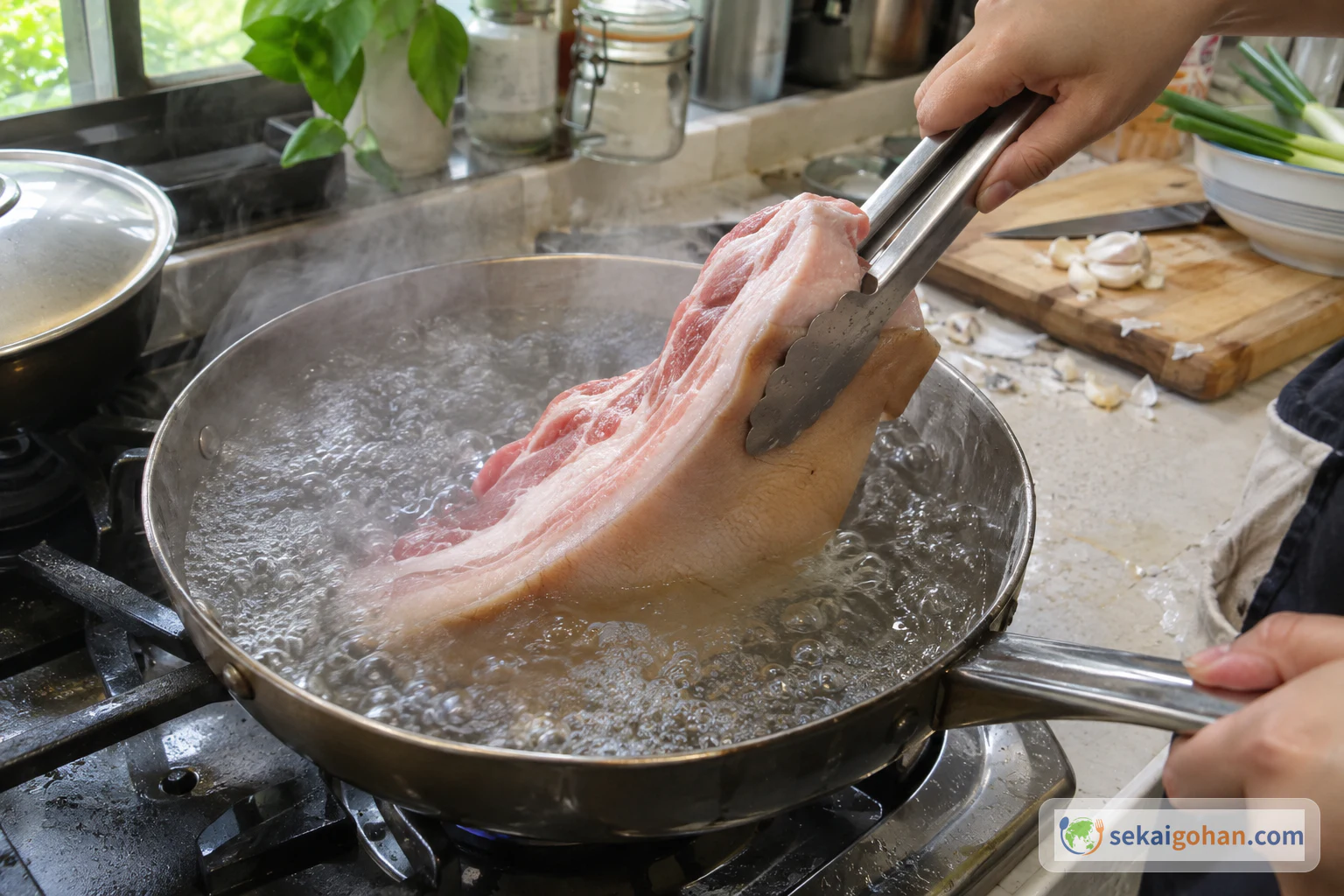
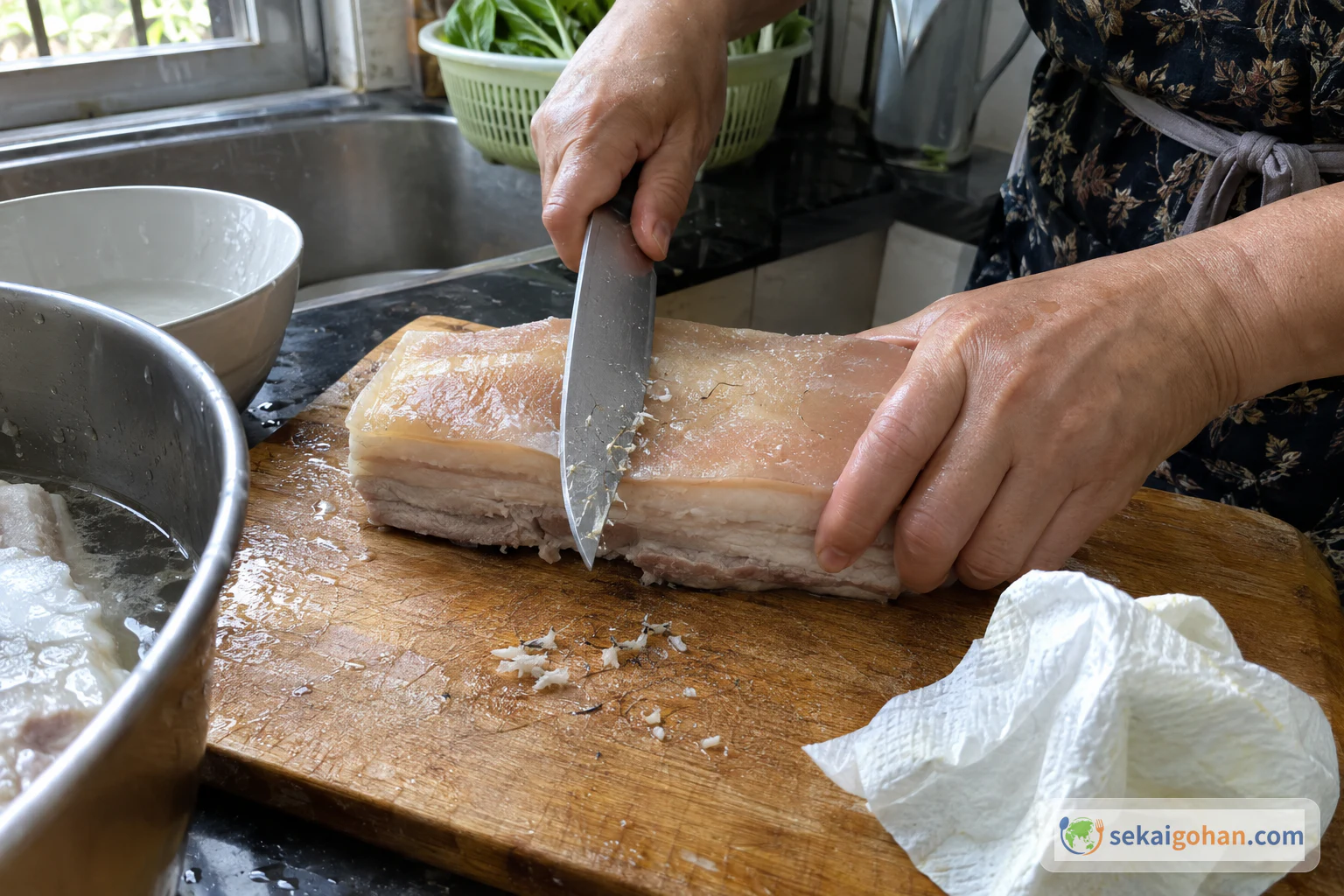
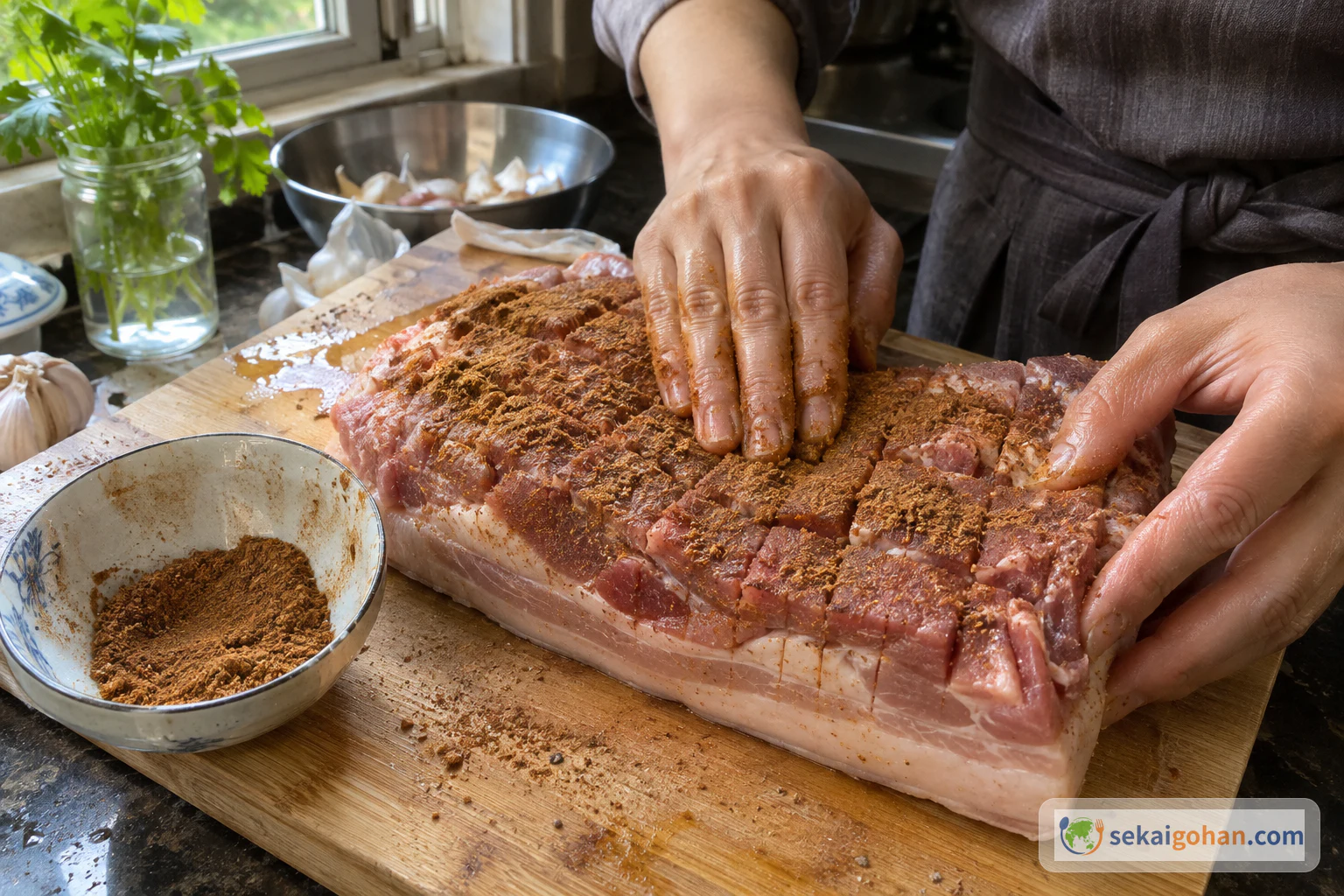
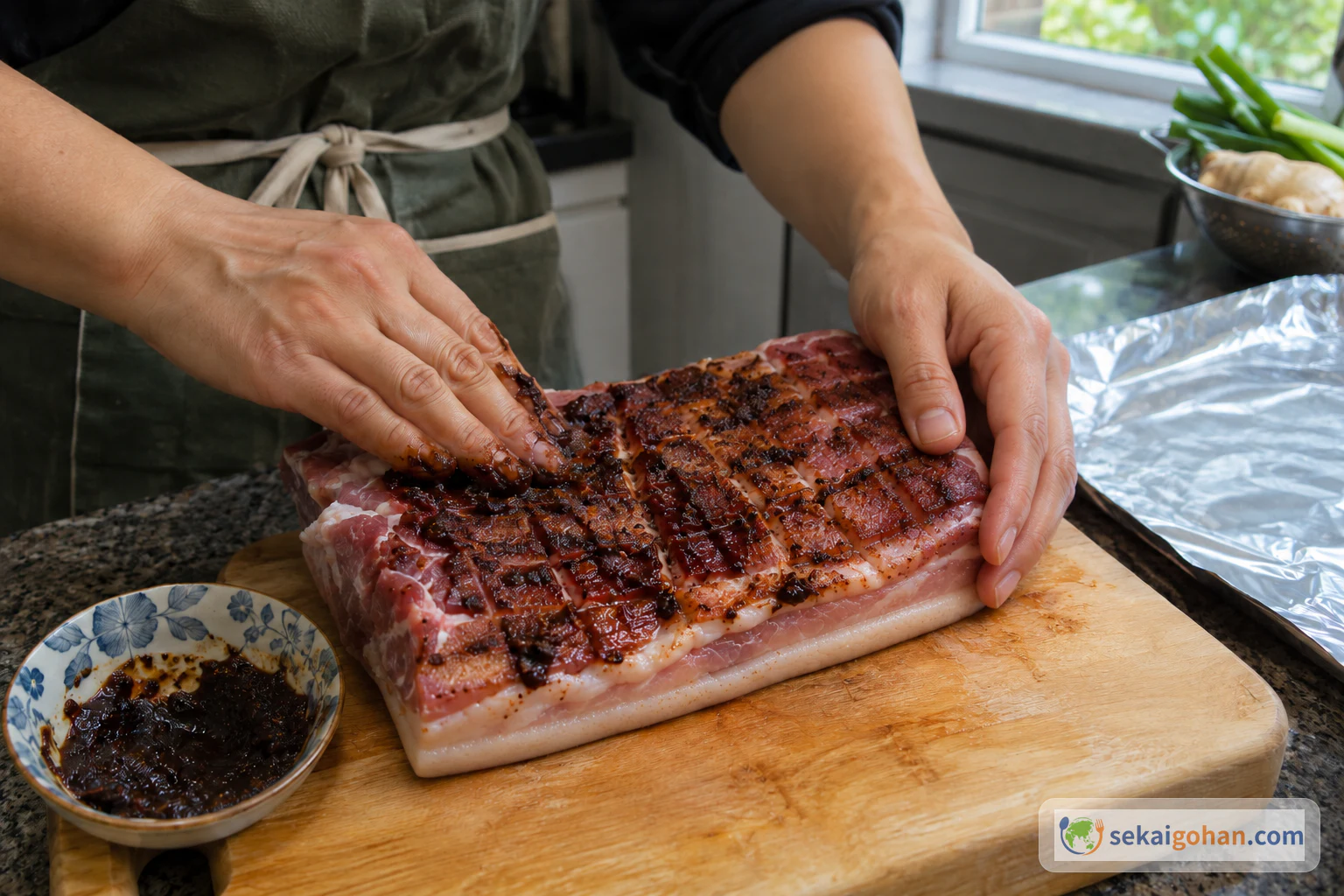
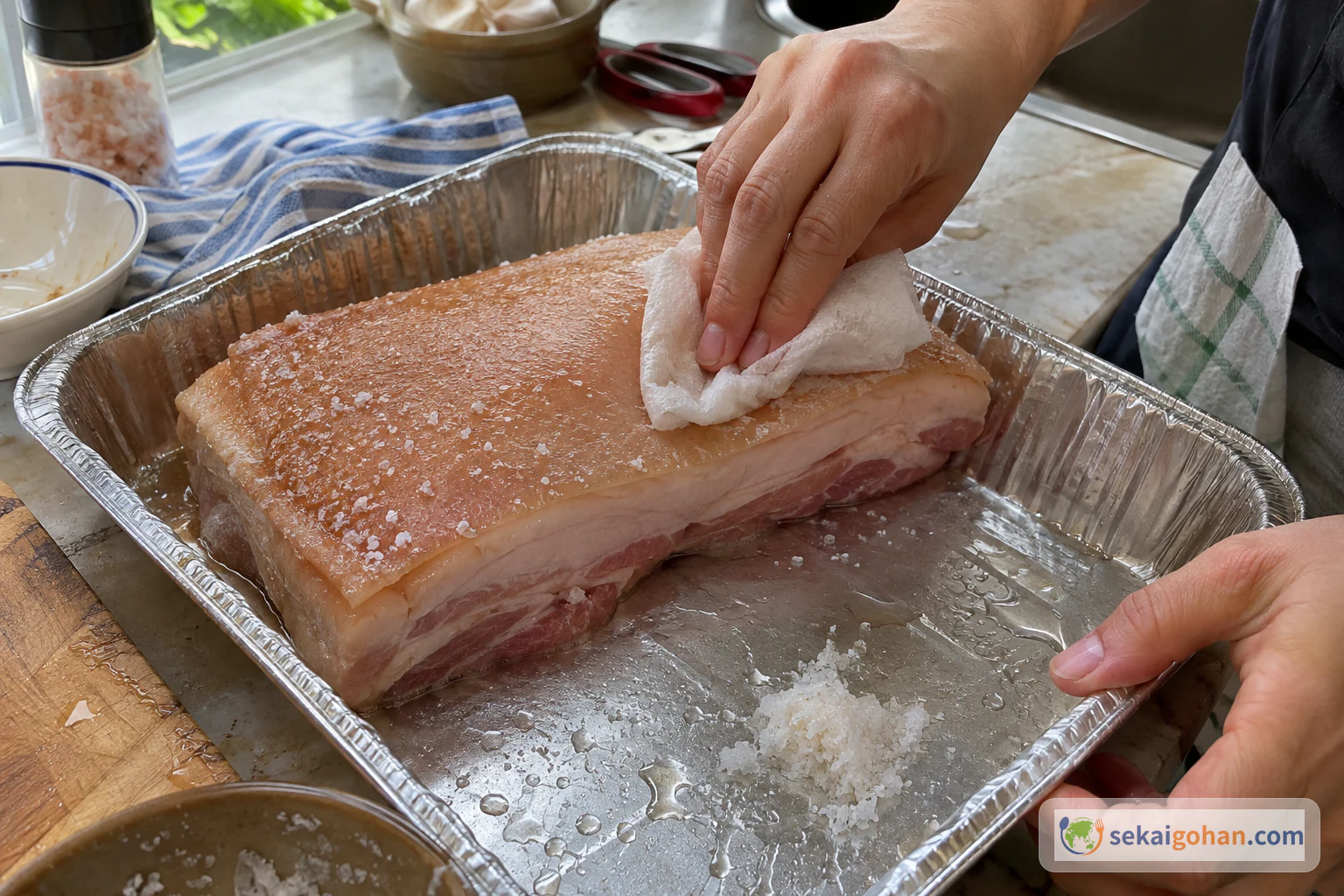
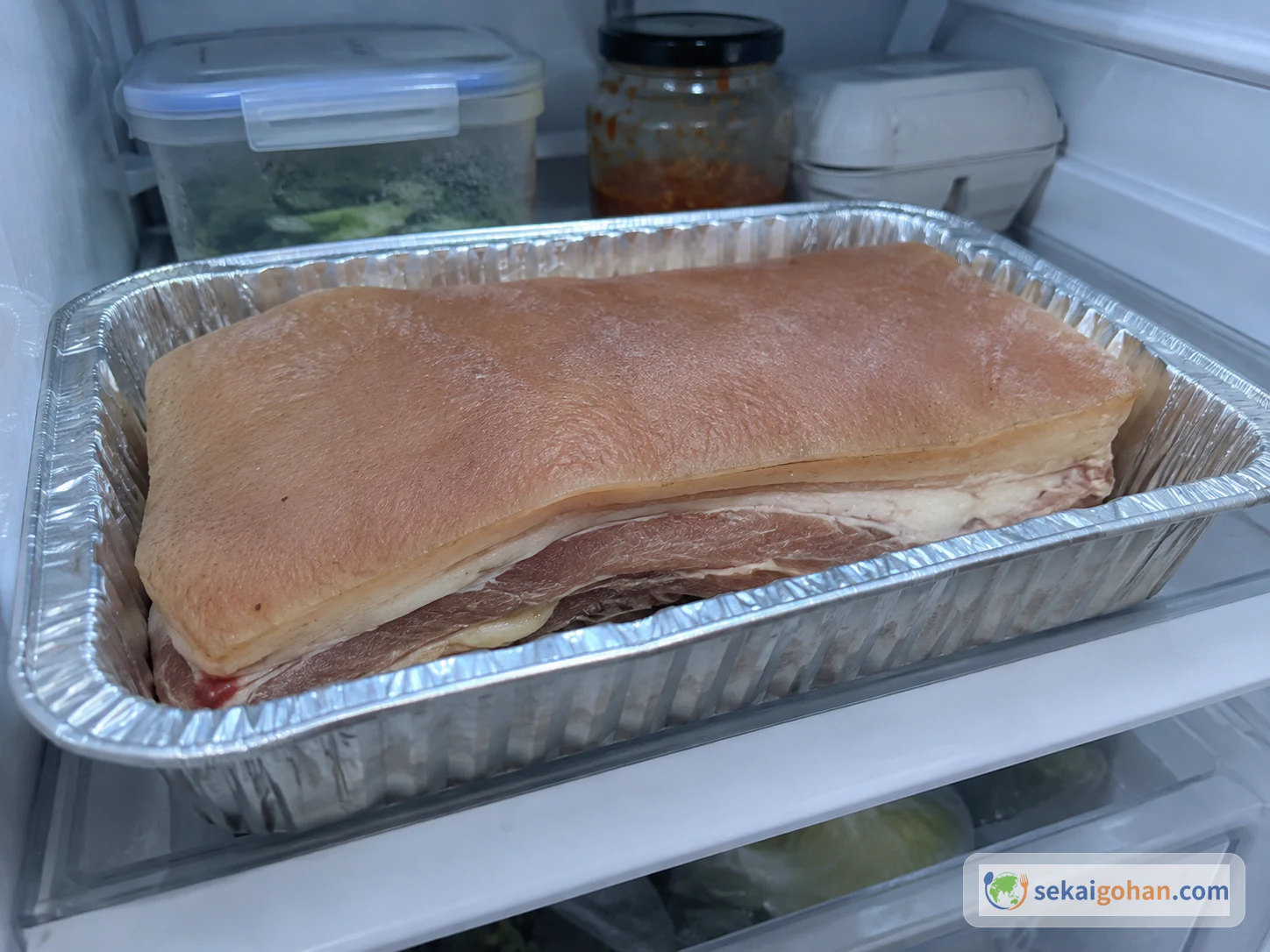
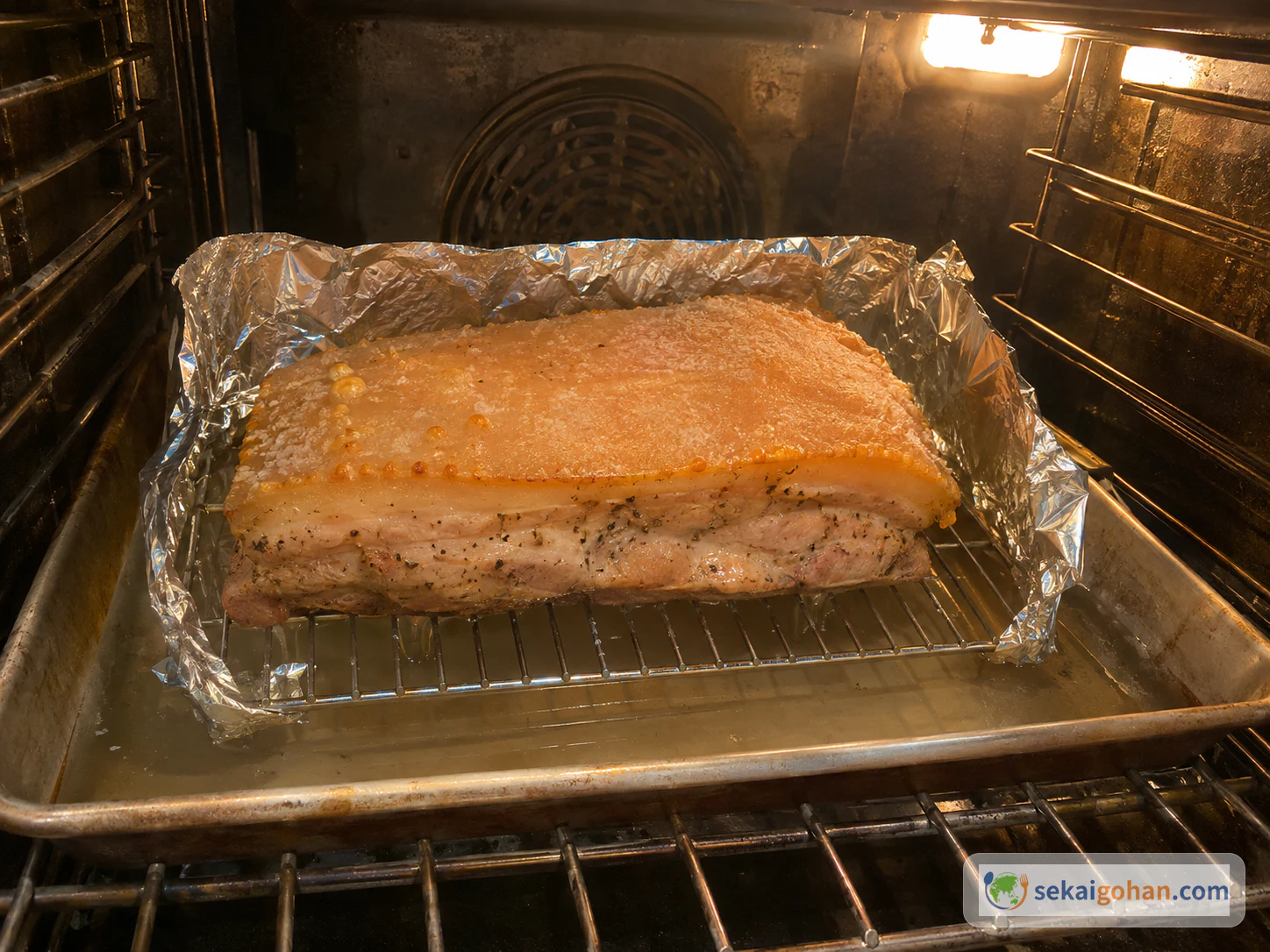
The work splits across two days. On the first, you blanch and clean the pork, prick the skin, season the meat side, then salt and wipe the skin; the pork then dries uncovered in the refrigerator overnight, which is the long hands-off stretch. The next day is the oven and the rest before cutting. The skin needs dry, untouched surface all the way through: nothing wet, and no rub or sauce on it.
When It Goes Wrong
| What you see | Why | What to do |
|---|---|---|
| Skin stays flat, hard or rubbery | Too few holes, holes too shallow, or the skin was not dry enough | Next time, prick more densely through the skin and give it the full 10 to 12 hours or longer uncovered in the refrigerator |
| Pale, unblistered patches on the skin | Rub or bean sauce strayed onto the skin, or a damp spot was missed | Keep the seasoning strictly on the meat side and check that the dried skin is matte all over before it goes in the oven |
| Meat dry, juice pooled on the board | Cut too soon | Rest the full hour before cutting |
| Everything tastes too salty | Salt left on the skin, or extra salt in a garlic salt swap | Wipe and scrape off every grain after the 5 minutes; with homemade garlic salt, go lighter on the salt |
| Bottom scorched or smoking | Pork set straight in the pan, or the pan ran dry | Always roast on a rack over the water, inside the foil wall |
The skin cannot be fixed once the pork is in the oven, so the moment to catch a problem is before roasting. Run your hand over the dried skin: it should feel uniformly hard and dry with no tacky spots and no seasoning on it.
Serving and Variations
At the table
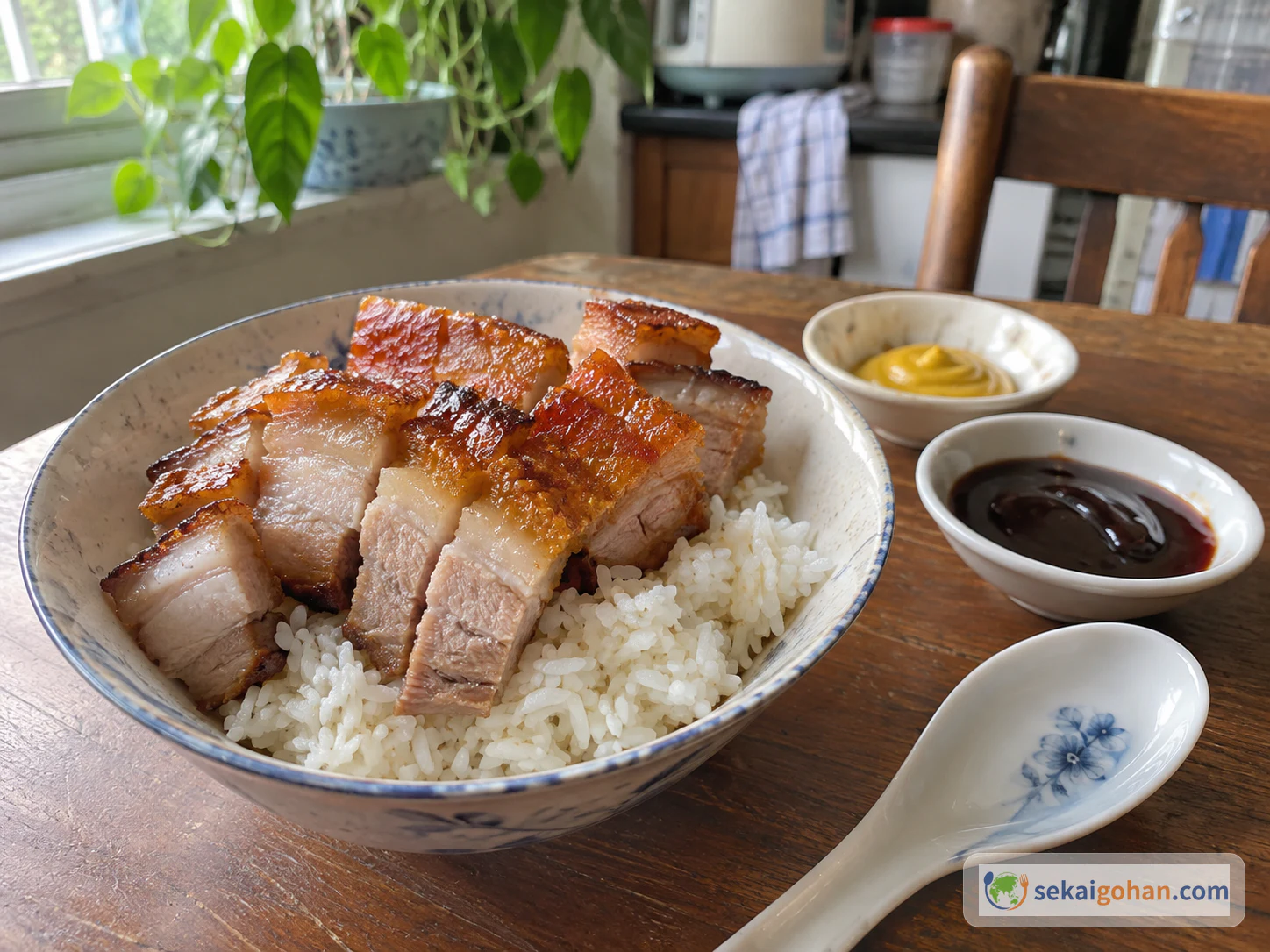
Siu yuk goes the way it goes at the shop: chopped into small pieces and laid skin-side up over white rice, with Chinese hot mustard and hoisin sauce on the side for dipping. The mustard cuts through the fat; the hoisin adds the sweetness the pork itself does not have. In Hong Kong cha chaan teng, roast pork is braised with tofu in a soy-based sauce and served over rice as 豆腐火腩飯, and it is one of the layers of poon choi, the big communal basin dish served at festivals and winter gatherings. Leftover pieces go into fried rice or fried noodles.
Variations
Home recipes for siu yuk split in three places: what dries the skin, how the oven is run, and how the meat is seasoned. Each change below is its own method; keep its amounts separate from the recipe above.
- Salt crust. The skin is covered in a single layer of coarse salt and roasted longer at one temperature, then finished under a low broiler. The crust lifts off in one sheet after roasting, and coarse salt keeps the skin from turning too salty.
- Alcohol on the skin. Vodka or baijiu brushed on the skin in place of vinegar dries faster than water does, and the skin puffs readily. This version roasts low and long and finishes under the broiler.
- Brined belly. The block soaks in salt water for 2 hours before drying, and the seasoning goes Shaoxing wine, garlic, ginger and scallion instead of bean sauce. The meat comes out saltier throughout.
Frequently asked questions
Can I skip the blanching?
No. Blanching firms the skin so it scrapes clean and holds its shape through pricking and drying. Skipping it is one of the common reasons the skin roasts up uneven.
Why vinegar on the skin?
Vinegar helps the skin dry out in the refrigerator and puff in the oven. It is the same move roast-meat shops use before air-drying their pork. Spread it thinly; it goes on after the salt is wiped off, never with it.
Can I make a smaller piece?
Yes. With half the pork, halve every seasoning, the skin salt and the vinegar too. Roasting time follows the thickness of the block rather than its weight, so keep the same temperatures and judge the finish by the deep golden, fully blistered skin.
Do I need a meat thermometer?
You can cook siu yuk by time and by the look of the skin. If you use a thermometer, push it into the thickest part in the middle of the block, away from any bone, and look for at least 160°F (71°C). Pork is never eaten raw or underdone.