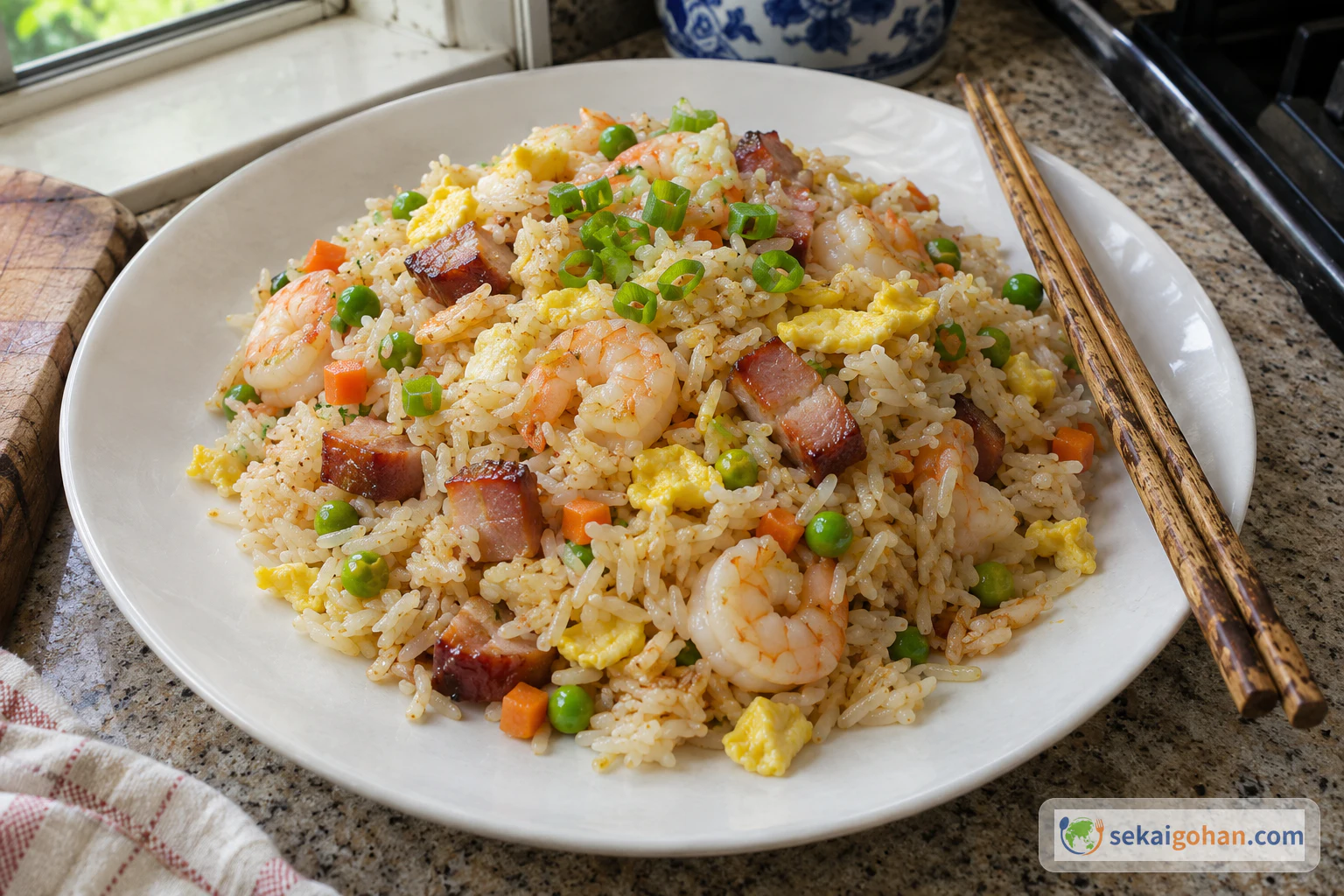
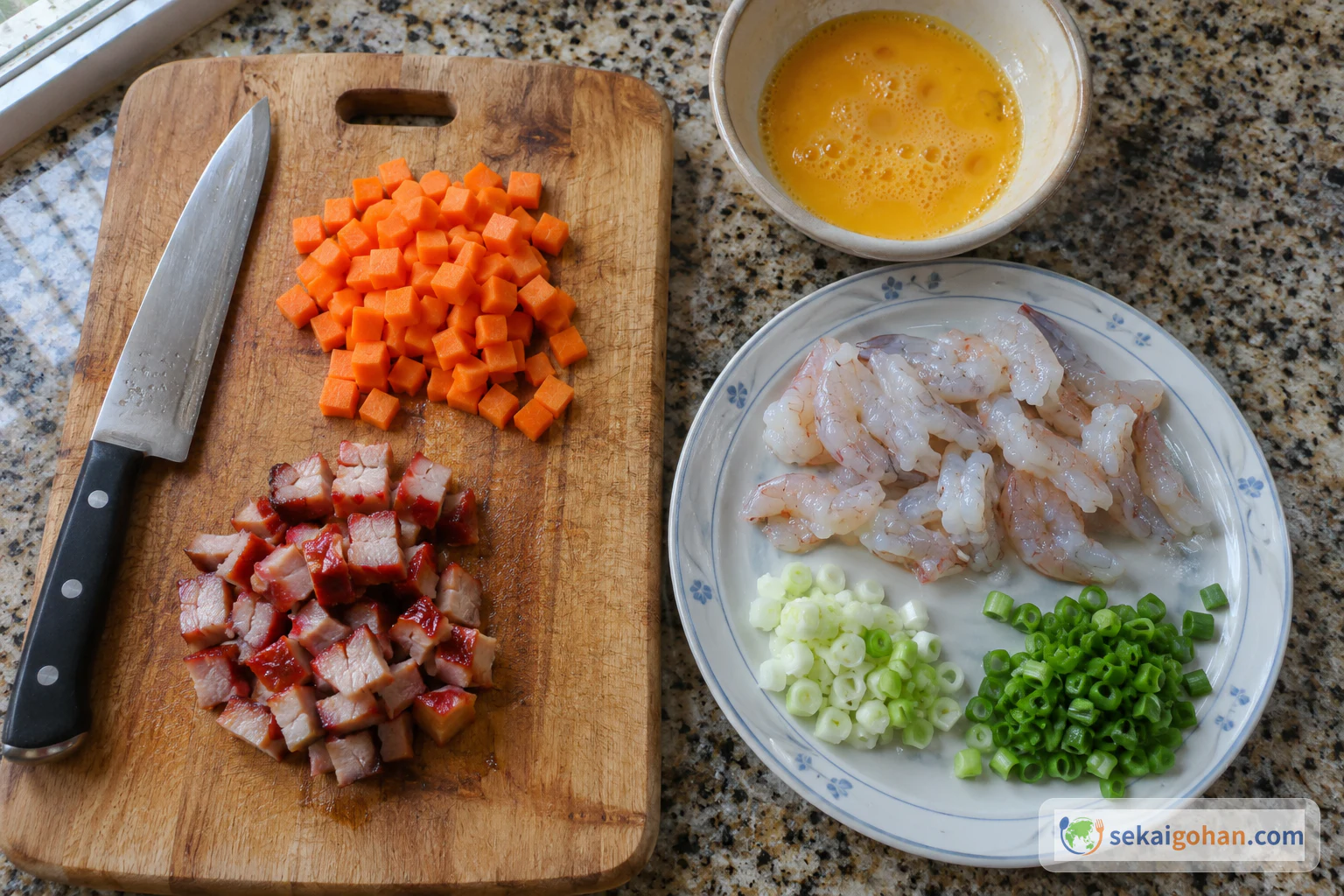
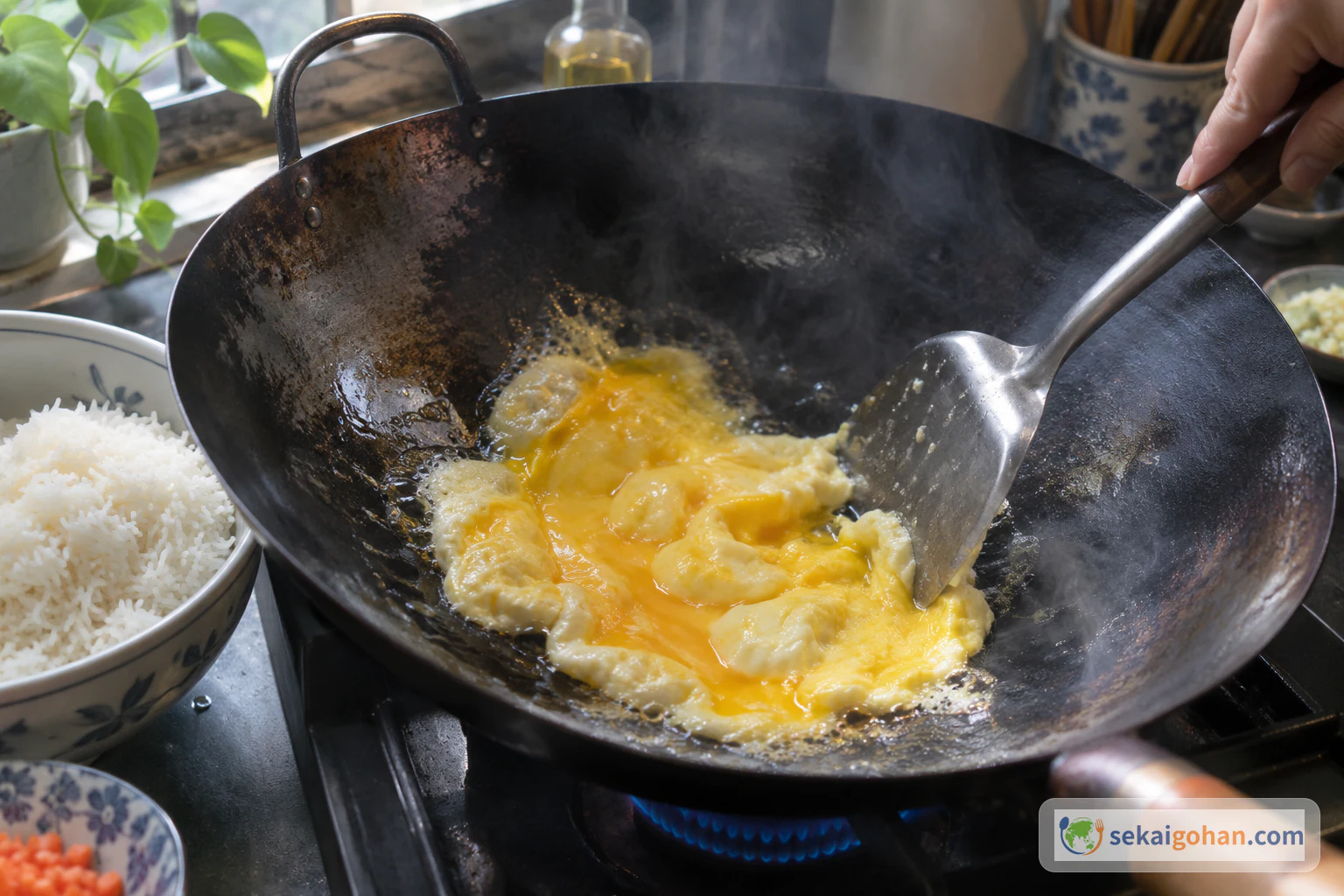
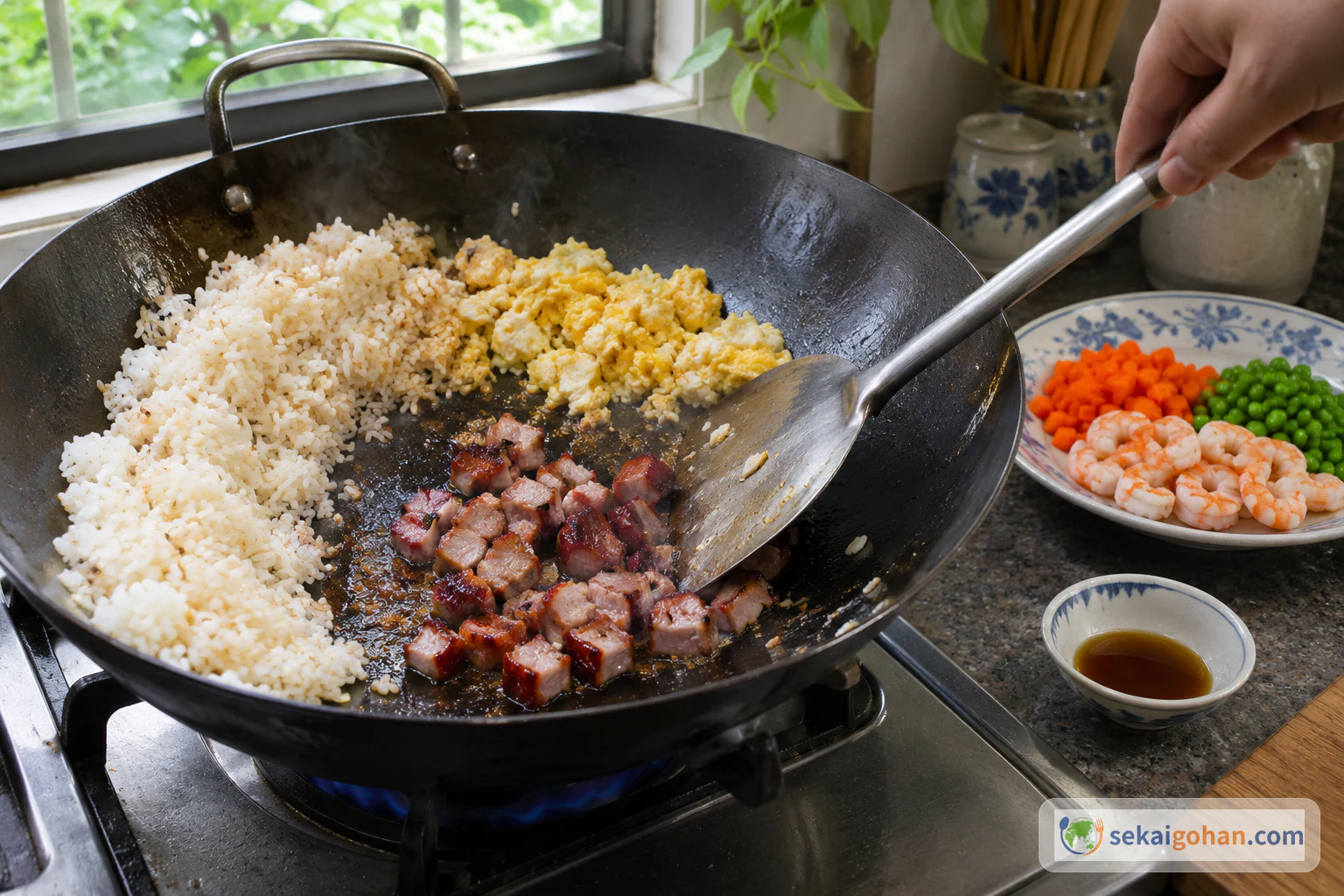
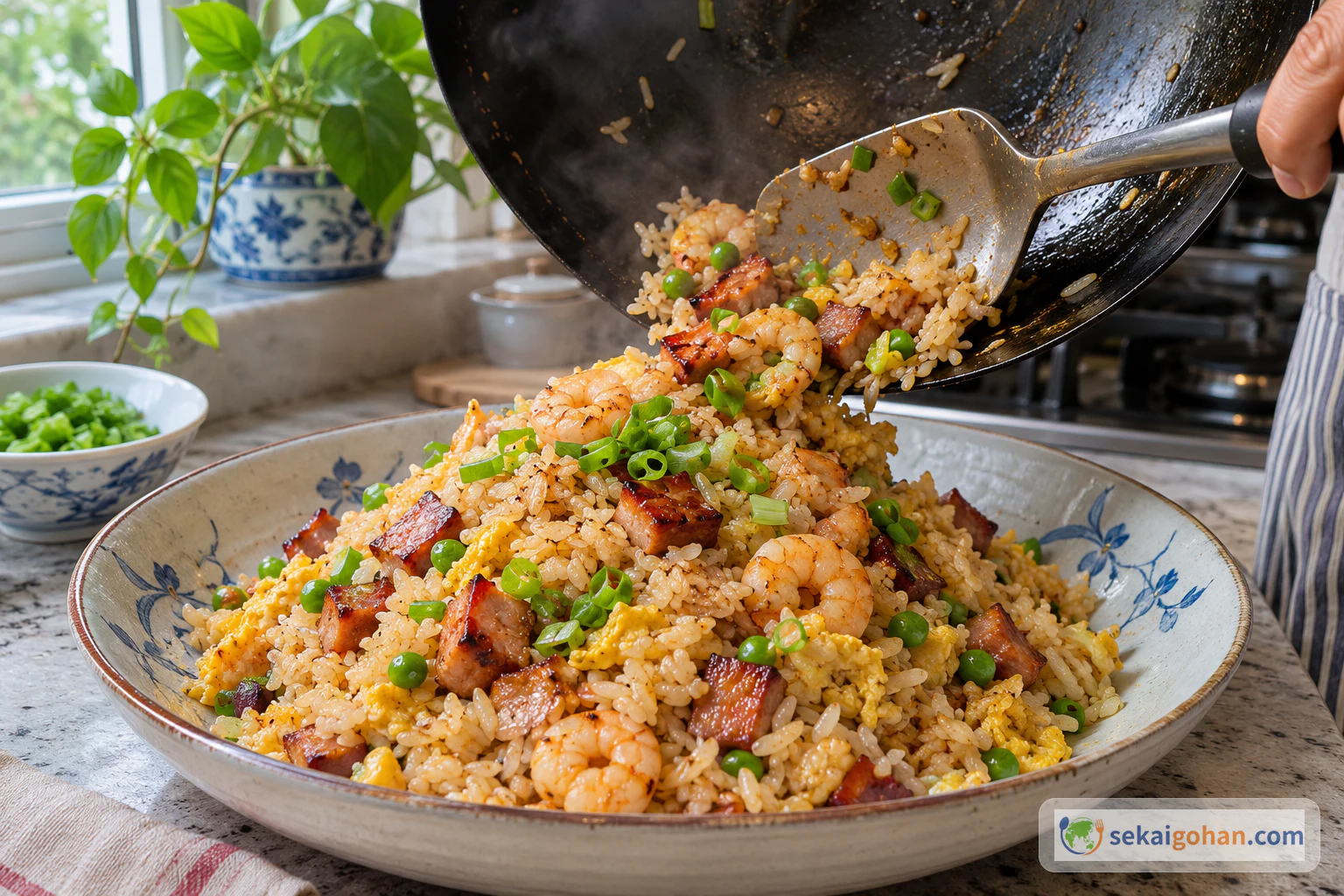
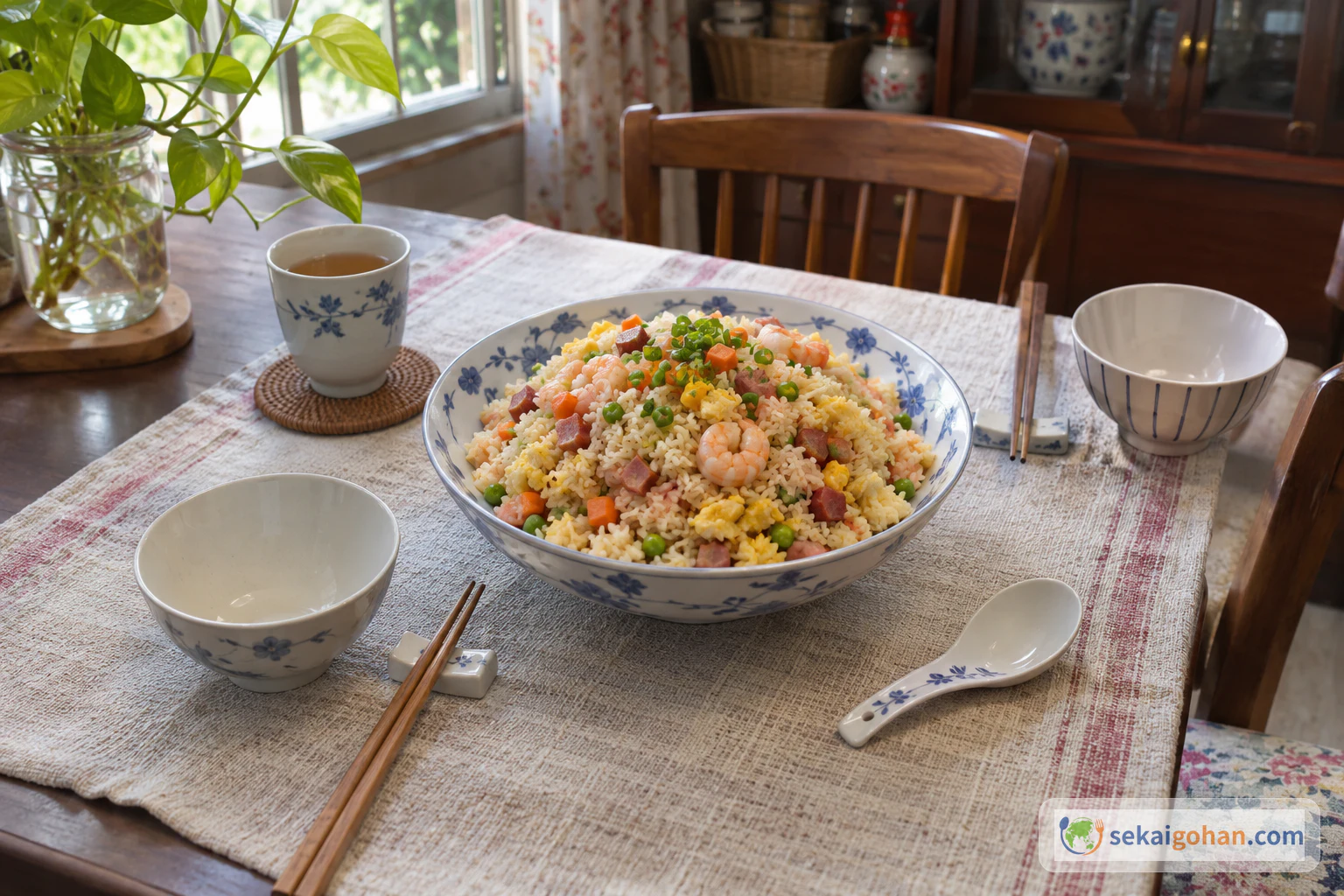
Pour the beaten egg into a wok so hot the oil ripples, count to ten or fifteen, and tip the rice straight in while the egg is still soft. Soon the grains start to crackle against the metal, and the egg breaks into small yellow pieces caught between them. Then come cubes of char siu with their sweet roasted smell, pink shrimp, green peas and orange carrot, and a last slick of oil that makes every grain shine. Yeung Chow fried rice carries the name of Yangzhou, a city in China's Jiangsu province, and Chinese restaurants abroad sometimes list it as house or special fried rice. It tastes salty and savory from salt and light soy sauce, with the sweetness of the pork and peas running through it, and it goes to the table in one big bowl that everyone serves themselves from.
From Yangzhou to the Restaurant Menu
One dish, many spellings
In Chinese it is 揚州炒飯 (simplified 扬州炒饭), Yángzhōu chǎofàn in Mandarin. English menus spell it Yangzhou, Yang Chow, Young Chow or Yeung Chow, and plenty of restaurants drop the city altogether and call it house or special fried rice. Whatever the menu says, you know it by what is in the bowl: egg, two kinds of protein, peas and carrot, folded into rice that stays in separate grains.
Yeung Chow is an irregular way of writing the Cantonese reading of the name, joeng4 zau1 caau2 faan6. The spelling travelled with Cantonese cooks and their restaurants, which is why it shows up on menus far from Yangzhou itself.
Where it began
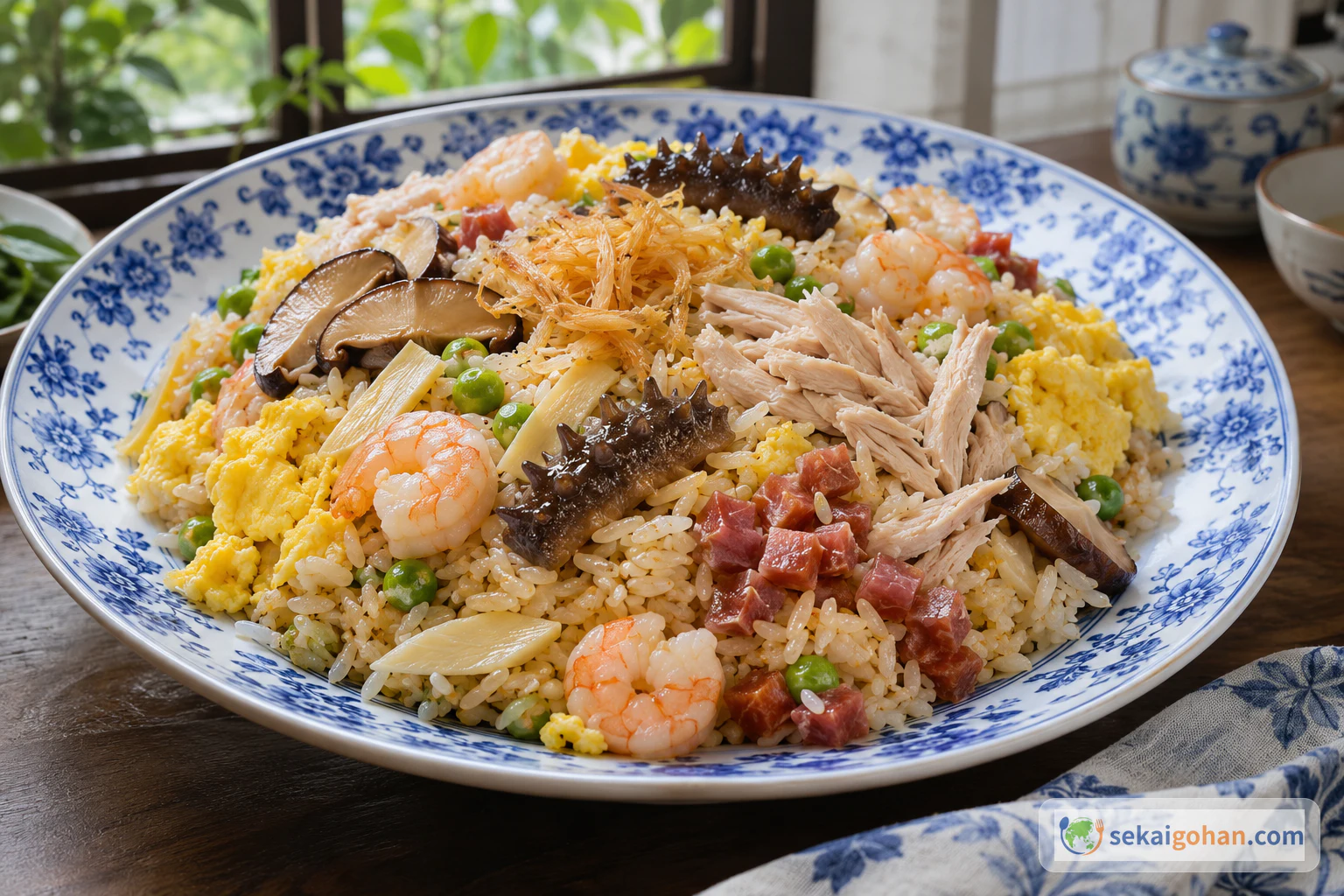
Where the dish began is not settled. One telling takes it back to the Sui dynasty (581–618). Another says Yangzhou sailors tossed the scraps of their lunch into fried rice for dinner. Another credits Yi Bingshou, a Qing-dynasty magistrate of Yangzhou, and yet another places its birth in Guangzhou, far to the south. Over generations of chefs it became one of the best-known dishes of Huaiyang cooking, the style of the Yangzhou region, which prizes chosen ingredients, careful technique and bright color while keeping each ingredient tasting of itself. Versions range from egg alone to shrimp and egg or ham and egg, and older, richer versions add chicken, sea cucumber, bamboo shoots or scallops. Yangzhou fried rice is one of many dishes from China whose name points to one city while its cooks spread everywhere.
The 2015 Yangzhou standard
On October 22, 2015, at the first national invitational Yangzhou fried rice competition, the city announced a new standard for the dish. The base is top-grade long-grain indica rice and three to four fresh eggs. Eight garnishes go with it: rehydrated sea cucumber, cooked local chicken thigh, Chinese ham, rehydrated dried scallop, starch-coated lake shrimp, rehydrated flower mushroom, fresh bamboo shoot and green peas. The finished rice should have distinct, glistening grains, the colors red, green, yellow, white and orange, and a salty-savory taste, neither too hard nor too soft, fragrant and fresh.
An earlier standard from 2002, set by the Yangzhou Culinary Association, was only a reference. The 2015 version came out as a local standard from the city's quality supervision bureau and carries some binding force. Restaurants that follow it earn the title of designated maker of standard Yangzhou fried rice and lose it if they stop. The association put the rule simply: lose the aroma of egg, of rice or of the vegetables, and it is no longer true Yangzhou fried rice.
Two proteins, one pan
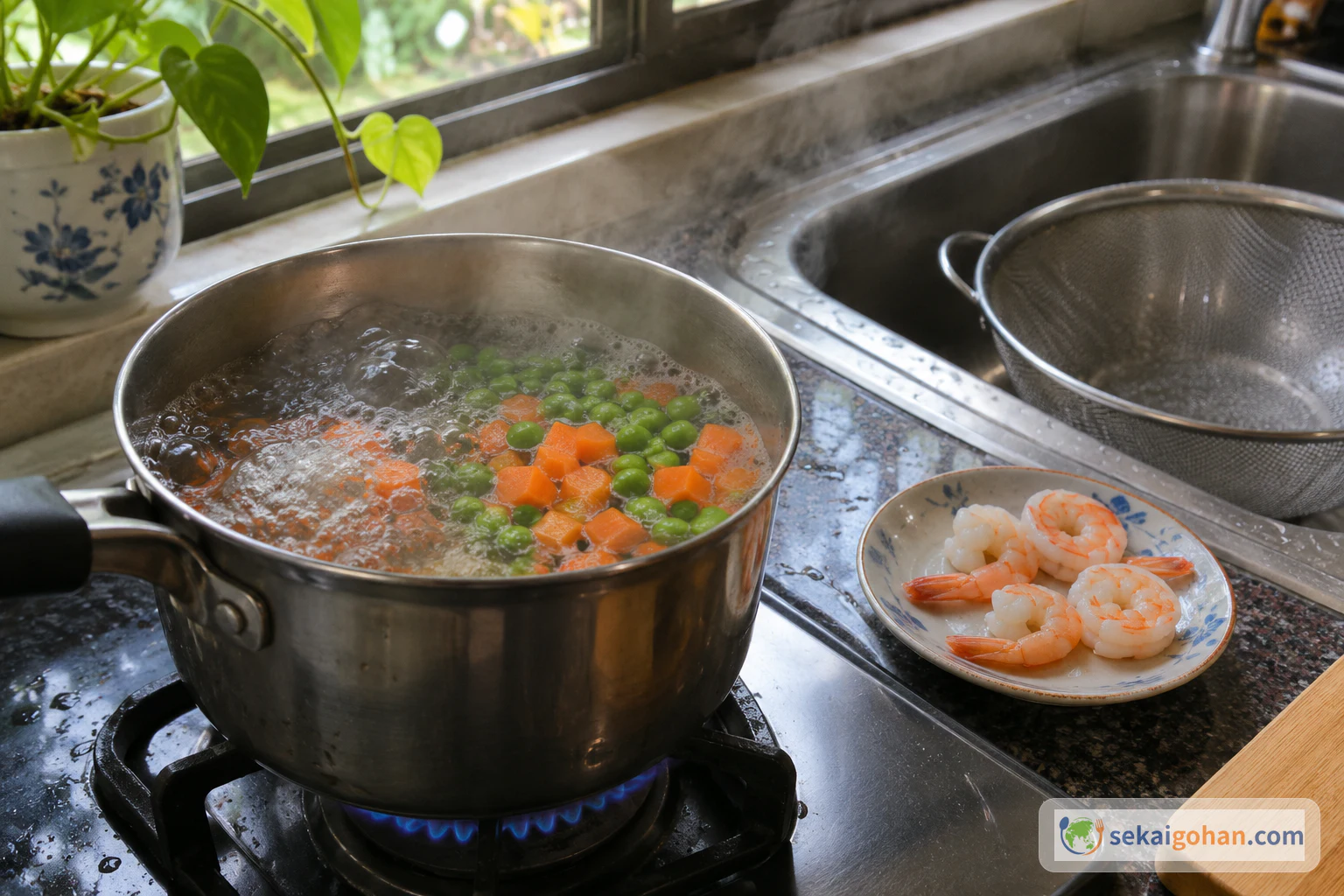
That banquet form is one end of the range. The fried rice in Cantonese restaurants, in Hong Kong and wherever Cantonese cooks went, settled on char siu and shrimp as its pair, and that is the version cooked here. Two proteins together set it apart from fried rice with a single topping. The seasoning is only salt and light soy sauce, with no dark soy, so the rice stays pale and the colors of the garnish show. The egg goes into the wok before the rice, and the vegetables and shrimp are blanched first so they spend almost no time in the wok, where they would steam the rice.
Ingredients (serves 5)
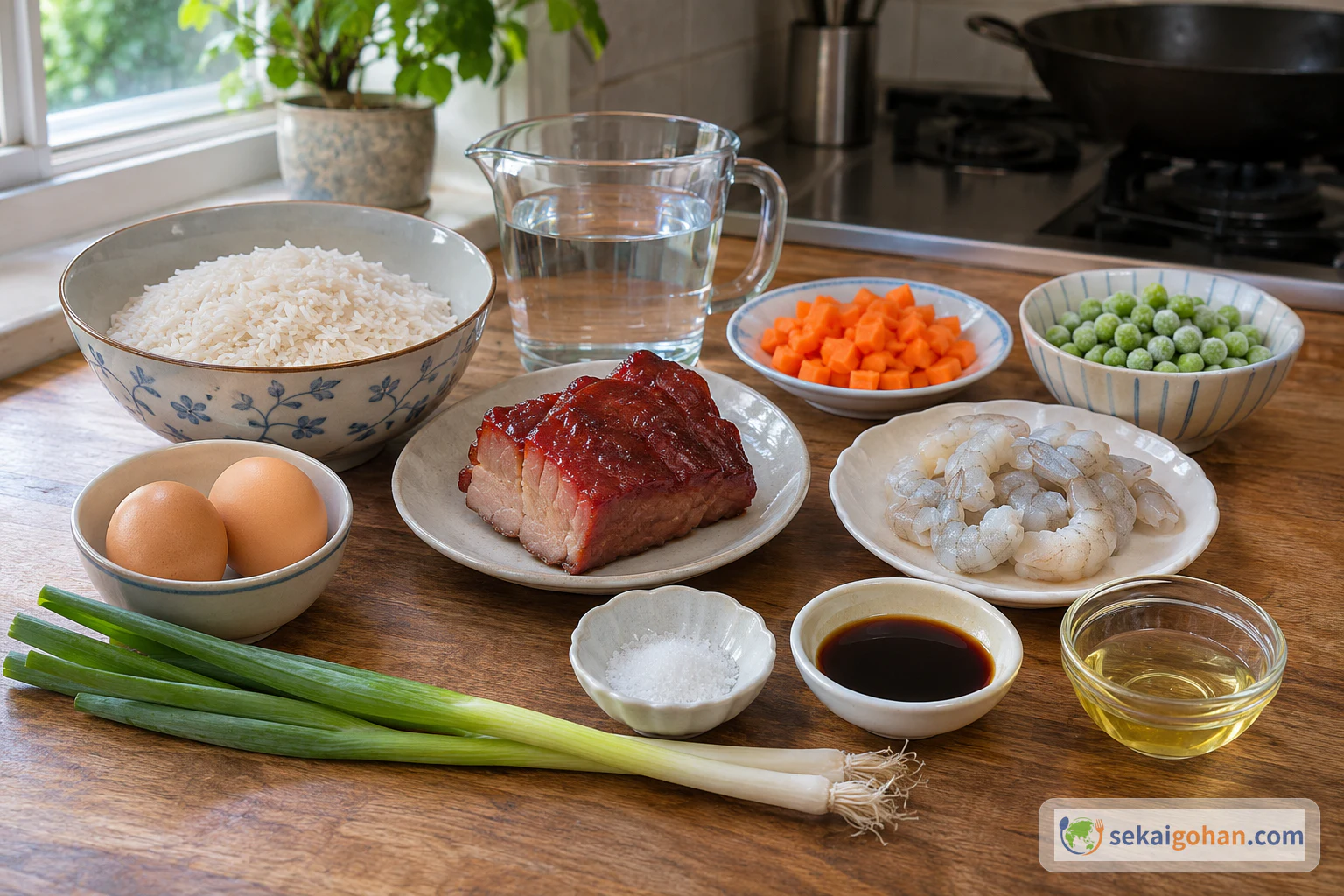
This dish contains shrimp (crustacean), egg, soy and wheat (in soy sauce) and pork. If you use ham or Spam instead of char siu, read its label for allergens and additives. Keep the pot you blanch the shrimp in away from other allergens if you are cooking for someone with allergies.
Equipment
- Rice cooker or pot with a lid
- Medium pot for blanching
- Strainer or colander
- Wok (carbon steel) or a large nonstick skillet
- Wok spatula
- Knife and cutting board
- Small bowl for the eggs
- Large serving bowl or platter
Choosing and Substituting
The rice is jasmine, cooked with less water than usual so the grains come out firm and cooked through. Short-grain Japanese rice works when you cook it firm, but it drinks water differently, so do not carry the jasmine water measure over; aim for the same firm, dry grain. Whatever rice you use, the result in the wok depends on how firm it went in.
Char siu is the protein that gives the dish its character. Buy it ready-made from a Chinese barbecue counter or a Chinese grocery, or use ham or Spam. Ham and Spam bring less sweetness and more salt, so taste before adding the last of the seasoning. Frozen peeled shrimp and frozen peas are fine. Any neutral oil works: vegetable, rice bran or peanut.
Chinese light soy sauce is the seasoning the amount is built on, and it is worth buying a bottle. Japanese soy sauces behave differently. Japanese dark soy (koikuchi) colors the rice darker. Japanese light soy (usukuchi) is saltier, so never pour in the full amount; add a little, toss, and taste.
What keeps the dish recognizable is the pair of proteins, the firm rice and the egg fried first. The banquet garnishes of the Yangzhou standard belong to a different table and are not needed here.
Method
Start the rice first; while it cooks, cut everything and blanch the garnish, so that the wok work begins with every bowl lined up beside the stove. Once the egg hits the oil, the dish moves quickly and there is no pause until it is in the serving bowl.
A home burner and wok do not have enough hot surface for five servings of rice at once. Split everything that goes into the wok in half and fry two batches, each with the same timings. The time at the stove gets longer, and each grain gets its turn against the hot metal.
Shake the blanched carrots, peas and shrimp hard in the strainer and pat them with paper towels just before they go in. Water clinging to them turns to steam in the wok and softens the rice you worked to keep firm.
The wok heats empty on high, and the oil is ready when it ripples. Keep the handle turned in, pour the egg in low and close to the surface, and keep water away from the hot oil.
When It Goes Wrong
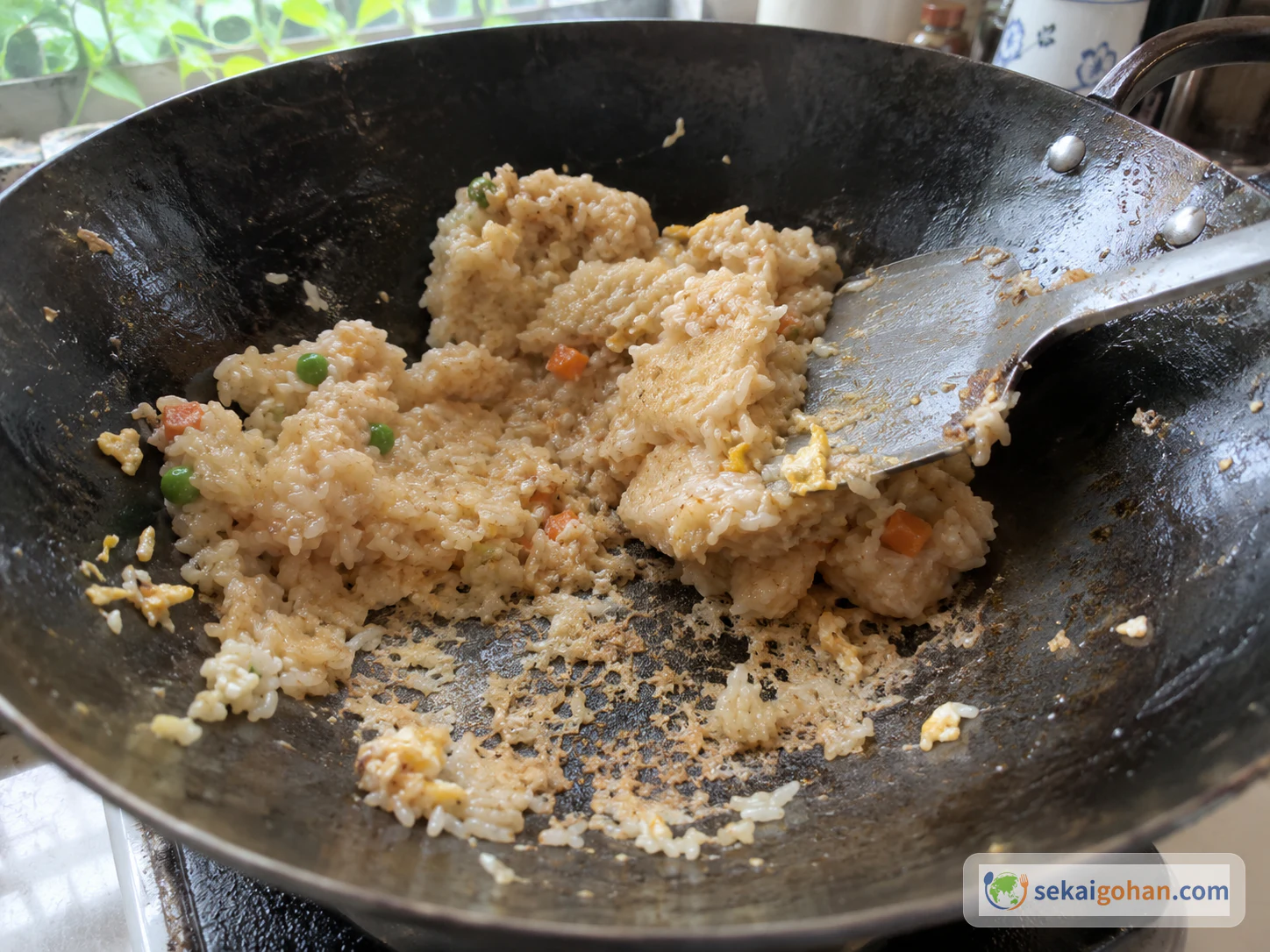
Most problems with this dish come from water and heat: too much water in the rice or the garnish, or a wok that was not hot enough when the rice went in.
| What you see | Why | What to do |
|---|---|---|
| Rice clumps into wet, sticky lumps | Too much cooking water, rice cooked too soft, or a wok that was not hot enough | Spread the rice thin on a tray to let the steam off, then fry it again in smaller amounts on high heat. Next time, cook it with the measured water or cook it the day before |
| Rice sticks to the wok | The wok went in cold, or the oil was too little | Heat the empty wok for the full minute before the oil, and wait for the oil to ripple. If it still catches, add a little oil |
| The egg disappears | The egg cooked too long before the rice, or the rice was stirred too much afterward | Add the rice within 10 to 15 seconds of the egg, then toss to break things up instead of stirring constantly |
| The rice tastes flat | Not enough salt or soy sauce | Taste and add salt or light soy a little at a time. With Japanese light soy, which is saltier, add even less at once |
| The garnish is watery | The blanched vegetables and shrimp were not drained | Drain hard in the strainer and pat dry right before they go into the wok |
| The aroma is weak | The wok was not hot, or the soy sauce landed on the cold rice | Fry on high against the wok's surface, and pour the soy around the hot edge of the wok |
Serving, Variations and Storage
Serving
This is a shared dish: one large bowl in the middle of the table, small bowls and chopsticks for everyone, and people help themselves. It also makes a meal on its own, or the closing rice course beside a main dish such as mapo tofu. Fried rice grew out of using up what was left from another meal, and it still plays that role at home.
Variations
- Ham or Spam for the char siu. The rice gets less sweet and more salty; season with a lighter hand.
- More shrimp, or none. Without shrimp the dish still works. If you cut back on the meat, use three eggs instead of two so the rice keeps its richness.
- Garden vegetables. Corn, edamame, green beans or broccoli change the colors and add crunch. Leafy greens release water and dampen the rice, so keep them out or add them at the very end.
Storage
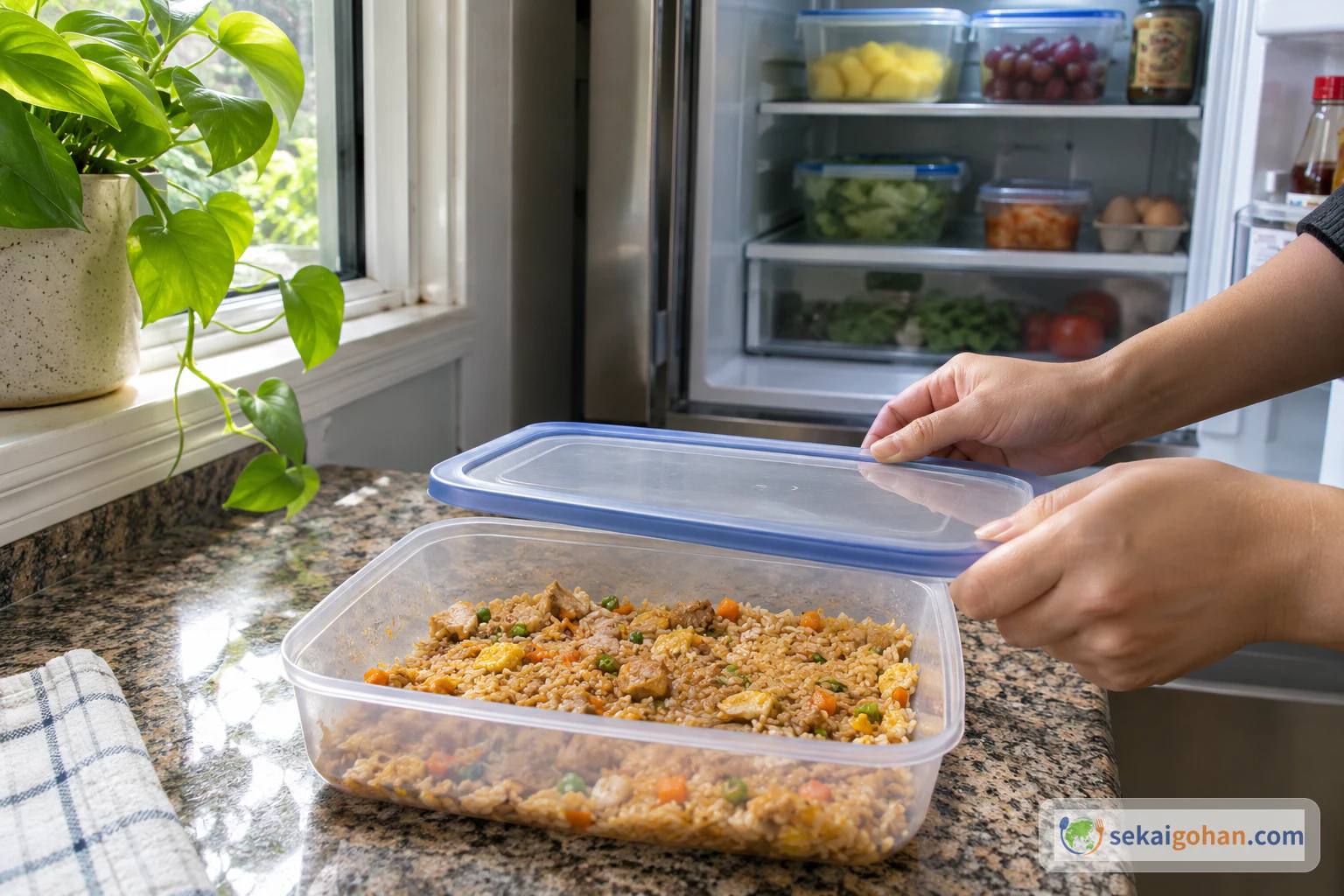
Fried rice is one of the foods behind Bacillus cereus food poisoning. The bacterium lives in soil and on rice and grain, forms heat-resistant spores that survive cooking, and as it grows in rice left warm it makes a toxin that reheating does not destroy. Do not leave cooked rice or fried rice at room temperature.
Whatever will not be eaten right away goes into the refrigerator promptly. Once the steam has died down, spread it in a shallow container, cover it, refrigerate it, and finish it by the next day. If it sat out and you are unsure how warm or how long, throw it out. Smell, appearance and taste do not tell you leftover rice is safe, and neither does reheating; when you reheat, stir-fry it in a pan or microwave it until it is hot all the way through, evenly. For a lunchbox, cool the rice thoroughly before packing and eat it the same day. These illnesses occur about as often from mid-September through October as in midsummer, so the same care holds into autumn.
Frequently asked questions
Can I use rice cooked the day before?
Yes. If your rice tends to come out soft, cook it the day before and refrigerate it overnight before frying. Fresh rice works too when it is cooked with a short measure of water. Never use rice that is too old, or rice that smells off, feels slimy or pulls into strings.
Is the 2-cup rice measure the same as my rice cooker's cup?
No. The cups in this recipe are US cups of 240 ml. A Japanese rice-cooker cup (one gō) holds 180 ml, so the rice here comes to about 2.7 rice-cooker cups. Measure with a US cup or by milliliters to keep the rice-to-water balance right.
Can I fry the rice first and add the egg later?
Some cooks fry the rice first, push it aside and scramble the egg in the empty space. Both orders make good fried rice. Pick one and stick with it; frying the egg first, as here, leaves pieces of soft egg through the rice.
Do I need a wok?
A wok heats the rice faster and makes it easier to keep the grains separate, and its sloped sides let you push the rice up and out of the way for the char siu. A large nonstick skillet also works. Carbon steel and cast iron pans need enough oil and some practice before rice stops sticking.